



Some hairstyles look neat from the front and refuse to cooperate everywhere else. Bantu knots with bangs are not that kind. They can read polished, playful, sharp, or soft depending on how you shape the front, how big you make the knots, and whether the bang sits blunt, swept, curled, or braided.
The bang piece matters more than people think. A narrow front section with a hard line gives a different mood than a fluffy curl that brushes the brows. A deep side part can take the style from cute to dramatic in one move. And if you’ve ever wondered whether you need to cut your hair for that fringe effect, the answer is no. A lot of the best looks use a temporary bang section, which is one reason people keep coming back to this style.
There’s also a practical side to it. Good Bantu knots start with clean sections, enough moisture, and tension that is firm without being mean to your scalp. If the roots feel pinched, the sections are too tight. If the front keeps puffing up, the bang section probably needs more hold or a better base.
The fun part is how much range you get from the same basic idea. Some versions look dressy enough for a wedding. Some are the kind of style you throw on with hoop earrings and a glossy lip and suddenly you look like you planned your whole day. And some just feel good because they keep the hair tucked, shaped, and out of your face while still giving you something interesting to look at.
1. Center-Part Classic Bantu Knots With Blunt Fringe
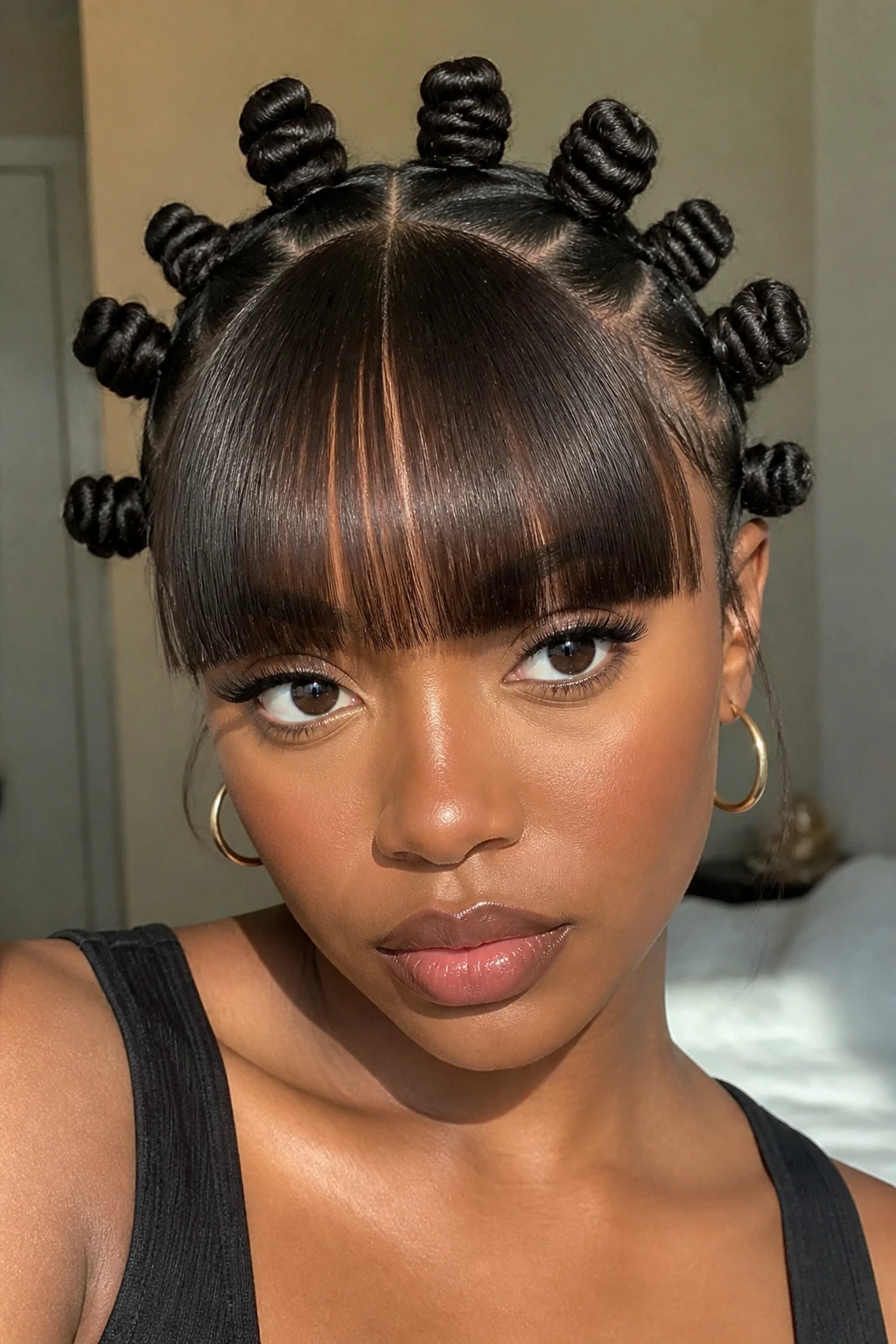
A center part gives Bantu knots a clean spine, and the blunt fringe brings the whole style into focus. The look is simple on paper, but it has a crisp, almost graphic feel once the knots are set. Keep the front section about 2 to 3 inches deep so the bangs have enough weight to sit forward instead of splitting into loose pieces.
This version works best when the hair is stretched first. Blow-drying on low heat or doing a good braid-out the day before makes the knots smoother and gives the front a neater finish. A tiny bit of edge control at the roots helps the center part stay sharp, but don’t drown it. Too much product makes the front look greasy, and that is a fast way to ruin an otherwise clean style.
The blunt bang doesn’t have to be cut blunt. You can shape it with twists, flexi rods, or a flat-ironed front section tucked under at the ends. What matters is the line across the forehead. Straight. Intentional. A little severe, in a good way.
Best for: people who like symmetry, clean parts, and a face-framing style that doesn’t wander around by midafternoon.
2. Side-Swept Bangs With Small Crown Knots
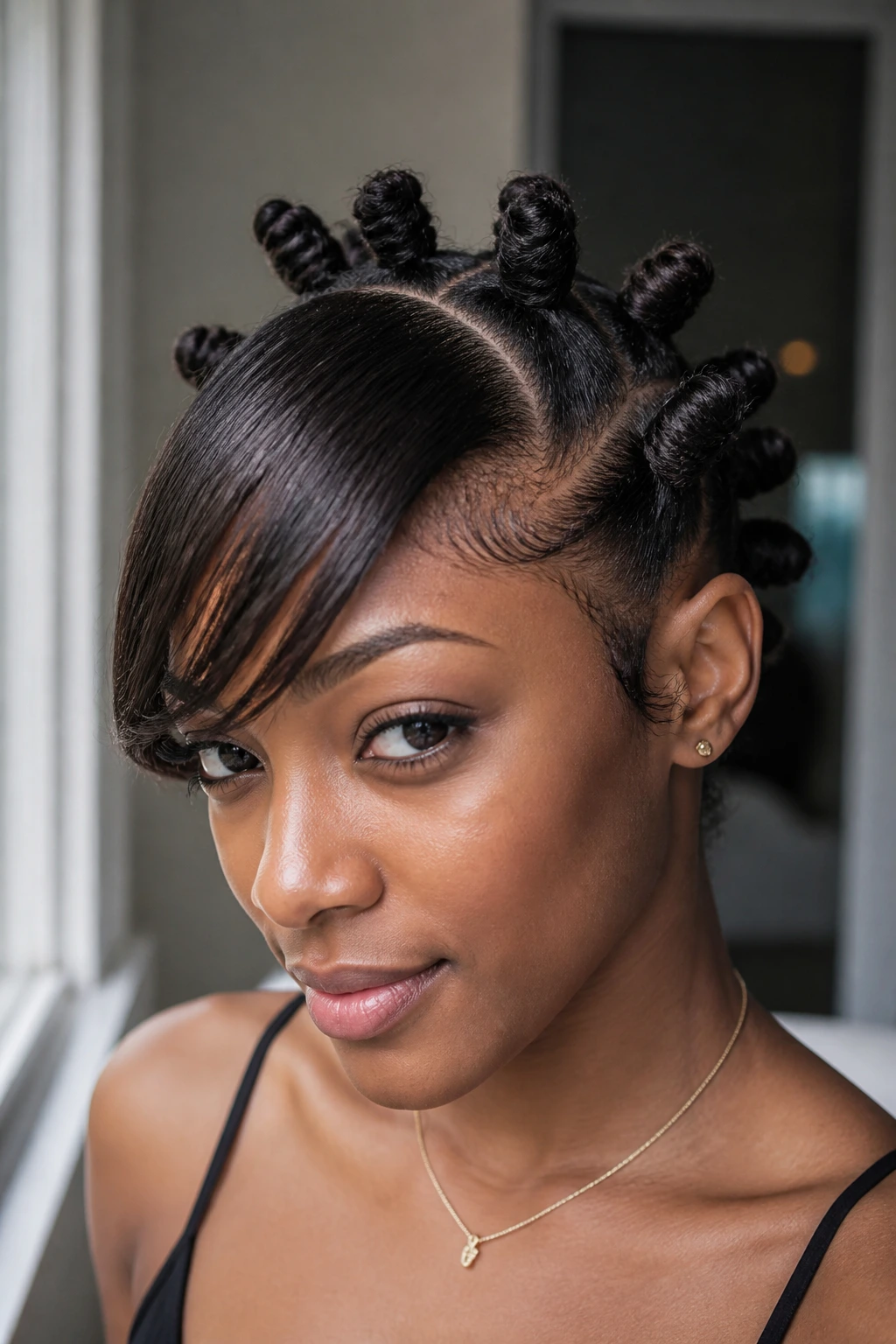
Why do side-swept bangs work so well with Bantu knots? Because they soften the whole silhouette without making the style look loose. A deep side part pulls the eye diagonally, and that one move changes the balance of the knots around it. Small crown knots keep the top light enough that the fringe can do its job.
What Makes It Different
The bangs are the star here, not the knots. Let the front section fall across the forehead in a gentle arc, then pin or twist the ends so they stay in place. If you want a softer finish, leave a few curls or coil ends out so the bang doesn’t look too stiff. That little bit of movement matters.
Small knots around the crown also make this style easier to wear under hats or headwraps. The profile stays neat. The bang adds just enough drama to keep it from feeling plain.
- Deep side part for a longer line across the face
- Small, even knots at the crown for a lighter top
- Front section shaped with a twist, curl set, or finger coil
- Works nicely on oval and heart-shaped faces
Tip: if your fringe keeps splitting, set it with a satin scarf for 10 to 15 minutes while the hair is still slightly damp.
3. Jumbo Knots and Curly Leave-Out Bangs
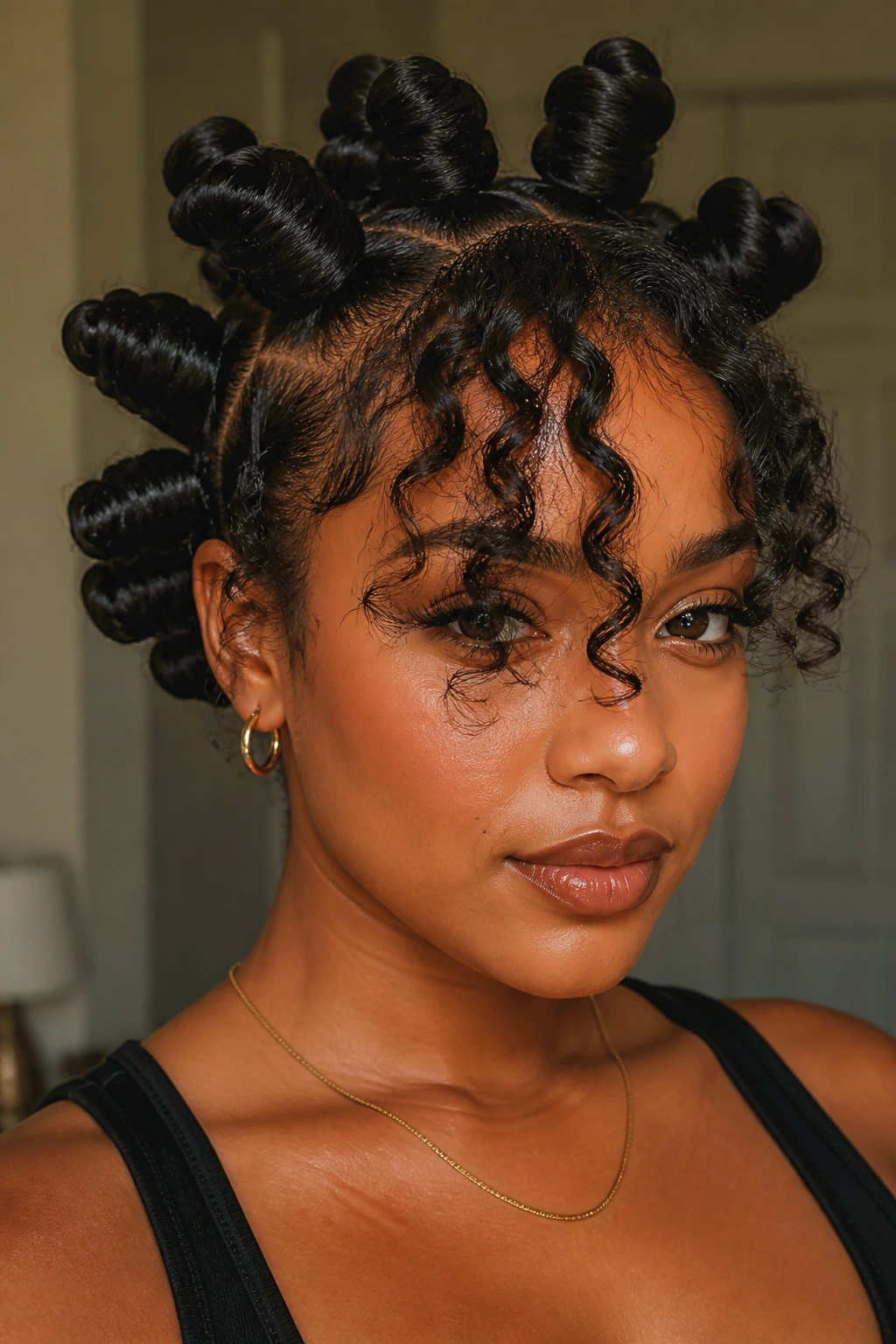
Jumbo knots bring the volume, and the curly bang keeps the style from looking too heavy. This is one of those looks that reads bold the second you walk in a room. The bigger knots create shape fast, which is useful if you want the style to feel full without spending half your morning sectioning tiny parts.
The bang should be soft and springy, not stiff. Flexi rods, perm rods, or a simple twist set on the front section can give you that rounded curl pattern. Leave the ends a little loose and separate them with oiled fingers once they’re dry. That keeps the fringe from turning into a single hard tube.
This style is also forgiving if your hair has different textures in different spots. The knots hide a lot. The curls in front draw attention upward. And because the bangs are curly instead of flat, the whole look feels less controlled in a nice way — like you meant to look this easy, even if you spent forty minutes getting there.
If your hair is fine, don’t make the knots oversized to the point where they sag. Heavy knots droop. Fast.
4. Mini Bantu Knots With Baby Bangs
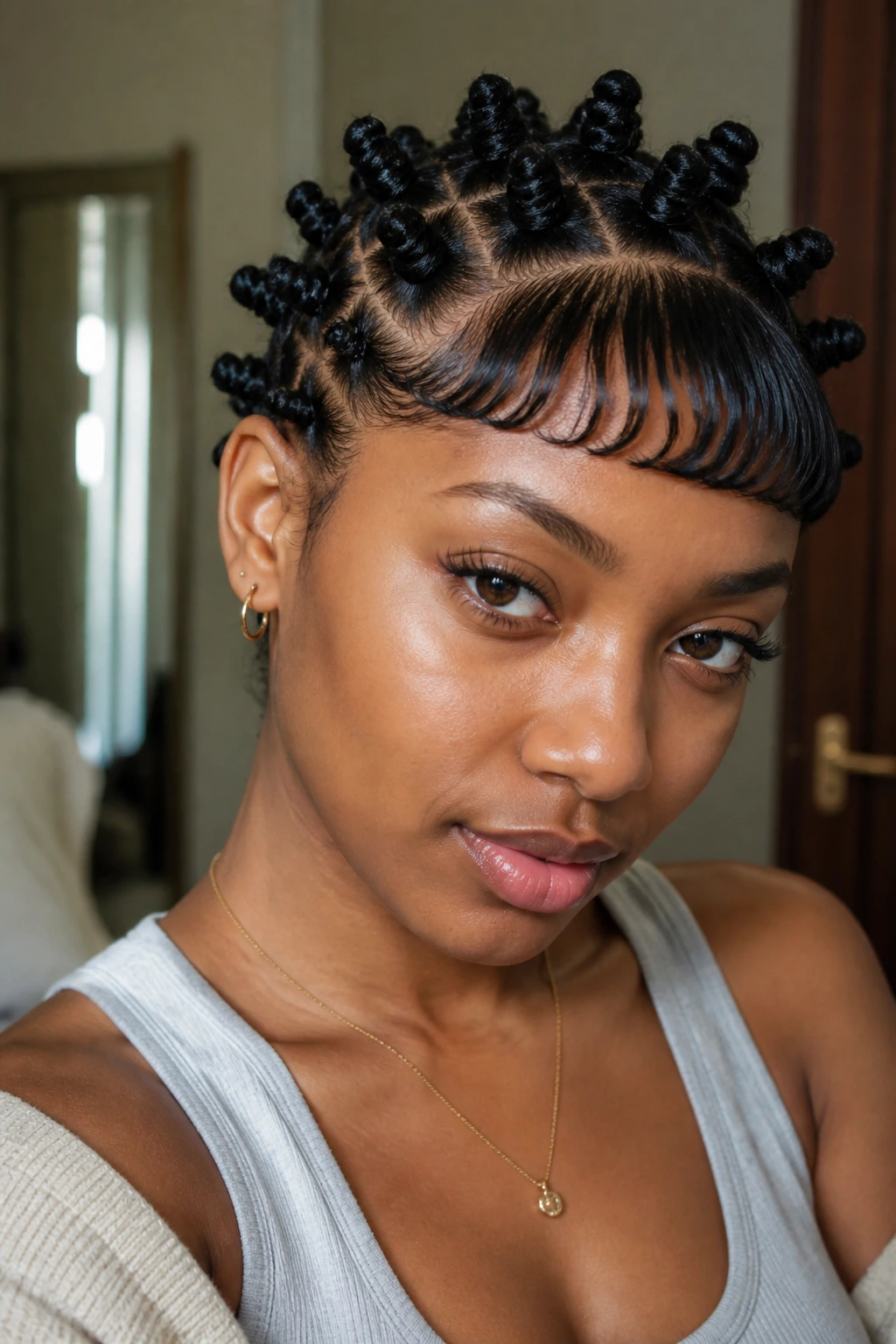
Mini Bantu knots are for people who don’t mind detail work. There’s more sectioning, more twisting, more time, and more payoff. The result looks intricate from across the room and almost jewel-like up close. Baby bangs keep the front light so the style doesn’t tip into costume territory.
The bang section here should stay short and precise. Think of it as a narrow strip just above the brows, shaped into tiny coils or a blunt little row of twists. A little gel at the roots helps the front sit flat, but the ends should still have some movement. Too much product turns the whole thing into a stiff helmet. Nobody wants that.
A Small Style With a Lot Going On
Mini knots are a good choice if you like styles that last because there are so many sections holding the shape. They also let you tuck away shorter strands neatly. The baby bangs give you a bit of softness, which keeps the overall effect from feeling too severe.
- Best on stretched natural hair or a lightly blown-out base
- Works well with tiny parts and a rat-tail comb
- Use a light foam or setting lotion on the front
- Great if you want the knots to stay compact for several days
Note: if your scalp gets sore fast, make the sections slightly larger. Tiny does not have to mean tight.
5. Half-Up Halo Knots With Soft Fringe
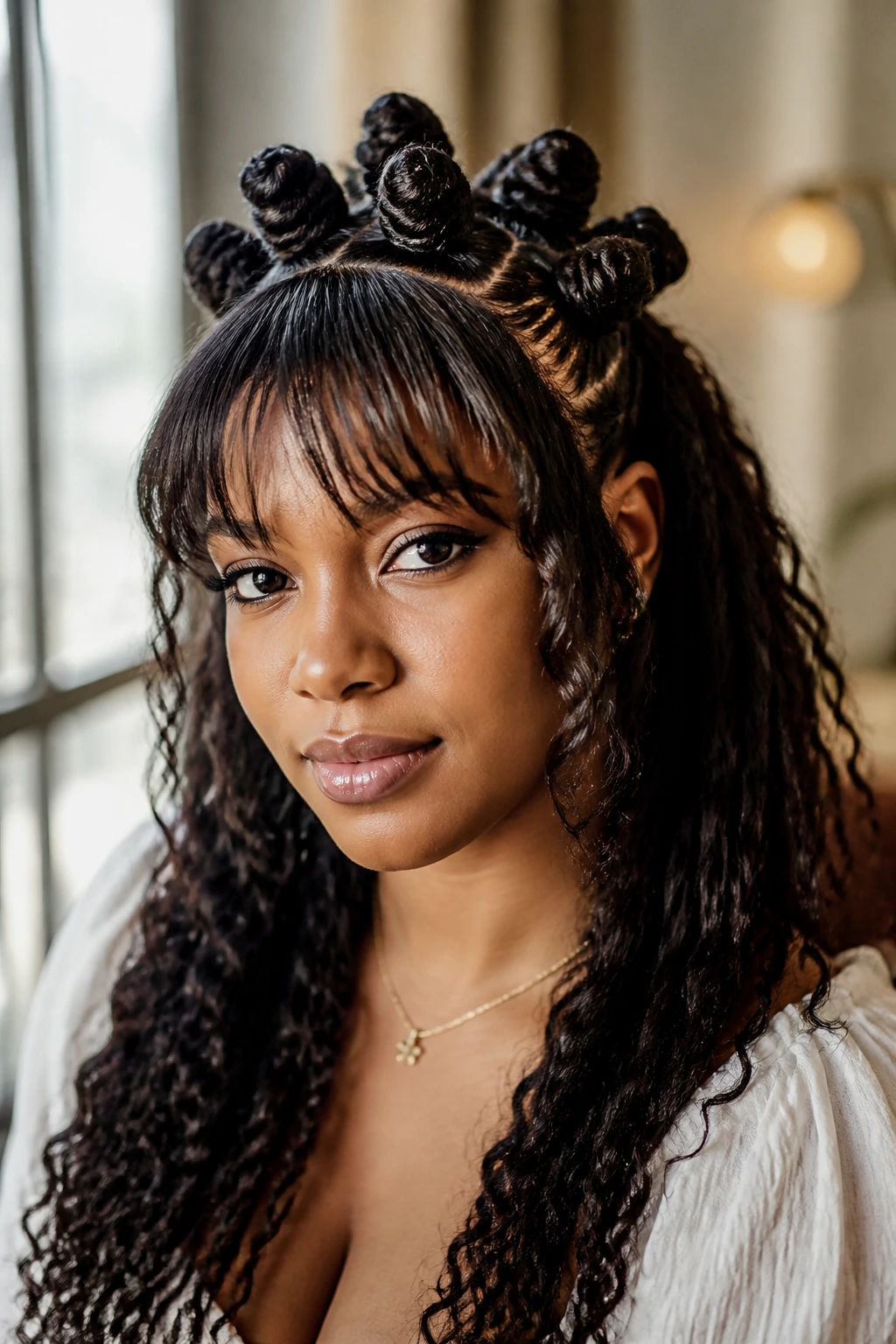
A half-up halo arrangement gives you room to breathe. The top section is knotted, while the lower hair stays down, braided, twisted, or left in defined curls. That mix gives the style a little softness around the neck and shoulders, which is useful if you do not want your whole head pinned up.
The fringe should be soft enough to bridge the two textures. A side-swept bang or a loose front curl works better here than a hard blunt line. You want the front to feel like it belongs to the rest of the style, not like it was added as an afterthought.
This is one of the easiest Bantu knot styles with bangs to dress up. The upper knots create height, the loose hair adds movement, and the fringe keeps the face from looking too open. It’s a good option for long earrings, off-the-shoulder tops, or any setting where you want a little shape without going full sculptural.
A satin scrunchie or discreet pin at the back helps the half-up section stay anchored. The rest is about balance.
6. Zigzag-Part Bantu Knots With Feathered Bangs
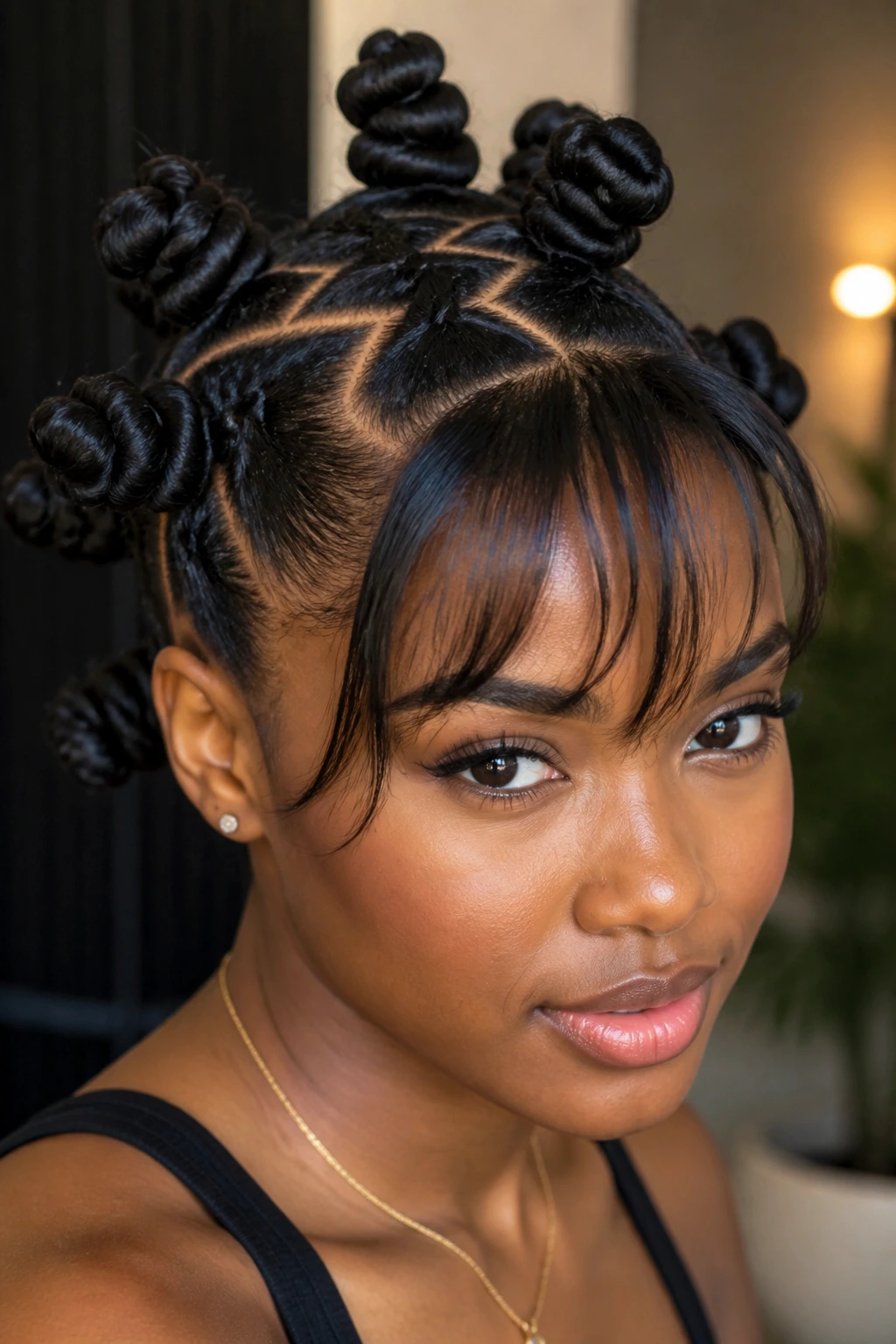
A zigzag part wakes the whole style up. Straight parts are neat, sure, but zigzags add energy before the knots even begin. That matters when you want the hair to look playful instead of formal. Feathered bangs keep the front from feeling too rigid, which fits the slightly broken-up parting.
Why It Works
The zigzag lines draw the eye around the head instead of straight across it. That makes the knots feel more dynamic. Feathered bangs then soften the edge at the forehead so the style doesn’t look too sharp. It is a nice contrast — crisp parts, soft front.
The bang itself can be created with a light twist-out or a few tiny braids undone after drying. Separate the curls gently. You want a few pieces to fall forward, but not in a messy way. Think light and airy, not unplanned.
This style is especially good if you like a little visual movement in your hair but still want the structure of Bantu knots. It photographs with a lot of detail, and the zigzag sectioning gives you something interesting even when the bangs are tucked back.
Tip: if your hair is very thick, make the zigzags broader. Tiny zigzags on dense hair can turn into a battle.
7. Asymmetrical Knots With Deep Side Bangs
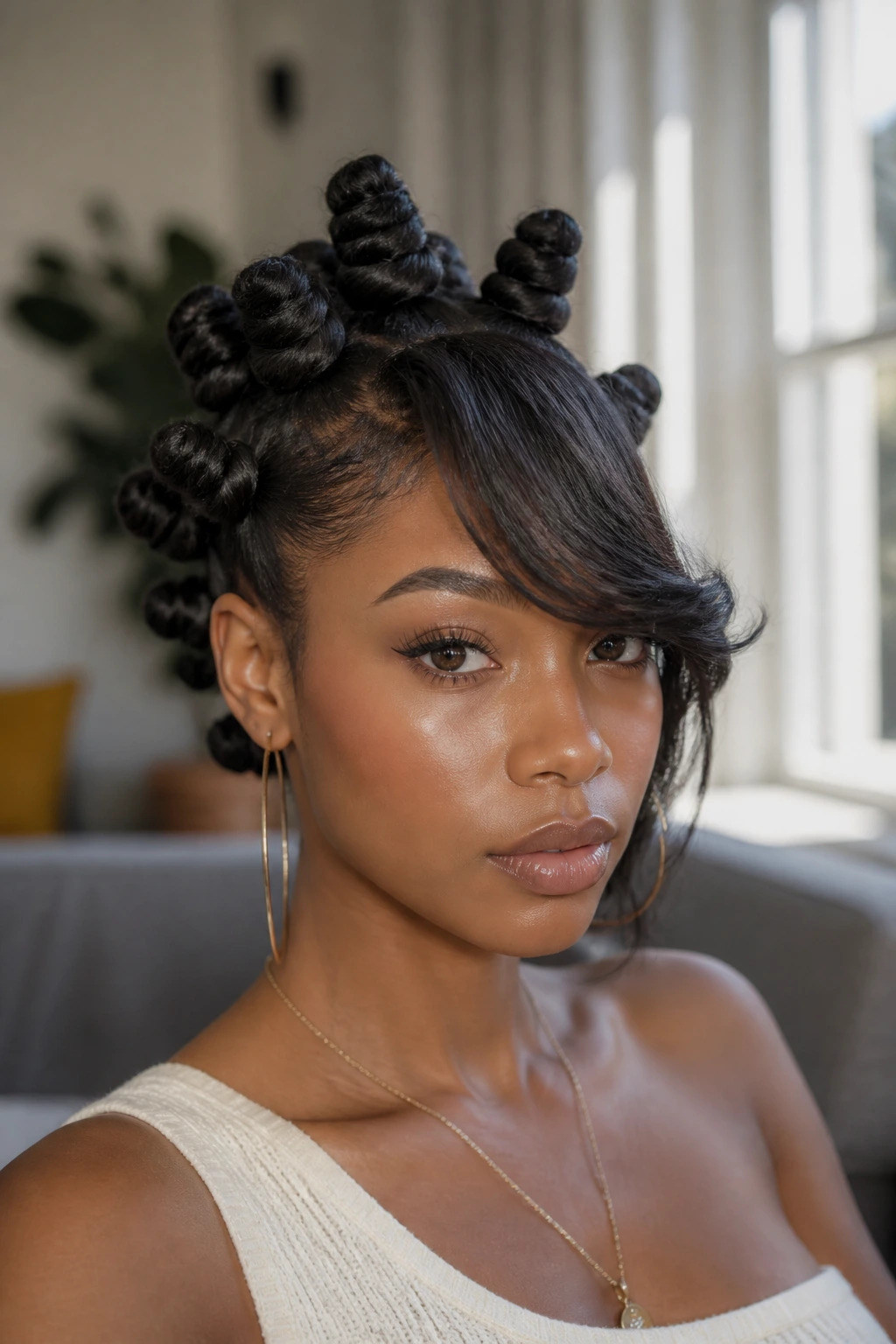
Asymmetry gives Bantu knots a sharper personality. One side sits fuller, the other stays cleaner, and the deep side bangs pull everything into a single direction. The effect is strong. Not loud for the sake of it, just unmistakable.
The key is not to make both sides compete. Let the heavier side carry more knots or larger sections, then keep the opposite side leaner. The bang should sweep from the fuller side toward the slimmer one, creating a long line across the face. That line does a lot of work. It lengthens the face, cuts down bulk, and gives the whole look a little edge.
This style works well when you want the knots to feel editorial but still wearable. It can go casual with a T-shirt and big earrings, or it can look polished with a blazer and a clean neckline. The asymmetry does the styling for you.
A wide-tooth comb and a dab of styling cream at the roots will keep the side bang smoother. If it keeps puffing up, pin the underside while it sets.
8. Sleek Low Knot Rows With Straight-Across Bangs
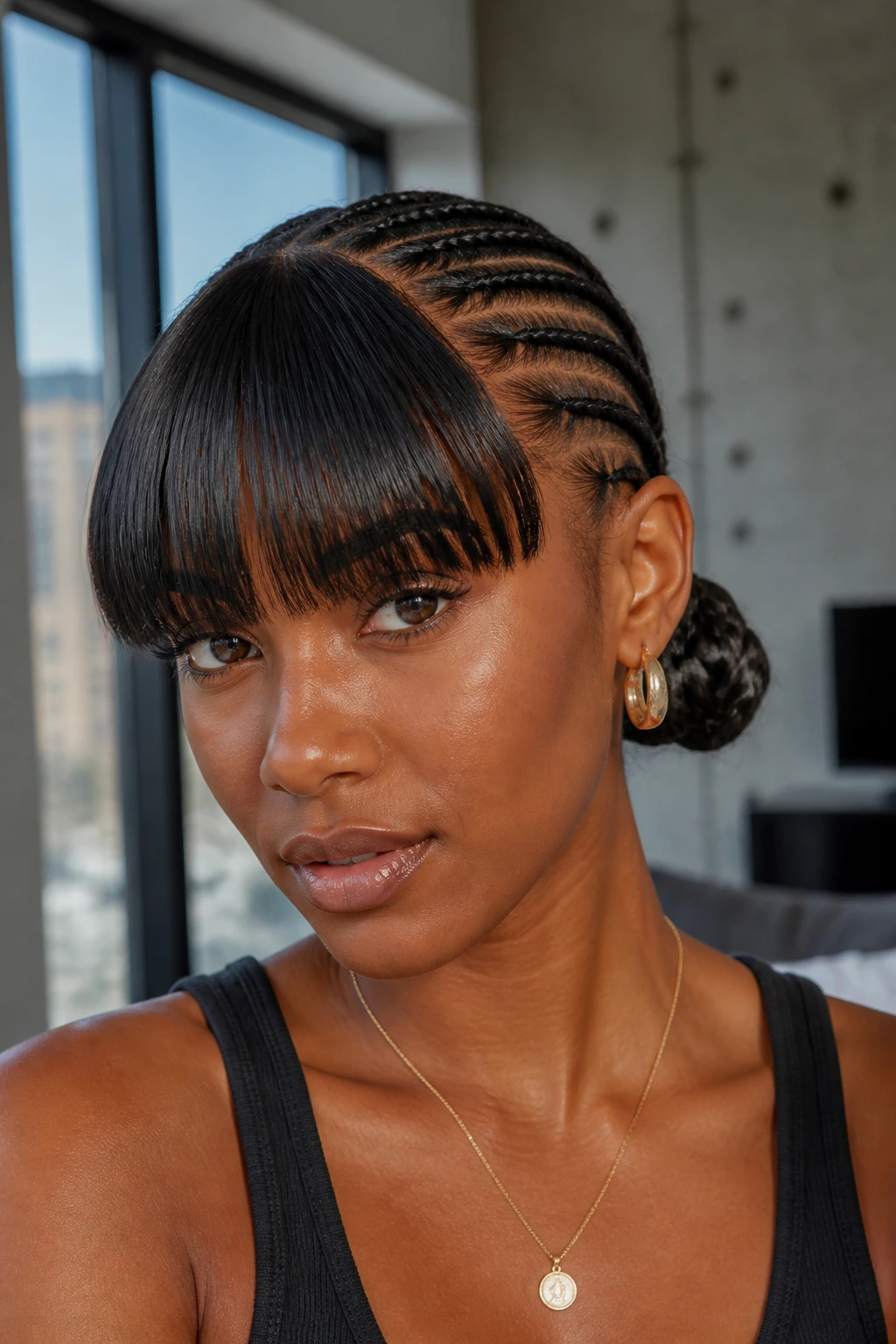
Low knot rows have a calmer mood than high or all-over knot layouts. They sit closer to the nape and sides, which makes the silhouette feel grounded. Add straight-across bangs, and the style turns neat in a hurry.
This one is a good fit when you want polish without a stiff updo. The low placement keeps the profile smooth, and the bang gives the face enough framing to stop the style from feeling severe. If your hair is long, the low rows also help manage bulk. If it’s shorter, they can create the illusion of a more elongated shape.
Use a firm base at the roots, then keep the knots compact. The bang should sit just above or at the brows. If it gets too long, the look starts to lean curtain instead of straight-across, and the whole point is lost. You want a clean bar of hair over the forehead, not a drape.
This is the kind of style that looks expensive even when it isn’t. The trick is control. Smooth roots. Even rows. No fuzzy edges where the bangs meet the knots.
9. Triangle-Part Knots With Face-Framing Twists
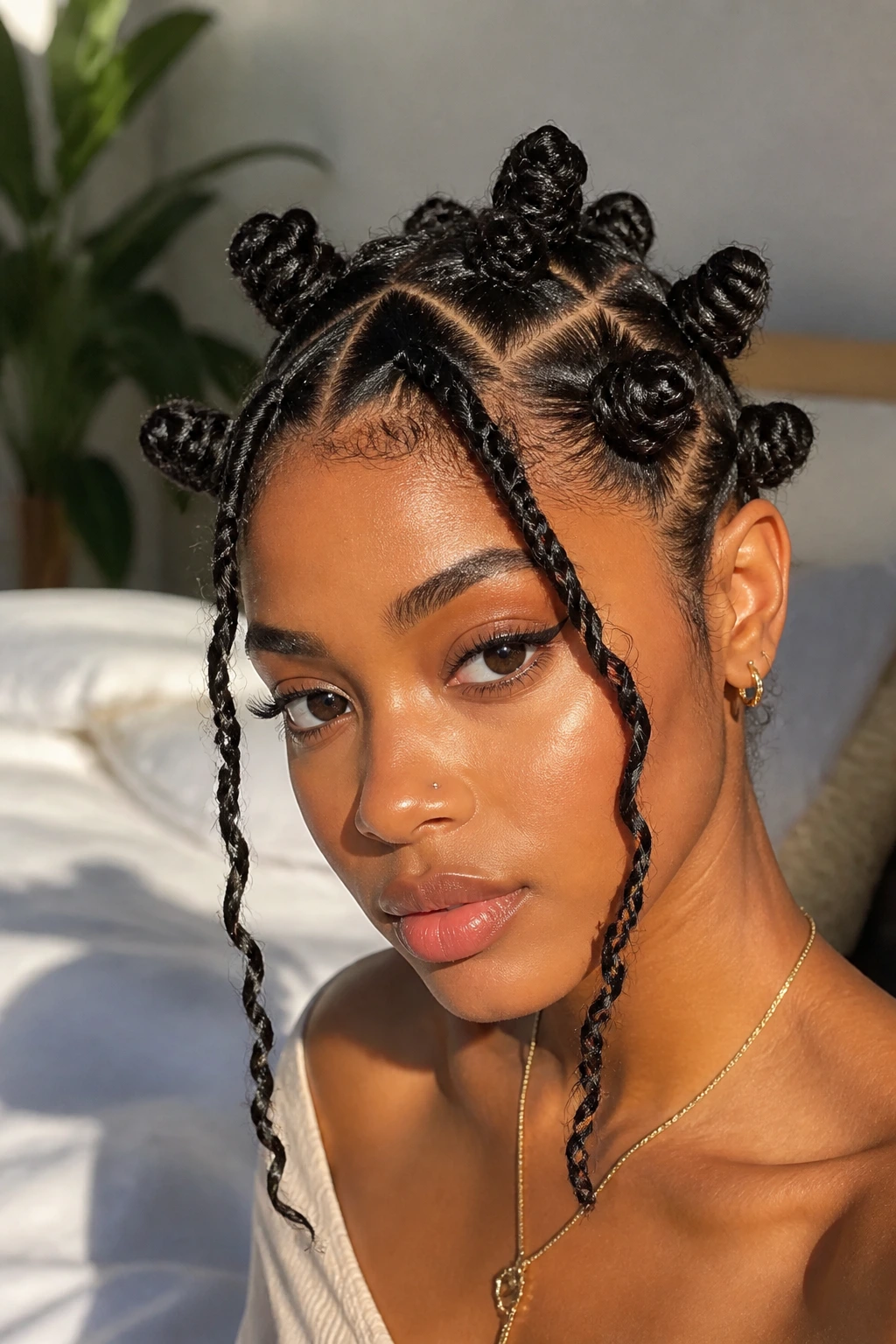
Triangle parts give the scalp a very different texture. They break up the usual grid and make each knot feel a little more deliberate. Add face-framing twists in place of a hard bang, and you get a style that feels softer without losing shape.
The Shape Story
Triangle parts naturally make the style feel more handmade, which I like. The geometry is visible but not too neat. The face-framing twists can be left slightly longer, then curled at the ends so they hang near the cheekbones. That makes the front look less like a fringe and more like a careful frame.
This version is especially kind to rounder faces, because the diagonal lines and side pieces create length without trying too hard. It also works well if you hate the feeling of hair sitting straight across your forehead. Some people love bangs. Some people just tolerate them. This is the middle ground.
- Triangle sections keep the roots interesting
- Two or three front twists soften the forehead area
- Ends can be curled under or left loose
- A light mousse helps the front stay defined
Small warning: triangle parts take more time than square parts. They are worth it if you care about detail.
10. Knot Mohawk With Tapered Bangs
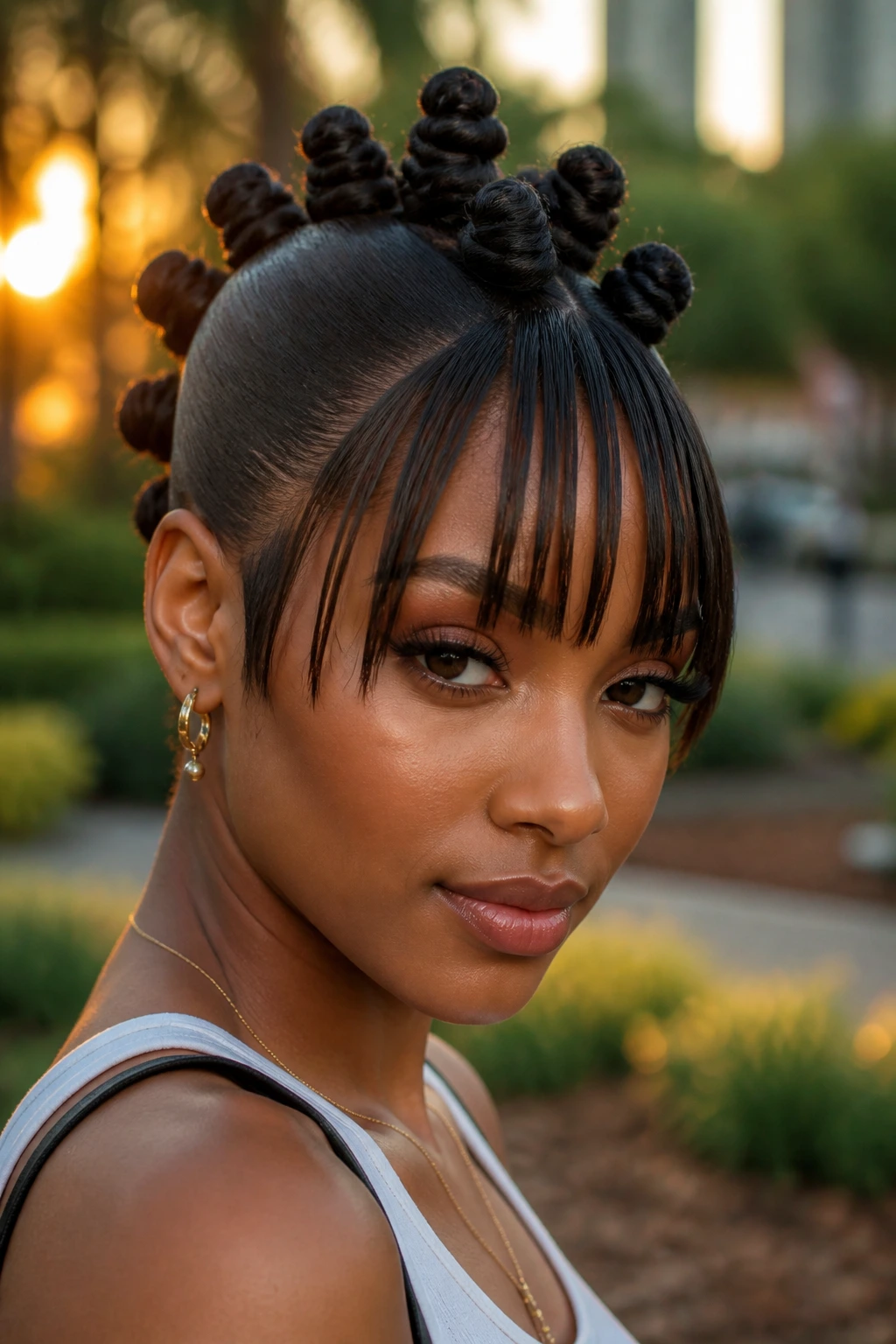
A knot mohawk has attitude from the start. The sides are flattened, braided, or slicked down, and the knots run in a center strip from front to back. Tapered bangs make the front feel finished instead of bluntly spiky.
The taper matters. A narrow front section that narrows as it reaches the temples helps the whole style feel intentional. You can shape it with a twist-out, a curled front piece, or a pin-under technique that keeps the ends tucked. The point is to create a front that narrows toward the sides, matching the mohawk shape.
This style looks especially good on hair that can hold a strong root. If the sides are too puffy, the mohawk loses its line. Keep the roots sleek and the knots firm. A little shine on the sides is fine. A greasy finish is not.
It’s a good choice when you want the face to look open but still framed. The tapered bang gives the top more presence without blocking the forehead completely.
11. Braided Bangs and Bantu Knots Combo
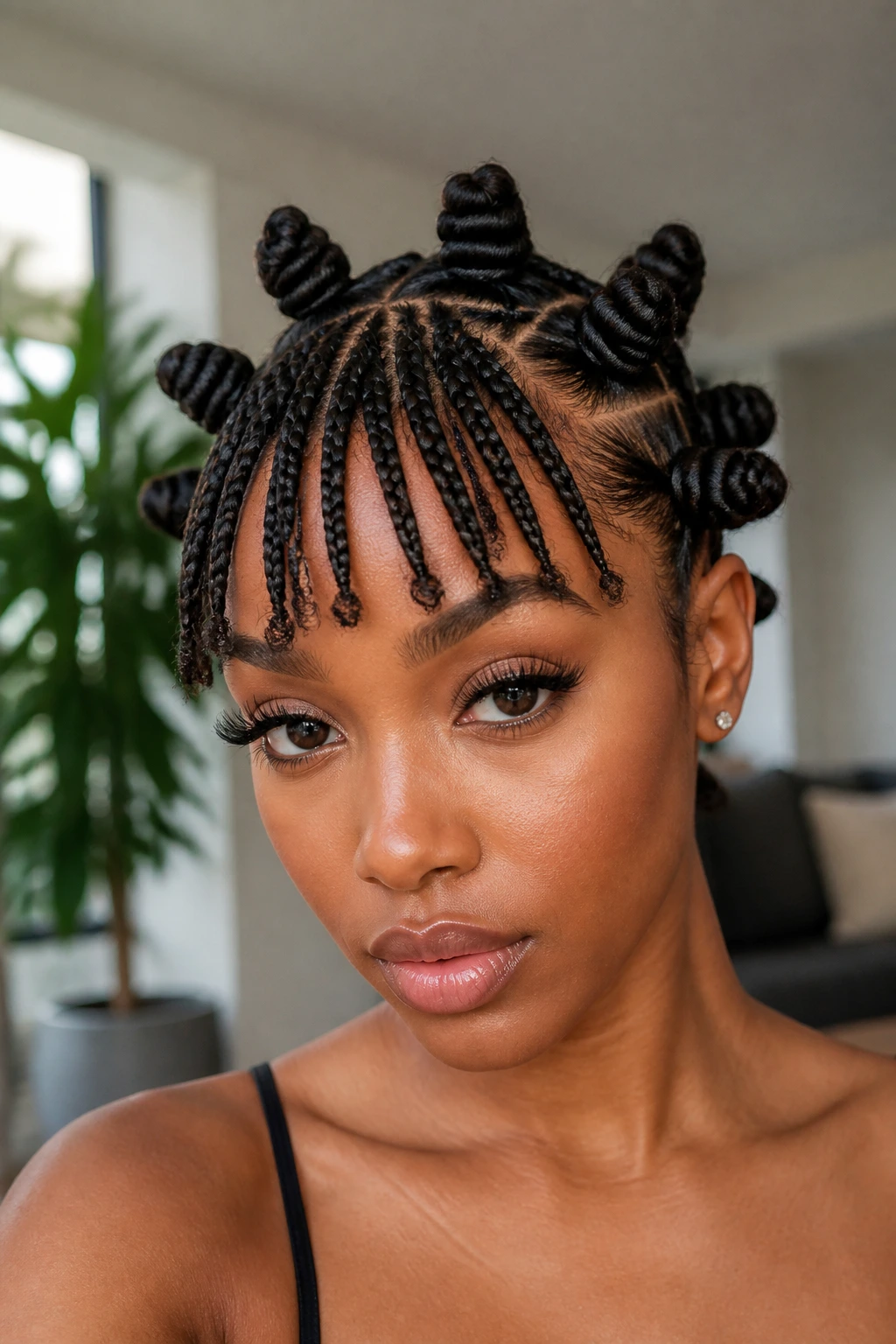
Braided bangs give Bantu knots a more controlled front, which is handy if your hair is prone to frizz or if you want the style to last a little longer before the front starts shifting. The contrast is what makes it interesting: tight braid pattern up front, rounded knots through the rest of the head.
Unlike loose bangs, braided bangs do not need daily reshaping. That alone makes them worth the effort. They also work nicely with medium to long hair, since the braid can be fed into itself or pinned off to one side once it reaches the desired length. A small braid can sit flat and still frame the face.
This combo feels practical, but it does not look plain. You get texture from the braids and shape from the knots. If you want to soften the edges, leave one braid slightly longer on each side. That gives a hint of curtain effect without giving up structure.
Good fit for: hot days, long events, and anyone who wants the front to stay put.
12. Chunky Knots With Long Curly Bangs
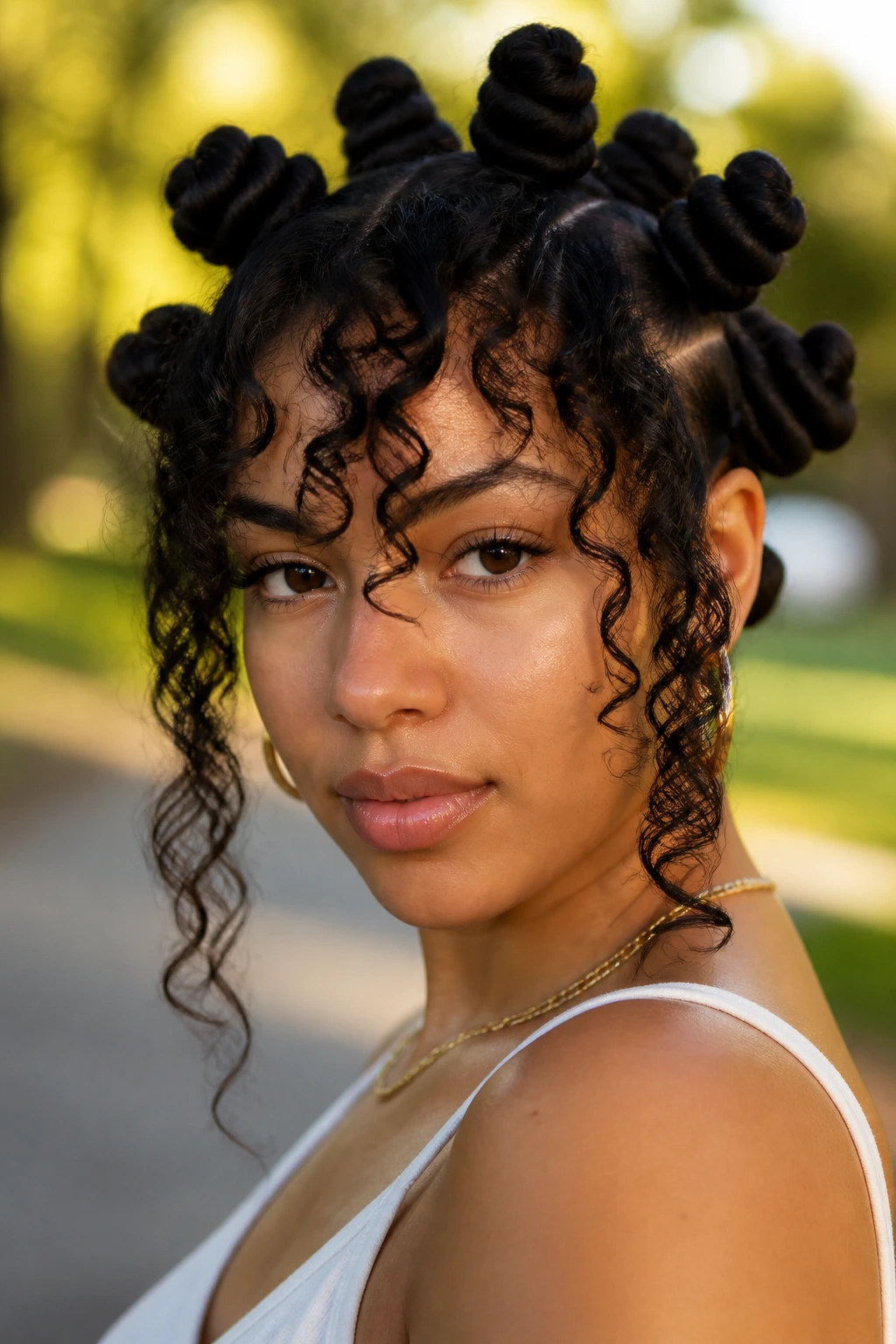
Chunky knots are generous. They take up space, they look plush, and they give the style a warm, rounded shape. Long curly bangs keep the front from looking too heavy. The contrast is what makes the style sing — big knots, soft fringe.
A longer bang works well here because it echoes the size of the knots instead of fighting them. Set the front on rods, a braid-out, or two-strand twists that are unraveled once dry. Let the curls fall toward the cheekbones or just past them. That little bit of length makes the style feel less boxed in.
This is one of those looks that needs balance. If the knots are large and the bangs are short, the face can look too exposed. If the bangs are long and the knots are huge, the whole head can feel crowded. Split the difference. That’s the sweet spot.
Chunky knots also tend to work well on hair that has some density, because they hold their shape without disappearing. If your strands are finer, use a bit of extension hair or keep the knots a touch smaller so they do not collapse.
13. Knot Crown With Wispy Fringe
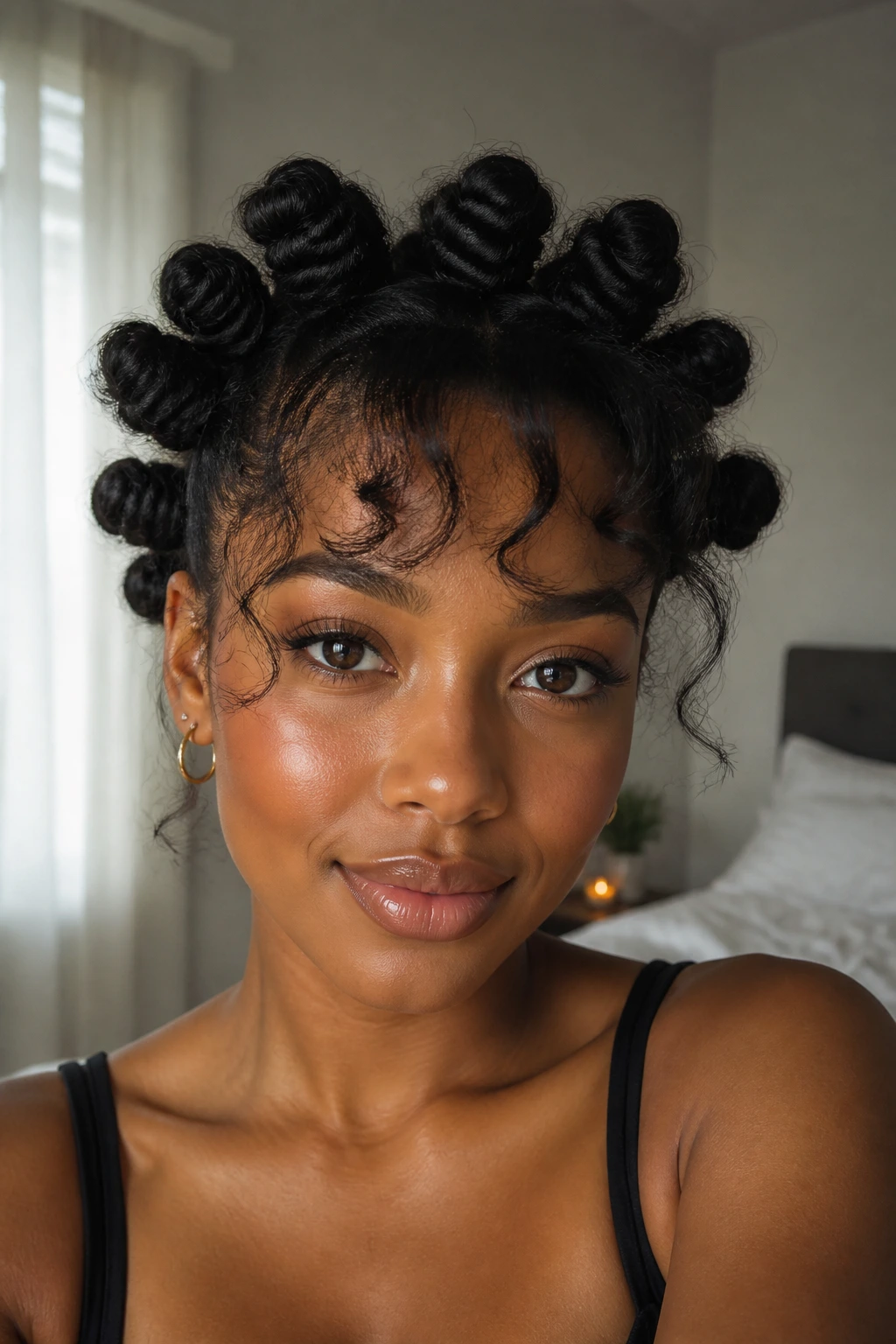
A knot crown wraps around the head like a halo, and the wispy fringe stops it from feeling too formal. There’s something nice about a style that sits high but still leaves a little softness near the eyes. It keeps the whole thing from reading as severe.
What to Watch For
The fringe should be airy, not dense. A few fine pieces across the forehead are enough. If you make the bang too thick, it fights the crown shape and starts to look boxy. Wispy bangs work best when the ends are lightly separated and the roots are smooth.
This style can be built with medium-sized knots arranged in a circle or arc. The crown effect gives height, which is handy if you want to lengthen the face or show off earrings and necklines. It also works well with dresses and structured tops, since the hair sits away from the shoulders.
- Keep the bangs thin and light
- Use a smoothing cream at the roots
- Let the crown knots sit evenly spaced
- A soft hold spray can tame flyaways without flattening the shape
Opinion: this one looks best when it is not overstyled. If it feels a little airy, you are on the right track.
14. High Ponytail Base With Knotted Top and Bangs
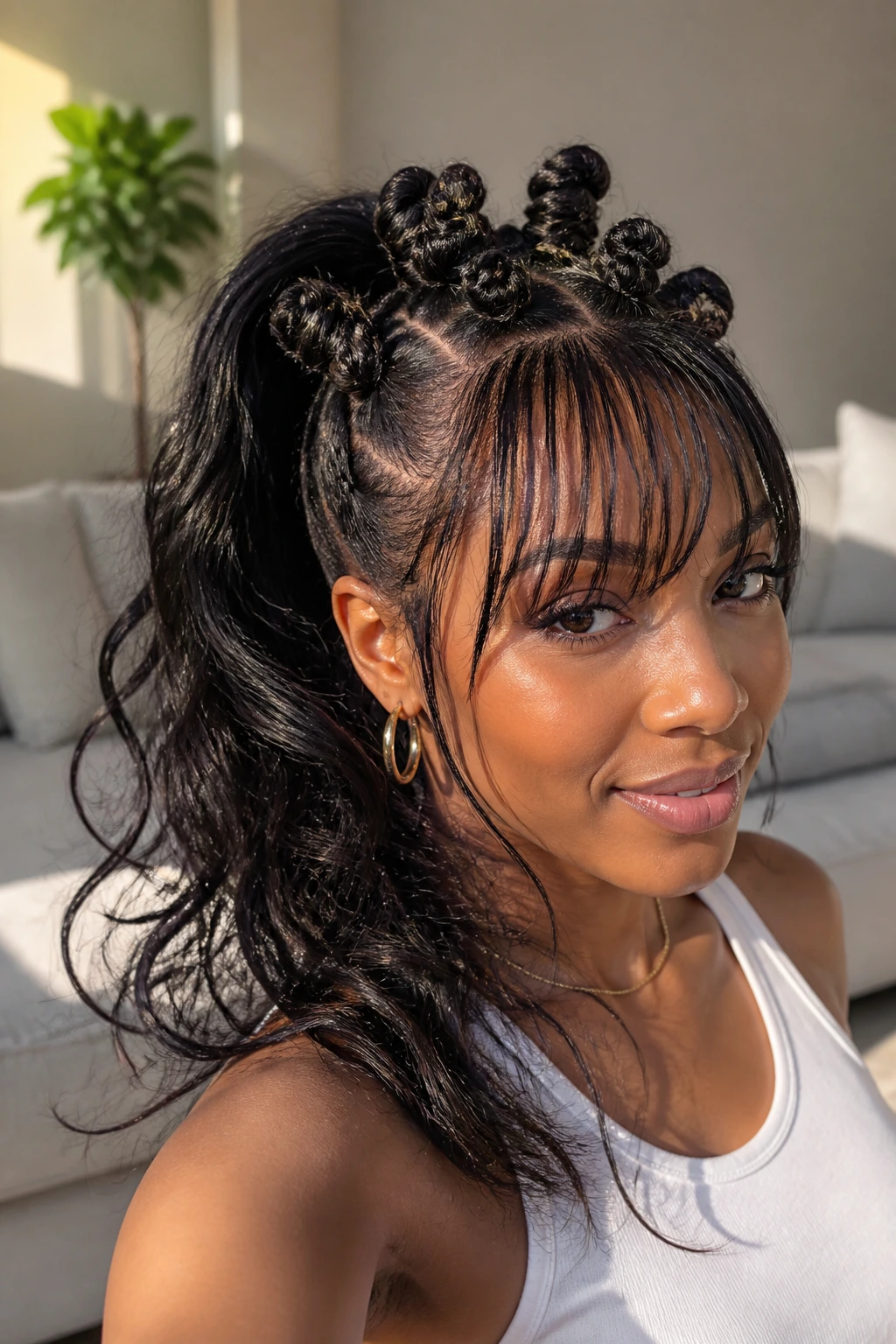
A high ponytail base gives the style a lift before the knots even begin. The hair is pulled upward, then shaped into knots on top, which creates height and keeps the neck clear. Add bangs, and the whole look gets a playful swing.
This is the style I would pick if I wanted my face to look open but still framed. The bangs can be side-swept, curled, or softly blunt, depending on how much forehead you want to show. A high base tends to make the features look a little sharper, so a softer bang can balance that out.
The trick is to secure the ponytail base firmly without pulling the hair so tight that the roots scream by hour two. A wrapped base, a strong band, and a bit of smoothing cream usually do the job. Then the knots can sit on top like little sculpted domes.
This version feels energetic. It moves when you move. That makes it a good choice for dance, parties, or any day when you want your hair to keep up instead of sitting there politely.
15. Beaded Bantu Knots With Thin Curly Bangs
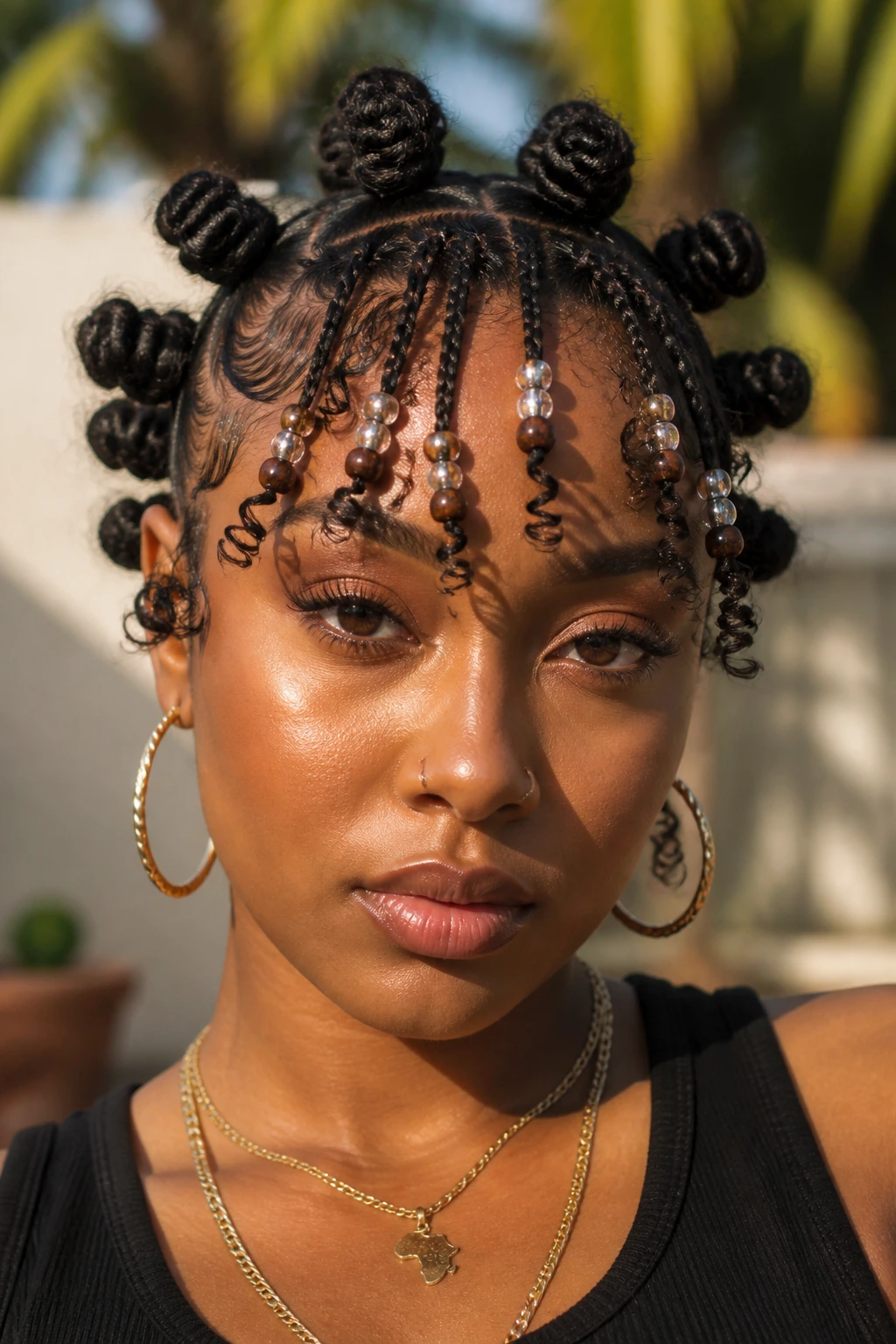
Beads add rhythm to the style. Not clutter. Rhythm. A few beads at the ends of the bang pieces or on small front braids give the whole look a little sound and motion, and that tiny detail can change the mood fast. Thin curly bangs keep the front light enough that the beads don’t overwhelm it.
The bang should be narrow and defined, with enough length for a curl or coil to show shape. If the front is too full, the beads get lost. If the bangs are too short, the accessories start to look stuck on. Keep the balance simple. A line or two of beads is enough.
This style has a playful edge, but it can still feel refined if the colors are kept in the same family as the hair. Wooden beads, clear beads, and matte black ones all give different results. Clear beads look light. Wood feels earthy. Black blends in and lets the curl do more talking.
A good small detail here is end sealing. If the front coils frizz quickly, use a touch of gel or mousse to keep the ends neat before adding the beads.
16. Flat-Twisted Front Into Bantu Knots and Bangs
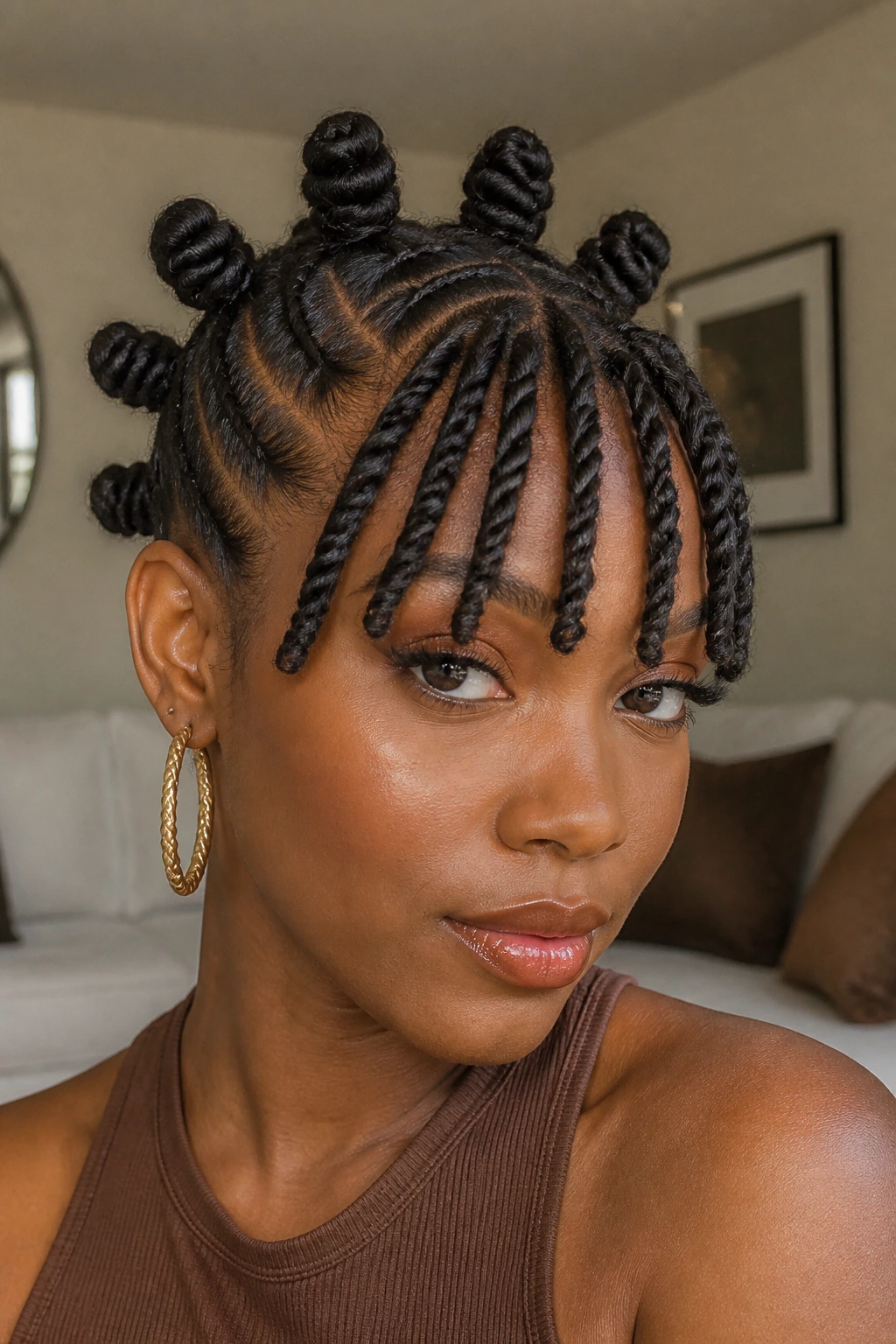
Flat twists in the front are a smart way to make bangs behave. They lie close to the scalp, guide the eye, and feed neatly into the knots behind them. The result feels tidy without being plain. If your hair gets fuzzy around the hairline, this is a useful move.
Unlike loose bang styles, flat-twisted bangs hold their direction. That makes them helpful for longer wear or for anyone who likes a front that does not need daily fussing. You can twist the front straight back, angle it slightly, or split it into two thin twists that meet near the center. Each version changes the shape a little.
This style suits people who want a protective feel without giving up a face-framing finish. The twists keep the edges protected, and the bang area stays controlled. If you want a softer look, leave the twist ends slightly curled or tuck them under the first knot.
It is also a good base for accessories. Tiny cuffs, gold thread, or small pins can sit on the twists without getting lost.
17. Two-Tone Color Block Knots With Copper Bangs
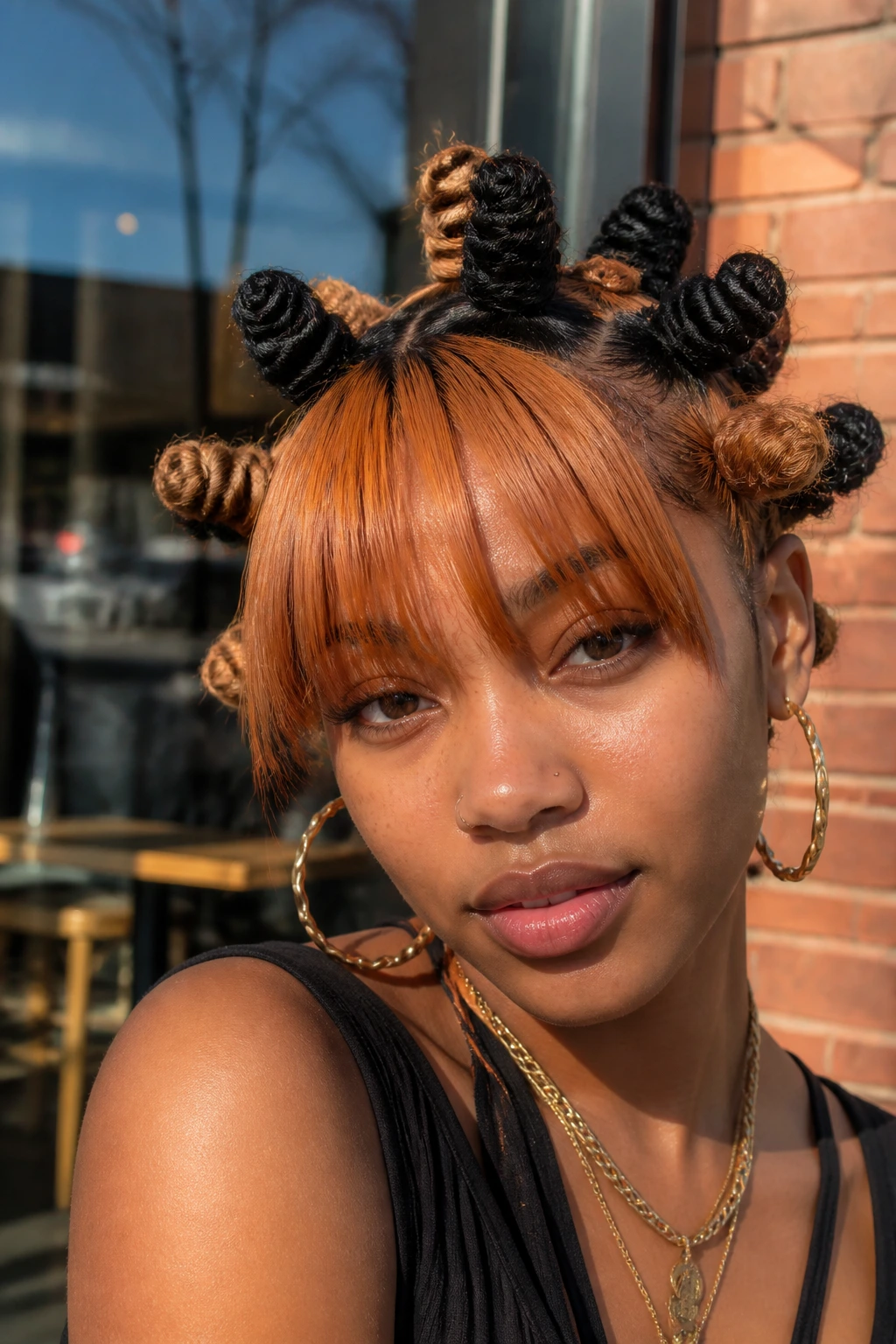
Color block hair has a way of making Bantu knots look sharper than they already are. Put one tone through the knots and a copper or warm-toned shade through the bangs, and the front instantly becomes the focal point. The contrast does half the styling for you.
This look works whether the color is permanent, temporary, or done with extension hair. What matters is placement. The bangs should be the brighter or warmer piece if you want them to pop. If the knots are the lighter shade, the front becomes a frame. If the bangs are darker, the face gets more definition. Small choice. Big effect.
The style is strong, so the rest of the hair can stay fairly simple. Clean parts, smooth roots, and evenly sized knots keep the colors from fighting each other. The bang should be shaped with enough care that the color difference reads as deliberate, not random.
A color block version like this tends to look best with minimal jewelry near the face. Let the hair handle the drama. It already is.
18. Side-Pinned Knot Stack With Sweeping Fringe
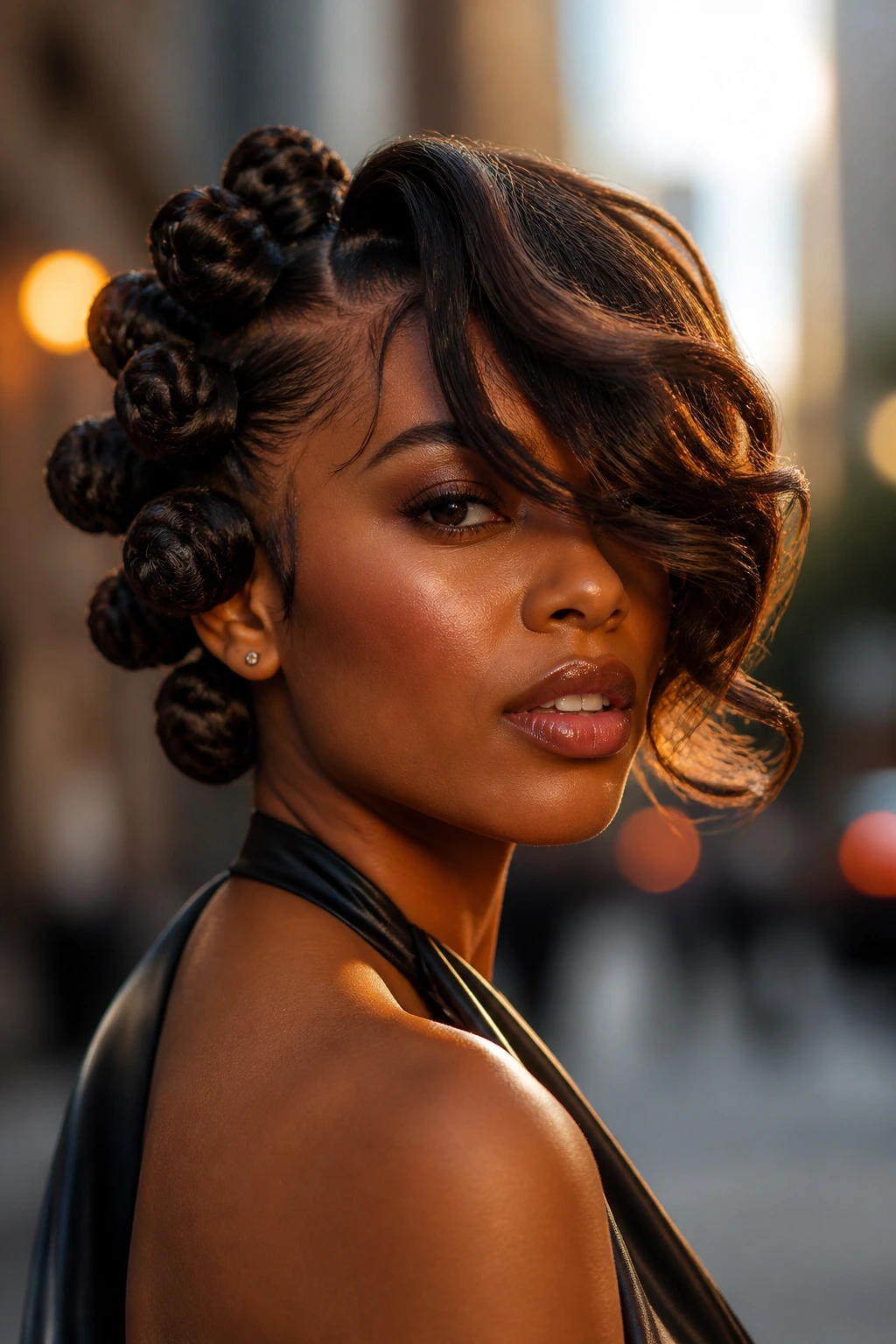
A side-pinned knot stack has a nice old-school glamour to it, but in a modern way. The knots are clustered and pinned toward one side, creating a stacked shape that feels a bit like a sculpted roll. Sweep the fringe across the face and the whole thing suddenly has movement.
The side fringe should travel in the opposite direction from the stack. That cross-motion keeps the style from feeling flat. You want the eye to go one way, then the other. That’s the trick. The contrast adds life.
This style suits dressier settings, but it is not too precious for everyday wear either. A big earring on the open side helps balance the shape. So does a neckline that leaves the collarbone clear. The hair is doing enough on its own, so the outfit does not have to fight for attention.
Pins matter here. Use flat bobby pins that match your hair color, and hide them under the knots so they disappear. Visible pins can break the illusion. Hidden ones do the job quietly.
19. Space-Bun-Inspired Bantu Knots With Micro Bangs
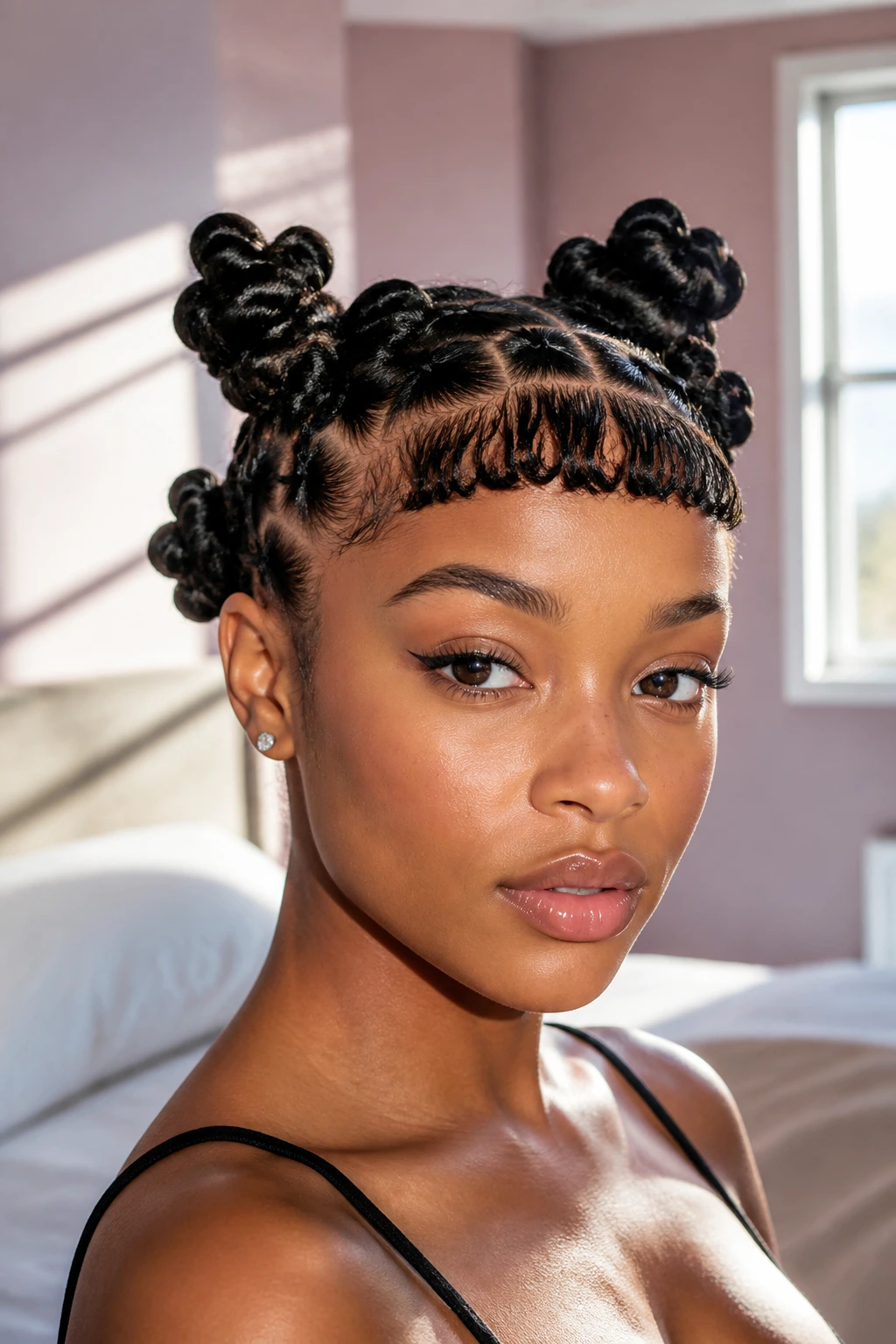
There is something fun about Bantu knots that sit high and slightly apart, almost like a set of tiny space buns with more texture. Micro bangs take the style even further into playful territory. Short, precise, and a little unexpected. That front detail keeps the look from becoming too round.
The Feel of It
Micro bangs need confidence. They expose more forehead and put the shape of the knots front and center. If you like styles that read quirky without being messy, this is a good lane. The bangs can be cut-like in appearance, but they do not have to be actually cut. A very short front section, pinned and shaped into tiny curls or twists, gives the same effect.
The overall shape works best when the knots are evenly spaced and the parting is clean. The look is small in some places and bold in others, which is why it feels interesting.
- Short front section with a neat finish
- High knot placement for a lifted silhouette
- Best when the roots are smoothed down first
- Works well with bold makeup or simple clothes
Small warning: micro bangs are not forgiving if the front gets fuzzy. A satin scarf helps a lot.
20. Pineapple-Style Knots With Fluffy Bangs
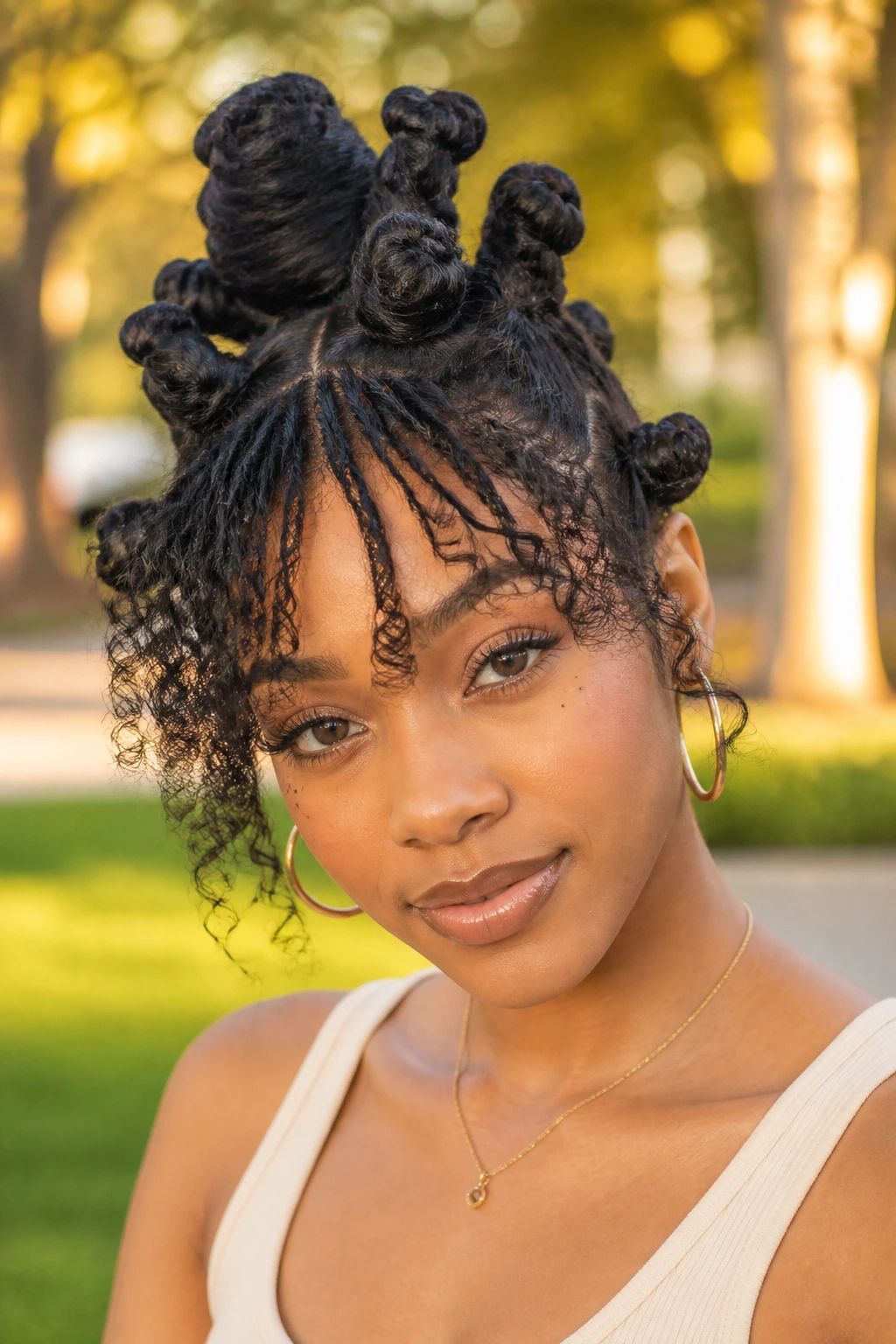
Pineapple-style knots sit high and loose, which gives the style a casual, slightly undone shape. Fluffy bangs fit that mood perfectly. They do not need to be slick or rigid. They just need enough definition to frame the face and keep the front from disappearing into the rest of the hair.
This look is a good choice for textured hair that already wants to live a little higher on the crown. The knots can be spaced with more air between them, and the bang can be built from fluffy curls, stretched coils, or a soft twist-out. Think volume with direction. Not chaos.
Because the style is airy, it pairs well with everyday clothes. Hoodies. Turtlenecks. Big earrings. The hair can carry the whole look without demanding a full glam moment. And if the front starts to loosen, it usually still looks intentional because the style already has a relaxed shape.
A light mist of leave-in on the bang section before setting it can help the curls stay springy. Don’t soak it. Damp is enough.
21. Knot-and-Braid Mix With Curtain Bangs
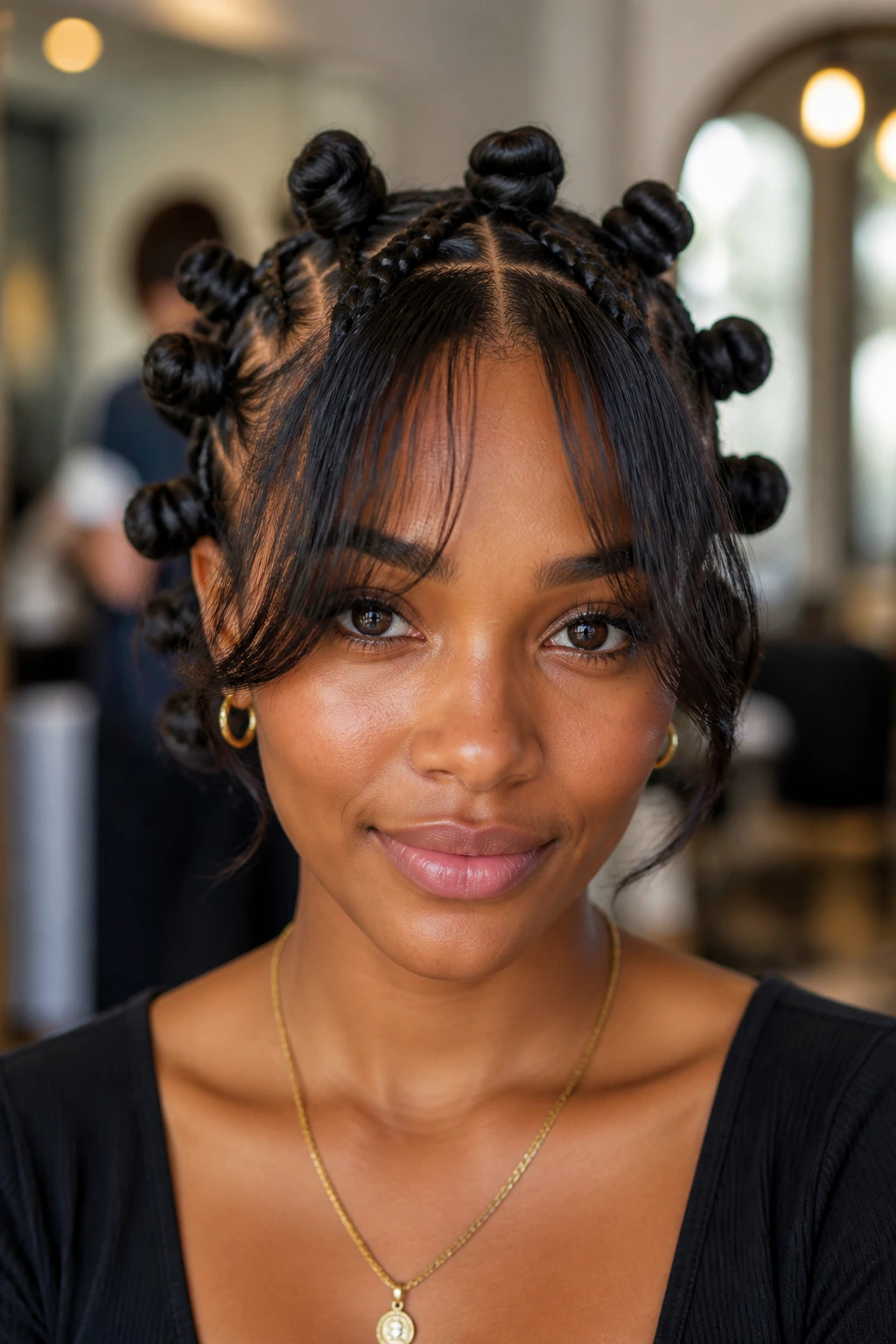
A knot-and-braid mix gives you two textures in one style, and that makes the hair look more layered right away. Some sections become Bantu knots, others become flat braids or small plaits, and the curtain bangs fall down the center or just off-center. It sounds busy. It doesn’t have to look busy.
What keeps this style from becoming too much is repetition. Use the same braid size in a few places, keep the knot sizes consistent where they appear, and let the curtain bangs stay soft. The bangs should open around the forehead and temples the way curtains frame a window. That shape is flattering because it lets part of the face show while still keeping the front shaped.
This style works well if you like mixed patterns. It has enough detail for close viewing but still reads clearly from a distance. If you are styling for a picture or a special outing, this is one of those looks that gives a lot without needing glitter or extra accessories.
A middle part tends to work best here, but a slight off-center part can make the curtain effect feel less formal.
22. Short Hair Bantu Knots With Tapered Bang Detail
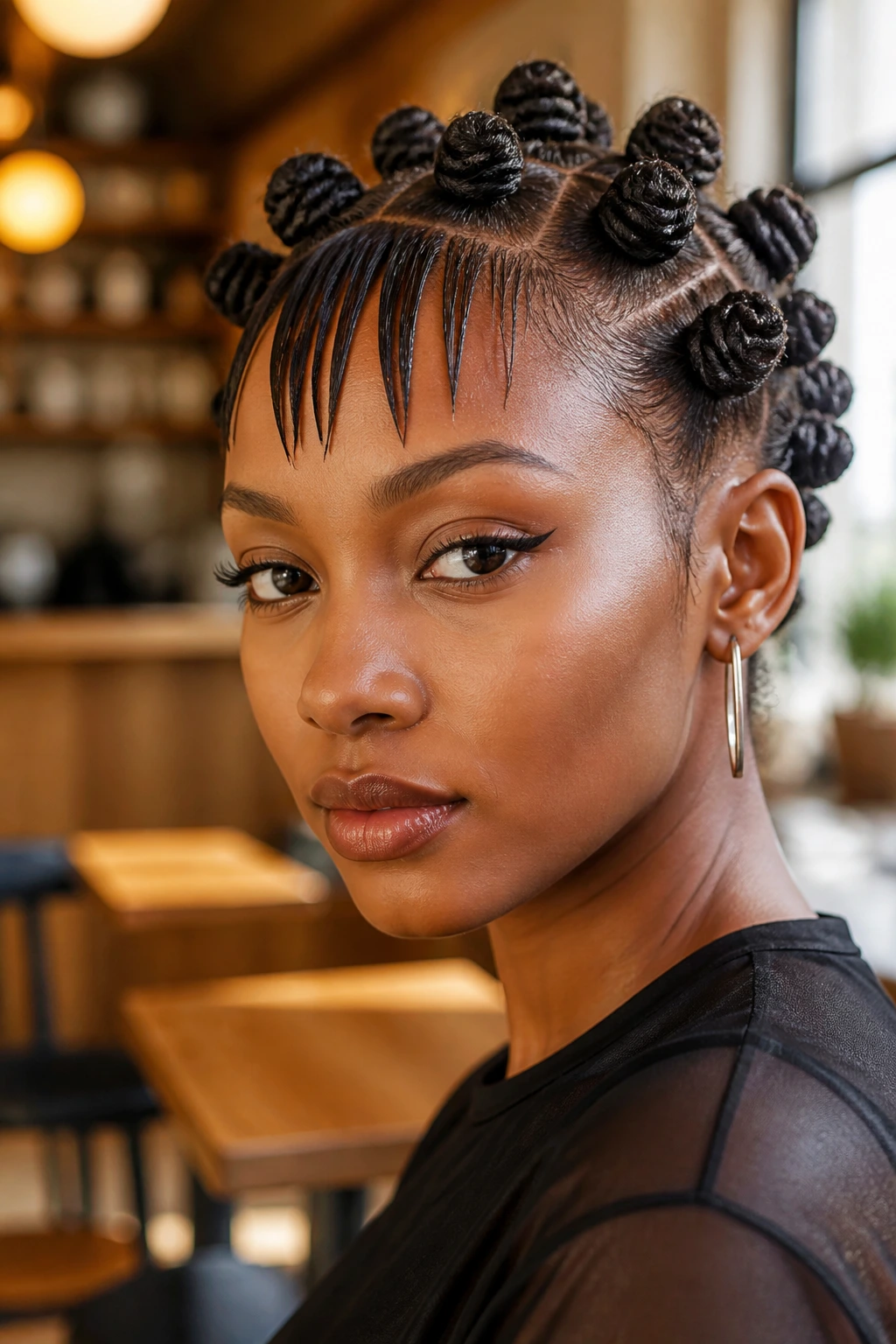
Short hair can absolutely handle Bantu knots, and the bang detail is what keeps the style from shrinking visually. Tapered bangs help create length at the front, even when the hair itself is not long. The shape is tight at the temples, fuller at the center, and softly pointed at the ends.
This is a smart style for a TWA or a shorter stretched base. Small knots will sit better than oversized ones, and the bang can be built from a narrow front section that is twisted, pinned, or curled downward. If the hair is too short to drape, don’t fight it. Shape it into a neat taper and let the line do the work.
Short hair versions of this style usually look strongest when the parts are crisp. The shorter the hair, the more the parting shows. That means a clean comb, good lighting, and a little patience matter more than usual. Harsh parts on short hair stand out fast, so keep the sections smooth.
If you wear glasses, this version can be especially nice because the tapered bang leaves room around the frames without crowding them.
23. Long Hair Stretched Knots With Rollerset Bangs
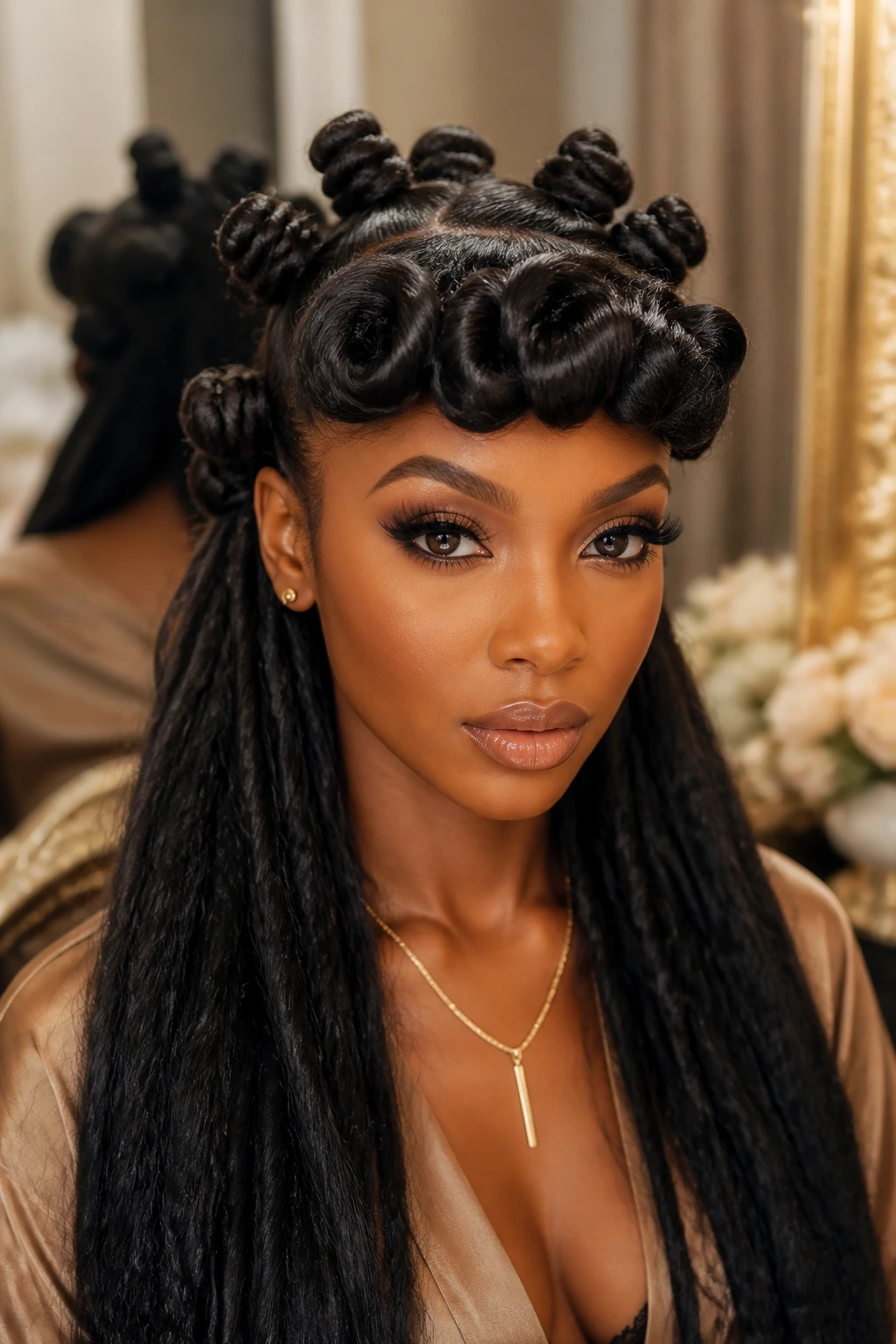
Long hair gives Bantu knots a softer drape, but it can also bring bulk if the front is not set properly. Rollerset bangs fix that. The front section is rolled, dried, and shaped so the fringe falls in a smooth curve instead of puffing straight up.
The result feels polished in a way that is a little different from the tighter, more compact knot looks. The longer hair lets the knots sit fuller, and the rolled bang adds a controlled bend across the forehead. If your hair tends to frizz at the ends, rollers are a good choice because they set a more even curve than loose twisting sometimes does.
This style is useful when you want your hair to look smooth without flat ironing everything. The curl pattern in the bangs gives life to the front, while the knots keep the rest of the style contained. It’s a good middle road between sleek and textured.
Use a setting mousse or a light foaming wrap lotion before rolling the bangs. Once dry, separate the curls carefully. Too much separation turns smooth into fuzzy.
24. Formal Updo Bantu Knots With Sculpted Side Fringe
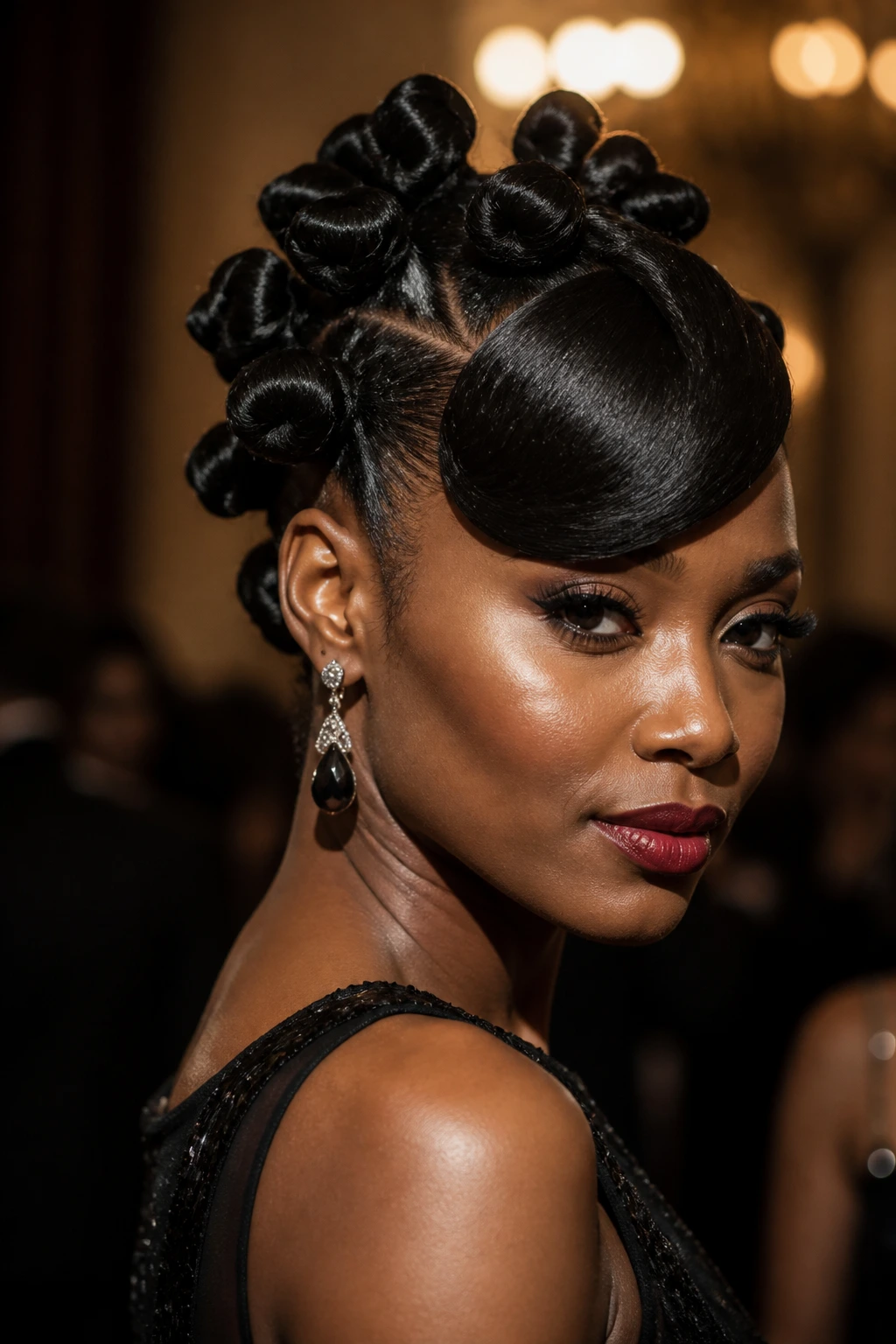
Formal versions of Bantu knots usually depend on shape. This one has shape in spades. The knots are lifted into an updo, pinned close, and arranged with enough precision that the style feels tailored. The side fringe is sculpted, not soft, which gives the whole look a cleaner line.
A sculpted fringe works especially well when it is brushed in one direction and held with light styling gel and pins beneath the surface. You want the front to look intentional from every angle. No loose ends where they should not be. No surprise puff at the temple. The side fringe should curve just enough to open the face while still looking controlled.
This is the version I would pick for a formal dinner, a gala, or any event where your hair needs to hold up under lights and close conversation. It pairs well with defined cheekbones, statement earrings, and clothes that already have structure.
Small Styling Note
Use a stronghold spray only after the shape is set. If you spray too early, the hair can stiffen before you finish the line.
25. Protective-Style Bantu Knots With Tucked Bangs
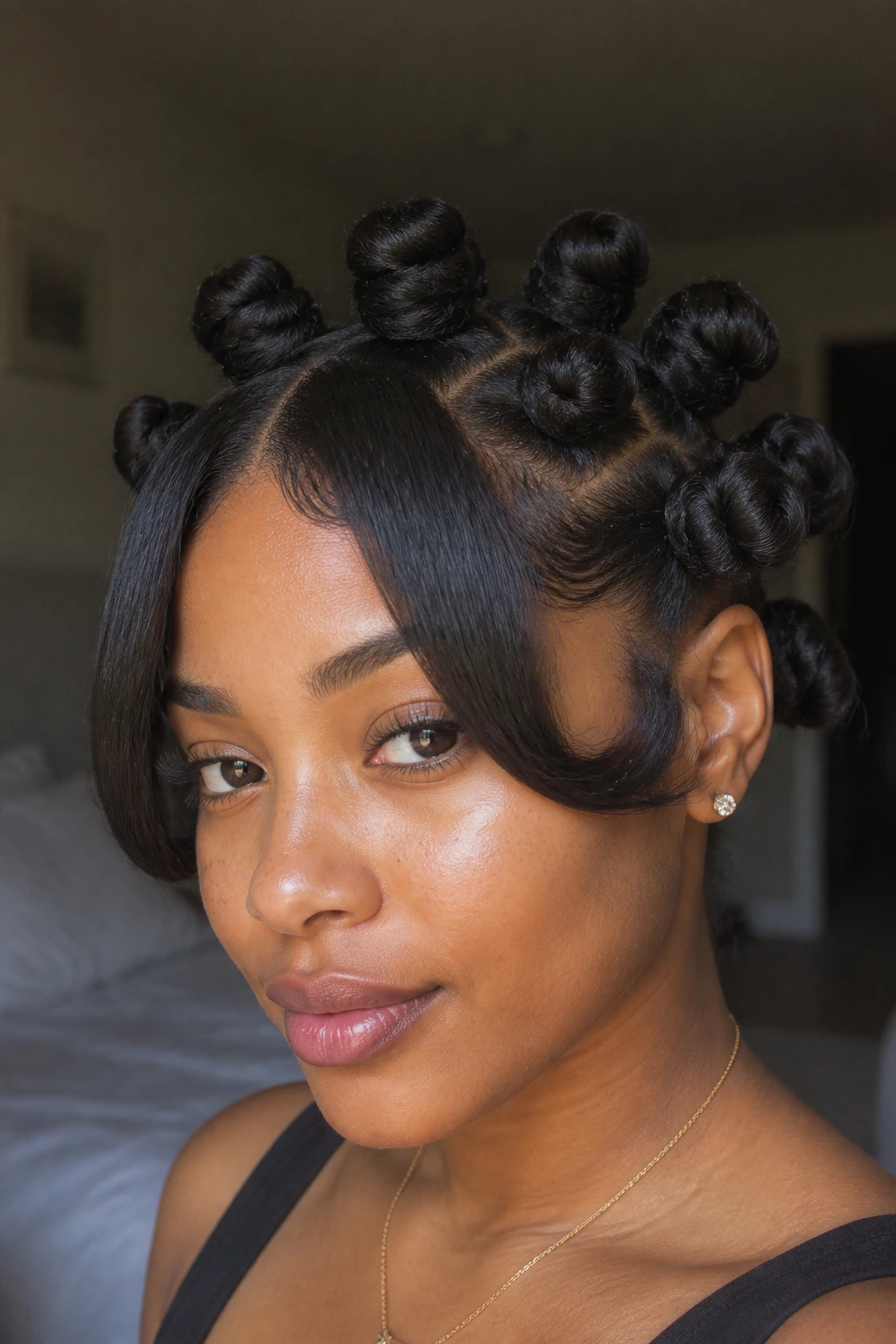
Sometimes the smartest style is the one that asks the least from your hair. Protective-style Bantu knots with tucked bangs keep the ends secured, the front controlled, and the tension low enough that your scalp can breathe. The bangs are tucked, pinned, or wrapped inward so they frame the face without hanging loose.
This is a good choice when your hair needs a break from too much handling. The tucked bang keeps the look neat for sleeping, scarfing, and daily wear. It also cuts down on frizz around the hairline, which is where a lot of styles start to unravel first. If you want a clean finish, this is where you put the work.
The style can still look elegant. Tucked does not mean boring. A side tuck can create a sweep. A center tuck can create a small opening over the forehead. A few front coils can be hidden while still hinting at texture. That kind of restraint can look better than a front section trying too hard to be the star.
Use a satin scarf at night, and don’t pile on heavy oils. Light moisture, gentle parts, secure knots. That is the whole game.
Final Thoughts
Bantu knots with bangs work because they give you shape at the crown and personality at the face. That combination is hard to beat. You can keep the look neat and classic, or push it into something more dramatic with parts, color, accessories, or a different fringe shape.
The main thing I’d watch is tension. Bangs should frame, not fight. If your front is pulling or your edges feel sore, loosen the sections and reshape the front rather than forcing the style to hold.
And if you are choosing between two versions, pick the one that suits how you actually wear hair. Some people want crisp and sculpted. Others want soft and curly. Both can look excellent. The better style is the one you can keep comfortable past the first mirror check.
