



Fishtail braids are one of the most versatile and visually striking braid styles, and when incorporated into a ponytail, they create an elegant look that works for virtually any occasion. For Black women with naturally textured hair, fishtail ponytails offer a beautiful way to showcase texture while maintaining a polished, intentional style. The fishtail braid works particularly well with coils, waves, and curls because the braid pattern becomes even more pronounced and visually interesting when it weaves through thicker, more textured strands—something that straighter hair types simply cannot achieve with the same dimension.
What makes fishtail ponytails so appealing is their blend of sophistication and low-key elegance. Unlike some braid styles that demand a lot of mental math or a YouTube tutorial pause button, the fishtail technique becomes intuitive once you understand the basic crossing pattern. The result is a braid that looks intricate and intentional without requiring a professional’s hand—and for Black women especially, there’s real power in a protective style that you can execute yourself while your hair is getting the protection it needs.
The 12 styles below showcase the range of fishtail ponytails you can create, from sleek and minimalist to textured and full of personality. Each one works with different face shapes, hair textures, and styling occasions. Whether you’re heading to work, attending a formal event, or just want a go-to style for your everyday rotation, you’ll find a fishtail ponytail here that fits your needs.
1. Classic Fishtail Ponytail with Volume at the Crown
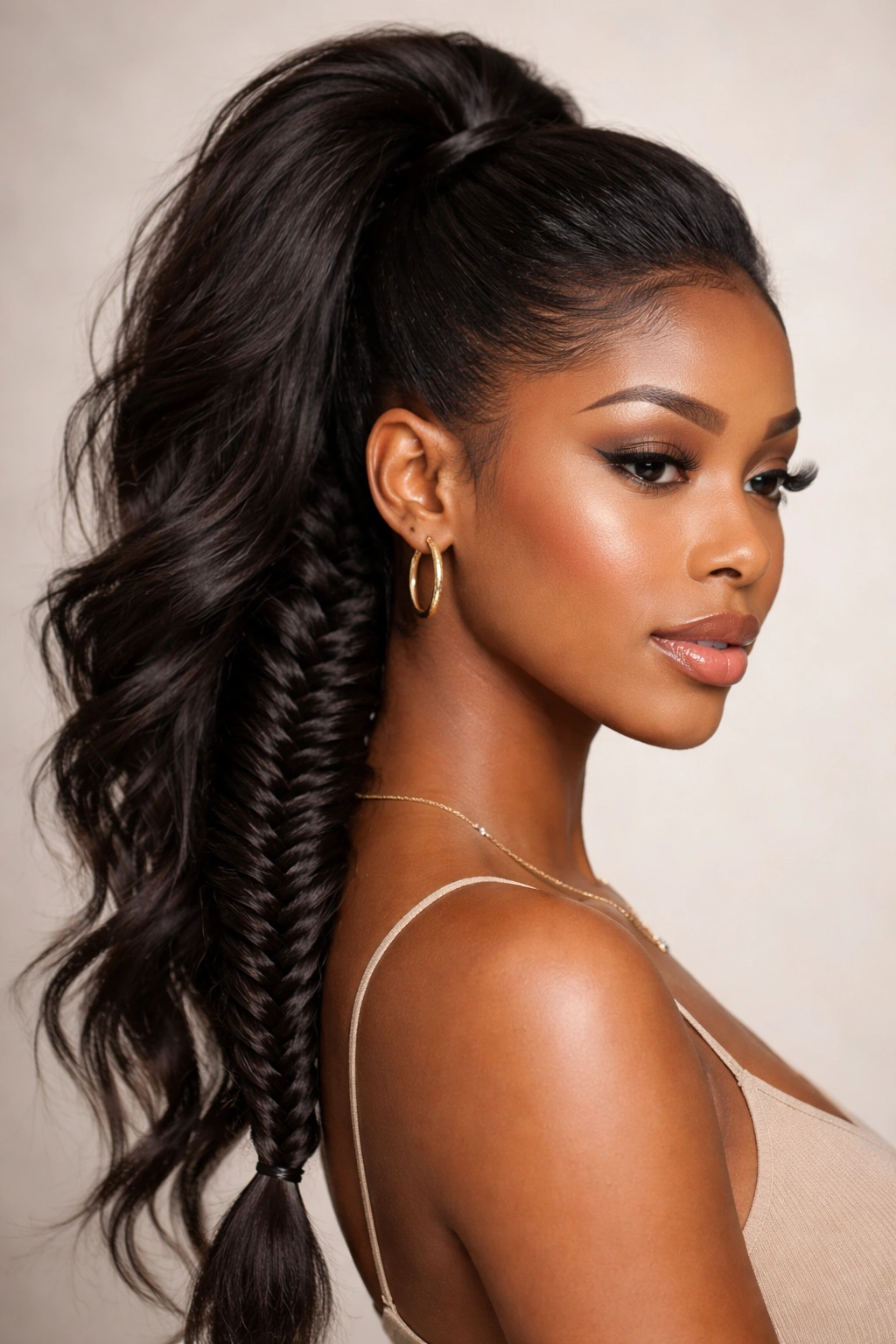
The foundational fishtail ponytail is a style that deserves respect because it’s genuinely beautiful in its simplicity. Start by gathering your hair into a high ponytail and securing it with an elastic, but before you braid, take a moment to gently pull at the top sections of your ponytail at the crown to create volume. This small step transforms the look from flat to dimensional—especially important when working with hair that has natural texture and weight.
Why This Look Works So Well
The high placement creates an instant lifted, youthful effect that flatters most face shapes. The volume at the crown elongates the face and draws attention upward, which is why this is such a reliable choice for everything from casual to professional settings. Once your crown is prepped with that gentle fluffing, divide your ponytail into two equal sections and begin the fishtail pattern: take a thin section from the outer edge of the right section, cross it over to the left section, then take a thin section from the outer edge of the left and cross it to the right. The thinner your sections, the more intricate the braid appears.
Key Points to Master
- Pull volume before you braid—it’s infinitely easier than trying to fluff after you’ve locked everything down
- Keep your sections consistent in thickness so the braid looks balanced and intentional
- Don’t pull the braid too tight; a slightly looser fishtail reads as more luxe and less strained
- The braid should gradually get thinner as you work down the length, which happens naturally if you’re taking equal sections
Pro tip: Spritz your ponytail lightly with water or a leave-in conditioner before braiding—this gives you better grip and control, especially with coily or heavily textured hair.
2. Fishtail Half-Ponytail Hybrid

This style sits at the intersection of effortless and intentional. Instead of pulling all your hair into a traditional ponytail, gather only the top half of your hair and secure it loosely, then fishtail-braid just that upper section while leaving the bottom half of your hair down and loose. It’s a style that reads as “I woke up like this” while actually being thoughtfully constructed.
The Styling Sweet Spot
The half-ponytail version of the fishtail works beautifully when you want to frame your face while still showing off length. The loose bottom section can be curled, left in its natural texture, or even twisted into loose waves for added movement. The fishtail braid on top anchors the style visually, preventing the entire look from feeling too casual or unkempt. This is particularly effective for Black women with shoulder-length or longer hair because you get the protection of a gathered style on top with the freedom and styling options of loose hair below.
How to Execute It
- Section your hair horizontally across the crown, dividing it roughly halfway down the back
- Clip up the top section and leave the bottom loose
- Create your fishtail braid using only the top section
- Secure the braid’s end with a small elastic
- Release the bottom section and style it separately—curl it, leave it textured, or add waves
Worth knowing: This style works best when there’s a clear contrast between the braided top and the styled bottom, so don’t blend them together—let them be visually distinct.
3. High Fishtail Ponytail with Hair Accessories

Sometimes the simplest fishtail ponytail needs a tiny boost in polish, and that’s where thoughtfully chosen hair accessories come in. A gold cuff slid over your elastic, a delicate wire wrap twisted around the base of your braid, or even a decorative hair clip threaded through the fishtail pattern itself elevates the entire look from everyday to special occasion without requiring any additional braiding skill.
Why Accessories Make a Real Difference
Hair accessories do visual heavy lifting when you need them to. A metallic cuff catches light and draws attention to your ponytail; a fabric wrap adds texture and interest; a hair stick or fork creates architectural detail. For Black women, these accessories also offer an opportunity to celebrate cultural aesthetics and personal style in a way that feels both modern and connected to tradition. Gold, brass, and copper metallics pair beautifully with deeper skin tones and create instant visual harmony.
Accessory Placement Ideas
- Slide a metal cuff directly over the elastic at the base of your ponytail for clean, modern feel
- Weave a delicate chain or wire through the fishtail braid itself—this works best when done after the braid is complete
- Clip a decorative hair barrette to the side of your ponytail for asymmetrical interest
- Wrap a colorful fabric strip or silk scarf around the base to add texture and protection
Quick fact: Using silk or satin accessories instead of metal ones helps protect your hair from breakage and keeps your style in better condition longer, especially important for protective styling.
4. Low Fishtail Ponytail for Everyday Wear
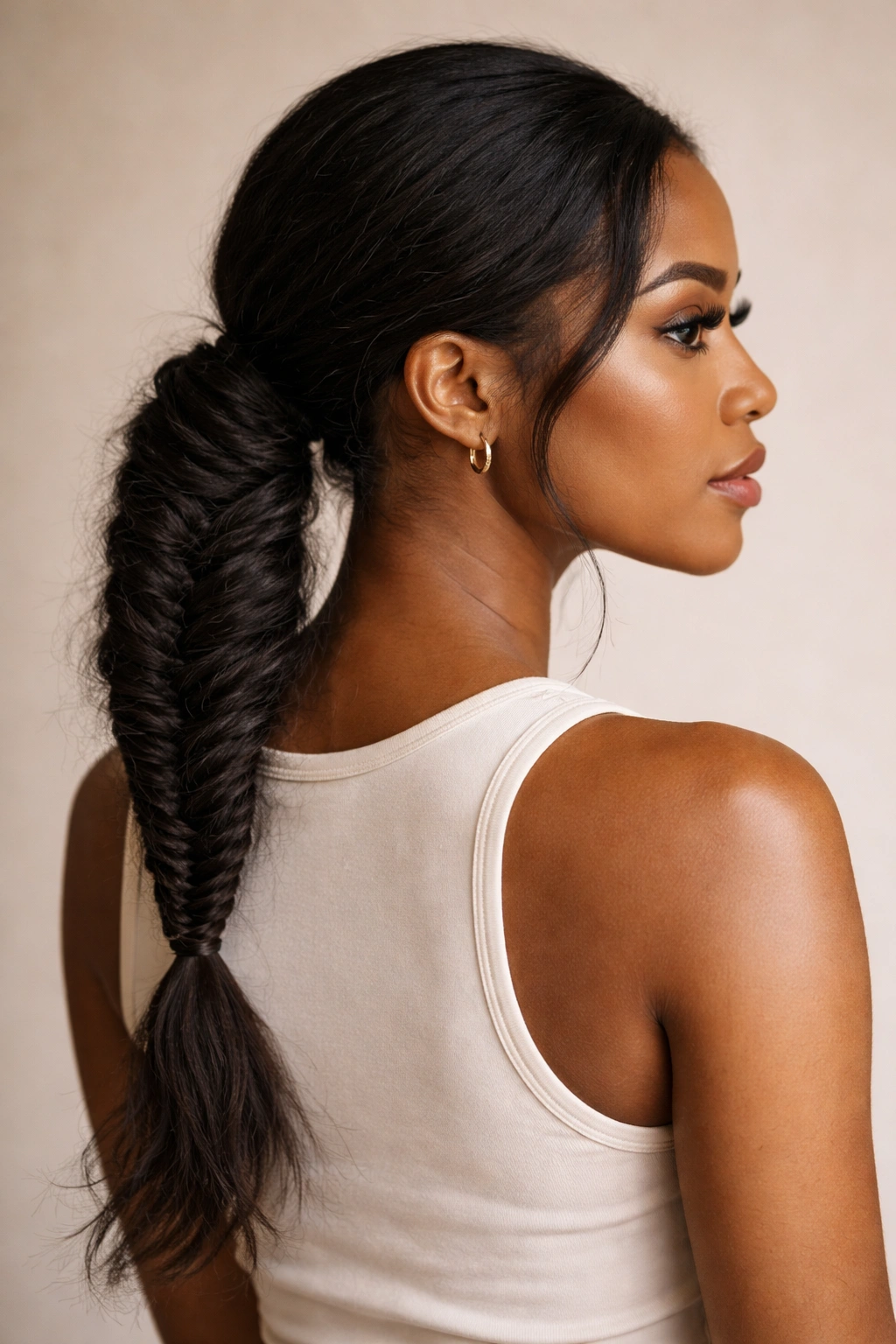
The low fishtail ponytail is the workhorse of the ponytail world—it’s comfortable enough to wear daily, polished enough to take to professional settings, and requires minimal styling time once you’ve mastered the basic braid. Gather your hair into a low ponytail at the nape of your neck, and create your fishtail braid from root to tip.
The Practicality Factor
Low ponytails sit away from your face and neck, which means they don’t create tension headaches even after wearing them for eight or ten hours. They’re also easier to sleep in compared to high ponytails, making them a genuinely smart choice if you’re rotating this style into your regular lineup. The lower placement also feels inherently more professional in work environments, which is valuable context when you’re building a rotation of styles.
Styling Considerations
- Keep the braid looser through the crown and slightly tighter through the length for a balanced silhouette
- Don’t smooth every single hair back—leave some intentional texture and flyaways for a lived-in, natural feel
- A low fishtail ponytail looks beautiful worn with your natural texture peeking through the braid, not slicked completely smooth
Real talk: If you have natural hair and you’re worried about a low ponytail feeling too severe, braid loosely and let some texture and curl show through the braid pattern itself—that’s actually the most flattering version.
5. Braided Fishtail Ponytail with Undercut Details
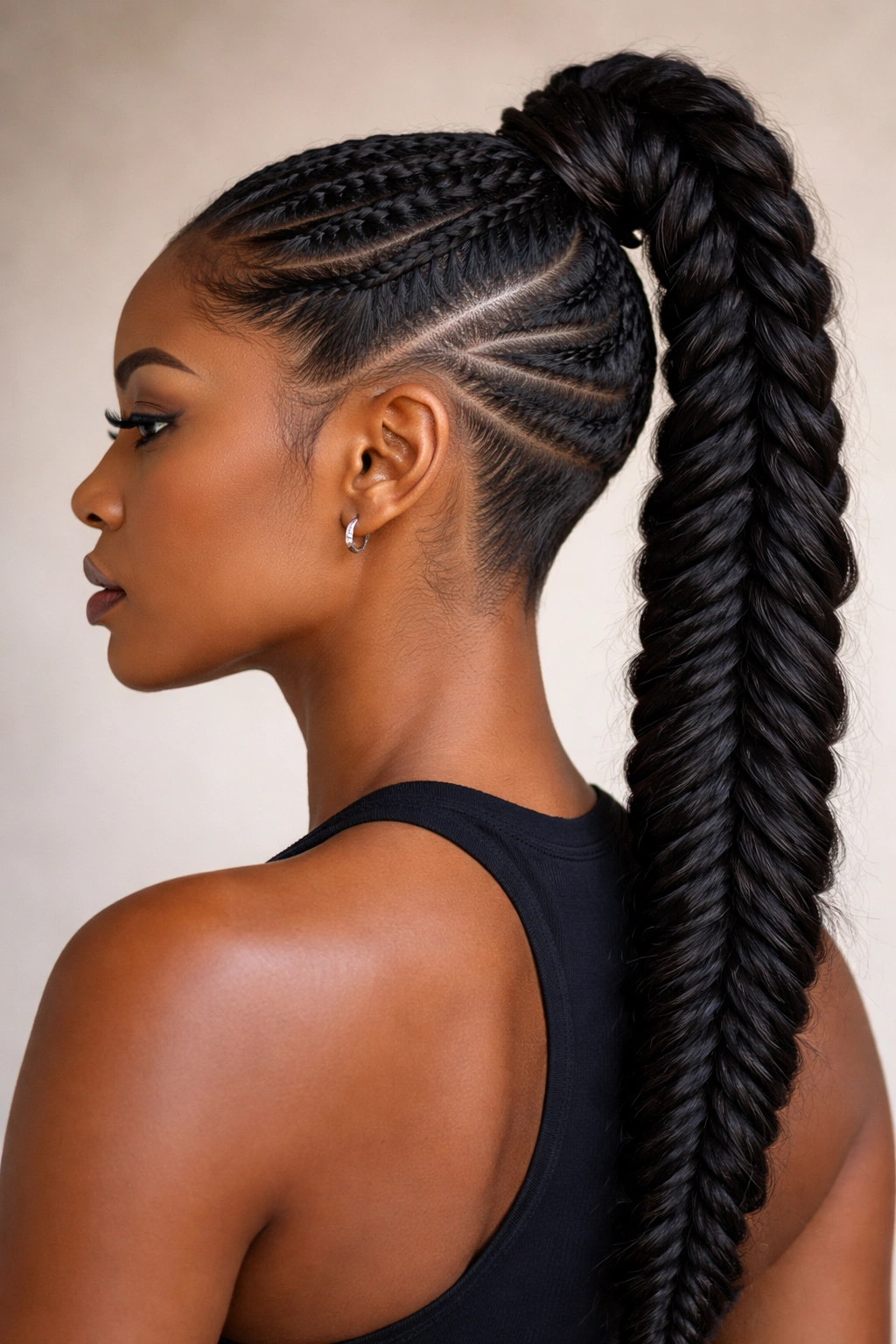
For Black women who are comfortable with texture and want a style with real visual impact, a fishtail ponytail paired with shaved or tapered undercut details creates a look that’s contemporary and boldly personal. If you have an undercut, fade, or shaved detail on the sides or back of your head, a fishtail ponytail showcases that intentional cut beautifully.
Why Undercuts Amplify the Fishtail
When you wear your ponytail high or in a way that shows your undercut, the contrast between the braided volume above and the clean detail below creates visual drama that a standard ponytail simply cannot achieve. The undercut reads as intentional and stylish, not utilitarian. It’s a combination that says you put thought into this look.
Execution Strategy
- Make sure your undercut is freshly shaped so the lines are clean
- Wear your fishtail ponytail high enough that the undercut detail remains visible
- Consider using slightly thicker sections in your fishtail so the braid pattern is clearly visible
- A metallic or decorative cuff at the base of the ponytail draws even more attention to the contrast between your braided hair and the clean undercut
Pro tip: If you have an undercut, wearing your fishtail slightly loose rather than extremely tight actually creates better visual balance with the clean lines of the cut.
6. Fishtail Ponytail with Curled Ends
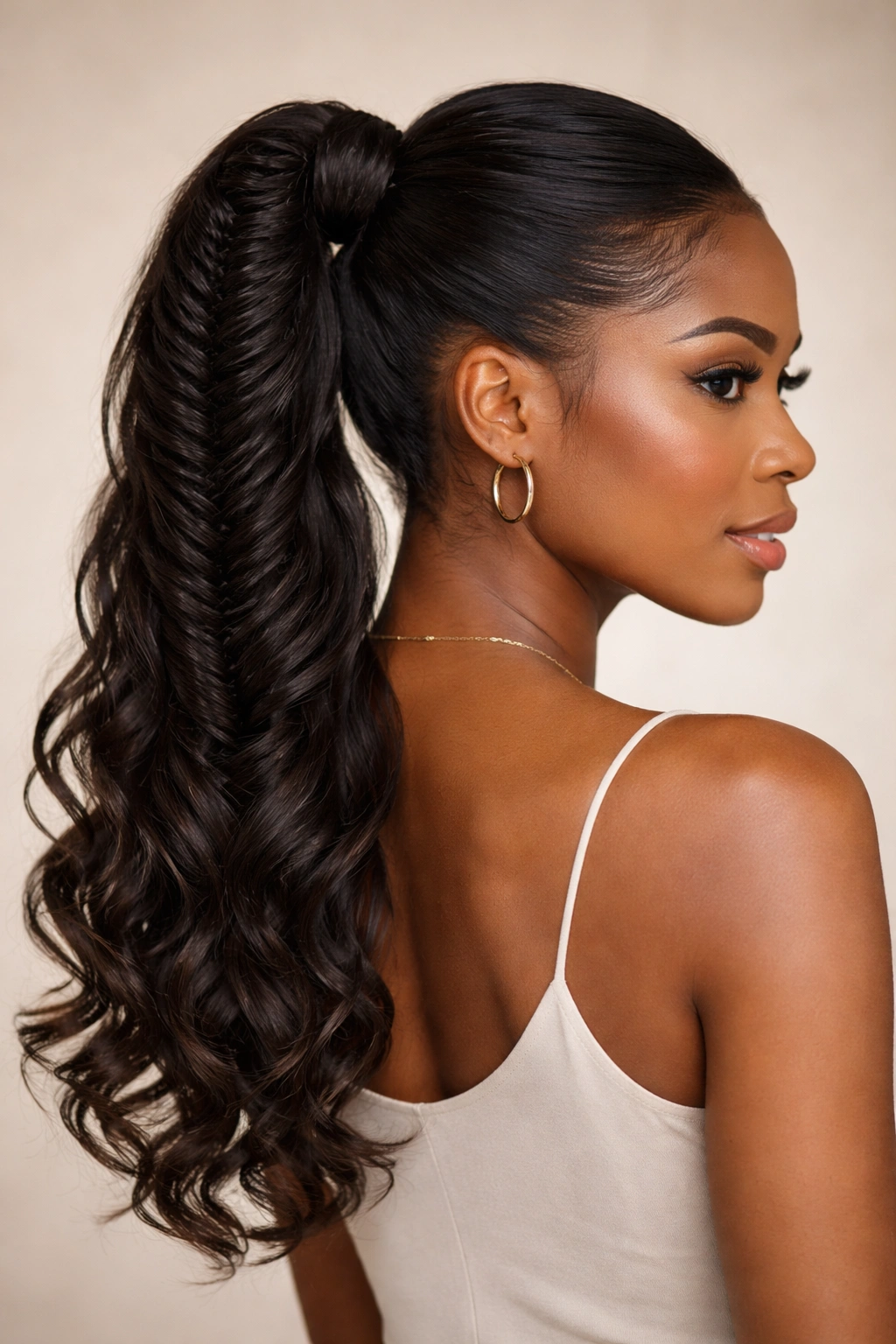
One way to add instant dimension and movement to a fishtail ponytail is to curl the ends of the braid after it’s complete. This works beautifully with textured hair and creates a style that feels fuller, more intentional, and more finished than a straight braided ponytail.
The Curling Method That Works
After you’ve fishtail-braided your ponytail and secured it with an elastic, take small sections of the braid’s end and wrap them around a curling iron or straightener, holding each curl for a few seconds before releasing. Work in sections so every part of the braid’s end gets the curl treatment. The curl doesn’t need to be tight—a loose, relaxed wave is often more flattering and longer-lasting than a crimped, defined curl.
Why This Detail Matters
Curled ends make a style feel more intentional and polished. Instead of a braid that just ends, you now have a braid that transitions into a curl—it’s the kind of detail that makes people think you spent hours on your hair when you actually spent maybe an extra five minutes. For textured hair, this also works with your natural curl pattern rather than against it.
Application Tips
- Let your braid cool before you curl the ends so you’re working with hair that’s already set
- Use a heat protectant spray before curling, especially important when you’re curling braided hair that’s already been manipulated
- Smaller curls usually look better on braided hair than large, loose waves
- The curl should integrate visually with the braid, not feel like a separate element added on top
Worth knowing: If your hair is naturally very curly, you might get the exact same effect by simply releasing the elastic and letting your natural curl pattern take over—no heat required.
7. Sleek Fishtail Ponytail with Baby Hairs
A sleek, smooth fishtail ponytail that showcases your baby hairs and edges is an approach to the style that emphasizes polish and intentionality. This version requires a bit more preparation than a casual fishtail, but the payoff is a look that’s genuinely striking.
Creating the Sleekness
Start by smoothing your hair back with a gel or edge control that works with your hair type—not against it. The goal isn’t to make your hair bone-straight if that’s not its natural state, but rather to create a sleek, controlled surface. Use a fine-tooth comb or a brush designed for edge control to smooth the hair, working from the hairline toward the crown. Once you’ve gathered your hair into your ponytail and secured it, go back and use a small brush to define and shape your baby hairs and edges.
The Baby Hair Strategy
Baby hairs and edges deserve their own moment of attention in this style. Rather than trying to slick them down so aggressively they disappear, define them instead. Create a small wave pattern, a swoosh to the side, or a clean geometric shape using edge control and a small brush. This approach honors the natural hairline rather than fighting against it, which is both more flattering and more sustainable for your hair health.
Polish Points
- Use products designed for your specific hair type—what works for someone with loose waves won’t work the same way for someone with coils
- Define your edges intentionally; don’t try to make them invisible
- A sleek ponytail with shapely, intentional edges reads as intentionally stylized rather than rushed
- This look pairs beautifully with minimal makeup so your hair remains the focal point
Quick fact: Gel and edge control products work better when applied to damp or moisturized hair, so prep your hair with a leave-in conditioner or water before applying your styling products.
8. Textured Fishtail Ponytail with Chunky Twists
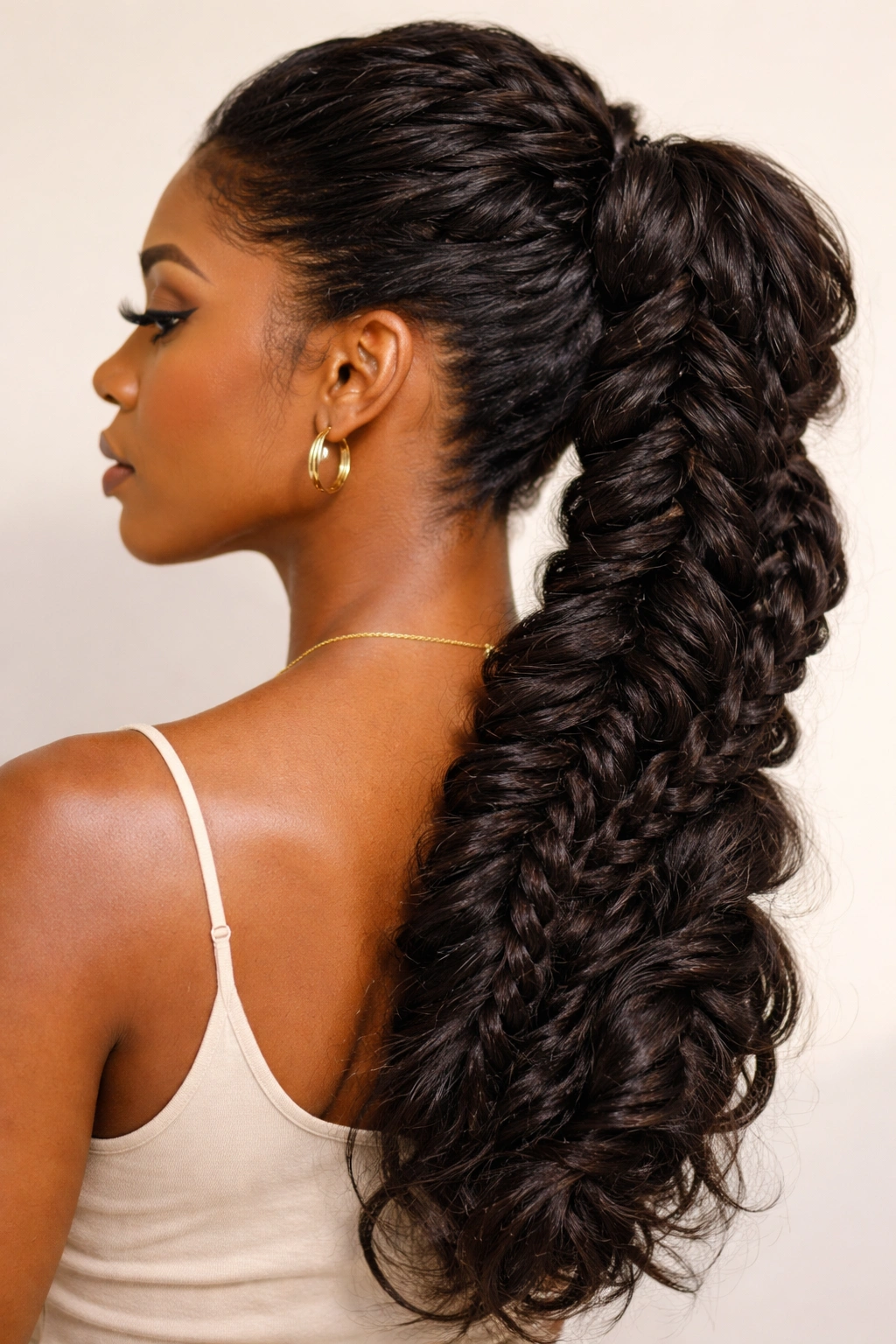
For Black women who want to celebrate their texture fully rather than sleek it down, a fishtail ponytail with chunky twists woven throughout creates a look that’s visually interesting and celebrates the natural dimension of textured hair. This style works beautifully with coily, kinky, or densely curled hair.
Building Texture Into the Style
Instead of creating a tight, controlled fishtail braid, create a looser fishtail while simultaneously weaving in chunky two-strand twists on either side of the main braid. Or, after you’ve created your fishtail braid, take small sections of the braid and gently pull them outward and slightly upward to create a fluffed, textured effect. The goal is to create visual interest and showcase the way texture catches light and creates shadow and dimension.
Execution Details
- Create your basic fishtail braid, but keep it slightly looser than you might for a sleek version
- As you braid, occasionally incorporate small two-strand twists into the braid pattern itself
- After you’ve secured the braid, gently pull at sections to create texture and fluff
- The final result should feel lived-in and dimensional, not slicked or controlled
Why Textured Looks Matter
A textured fishtail celebrates the natural characteristics of Black hair in a way that sleek styles sometimes don’t. This doesn’t mean sleek is wrong—it’s beautiful—but textured styles honor the hair’s natural texture and create a look that’s distinctly and authentically personal. You’re working with your hair, not against it.
Pro tip: Slightly damp hair holds texture better than completely dry hair, so spritz your ponytail with water or a light mist of leave-in conditioner before you start fluffing and pulling at the sections.
9. Fishtail Ponytail with Color-Block Highlights
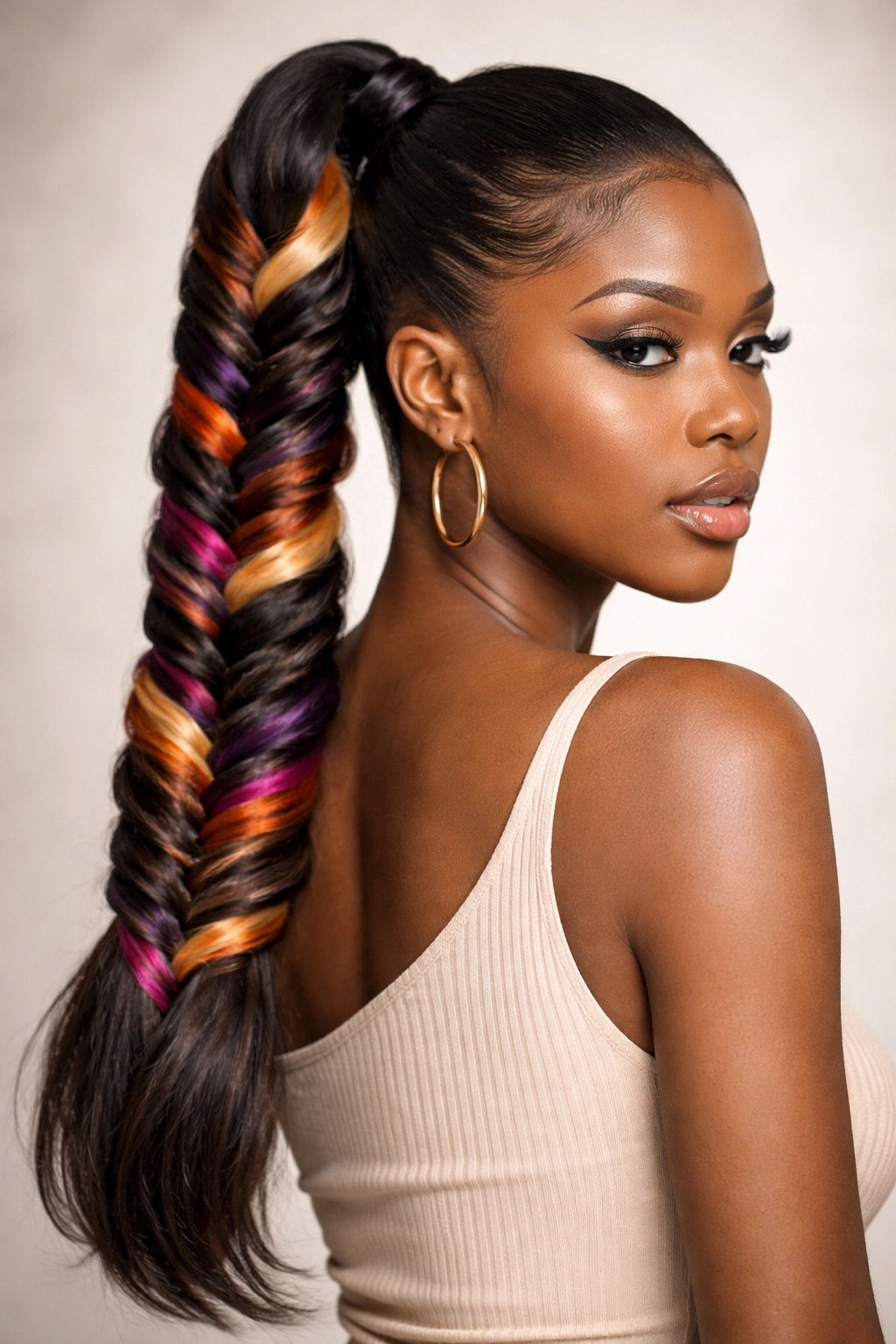
If you have multiple hair colors, extensions, or a highlight placement that creates visual contrast, a fishtail ponytail is an excellent vehicle for showcasing that color work. The braid pattern naturally creates light and shadow, and when you have color variation in your hair, the braid becomes a stage for that color to shine.
Color Positioning Strategy
The way you position your hair sections as you create the fishtail braid determines how visible your colors are. If your highlights are toward the front of your hair, make sure those sections are included in your outermost braid layers so they’re visible. If your color is more blended throughout, the fishtail pattern itself will create enough movement and dimension that the colors will naturally catch light and become visible as you move.
Hair Extension Considerations
If you’ve added extensions for length or for color contrast, a fishtail ponytail is an excellent way to incorporate them. Braiding extensions creates texture and visual interest that you wouldn’t get if you simply wore them loose. The braid also helps distribute the weight of extensions more evenly, reducing tension on your natural hair at the roots.
Visual Impact
- The braid pattern naturally shows off color work better than a straight ponytail would
- Positioning colored sections in the outer layers of the braid ensures they’re visible
- Multiple colors in a fishtail create a more complex, visually interesting look
- The movement of the braid as you walk or turn shows off colors that might be hidden when your hair is still
Worth knowing: If your color work is subtle, a slightly looser, more textured fishtail will show it off better than a super-tight, sleek version.
10. Side-Swept Fishtail Ponytail
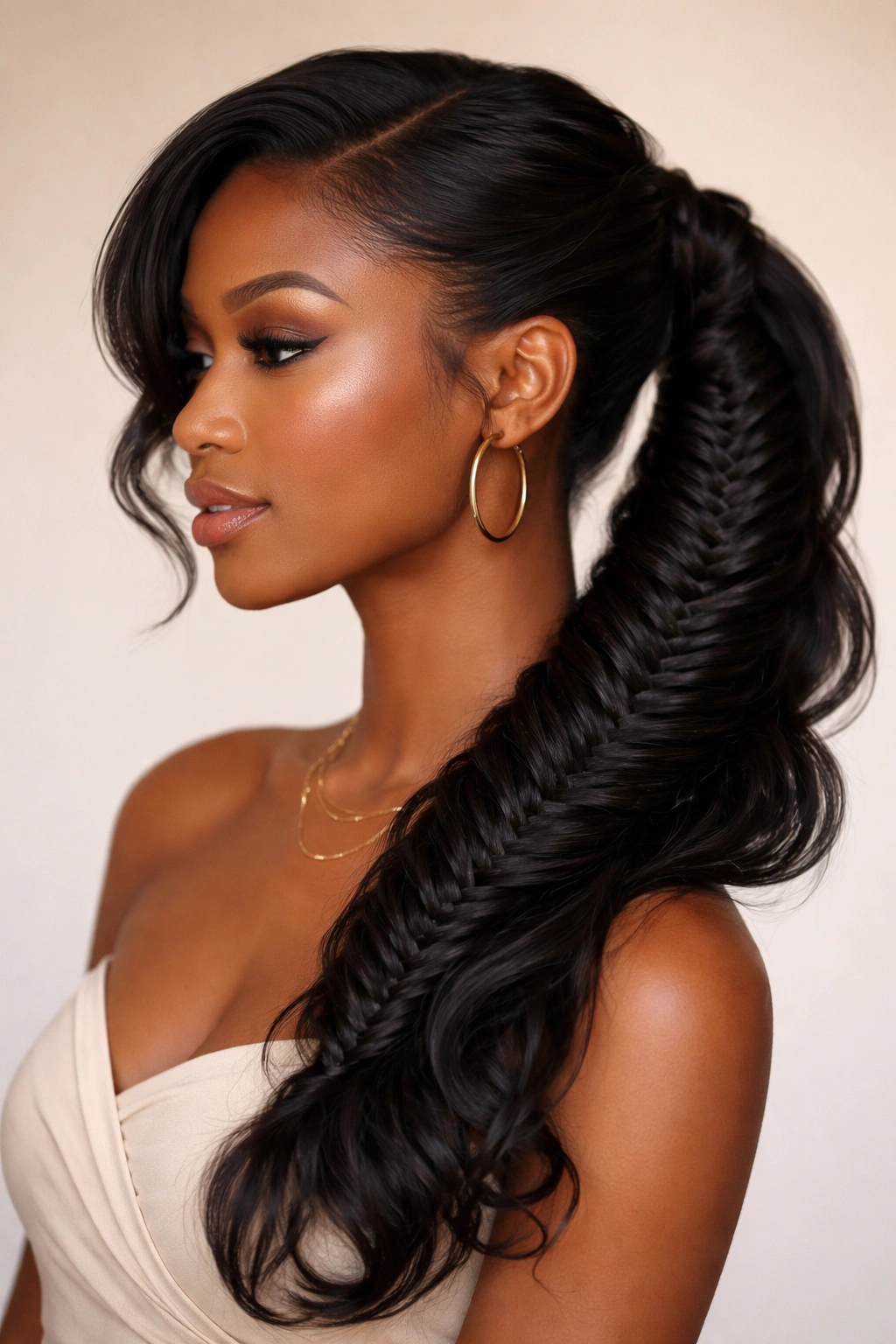
The side-swept fishtail ponytail is a style that’s slightly more experimental than a centered ponytail but doesn’t require a complete style overhaul. Gather your hair to one side rather than straight back, and create your fishtail braid from that side-gathered position.
The Asymmetry Factor
Asymmetrical styles flatter most face shapes because they create movement and visual interest rather than placing everything down the center. A side-swept fishtail ponytail emphasizes one side of your face while softening the other, which is why it’s such an effective style choice if you’re looking for something that feels different without being dramatically different.
Placement Considerations
- Determine which side you want your ponytail on—typically, the side opposite your part creates the most balanced look
- Gather your hair firmly to that side before you start braiding
- Create your fishtail braid as you normally would, but from the side position
- You can wear the braid over your shoulder or tucked behind your back, depending on what you’re doing and what mood you want to create
Why Side-Swept Works
This style is particularly flattering on Black women with wider face shapes because the asymmetry creates visual movement that doesn’t emphasize width. It’s also more interesting than a traditional centered ponytail without requiring you to learn an entirely new braiding technique.
Pro tip: Let a few small sections of hair escape near your face—this softens the look and prevents it from feeling too severe or pulled.
11. Double Fishtail Ponytails
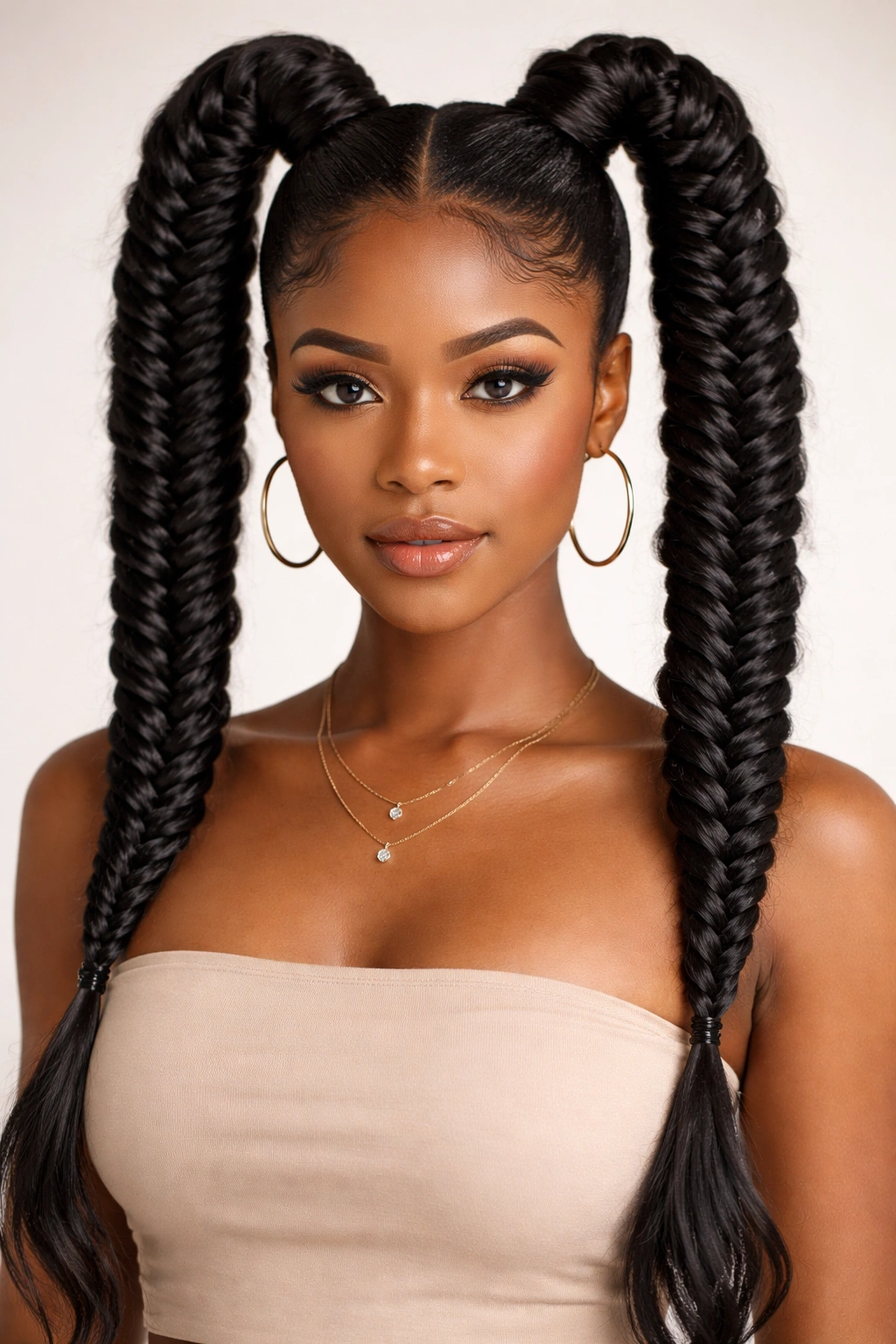
For a playful, youthful take on the fishtail ponytail, create two smaller fishtail ponytails instead of one larger one. This works beautifully with medium to thick hair and creates a look that’s fun without being costume-y.
Creating Two Balanced Ponytails
Divide your hair down the center from hairline to neck, creating two equal sections. Gather each section into a ponytail at the position you want (typically high or mid-height), and create a fishtail braid in each ponytail separately. The result is two distinct braids rather than one centered one, which completely changes the aesthetic and visual impact of the style.
Who This Works Best For
Double fishtail ponytails are particularly striking on Black women because the contrast between the two defined braids and the overall shape of the style is visually bold and confident. This isn’t a subtle style—it’s a statement style, which is part of its appeal.
Styling Angles
- You can make the ponytails match exactly, or experiment with different braid tightness in each one for asymmetrical interest
- The space between the two ponytails at the crown can be either smooth or textured, depending on your mood
- This works beautifully with colorful elastics or hair clips in coordinating colors
- The style reads as young and fun, not severe or overly complex
Worth knowing: This style creates less overall length than a single centered ponytail because you’re dividing your hair, so it’s better suited to thicker hair or hair that’s longer in length.
12. Fishtail Ponytail with Crown Braid Base
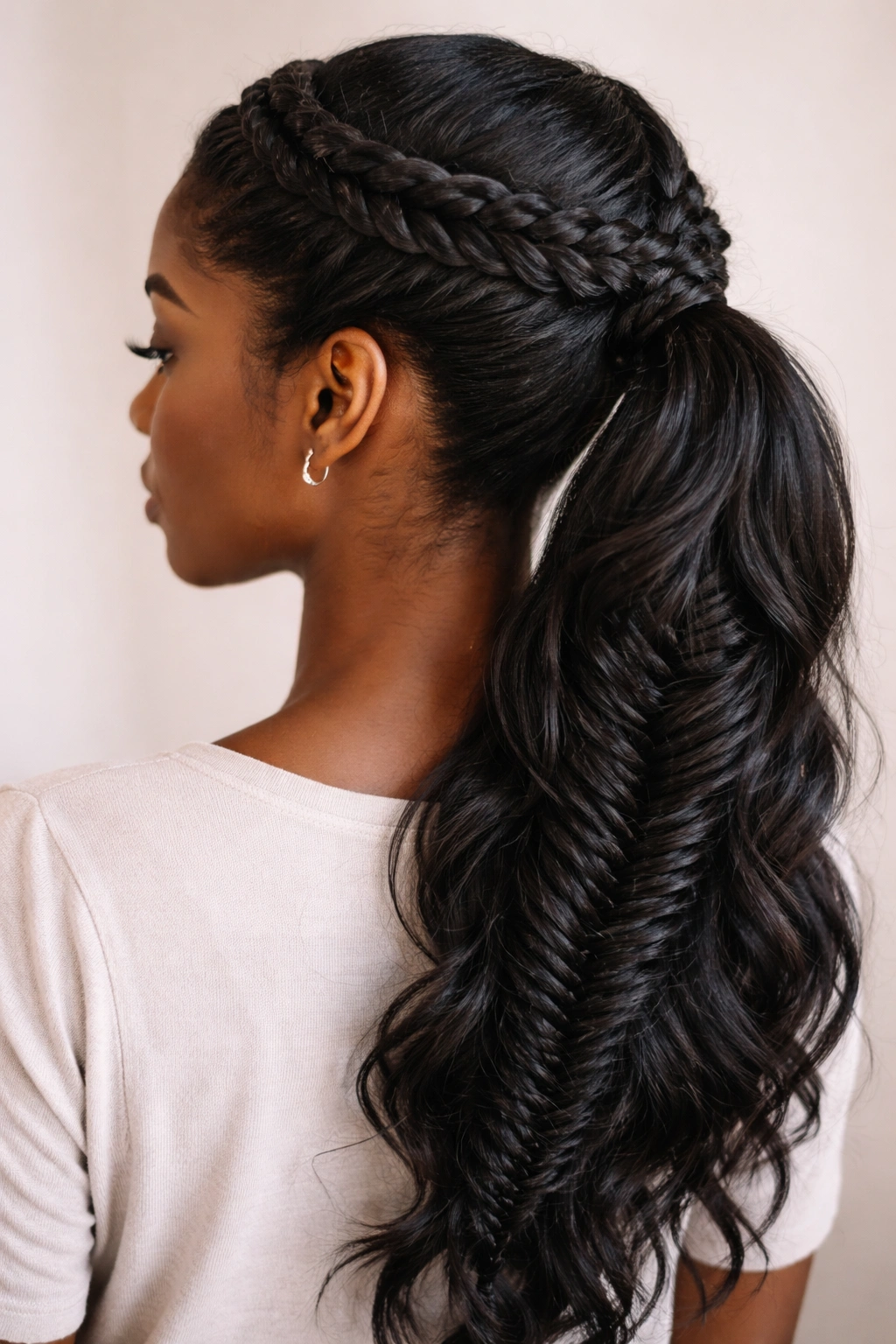
For Black women who love the intricate look of multiple braids working together, a fishtail ponytail with a crown braid base layers two braiding techniques into one cohesive style. Create a crown braid (or halo braid) across the top of your head first, then gather the rest of your hair into a fishtail ponytail below it.
The Two-Braid System
A crown braid runs across the top and back of your head, following your natural hairline and creating a wrapped, protective effect. Once that’s complete and secured, gather the remainder of your hair into a fishtail ponytail. The contrast between the crown braid’s tight, controlled pattern and the looser fishtail creates visual interest and a look of intentional sophistication.
Skill Building
This style requires comfort with both crown braiding and fishtail braiding, so it’s not a beginner option. However, if you’re comfortable with both techniques, the payoff is a style that looks genuinely complex but is actually just two techniques you already know, stacked together.
Visual Payoff
- The crown braid adds a protective element to your edges and hairline
- The contrast between two different braid styles creates visual complexity
- This works beautifully for special occasions or situations where you want your hair to feel intentional and carefully styled
- The crown braid also helps manage baby hairs and edges beautifully
Pro tip: Practice the crown braid separately until it feels natural before attempting this combination style—trying to learn two techniques at once is unnecessarily complicated.
Final Thoughts
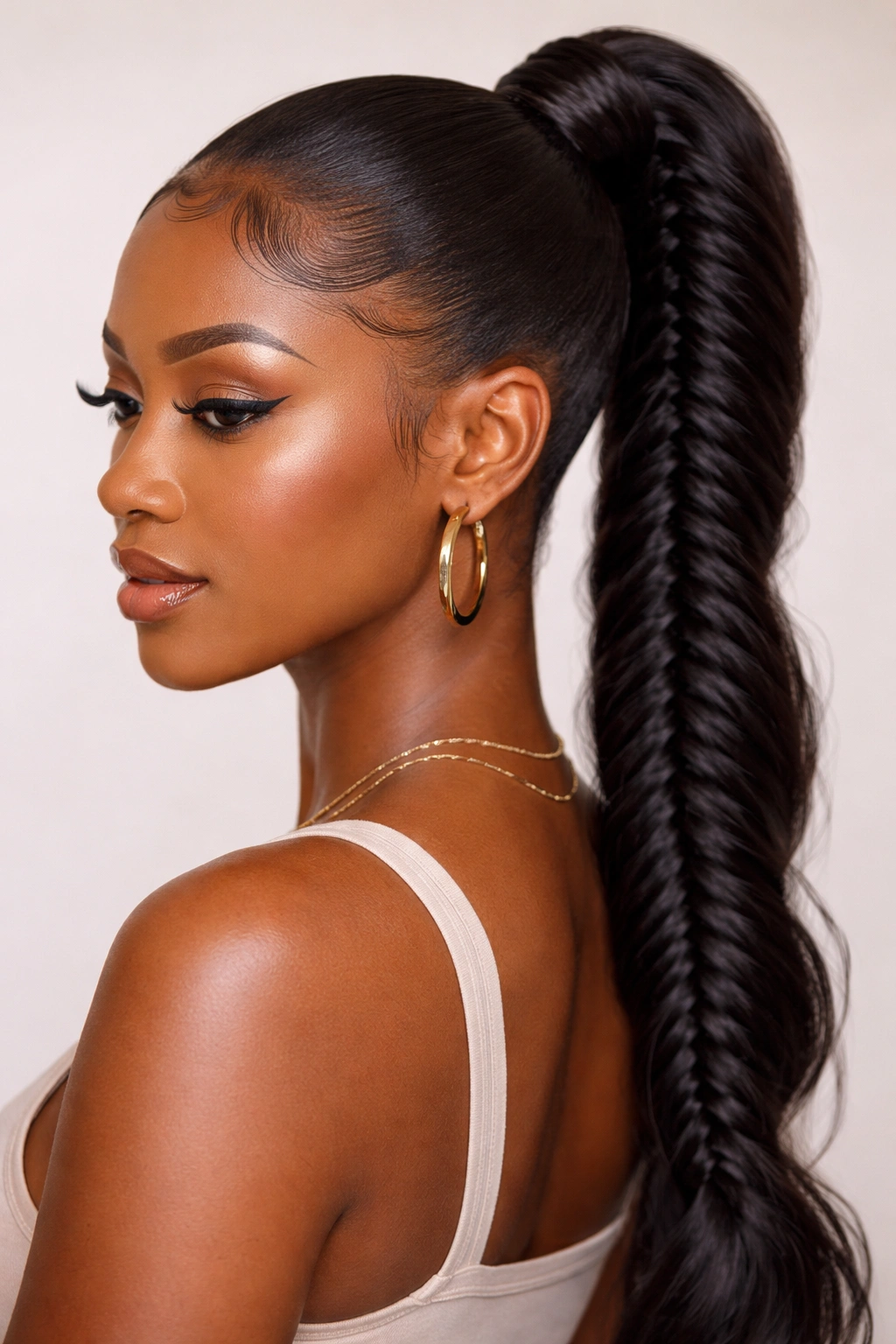
Fishtail ponytails offer Black women a style option that celebrates texture, allows for creative experimentation, and works across virtually every setting—from casual to professional to special occasion. The beauty of the fishtail braid is that once you understand the basic crossing pattern, you can adapt it infinitely. You can make it sleek, textured, embellished, asymmetrical, or layered with other braiding techniques.
The most important thing to remember is that your hair is working for you, not against you. If a fishtail ponytail feels too tight, loosen it. If it feels too casual, add an accessory or smooth your edges. If the style feels basic, texture it, color-block it, or layer it with another braid. The 12 versions above are starting points—the real goal is finding the versions that make you feel confident, beautiful, and like yourself.
Build your fishtail skills by practicing the basic version repeatedly until it becomes second nature. Then, once that’s solid, start experimenting. Try it higher, lower, looser, tighter, with accessories, with texture, with twists. Each small variation changes the entire feeling of the style, which is exactly what makes fishtail ponytails such a powerful tool in your styling rotation. You’re not just learning one ponytail—you’re learning a braid technique that can adapt to however you want to show up.
