



Igbo weddings are celebrations of culture, beauty, and heritage — and the bride’s hairstyle is absolutely central to that story. The way a woman adorns her hair on her wedding day speaks volumes about her identity, her respect for tradition, and her personal style. Unlike Western bridal trends that shift constantly, Igbo bridal hairstyles draw from centuries of artistry and cultural meaning, combining intricate braiding techniques, elegant wraps, and ornamental touches that transform hair into wearable art.
If you’re planning an Igbo wedding or attending one as a bride, you’ve probably noticed that the hairstyle choices feel different from typical bridal looks. This isn’t accidental. Igbo bridal hair carries symbolic weight — it connects you to your ancestors, honors your family, and celebrates the craftsmanship of the women who’ve refined these techniques over generations. The styles you’ll see range from sleek and modern to deeply ornate, from geometric precision braiding to flowing wrapped styles that frame the face with confidence and grace.
The beauty of Igbo bridal hairstyles is their flexibility. Whether you’re going for a look that’s primarily traditional, primarily contemporary, or a thoughtful blend of both, there’s a style that will feel authentically you while respecting the cultural foundation. Many brides choose to incorporate elements like coral beads, gold chains, or elaborately woven patterns that become part of their complete bridal look — including the gele (head wrap), the blouse, and the wrapper skirt.
This guide walks you through ten of the most stunning Igbo bridal hairstyles, explaining not just how each one looks, but the technique behind it, who wears it best, and how to make it work for your specific vision of your wedding day.
Understanding Igbo Bridal Hair Traditions
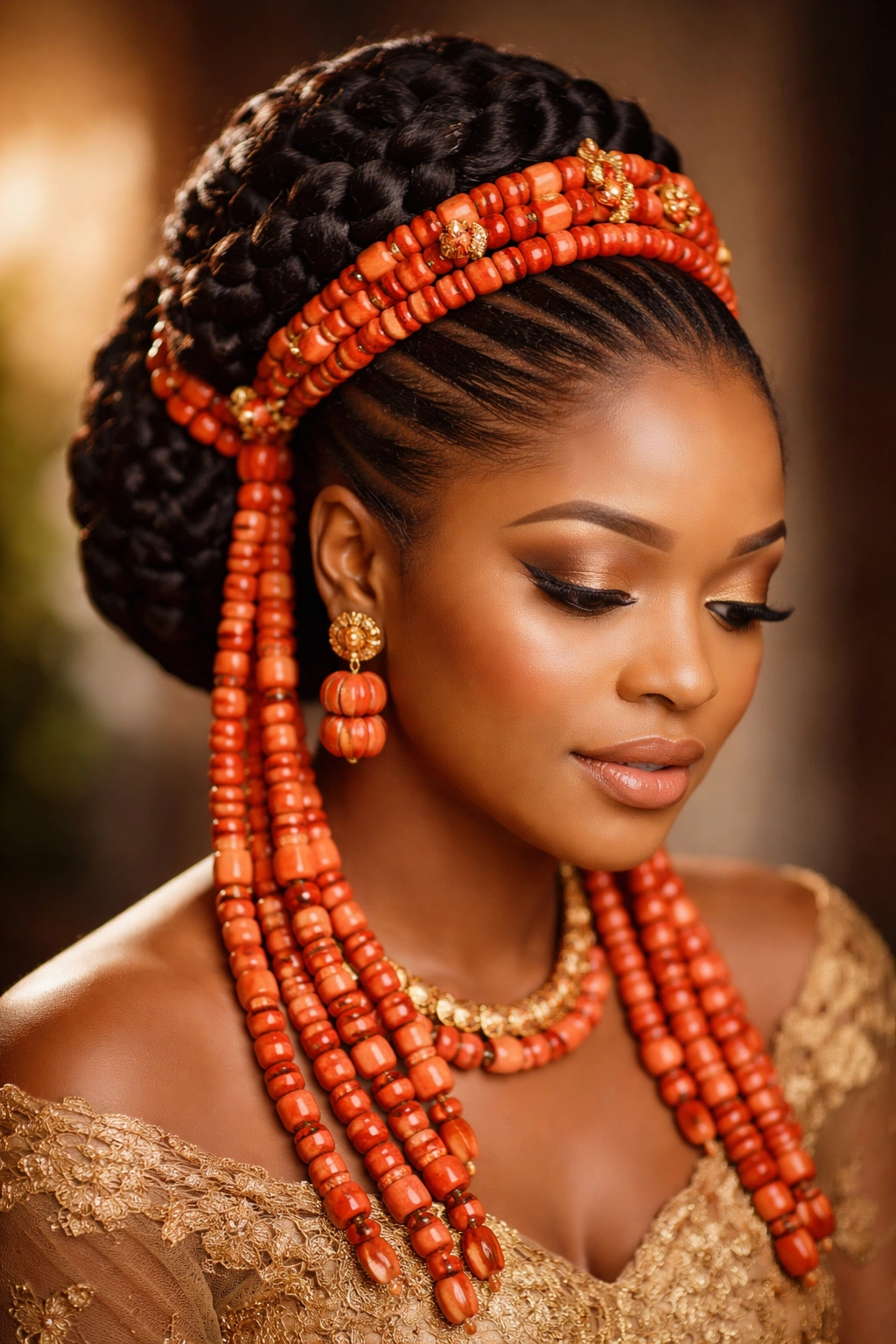
Igbo hair artistry has deep roots in storytelling and status. Traditionally, the complexity and craftsmanship of a woman’s hairstyle communicated her position in society, her family’s resources, and the care taken to prepare her for marriage. Mothers and aunts would spend hours on the bride’s hair, treating it as a sacred preparation ritual. This wasn’t vanity — it was ceremony, a way of saying “we honor this transition.”
Modern Igbo brides often blend this respect for tradition with contemporary aesthetics. You might wear a style rooted in ancestral technique but styled with modern elements like jeweled hairpins or sleek finishes. You might choose a braided pattern that tells a specific story about your family’s origin or history. The key is intention — understanding not just what the style looks like, but what it means and why you’re choosing it.
The Cultural Significance of Igbo Bridal Hair
The hair preparation ritual has always been about more than appearance. It’s a coming-of-age moment, a blessing ceremony, and a declaration of readiness. Many Igbo brides incorporate symbolic patterns — certain braid formations represent fertility, protection, prosperity, and union. The number of braids, the direction they’re woven, even the specific beads or gold thread used can carry meaning passed down through families.
Preparing Your Hair for an Igbo Bridal Style
Igbo bridal hairstyles demand healthy, strong hair because they often involve tension from braiding and the weight of ornaments. Starting weeks before your wedding, deep condition your hair regularly, moisturize your scalp, and avoid styles that pull too tightly. If you’re planning an elaborate braided style, get a test run at least two weeks before the wedding. Your hair should feel soft and strong, not brittle — this ensures both beauty on the day and the health of your hair afterward.
1. The Igbo Crown Braid with Coral Beads
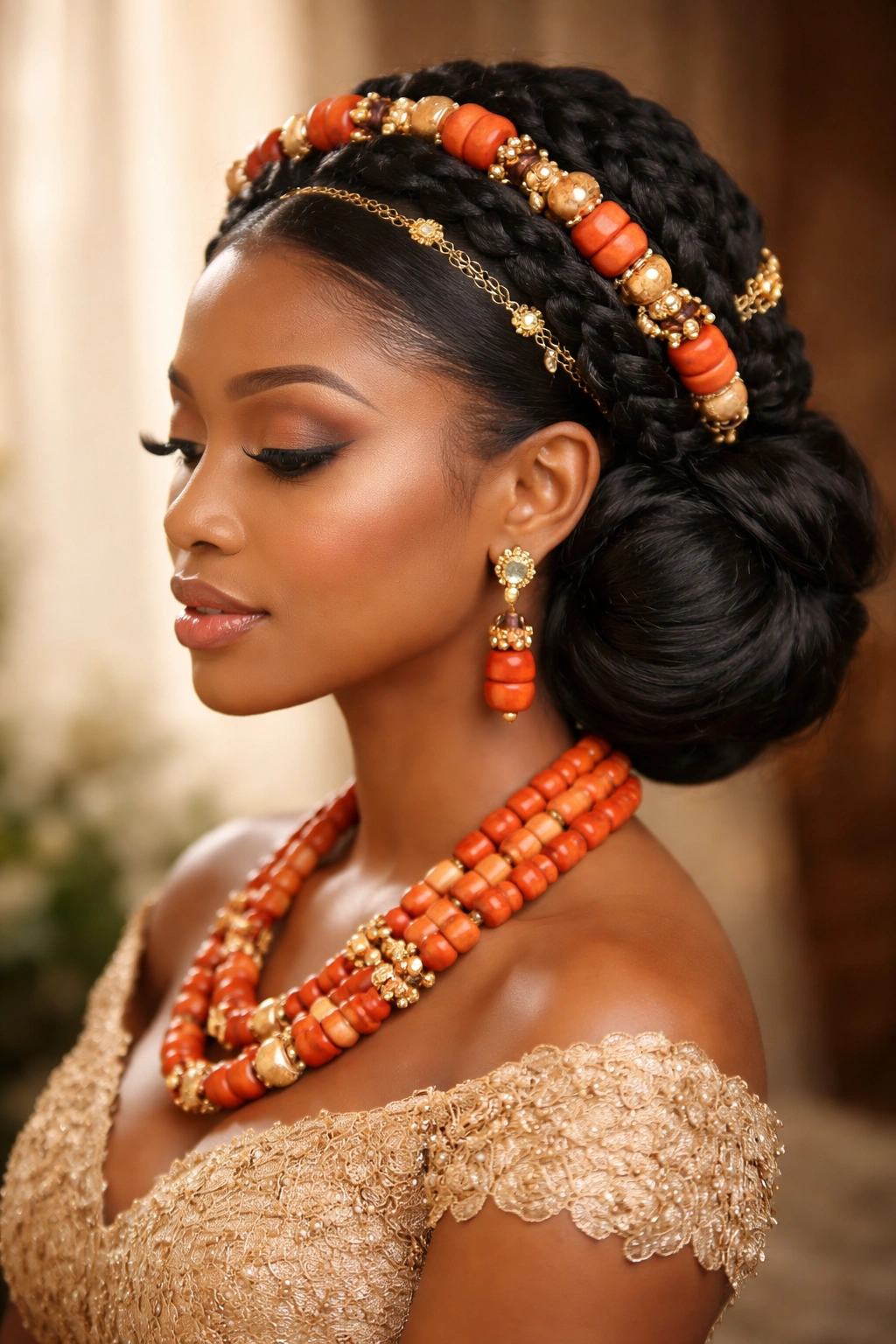
The crown braid is perhaps the most iconic Igbo bridal style, and it’s devastatingly elegant when executed well. This style features two or three thick braids arranged in a crown or circular pattern around the head, often interwoven with coral beads, gold thread, or both. The braids are positioned so they create a regal frame for the face, and the back of the head remains open for a voluminous low bun or loose waves. This style works beautifully with a gele (traditional head wrap) and allows your face and neck to remain fully visible — important if you’re wearing a detailed beaded blouse or statement necklace.
Why This Style Endures
The crown braid works because it honors tradition while feeling modern and wearable. It’s not so ornate that it becomes uncomfortable to wear for hours, but it’s detailed enough to command attention. The horizontal lines of the braids create a sophisticated silhouette, and the coral beads catch light as you move, creating subtle shimmer without being flashy. This style is forgiving if your hair isn’t extremely thick — even medium-weight hair braids beautifully when your stylist knows how to incorporate thread or beading into the weave.
How to Wear It and Make It Your Own
- Works with almost any skin tone and face shape; the curved lines soften angular faces and add structure to rounder ones
- Can be worn alone for a sleek look or paired with a dramatic gele in complementary fabrics
- The braids can be arranged tightly against the scalp for a formal effect or left slightly loose for a softer, more romantic feeling
- Coral beads are traditional, but gold, glass, or jeweled beads create equally stunning variations
- Pairs perfectly with an open-back or halter-neck dress because it doesn’t cover your shoulders or back
Pro tip: Have your braids done 2-3 hours before your wedding so they look fresh and taut in photos, but your scalp has time to relax slightly for comfort during the long day ahead.
2. The Elaborate Box Braid Updo
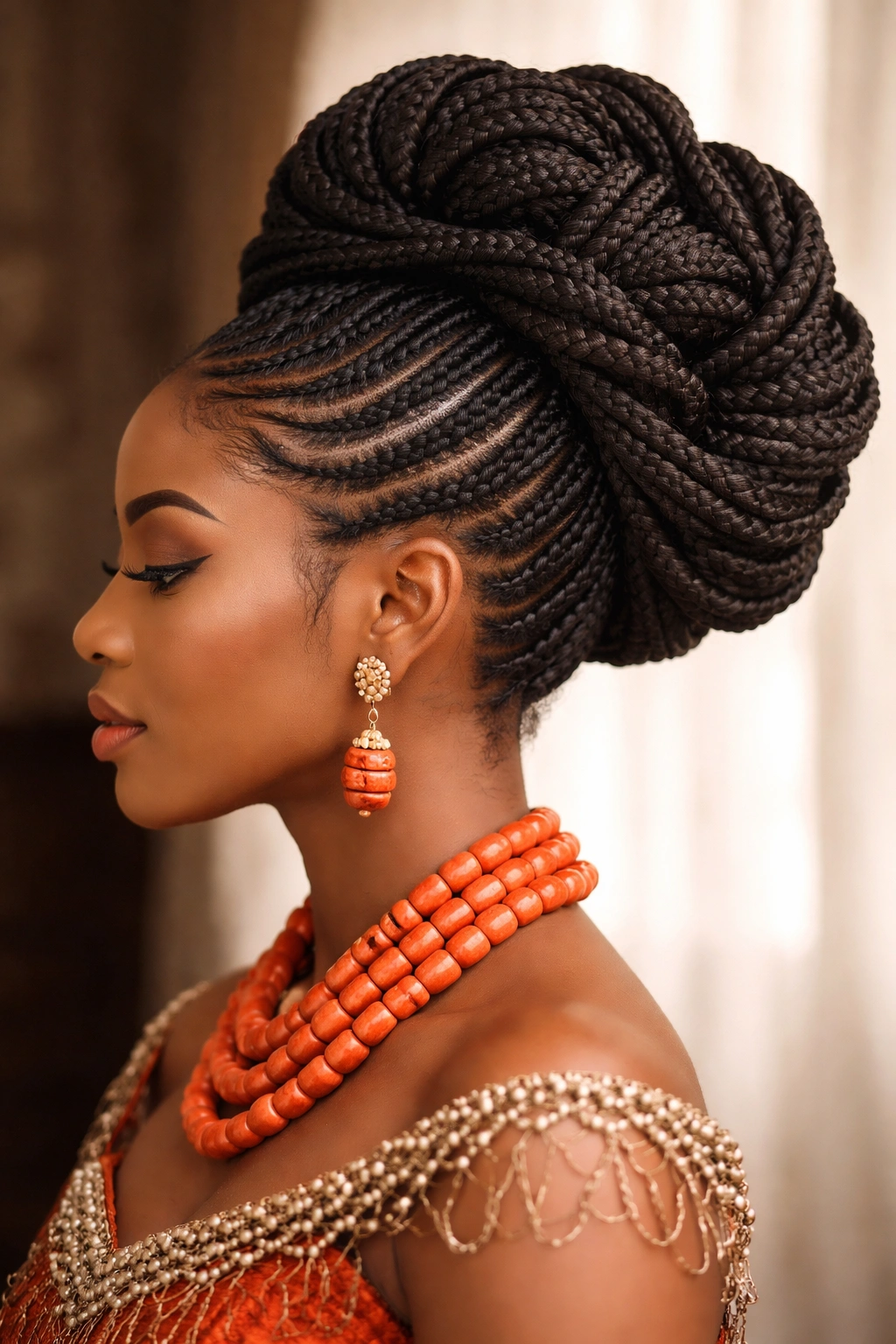
This style takes classic box braids to a completely different level — they’re arranged into an intricate updo with a clear focal point at the crown or back of the head. Smaller box braids are often incorporated around the hairline in geometric patterns, with larger braids forming the bulk of the updo. This style showcases serious craftsmanship; it demands time and skill from your stylist, but the result is a sculpture of hair that’s both protective and jaw-droppingly beautiful.
The Technique and Visual Impact
Box braids have practical roots — they protect your hair while looking intentional and striking. But when a skilled braider creates an elaborate updo with multiple braid sizes and careful arrangement, it becomes art. The geometric precision of the individual braids contrasts with the organic flow of the overall shape, and the way light plays across the braided texture creates incredible depth in photographs. This is the style to choose if you want maximum presence and impact, if you have medium to thick hair, and if you have time for your stylist to work unhurried on the day before your wedding.
Building Your Updo Vision
- Requires 6-8 hours of braiding time, so plan for this to be done the day before your wedding
- Works best with shoulder-length or longer hair; shorter hair can be braided but the updo won’t have the same volume
- Gold or silver thread woven through the braids adds luxury without overwhelming the design
- The smaller braids framing your face should complement the dimensions of your face — thicker braids for larger faces, finer braids for delicate features
- Consider leaving one or two braids slightly loose or wavy for a touch of softness and movement
- This style pairs beautifully with minimal jewelry since the hair itself is the statement piece
Pro tip: After your braids are complete, ask your stylist to gently curl the ends of the braids with a curling iron set to low heat. This gives them a polished finish and softens the overall look.
3. The Wrapped Hair with Face-Framing Braids
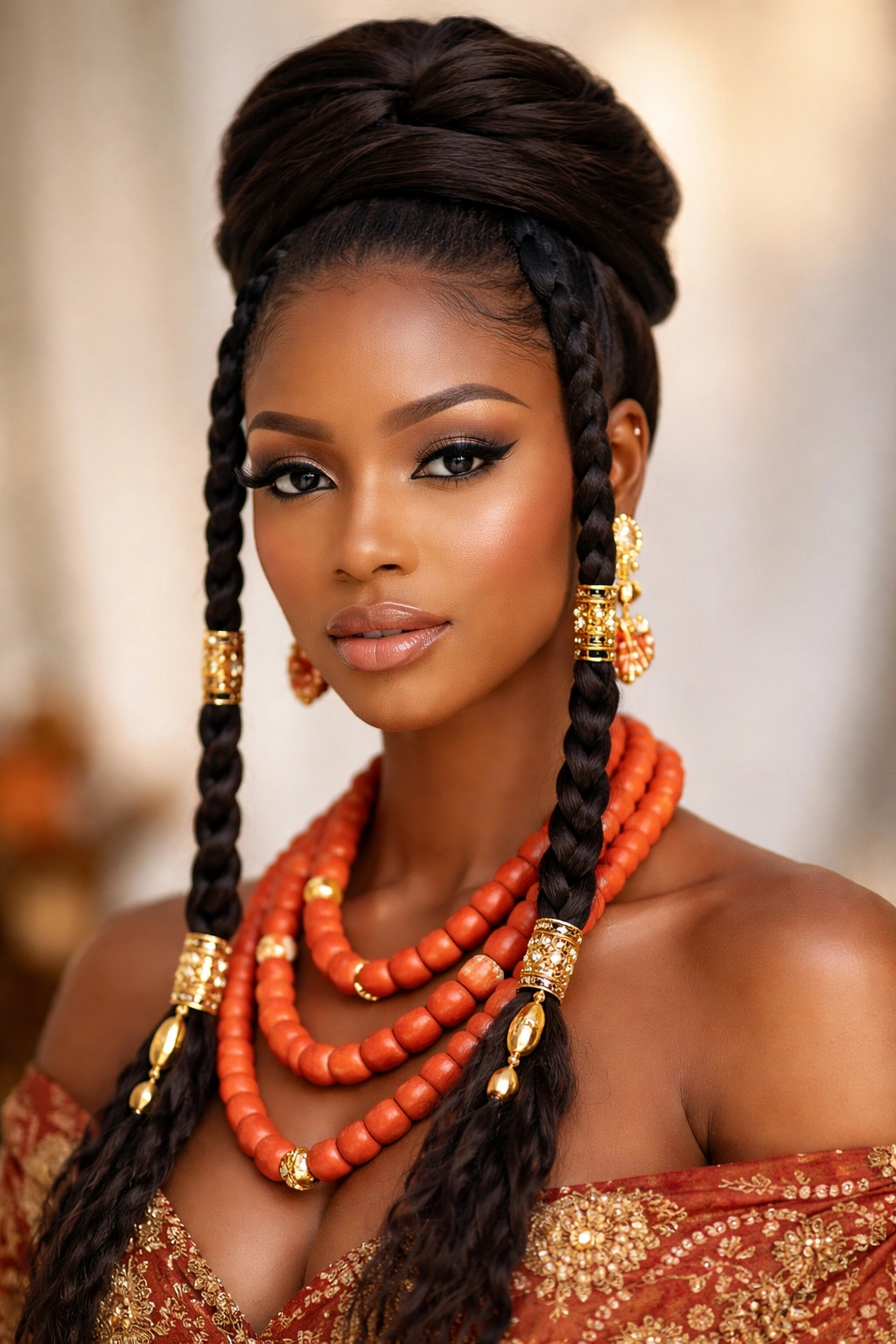
This hybrid style combines the elegance of wrapped hair (often using fabric or your own hair twisted and wrapped) with strategic face-framing braids. The majority of your hair is styled into a wrapped formation — either a single wrapped bun or a series of wrapped coils — while two or three thicker braids frame your face, often adorned with beads or gold. This style is particularly popular because it feels fresh and modern while remaining deeply rooted in Igbo tradition. It’s also one of the more comfortable options for all-day wear, since the wrapped sections distribute weight evenly.
The Art of Strategic Wrapping
Wrapped hairstyles require a soft touch and good tension control. Your stylist will section your hair, twist each section (either with your own hair or incorporating thread), and then wrap the twisted section with thread, ribbon, or fabric to create a smooth, finished appearance. When done well, the wraps look intentional and polished — not makeshift. The face-framing braids add dimension and break up the smoothness of the wraps, creating visual interest and ensuring your face remains the focal point. This is an excellent choice if you’re uncomfortable with extremely tight braiding or if you have a smaller face that benefits from framing elements.
Customizing Your Wrapped Style
- The thread or fabric used for wrapping can echo colors in your gele, outfit, or wedding décor
- Some brides use their own natural hair for wrapping (called “self-wrapping”), which creates a very sleek, seamless look
- The number and thickness of face-framing braids can be adjusted — more braids for drama, fewer for subtle framing
- Works beautifully with asymmetrical designs, where the wrapping is heavier on one side
- The wrapped sections can be positioned as a bun, coils, or even a wrapped crown formation
- This style keeps all your hair off your face and neck, ideal if you’re wearing a high collar, a detailed beaded neckline, or significant jewelry
Insider note: Ask your stylist to use bobby pins that match your hair color under the wraps. If even one pin shows through in photos, it can distract from the overall effect.
4. The Cornrow Crown with Extended Braids
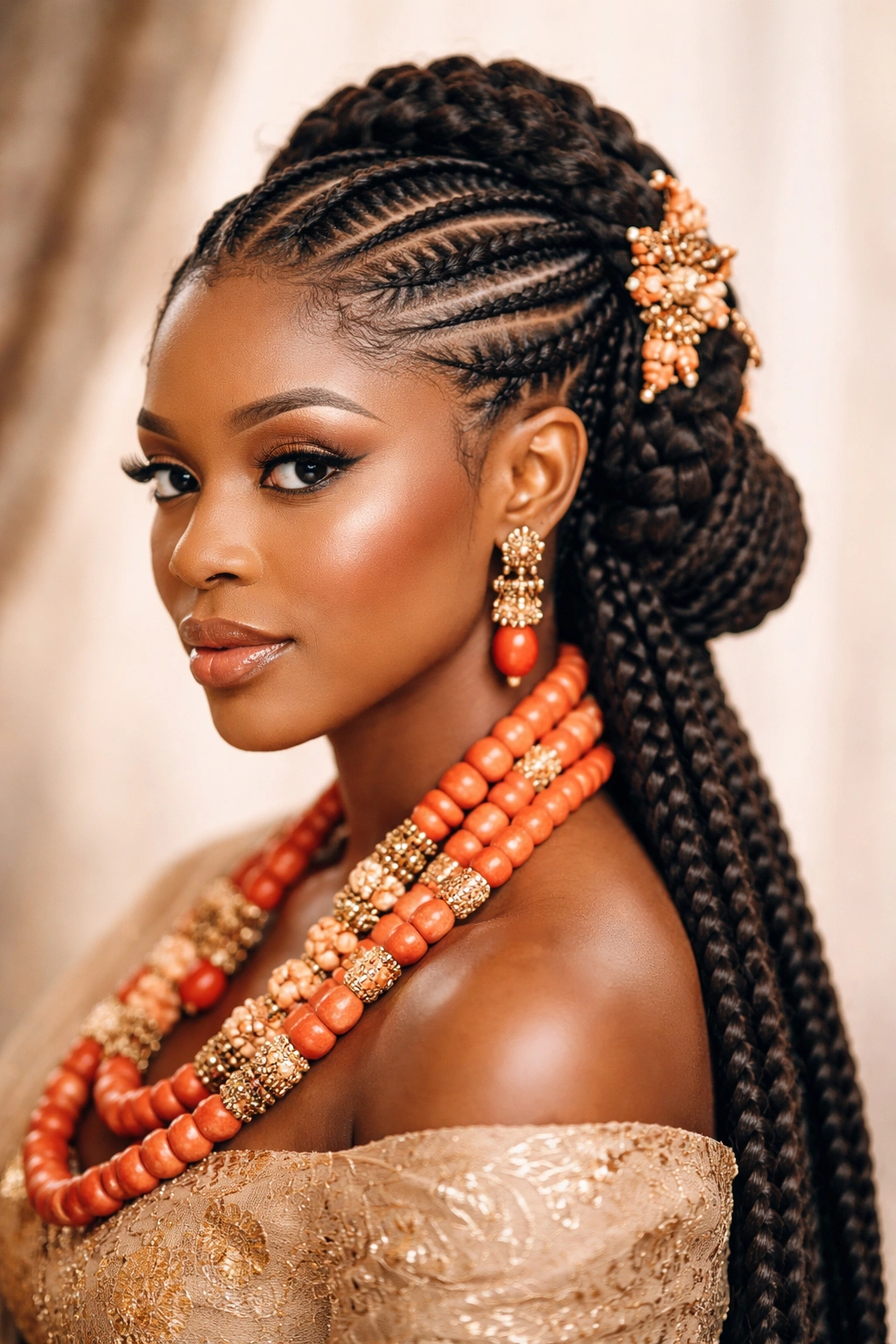
Cornrows have always been fundamental to Igbo hair artistry, and when a talented braider creates a crown of cornrows at the hairline with longer, thicker braids extending down the back or sides, the effect is stunning. The cornrows are typically positioned to create a defined pattern — sometimes geometric, sometimes more organic — and they flow into braids that can be left loose, braided together into a larger plait, or incorporated into a bun. This style balances precision with flow, and it’s an excellent option if you want something that feels clearly rooted in tradition while maintaining a modern sensibility.
Precision Patterns and Their Meaning
The pattern your braider creates in the cornrows can be simple (straight lines back from the face, for instance) or complex (geometric designs that create visual depth and movement across the head). Some brides work with their stylist beforehand to sketch out a specific pattern that holds meaning for them or their family. This level of customization transforms the hairstyle from beautiful to personal — it becomes a visual representation of your family history or your own intentional choice as a bride. The extended braids below the cornrows can be thick, thin, single, or multiple, depending on the overall effect you want.
Achieving Perfect Cornrow Placement
- The cornrows should follow the natural curves of your head, not fight them
- Tighter cornrows create a more formal, precise look; slightly loosened cornrows feel softer and more romantic
- Beads can be incorporated into the cornrows themselves or added as you go down the extended braids
- Many brides add gold thread to the cornrows for subtle shimmer
- The extended braids work well styled into a low bun, left loose for movement, or twisted together at the back
- This style is excellent if you have a well-shaped head and confident features that can handle the precision of cornrows
Pro tip: Cornrows can feel very tight for the first 24 hours, but they settle and become more comfortable. Wear a silk scarf loosely the night before your wedding to help them relax slightly without losing definition.
5. The Braided Low Bun with Statement Jeweled Brooch
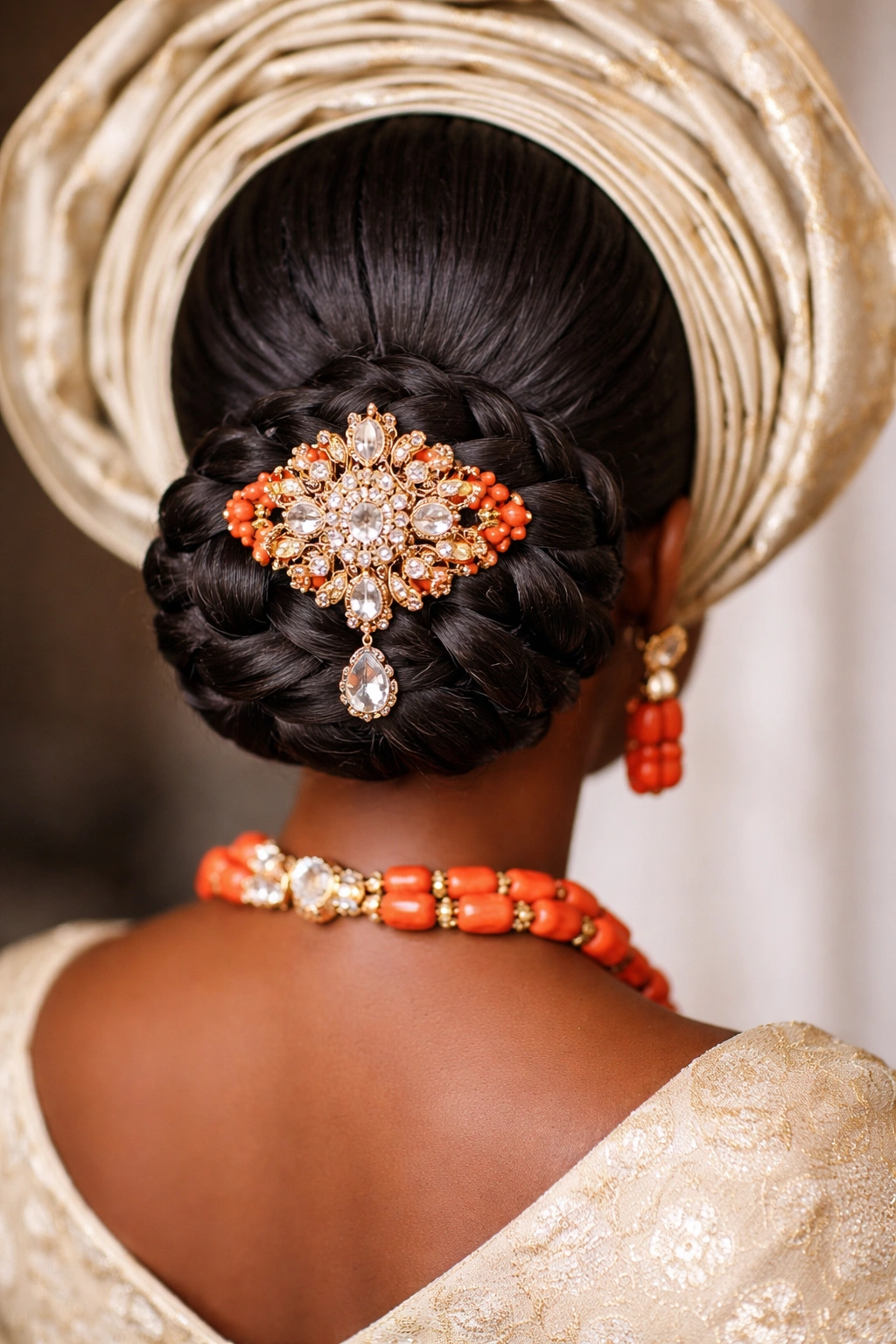
Sometimes elegance is understated. The braided low bun with a statement jeweled brooch takes sophisticated simplicity and elevates it with one striking focal point. Your hair is gathered into a low bun at the nape of your neck, constructed from multiple interwoven braids to create texture and visual interest. A large, ornate jeweled brooch — often featuring coral, gold, and gemstones — secures the bun and serves as a stunning focal point. This style works beautifully with a gele and is ideal if you want your entire bridal ensemble to shine, not just your hair. The brooch becomes a jewelry piece that can be passed down or worn again.
The Understated Drama of Textured Details
While this style appears simple at first glance, the texturing matters enormously. The braids that form the bun shouldn’t be uniform — varying the braid thickness or incorporating thinner, delicate braids alongside thicker ones creates depth and prevents the style from looking flat. The jeweled brooch shouldn’t just sit on top of the bun; it should be positioned to anchor it and appear intentional, almost architectural. This is the style to choose if you prefer restraint and elegance over maximum volume, if your wedding outfit is already quite ornate, or if you want a style that won’t feel dated in ten years.
Making the Brooch the Star
- The brooch should complement your gele and your beaded blouse, not clash with them
- Vintage or heirloom brooches work beautifully here — this is an excellent opportunity to wear a family piece
- Your braids don’t need to be extremely tight; in fact, a slightly softer bun with a strong brooch looks more modern
- The low position of the bun elongates the neck and works well with most neckline styles
- Hair can be curled gently at the nape for softness, or kept sleek for maximum polish
- This style requires minimal hair length — even shoulder-length hair works well
Worth knowing: Make sure your brooch is actually secured to something stable before the wedding day. A safety pin, hair stick, or sturdy comb backing gives you peace of mind that it won’t shift during dancing or movement.
6. The Twisted Crown with Side Sweep
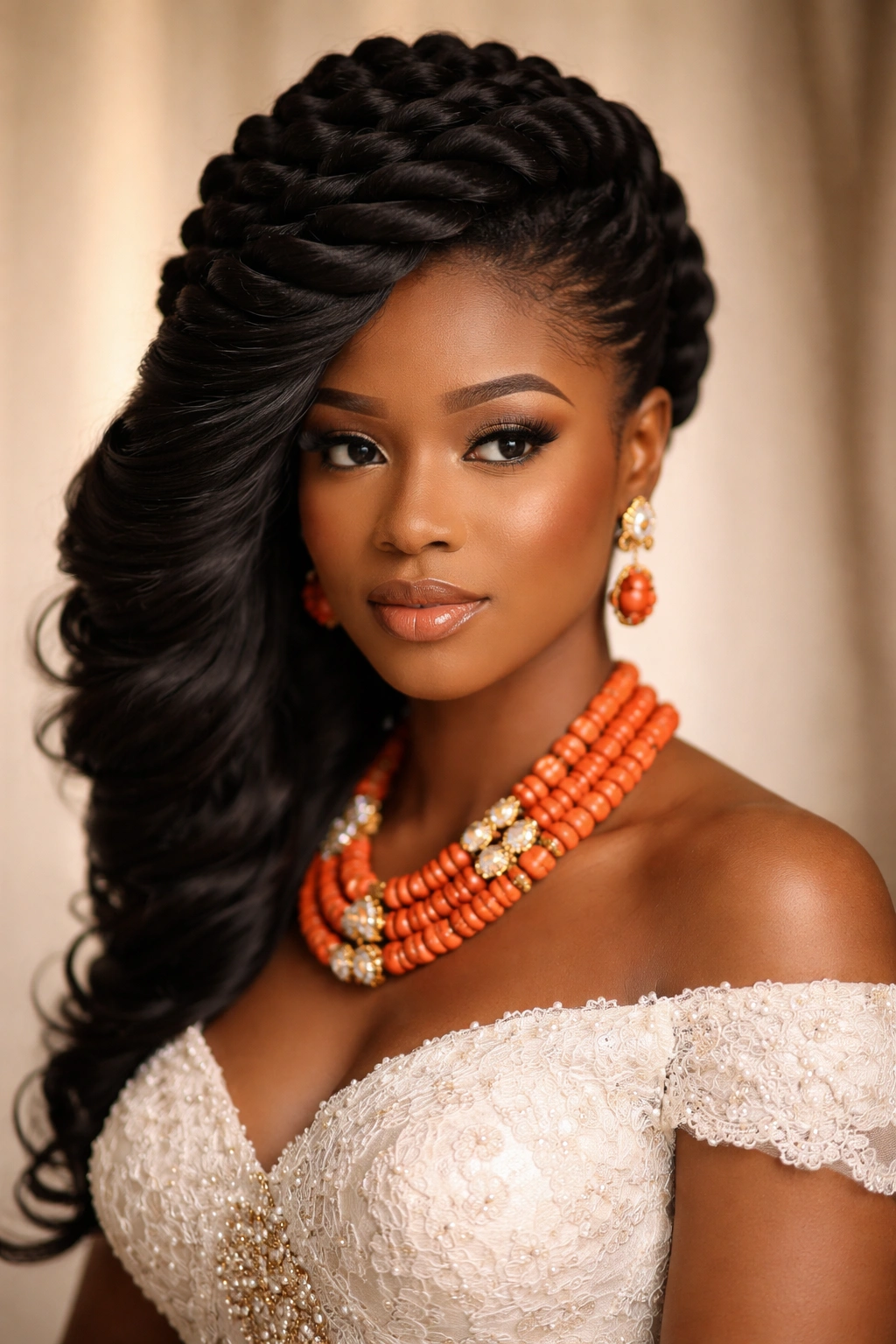
Rather than braids, this style features thick twists arranged in a crown pattern, with one twist swept dramatically to the side. Twists are smoother and softer than braids, creating an elegant, almost Art Deco aesthetic. Your natural hair or hair with added texture forms the twists, and they’re arranged to create height at the crown and movement across the head. The side sweep creates asymmetry and prevents the style from feeling too formal or rigid. This option is perfect if you want your hairstyle to feel romantic and soft rather than geometric and precise.
The Elegance of Twisted Details
Twists are underrated in Igbo bridal styling, probably because braids are more traditional, but they deserve more attention. A twisted style feels less sculptural and more fluid than braids; it moves slightly with your body, which creates an almost living quality. Twists also photograph beautifully because the twisted texture catches light differently than braids, creating a subtle shimmer that shows up gorgeously in photographs. If you have fine or medium-weight hair that doesn’t hold braids quite as dramatically, twists can be the perfect solution.
Arranging Your Twists for Maximum Impact
- Start with a consultation showing your stylist photos of the general arrangement you want
- The side sweep should feel natural, not forced — typically the twist moves from one side at the crown toward the opposite shoulder
- Twists can be loosely arranged so they feel touchably soft or tightly twisted for a more defined look
- Adding thin gold thread or beads to the twists adds glamour without changing the fundamental feel
- Your twists should be pinned so they’re secure but the pins aren’t visible in photos
- This style works beautifully with loose waves or curls at the bottom, creating contrast between the structured crown and free-flowing ends
Pro tip: Twists that are slightly loosened after installation look more romantic in photos. Ask your stylist to gently separate and fluff the twists for a softer effect about 30 minutes before you need to be photographed.
7. The Geometric Braided Crown with Negative Space
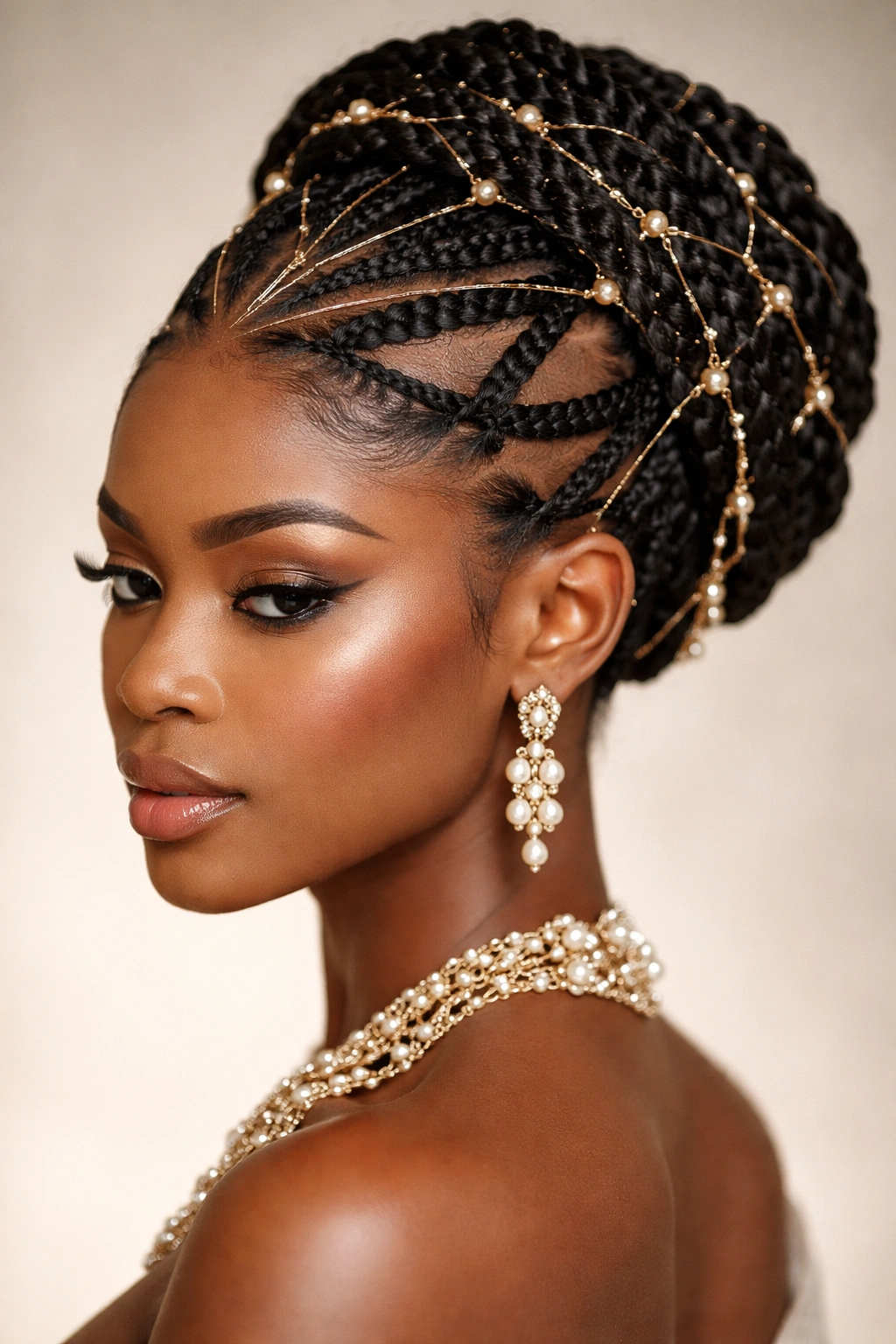
For the bold bride who wants maximum visual impact, this style features geometric braiding that intentionally creates negative space — areas of visible scalp arranged in a pattern that becomes part of the design itself. Your stylist might create cornrows in a specific geometric pattern (chevrons, triangles, abstract shapes) with spaces between them, making the overall design more striking than a full head of braids would be. This style often incorporates beads or gold thread both in the braids and in the geometric spaces themselves.
The Drama of Strategic Negative Space
This is the style that makes people stop and stare. It’s bold, intentional, and demands confidence from the wearer, but on the right bride, it’s absolutely unforgettable. The negative space prevents the style from being overwhelming even though it’s visually complex. Geometric braiding also allows your stylist to be creative — this is where your personal story or your family’s history might be represented through the specific pattern your braider creates. It’s high-fashion meets cultural tradition, and it photographs exceptionally well.
Making Geometric Braiding Work for You
- Requires a scalp that’s healthy and completely clear (no flaking, irritation, or tenderness)
- Works best with thicker hair; finer hair can be geometric braided, but it demands extra skill
- The pattern should complement your face shape — angular patterns for round faces, softer patterns for angular faces
- Beads look stunning in the negative space, creating a unified design
- Your gele can echo the geometric theme, creating a cohesive overall look
- This style is less about longevity and more about that specific moment — plan accordingly if you want to change into an evening hairstyle
Real talk: This style requires a stylist with serious skill and vision. Look at their portfolio closely. If you love the concept but are nervous about the execution, consider scheduling a consultation or test run specifically for this style.
8. The High Braided Bun with Softness at the Nape
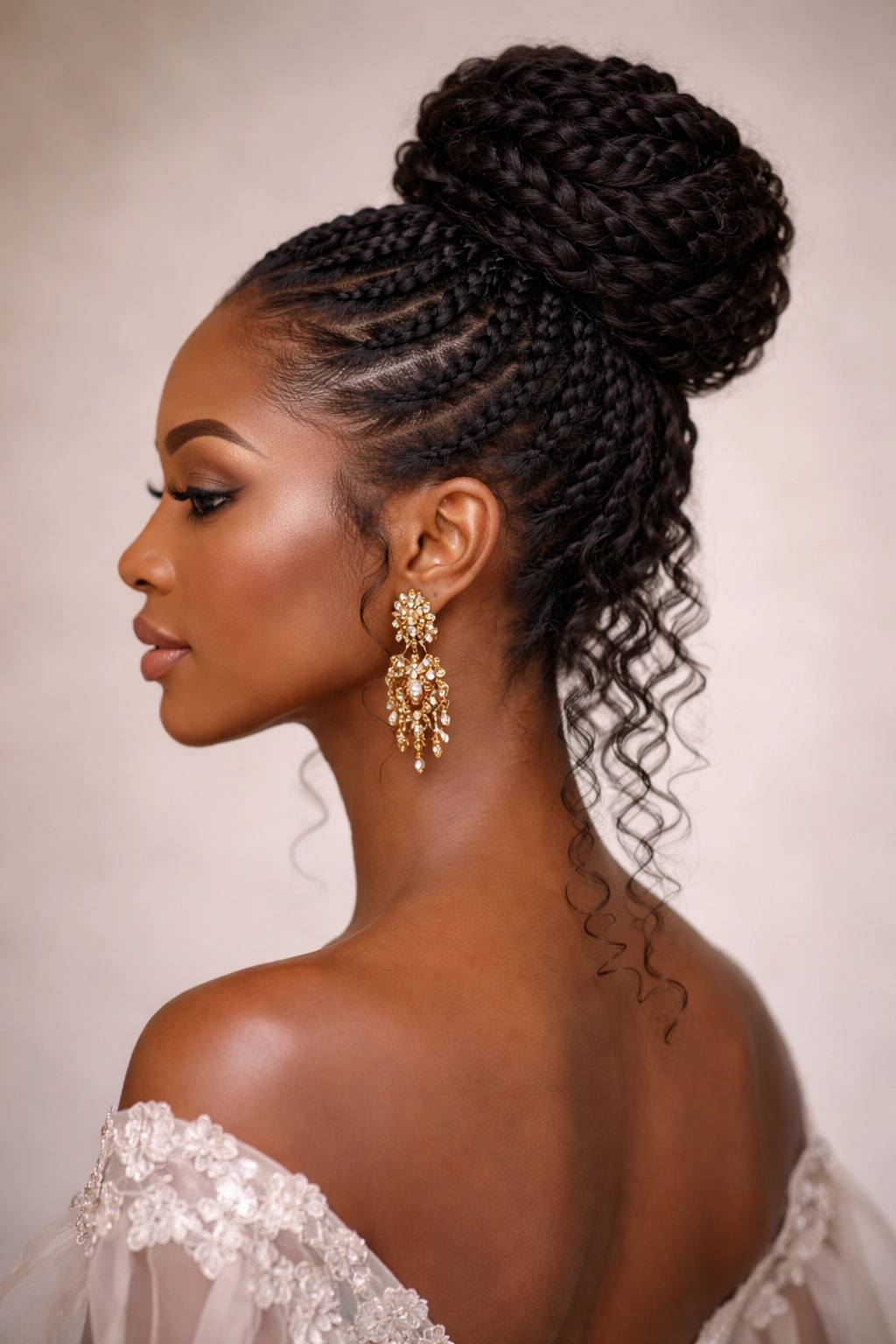
A high braided bun sits at the crown of the head, and the braids that form it are elaborate and ornate, but the nape of the neck is kept soft and slightly loose. Some women leave a few small braids or twists loose at the nape, while others simply allow some natural hair or soft curls to frame the back of the neck. This creates contrast — formal and structured on top, romantic and soft below. It’s an excellent style for women who love the elegance of a high bun but want their style to feel less severe and more approachable.
Balancing Structure with Romance
The high positioning makes you appear taller and more regal, and it keeps all your hair off your face and neck. The softness at the nape prevents the overall look from being too severe — it whispers femininity even as the high bun declares confidence and formality. This is a particularly good choice if you have a long, graceful neck that benefits from being fully exposed, or if you’re wearing a dress with an open back or low back. The contrast between the structured braids and the soft nape elements creates visual interest and feels deeply intentional.
Achieving the Right Balance
- The braids forming the bun should be tight enough to stay secure but not so tight they cause discomfort
- The softness at the nape can be created with loose braids, twists, tendrils, or gentle curls
- The transition from structured to soft should feel natural, not like two different hairstyles
- This style works beautifully with a statement earring or neck jewelry since your neck is prominently featured
- Hair at the nape can be curled with a small-barrel curling iron for delicate waves
- The overall effect should feel balanced — if the top is extremely ornate, keep the nape simpler, and vice versa
Styling note: Spray a light hairspray on the soft nape elements before photos to ensure they hold but still look natural and touchable.
9. The Wrapped and Braided Hybrid with Cascading Elements
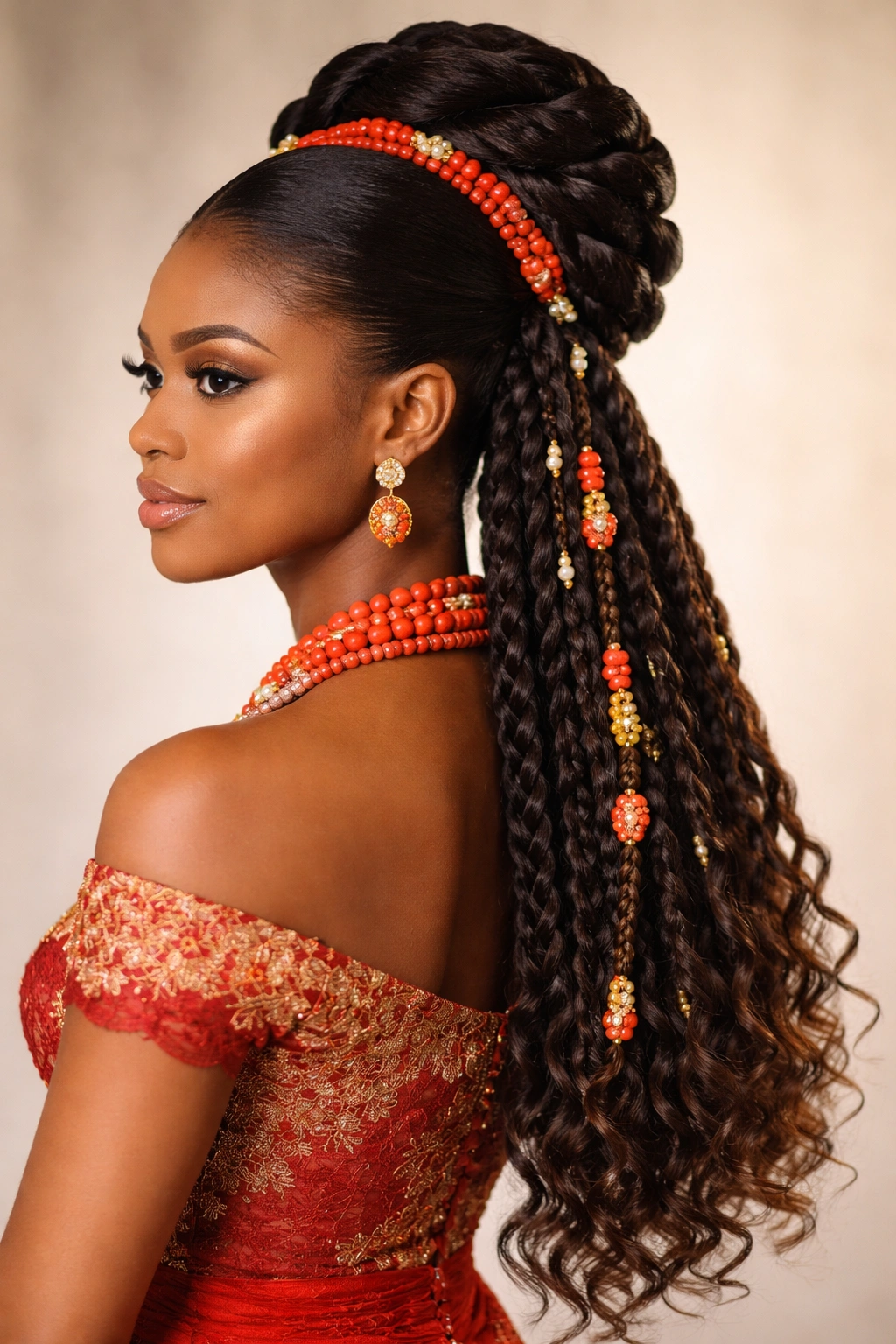
This style is where wrapping and braiding come together into one cohesive, flowing design. A significant portion of your hair is wrapped (either self-wrapped or wrapped with thread), while thicker braids are positioned to cascade down the sides or back of your head. The wrapping creates a smooth, polished foundation, and the cascading braids add movement and softness. Some of the cascading braids can be left loose at the bottom, creating an organic, almost painterly effect. This is a style that celebrates the full range of your stylist’s skill set and is excellent if you want something that feels utterly unique.
The Artistry of Blending Techniques
When wrapping and braiding are combined by a stylist who knows how to balance the two techniques, the result is sophisticated and complex without feeling chaotic. The wrapped sections provide visual rest and sophistication, while the cascading braids add movement and interest. This style is particularly effective in photography because it has multiple visual levels — close up, you see the intricate wrapping and braiding; from a distance, you see the overall shape and movement. It’s a style that rewards being viewed from multiple angles.
Creating Your Unique Wrapped-and-Braided Vision
- Start with a sketch or Pinterest board showing the general balance you want
- The wrapped sections should feel intentional and smooth; loose or sloppy wrapping undermines the entire effect
- The cascading braids should be thick enough to read as significant design elements, not thin or delicate
- Consider whether you want the braids to stay in the style all day or cascade loose by evening
- Adding subtle beads to both the wrapped sections and the braids creates visual unity
- This style suits brides with longer hair (18+ inches) since you need length for the cascading elements to be dramatic
Pro tip: Have your stylist take photos of the cascading elements before you put on your gele or your dress. These photos capture the full intricacy of the design and are beautiful for your wedding album.
10. The Traditional Igbo Bride’s Crown with Full Ornamentation
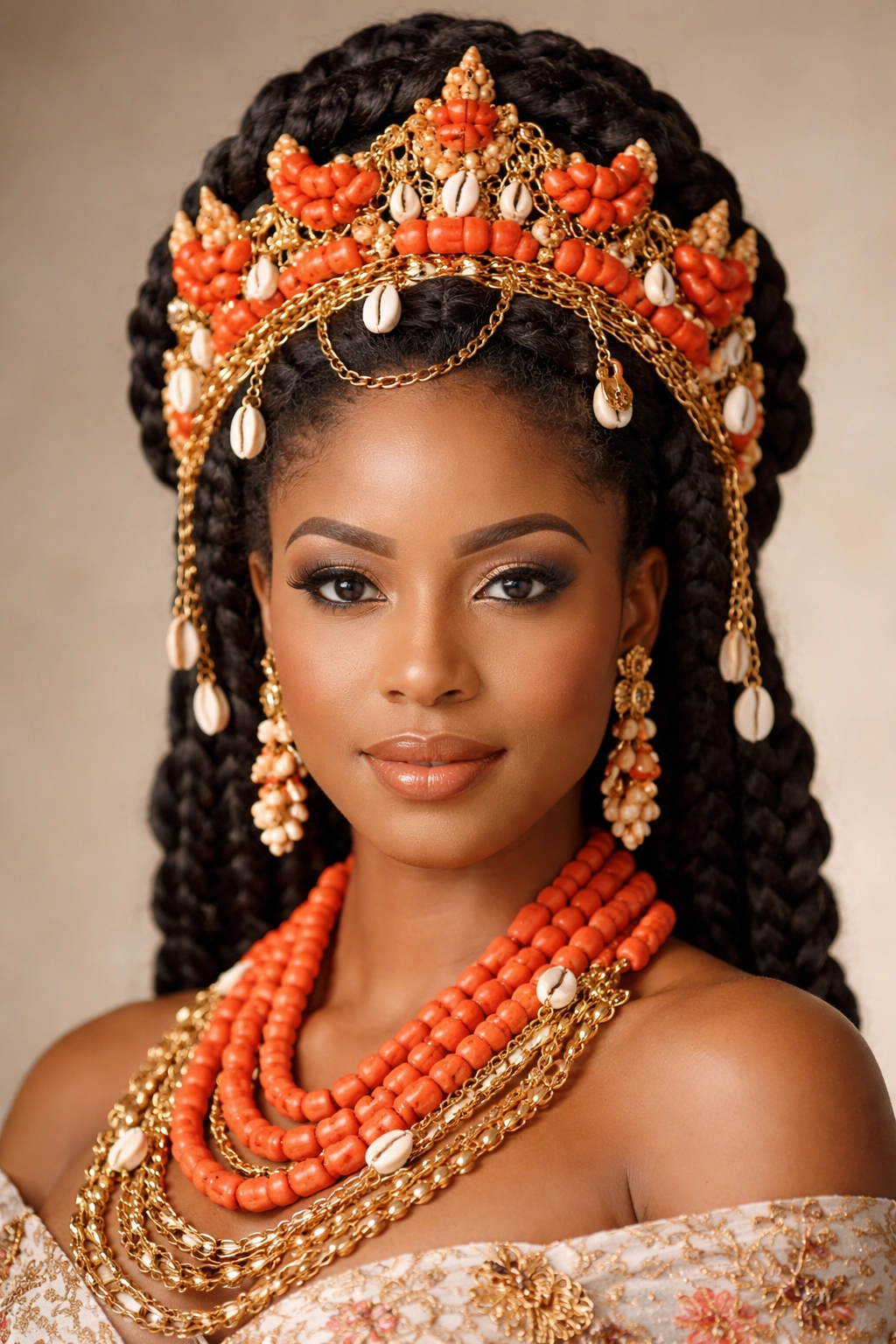
This is tradition with all the beauty marks. Your hair is braided in the style historically worn by Igbo brides — typically a series of neat braids arranged in a specific pattern that might vary by region or family tradition — and then adorned with coral beads, gold chains, cowrie shells, or other ornaments that hold cultural significance. The braids themselves might incorporate a significant amount of thread or beading so that the ornamentation is built into the hairstyle, not simply added on top. This is the style to choose if honoring your cultural heritage and family traditions is the primary goal of your bridal hair.
The Sacred and the Beautiful
Wearing a traditional crown style isn’t just about looking beautiful on your wedding day — it’s about connecting to your ancestors, honoring your family, and participating in a lineage of Igbo women who’ve worn similar styles at their own weddings. If you’ve learned that your family has a specific braiding pattern or style passed down through generations, or if your mother or grandmother had a particular way of adorning the bride’s hair, this is the time to research and potentially recreate that tradition. Your stylist might need guidance from family members, and that’s not just acceptable — it’s the entire point.
Honoring Tradition with Personal Authenticity
- Meet with elders in your family to understand what your family’s traditional style looks like
- The ornaments you choose should hold meaning — whether that’s family-specific beads, your family’s coral shade, or symbols that matter to your heritage
- This style often takes longer to execute because of the amount of ornamentation, so plan accordingly
- Coral is traditional, but work with what your family uses — some families emphasize gold, others favor pearls or specific beads
- The style should feel abundant and celebratory, not sparse or minimalist
- Consider whether you’ll wear this specific style for your Igbo ceremony only, or for your entire wedding day
Worth knowing: If certain ornaments or materials are family heirlooms, arrange well in advance to have them properly cleaned and secured by your stylist. Some pieces might need special handling to remain safe throughout the day.
Final Thoughts
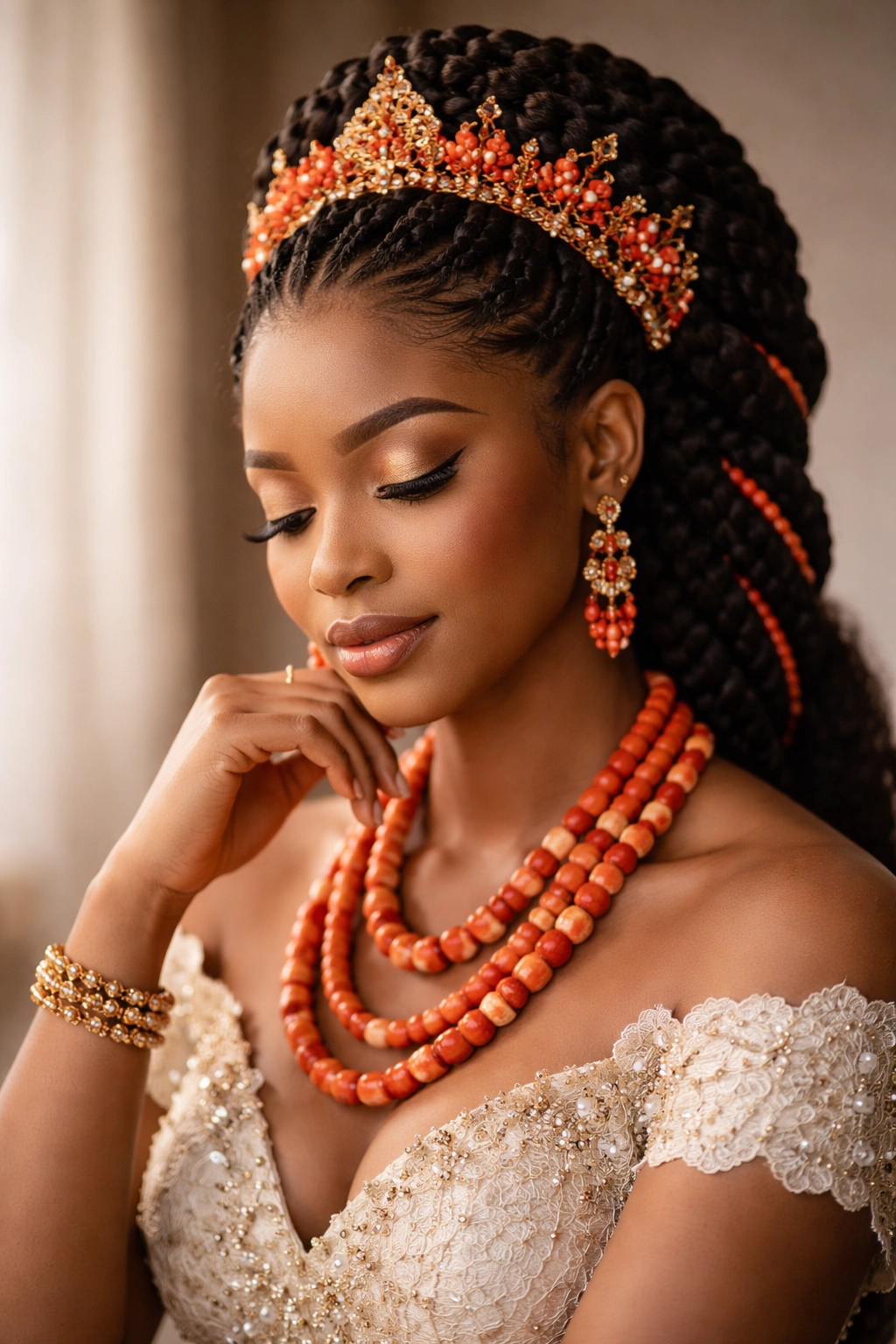
Choosing your Igbo bridal hairstyle is one of the most meaningful decisions you’ll make in your wedding planning because it touches so many layers — aesthetics, cultural identity, family connection, and personal preference all come together in that choice. There’s no single “right” style, only the style that feels right for you. That might be a completely traditional style that honors your family’s specific heritage, a contemporary interpretation that celebrates your creative vision, or something in between that honors both tradition and individuality.
The most important thing is to choose a style you genuinely love and a stylist who understands both the technical skill required and the cultural significance behind it. Start your planning early, get a test run if possible, and take time to sit with your choice. On your wedding day, your hairstyle should feel like a natural extension of yourself — beautiful, intentional, and completely yours. Whether you’re wearing a crown of coral-adorned braids, an elaborate wrapped updo, or anything in between, you’re participating in something much larger than just a hairdo. You’re becoming part of the ongoing story of Igbo women celebrating love, beauty, and heritage.
