



Some Bantu knots look neat and sculpted. The styles people save, screenshot, and bring to the salon chair are usually the ones with contrast: a clean knot at the root, then a burst of curl at the end, along the hairline, or through the loose sections. Bantu knots with curls do something plain knots cannot. They give you shape and movement.
They also ask for more skill than people think. If the sectioning is sloppy, you see it right away. If the base is pulled too tight, your scalp starts complaining before lunch. And if the curls are limp, fuzzy, or set on the wrong size rod, the whole style loses that crisp finish that makes it stand out in photos and in real life.
There is history here too. Bantu knots come from African hair traditions, and they deserve to be named correctly and worn with respect. A good set is not random. The size of each part, the direction of the twist, the hold of the mousse, the choice between finger coils, flexi rods, perm rods, or added curly hair — all of that changes the final look.
Some of these styles lean soft and playful. Others are sharp enough for a formal event, a shoot, or a night when you want your hair to do half the talking. The difference lives in the details.
1. Jumbo Crown Bantu Knots With Loose Spiral Ends
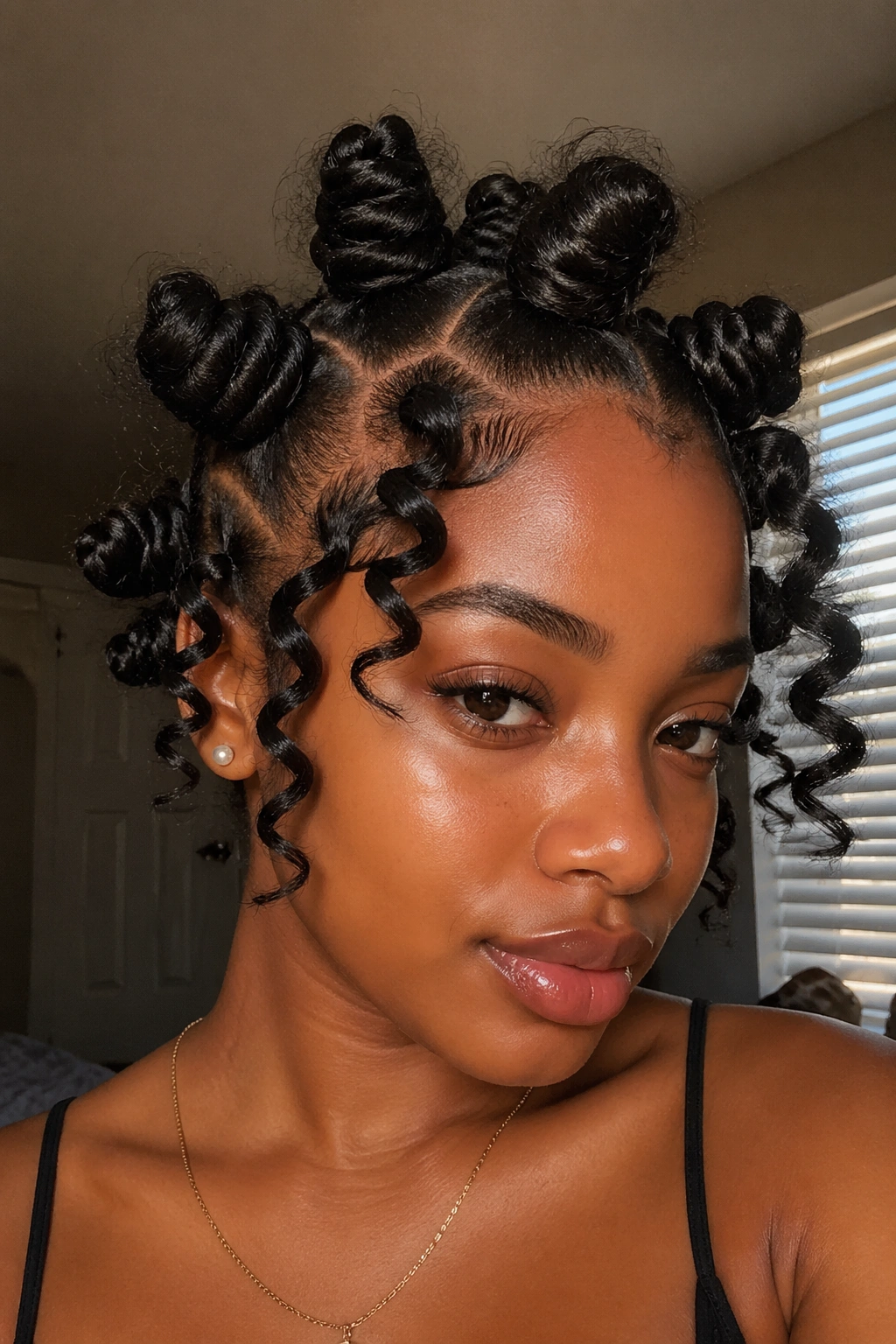
Big sections change the whole mood. Instead of a busy head full of tiny knots, you get six to eight jumbo knots placed across the crown, then soft spiral ends peeking out like punctuation marks.
The trick is proportion. Ask for parts around 2 to 2½ inches wide so the knots look intentional rather than oversized by accident. On medium or long natural hair, the ends can be wrapped loosely and left out for a soft spiral finish. On shorter hair, a small amount of curly extension hair gives the same effect without forcing the knot too tight.
Why the big sections work
Large knots put the focus on your face and your bone structure. They also install faster, which matters if you are not interested in spending three hours getting tiny sections polished.
Fast styling notes
- Best on: medium to long natural hair, stretched hair, or added hair
- Curl method: wrap the loose ends on purple perm rods for a wider spiral
- Parting shape: clean squares keep the look bold and graphic
- Finish product: a light shine foam helps the spirals separate instead of clumping
Pro tip: leave about 1 inch of the ends out before wrapping the knot if you want the curls to read first, not the bun.
2. Mini Grid Bantu Knots With Corkscrew Curls
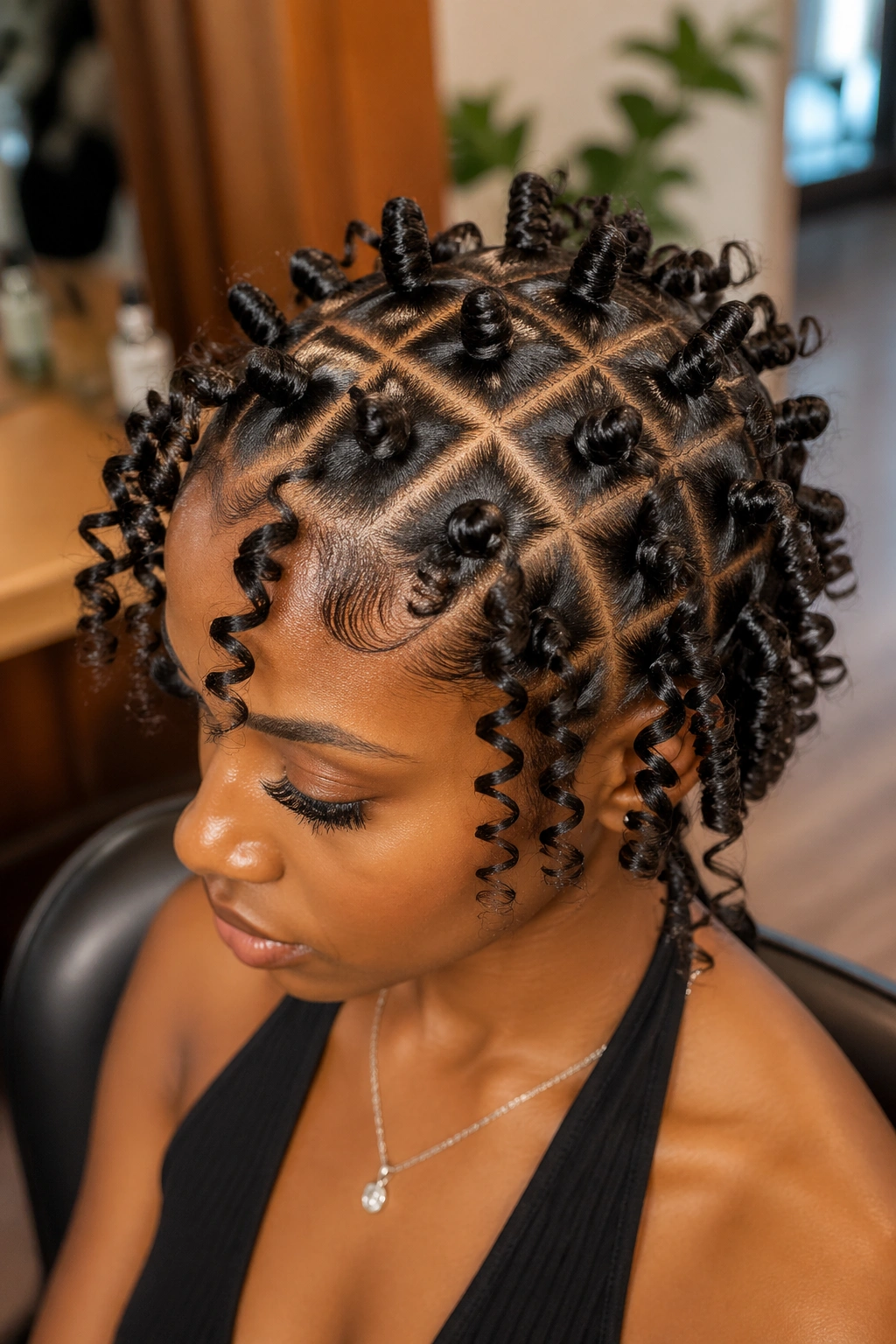
If you want a style that looks detailed from every angle, go smaller. Mini grid Bantu knots with corkscrew curls have that sharp, precise finish that holds attention because the patterning is so deliberate.
A tight grid of 12 to 20 small sections creates a clean, almost beaded effect across the scalp. Then the curls come in and soften the geometry. I like this look most when the ends are set on orange or gray perm rods, because the curl is narrow enough to bounce but not so tiny that it turns into fuzz by day two.
This one suits dense hair. Coarse, thick strands help each knot hold its round shape, and the small curls give the style motion when you turn your head. There is also less empty scalp showing, which some people prefer.
Maintenance matters more here. Sleep with a satin scarf tied snug around the edges and another bonnet over the top, because mini knots frizz faster when every little section is exposed. Done cleanly, though, this style looks crisp for days and gives you a strong knot-out when you take it down.
3. Half-Up Bantu Knots With Shoulder-Length Curls
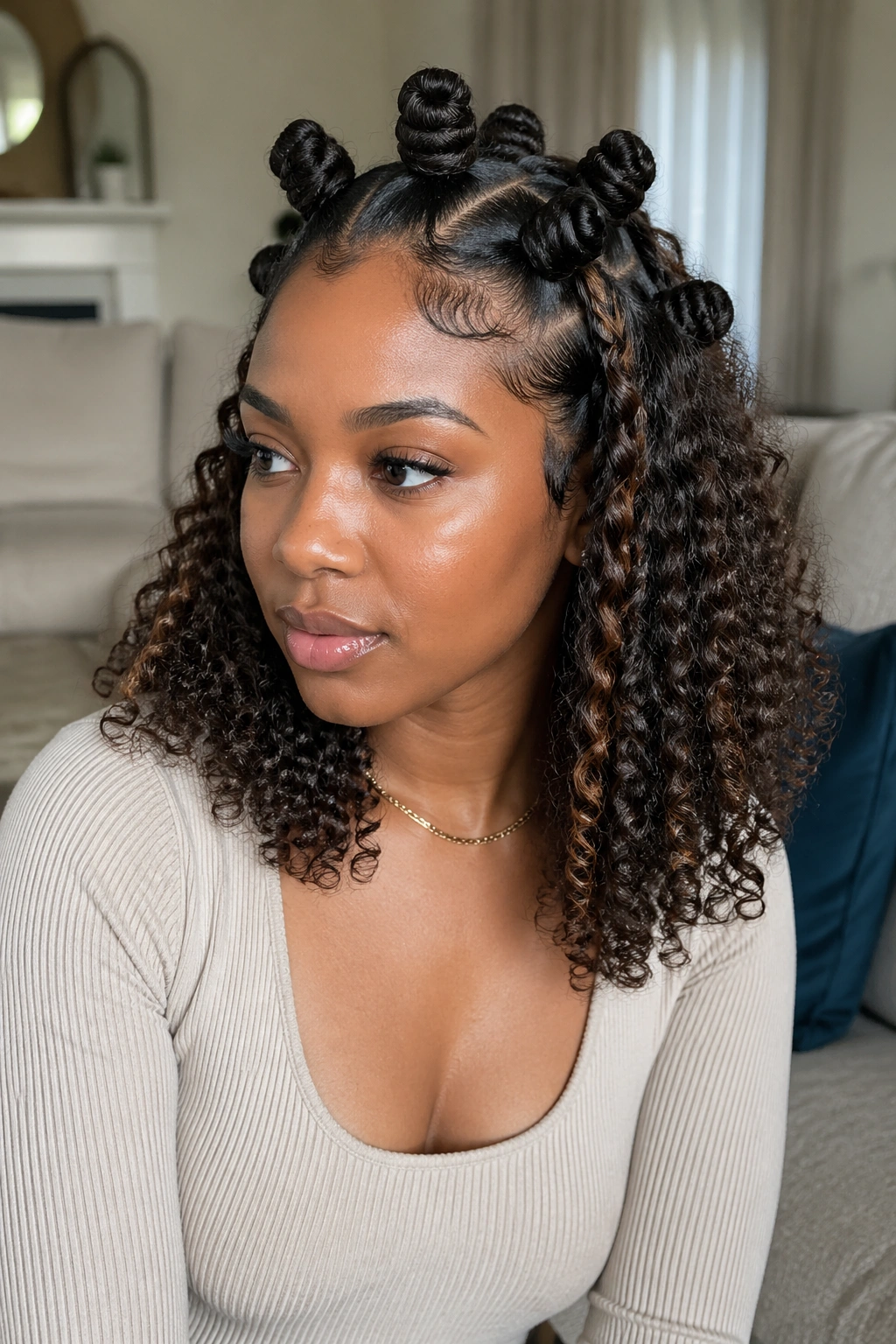
Need something softer than a full head of knots? A half-up set gives you the sculpted feel of Bantu knots on top while letting the curls do their thing through the back and sides.
This works especially well on shoulder-length hair because the loose curls create width around the jaw and neck, which balances the height of the knots. Usually four to six knots on the top half is enough. More than that, and the loose section can start to look like an afterthought.
How to split the shape
Keep the parting line slightly above the temples rather than straight across the middle of the head. That higher split gives the top section lift and lets the curls underneath fall cleanly instead of bunching at the shoulders.
For the loose section, use a setting foam and define the curls before the knots are wrapped. Finger coils work if you want a tighter spring. A large flexi rod gives you a softer drop.
A style like this earns its place because it does two jobs at once. From the front, you get structure. From the side and back, you get swing.
4. Triangle-Part Bantu Knots With Defined Ringlets
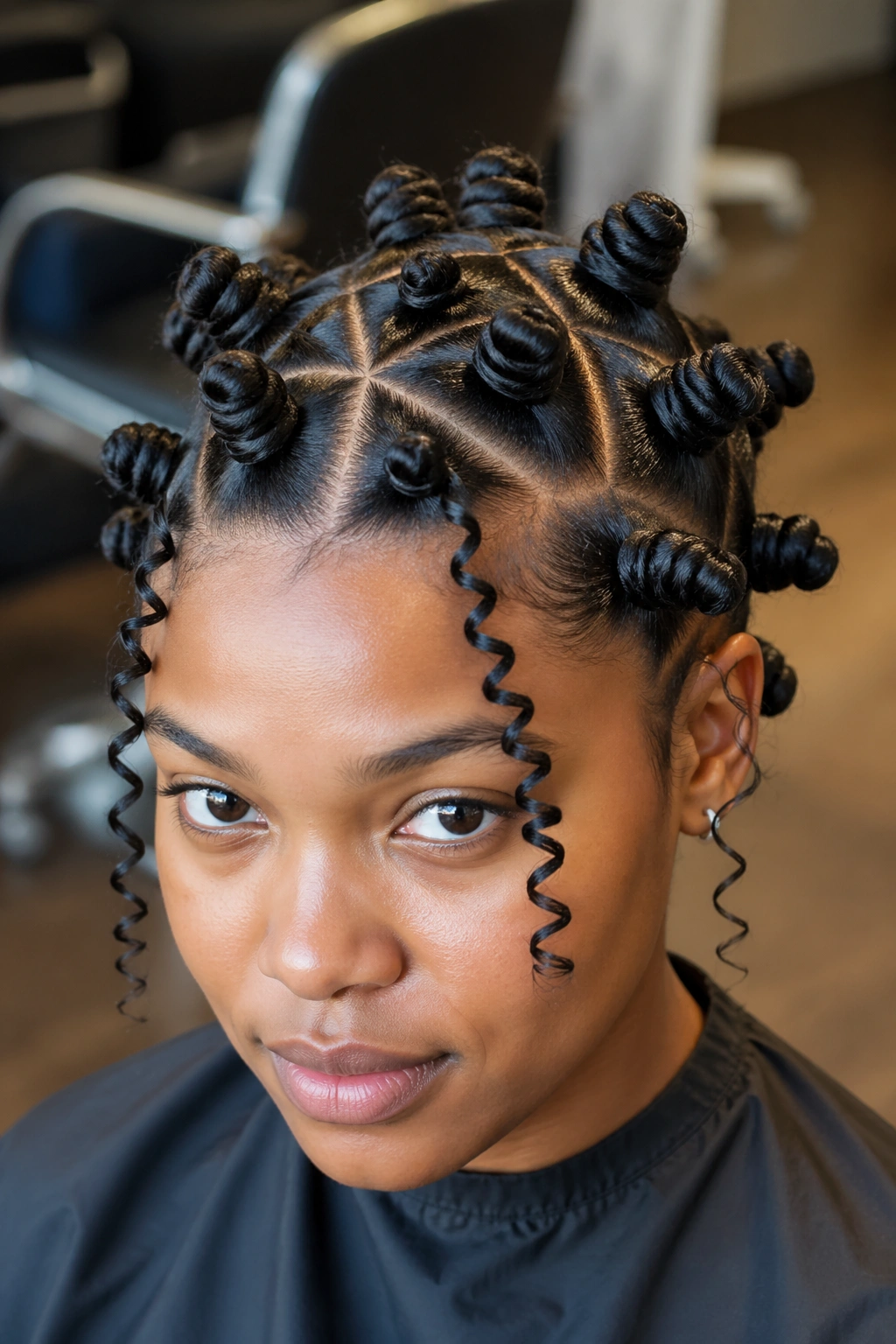
A stylist who knows how to part hair can turn a simple knot set into something far more graphic, and triangle parts are one of the quickest ways to get there. They change the whole scalp pattern before the curls even enter the picture.
Instead of straight lines crossing each other, each knot sits on a pointed base, which gives the style a sharper, more directional look. Then the defined ringlets soften that structure.
What makes this one hit harder
- Triangle parts make the scalp design visible, even from a distance
- Medium-size knots keep the pattern clear; tiny knots can crowd the shape
- Ringlets look best when each end is smoothed with gel before rolling
- Edge control matters here because the clean lines are part of the whole point
Go with 8 to 12 knots so each triangle has room to show. I also prefer this look with a side or diagonal layout instead of a strict center split, because the pointed sections already give you enough symmetry. Too much order can make it feel stiff.
5. Side-Part Bantu Knots With a Curly Fringe
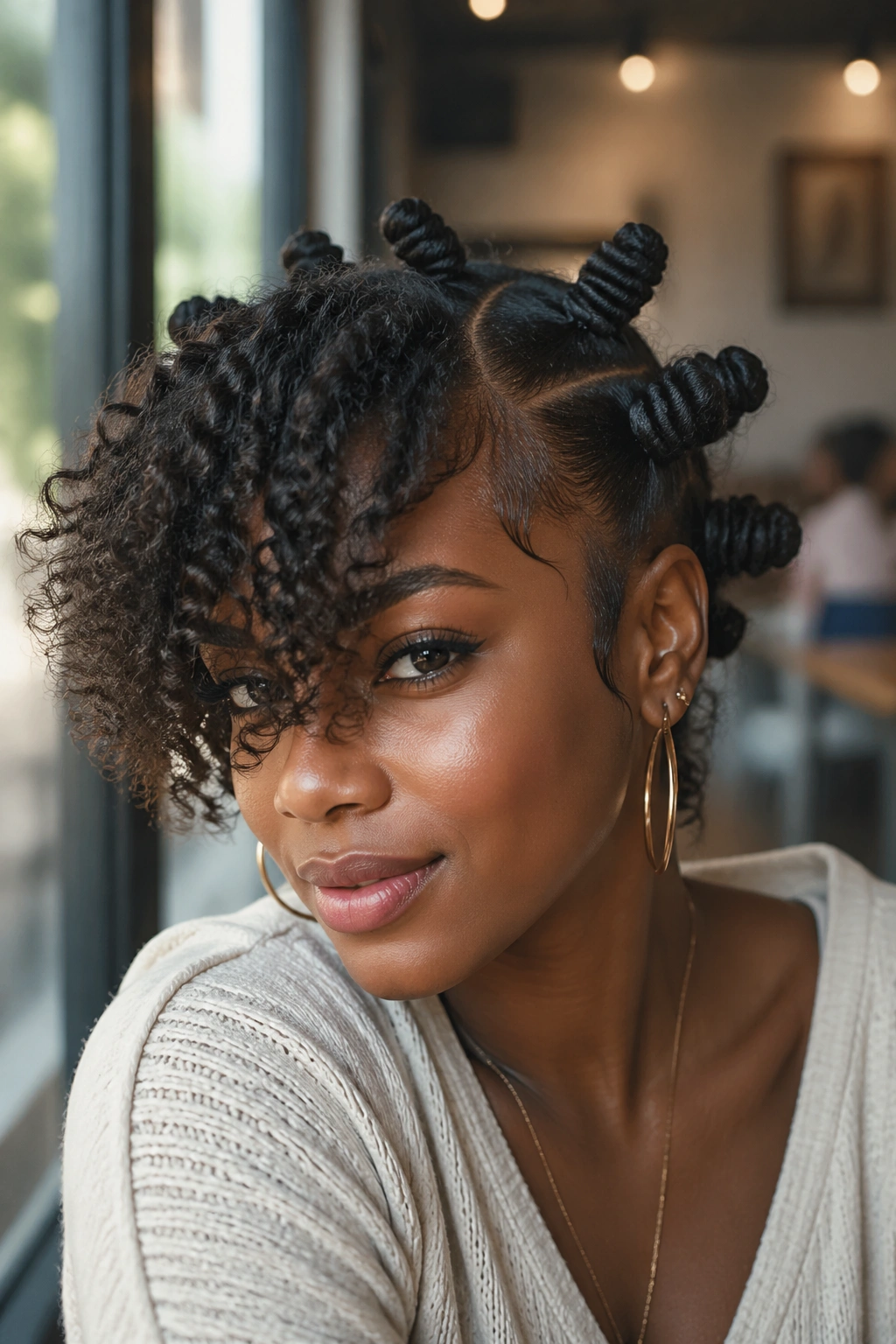
A side part changes the attitude fast. The moment the knots shift off center and a curly fringe falls across the forehead, the look gets looser and a little more playful.
This style works best when the part is deep enough to matter — about 2 inches off the center line is a good place to start. One side holds two or three knots, the fuller side holds four or five, and the fringe is made from a small front section left out and curled. If the bang area is too thick, it overwhelms the knots. If it is too thin, it looks accidental.
Texture does the heavy lifting here. You want the fringe glossy, springy, and separated into a few clear curl clumps rather than brushed out into a cloud. A small barrel wand can work on added hair, but on natural hair I still prefer finger coils or slim flexi rods because the finish looks less forced.
The whole style reads lighter than a centered knot set. It is one of my favorites when someone wants Bantu knots with curls but does not want the result to feel too formal.
6. Four Oversized Bantu Knots With Face-Framing Tendrils
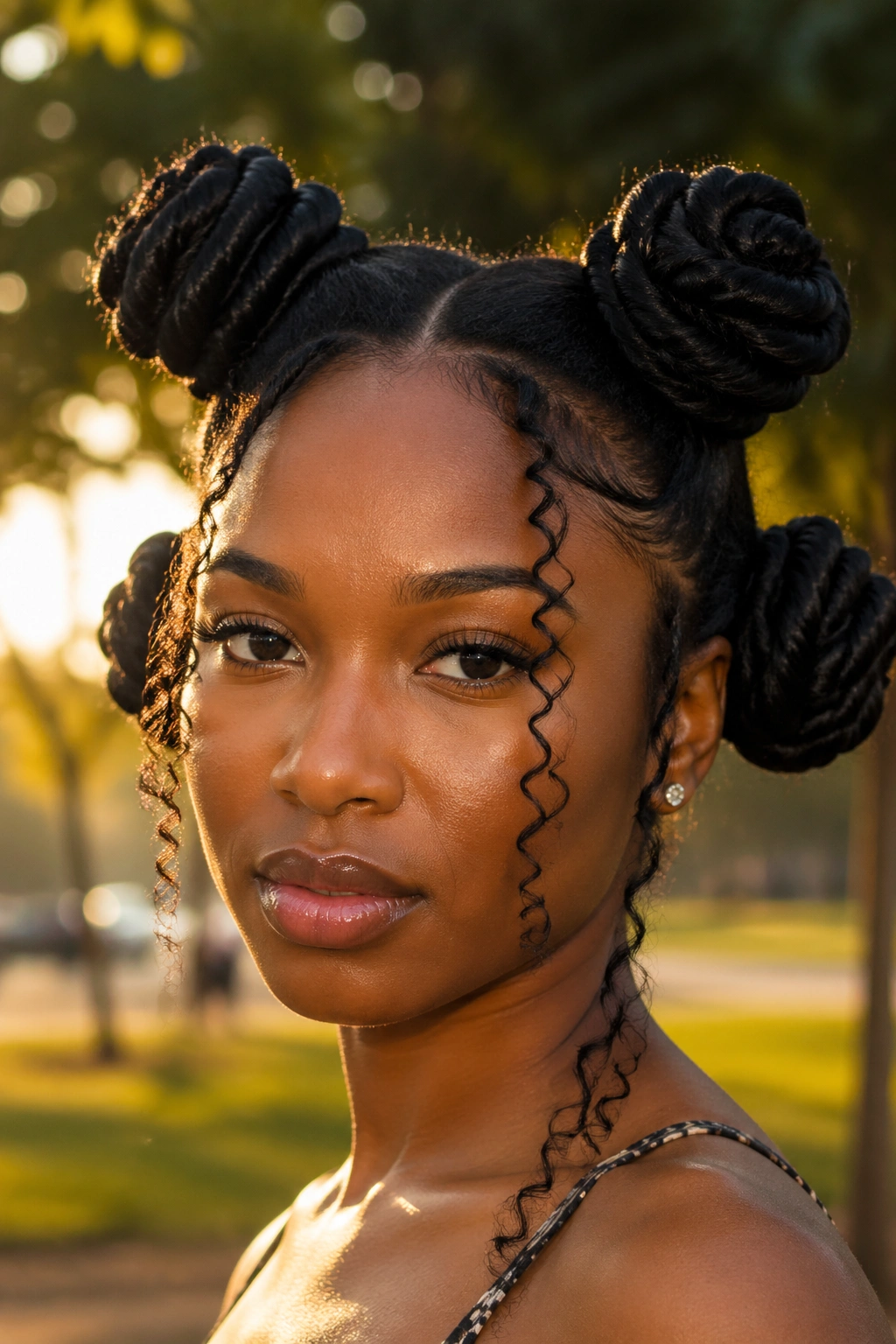
Unlike a head full of small knots, four oversized knots are blunt, fast, and hard to miss. You are not hiding the style’s structure here. You are putting it front and center.
This look makes sense when you want less sectioning, less install time, and less pulling on the scalp. One knot sits near each quadrant of the head, and the face-framing tendrils do the softening work. I would not crowd the hairline with too many little curls. Two tendrils on each side — sometimes one is enough — keep it clean.
On longer hair, the tendrils can be your own ends. On shorter hair, braided-in curly hair gives you more control. Use a quarter-size amount of mousse on each loose piece, wrap it on a small gray rod, and let it set fully before separating.
Who does this suit? People who like bold shapes. If you have a rounder face, place the front knots slightly higher to create lift. If your forehead is longer, drop the tendrils lower and let them curve at cheek level. Small change. Big difference.
7. Mohawk Bantu Knots With Coily Back Curls
Some styles are quiet. This one is not.
A mohawk row of Bantu knots down the center of the head, paired with coily curls through the back or sides, has more edge than a classic all-over knot set. It works especially well when the curls are tightly defined and packed close together instead of hanging loose.
Placement that keeps the shape strong
Start with five to seven knots from the forehead to the crown, each sitting in a centered row. The side sections can be slicked flat, braided down, or twisted back into the line of knots. Then the back section gets curled with small rods or finger-coiled for a springy finish.
Where it looks best
- On natural hair that has been stretched first with heatless banding or a blow-dry on low
- On oval, heart, and square face shapes that can carry a taller center line
- With strong edge styling near the temples
- With earrings that fill the exposed side space
The result has lift, shape, and a little attitude. Good. Bantu knots do not always need to behave.
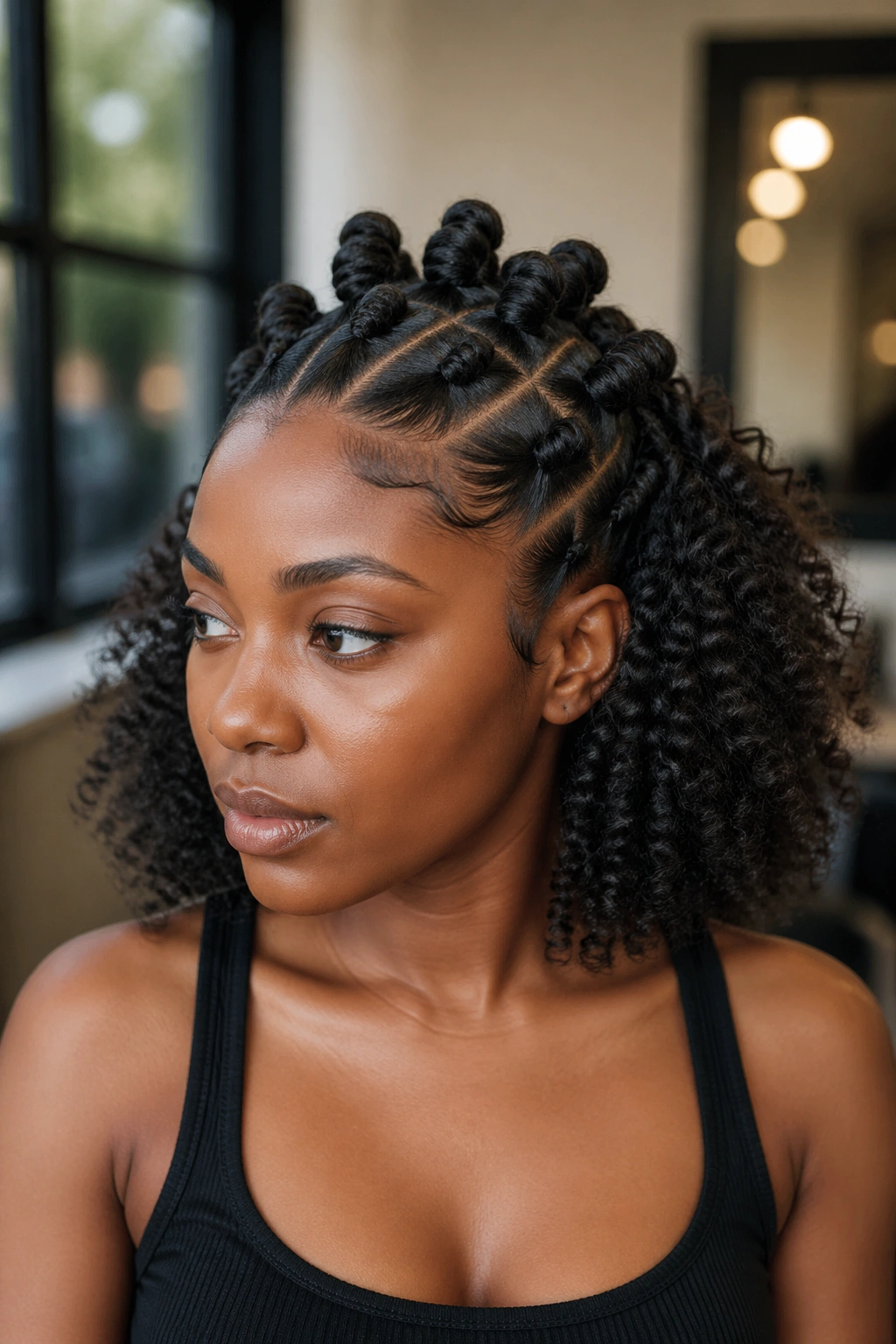
8. Low Nape Bantu Knots With Curled Bob Ends
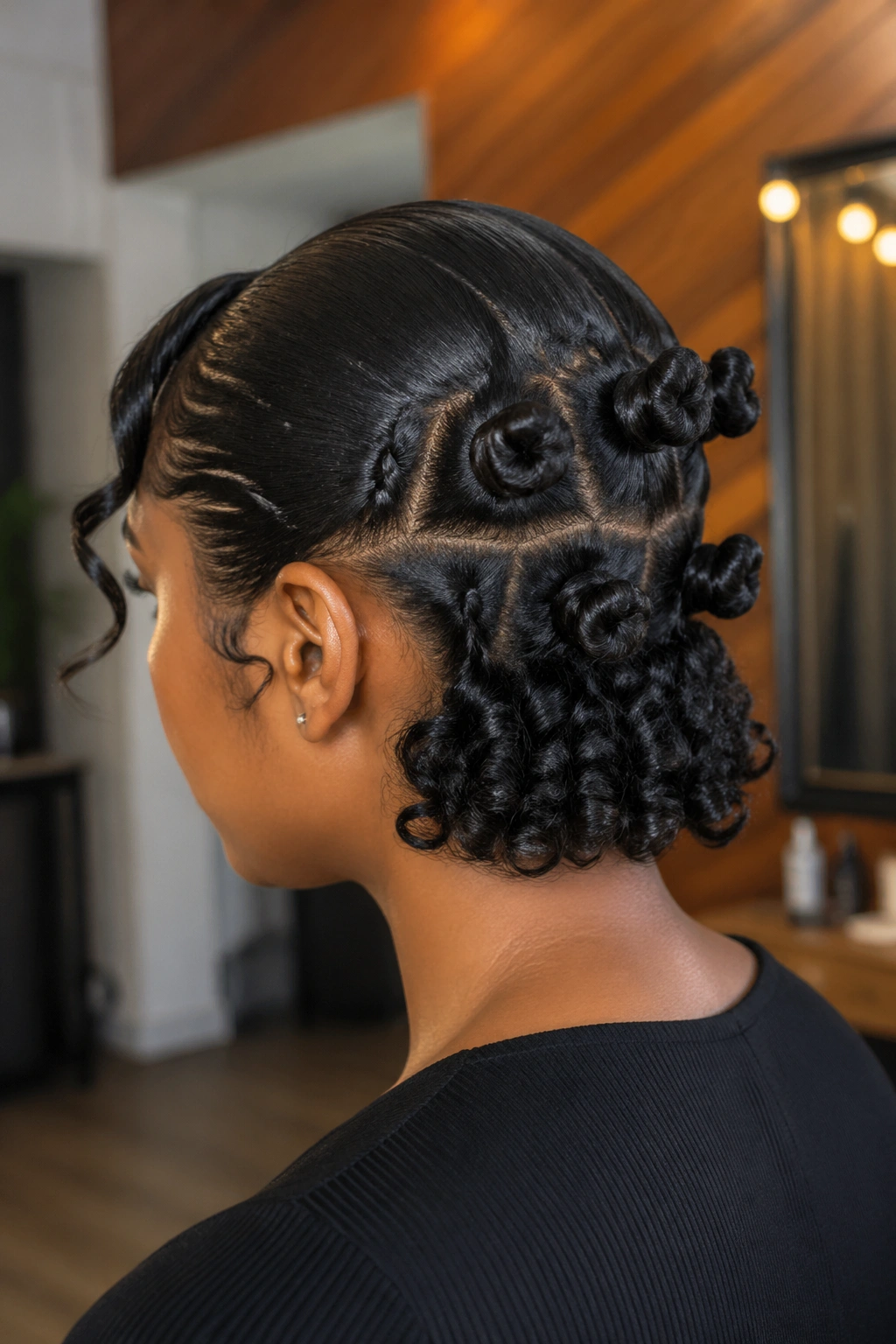
Not every knot style needs height. Low nape Bantu knots sit closer to the back of the head, and when the loose ends are curled into a bob shape, the whole look feels compact and polished.
Picture three or four knots placed from ear to ear near the nape, with the remaining hair curled under so it brushes the neck. That tucked curve matters. If the curls hang too long, the balance goes off and the low knots start to look disconnected from the rest of the style.
This one works well on stretched medium-length hair and on crochet-added hair because you can control where the curl stops. A 1-inch rod gives enough bend for a bob line without turning the ends into ringlets.
There is also a practical upside. Styles that sit lower often feel easier on a tender scalp, especially if you are used to pain around the hairline. Do not force the twist so tight that the knot looks shiny and hard. You want secure, not strained.
9. High-Stacked Bantu Knots With Perm-Rod Curls
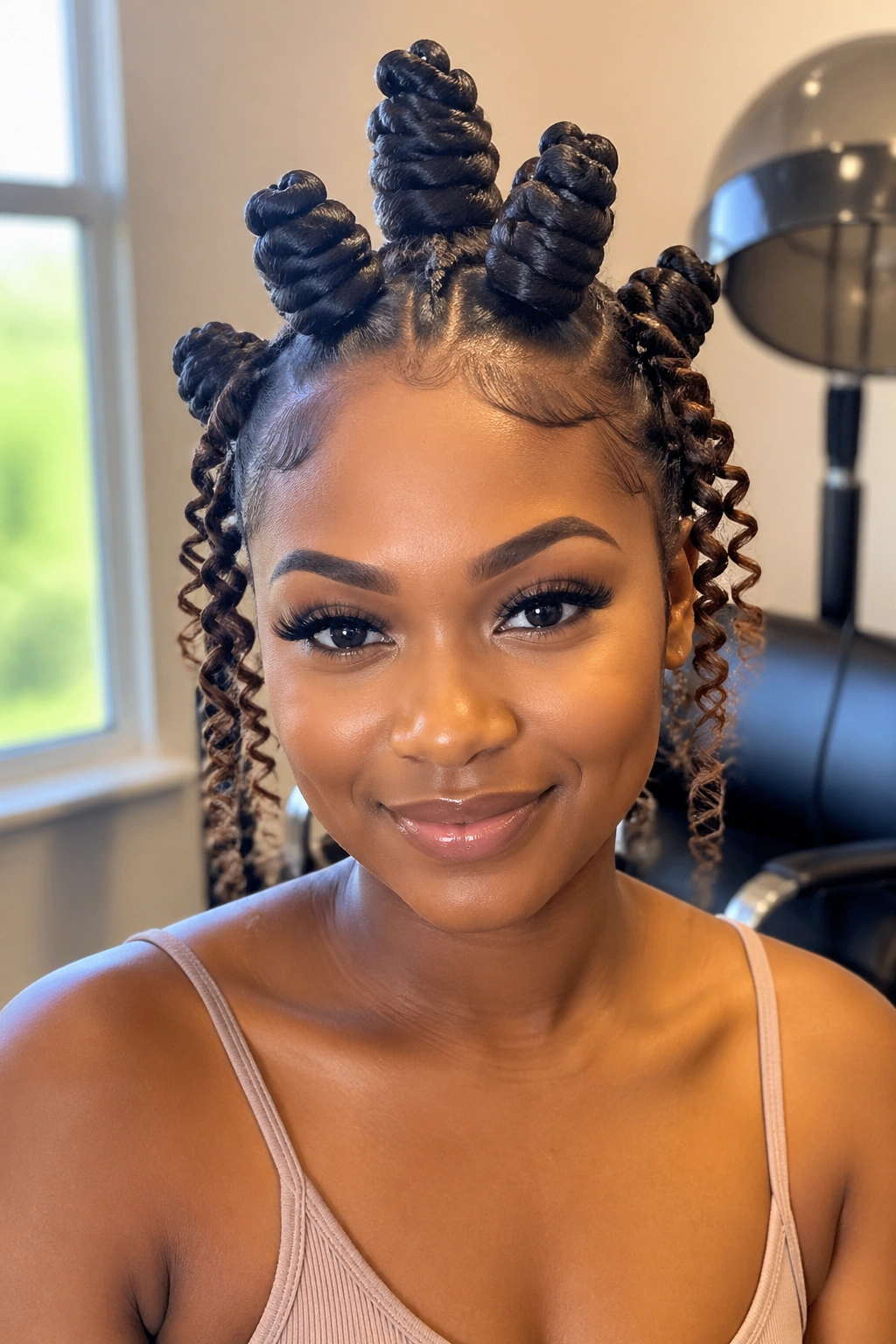
Want height? Go all the way. High-stacked Bantu knots create a lifted profile from the front, and the perm-rod curls give the style bounce instead of stiffness.
The shape depends on vertical placement. Keep the knots clustered from the top of the head into the crown, not drifting too far backward, or the front view loses its drama. Six medium knots usually do the job.
How to get the curls to pop
Use a setting foam from roots to ends, then wrap the loose ends on orange or purple perm rods, depending on how tight you want the curl. Orange rods give a tighter spring. Purple rods give a fuller, looser curl that fills space faster.
Drying time matters here more than people want to admit. If the rods come out while the hair still feels cool or damp at the core, the curls drop before you even leave the house. Sit under a hooded dryer long enough, or air-dry overnight with the rods fully secure.
A tall style like this likes balance. Strong brows, hoop earrings, a defined lip — all of it plays well.
10. Heart-Part Bantu Knots With Springy Coils
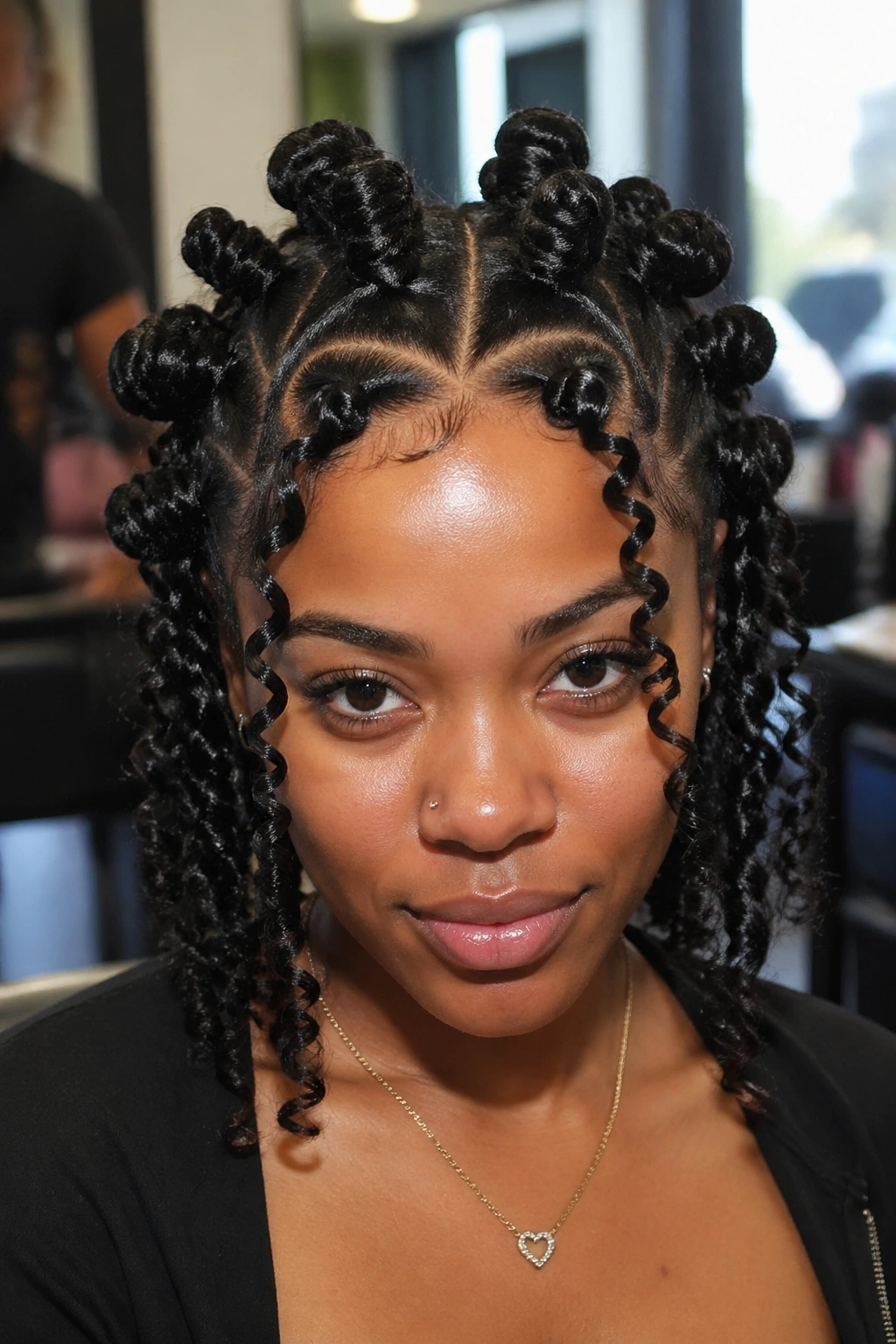
There is a point where hair styling leans into art, and heart parts live right there. They are playful, yes, but when they are clean and paired with springy coils, they do not read childish. They read intentional.
You only need one or two heart-shaped parts near the front or side. A whole head of them can look crowded fast. Let those statement sections frame medium-size knots, then keep the rest of the parting simple so the eye knows where to land.
Quick planning notes
- Ask for the heart detail where it will be visible from the front, not buried near the crown
- Use small finger coils or slim rods on the loose ends so the curls echo the curved part shape
- Skip chunky beads here; the scalp design already carries enough detail
- A strong hold gel and rat-tail comb are non-negotiable
This style is a conversation starter. If you like hair that gets noticed before you say a word, it does the job.
11. Zigzag-Part Bantu Knots With Fluffed Curls
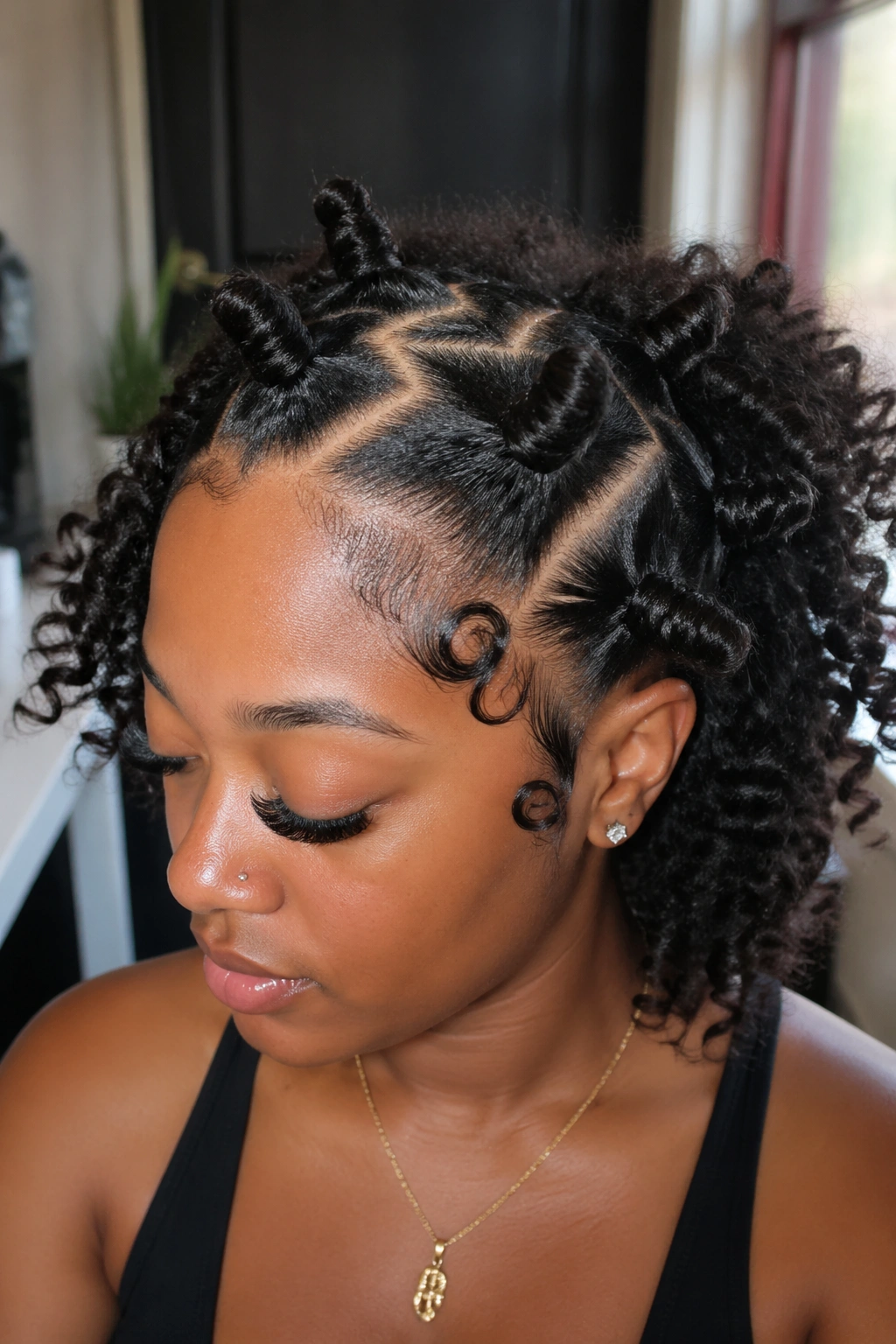
Straight parts are clean. Zigzags are louder.
A zigzag-part knot set already has movement built into it before you add curls, which is why I like pairing it with fluffed curls instead of perfectly separated ringlets. The little bit of softness stops the scalp pattern from feeling too sharp.
Use medium knots here. Tiny ones can make the parting look busy, while jumbo knots hide the zigzag entirely. Somewhere around 1½-inch sections usually lands in the sweet spot.
The curls need a different finish than the rod-set styles above. After the ends are fully dry, rub a drop of lightweight oil between your fingers and loosen them a touch. Not all the way. You still want visible curl pattern. You are aiming for airy, touchable, and a bit fuller around the edges.
This look has range. It can feel casual with a T-shirt and hoops, then shift into something dressier if the edges are slick and the part lines are razor clean. That swing is what makes it worth saving.
12. Braided-Root Bantu Knots With Curled Tips
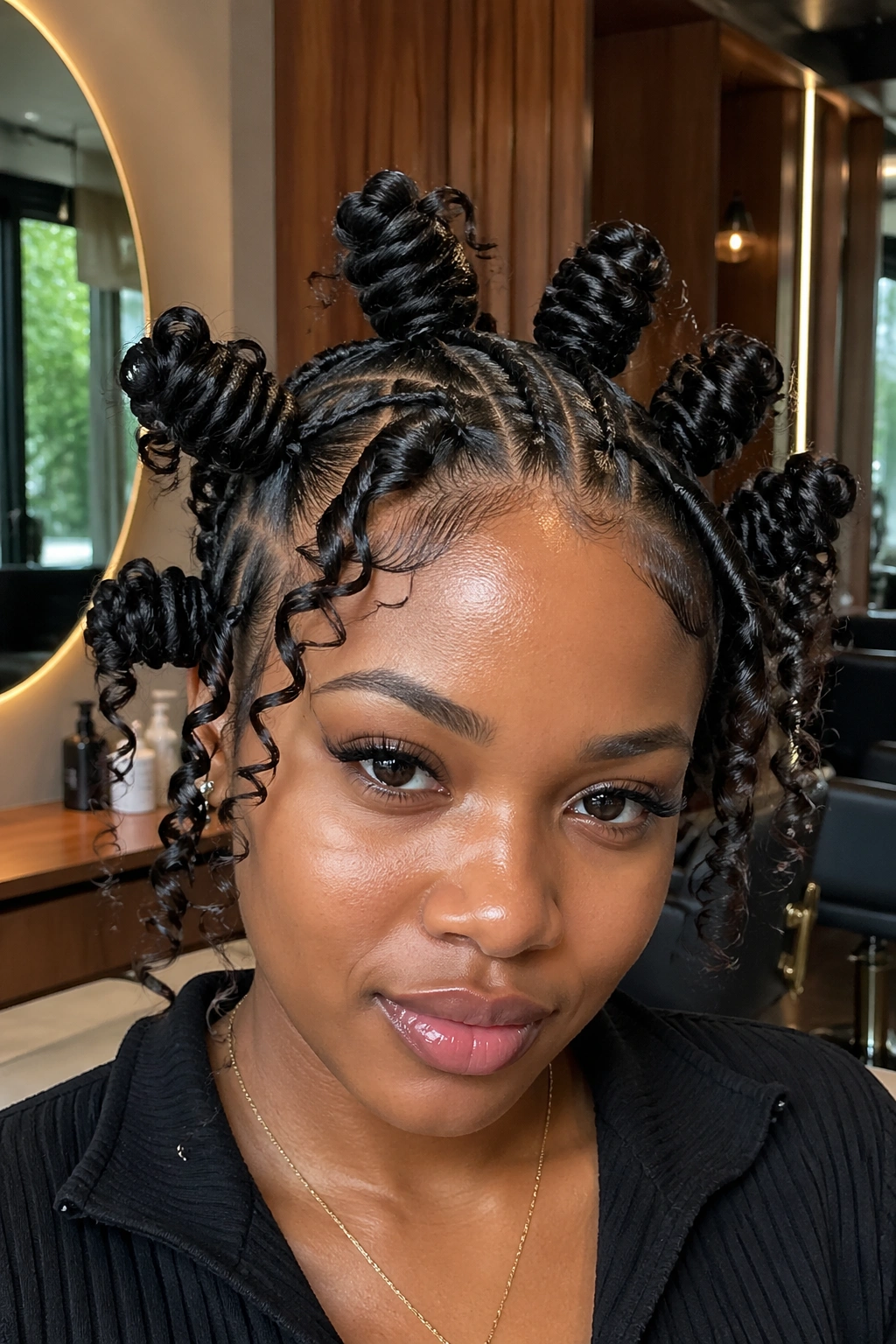
Compared with a basic twist-at-the-root knot, braided roots give you more grip and more scalp detail. They also hold up well on silkier textures or on hair that likes to puff at the base by day two.
The method is simple enough: braid each section for 1 to 2 inches, then twist the rest into a knot and leave the tips out to curl. That little braided stem changes the whole look. The knot sits flatter and cleaner, and the exposed curl at the end looks more deliberate.
This is a strong option if you sweat a lot, work out often, or live somewhere humid enough to ruin a soft twist set by breakfast. The braided base resists that early swelling you sometimes get around plain knots.
Use smaller curls on the tips than you think you need. A broad curl can fight with the narrow braid detail. Slim finger coils or gray perm rods usually match the scale better. It is one of those styles that does not scream for attention but keeps looking better the longer you stare at it.
13. Bantu Knot Bob With Tucked-In Ringlets
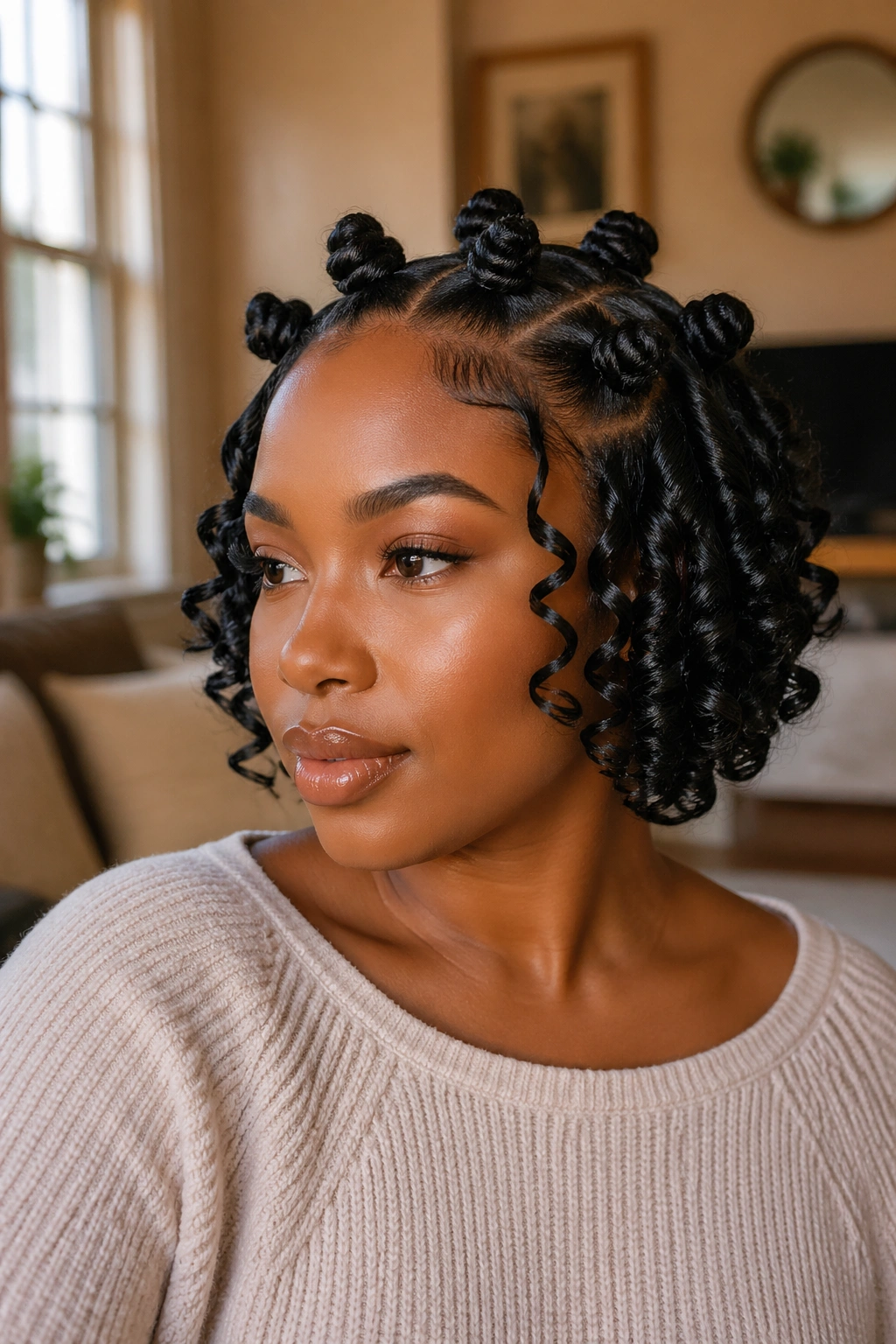
A bob and Bantu knots sound like they belong in separate conversations until you see them combined. Then it clicks.
A Bantu knot bob uses knots through the top and sides, then lets the remaining hair curl and tuck under so the whole silhouette lands around chin or jaw length. The shape feels neat and compact, which is why it works so well for work settings, dinners, and events where you want your hair polished but not towering.
Why the tuck matters
If the curls drop straight, you lose the bob line. Use medium flexi rods or a small round brush with low heat on added hair to create that inward bend at the ends. The curve should hug the neck slightly, not flip outward.
A center part can make this feel too severe. I like a soft side part or offset top knot placement better. It keeps the style from turning boxy.
You will also want the knots smooth, not chunky. Think refined scale. Five to seven knots is usually enough.
14. Asymmetrical Bantu Knots With One-Side Curls
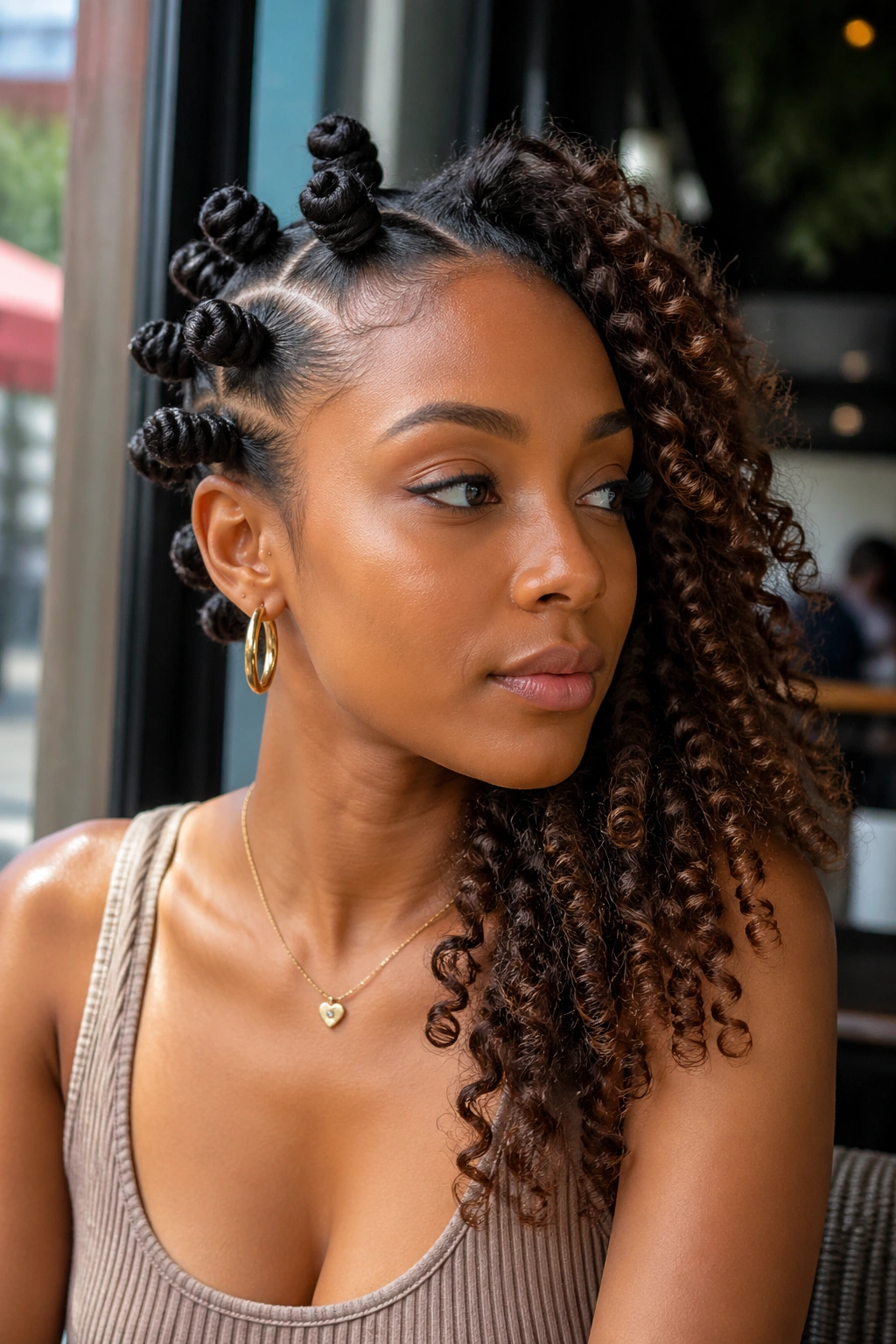
Symmetry is overrated in hair. A clean imbalance can look more modern, more intentional, and honestly more memorable than a centered layout.
This style keeps knots concentrated on one side or across the upper section, then lets a heavier curtain of curls fall on the opposite side. The contrast is the whole point. One half feels sculpted. The other half moves.
Placement is everything. If the knot side sits too low, the style starts dragging your face downward. Keep those knots lifted around the temple and crown, then let the curls sweep from the opposite side part. Long curls work best here because they underline the imbalance. Shoulder-skimming curls can work too, though you need dense definition so they do not disappear.
Accessories can help, but use restraint. A cuff on one knot or a single gold string wrap is enough. Once you pile on clips, beads, and rings, the style stops feeling asymmetric and starts feeling crowded.
Good asymmetry looks planned. That is the line.
15. Beaded Mini Knots With Curl Clusters
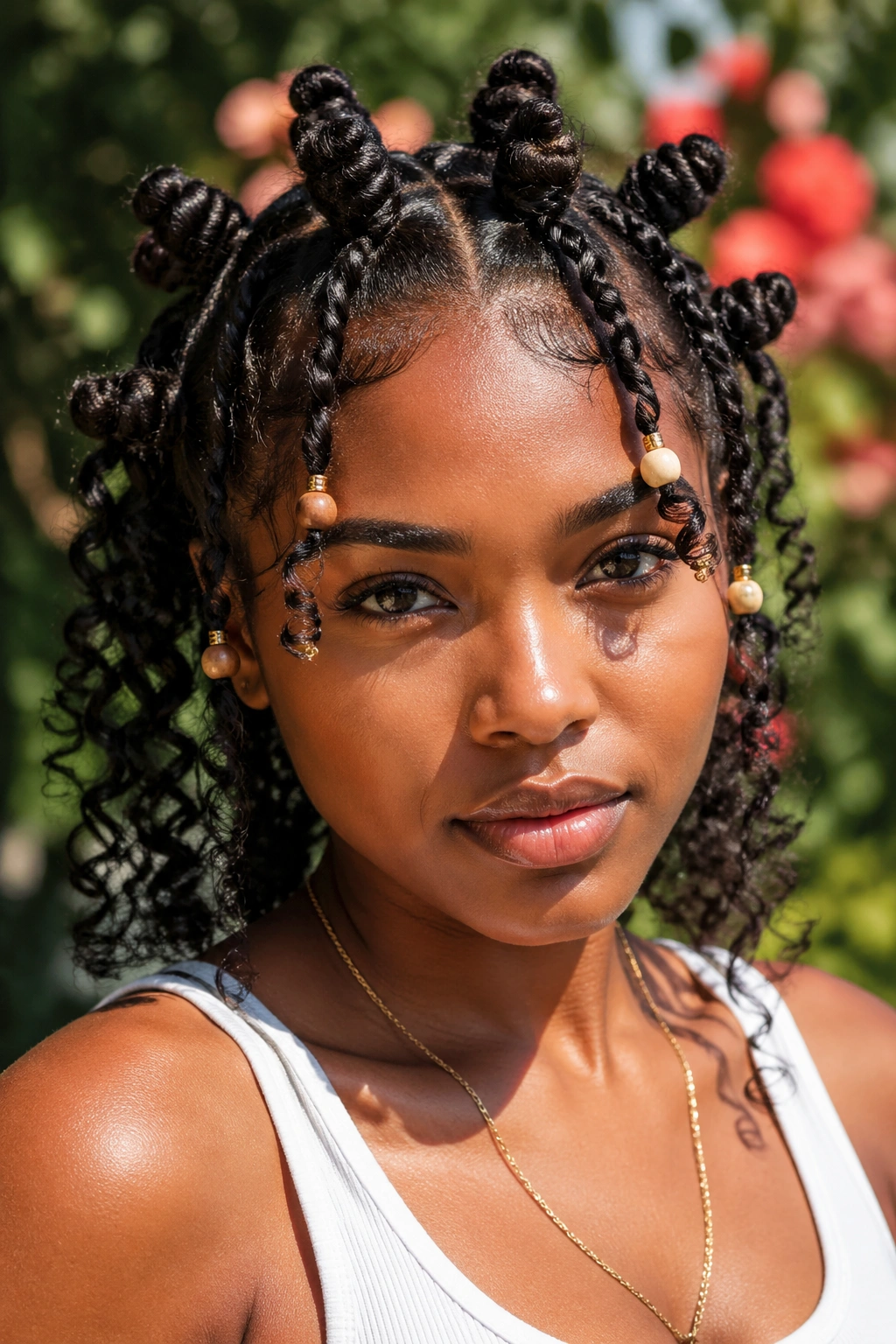
Can beads work with curls and Bantu knots without looking overloaded? Yes — if the beads are used like punctuation, not confetti.
With mini knots, the scale is already small, so the beads need to stay small too. Think slim wooden beads, metal cuffs, or a few clear beads at the ends of selected curl clusters. Covering every knot with chunky hardware is too much weight and too much visual noise.
How to keep the details readable
Use 10 to 16 mini knots and reserve the beads for the front third of the head or for three to five curls around the face. That placement keeps the shine near your eyes, where it does the most work.
Curl clusters look best when they are grouped on purpose. Twist two or three nearby tendrils in the same direction so they sit together instead of scattering apart.
A style like this lives or dies on neatness. The moment the parts get fuzzy, the beads stop looking like a design choice and start looking random. Fresh edges and clean section lines matter more than usual here.
16. Copper Bantu Knots With Caramel Ringlets
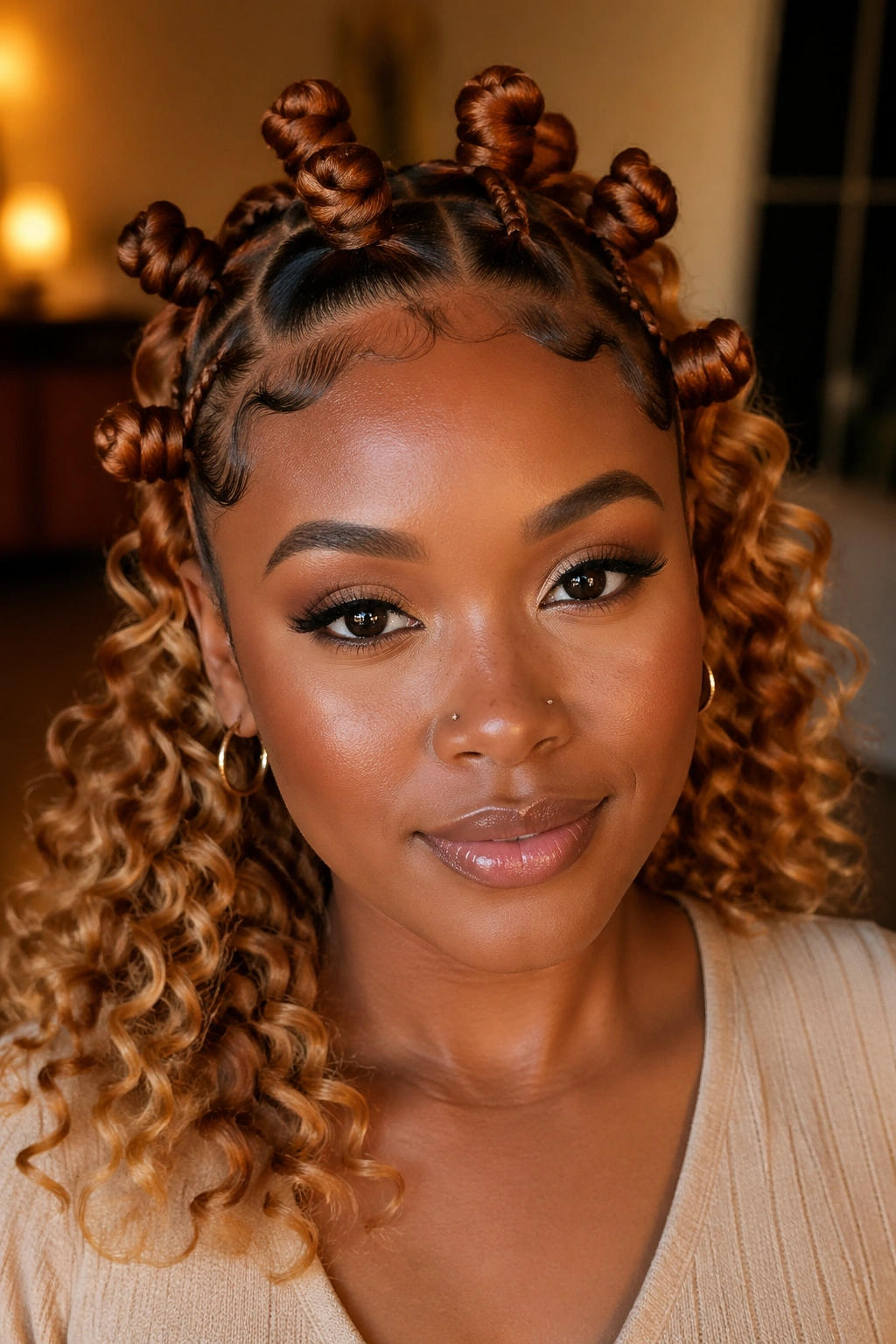
Color changes Bantu knots faster than a new parting pattern does, and copper with caramel ringlets is one of those combinations that makes the curls show up from across the room.
The reason it works is contrast. A richer copper or auburn base gives the knots weight, while lighter caramel curls at the ends catch the eye first. You do not need a dramatic color jump. Even two shades lighter on the curled pieces creates enough separation.
Best ways to place the color
- Keep the roots and first wrap of the knot deeper in tone
- Let the lighter shade live on the exposed curls, tendrils, or loose back section
- Use rod-set ringlets rather than fluffy curls so the color pattern stays visible
- Finish with a serum, not heavy grease, so the shine stays clean
This look especially suits photo days, parties, and any moment where lighting matters. Curls reflect color differently than smooth wrapped knots, which is why the two-tone effect reads so clearly.
17. Halo Bantu Knots With Curly Bangs
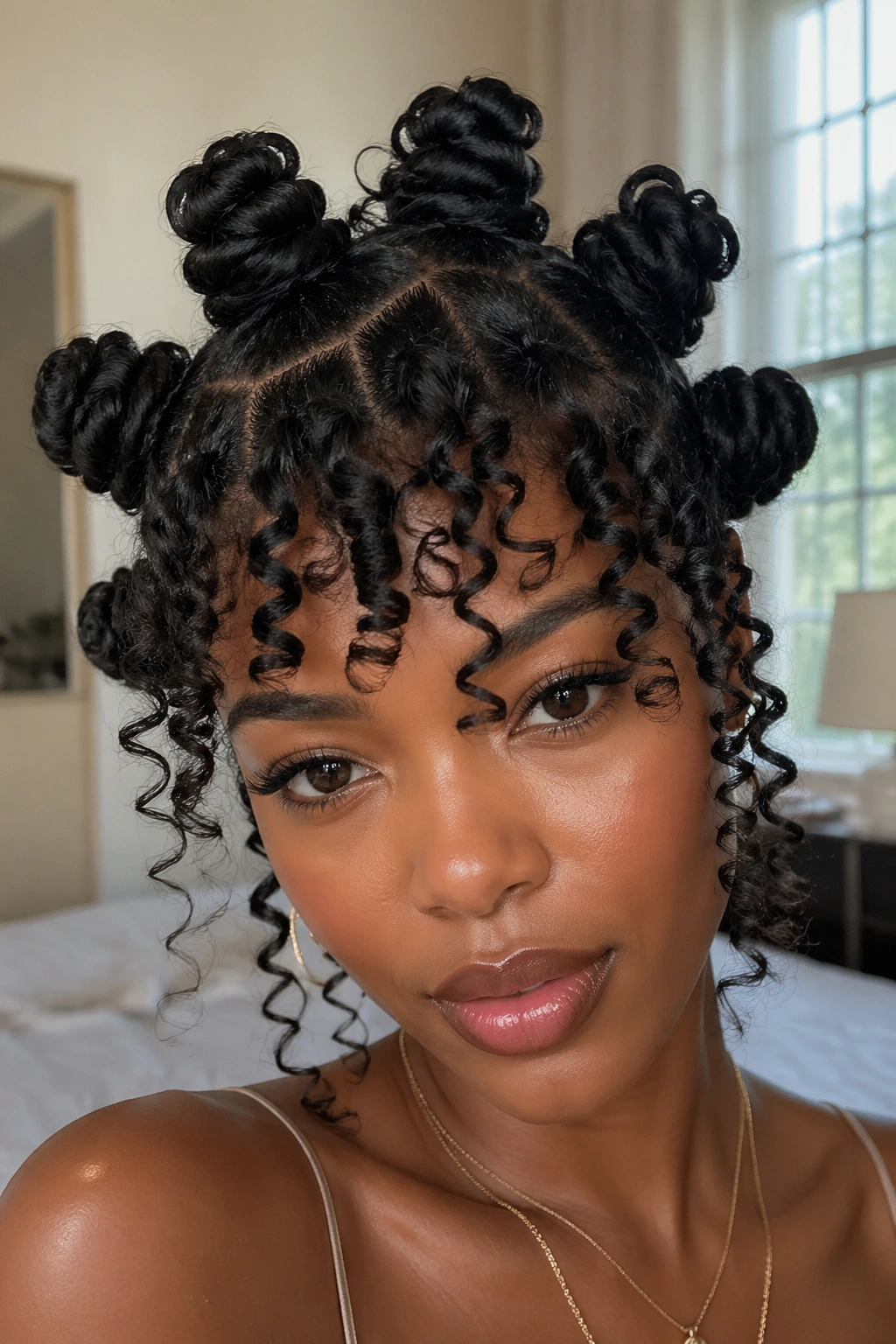
A halo arrangement places the knots around the outer edge of the head, leaving space through the middle or front for curls and bangs. The result is softer than a crown packed with knots and much less severe than a full slicked-back setup.
Curly bangs are the make-or-break piece. They should sit between the brows and the upper lashes when dry, not stretched down to your cheekbones. Curls shrink, though, so set them a little longer than the final target. That detail trips people up all the time.
I like this on medium-density hair because the halo needs enough bulk to read as a ring. If the knots are too small and the bangs are too heavy, the outer shape disappears. Aim for six to eight knots around the perimeter, then leave a controlled front section out for the fringe.
The mood here is softer, but not fragile. It still has architecture. That balance is why the style keeps coming back in salon inspiration boards and formal-hair mood folders.
18. Flat-Twist Bantu Knots With Defined Ends
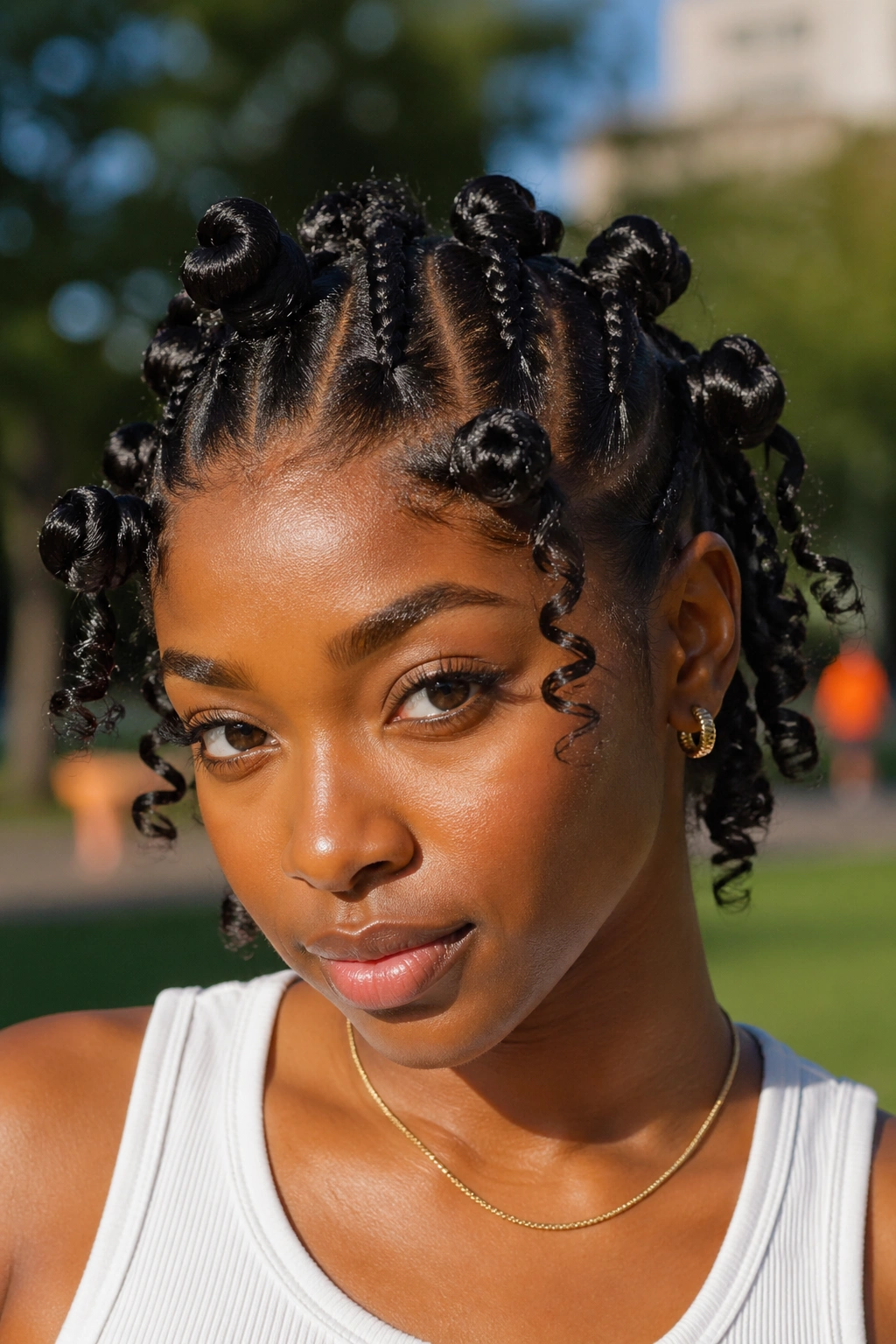
If plain roots feel too bare, flat twists leading into Bantu knots give you more direction and more hold. They also stretch the hair slightly before it is wrapped, which helps the knot sit smoother.
Think of each flat twist as a runway into the knot. You can run the twists from the hairline back, from the side toward the crown, or diagonally across the head. Then the loose ends are coiled or rod-set so the finish does not stop abruptly at the knot.
This style is a strong pick for shorter natural hair because the flat twist does part of the gripping work that length would usually handle. Hair around 4 to 6 inches long can often hold this style well with mousse and a firm gel.
Use a pointed tail comb for the parts and keep the twists flat, not ropey. Thick raised twists can compete with the knots. The best version has a smooth path from scalp to knot, then a crisp curl at the end. That progression is what makes it feel complete.
19. Cornrow-to-Knot Style With Loose Curls
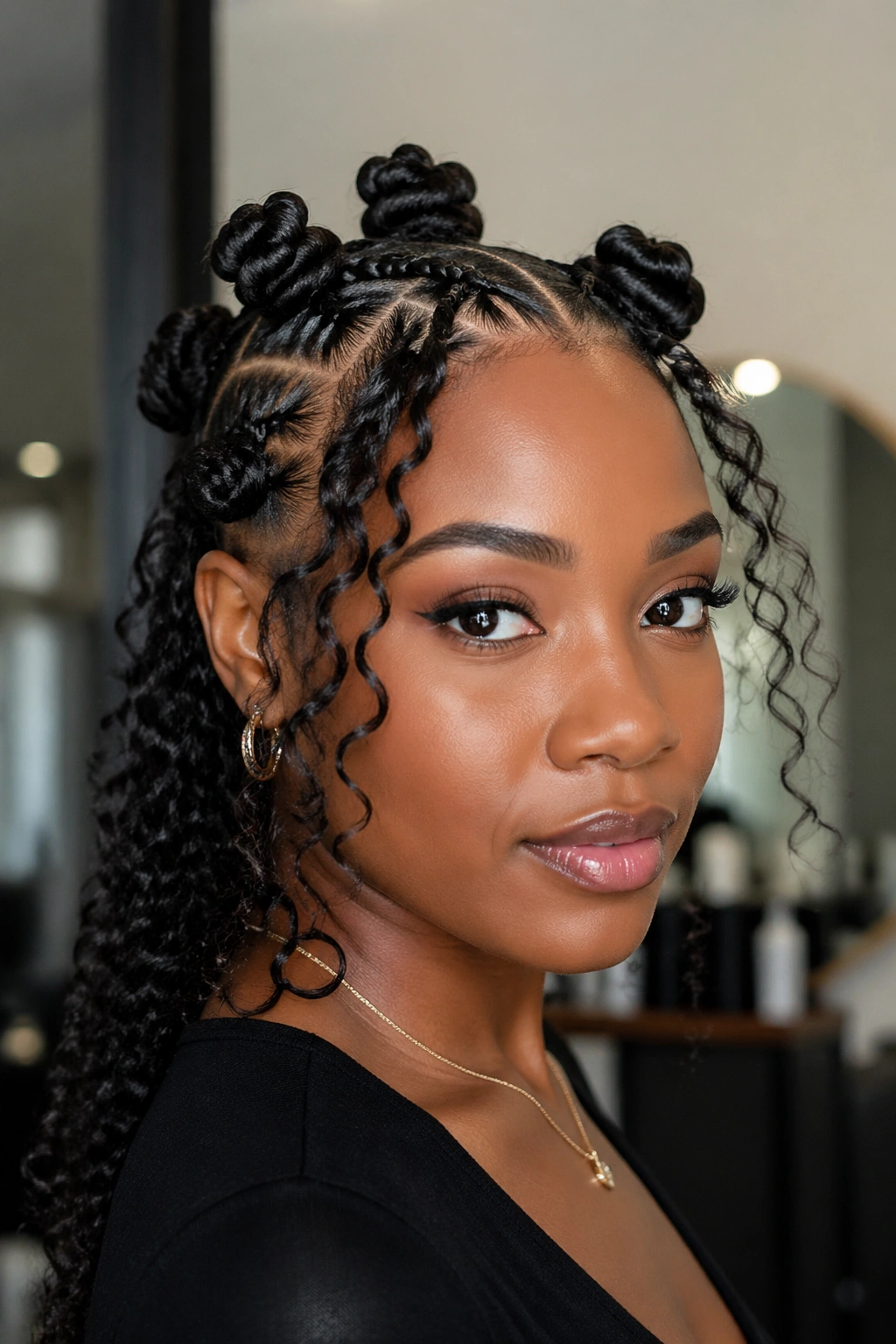
There is something satisfying about a style that changes texture as your eye moves across it. Cornrows feeding into Bantu knots, then breaking into loose curls, does exactly that.
The cornrows can start at the front or the sides, usually in four to eight neat rows, and lead into knots placed at the crown or upper back of the head. Then a section of loose curls fills the remaining space. You get braid detail, knot structure, and curl movement in one look.
Where this one shines
- When you want a style that lasts longer than plain loose curls
- When your edges need a cleaner framework than a fully freeform knot set
- When you like mixed textures in one hairstyle
- When you want the back view to matter as much as the front
Loose curls should stay loose. Do not over-separate them, and do not drown them in heavy butter. A light mousse and a fingertip of serum are enough if the set was done cleanly.
This is one of the more intricate options on the list, and it earns the extra chair time.
20. Center-Part Bantu Knots With Waterfall Curls
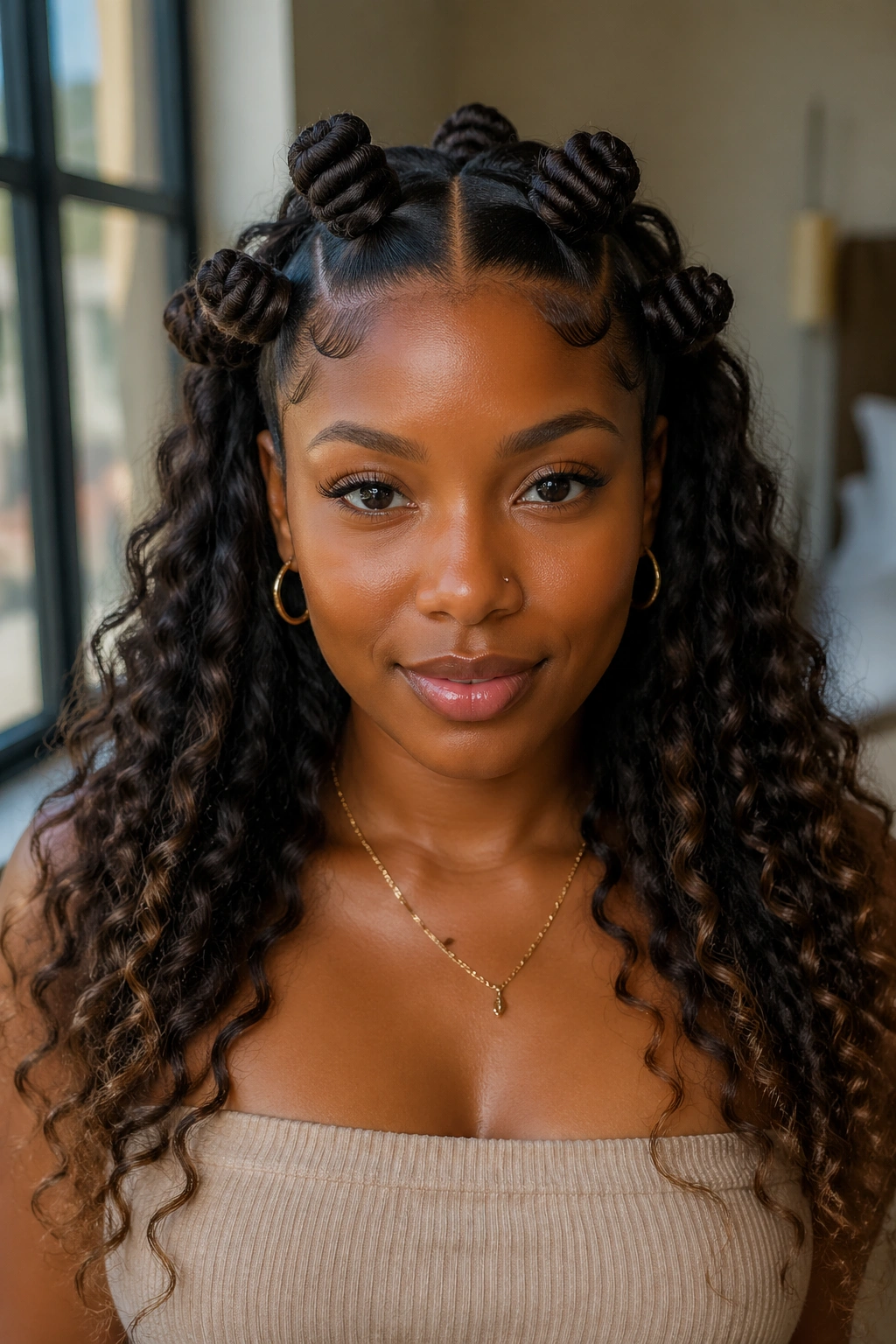
A center part can look flat on some styles. On this one, it gives the curls a clean lane to fall around.
Center-part Bantu knots with waterfall curls use symmetry on top and length through the lower half. The knots sit in balanced rows on either side of the part, while the curls drop from behind them in a long, vertical sheet. It is one of the sleekest ways to wear Bantu knots with curls if you want something dressy but still full of movement.
The waterfall effect needs length. If your natural hair does not have it, added curly hair is the easier route. Pick a curl pattern that drops rather than shrinks too much upward. Deep spiral or loose coily extension hair works better here than a tight kink.
Do not crowd the top. Four to six knots total is enough. Too many knots make the waterfall section feel chopped up. Leave room for the curls to read as one curtain.
A center-part style also asks for balance in the mirror. If one side is heavier, you see it right away.
21. Chunky Bantu Knots With Brushed-Soft Volume
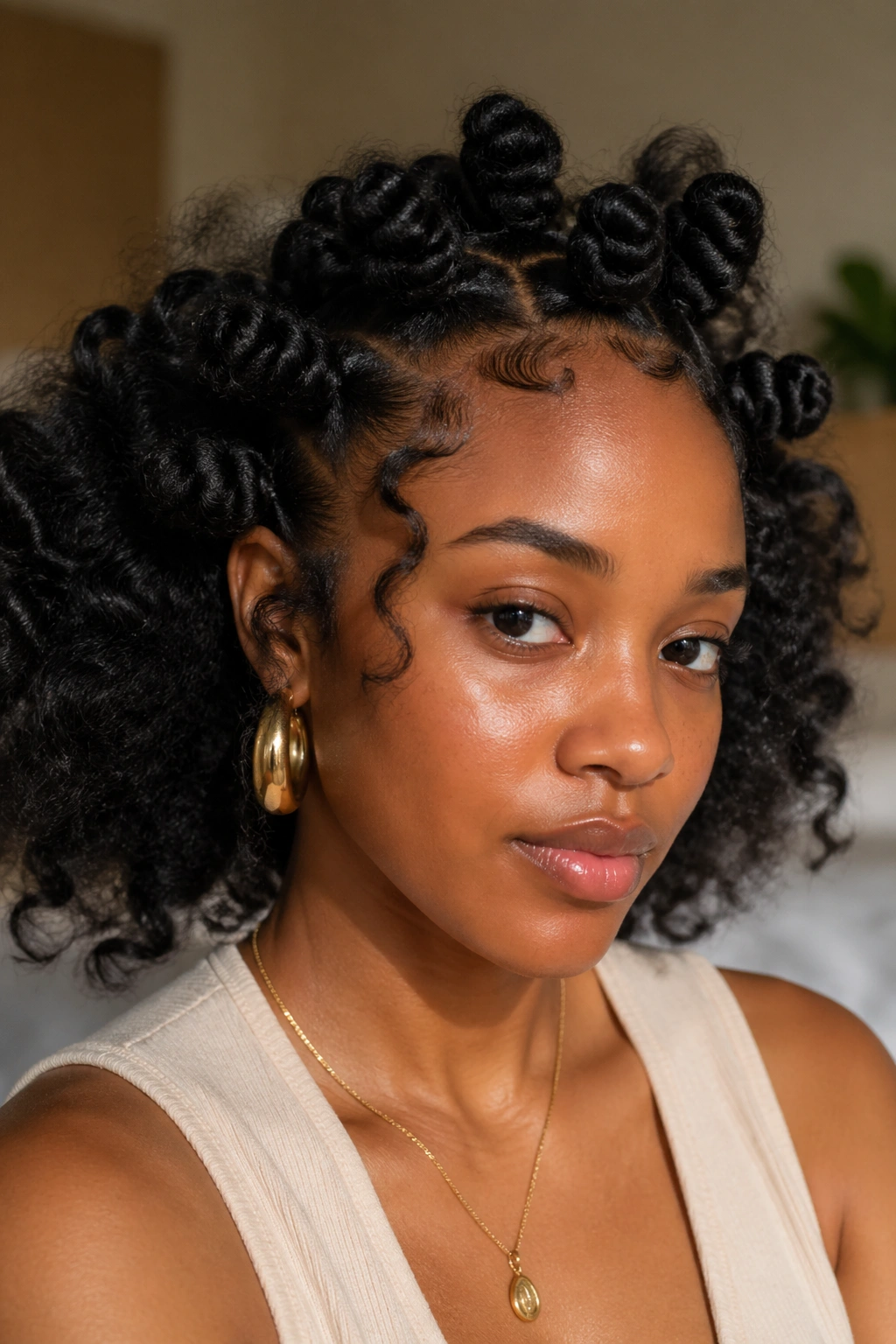
Need curl without the hard ringlet finish? Try chunky knots paired with softly brushed curls instead of sharply separated spirals.
This look starts with medium-to-large knots, then uses a curl set that gets loosened once dry. You still need a real set underneath — flexi rods, perm rods, or a braid-and-rod combo. Brushing out random damp hair will only give you frizz. Once the curls are fully dry, gently pull them apart and lift at the roots with fingers or a pick.
Why the softer finish works
The chunkier knots give the style enough structure that the looser curls do not look messy. They look intentional, fuller, and a little more relaxed around the face and shoulders.
A style like this flatters dense hair because it can hold volume without looking thin at the ends. If your hair is finer, use less brushing and keep more of the original curl intact.
The result feels less strict than a glossy ringlet set. It moves more. It also photographs better in lower light, where tiny defined curls can disappear.
22. Bridal Bantu Knots With Polished Ringlets
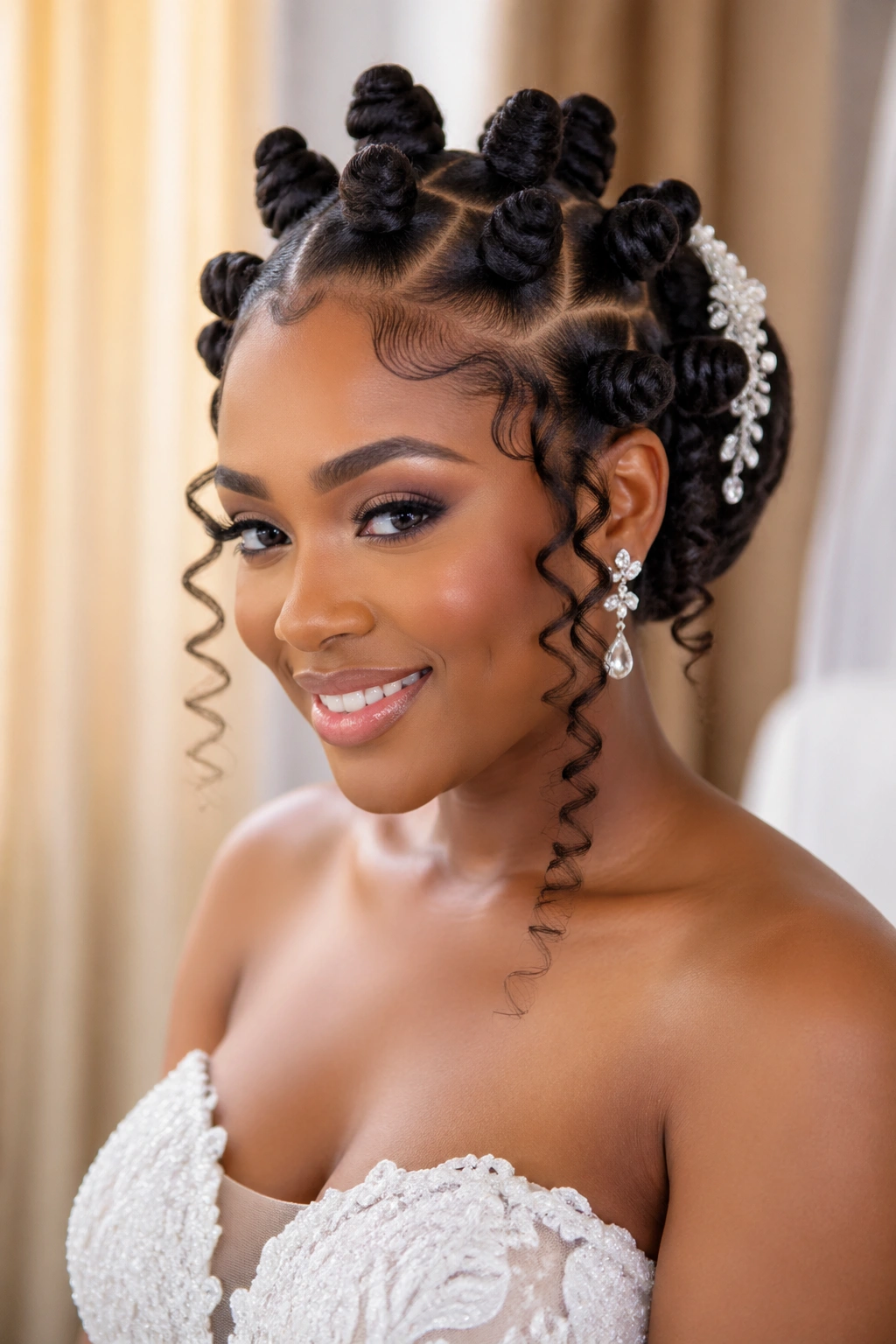
Wedding hair gets weirdly timid around textured styles, which is a shame, because bridal Bantu knots with polished ringlets can look formal, sculpted, and deeply intentional when they are done right.
The difference is finish. Parts must be clean. The knots need smooth wrapping with no flyaway ends sticking out. The ringlets should be shiny, uniform, and placed where they frame the face, neckline, or veil instead of crowding every inch of the style.
Details worth asking for
- Five to seven knots keeps the silhouette refined
- Use a light gel at the base and a foam through the ends for ringlets with slip
- Place two or three face-framing curls near the temples or behind one ear
- Add pins, pearls, or cuffs sparingly so the hair still reads first
I would skip oversized baby hairs here unless that is already your signature. A clean hairline usually suits bridal knot styles better than dramatic swoops.
This one has presence. It does not need to shout.
23. Short-Hair Bantu Knots With Finger Coils
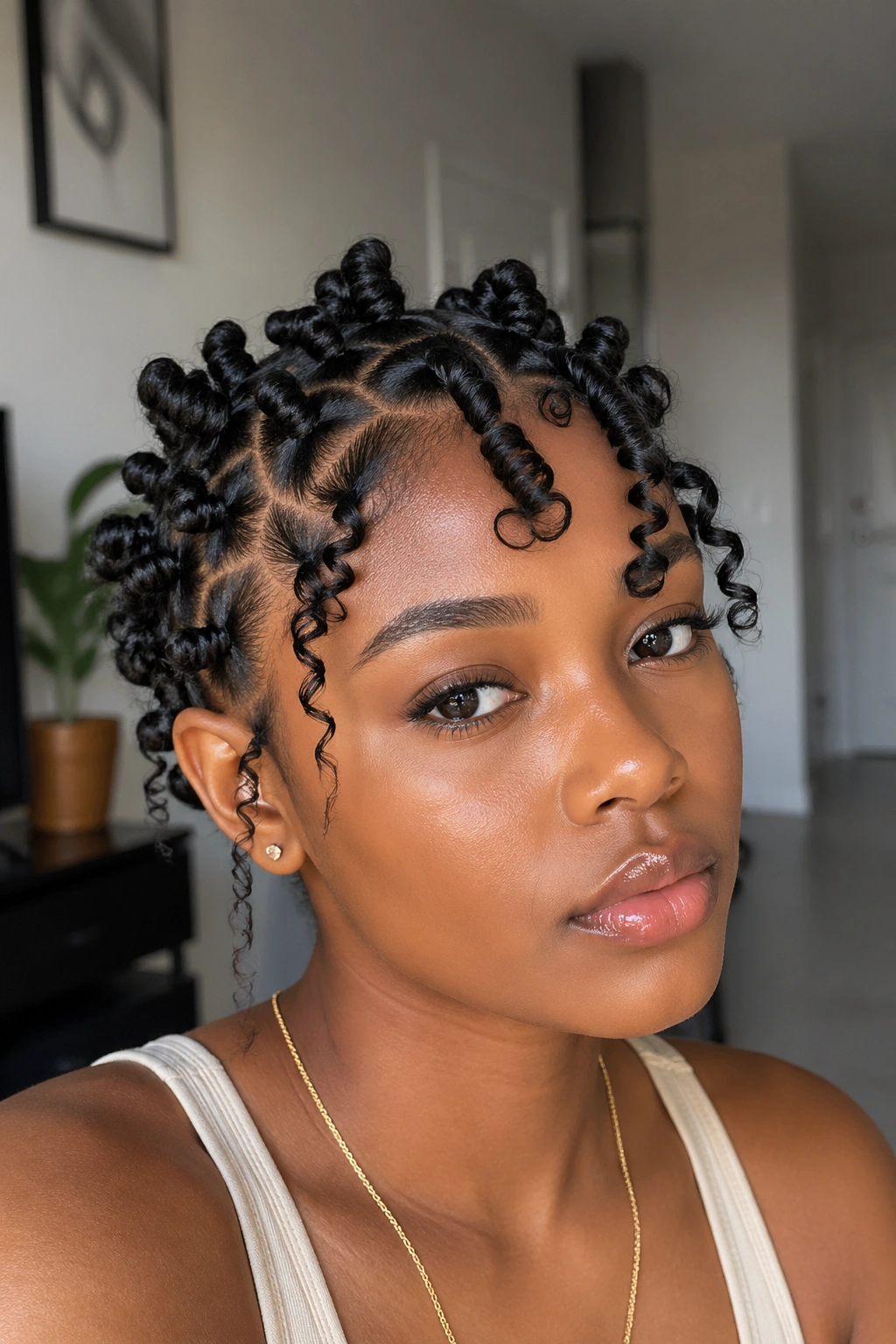
Short natural hair can wear Bantu knots with curls just as well as longer hair, sometimes better, because the scale feels tighter and more sculpted. Finger coils are the smartest curl choice here.
On short hair, long loose tendrils can look tacked on. Finger coils stay closer to the head and match the compact size of the knots. Hair around 3 to 5 inches long often works beautifully for this, especially when stretched lightly first with a blow-dryer on cool or low.
You may only get six to ten knots, and that is fine. Trying to force more can make the parts too small and the twist too tight. Use a creamy styler with hold, then twirl the exposed ends around your finger until each coil forms and springs back.
This style has one big advantage: the take-down is often excellent. Because the hair started in smaller sections with defined coils, the knot-out usually lands fuller and more even than a random rushed set. A good style on the way in, a good style on the way out — that is efficient hair.
24. Waist-Length Bantu Knots With Curled Extensions
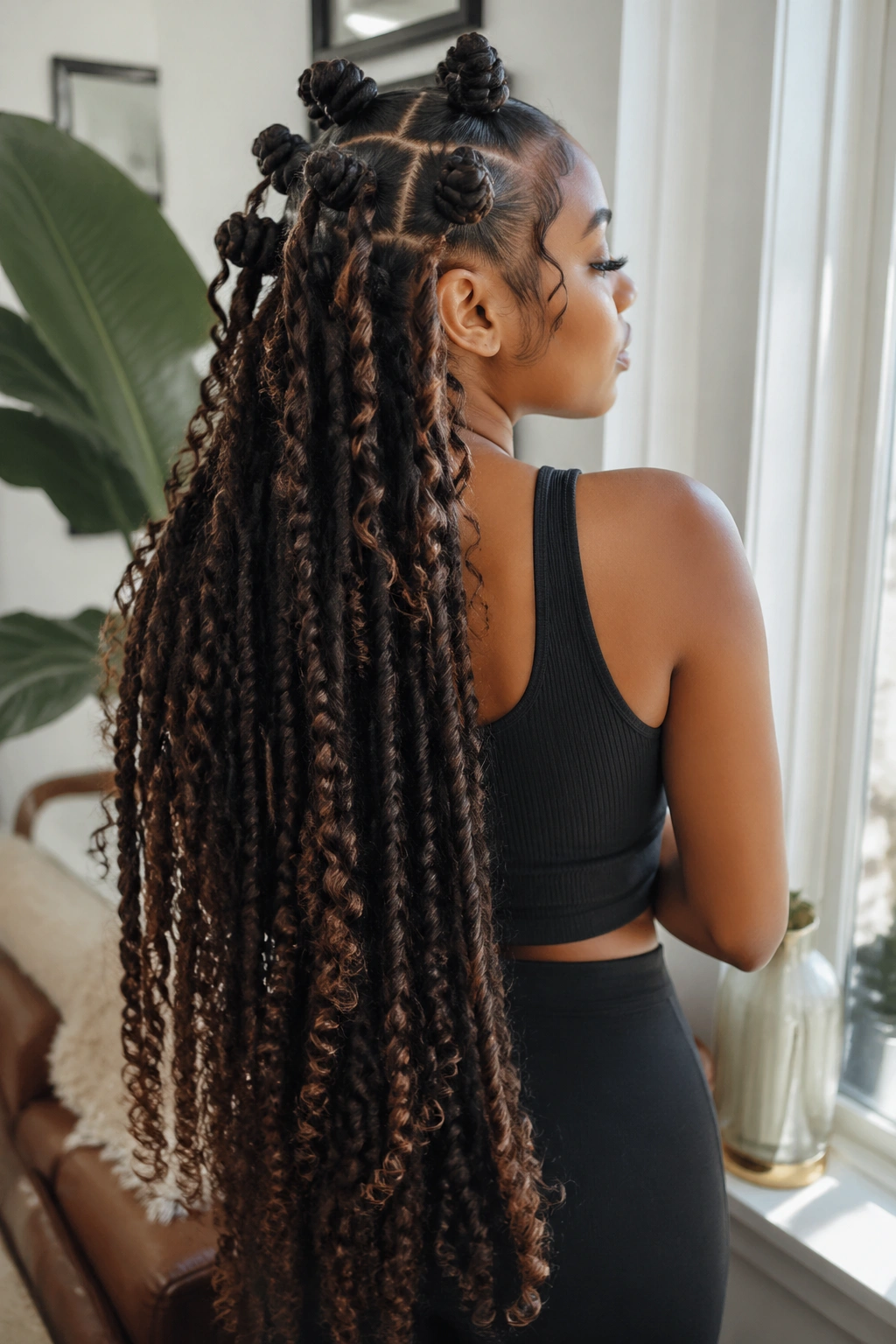
Natural hair does not need to reach your waist for you to wear long Bantu knots with curls. Extensions can build that length, and when they are color-matched well, the result looks far more convincing than people expect.
This style uses your own hair for the knot base and added hair for the wrapped length or exposed curls. The best installs keep the knot size believable. If the added hair makes each knot huge and heavy, you lose the elegance and gain a headache. Light bundles, moderate density, and clean wrapping matter more than raw length.
For the loose curls, choose extension hair that holds a set and stays separated. Pre-curled hair can work, but I often prefer straight or lightly textured braiding hair curled after installation because the pattern looks more controlled.
Long styles also need weight management. Spread the knots evenly across the head instead of stacking them all at the top. Your neck will notice the difference by the end of the day.
25. Knot-Out Hybrid Bantu Knots With Full Texture
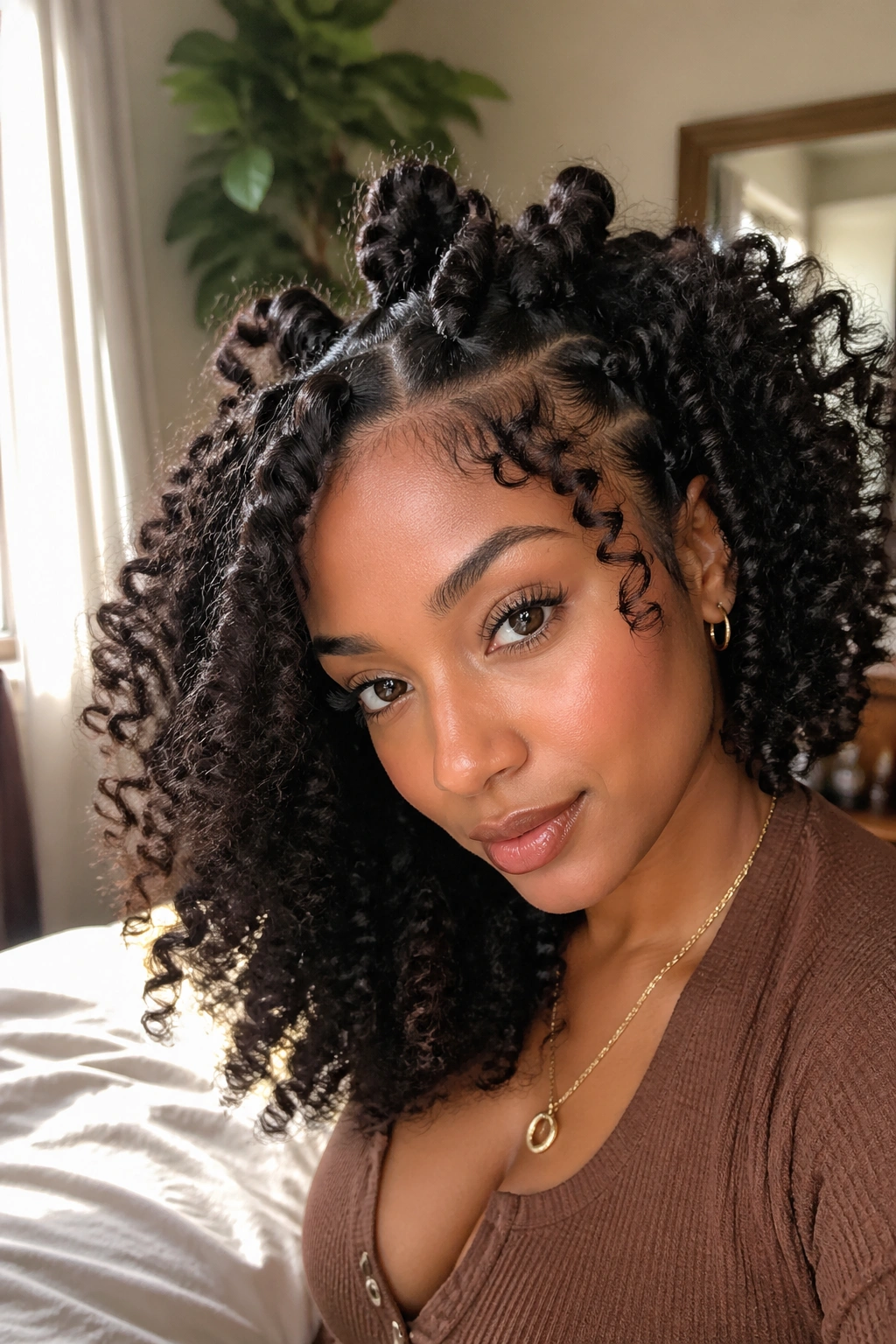
This is the style for people who cannot decide whether they want to wear the knots or take them down. A knot-out hybrid keeps a few Bantu knots visible while the rest of the hair is released into a full textured curl pattern.
Usually the front or crown holds three to five knots, while the rest of the hair is unraveled, fluffed, and shaped. You get the visual nod to the original style without committing to a full head of knots.
Why it works so well
The visible knots act like anchors. They give the fluffy texture some structure, which stops the released hair from looking random or unfinished.
Best ways to shape it
- Keep the unraveling gentle; separate each section 2 to 4 times, not into tiny wisps
- Use a pick at the roots only, leaving the curl definition at the ends intact
- Place the remaining knots where they frame the style, usually the crown or one side
- Mist lightly with a shine spray instead of heavy oil
There is also a practical upside. If one or two knots frizz, the style still works because the loosened texture already carries some softness. It is forgiving — and that counts for a lot.
Final Thoughts
The best Bantu knots with curls are not the ones with the most extras. They are the ones where the sectioning, knot size, and curl shape agree with each other. That sounds small. It is not.
If you want a sharp, graphic look, go cleaner with the parts and tighter with the curls. If you want softness, let the curls loosen, shift the placement off center, or leave space around the face. And if your scalp is tender, do not chase a super-snug finish for the sake of a photo. Hair that looks good and hurts is not a win.
Pick the version that matches how you actually like to wear your hair — polished, playful, bold, formal, somewhere in the middle — and the style will read stronger before anyone even notices the details.
