



Fulani braids with Bantu knots have a rare kind of balance: the face-framing braids keep things grounded, and the knots pull the eye upward without making the style feel fussy. That mix is part of the appeal. It looks planned, but not stiff.
There’s also a practical reason people keep coming back to it. The braids give you structure and staying power, while the knots add height, texture, and a little attitude right where it counts. A good version doesn’t just sit on the head. It moves with it, and the parting matters more than most people realize. Clean sections, even tension, and the right knot size can make the difference between a style that feels polished and one that feels heavy by day three.
I’ve always thought this style works best when it respects the scalp. Tight braids, oversized extensions, and too many accessories can turn a smart look into a headache fast. Keep the front neat, keep the weight even, and let the shape do the talking. That’s where the really good versions live.
The fun part is how much room there is to play. One knot changes the mood. A center part feels classic. A zigzag part feels sharper. Beads, shells, gold cuffs, curly ends, and mixed braid sizes all push the style in a different direction without losing the Fulani braid backbone. The list below leans into that range, because the details are where this style gets interesting.
1. Center-Part Fulani Braids with Four Neat Bantu Knots
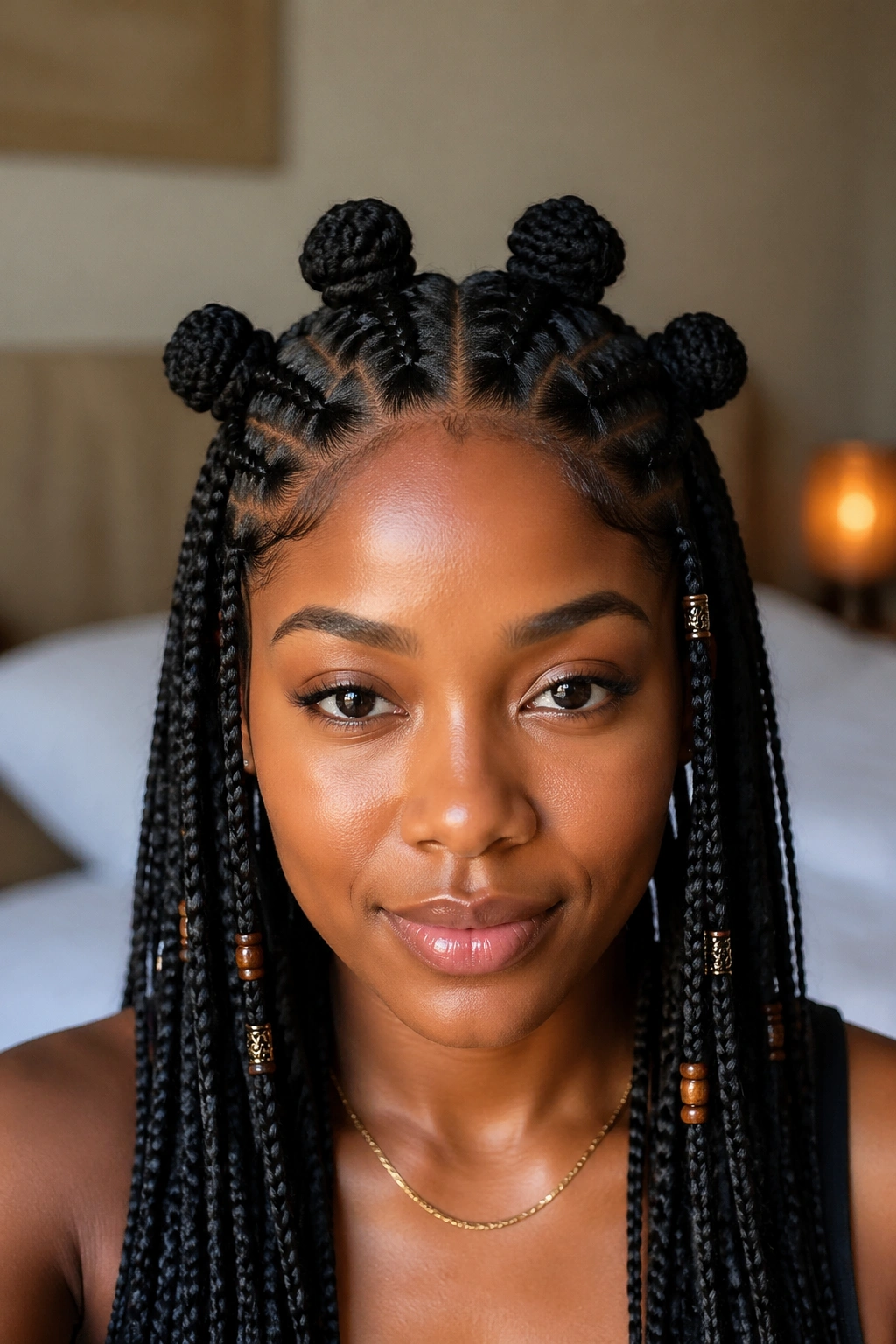
This is the version I think of as the cleanest, most balanced take on Fulani braids with Bantu knots. A straight center part gives the face room, and four knots lined up through the crown keep the silhouette tidy without looking rigid. It’s the kind of style that works just as well with a simple tee as it does with earrings that do a little extra work.
The trick is spacing. If the knots sit too close together, the crown can feel crowded. Spread them out just enough so each knot reads on its own, with the braids leading the eye forward instead of cluttering the top of the head. Medium-width cornrows on the sides usually make this version sit nicely.
Best for: round faces, oval faces, and anyone who wants a balanced shape.
Ask for: a sharp center part, slim side cornrows, and four medium Bantu knots across the top.
Watch for: bulky knots that sit too high. They can make the style feel top-heavy fast.
Keep the front rows neat and the ends tucked tightly. That’s what gives this version its crisp, finished look.
2. Side-Swept Fulani Braids with a Single Knot Stack
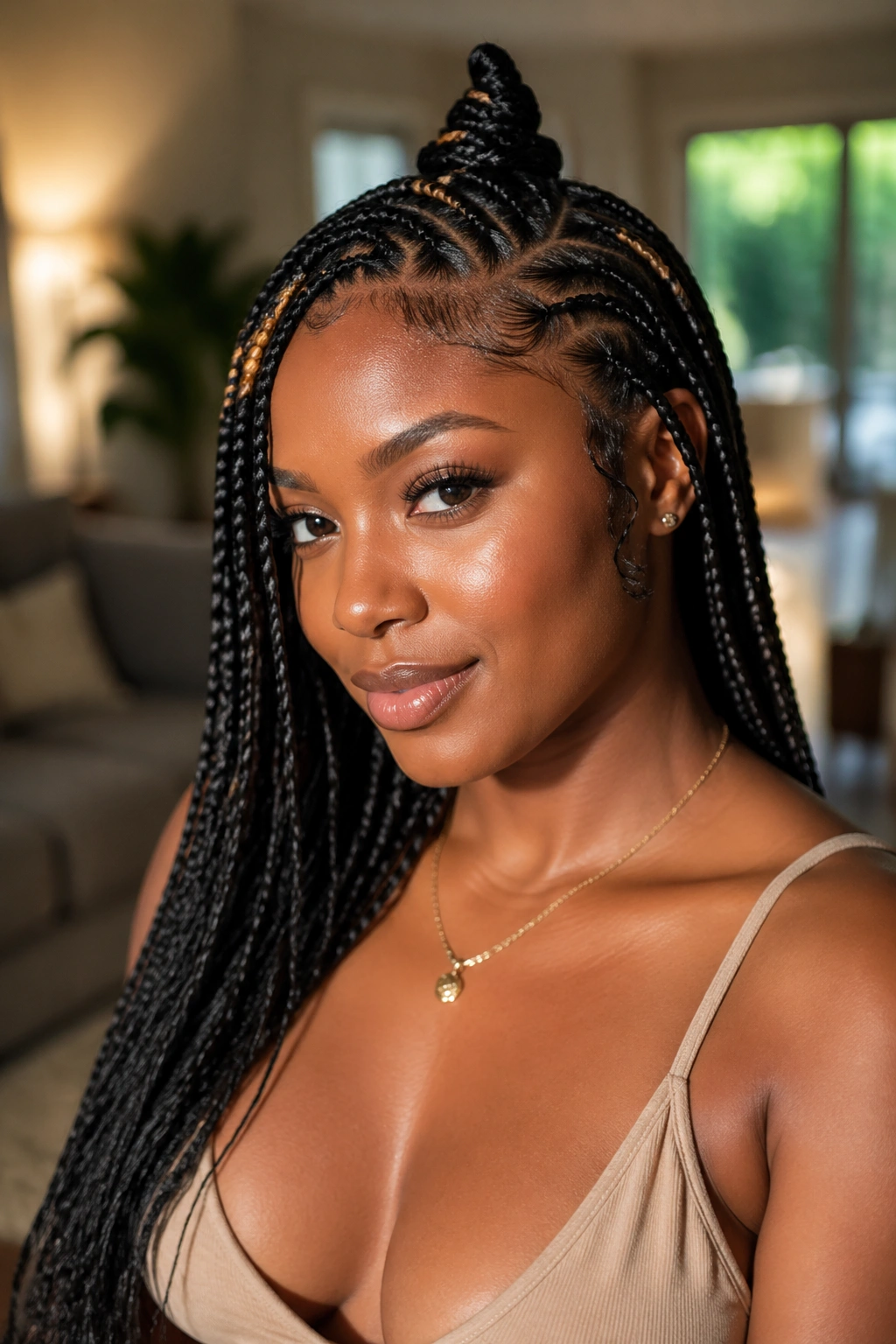
What happens when you move the part off-center and keep the knot work clustered to one side? The whole style softens. A side-swept Fulani braid pattern with a single knot stack feels less formal, more relaxed, and a little more romantic without losing shape.
Why the Off-Center Line Works
A side part changes the way the braids fall around the eyes and cheekbones. That little shift makes the style feel less symmetrical and a bit more alive. The knot stack can sit just above the temple or just behind it, depending on how much face you want to open up.
If you wear glasses, this version is a smart pick. The side work can be arranged to avoid pressure at the temples, and the braid direction keeps the frames from fighting the style. It also looks good on hair that has a natural side part already, since you’re not forcing the scalp into a line it doesn’t like.
How to Wear It
- Keep the knot stack small to medium so it doesn’t sit too far out from the head.
- Leave the side cornrows slim and clean to keep the part from feeling crowded.
- Add one or two face-framing braids with beads if you want movement near the jawline.
- Avoid heavy accessories on the side that carries the knots.
A side-swept version like this has a quiet confidence to it. Not loud. Just well-placed.
3. Jumbo Fulani Braids with Oversized Bantu Knots
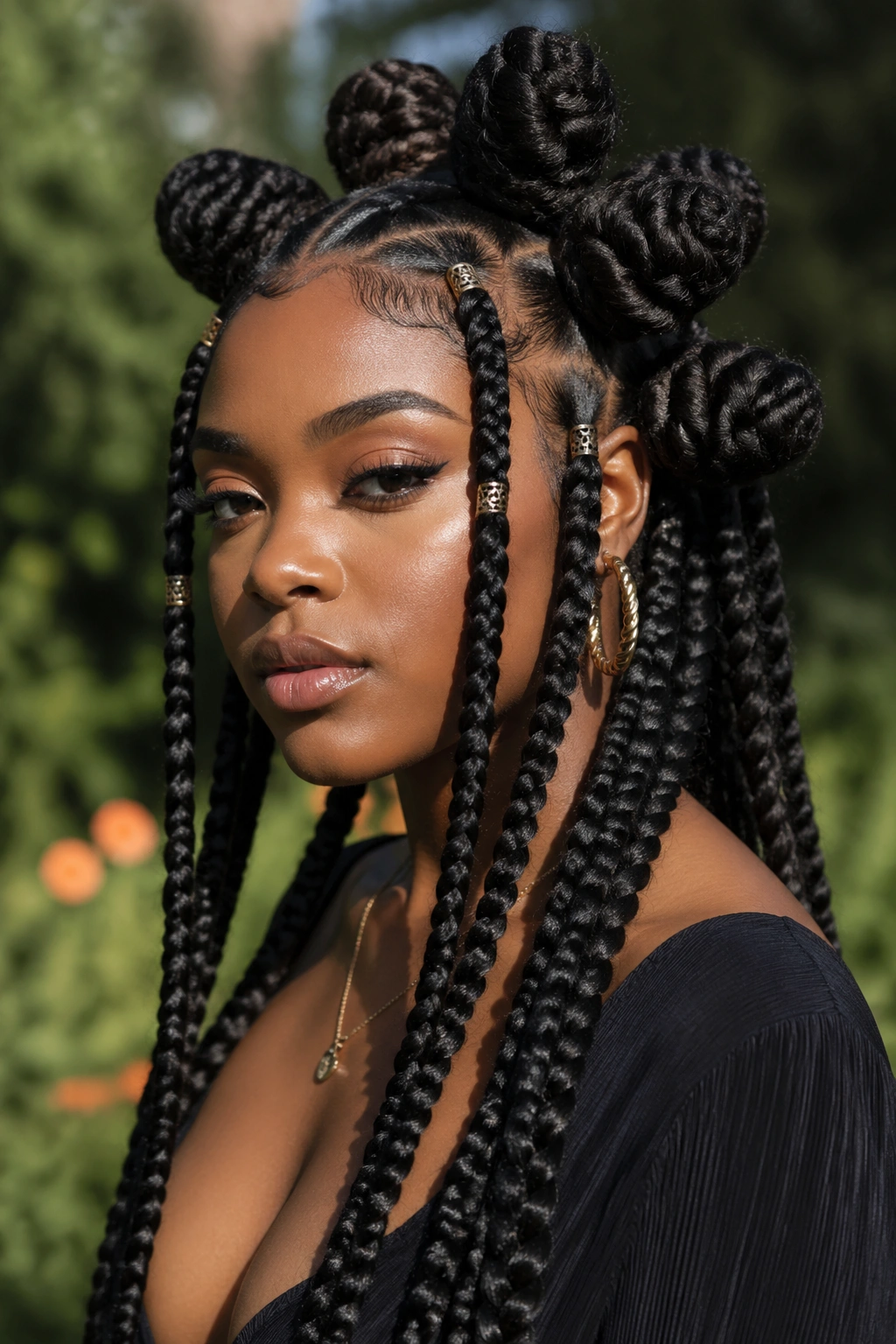
Picture a style that reads from across the room. That’s this one. Jumbo Fulani braids with oversized Bantu knots are bold in the way big hoops or a strong shoulder line are bold — they don’t ask permission, and they don’t need much else.
The appeal is in the size contrast. Thick braids along the sides create a strong base, then the knots sit on top like deliberate sculptural pieces. Fewer braids usually mean a faster install, which matters if you hate spending forever in the chair. The tradeoff is weight. Bigger sections can pull more, especially if the extensions are dense or the knots are stacked high.
- Best on thicker hair or on clients comfortable with a little more weight.
- Works well when you want the style to last without tiny parting maintenance.
- Looks strong with plain ends, because the braids themselves are already doing a lot.
- Can be paired with one or two gold cuffs, but don’t overdo it.
If you want drama without a lot of tiny detail work, this is the one. Keep the knots secure, not tight, and let the size be the point.
4. Knotless Fulani Braids with Tiny Top Knots
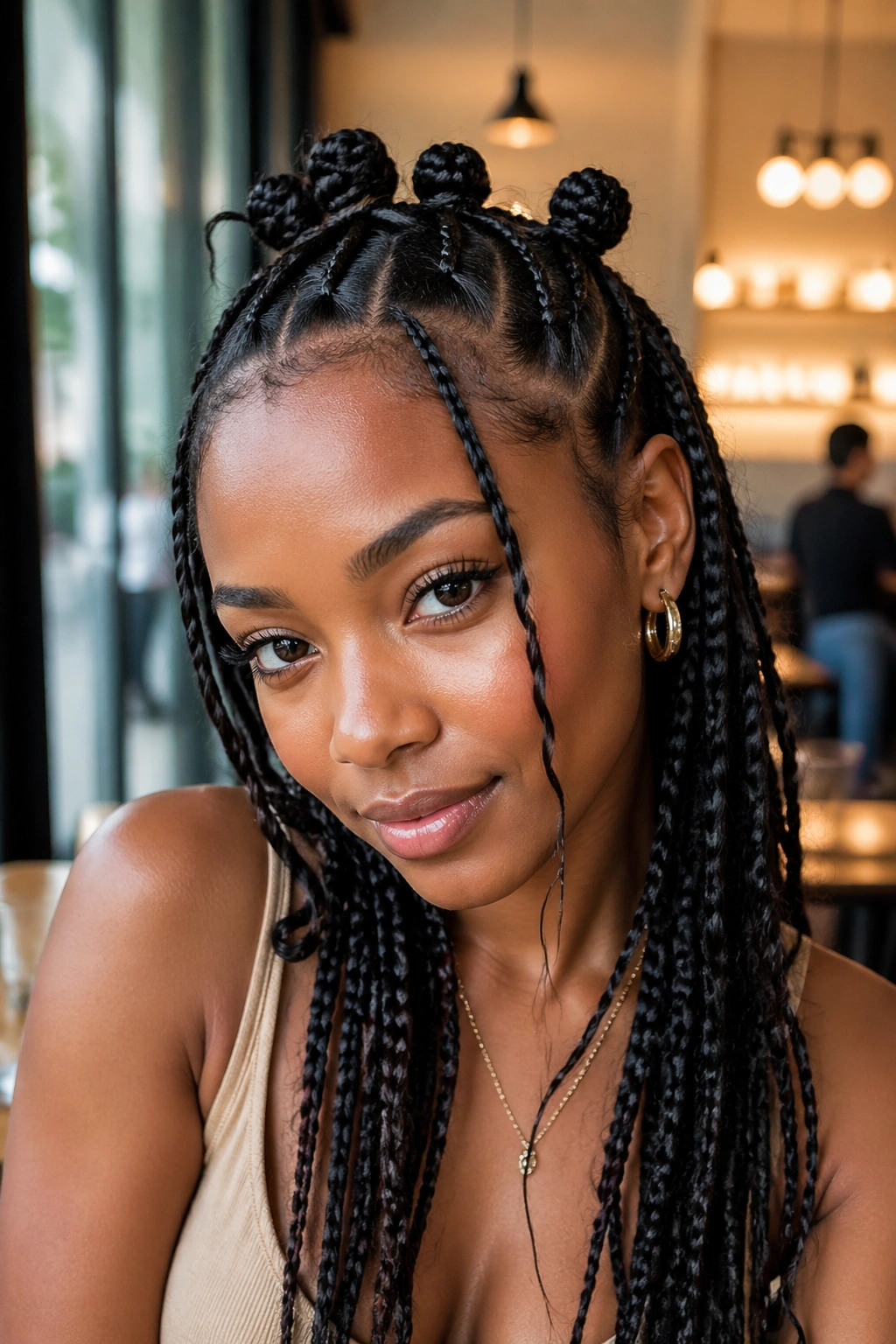
Knotless braids change the whole feel of the style. The base looks smoother, the scalp shows a little more cleanly, and the Bantu knots at the top stay light instead of bulky. That’s a nice combination if you like the idea of Fulani braids with Bantu knots but don’t want the front of your head packed with heavy sections.
There’s a quieter elegance here. The braids taper in from the root, so the knots don’t have to fight with a thick start point. They sit more naturally, almost like they belong there instead of being added on at the last minute. The style usually lasts longer when the foundation is neat, because you’re not dealing with a lot of root puffing in the first few days.
The other advantage is comfort. If your scalp gets grumpy, knotless braids can feel easier to wear. They still need care, though. Loose does not mean sloppy. Keep the parting clean, keep the knot size modest, and wrap the hair at night so the top stays smooth.
This is the version for someone who likes their style neat up close, not just from a distance.
5. Beaded Fulani Braids with Bantu Knots at the Crown
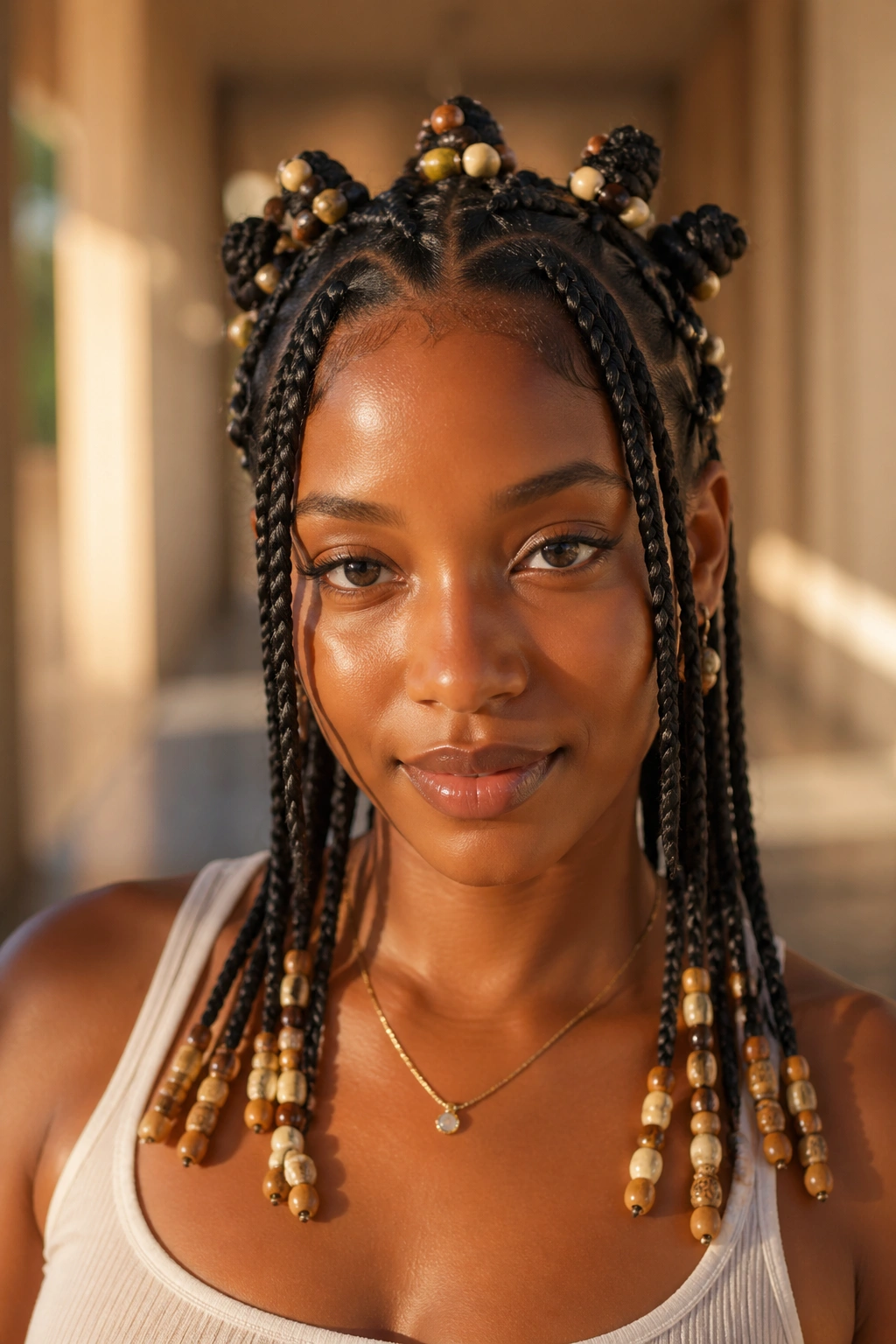
Beads change the whole mood of the style. Without them, the braids and knots carry the shape on their own. With them, the ends move, click softly, and add a bit of rhythm every time you turn your head. That’s why beaded Fulani braids with Bantu knots feel so alive.
Unlike plain-ended styles, this version leans into movement. The knots stay at the crown, while the side braids can be finished with clear beads, wooden beads, or polished gold pieces. The best setups use beads with some restraint. A few well-placed strands do more than covering every braid. Too many beads, especially in the front, can drag the whole thing down.
What I like here is the contrast: the top stays sculpted, the ends stay active. That mix gives the style range. It can read ceremonial with cowrie shells, casual with wood, or sharper with gold-toned cuffs near the tips. Keep the knot placement centered and let the accessories do the rest.
This is a strong pick if you want a style that feels rooted, detailed, and a little expressive without becoming noisy.
6. Triangle-Part Fulani Braids with Low Set Knots
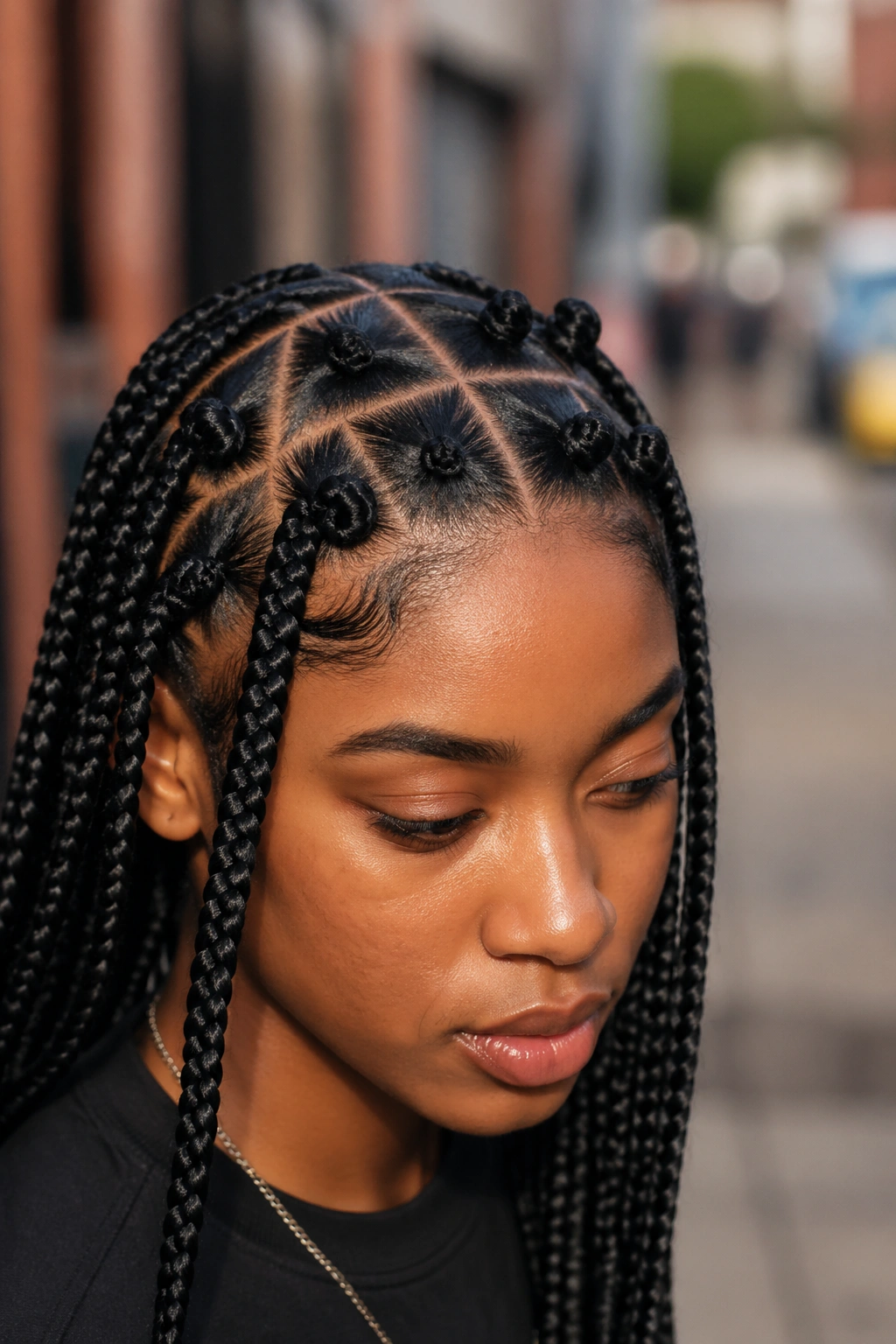
Triangle parts give the scalp a different kind of rhythm. Instead of straight rows only, you get angles that break up the surface in a way that feels deliberate and fresh. Put low-set Bantu knots into that pattern, and the whole style becomes softer at the crown, less stacked, more grounded.
What Makes It Different
Triangle parting works especially well when you want the braids to look patterned without looking busy. The sections catch the light at different angles, and the knots sit lower, which keeps the top from feeling too tall. That’s useful if you wear hats, low headwraps, or anything that needs room on top.
This shape also flatters people who like geometric detail but don’t want sharp lines everywhere. The triangles add interest. The low knots keep it wearable.
How to Ask for It
- Request triangle sections through the top and sides, not only in the front.
- Keep the knots medium-sized and placed just above the forehead line.
- Use slim braids near the edges so the pattern stays visible.
- Skip heavy accessories at the crown; the parting is already doing plenty.
Triangle parts are one of those small changes that make the whole style feel thought through. They’re subtle. But not boring.
7. Half-Up Fulani Braids with a Bantu Knot Mohawk
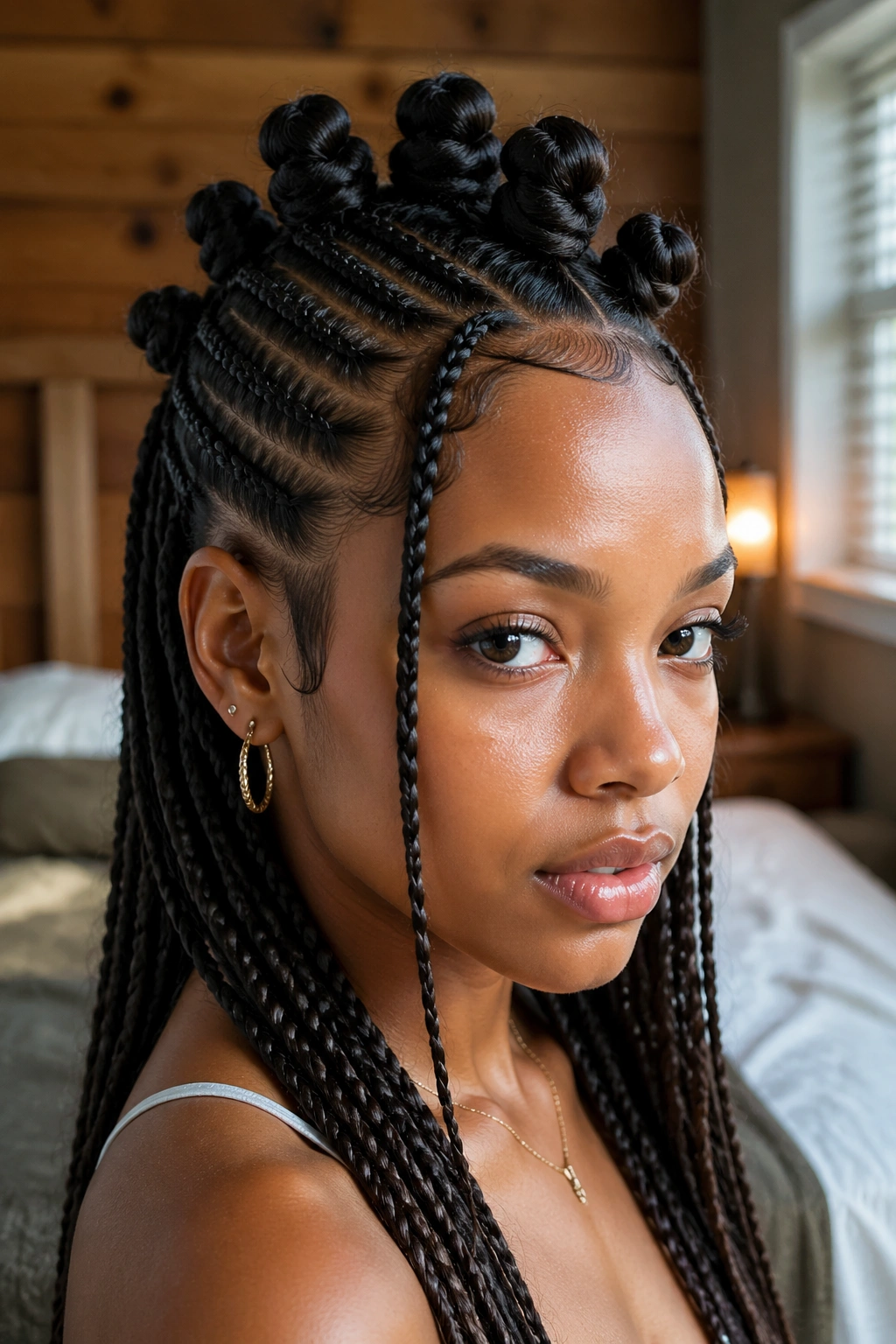
This version has a little more edge. Pulling the top section into a row of Bantu knots turns the style into a half-up mohawk shape, which gives height through the center and keeps the sides clean against the head. It’s a smart option if you want your face open but still want something with a bit of attitude.
The silhouette matters here. The knots should run in a straight or slightly curved line down the top, while the side cornrows stay flat and controlled. That contrast is what sells the look. If the sides are too loose, the whole thing loses its shape. If the knots are too far apart, the mohawk effect disappears.
This is one of those styles that looks best with strong cheekbone framing. The top gives lift, and the side braids draw a clean line down the face. Keep the ends simple unless you want the look to lean more playful than sharp.
One good rule: the higher the knots, the more carefully the braids underneath need to be anchored.
8. Waist-Length Fulani Braids with Curly Ends
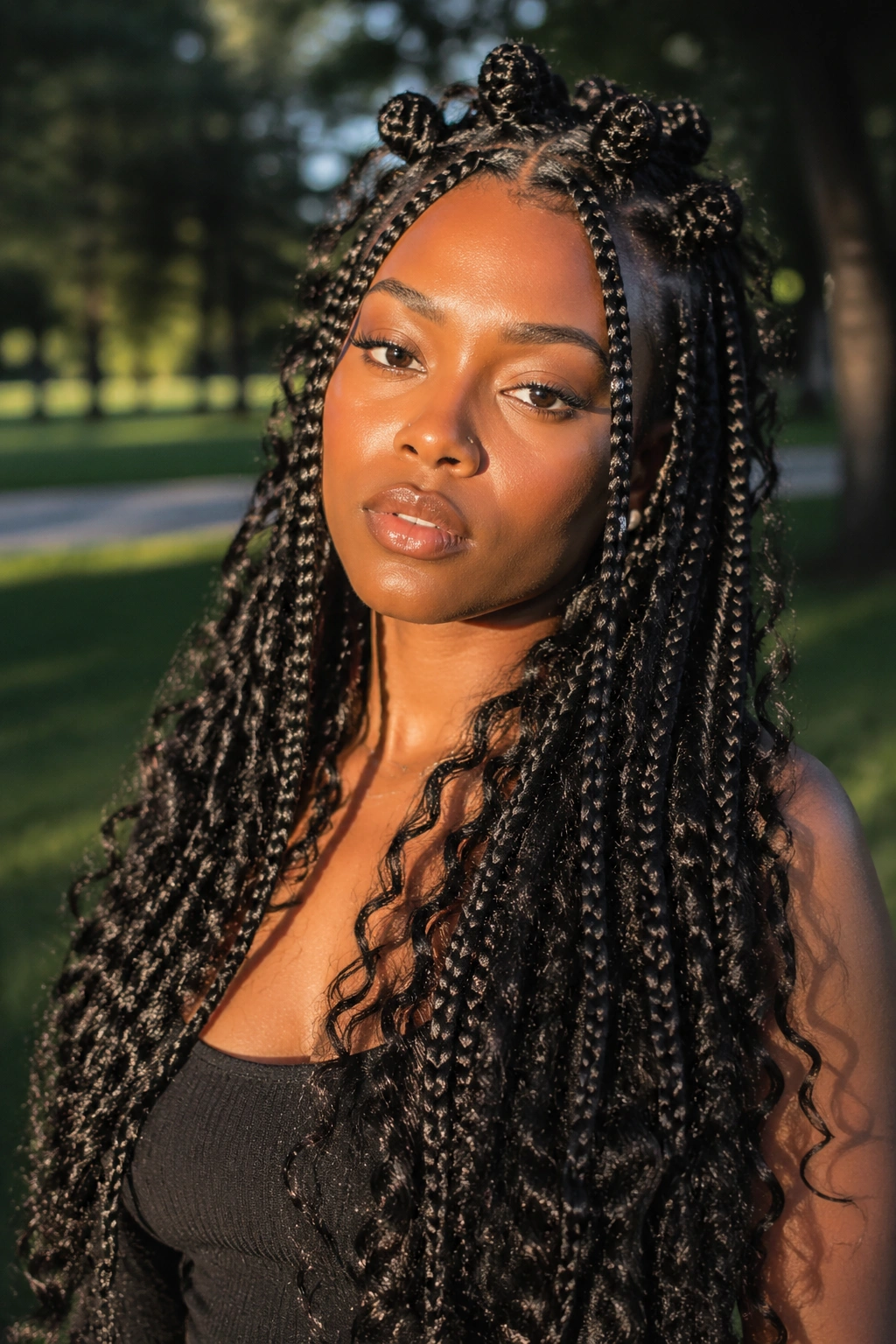
Can long braids and Bantu knots share the same head without fighting each other? Absolutely, if the balance is right. Waist-length Fulani braids with curly ends feel softer than a fully tucked version, and the length adds drama while the knots keep the crown from looking plain.
The Shape Makes the Style
Long braids naturally pull the eye downward, so the Bantu knots have to work a little harder up top. That’s fine. The knots give structure, then the curls at the ends bring in movement. It’s a nice contrast. Straight, sculpted top. Loose, airy bottom.
A Few Things That Help
- Use flexi rods or perm rods on the ends if you want defined curls.
- Ask for slightly narrower braids near the front so the length doesn’t overwhelm the face.
- Keep the knot row compact; a big knot on top of long hair can feel too heavy.
- Sleep with the ends tucked into a silk wrap to help the curl pattern hold.
Long styles like this do take more upkeep. The ends need attention, and the knots need to stay neat. Still, when the proportions are right, the result is worth it. It has presence.
9. Shoulder-Length Fulani Braids with Two Row Knots
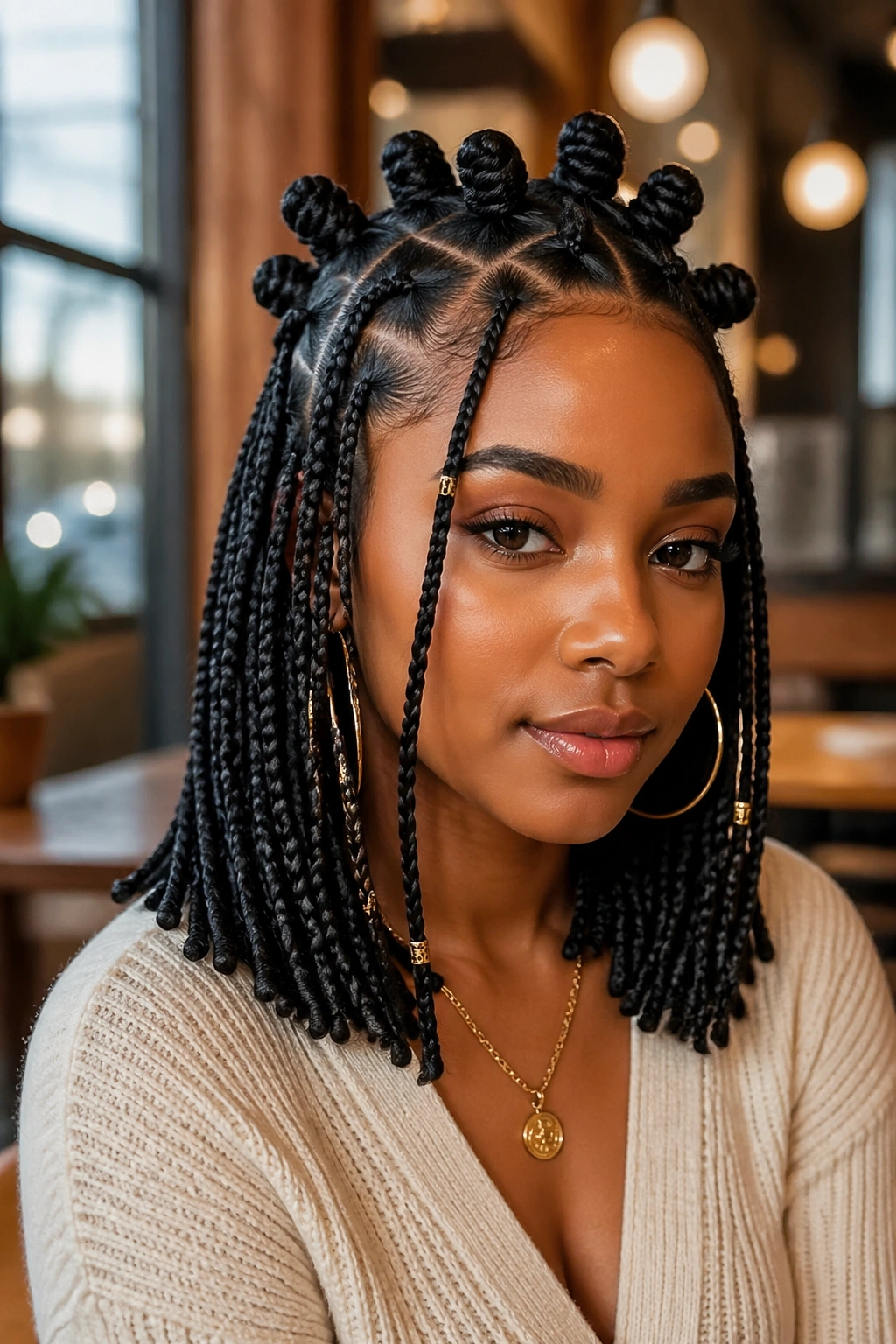
Shoulder-length versions are underrated. They’re easier to wear, easier to wash around, and they don’t swing around quite as much as waist-length braids. Add two rows of Bantu knots on top, and the style keeps its character without dragging too much weight around.
A woman with a busy day, a lot of movement, or a dislike of extra length usually appreciates this cut more than she expects to. It sits neatly, reaches the collarbone or the shoulders, and still gives you room to decorate the ends if you want. The two rows of knots are enough to create a pattern without turning the crown into a block.
- Good pick if you want less pull on the neck.
- Easier to pin back than longer versions.
- Looks especially clean with medium-thick braids.
- Works well with simple ends or small beads near the bottom.
The nice thing about shoulder length is that it doesn’t shout. It just works. And when the parting is clean, that kind of restraint looks sharp.
10. Zigzag-Part Fulani Braids with Clean Cornrow Lines
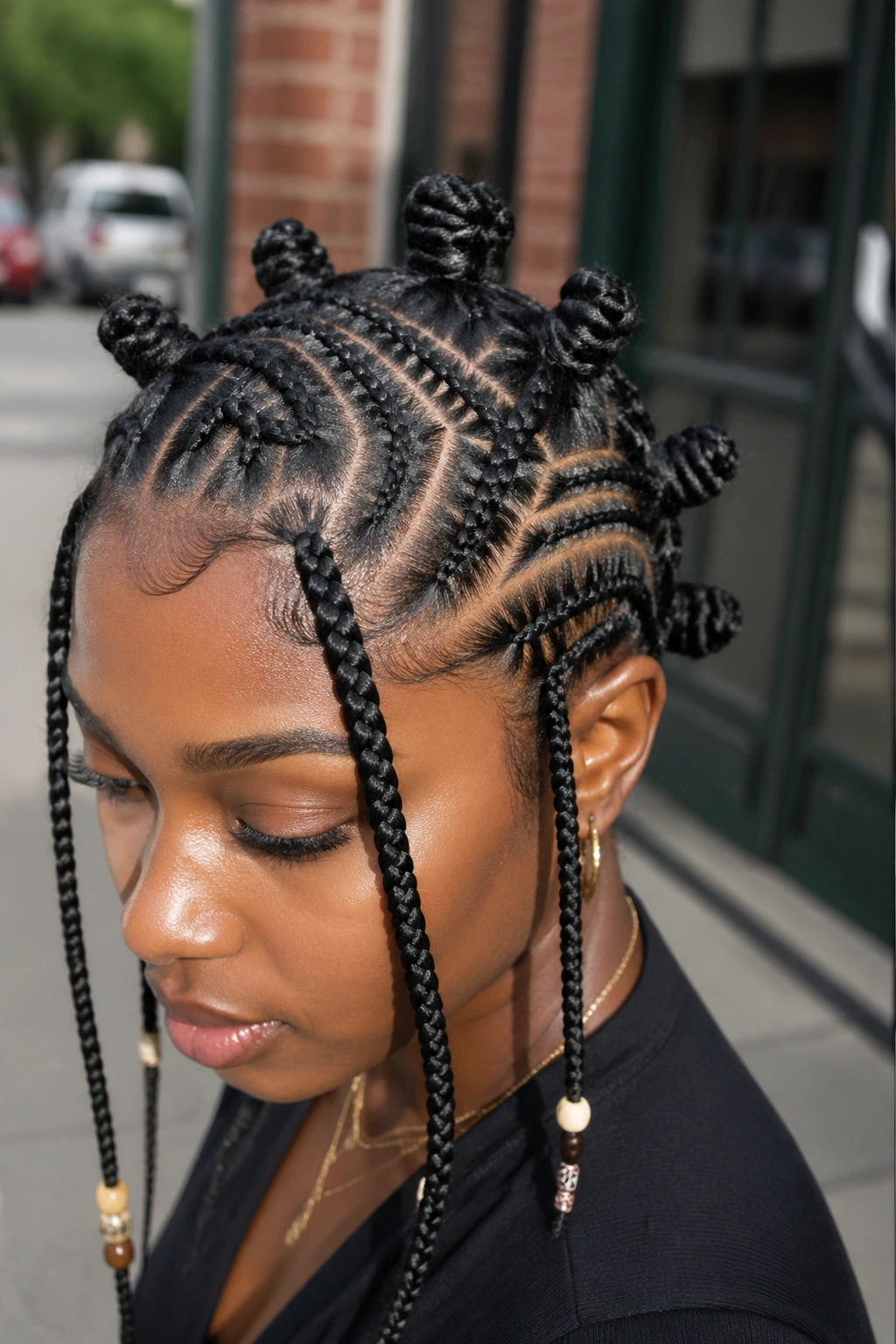
A zigzag part changes the whole story. Instead of straight rows, the scalp pattern breaks and turns, which gives the style a little motion before the braids even start. Put Bantu knots into that structure and the top begins to feel almost architectural.
This is the version for someone who likes detail that rewards a second look. From a distance, it reads as polished. Up close, you notice the parting and the way the lines travel. The knot placement should stay simple so the zigzag pattern remains the focus. If you pile on too many accessories here, the eye stops knowing where to land.
I like this one on medium-length hair, especially when the cornrows are tight enough to stay flat but not so tight that the scalp looks strained. The best versions have enough spacing to show the design. Clean lines. No clutter.
If you want a style that feels a little more editorial without losing wearability, this is a strong place to start.
11. Colored Fulani Braids with Burgundy or Copper Knots
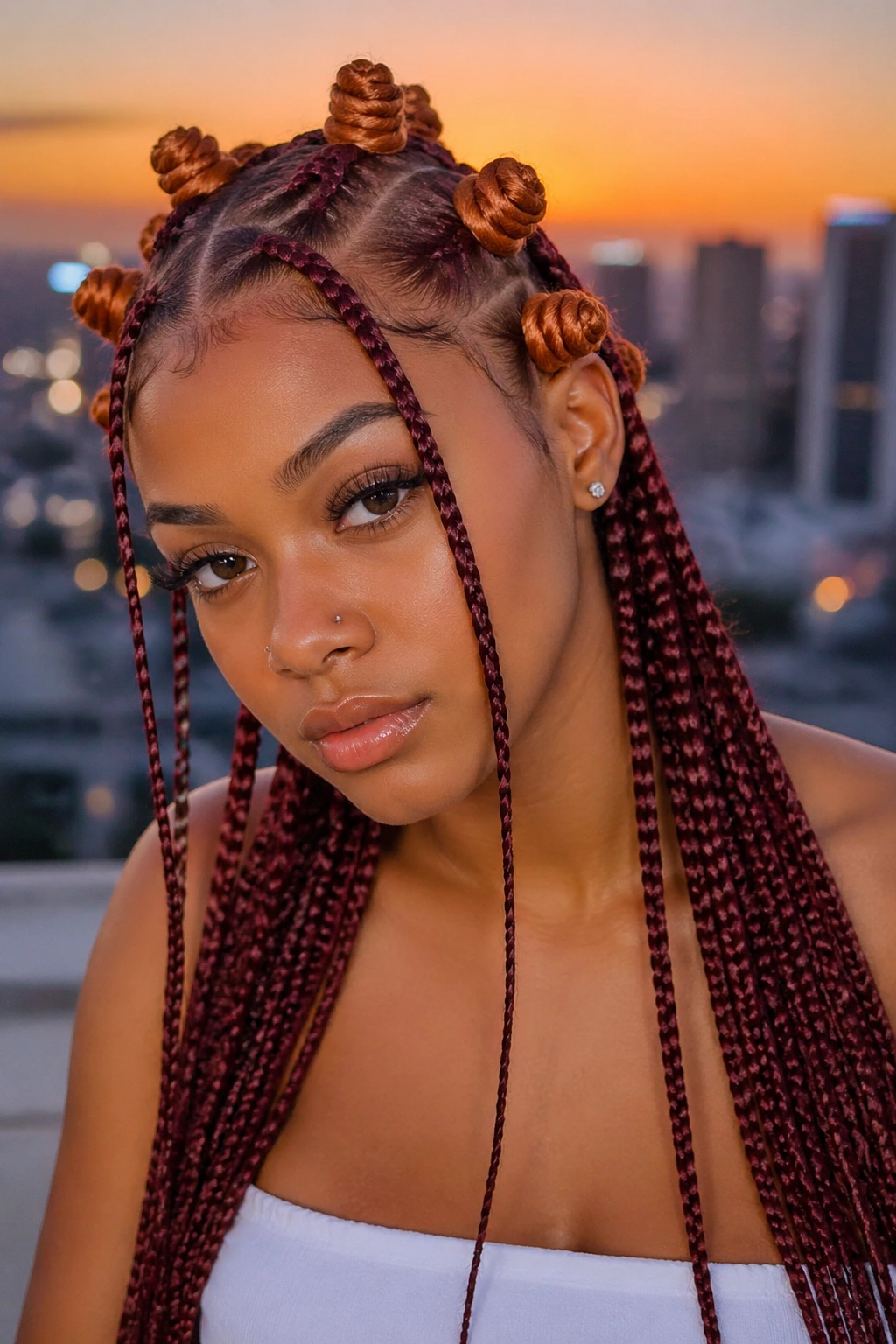
Color changes the mood faster than almost anything else. Burgundy braiding hair makes the knots look deeper and richer. Copper brings warmth. Honey brown softens the whole style. Even blue-black, which can look nearly neutral in shade, gives the braids a different shine when the hair moves.
What makes colored Fulani braids with Bantu knots useful is the way the color frames the shape. The knots no longer sit quietly in the background. They become part of the color story, especially if the braids alternate between darker roots and lighter extensions. That contrast can be subtle or loud, depending on how much color you want near the face.
This style is best when the color is chosen with the skin tone and wardrobe in mind, not just because it looks pretty in a bundle. A warm copper can glow near deeper skin tones. Burgundy tends to read rich and grounded. If you wear a lot of black, either one can give the whole style more life.
Keep the color consistent through the knot sections so the top doesn’t look patched together.
12. Bob-Length Fulani Braids with Mini Bantu Knots
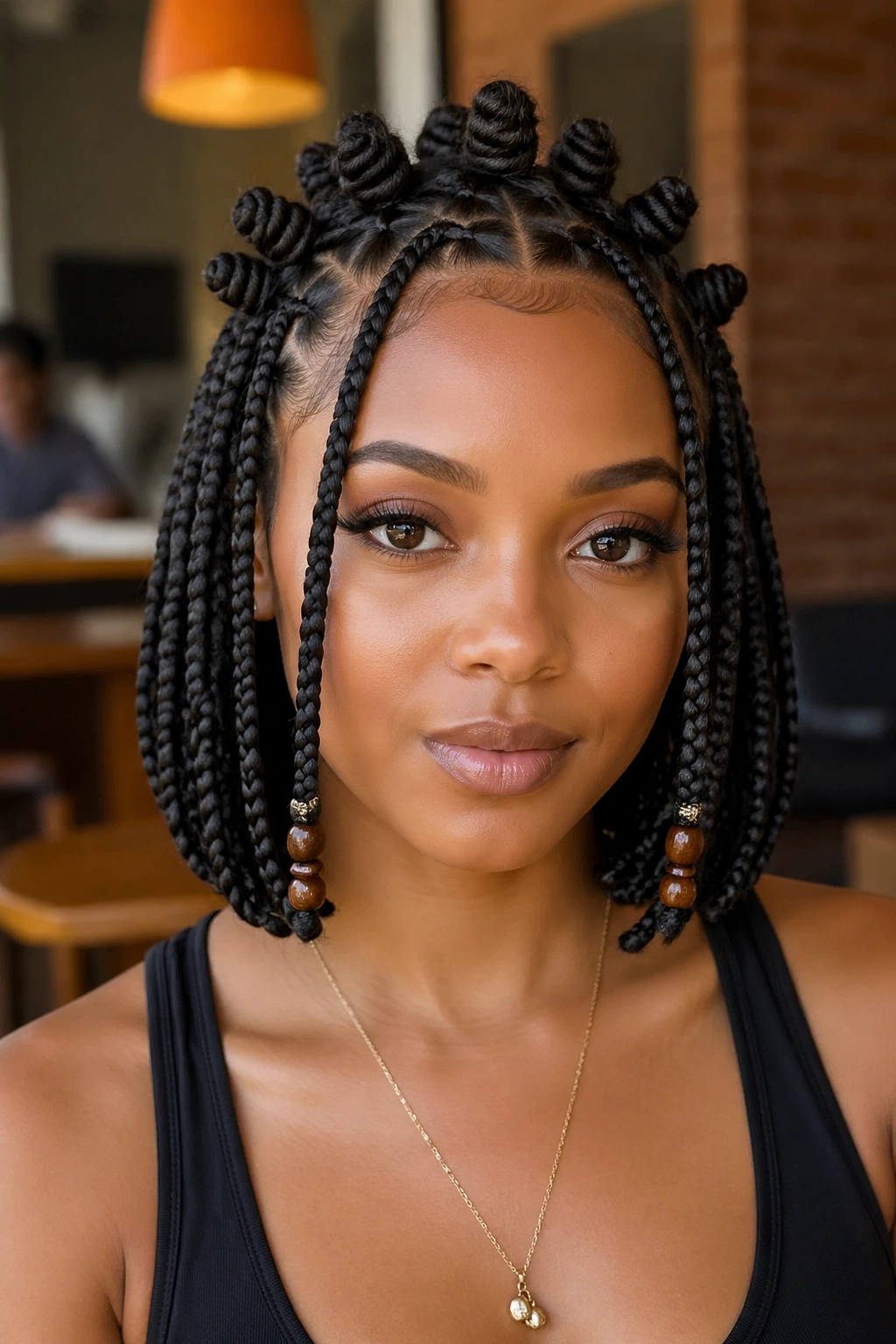
Shorter braids can be a relief. Bob-length Fulani braids with mini Bantu knots feel light on the neck, easy to flip, and surprisingly chic when the parting is done well. The small knots keep the crown interesting without overwhelming the shorter length below.
Why the Short Cut Works
Bob-length styles draw attention to the face and neck, which can be a plus if you like earrings or want the hair out of your way. The mini knots make the top feel detailed, but because they’re small, the style doesn’t tip into heaviness. That matters on shorter hair, where too much volume up top can look lopsided.
Keep in Mind
- Ask for blunt ends or softly tapered ends, depending on how clean you want the line.
- Keep the knot row close to the scalp so it stays balanced.
- Use a lightweight mousse to smooth the braids after installation.
- Avoid oversized beads; they can make a short cut look crowded fast.
A bob version like this is neat without being severe. It has shape, but it doesn’t drag. That’s the appeal.
13. Fulani Braids with Gold Cuffs and Thread Wraps
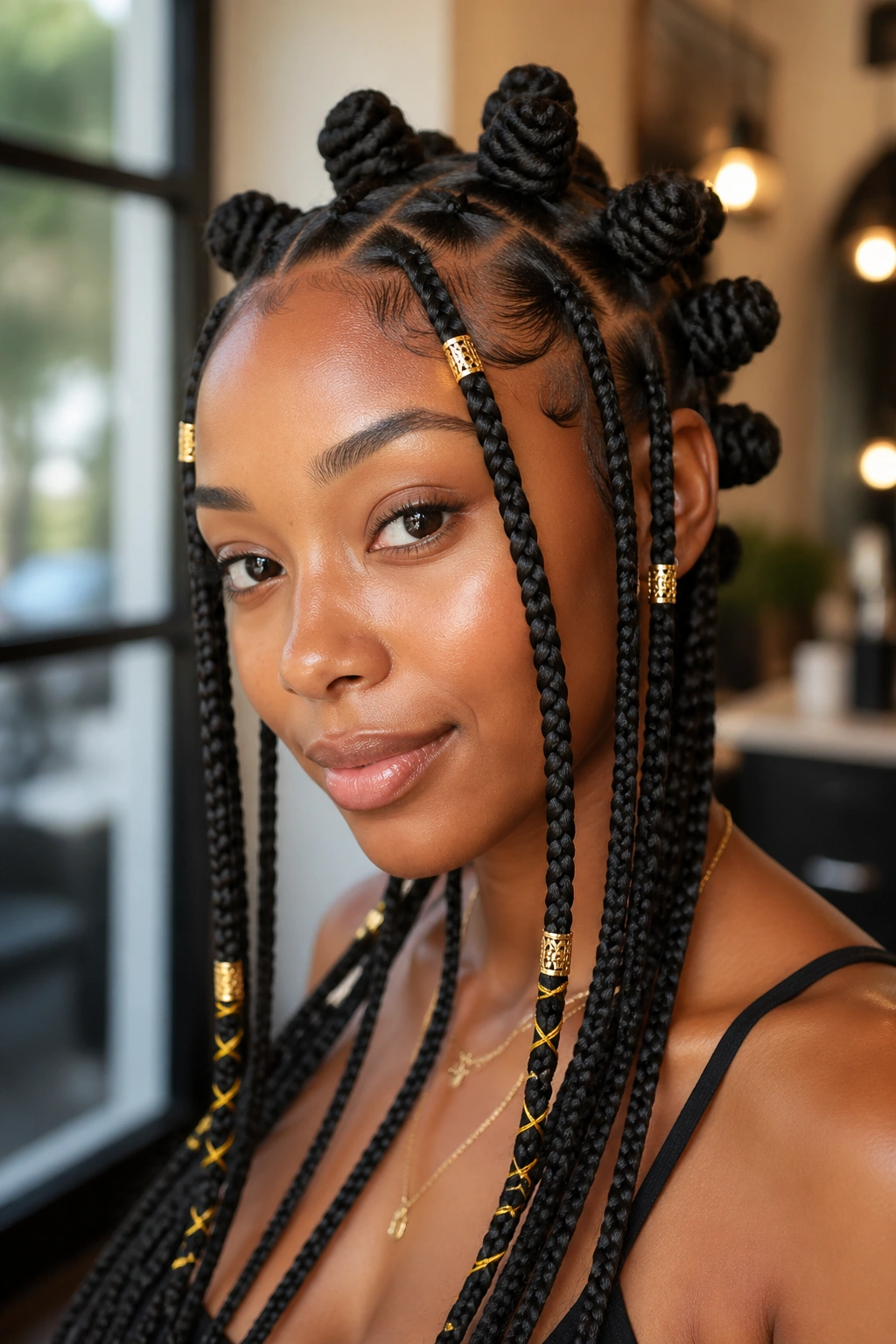
Metal and thread can do a lot when they’re used with restraint. Gold cuffs catch on the braids at strategic points, and thread wraps bring in color or texture without changing the braid pattern itself. Put them into Fulani braids with Bantu knots, and the whole look gains detail fast.
The best thing about this kind of styling is that it lets the braid structure stay simple. You don’t need huge knots or oversized parts. A few gold cuffs near the face-framing braids can be enough. Thread wraps work well near the ends, especially if you want one braid to stand out from the rest. Too many wraps, though, and the style starts looking crowded.
I’m picky about placement here. Put metal cuffs where they can be seen, not where they’ll snag at the roots or fight with the knots. A little shine near the front can be enough. The rest can stay quiet.
This version suits anyone who wants the style to feel finished without leaning into beads or shells. It’s cleaner. Sharper, too.
14. Fulani Braids with a Braided Halo and Center Knots
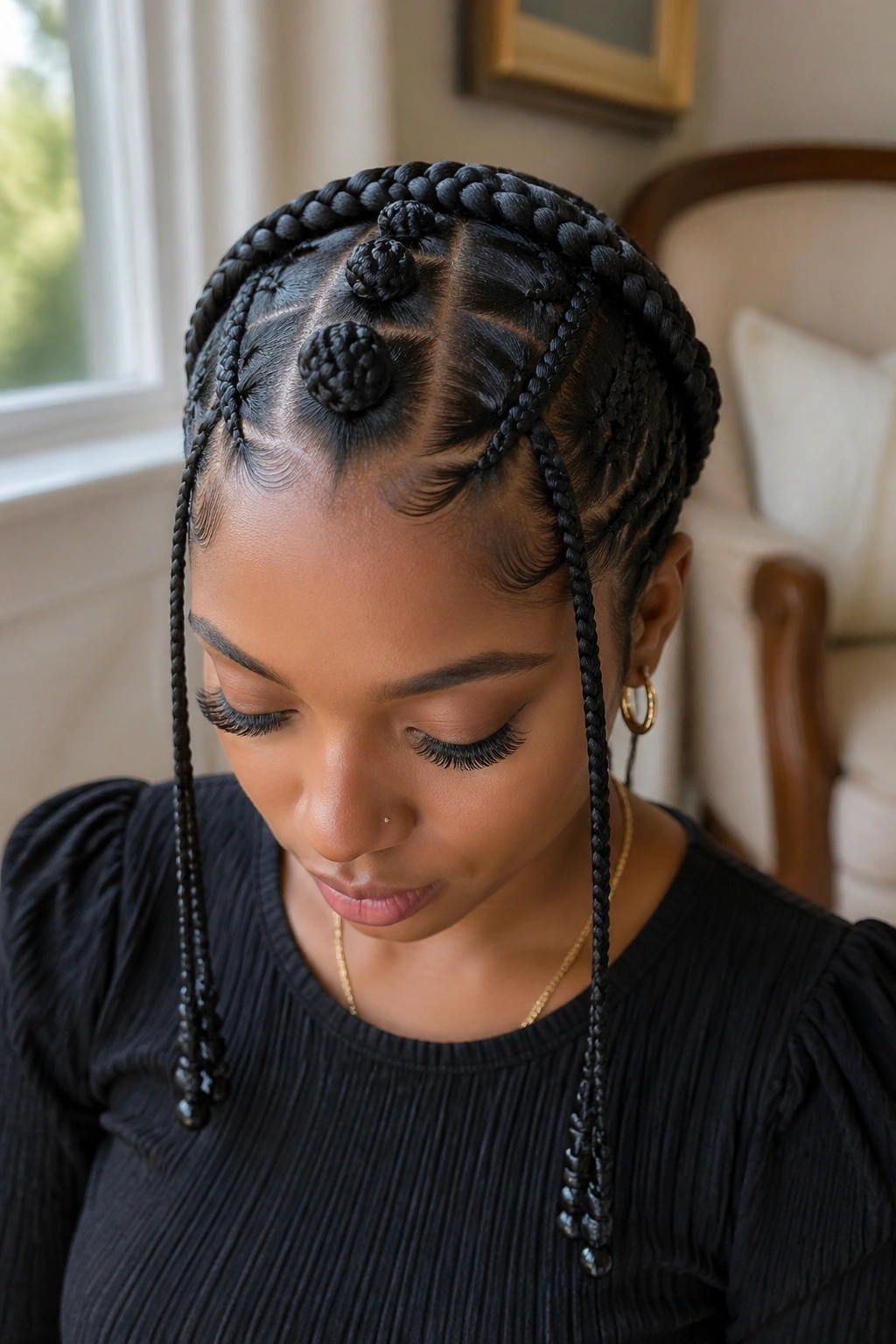
Can a Fulani style feel soft and regal at the same time? Yes, if the braids are arranged like a halo around the hairline and the knots stay centered above the forehead. The shape draws the eye in a circle, which gives the whole style a crown-like quality without turning it into a formal updo.
How to Wear It
The front cornrows need to curve gently around the face. That curve is the whole point. The Bantu knots at the center should stay neat and medium in size so they don’t crowd the top. The side braids can fall straight back or angle slightly toward the nape, depending on how much softness you want.
What Makes It Hold
- Keep the halo braid close to the hairline so it frames rather than lifts away.
- Use even braid thickness on both sides to prevent the style from tilting.
- Let the center knots stay the visual anchor; don’t overload them with accessories.
- Pair with simple earrings if you want the face framing to stay clean.
This is the version I’d pick for dressier settings, but it doesn’t feel overdone. It has shape, and that shape does the work.
15. Asymmetrical Fulani Braids with Off-Center Knots
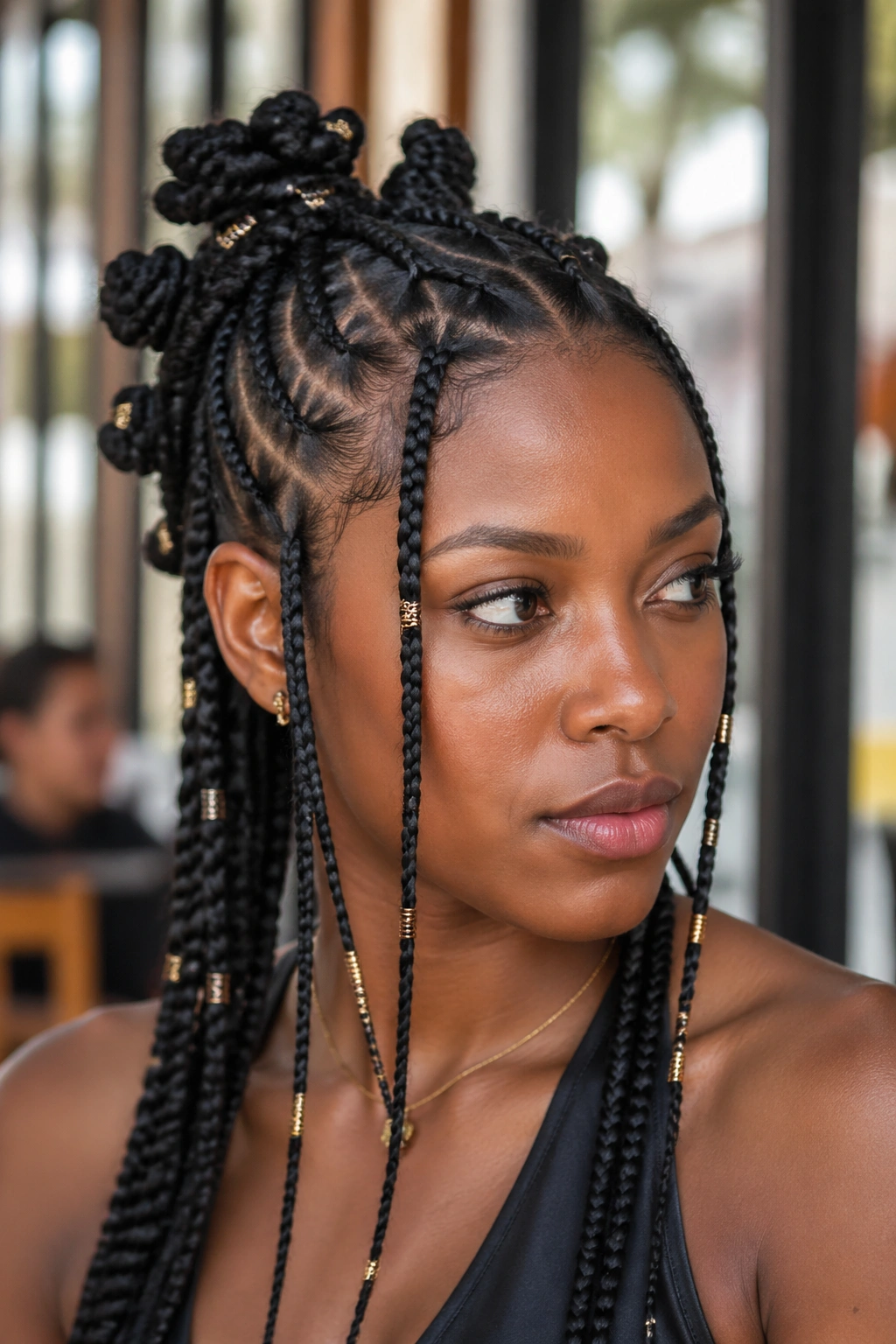
A little imbalance can be the whole point. Off-center knots give the style motion, especially when the braids are arranged to fall heavier on one side. It feels less predictable than a centered layout, and that makes it interesting right away.
There’s a difference between asymmetrical and messy. This style needs control. The braids on the heavier side should still be evenly spaced, and the knot cluster should feel intentional, not accidental. That usually means one side carrying more visual weight while the other side keeps the face open.
I like this on people who already wear side parts in their regular styles. The asymmetry feels familiar, not forced. It can also flatter strong jawlines and longer faces because the eye keeps moving rather than settling in one place.
If you want the look to stay elegant, keep the accessories minimal. Off-center design is already doing plenty. Let the parting stay the star.
16. Feed-In Fulani Braids with Seamless Scalp Cornrows
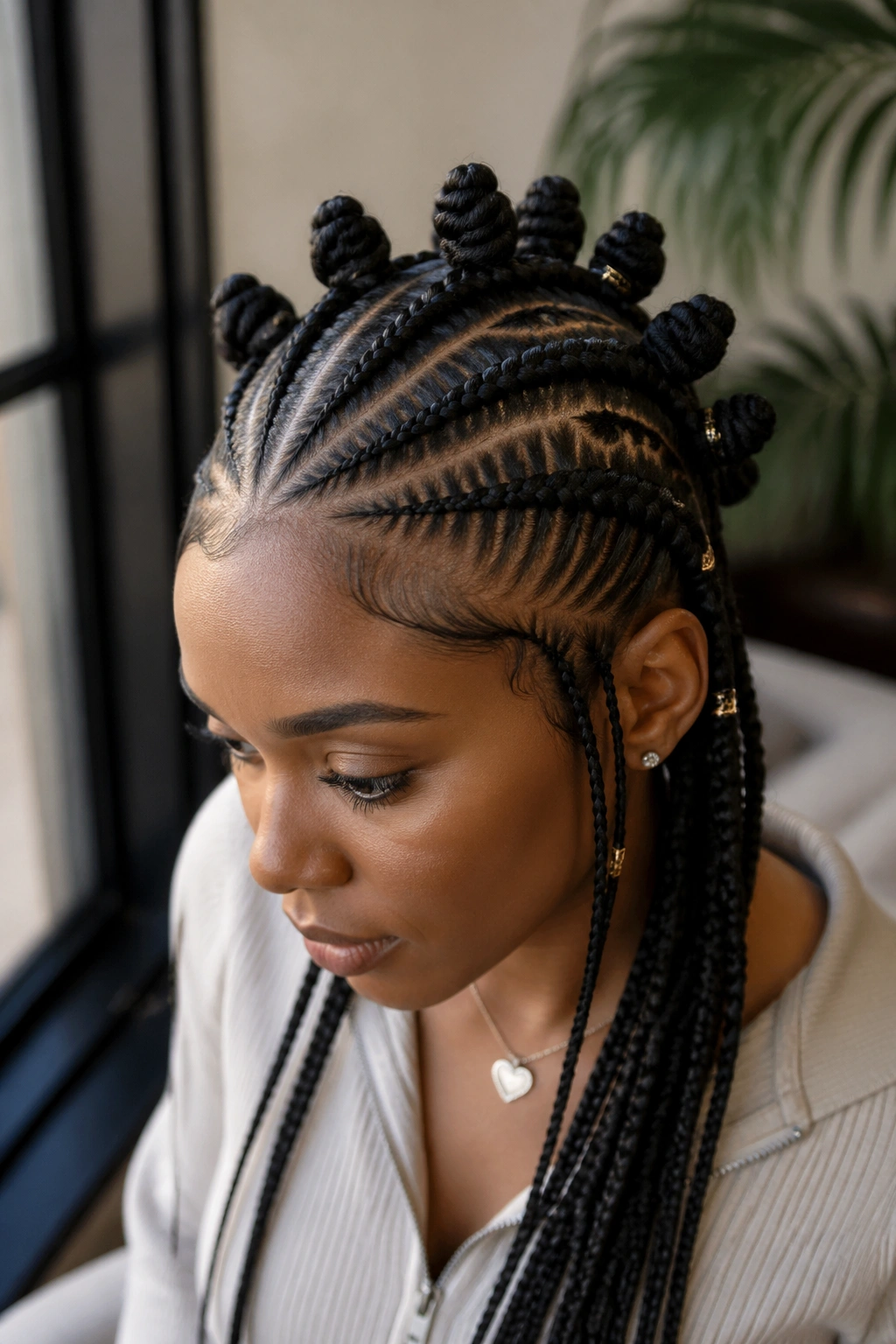
Feed-in braids are one of those details you only notice if they’re done well. The braid starts small at the scalp and grows gradually, which makes the base look smooth instead of bulky. Add Bantu knots to that, and you get a style that feels clean all the way through the crown.
The visual effect is subtle but important. The scalp lays flatter. The braids look as if they emerge naturally from the parting. That matters if you like a neat finish and don’t want the top row to feel thick or raised before it reaches the knot section.
This version is especially good if your hairline is delicate or if you’ve had styles in the past that felt too tight at the start. Feed-in braids can still be snug, but the graduated base tends to look softer. The knots should remain medium or small so the seamless effect doesn’t get interrupted by a big lump at the crown.
No wild accessories needed here. The technique itself is the attraction.
17. Fulani Braids with Shell Accents and Long Hanging Ends
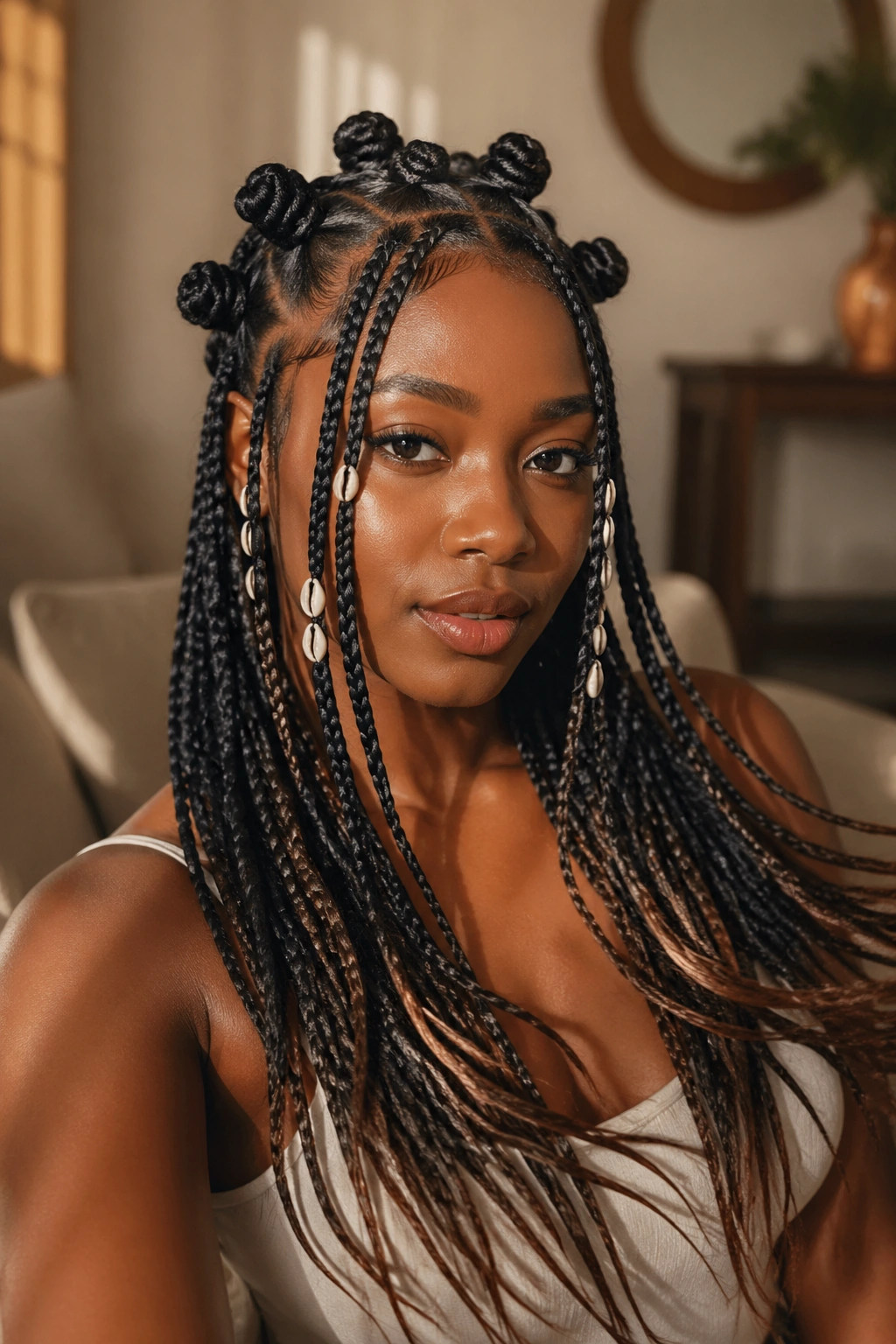
Shell accents bring a different texture to the style. They feel earthy, tactile, and a little more grounded than polished metal pieces. Pair them with long hanging ends, and the whole look leans into movement instead of stiffness.
The shell detail works best when it’s spaced out. You do not need shells on every braid. A few placed near the front or around the face framing pieces are enough to change the mood. The long ends create a soft drop below the knots, which keeps the silhouette from feeling too top-heavy.
I’ve always thought this version suits people who like their hairstyles to look touched by hand, not manufactured into perfection. There’s something about the shell against braided hair that feels warm and personal. Keep the shells light so they don’t snag, and don’t put them so close to the roots that they tug.
This style is easy to overdo. Done lightly, it looks rich.
18. Faux-Loc Inspired Fulani Braids with Knotted Crown
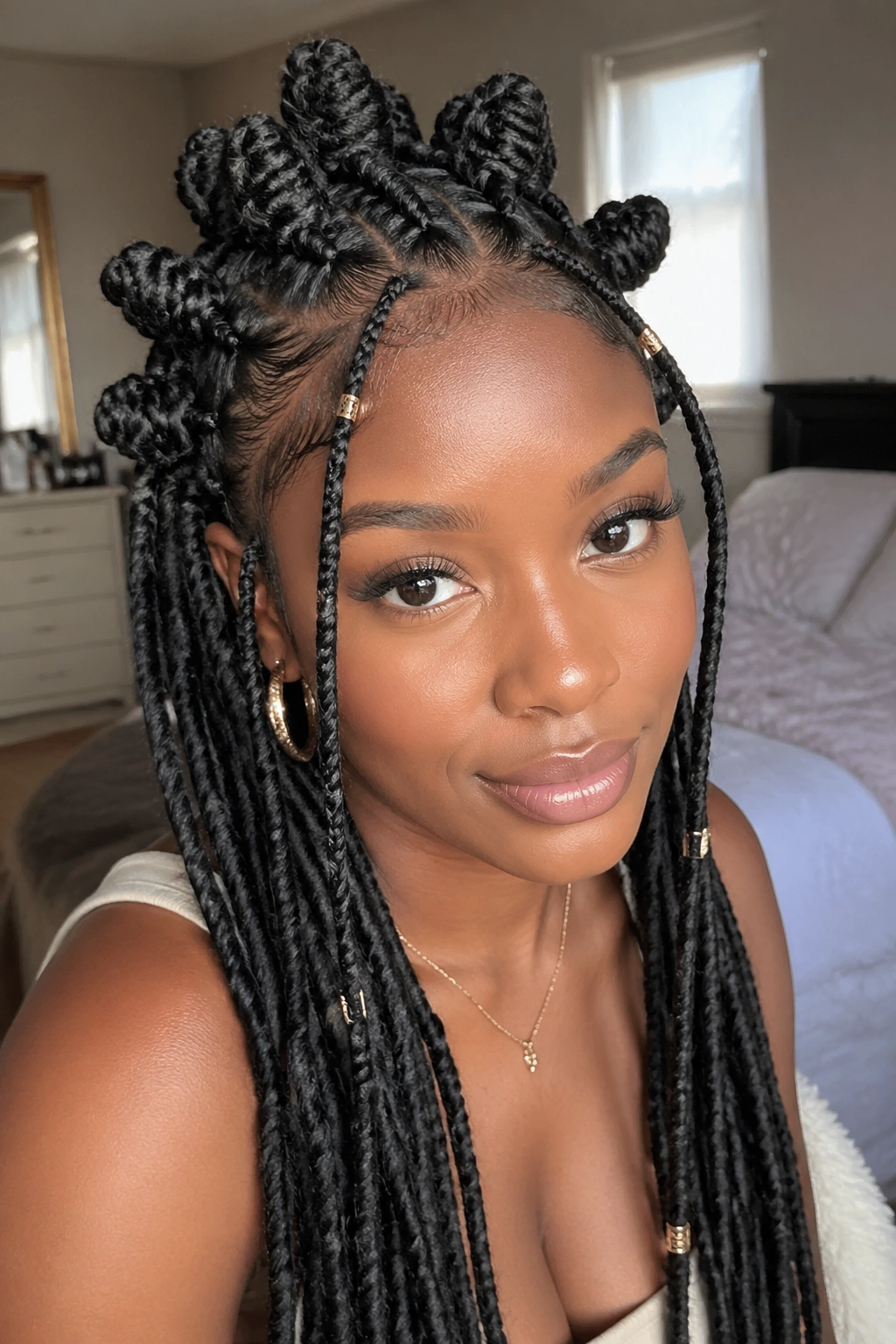
What if you want the fullness of loc-inspired styling without committing to a full faux-loc install? This version sits in that middle ground. The Fulani braid base gives the structure, while the knots on top add the rounded shape that makes the crown feel fuller.
The Shape Does the Work
The hair around the crown should be wrapped or braided in a way that adds thickness without looking blocky. Then the Bantu knots can sit like rounded anchors across the top. The ends can be left with a bit more texture so the style keeps that loc-inspired feel instead of reading as standard braids.
Small Details Matter
- Use slightly thicker extension hair to build the loc-like volume.
- Keep the crown knot row even so the top doesn’t tilt to one side.
- Leave the ends textured rather than overly polished.
- Skip shiny accessories if you want the faux-loc mood to stay believable.
This version is good when you want fullness and shape more than sleekness. It has body. A little grit, too.
19. Mohawk Fulani Braids with Raised Bantu Knots
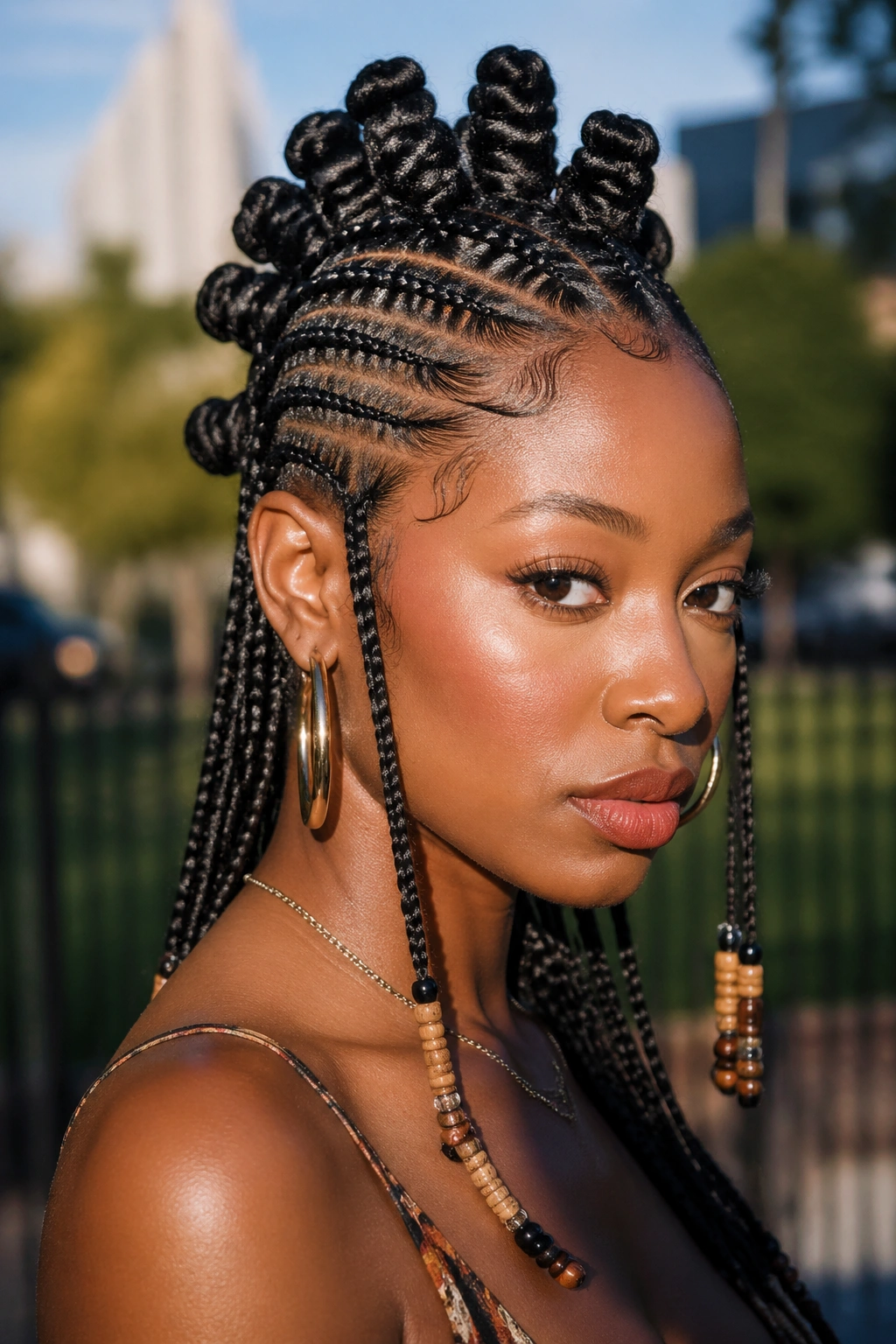
This is the bold one. The sides stay low and controlled, while the center line rises into a row of Bantu knots that reads almost like a crest. Mohawk Fulani braids with raised knots make a clear statement without needing bright colors or heavy decoration.
The silhouette is the reason it works. The eye follows the narrow sides upward into the center, and the height gives the style a strong profile from the side. It’s a smart choice if you like sharper shapes or if you want to lengthen the look of the face. The center row should be secure but not giant; if the knots get too wide, the mohawk effect turns clumsy.
This style does best with a clean part and smooth sides. Any puffiness near the temple areas can dilute the shape. Keep the top row neat, and the rest falls into place.
A lot of people think dramatic styles need more accessories. Sometimes the outline is enough.
20. Side Ponytail Fulani Braids with Wrapped Base Knots
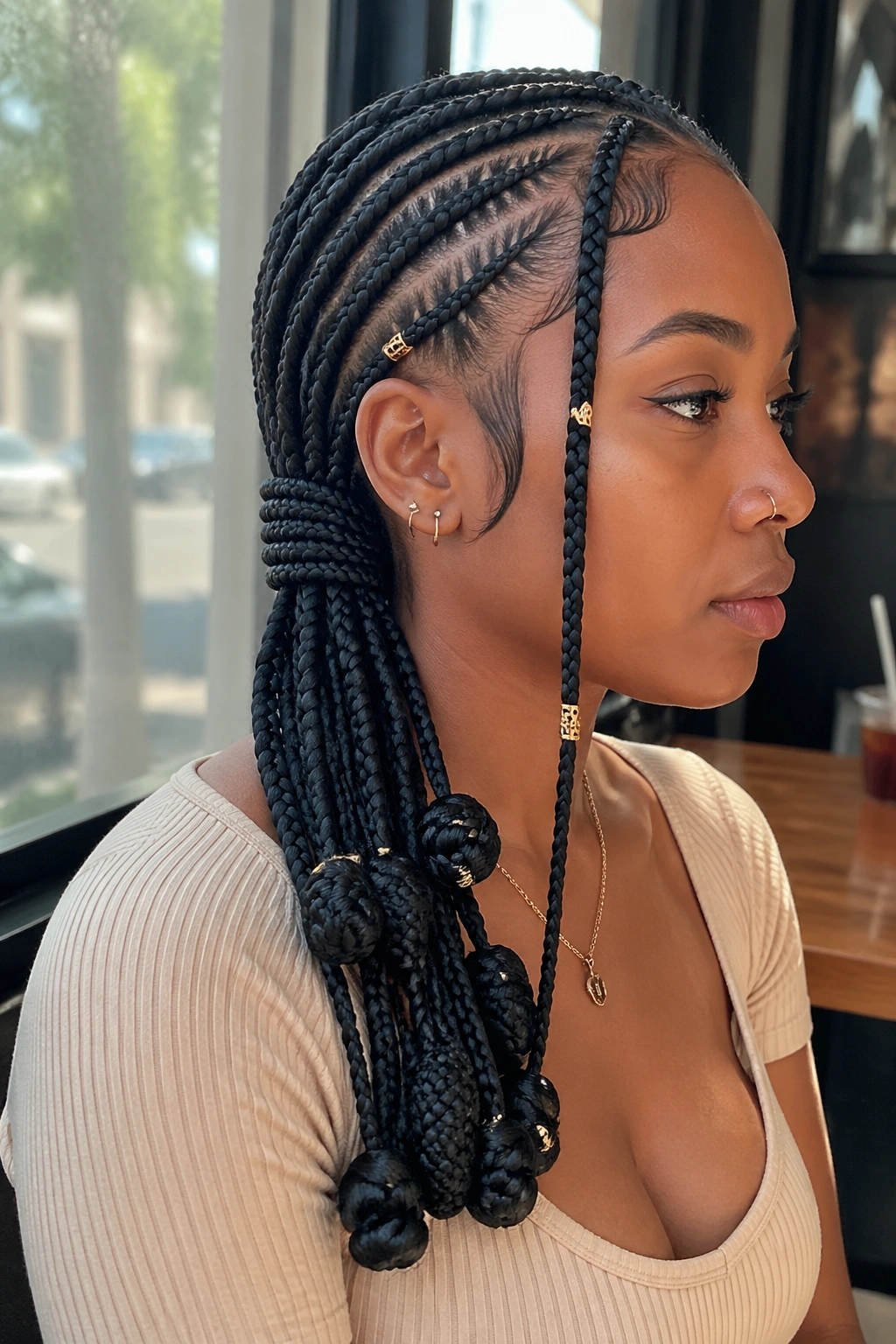
What changes when you pull the braids to one side instead of letting them hang straight down? The entire style gets softer at the neck and stronger at the shoulder. A side ponytail finish makes Fulani braids with Bantu knots feel more dressed up, even if the braids themselves are simple.
What to Ask For
Ask for the knots to stay centered or slightly off-center at the crown, then have the lower braids gathered low to one side. If you want a wrapped base, a small section of braid can be used to cover the hair tie and give the ponytail a smoother finish. That detail matters more than people think.
Why It Works
- The side placement keeps the length from falling straight down your back.
- The wrapped base hides the elastic and makes the style feel intentional.
- A low side ponytail is easier on the neck than a high one.
- It gives room for earrings and shoulder-baring necklines.
This version is especially useful when you want movement but not chaos. It’s tidy, but not severe. A nice middle ground.
21. Micro Fulani Braids with Delicate Parting and Tiny Knots
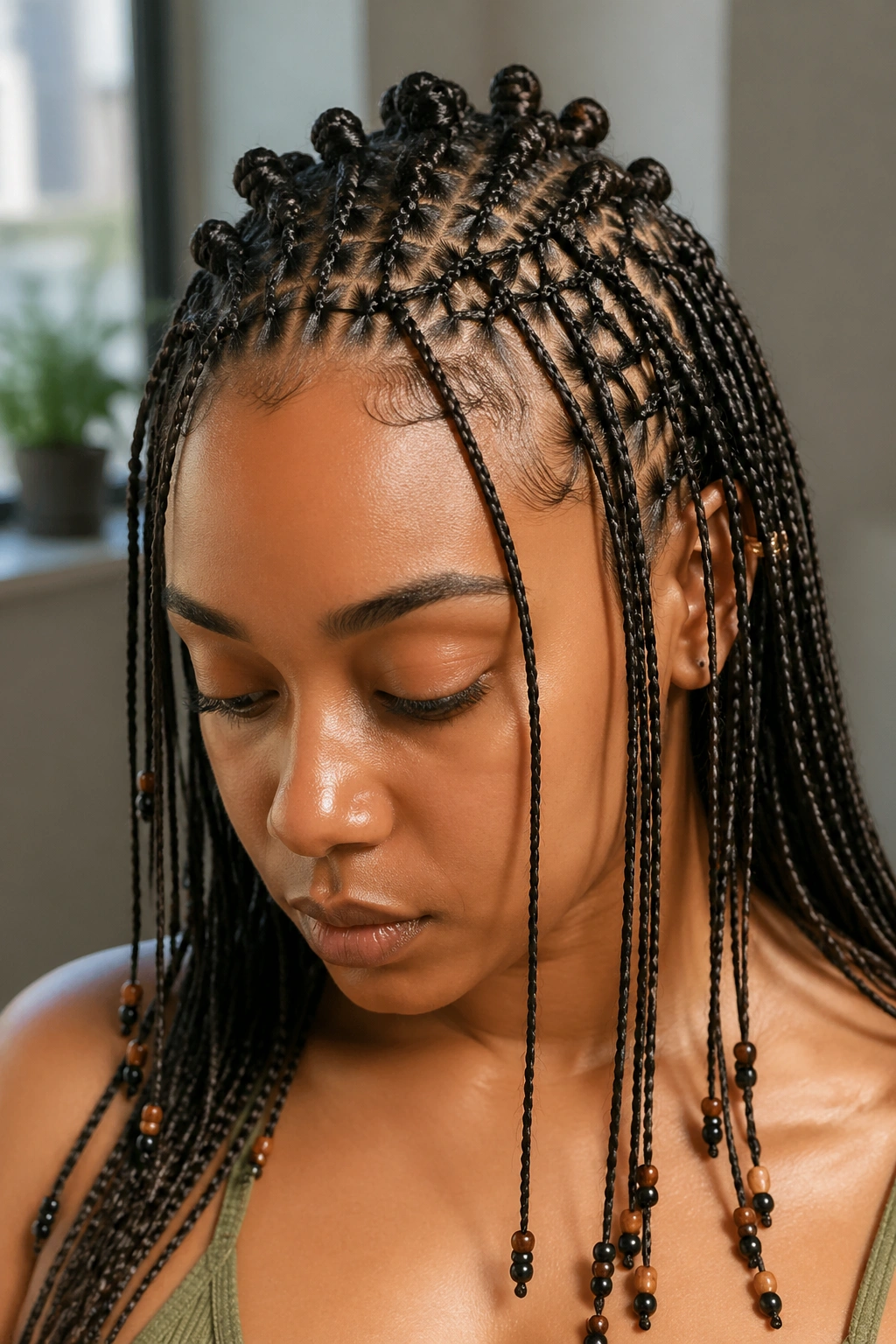
Micro braids are not for the impatient. They take time, and they demand a calm hand from the person doing them. But when they’re finished, the detail is hard to beat. Tiny Bantu knots sitting over delicate Fulani braids create a fine, intricate surface that looks almost like woven fabric.
The main advantage is visual texture. The braid lines become slimmer, the parting becomes more detailed, and the knots look more delicate because everything around them is smaller. That can be stunning on the right head shape. It can also be a lot of work, so I would not recommend it to someone who hates maintenance or sits restlessly in the chair.
The small size means the style can last well if cared for properly, but the initial install has to be clean. Sloppy micro parts show fast. Very fast. Keep the sections even, and don’t overload the style with extra decorations. The detail is already doing a lot of talking.
This one rewards patience. No shortcut replaces that.
22. Layered Fulani Braids with Mixed Braid Sizes
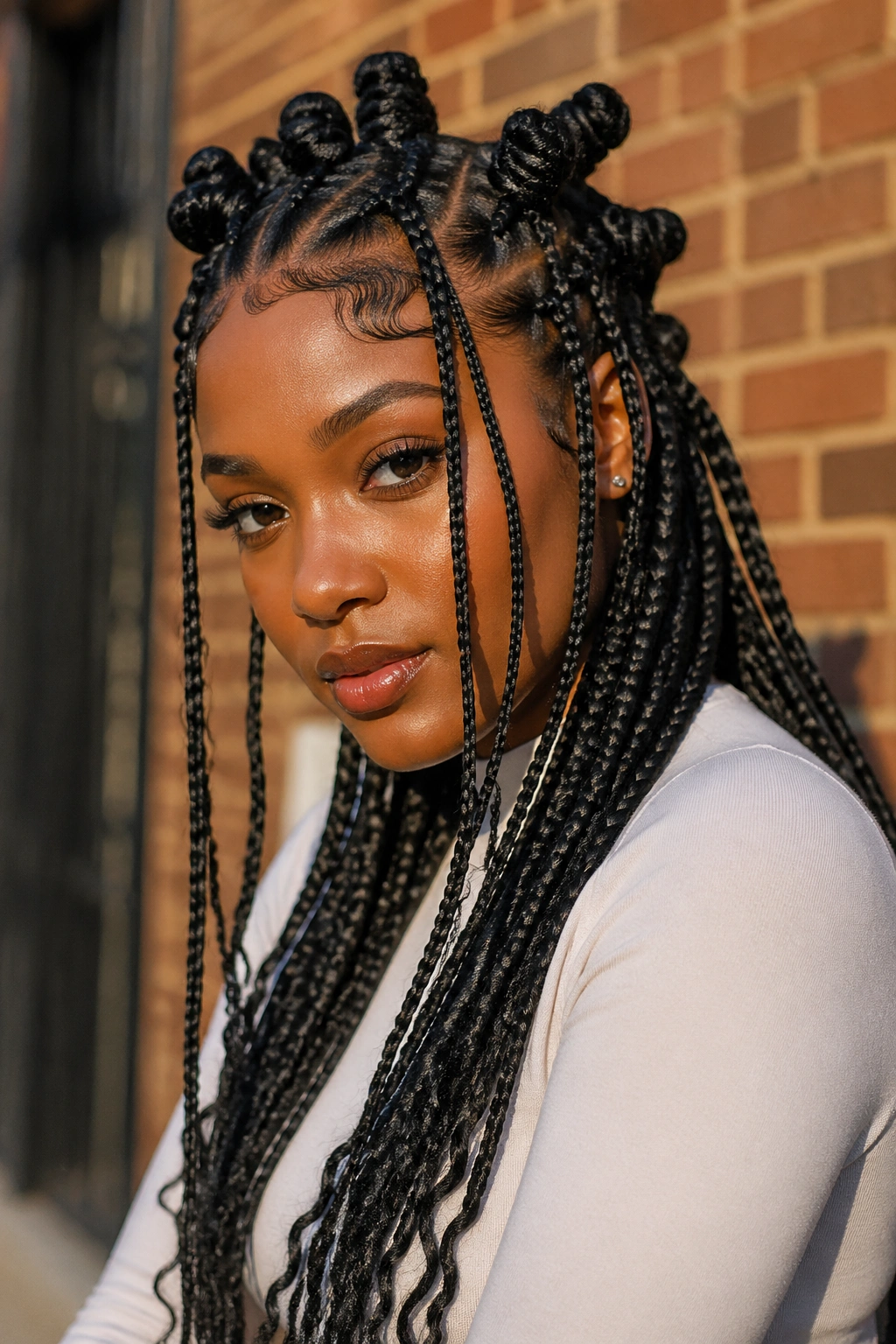
Most styles stay honest to one braid size. This one doesn’t. Layered Fulani braids with mixed braid sizes use thicker sections near the center and slimmer ones around the edges, which creates depth without needing more length or more accessories.
The effect is subtle at first, then it grows on you. The thick braids carry visual weight, the small ones keep the edges neat, and the Bantu knots sit in the middle like an anchor. If all the braids were the same size, the style would be flatter. Mixing them creates movement before the hair even swings.
I like this for people who want texture without a lot of extra decoration. It can look expensive in a practical, not flashy, sense. The trick is to keep the size changes intentional. Random thickness reads messy. Planned thickness reads styled.
Don’t crowd the crown with too many knots if you’re using mixed sizes. Give the braid layers room to show.
23. Fulani Braids with Twisted Ends and a Knot Row
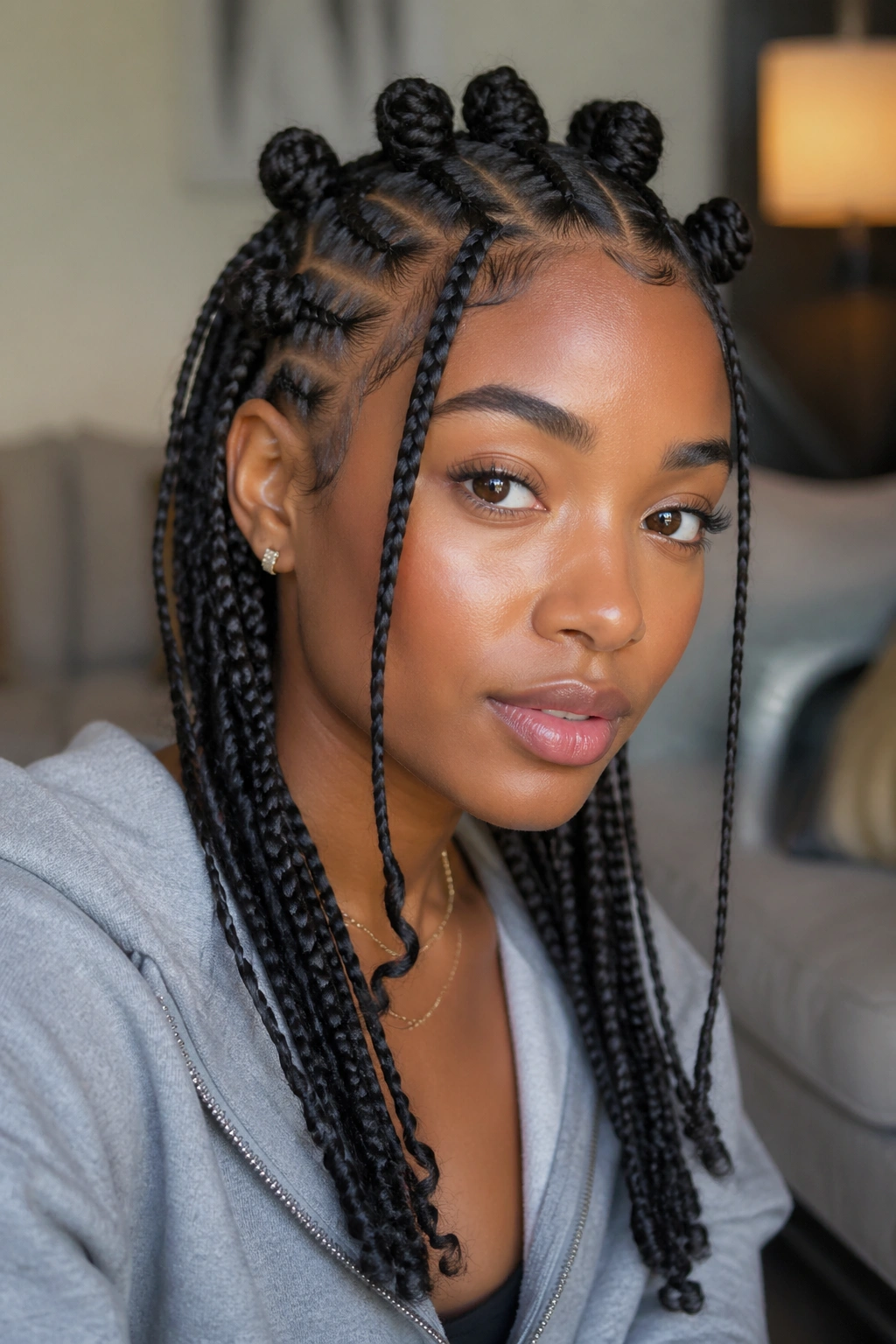
Twisted ends change the finish in a nice way. Instead of a blunt seal or a curled finish, the braids taper into twists, which softens the look and gives the ends a little flexibility. Add a row of Bantu knots through the top, and the whole style feels less rigid.
This is a good option if you like your braids to look a bit more relaxed. Twists at the ends move differently than sealed braid tips, so the style gets a lighter swing. The knots carry the structure, while the twisted ends do the quiet work at the bottom.
Compared with a straight-braided finish, this version feels easier to dress down. It works with casual clothes, sure, but it also looks polished enough for a more put-together setting. The best versions keep the twists consistent in size so the ends don’t fray unevenly.
If you like softness in a braid style, this detail is worth asking for.
24. Low Bun Fulani Braids with Hidden Bantu Knots
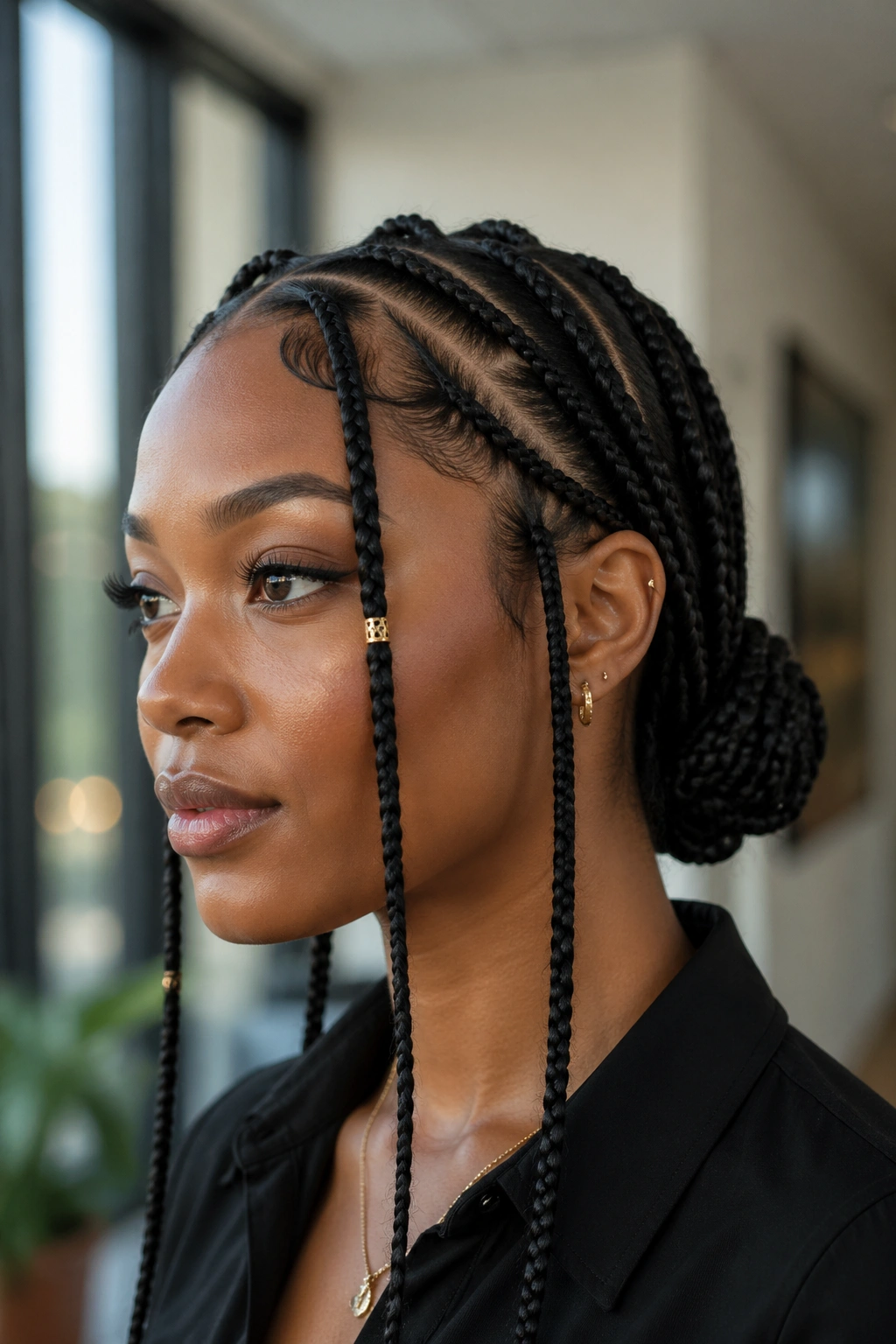
A low bun can quiet a style down without making it boring. With Fulani braids, that means braiding the top pattern first, then tucking the lengths into a low bun at the nape while the Bantu knots stay tucked into the upper shape, partly visible and partly hidden.
What Makes It Work
The low placement keeps the style close to the head, which is useful if you want something neat for work, travel, or long days where loose hair gets in the way. The hidden knots add structure up top, but because they’re not towering over the head, the whole look feels more restrained.
Practical Details
- Keep the bun low and centered at the nape or slightly off to one side.
- Use pins or wrapped braids to secure the bun without sharp tension.
- Leave one or two face-framing braids free if you want softness.
- Choose small to medium knots so they stay part of the shape instead of taking over.
This is the version for people who like a braid style with discipline. Quiet, but not dull.
25. Sculptural Fulani Braids with Bold Geometry and Big Knots
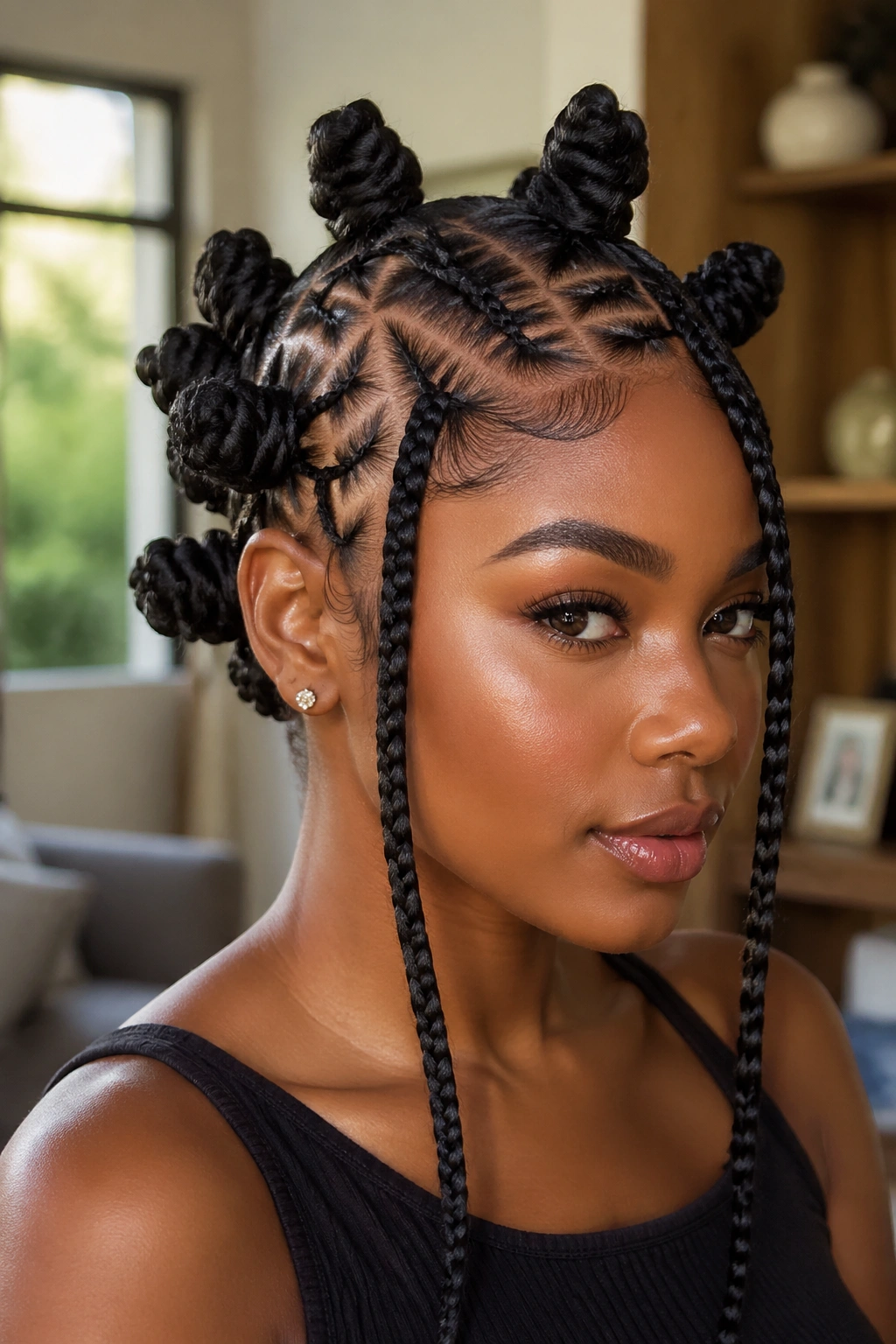
This is the most dramatic version in the bunch, and I mean that in a good way. Sculptural Fulani braids with bold geometry and big knots turn the head into a real shape study: sharp parts, strong curves, and knots that read almost like design elements instead of simple buns.
The best thing about this style is how intentional it looks when done right. The parts should feel measured. The knots should be spaced with care. The side braids can angle toward the cheekbones or sweep back in straight lines, depending on how hard you want the geometry to land. If you like a fashion-forward profile, this is the one that gives you room to play.
I would keep the accessories minimal here. The structure already has enough force. A few cuffs or a single bead line can help, but too much decoration will compete with the shape. This style has presence because of the outline, not because it’s covered in extras.
It’s the sort of look that makes a clear choice: either you love strong shape, or you don’t. I’m in the first camp.
Final Thoughts
The smartest Fulani braid and Bantu knot styles are the ones that balance shape, weight, and scalp comfort. That sounds simple, but it’s where a lot of installs go wrong. A beautiful part can still feel off if the knots are too heavy or the braids are too tight at the front.
Small changes do a lot. A side part softens the face. A center part sharpens it. Beads make the ends move. Shells shift the mood. A low bun makes the whole thing calmer, while a mohawk row gives it edge. None of that needs a full reinvention.
If you’re choosing one of these styles for your next appointment, think about how you live in your hair, not just how it looks on day one. A style that sits well at the crown and stays comfortable at the temples usually wins the long game. That’s the version worth wearing twice.
