



Korean fashion has always had this enviable way of making trends feel effortlessly cool, and nowhere is that more true than in hairstyling. If you’ve got wavy hair and you’re drawn to the soft, face-flattering aesthetic of Korean beauty, medium-length styles with bangs are where it’s at. The combination is actually genius—wavy texture adds movement and dimension to sleek Korean silhouettes, while bangs frame your face in that signature way that makes everything feel intentional and polished.
The thing about pairing bangs with wavy hair is that it’s less intimidating than it sounds. Korean stylists have spent years perfecting the art of working with natural texture rather than against it, which means your waves become an asset, not something you’re fighting. Bangs can soften a round face, add drama to a longer cut, or completely transform your look without requiring a drastic length change. Medium length hits that sweet spot—long enough to style multiple ways, short enough to feel fresh and manageable.
What makes these 18 styles work so well is the versatility. Whether you prefer blunt precision, wispy softness, or something in between, there’s a Korean medium style with bangs designed to work with your natural wave pattern. Many of these cuts are specifically engineered to look good even when you’re not blow-drying or styling—they’ve got built-in movement that plays to wavy hair’s strengths.
1. Curtain Bangs with Textured Layers
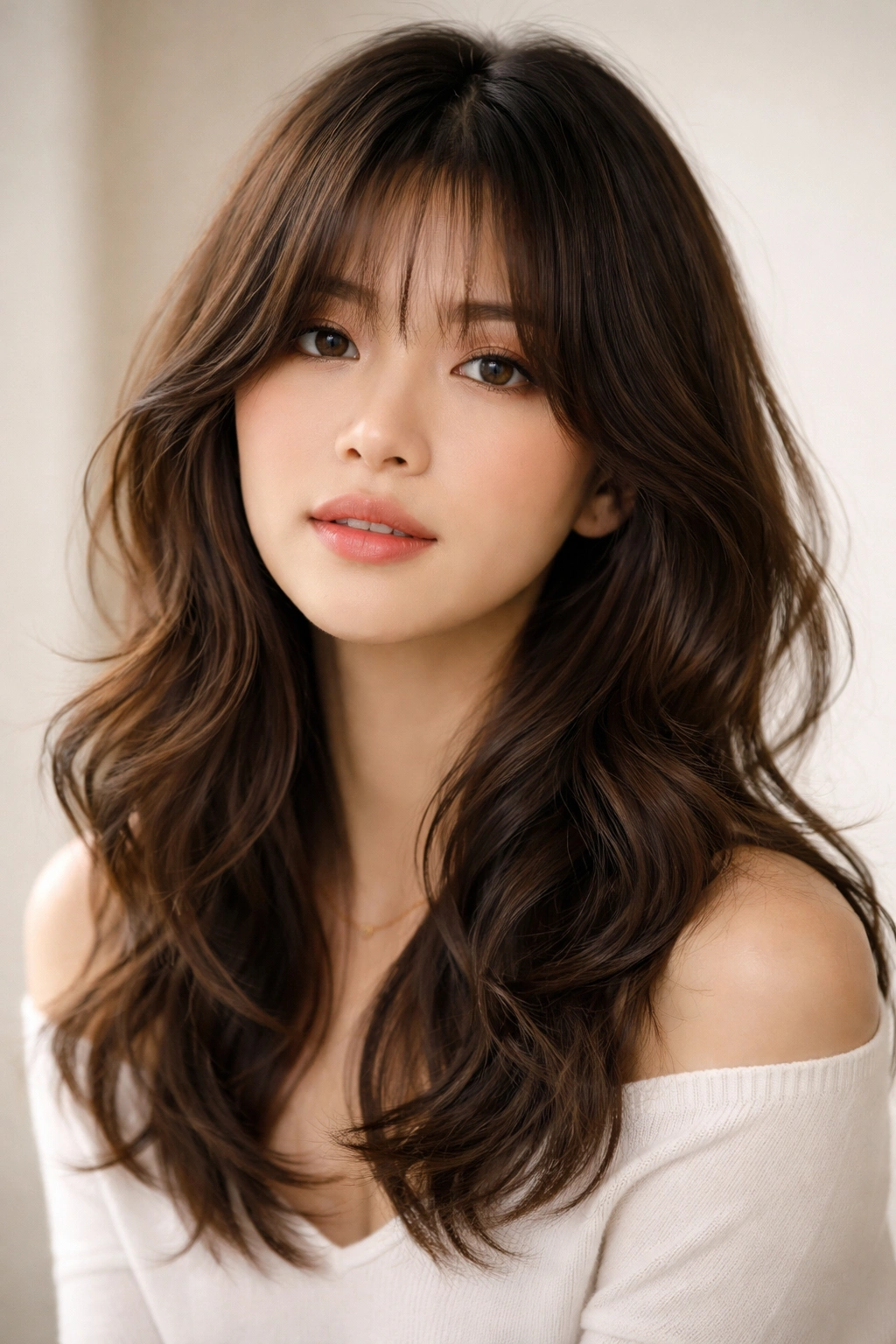
Curtain bangs are the gentle entry point for anyone nervous about committing to bangs. These open in the middle and frame the face on both sides, creating a naturally flattering silhouette that works especially well with wavy hair because the texture helps them fall exactly where you want them.
Why Curtain Bangs Dominate Korean Beauty Right Now
Curtain bangs work because they’re forgiving—they don’t require precision every single day, and they actually look better when your hair is slightly textured and lived-in. The slight bend in wavy hair makes the curtain effect more pronounced and less severe than it would be on straight hair. They soften your face without being overly dramatic, which is exactly the Korean beauty aesthetic: polished but not rigid.
How to Make Them Work With Your Waves
- Curtain bangs should hit at about cheekbone length or slightly below for the most flattering effect
- Ask your stylist to point-cut the ends rather than blunt-cut them; this creates softer layers that blend seamlessly with wavy texture
- Layers throughout the rest of your medium-length hair amplify movement and prevent the style from looking heavy
- Styling with a light sea salt spray enhances the natural curtain effect without requiring heat tools
- These bangs look best when you part your hair naturally rather than forcing an exact center part
The genius of curtain bangs is that you can style them dozens of ways depending on your mood—sweep one side back with a clip, let them fall naturally, or even twist them to one side for a completely different vibe. With wavy hair, you get movement built in without extra effort.
Pro tip: Sleep on damp hair twisted loosely around your finger, and wake up with effortlessly styled curtain bangs that frame your face perfectly.
2. Soft Blunt Bangs with Feathered Ends
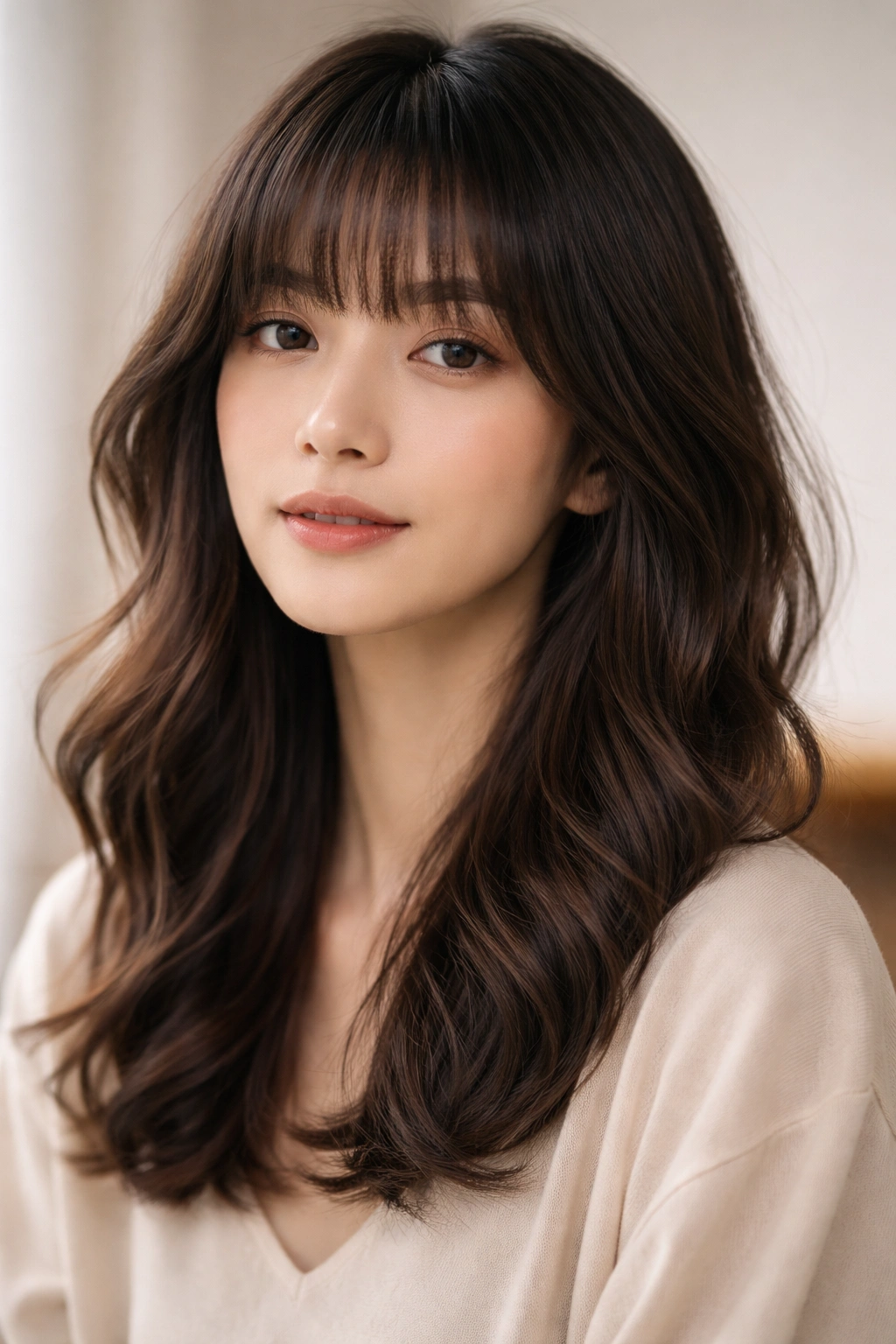
Soft blunt bangs sound contradictory—but the difference is in the execution. Instead of a razor-sharp line, your stylist creates a blunt appearance that’s slightly softened with subtle feathering, especially through the ends. This gives you the polished feel of a blunt bang without the harsh, severe edge.
Why This Hybrid Approach Is So Korean
Korean stylists invented the art of looking put-together while maintaining an effortless vibe. Soft blunt bangs hit that balance perfectly. They’re structured enough to look intentional and chic, but the feathered edges blend gorgeously with wavy texture instead of fighting against it. The movement in your waves softens the line just enough to prevent that “helmet hair” effect blunt bangs can sometimes create.
The Styling Formula That Makes This Work
- Ask your stylist for a blunt baseline that falls just above or at your eyebrows, then texturize the edges with point-cutting
- The blunt appearance should only be visible when you’re styling it smooth; texture is your friend here
- Pair this bang style with subtle layers throughout your medium length to create a cohesive, soft-but-structured look
- A light volumizing mousse applied to damp roots keeps these bangs from looking flat or greasy
- Styling with a round brush and medium heat creates that soft, feathered finish that blends with your natural waves
With wavy hair, soft blunt bangs photograph beautifully because the texture catches light and creates dimension that a straight-haired person might not get naturally. You’re basically getting free enhancement from your hair texture.
Worth knowing: These bangs require trims every 4-6 weeks because the blunt line becomes more obvious as they grow out. Investing in regular maintenance keeps them looking intentional rather than shaggy.
3. Side-Swept Bangs with Volume
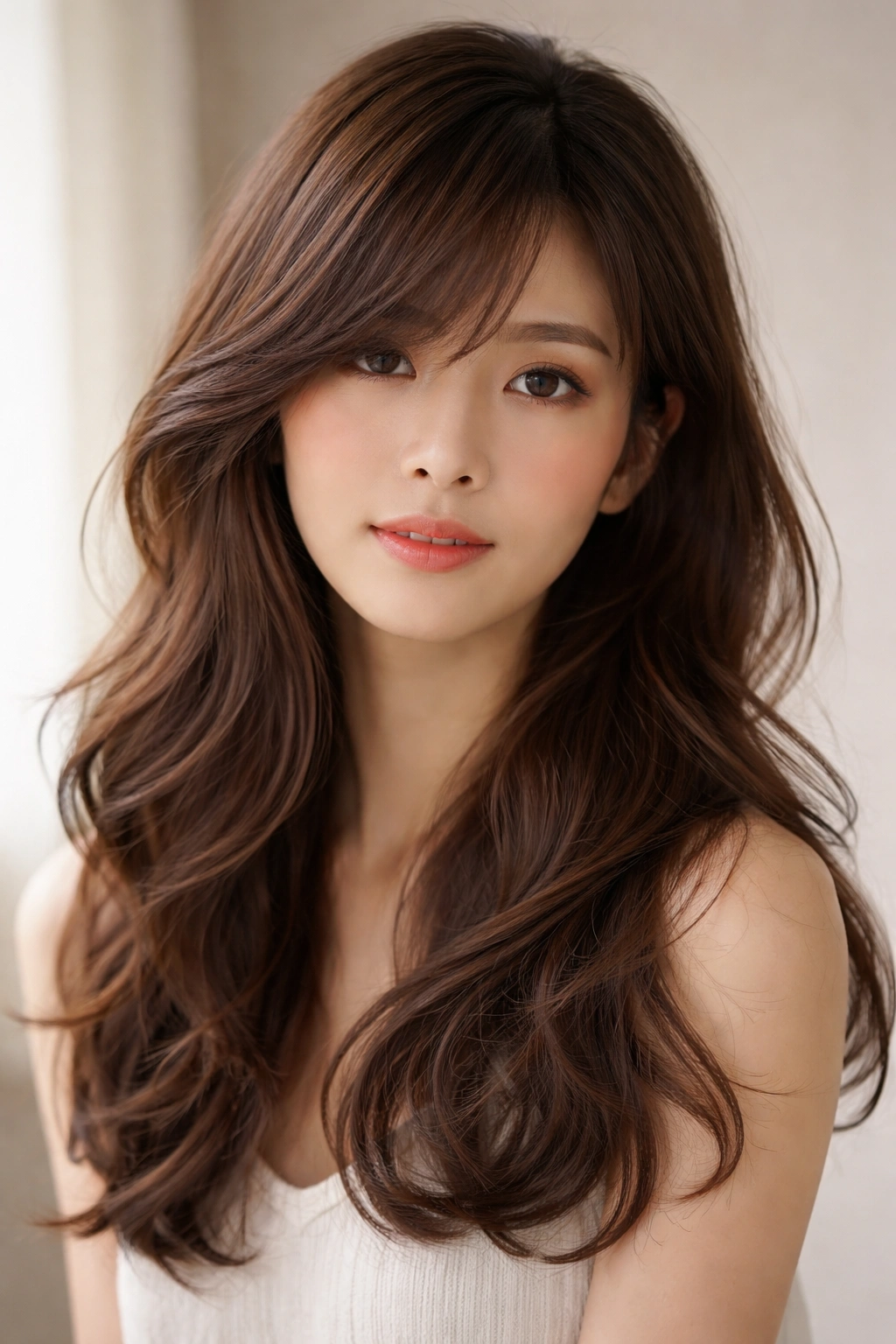
Side-swept bangs take drama and sophistication and blend them into something that feels modern and relaxed. Instead of covering your entire forehead, these bangs sweep to one side, creating asymmetry that’s very much in line with current Korean fashion and beauty trends.
What Makes Side-Swept Bangs Flattering for Wavy Hair
The beauty of side-swept bangs is how they work with wavy hair’s natural bend and movement. Rather than fighting your texture, you’re using it to create the sweep. The asymmetry also tends to be incredibly flattering—it elongates the face, creates balance, and gives you a sophisticated but approachable look that works for pretty much any face shape.
Building Volume Into the Design
- Side-swept bangs should start high at the roots so they have somewhere to sweep to without looking thin or stringy
- Subtle layers behind the bangs create dimension and allow your waves to show through rather than flatten the style
- Point-cutting through the bang area removes weight while maintaining the length you need for the sweep
- Adding texture spray and blow-drying in the direction of the sweep locks the style in without making it look too set or stiff
- Your medium-length waves should fall behind the bangs in soft, defined waves rather than dense, heavy waves
The asymmetrical nature of this style means it photographs well, works across different face shapes, and genuinely looks better with wavy hair because the texture adds the dimension that makes the sweep look intentional.
Insider note: If you sleep on the opposite side of where you want your bangs to sweep, you’ll wake up with the natural bend already set in the right direction.
4. Wispy Bangs with Shoulder-Length Waves
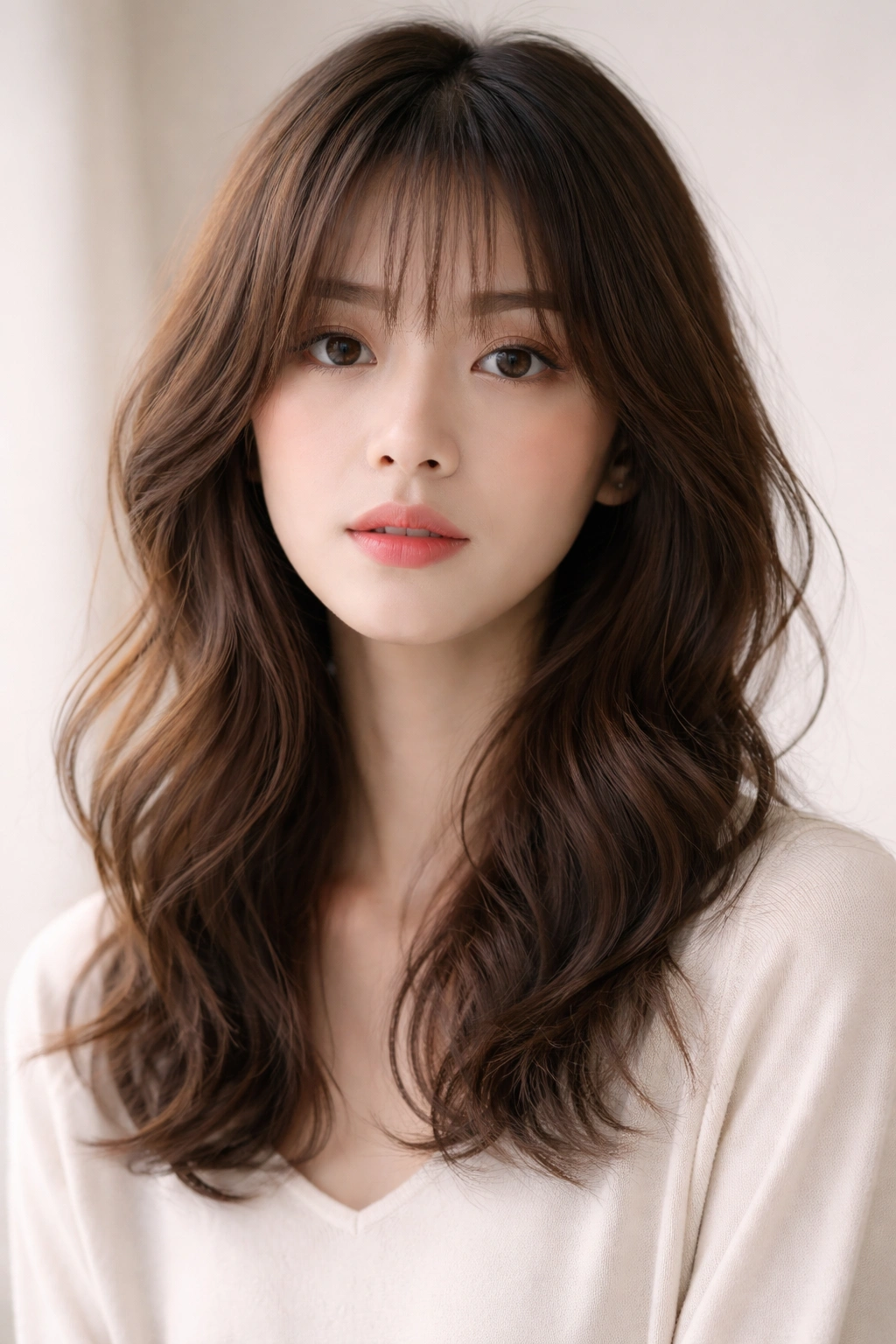
Wispy bangs are delicate and ethereal—multiple layers cut at varying lengths that create a soft, barely-there coverage across the forehead. Paired with shoulder-length waves, this style hits the sweet spot between Korean minimalism and textured movement.
Why This Style Reads As Effortlessly Cool
Wispy bangs feel very now—they’re soft without being trendy in a way that’ll feel dated next year. The slight transparency means you see skin through the bang, which feels less heavy and more sophisticated than fully dense bangs. Combined with shoulder-length wavy hair, you get a style that looks like you didn’t try too hard, which is pretty much the Korean beauty ideal.
Making Wispy Bangs Work With Your Natural Texture
- Wispy bangs require multiple layers at different lengths; ask your stylist to create 4-5 distinct layers across the bang area
- Each layer should be slightly longer than the one below, creating that feathered, see-through effect
- Point-cutting is essential here—never blunt-cut wispy bangs or you lose the whole ethereal vibe
- Shoulder-length waves that start around your chin area frame wispy bangs beautifully
- These bangs actually require less styling than denser bangs because imperfection is part of the aesthetic
The advantage of wispy bangs with wavy hair is that your natural texture does a lot of the work for you. Those layers fall exactly where they’re meant to fall without looking undone or messy. You get movement, lightness, and sophistication without extra effort.
Pro tip: A light volumizing spray keeps wispy bangs from sticking flat when humidity hits. You want them to maintain their layered texture, not collapse into a greasy line.
5. Thick Straight Bangs with Wavy Underlayers
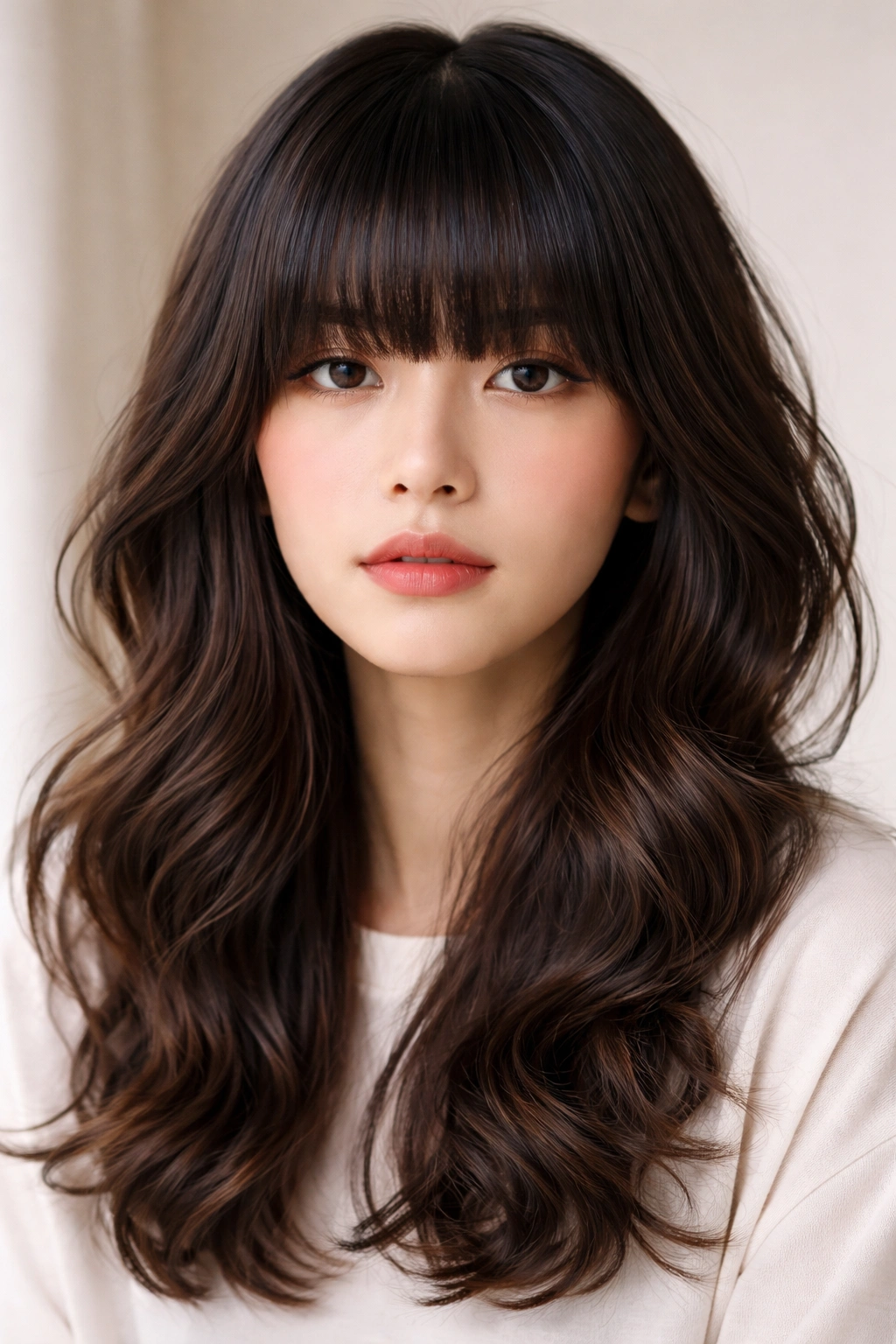
This is the striking, statement-making choice: bold, straight-cut bangs that cover your entire forehead paired with wavy texture underneath. The contrast between the precision of the bangs and the movement of your waves creates a look that’s both edgy and soft.
Why Bold Bangs Create High-Impact Style
Thick, blunt bangs make a statement. They’re bold and confident, very much aligned with the Korean approach to beauty—deliberate, well-executed, and unapologetic. Paired with wavy underlayers, you get this interesting contrast: the structured, graphic quality of the bangs against the soft, organic movement of your waves. It’s design-forward without being cold or severe.
Styling Thick Bangs So They Work With Your Waves
- Straight bangs need to hit at eyebrow level or just above—any longer and they obstruct your vision or look outdated
- The rest of your hair should be noticeably wavy and textured to create visual balance against the straight bangs
- These bangs require regular trims (every 3-4 weeks) because they show growth immediately
- A smoothing serum keeps the bangs from frizzing or developing texture that would dilute their impact
- Your medium-length waves should fall in defined waves or loose curls rather than tight ringlets, which would look conflicting
The key to making this work is the contrast. If your bangs look perfectly straight and polished while your waves are soft and textured, you’ve created a cohesive style that feels intentional and beautiful. If everything blurs together, it looks less intentional.
Worth knowing: This style requires more styling effort than some others—your bangs need to look smooth and precise most days, or the whole look falls apart. If you’re not willing to blow-dry your bangs regularly, choose a softer bang style instead.
6. Parted Bangs with Choppy Waves
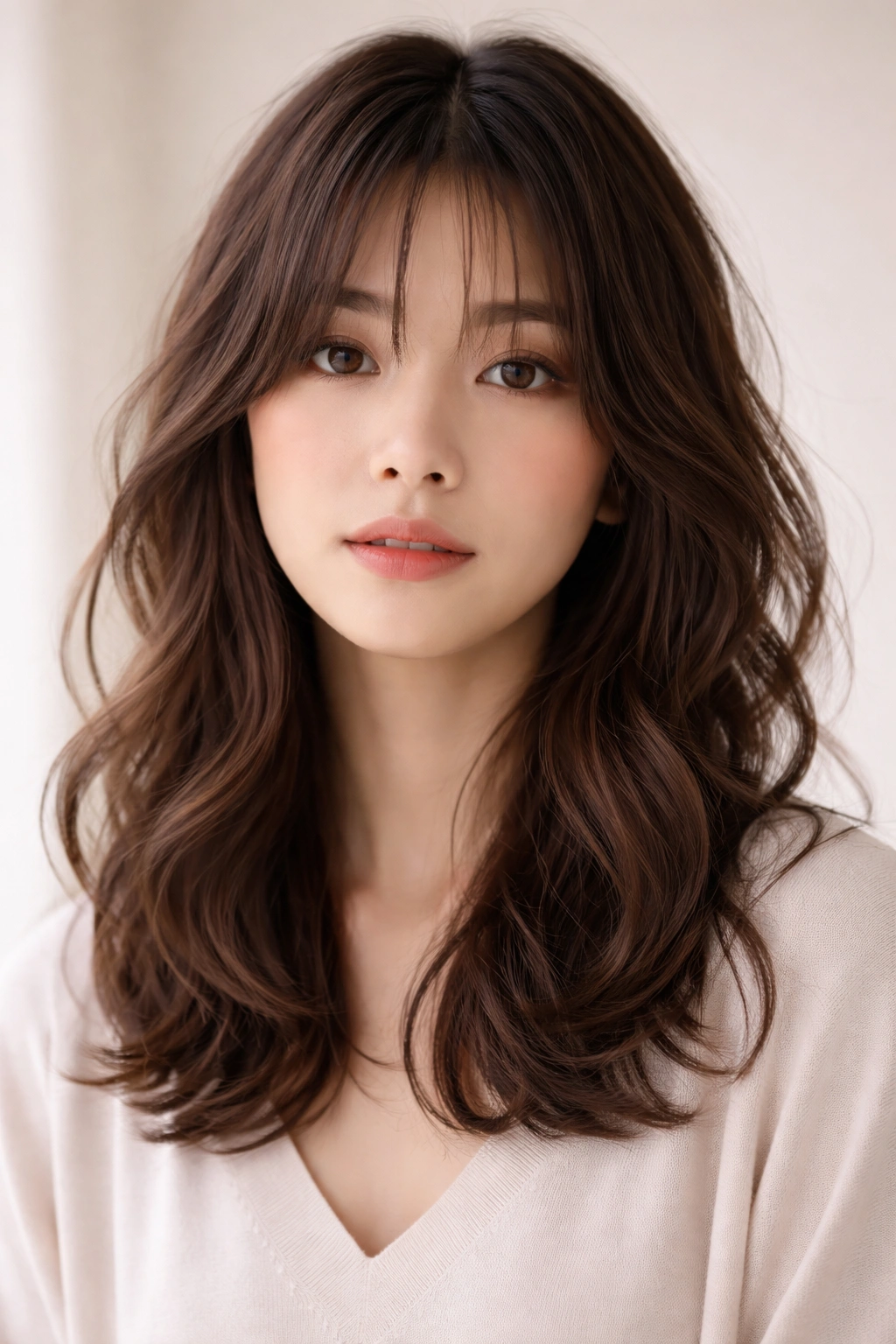
Parted bangs sit down the center of your forehead with a natural part that falls toward each side. Combined with choppy, textured waves throughout your medium-length hair, this style is undeniably modern and works beautifully with natural wavy texture.
The Appeal of Choppy Layers With Parted Bangs
Parted bangs feel more wearable than full coverage bangs for everyday styling—they give you the benefit of face-framing without the commitment. Choppy waves amplify this casual-but-intentional vibe. The Korean approach to this style is about embracing texture and movement rather than fighting it, which means your wavy hair is literally the style, not something you’re trying to smooth out or control.
Creating Choppy Waves That Frame Your Face
- Parted bangs should start at a natural hairline part and fall just past your eyebrows on either side
- Choppy layers throughout should vary in length, creating jagged edges rather than blended layers
- Point-cut everything liberally; this removes weight while maintaining texture and movement
- Your medium length should hit around shoulder-blade length, allowing the choppy layers to flip and move freely
- Wavy hair naturally suits choppy layers because the texture helps separate each layer visually
The advantage of this style is that it genuinely looks better the more texture you have. Wavy or curly hair is the ideal canvas for choppy layers because each layer reads distinctly and creates dimension without looking disheveled.
Insider note: Choppy layers can look scraggly if they’re not cut with precision. Make sure your stylist understands the difference between “choppy” and “broken and thin.” Good choppy layers have weight and movement; bad ones just look undone.
7. Micro Bangs with Medium Waves
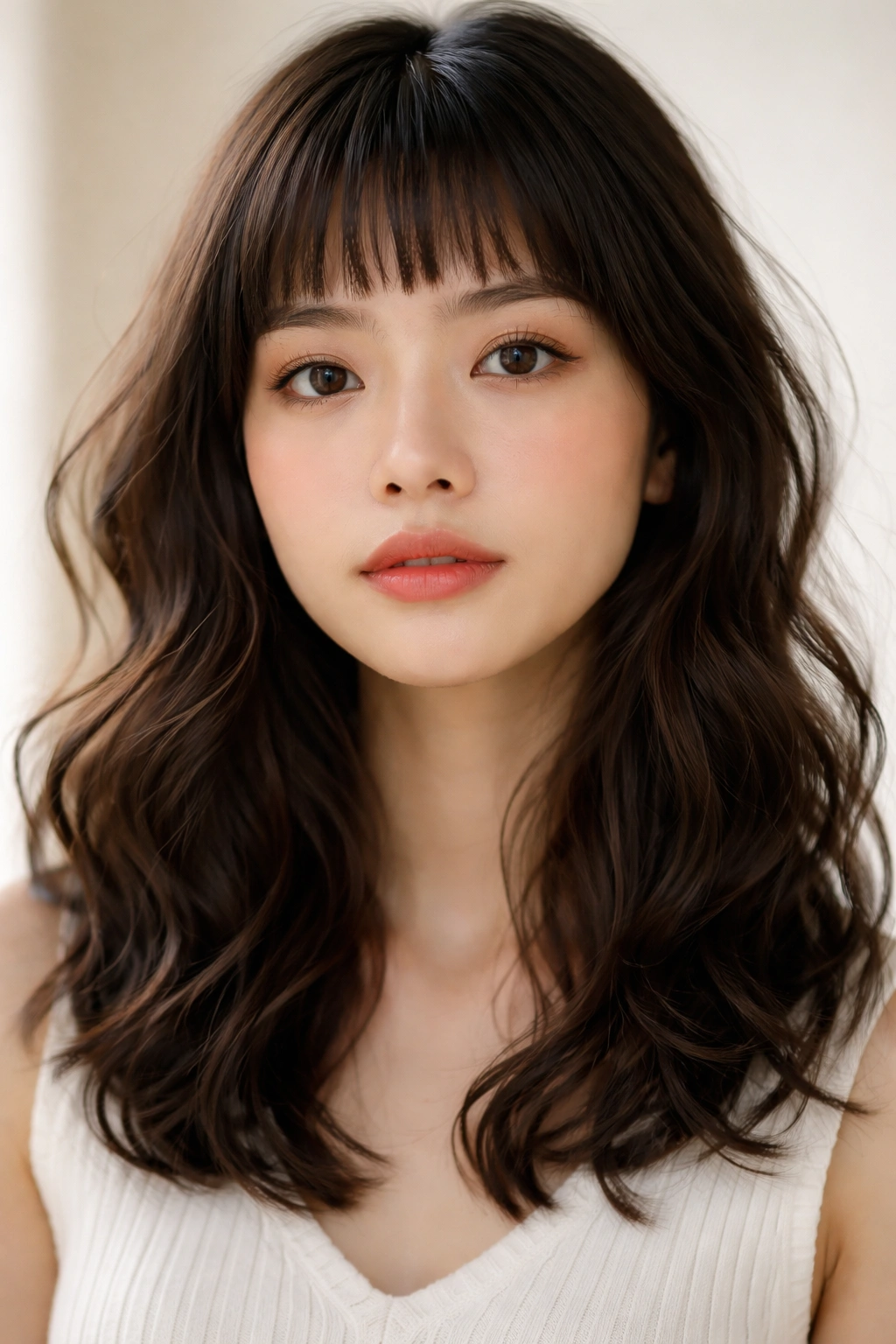
Micro bangs sit just above the middle of your forehead—that tiny, barely-there fringe that’s become increasingly popular in Korean beauty. Paired with medium-length waves, they’re unexpectedly chic and work well if you’re willing to fully commit to a bold choice.
Why Micro Bangs Are Having a Moment
Micro bangs feel very fashion-forward and editorial. They’re not a practical choice for everyday wear without styling, which is actually part of their appeal—they feel intentional and design-y. With wavy hair, they read less severe than they would on straight hair because your waves soften the overall look and prevent it from feeling too stark or stark.
Making Micro Bangs Work Long-Term
- Micro bangs should hit approximately ¾ inch above your natural eyebrow line
- They require trims every 2-3 weeks without exception—any growth makes them less impactful
- Your medium-length waves become the focus when your bangs are this subtle, so invest in a great cut and styling products
- These bangs actually give you freedom to style your hair multiple ways because they’re so small they don’t interfere with different styling directions
- Texture spray and a blow dryer help separate and define the micro bangs so they don’t look like a thin, stringy line
This is a style for someone who loves fashion, enjoys frequent haircuts, and isn’t afraid to stand out. If you’re looking for low-maintenance, micro bangs aren’t your answer. But if you want a look that makes a sophisticated, editorial statement, they’re incredible.
Pro tip: Micro bangs pair best with defined waves or loose curls rather than straight hair. The texture you already have makes this bold choice feel balanced and wearable.
8. Baby Bangs with Layered Bob
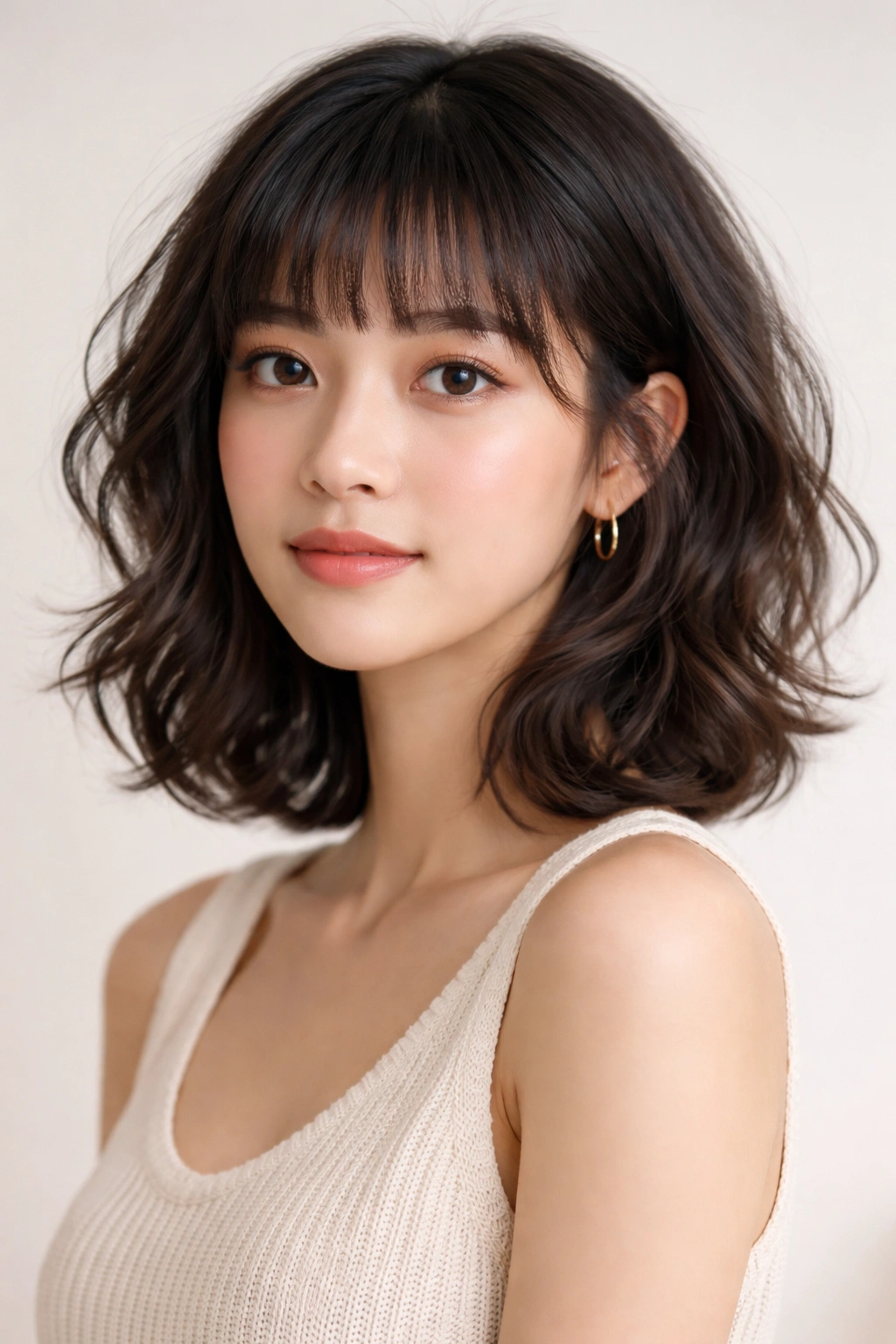
Baby bangs are shorter than micro bangs—they hit so close to your eyebrows that they’re almost negligible. Paired with a layered bob structure, they create a playful, youthful vibe that’s very Korean and very current.
The Charm of Baby Bangs on Medium Hair
Baby bangs read as cute and youthful without looking costume-y. They add a subtle face-framing element without the commitment or maintenance of longer bangs. The layered bob structure gives you shape, dimension, and movement—especially important when you’re working with wavy hair and want the style to maintain volume through the layers rather than collapsing flat.
Cutting and Styling a Layered Bob With Baby Bangs
- Baby bangs should fall right at or just above your natural eyebrow line, creating barely-there coverage
- Layers throughout the bob should be cut at varying lengths to create movement and prevent weight from sitting at the ends
- Your layered bob should be shorter in the back (somewhere between chin and jaw length) and slightly longer in front for balance
- Point-cutting through all layers creates texture that plays beautifully with wavy hair
- These bangs require less styling than full-coverage bangs, but frequent trims keep them looking intentional
The beauty of this combination is that the baby bangs feel approachable and friendly while the layered bob provides structure and shape. With wavy hair, the layers actually look fuller and more dimensional than they would on straight hair, which means your style reads as voluminous and well-cut.
Worth knowing: Baby bangs are genuinely only flattering on certain face shapes—they tend to work best on oval or heart-shaped faces. If you have a round or square face, full-coverage bangs might be more flattering.
9. Wispy Layered Bangs with Face-Framing Waves
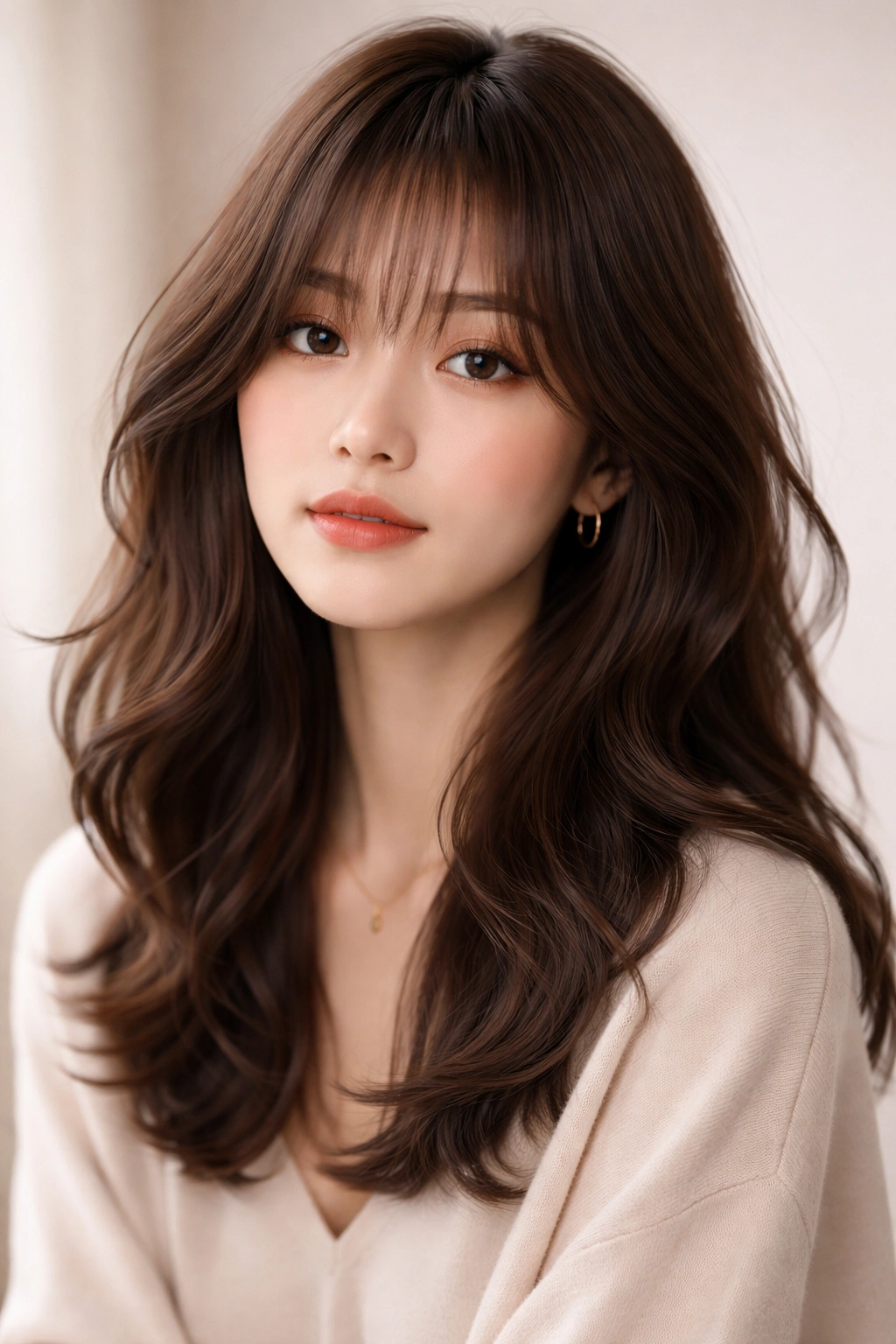
This style takes wisps and layering to the next level—bangs that are deeply feathered and transition seamlessly into face-framing layers. It’s less “bang” and more “sculpted opening” that draws attention to your face while maintaining softness.
Why This Approach Feels So Sophisticated
Wispy layered bangs that transition into face-framing waves create a style that feels intentional and high-fashion without looking like you’re trying too hard. The continuous layering from bangs through the front sections means everything flows together rather than bang versus hair. It’s the kind of cut that makes you look like you just got a professional blow-out every time you style it.
The Technical Execution That Makes It Work
- Multiple layers starting at the bang area should decrease in length as they move toward the sides of your face
- Each layer should be point-cut to create soft, feathered edges that blend with wavy texture
- The face-framing section should be substantial enough to actually frame your face—starting around cheekbone level and tapering from there
- Your medium-length layers should fall in a way that encourages waves rather than fights them
- Styling with mousse and a diffuser or round brush creates waves that sit exactly where they’re cut to sit
This cut is pure genius with wavy hair because the layers are engineered to work with your natural texture. You’re not fighting gravity or trying to create movement where there’s none—you’re simply enhancing the movement you already have.
Insider note: This is a cut that truly requires a skilled stylist. Poor execution makes it look shaggy; good execution makes it look editorial and intentional. If your stylist doesn’t fully understand the concept, keep looking.
10. Straight-Cut Bangs with Tousled Waves
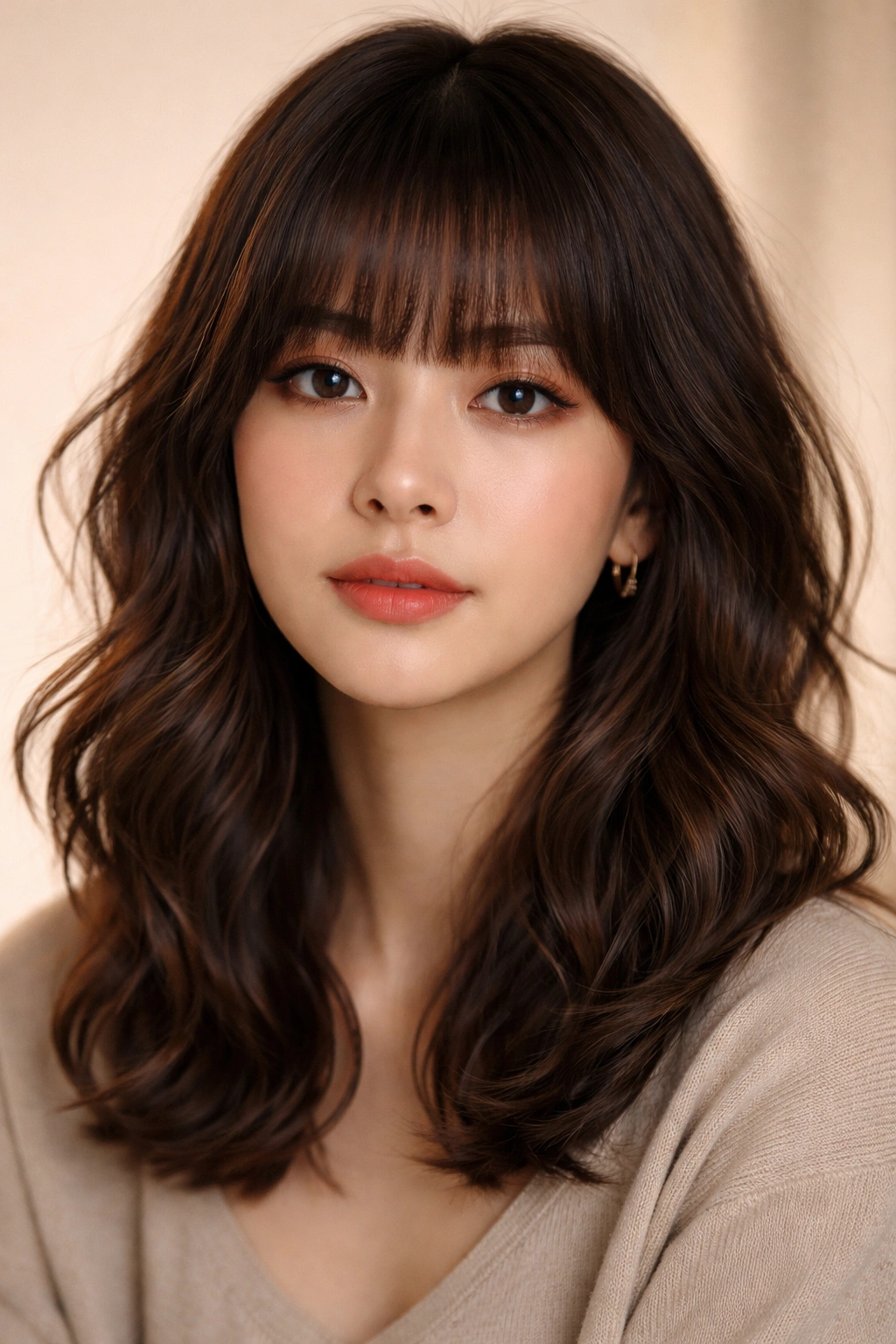
Straight-cut bangs that sit blunt across your forehead paired with intentionally tousled, textured waves throughout your medium length. This is the approachable version of bold bangs—still striking and intentional, but with a lived-in, casual quality.
Why Tousled Waves Soften Bold Bangs
Straight-cut bangs can read as severe on their own, especially if you’re pairing them with sleek, straight hair. But combine them with deliberately tousled waves and suddenly the whole vibe shifts. The waves say “I don’t take myself too seriously,” while the bangs say “but I’m definitely intentional about my style.” It’s the perfect balance between polish and ease.
Creating Intentional Tousle, Not Accidental Mess
- Straight bangs should hit right at eyebrow level, blunt and precise
- The rest of your hair should have choppy layers that encourage movement and texture
- “Tousled” doesn’t mean unwashed or unkempt—it means deliberately creating waves and bends through styling
- Texturizing spray, sea salt spray, or salt-based texturizing cream helps define waves and prevent them from looking flat
- Blow-drying sections of your hair around a barrel brush creates defined waves that read as intentional rather than just humidity damage
The key to this style is that your waves need to look chosen, not accidental. With wavy hair, this means enhancing what you have rather than creating it from scratch. Styling products and the right cut make all the difference in whether your waves read as chic or chaotic.
Pro tip: This style photographs beautifully in natural light because texture really shows. But if you’re styling for indoor photography or video, make sure your waves are defined enough to read on camera—overhead lighting can flatten them otherwise.
11. Asymmetrical Bangs with Uneven Layers
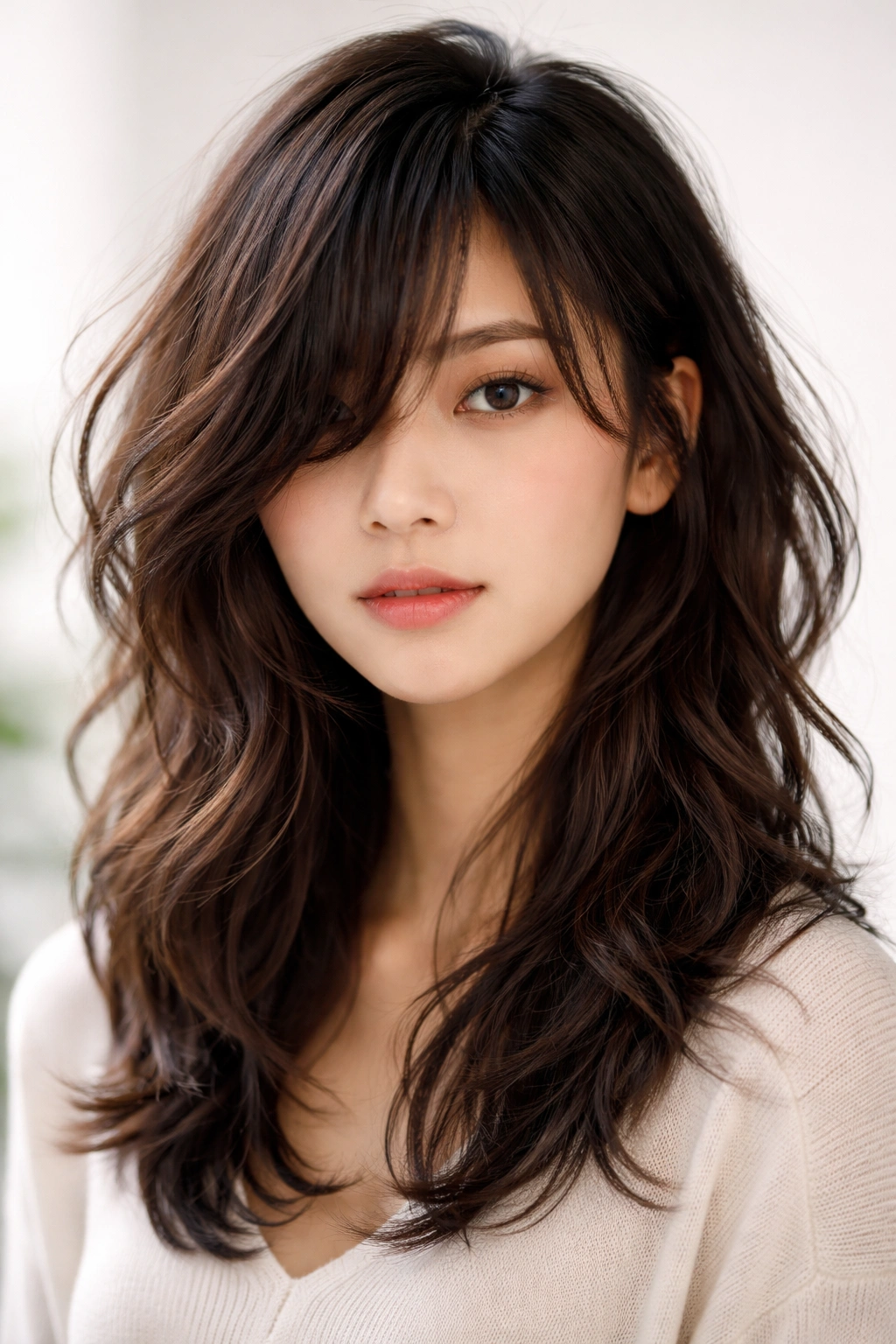
Asymmetrical bangs that fall longer on one side than the other paired with deliberately uneven layers throughout creates a style that’s daring, creative, and very fashion-forward. This isn’t a safe choice, but it’s an incredibly striking one.
The Editorial Appeal of Asymmetrical Design
Asymmetrical cuts are the hallmark of high-fashion hairstyling. They require confidence to wear because they’re not conventionally balanced, but they photograph beautifully and read as artistic and intentional. Combined with uneven layers, you get a style that’s unmistakably modern and fashion-oriented. This is a look that turns heads.
Making Asymmetrical Layers Work With Wavy Hair
- Asymmetrical bangs should be significantly longer on one side (hitting around cheekbone level) and shorter on the other (hitting eyebrow level or shorter)
- Uneven layers throughout mean some sections of your hair are noticeably shorter than others, creating movement and preventing weight
- Point-cutting is essential—you want defined, separate layers, not blended ones
- Your medium length should feel choppy and textured rather than uniform
- Wavy hair actually makes asymmetrical cuts look more intentional because the texture prevents them from looking accidental
This style is high-commitment. You need a stylist who understands the artistic vision, regular trims to maintain the asymmetry, and styling products to keep your waves defined. But if you pull it off, it’s genuinely one of the most distinctive looks possible.
Worth knowing: Asymmetrical cuts look either absolutely stunning or actively bad—there’s not much middle ground. Make sure you trust your stylist implicitly and look at extensive before-and-after photos before committing.
12. Pin-Straight Bangs with Wavy Extensions
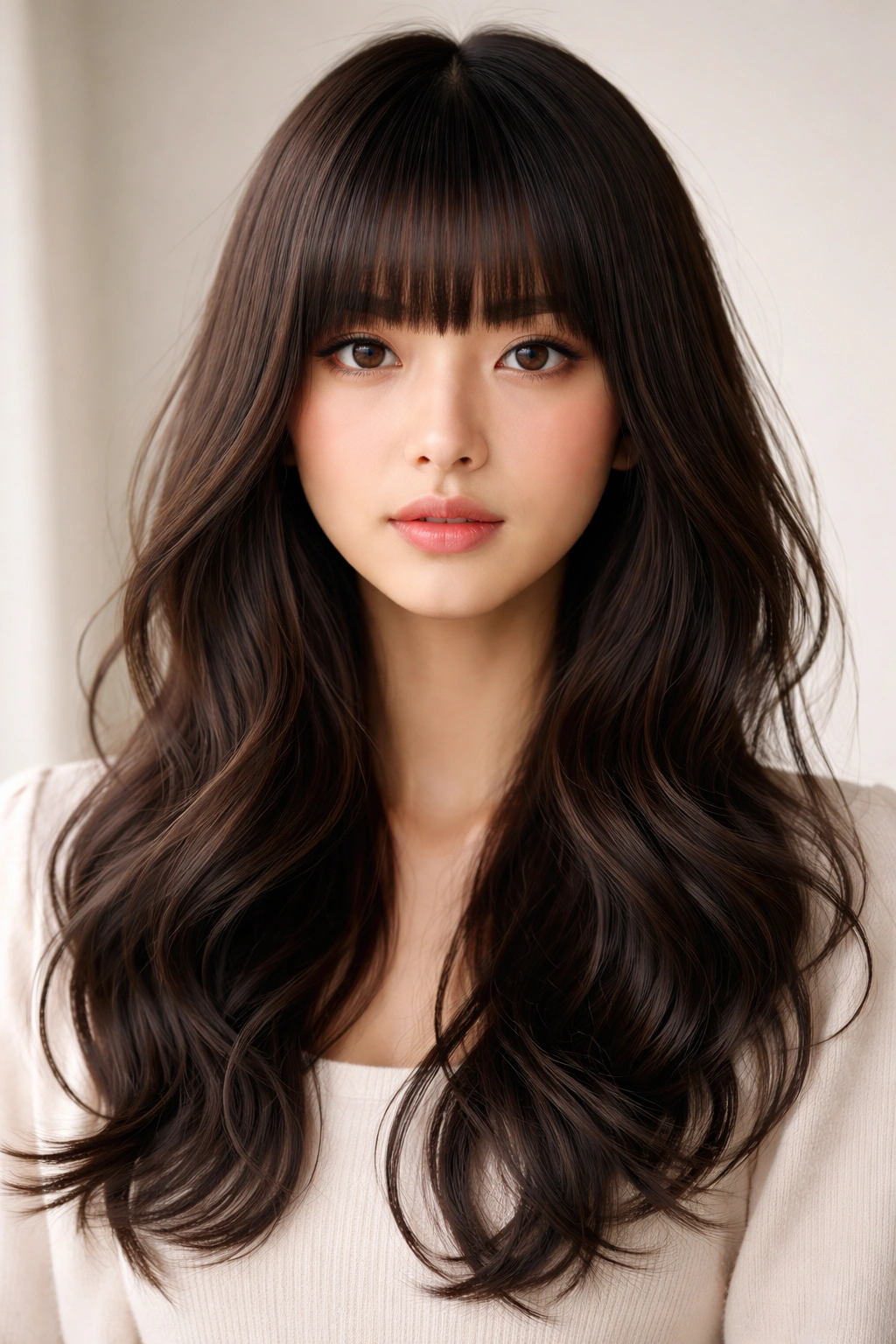
This is an interesting hybrid approach: perfectly straight, almost glass-like bangs that create maximum contrast with softer, slightly wavy hair throughout the rest of your medium length. It’s sleek where it matters and soft where you want softness.
Why This Contrast Works So Well Aesthetically
Pin-straight bangs demand attention—they’re almost graphic in their precision. Pairing them with waves creates this interesting visual dialogue where the eye moves from structure to softness. It’s very design-forward and reads as intentional and creative rather than accidental.
Styling Pin-Straight Bangs So They Actually Stay Straight
- Your bangs need to be thick enough that they don’t look wispy or thin when blown straight
- A smoothing serum or anti-frizz product is non-negotiable—you want the surface of your bangs to be absolutely smooth
- Daily blow-drying with a paddle brush (not a round brush) keeps them flat and straight
- The rest of your hair can be waves or soft curls—the contrast is actually the point
- Your medium length should have enough texture that the bangs read as a deliberate design choice, not a mistake
The advantage of this style is that pin-straight bangs actually frame wavy hair beautifully. The precision creates a boundary, and the waves inside that boundary look even softer and more textured by contrast. It’s a style that plays to the strengths of wavy hair.
Insider note: If you have naturally wavy or curly hair, maintaining pin-straight bangs requires daily heat styling. If you’re not willing to blow-dry your bangs every single morning, skip this approach.
13. Blunt Bangs with Shag Layers
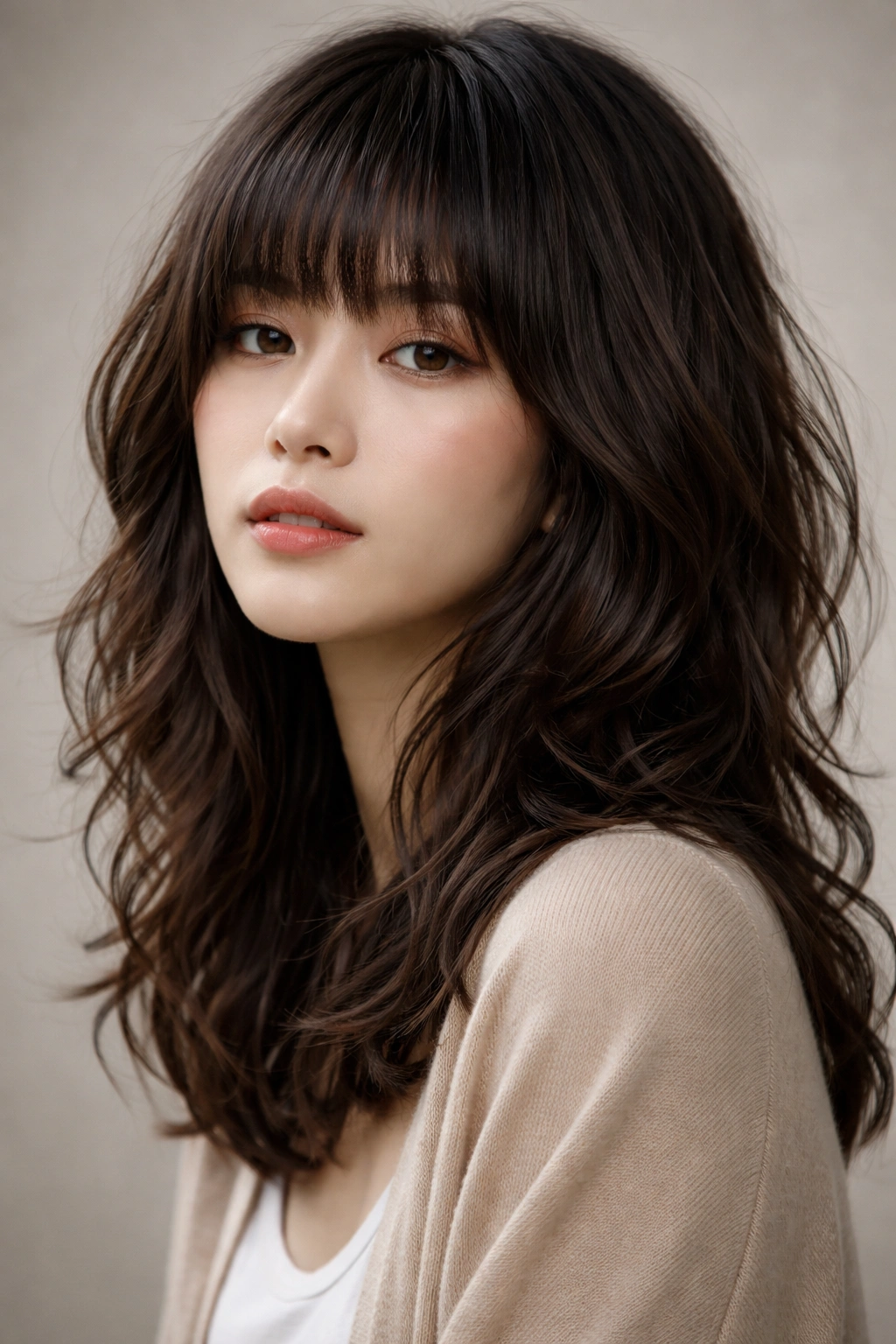
Blunt bangs paired with shag-cut layers create a look that nods to retro style while feeling completely current and cool. The structure of blunt bangs combined with the movement of shag layers is genuinely one of the best combinations for wavy hair.
Why Shag Layers Are Perfect for Wavy Hair
Shag haircuts are having a major moment, and there’s a reason: they were basically designed for textured, wavy hair. Shag layers create multiple lines of movement and visual interest, which means your waves have somewhere to go and show off their texture. The blunt bangs provide structure and face-framing, while the shag layers provide the movement and volume.
Getting a Shag Cut That Works With Your Natural Waves
- Your blunt bangs should hit at or just above eyebrow level, creating a clean frame
- Shag layers should start around mid-chin and get progressively shorter as they move toward the back
- Multiple choppy layers throughout create that signature shag texture without requiring the hair to be completely short
- Your medium length should be thick enough for layers to show definition; wispy thin hair can look stringy in a shag
- Point-cutting is essential; blunt-cutting shag layers makes them look choppy in a bad way rather than textured in a good way
With wavy hair, this cut is genuinely easy to style. Your natural texture does most of the work. You get volume, movement, and personality without having to blow-dry for hours or use tons of products.
Pro tip: Shag layers can look dated if they’re cut too short or at too uniform angles. Make sure your stylist has recent reference photos and understands how to execute a modern shag rather than a ’70s shag.
14. Curved Bangs with Beachy Waves
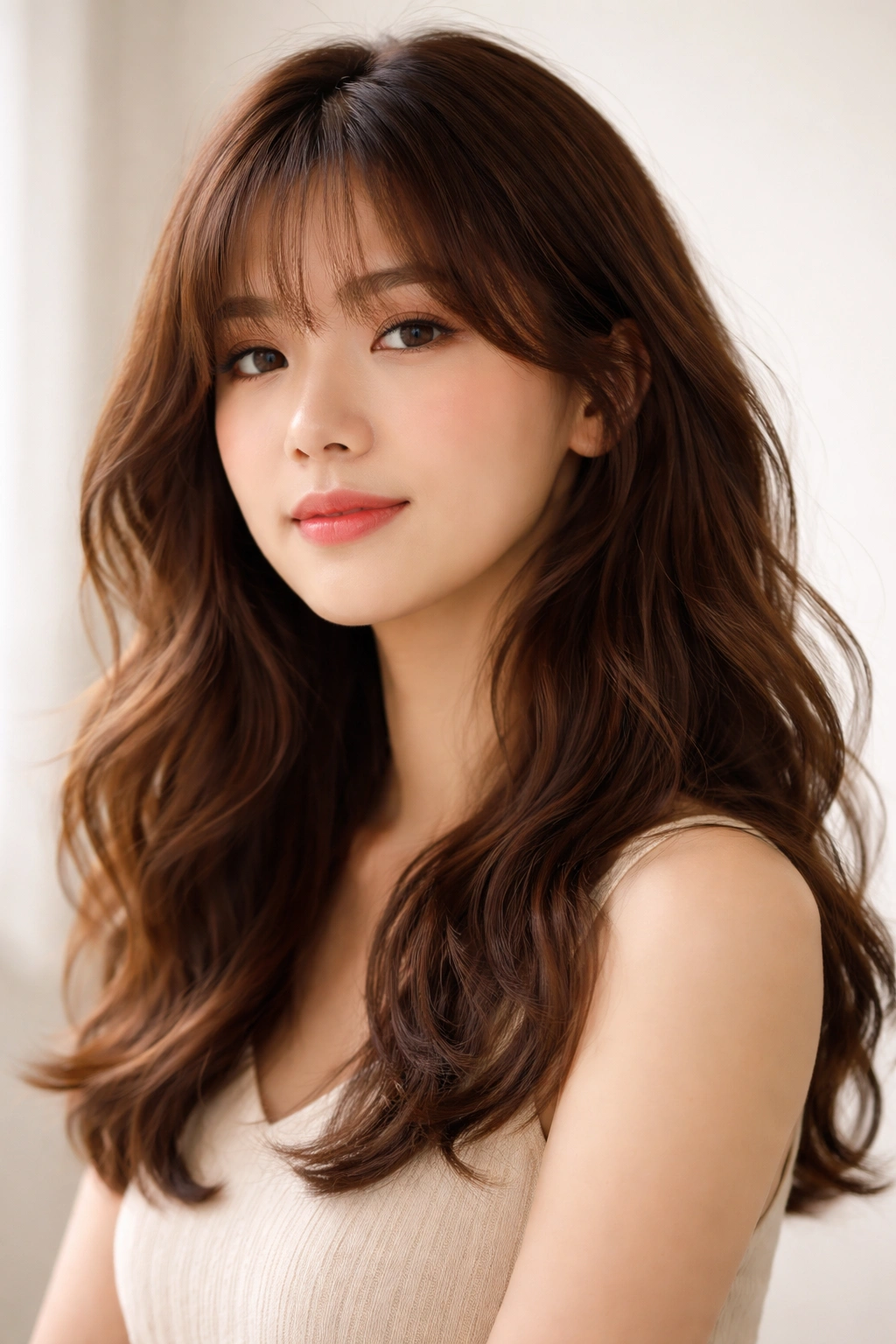
Curved bangs that follow the natural contour of your forehead paired with soft, beachy waves throughout. This is the relaxed, vacation-ready version of bangs—soft and approachable without sacrificing intentionality.
The Laid-Back Appeal of Curved Bangs
Curved bangs feel friendlier than straight bangs but more intentional than side-swept or curtain bangs. They follow the natural shape of your face, which means they’re generally flattering on most face shapes. The beachy waves reinforcement the casual vibe—this is a style that says “I look effortlessly put-together.”
Creating Beachy Waves That Actually Stay
- Curved bangs should follow the gentle curve of your brow bone rather than being completely straight or super dramatic
- They should hit right around eyebrow level, curving slightly upward at the sides
- Layers throughout your medium-length hair should be cut to encourage waves and movement
- Beachy waves work best on hair that’s at least 1-2 inches past shoulder-length, giving you enough length for the waves to form properly
- Salt spray and a diffuser on low heat create beachy texture without making your hair look dry or damaged
This style is incredibly wearable day-to-day. It doesn’t require precision styling every morning, and it actually looks better slightly tousled than perfectly polished. Your wavy hair is doing exactly what it’s supposed to do.
Worth knowing: “Beachy” doesn’t mean “wind-blown and messy.” It means intentional waves with definition and shape. Make sure your styling products create structure rather than just dampness.
15. See-Through Bangs with Textured Medium Length
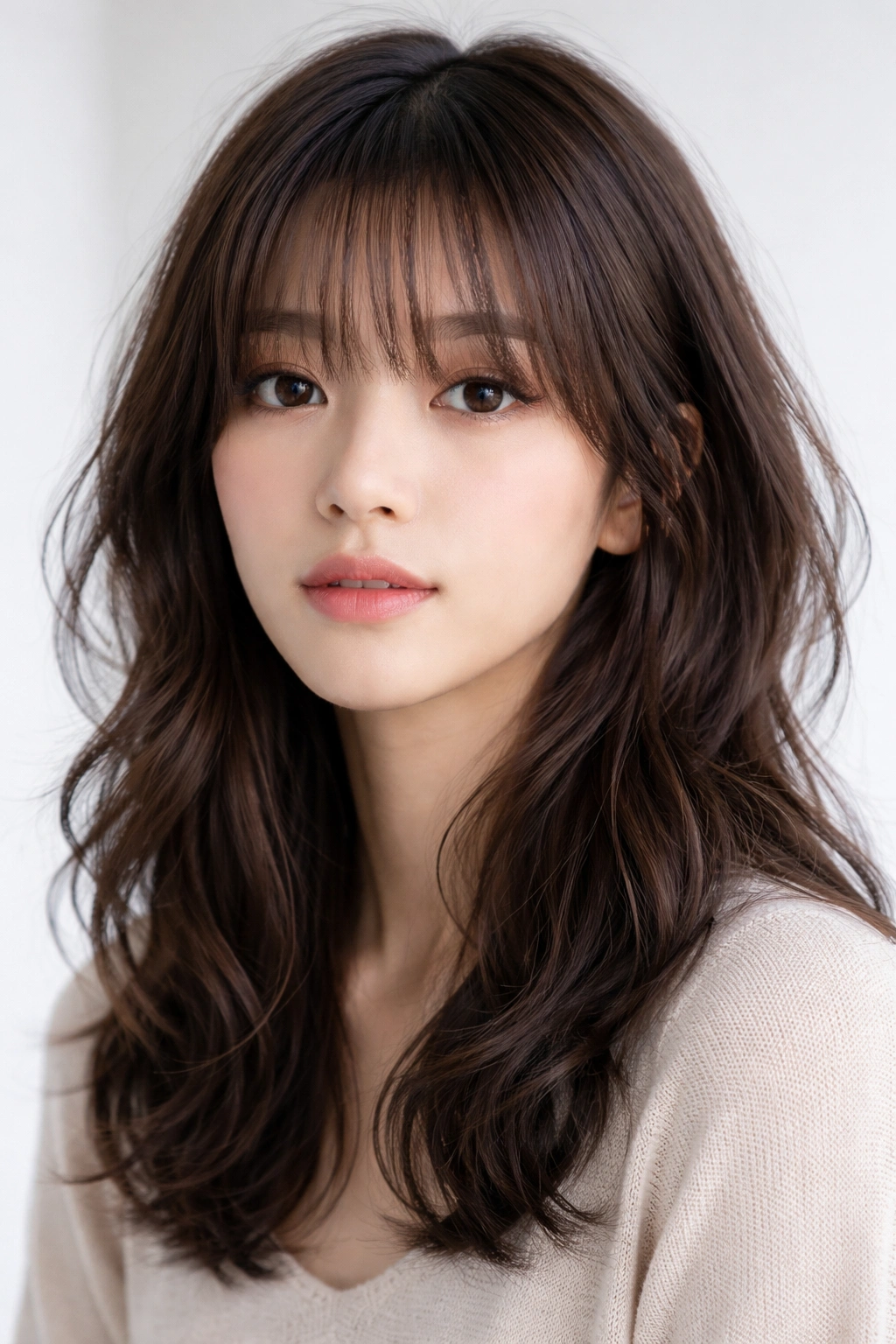
See-through bangs are partially transparent, hit above the eyebrow line, and allow skin to show through the strands. Paired with textured, layered medium-length hair, they’re modern, sophisticated, and endlessly wearable.
Why See-Through Bangs Are The Sweet Spot
See-through bangs hit the perfect balance between “definitely bangs” and “barely-there.” They frame your face and change your look without the commitment of full-coverage bangs. They photograph beautifully because the slight transparency reads as soft and feminine. And they work across nearly every face shape and styling preference.
Executing See-Through Bangs on Wavy Hair
- See-through bangs are created by cutting individual strands at varying lengths rather than one uniform length
- They should sit above eyebrow level, creating that barely-there coverage
- Your medium-length textured layers should complement the lightweight quality of see-through bangs
- Point-cutting through all layers creates separation that makes each layer visible and prevents density
- These bangs actually look better with some texture; perfectly smooth straight hair can make them look too thin
The genius of see-through bangs on wavy hair is that your natural texture automatically creates the variation and dimension that makes them look good. You’re not fighting your hair texture; you’re using it.
Insider note: See-through bangs require regular trims (every 4-6 weeks) because the variation in lengths becomes more obvious as they grow. But the maintenance is less intensive than blunt bangs.
16. Sidepart Bangs with Voluminous Waves
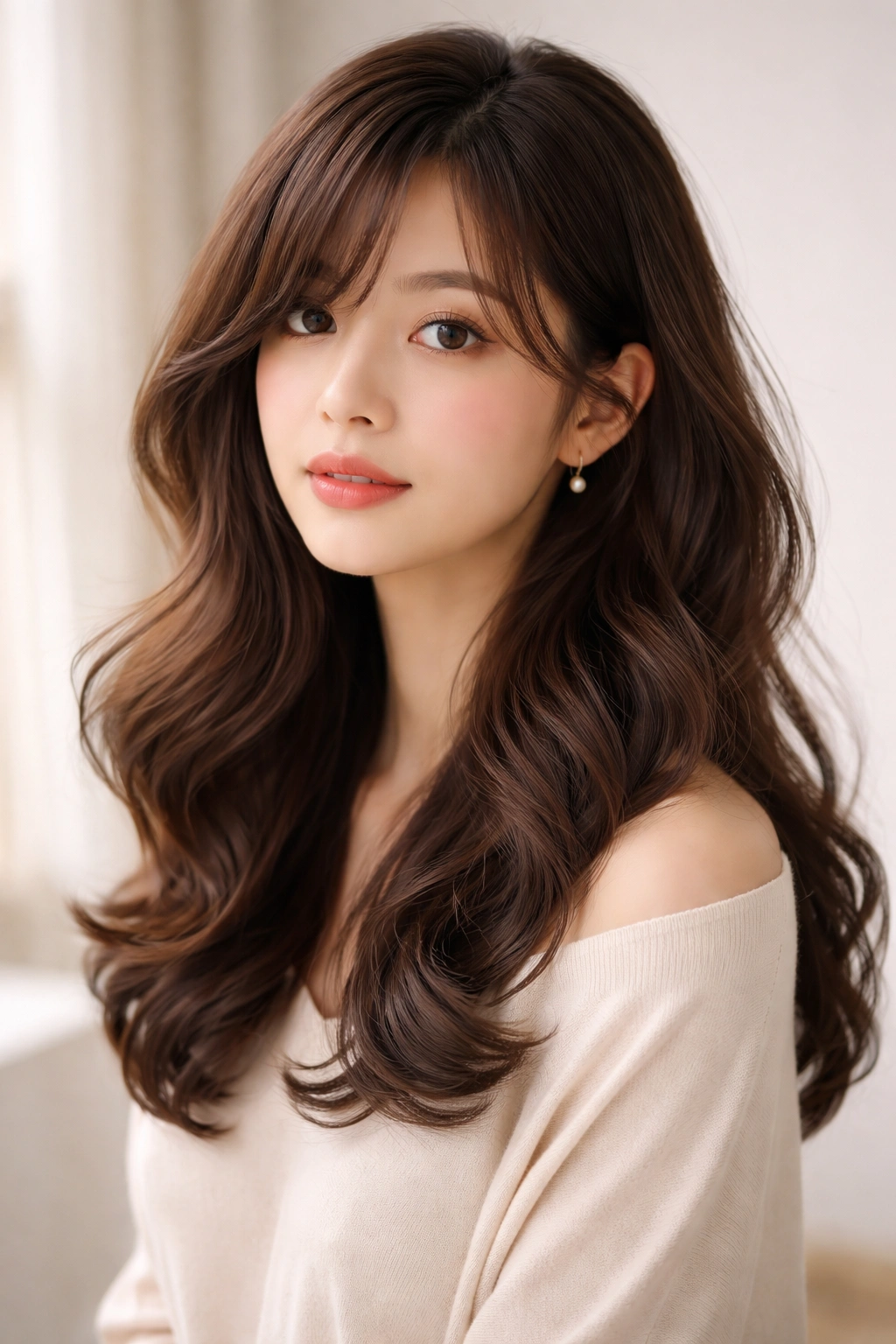
Sidepart bangs are longer on one side and shorter on the other, falling from a deep side part. Combined with voluminous, substantial waves throughout your medium-length hair, they create a style that’s undeniably feminine and flattering.
The Flattering Quality of Sidepart Bangs
Sidepart bangs are universally flattering because the asymmetry creates the optical illusion of a narrower, more sculpted face. They work for most face shapes and can be styled multiple ways depending on where you place your part. The voluminous waves amplify this flattering effect by adding fullness and dimension rather than lying flat against your face.
Building Volume Into Waves With Sidepart Bangs
- Your sidepart should be deep enough that one side of the bang is noticeably longer (around cheekbone length) while the other is shorter (around eyebrow level)
- Layers throughout your medium-length hair should be cut to encourage volume at the crown and through the mid-shaft
- Volumizing mousse applied to damp roots before blow-drying helps your waves maintain lift throughout the day
- Blow-drying in the opposite direction of where your waves naturally fall creates bounce and prevents them from getting flat
- Your waves should be substantial and well-defined rather than soft and wispy—you need weight to maintain volume
This style is work-appropriate, date-appropriate, and genuinely flattering. It’s not as trendy-feeling as some other options, which actually works in its favor for longevity.
Pro tip: If your hair is naturally super wavy or curly, you might need a smoothing treatment or keratin application to prevent the sidepart bangs from developing texture that makes them look frizzed out rather than intentionally styled.
17. Rounded Bangs with Curled Ends
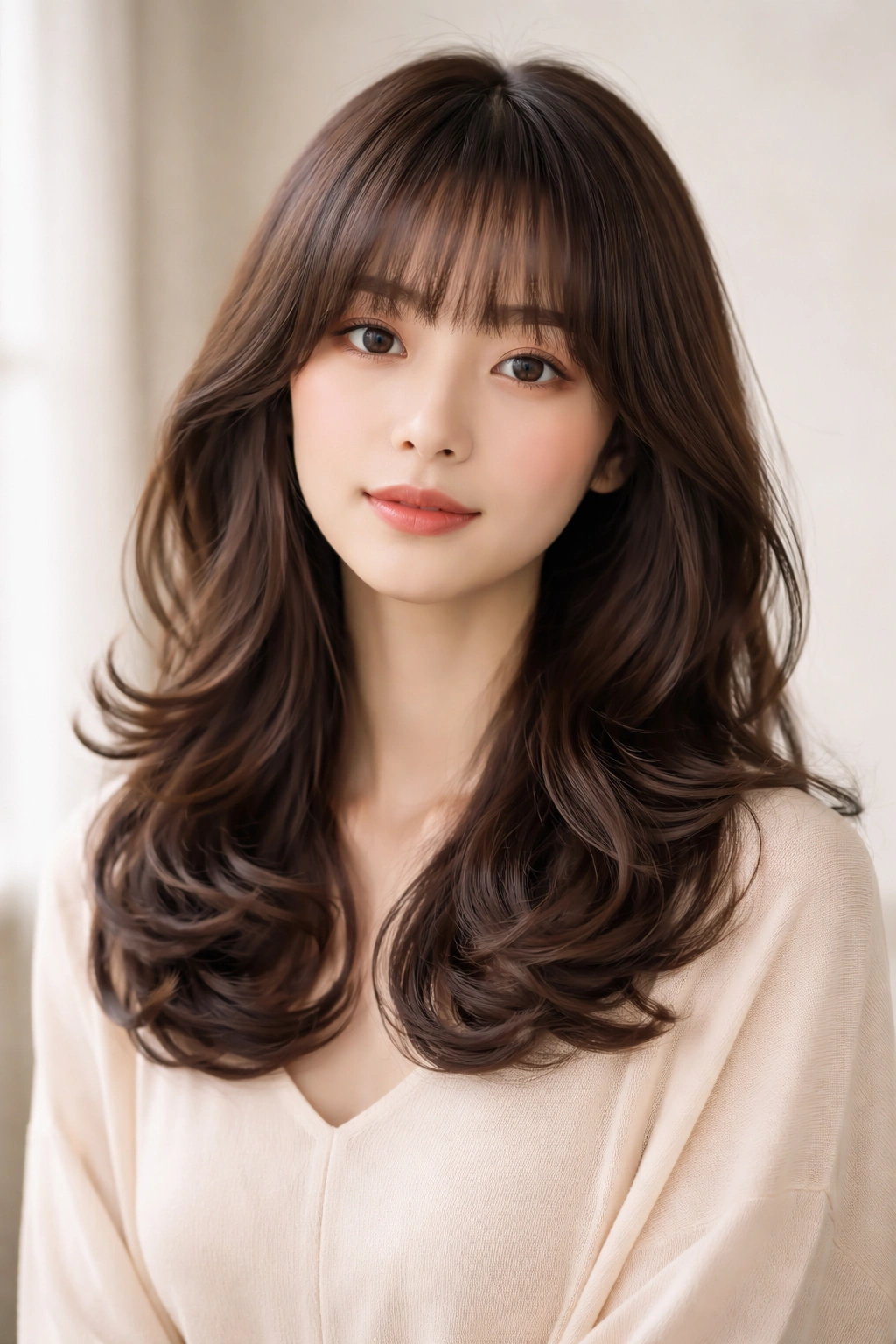
Rounded bangs that curve gently around the sides of your face paired with intentionally curled waves throughout your medium-length hair. This creates a cohesive style where the bangs and the rest of your hair are working together in the same direction.
The Charm of Rounded Bangs on Face-Framing Hair
Rounded bangs are less common than straight or side-swept, which actually makes them more distinctive. They follow a gentle curve rather than a blunt line, creating a softer, more romantic feeling while still being intentional and stylized. When you pair them with curled waves, everything feels coordinated without being too matchy or trying-too-hard.
Creating Coordinated Curls and Bangs
- Rounded bangs should curve gently from roughly cheekbone level on one side to cheekbone level on the other side, creating a soft arc across your forehead
- They should hit right around eyebrow level at the center
- Your medium-length waves should be in defined curls or waves rather than soft bends—you want enough structure that the style reads as intentional
- Using the same heat tool (curling iron or wand) for both your bangs and the rest of your hair creates cohesion
- Your waves should sit with the rounded shape of your bangs rather than in opposition to it
This style requires more styling effort than some others because you’re essentially curling your entire head including your bangs. But the payoff is a look that’s distinctly coordinated and romantic without being overdone.
Worth knowing: Rounded bangs work best on hair that holds a curl. If your hair is resistant to styling or doesn’t maintain waves, this approach will require daily heat styling or heavy-hold products.
18. Long Bangs with Wavy Lob
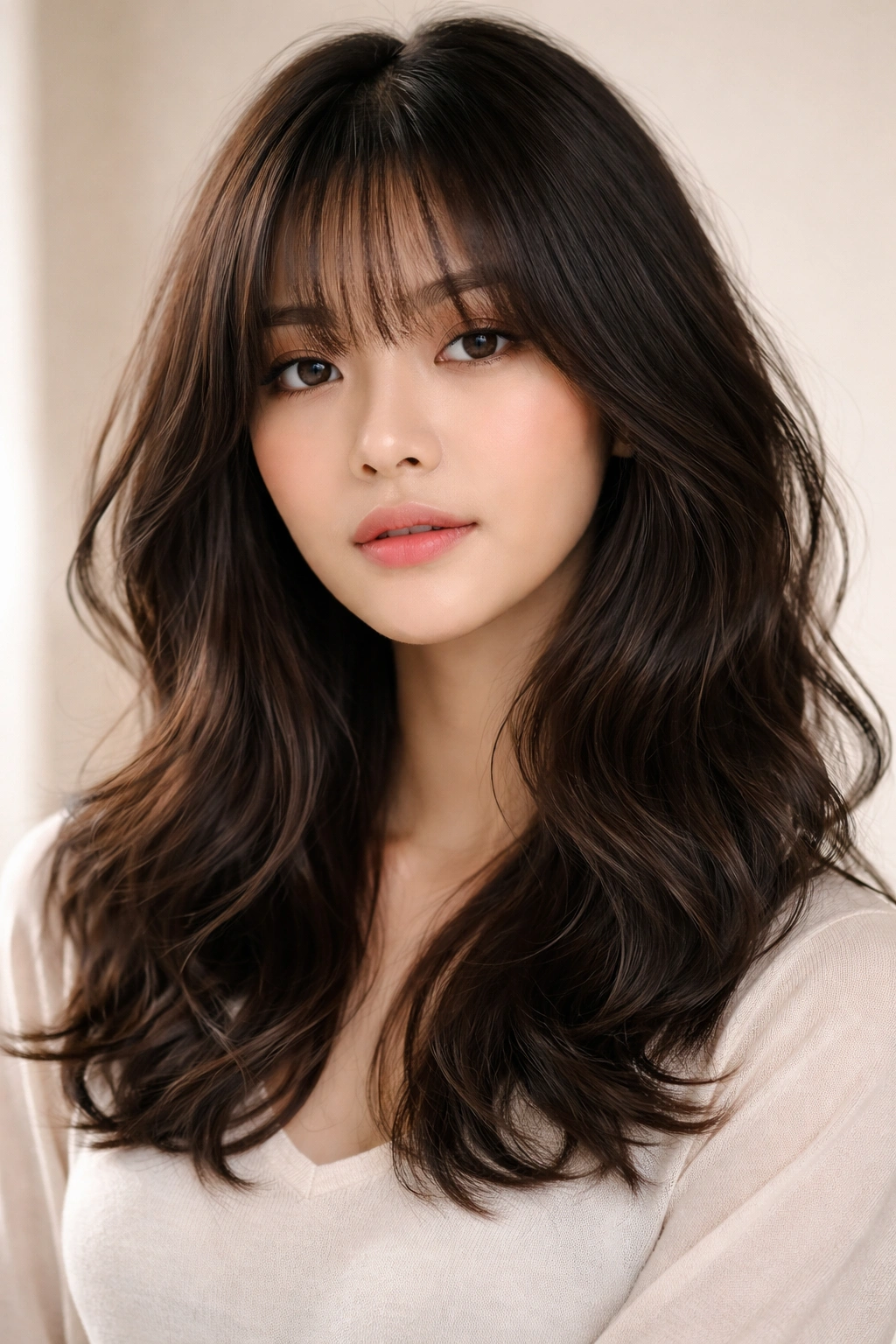
Long bangs that fall below eyebrow level toward cheekbone paired with a lob (long bob) structure and layered waves. This is the sophisticated, effortlessly cool version of bangs and the perfect style for someone who wants bangs without the heavy forehead coverage.
Why Long Bangs Feel So Wearable
Long bangs hit the sweet spot between “not quite bangs” and “definitely bangs.” They frame your face and create softness without the daily styling that comes with full-coverage bangs. A wavy lob gives you length and movement while still feeling intentional and sculpted. Together, they create a look that’s endlessly versatile.
Styling a Wavy Lob With Long Bangs
- Long bangs should fall roughly to cheekbone level or slightly below, hitting right around the widest part of your face
- They should sit on either side of your part rather than directly in the center, creating an almost curtain-bang effect but fuller
- Your lob should have layers throughout to create movement and prevent it from feeling heavy or blocky
- Medium length for a lob typically falls somewhere between chin and collarbone, giving you enough length to style multiple ways
- Point-cutting through all layers creates texture that works beautifully with natural wavy hair
The advantage of this combination is that you get the face-framing benefit of bangs without the commitment. You can style your long bangs multiple ways—swept to one side, parted in the center, twisted back, pinned up. They’re far more versatile than traditional full-coverage bangs.
Insider note: Long bangs actually require less frequent trims than shorter bangs because growth is less noticeable. You can go 8-12 weeks between trims rather than the 4-6 weeks that blunt bangs demand.
Final Thoughts
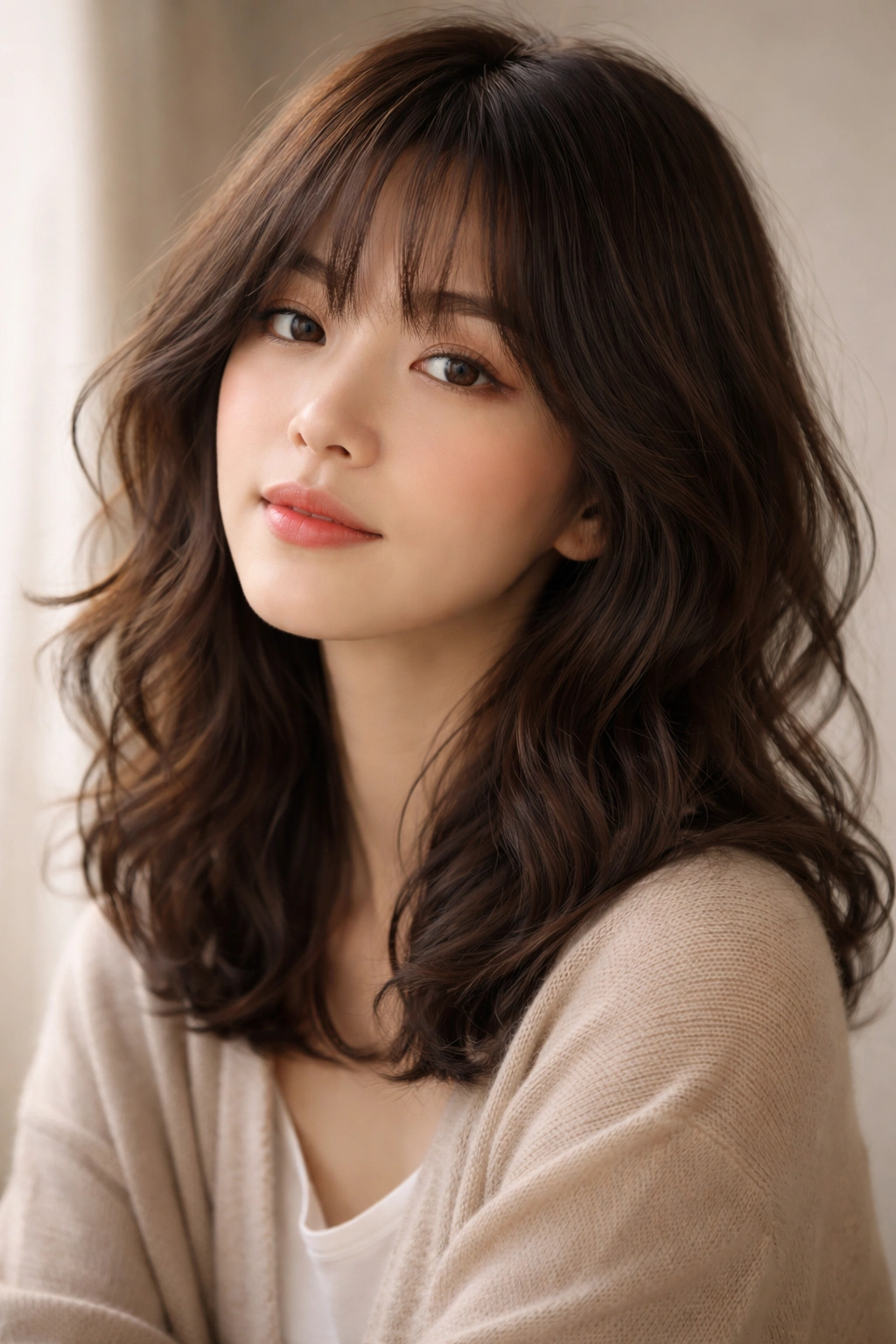
The beautiful thing about Korean medium hairstyles with bangs on wavy hair is that there’s genuinely something for every preference and lifestyle. Whether you’re looking for something bold and editorial or soft and romantic, a style that requires minimal daily styling or one that’s a bit more intentional, you’ve got options that work specifically with your texture rather than against it.
The most important thing is finding a stylist who understands both Korean hairstyling and how to work with wavy hair specifically. Poor execution can make even the most beautiful style concept fall flat. Take reference photos, ask questions about how your particular hair texture will behave with the style you’re considering, and don’t hesitate to ask about styling techniques and product recommendations before you commit.
Your wavy hair is an asset, not something to fight. These 18 styles are specifically designed to celebrate your natural texture while giving you the intentional, thoughtfully-executed look that Korean beauty is famous for. The result is a style that feels uniquely yours—put-together, confident, and effortlessly cool.
