



A scarf can rescue curly hair faster than almost any other accessory. That sounds dramatic, but it isn’t. Put the right scarf on curls, and you get shape, color, and a little control without flattening the life out of the hair.
Scarf hairstyles for curly hair work best when the scarf follows the curl pattern instead of fighting it. Silk and satin glide over coils with less friction. Cotton grips more, which can help when your hair is fine or extra slippery, but it can also steal moisture and leave a dry-looking bend if you wrap too tightly.
The real trick is tension. Too loose, and the scarf slips by lunchtime. Too tight, and you get dents at the hairline, a headache, and curls that look sad instead of styled. I like scarves that are wide enough to anchor, but not so bulky that they swallow the whole shape of the hair.
Some of the looks below are for day-two curls that need help. Others are for wash-and-go hair that’s doing most of the work already. A few are flat-out practical, the kind you can throw on before a long day and still wear with confidence when you catch your reflection later.
1. The Pineapple Wrap
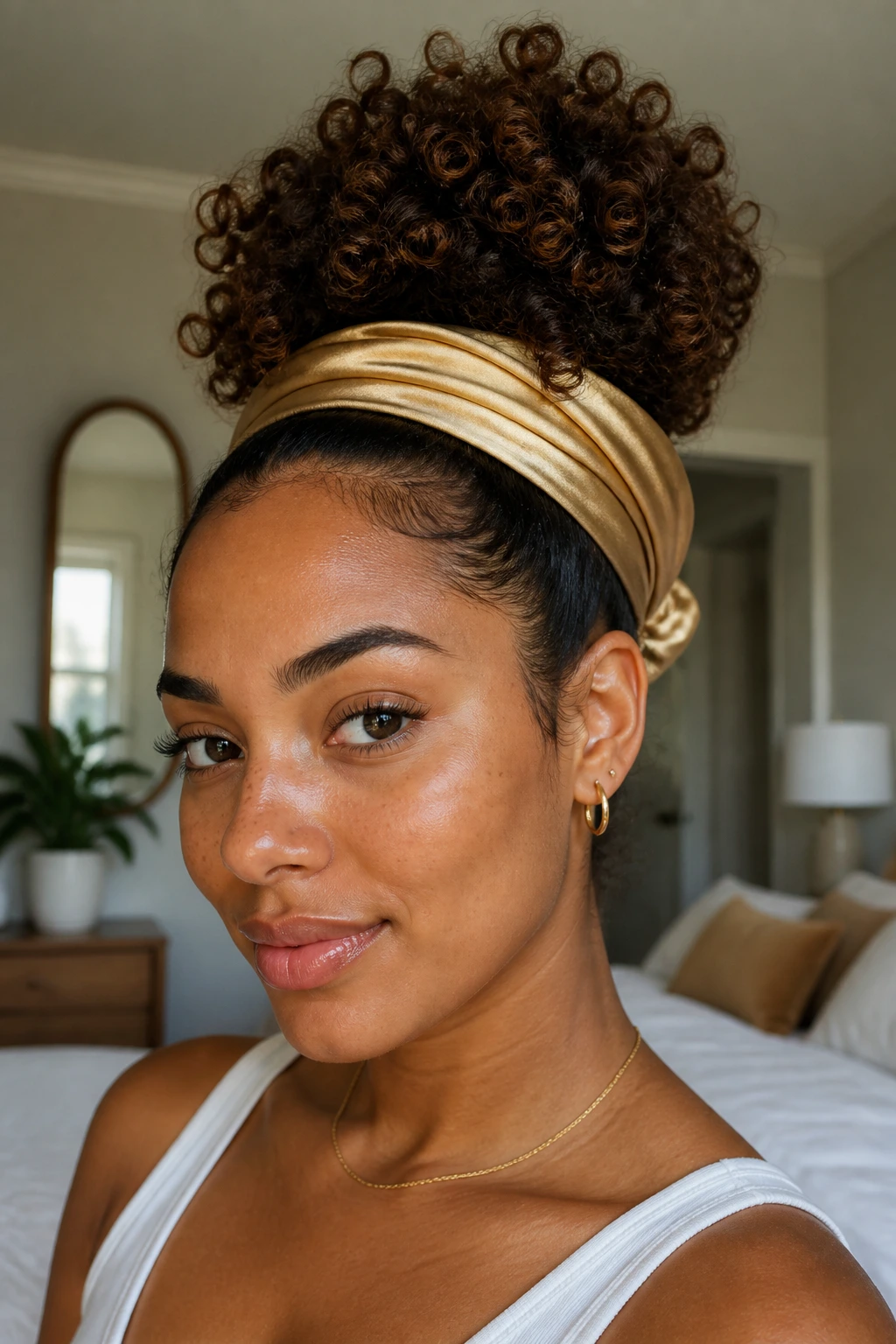
The pineapple wrap is the one I keep coming back to for long, loose curls. It holds the bulk of the hair high on the head, which protects curl clumps and keeps the shape from getting crushed against a chair, a hood, or a pillow.
Why It Works
A high pineapple keeps the ends of the curls away from friction, and that matters more than people think. Curly hair loses shape fast when the ends keep rubbing on collars and jackets. By lifting everything up, you protect the spring and make the whole style look intentional instead of accidental.
Use a 22- to 27-inch square scarf if your hair is medium to thick. Fold it into a long band, then wrap it around the base of the pineapple once or twice. The scarf should sit snug, not strangling. If the puff starts to flatten at the crown, loosen it a little and let the curls stack higher.
- Best for medium to long curls
- Works well on second- or third-day hair
- Use satin or silk for less frizz
- Leave the ends soft and free if you want more volume
My favorite move: tuck the knot toward the back so the front stays clean and the puff keeps its shape.
2. The Wide Silk Headband Sweep for Curly Hair
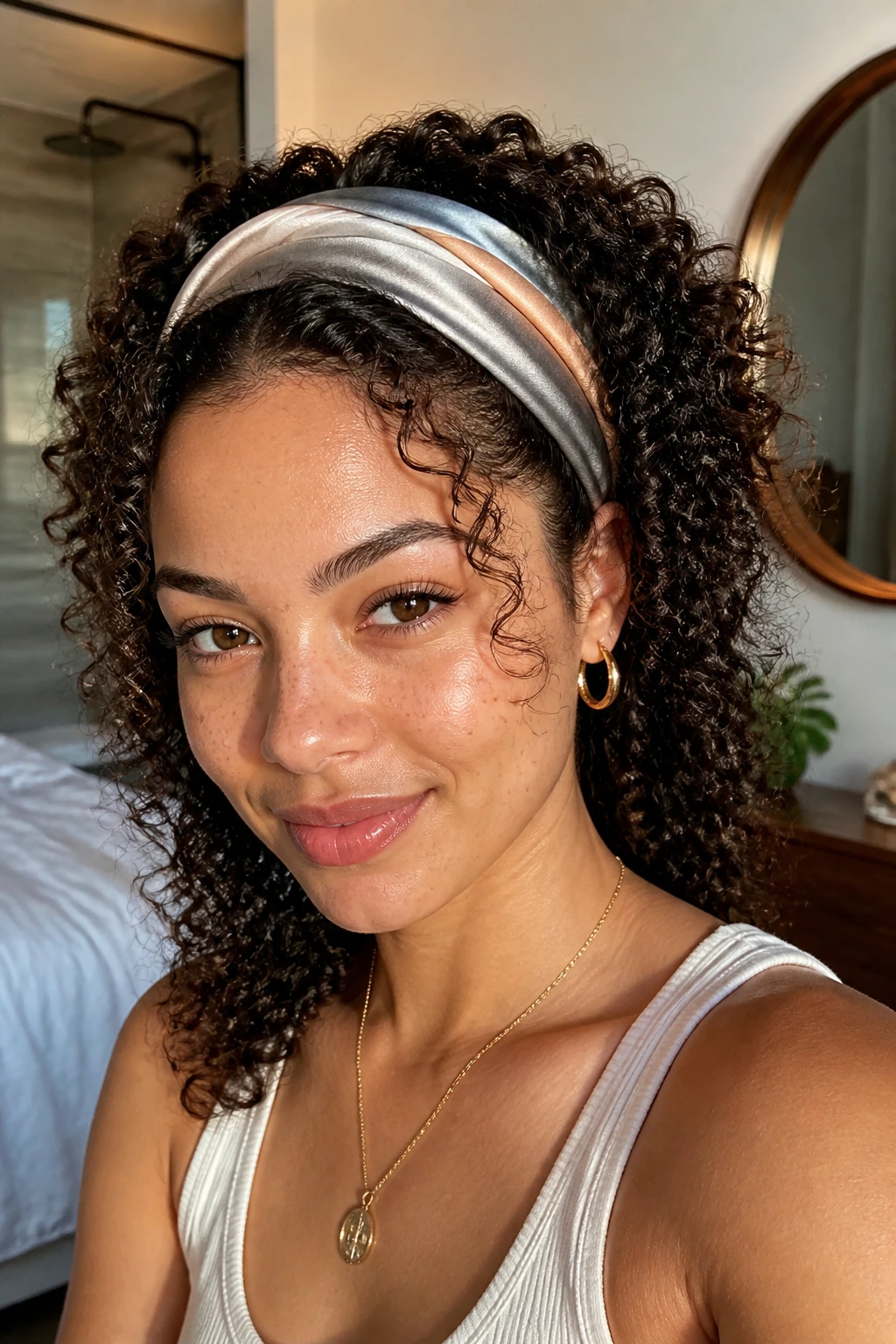
A wide silk headband is the easiest style in the bunch, and I mean that in the best way. It can make sleepy curls look deliberate in about ten seconds, which is a small miracle on rushed mornings.
The scarf sits like a broad band across the crown and hairline, then the lengths fall loose behind it. That gives you face framing up front and full curl texture everywhere else. The look works because it controls the front without pinning down the part or squeezing the whole head.
If your curls puff up near the temples, fold the scarf to about 3 to 4 inches wide and place it a finger-width behind the hairline. A little lift at the roots keeps it from looking flat. Tuck the ends under at the nape or let them trail behind one shoulder if the scarf is long enough. Either way works.
This is the style I’d hand to anyone who says scarves feel fussy. They do not have to be.
3. The Low Puff with a Side Knot
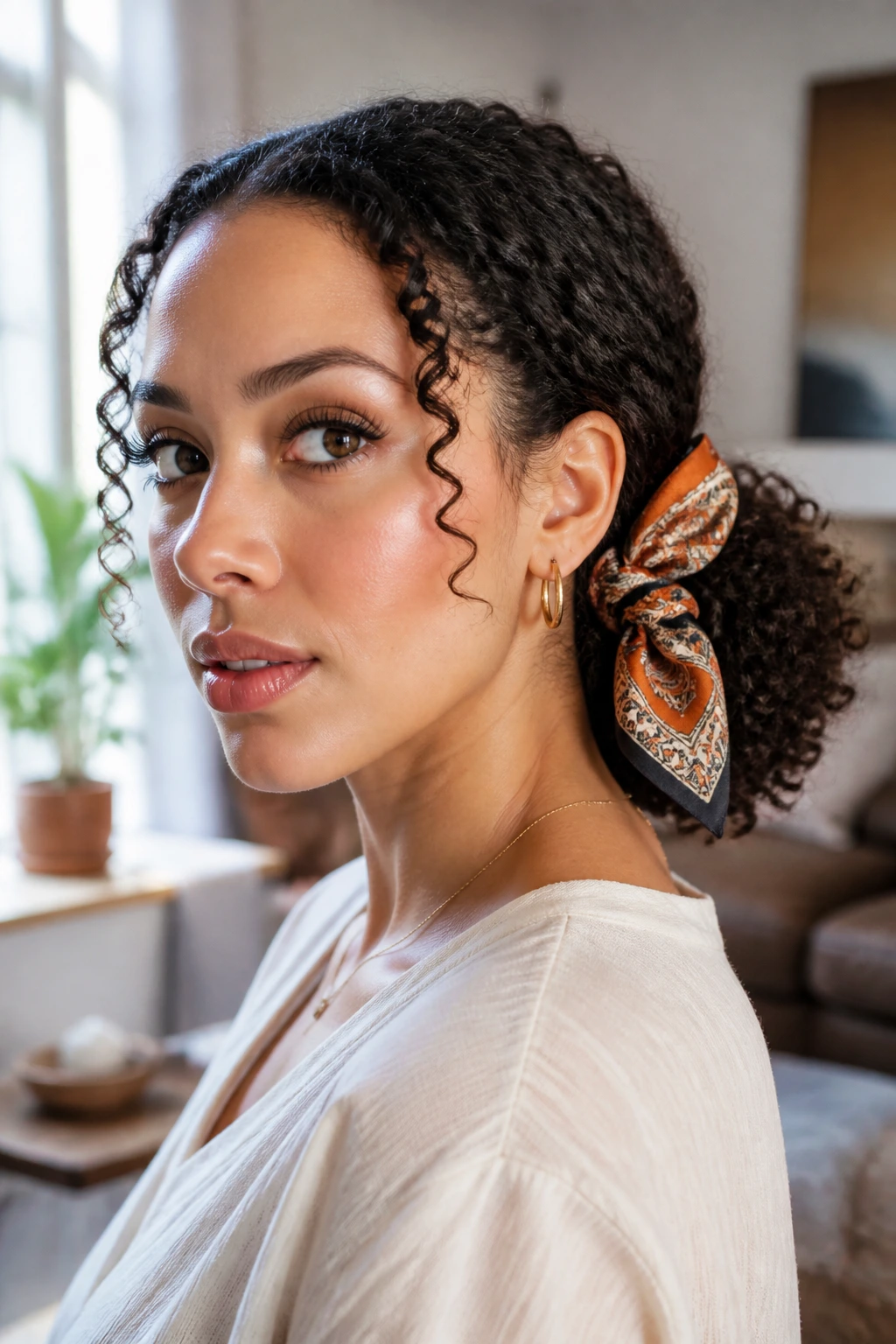
Why does a low puff look so polished with a scarf? Because the knot gives the eye a place to land. Without it, a low puff can feel unfinished. With it, the whole style looks planned.
Start by gathering the curls at the nape, then secure them loosely so the puff still has room to breathe. Wrap a scarf around the base and knot it off to one side instead of dead center. That little shift changes the mood of the style fast. Center knots can look formal. Side knots feel softer and less stiff.
How to Style It
- Smooth the top lightly with your hands or a soft brush, but do not chase every flyaway.
- Gather the curls low at the nape and secure with a fabric tie.
- Wrap the scarf around the base once, then tie it slightly off-center.
- Pull a few curls free around the face if you want more movement.
This one works especially well with dense curls that want to puff outward. The scarf keeps the base neat while the rest of the hair stays big and alive.
4. The Bandana Frame with Front Curls Out
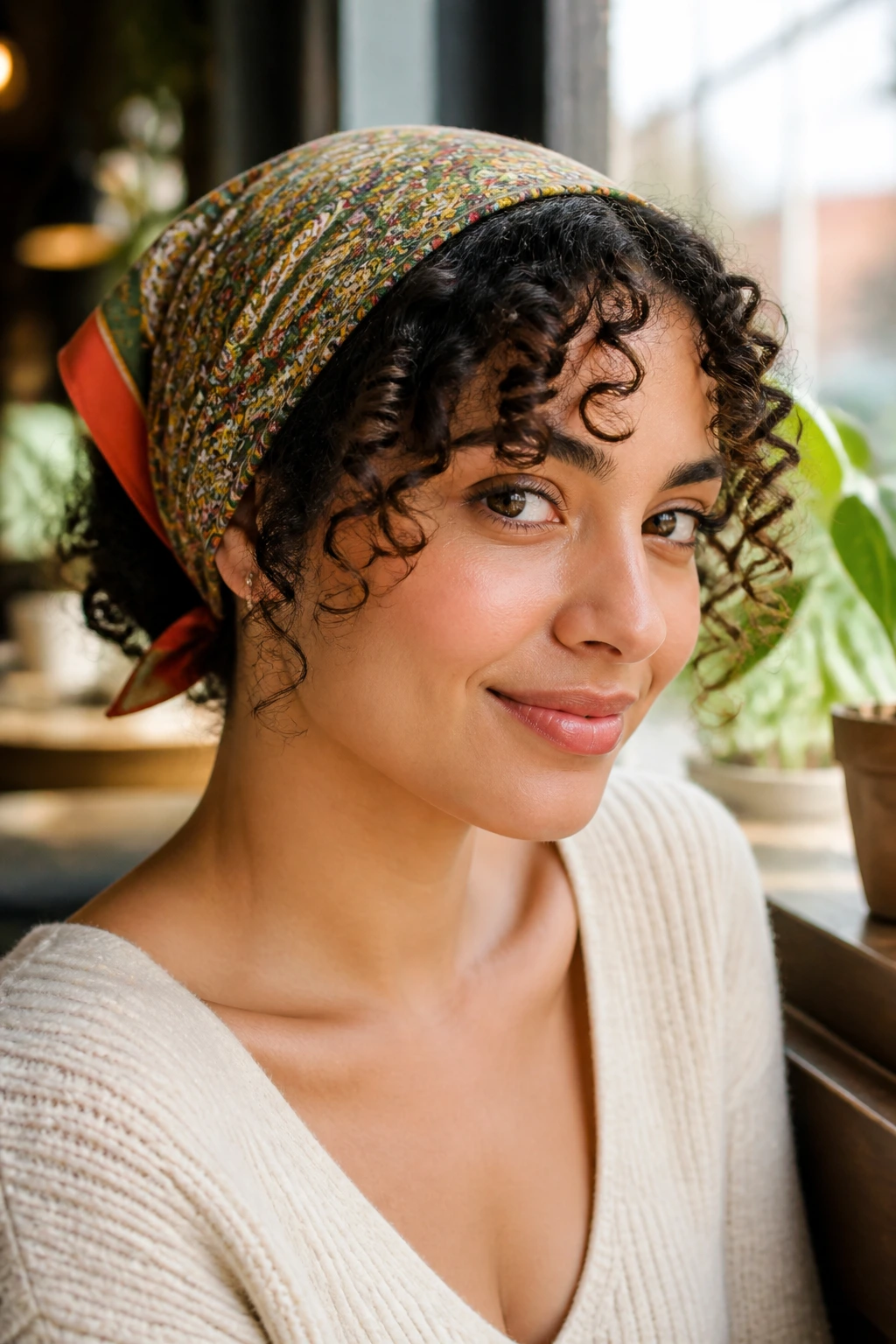
I reach for this look when the front of my hair has personality and the sides need a little order. It feels casual, but not sloppy. That is the sweet spot.
Fold the scarf into a triangle, place the long edge along the hairline, and tie it at the back. Leave the front curls out so they sit over the scarf instead of under it. That gives you shape around the face and keeps the front from being smashed flat. If you have shorter layers, let them spill out on purpose. The contrast is what makes it work.
- Keep the knot low at the nape for a cleaner line
- Use a scarf with enough width to cover frizz at the temples
- Leave a few side curls loose if your face needs softness
- Choose a print with a bit of contrast so the scarf reads from a distance
This style is easy to wear with oversized hoops, a plain tee, or a dress that needs a little color near the face. It does not try too hard. That’s the appeal.
5. The Halo Wrap Around the Hairline
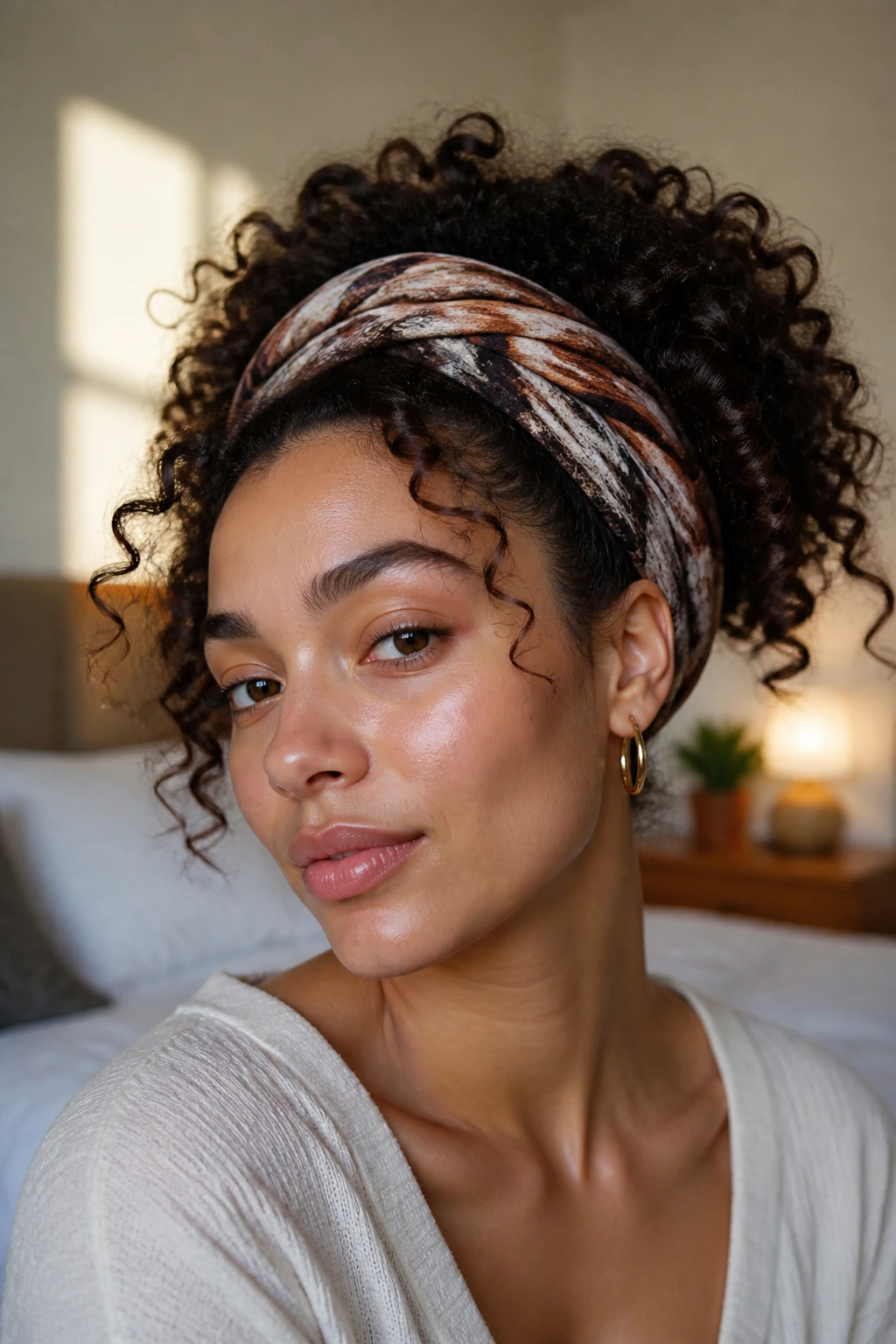
A halo wrap looks fussy from far away, then you do it once and realize it’s just a thoughtful headband with a better personality. The scarf circles the hairline, not the whole head, which means your curls stay visible and full.
I like this for wash-and-go curls that have good definition but need help at the front. The scarf acts like a frame. It keeps the forehead area clean, controls frizz around the edges, and lets the rest of the hair stay big.
Where to Place It
Put the scarf about half an inch behind the hairline if you want a soft frame. Move it closer to the hairline if you want a tighter vintage look. Either way, the scarf should sit evenly from temple to temple so it does not slide into one ear by lunch.
What Makes the Shape Work
A halo wrap needs a scarf that holds its line. A slippery square can twist too much, while a narrow strip can dig in. I prefer a medium-width fold, something around 2 to 3 inches, because it stays neat but does not feel heavy.
This is one of those scarf hairstyles for curly hair that looks like effort even when it barely took any.
6. The Scarf-Woven High Puff
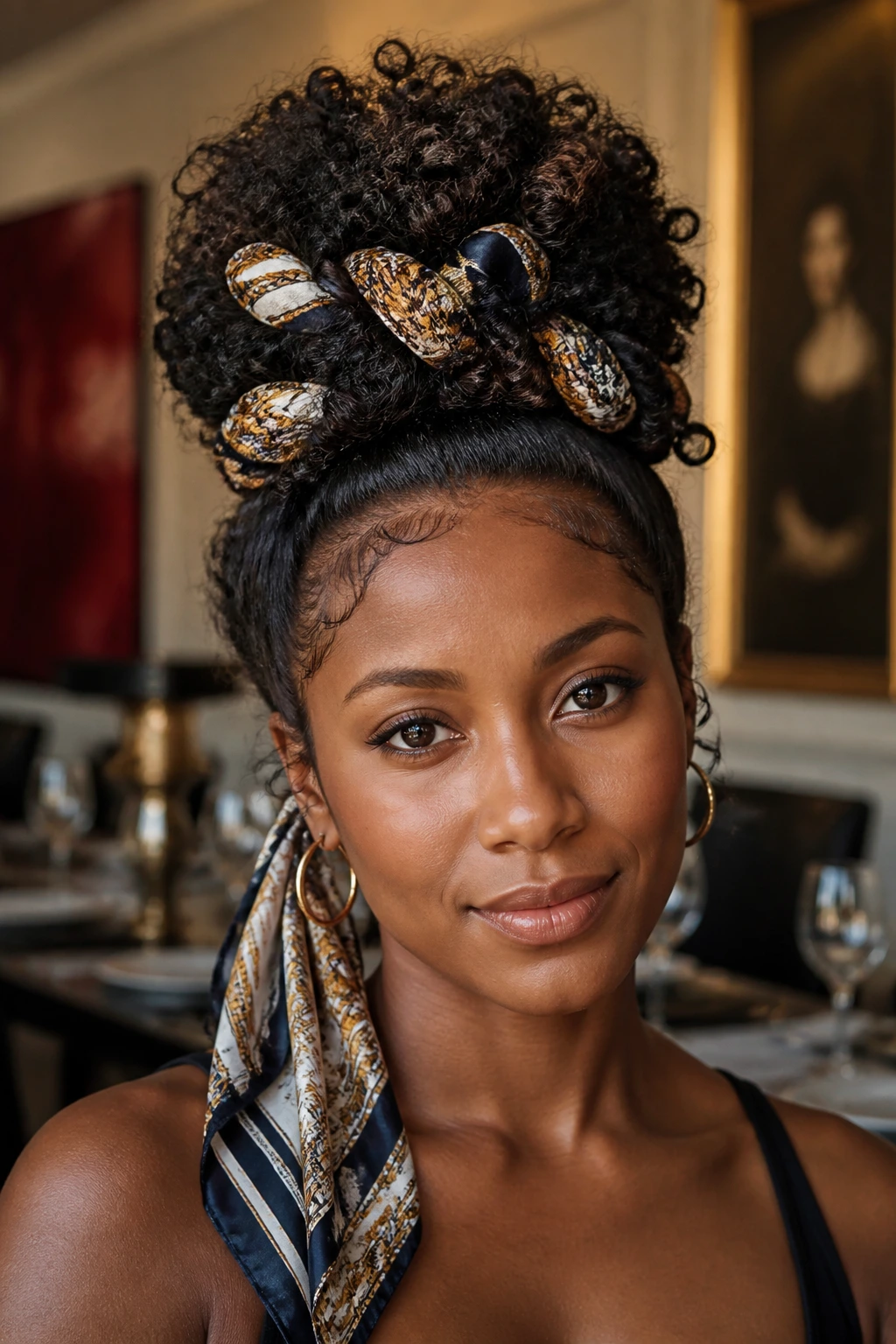
A plain high puff is fine. A scarf-woven high puff has a bit more attitude.
Instead of tying the scarf only at the base, thread it into the puff so part of the fabric runs through the style and part of it hangs free. You can loop it around the ponytail holder, cross it over the front, or wrap it once around the puff before letting the tails drop. The curls stay the star, but the scarf gives the puff a stronger shape.
What Makes It Different
This style works because the scarf becomes part of the silhouette, not just decoration. A high puff already gives you height. The scarf adds line and contrast, which helps the style read cleanly from every angle.
Best results come from dense curls or coils that can hold a little weight. If your hair is fine, keep the scarf light and skip bulky knots. Too much fabric can pull the puff down and kill the lift.
I like this style with a scarf that has one solid color and one print, because the movement shows up better when the scarf shifts. It is playful, but still tidy enough for a dinner, a gallery, or any day you want your hair to do the talking.
7. The Half-Up Top Knot with Scarf Tail
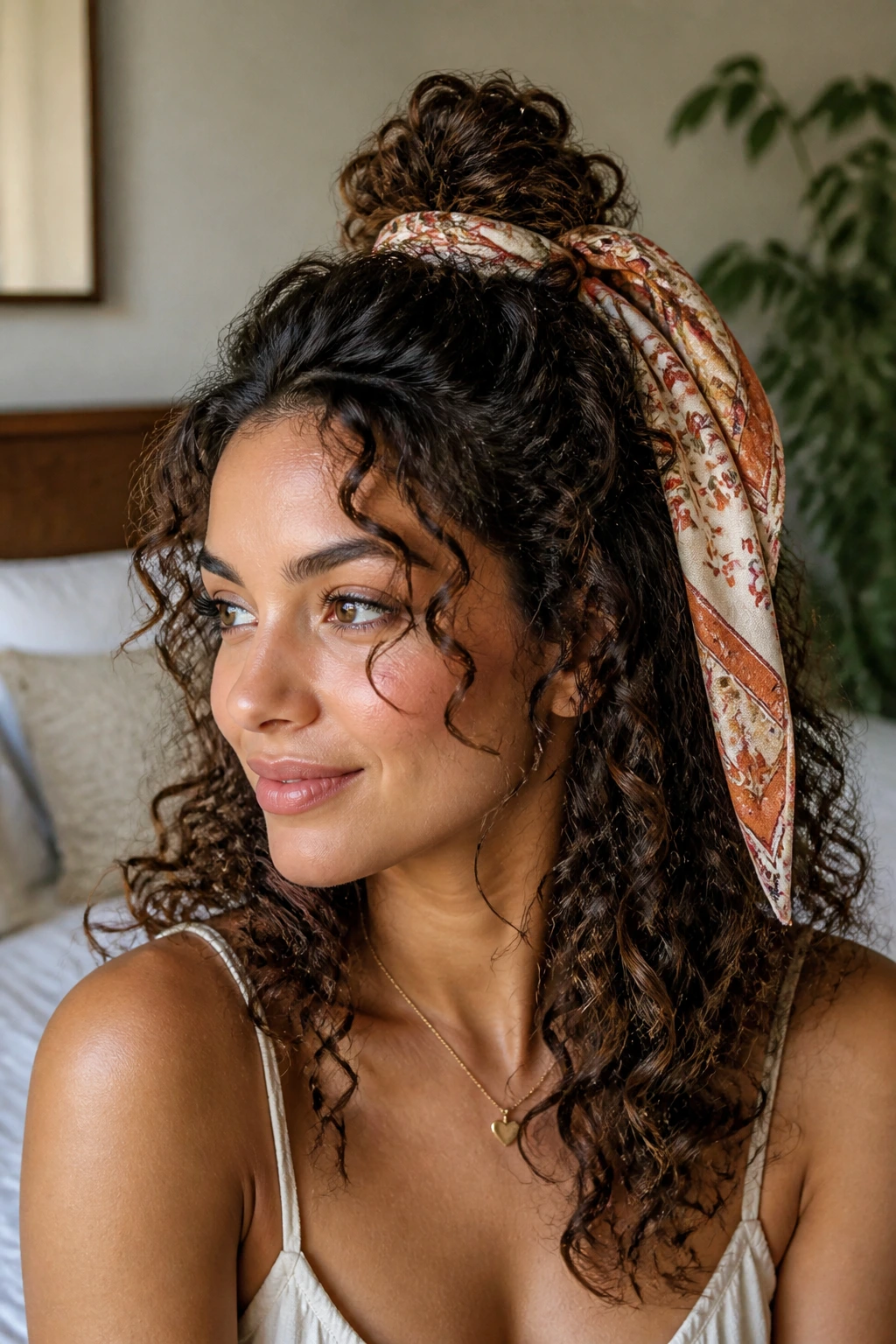
If you want your curls off your face but not hidden, this one earns its keep fast. The top knot gives you lift. The scarf tail gives the whole style a little drama.
Section off the top half of the hair, twist it into a knot, and secure it loosely. Tie the scarf around the base of the knot, then let the ends fall down with the rest of the hair. You can also knot the scarf into a bow if you want the look to feel softer. I prefer the tail version because it moves better.
- Part off the top section from temple to temple.
- Twist or wrap that section into a compact knot.
- Tie the scarf around the knot so the tails hang down one side or both.
- Fluff the lower curls with your fingers so they do not look pressed down.
This style is especially handy for curls that are a little uneven on day two. The knot hides the parts that have gone limp. The loose bottom half keeps it from feeling overdone.
8. The Braided Scarf Crown
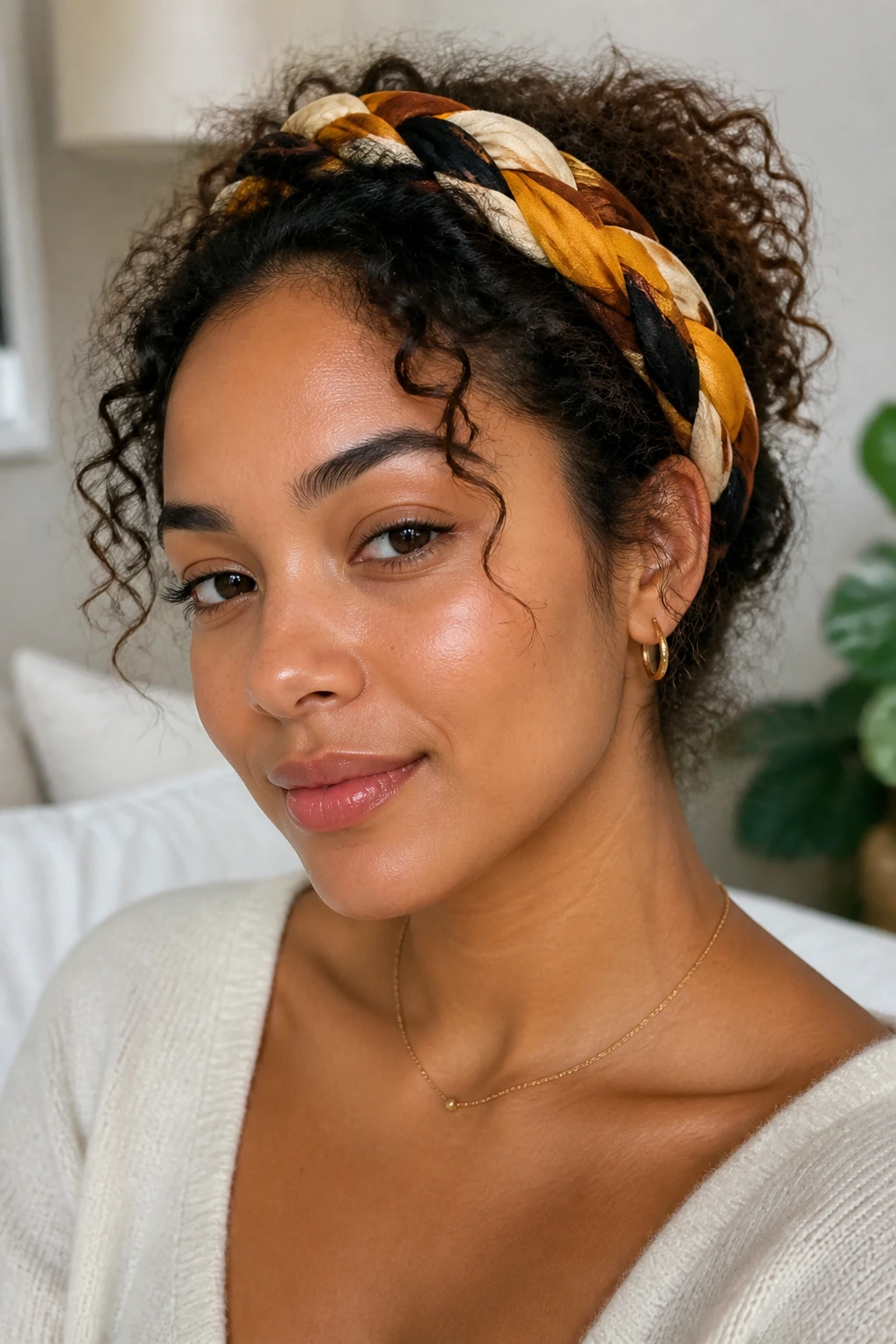
A scarf can fake braid texture in a way that is almost unfair. You get the look of a woven crown without spending twenty minutes fighting with tiny sections.
The trick is to use the scarf like one of the strands. Fold it into a long strip, start near one temple, and wrap it across the top of the head toward the other side. If you have enough length, tuck the ends under the curls at the back. The visual effect is crown-like, but softer than a tight braid.
This style is a good pick when the hairline needs rest. Instead of pulling hair back hard, the scarf does the heavy lifting. That makes it friendlier for sensitive edges and for curls that frizz fast around the crown.
- Use a long scarf, not a short square
- Keep the wrap even so the crown does not tilt
- Pin at the nape if your hair is slippery
- Leave the rest of the curls loose for contrast
I like this one when I want the front to look neat but not stiff. It has a little old-school energy without feeling costume-like.
9. The Low Bun Wrapped Like a Ribbon
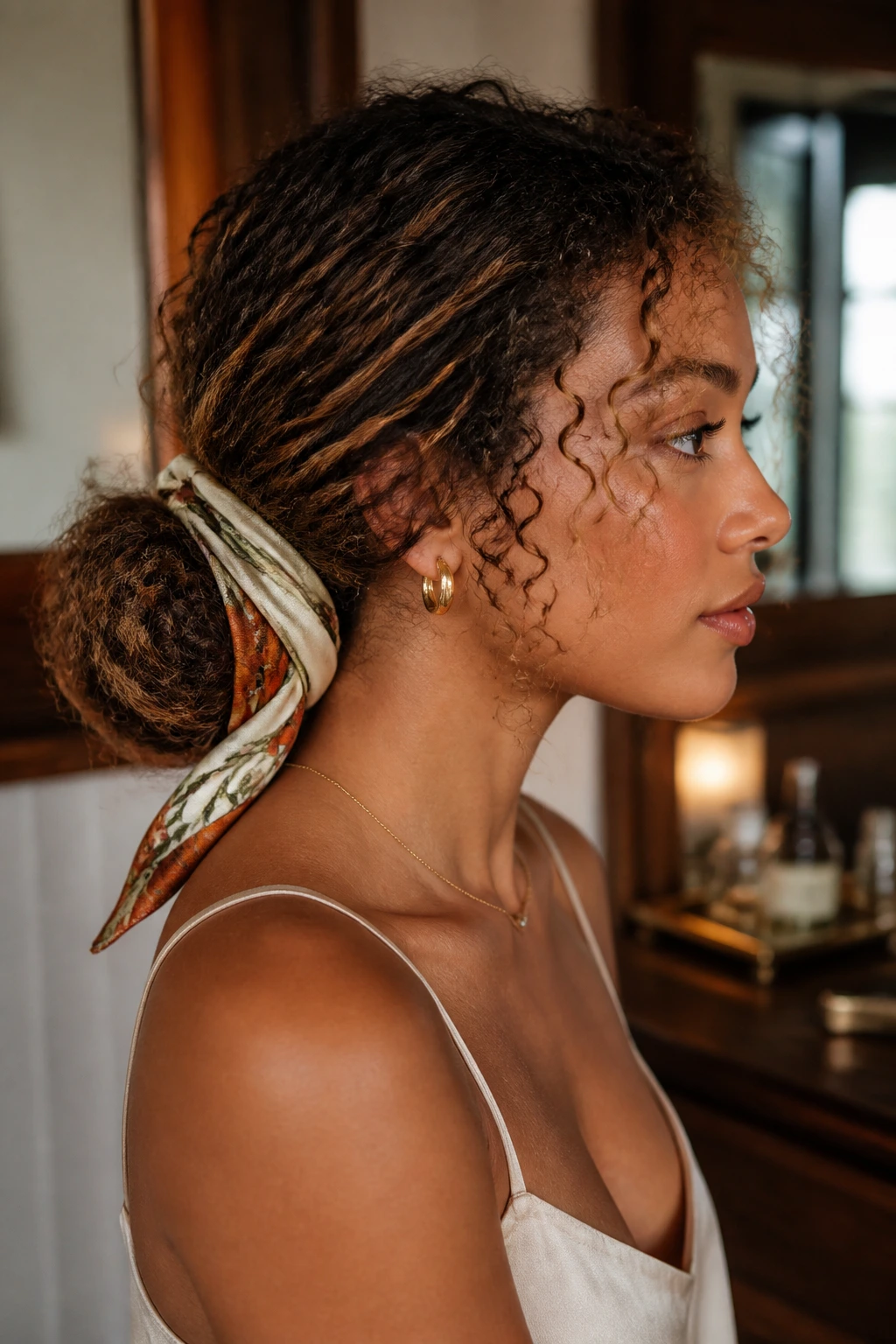
A low bun with a scarf wrapped around it has a clean, almost glossy look to it. The scarf behaves like a ribbon, but the bun keeps it from feeling precious.
Start with a low bun at the nape, then wind the scarf around the bun and tie it off underneath or off to one side. If your hair is thick, leave a few curls poking out on purpose. A bun that is too perfect can look harsh on curly hair. A couple of loose pieces make it feel softer and more natural.
Best Scarf Fabric
Silk works if you want the bun to look smooth and neat. Jersey works if you want the scarf to hold better and stay in place longer. Cotton can work too, but it tends to feel bulkier and less fluid around a bun.
This look is one of my favorites for dressier days because it keeps the neck open. It also lets earrings do some work, which is handy if you like a clean line up top and a little shine near the face. Not every scarf hairstyle needs to be loud. This one knows when to stay quiet.
10. The Vintage Front Tie
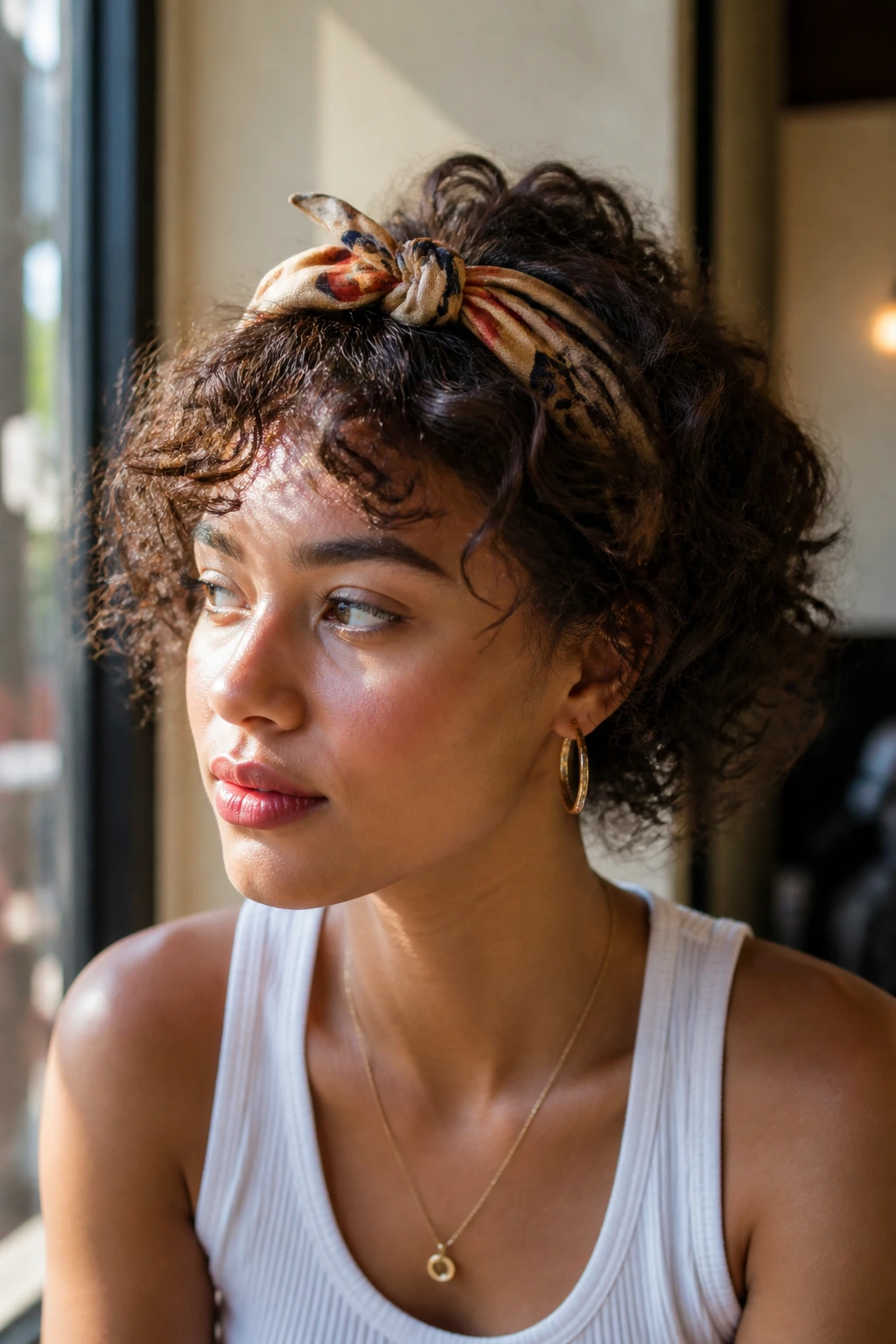
A front tie can go wrong fast if the knot is huge or the fabric is stiff. Keep it soft, and it turns into a sharp little style with real personality.
Fold the scarf into a triangle, bring the point toward the back, and knot the ends at the top or slightly off-center. Let the curls fall around it. The point of the triangle gives the look shape, while the knot keeps it from drifting into beach-vacation territory unless that is the mood you want.
The style works best when the knot is small and the scarf is not overly thick. A bulky knot can swallow the forehead and make the face look crowded. A slim one sits neatly and leaves the curls visible.
I like this look with strong lip color or a plain top. It makes the scarf feel like part of the outfit rather than an afterthought. And if your hair has a stubborn front section that never wants to cooperate, this is an easy way to stop arguing with it.
11. The Flat-Twist Updo with a Loose Scarf
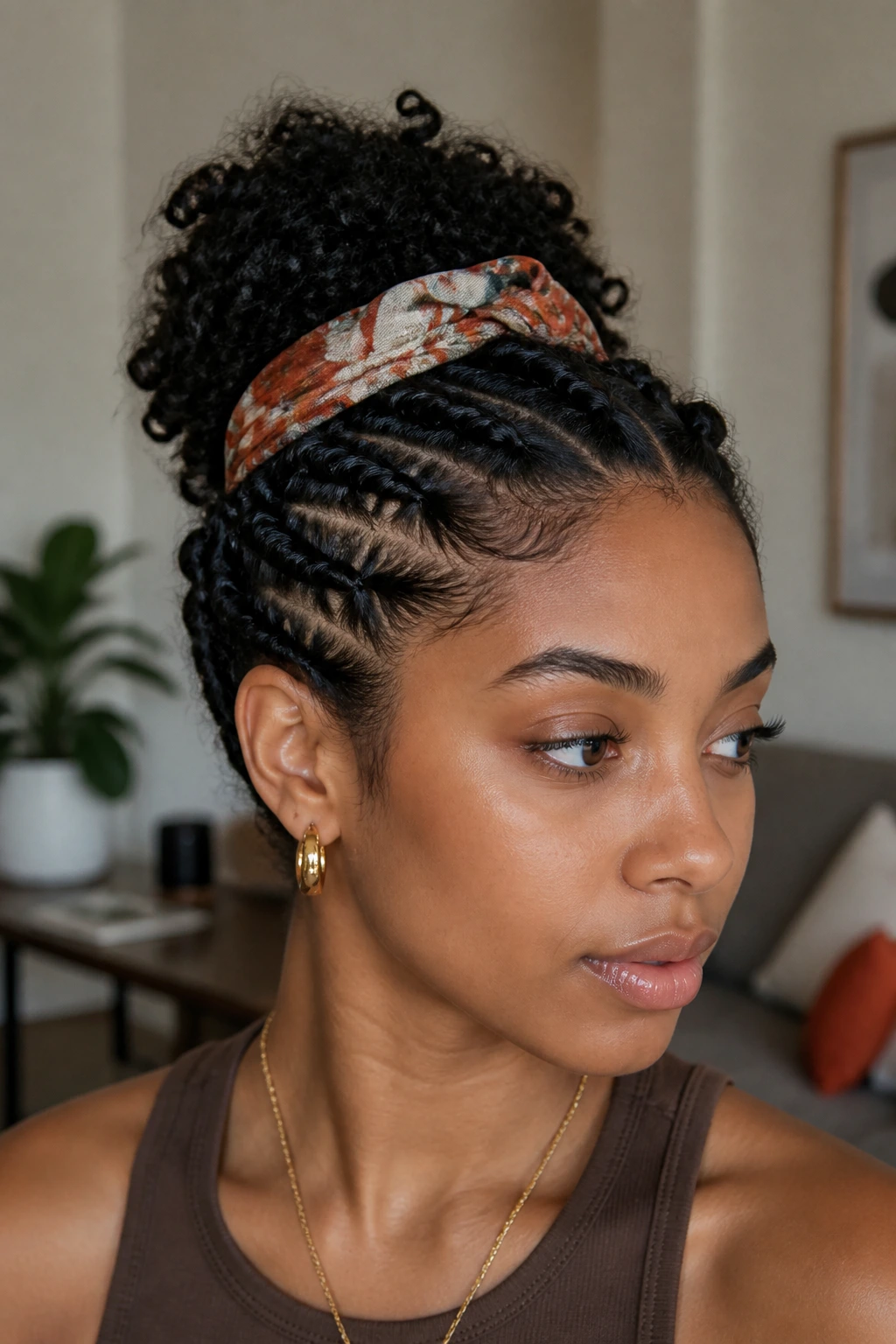
Flat twists do the hard part here. The scarf just finishes the picture.
Start with two or more flat twists along the sides or back, then pin them into an updo. Once the shape is secure, add a scarf as an accent around the base or across the crown. You do not need a lot of fabric. In fact, too much will hide the twists, which defeats the point.
Why Flat Twists Help
Flat twists keep the style close to the head, so the scarf has a neat place to sit. They also give the curls a cleaner texture around the edges, which helps the whole look stay polished for longer. If your hair tends to puff up fast, this is a smart route.
How to Keep It Comfortable
Do not pull the twists too tight at the scalp. That is the mistake people make, and it ruins the style by lunch. Keep the tension firm but not harsh. The scarf should be snug enough to stay put, then loose enough that you can move your brows without feeling the wrap.
This one feels a little more dressed up than the casual scarf looks, but not stuffy. It has structure without losing curl shape.
12. The Side-Swept Scarf and Defined Part
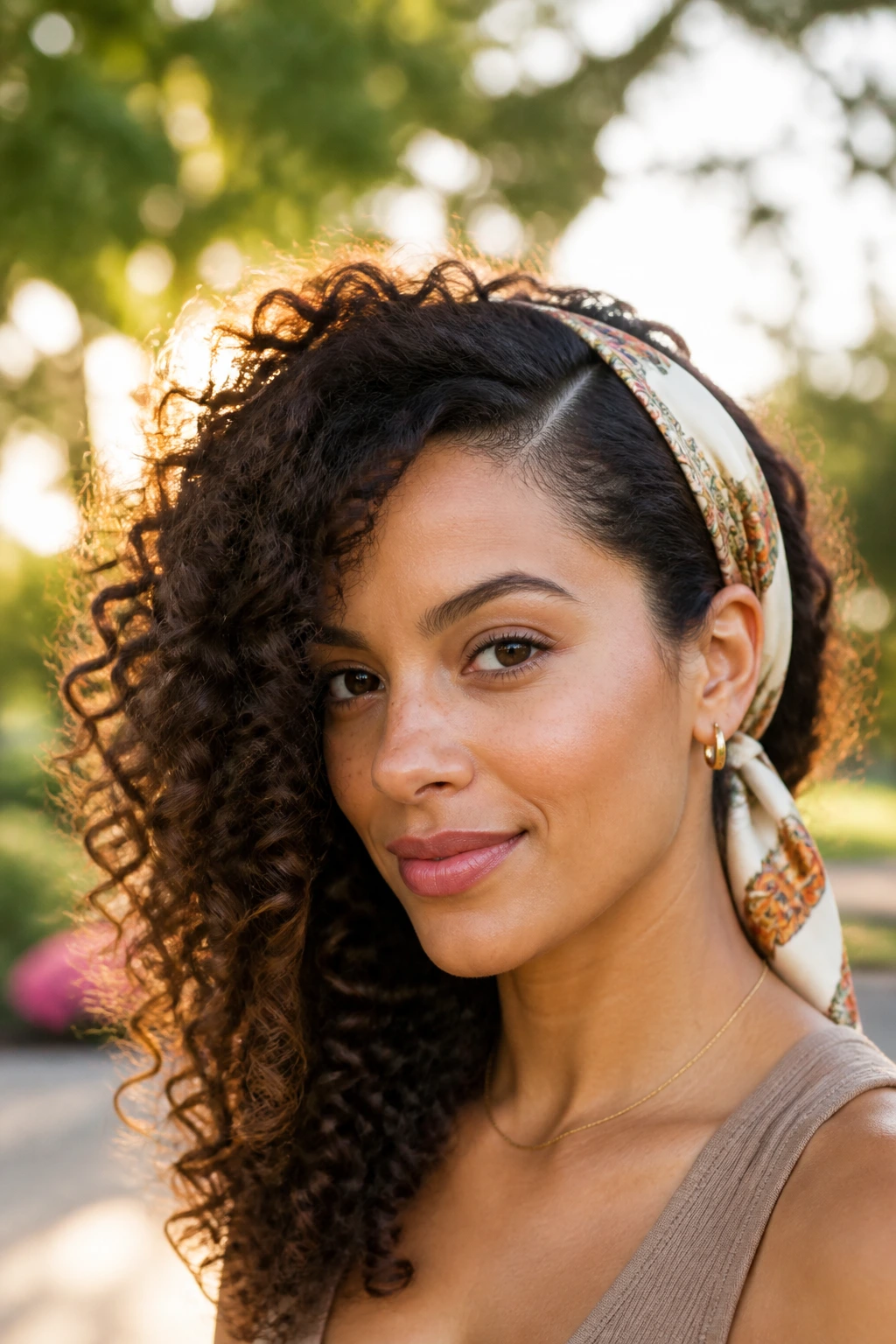
Want one side soft and the other side controlled? This is the answer.
Make a deep side part, let the curls fall to one side, and place the scarf so it frames the part instead of covering it. Tie it behind the ear or low at the nape, then let the heavier side of the curls do the visual work. The result feels asymmetrical in a good way. It has motion.
How to Balance the Sides
- Keep the scarf flatter on the side with less hair
- Let the fuller side stay loose and textured
- Use a scarf that contrasts with your hair color so the part line shows
- Pin behind one ear if the scarf keeps slipping forward
This style works well for curls that are longer on one side or for layers that need a little direction. It also helps when your roots are flat on one side and fuller on the other. Instead of fighting the difference, you use it.
The side sweep is a quiet style, but it has edge. That is why I like it.
13. The Space Buns with a Center Knot
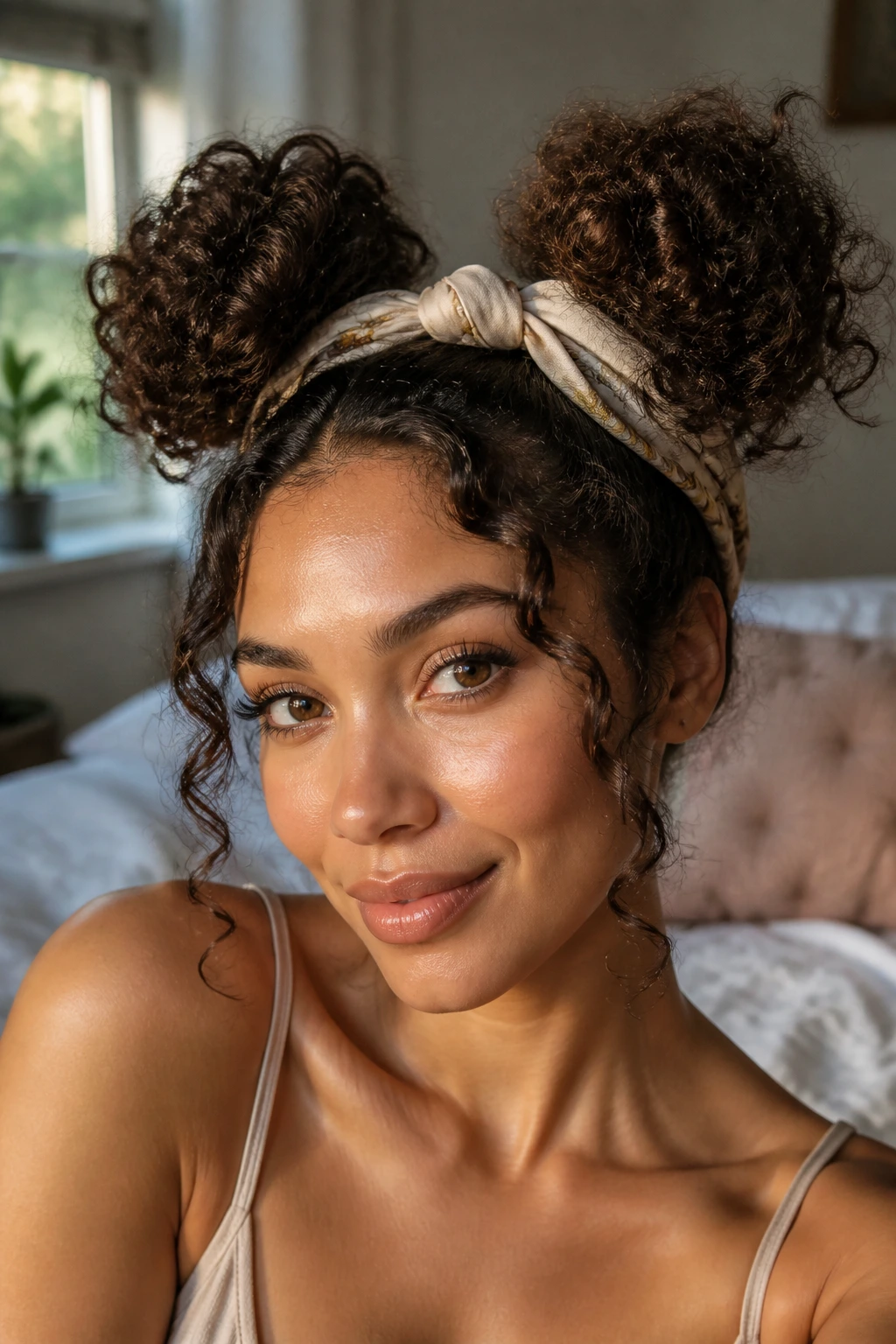
Space buns sound playful because they are. That does not mean they have to look childish.
Split the hair down the middle, make two high buns, and wrap a scarf around the center part where the buns meet or knot it at the back of the crown. The scarf gives the style a focal point so it reads as deliberate, not random. If your curls are thick, keep the buns a little smaller and let the texture do the rest.
This is a good choice when your hair is having one of those days where everything wants to go in different directions. The buns corral the hair. The scarf adds shape. The center knot keeps the middle from looking empty.
A few things matter here:
- Use pins if the buns are heavy
- Keep the scarf narrow enough to avoid bulk at the crown
- Let a few front pieces fall loose if you want a softer line
- Try a print that has movement, not just tiny dots
This one is fun. It can also be practical, which is a nice surprise.
14. The Twist-Out Frame
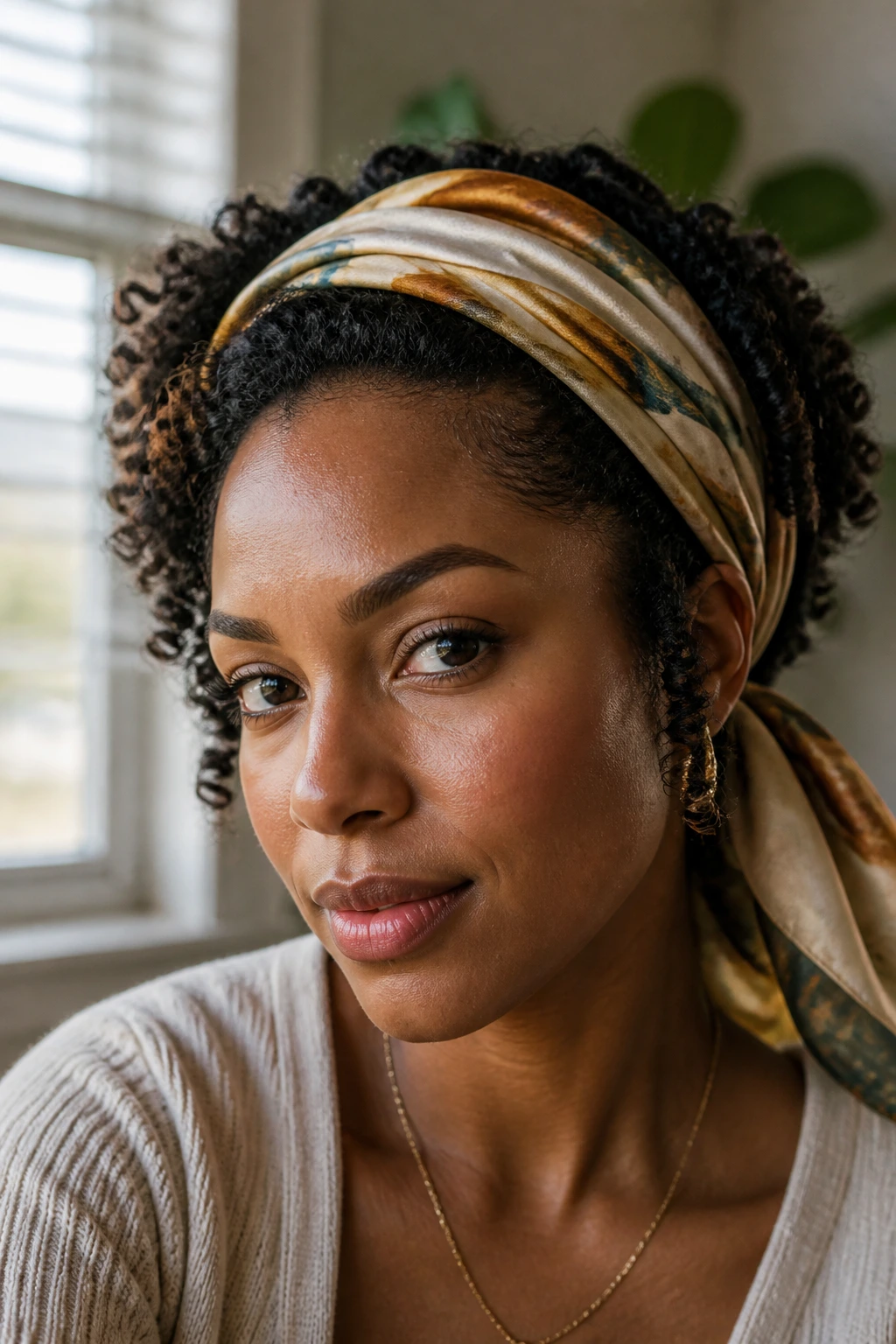
A twist-out already gives you texture, so the scarf should frame it, not bury it. That is the whole point.
Pull a scarf across the hairline or around the crown and let the twist-out spill around it. The texture stays front and center. The scarf keeps the front from turning fuzzy, which is usually the first place a twist-out starts to lose its shape. If you want a style that looks full but not chaotic, this is a good place to start.
The Finish That Matters
The scarf should sit like a border. Not a wall. You still want to see the pattern of the twists, especially around the temples and crown. A silky fabric helps here because it slides over the hair instead of roughing it up while you move through your day.
I prefer this look when the curls have been stretched a little and the roots have some lift. If the hair is too fresh and too soft, the scarf can flatten the front. If the hair is too dry, it can exaggerate frizz. That middle zone is where it shines.
This is one of those scarf hairstyles for curly hair that rewards a little patience. Not much. Just enough.
15. The Sleep-to-Street Satin Wrap
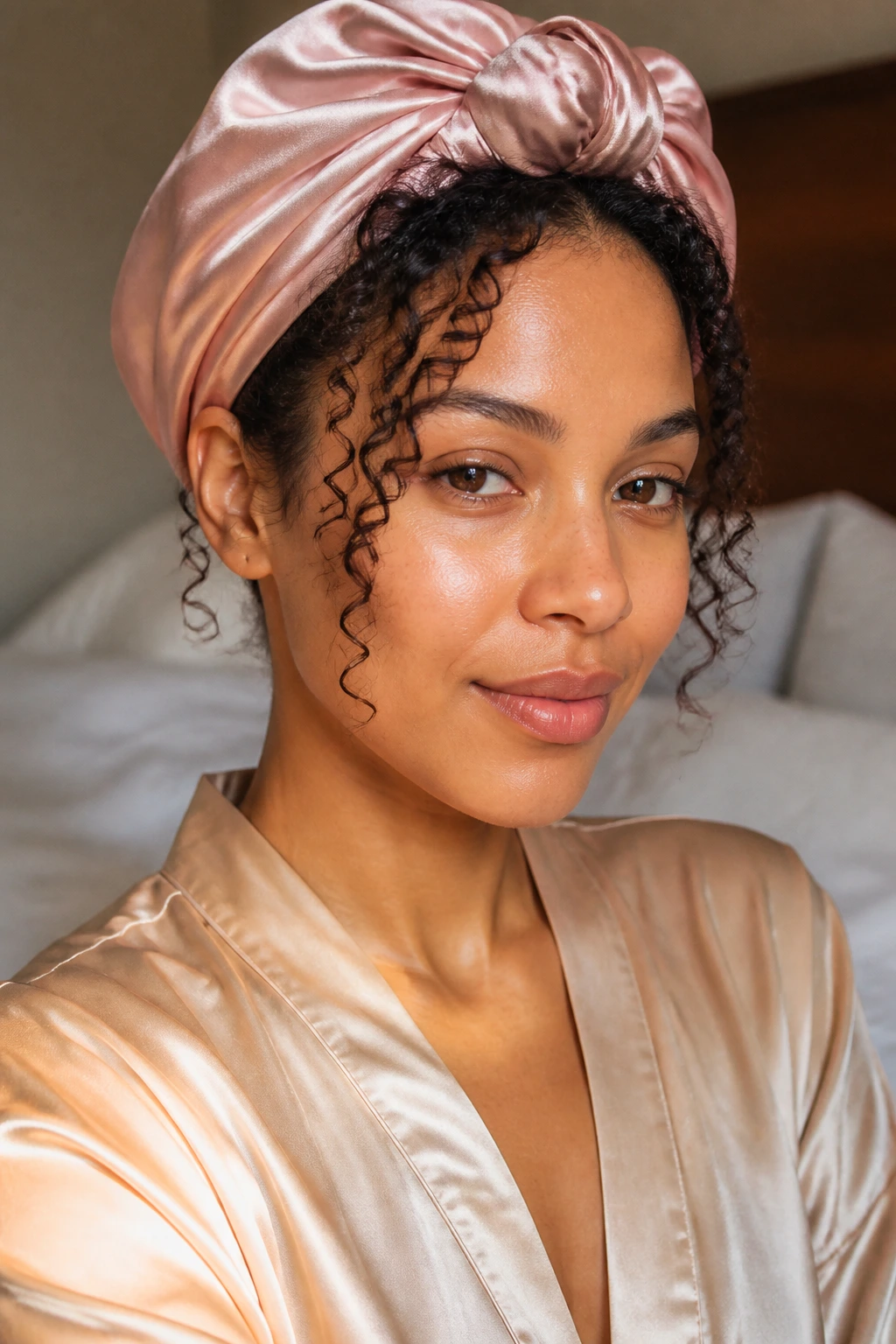
Some scarf styles are about being seen. This one is about making your hair work for you from night to morning, then looking good enough to leave the house without a reset.
Use a satin or silk scarf to wrap the curls in a soft, loose shape before bed, then keep part of the wrap in place the next day. If the scarf was tied neatly enough, it can stay on as part of the outfit. If not, shift it into a low wrap or a soft band and let the curls frame the face. The point is to protect the pattern first, style second.
Make It Look Intentional
- Keep the fold smooth so it does not bunch at one ear
- Choose a scarf with enough length to tuck cleanly
- Leave a few curls exposed at the front for shape
- Avoid tying over the highest part of the crown if you want volume in the morning
This is my favorite kind of scarf hairstyle because it does not pretend hair should be perfect at all times. It solves a problem and still looks good. That is rare.
If your curls need less friction, less fuss, and a little more shape, start here. Then work your way outward into the louder styles when you feel like it.
