



A professional hairstyle sets the tone for how you show up at work. Whether you’re heading to the office, attending back-to-back meetings, or presenting to clients, your hair deserves a style that looks polished, stays in place, and keeps you feeling confident throughout the day. Ponytails are the go-to solution for working professionals — they’re versatile enough to suit any dress code, practical enough to survive a busy schedule, and endlessly customizable to match your personal style and the image you want to project.
The beauty of a work-appropriate ponytail is that it goes far beyond the basic elastic-pulled-back look you might throw together on a lazy weekend. There are styles that read ultra-professional and formal, options that feel modern and creative, and techniques that add polish and refinement without requiring a trip to the salon or hours of styling time. The right ponytail communicates that you’re put-together, intentional, and professional — qualities that matter in how others perceive your competence and professionalism.
What separates a truly polished work ponytail from an ordinary one isn’t magic — it’s technique, strategic placement, and knowing which style suits both your hair texture and your workplace culture. Some styles work best for formal office environments, while others feel equally at home in creative industries, tech companies, or hybrid work settings. The key is understanding how to execute each style cleanly, what products and tools make the difference, and how to adapt any ponytail to last through your entire workday without falling flat or coming loose.
Let’s walk through fifteen ponytail styles specifically designed for work, each one detailed enough that you can recreate it confidently and understand exactly why it reads as professional and polished.
1. Classic High Ponytail
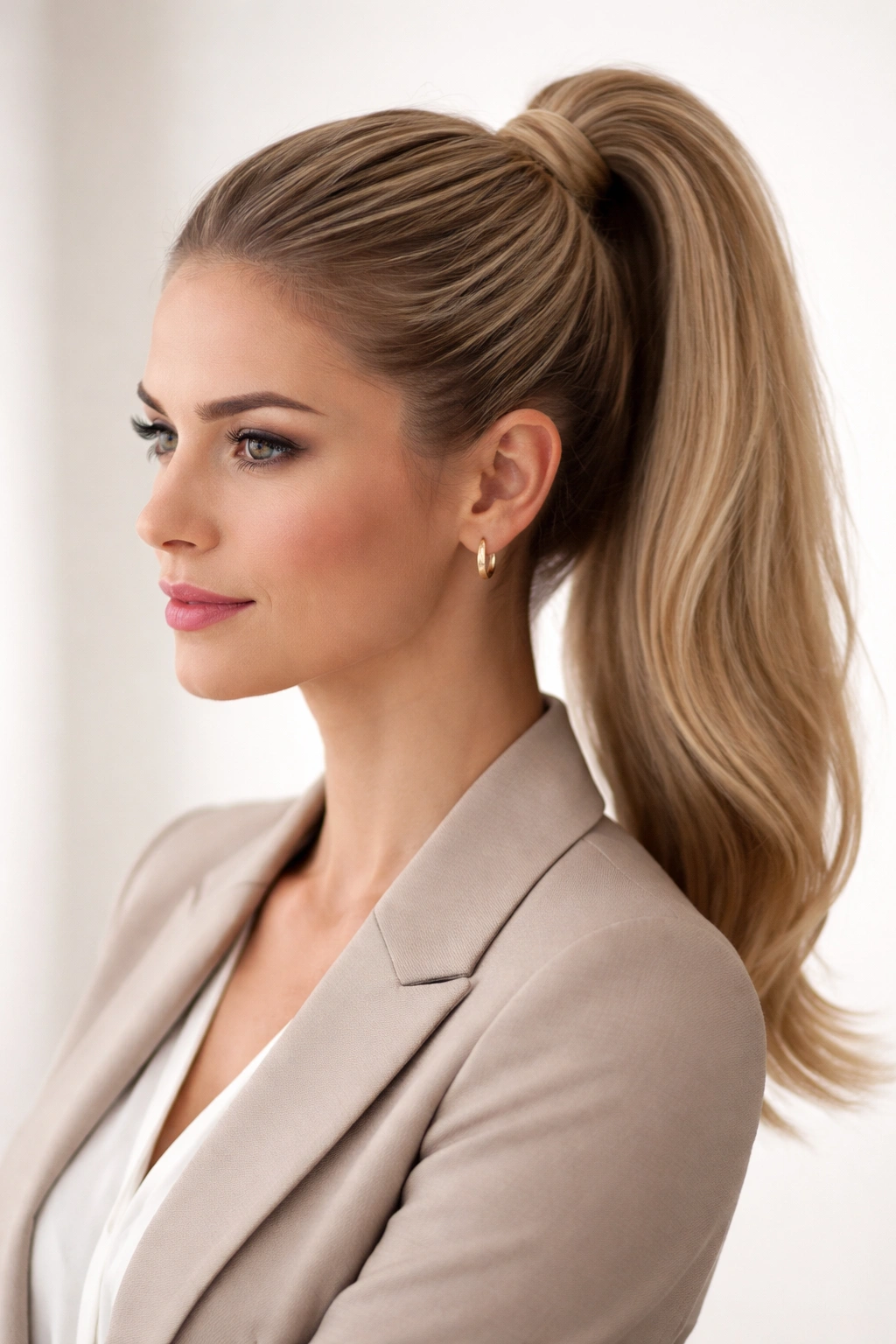
The classic high ponytail is the foundation of workplace styling — it’s professional, no-nonsense, and works in virtually any office environment. Position this ponytail at the crown of your head, roughly where your natural hairline meets the back curve of your skull. The key to making this style feel refined rather than severe is creating subtle texture and ensuring the ponytail sits neatly without pulling too harshly at your hairline.
Why It Works in Professional Settings
A high ponytail immediately frames your face and keeps hair completely off your shoulders and neck, which creates visual clarity and makes you appear focused and ready for action. This placement is flattering on most face shapes because it elongates the face slightly and draws attention to your eyes and features. The high positioning also signals confidence — it’s not a timid, pulled-back style but a deliberate choice that says you’re in control. It photographs well during video calls and doesn’t cast shadows across your face during presentations.
How to Style It Perfectly
- Use a paddle brush to smooth hair back from your face, working from your forehead toward the crown
- Create a small section at the crown and hold it while brushing the rest of your hair back — this prevents the ponytail from sitting too high and looking costume-like
- Secure with a strong elastic that matches your hair color; use a second elastic looped around once to anchor it firmly
- Take a small section from the ponytail and wrap it around the elastic base to conceal the fastener and add polish
- Pin the wrap in place underneath with a bobby pin in a matching shade
- Smooth flyaways with a fine-tooth comb and a dab of lightweight styling cream
Pro tip: If you have thin hair or your ponytail looks sparse, tease gently at the crown before securing to create fuller-looking volume without that obvious pulled-back feeling.
2. Sleek Low Ponytail
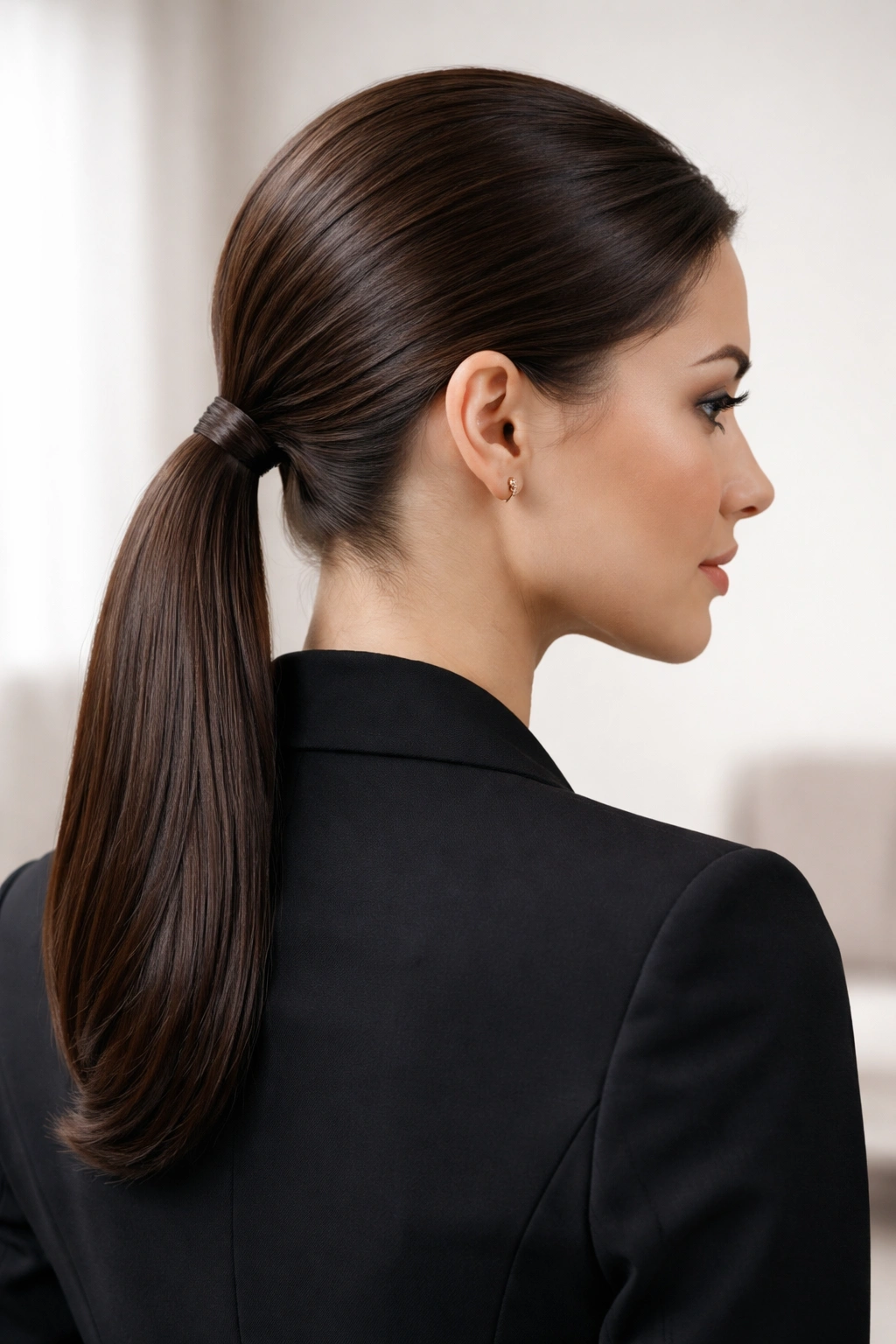
The sleek low ponytail communicates elegance and restraint — it’s the ponytail of choice for formal offices, client-facing roles, and any environment where understated polish matters. Positioned at the nape of your neck, roughly where your collar would sit, this style feels sophisticated without looking dated. The sleekness is what transforms it from casual to professional; every hair should be smoothly in place with no texture or flyaways visible.
Why It Projects Professional Authority
A low ponytail is inherently more formal than its high counterpart because the lower placement creates a longer, more streamlined silhouette. It’s the style you see on news anchors, corporate executives, and anyone who needs to project calm competence. Because the ponytail sits lower, it doesn’t compete with your face — instead, it frames your neck and shoulders, creating an elegant line. This positioning also feels secure and stable, which translates psychologically as someone who has things under control. It’s especially effective in conservative industries like finance, law, or healthcare.
The Technique for True Sleekness
- Start with slightly damp hair that you’ve applied a smoothing serum to — this reduces frizz and creates the polished finish that defines this style
- Use a fine-tooth comb to smooth every section back toward the nape of your neck
- Keep the ponytail low enough that it sits an inch or two above your collar, not right at your hairline
- Use a firm elastic to secure it; a metal elastic tends to hold longer than regular fabric bands
- Wrap a thin section around the base and secure it invisibly with bobby pins
- Apply a light hairspray to tame any frizz, but not so much that your hair looks stiff or plastic
Worth knowing: The sleeker your hair appears, the more intentional and polished you look. Even if you have naturally textured hair, using a smoothing product and taking time to brush through makes an enormous difference in how this style reads.
3. Braided Wrap Ponytail
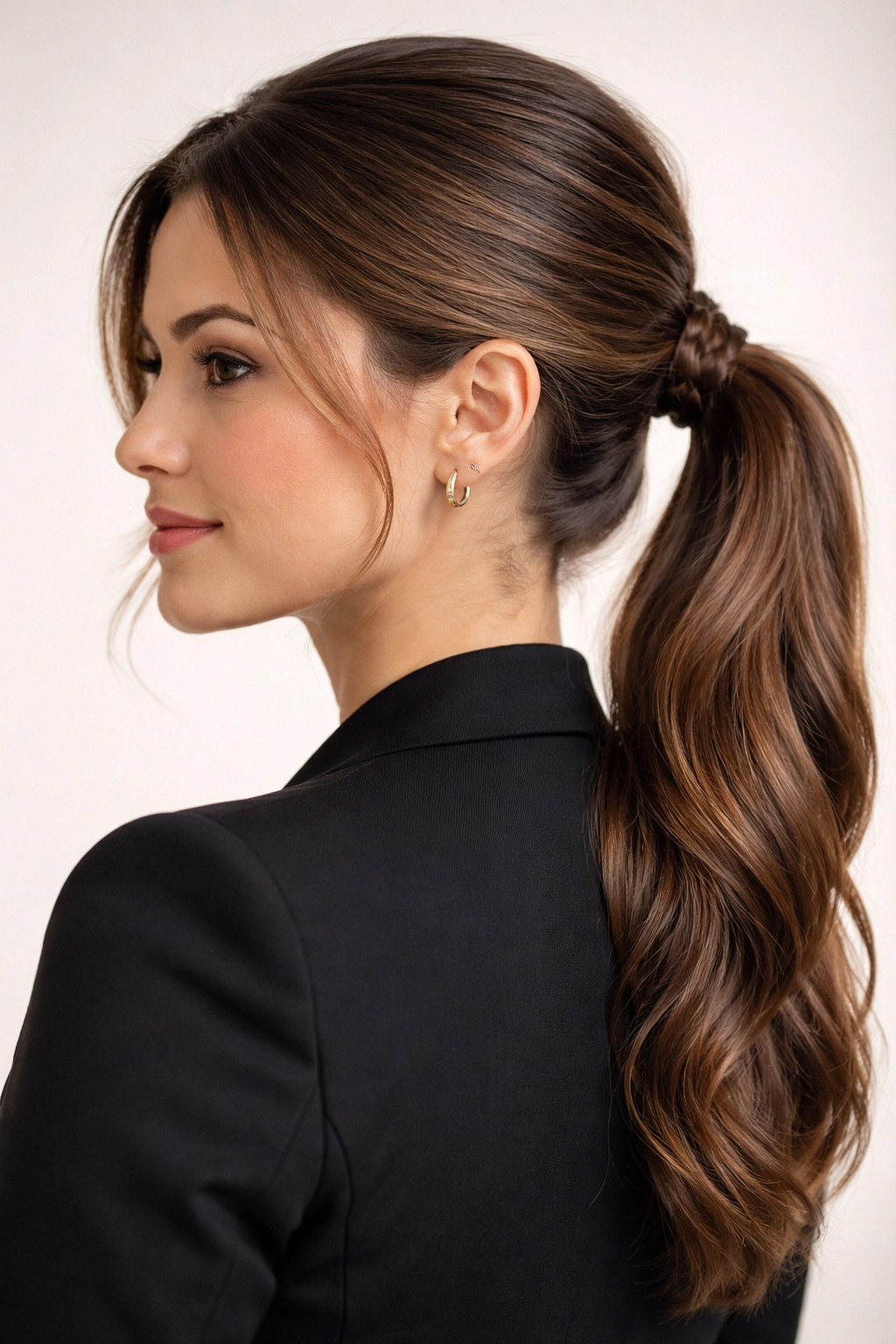
The braided wrap ponytail adds visual interest and texture while maintaining complete professionalism. It’s a style that signals attention to detail — you’ve clearly put thought into your appearance without looking like you’ve spent hours getting ready. A simple three-strand braid wrapped around the base of a low to mid-level ponytail is the sweet spot between polished and creative.
What Makes It Stand Out
This style is particularly effective in creative industries, client-facing roles where personality matters, and any workplace that appreciates effort without requiring strict formality. The braid adds dimension and visual interest that a plain ponytail lacks, but it never looks unprofessional because the braid itself is neatly executed and contained. What makes this style work is that the braid is functional — it’s actually holding the ponytail together — rather than purely decorative. That functionality is key to keeping it professional rather than trendy.
Steps to Create the Braided Wrap
- Gather your hair into a low to mid-height ponytail and secure it with an elastic
- Take a thin section of hair from the ponytail’s edge (about the thickness of your pinky finger)
- Divide this section into three strands and begin a simple three-strand braid
- Braid tightly enough that it holds its shape but not so tight that it looks strained or pulls on the hair
- Wrap the finished braid around the base of the ponytail, covering the elastic completely
- Secure the end of the braid underneath with a bobby pin in a matching hair color
- Smooth any stray hairs and set with a light hairspray
Quick facts:
- This style works beautifully on textured hair that resists frizz
- The braid looks intentional even if a few flyaways escape
- You can prep the braid the night before and tighten it the morning of
- This style typically lasts 10-12 hours without loosening
4. Half-Up Ponytail
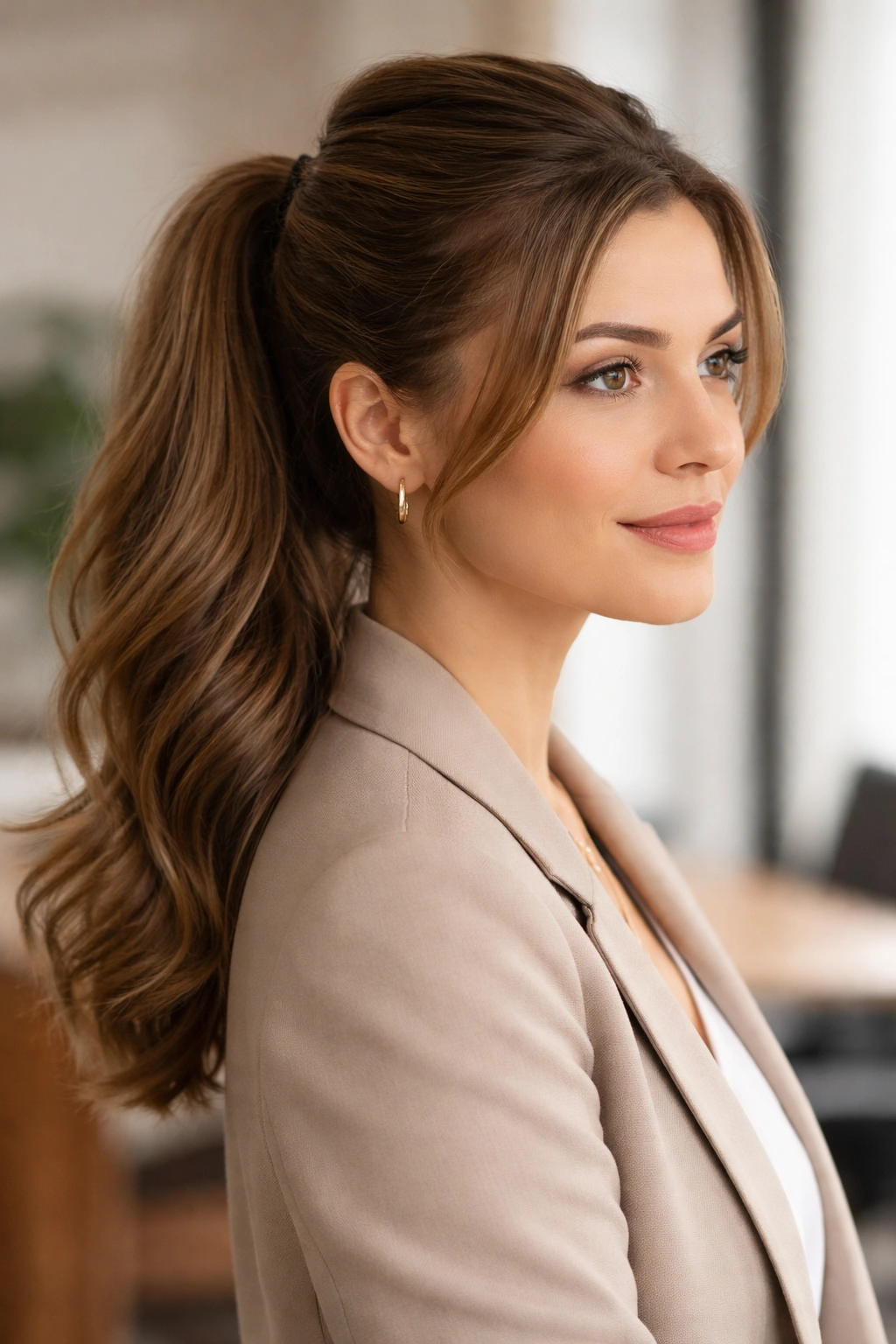
The half-up ponytail is the perfect style when you want to show texture and movement while still keeping hair off your face and neck. This style captures roughly the top half of your hair in a ponytail while allowing the bottom half to flow freely. It’s far more interesting visually than a simple ponytail, yet it reads as completely professional because the front sections are cleanly pulled back.
Why Professional Environments Embrace This Style
The half-up ponytail flatters most face shapes because it frames the face while still showing your hair’s natural texture and length. It’s less severe than a full ponytail, so it works well in creative industries, younger-skewing companies, and any environment where showing personality matters. The style also has the practical advantage of keeping hair off your shoulders and neck, which is important in professional settings where you might be sitting at a desk or standing for presentations. It’s formal enough for client meetings yet relaxed enough for internal team days.
How to Construct It Cleanly
- Brush your hair smooth and create a clean center or side part, depending on your preference
- Starting at one temple, take a section of hair from one side of your head
- Cross this section toward the back of your head, gathering more hair as you go, creating a smooth, curved line
- Repeat on the other side, so you have two sections meeting at the back of your head
- Secure both sections together with an elastic at the crown or slightly behind it
- If desired, take a thin piece of hair from the ponytail and wrap it around the elastic to hide the fastener
- Use a paddle brush to smooth any bumps and set with hairspray
Pro tip: If you have baby hairs around your hairline, smooth them with a tiny bit of gel or edge control before starting — this prevents the wispy, unstyled appearance that contradicts the polished feel of the half-up style.
5. Bubble Ponytail
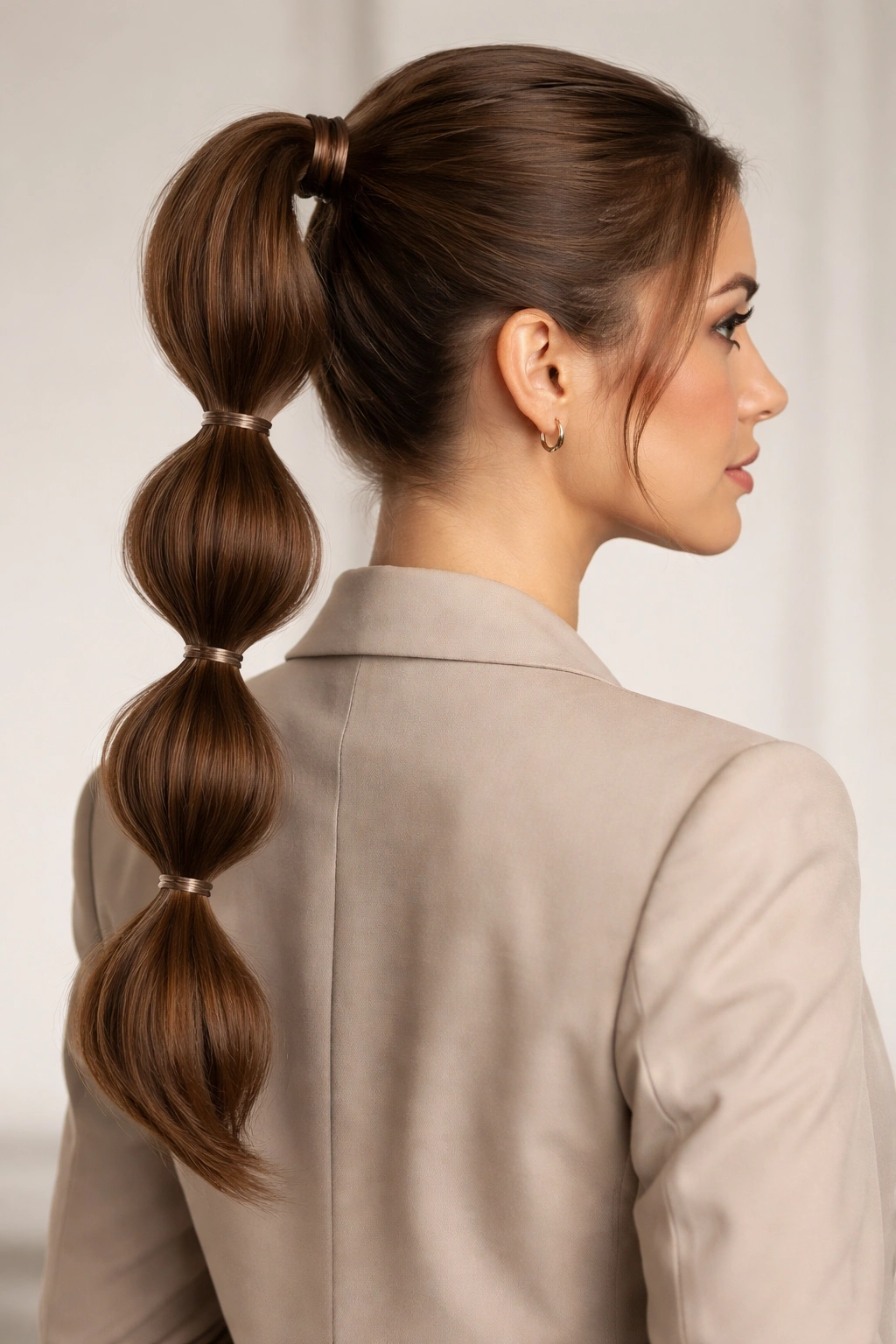
The bubble ponytail is a textured, playful variation that’s become increasingly popular in modern offices, especially in tech and creative industries. This style uses multiple elastics positioned along the length of a ponytail to create “bubbles” of fuller hair between each band. It’s modern and visually striking while remaining professional because the structure is clean and intentional.
What Makes This Style Work at Work
The bubble ponytail reads as creative and current without crossing into casual or unprofessional territory. It works particularly well if your hair has volume or texture because the bubbles showcase movement and dimension. The style is also incredibly practical — the multiple elastics distribute tension across your hair, reducing breakage and the stress on individual strands that a single tight elastic creates. The visual interest of the bubbles also means that if one section gets slightly loose during your day, it doesn’t immediately look messy; the style has enough texture built in that minor imperfections don’t register.
The Step-by-Step for Perfect Bubbles
- Begin with a high or mid-height ponytail secured with a sturdy elastic
- Measure about 2-3 inches down from the first elastic and place a second elastic directly under it, gathering the hair in that section
- Gently tease or gently pull the hair between the two elastics outward to create the “bubble” effect
- Repeat this process down the length of your ponytail, spacing the bubbles evenly (usually three to four bubbles per ponytail)
- Be gentle when creating bubbles — you want them voluminous but not so stretched that the style looks distorted
- Smooth any flyaways and set with a flexible hold hairspray
What to know:
- This style holds beautifully throughout a full workday and into evening if needed
- It works on both straight and wavy hair, though wavy hair may not show bubbles as dramatically
- You can create subtle, barely-there bubbles for a conservative office or more exaggerated ones for creative environments
- Preparing this style the night before and refreshing the bubbles the morning of saves precious time
6. Twisted Ponytail
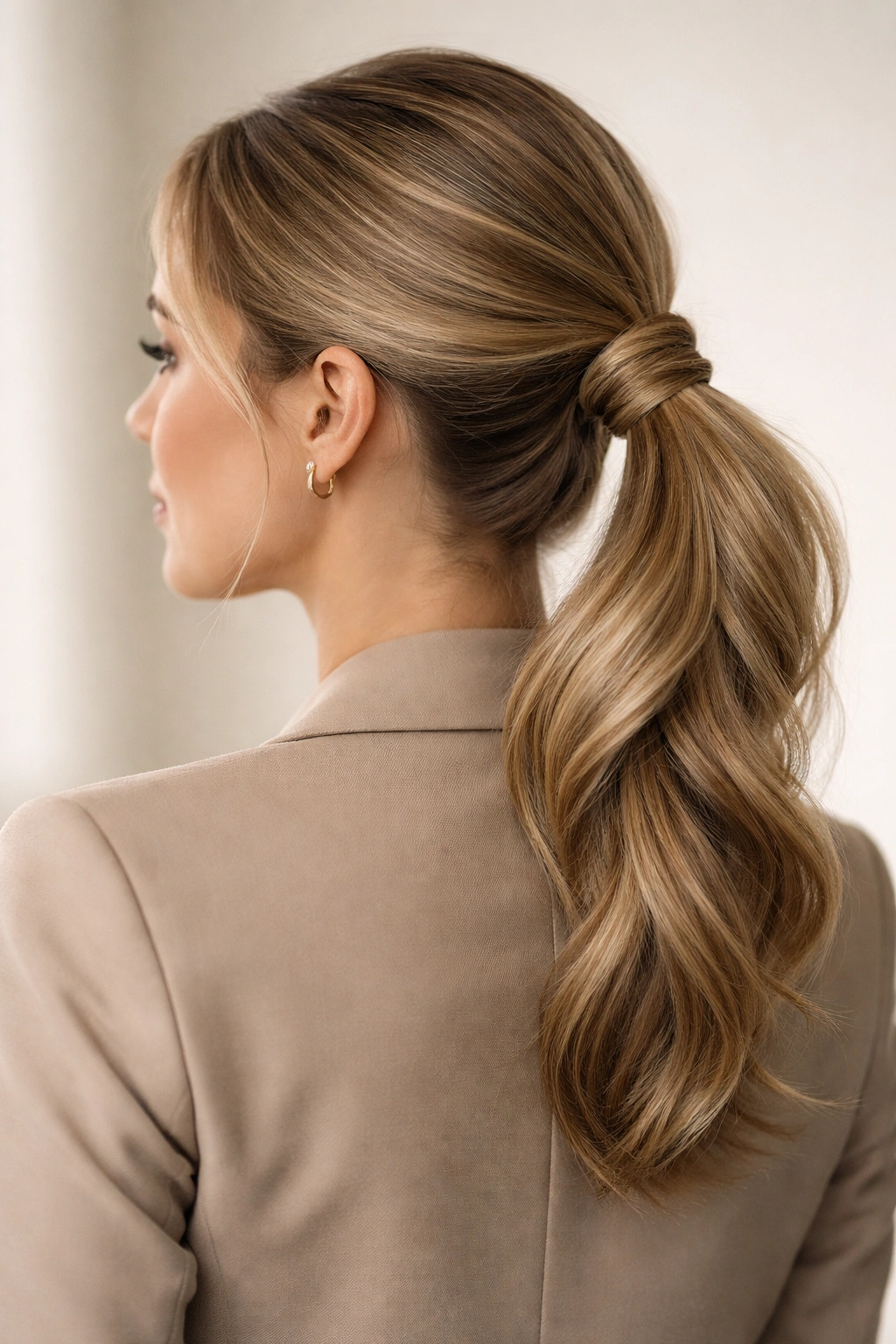
The twisted ponytail creates elegant definition and visual texture by incorporating twists rather than braids. This style is sophisticated and takes only slightly longer than a basic ponytail, making it ideal for mornings when you need something polished without spending thirty minutes on your hair. The twists catch light and create movement that a smooth ponytail lacks.
Why Twists Read as Refined
Twists feel more modern and sleek than braids, which is partly why they’ve become increasingly popular in professional settings. The technique also feels fresher than a plain ponytail because it shows intention and technique without looking costume-like or overly styled. Twists work beautifully on all hair textures and lengths, and they hold up remarkably well throughout a workday because the twisting creates enough grip in the hair that elastics stay secure without needing to be uncomfortably tight.
How to Create the Twist Effect
- Gather your hair into a high, mid-level, or low ponytail depending on your preference and workplace culture
- Divide the ponytail into two equal sections
- Twist one section tightly clockwise, then twist the other section tightly clockwise as well
- Wrap these two twisted sections around each other, maintaining tension to create a rope-like braid
- Secure the end with a small elastic
- Take a thin piece of hair from under the ponytail and wrap it around the base elastic to conceal it
- Pin the wrap and set with a finishing spray
Quick facts:
- This style actually works better if your hair is slightly damp or dampened with a styling spray, as it holds the twist shape more dramatically
- The twist method is faster than braiding once you practice it a few times
- Twists tend to last 8-10 hours before needing a refresh, making them ideal for full workdays
- You can create thicker twists for a bolder look or thin twists for something more delicate
7. Sleek Bun with Face-Framing Sections
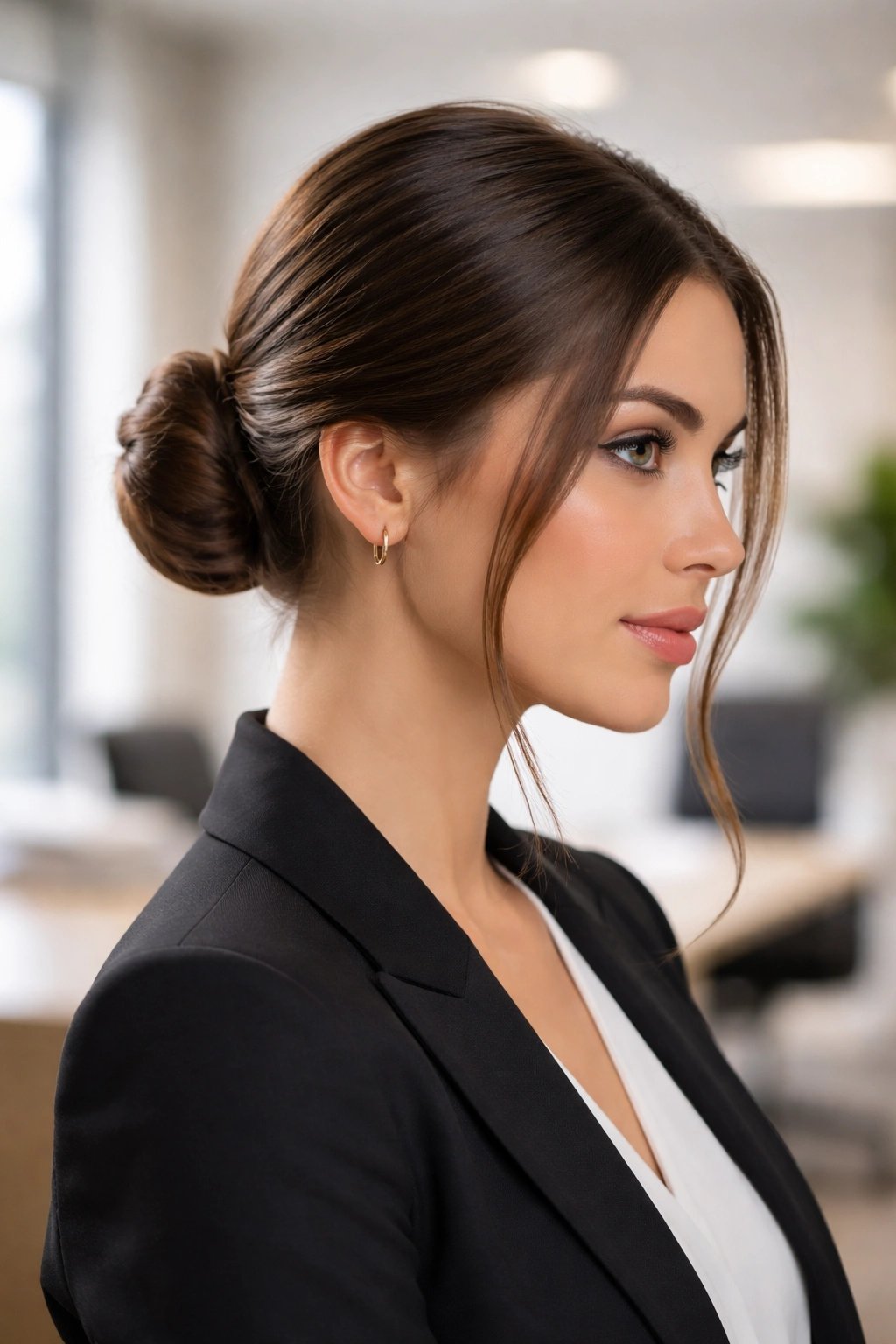
A sleek, low bun is a classic professional style, but adding strategically positioned face-framing sections elevates it from conventional to intentionally polished. These soft pieces of hair frame the face and soften what could otherwise feel severe, making the style appropriate even for very formal or conservative workplaces.
Why This Variation Feels Modern and Professional
Adding face-framing sections to a bun solves a common problem with the style — it can sometimes read as too austere or pulled-back, which is why some people avoid it. The face-framing pieces instantly soften that effect while maintaining the secure, professional quality that makes a bun such a great work style. This variation shows sophistication because you understand how to balance severity with softness. It’s the kind of detail that executives and professionals in client-facing roles appreciate — clearly intentional but not showy.
Creating the Perfect Framed Bun
- Create a very sleek, low ponytail at the nape of your neck using smoothing serum and a fine-tooth comb
- Before tightening the elastic completely, release two thin sections from each side of the ponytail to act as face-framers
- Tighten the ponytail elastic firmly
- Twist the ponytail into a rope and coil it against itself to create a bun shape
- Secure the bun tightly with multiple bobby pins in a matching hair color
- Wrap a thin section of hair around the bun base to cover the elastic and pins
- Curl or wave the face-framing pieces slightly with a small curling iron for softness
- Set everything with a light hairspray
Worth knowing:
- This style is especially effective if you have a longer face shape, as the framing pieces create horizontal lines that balance features
- The face-framing pieces should be thin enough that they don’t overwhelm the bun but substantial enough to be visible
- This style reads as particularly polished and intentional, even though it’s not dramatically complicated
8. High Voluminous Ponytail
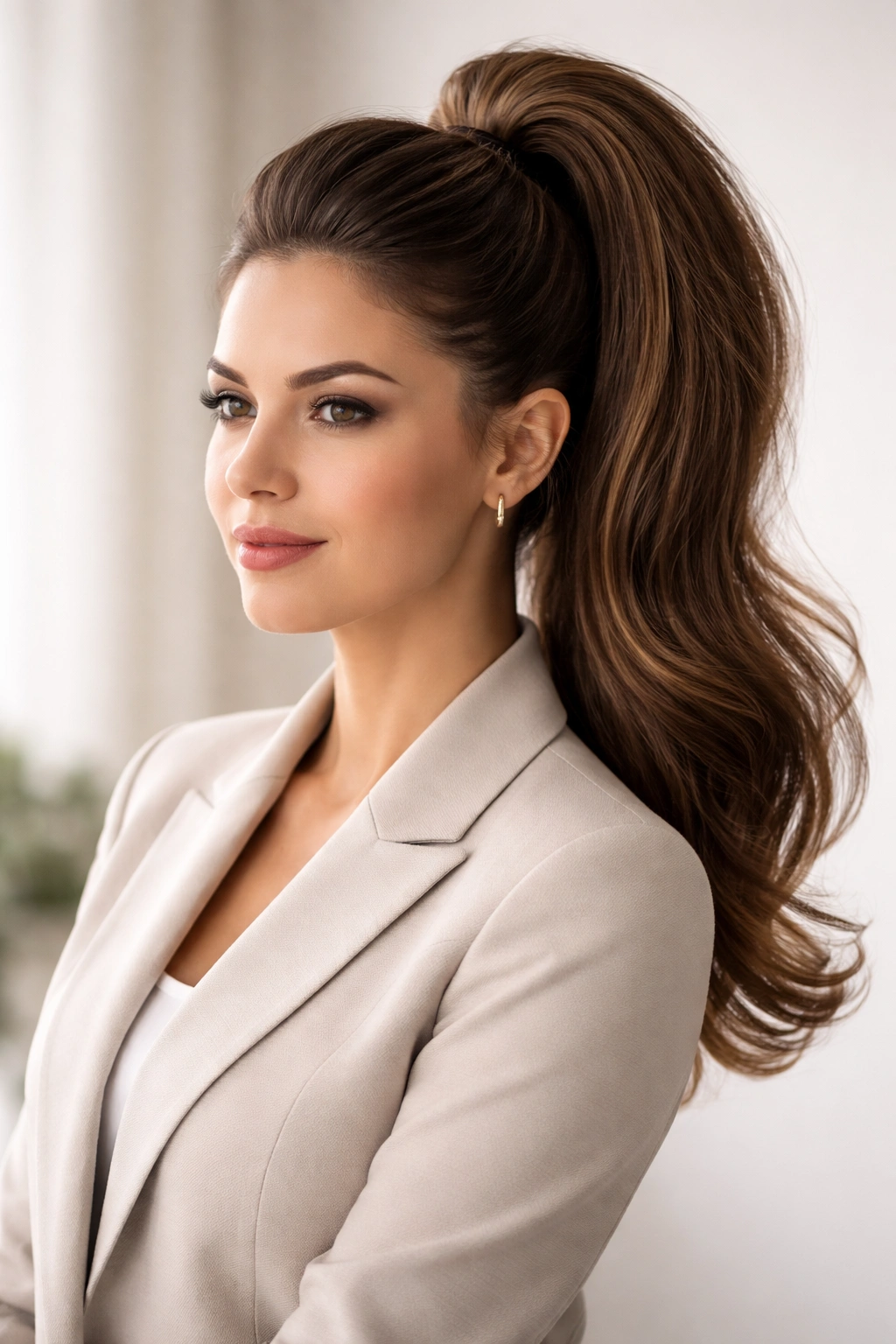
A high voluminous ponytail communicates energy and confidence while remaining completely professional. This style requires a bit more preparation than a simple ponytail, but the result is striking — a full, dimensional ponytail that looks healthy and vibrant. The key to making it work professionally is that the volume is controlled and shaped, not chaotic.
What Makes This Style Stand Out at Work
Volume reads as health and vitality, which translates subconsciously to competence and capability. A voluminous ponytail shows that you’ve put effort into your appearance without looking like you’ve spent two hours on your hair. This style works beautifully in media, entertainment, fashion, or any industry where personality and image matter. It’s also fantastic if you naturally have thick or curly hair, because it celebrates those qualities rather than fighting them.
Techniques for Controlled Volume
- Start with damp hair and apply a volumizing mousse to the roots
- Blow-dry your hair, using a round brush to create lift and fullness throughout
- Tease gently at the crown and throughout the mid-lengths to build additional body
- Use a paddle brush to smooth the outer layer while maintaining the teased texture underneath
- Gather your hair into a high ponytail, pulling it back smoothly from your face while keeping the volume in the crown
- Secure with a strong elastic
- Wrap a thin section around the base to conceal the elastic
- Use a light-hold hairspray to set the style and smooth any flyaways
Quick facts:
- This style requires a blast of cool air from your blow dryer at the end to set the volume
- Adding a volumizing dry shampoo to the roots the night before creates even more lasting volume
- This ponytail typically lasts 8-10 hours before the volume begins to deflate, so it’s ideal for full workdays
- Waving or curling the lengths of the ponytail before securing it creates even more texture and movement
9. Textured Side Ponytail
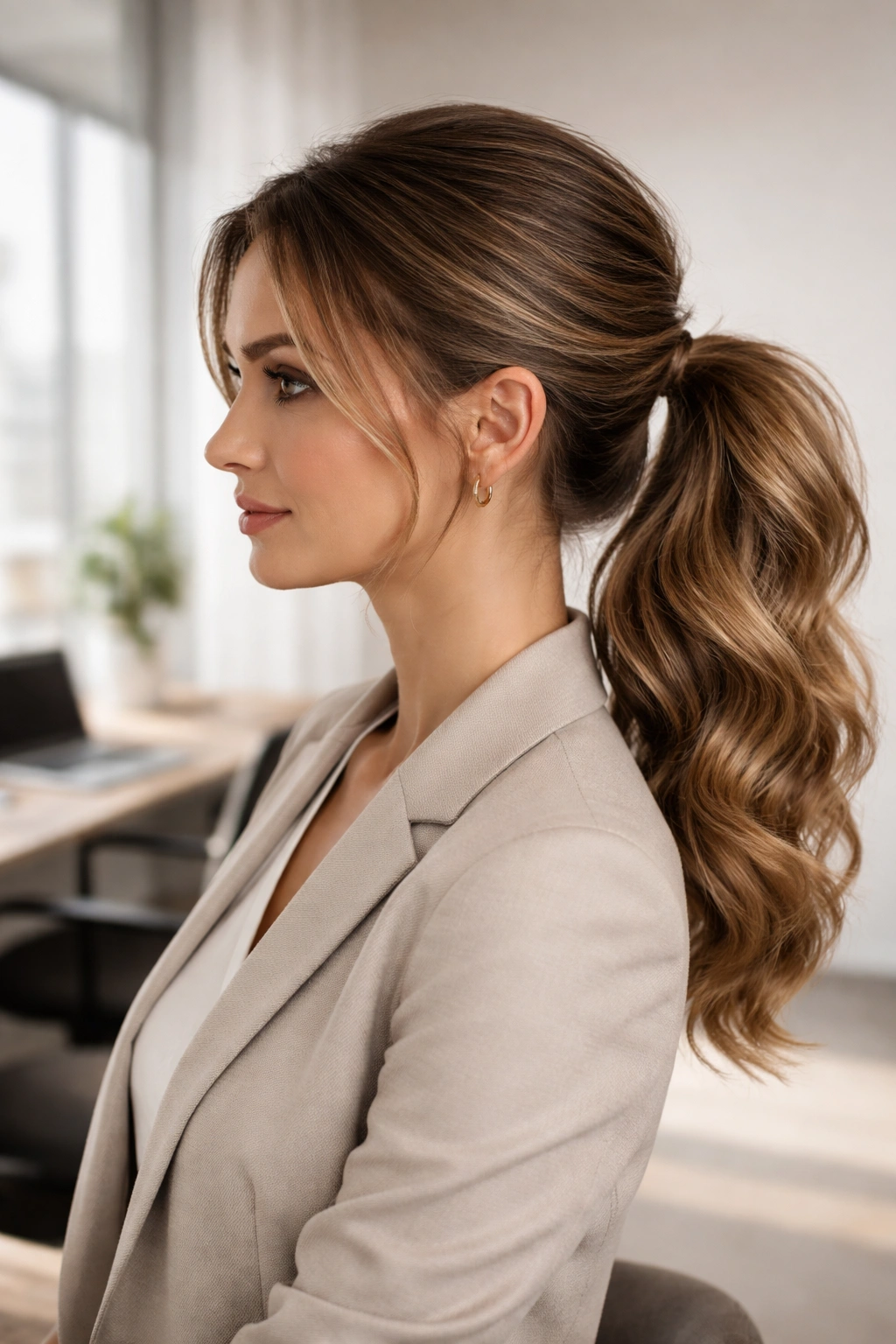
A side ponytail positioned slightly off-center feels modern and approachable while maintaining complete professionalism. When executed with intentional texture, this style feels curated and interesting without being casual. The side positioning makes it flattering on most face shapes and reads as someone who understands style but isn’t overly fussy about their appearance.
Why Side Ponytails Work in Modern Offices
Side ponytails feel less formal than centered styles, which is why they work particularly well in contemporary offices where personality matters. The asymmetrical positioning creates visual interest and movement that centered styles lack. This style is also incredibly practical because it keeps hair off one shoulder completely while the opposite side can have some texture and movement. It’s a balance between polished and relaxed that appeals to many professionals.
How to Perfect the Side Ponytail
- Apply a light texturizing spray or sea salt spray to damp hair to create grip and dimension
- Blow-dry your hair with a round brush, creating waves or waves rather than complete smoothness
- Create a deep side part, pulling one side smoothly back and gathering more hair as you move toward the back of your head
- Position the ponytail at the back of your head, but slightly toward the side you’re pulling from
- Secure with an elastic, making sure the ponytail sits at a slight angle rather than perfectly straight
- Take a thin piece of hair and wrap it around the base
- Spritz with a flexible-hold hairspray to maintain the texture without stiffening the style
Pro tip: This style works better if you prepare it the night before and sleep on it, which allows the waves to set and look less blow-dried and more naturally textured.
10. Polished Fishtail Ponytail
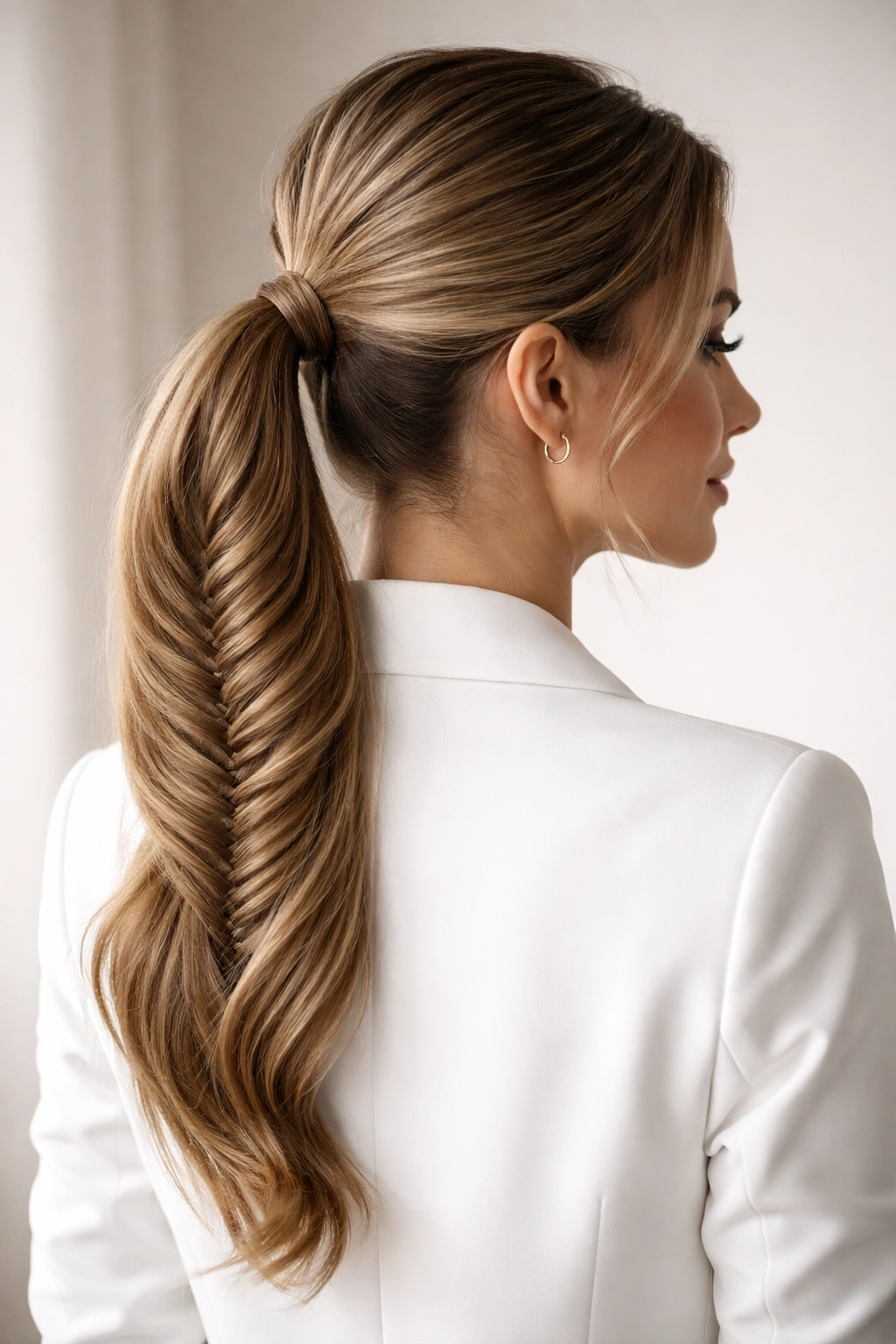
A fishtail braid incorporated into a ponytail is a sophisticated way to add visual interest and texture. The fishtail pattern is more delicate and intricate than a standard three-strand braid, which makes it read as intentionally styled and polished. This style works beautifully in creative industries or any environment where technical skill and attention to detail are valued.
What Makes Fishtail Braids Professional
Fishtail braids have an elegant, almost intricate quality that immediately signals effort and care. The pattern creates visual interest that draws the eye and communicates that you’ve put real thought into your appearance. Unlike trendy braiding techniques that might feel too fashion-forward for some offices, a fishtail braid reads as a technical skill rather than a trend. It’s professional enough for any environment but creative enough to show personality.
Creating a Polished Fishtail
- Gather your hair into a mid-level or low ponytail and secure it with an elastic
- Divide the ponytail into two equal sections
- Take a small piece of hair from the outer edge of the right section and cross it over to the left section
- Take a small piece from the outer edge of the left section and cross it over to the right section
- Continue this alternating pattern, keeping tension even throughout
- The key to a polished fishtail is using very thin pieces — thinner than you’d use for a regular braid
- Secure the end with a small elastic
- Wrap a thin piece of hair around the base to conceal the main elastic
- Pin and set with hairspray
What to know:
- Fishtail braids look more impressive and complicated than they actually are, making this a great style for impressing colleagues without spending extra time
- This style holds beautifully throughout a workday because the braiding creates multiple points of grip in the hair
- Slightly textured or wavy hair creates a fuller-looking fishtail than completely straight hair
- You can create this braid more loosely for a relaxed look or tightly for something more formal
11. Low Twisted Wrap Ponytail
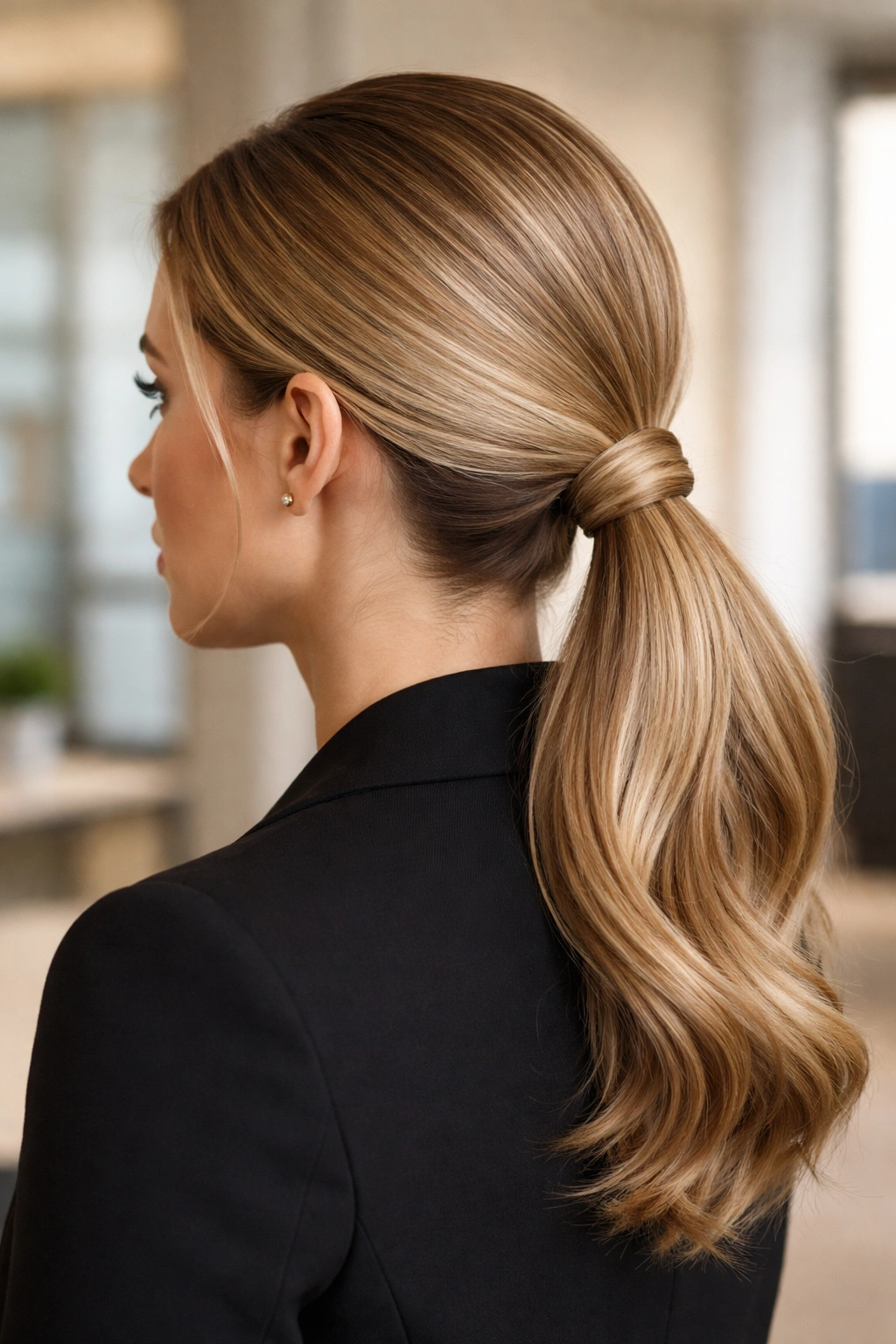
A low ponytail with a twisted wrap combines the security of a low ponytail with the visual interest of twisted detail. This style is sophisticated and shows technical knowledge without being trendy or overly complicated. It’s ideal for professional environments where you want to look polished without appearing to have spent hours on your hair.
Why This Combination Works Professionally
The low ponytail is universally professional, but adding the twisted wrap element elevates it from basic to intentional. The twist detail communicates that you understand styling and care about the details of your appearance. This combination also makes the style more secure and stable, because the twist helps grip the hair and keeps the elastic in place. It’s the kind of polish that matters in client-facing roles, presentations, or any situation where your appearance contributes to how others perceive your professionalism.
The Technique for a Twisted Wrap
- Create a very smooth, low ponytail secured with a firm elastic
- Take two thin sections of hair from the ponytail, one on each side
- Twist each section tightly
- Cross the two twisted sections over each other and wrap them around the base of the ponytail, covering the elastic completely
- Secure the ends with bobby pins in a matching hair color underneath the ponytail
- Smooth any flyaways and set with a light hairspray
Quick facts:
- This style is perfect for hair that’s slightly damp or dampened with a smoothing spray, as it holds the twist shape better
- The wrap detail adds approximately two minutes to a basic ponytail, making it time-efficient for busy mornings
- This style typically lasts 10-12 hours without requiring adjustments
- You can create thicker or thinner twisted wraps depending on how dramatic you want the detail to be
12. Center-Part High Ponytail
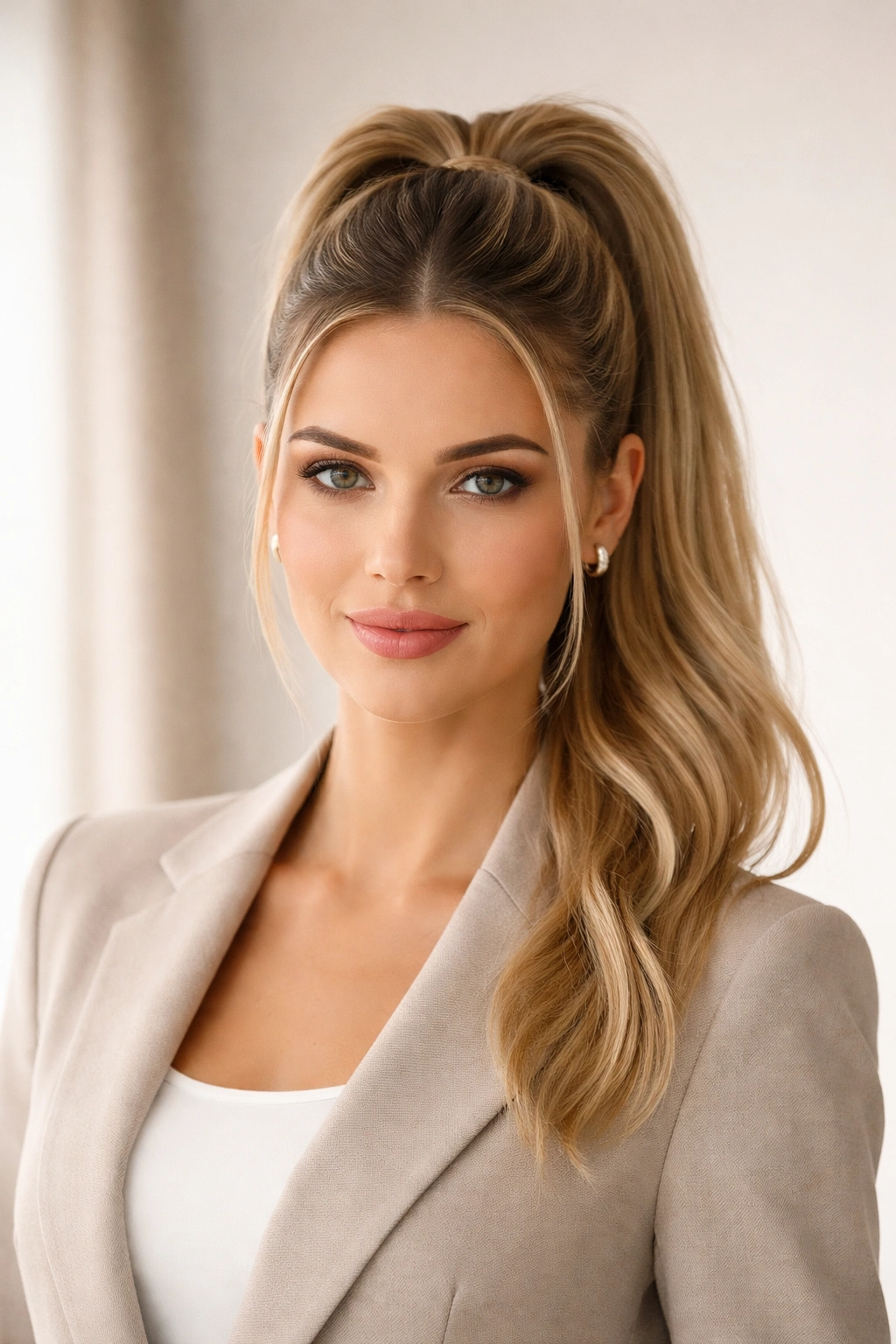
A center-parted, high ponytail is exceptionally flattering and works in virtually any professional environment. The center part is inherently balanced and symmetric, which reads as polished and intentional. Combined with a high ponytail placement, this style communicates confidence and clarity.
Why Center Parts Elevate Ponytails
A center part lengthens the face visually and creates a balanced, symmetrical appearance that reads as refined. Unlike side parts, which can feel more casual or trendy, center parts feel classic and timeless. When paired with a high ponytail, the center part creates an elongated line from the crown of your head down the center of your face, which is widely considered the most flattering proportion. This style works particularly well in formal or traditional professional environments.
Executing a Perfect Center Ponytail
- Use a fine-tooth comb and part your hair precisely down the center of your scalp, from your hairline to the nape of your neck
- Brush the hair on each side of the part back smoothly toward the crown
- Gather all hair at the crown into a high ponytail
- Secure with a strong elastic
- Take a thin section from the ponytail and wrap it around the elastic, pinning it underneath
- Use a small amount of edge control or gel along the part to keep it crisp throughout the day
- Set with a medium-hold hairspray
Worth knowing:
- A perfectly crisp center part takes practice, but once you’ve done it a few times, it becomes automatic
- If you have thick hair, use a rattail comb (the thin end of a teasing brush) to create the part line
- This style is especially effective if you have naturally straight or slightly wavy hair that shows the part clearly
- The center part draws attention to your face, so ensure your skin and makeup are in good shape before wearing this style
13. Sleek Middle Ponytail
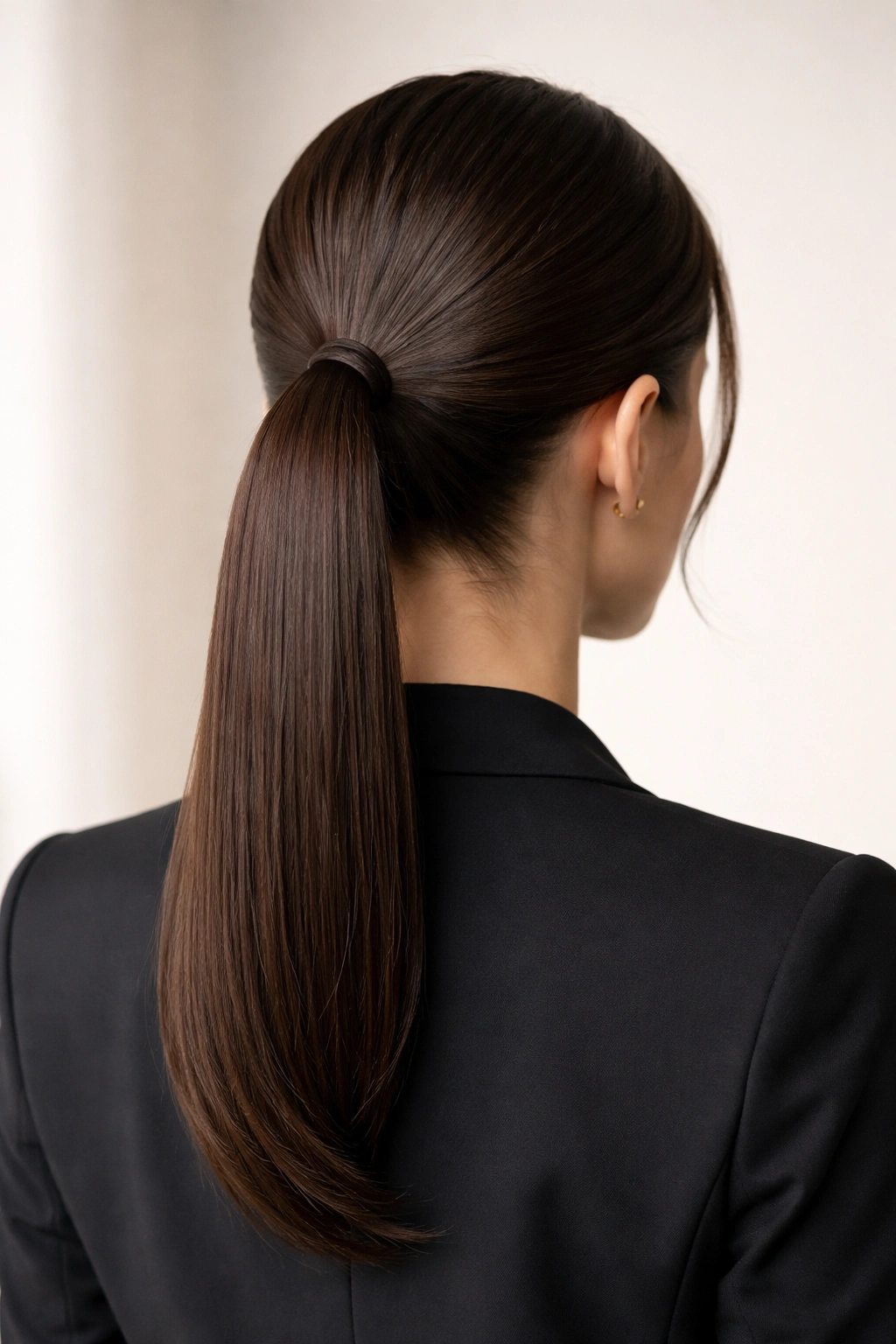
A middle-height ponytail positioned at the back of your head (neither high nor low) is a versatile style that works in virtually every professional environment. This placement is often called the “sweet spot” because it balances formality with approachability. The sleek finish keeps it polished without feeling overly severe.
Why Middle Positioning Is Universally Professional
A middle ponytail is the Goldilocks of ponytail placement — not too high (which can read as youthful or overly casual), not too low (which can sometimes feel dated). This placement works beautifully on most face shapes and hair types. It’s also incredibly practical because it keeps hair off your shoulders and neck while maintaining enough length and movement that the style never looks unfinished. The middle positioning also means you can style your ponytail in the morning and it won’t shift dramatically throughout the day.
Creating the Perfect Middle Ponytail
- Use a paddle brush to smooth your hair back from your face, working from your forehead toward the back of your head
- Position your ponytail at the back of your head, roughly level with your ear lobes
- Secure with a strong elastic that matches your hair color
- Smooth the front sections carefully with a comb to eliminate bumps
- Take a thin section from the ponytail and wrap it around the elastic
- Pin the wrap underneath with bobby pins in a matching shade
- Apply a smoothing cream or serum to tame flyaways
- Finish with a light to medium hairspray
Pro tip: If you want this style to read more polished, blow-dry your hair with a round brush before creating the ponytail — this creates subtle volume and shine that makes the style appear more refined.
14. Curved Ponytail
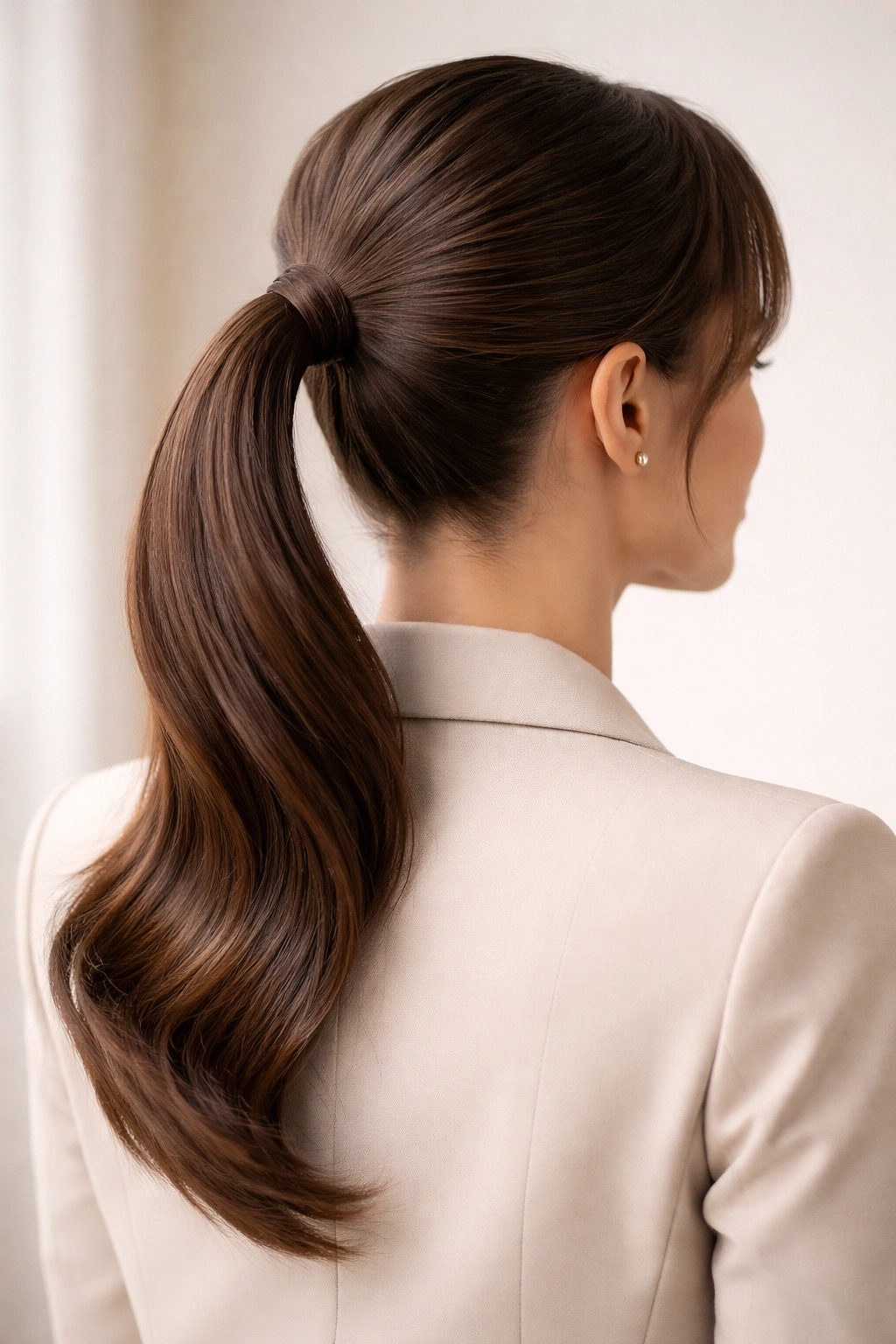
A curved ponytail incorporates a subtle bend or curve rather than pulling hair straight back. This technique creates a more dynamic, modern silhouette while remaining completely professional. The curve is subtle enough that it reads as intentional styling rather than a mishap, and it’s flattering on most face shapes.
What Makes Curved Ponytails Modern
A straight back line can sometimes read as harsh or severe, particularly on certain face shapes. A curved ponytail softens this effect by creating a more flowing line from the crown to the base of the ponytail. The curve also adds visual interest and movement that a straight ponytail lacks. This style is particularly effective if you want something more contemporary than traditional but still completely professional.
Creating the Curve Effect
- Blow-dry your hair with a round brush, creating a subtle wave throughout
- Use a straightening iron or wand to create a gentle curve in the back sections of your hair — the curve should flow from the crown toward the nape of your neck, not be dramatically kinked
- Gather your hair at a mid-level ponytail position
- Secure with an elastic
- Wrap a thin section around the base to conceal the elastic
- The curve should be subtle but visible when you look at the ponytail from the side
- Set with a flexible-hold hairspray that maintains movement
Quick facts:
- This style works beautifully on medium to long hair, as shorter lengths don’t show the curve as dramatically
- The curve should flow naturally with the shape of your head, not look artificially kinked
- This style photographs beautifully and looks polished in video calls
- The subtle wave gives the impression of effortless styling, even if you’ve put real technique into creating it
15. Slicked-Back Ponytail
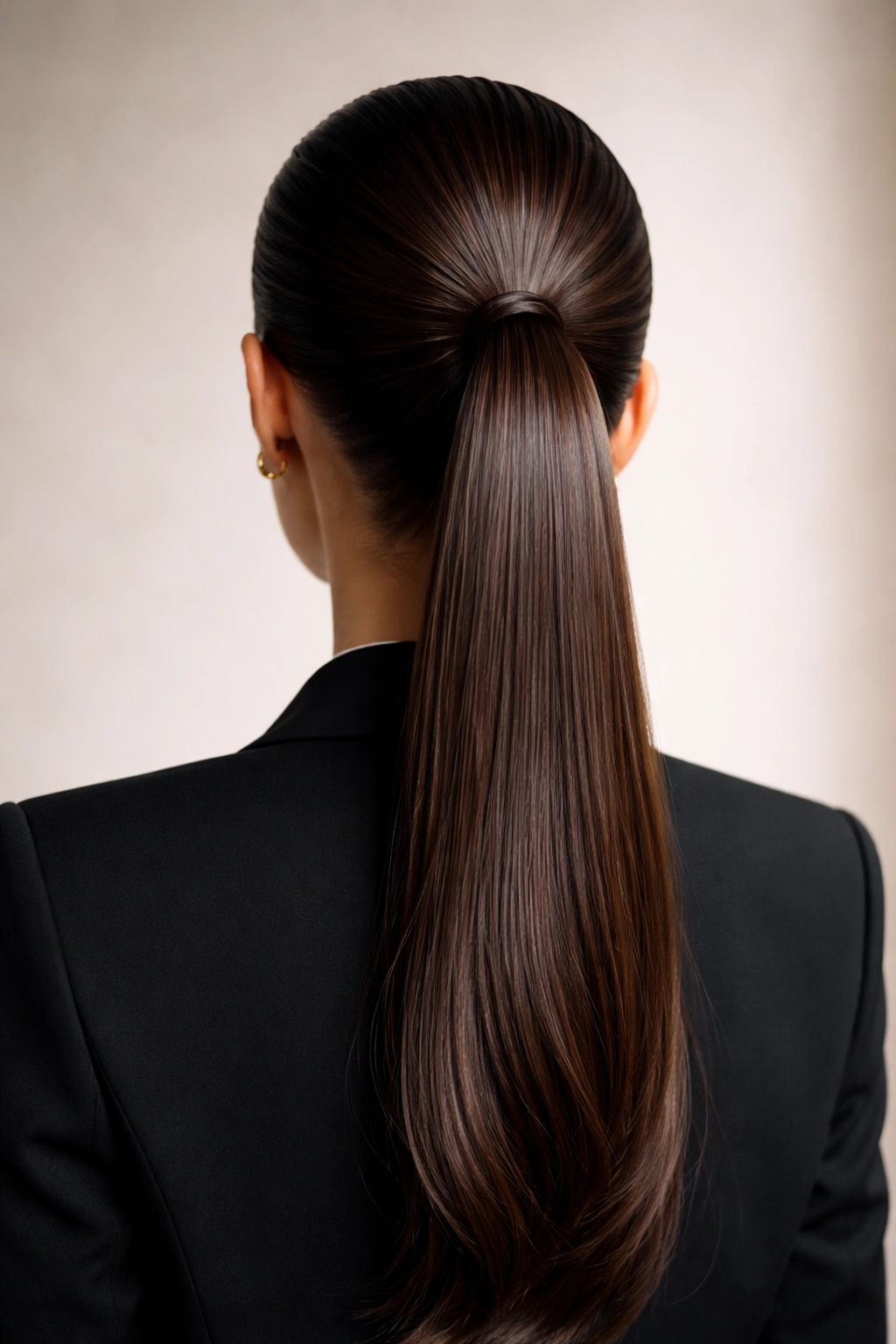
A completely slicked-back ponytail is the ultimate expression of polish and intention. Every hair is smoothed back tightly, creating an almost graphic quality. This style reads as highly professional and works beautifully in formal environments, for presentations, or any situation where you want to project maximum confidence and control.
Why Slicked Styles Command Authority
A slicked-back style reads as someone who is completely in control — of their appearance, their presentation, and their environment. It’s a bold choice that communicates confidence without needing volume or texture to make an impact. This style is particularly effective in formal business environments, client presentations, or situations where projecting authority matters. The sleekness also means the style holds beautifully throughout long days without requiring touch-ups.
Perfecting the Slicked Look
- Start with damp hair and apply a smoothing serum or gel to soaking-wet hair
- Use a fine-tooth comb to brush your hair back from your forehead in one smooth, controlled motion
- Work the comb through repeatedly, ensuring every section is smooth and has product distributed throughout
- Gather your hair at your desired ponytail height (high, middle, or low) and secure with a very strong elastic
- Make sure the elastic is positioned so that once secured, the ponytail feels immovable
- Take a thin section of hair and wrap it around the elastic base
- Apply a firm-hold hairspray or gel to tame any potential flyaways
- Use a fine-tooth comb to smooth the entire ponytail one more time
Worth knowing:
- This style requires product — you cannot achieve true sleekness without smoothing serum or gel
- The gel should be lightweight enough that it doesn’t make your hair feel stiff or crunchy, just smooth and controlled
- This ponytail typically lasts 12+ hours without loosening, making it ideal for long workdays or travel
- If you have naturally textured hair, you may need to blow-dry with a paddle brush before applying product for maximum sleekness
Final Thoughts

A polished ponytail is one of the most efficient investments you can make in your professional appearance. Whether you choose a classic high ponytail, an elegant braided variation, or something more textured and modern, the key is executing the style cleanly and intentionally. The fifteen styles covered here represent the full spectrum — from ultra-formal slicked looks to creative twisted and braided options — so you can find something that matches your workplace culture, hair type, and personal style.
The true benefit of mastering multiple ponytail styles is that you can adapt your appearance to different situations throughout your work life. A very formal meeting with executive leadership might call for a sleek low ponytail, while a creative brainstorm with your team might feel perfectly suited to a textured bubble ponytail or a modern twisted version. When you have several techniques in your toolkit, you can approach your appearance strategically rather than defaulting to the same style every single day.
Invest in quality tools and products that actually hold — a good paddle brush, strong elastics in colors matching your hair, bobby pins in your exact shade, and a smoothing serum or volumizing mousse depending on your hair type. These tools make a tremendous difference in how polished your final result appears and how long your style lasts throughout your day. Practice each technique a few times on a weekend so that when you need the style on a workday morning, your hands understand the motion and you can execute it efficiently.
