



Half-up hairstyles have become a go-to choice for anyone wanting something between fully down and pulled back—they’re polished without feeling severe, effortless-looking even when they take real effort, and infinitely customizable. When you add flowers into the equation, you’re elevating a basic style into something that works just as beautifully at a formal wedding as it does for a casual garden party or everyday elegance. The combination of a half-up silhouette with the softness and romanticism of fresh blooms or delicate floral accents creates something truly special.
What makes half-up bun styles with flowers so versatile is that they work across hair types, face shapes, and occasions. Whether you’re starting with thick waves, fine strands, curls, or straight hair, this style adapts to what you have and makes it look intentional. The flowers do the heavy lifting aesthetically—they soften the structure, add dimension and color, and instantly make even a basic hairstyle feel like you spent hours getting ready (even if you didn’t).
If you’re looking to move beyond a simple half-up ponytail or wondering how to style flowers into your hair in ways that actually look polished, these 15 approaches range from romantic and loose to structured and editorial. Each one comes with the reasoning behind why it works so well and the specific techniques that make the difference between a hairstyle and a moment.
1. The Romantic Twisted Half-Up With Scattered Blooms
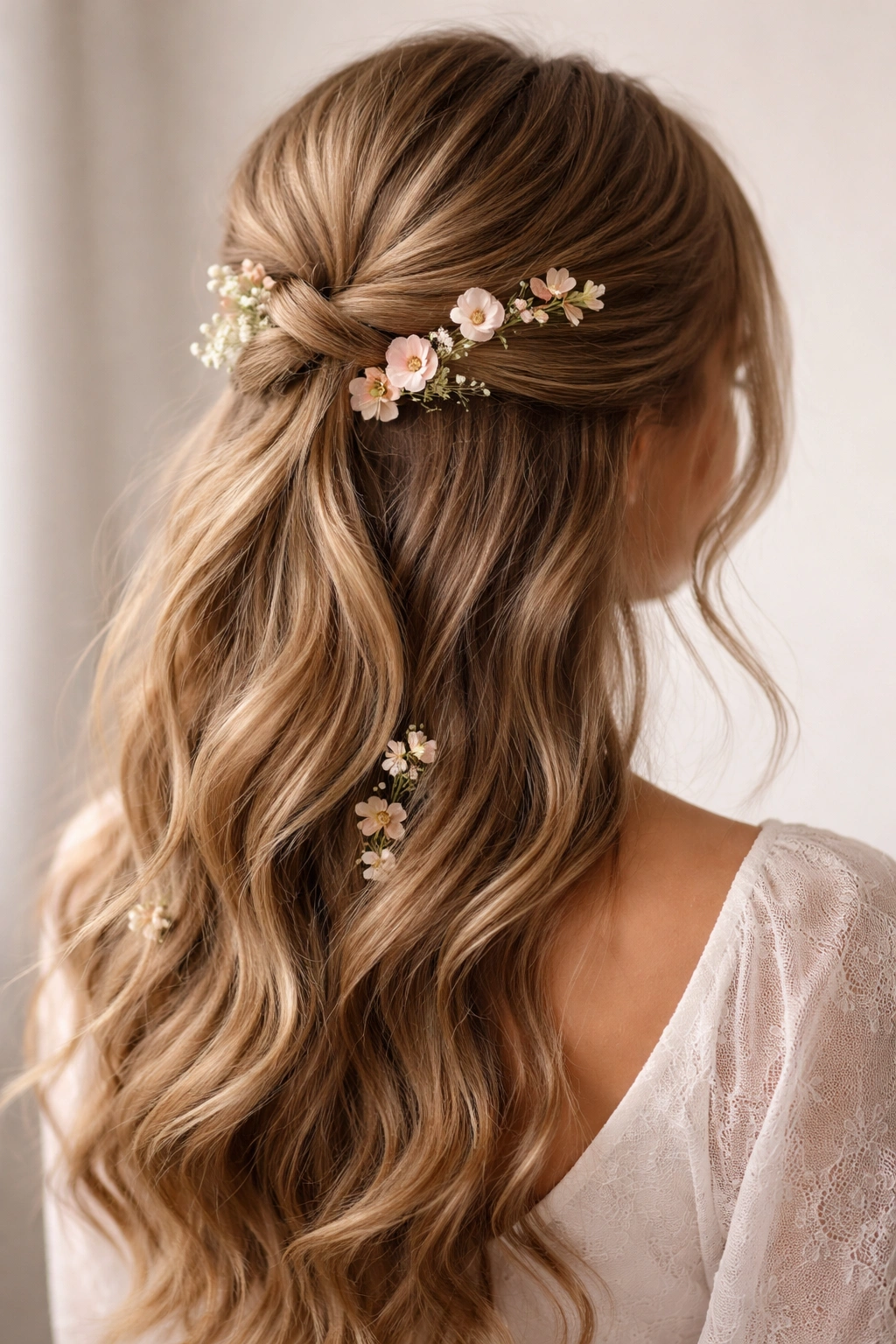
This style starts with a twisted section pulled from one side, secured loosely at the back of the head, and nestled with small flowers tucked throughout rather than positioned in one dense cluster. The twist itself should be relaxed and slightly loose—tension here is the enemy of romance. You’re going for that “I just happened to gather my hair and tuck some flowers in” vibe, which paradoxically requires more intention than it appears.
Why This Approach Creates Effortless Elegance
The beauty of scattered blooms is that imperfection becomes part of the design. Small flowers woven throughout the twist and around the securing point create depth and visual interest from every angle. Rather than one statement focal point, your eyes travel across the arrangement, which makes even fine or thin hair appear fuller and more textured.
How to Build This Look
- Start with second-day or textured hair—the twist holds better and looks more organic when hair isn’t freshly washed
- Take a 2-inch section from one side near the temple and twist it loosely toward the back of your head
- Secure the twist with a clear elastic or bobby pins hidden beneath the twist itself
- Insert small filler flowers (baby’s breath, waxflower, or limonium) individually into and around the twist using bobby pins bent into U-shapes
- Leave face-framing pieces loose to soften the front, and allow some hair from the ponytail section to fall loose around the base
Pro tip: Mist the finished style lightly with hairspray before inserting flowers so they’ll hold their position better, and insert stems into the twist rather than trying to pin flower heads only—it’s more secure and less visible.
2. The Classic Half-Up Bun With a Flower Crown Integration
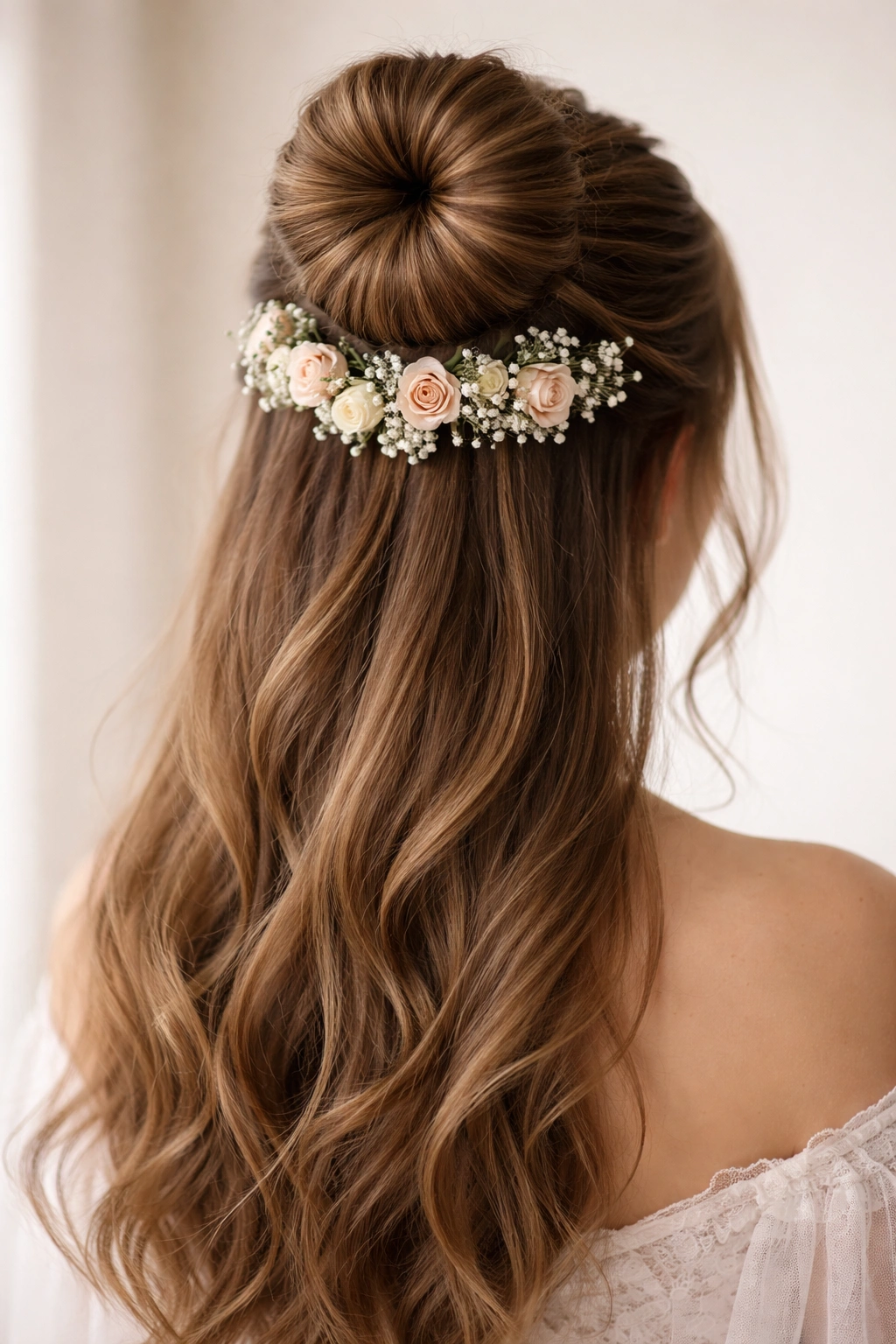
This style is structured and intentional: a clean, rounded bun positioned at the crown with a delicate flower crown or coordinating floral piece that sits at the base where the half-up portion begins. The bun itself should be compact and polished, made by twisting the gathered hair and coiling it into a tight circle, then secured with bobby pins.
What Makes It Stand Out for Special Occasions
The clean geometry of a proper bun paired with flowers creates a formal, put-together aesthetic without looking overly rigid. The bun sits high enough to elongate the neck and face, and the flowers placed at the base where the style transitions from down to up create a natural focal point that frames the face beautifully. This is the style you see in bridal parties, proms, and editorial shoots for a reason—it photographs impeccably.
Construction Details That Matter
- Begin with hair that’s been blow-dried straight or gently waved for a smoother bun base
- Create a high half-up by sectioning hair from ear to ear across the crown and securing it in a ponytail at the back of the head
- Twist the ponytail tightly and coil it around itself, using bobby pins to anchor each loop close to the base
- Smooth any flyaways with gel or hairspray applied with a fine-tooth comb
- Tuck a pre-made flower crown or arrange flowers in a graduating line where the bun begins, securing stems or the crown base with bobby pins
Worth knowing: The height of your half-up section determines the overall proportion—aim to leave roughly equal amounts of hair down and up, or slightly more down if you have a longer face.
3. The Textured Half-Up Bun With Oversized Statement Flowers
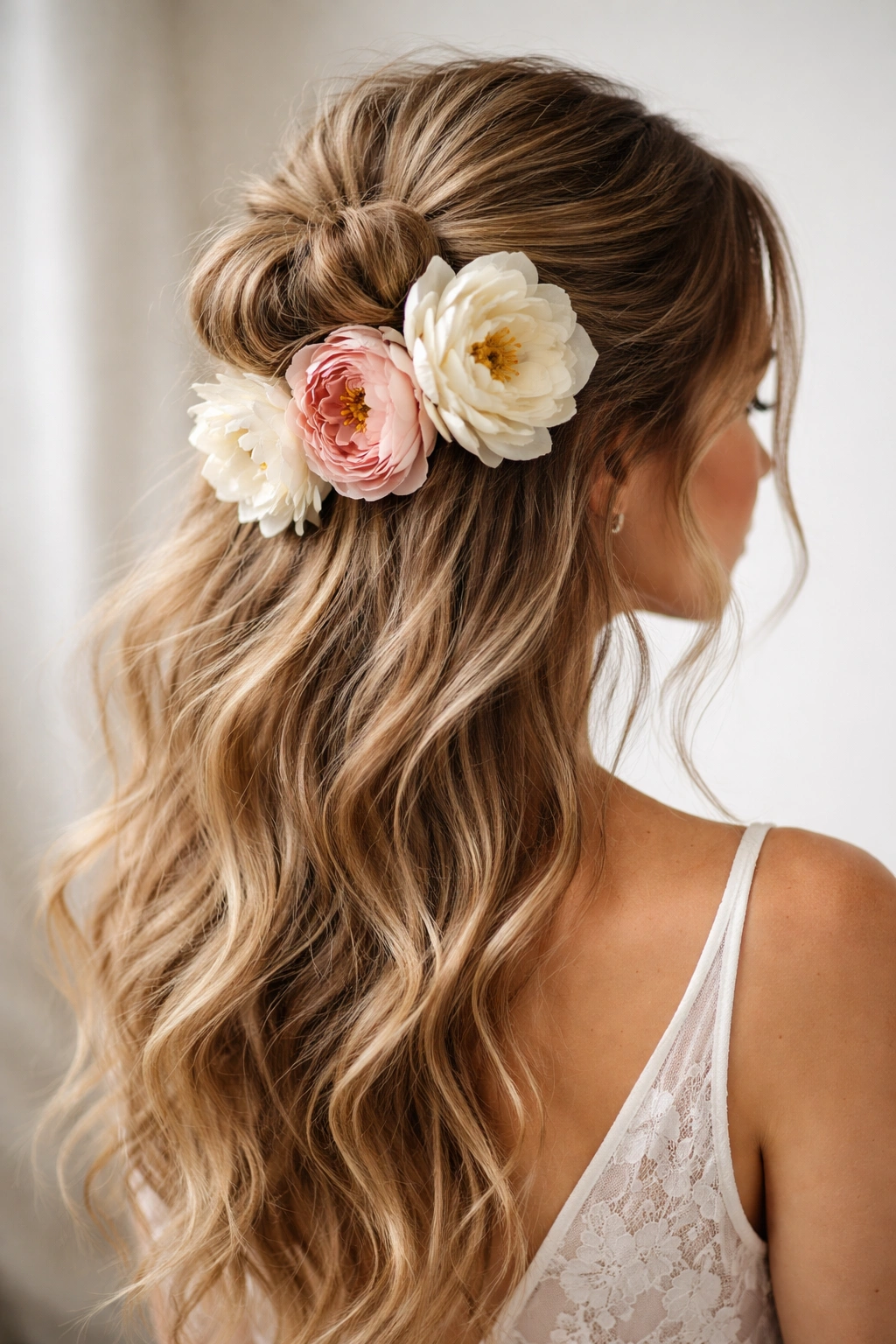
This version celebrates volume and movement. Instead of a tight bun, you’re creating a looser, more undone bun that sits slightly lower than the classic version, and you’re pairing it with one to three larger, bolder flowers positioned asymmetrically. This works beautifully with naturally wavy or curly hair, or with hair that’s been given texture through styling.
Why Oversized Blooms Work Here
A single large peony, a cluster of garden roses, or oversized ranunculus demands attention—but only when the bun beneath it has enough texture and volume to stand as an equal partner. The flowers aren’t decorating a simple style; they’re collaborating with it. This approach reads as modern and artistic rather than traditionally romantic.
Styling for Maximum Impact
- Prep hair with sea salt spray or curl-defining product to enhance natural texture
- Create a half-up section and secure it loosely into a ponytail, leaving the elastic about an inch lower than you’d normally place it
- Rather than twisting tightly, loosely gather the ponytail section and secure it with bobby pins, allowing visible loops and texture
- Gently pull and encourage waves throughout both the down and up portions
- Position 1-3 large flowers on one side of the bun base, allowing them to sit slightly off-center
Insider note: Spray the bun lightly with dry shampoo before adding flowers—it creates texture and grip so flowers stay put without looking pinned down.
4. The Double-Twisted Half-Up With Delicate Flower Accents
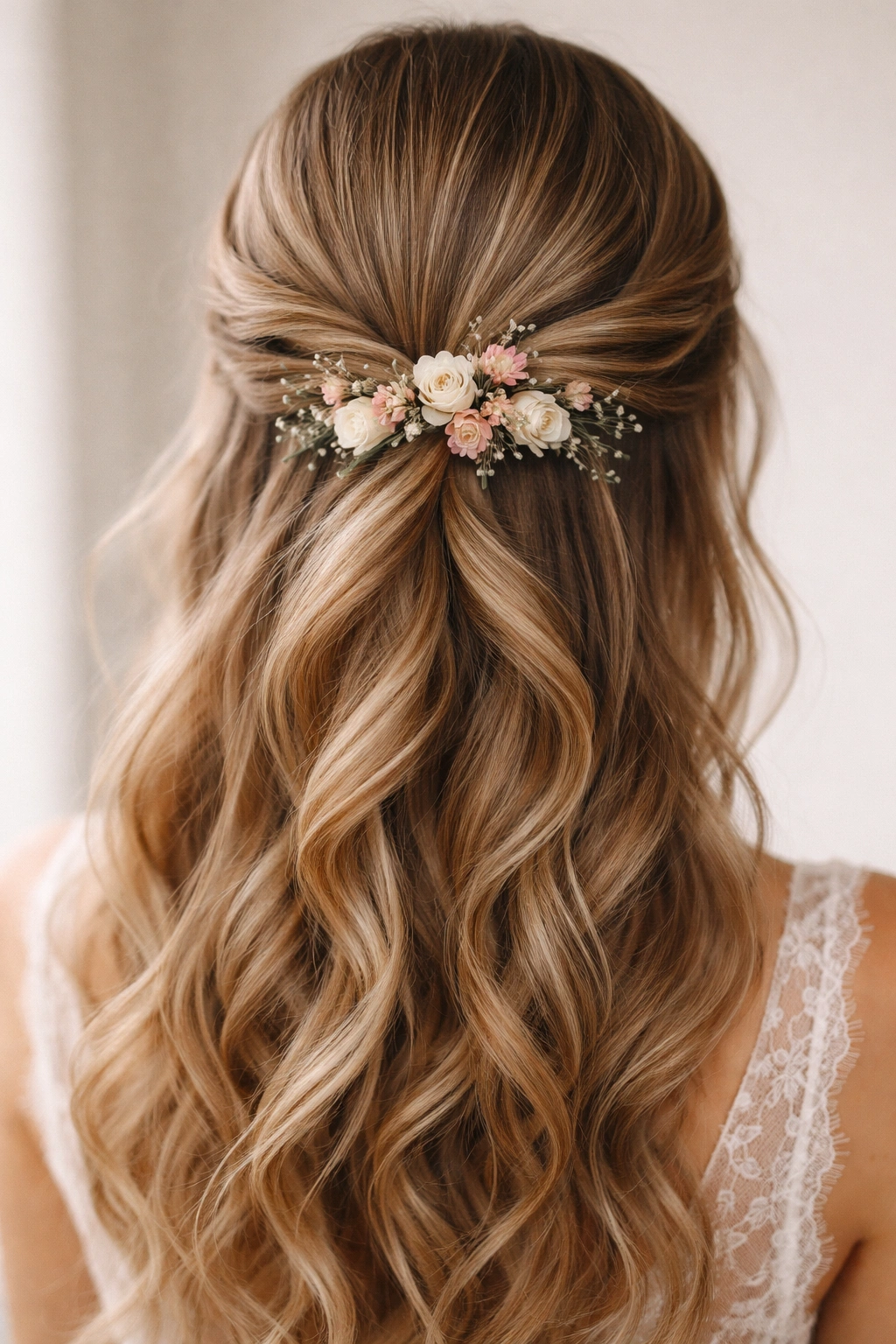
This style involves two separate twists pulled from opposite sides, meeting and merging at the back of the head, then secured loosely with small flowers nestled between the two twists. The dual-twist approach creates visual width and a more interesting silhouette than a single twisted section.
How the Dual-Twist Creates Dimension
Two independent twists that merge give the illusion of more hair, more movement, and more intentionality than a single twist. When you add flowers in the valley where these twists meet, the flowers become integral to the structure rather than an accessory placed on top of it. It’s a subtle but significant difference in how polished the final result appears.
Step-by-Step Construction
- Take a 2-inch section from the left side at temple height and begin twisting loosely back toward the crown
- Take an equal section from the right side and twist it back toward the crown as well
- Meet the twists at the back of the head and secure both together with bobby pins or a small elastic
- Smooth the twists gently with your fingers and a fine-mist hairspray to eliminate flyaways
- Tuck small flowers into the point where the twists meet, securing with bobby pins if needed
- Allow face-framing pieces to fall loose, and leave the bulk of the hair down with some gentle waves
Pro tip: Twisting slightly loosely intentionally prevents the twists from looking too severe—aim for that “barely contained” aesthetic.
5. The High Ponytail Half-Up With Flower-Wrapped Base
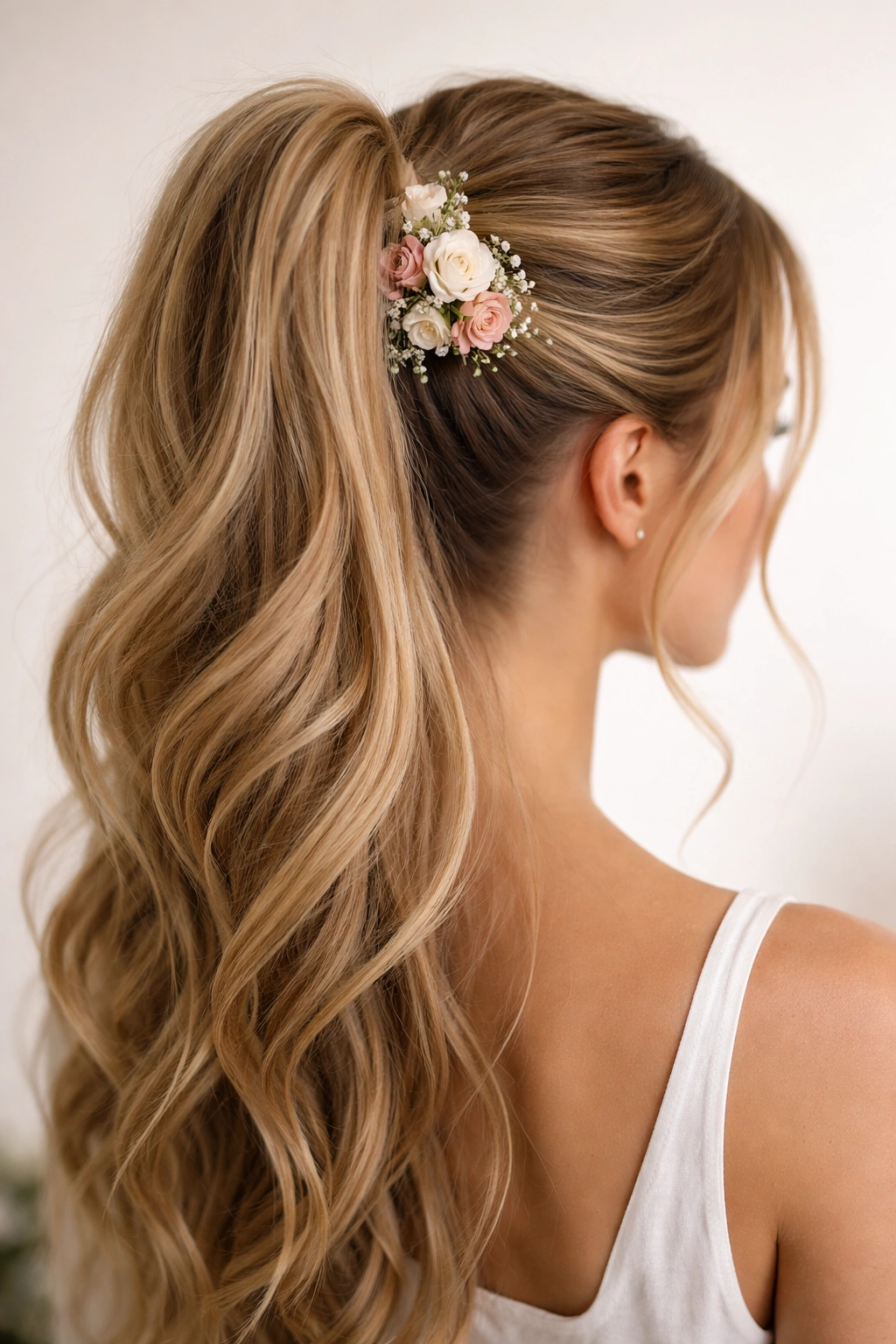
This hybrid approach sits somewhere between a full ponytail and a true half-up. You’re creating a ponytail high on the head from a half-up section, then wrapping flowers around the elastic base so completely that the elastic itself disappears beneath the blooms. The result looks more intentional and polished than a standard ponytail with flowers stuck in it.
Why Wrapping Creates Cohesion
When flowers are wrapped around the hair elastic itself, they become structural rather than decorative. They sit at the exact spot where the style transitions from loose to gathered, which is the most visually impactful placement. The wrapped effect also makes the style look more curated and less like flowers were added as an afterthought.
How to Wrap Flowers Around the Base
- Gather a half-up section into a ponytail and secure it tightly with a sturdy elastic
- Select flowers with sturdy stems or use a floral foam base or small floral comb
- Wrap flower stems around the elastic base in a spiral, securing each flower with a bobby pin as you go
- Completely conceal the elastic beneath layers of flowers and greenery
- Allow flowers to cascade slightly down the front of the ponytail for a fuller effect
- Tease the ponytail gently and pin it loosely to create a half-bun texture if desired
Worth knowing: Pre-wrap the elastic with floral tape before adding flowers—it gives flowers a secure surface to grip and makes the whole arrangement more stable.
6. The Side-Swept Half-Up With Flowing Flower Cascade
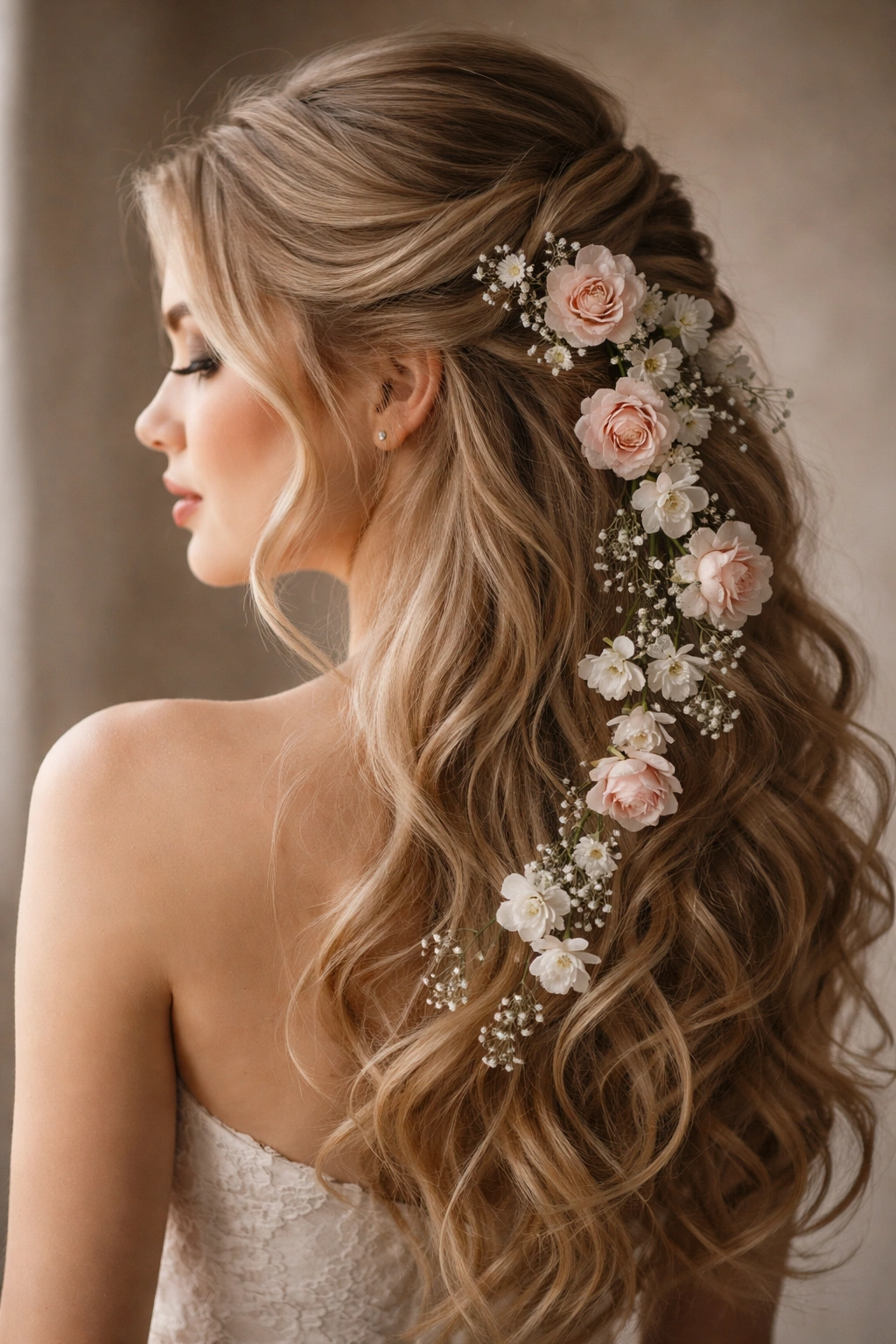
This romantic style sweeps the half-up section toward one side of the head rather than centering it, and allows flowers to cascade asymmetrically from the gathering point down through the loose hair. It’s a more dramatic, fashion-forward take on the half-up that photographs beautifully and works especially well for special events.
The Visual Drama of Asymmetry
Side-swept styles are inherently more dynamic than centered ones—they create movement and visual interest even when you’re standing still. When you add flowers that flow in the same direction as the sweep, you’re amplifying that movement rather than fighting it. This creates a cohesive, intentional-looking silhouette that feels both romantic and editorial.
Creating the Sweep and Cascade
- Tease hair at the crown to create volume, then gently smooth the surface layer
- Take a deep side part and sweep a large section of hair from the deeper side toward the opposite side of the head
- Secure this swept section with bobby pins at a point roughly 2 inches behind the opposite ear
- Create a loose half-bun or gathered ponytail at this point, leaving texture and slight loops
- Begin attaching flowers at the gathering point and allow them to cascade down through the loose side, securing stems with bobby pins as you go
- Mist everything lightly with hairspray to hold the sweep and cascade in place
Pro tip: The cascade should follow the natural fall of your hair, not work against it, or it will look awkward and uncomfortable rather than effortlessly beautiful.
7. The Sleek Low Half-Up With Structured Floral Comb
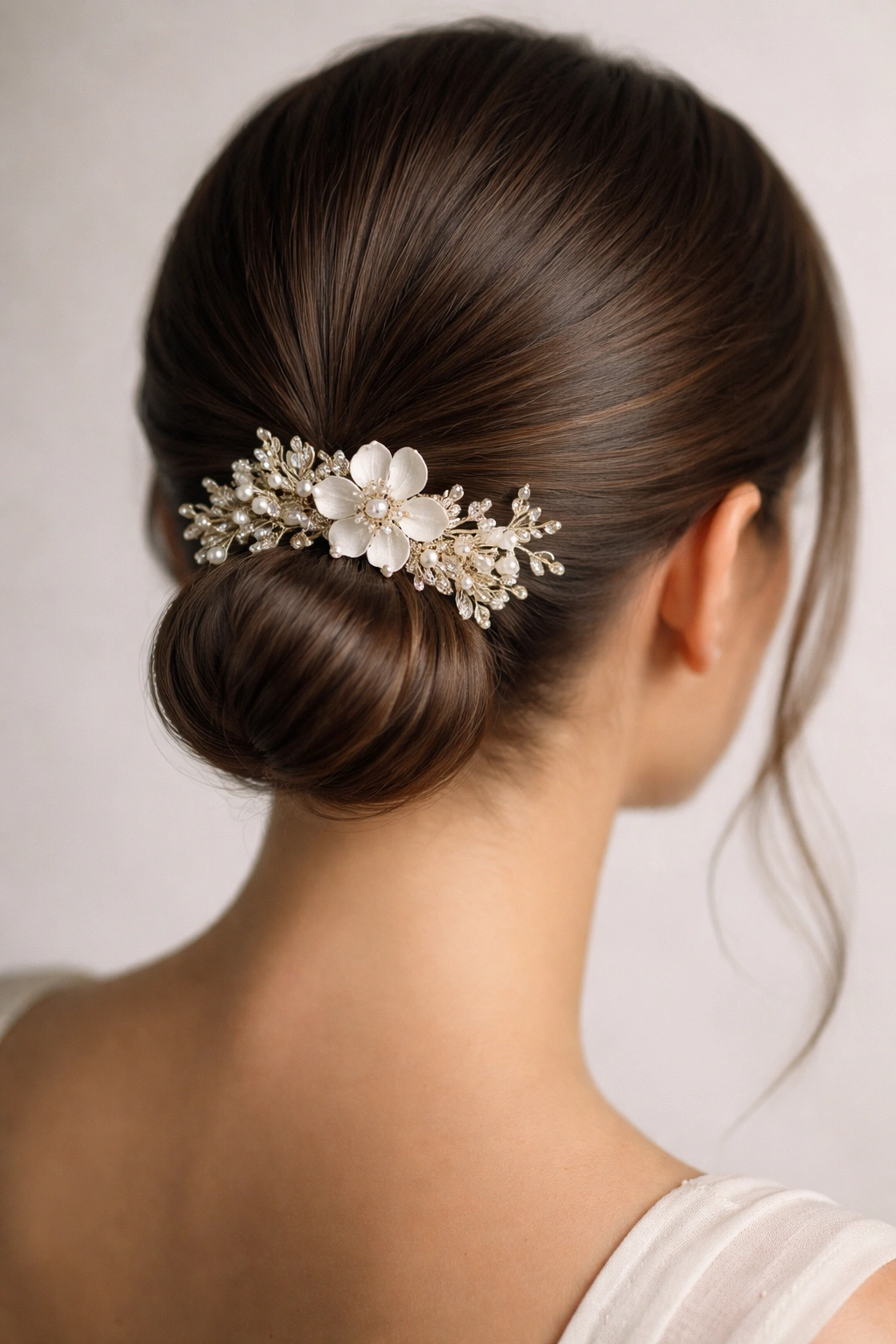
This style is all about clean lines and sophistication. The half-up section is gathered low and very smoothly into a small, tight bun or gathered ponytail, and secured with a structured floral comb rather than bobby pins. The comb itself becomes a design element, visible and intentional rather than hidden.
Why a Structured Comb Changes Everything
A decorative floral comb or hair fork placed at the base of a low half-up gathers the style while also contributing texture and visual interest. Unlike scattered flowers or organic-looking arrangements, a structured comb reads as intentional and editorial. It’s the difference between “I put flowers in my hair” and “I positioned a design element precisely.” This approach suits sleeker, straighter hair and more formal occasions.
Execution for Maximum Polish
- Blow-dry hair smooth and straight, using a flattening brush or blow dryer with a concentrator nozzle
- Create a center or deep side part depending on your face shape and preference
- Take a section of hair at ear level across the back of the head and gather it into a small, tight ponytail
- Secure the ponytail tightly with a small elastic
- Insert a floral comb or decorative hair fork through the ponytail at the base, using the comb’s prongs to secure the gathered hair
- Smooth any flyaways with edge control or gel, and pin any stray pieces with bobby pins placed just below the comb so they’re hidden
Worth knowing: Invest in a quality floral comb with substantial weight and strong prongs—cheap combs won’t grip thick hair securely and will slide throughout the day.
8. The Braided Half-Up With Woven Flowers
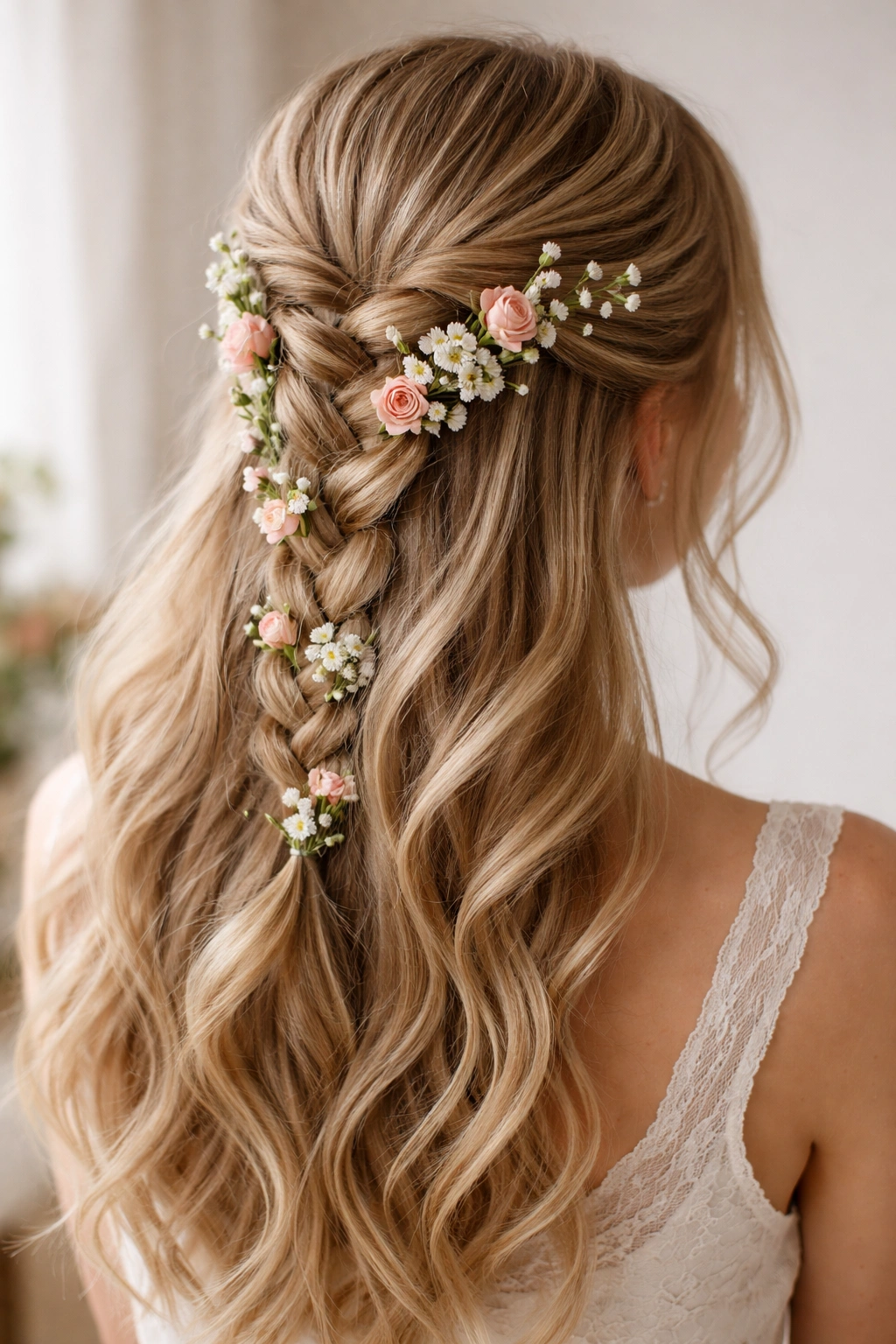
This style incorporates flowers directly into a braid rather than adding them afterward. A Dutch or French braid pulled back from one or both sides holds flowers woven throughout the braid structure itself. When done well, the flowers become integral to the braid, not an addition to it.
How Weaving Flowers Into a Braid Works
Incorporating flowers into a braid requires a different approach than adding them to twists or loose sections. As you braid, you’re literally pulling stems or floral elements into the braid structure with each crossing of hair sections. It takes more dexterity and planning than it might seem, but the payoff is a deeply cohesive, intricate-looking style that shows real skill.
Technique for Braiding in Flowers
- Start with textured or slightly damp hair that will hold the braid structure firmly
- Begin a Dutch braid at the temple, pulling the braid direction toward the back of your head
- Every 2-3 crossings of the braid, lay a small flower stem along one of the three hair sections before continuing the braid
- The braid will naturally pull the flower into its structure as you continue braiding
- Keep the braid tension firm so flowers don’t slip out, but not so tight that you’re damaging hair
- Once you’ve finished the braid and secured it, adjust the braid to loosen it very slightly and make flowers more visible
- Pin loose flowers around the base where the braid finishes, or leave the braid loose to cascade
Insider note: Practice this style on someone else first—it’s difficult to see what you’re doing when braiding your own hair, and you’ll have better results if you can see where flowers are sitting.
9. The Curved Half-Up With Flower Pin Clusters
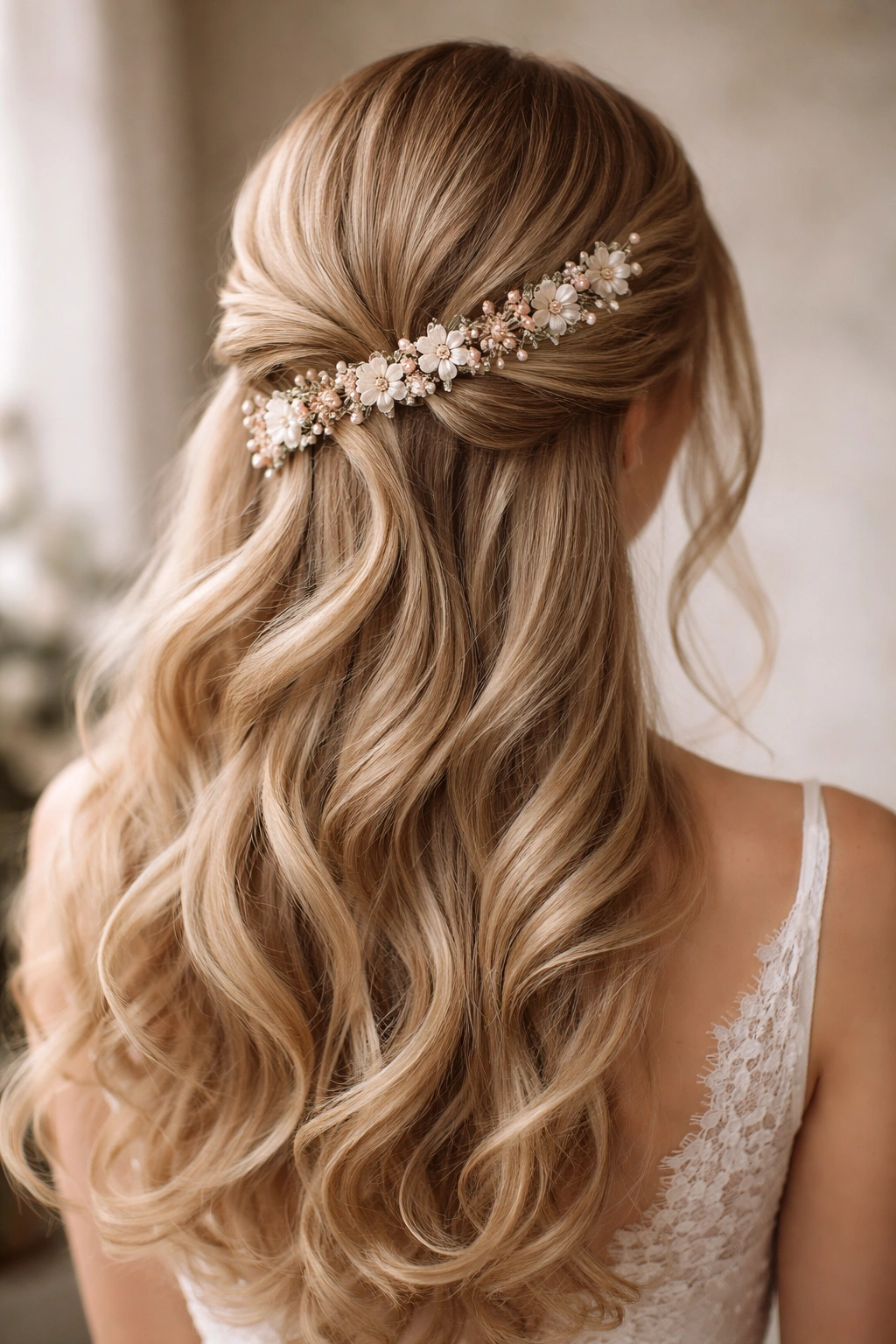
This style curves the half-up section up and around rather than pulling straight back. Instead of a single gathering point, you secure the section with multiple clusters of decorative hair pins spaced along a curved line from one side of the head to the other. Small flower clusters sit at the base of each pin cluster, creating a repeating motif.
Why Curves Feel More Romantic
Straight, centered lines feel structured and formal, while curved lines inherently feel softer and more romantic. By curving the half-up section, you’re immediately shifting the tone of the style toward something more feminine and flowing. The repeating pin clusters add rhythm and visual interest—your eye travels along the curve, which makes even a fairly simple arrangement feel intricate.
Creating the Curved Effect
- Start with waves or curls already in the hair for a softer base texture
- Take a section of hair from behind one ear and begin pinning it up and back, but in a curved line rather than a straight path
- Space decorative bobby pins or hair clips spaced about 2-3 inches apart along this curved line
- At the base of each pin, attach a small cluster of 2-3 coordinating flowers using additional bobby pins
- Allow the pinned section to create a gentle arc across the back of the head
- Leave plenty of hair loose and wavy below the pinned section
- Allow some face-framing pieces to fall completely loose
Pro tip: Tease hair slightly along the curved line before pinning—it creates grip and prevents pins from sliding, and the texture reads as intentional rather than sloppy.
10. The Messy Bun Half-Up With Wildflower Scatter
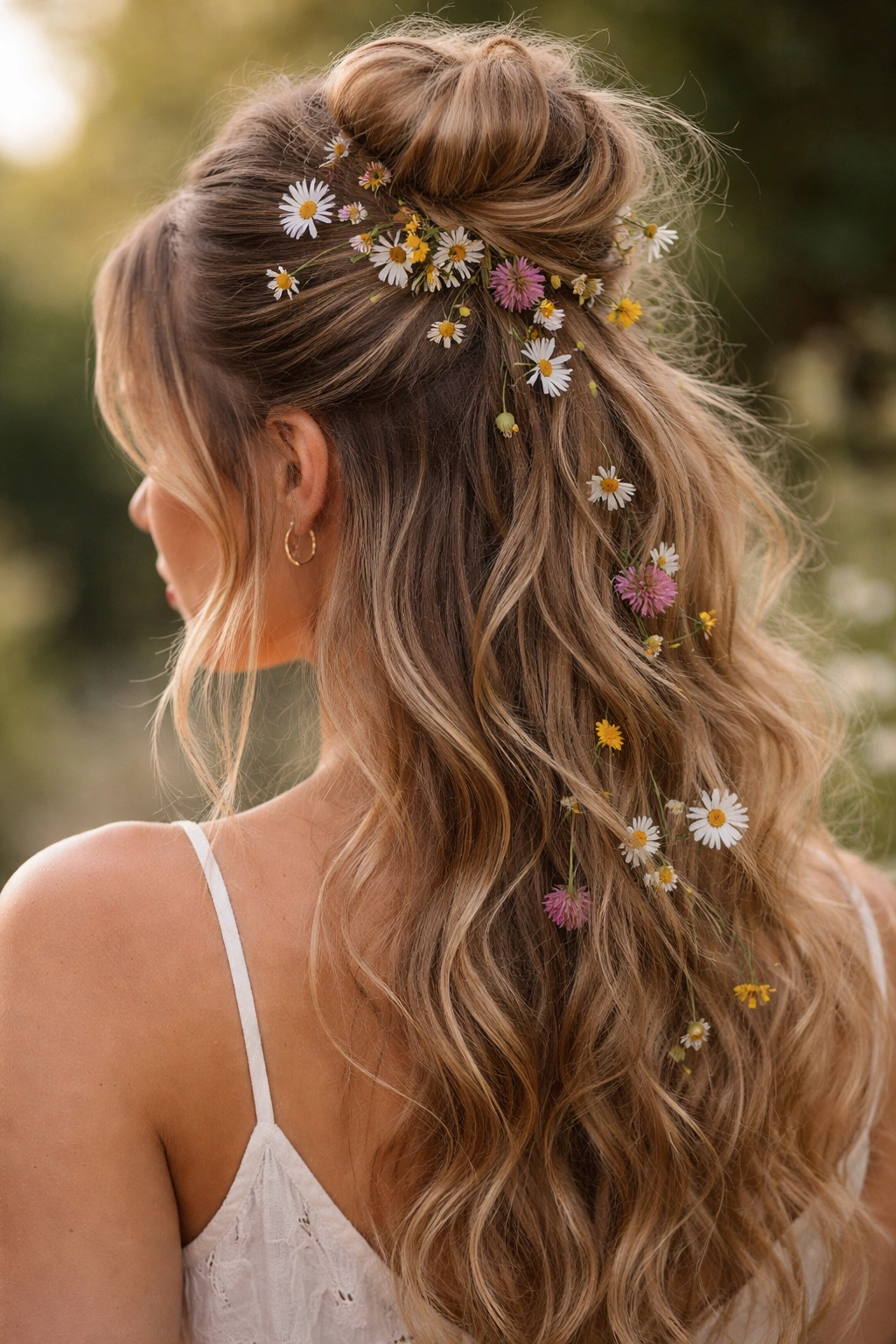
This is the deliberately undone approach: a half-up section gathered into a loose, undone bun that looks authentically messy rather than manicured, with small wildflowers or mixed greenery scattered throughout the bun and surrounding loose hair. The “messiness” is intentional and styled, which requires as much work as a neat bun but reads as effortless.
The Art of Styled Messiness
Messy buns look easy and effortless when they’re actually carefully constructed to appear that way. Every piece that’s supposed to be loose is pinned or teased into position; every loop that looks accidental is actually deliberate. The wildflower scatter supports this aesthetic by mimicking what nature might do if flowers had fallen into a soft, loose hairstyle—which is exactly the vibe you’re going for.
Building a Styled Messy Bun
- Start with textured or second-day hair, or add texture to clean hair with sea salt spray and a curling iron
- Create a high half-up ponytail and secure it loosely with an elastic
- Divide the ponytail into three sections and tease each section vigorously with a fine-tooth brush to create volume
- Pin the teased sections together loosely, creating visible loops and texture, securing with bobby pins
- Intentionally leave small pieces loose around the bun and pull out a few face-framing pieces
- Scatter small flowers and greenery throughout the bun structure, tucking stems into the teased texture so they’re held by the volume rather than just pinned
- Mist lightly with hairspray—light enough that the style still moves, heavy enough that everything stays in place
Worth knowing: The texture beneath the flowers is what allows them to sit naturally without looking pinned. Invest time in creating volume, and the flowers will feel like they belong rather than look like they were added.
11. The Twisted Wrap Half-Up With Front-Facing Flowers
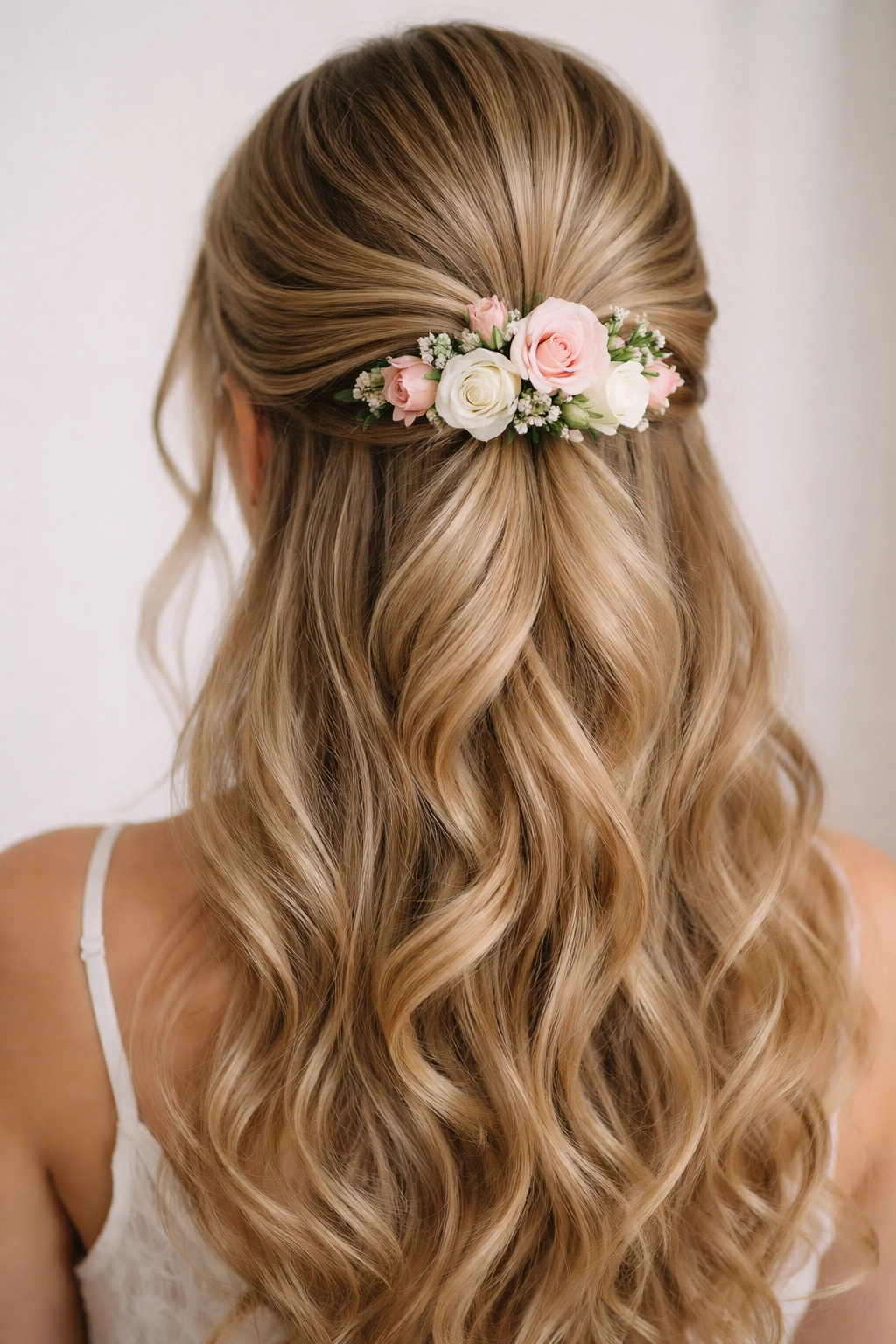
This style features a subtle technique: the half-up section is gathered, then part of it is twisted and wrapped around the base of the ponytail, creating a cuff effect that frames the flowers positioned in front. The flowers sit in the center of this twisted wrap, making them a focal point that’s clearly intentional but still feels organic.
How Wrapping Creates a Frame
When you wrap twisted hair around the base of a gathered section, you create a visual container for whatever sits in the center—in this case, flowers. The wrapped section becomes a frame, and the flowers inside are the artwork. This positioning is flattering because it naturally draws attention to the face and creates a balanced, intentional composition.
Technique for the Twisted Wrap
- Gather a half-up section into a low or mid-height ponytail and secure it loosely with an elastic
- Take a 1-inch section of the ponytail itself and twist it very tightly
- Wrap this twisted section around the base of the ponytail, securing the end with bobby pins tucked underneath
- Position 3-5 medium-sized flowers in the center of the wrapped base, securing them with bobby pins
- Ensure flowers face forward and slightly upward so they’re visible from the front
- Leave the bulk of the ponytail loose and wavy below, and allow face-framing pieces to fall softly
Pro tip: The twist should be tight enough to hold the wrapped position without slipping, but not so tight that it’s visibly strained—you want it to look secure, not stressed.
12. The Dutch Braid Half-Up With Flower Threading
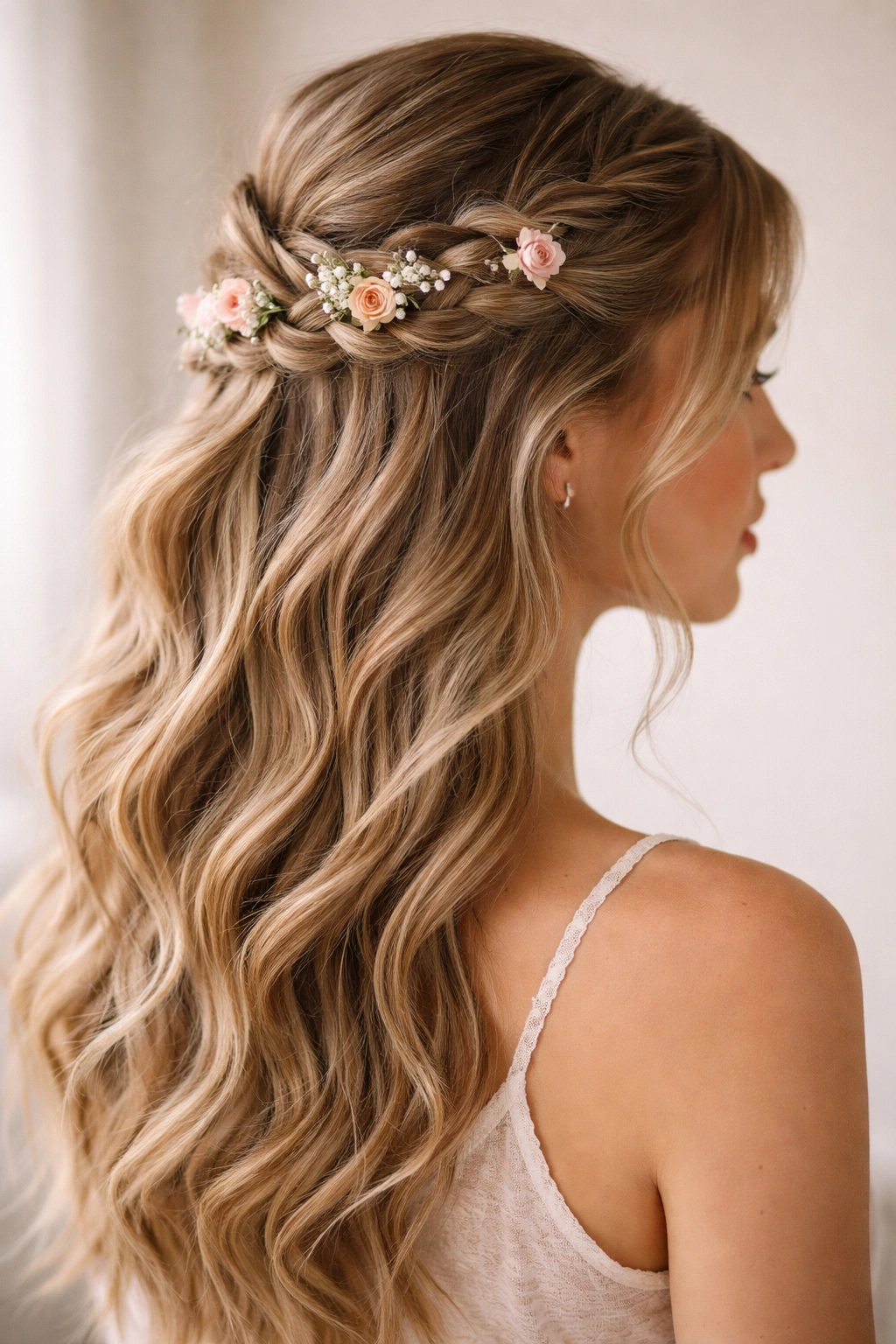
This style features a Dutch braid pulled back from the front hairline, meeting at the back of the head where it’s secured loosely. Rather than weaving flowers into the braid, you’re threading them loosely through and around the braid’s outer edges after it’s completed, allowing them to sit delicately rather than being pulled tight into the structure.
Why Threading Creates a Different Effect Than Weaving
Threading flowers after the braid is complete gives you more control over placement and allows flowers to sit more delicately. They’re supported by the braid without being crushed into it. This approach also gives you the option to change or adjust flowers after styling, which is helpful if you’re working with perishable fresh blooms and need flexibility.
Method for Threading Flowers
- Create a Dutch braid (the reverse of a French braid, where sections go underneath rather than over) starting at the hairline and pulling back toward the crown
- Secure the braid firmly at the back of the head, but leave it slightly loose so there’s room to thread flowers
- Take small sprigs of delicate flowers or individual blooms and gently thread stems through the outer loops of the braid
- Space flowers evenly along the braid length, or cluster them more densely in certain sections
- Allow trailing greenery or longer stems to flow down the length of the loose hair below the braid
- Secure anything that needs reinforcement with a bobby pin, but keep it subtle
Worth knowing: This approach works best with flowers that have pliable stems—ranunculus, roses, and spray flowers thread easily, while thick-stemmed dahlias or peonies will be more difficult.
13. The Half-Up With Flower-Filled Hair Net or Snood
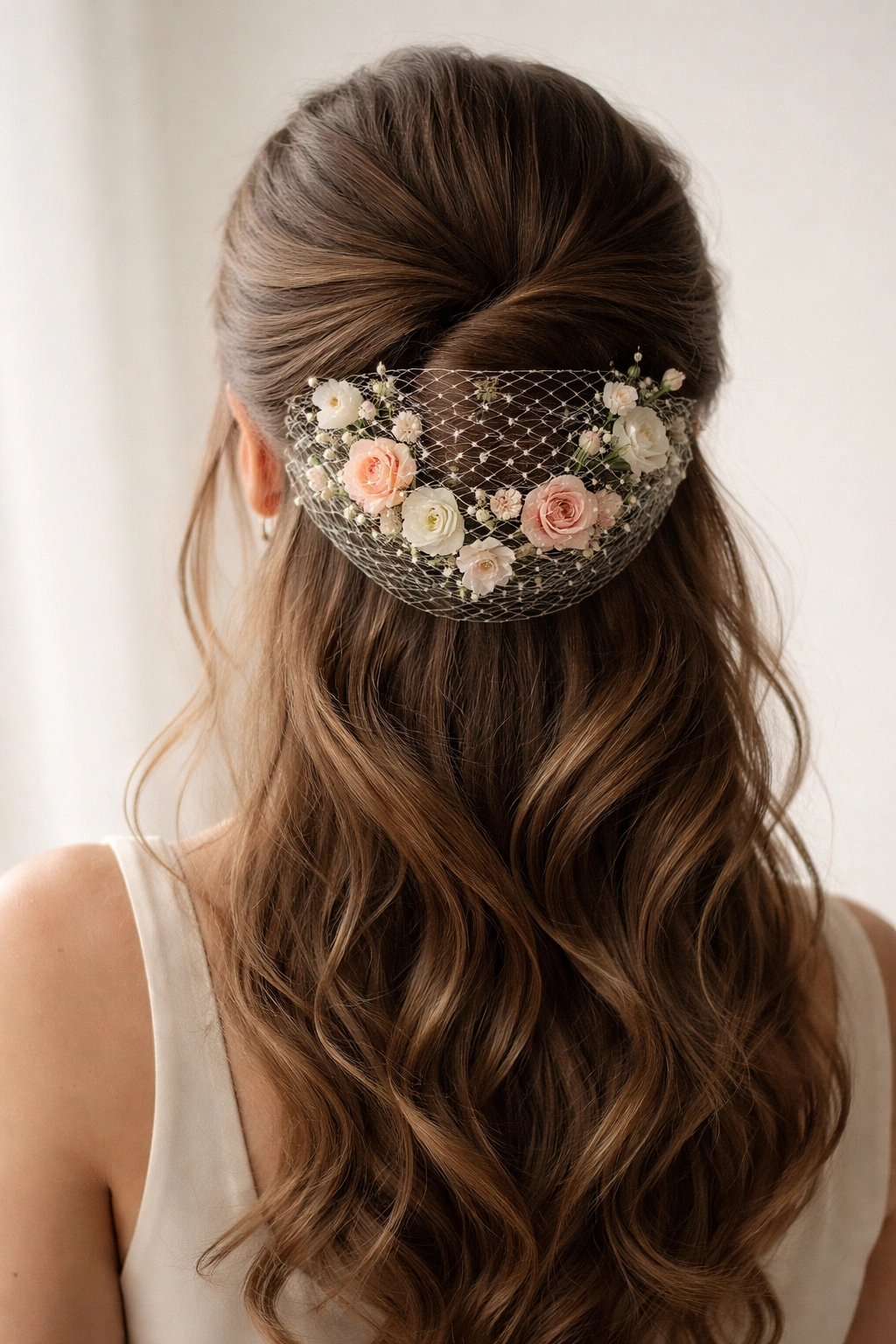
This more editorial approach gathers the half-up section smoothly and encases it partially in a delicate hair net, a mesh snood, or a custom cage structure that’s been adorned with flowers. The flowers sit against the mesh, creating a sculptural, modern look that’s distinctly different from organic, scattered flower placements.
The Modern Edge of Structured Containment
Hair nets and snoods bring a vintage-modern edge to floral styling. Rather than mimicking nature, you’re creating an intentional, architectural structure. The flowers become design elements arranged within a geometric framework. This approach suits editorial shoots, avant-garde styling, or anyone wanting to push floral hair styling beyond the traditional romantic aesthetic.
Creating This Structured Look
- Gather a half-up section smoothly and secure it tightly in a low ponytail with a small elastic
- Position a delicate hair net or mesh snood over and around the gathered section, securing it with bobby pins
- Arrange flowers on and around the mesh structure, securing stems and blooms with very fine floral wire or bobby pins
- You can create focal points where flowers cluster densely, or distribute them evenly across the mesh
- Leave the loose hair below smooth and sleek to contrast with the textured, decorated upper section
- Consider adding greenery or filler flowers that cascade down through the mesh into the loose hair
Insider note: If you can’t find a suitable hair net, you can create a custom structure using floral wire bent into a shape and decorated with flowers—it’s more DIY but equally effective.
14. The Soft Half-Up With Flower Hair Sticks or Forks
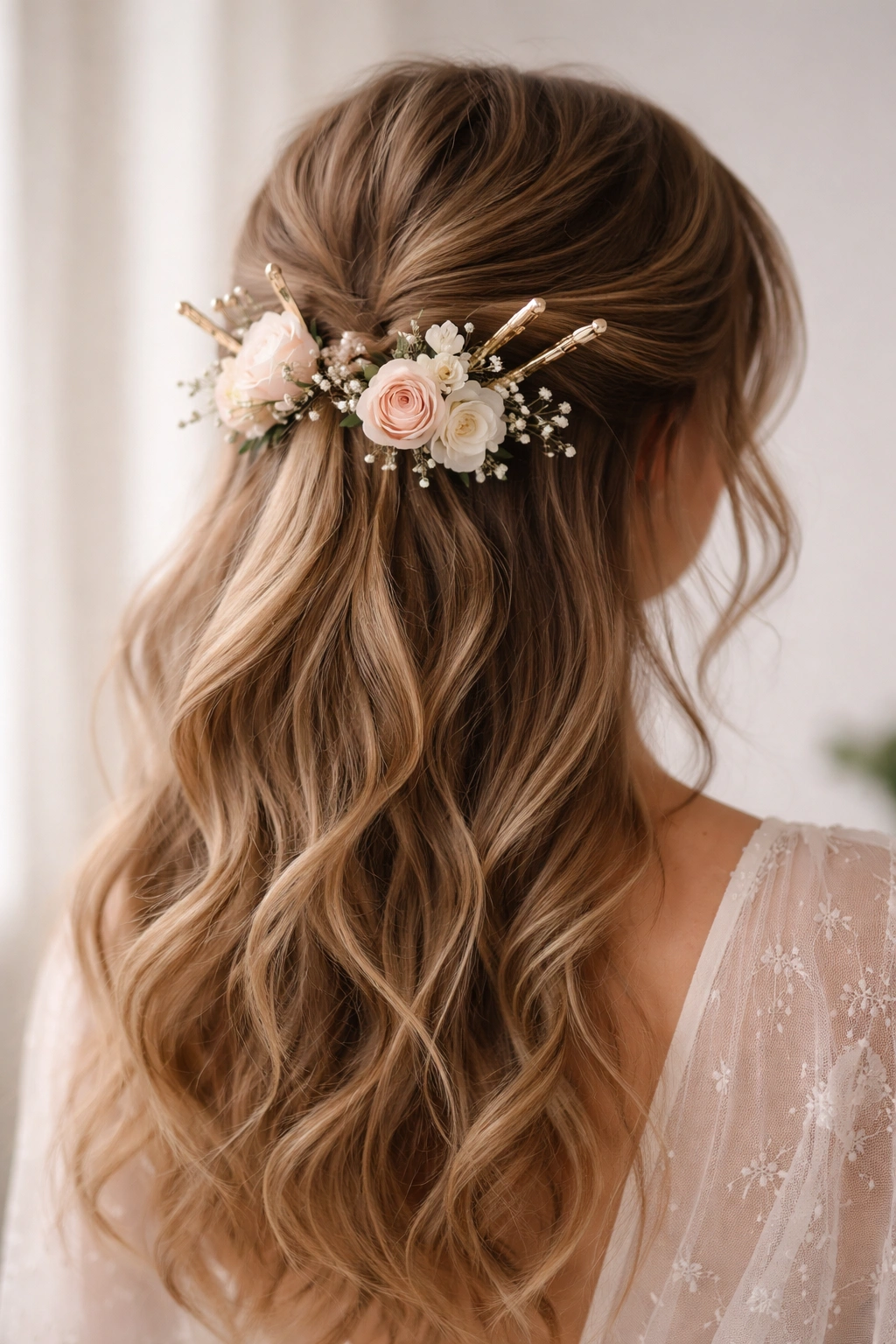
This approach gathers the half-up section and secures it using decorative hair sticks or hair forks—traditional hair accessories that function like an ornamental comb—with flowers attached or arranged around them. The sticks or forks become visible design elements rather than hidden practical tools.
Why Hair Sticks and Forks Feel Special
Hair sticks and forks have visual presence without the heaviness of a comb. They’re delicate, ornamental, and feel special—like you’ve chosen something intentional and beautiful. When paired with flowers, they create a focal point that feels curated and thoughtful. This approach suits anyone who wants to feature a beautiful hair accessory rather than hide it.
Using Sticks and Forks for Floral Styling
- Create a soft, loose half-up ponytail and gather it gently without a tight elastic
- Position a decorative hair stick or fork through the gathered hair at the base, using the implement’s design to secure the ponytail loosely
- Wrap the hair around the stick in a figure-eight pattern or allow it to sit naturally secured by the stick
- Attach flowers around the stick or fork, using floral tape, wire, or small bobby pins to secure stems
- Allow the stick or fork’s design to frame the flowers rather than hiding it
- Leave plenty of hair loose below, with waves or curls for softness
Pro tip: Hair sticks and forks grip textured or second-day hair better than freshly washed, slippery hair—style accordingly, or tease the section gently before securing.
15. The Half-Up Bun With Flower Crown Halo
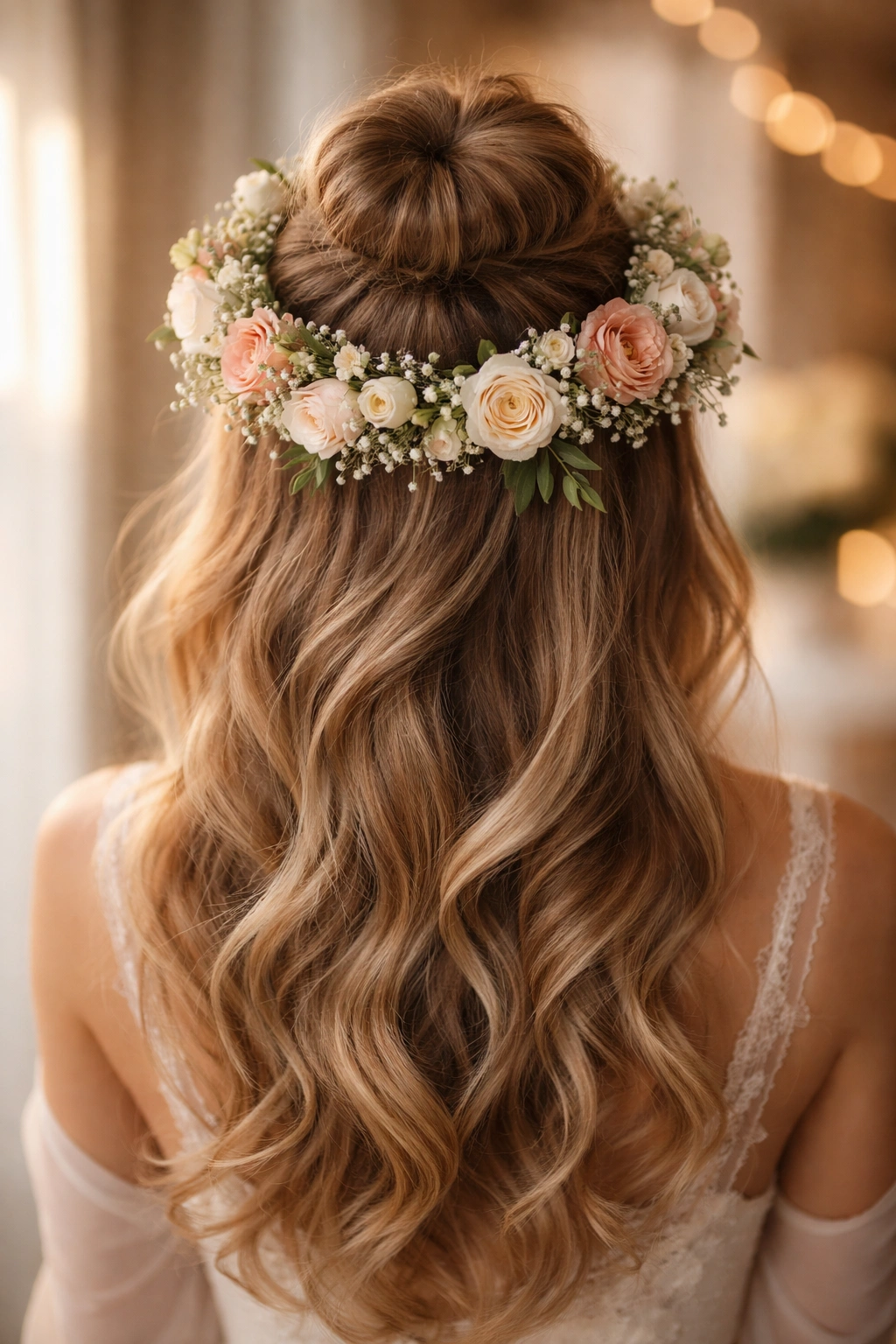
This is the celebration style: a half-up bun positioned high and centered, with a full flower crown or halo of flowers resting just behind the bun and cascading down both sides. The flowers create a complete frame around the back of the head while leaving the face and front open. It’s romantic, bold, and unmistakably special-occasion energy.
Why a Halo Creates Maximum Visual Impact
A flower crown halo does the work of drawing attention toward the back and sides of the head rather than concentrating it at one small point. This creates a richer, more generous visual effect—it’s not just flowers, it’s flowers everywhere. The style is inherently romantic, celebratory, and photographs beautifully from every angle, which is why it’s so beloved for weddings and special events.
Constructing a Flower Crown Halo
- Create a high, smooth half-up bun following the classic half-up bun instructions in item 2, but position it slightly higher than you would normally
- Position the back of a pre-made flower crown at the base of the bun, allowing the crown to sit like a halo around the bun and down the back of the head
- If the crown isn’t quite sitting as you want, secure it with bobby pins hidden beneath the flowers
- Allow flowers to cascade down both sides of the loose hair below the bun
- Consider adding additional loose flowers or greenery that flow from the crown into the loose hair for a more abundant effect
- Ensure the loose hair below has texture and waves to complement the abundance of the flower crown
Worth knowing: A full flower crown adds visible weight to the back of the head—ensure your base bun is very securely pinned before adding the crown, or everything will slowly slip downward throughout the day.
Final Thoughts
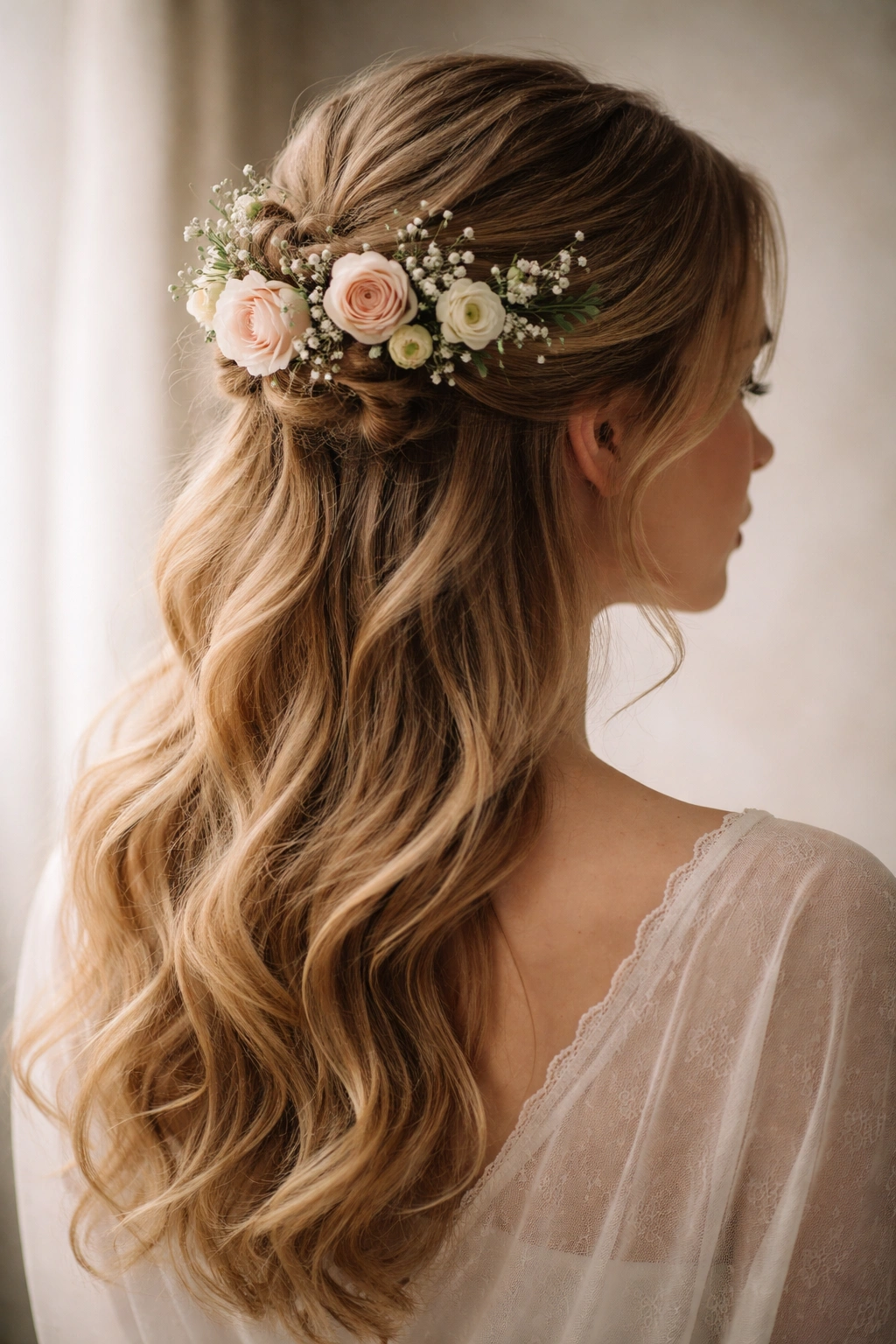
Half-up styles with flowers work because they balance structure with softness, intentionality with effortlessness. Whether you’re drawn to the romantic scattered-bloom approach, the editorial drama of an oversized statement flower, or the celebration-ready abundance of a flower crown halo, the principle remains the same: the flowers enhance and romanticize the hairstyle rather than dominating it.
The real skill isn’t in any one technique—it’s in understanding how texture, placement, and proportion work together. A messy bun reads as styled rather than sloppy when you’ve intentionally teased and positioned each piece. A simple bun becomes special when flowers are placed with consideration for how they’ll look from every angle. Flowers do remarkable work in a hairstyle, but they work best when they’re partnered with solid foundational styling.
Start with whichever of these styles speaks to you most naturally, but don’t hesitate to mix and match techniques. A wrapped base idea from one style can enhance a braided approach from another. The scattered flowers concept works with the structured half-up just as beautifully as it does with the messy version. These aren’t rigid formulas—they’re starting points for understanding how flowers and half-up sections can create something that feels authentically you while still being undeniably special.
