



Half-up half-down hairstyles have become a go-to choice for people wearing locs who want to balance style with practicality. This particular combination offers the best of both worlds—you get the polished, intentional look of an updo while keeping length visible and your face framed beautifully. Locs, with their natural texture and weight distribution, create stunning visual interest when styled this way, and they hold these styles securely without needing excessive heat or damaging products. Whether you’re heading to work, a special event, or just want to refresh your everyday look, half-up half-down bun variations give you endless creative possibilities that look equally impressive and require minimal styling time once you’ve mastered the technique.
What makes locs so perfect for these styles is their inherent grip and structure. Unlike other hair types that might slip or require constant pinning throughout the day, locs stay exactly where you put them. This means you can experiment with details—intricate wrapping, spiral patterns, multiple texture layers—without worrying about the style collapsing by midday. The beauty of half-up half-down styling with locs is that you’re not trying to hide anything; instead, you’re showcasing the texture, length, and character of your locs while creating a focal point at the crown or sides. These styles work across all loc lengths, from shoulder-length to waist-length, and they adapt beautifully to both casual and formal settings.
Let’s explore 15 distinct half-up half-down bun styles that range from sleek and minimal to textured and statement-making—each one designed specifically with locs in mind, practical enough for daily wear, and striking enough to turn heads at any occasion.
1. The Classic High Half-Up Bun
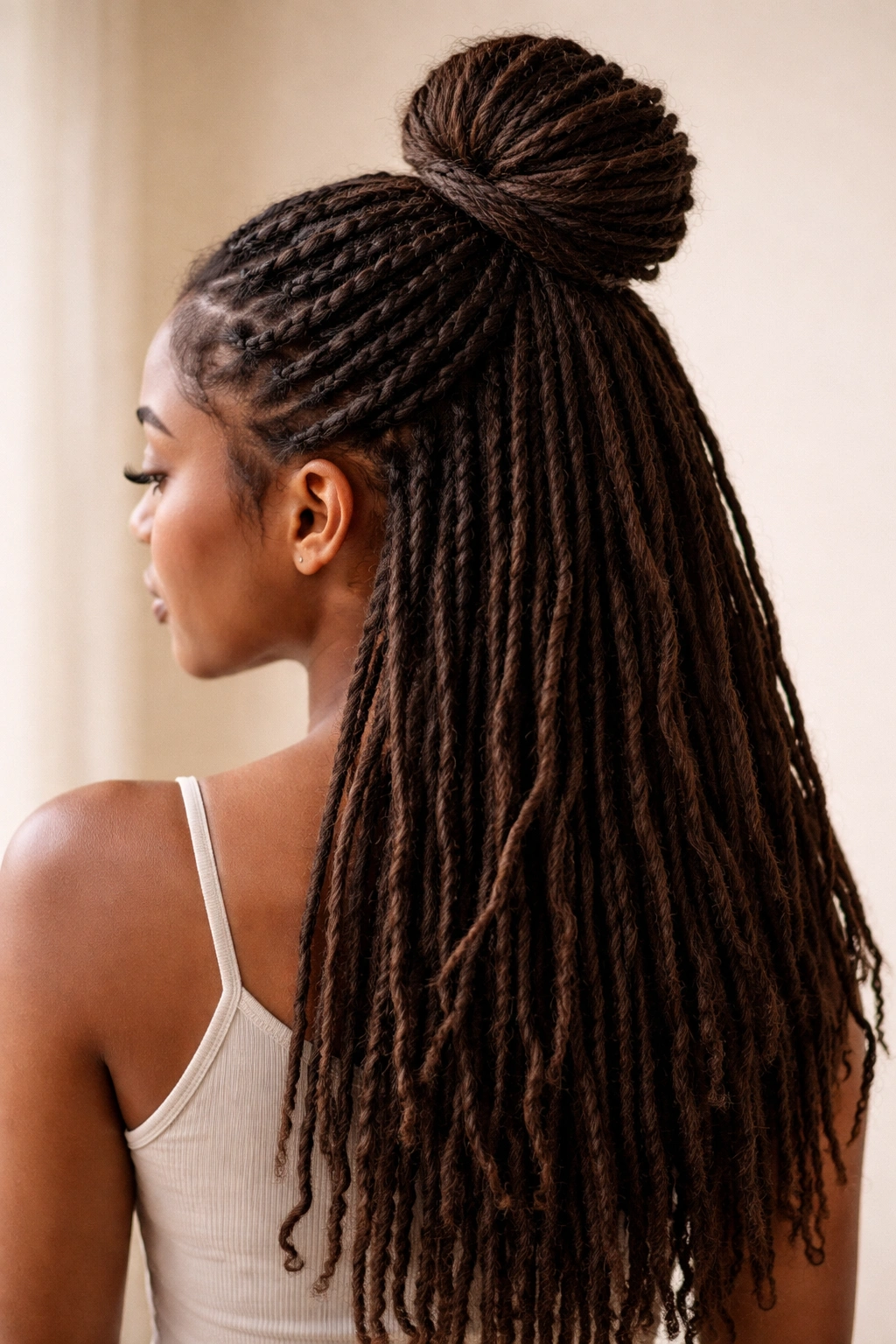
The classic high half-up bun is the foundational style that works in virtually any situation. You’re gathering the top section of your locs—roughly from temple to temple across the crown—into a secure bun positioned high on the head, while the remaining locs flow freely down your back. The appeal of this style lies in its simplicity and its ability to frame your face while keeping hair away from your shoulders. This works especially well if you’re dealing with locs that are just past shoulder-length, as it creates the illusion of even more length and volume.
Why This Style Stands Out
The high positioning creates a lifted, youthful effect that’s flattering on most face shapes. Because it sits at the crown, the weight distribution feels balanced—you’re not creating tension on your hairline, and the style can be worn comfortably for an entire day without causing discomfort. The exposed section of your locs below the bun showcases their natural length and movement, which is particularly striking if you have color, ombré, or natural variation in your locs.
How to Perfect It
Start with locs that are clean and have some moisture in them. Section off the top portion by creating an invisible line from the top of one ear to the top of the other ear, running over the crown. Gather those sections into a high pony using a loc-safe elastic or a smooth hair tie, then twist or wrap that gathered section around itself to create the bun base. Secure with bobby pins or additional elastics tucked underneath for a seamless finish. The key is making sure your base feels tight enough to hold all day but not so tight that you’re causing tension.
Pro Tip
For a softer, more modern finish, gently pull and fluff the bun slightly after creating it—this creates dimension and makes it look intentional rather than too polished. If you have shorter locs around your hairline, leave a few face-framing pieces out to soften the overall look.
2. The Twisted Half-Up Bun
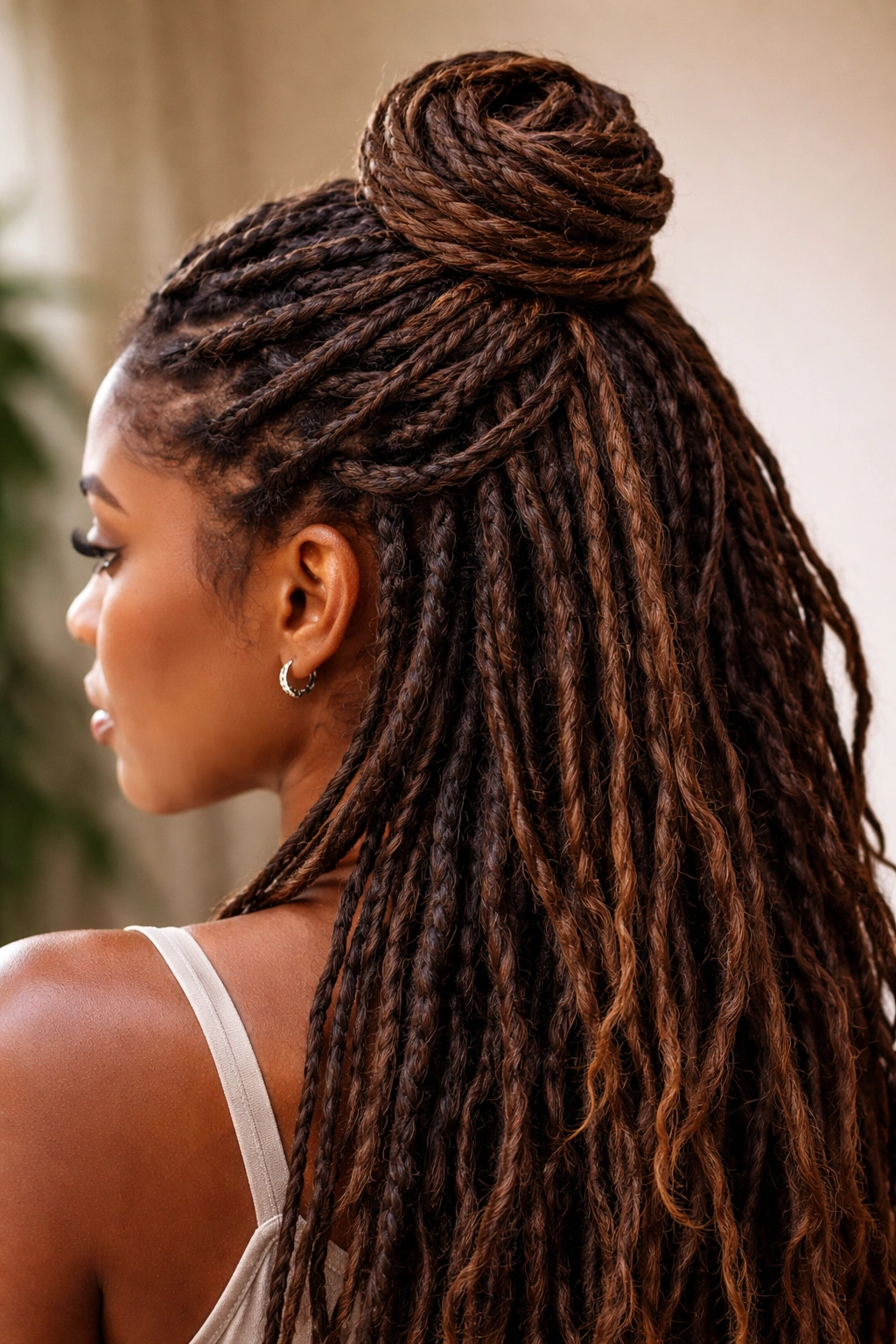
The twisted half-up bun adds a dimensional detail that transforms the classic style into something more visually interesting. Rather than simply gathering your top section straight up, you’re twisting those locs as you bring them together, which creates a spiral effect that catches light and adds movement to your half-up section. This style works beautifully for both casual and dressier occasions, and it’s one of the easiest variations to master once you understand the basic technique.
What Makes It Different
The twist creates a visual focal point at the crown that draws the eye upward and adds sophistication to the overall look. Because locs have natural texture, the twist actually becomes more pronounced and visually interesting than it would be with straight hair—the ridges and dimension of each loc make the spiral visible from multiple angles. This style also tends to feel more secure than a simple gather-and-bun because the twist itself acts as a locking mechanism that keeps everything in place.
How to Create It
Section the same top portion as you would for a classic high bun, but instead of gathering it straight up, divide it into two equal sections. Twist one section clockwise and the other counterclockwise, then bring both twisted sections together at the crown. Wrap them around each other in a spiral, then coil the entire twisted section onto itself to form the bun. Secure with bobby pins inserted directly into the spiral for maximum hold. The result should look like a rope-twisted crown.
Styling Notes
This style pairs beautifully with face-framing pieces—leave out a few locs on each side to soften the twist and create dimension around your face. The twisted detail is significant enough that you can wear the rest of your hair completely sleek and still have visual interest. For a more dramatic effect, you can wrap a complementary scarf or thin braid around the finished bun to add color and texture.
3. The Braided Half-Up Bun with Wrapped Detail
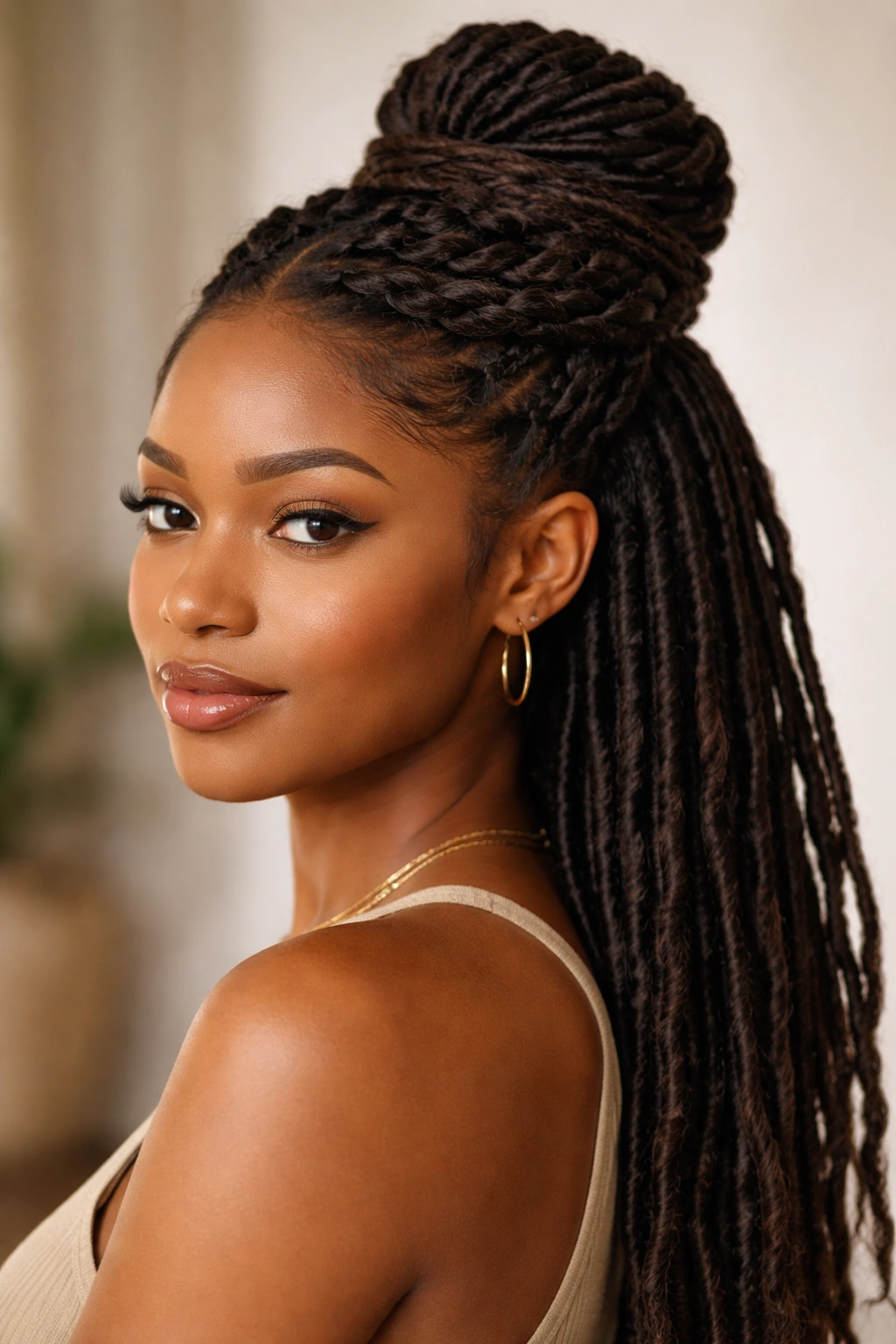
When you incorporate a braid into your half-up bun, you’re adding a whole new level of texture and artistry. This style uses a three-strand or four-strand braid (depending on your preference and loc size) that extends from one side of your head to the other, gathering as it goes, then coils into a bun at the crown. The wrapped detail—whether it’s another section of locs, a thin braid, or a decorative element—adds a finished, intentional appearance that works beautifully for special events and photo-worthy moments.
Why It’s a Top Pick for Occasions
The braid creates structure and movement simultaneously, making this style feel both polished and dynamic. Because you’re braiding your locs into the style itself, rather than just pinning them, you get superior hold and security—this is a style that will absolutely last through an entire event without slipping or loosening. The visual impact is significant too; the braid draws attention to the crown and shows off the thickness and beauty of your locs in a way that simple gathering doesn’t achieve.
How to Build It
Start with clean, moisturized locs. Begin on one side of your head (let’s say the right side), taking a three-loc section at temple level. Begin braiding toward the back of your head, and as you braid, add additional locs from the top section of your head into the braid as you would for a traditional crown braid. The braid should curve over the top of your head and end at the opposite side (in this case, behind your left ear). Once your braid reaches the crown, gather all the loose top-section locs along with the end of the braid and coil them together into a bun.
Wrapped Detail Options
Wrap a thin braid, a contrasting-colored section of locs, or even a complementary ribbon or cord around the base of the bun where it meets the scalp. Tuck the wrapped element under the coil and secure with bobby pins. This detail elevates the style from nice to noteworthy and shows intentional styling.
4. The Double Bun Half-Up Style
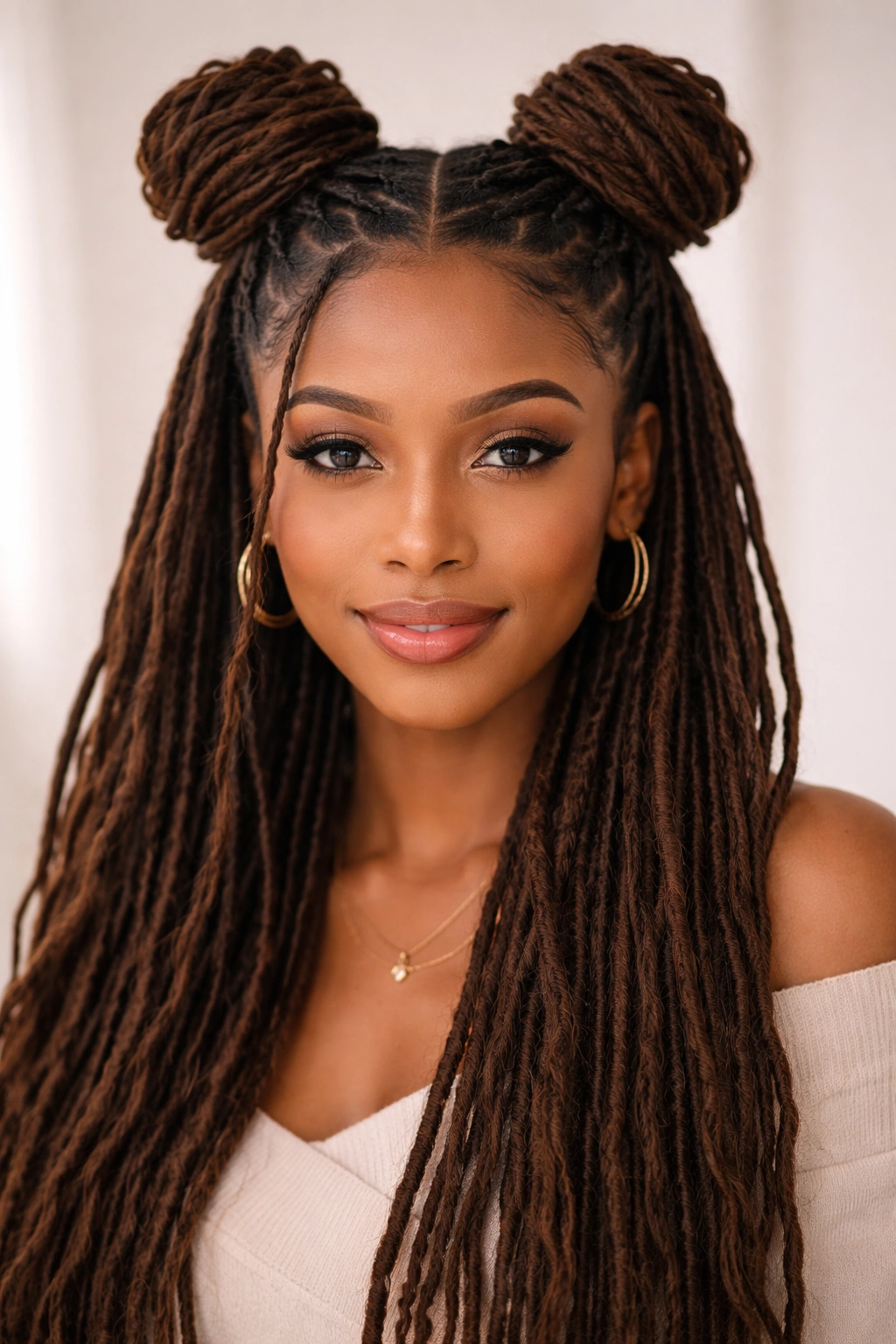
Double buns in a half-up configuration offer a playful, modern twist on traditional styling. Instead of gathering all your top section into one bun, you’re creating two symmetrical buns positioned on either side of the crown, which creates a balanced, creative look that’s surprisingly flattering. This style works particularly well for people with medium to long locs and adds a youthful energy that feels both trendy and timeless.
What Makes It Stand Out
The symmetry of double buns is inherently pleasing to the eye—it’s a balanced composition that feels intentional and artistic. This style also distributes the weight of your locs across two points rather than one, which means it’s more comfortable for all-day wear and creates less tension on any single area of your scalp. The style photographs beautifully and works equally well for casual hangouts and music festivals as it does for creative professional settings.
How to Create It
Divide your top section down the middle with a center part from your forehead to the crown. Section off the right side of this top section (from your center part to your right ear) and gather it into a secure bun at approximately 1-2 inches to the right of the center point. Repeat on the left side, creating a mirror-image bun. Both buns should sit at roughly the same height on the crown and be approximately the same size for visual balance.
Quick Facts
- This style works best if your locs are roughly the same thickness and length
- The space between the buns can be enhanced with small decorative pins or cuffs for added visual interest
- You can wrap each bun individually for a more finished, formal look, or leave them loose and textured for a casual vibe
- The remaining half-down locs should fall naturally in the center of your back, framing the two buns
5. The Side-Swept Half-Up Bun
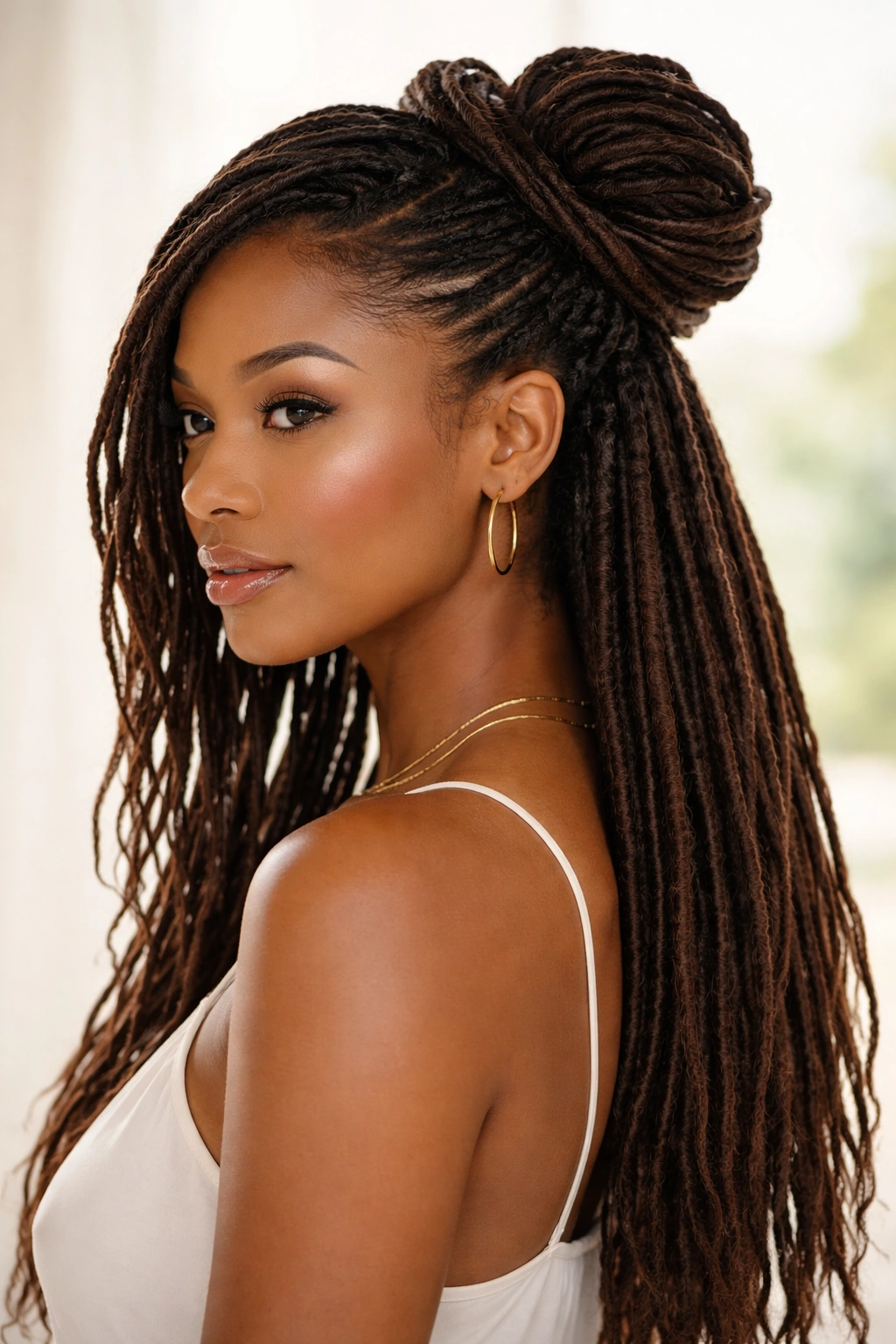
The side-swept half-up bun moves away from the centered crown placement and instead gathers all your top section into a bun positioned to one side—typically over your right or left shoulder. This asymmetrical approach creates a romantic, elegant silhouette that’s particularly flattering on longer loc styles. The side position also means you’re showcasing one side of your face more prominently while creating beautiful shape and movement through the bun placement.
Why It Feels So Elegant
Asymmetrical styling has an inherently sophisticated quality—it feels intentional and designed rather than simply gathered. The side bun draws attention to the nape of your neck and creates a graceful curve from your crown down to where the bun sits. This style pairs beautifully with side-swept bangs (if you have them), decorative jewelry along the exposed ear side, or a simple earring that becomes the focal point of the asymmetrical design.
How to Execute It
Section your top portion as usual, but instead of gathering it straight up to the center crown, angle your gathering motion toward the right (or left, depending on which direction you want to sweep). Create your bun at the sweeping point—roughly where your locs would naturally rest over your shoulder. You can braid the gathered section before coiling it, create a simple twist, or leave it textured; all approaches work beautifully with this placement.
Pro Tips for This Style
Use bobby pins that match your loc color to secure everything invisibly. If you have baby locs or shorter pieces around your hairline on one side, brush them gently toward the other side to create a clean, open profile on the sweeping side. The side-swept bun looks even more striking when the remaining half-down locs are brushed toward the opposite side, creating a strong visual direction from the top of your head to the bottom.
6. The Messy Textured Half-Up Bun
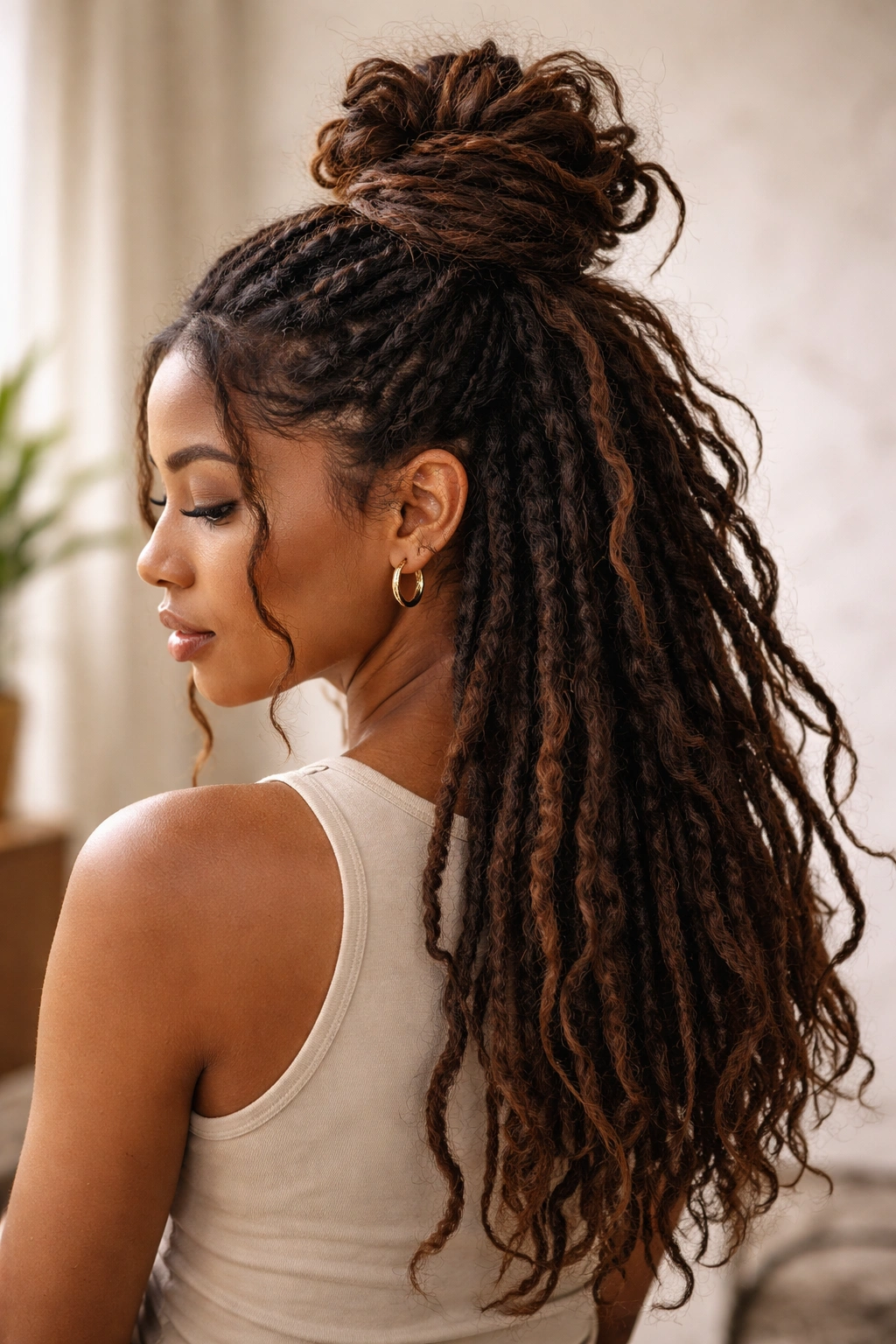
If you prefer a style that feels intentionally undone rather than precisely polished, the messy textured half-up bun is your answer. This style embraces the natural texture of your locs and creates a bun that looks deliberately loose, with sections poking out and the overall composition feeling organic rather than geometric. It’s perfect for casual days, for situations where you want your locs to be part of the statement rather than neatly contained, and for times when you want a style that doesn’t require perfection to look good.
What Makes It Stand Out
The beauty of this style is that the “imperfections” are actually the entire point—flyaways, texture, slightly loose sections, and irregular bun shape all contribute to the intentional, effortless aesthetic. This is the style you wear when you want to communicate that you’re not trying too hard, even though creating it might require slightly more thought than you’d expect. It works perfectly with locs because their inherent texture and dimension make them look good even when they’re not perfectly arranged.
How to Build It
Gather your top section loosely—you’re not looking for a tight, secure base here. Create your bun by coiling your gathered locs, but don’t secure it overly tightly with bobby pins. Instead, use a few pins to anchor the shape, then deliberately loosen and fluff the coil, pulling out small sections to create the textured, undone appearance. The bun should look like it could fall apart any second, but it won’t because those strategic bobby pins are doing their job invisibly.
Styling Notes
Wear this bun with a few face-framing locs pulled forward on each side—the asymmetry is part of the charm. You can add a subtle hair cuff, a thin ribbon woven through the bun, or leave it completely plain. This is the kind of style that gets better as you wear it—the slight movement and shifting of the bun throughout the day actually enhances the intentionally undone aesthetic.
7. The Crown Braided Half-Up Bun
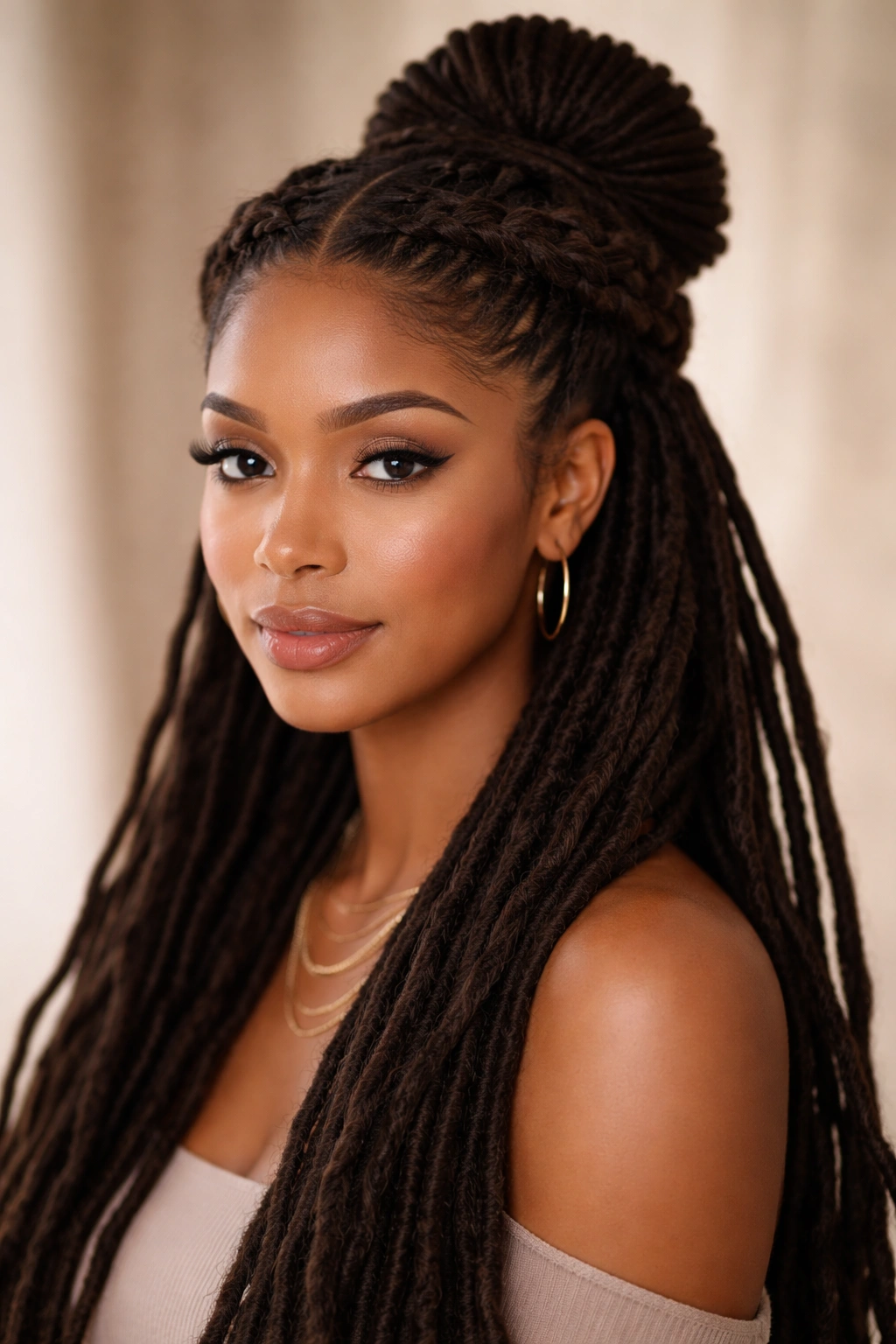
The crown braided half-up bun combines the elegance of a full crown braid with the practicality of the half-up bun. Your braid begins at one temple, traces around the back of your head in a crown-like pattern, and ends at the opposite temple, where you then gather the remaining top-section locs and the end of the braid into a centered bun. This style feels dressy and intricate while remaining surprisingly easy to achieve once you’re comfortable braiding your locs.
Why It’s a Top Pick for Special Events
The crown braid creates an instant halo effect that feels ceremonial and intentional—it’s the kind of style people compliment and ask how long it took to create. The braid showcases your locs’ dimension and creates a frame for your face that’s flattering from every angle. Because the braid is incorporated into the bun rather than being a separate element, the overall style feels cohesive and expertly executed, even if you’re relatively new to styling your locs.
How to Create It
Begin at the right temple with a three-loc section. Start braiding, and as you move toward the back of your head, add additional locs from the top section into the braid in a crown-like pattern. The braid should curve over the top of your head and end somewhere behind your opposite ear. Once the crown braid is complete, gather all remaining top-section locs along with the end of the braid and coil them into a centered bun at the crown.
Quick Facts
- Take time to ensure your braid is even and tight before you begin coiling the bun
- The crown braid should be the same thickness throughout—don’t add too many locs at once
- This style looks most striking when your locs have good separation and definition
- You can skip the bun and leave the end of the crown braid loose for a different look, or wrap the braid around the base of the bun for extra detail
8. The Wrapped Base Half-Up Bun
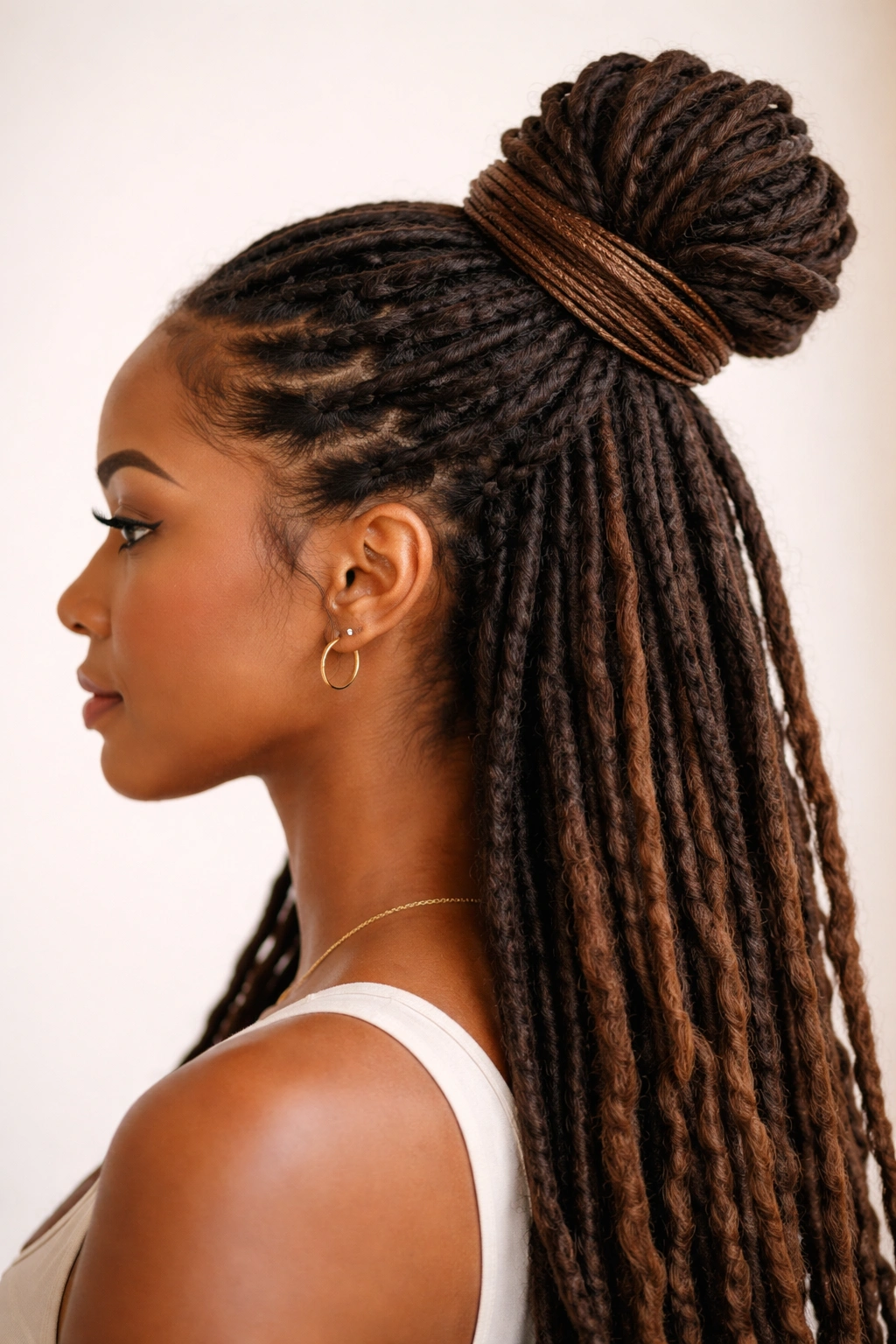
The wrapped base half-up bun is all about the details. You’re creating a simple high half-up bun, but then wrapping the base where the bun connects to your scalp with a complementary element—this might be a thin loc, a decorative cord, ribbon, yarn, or another section of locs in a contrasting color or shade. The wrapped detail draws attention to the crown and transforms a basic bun into something with intentional styling and finish.
What Makes It Different
The wrapped detail is surprisingly transformative—it adds color, visual interest, and a sense of polish to an otherwise simple style. This is also a fantastic way to incorporate accessories or play with color without committing to elaborate braiding or complex styling. The wrapped element frames the bun and creates a visual anchor point that makes the entire style feel more put-together and intentional.
How to Apply It
Create your half-up bun using whatever method you prefer—gather and coil, or use a simple tie. Once the bun is secure, take your wrapping element (let’s say a thin loc or decorative cord) and begin wrapping it tightly around the base of the bun where it meets your scalp. Wrap around and around until the entire base is covered, then tuck the end underneath the bun and secure with bobby pins. The wrapped base should look like a smooth, finished ring around the bun.
Wrapping Material Ideas
- A thin loc matching or contrasting your natural color
- A complementary yarn or cord wrapped tightly and smoothly
- Ribbon or silk ribbon for a dressy, elegant look
- A thin braid incorporating hair and decorative elements
- A metallic cord for an edgier, more modern aesthetic
9. The Sleek Low Half-Up Bun
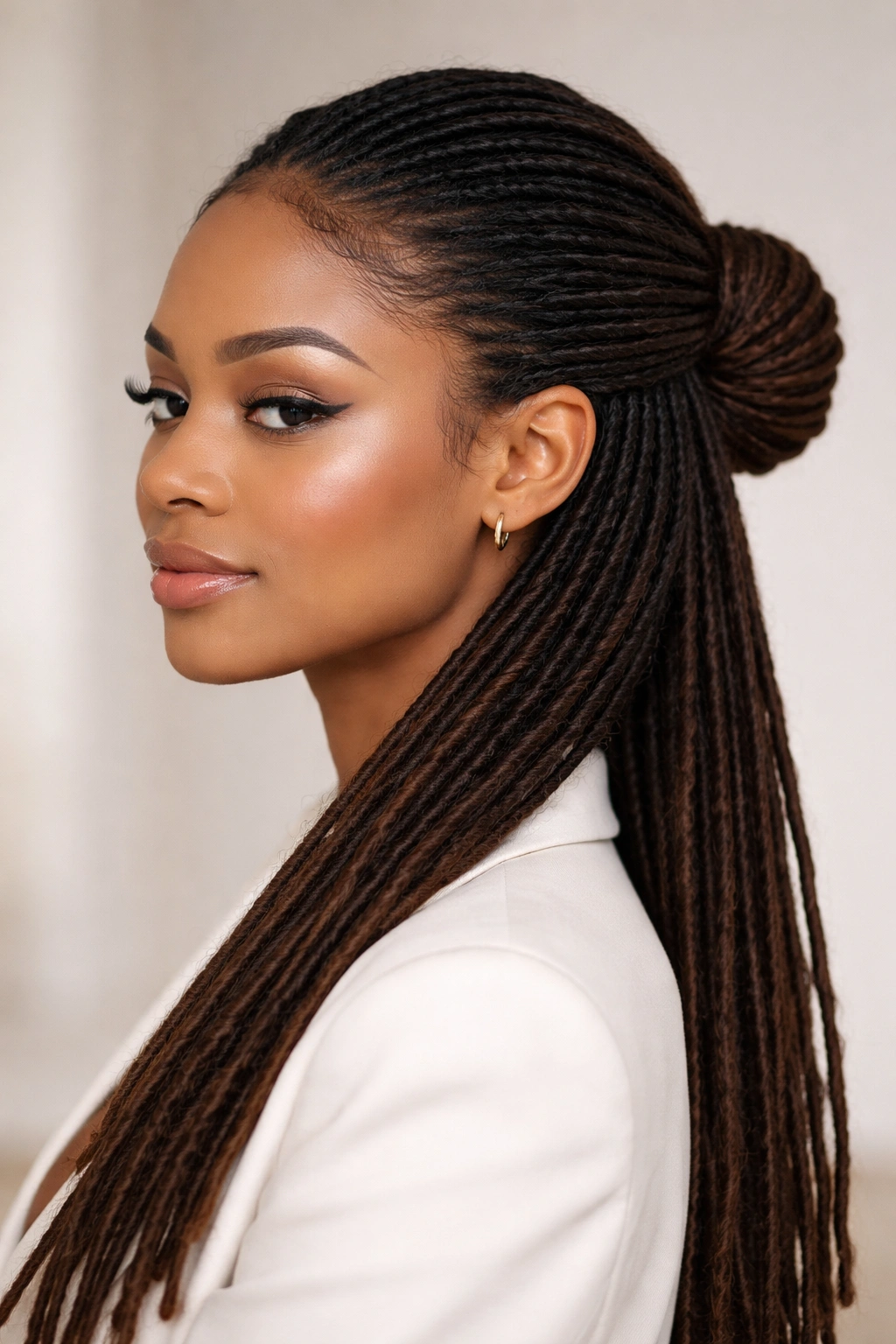
For situations where you want the elegance of a half-up style but prefer a lower, more conservative placement, the sleek low half-up bun is your answer. This style gathers your top section but positions the bun lower, roughly at the nape of your neck rather than at the crown. The positioning creates a longer, more elongated silhouette while still keeping hair away from your face and shoulders. This is an excellent choice for professional settings, formal events, and any situation where you want to appear polished without being too statement-making.
Why It’s a Top Pick for Professional Settings
The low placement feels more conservative and traditionally “professional” than higher buns, which can sometimes read as casual. The style elongates your neckline and creates a sleek, refined appearance that’s flattering and appropriate for workplace settings, client meetings, and formal events. Because the bun sits lower, it also puts less visual weight on the crown of your head, which some people prefer aesthetically.
How to Execute It
Section your top portion as you would for a classic half-up bun, but angle your gathering motion downward rather than straight up. You’re gathering the same amount of hair, but directing it toward the lower back of your head—roughly where your lower neck meets your upper back. Create a smooth, sleek bun at this lower placement. For maximum polish, smooth your gathered section with a light gel or edge control before coiling it into the bun.
Pro Tips for This Style
This style looks even more polished when you smooth your top section completely—no texture or flyaways visible in the front half of your head. Use bobby pins to anchor the bun securely at the back. The lower placement means gravity is working with you to keep the bun secure, so this style remains comfortable and intact throughout an entire workday.
10. The Spiral Half-Up Bun
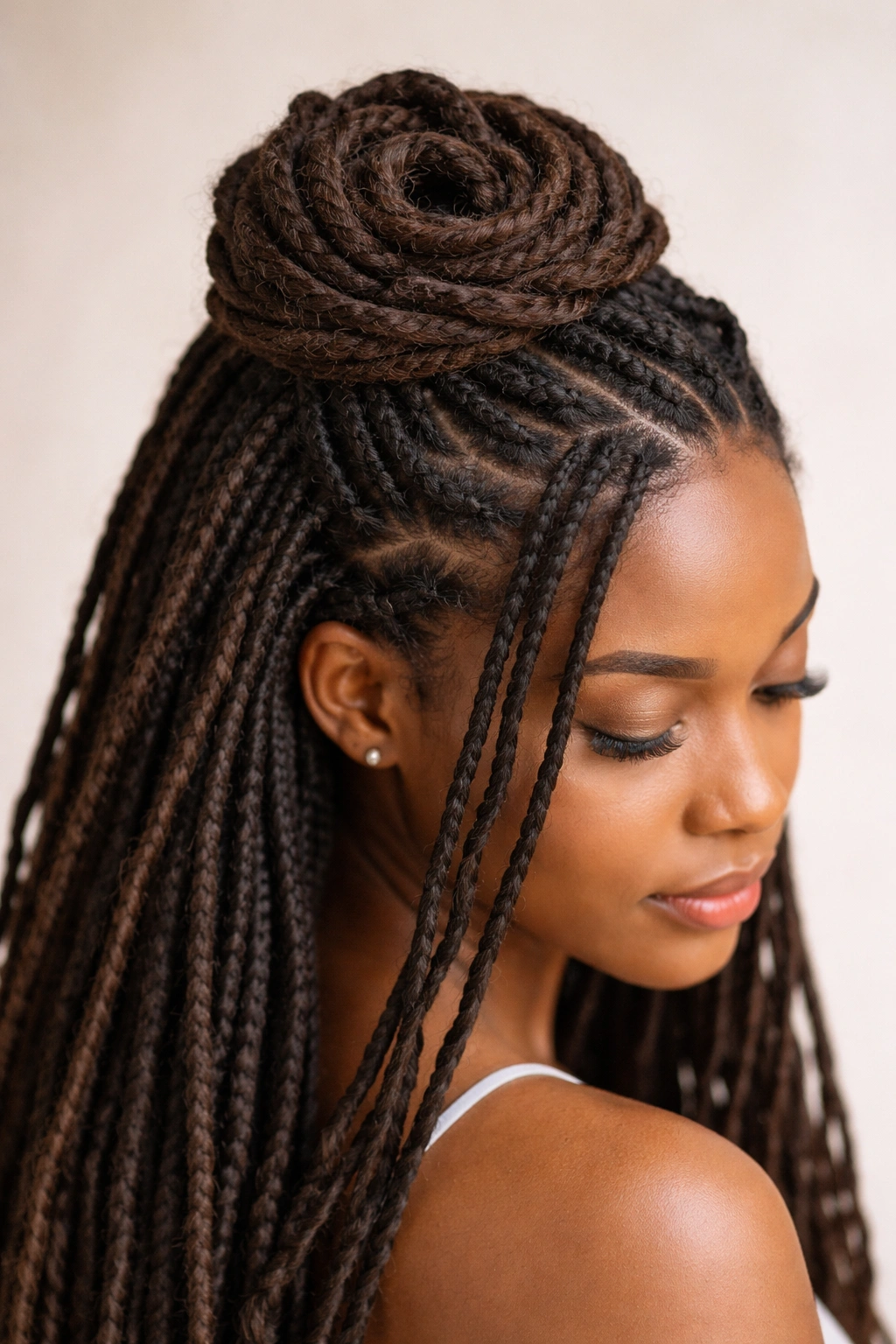
The spiral half-up bun takes the basic concept and adds visual complexity through an intentional spiral pattern. Rather than simply coiling your gathered locs into a bun shape, you’re creating visible spiral ridges by carefully and deliberately wrapping your gathered section around itself in a tight, controlled spiral. The result looks intricate and intentional, like something that required serious skill to execute, even though it’s actually quite manageable once you understand the technique.
Why It Looks So Complex
The spiral creates visual depth and texture that catches light beautifully, especially if your locs have any variation in color or if you use contrasting lighting. The ridges of the spiral create shadow and highlight effects that make the style look three-dimensional and artistic. This style communicates effort and intentionality—it reads as a styled, special-occasion look even if it only took you 10 minutes to create.
How to Build It
Gather your top section and pull it up to your crown placement. Before coiling it into a bun, hold the gathered section in both hands and begin wrapping it around itself in a tight spiral, making sure each loop of the spiral is visible and distinct. As you wrap, you’re simultaneously coiling the section into a bun shape, but the spiral pattern is the focal point. Once you’ve spiraled the entire section into a bun shape, secure it with bobby pins inserted between the spiral ridges.
Styling Notes
This style looks best when your locs are relatively similar in thickness—significant variation in loc size can make the spiral pattern less visible. The tighter your spiral wraps, the more pronounced the pattern will be. You can enhance the spiral effect by using bobby pins that match your loc color and spacing them at regular intervals around the spiral, or by wrapping the spiral with a thin contrasting element to make it even more visually striking.
11. The Criss-Cross Half-Up Bun
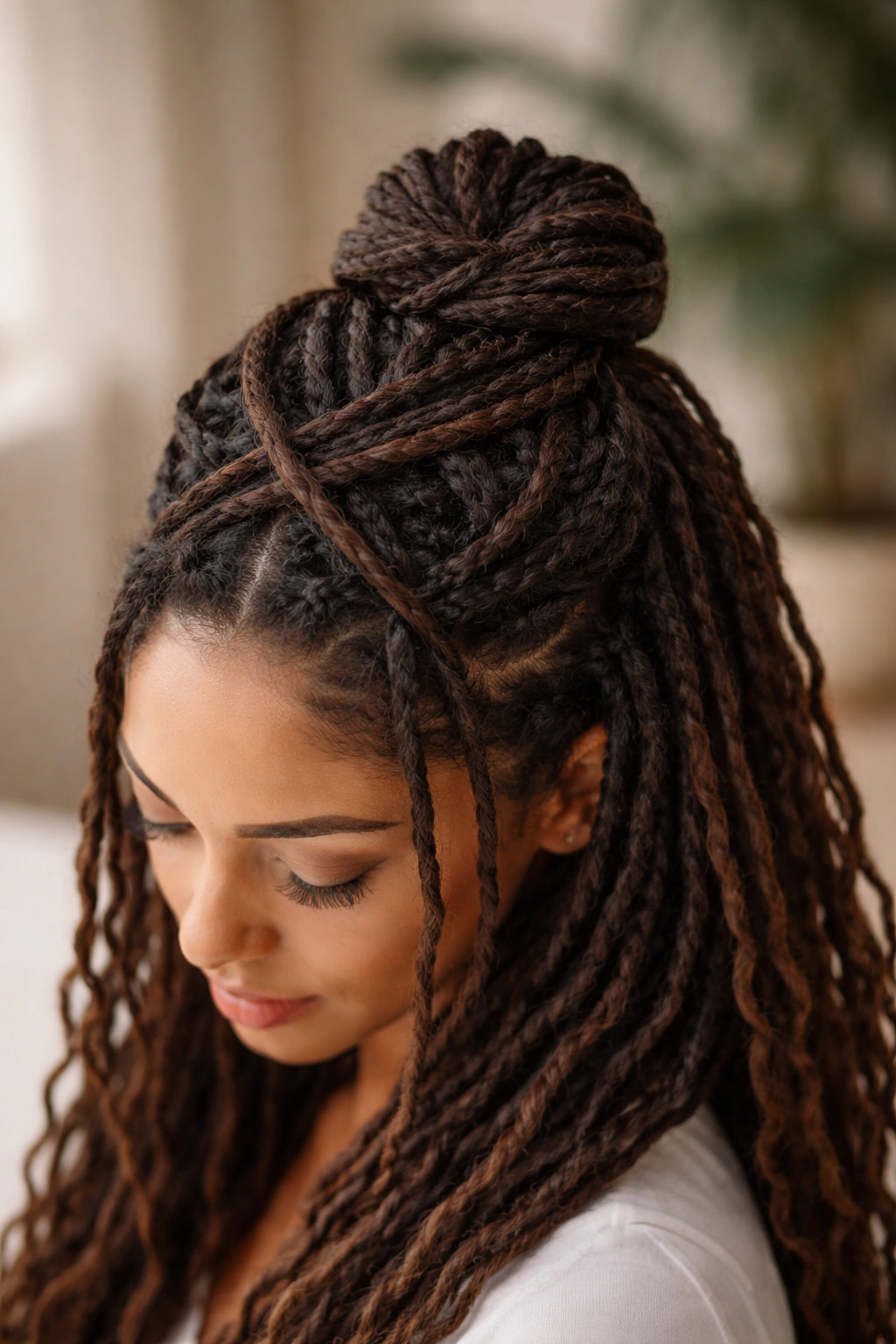
The criss-cross half-up bun adds dynamic visual movement through a crossing pattern created before coiling into the bun. You’re essentially creating two or more crossing sections that form an X or lattice pattern at the crown before gathering everything into a bun. This style creates the illusion of complexity and artistry while remaining surprisingly straightforward to execute once you understand the mechanics.
What Makes It Stand Out
The crossing pattern creates visual interest and movement that’s different from any other half-up bun variation. The intersecting lines draw the eye toward the crown and create a sophisticated, almost architectural quality to the style. This is the kind of detail that makes people assume you spent considerable time on your hair, when in reality it’s a relatively quick styling technique.
How to Create It
Divide your top section into two or more sections (two creates a simple X, three creates more complexity). Take your first section and angle it toward the right side of the crown. Take your second section and angle it toward the left side, crossing over the first section. If using three sections, angle the third section down the center. Once your sections have created your desired crossing pattern, gather all sections together at the crown and coil them into a bun. The crossing points should remain visible in the finished style.
Quick Facts
- This style works best with medium to thick locs that have good definition
- The tighter your crossing sections, the more visible the pattern will be
- You can wrap decorative elements around the crossing points for added visual interest
- This style pairs beautifully with face-framing locs that soften the geometry of the crossing pattern
12. The Asymmetrical Half-Up Bun
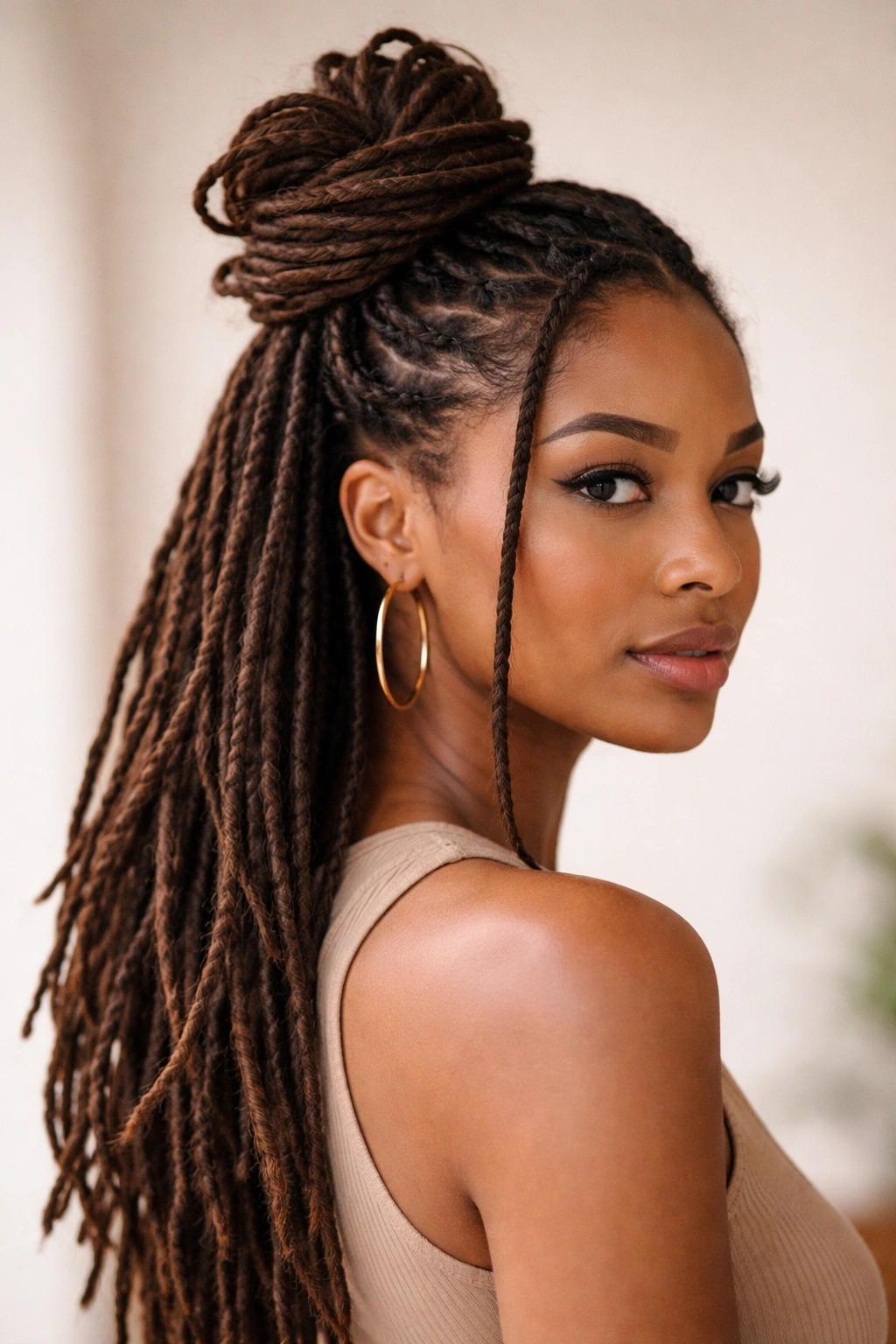
The asymmetrical half-up bun embraces imbalance as a design element, creating a style where your bun placement, size, or embellishment is deliberately uneven. This might mean gathering more locs on one side than the other, positioning your bun slightly off-center, or adding wrapping or braiding details to only one side of the bun. The asymmetry creates a modern, artistic aesthetic that feels intentional and designed rather than accidental.
Why It Feels So Modern
Asymmetry has become increasingly appreciated in contemporary design and fashion—it creates visual interest and breaks from traditional notions of beauty that emphasized perfect symmetry. An asymmetrical bun feels fresh and creative while remaining entirely wearable for everyday occasions. This style says you’re confident enough to embrace balance as a concept rather than a requirement.
How to Execute It
Create your bun using any method you prefer, but deliberately position it off-center—perhaps 2-3 inches to the right rather than directly at center crown. Alternatively, gather slightly more locs on one side than the other when creating your bun, resulting in a bun that’s visually weighted toward one side. You can enhance the asymmetry by adding wrapping, pinning, or decorative elements to one side only.
Styling Notes
Let more face-framing pieces out on the side opposite your bun placement to balance the visual weight. The asymmetry should feel intentional rather than like an accident—embrace it fully. This style looks particularly striking with minimal additional styling or jewelry, as the asymmetrical bun itself is the statement.
13. The Accessorized Half-Up Bun
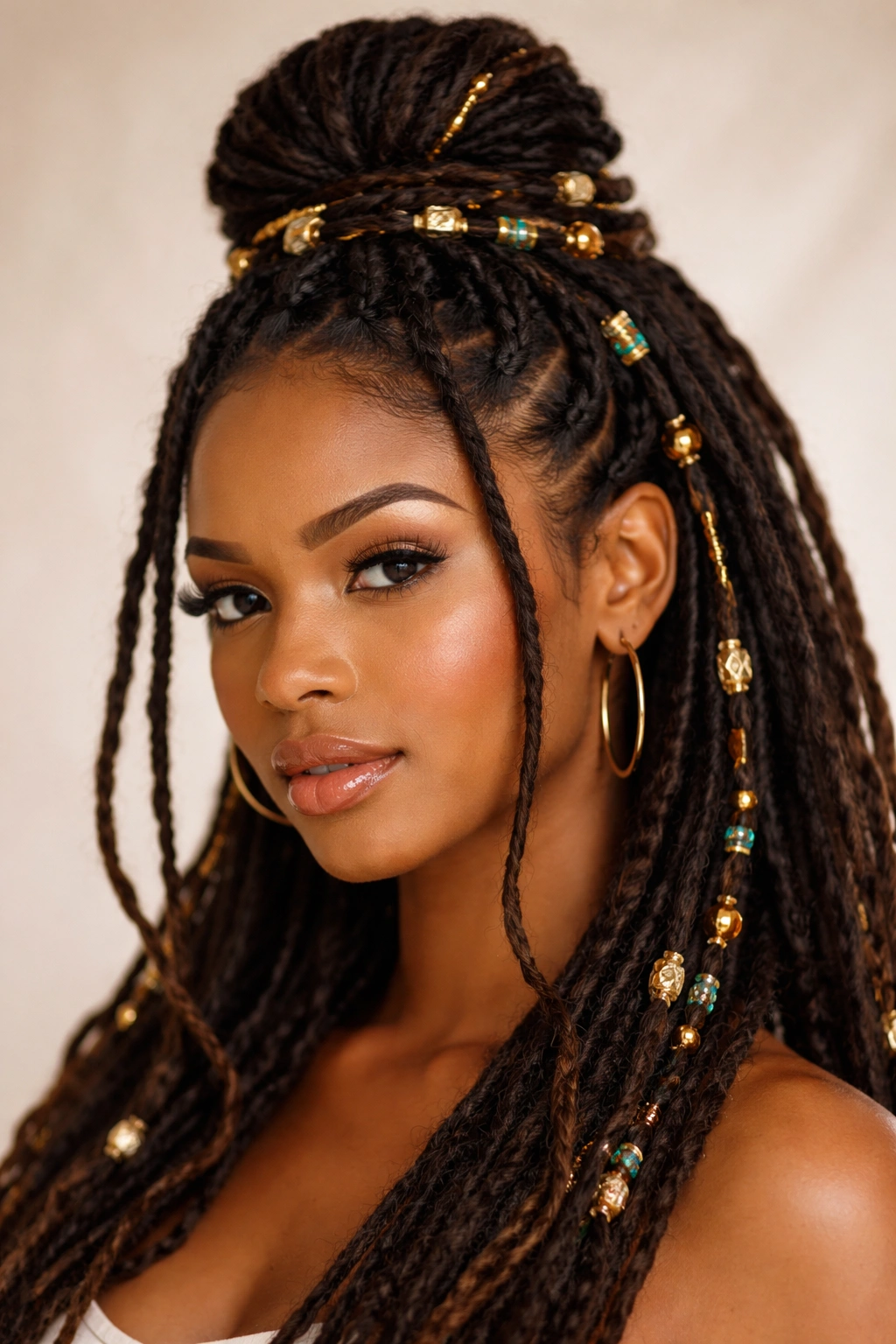
The accessorized half-up bun is less about the styling technique and more about the decorative elements you add to a basic half-up bun. You might use gold cuffs, colorful beads, decorative pins, silk scarves, fresh flowers, faux gems, or any other embellishment that speaks to your personal style. The bun itself might be simple and straightforward, but the accessories elevate it into something special and personalized.
Why It Stands Out
Accessories allow you to personalize your hairstyle without requiring advanced styling skills—you’re not learning a new braiding technique or complex wrapping method; you’re simply adding elements that reflect your aesthetic. This approach is also incredibly versatile—the same basic half-up bun can feel casual with minimal jewelry, romantic with flowers, edgy with metallic cuffs, or professional with a single decorative clip.
How to Apply It
Create a basic half-up bun using any technique you’re comfortable with. Once the bun is secure, add your chosen accessories. Loc cuffs can be threaded onto individual locs or positioned around the base of the bun. Decorative pins can be woven through the coil. Ribbons or scarves can be wrapped around the base. Fresh flowers can be tucked into the bun structure itself. Beads can be threaded onto individual locs that make up the bun.
Accessory Ideas
- Metal or beaded loc cuffs (gold, silver, copper, or mixed metals)
- Fresh flowers or greenery tucked into the bun
- Decorative hairpins with pearls, gems, or unique shapes
- Silk or velvet ribbons wrapped around the base
- Colorful yarn woven through the coil
- Faux gems or crystals adhered to the scalp near the bun
- Vintage brooches positioned at the base of the bun
14. The Bubble Half-Up Bun
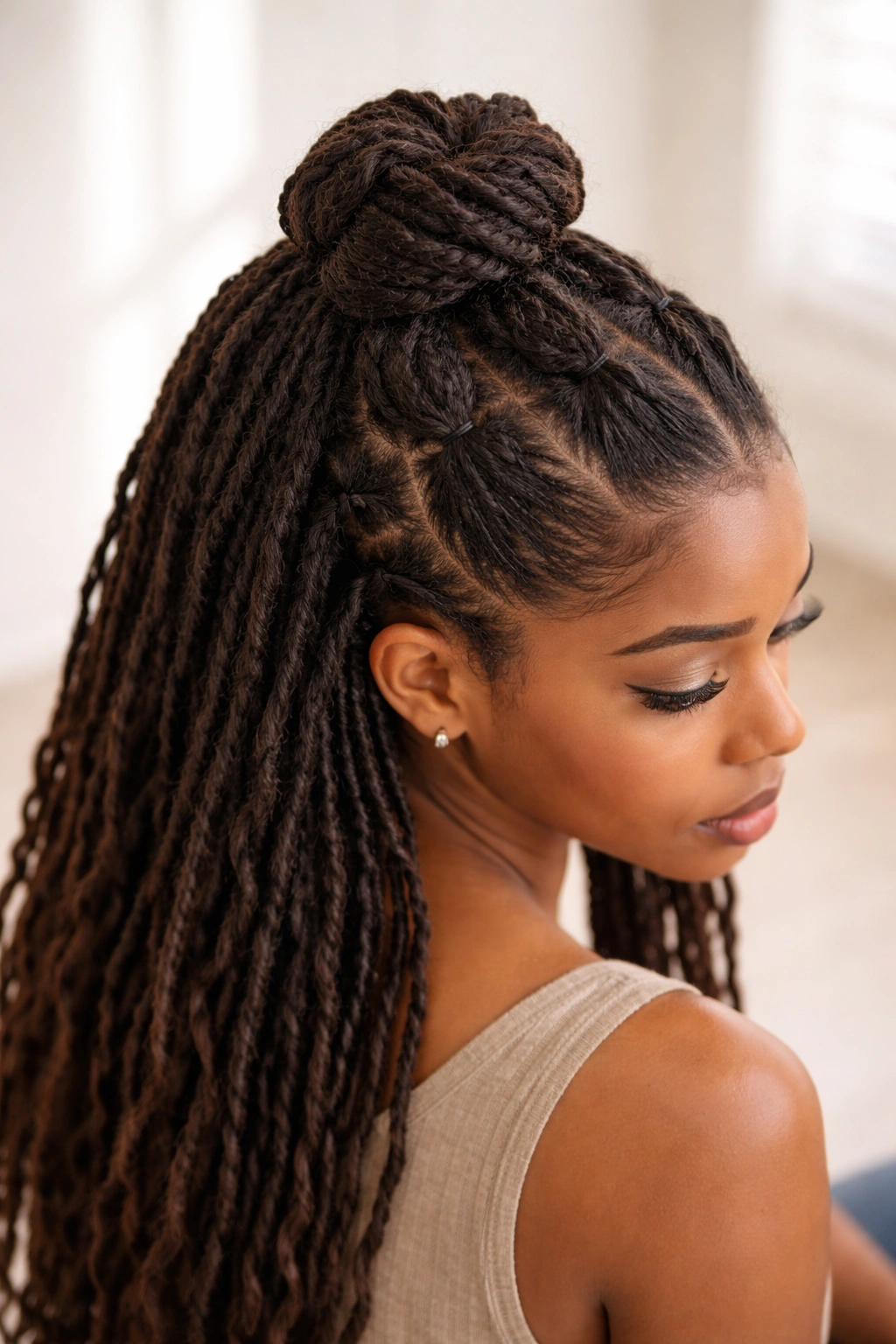
The bubble half-up bun is a playful, dimensional style created by dividing your gathered top section into multiple segments and securing each segment individually with small elastics before coiling the entire gathered section into a final bun. The segments create distinct “bubbles” that give the style volume, texture, and a youthful, creative energy. This is an excellent choice for people who want a fun, distinctive look that photographs beautifully.
What Makes It Stand Out
The segmented bubble effect creates visual rhythm and movement that’s different from any smooth, single-coil bun. The multiple sections and elastics also distribute the weight of your locs across several points, making the style more comfortable for all-day wear. The bubbles create shadow and highlight effects as they sit against each other, adding dimension and artistry to the overall composition.
How to Create It
Gather your top section into a high half-up position. Using small elastics or thread that matches your loc color, divide this gathered section into 3-5 equal segments from scalp to tip. Secure each segment individually with an elastic. The segments should be evenly spaced and roughly equal in size. Once all segments are secured, gently fluff and pull each segment outward to create the bubble effect. Then take the entire gathered section and coil it into a bun shape, securing with bobby pins. The bubbles should remain visible and distinct in the finished bun.
Pro Tips for This Style
The more segments you create, the more bubble effect you’ll achieve, but too many can look chaotic—aim for 3-5 for a balanced look. Each bubble should be roughly the same size for visual harmony. You can enhance the bubble effect by using elastics in a contrasting color to the bubbles themselves, or keep everything matching for a more subtle version.
15. The Scarf-Wrapped Half-Up Bun
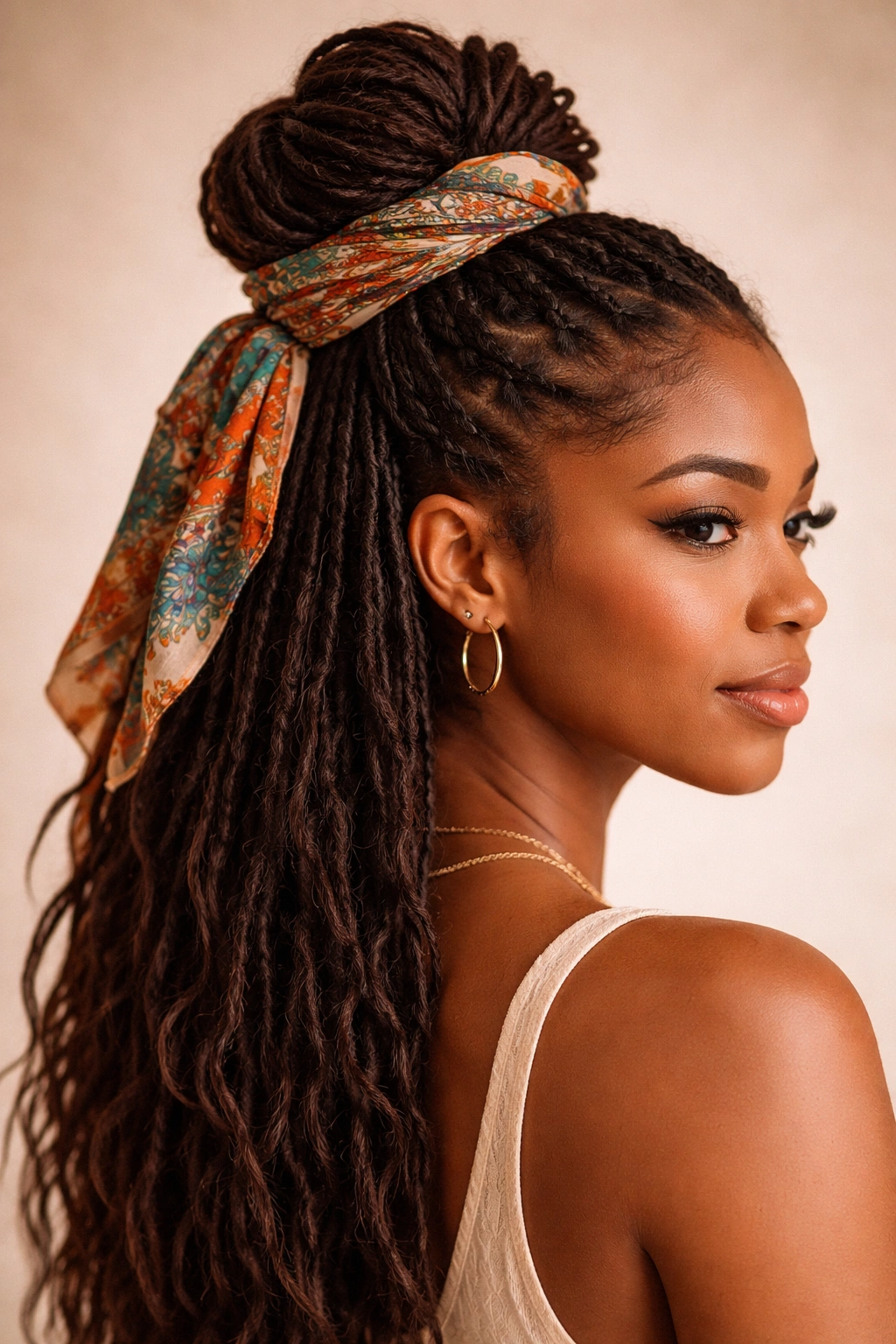
The scarf-wrapped half-up bun incorporates a complementary scarf or fabric directly into your styling, either by using it as a wrapping element around the base of the bun, weaving it through the coil, or creating a decorative element within the bun structure itself. This approach adds color, pattern, and texture while also protecting your locs and adding a cultural or fashion-forward aesthetic. Scarf wrapping transforms a simple bun into something with intentional styling and visual impact.
Why It’s a Top Pick for Statement-Making
Scarves introduce color, pattern, and personality in a way that other styling elements can’t quite achieve. A bold printed scarf, a luxurious silk scarf, or a contrasting solid color can completely change the energy and appearance of your half-up bun. This approach also allows you to coordinate your hairstyle with an outfit, express cultural significance, or showcase your personal style in a visible, impactful way.
How to Apply It
Create your half-up bun using your preferred method. Cut or tear a scarf or fabric into a workable strip (roughly 12-18 inches long and 2-4 inches wide). Once your bun is secure, begin wrapping this fabric strip tightly around the base of the bun where it meets your scalp. Wrap around and around until the base is completely covered or until you’ve achieved your desired effect. Tuck the end of the fabric underneath the bun and secure with bobby pins. The fabric should create a smooth, finished band around the bun base.
Material and Pattern Ideas
- Silk scarves for a luxurious, elegant finish
- Printed scarves or fabrics featuring patterns, logos, or cultural designs
- Solid-colored linen or cotton for a more casual aesthetic
- Metallic or lamé fabrics for a glittery, statement-making look
- Denim or other textured fabrics for an edgier appearance
- Batik or tie-dye fabrics for a bohemian, artistic vibe
Final Thoughts
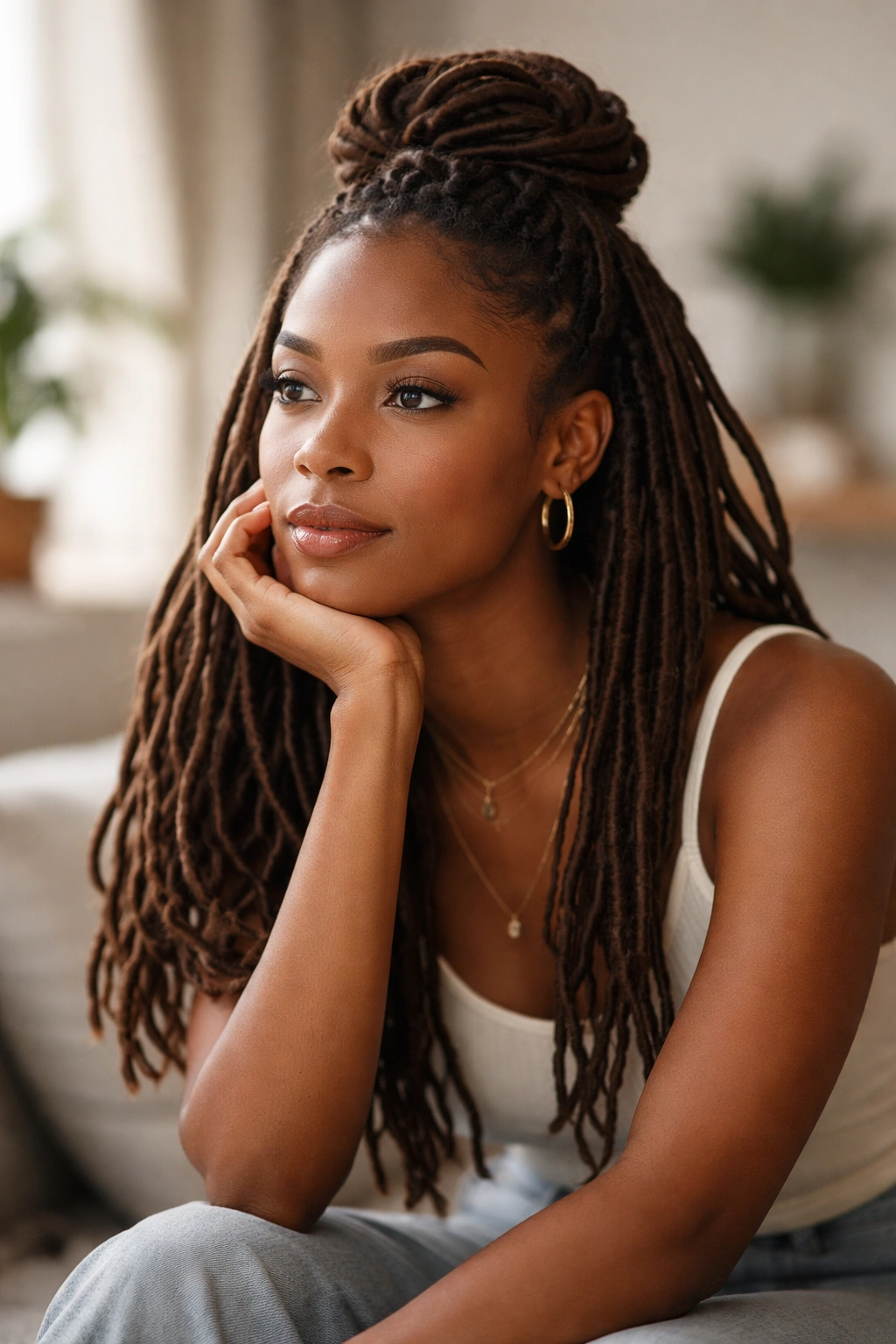
These 15 half-up half-down bun styles offer something for every occasion, preference, and skill level. Whether you’re drawn to the simplicity of a classic high bun, the artistry of a crown braid style, or the personality of an accessorized version, you have genuine range within this single styling category. The beauty of styling locs is that they work with you—their natural grip, texture, and weight distribution mean you can focus on the creative aspects of styling rather than worrying about whether the style will hold.
Start with whichever style speaks to you most, and don’t hesitate to modify and personalize it. Some of these styles work beautifully with face-framing pieces, others shine with minimal additional locs visible around your face. Some feel more formal, others playful and casual—but all of them celebrate the length and beauty of your locs while keeping them off your shoulders and out of your face. Once you’ve mastered a few variations, you’ll find yourself mixing and matching techniques to create entirely new styles that feel uniquely yours.
The real magic of half-up half-down styling is the flexibility it offers. You’re not committing to a full protective style that you’ll wear for weeks; you’re creating something you can adjust, refresh, and recreate differently tomorrow. Your locs are a canvas for creativity, and these 15 styles are just the beginning of what’s possible when you embrace both structure and play in your styling approach.
