



Fulani braids are so much more than just a hairstyle—they’re a cultural statement steeped in heritage and tradition. Originating from the Fulani people of West Africa, these braids represent beauty, identity, and an artistry that’s been perfected over centuries. What makes Fulani braids instantly recognizable is the signature combination of thin, intricate braids paired with bold geometric patterns, striking metallic cuffs, cowrie shells, and beads that catch the light with every movement. The style speaks to a deeper connection with roots while remaining undeniably contemporary and chic.
The beauty of Fulani-inspired hairstyles is their incredible versatility. Whether you’re looking for an elaborate protective style that makes a statement or a simpler, everyday interpretation of the aesthetic, there’s a Fulani braided look that fits your lifestyle, hair texture, and personal style. These styles aren’t just visually stunning—they also protect your hair while you rock an authentic, culturally rich appearance that celebrates African beauty standards. The styles range from traditional patterns that honor the original designs to modern adaptations that blend Fulani elements with contemporary trends.
What’s even better is that Fulani braids work on nearly every hair type and texture. Whether you have naturally coily hair, straighter hair, or anything in between, a skilled braider can create this look with human hair extensions or your own hair. The investment in time and money pays off with a protective style that can last anywhere from three to eight weeks, depending on how well you maintain it and the specific style you choose. Let’s explore 15 stunning Fulani-inspired hairstyles that’ll inspire your next protective style move.
1. Fulani Braids with Gold Cuffs
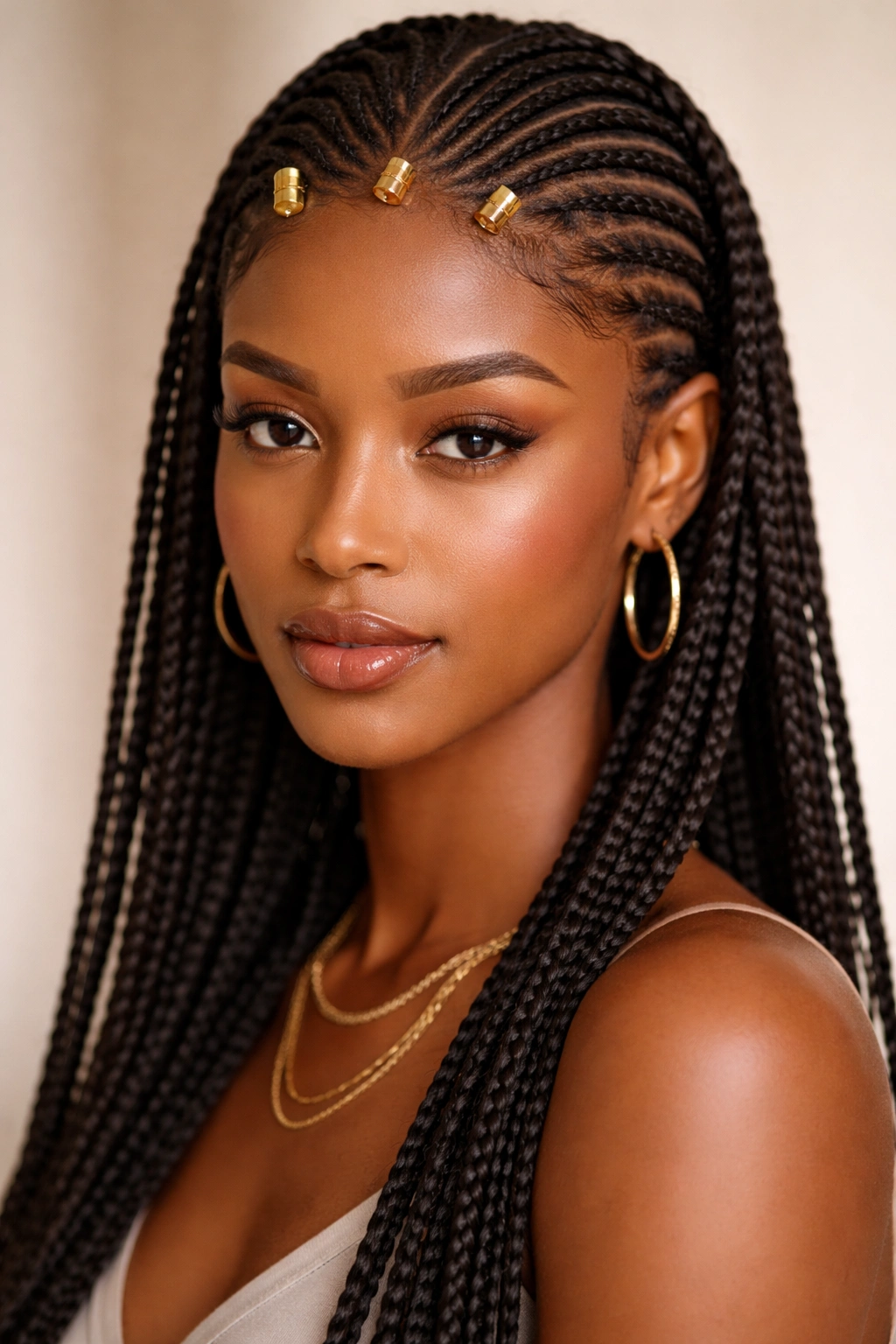
This is the quintessential Fulani look that has influenced hair trends around the world. Thin, precisely placed braids frame the face and travel back toward the crown, with the signature element being the golden or brass tube cuffs wrapped around strategic braids near the hairline. These cuffs catch light beautifully and add a luxe, almost regal quality to the entire style. The braids typically start thinner at the front and can vary in thickness as they move toward the back, creating beautiful dimension and flow.
Why It Remains Iconic
The gold cuffs weren’t chosen arbitrarily—they’ve historically signified wealth, status, and cultural pride within Fulani communities. Today, they’re the most recognizable marker of this protective style and instantly elevate your look from casual to statement-making.
Key Details to Know
- Cuff placement: Typically 3-5 cuffs positioned along the hairline or temples create the classic effect
- Braid count: Usually 15-25 braids total, with finer braids near the face thinning to slightly thicker ones toward the back
- Cuff materials: Brass, gold-plated, or stainless steel—all age beautifully and won’t tarnish quickly
- Maintenance: Tighten loose cuffs monthly and keep the braids smooth with moisturizing products
- Longevity: Lasts 4-6 weeks with proper care and nightly pineappling
The style takes 4-6 hours to complete with an experienced braider. The result is a look that demands attention and absolutely delivers on the Fulani aesthetic. Whether you’re heading to a special event or simply want to express your cultural pride, this style checks every box.
2. Fulani Cornrows with Beads
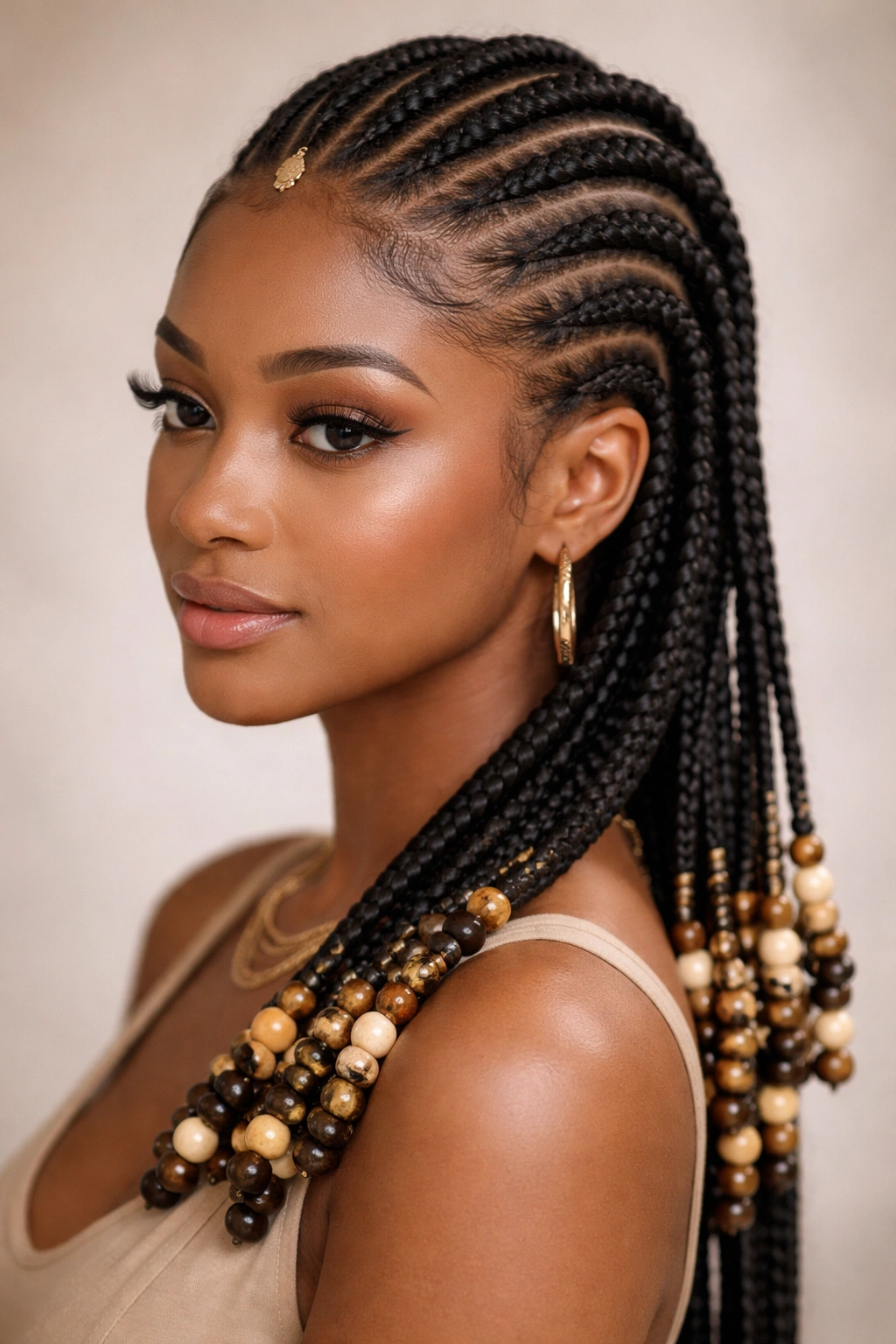
This variation simplifies the braiding technique by using cornrows—braids that sit flush against the scalp—instead of individual braids, but keeps all the aesthetic magic of the Fulani tradition. Glossy beads (typically wooden, acrylic, or metallic) are threaded through the cornrows, usually concentrated near the ends or clustered strategically along the pattern. The beads create movement, sound, and visual interest that makes this style particularly playful and dynamic.
How Beads Transform the Look
Beads add texture, personality, and a tactile element that individual cuffs alone can’t achieve. They catch light differently than metal cuffs, creating a softer, more organic aesthetic while maintaining that strong cultural connection.
Style Specifications
- Bead types: Wooden beads are traditional and lightweight; acrylic beads offer more color variety
- Placement strategy: Beads clustered at the ends create a chic look; scattered beads along the length feel more playful
- Cornrow pattern: Usually 3-5 straight-back cornrows or a combination of straight rows with one or two diagonal patterns
- Styling options: Cornrows can be left loose or styled into a bun or twisted crown
- Refresh timeline: Beads can be repositioned or swapped every 2-3 weeks without redoing entire cornrows
This style works beautifully for both braiding beginners and style veterans. The maintenance is slightly easier than individual braids since there’s less surface area to moisturize, and the beads add personality without requiring the investment of metal cuffs.
3. Fulani Straight-Back Style
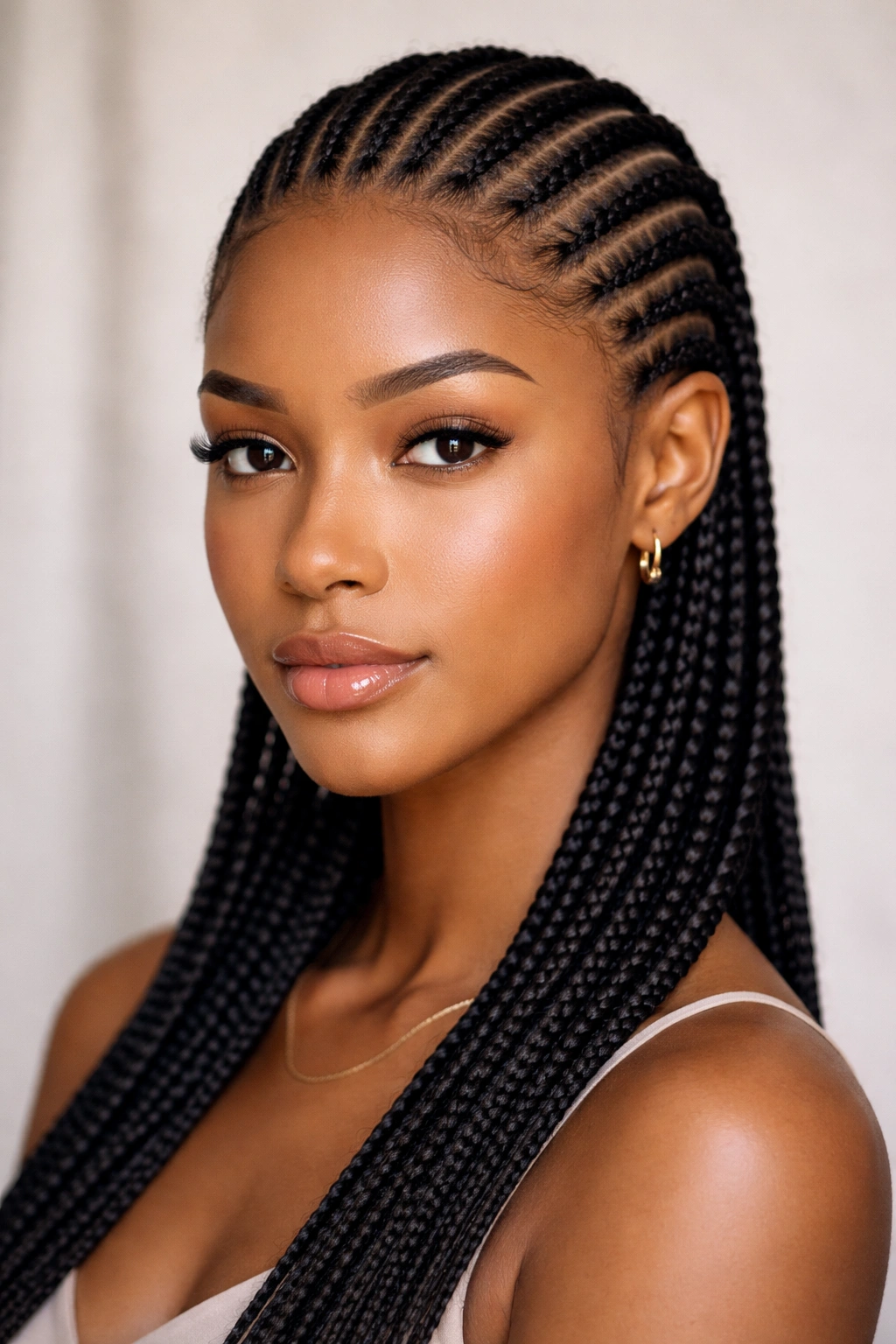
The straight-back Fulani braids are the most elegant and streamlined interpretation of this protective style. Braids travel straight from the front hairline all the way to the back of the head, creating clean lines and an almost architectural appearance. This style emphasizes the natural shape of your head and works especially well if you prefer a more minimalist aesthetic while still honoring the Fulani tradition. The braids maintain consistent thickness throughout and are typically left down to show their full length.
Why Straight-Back Designs Reign
The simplicity is deceptive—a straight-back pattern actually requires more precision and skill from your braider because any deviation in line becomes immediately visible. This is why this style looks so satisfying and feels so polished.
Style Essentials
- Braid count: Usually 10-15 braids for a balanced, uncrowded look
- Spacing: Even spacing between braids is critical for the architectural effect
- Adornments: Gold cuffs or beads work equally well; some prefer to keep this style bare for pure simplicity
- Face-framing: Some braids can be slightly thinner near the face for a softer frame
- Styling versatility: Can be worn down, wrapped into a crown, twisted into a bun, or half-up
The straight-back pattern is ideal if you want your braids to last longer—typically 6-8 weeks—because the consistent pattern makes maintenance and tightening more straightforward. This is also a great style if you have a preference for minimalist aesthetics but want to rock strong cultural representation.
4. Fulani Front Knots
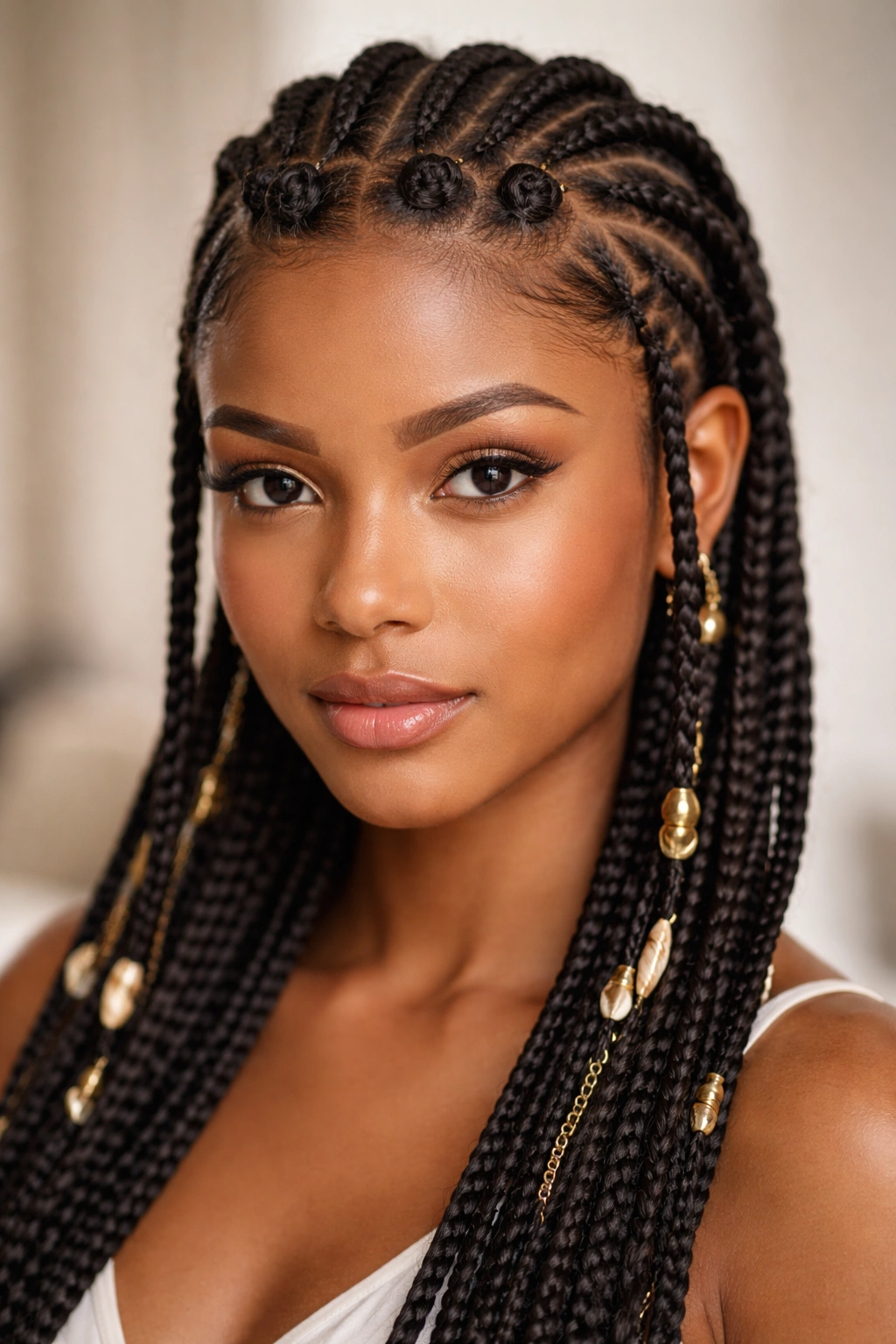
This style combines traditional Fulani braids with decorative knots positioned at the very front of the hairline, usually near the temples or across the crown area. The knots are typically created by wrapping and securing small sections of hair or extensions in a twisted or knotted pattern, creating three-dimensional texture that pops visually. This interpretation is younger, fresher, and less traditionally rigid than classic Fulani braids, making it perfect if you want to blend cultures and eras.
The Modern Twist
Front knots add an architectural element that’s somewhere between protective styling and artistic sculpture. They work beautifully as a transitional style between full braids and looser styles.
Styling Breakdown
- Knot placement: Usually 1-3 prominent knots placed symmetrically or asymmetrically depending on preference
- Knot materials: Can be created with your own hair or with extensions for more dramatic effect
- Behind the knots: Braids, cornrows, or loose curls can extend back from the knots
- Size variation: Knots can be delicate and intricate or bold and chunky depending on desired impact
- Adornment options: Knots themselves make a statement, so cuffs and beads are optional
This style typically takes 3-4 hours and lasts 4-6 weeks. The beauty is that if you want something more dramatic, you can add more knots or make them larger. If you prefer subtlety, one or two modest knots create an understated elegant effect.
5. Fulani Side Braids
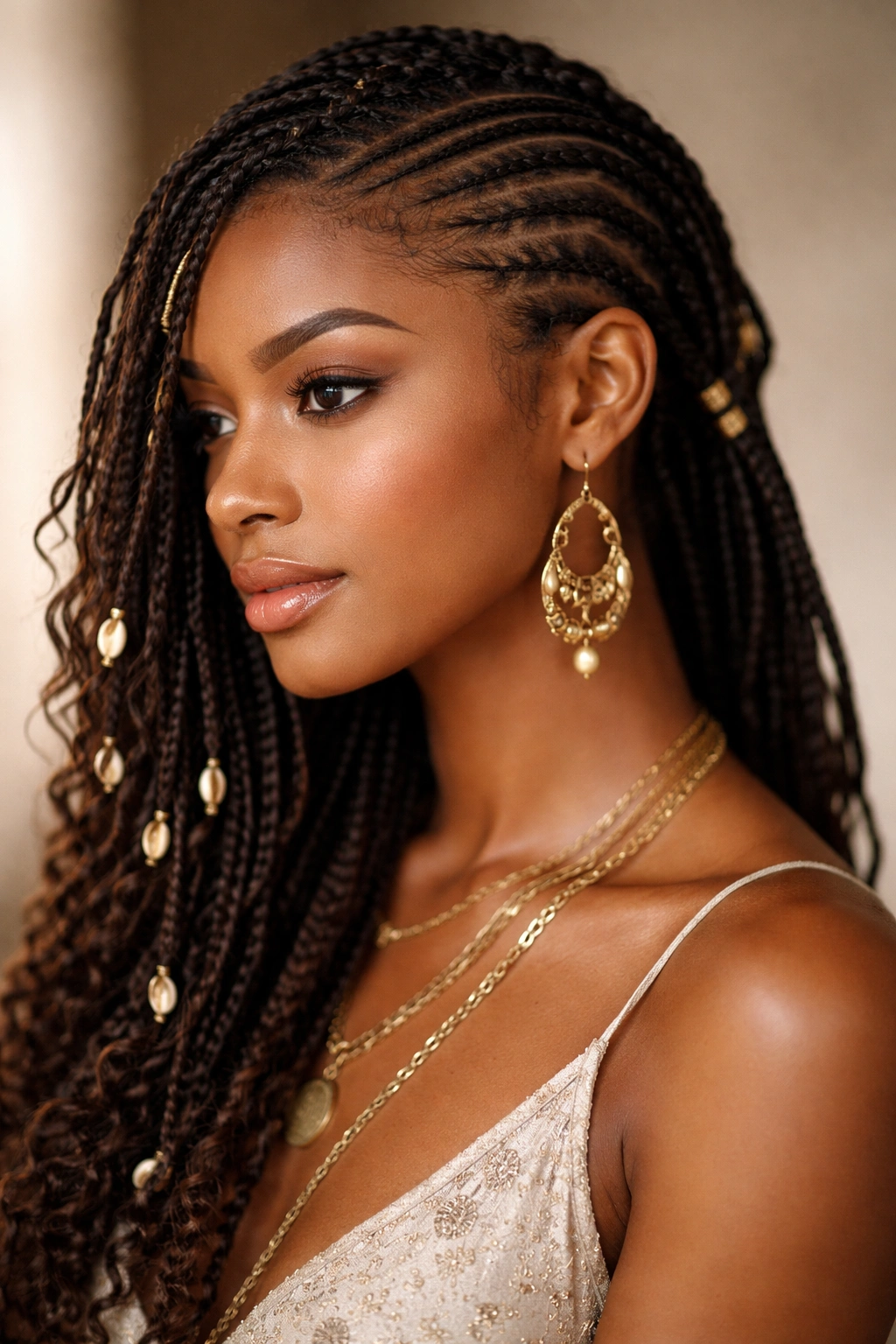
Side braids offer a romantic, asymmetrical take on the Fulani aesthetic. Rather than centering the braids, this style sweeps them to one side of the head, often with braids gathered or pinned at one ear or the nape of the neck. This creates a softer silhouette than center-part styles and is particularly flattering for face shapes that benefit from asymmetrical framing. Side-swept Fulani braids feel slightly more relaxed and approachable while maintaining full cultural authenticity.
The Asymmetrical Appeal
Side placement creates visual movement and draws attention to one side of your face. It’s a styling choice that feels intentional and artistic—you’re curating how the world sees you.
Styling Details
- Parting pattern: Side part with braids sweeping toward the smaller section
- Braid thickness: Can range from very fine to medium weight depending on overall volume desired
- Gathering method: Braids can be secured with a hair tie, wrapped around each other in a bun, or left to fall over the shoulder
- Cuff and bead placement: Concentrate adornments on the side where braids gather for maximum impact
- Face-framing: Leaving 2-3 thin braids loose around the face creates a softly romantic effect
This style works beautifully for everyday wear because it feels slightly less formal than center-parted styles. It’s also ideal if you want to show your natural hairline on one side while protecting the other side with braids. The side-swept arrangement typically lasts 5-7 weeks because the gathered side experiences less daily friction than loose braids.
6. Fulani Wrapped Crown
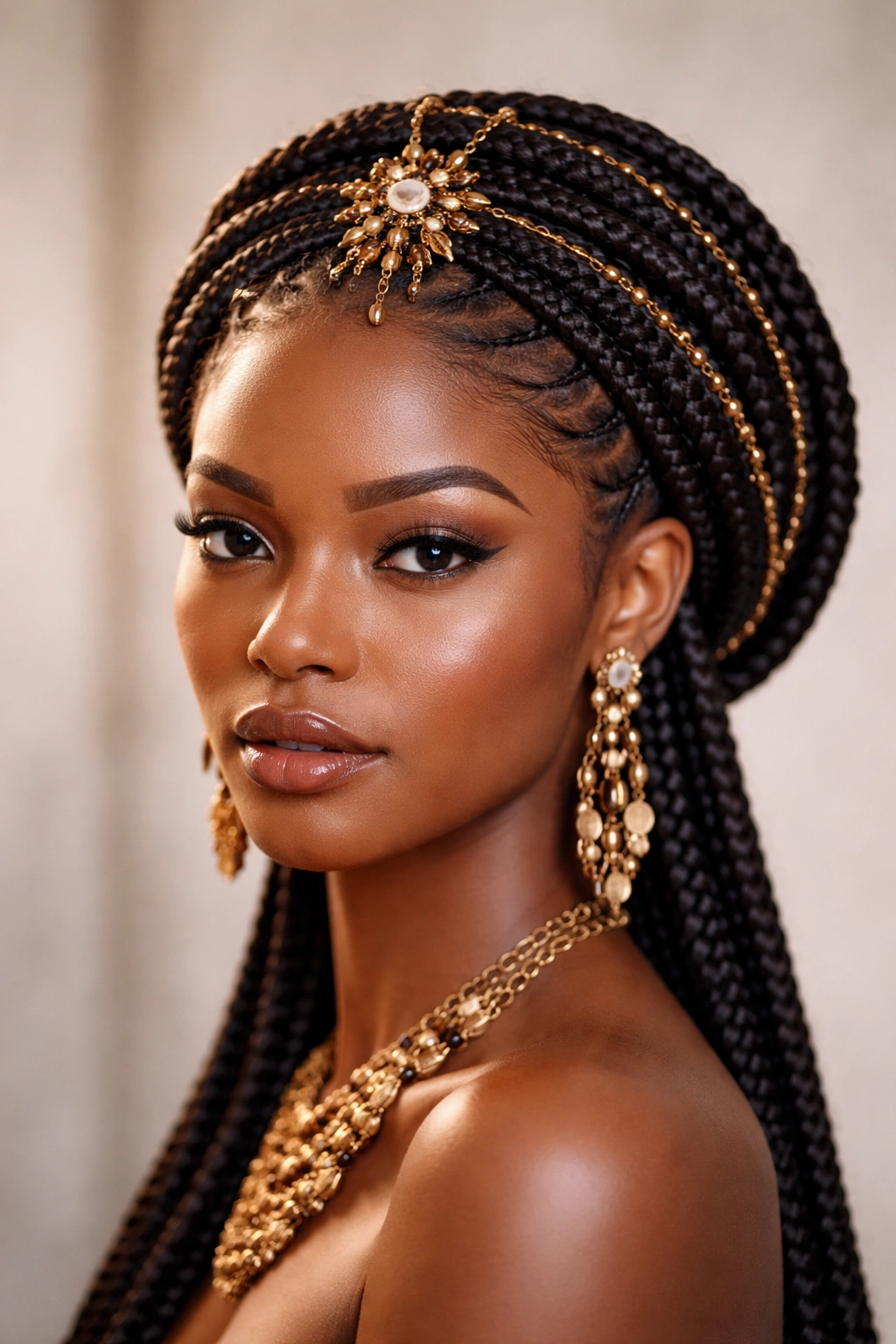
Imagine Fulani braids that spiral around your head like a crown, with the wrapped effect creating a halo-like appearance. The braids begin at one side near the ear and travel around the head, creating concentric circles that meet at the crown or back of the head. Adornments are typically clustered where braids meet, creating a focal point. This style is absolutely stunning for special occasions and makes you feel like royalty—which is fitting, given the Fulani tradition of this hairstyle signifying status.
The Crown Effect
This style takes your braids vertical and three-dimensional, creating visual drama from every angle. It’s the kind of hairstyle that makes people stop you on the street asking for details.
Crown Specifications
- Spiral direction: Usually clockwise, but can go either direction for visual variation
- Braid count: Usually 6-12 braids depending on desired density
- Starting point: Typically begins at one temple or ear and travels around
- Ending point: Braids usually meet at the crown or are secured in a bun at the nape
- Adornments: Gold cuffs clustered at the meeting point create a jeweled-crown effect
- Face-framing option: Leaving small face-framing braids loose before the crown begins softens the overall look
This style requires significant skill to execute well—spacing must be perfect for the crown effect to look intentional rather than accidental. Plan for 5-7 hours of braiding time. The good news is that once in place, this style lasts 6-8 weeks and honestly gets more beautiful as your natural hair grows into the braids, creating more volume at the crown.
7. Fulani Mixed Braids
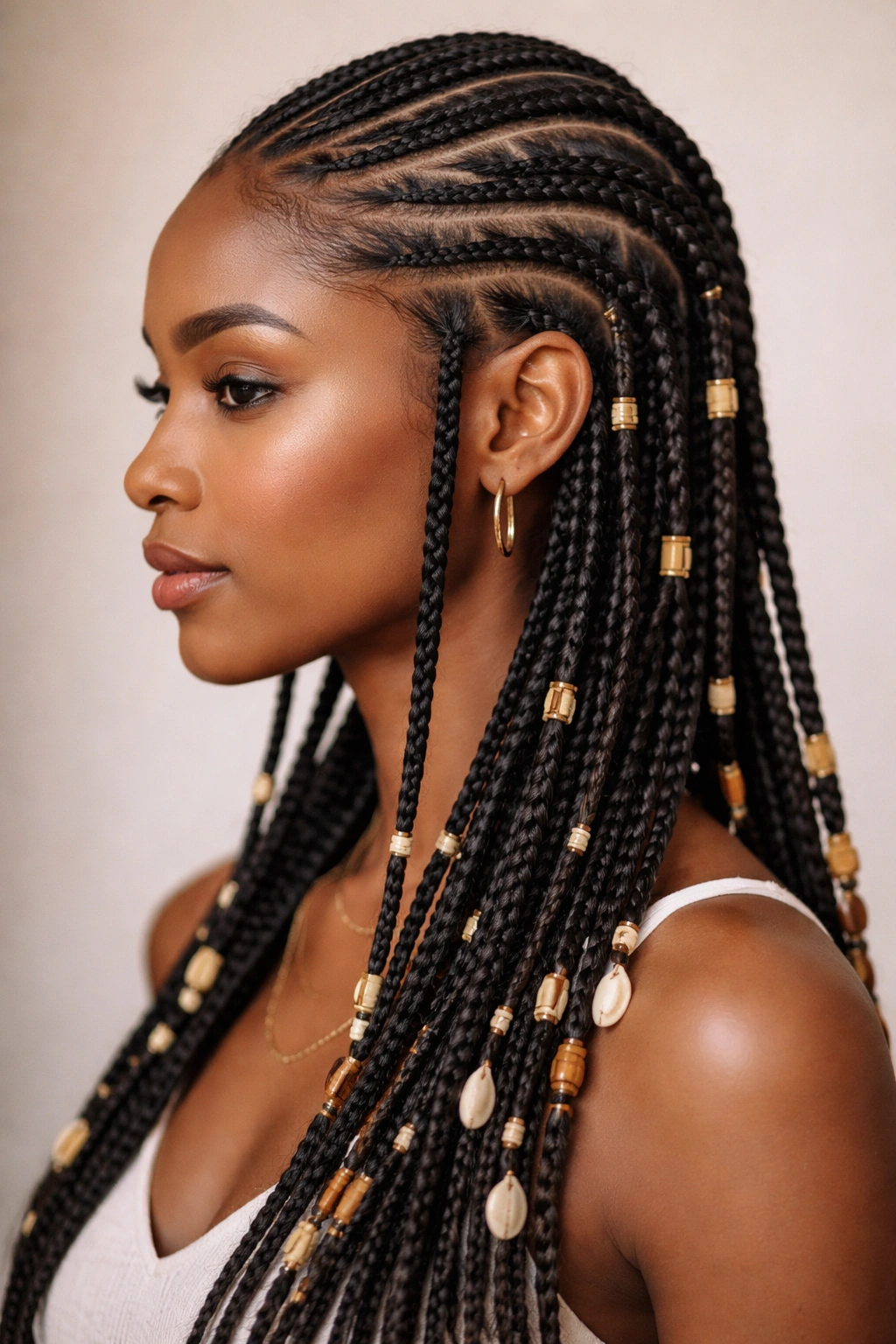
This style refuses to follow one rule, instead combining different braid sizes, thicknesses, and patterns within a single look. You might have very fine braids mixed with thicker protective braids, or straight-back sections combined with diagonal patterns. The mix creates visual interest and texture variation that keeps the eye traveling across your head. This interpretation feels contemporary and creative while respecting the core Fulani aesthetic through the use of multiple thin braids and strategic adornments.
Creative Expression Through Mix
Mixed braids let you collaborate with your braider to create something completely unique to you. There’s no “wrong” combination—only creative choices.
Mixing Options
- Thickness variation: Alternate very fine braids with medium braids for textural contrast
- Pattern combination: Straight sections mixed with diagonal or wavy patterns
- Adornment spread: Use cuffs on thick braids and beads on thin ones for visual distinction
- Length variation: Some braids can be left full length while others are wrapped into buns
- Color blocking: If using colored extensions, group colors strategically throughout the mix
This style typically takes 5-6 hours and requires a braider who’s comfortable with creative interpretation. The maintenance is slightly more involved because different braid thicknesses require different care, but the visual payoff is absolutely worth it. This style tends to last 4-6 weeks before certain thicker braids start needing tightening.
8. Fulani Double Buns
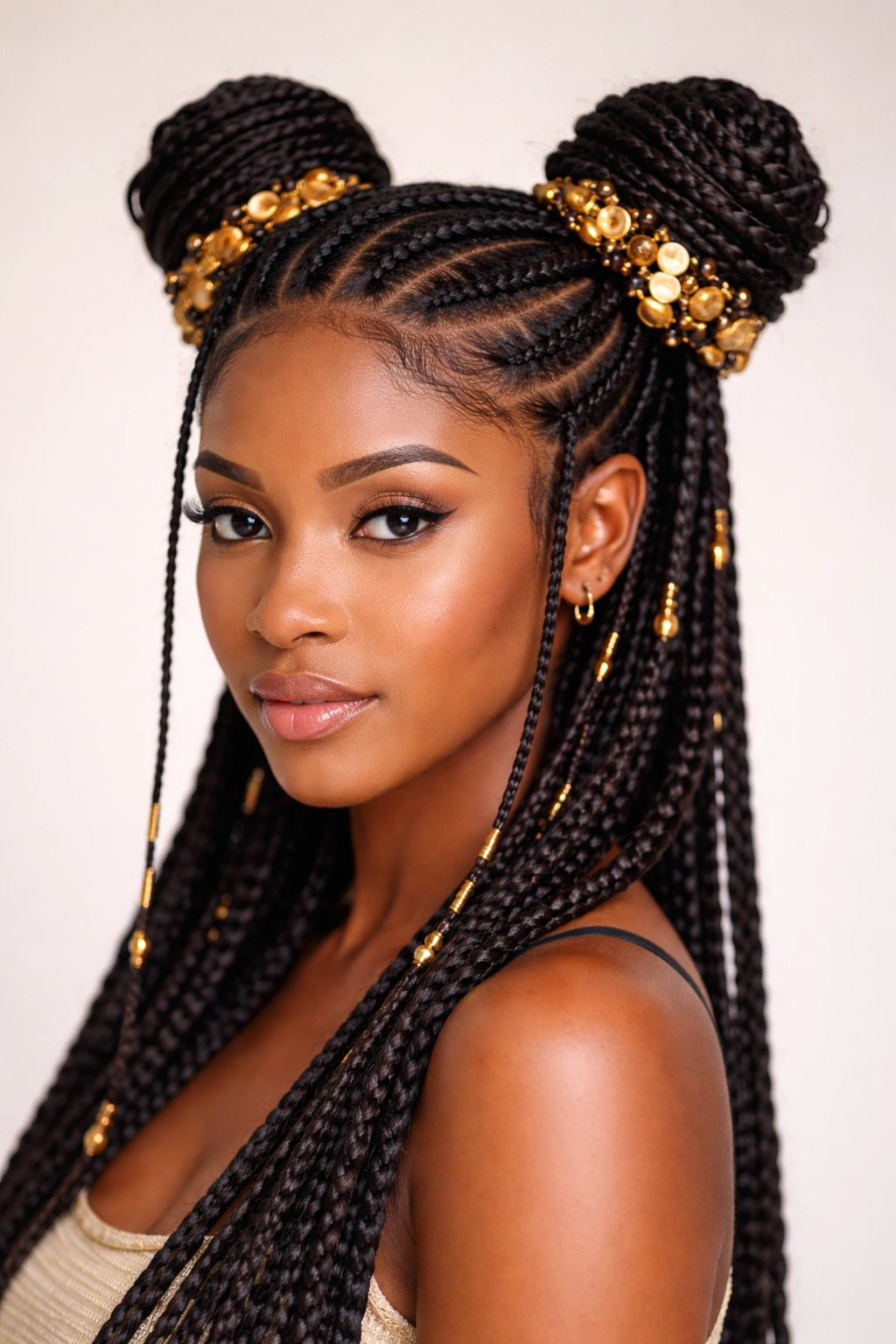
Take the traditional Fulani braids and style them into two symmetrical buns positioned on either side of the crown. The braids travel from the hairline back to where they’re wrapped and secured into buns, with adornments clustered where the braids form the knots. This style is playful, youthful, and absolutely adorable while maintaining the sophistication of the Fulani tradition. It’s perfect if you want something that photographs beautifully and works for both casual and semi-formal settings.
Why Double Buns Feel Fresh
The bun styling makes the protective style feel intentionally fashion-forward rather than purely practical. It’s a styling choice that shows intention and personality.
Double Bun Details
- Bun placement: Positioned above the ears or slightly toward the crown depending on head shape
- Bun size: Can be delicate and small for a subtle effect or chunky and prominent for dramatic impact
- Braid style: Usually 8-12 braids traveling from front to back, with each braid contributing to bun volume
- Bun securing: Wrapped with string, extensions, or clasped with decorative hair clips
- Adornment placement: Gold cuffs or beads concentrate around the bun base for maximum visual impact
- Face-framing: Optional face-framing braids or loose curls soften the look before the buns begin
This style works beautifully on all face shapes because the symmetry is flattering and the buns add visual height. It typically lasts 5-6 weeks and honestly gets cuter as your natural hair grows and adds volume to the buns. This is an excellent style for active lifestyles because the braids are secured and won’t get in your face.
9. Fulani Puffs
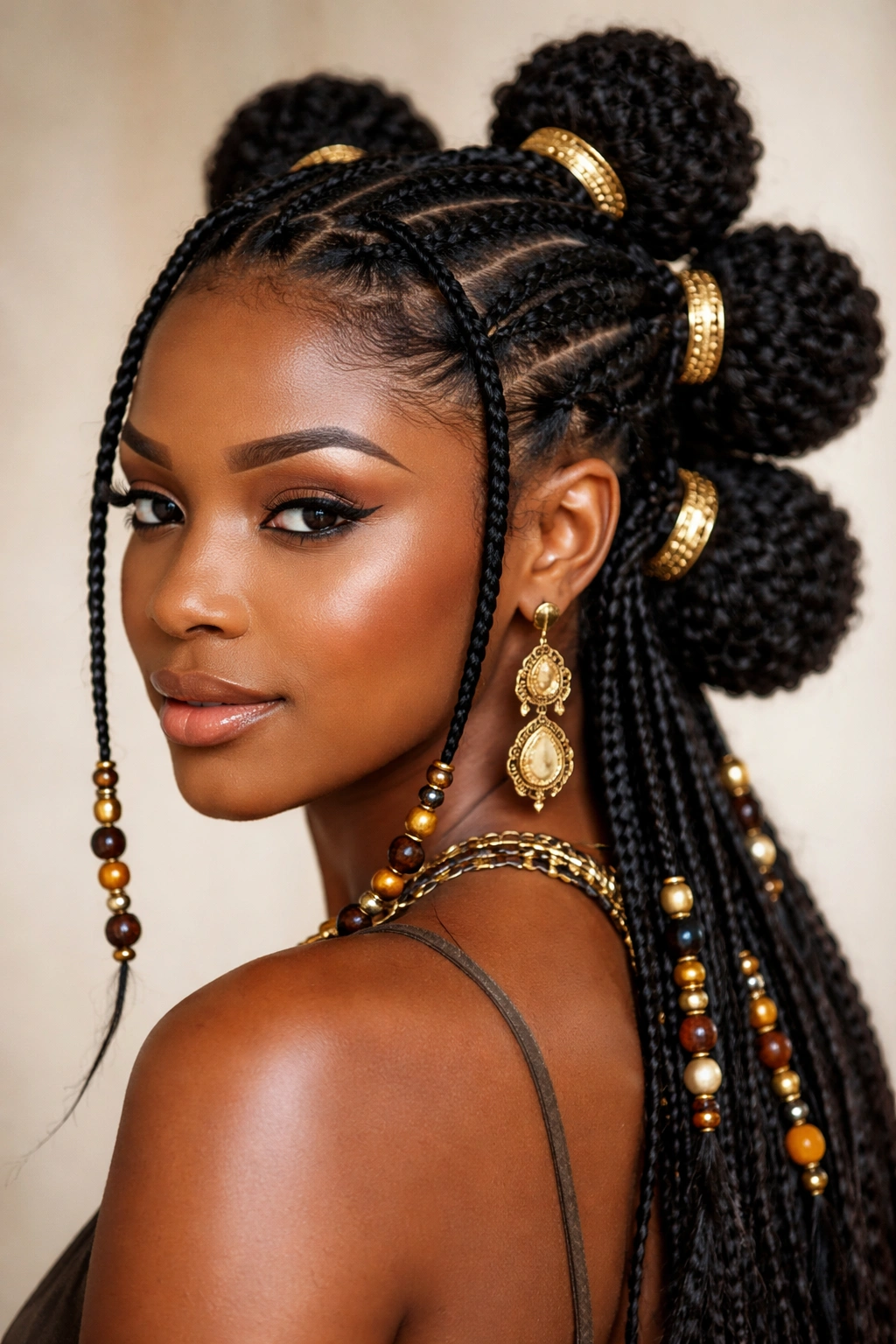
This style uses Fulani braids as the foundation but styles them into multiple puffs—gathered clusters of braids that are secured and puffed out for a three-dimensional effect. Rather than leaving braids down or in traditional bun formations, this style creates 3-5 puffs scattered throughout your head, usually positioned off-center for an artistic look. It’s youthful, creative, and incredibly photogenic. The puffs can be small and delicate or large and voluminous depending on your preference.
The Puff Effect
Puffs transform braids into sculptural elements. Each puff becomes its own statement, creating visual rhythm and movement across your entire head.
Puff Styling Options
- Puff count: Usually 3-5 puffs for balanced visual interest
- Puff placement: Can be symmetrical or artistically scattered
- Puff size: Varies from delicate to chunky depending on desired drama
- Gathering method: Puffs are created by gathering groups of braids, securing them, then fluffing the ends outward
- Adornment placement: Cuffs at the base of each puff create repetition; beads throughout add playfulness
- Loose ends: Some braids can be left down between puffs for texture variety
This style takes 4-5 hours to complete and lasts 5-7 weeks depending on how securely the puffs are gathered. The puffs can be restyled weekly without redoing the entire braided base, giving you styling flexibility. This is an ideal style if you love variety because you can literally rearrange your puffs every few days for a completely different look.
10. Fulani Threaded Braids
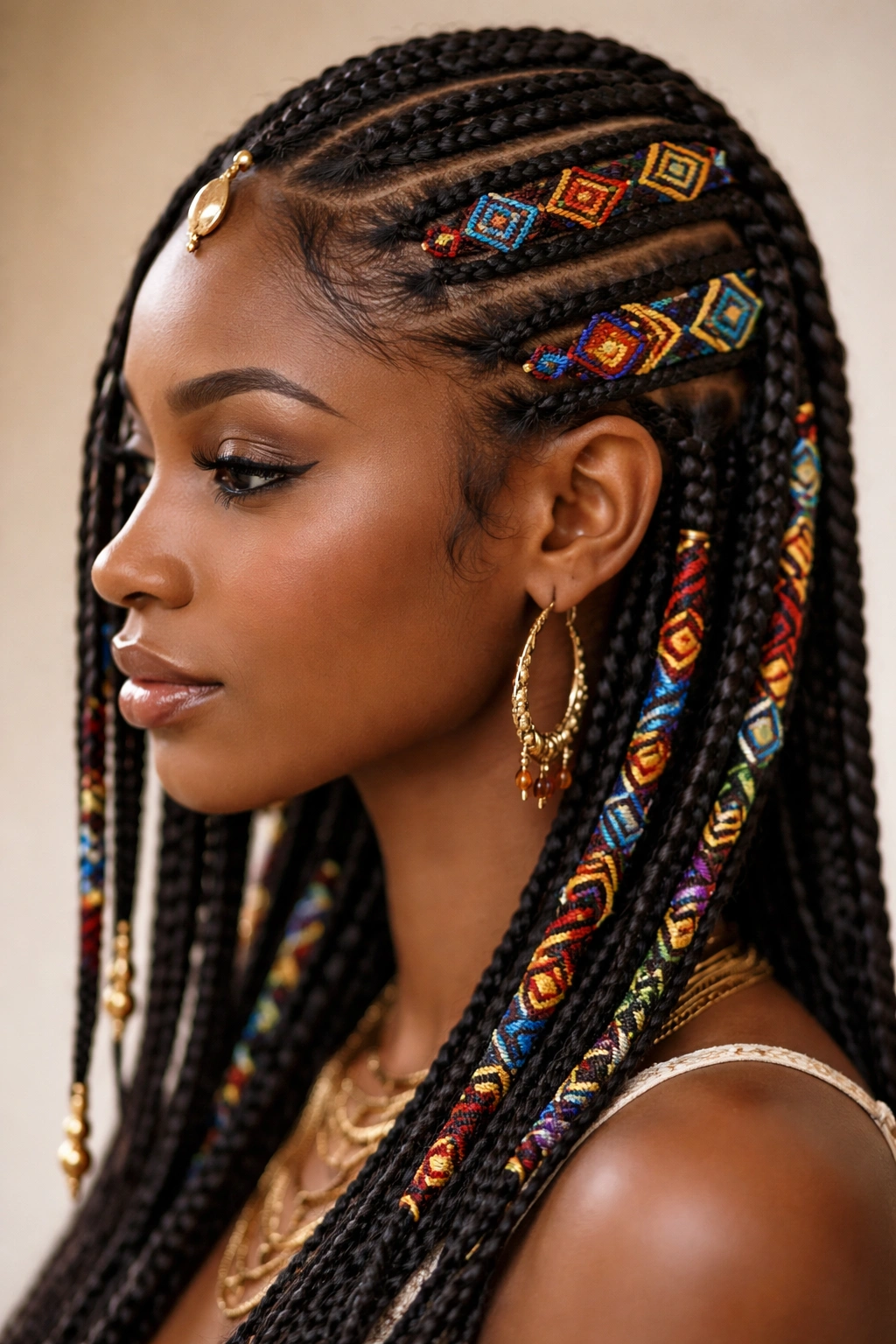
This interpretation incorporates thread—typically colorful embroidery thread, yarn, or metallic thread—wrapped around and through the braids rather than relying solely on metal cuffs or beads. The thread can be wrapped tightly around each braid in geometric patterns, creating lines of color that add visual excitement. This is a particularly creative option if you want to incorporate specific colors into your look or create patterns that reflect personal meaning. It’s also a more budget-friendly adornment option than metal cuffs.
Thread as Artistic Medium
Threading transforms braids into a canvas. You can create intricate patterns, color stories, and artistic expressions that feel deeply personal.
Threading Techniques
- Spiral wrapping: Thread spirals around braids in tight or loose patterns
- Geometric patterns: Thread creates diamonds, stripes, or checkerboard patterns along braids
- Color combinations: Single colors for minimalist effect or multiple colors for bold statements
- Threading density: Can be subtle with sparse threading or bold with dense coverage
- Mix-and-match approach: Thread some braids and leave others plain for visual contrast
Thread typically costs $2-5 per spool, and a single style might use 5-10 spools depending on coverage desired. This makes threading an accessible way to add custom color and personality to your Fulani braids. The thread is applied during braiding and can last the full duration of your braids—typically 5-8 weeks.
11. Fulani Braids with Shells
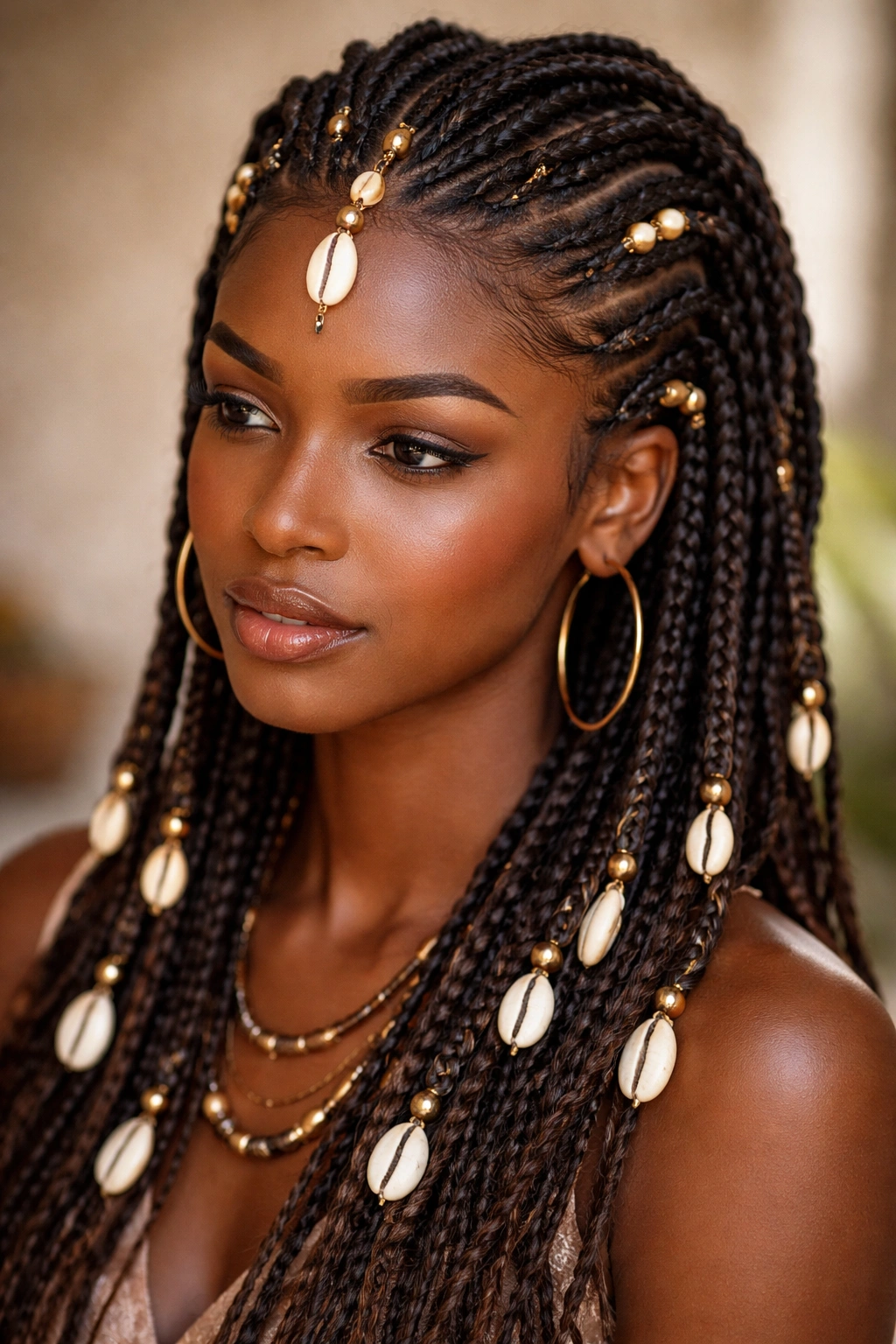
Cowrie shells hold deep cultural significance in African tradition and styling. This Fulani variation incorporates actual cowrie shells or shell-shaped beads directly into the braids, either threaded through the ends or attached at strategic points. Shells add a natural, earthy element that feels grounded and spiritually connected. The shells catch light differently than metal cuffs, creating a softer, more organic aesthetic. This is an excellent option if you want to honor the most traditional roots of Fulani styling.
The Spiritual Connection
Shells historically represented wealth and protection in African cultures. Wearing shells in your braids is more than aesthetic—it’s connecting with ancestral meaning and tradition.
Shell Integration Methods
- Shell placement: Typically concentrated at the ends of braids or clustered at the crown
- Shell types: Genuine cowrie shells for authenticity; shell-shaped acrylic beads for durability
- Sizing options: Shells range from tiny accent shells to substantial statement pieces
- Mixing approach: Shells can be mixed with metal cuffs, beads, and thread for layered effect
- Quantity: Usually 10-30 shells distributed throughout the style depending on desired density
- Securing method: Shells are typically tied or glued to braids during the installation process
Genuine cowrie shells cost more than plastic alternatives but develop beautiful patina over time and feel authentic. This style lasts 6-8 weeks because shells don’t require the maintenance that looser adornments might need. Many people find that wearing shells in their braids creates a spiritual connection and intention-setting benefit beyond the purely aesthetic.
12. Fulani Braided Bun
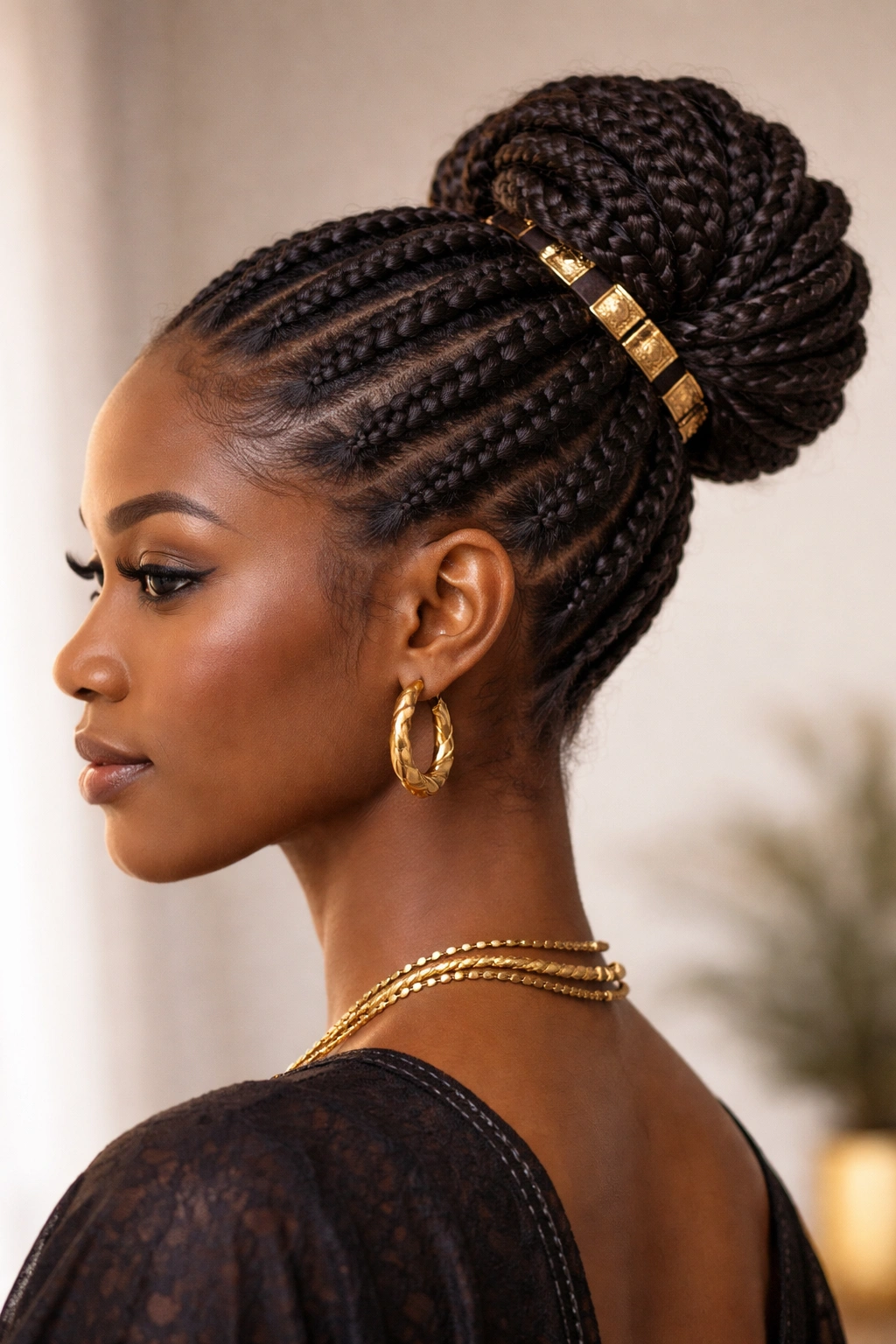
This style takes a smaller number of thicker Fulani braids and gathers them into a single, prominent bun positioned at the back or crown of the head. Rather than multiple thin braids, this interpretation uses perhaps 6-10 medium-weight braids that travel from the front hairline or sides back to the bun point. It’s more understated than some other Fulani styles but no less authentic. The bun can be wrapped tightly for a sleek effect or loosely for a more undone, romantic appearance.
The Sophisticated Single Bun
The single bun approach feels more mature and polished than double buns or multiple puffs. It’s an excellent option if you prefer your protective styles to read as elegant rather than playful.
Bun Specifications
- Braid count: Usually 6-12 braids depending on desired volume
- Braid thickness: Medium weight braids create the most beautiful bun fullness
- Bun position: High crown placement feels youthful; low nape placement feels more classic
- Bun tightness: Sleek wrapping creates a neat appearance; looser wrapping creates volume
- Adornment style: Cuffs clustered around bun base, or scattered throughout braids
- Face-framing option: 2-4 thin face-framing braids left loose before the bun begins
This style works beautifully for professional settings and special events. It typically lasts 6-8 weeks because the protective nature of the bun means braids experience minimal manipulation. You can refresh the bun weekly without redoing the entire style, giving you longevity and versatility in a single protective style.
13. Fulani Geometric Patterns
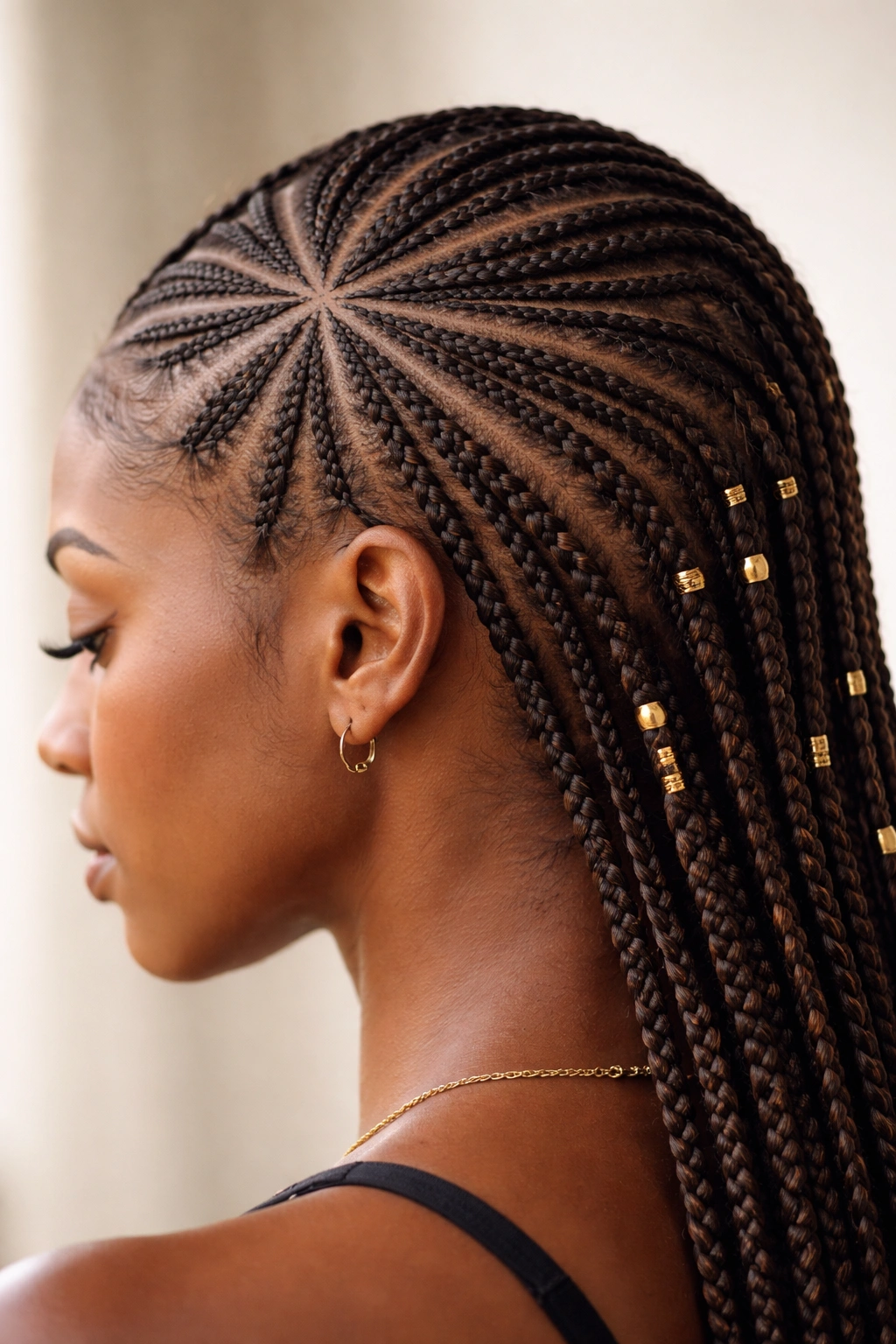
This style elevates Fulani braiding into an art form by creating specific geometric patterns with the braid placement itself. Rather than straight-back or random placement, geometric patterns might include triangles, diamonds, squares, or wave-like arrangements. The braids themselves remain thin and authentic to the Fulani tradition, but their arrangement creates overall visual designs. This requires an exceptionally skilled braider who understands spatial relationships and can visualize completed designs.
Braids as Graphic Design
This interpretation treats your head like a canvas and braids like lines creating intentional artwork. It’s the meeting point of ancient tradition and modern artistic expression.
Pattern Options
- Triangular pattern: Braids arranged to create triangular shapes emanating from center
- Diamond grid: Braids form diamond shapes across the entire head
- Wave pattern: Braids create undulating waves from front to back
- Asymmetrical designs: Creative, non-symmetrical patterns that feel modern and unique
- Circular motifs: Concentric circles created by braid placement
- Custom designs: Work with your braider to create patterns that reflect personal meaning
This style typically takes 6-8 hours because the braider must maintain spatial precision throughout. The result is a style that works beautifully from every angle and photographs incredibly well. Geometric pattern styles last 6-8 weeks and honestly get more impressive as time goes on because natural hair growth adds dimension to the intentional pattern.
14. Fulani Jumbo Braids
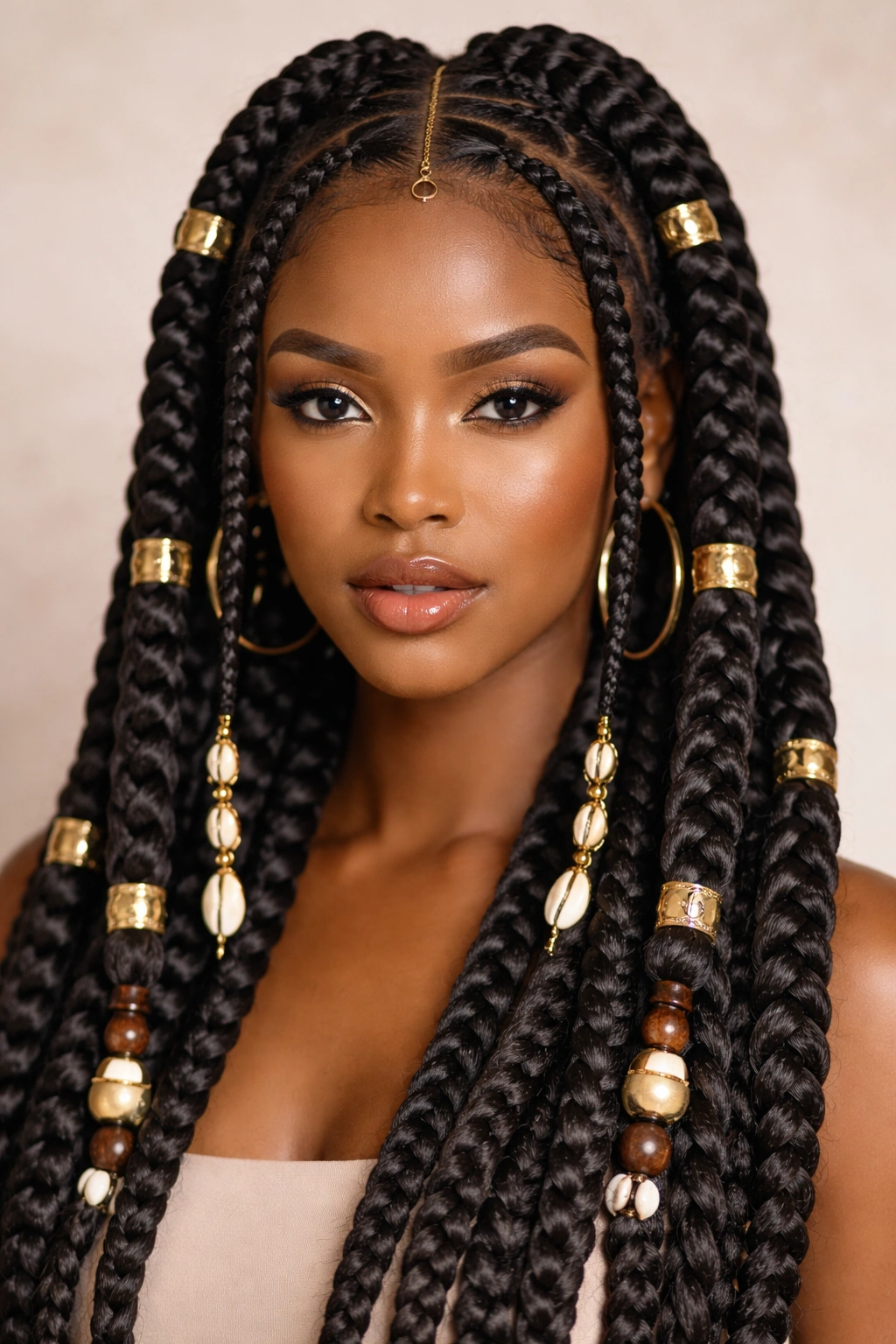
For those who prefer bolder, more substantial braids than traditional thin Fulani braids, jumbo Fulani braids offer an interpretation that honors the aesthetic while embracing larger dimensions. Instead of 15-25 thin braids, this style might feature 6-10 thick, chunky braids with the same adornment style—gold cuffs, beads, shells, or threading. The braid thickness means the style installs faster and lasts longer while still maintaining the essence of Fulani styling. The jumbo approach feels more modern and edgy than delicate traditional braids.
Dramatic Impact Through Scale
Jumbo braids make a bolder statement. There’s something commanding about a small number of substantial, perfectly executed braids that immediately captures attention.
Jumbo Specifications
- Braid count: Usually 6-12 braids creating full head coverage
- Braid thickness: Noticeably thicker than traditional braids, creating dramatic volume
- Installation time: Typically 3-4 hours rather than 5-7 for traditional styles
- Adornment scaling: Gold cuffs look even more striking on jumbo braids; spacing between cuffs matters more
- Styling options: Can be left down, twisted into buns, or styled into updos
- Hair requirements: Often uses more extensions due to larger braid volume
- Longevity: Lasts 7-10 weeks because larger braids hold tight longer
This style is perfect if you want the Fulani aesthetic but prefer faster installation and longer wear time. Jumbo braids also work beautifully if you have thicker hair texture naturally, as they create better proportion than very fine braids might.
15. Fulani Modern Fusion
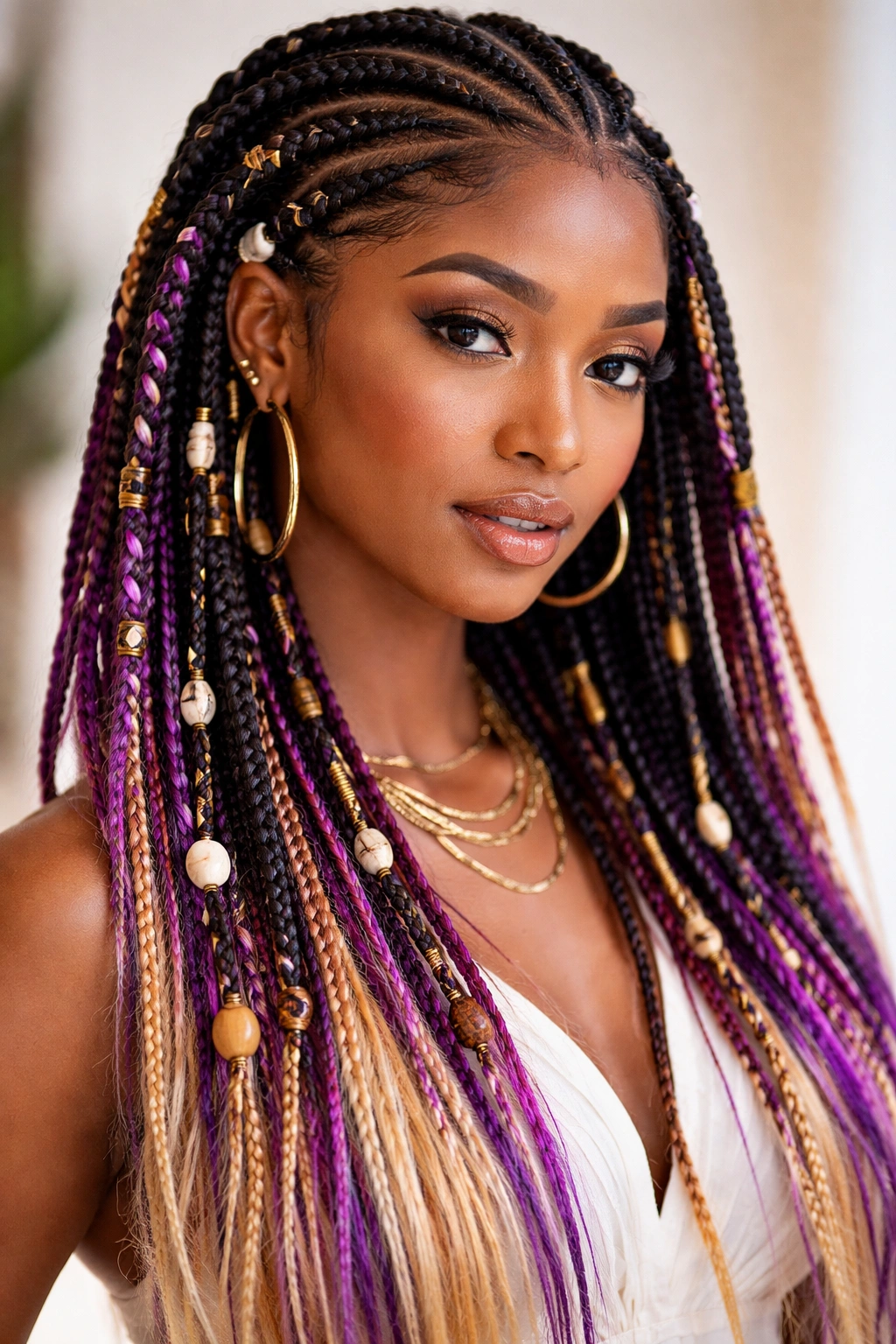
This final style blends traditional Fulani braiding with contemporary elements—perhaps incorporating colorful ombre extensions, metallic thread mixed with beads and cuffs, or combining braids with loose textured hair elements. The fusion approach honors the Fulani tradition while refusing to be confined by it. It might include braids styled alongside twists, coils, or naturally textured sections. The fusion approach is perfect if you want to celebrate your cultural heritage while expressing contemporary personal style.
Honoring Tradition While Embracing Evolution
The fusion approach acknowledges that culture isn’t static. Traditions live and breathe through reinterpretation. This style respects ancestral practices while claiming space for modern creativity.
Fusion Ideas
- Ombre braids: Braids that transition from dark to light creating visual drama
- Colorful accents: Traditional Fulani braids with select colorful extensions woven throughout
- Mixed protective styles: Braids combined with twists, cornrows, or coils in single style
- Hybrid adornments: Cuffs, beads, shells, and thread all incorporated into one look
- Hair texture mixing: Braids combined with loose natural curls or textured sections
- Modern styling approaches: Braids styled with contemporary elements like hair clips or jewelry
This style can take 5-7 hours depending on complexity, but the result is a completely unique style that belongs entirely to you. Fusion styles typically last 5-6 weeks because the mixed elements experience different levels of manipulation and wear. The beauty is that you can adapt, refresh, and modify the look throughout the wear period as you experiment with different styling approaches.
Final Thoughts
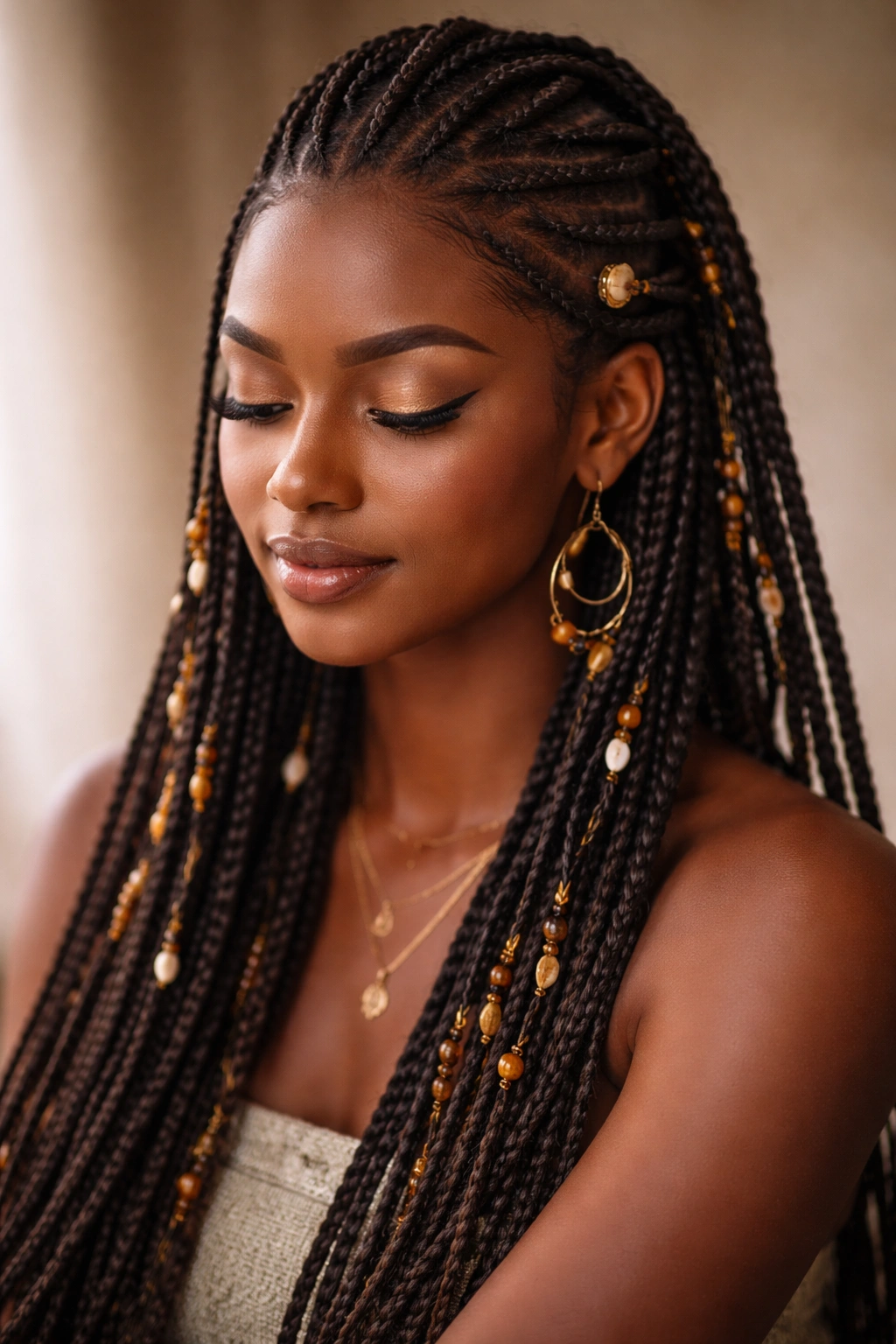
Fulani-inspired braids represent so much more than just a protective style—they’re a celebration of African heritage, artistic expression, and cultural pride. Whether you choose the classic gold-cuffed braids that immediately signal the Fulani aesthetic or you venture into geometric patterns, fusion approaches, or creative reinterpretations, you’re participating in a rich tradition that has been refined and reimagined across generations.
The key to a beautiful Fulani style is finding a braider who understands not just the technical execution but the cultural significance of what they’re creating. Take time to look at portfolios, read reviews, and have detailed consultations about what style speaks to you. Every style in this guide is absolutely beautiful when executed well—the “best” choice is the one that makes you feel confident, connected, and authentically yourself.
Your Fulani braids are an investment in your hair health, your cultural expression, and your artistic identity. Treat them well with consistent moisturizing, nightly care, and mindful styling, and they’ll reward you with weeks of stunning beauty. Whether this is your first time exploring Fulani styles or you’re returning to a beloved look, you’re making a choice that celebrates African beauty standards and contributes to the ongoing evolution of this powerful, meaningful tradition.
