



Feed-in cornrows have become the gold standard for anyone with short hair looking for a protective style that’s both sophisticated and low-maintenance. Unlike traditional cornrows that start with a thick base, feed-in cornrows gradually incorporate hair as you braid, creating a seamless blend that looks intentional and refined. The beauty of this technique is that it works exceptionally well with shorter lengths—you get all the benefits of a protective style without the weight or tension that can come from heavier braids.
Short hair presents a unique advantage for feed-in cornrows. You can experiment with patterns, directions, and designs that might feel overwhelming on longer hair, and the faster regrowth timeline means you can rotate through multiple styles regularly. Whether you’re protecting your natural texture, growing out a cut, or simply want a polished look that requires minimal daily styling, feed-in cornrows offer the flexibility and elegance that makes them a go-to choice across different hair types and textures.
The technique itself requires precision and skill—your braider needs to understand how to maintain tension while gradually feeding in hair so the cornrows sit flat and look dimensional. For short hair, this becomes even more critical since there’s less surface area to work with, and any unevenness shows more obviously. The following twelve styles showcase different approaches to feed-in cornrows on short hair, each offering distinct visual impact and practical benefits depending on your lifestyle, face shape, and styling preferences.
1. Sleek Side-Swept Feed-In Cornrows
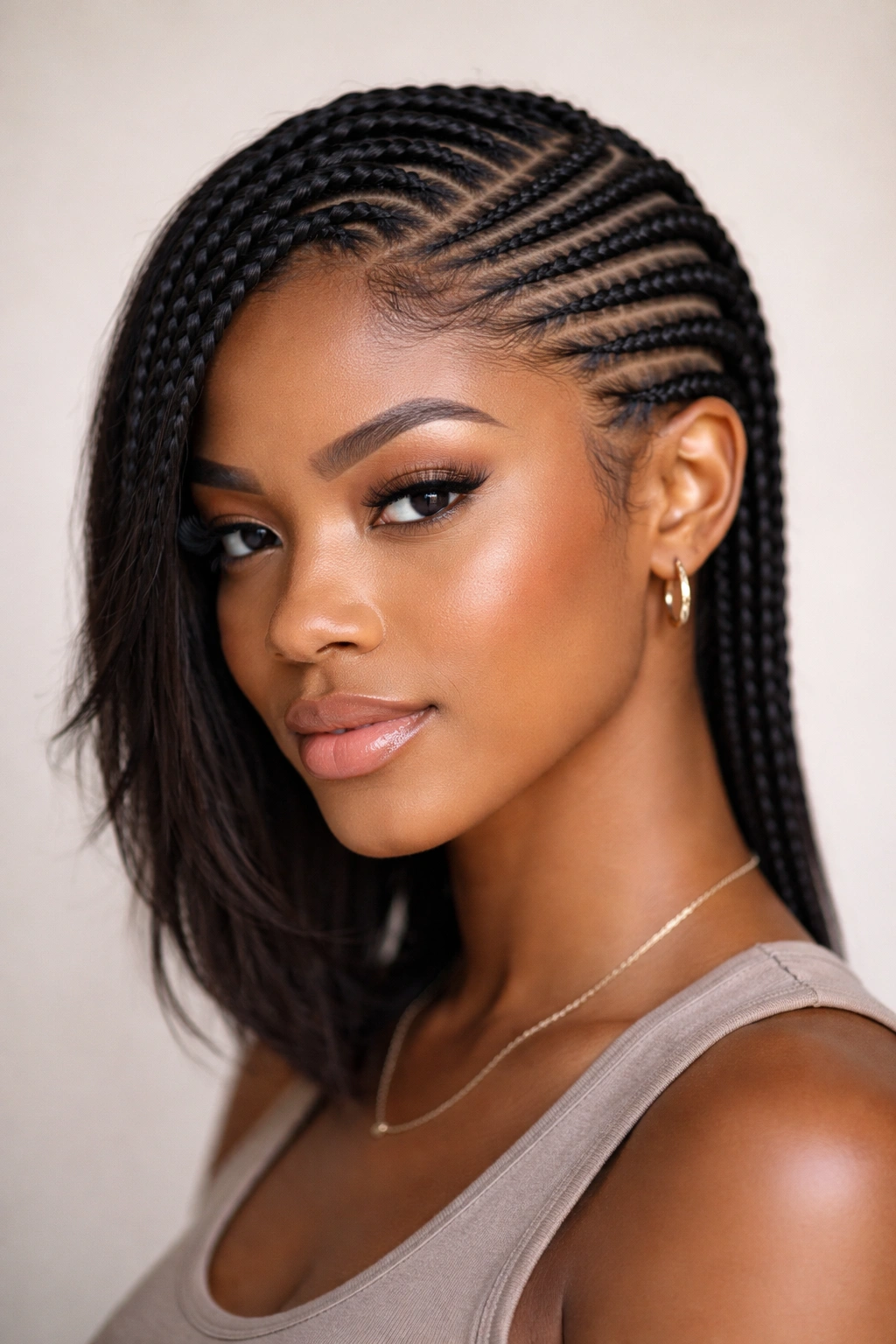
This is the quintessential polished look that works for nearly any setting—boardroom to date night. The cornrows start at one temple and sweep across the head toward the back, creating an asymmetrical pattern that adds sophistication to short hair. The side-swept direction gives your face definition and draws attention to your cheekbones and eyes, making it particularly flattering for oval or round face shapes.
Why This Style Works for Short Hair
Sleek side-swept cornrows don’t require length to look intentional. The sweeping motion creates the illusion of movement and styling intention that makes even shoulder-length or chin-length hair feel polished. The asymmetry breaks up the shape of your head in a way that feels modern and deliberate rather than simply practical. Feed-in tension keeps everything smooth and secure without the heaviness that comes with traditional cornrows, so your neck and scalp feel comfortable throughout the day.
How to Style and Maintain It
- Start with clean, moisturized hair and apply a lightweight gel or mousse to each section before braiding
- Have your braider begin thin feed-in cornrows at your temple and gradually thicken as they move back
- Ask for the braids to curve slightly rather than follow a completely straight path—this enhances the swept effect
- Smooth flyaways with an edge control product along your hairline and where the cornrows meet your scalp
- Sleep with a silk or satin scarf or bonnet to maintain the sleekness overnight
- Refresh the look every 3-4 days with a light moisturizer and edge control
Pro tip: If you have a narrow face, ask your braider to angle the cornrows slightly downward as they sweep back—this creates balance and prevents the style from making your face appear longer.
2. Double Feed-In Cornrows with Geometric Patterns
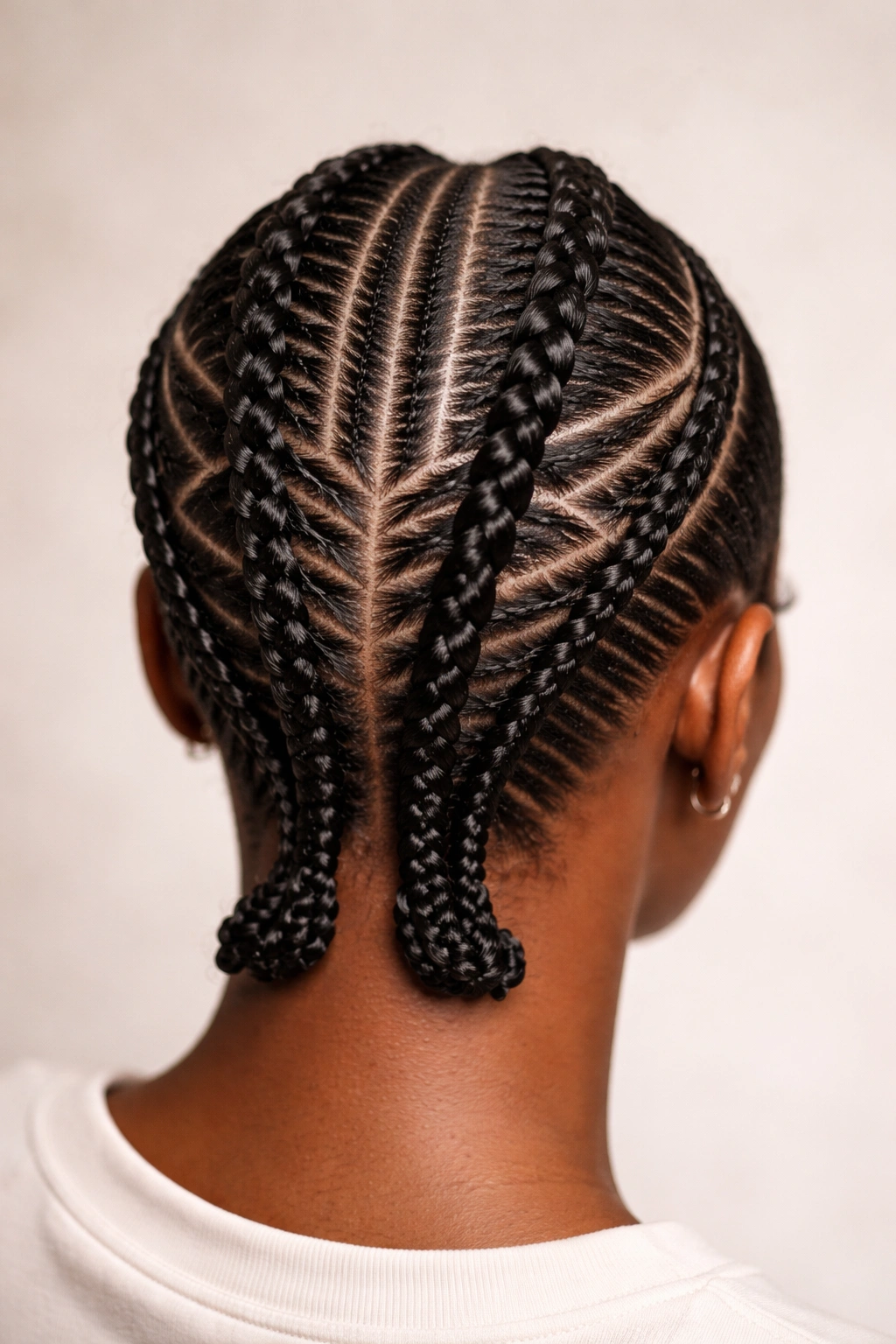
Two substantial feed-in cornrows braided in parallel lines down the center of your head offer a bold, graphic look that photographs beautifully and suits short hair perfectly. The geometric simplicity reads as intentional and editorial, and the parallel pattern creates visual symmetry that’s both calming and striking. You can ask your braider to vary the thickness or add subtle curves rather than keeping them perfectly straight, which adds personality without sacrificing the clean aesthetic.
Why Geometric Patterns Elevate Short Hair
Double cornrows work with your hair’s natural growth pattern on short hair rather than fighting against it. The two-cornrow format is sturdy enough to hold without needing excessive tension, which means less stress on your hairline and edges. The geometric pattern also means styling is straightforward—no complex sections to brush out or restyle. Your short hair length means these cornrows will sit closer to your scalp, creating more definition and making the pattern clearer and more striking than longer hair would allow.
Styling Considerations and Variations
- Pair with a sleek, shiny finish for a high-fashion look, or use a more matte edge control for a casual aesthetic
- Ask your braider to slightly curve the cornrows in an S-shape rather than perfectly straight—this adds movement while maintaining the geometric feel
- Add subtle metallic thread if you want just a hint of detail without overwhelming short hair
- The look pairs beautifully with dangling earrings that won’t catch in the cornrows
- For a bolder statement, ask your braider to create wider space between the two cornrows so your scalp shows through in a deliberate stripe
Worth knowing: This style reveals your entire face and hairline, so if you’re protective of your edges or dealing with breakage, give yourself a break between wearing this style and protective styles that have more coverage.
3. Curved Feed-In Cornrows with Side Part
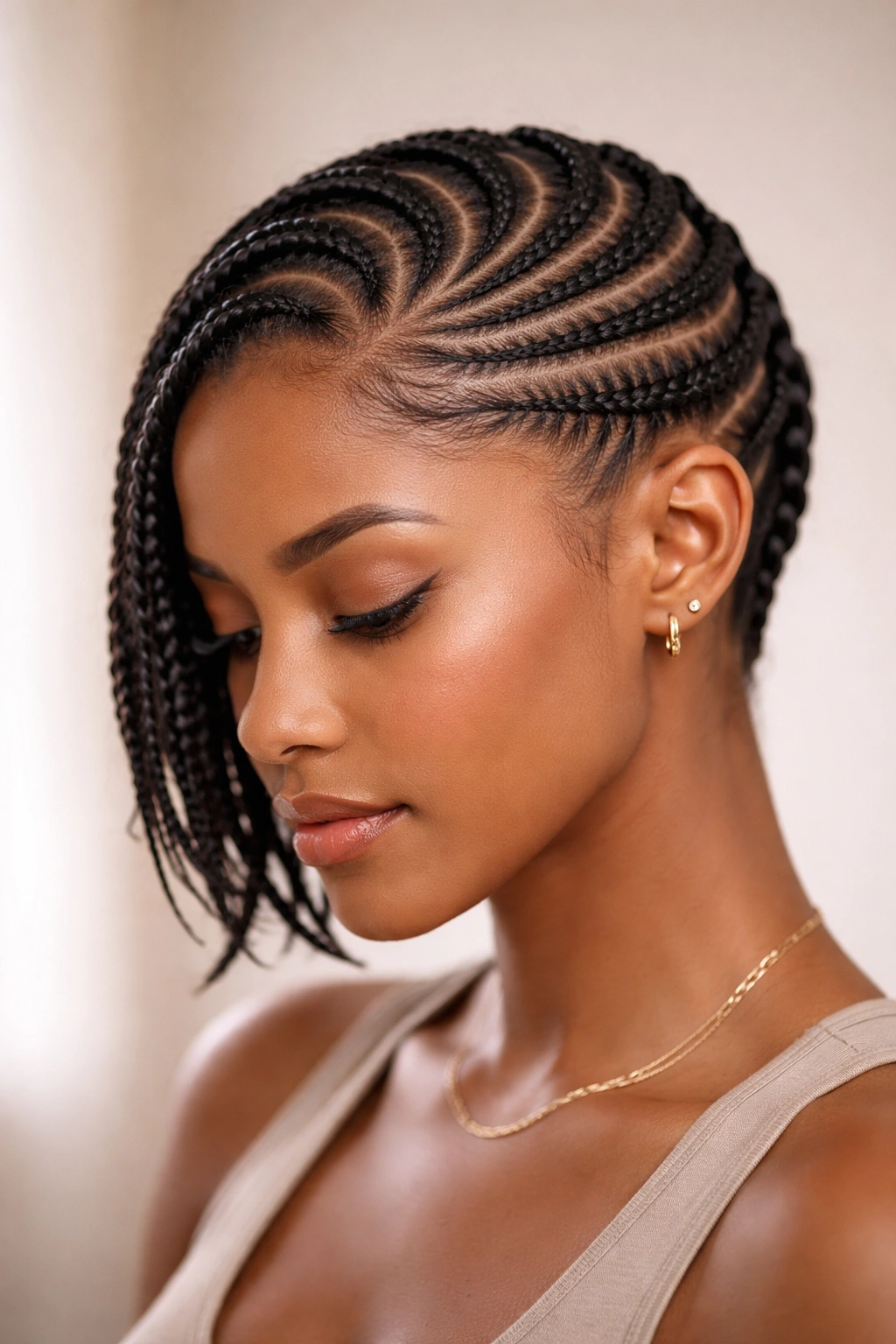
Rather than straight lines down the back of your head, curved feed-in cornrows that follow the natural contours of your skull create a softer, more organic look. The cornrows might start at one side part and curve gently as they move back, or they might spiral around the back of your head in a whimsical pattern. This style is particularly flattering for short hair because the curves visually soften the outline of your head and face while still looking intentional and styled.
The Visual Impact on Short Hair
Curved cornrows trick the eye into seeing more movement and dimension than straight lines. On short hair, where you have limited length to create the illusion of texture, curves add visual complexity and interest. The side part also gives you the ability to sweep your hair in a particular direction, which helps you control how the style frames your face. This is an excellent choice if you want a protective style that still feels fashion-forward and feminine rather than purely utilitarian.
Execution and Maintenance Tips
- Have your braider map out the curves before beginning—they should follow the natural shape of your head, not work against it
- Curves work best when they’re gradual and smooth; avoid sharp angles that can look choppy on short hair
- Use a flexible styling gel rather than a heavy cream so the curves look soft rather than rigid
- Refresh the style every few days with light moisturizer—curves tend to flatten more than straight lines as they age
- Sleep with a silk scarf that follows the curve of your head rather than pulling in one direction
- This style pairs beautifully with a simple pendant necklace or layered delicate chains
Insider note: Ask your braider to create one or two slightly thicker cornrows and complement them with thinner ones. This mixed thickness creates visual interest and prevents the style from feeling too uniform.
4. Feed-In Cornrows with Curly Extensions Blended
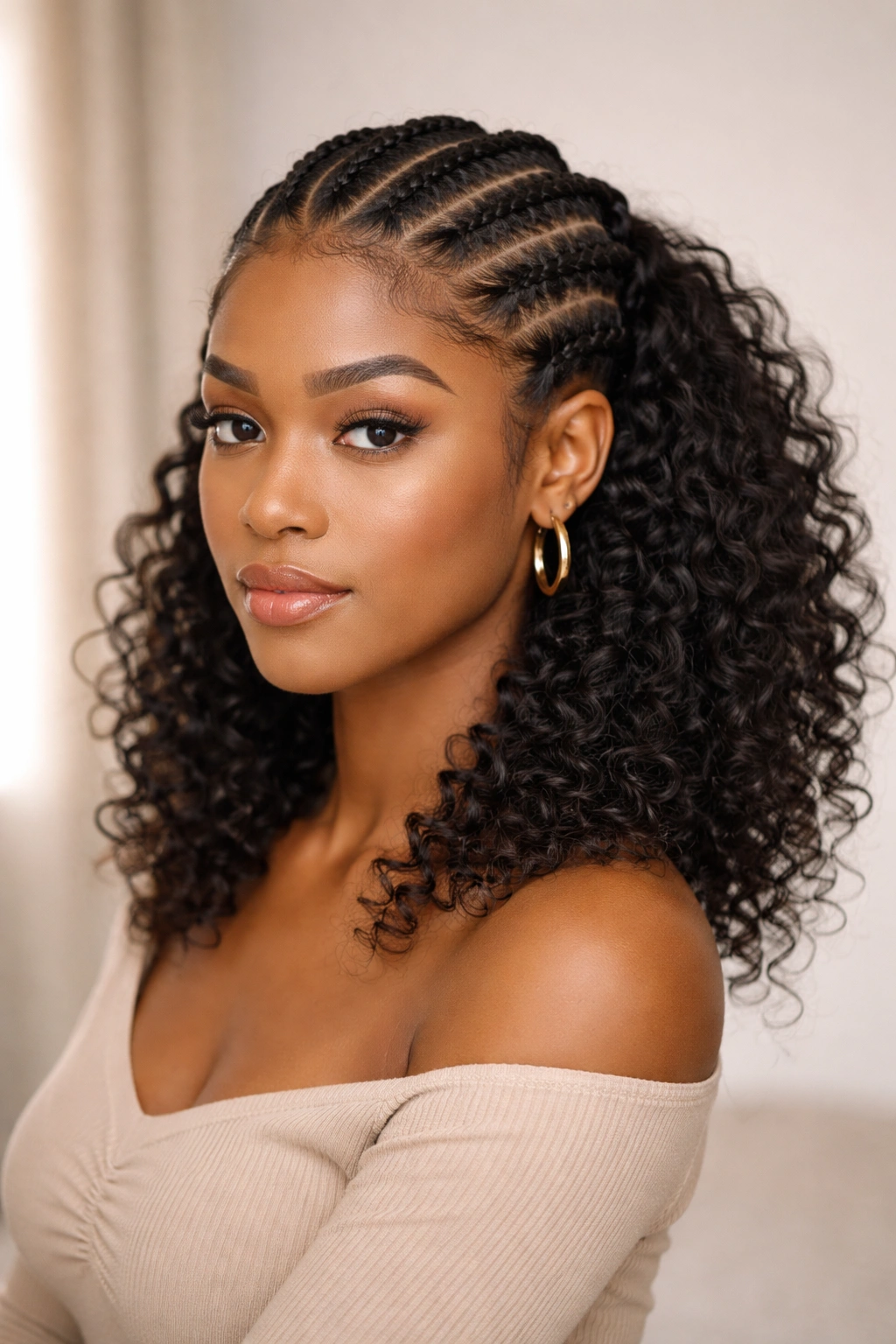
This hybrid style uses feed-in cornrows as the base structure, then incorporates curly extensions that blend seamlessly with your natural texture. Rather than using straight extensions, curly or textured extensions are fed in alongside your hair, creating a style that’s partly braided, partly twisted, and partly curly. On short hair, this approach gives you the protective benefits of cornrows while adding fullness, texture, and movement that shorter natural hair sometimes lacks.
Why Blending Extensions Works on Short Hair
Short hair can look wispy or thin even when it’s healthy, simply because there’s less length to create bulk. Incorporating curly extensions through the feed-in process means every inch of hair from root to end has dimension and texture. The curly extensions also hide the fact that your natural hair is short—from a distance, the style reads as full-bodied and substantial. The blended approach also means less visible braiding, which appeals to people who want a protective style that reads as more natural texture than obviously styled.
Application and Care Considerations
- Curly extensions should match your natural curl pattern as closely as possible—if you have loose waves, deep waves work better than tight coils
- Have your braider use thinner sections when feeding in curly extensions; otherwise, the weight becomes uncomfortable and the texture looks bulky rather than blended
- Keep extensions moisturized daily with a lightweight leave-in conditioner—curly extensions dry out faster than braiding hair
- Sleep with extensions wrapped loosely or in a pineapple (high ponytail) to maintain curl definition
- Plan for this style to last 3-4 weeks maximum; extensions begin to slip and lose shape after that timeframe
- Curly extensions are heavier than traditional braiding hair, so ensure your braider doesn’t braid too tightly at the roots
Real talk: This style requires daily or every-other-day maintenance to keep the curls defined and moisturized. If you’re looking for a low-maintenance protective style, this might not be the best choice.
5. Zigzag Feed-In Cornrows for Short Hair
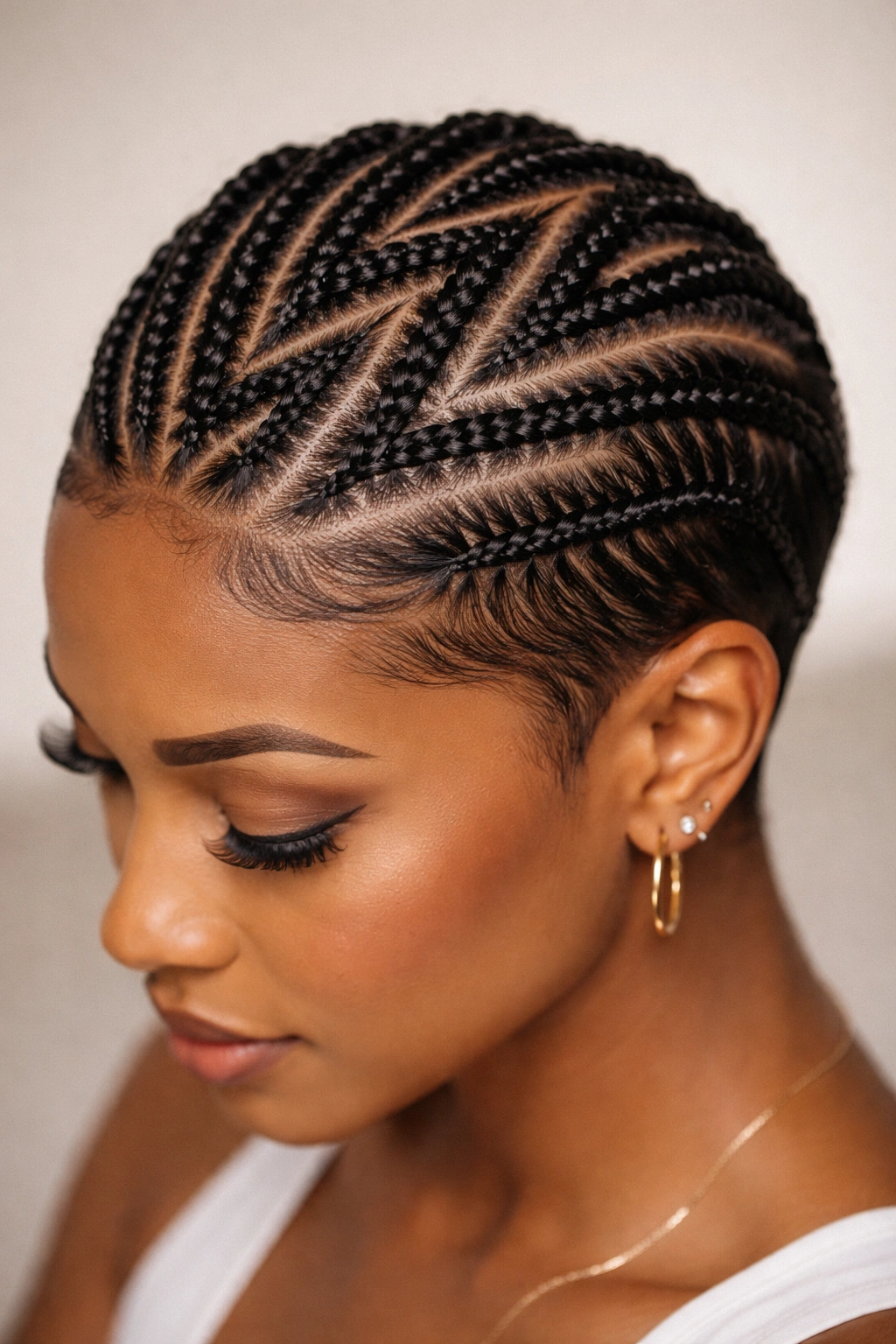
Zigzag cornrows follow a lightning-bolt pattern across your head rather than moving straight back, creating maximum visual interest and a playful, artistic vibe. The pattern can start at one side and zigzag across the crown to the other side, or it can spiral in a zigzag motion from front to back. This style demands attention and works best when you’re confident wearing something bold and unconventional—it’s not a subtle statement.
Design Possibilities and Pattern Variations
- Classic side-to-side zigzag: Cornrows start at one temple and zigzag horizontally across the top of your head
- Spiral zigzag: Cornrows spiral around the head in a zigzag pattern rather than concentric circles
- Double-zigzag: Two separate zigzag patterns mirror each other across the center line of your head
- Curved zigzag: Instead of sharp angles, the pattern uses gentle waves that look like a topographical map
- Mixed width: Alternate between thin and thick sections within the zigzag for additional complexity
Why Short Hair Shows Off the Pattern Best
On short hair, every detail of the braiding pattern is visible—there’s no long hair to obscure the lines or distract from the design. Zigzag cornrows look crisp and clean on short hair in a way they might look chaotic on longer lengths. The pattern also doesn’t require additional length to look intentional; the design itself carries the visual impact. This is one of the few styles where having very short hair (pixie length to chin length) actually works in your favor.
Styling and Wear Time
- Pair zigzag cornrows with minimal additional styling—let the pattern be the statement
- Use a high-shine gel to make the braids gleam and emphasize the geometric pattern
- Avoid wearing hats or headwear that would cover the pattern and defeat the purpose
- This style typically lasts 4-6 weeks depending on how active you are
- Refresh the edges every 2-3 days to maintain a polished appearance
Pro tip: Photograph your zigzag pattern from multiple angles before you leave the salon so you can show your braider reference images if you want to replicate the design in the future.
6. Minimalist Single Feed-In Cornrow
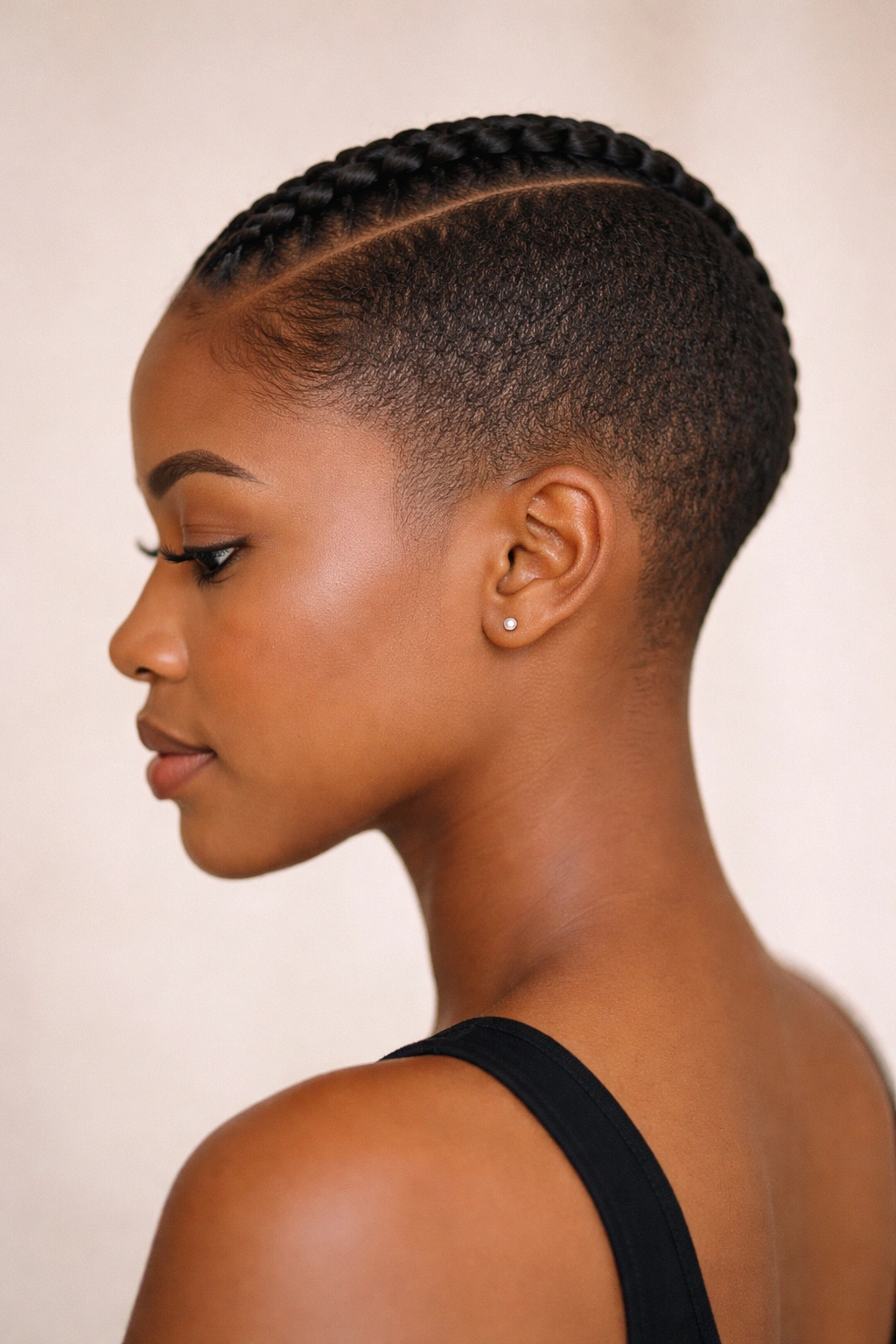
For those who want a protective style but prefer an understated aesthetic, a single feed-in cornrow offers all the benefits without dominating your look. One thick, substantial cornrow braided to the back of your head or wrapped around your crown provides structure and a finished appearance while maintaining a minimal, almost invisible sensibility. This style reads as effortlessly chic and works beautifully on very short hair where multiple cornrows might feel overwhelming.
The Appeal of Single Cornrow Simplicity
A single cornrow is the protective-style equivalent of a statement earring—one powerful element that transforms your entire look without adding complexity. On short hair, one cornrow takes just minutes to style and requires minimal maintenance. It’s also a perfect transitional style if you’re new to cornrows; starting with a single cornrow lets you understand how the braiding feels on your scalp and how long you can comfortably wear it before committing to a more complex multi-cornrow design.
Placement Options for Maximum Impact
- Center part: One cornrow running down the exact center from forehead to nape
- Side placement: One cornrow positioned off-center, sweeping from temple toward the back
- Crown wrap: One cornrow wrapped around the circumference of your head like a crown
- Diagonal placement: One cornrow running diagonally from one side of your head to the other
- Back placement: One thick cornrow positioned at the back of your head while the rest of your hair remains loose
Styling Flexibility and Versatility
- Pair a single cornrow with loose, textured curls for a mixed look that feels effortless
- Wear it sleek and shiny for a polished aesthetic, or matte for a more casual vibe
- A single cornrow works with updos, half-up styles, and side ponytails
- This is one of the easiest protective styles to transition out of—you can unravel it in minutes if you need to switch styles
- Single cornrows work well with all hair textures from straight to coily
Worth knowing: Placement matters more with a single cornrow than with multiple cornrows. Spend time with your braider discussing exactly where you want the cornrow positioned and how it will sit on your head from different angles.
7. Feed-In Cornrows with Colored Thread Details
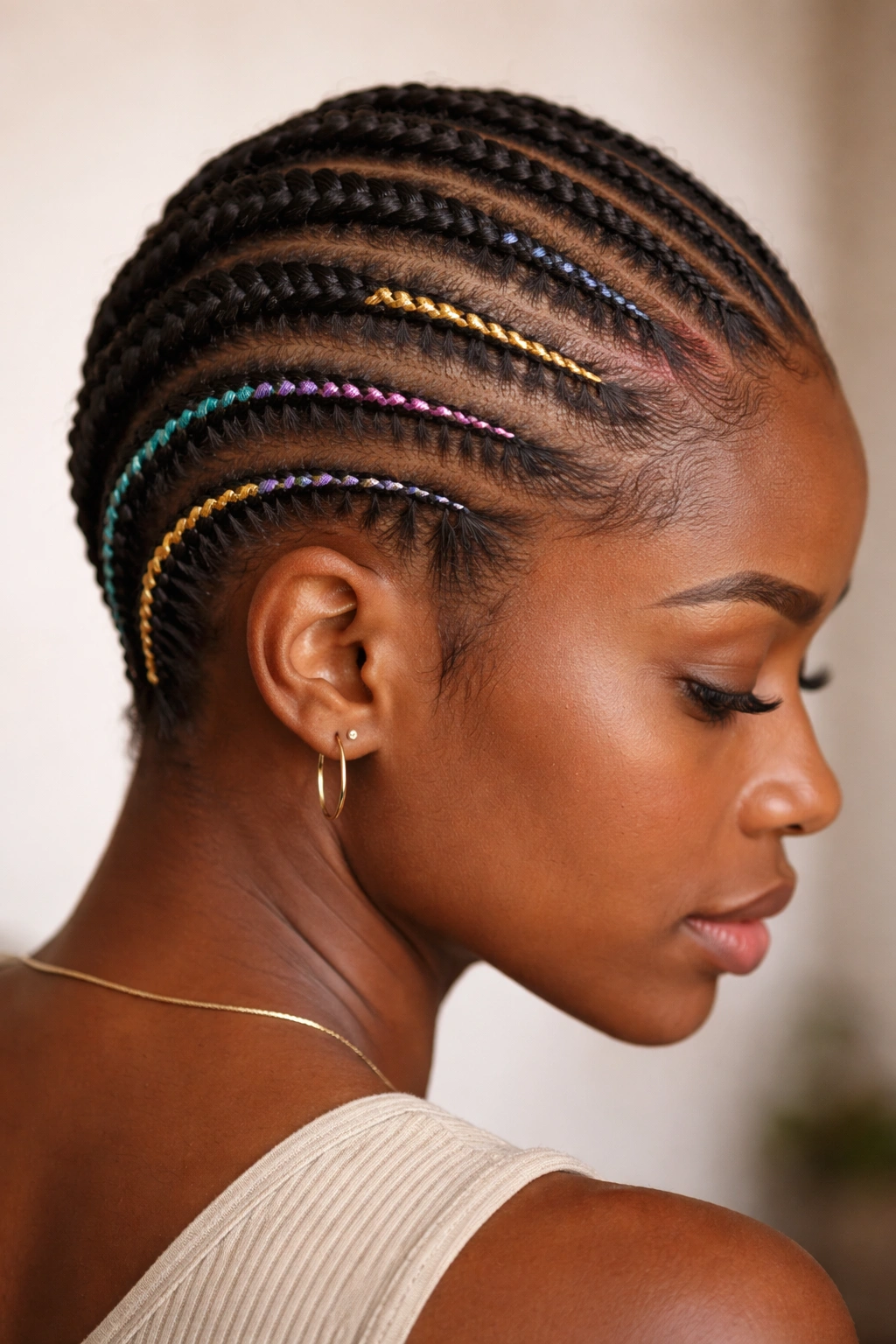
Incorporating colored thread, yarn, or thin braiding hair into your feed-in cornrows adds a layer of personalization and visual pop without changing your actual hair color. Whether you choose a metallic gold thread, a vibrant jewel tone, or a subtle earth tone, threaded cornrows give you total creative control over how bold or minimal the design element is. On short hair, the thread is immediately visible and impactful; it’s not lost in long lengths but rather becomes part of the overall composition.
Color Combinations That Work Best
- Gold or bronze thread with any hair color: Classic, warm, and universally flattering
- Silver or platinum thread: Creates a cool-toned, almost futuristic aesthetic
- Deep jewel tones (emerald, sapphire, garnet): Add richness without being loud
- Pastels or soft hues: Create a whimsical, artistic feel that reads as intentional rather than accidental
- Contrasting colors: Use a thread color that contrasts with both your hair and skin tone for maximum visibility
Integration Techniques for Short Hair
- Have your braider feed the thread in alongside your hair so it’s integrated throughout rather than wrapped around the outside
- Ask for the thread to run consistently through all cornrows for a unified look, or use different threads in different cornrows for more visual complexity
- Thread placement matters—some braiders run it down the center of each cornrow, while others incorporate it along the edges
- The thickness of the thread affects how visible it is; thicker threads make a bolder statement while thin threads add subtle detail
- Colored thread can last the entire duration of your cornrow wear (4-8 weeks) without fading if you use quality materials
Maintenance and Style Longevity
- Colored threads don’t require special care beyond regular cornrow maintenance
- Avoid chlorine if possible; even quality thread can fade in pool water
- Refresh edges with edge control products as usual—the thread won’t be affected
- If a thread begins to fray, ask your braider to trim it; don’t try to fix it yourself
- This is a style choice that photographs beautifully and works well on social media
Insider note: Metallic threads photograph better in natural light than artificial indoor lighting. If you’re planning professional photos, schedule them for daytime when the light catches the thread most beautifully.
8. Crown-Style Feed-In Cornrows
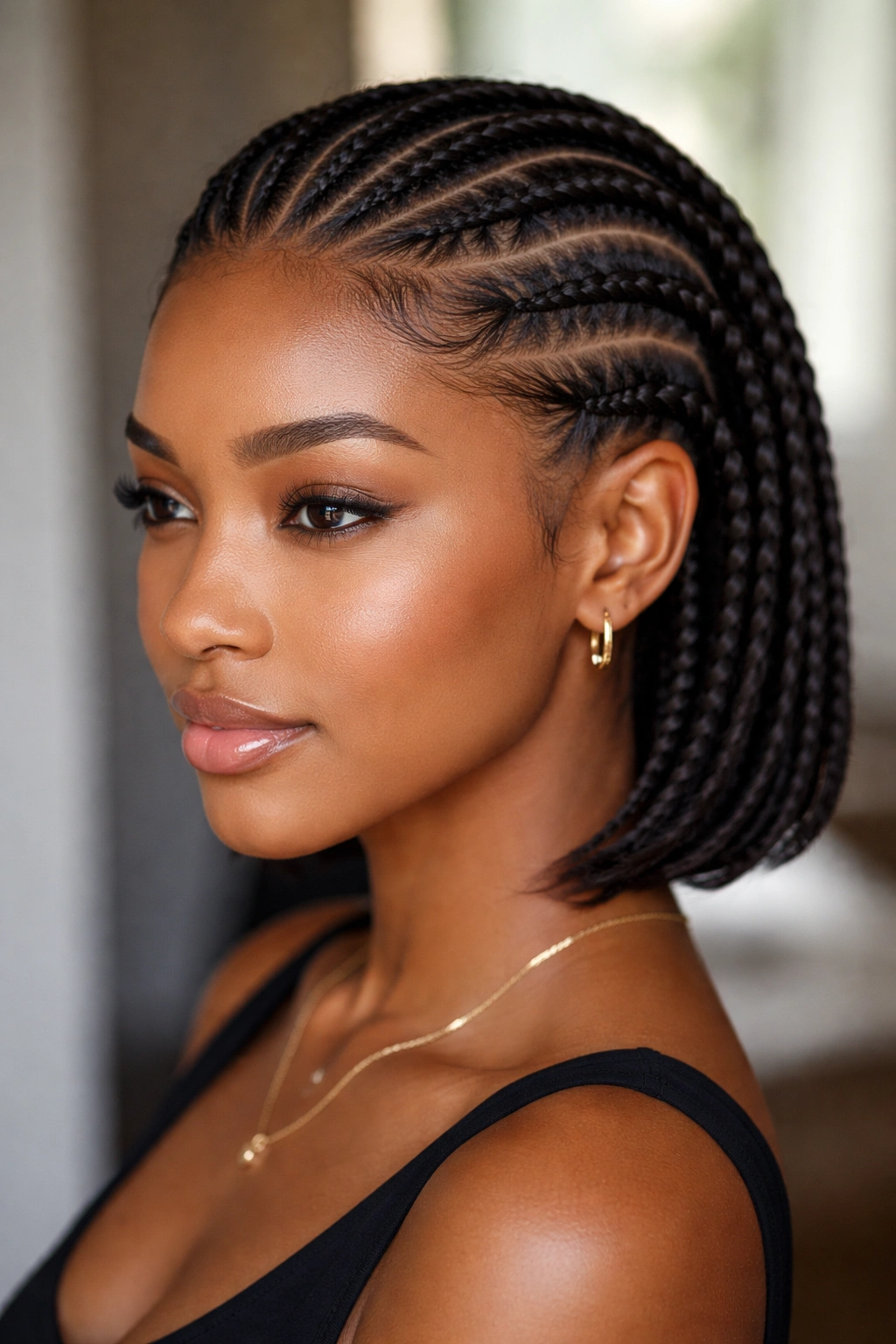
A crown-style layout places feed-in cornrows around the perimeter of your head like a halo or crown, leaving the crown and top of your head free or with minimal braiding. This approach frames your face beautifully and creates visual lift and dimension. On short hair, crown-style cornrows work particularly well because they emphasize your facial features and bone structure without overwhelming your head with braids. The style is also incredibly flattering for different face shapes since it draws attention upward and outward.
How Crown Placement Flatters Your Features
If you have a round face, crown cornrows draw the eye upward and give definition to your jawline. For an oblong face, placing cornrows at the sides and back creates width in the right places. Square faces benefit from the softness of cornrows placed at the temples rather than straight down the center. Heart-shaped faces look balanced when cornrows start slightly back rather than at the very front hairline. The crown-style approach lets you customize placement specifically for your face shape and features.
Styling the Free Hair Above and Below Braids
- Leave the very crown completely free for a spiky, textured, or naturally curly look
- Braid the bottom section while leaving the top loose for a mixed aesthetic
- Add volume to the unbraid sections with mousse or texture spray
- Wear the free hair down and flowing, or sweep it into a small ponytail or bun
- Layer the braided and free sections so they blend rather than creating a stark line
Creating Visual Balance
- Have your braider start the crown cornrows slightly back from your natural hairline to ensure your forehead isn’t overwhelmed
- Thicker cornrows around the perimeter balance thick, voluminous free hair on top
- If your free hair is sleek and smooth, slightly thinner cornrows look proportional
- Ask for the cornrows to be slightly curved rather than perfectly straight to enhance the crown effect
- Side-swept cornrows that gather toward the back create more lift than centered ones
Pro tip: Crown-style cornrows work beautifully with a statement accessory like a comb, clip, or headwrap placed in the unbraid section at the top of your head.
9. Thin Intricate Feed-In Cornrows (Micro Style)
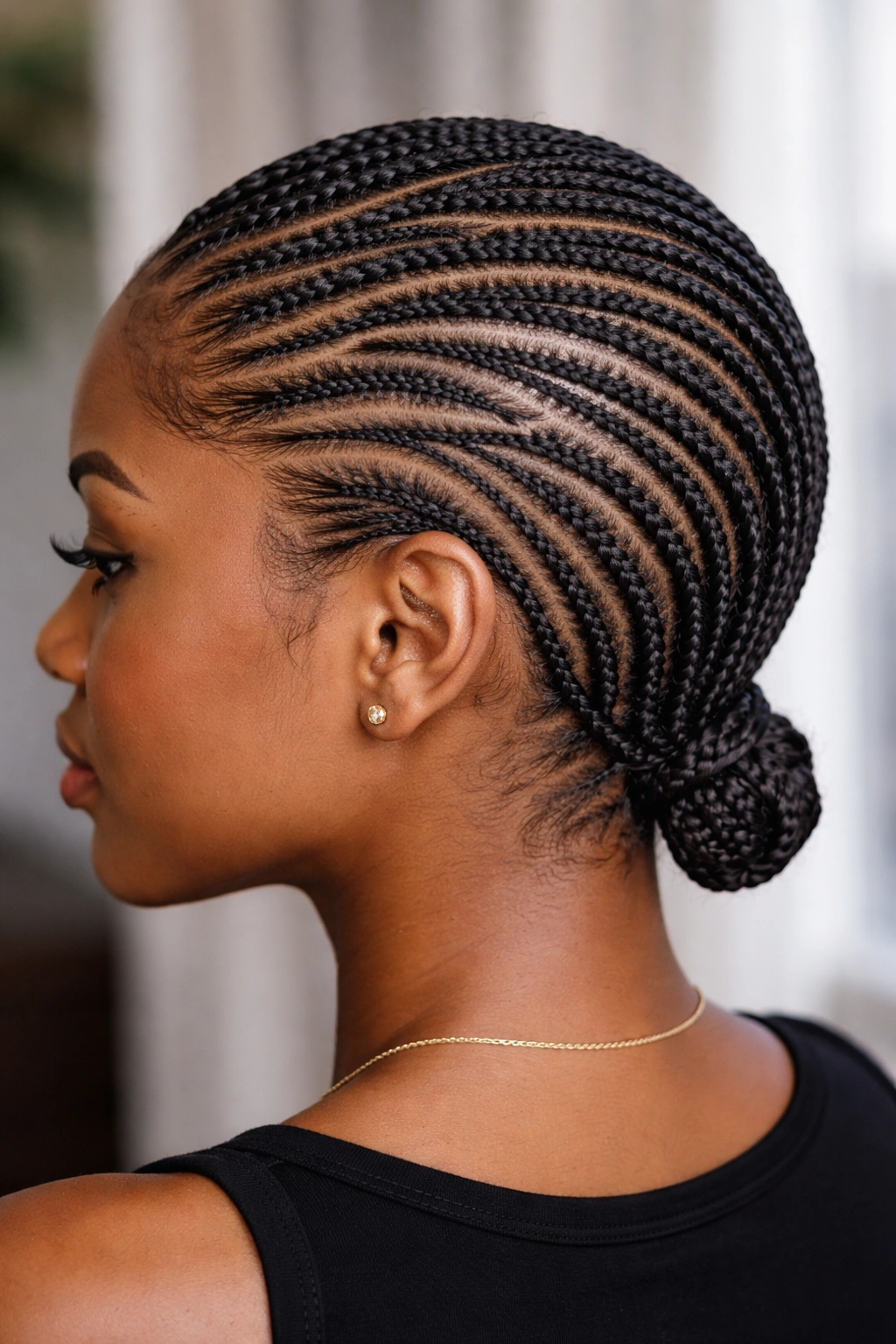
Micro cornrows take the feed-in technique to its finest expression—thin, delicate cornrows that create a nearly mosaic-like pattern across your entire head. This style requires significant patience and expertise from your braider; each cornrow needs to be fed in consistently while staying thin enough to create visual texture without being fragile. On short hair, micro cornrows create exceptional detail and depth, and they’re actually easier to manage than on longer hair since there’s less length for the braids to snag or tangle.
Why Micro Cornrows Require Specific Expertise
Micro cornrows are technically demanding because the tension needs to be absolutely consistent throughout each braid—too tight and you risk breakage, too loose and the braids unravel. Your braider also needs to be skilled at feeding hair in micro-increments, which requires a steady hand and deep understanding of the technique. This is not a budget style; expect to pay significantly more than you would for thicker cornrows, and book with a braider who specializes in intricate work.
Design Possibilities With Micro Cornrows
- Full head coverage with hundreds of thin cornrows running straight back
- Geometric patterns created by varying the direction of individual cornrows
- Ombré effect using braiding hair in multiple shades throughout the cornrows
- Mixed thickness: alternating thin cornrows with thicker ones to create rhythm
- Radial pattern: cornrows radiating outward from a central point like rays of sun
- Spiral pattern: thin cornrows spiraling around the head in circular or S-curve patterns
Wear Time and Maintenance for Micro Cornrows
- Expect installation to take 4-8 hours depending on coverage and complexity
- Micro cornrows last 6-10 weeks, longer than thicker styles since they’re less likely to unravel
- Maintenance is actually easier with micro cornrows—the tight spacing means less manipulation needed between washes
- Sleep with a silk bonnet to prevent the delicate braids from snagging
- Refresh edges every 2-3 days since the fine braids draw more attention to the hairline
- Washing is gentle with micro cornrows; you can wash without fear of the braids loosening
Real talk: Micro cornrows look stunning, but they demand skilled installation and consistent care. If you don’t have a trusted braider who specializes in intricate work, this might not be the best first cornrow experience.
10. Feed-In Cornrows with Braided Bun
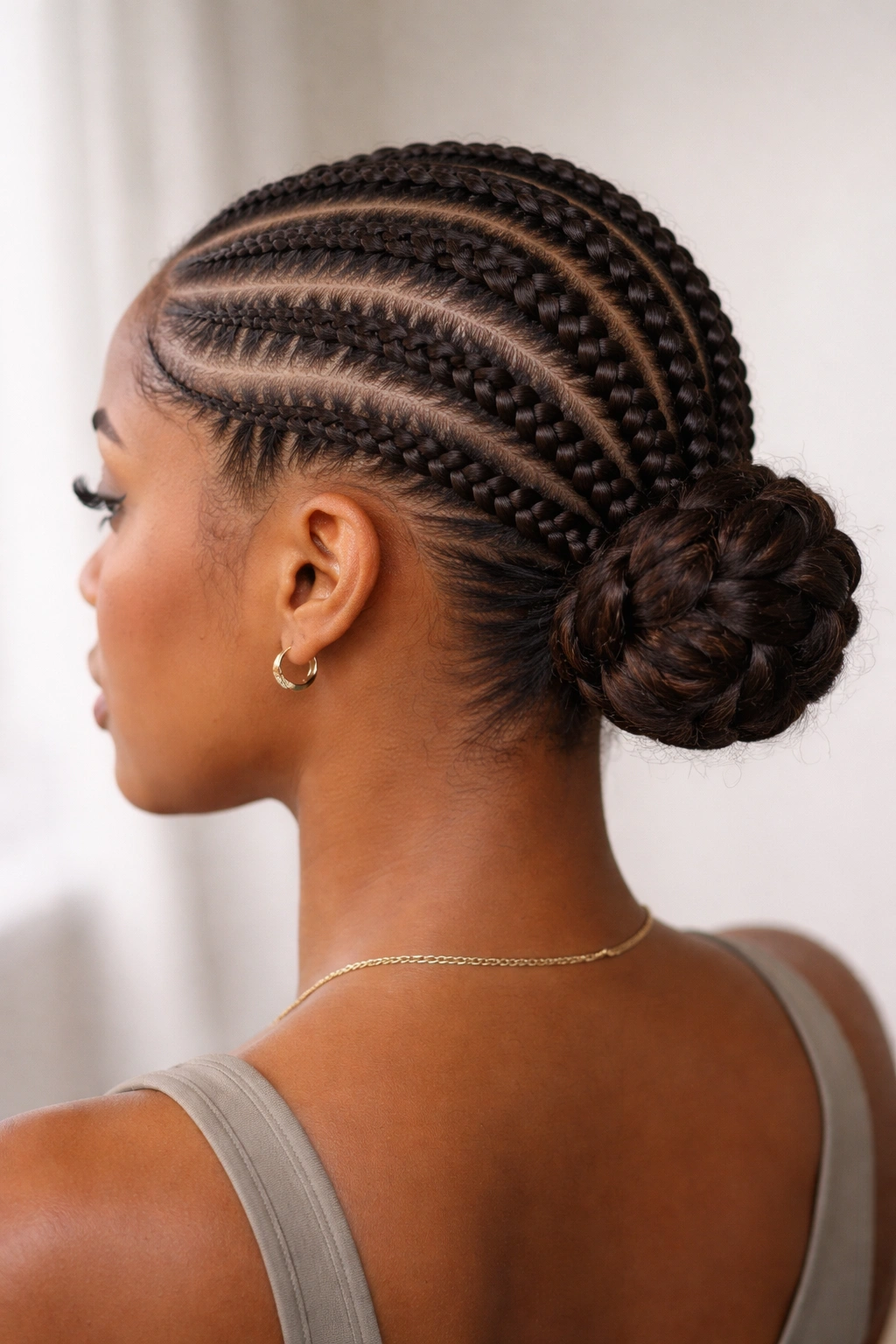
Combining feed-in cornrows with a braided bun creates a look that’s protective, polished, and practical all at once. The cornrows run back along your scalp and feed directly into a bun shape at the nape of your neck or crown. This approach works beautifully on short hair because the bun doesn’t need to be huge or elaborate—even a small, compact bun reads as intentional and styled. It’s also a great option for keeping your hair fully protected while maintaining maximum visibility through your hairline and temple area.
Different Bun Variations for Short Hair
- Tight low bun: Cornrows feed into a very compact bun at the nape of your neck, perfect for a professional setting
- Crown bun: Cornrows spiral up the back and feed into a bun positioned at or near your crown
- Side bun: Cornrows angled toward one side of your head feed into a bun positioned at the side of your head
- Textured bun: Cornrows feed into a bun made from the loose ends of your hair, creating a deliberately undone aesthetic
- Two-bun variation: Multiple cornrows feed into two small buns, one on each side of your head
Why This Style Works for Active Lifestyles
Short hair with a braided bun stays completely secured and out of your face during activity. The feed-in braids at the scalp prevent the bun from shifting or loosening as you move. This is an excellent style choice if you exercise, work in a hands-on profession, or simply want a look that stays flawless throughout your day without requiring adjustments.
Styling and Refreshing the Look
- Use bobby pins that match your hair color to secure the bun
- A light hairspray keeps flyaways in check without making your hair feel crunchy
- You can refresh the bun every few days by loosening and retightening it slightly
- This style photographs beautifully from the side and back
- Pair with minimal accessories since the bun is already a substantial styling element
Worth knowing: If your hair is very short (pixie length), a braided bun might not be possible since you don’t have enough length to gather at the back. Work with your braider to determine if this style is feasible with your current hair length.
11. Asymmetrical Feed-In Cornrows Design
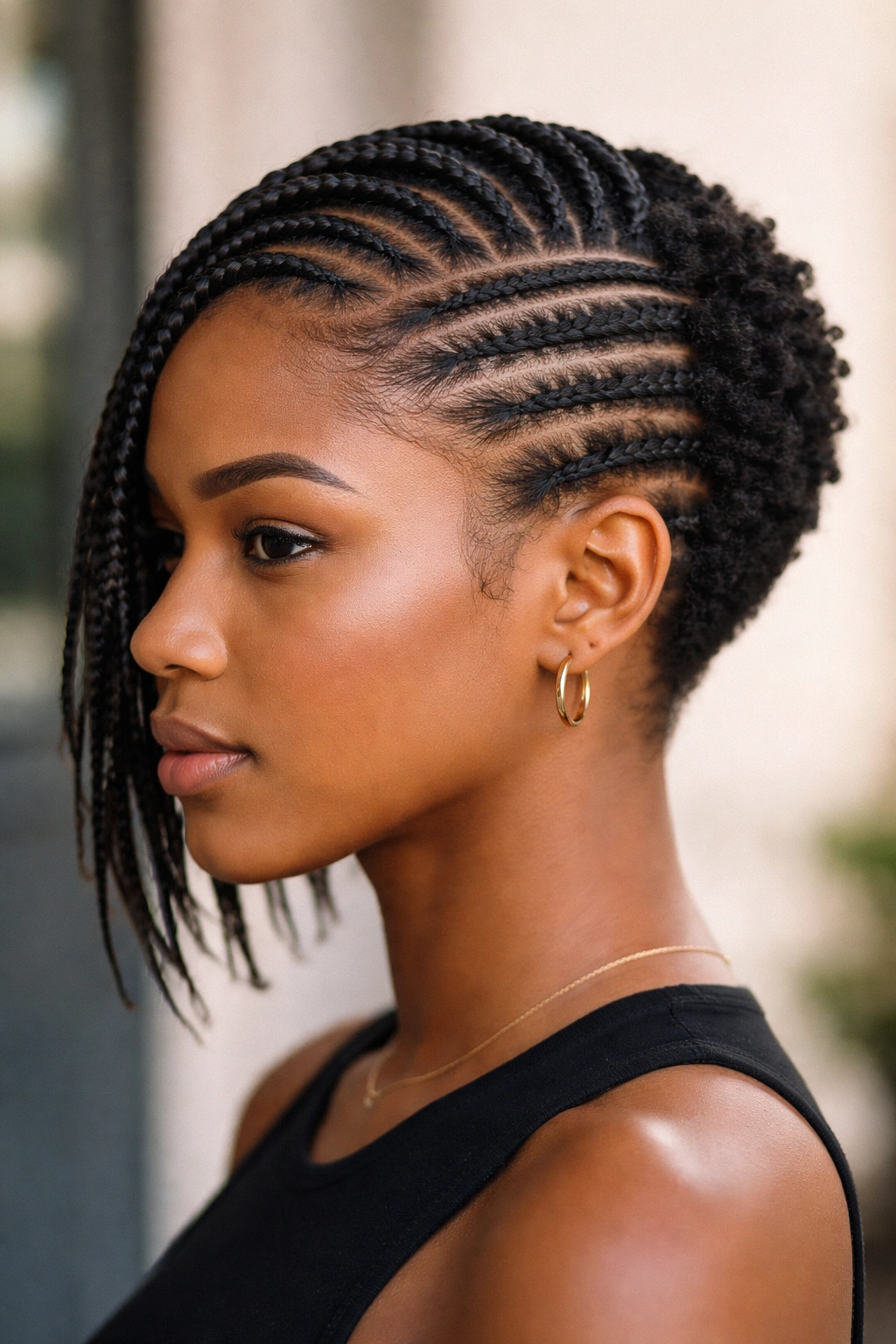
Asymmetrical cornrow designs break away from the typical centered or evenly distributed approach and instead use mismatched placement to create a bold, artistic look. One side of your head might have multiple cornrows while the other side has fewer or none; cornrows might be clustered in one area and sparse in another. This style demands confidence and a willingness to stand out, but it’s undeniably striking on short hair where the asymmetry is completely visible.
Design Approaches to Asymmetrical Cornrows
- One side heavy: One side of your head has 5-7 cornrows while the other side has 1-2 or none
- Clustered placement: Cornrows grouped in one section of your head (temple area, one side, back) rather than distributed evenly
- Gradient density: Cornrows transition from thick clustering on one side to sparse placement on the other
- Opposite directions: Cornrows on the left side run straight back while cornrows on the right side curve or angle differently
- Negative space: Strategic gaps between cornrows on one side create intentional empty space that’s part of the design
Who This Style Flatters Best
Asymmetrical designs work beautifully on people with strong bone structure and facial features that can support bold styling. They’re particularly striking on those with defined cheekbones, strong jawlines, or distinctive features you want to emphasize. The asymmetry should draw attention toward your best features rather than away from them.
Confidence and Care Considerations
- This style makes a clear statement—you’re not trying to blend in or play it safe
- Asymmetrical designs photograph beautifully and translate well to artistic or fashion contexts
- The uneven distribution means one side of your scalp might feel different pressure than the other; wear time might need to be slightly shorter than with evenly distributed cornrows
- Maintenance is asymmetrical too—you might need to refresh one side of your edges more frequently
- This is a style that works well if you’re comfortable with people asking about it or complimenting it
Pro tip: Try an asymmetrical cornrow design in a temporary or semi-permanent way first—get one or two cornrows on one side to test how you feel wearing something so visibly unconventional before committing to a full asymmetrical installation.
12. Feed-In Cornrows with Shaved Sides
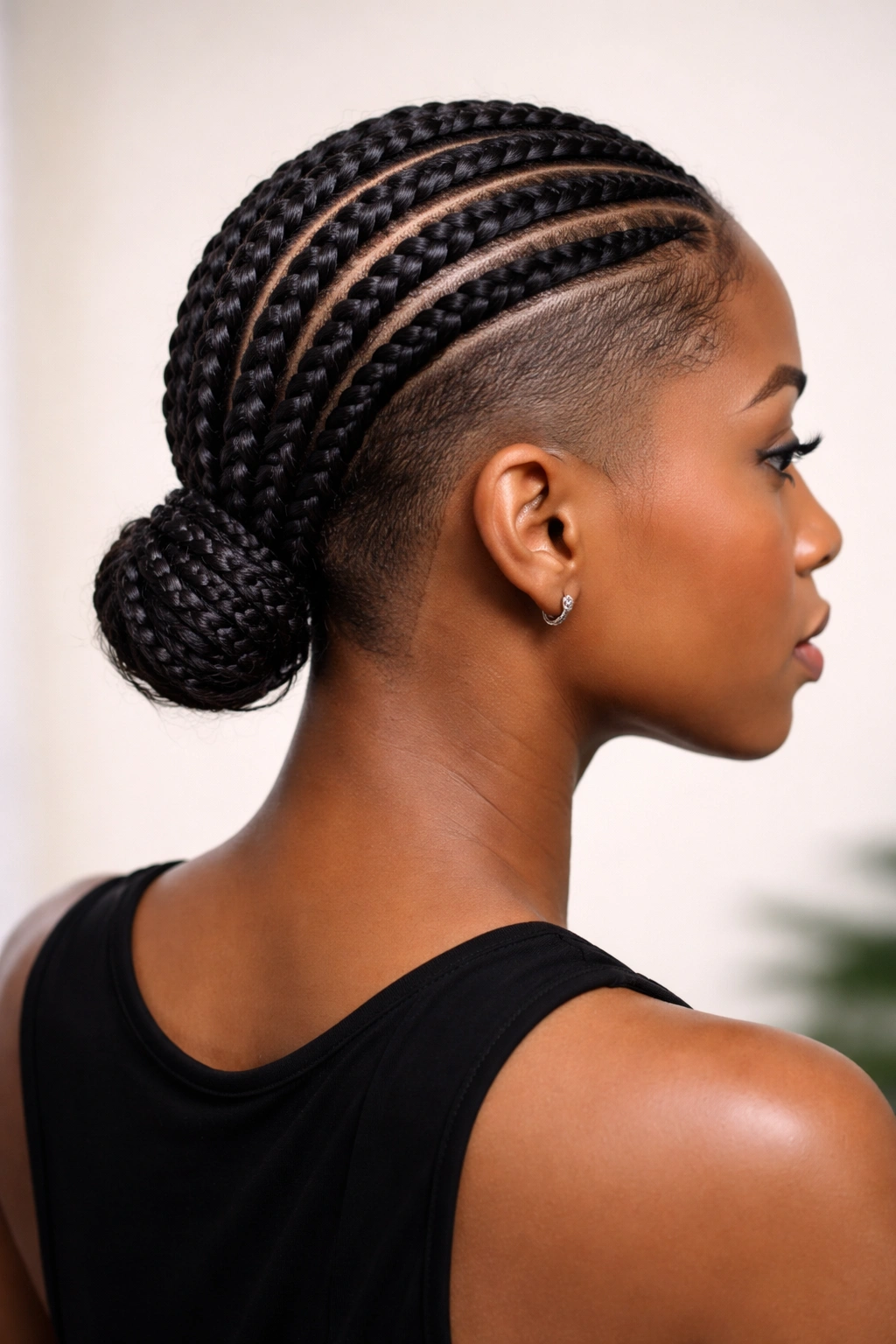
The contrast between intricate feed-in cornrows down the center or back of your head and closely shaved sides creates a high-fashion, fashion-forward aesthetic that’s become increasingly popular. The shaved sides expose your scalp and elongate your face while the cornrows down the middle draw attention upward. On short hair, this style creates maximum visual impact with minimal bulk, and it’s exceptionally practical since the shaved sides require no styling whatsoever.
Design Variations With Shaved Sides
- Center cornrows: One or multiple thick cornrows running straight down the center from forehead to nape, shaved sides completely bare
- Back cornrows: Cornrows limited to the back of your head and nape, leaving shaved sides and a loose top
- Spiral cornrows: Cornrows spiraling across the back while sides are shaved clean
- Asymmetrical cornrows: Cornrows only on one side of your head paired with shaved sides
- Textured top: Loose, natural texture on top and at the front with cornrows and shaved sides toward the back
How Shaved Sides Change the Overall Impact
Short hair with shaved sides creates an edgy, confident aesthetic that reads as intentional and artistic. The shaved areas make your face feel more defined and your facial features more prominent. If you’re concerned about the look being too harsh, slightly longer hair on the sides (rather than completely shaved) creates a softer transition. Shaved sides also mean less hair to maintain overall; you’re getting a complex braided look while reducing total styling time.
Maintenance and Growing Out Considerations
- Shaved sides need refreshing every 1-3 weeks depending on how fast your hair grows and how precise you want the line
- You can maintain shaved sides yourself with clippers or visit your barber regularly
- As sides grow out, the transition line becomes softer and less defined; some people like this gradual blur while others prefer sharp maintenance
- Cornrows on shaved sides can last longer since there’s no competing hair texture
- This style works with almost any hair type on the braided portion, but shaved sides look best on those comfortable with visible scalp
Styling and Outfit Coordination
- Shaved sides pair beautifully with minimal jewelry since your face and neck are very exposed
- Consider how this style photographs—it’s dramatic and reads beautifully in profile but some people find full frontal views too edgy
- Clothing choices impact how bold the style feels overall; minimal, clean aesthetic pieces balance the edginess
- Hats and headwear will cover the style; consider whether you want this look visible or occasionally concealable
Real talk: Shaved sides are a commitment that requires regular maintenance. If you’re not ready for the upkeep or if you’re uncertain about how you feel being that visibly bold, start with cornrows alone before adding shaved sides to the design.
Final Thoughts
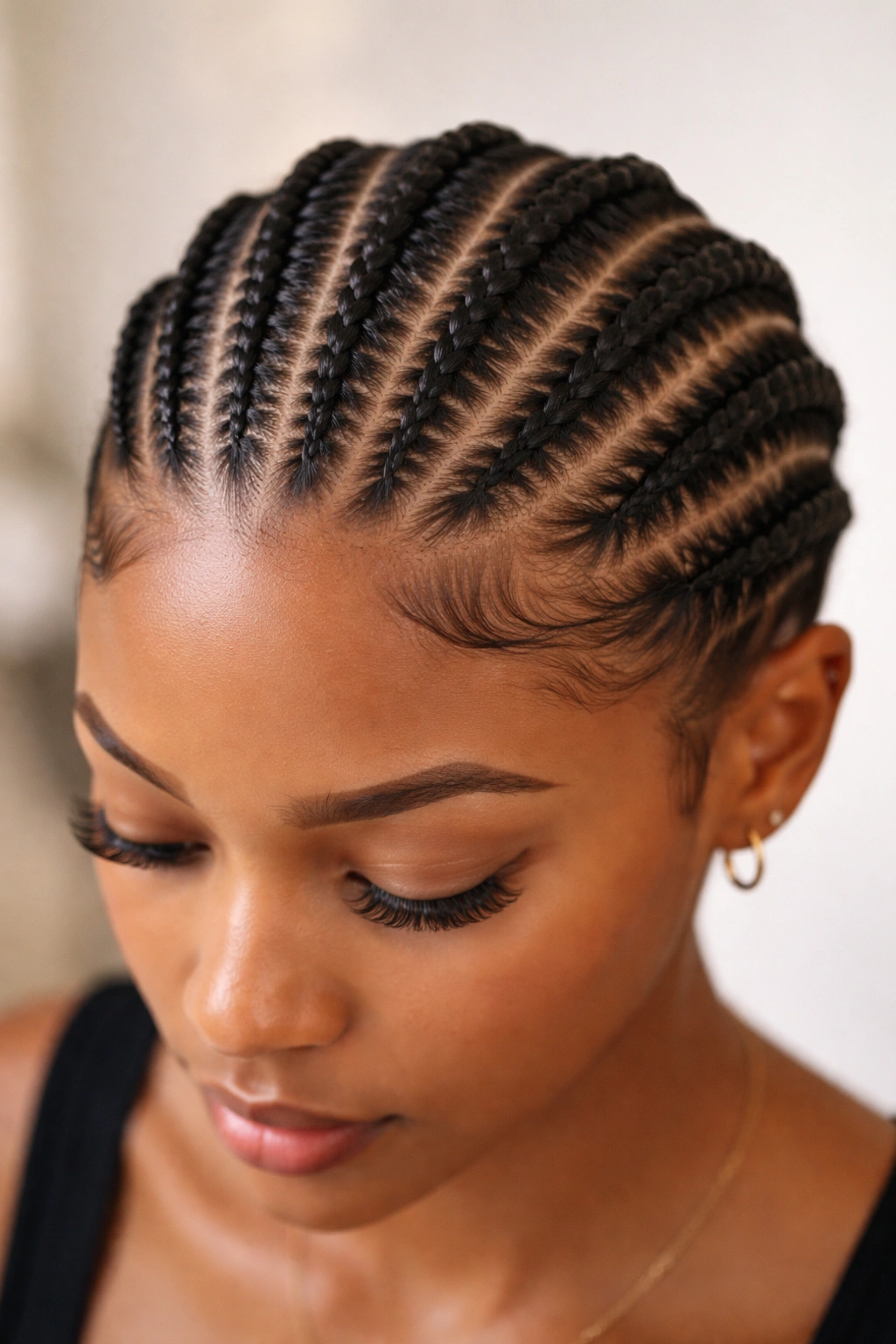
Feed-in cornrows for short hair offer remarkable versatility—you can go minimalist with a single cornrow, create geometric patterns with multiple braids, or push boldly into asymmetrical designs and contrasting shaved sides. The key to choosing the right style for you is considering your lifestyle, comfort level with visibility and attention, and what your braider can realistically execute with skill and precision.
Short hair actually gives you advantages when wearing feed-in cornrows. The reduced length means faster installation, less weight on your scalp, and clearer visibility of whatever pattern or design you choose. Every braid shows, every detail matters, and simplicity reads as sophistication rather than necessity.
Whichever style you select, invest in a braider whose work you trust and who understands your vision clearly. The quality of your feed-in cornrows depends entirely on consistent tension, precise feeding technique, and attention to detail throughout the installation. Schedule regular maintenance appointments to refresh your edges and check on the health of your hairline. Moisturize consistently, sleep protectively, and plan for the style to last 4-8 weeks depending on your hair growth rate and activity level.
Feed-in cornrows are more than a protective style—they’re a form of creative expression and personal identity. Whether you choose a sleek, minimal look or an intricate, artistic design, you’re making a statement about how you move through the world with intention and confidence.
