



A crown braid is one of those hairstyles that instantly makes you look like you’ve stepped out of a fairy tale—which is exactly the vibe you want on your wedding day. Unlike a standard half-up hairstyle that sits higher on the crown, a crown braid wraps around the head like a delicate circlet, creating an ethereal, princess-worthy look that photographs beautifully and holds up throughout hours of celebration. The genius of pairing a crown braid with a half-up style is that you get the best of both worlds: enough hair down to frame your face softly and move with you as you walk, but enough secured with the braid to keep everything looking polished and intentional.
What makes crown braids so perfect for weddings is their incredible versatility. Whether your vision is romantic and bohemian, sleek and modern, or vintage-inspired and ornate, there’s a crown braid interpretation that fits your aesthetic. You can weave fresh flowers through the braid for garden-party elegance, thread metallic ribbons or delicate chains for contemporary glamour, or keep it pure and simple for timeless refinement. The braid itself becomes part of your jewelry—an architectural element that draws attention to your face, shoulders, and the back neckline of your dress.
The styling possibilities expand even further when you consider how a crown braid interacts with your veil, your dress neckline, and the overall silhouette you’re creating. Some brides prefer a braid that sits snugly against the head; others want more dimension and texture. Some want the braid to anchor a veil perfectly; others want it to be the statement piece on its own. Understanding these different crown braid styles—and how each one will look in candlelight, in photographs, and when you’re dancing—is essential to making the right choice for your big day.
1. Classic Crown Braid
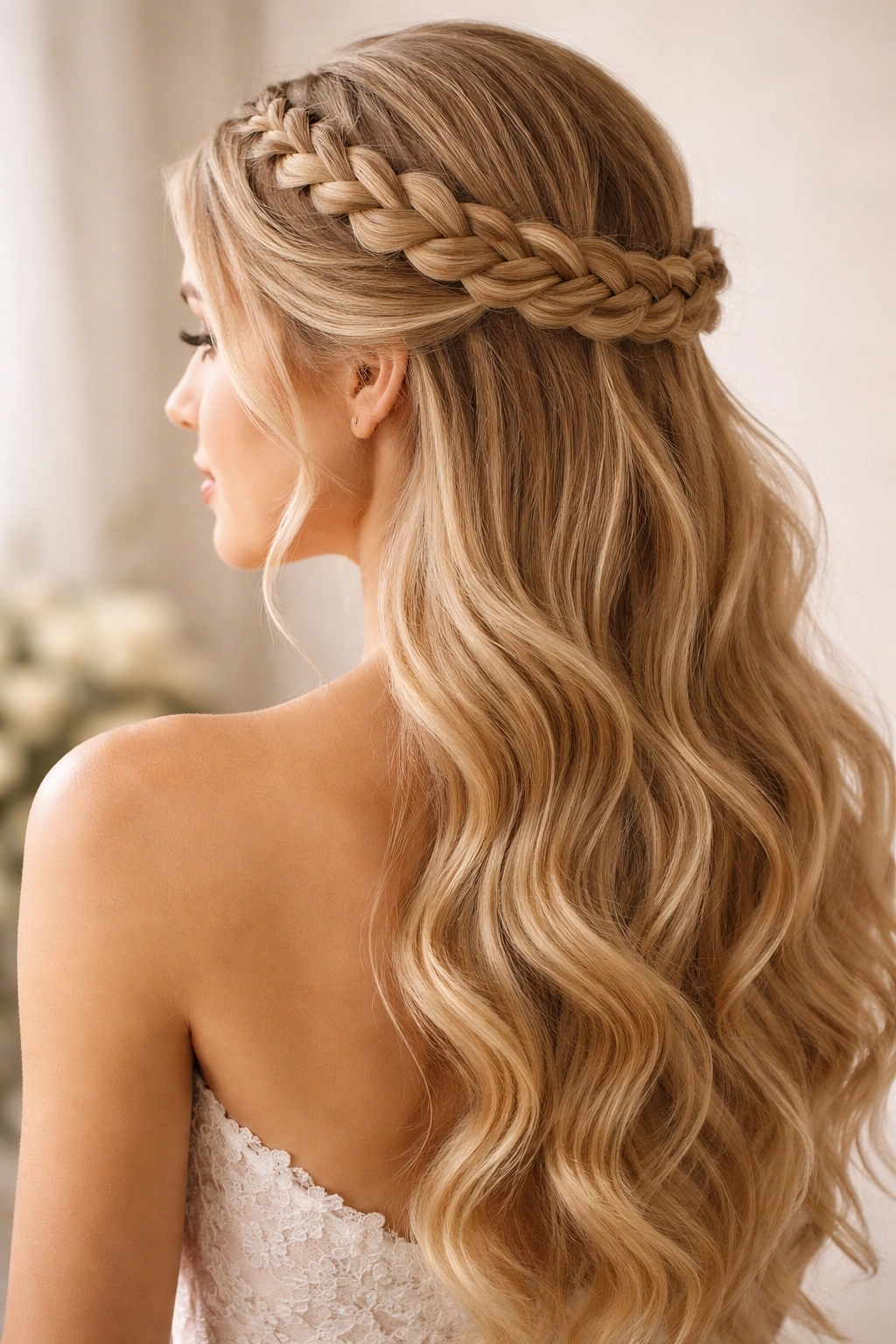
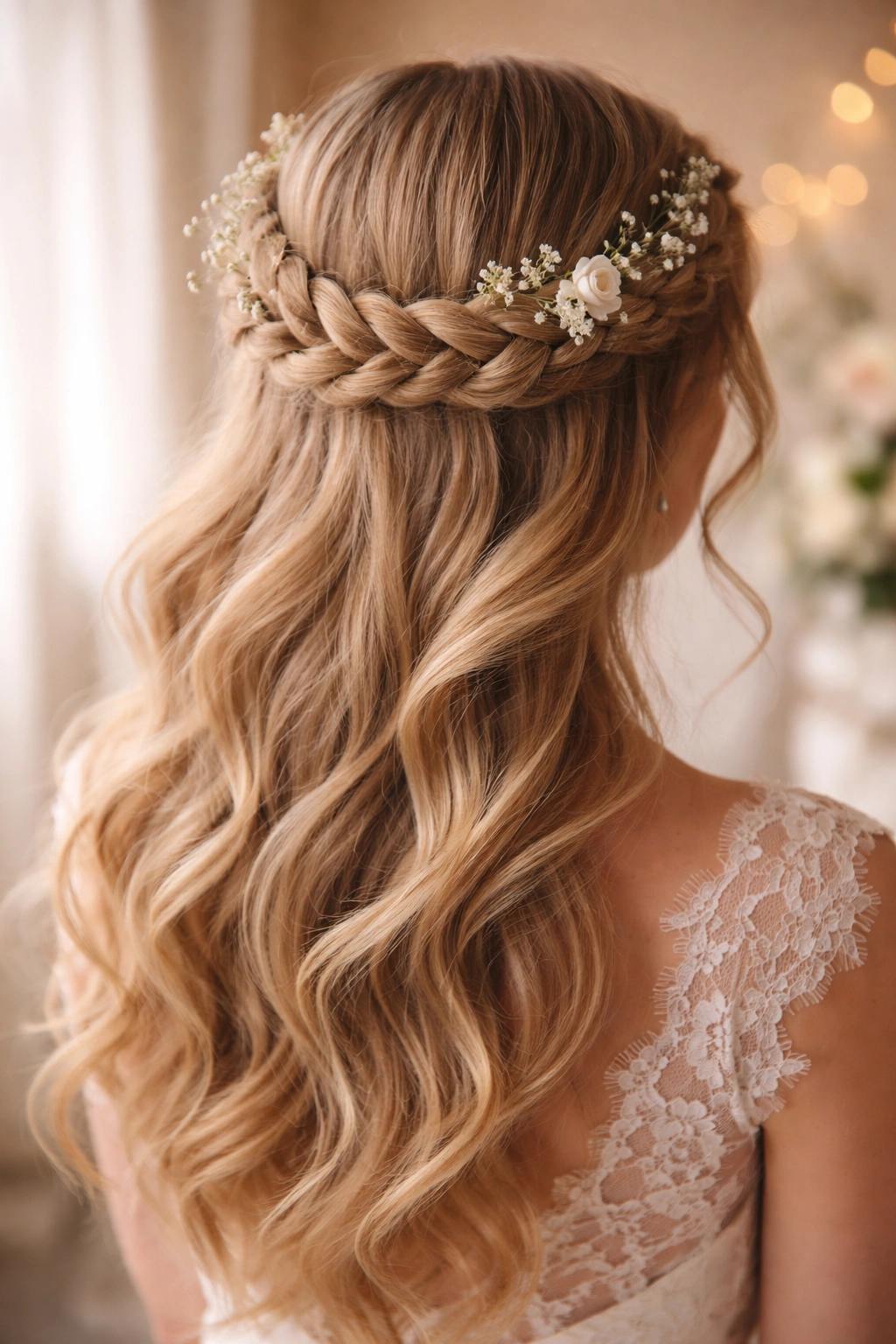
The classic crown braid is the timeless option that suits nearly every bride, every hair type, and every wedding aesthetic. This is a three-strand French braid that begins at one side of your head (typically behind your ear), travels across the back of your skull in a graceful arc, and finishes at the opposite ear. The braid sits low enough to feel anchored and secure, but high enough that plenty of hair flows below it in soft waves or curls. The half-up structure means your length and volume are on full display while the braid keeps everything harmoniously contained.
Why It’s the Go-To Choice for Weddings
The classic crown braid works because it’s sophisticated without feeling overly trendy or costume-like. It photographs beautifully from every angle—the braid is visible and ornamental in profile shots, your face is framed and open in front-facing photos, and the back creates a gorgeous focal point if you’re doing a veil or dramatic gown back. The braid also distributes the weight of your hair evenly, so it stays in place through ceremony, reception, and dancing without requiring frequent touch-ups. This is stability and elegance in one.
How to Make It Your Own
- Works seamlessly with loose waves, tight curls, straight hair, and texturized styles—the braid adapts to your hair’s natural movement
- Pairs beautifully with delicate hairpins, pearl details, or subtle sparkle woven directly into the braid
- Creates a perfect anchor point for a tulle or silk veil without any awkward lumps or gaps
- Allows you to keep volume on top of your head for a lifted, regal silhouette that photographs well
- Comfortable to wear all day because the braid is secure but not so tight it causes tension headaches
Pro tip: Ask your stylist to leave some soft, wispy pieces around your face before braiding—these catch light and soften the overall look, making the braid feel less severe and more romantic.
2. Twisted Crown Braid
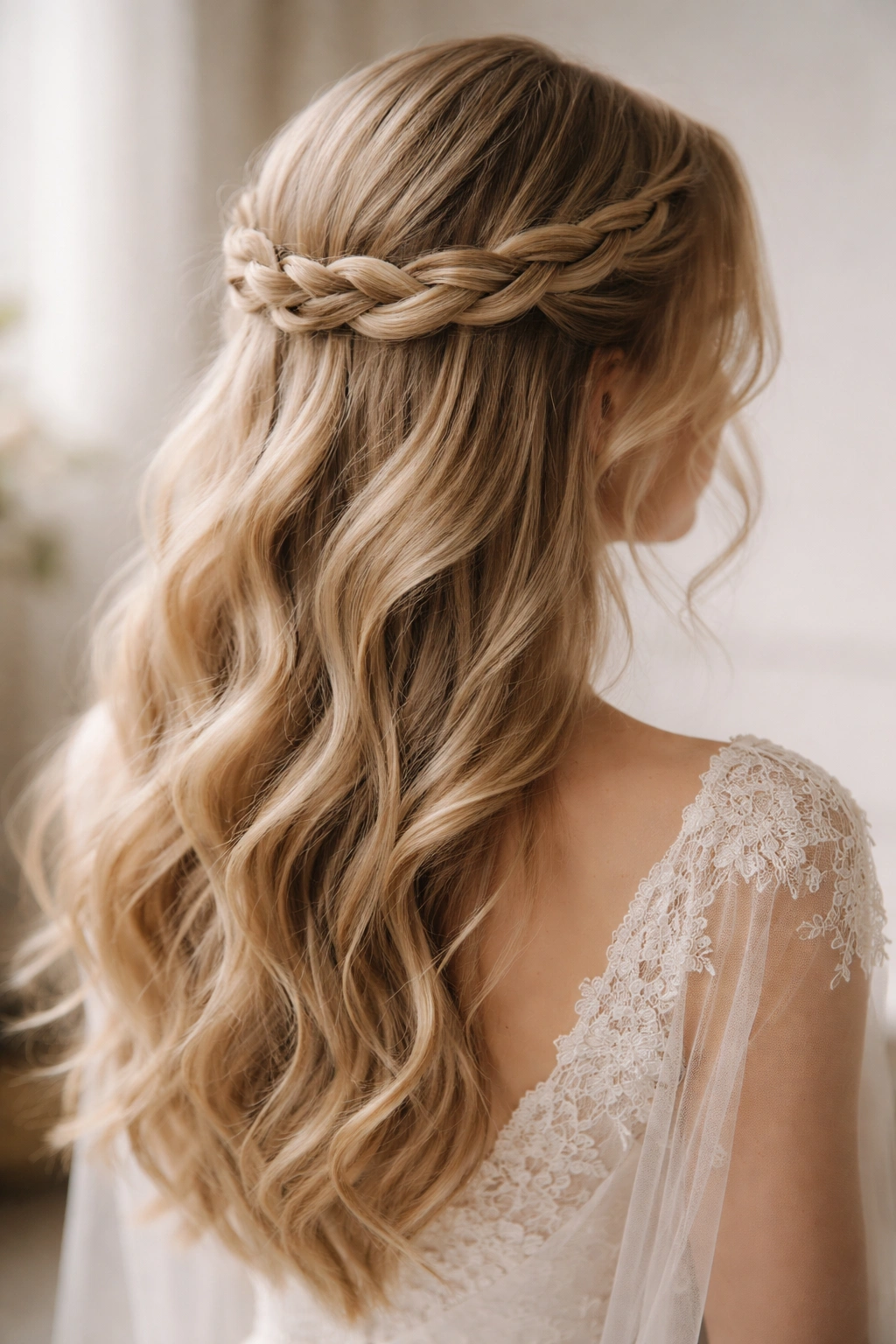
Where the classic crown braid uses three interwoven strands, a twisted crown braid uses just two sections of hair twisted around each other in a spiral motion as they travel around your head. This creates a more fluid, less structured appearance—it feels lighter and more ethereal than a traditional braid while still providing excellent hold. The twist naturally creates texture and movement, making it particularly stunning if you have fine hair or prefer a less geometric braid pattern.
The Visual Effect and Why Brides Love It
A twisted crown braid has an almost rope-like quality that’s incredibly romantic. Because the two strands are simply twisted rather than woven in the complex over-under pattern of a traditional braid, the finished texture is smoother and more refined. This style photographs with beautiful depth—the twist catches light differently than a flat braid, adding dimension to your hairstyle. It also tends to feel less formal and more whimsical, which appeals to brides going for a bohemian or garden-wedding vibe.
What Makes It Different From a Regular Braid
- Takes slightly less time to create than a three-strand braid, though it requires more precision to keep both sections even
- The final texture is smoother and more refined, with a ropelike appearance rather than the defined woven look of a French braid
- Creates a softer silhouette, making it ideal if you want an ethereal rather than structured aesthetic
- Works beautifully with hair that has some natural wave or texture, since the twist accommodates movement better than a tight braid
- Feels secure and stays in place throughout the day without the heavier, more geometric appearance of a traditional braid
Worth knowing: Twisted braids tend to loosen slightly more throughout the day than three-strand braids, so plan for a quick touch-up before your first dance if you’re having a long reception.
3. Dutch Crown Braid
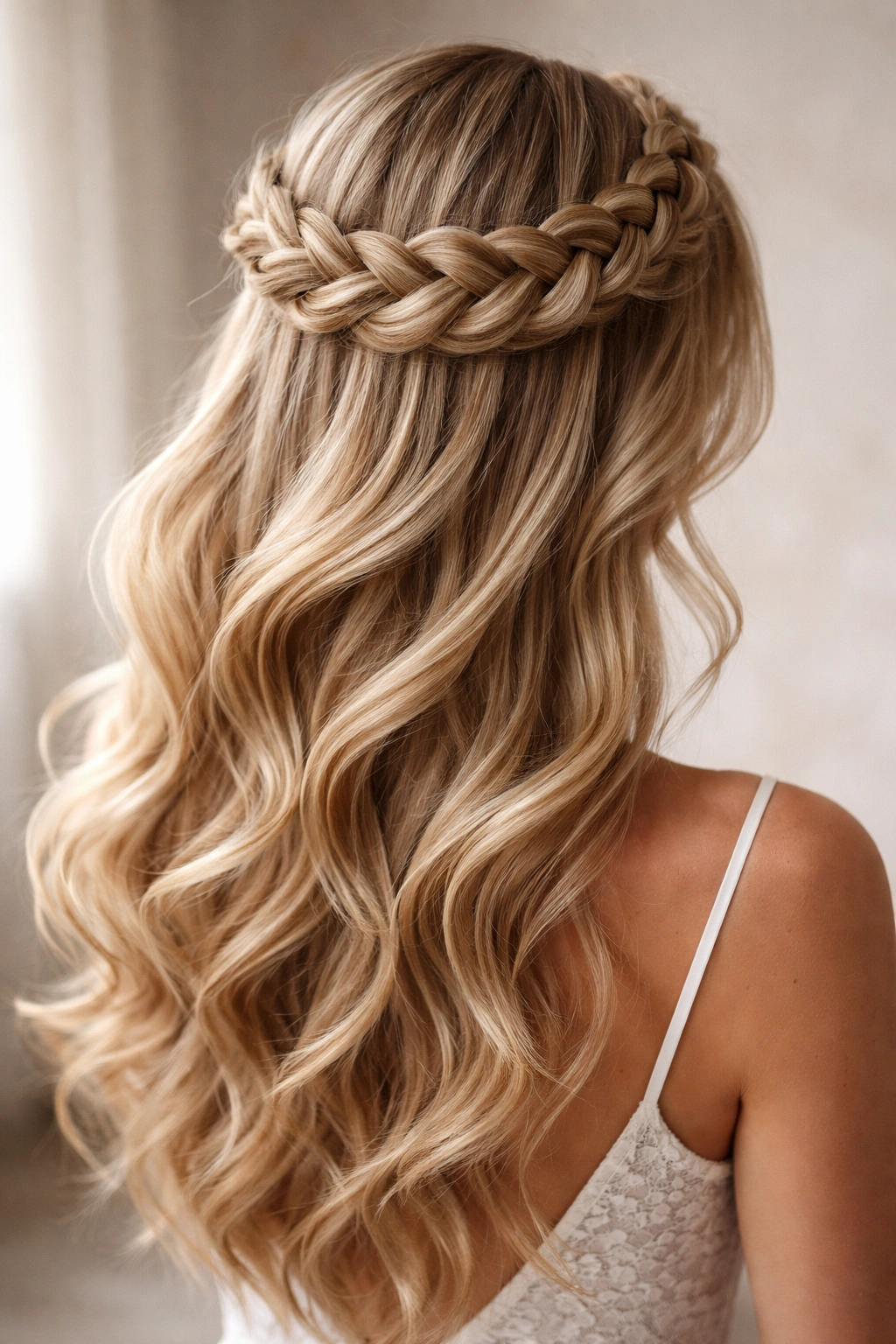
A Dutch braid is the inverse of a French braid—instead of crossing the strands over each other, you cross them under, creating a braid that sits on top of the hair rather than seeming woven into it. When used as a crown, a Dutch braid creates an incredibly bold, three-dimensional look. The braid itself becomes a prominent design element, building height and texture as it travels from one side of your head to the other. This style demands attention and works particularly well if you want your hairstyle to be a major focal point.
Why Choose a Dutch Crown Braid for Your Wedding
If you’re not afraid of a statement hairstyle, a Dutch crown braid is stunning. The raised, dimensional quality makes it look more ornate and intricate than a French braid, even though the actual technique is simply inverted. This style is especially gorgeous if you’re wearing your hair down with lots of volume and texture beneath—the contrast between the sculpted braid on top and the soft waves below creates a really dynamic, high-fashion look. It’s the choice for brides who want their hairstyle to feel like a bold design statement, not just a practical solution for managing long hair.
Technical Details and Best Practices
- Works best with medium to thick hair that has some natural texture or hold—fine, slippery hair can be harder to Dutch braid neatly
- Creates visible height and dimension, making your head appear lifted and elongated
- Requires practice to execute smoothly, so definitely do a trial run with your stylist beforehand
- Pairs beautifully with hair accessories like statement clips, decorative pins, or woven metallic thread that highlight the braid’s raised texture
- Takes longer to style than a French braid, so factor in extra time on your wedding morning
Insider note: Dutch braids photograph even better in bright, natural light because the raised texture creates shadow and dimension that’s more visible in outdoor settings.
4. Braided Crown with Cascading Curls
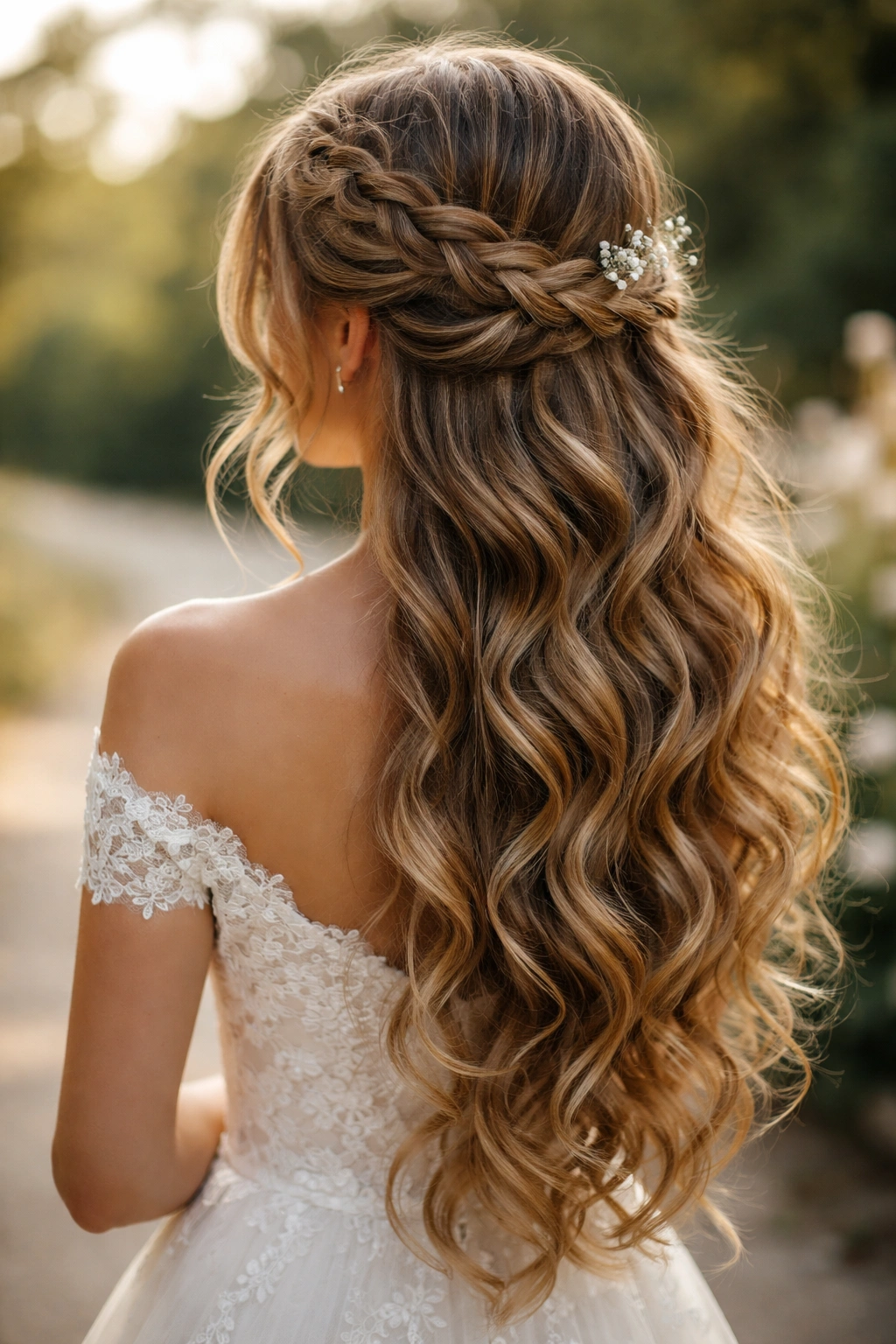
This is the romantic, intentionally undone version of a crown braid—the braid begins at one side, travels partway around the head (typically stopping at the nape of your neck or just past center), and then releases into long, flowing curls that cascade down your back and over one shoulder. This style gives you the sophistication of a braid with the romantic impact of flowing hair. It’s less “fully put together” than a complete crown braid and more “effortlessly glamorous,” which appeals to brides who want polish without appearing overly styled.
The Romance Factor and Photography Impact
Cascading curls from a crown braid create movement and drama in a way that a fully secured crown braid doesn’t. When you walk, when you dance, when a breeze catches your hair—it moves with you, creating living texture in photos and video. The partial braid provides enough structure to keep your hair from looking messy, while the cascading section gives you that romantic, flowing-hair moment that makes wedding photos feel dreamy. This is the style that works beautifully for destination weddings, outdoor ceremonies, and any setting where movement and natural light matter.
Styling Considerations for Maximum Impact
- Requires slightly more hair to create the cascading effect—aim for at least shoulder-blade length
- Works best with curl patterns that hold well (either natural curls or curls created with a curling iron beforehand)
- The cascading section should be heavily textured and piece-y, not a solid sheet of hair—this creates more visual interest and movement
- Pairs gorgeously with delicate hairpins anchoring the braid where it releases into curls
- Creates a beautiful frame for lace or sheer dress backs since the flowing curls draw attention to that area
Real talk: This style shows off your dress neckline and back better than a fully secured crown braid, so it’s perfect if you have detailed beading, a gorgeous open back, or an intricate lace pattern you want visible.
5. Double Crown Braid
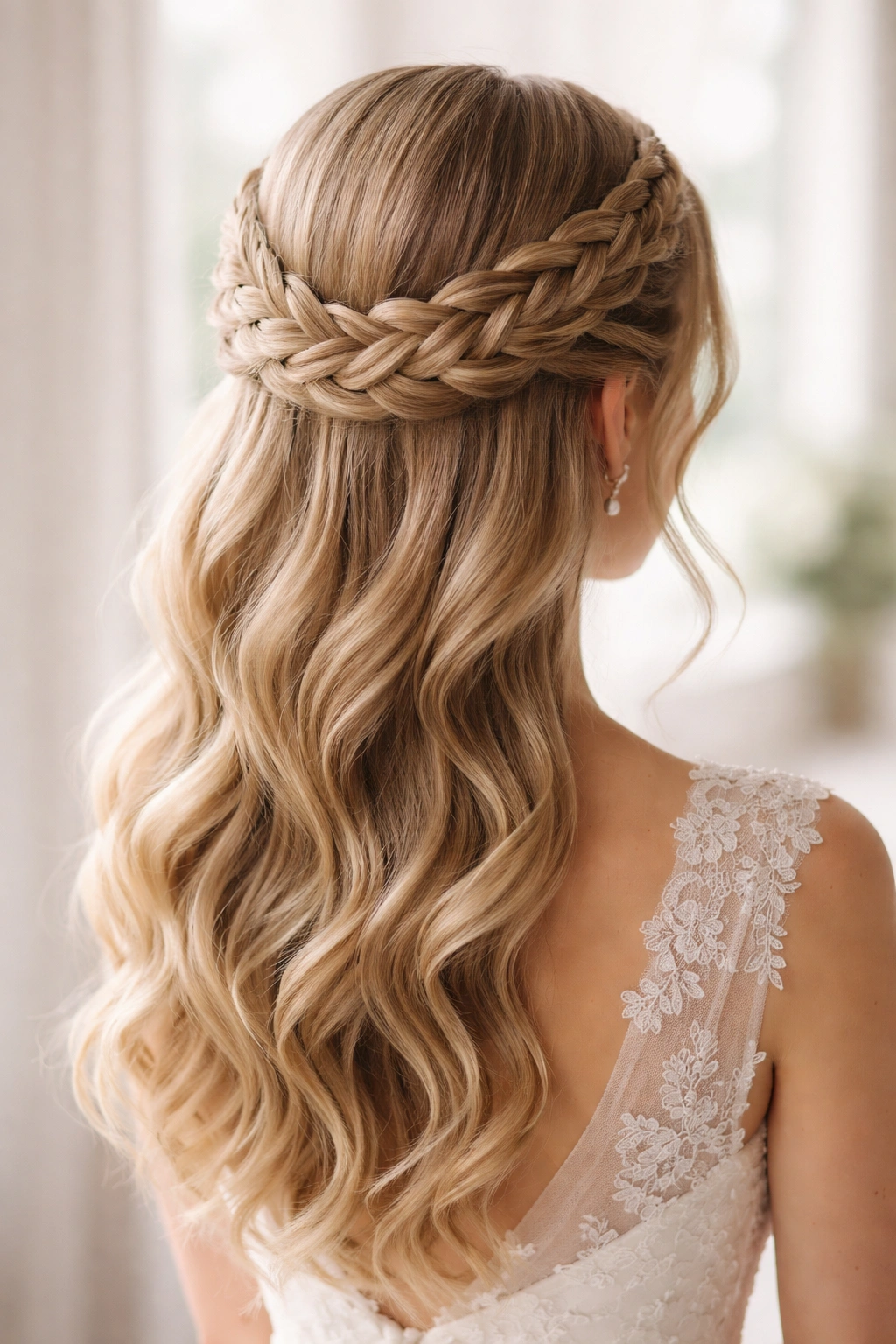
Instead of a single braid encircling your head, a double crown braid uses two parallel braids that run side by side around your crown, creating a more ornate, intricate-looking style. Both braids typically start at the same side (perhaps behind one ear), travel around the back of your head, and finish behind the opposite ear, ending in a unified ponytail or allowed to release into curls. The double braid creates exceptional visual depth and makes your hairstyle feel more elaborate and wedding-worthy without actually requiring significantly more complexity.
Visual Impact and the Ornate Feel
Two braids are inherently more visually interesting than one—there’s a sense of pattern and symmetry that feels intentional and luxe. The double crown braid reads as more bridal than a single braid, even though an experienced stylist can create it in roughly the same timeframe. This style is particularly stunning in photography because the doubled structure creates layers and texture that catch light beautifully. It’s also practical: if one braid loosens slightly throughout the day (inevitable in any long reception), you still have the second braid holding everything secure.
How to Wear It Confidently
- Works with most hair types and textures, though thicker hair makes the double braids look fuller and more substantial
- Can be styled with braids that are tight and geometric for a modern look, or loose and textured for a softer, more romantic appearance
- Pairs beautifully with hair accessories that emphasize the doubled structure—place delicate pins or crystals between the two braids for added sparkle
- Creates a perfect foundation for anchoring a veil, since the doubled structure provides two anchor points instead of one
- Works particularly well if you have thick, voluminous hair, since two braids help manage that volume while looking intentional rather than overwhelming
Pro tip: Ask your stylist to vary the tightness of the two braids slightly—one slightly tighter, one slightly looser—to create more dimension and avoid a too-matchy look.
6. Fishtail Crown Braid
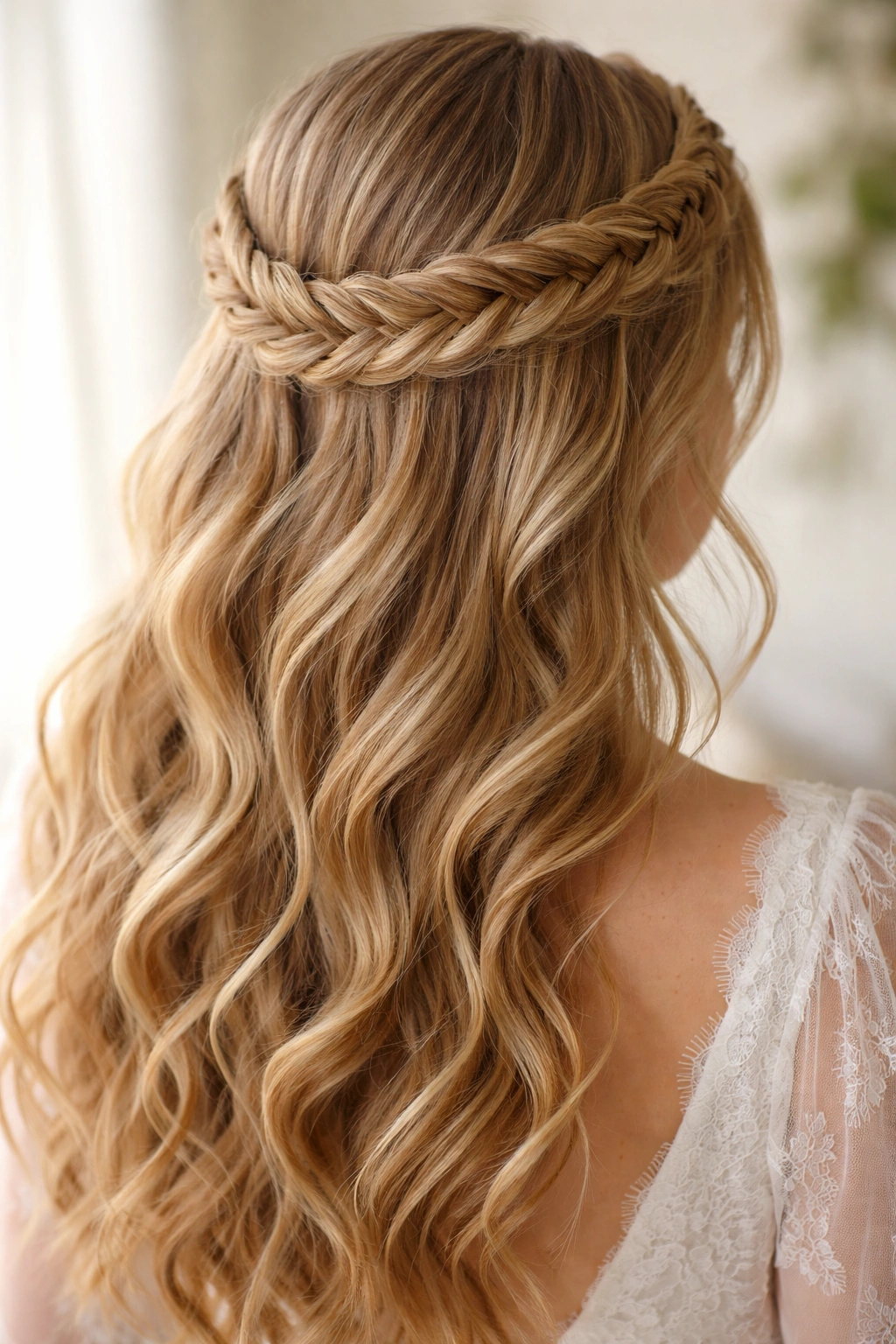
A fishtail braid is created by dividing your hair into just two sections and alternately pulling thin strands from the outside of one section and crossing them over to the other section. The result is a narrower, more delicate-looking braid with an intricate feathery texture that resembles a fish’s tail. When used as a crown braid, a fishtail is absolutely mesmerizing—it has an intricacy and artisanal quality that feels special and intentional. If you want your hairstyle to feel like wearable art, this is your style.
Why Fishtail Braids Feel More Luxe Than Traditional Braids
The fishtail’s delicate, narrow appearance makes it look more complex and painstakingly created than a standard three-strand braid—even though it’s not actually harder to execute, just different. The thinner overall braid also tends to feel more refined and less chunky, which appeals to brides who want elegance rather than boldness. Because the individual strands are thin, a fishtail braid photographs with exceptional detail; the intricate pattern is visible even in distant shots, adding visual interest to wide-angle photos of your full silhouette.
Technical Considerations and Maintenance
- Requires medium to thick hair to look full and textured—very fine hair can look sparse in a fishtail braid
- Takes slightly longer to create than a traditional braid, so factor in extra styling time
- The delicate nature of the braid means it can loosen if you’re very active during your reception, so consider a light hairspray misting beforehand
- Looks absolutely stunning when paired with minimal accessories—the braid itself is the focal point
- Works beautifully with loose waves or curls beneath, since the fishtail’s delicacy pairs well with soft, romantic hair texture
Worth knowing: If you have any frizz or flyaways, use a smoothing serum or light hairspray on them before creating the fishtail, since the thin strands of a fishtail braid are more likely to show small hairs pulling out of the braid.
7. Metallic Thread Crown Braid
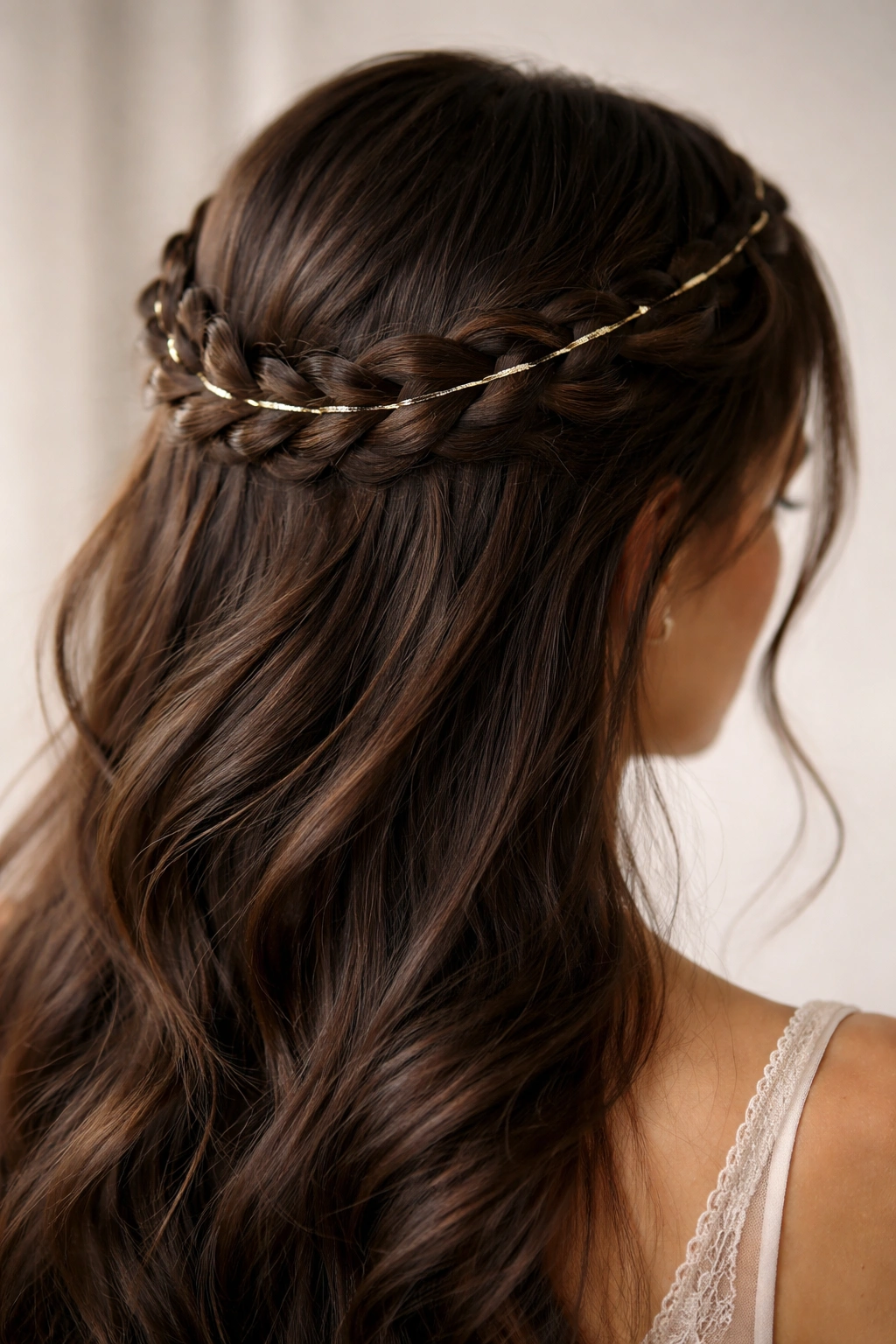
This is where crown braids become truly customizable: weave a thin metallic thread, ribbon, or delicate chain through your braid as you’re creating it. Gold, silver, rose gold, or even copper threads woven through a dark braid (or contrasting threads through blonde hair) add unexpected glamour and a contemporary edge. This style bridges the gap between natural and ornate—your braid is still clearly visible, but the metallic element elevates it into something more special and intentional.
The Contemporary Luxury Angle
Metallic threads trend toward modern luxury rather than traditional bridal style, which makes this choice perfect for weddings that lean contemporary, minimalist, or fashion-forward. The metallic element catches light continuously, making your hairstyle shimmer in candlelight, in photographs, and as you move around the reception. It’s subtle enough not to feel costume-like, but definite enough that it reads as a deliberate styling choice rather than accidental embellishment. This style also photographs beautifully in both color and black-and-white.
Choosing the Right Metallic Element
- Thin gold chains are incredibly popular for a modern, upscale feel—they catch light beautifully without being over-the-top
- Metallic ribbons (satin or grosgrain) woven through the braid create a softer, more integrated look than chains
- Thread works best in contrast to your hair color—gold thread in dark hair, silver in blonde or red hair
- Only needs to be woven through the braid for impact; you don’t need to cover the entire length
- Pairs well with minimal additional accessories, since the metallic thread is already a statement element
Insider note: Make sure your stylist secures the metallic element at the beginning and end of the braid with a tiny bobby pin or elastic so it doesn’t slip or unravel throughout the evening.
8. Half Halo Crown Braid
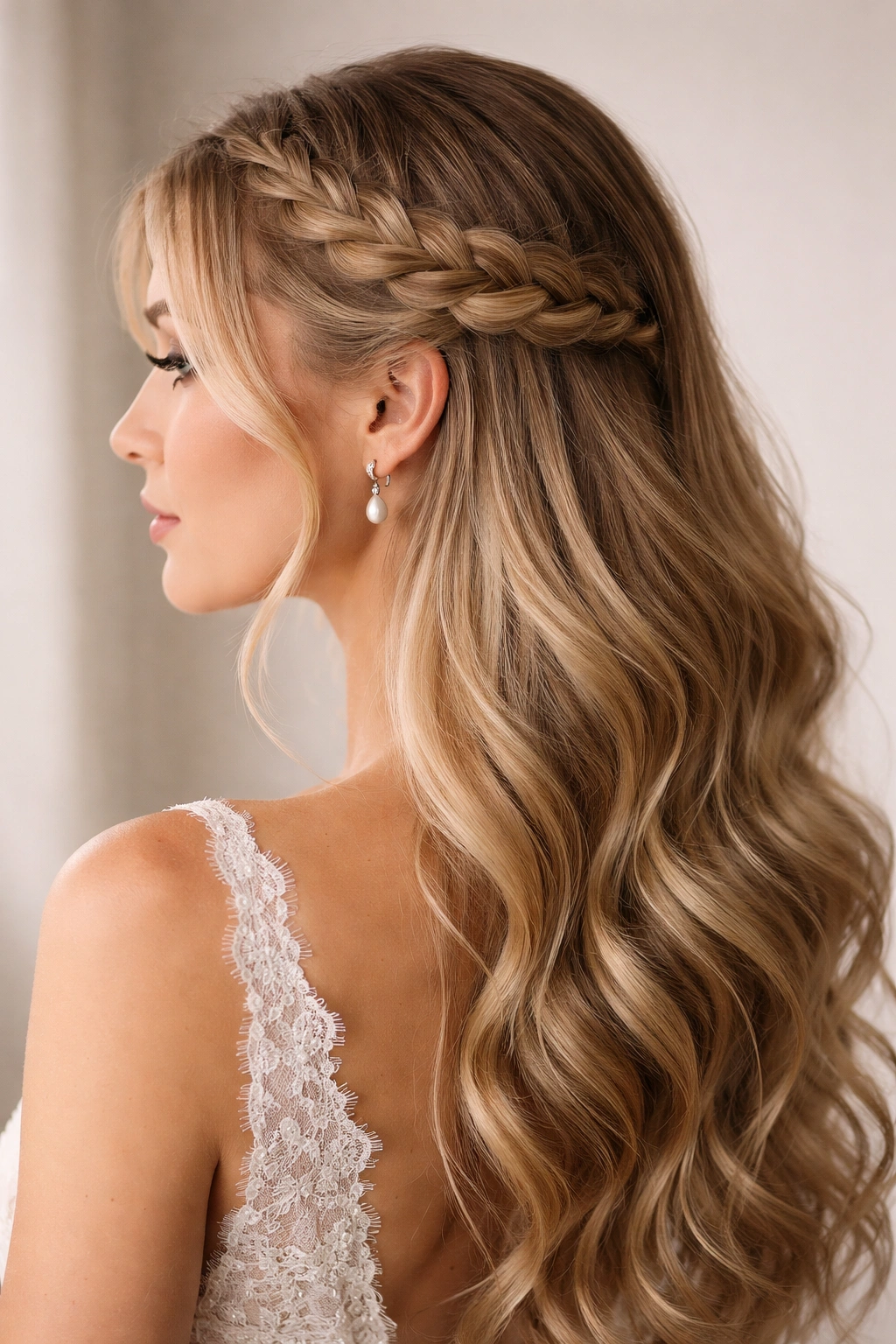
A half halo crown braid begins at the center part and travels around the back of your head like a traditional crown braid, but stops partway before reaching the other side—typically ending at ear level. The braid doesn’t complete a full circle, which creates an asymmetrical, more modern look than a traditional crown. The half-halo structure is especially flattering if you have a longer face, since it frames without encircling your entire head. It also works beautifully if you’re wearing your hair down with significant length and volume.
Why Asymmetry Feels So Modern and Elegant
A half halo braid works particularly well for contemporary, minimalist brides or those going for a fashion-forward aesthetic. The incomplete circle reads as intentional and modern—it’s not a crown completely encircling your head, but rather a design accent that enhances your natural beauty. This style also photographs beautifully because it shows off your facial structure without being too architectural. The braid isn’t the main event; it’s a sophisticated accent that adds movement and intentionality to an otherwise loose hairstyle.
Practical Styling Approach
- Start the braid at one side of your center part and travel back and around to the opposite ear
- Works best with looser, wavier hair beneath the braid—the contrast between the structured braid and flowing hair below is what makes this style work
- Creates a very romantic, garden-party aesthetic despite its modern asymmetry
- Allows your full hair length to be visible, which is stunning if you have very long hair you want showcased
- Requires less hair to be secured than a full crown braid, so it works well with finer hair
Pro tip: Have your stylist secure the end of the braid with a tiny clear elastic that sits right at ear level, then bobby pin it subtly so the endpoint feels like a natural design finish rather than looking like the braid just ran out of space.
9. Woven Crown Braid with Flowers
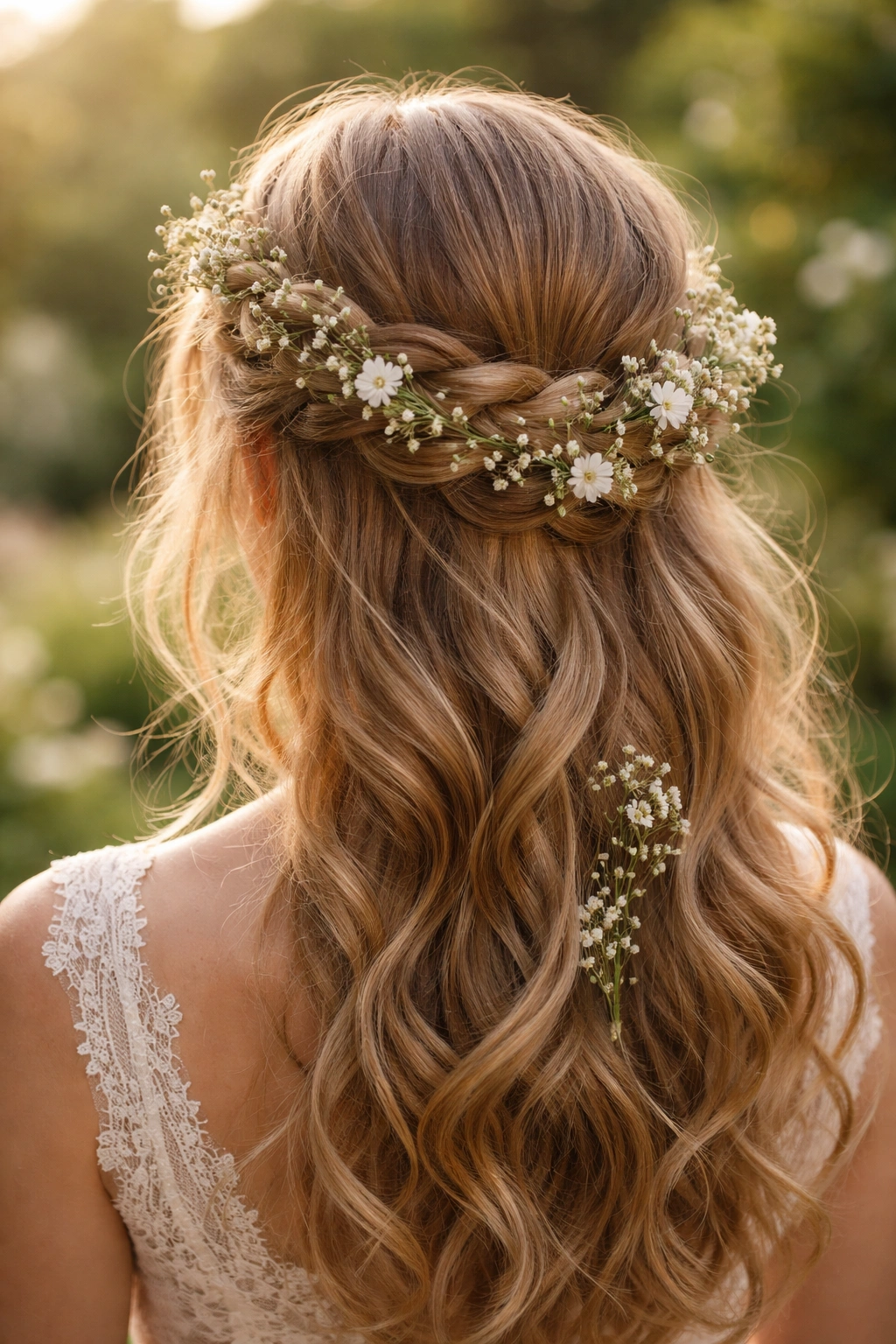
Fresh flowers woven directly into your crown braid create an undeniably romantic, garden-inspired look that feels timeless and effortlessly beautiful. Whether you’re using small blooms like baby’s breath and hypericum berries, larger statement flowers like garden roses, or delicate foliage like eucalyptus and ruscus, the flowers become part of your hairstyle architecture. This style works for garden weddings, bohemian celebrations, outdoor ceremonies, and any bride who wants her hairstyle to tie directly into her floral design.
The Romance and Seasonal Connection
A crown braid with woven flowers reads as deeply romantic and special—it’s the hairstyle that makes your guests feel like they’re watching a storybook moment unfold. The flowers add color, fragrance, and organic texture that photographs beautifully in natural light. This style also allows you to incorporate your wedding flowers into your hair, creating visual cohesion between your bouquet, the ceremony flowers, and your personal styling. The flowers move with you, creating a living hairstyle that evolves throughout the evening.
Practical Considerations for Florals
- Choose sturdy flower varieties that won’t wilt quickly under the warmth of hair products and body heat—garden roses, ranunculus, and hypericum berries are reliable choices
- Avoid heavy flowers that would weigh down fine hair or pull the braid loose
- Hydrate your flowers beforehand and consider having your florist add floral tape or water tubes to keep the blooms fresh
- Weave flowers in progressively as you create the braid, securing them with bobby pins at critical anchor points
- Plan for your florist and stylist to communicate so they can coordinate which flowers will be used and prepare them appropriately
Worth knowing: Flowers in your hair will shed petals and pollen as the evening progresses, which creates a romantic effect in photos but can stain your dress if you’re not careful. Consider lighter-colored blooms if you’re wearing white, cream, or pale colors.
10. Low Crown Braid with Accessories
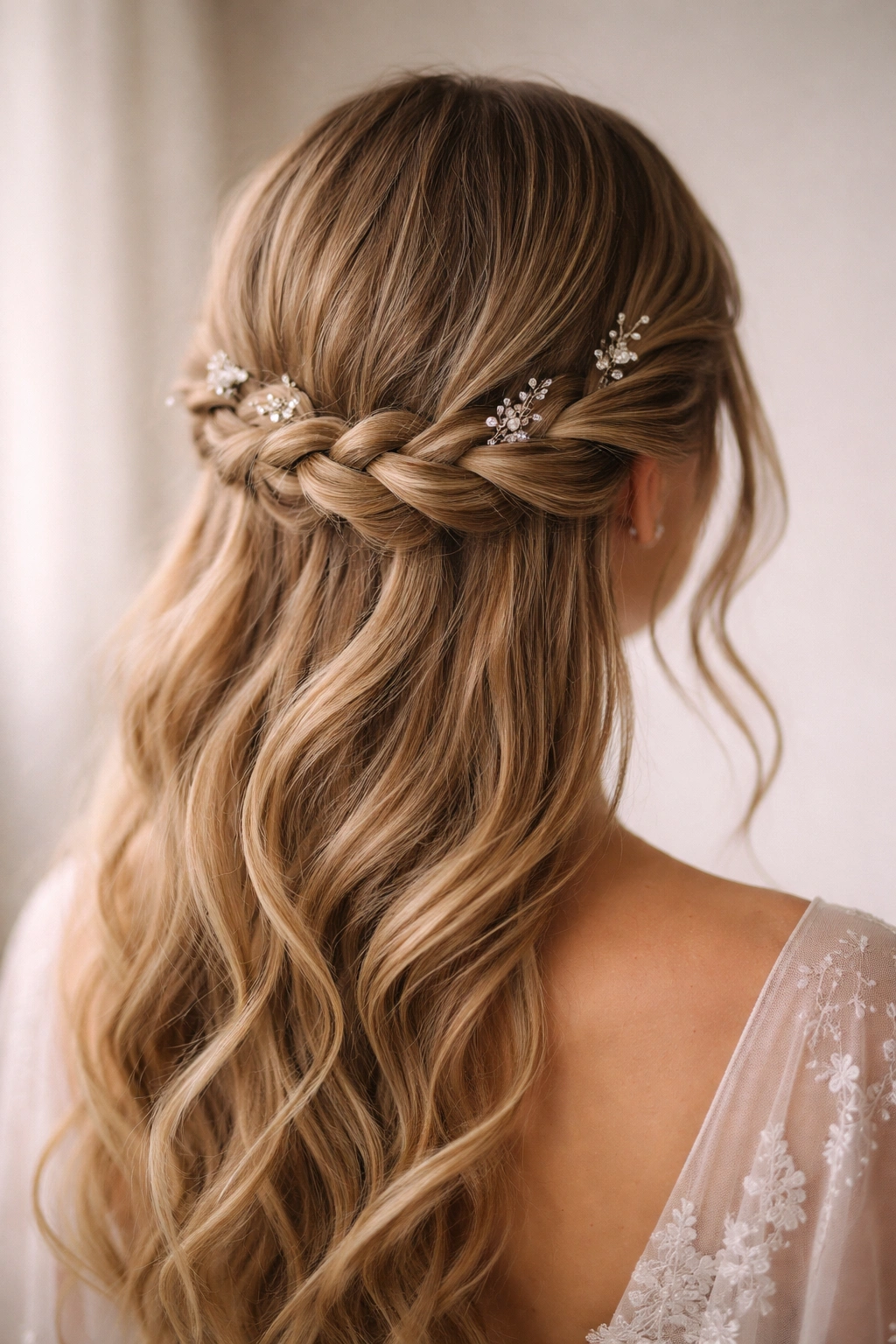
Instead of starting your crown braid at ear level and traveling around the top/back of your head, a low crown braid sits lower—beginning at the nape of your neck or the lower back of your head and traveling around to create a crown that sits much closer to the bottom of your skull. This creates a more subtle, less architecturally prominent look while still providing the security and polish of a braid. The lower placement also allows more hair to flow freely above the braid, which creates a softer silhouette and feels less structured.
When Low is More Your Aesthetic
A low crown braid appeals to brides who want the braided element for hold and polish but don’t want their hairstyle to be primarily braid-focused. This style is perfect if you have very thick, voluminous hair that needs some security but would look overwhelming with a high, prominent braid. It’s also gorgeous if you’re pairing your hairstyle with a delicate, ornate veil that sits on top of your head—the low braid doesn’t interfere with veil placement. The lower positioning creates a more subtle, refined aesthetic that feels less “elaborate updo” and more “casual beauty.”
Positioning and Visual Balance
- Works beautifully with voluminous curls or waves on top, creating a balanced silhouette rather than top-heavy appearance
- Allows you to show off the nape of your neck, which is perfect if your dress has a low or open back
- Pairs exceptionally well with a veil, since there’s no conflict between where the braid sits and where the veil anchors
- Creates a soft, romantic look rather than a bold architectural statement
- Works particularly well if you have hair long enough to have significant flow below the braid
Real talk: If you have very fine or slippery hair, a low braid might not hold as securely throughout a long reception—discuss this concern with your stylist to determine if you need additional bobby pins or hairspray to maintain hold.
11. Braided Crown with Veil Integration
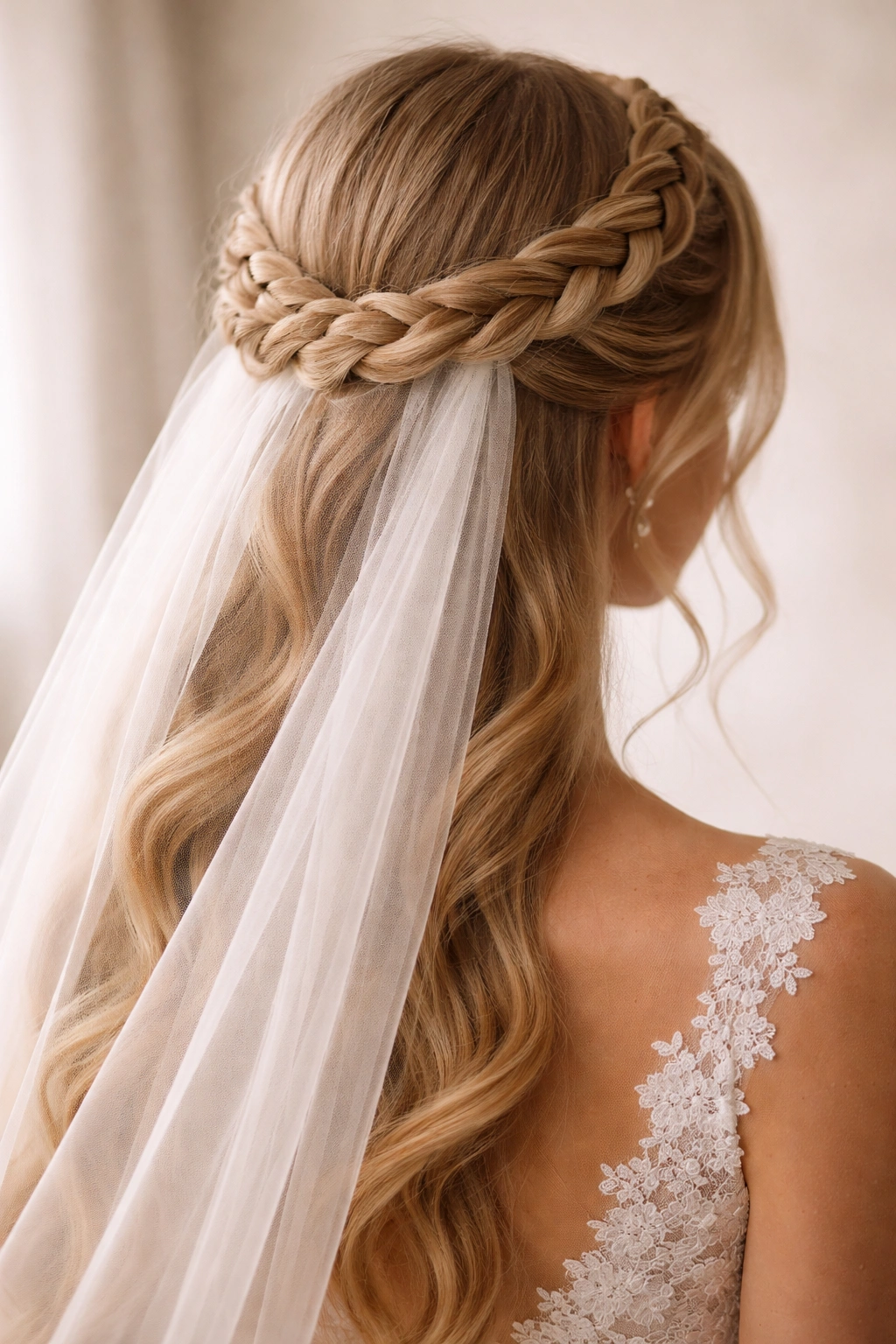
Rather than treating your braid and veil as separate elements, this style integrates them: the braid provides the anchor point for your veil, and the veil is threaded directly into or attached seamlessly to the braid itself. This creates a unified, intentional look where your braid and veil work together as a single design element. The veil doesn’t sit awkwardly on top of your hair or feel like it’s attached with visible pins; instead, it’s part of the overall architecture. This is the approach for brides who want a veil that feels like an integral part of their hairstyle, not an added element.
The Unified Design Approach
When your veil is threaded into your braid or attached directly to the braid’s anchor point, you create a more cohesive, high-fashion look. The veil’s movement is controlled by the braid, so it moves with your hairstyle rather than shifting independently. This integration also means your veil is extremely secure—it’s not going to slip or shift because it’s anchored into the structure of your braid. In photographs, the braid and veil read as a unified, intentional design rather than separate elements.
Technical Execution
- Discuss veil integration with both your stylist and your veil maker—they need to coordinate dimensions and attachment methods
- Some brides thread sheer veil fabric directly through the braid itself; others attach the veil’s comb to the braid’s anchor elastic
- The braid should be positioned where it will sit comfortably with veil weight—not so tight the braid pulls uncomfortably, not so loose the veil tugs
- Works beautifully with longer veils that create drama as they flow from your crown
- Requires a trial run to ensure the integration feels comfortable and secure
Pro tip: If using a veil comb, have your stylist run a few bobby pins through the comb into the braid to ensure absolutely zero movement—even a comb that feels secure can shift slightly during a long ceremony or reception.
12. Ombre Braided Crown
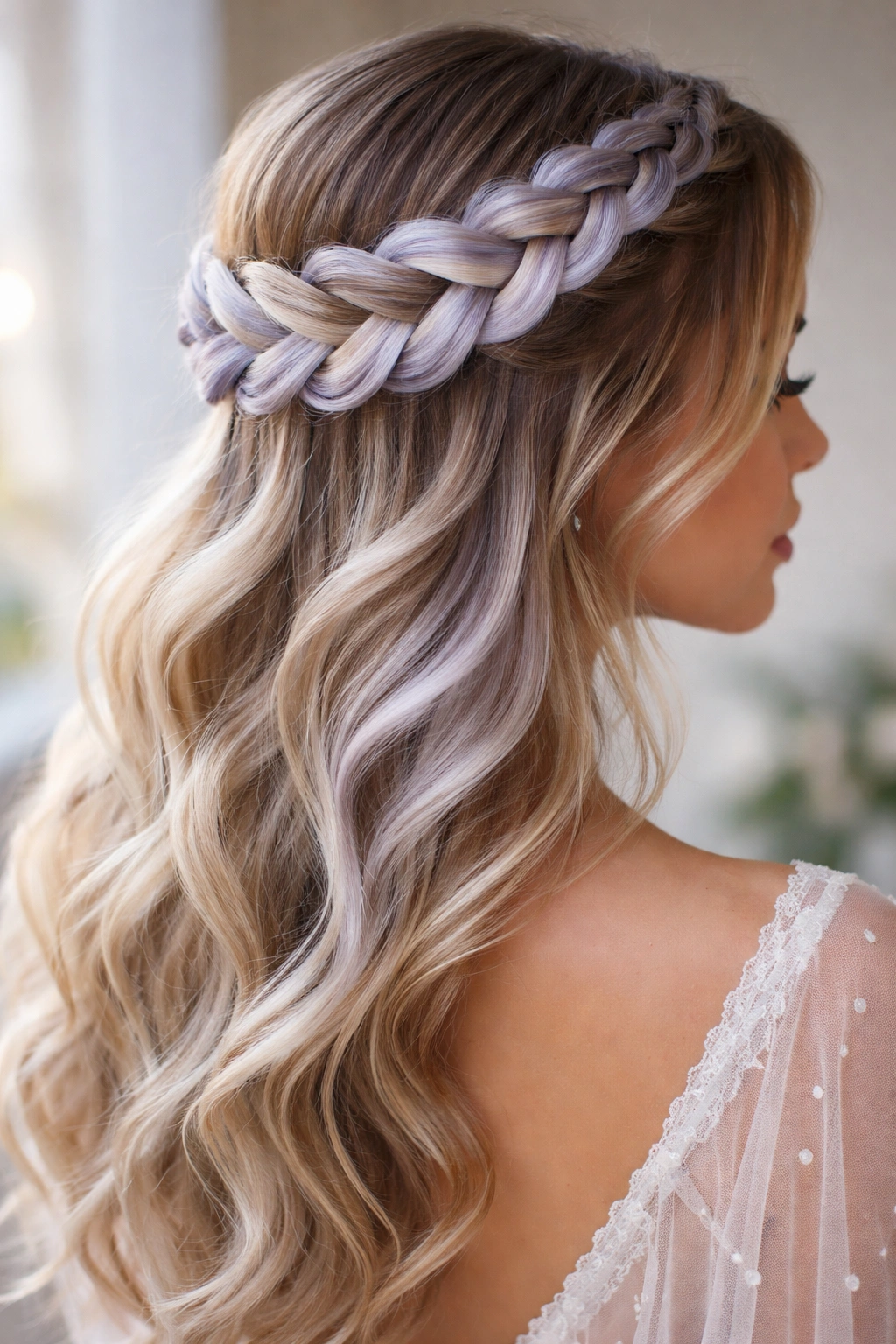
This is a creative color-play approach: your stylist creates a crown braid with your hair, then uses temporary color sprays, chalk, or other non-permanent coloring to create an ombre effect within the braid itself. Your natural color forms the base, while the outer edges of the braid are tinted in a contrasting shade—silver, rose gold, lavender, or a soft pastel. The color is concentrated just on the braid, not throughout your whole head, which makes this approach feel like a sophisticated style choice rather than a hair-color commitment.
Statement Style Without the Commitment
An ombre braided crown is perfect for brides who want drama and artistic expression without permanent hair changes. Temporary color works for a single day and washes out completely, giving you complete creative freedom. The ombre effect photographs beautifully—the color contrast within the braid creates visual interest and dimension in photos. This style is particularly stunning in bright, natural light, where the color shift is most visible. It’s the choice for fashion-forward, artistic brides who want their hairstyle to be genuinely memorable.
Color and Texture Combinations
- Soft pastels (blush pink, lavender, pale blue) create a romantic, whimsical effect
- Metallics (silver, rose gold) add contemporary glamour without competing with your dress
- Contrasting jewel tones in the braid create bold visual impact, best for brides wearing neutral or simple dresses
- Works best with darker or medium hair as the base—the color contrast is more visible
- The color should be concentrated on the braid itself, with minimal bleed onto surrounding hair for a clean, intentional look
Worth knowing: Test any temporary color products on a hidden section of hair beforehand to ensure they won’t stain your skin, dress, or veil. Some sprays and chalks work beautifully on dry hair but can transfer if they get damp.
Final Thoughts
A crown braid is so much more than a practical solution for managing long hair on your wedding day—it’s an artistic choice that transforms how you feel and how you photograph. Each of these twelve styles offers a completely different vibe: from the timeless elegance of a classic crown braid to the whimsical romance of flowers woven throughout, from the contemporary edge of metallic threads to the soft, asymmetrical balance of a half halo. The beauty of crown braids is that they’re endlessly customizable, so you can authentically express your personal style while still feeling polished, intentional, and utterly bridal.
The key is finding the style that resonates with how you want to feel as you walk down the aisle and move through your celebration. Do a trial with your stylist, experiment with different braid styles and accessories, and trust your instinct about which approach feels most like you. Your hairstyle should make you feel beautiful, confident, and like the absolute best version of yourself—and any of these crown braid styles can deliver exactly that. The best choice is the one that makes you smile when you see yourself in the mirror on your wedding morning.
