



Crown braids offer a timeless way to style your hair while keeping part of it down, creating that perfect balance between protective styling and effortless elegance. For Black women, especially those with textured, coily, or kinky hair, crown braids paired with half-up styling opens up endless possibilities for both everyday wear and special occasions. Whether you’re looking to protect your natural hair, add volume, incorporate fun accessories, or just switch up your look, crown braids deliver versatility that few other styles can match.
What makes crown braids so appealing is their adaptability to different hair textures and face shapes. You can wear them sleek and defined, thick and chunky, adorned with beads and cuffs, or woven with loose waves that frame your face beautifully. The half-up styling aspect means your ends stay free and visible, giving you the chance to show off length, curls, or waves while keeping the top section of your hair neatly contained. Plus, crown braids can be dressed up for formal events or toned down for casual everyday styling — they work just as well at a wedding as they do at the gym.
The beauty of this particular style category is that you don’t need extensions, though you can certainly add them if you want extra thickness or length. Your natural hair is more than enough to create stunning crown braids, and the technique actually works better on textured hair because the natural grip and hold mean your braids stay put longer without slipping. Let’s explore twelve distinct crown braid half-up styles that celebrate Black hair’s natural beauty and versatility.
1. Classic Crown Braid with Loose Waves
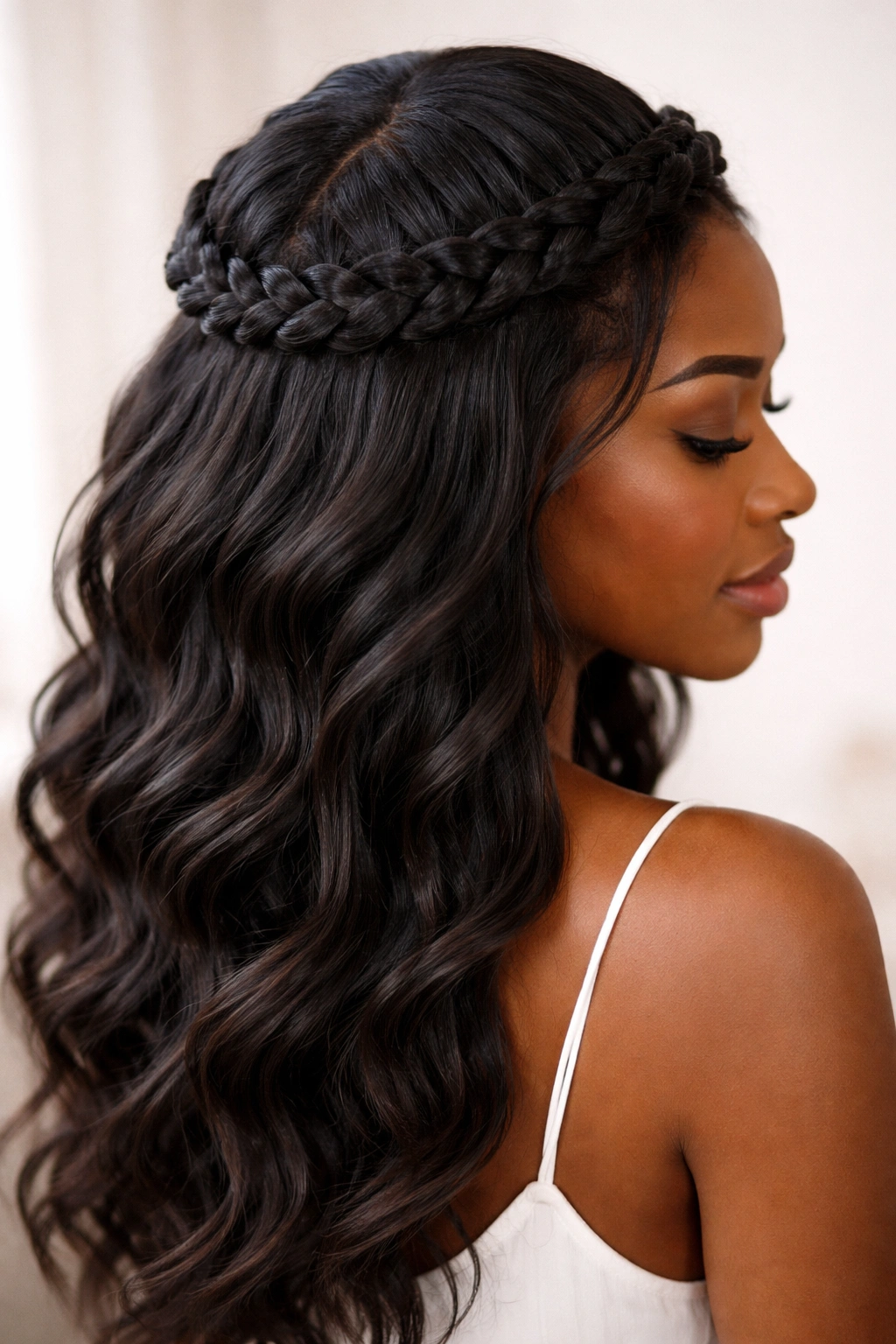
This is the foundational style that showcases the simple elegance of a crown braid. You braid from one side of your head, curving upward and around toward the opposite side, creating a regal frame for your face while leaving the bottom half of your hair completely down. The magic happens when you pair this clean, defined braid with loose, flowing waves in the bottom section — the contrast between the structured braid and the soft waves creates visual interest and dimension.
Why This Style Captures Timeless Appeal
The classic crown braid works beautifully on textured hair because the natural grip of coils and curls holds the braid in place without constant maintenance. Unlike smoother hair types that may require extra product or tension to keep braids defined, textured hair naturally grips the plaits, making this style incredibly practical for daily wear. The simplicity also means you’re not fighting against your hair’s natural movement — you’re working with it.
How to Style It Perfectly
- Start your braid on one side of your head at about ear level, picking up hair as you move upward and back
- Use a leave-in conditioner or light oil to smooth flyaways while maintaining the softness of your braids
- Secure the braid at the opposite side with bobby pins or a small elastic, tucking the end underneath for a seamless look
- Create waves in the bottom half using a curling iron on low heat (around 300°F), or use your fingers to shape waves into your natural curls and set with a light hold spray
Pro tip: Braid your hair when it’s slightly damp — not soaking wet, but not completely dry either. Damp hair braids more easily and the braid holds its shape better as it dries.
2. Intricate Double Crown Braid Design
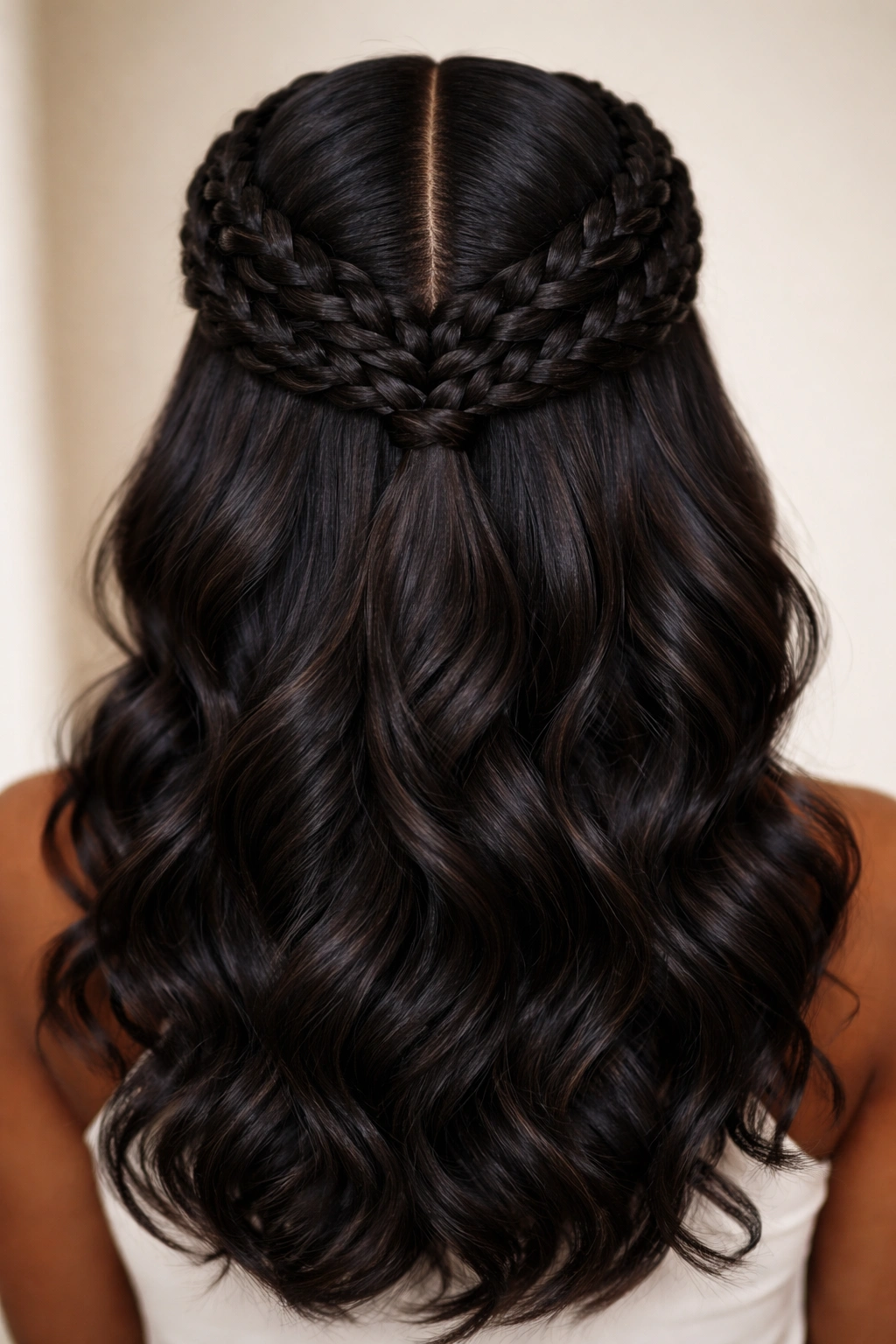
For those days when you want to make a more dramatic statement, double crown braids create a fuller, more complex look that still leaves the bottom half of your hair down. Instead of one braid traveling across your crown, you create two symmetrical braids that curve around the sides of your head, meeting in the center or crossing over each other for an interlocking effect. This style requires a bit more time and patience, but the payoff is absolutely worth it.
What Makes Double Braids So Striking
Double crown braids work particularly well on textured hair because each individual braid tends to appear thicker and fuller due to the natural volume of coily and kinky hair. What might look thinner on straighter hair textures appears bold and dimensional on textured hair. The symmetry of two braids also flatters various face shapes and creates a balanced, polished appearance that looks intentional and carefully crafted — even if you can do it yourself in under twenty minutes once you get the technique down.
Styling Techniques for Balance
- Start both braids at the same position on either side of your head, roughly at temple level
- Braid upward and slightly backward, curving toward the back of your head
- You can overlap the braids at the crown, weave them together, or let them sit side by side — choose based on your hair thickness and the look you prefer
- Secure both braids with bobby pins that match your hair color for an invisible hold
- Leave the bottom half completely down for maximum contrast and softness
Worth knowing: Double braids look best on medium to thicker hair sections. If your hair is on the finer side, focus on making each individual braid as neat and defined as possible rather than trying to make them thick.
3. Crown Braid with Bead Accents
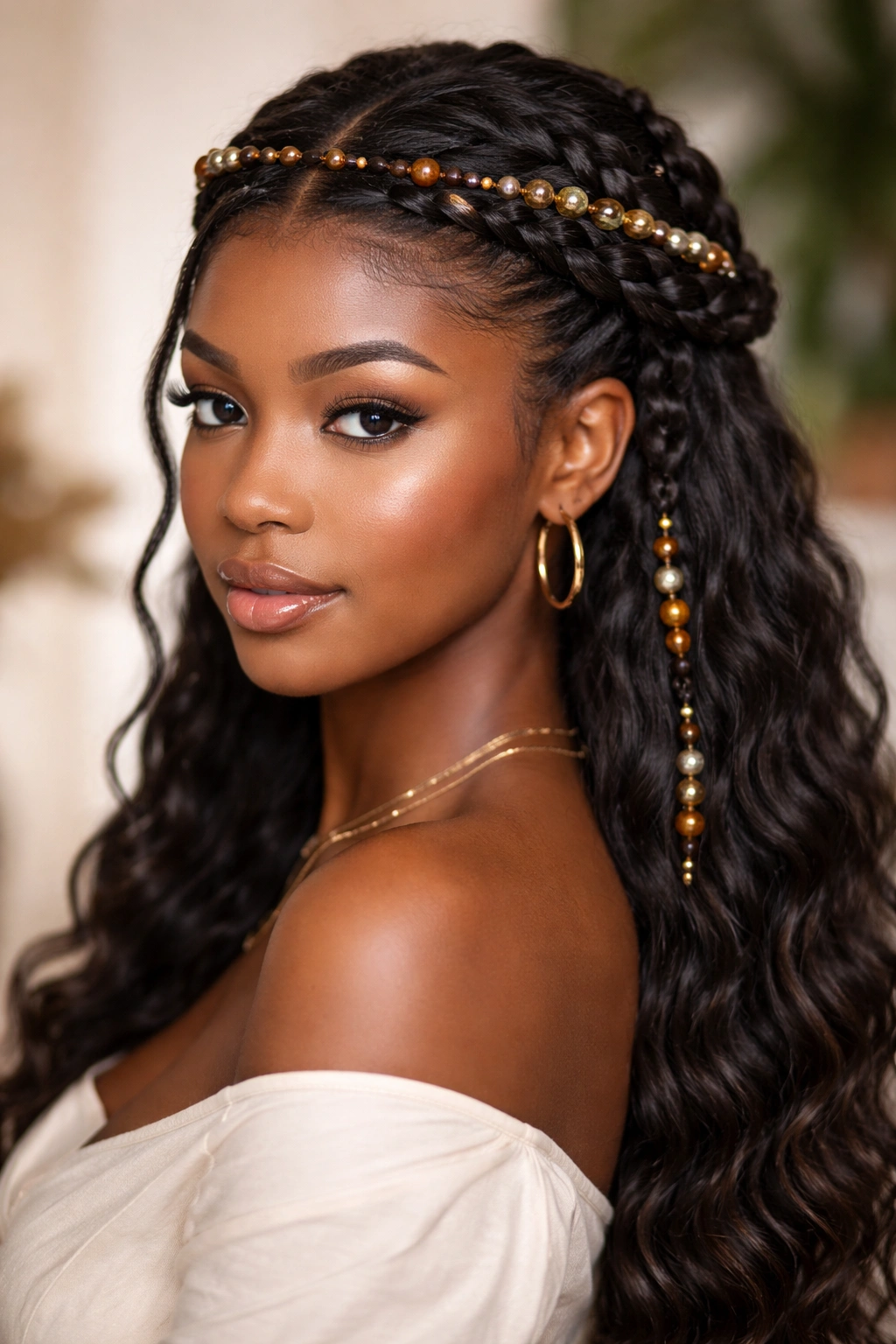
Adding beads to your crown braid transforms it from everyday styling into something celebratory and visually striking. Gold cuffs, wooden beads, colorful metal rings, or decorative hair jewels threaded onto the braid add personality and cultural flair. You can incorporate beads throughout the entire braid, concentrate them at the crown section, or scatter them randomly for a playful, less structured vibe. Beads also serve a practical purpose — they add weight that helps hold the braid in place throughout the day.
Why Beads Enhance Textured Hair
Beads are a beautiful, functional way to celebrate and adorn Black hair. Historically and currently, beads represent cultural heritage, personal style, and creative expression. Beyond the cultural significance, beads actually work with your hair’s natural texture — they slide onto the braids without slipping or moving around the way they might on smoother hair types. The grip is natural and secure, meaning fewer beads falling out or shifting during the day. Plus, beads catch the light differently depending on the material, adding sparkle and dimension to your overall look.
How to Incorporate Beads Thoughtfully
- Choose beads with holes large enough to slide onto your braid sections without catching or pulling your hair
- Metal cuffs work best near the crown area where you want emphasis, while smaller beads can be scattered throughout
- Thread beads onto individual sections of hair before you start braiding, or slide them onto the braid as you create it
- Mix metal tones (gold and silver) for a modern look, or stick with one tone for a more cohesive appearance
- Secure beads in place with a small elastic if they feel loose, or simply let them sit naturally — the tension of the braid usually holds them
Quick facts about bead styles:
- Gold beads give a warm, luxe aesthetic that complements deeper skin tones beautifully
- Wooden beads offer an earthy, bohemian feel with cultural resonance
- Colorful metal or enamel beads add playfulness and work well for casual occasions
- Crystal or rhinestone accents elevate the style for special events and formal occasions
4. Thick Textured Crown Braid
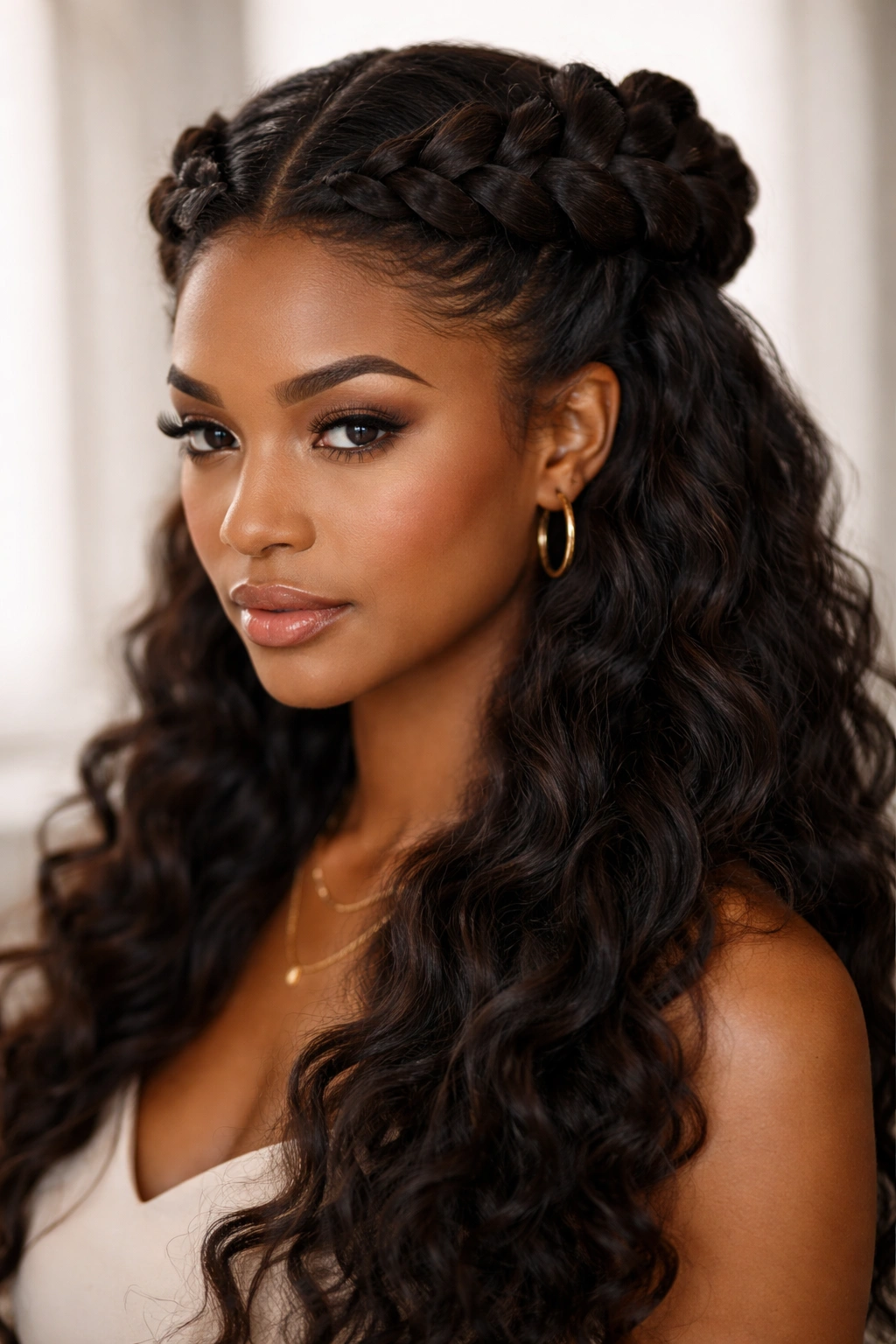
If you want maximum impact and a style that really shows off volume and dimension, the thick textured crown braid is your answer. Instead of creating a single, thin or medium-width braid, you deliberately create a chunky, statement-making braid using wider sections of hair. This works especially well if you use extensions or if you naturally have thick, full hair — the braid becomes a focal point rather than a subtle accent.
The Advantage of Going Thick
Thicker braids create a bolder visual statement and actually hold much better throughout the day because there’s more surface area and more hair gripping together. The style feels more modern and intentional, especially when paired with sleek or textured waves below. On textured hair, thick braids have incredible dimension — you can see the individual strand patterns, the color variation, and the natural texture in a way that thinner braids don’t showcase as well. They also take less time to redo or tighten if they loosen throughout the day because you’re working with fewer, larger sections.
Creating and Maintaining Thickness
- Use three substantial sections of hair instead of three thin ones — each section should feel like it has real weight
- For extra thickness, add hair extensions that match your color before you start braiding, or use the clip-in extensions method
- Braid more loosely than you would with thinner plaits, letting the braid expand slightly as you work — tension keeps braids tight and thin
- Once the braid is complete, gently pull on the outer edges to fluff and increase the diameter even more
- Secure the thick braid with bobby pins positioned at multiple points so the weight is distributed
Pro tip: Thick braids look best when they’re slightly textured rather than ultra-sleek. After braiding, run your fingers through it or use a soft brush to break up the pattern slightly — it adds softness and makes the braid look intentional rather than overly controlled.
5. Asymmetrical Crown Braid
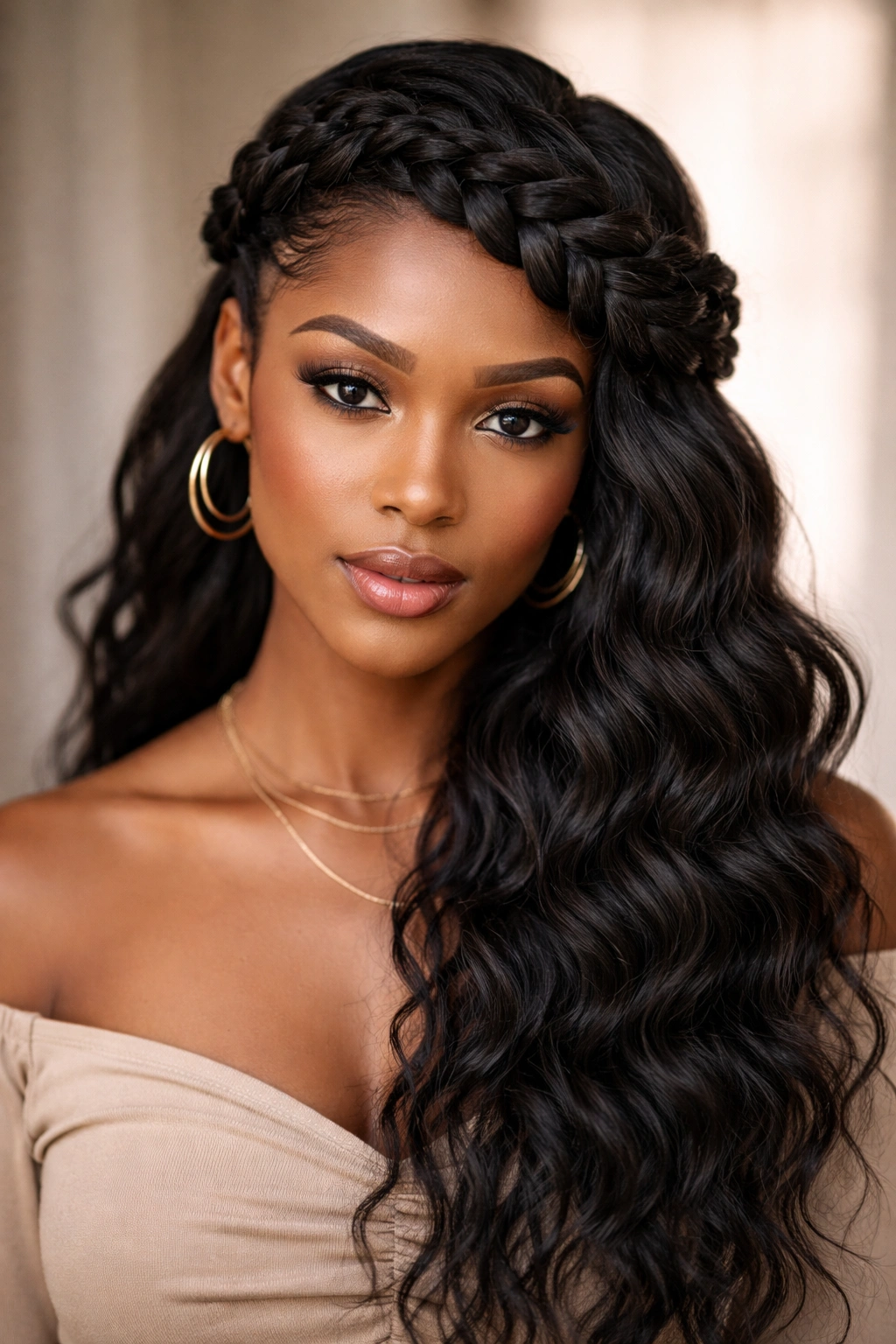
For a contemporary, slightly edgy take on the crown braid, try an asymmetrical design where the braid doesn’t follow the typical balanced crown path. Instead, you might start the braid on one side, curve it across at an angle, or create an off-center design that dips lower on one side than the other. This style works beautifully for square face shapes, as it softens the jawline, and it also works well for those who want a less traditionally polished appearance.
Why Asymmetry Feels Modern
Asymmetrical styling breaks away from the formal, balanced aesthetic of classical crown braids, giving you a more relaxed and contemporary vibe. The asymmetry can be subtle — just slightly off-center — or dramatic, with one side of the braid much lower than the other. On textured hair, asymmetrical braids create really interesting visual lines because the braid catches light differently depending on the angle, and the natural texture adds movement that makes the asymmetry feel intentional rather than accidental. It’s a way to style crown braids for people who want something that feels personal and unique rather than traditionally polished.
Techniques for Deliberate Asymmetry
- Decide which side will be your starting point — typically you want to start on the side where you want the braid to sit higher
- Braid at an angle across the crown rather than in a perfect arc, following your own head shape and preference rather than a symmetrical pattern
- You can also create two braids of different thicknesses or at different heights for a more dramatic asymmetrical effect
- Secure the braid at an angle rather than at the center back — this emphasizes the asymmetry
- Balance the asymmetrical top with how you style the bottom half — you might leave more waves on the lighter side and sleeker styling on the heavier side
Worth knowing: Asymmetrical styles work best when you’re confident about the look you’re going for. Take time to plan it out or even sketch it on yourself with a pencil before you start braiding so you know where you want the asymmetry to sit.
6. Crown Braid with Hair Cuffs
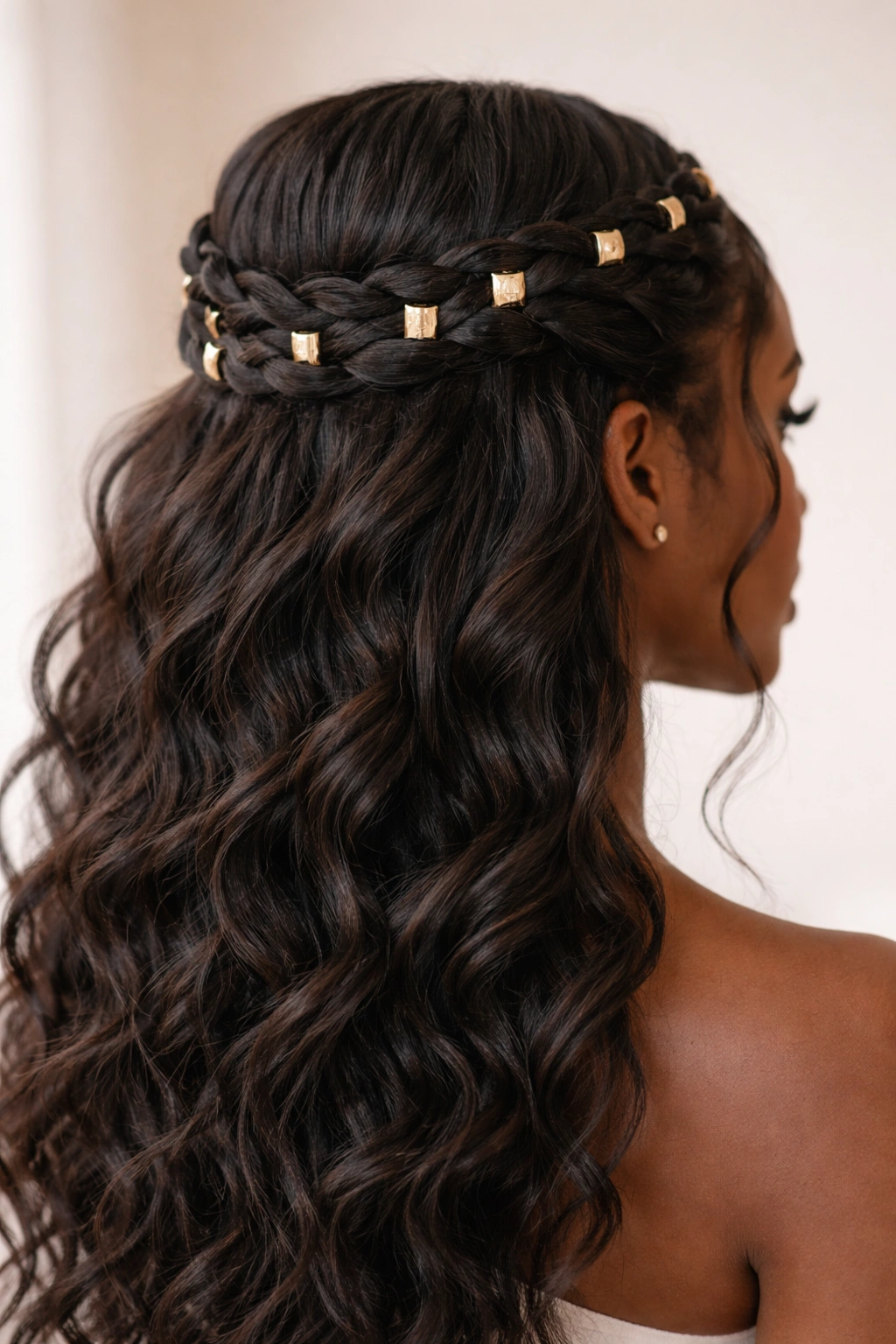
Hair cuffs are metal or plastic decorative rings that slide onto your braids or hair sections, adding glamour and visual interest with minimal effort. When you incorporate cuffs into a crown braid half-up style, you’re essentially adding jewelry to your hair without needing to wear additional accessories. Cuffs sit at specific points along your braid — at the beginning, the end, scattered throughout, or clustered in one area — and they can be as subtle or as showy as you want them to be.
How Cuffs Enhance Crown Braids
Cuffs add weight and hold to your braid while also creating visual anchors that draw the eye. They work particularly well on textured hair because they don’t slip or slide the way they might on smoother hair types — the texture grips the cuff, keeping it in the exact position you place it. Gold cuffs feel luxurious and formal, while silver or mixed-metal cuffs feel more modern and casual. The size of the cuff matters too — oversized cuffs make a bigger statement, while delicate, thin cuffs add polish and sophistication without looking costume-like.
Cuff Placement Strategies
- Cluster multiple cuffs at the crown (the highest point of the braid) for maximum impact and visual emphasis
- Scatter cuffs throughout the length of the braid for a playful, less structured look
- Use one statement cuff where the braid ends and your loose hair begins, creating a visual boundary between the two sections
- Mix cuff sizes and finishes for an intentional, curated aesthetic that feels personal
- Cuffs work best when they’re positioned over the widest part of your braid so they stay secure and don’t slip
Quick facts about cuff choices:
- Brass or gold-toned cuffs warm up deeper skin tones and pair beautifully with warm-toned clothing
- Silver or stainless steel cuffs feel contemporary and pair well with cool-toned jewelry and clothing
- Decorated cuffs with filigree, stones, or enamel work for special events and add elegance
- Simple, smooth cuffs work for everyday wear and are less likely to catch on your clothing
7. Fulani-Inspired Crown Braid
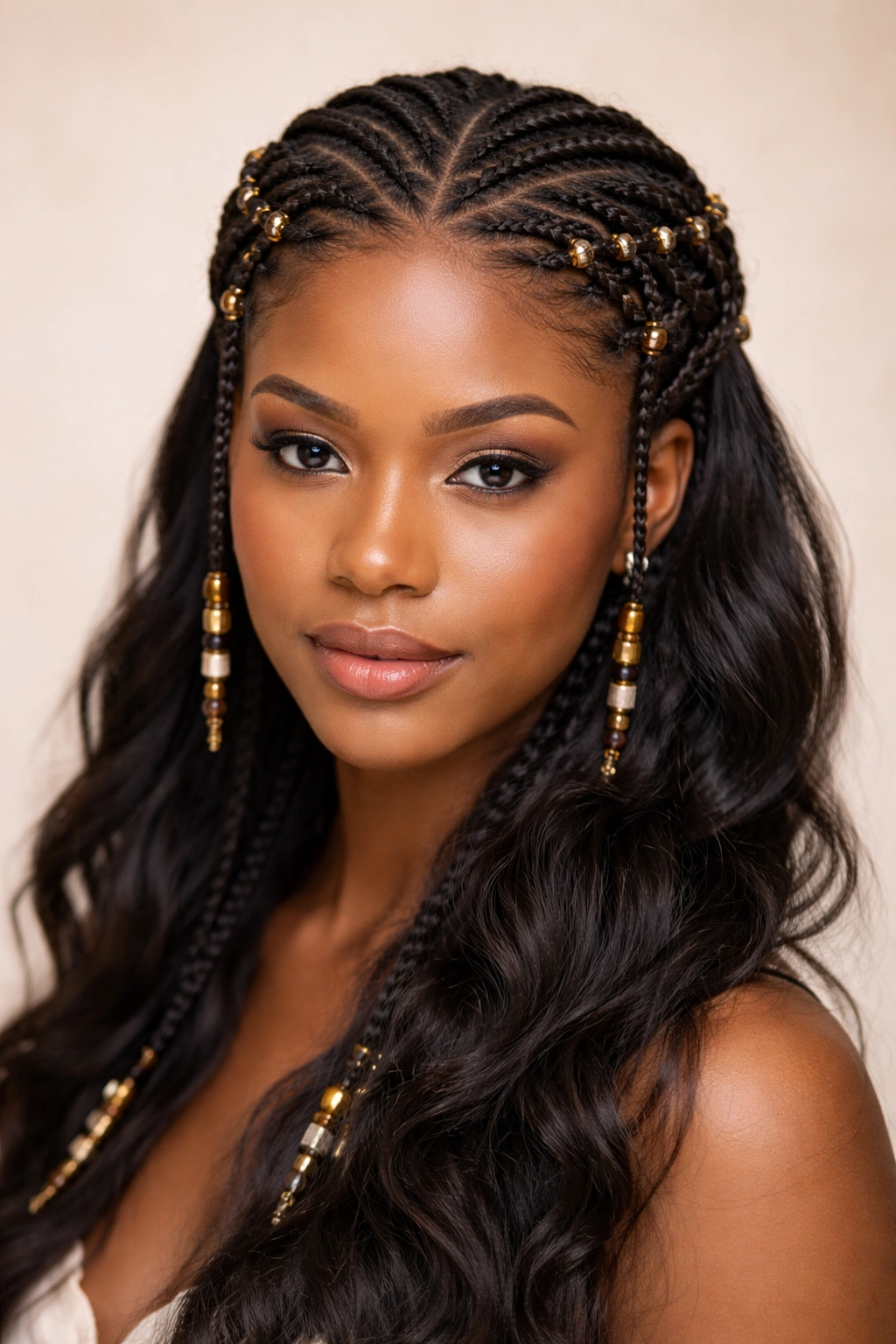
This style draws inspiration from Fulani braiding traditions, characterized by thin, precise braids often adorned with beads and incorporating a distinctive crown pattern. A Fulani-inspired crown braid typically features smaller, more delicate braids and often includes beads positioned at regular intervals along the braid. The style honors and celebrates African braiding heritage while creating a visually intricate and beautiful crown braid half-up design.
The Cultural and Visual Significance
Fulani braiding traditions carry deep cultural meaning and have been celebrated for centuries across West African communities. Adapting this style into a crown braid half-up format is a beautiful way to honor these traditions while creating contemporary styling that works for modern life. The precision required for Fulani-inspired braids means they tend to stay neat and polished looking, making them an excellent choice if you need a style that will look good throughout a busy day. The beads and geometric patterns create visual interest and show incredible craftsmanship.
How to Create Fulani-Inspired Styling
- Create several thin braids rather than one thick one — typically three to five depending on your hair thickness and preference
- Space the braids evenly across your crown section, either side by side or with slight gaps between them
- Incorporate small beads at regular intervals along each braid — spacing them about an inch apart or positioning them strategically for visual balance
- Use gold beads for a classic Fulani aesthetic, or choose colors that match your personal style and clothing
- Secure the braids where they meet in the back with bobby pins and smooth the loose hair below into waves or curls
- Consider adding a few smaller braids just at the front near your hairline for extra detail and authenticity
Pro tip: Fulani-inspired styles require patience and precision. If you’re new to this style, consider visiting a stylist the first time to learn the technique, or break the process into steps across two days — you don’t have to braid everything at once.
8. Crown Braid with Curly Ponytail
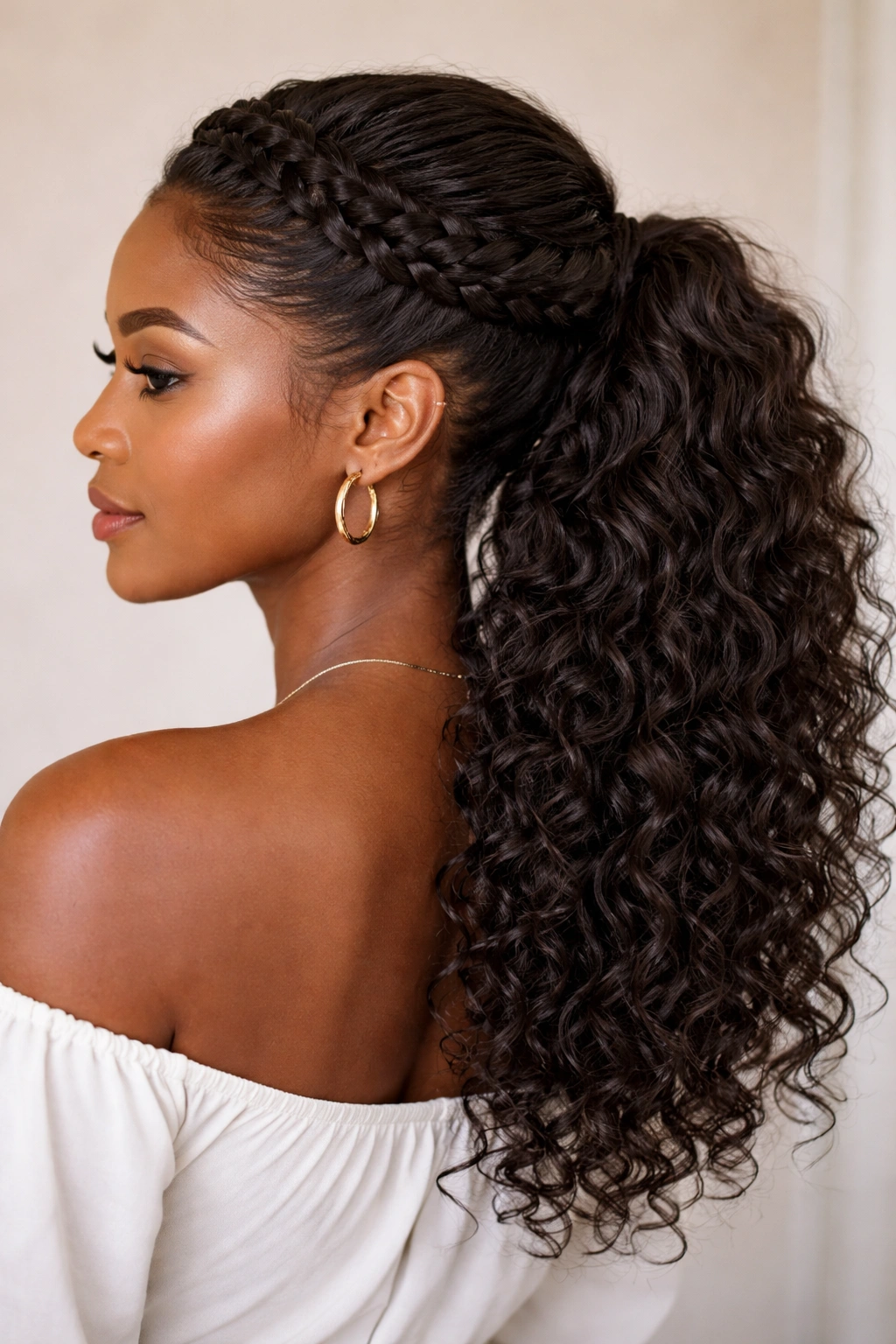
This variation takes the crown braid and intentionally focuses attention on the lower half by gathering the loose hair into a statement-making, full curly ponytail. Instead of leaving the bottom section completely down and loose, you’ll secure it at the nape of your neck or lower, creating defined sections — the structured crown braid on top and the voluminous curly ponytail below. This style works beautifully for formal events and also adapts well to casual settings depending on how you style the ponytail.
Why This Combination Works So Well
The contrast between the controlled, intentional crown braid and the full, bouncy curly ponytail creates visual balance and sophistication. On textured hair, the natural volume and curl pattern of a ponytail look absolutely stunning — you get gorgeous dimension and movement that pulls the style together. This combination also solves the practical problem of managing longer hair throughout the day while still showing off both the braid work and your hair length. Curly ponytails also work well for protecting your ends, as they’re gathered together rather than left completely exposed.
Styling the Curly Ponytail Section
- Once your crown braid is complete and secure, gather the remaining hair at the nape of your neck or slightly lower, depending on how much of your natural hair you want to show
- Use a hair tie that matches your color and won’t slip out of textured hair — fabric-covered elastic works better than plain elastic
- Create volume in the ponytail by gently fluffing and separating the curls with your fingers or a pick
- You can leave the ponytail with natural curls as they fall, or style them further with a curling iron, curling cream, or gel
- For formal occasions, smooth the area where the crown braid meets the ponytail for a polished transition
- Add a statement hair clip, scarf, or accessory where the ponytail is secured for extra personality
Worth knowing: The height where you position the ponytail changes the overall vibe of the style. A lower ponytail (at the nape) feels more casual and relaxed, while a higher ponytail (mid-back of head) feels more formal and polished.
9. Fishtail Crown Braid Half Up
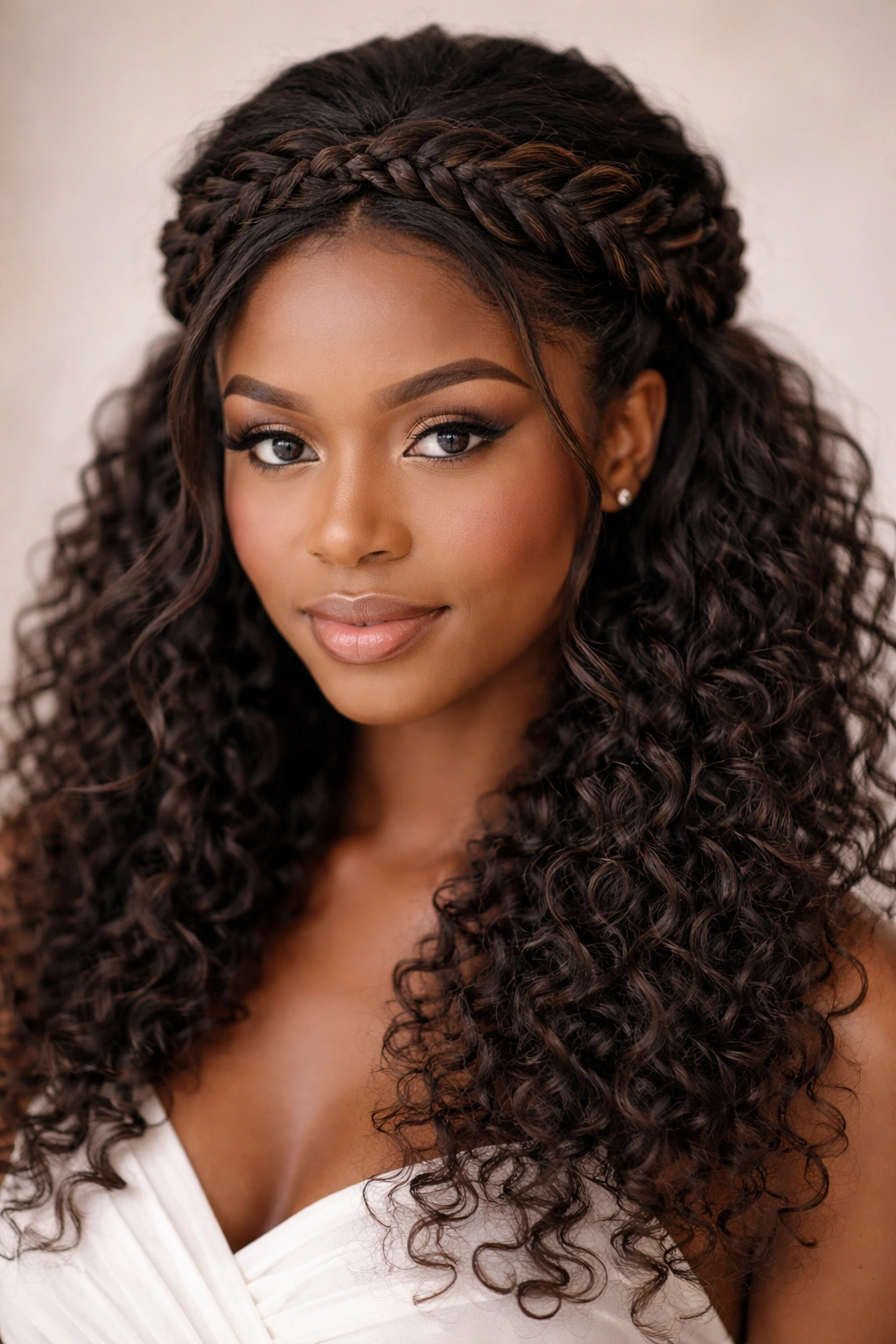
If you want to switch up your braiding technique while maintaining the crown braid half-up concept, try a fishtail braid instead of a standard three-strand braid. Fishtail braids use a different weaving pattern — you divide your hair into just two sections and pull thin strands from the outer edge of one section to the inner edge of the other, creating an intricate, textured pattern that looks like fish scales. On textured hair, fishtail braids have incredible dimension and visual interest.
Why Fishtail Braids Stand Out
Fishtail braids automatically look more intricate and intentional than standard braids, even though the technique is actually quite simple once you get the hang of it. On curly and textured hair, fishtail braids create a gorgeous, dimensional look because you can see all the individual texture and curl pattern woven throughout the braid. They also tend to look slightly looser and softer than tight three-strand braids, which can be a styling advantage if you prefer a more relaxed, bohemian aesthetic. The technique also works beautifully with extensions if you want to add length or thickness.
How to Create a Fishtail Crown Braid
- Divide your hair into two equal sections at your starting point (typically one side of your head)
- Take a thin strand from the outer edge of one section and cross it over to join the opposite section
- Repeat from the other side, alternating back and forth and always pulling from the outer edges
- Continue this pattern as you move across your crown, following the crown braid path
- The braid will naturally look fuller and more textured than a three-strand braid — this is exactly what you want
- Secure at the opposite side and gently pull the outer edges to fluff and add more dimension
- Style the bottom half with loose waves or leave your natural curls to flow freely
Pro tip: Fishtail braids are actually easier to do loosely than tightly, so if you’re just learning the technique, start with a relaxed approach rather than trying to make it perfect and polished.
10. Crown Braid with Twisted Sections
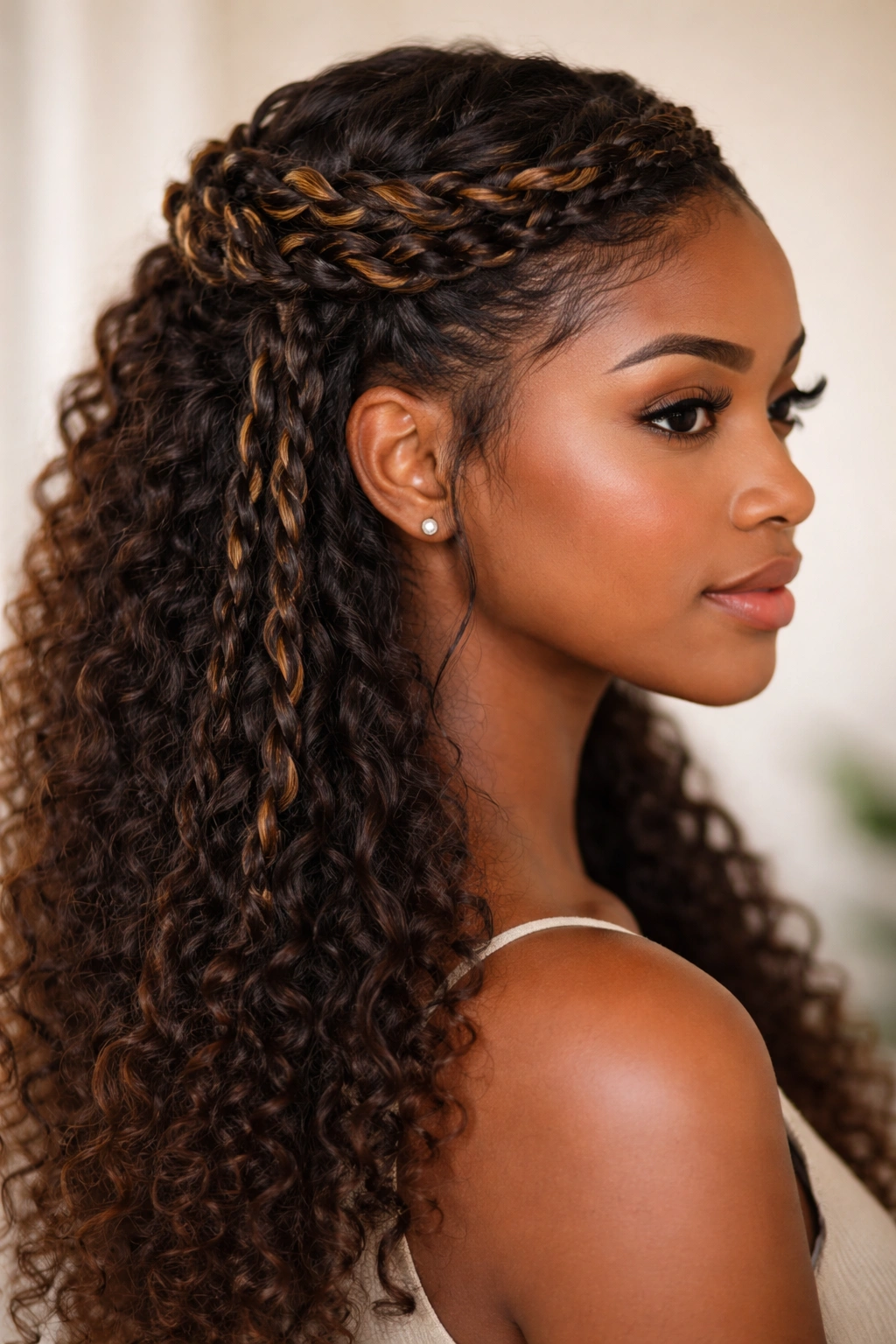
For a mixed-braid style that combines different textures and techniques, try incorporating twisted sections alongside your crown braid. Instead of a single continuous braid, you might braid one section of your crown and twist another section, creating visual variety and interest. Twists create a softer, more romantic look than braids while still being protective and contained. This style works beautifully if you want something that feels intentional and artistic without being overly formal.
How Twisted Sections Add Dimension
Twists feel lighter and more delicate than braids, and when you mix the two techniques in one style, you create visual interest and show off your styling creativity. On textured hair, twists look gorgeous because each individual curl and coil is visible within the twist, creating a rich, dimensional look. The combination of braids and twists also allows you to play with different thicknesses — you might have a thicker braid in the center and thinner twists on either side, for example. This mixed approach is also slightly faster to create than intricate multi-braid styles.
Creating Braids and Twists Together
- Divide your crown section into three or more areas depending on the look you want
- Braid the center section using your standard three-strand technique
- Create twists on either side by taking two sections of hair and wrapping them around each other continuously
- You can make twists the same thickness as your braid or vary the thickness for visual interest
- Secure all sections at the back with bobby pins, positioning them so they meet seamlessly
- Fluff both the braids and twists slightly to add softness and volume
- Leave the bottom half down in waves or curls that contrast with the texture of the top
Worth knowing: Twists tend to unravel slightly as the day goes on, which can actually look beautiful and lived-in. If you want them to stay perfectly intact, secure them with extra bobby pins or a light hold hairspray.
11. Bohemian Crown Braid with Natural Texture
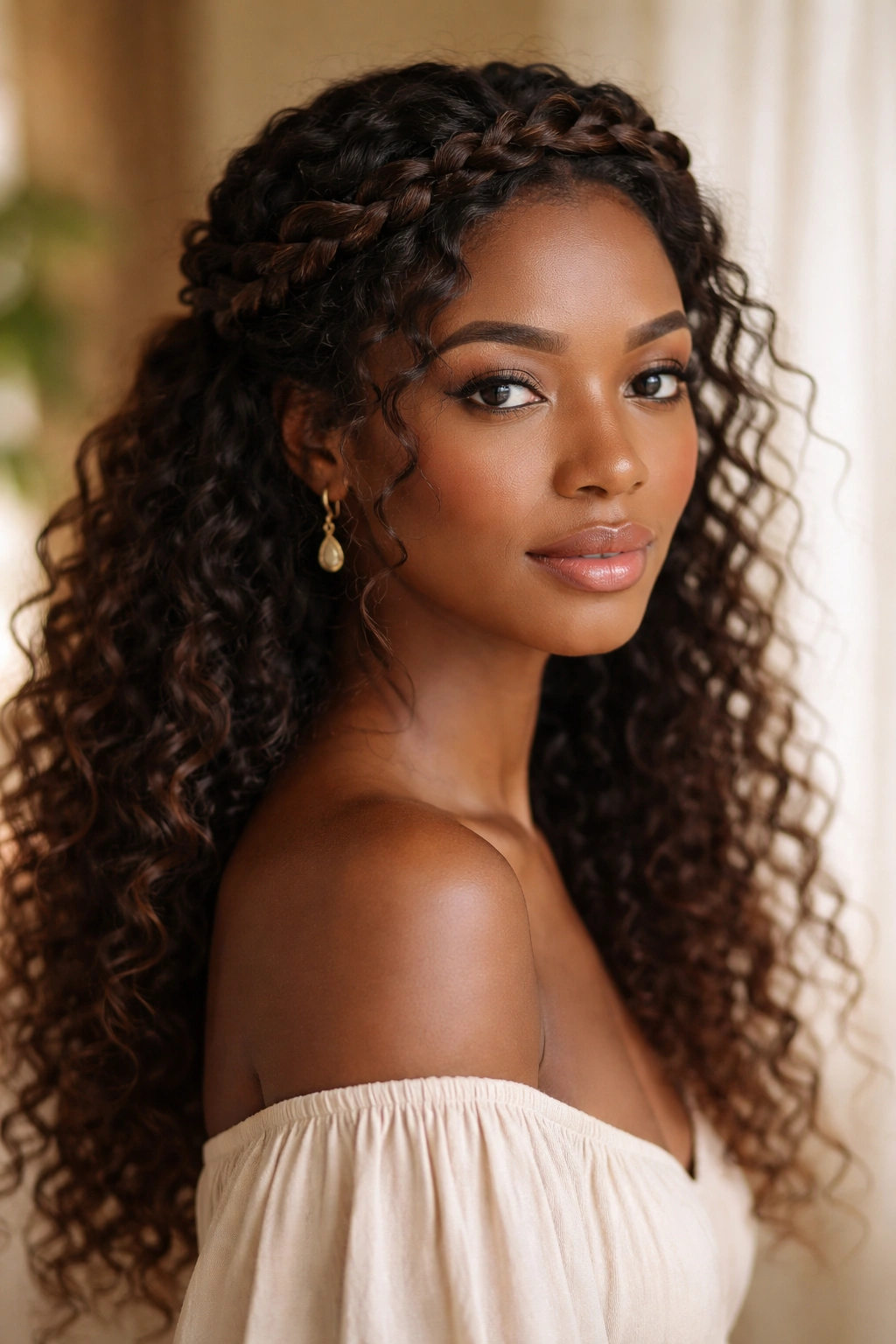
This style celebrates your natural hair texture by intentionally leaving some hair loose and textured throughout the crown braid area, creating a soft, romantic, undone aesthetic. Rather than creating a tight, neat braid, you’ll work with pieces of hair that partially escape, allowing your natural curls and coils to frame your face and add to the overall bohemian vibe. This style is perfect if you love the idea of a crown braid but prefer a less structured, more organic look.
Why Bohemian Styling Suits Textured Hair
Textured hair naturally creates the soft, romantic, undone aesthetic that bohemian styling celebrates. Instead of fighting against your natural curl pattern or texture, this style embraces it, allowing some hair to escape and frame your face beautifully. The result feels intentional and artistic rather than messy — you’re deliberately working with your hair’s natural movement and bounce. This style also requires less precision and tension, which means less stress on your hair and a quicker styling process overall.
Creating the Bohemian Look
- Start your crown braid slightly looser than you would normally braid, allowing hair to have movement within the braid itself
- Deliberately leave some small sections of hair unbraided around your hairline and temples, letting them frame your face with natural waves or curls
- As you braid, focus on the overall flow and movement rather than precision and perfection — slight imperfections add to the bohemian aesthetic
- Once the main braid is complete, use your fingers to gently pull sections out and create a fuller, airier look
- Apply a lightweight curling cream or leave-in conditioner to enhance your natural curl pattern in the loose sections
- Style the bottom half with your natural curls, perhaps with a bit of curl-defining product to enhance definition and bounce
Quick facts about bohemian styling:
- Less tension on your hair means less breakage and damage — it’s actually better for hair health
- This style works beautifully on all curl patterns, from loose waves to tight coils
- Bohemian braids last longer than tight braids because the looser structure is more flexible
- The style photographs beautifully because the movement and texture create dimension in pictures
12. Braided Crown with Sleek Low Bun
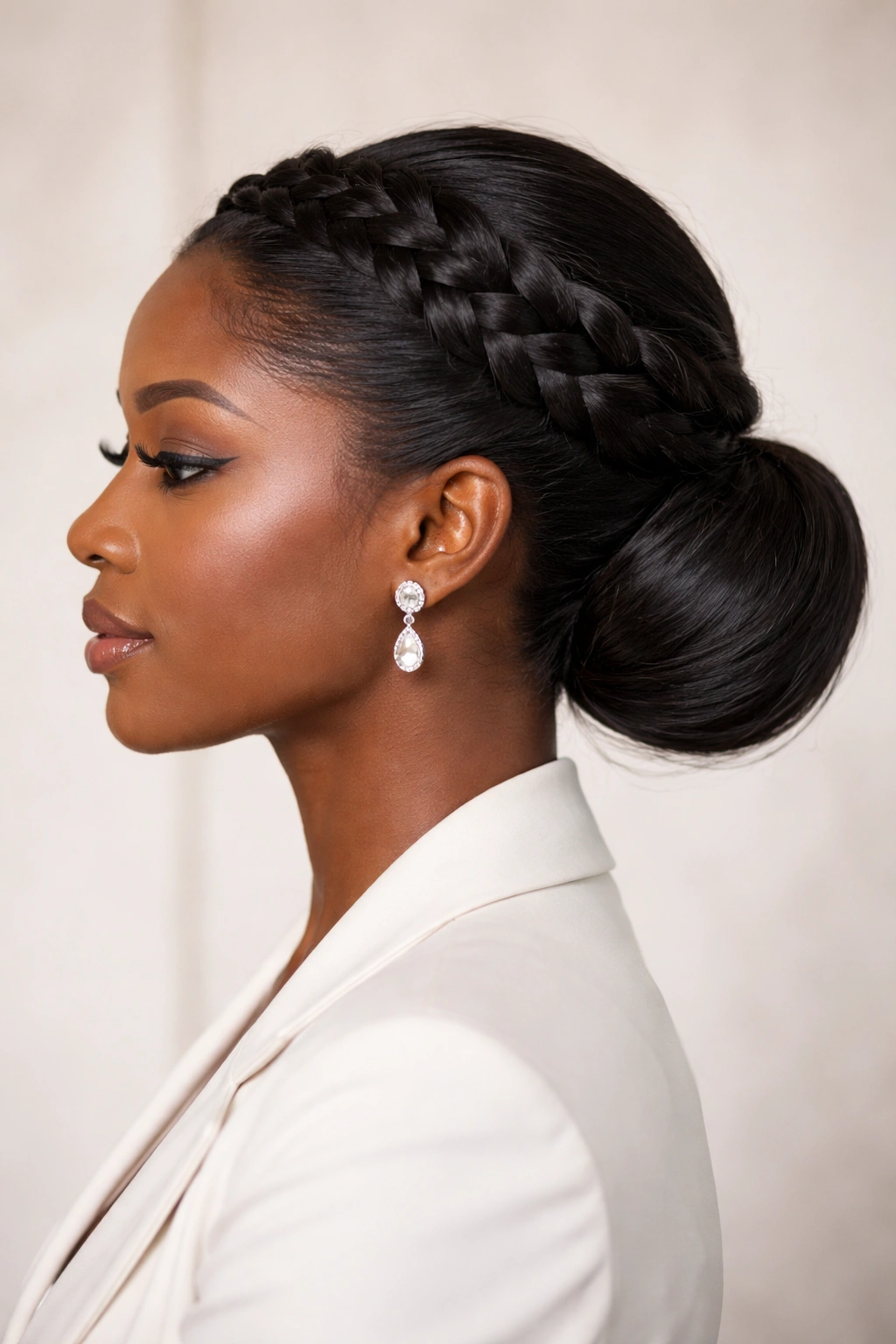
For a polished, put-together look that’s appropriate for professional settings and formal occasions, pair your crown braid with a sleek low bun. This style takes all the elegance of a crown braid and adds a practical element — your hair is completely contained and secured, making it an excellent choice for work, special events, or any situation where you want to look polished and professional. The contrast between the textured crown braid and the smooth bun is visually striking.
Why This Combination Exudes Sophistication
The crown braid draws attention to your face and the upper part of your styling, while the sleek bun shows refinement and intentionality. Together, they create an outfit-appropriate look that’s professional without being boring. On textured hair, this style is particularly effective because the crown braid showcases the beautiful dimension of your curls and coils while the smooth bun demonstrates that you can also style your hair sleekly when the occasion calls for it. This versatility is exactly what you need in a go-to professional style.
How to Create the Complete Look
- Complete your crown braid following any of the techniques mentioned in the previous sections
- Gather all the remaining hair at the nape of your neck and secure it with a hair tie
- Smooth the gathered hair using edge control or gel if you want a sleek appearance, or work with your natural curl pattern for a textured bun
- Twist the ponytail around itself to create a bun shape, pinning it securely with bobby pins
- Tuck any loose ends back into the bun and secure with additional pins
- For extra hold, use a flexible hairspray that won’t create flakiness or stiffness
- Smooth your hairline and any baby hairs using edge control product and a fine-tooth brush for a polished finish
Pro tip: This style actually improves throughout the day — the bun naturally relaxes slightly and looks even more beautiful by evening. Plan this style for days when you have at least an 8-hour window to wear it.
Final Thoughts
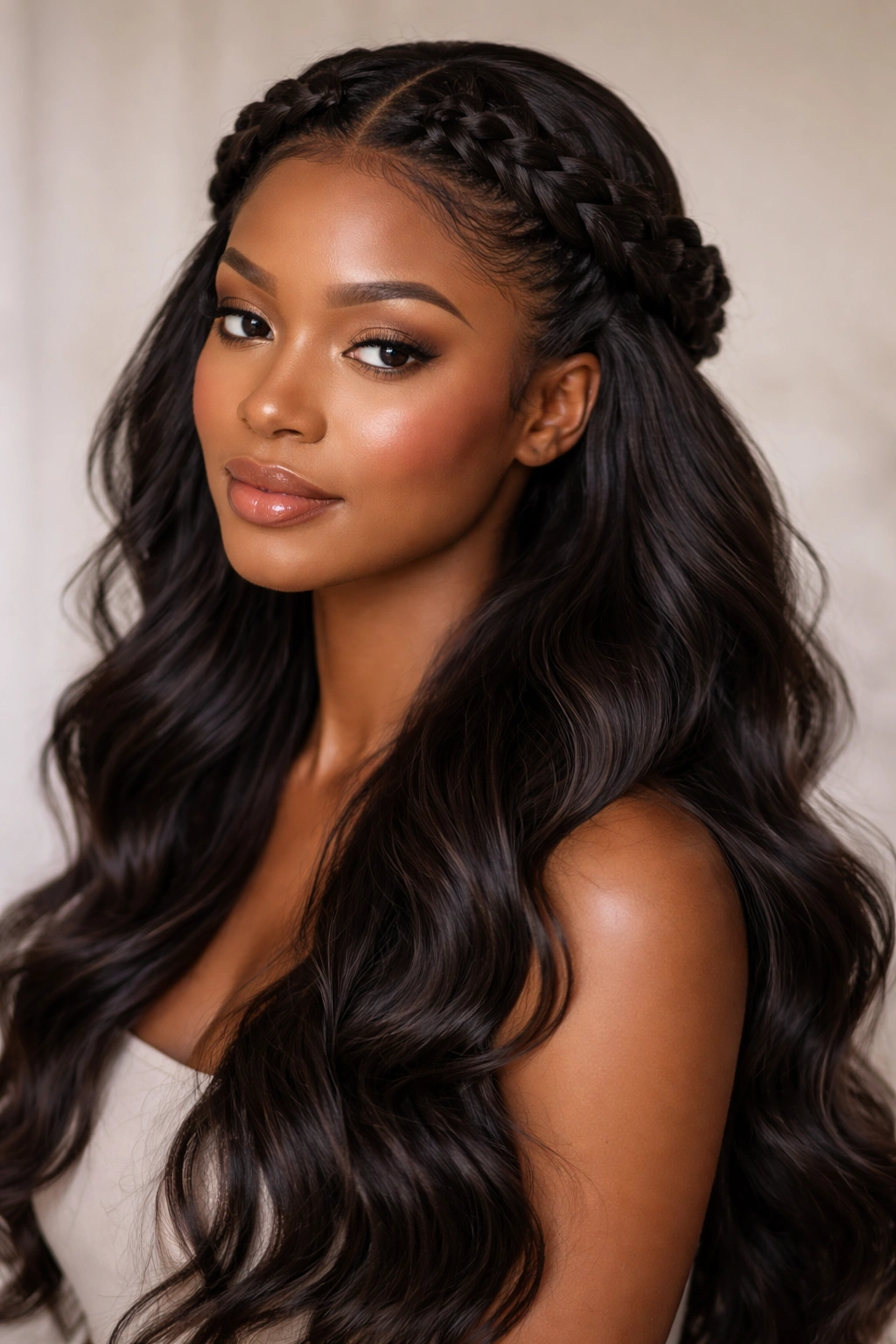
Crown braids offer Black women an incredible range of styling options that celebrate natural hair texture while providing protection and versatility. Whether you choose the classic elegance of a simple crown braid with waves, the cultural significance of a Fulani-inspired design, the modern edge of an asymmetrical braid, or the professional polish of a crown braid with a sleek bun, you’re working with a hairstyle that adapts to any occasion and any personal aesthetic.
The key to finding your favorite crown braid style is experimenting with different techniques and combinations until you discover what feels most like you. Each of these twelve styles can be customized further — you can add beads, play with braid thickness, incorporate twists, or style the bottom section however you want. Your crown braid becomes a canvas for your creativity and self-expression.
Remember that your natural hair texture is genuinely your advantage when it comes to crown braids. The grip, hold, and natural dimension of textured hair make these styles more secure, more visually interesting, and more beautiful than they often appear on other hair types. Embrace that texture, work with it rather than against it, and you’ll create crown braids that look absolutely stunning and keep your hair healthy in the process. Whether you’re styling your crown braid for yourself or as a form of cultural expression, you’re honoring a rich tradition of Black hair artistry and creativity that deserves celebration.
