



Crown braids offer an elegant way to frame the face while keeping hair partially pulled back, and adding flowers transforms the look into something truly romantic and memorable. Whether you’re preparing for a wedding, a special event, or simply want to elevate your everyday style, crown braid half-up half-down hairstyles provide versatility and sophistication. The beauty of this combination is that it works across different hair types, lengths, and textures—and the addition of flowers creates visual interest that makes even simple braids feel wedding-worthy or festival-ready.
The real magic happens when you understand how to layer the braid structure with floral elements. Fresh flowers, silk alternatives, or delicate flower crowns can be woven directly into the braid, pinned strategically at the base of the style, or tucked into the loose waves that fall beneath the half-up section. This hybrid approach gives you the polished elegance of a pulled-back style with the romantic flow of down hair, plus the undeniable charm that flowers bring.
What makes crown braids with flowers so appealing is their adaptability. You can create something delicate and whisper-soft for a garden wedding, bold and artistic for a festival, or sleek and modern for a night out. The half-up half-down structure means your face remains completely visible and framed beautifully, while the crown element adds immediate dimension and visual impact. Flowers are the perfect finishing detail because they add color, texture, and personality without requiring perfect execution—minor imperfections in the braid actually add to the romantic, intentional-looking quality.
1. Classic Twisted Crown Half-Up with Blush Roses
This timeless style combines the simplicity of twisted hair with the elegance of a floral accent, making it perfect for anyone seeking an understated yet polished look. The twist creates texture without the complexity of an actual braid, so it’s far more forgiving for beginners and works beautifully with different hair lengths.
Start with hair that has some texture or gentle waves—use a curling iron or braid waves in overnight if you’re starting with completely straight hair. Brush out one side gently to smooth the waves while keeping volume. Create two sections at the crown by dividing hair from your temple area on both sides. Twist each section firmly toward the back of your head, then secure both twists together at the nape of your neck with a clear elastic.
Why This Works Beautifully
The twisted structure holds securely without needing the complexity of a true braid, yet it delivers all the visual interest and elegance. Because you’re only doing two simple twists rather than navigating three or four braid strands, the whole style comes together in under five minutes—even faster with practice.
How to Add Flowers Perfectly
- Tuck 3-5 garden roses or spray roses directly into the twisted section just above the elastic where the two twists meet
- Choose roses in blush, ivory, or peach tones for a romantic, cohesive look
- Secure the stems with floral tape if using fresh flowers, or use pre-made floral picks for effortless integration
- Layer smaller filler flowers (baby’s breath, wax flower, or eucalyptus) around the roses for texture and movement
Pro tip: This style looks most romantic when you leave at least eight to ten inches of hair loose beneath the twist—let the bottom half fall in soft waves or curls that frame the shoulders beautifully.
2. Double Crown Braid with Floral Accent
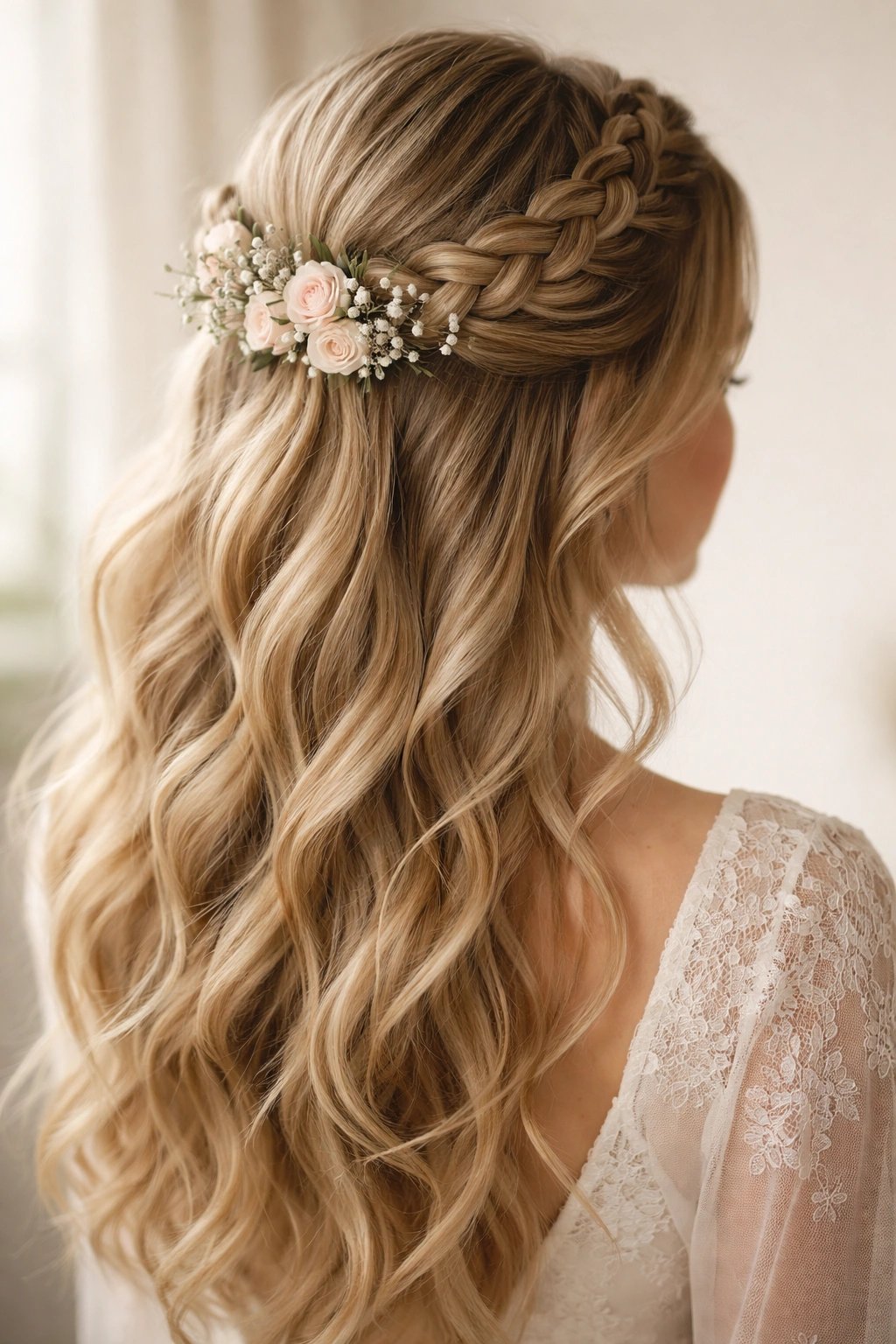
Creating two braids that loop around the crown gives you a more intricate, immediately striking look while still maintaining the half-up half-down structure. This style photographs beautifully and works especially well for special events where you want clear, visible detail.
Begin with clean, dry or slightly damp hair and apply a light texturizing spray to make the hair grippier and easier to braid. Create a deep side part and start your first braid at the nape of your neck on one side, braiding upward and across the back of your head toward the opposite temple. Repeat on the other side, starting at the opposite nape and braiding upward to mirror the first braid. Secure both braids at the crown area where they meet, then gently tease and widen each braid with your fingers for a fuller, softer appearance.
The Architecture of This Style
The two braids create a natural crown effect because they run horizontally across the back and sides of your head in opposite directions. This frames the face without pulling hair too tightly, and the loose bottom half creates contrast between the structured crown and the romantic waves below.
Floral Placement for Maximum Impact
- Pin a cluster of 5-7 small flowers (garden roses, ranunculus, or peonies) where the two braids meet at the crown
- Use flowers in a single tone or a gradient of related colors for a cohesive, intentional appearance
- Tuck delicate greenery (eucalyptus, Italian ruscus, or salal) around and between the braids for texture
- Consider a ribbon or silk tie woven through one or both braids in a complementary color
Worth knowing: The wider and softer you make these braids (by gently pulling on the edges), the more romantic and forgiving the style becomes—tight, neat braids read more formal and structured, while soft, loose braids feel bohemian.
3. Loose Romantic Crown with Scattered Flowers
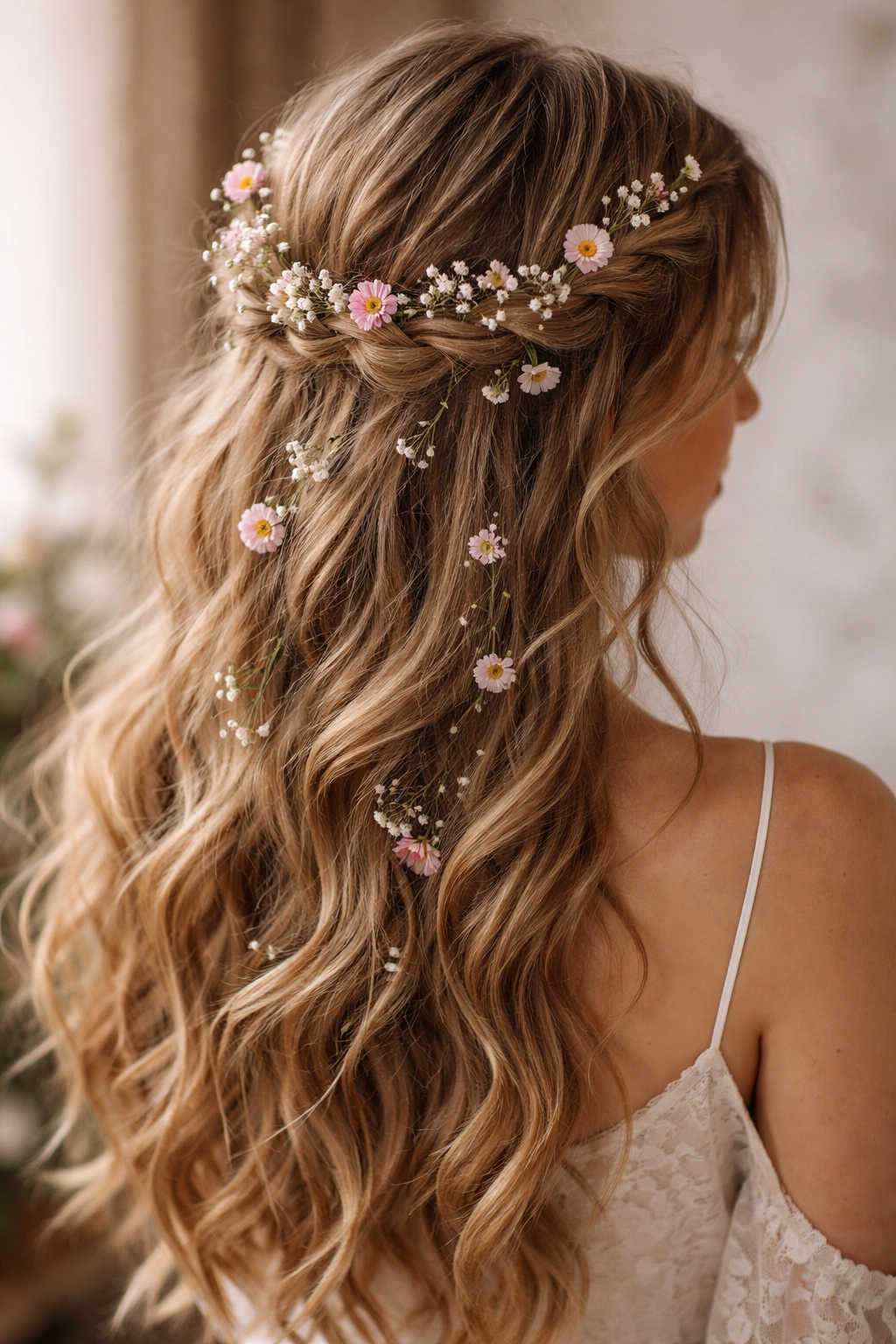
This style prioritizes the romantic, effortless aesthetic by using a loose, almost undone crown braid combined with strategically scattered small flowers throughout the crown area and the half-down section. It’s the opposite of a highly structured style—think more “I woke up like this” but better.
Work with hair that has natural texture or waves; if your hair is straight, create loose waves the night before or use a large-barrel curling iron. Rather than creating one defined braid, French braid loosely from one temple to the opposite temple, going roughly along the crown area but intentionally leaving bumpy sections and varying the braid width. Pull gently on each braid section to make it very loose and airy. Don’t secure the braid tightly; instead, let it fade into the loose hair below, pinning it loosely with bobby pins.
Why Loose Beats Polished Here
The whole appeal of this style is the soft, undone quality that still looks intentional and beautiful. A perfectly neat braid would undermine that aesthetic. The loose texture gives you permission to be imperfect, which paradoxically makes the style feel more sophisticated and designer-like.
Flower Distribution Strategy
- Place 1-2 larger focal flowers (peonies, garden roses, or dahlias) at the crown where the braid begins
- Scatter 4-6 smaller flowers throughout the braid and crown area, positioning them at slightly different heights
- Pin small flower sprigs into the loose waves below the crown area for a cascading effect
- Use flowers in varying shades of the same color (blush, dusty rose, mauve) for a romantic ombre effect
Insider note: Fresh flowers work beautifully with this style, but silk flowers actually give you more flexibility because you can adjust them as the day goes on—they won’t droop or lose petals.
4. Braided Halo with Clustered Flowers
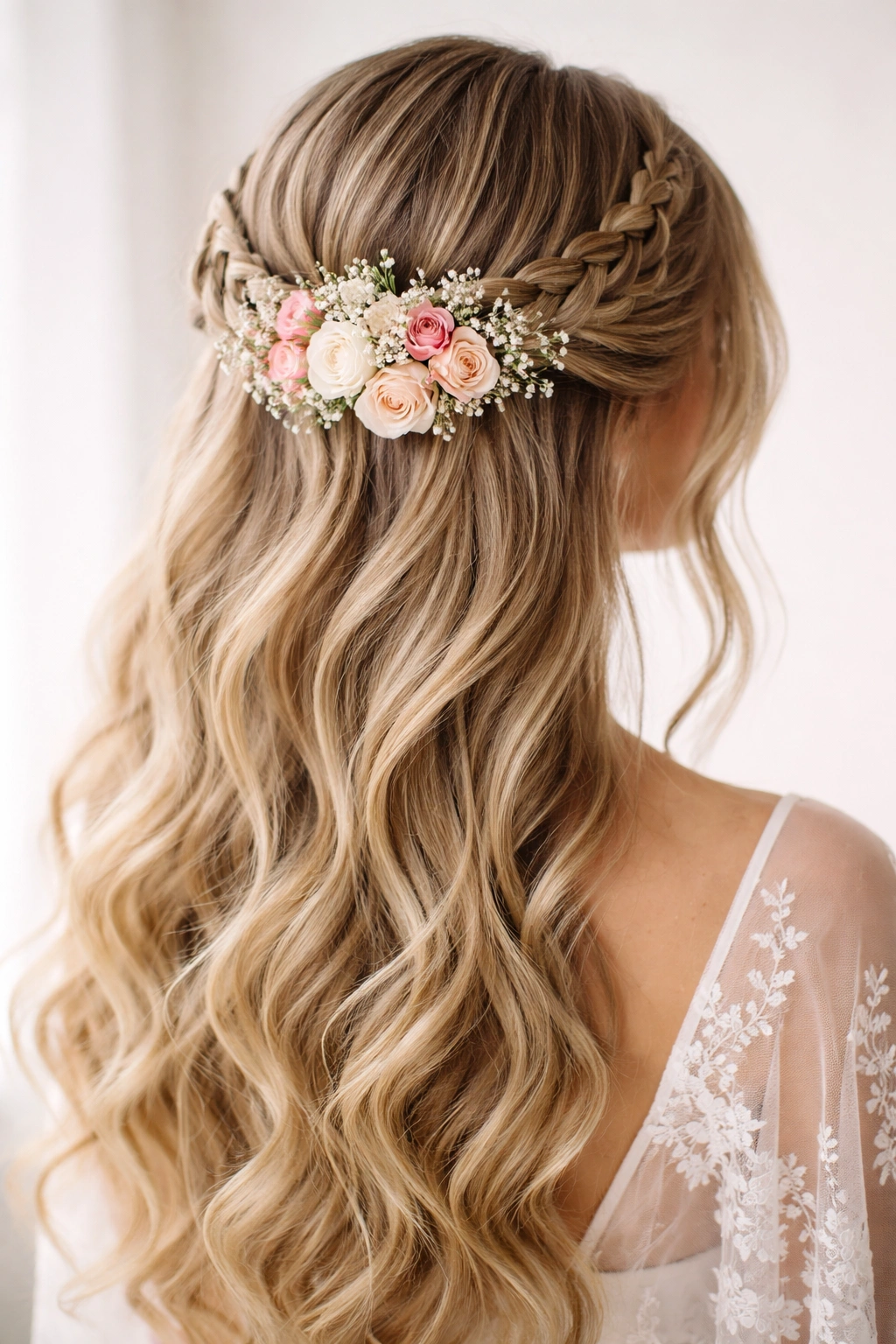
A halo braid sits all the way around the crown of your head, and when you do this as a half-up style, you’re creating an actual circular frame. Adding a concentrated flower cluster transforms it into something that looks almost like a flower crown integrated with the braid itself.
Divide your hair into two equal sections at the center of your head. Starting on one side, create a French braid that begins at your temple and works its way around the back of your head, following the natural curve of your crown toward the opposite temple. The braid should sit higher on your head than a typical crown braid—you’re aiming for a true “halo” position. Secure both sides at your opposite temple, letting the rest of your hair fall freely. Gently widen the braid by pulling on the edges.
The Visual Power of a True Halo
This structure creates an actual circular frame around your face when viewed from the front, which is particularly flattering for most face shapes. The half-up element means hair still flows down your back, but the upper portion has defined, visible structure.
Creating an Impactful Flower Cluster
- Create a concentrated arrangement of 6-10 flowers where both braid sections meet at the temple on one side (usually the side your face naturally turns toward in photos)
- Choose flowers with complementary heights and textures: combine larger focal flowers with smaller filler blooms and greenery
- Secure flowers with floral picks or by carefully winding floral tape around the stems and tucking them into the braid
- Consider using a graduated color arrangement—darker at the center, lighter at the edges—for artistic depth
Worth knowing: This style works best with hair that’s at least mid-shoulder length so the halo braid sits clearly visible. Shorter hair can work but may feel cramped.
5. Side-Swept Crown with Delicate Blooms
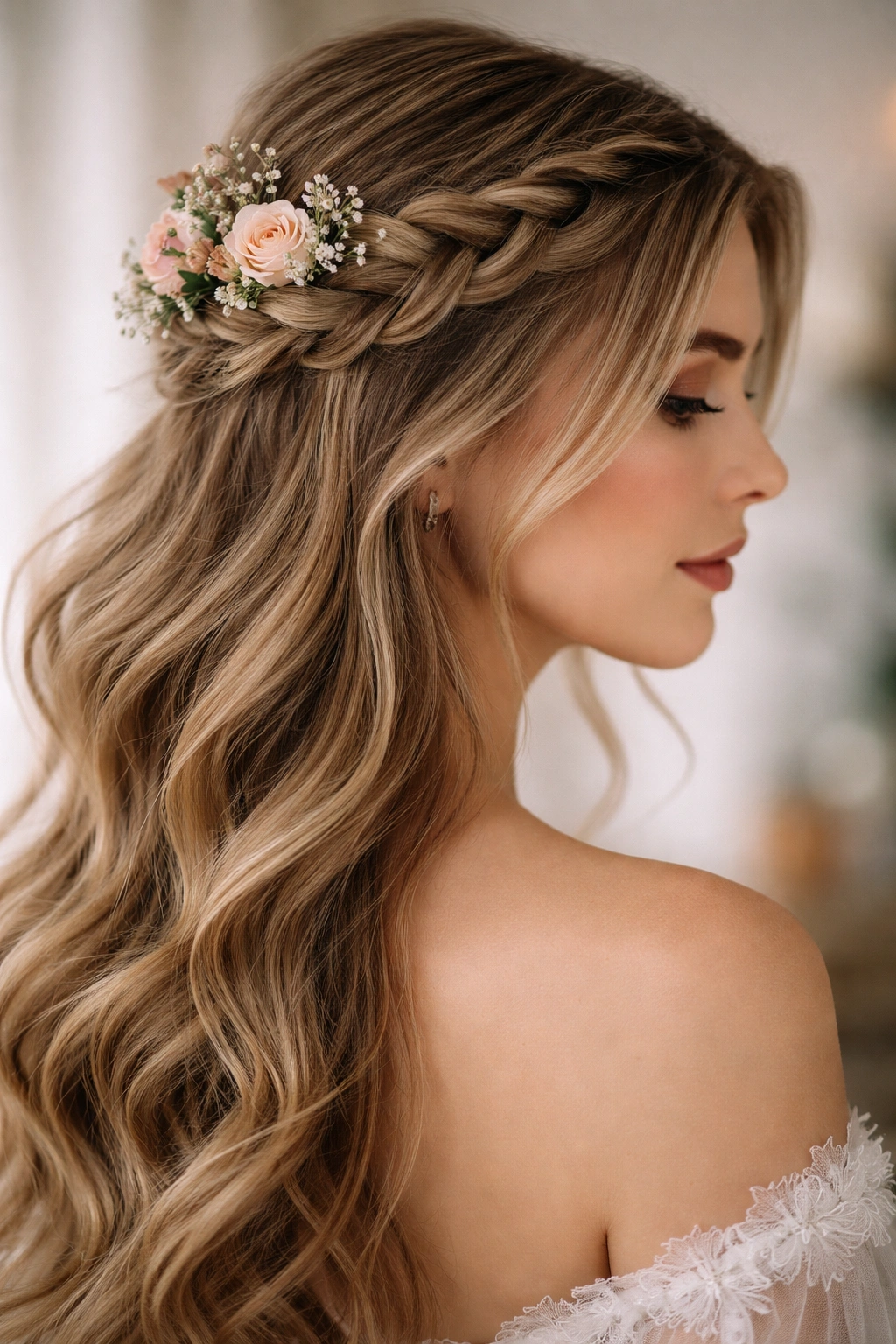
This asymmetrical approach sweeps the crown braid heavily to one side, creating movement and visual interest while keeping the half-down section fuller and completely unrestricted on the opposite side. It’s especially flattering for people who prefer their hair fuller on one side or who enjoy showing off one side of their face.
Create an extreme deep side part, starting practically at the back of your ear on one side. Begin braiding at that temple and work the braid across the back of your head toward the opposite temple, positioning it as your crown. Secure the braid loosely on the far side, leaving much of the back and underside loose. Pull gently on the braid sections to loosen it, then flip your head and style the loose portion (usually the opposite side and back) into waves or curls.
The Asymmetry Advantage
Side-swept styles instantly look more modern and fashion-forward than perfectly balanced styles. The sweep also has a flattering effect because it directs the viewer’s eye in a particular direction and can minimize or emphasize different aspects of your face shape depending on which side you sweep toward.
Positioning Delicate Flowers
- Place 2-3 delicate blooms (ranunculus, sweetpea, wax flower) tucked into the braid as it crosses the crown
- Add a single statement flower or a tiny cluster at the point where the braid ends on the far side
- Scatter 1-2 individual small flowers into the loose waves on the fuller side for visual continuity
- Use flowers in a single light color (ivory, blush, or pale yellow) for an ethereal feeling
Pro tip: This style pairs beautifully with loose Hollywood waves or textured curls in the down section. The contrast between the structured crown and the romantic, full waves below makes the whole look feel special.
6. Fishtail Crown Half-Up with Delicate Florals
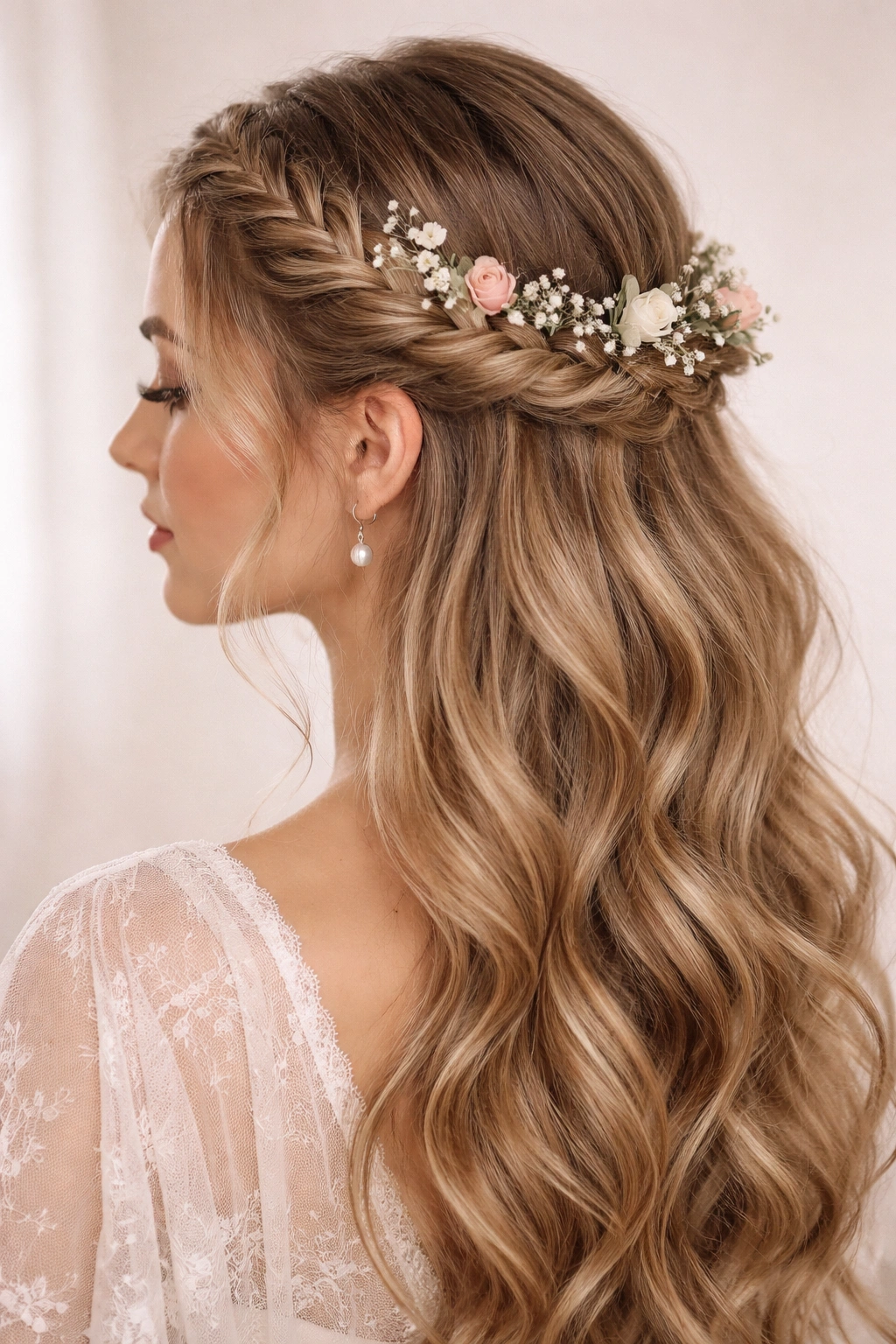
The fishtail braid creates a delicate, intricate texture that looks far more complex than it actually is to create. Using this braid type for a crown half-up style elevates the elegance immediately, and flowers tucked into the fine detail work beautifully with the intricate structure.
Create a small fishtail braid starting at one temple. If you’re unfamiliar with fishtail braiding: take two thin strands of hair and cross them over each other alternately, rather than working with three sections like a traditional braid. The resulting braid has a fine, lacy texture. Work the fishtail across the crown toward the opposite temple, keeping it loose and gentle. Secure it at the other temple, then soften it by gently pulling outward on each small crossover section.
Why Fishtail Braids Feel More Luxurious
The fishtail creates visual texture that reads as “intricate” even when the braid is quite loose and easy. This makes it a high-reward style for the effort involved—it looks impressive without requiring advanced braiding skill.
Integrating Flowers into Fine Detail
- Tuck very delicate, small flowers (baby’s breath, wax flower, forget-me-nots, or astilbe) directly into the crossover sections of the fishtail as you create the braid, or add them after by inserting stems between the delicate strands
- Keep flowers proportionally small so they don’t overwhelm the intricate braid texture
- Use 5-8 tiny flowers distributed throughout the braid rather than a single large cluster
- Pair white or pale pink flowers with this braid for a delicate, cohesive appearance
Worth knowing: Fishtail braids work best on hair that’s slightly textured or has some grip to it. If your hair is very slick and silky, the braid may feel too loose and fall apart. Apply a texturizing spray beforehand if needed.
7. French Braid Crown with Integrated Flower Crown
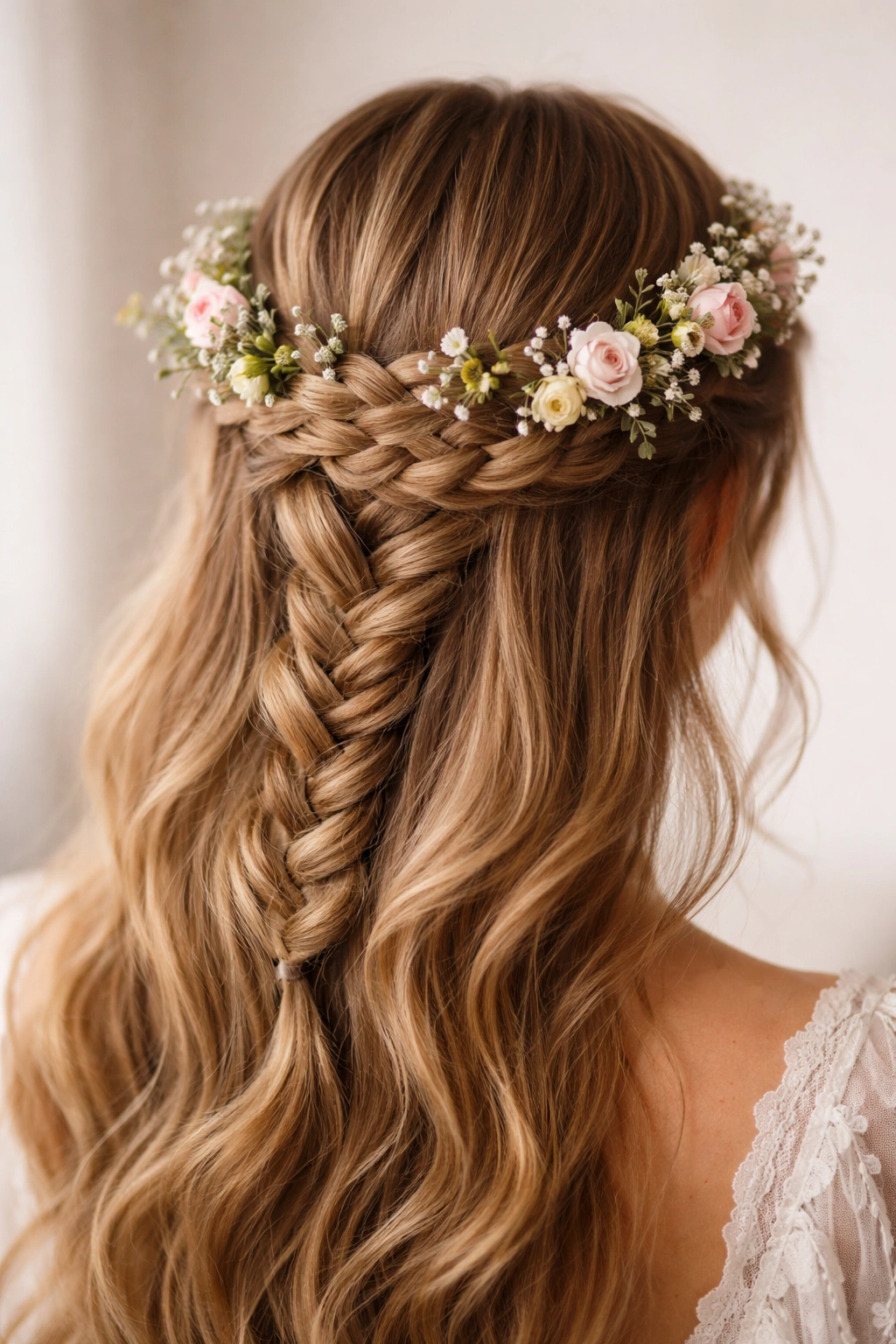
This style treats the braiding and the flower crown as one unified piece rather than two separate elements. You’re actually weaving flowers into the braid as you create it, which requires slightly more planning but creates a seamlessly integrated, high-impact result.
Gather your flowers and floral greenery before you start braiding. If using fresh flowers with stems, wrap the lower portions in floral tape or thin floral wire so they can be easily incorporated. Begin a French braid at one temple, adding small sprigs of greenery and tiny flowers directly into the braid strands as you work. You might add a piece of eucalyptus every few braiding motions, or weave in a small flower cluster. Continue braiding across the crown toward the opposite temple, continuing to integrate flowers as you go. Secure at the far temple.
The Seamless Integration Approach
Because flowers are going in during the braid rather than being added after, they feel like a natural part of the structure. The braid itself holds them in place, and the overall effect reads as one complete, artistic piece.
Strategic Flower and Greenery Choices
- Choose flowers that won’t be damaged by gentle pressure from the braid: ranunculus, garden roses, spray roses, and carnations all hold up well
- Incorporate greenery throughout: eucalyptus, Italian ruscus, and button fern add volume and structure without adding weight
- Use flowers in a cohesive color palette (all pastels, or all in shades of one color) for unity
- Plan to use 8-12 small flowers total, distributed throughout the braid length
Pro tip: Practice this style with ribbon first before attempting with fresh flowers. Braid the ribbon in to understand the mechanics, then do the same with flowers. This removes the pressure of being perfect with delicate florals on your first attempt.
8. Bohemian Crown Twist with Wildflower Mix
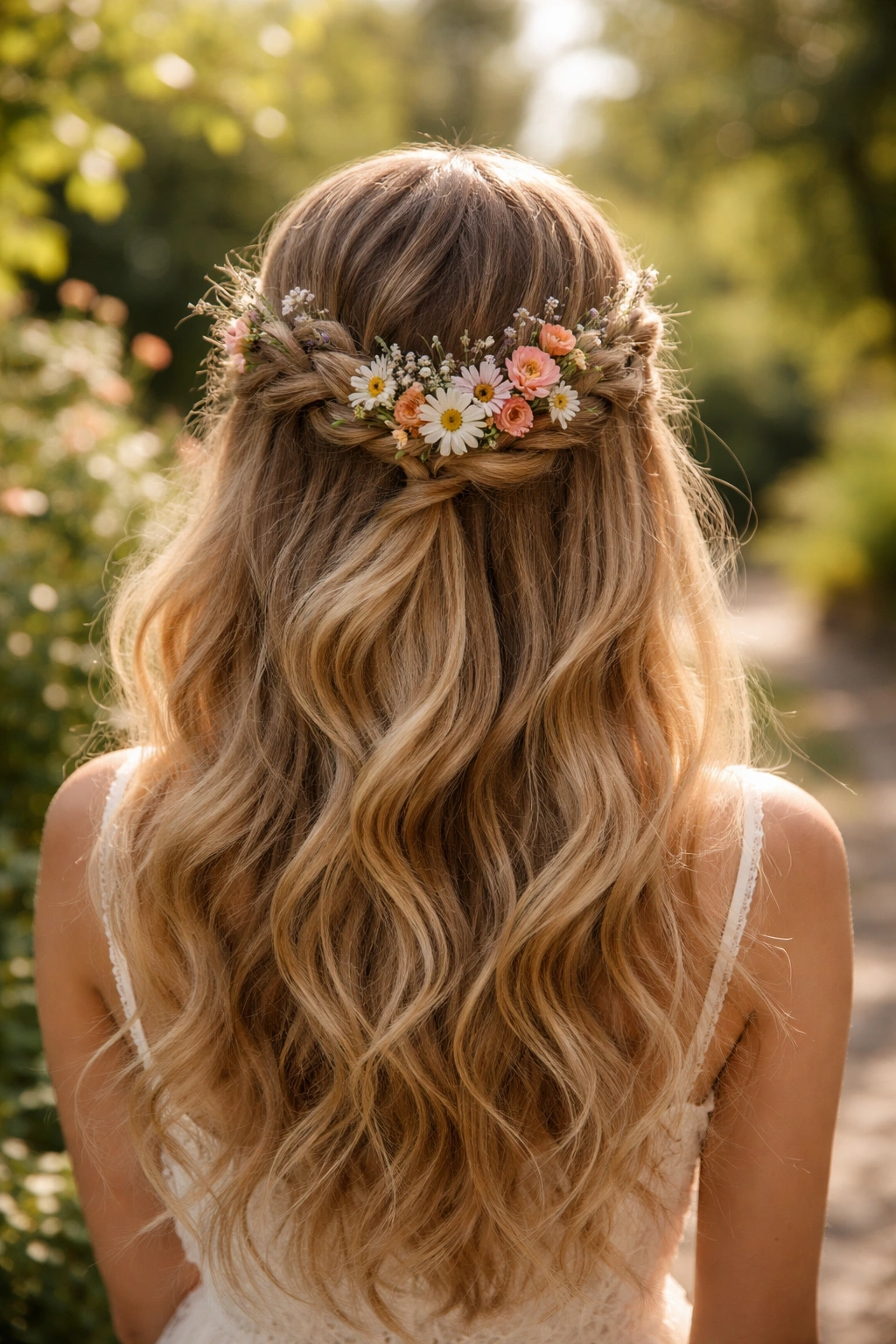
This entirely free-spirited style uses a loose, textured twist rather than a structured braid and incorporates a wildly romantic mix of different flower types in varying sizes and colors. It’s the aesthetic of “I gathered these beautiful flowers and twisted my hair to show them off,” and it works because the seeming randomness is actually intentional.
Create two loose twists from your temples toward the back of your head as described in style #1, but this time don’t bring them all the way to the center back. Instead, let them meet roughly 3-4 inches off-center, and don’t secure them tightly—use bobby pins loosely so the twists maintain a soft, undone quality. The half-down section should be very voluminous, with textured waves or curls flowing freely.
The Beauty of Intentional Casualness
The bohemian aesthetic actually requires more intentionality than it appears. Choosing flowers that work together, positioning them thoughtfully, and creating texture that flatters rather than reads as messy—these are skills. But once you master them, the style feels effortlessly romantic.
Wildflower and Mixed-Bloom Approach
- Combine 3-5 different types of flowers in varying heights and forms: roses, dahlias, wildflowers, baby’s breath, eucalyptus, pampas grass strands, or feathery greenery
- Use colors that could naturally occur together: sunset tones (coral, peach, gold), garden pastels (blush, sage, lavender), or jewel tones (burgundy, forest green, dusty purple)
- Create an asymmetrical arrangement concentrated where the twists meet, with a few stray flowers pinned into the loose waves below
- Layer the flowers so they have dimension: some high, some lower, some tucked directly into the twist, some sitting loose in front
Insider note: Wildflower bouquets from farmers’ markets or grocery stores are perfect for this style because they’re already curated for natural combinations and variety. You get that cohesive randomness without having to source individual stems.
9. Sleek Crown Braid with Statement Florals
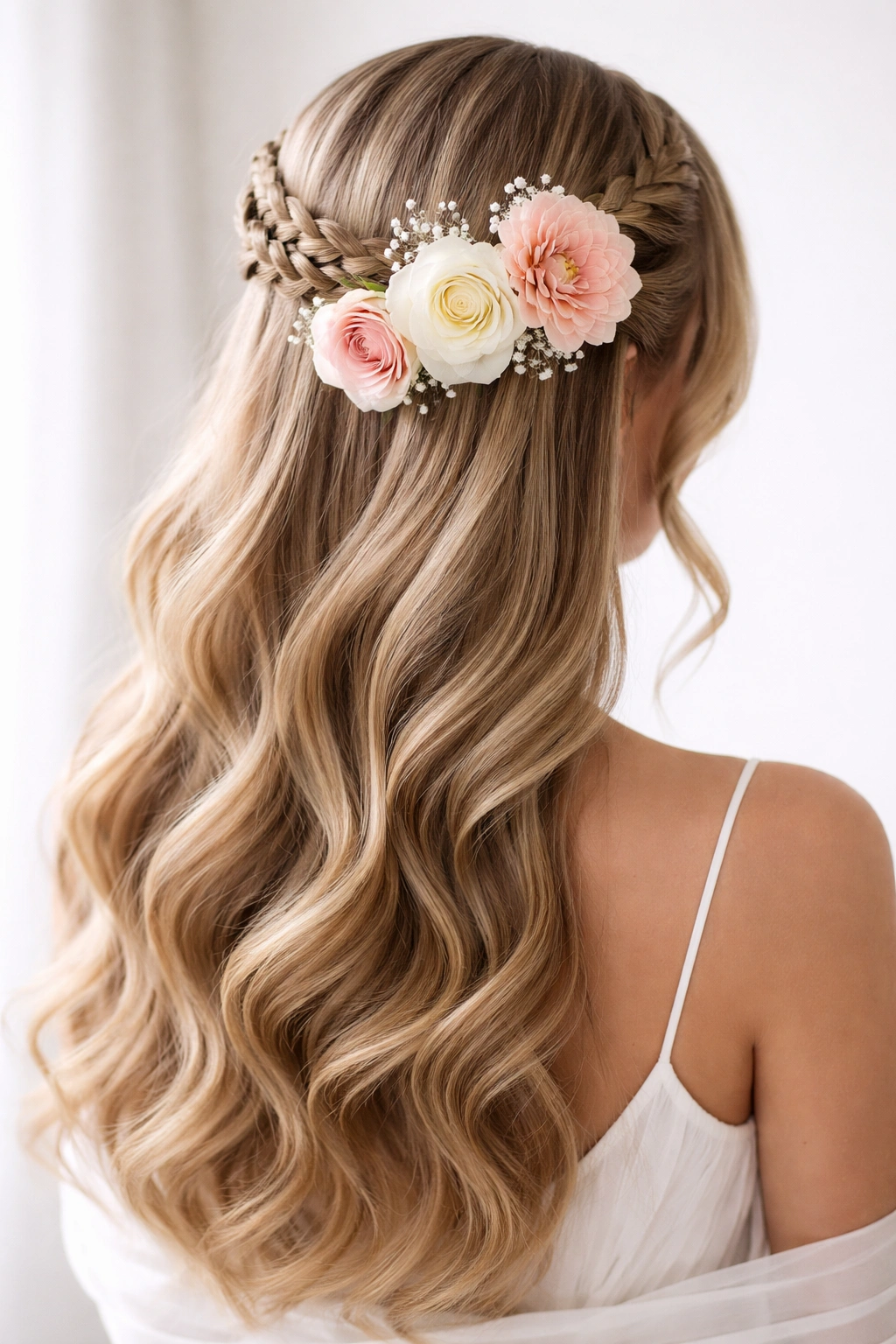
This style takes the opposite aesthetic direction from the bohemian approach: everything is polished, refined, and intentional. The braid is neat and smooth, the hair below is perfectly waved, and the flowers are chosen for their size and impact rather than delicate complexity. This is the choice for formal events, professional occasions, or anyone who prefers a more controlled, elegant aesthetic.
Apply smoothing serum to damp hair and blow-dry with tension to create a sleek, polished base. Create a single Dutch braid (braid underneath rather than over, creating a raised ridge effect) from one temple to the opposite temple, positioned along the crown. The braid should be tight enough to hold the polished look without looking uncomfortably severe. Secure at the end, then use a fine-tooth comb to smooth any flyaways. Style the down section in large, smooth waves or curls.
The Power of Restraint and Refinement
When you choose fewer elements and make them larger and more impactful, the style immediately reads as more sophisticated. A single statement flower carries more visual weight than five delicate blooms.
Statement Flower Selection and Placement
- Choose 2-3 large, showy flowers (garden roses, peonies, dahlias, or orchids) in a single color or tightly coordinated palette
- Position them as a single, concentrated cluster where the braid ends or at the crown where it begins
- Avoid mixing many different flower types—keep supporting greenery minimal and refined
- Choose flowers in jewel tones or rich pastels: deep burgundy, blush, ivory, or gold pair beautifully with sleek styling
Worth knowing: This style is particularly striking for people with dark hair and fair skin, where high contrast between hair and flowers creates immediate visual impact. But it works for any coloring when you choose flowers in the right tone.
10. Curled Crown Half-Up with Rose Detail
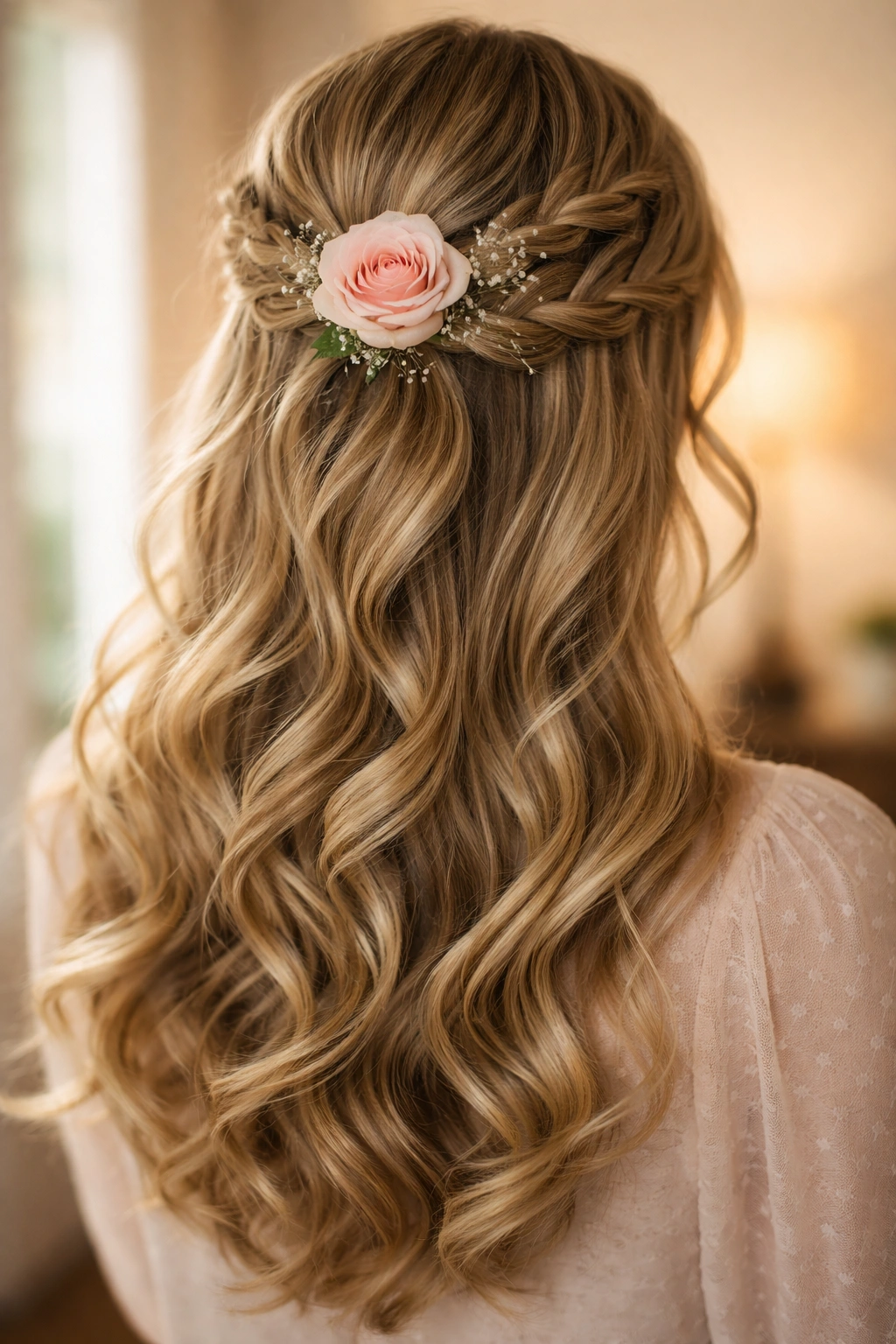
This style skips the braid altogether in favor of creating a full, curled crown section that’s pulled half-up, then nestling a single perfect rose or a small cluster into the crown area. It’s simpler to create than braid-based styles but yields equally impressive results.
Blow-dry your entire head with a large-barrel curling iron, creating loose, romantic curls throughout. Gently brush out the curls with a paddle brush to create soft waves rather than defined ringlets. Take a section of hair from your crown area—roughly from the front hairline back about 4-5 inches—and pull this section back gently. Secure loosely with a clear elastic, leaving plenty of volume and softness in the crown section. Leave the rest down to flow in waves.
Why Simpler Can Be More Striking
Not every beautiful hairstyle requires complex braiding. Sometimes the impact comes from texture, volume, and the right accessory—in this case, a single stunning flower or small cluster.
Rose Placement and Selection
- Choose a garden rose, a large spray rose, or a stunning ranunculus in a color that complements your skin tone
- Pin or secure the flower directly at the elastic where the crown section gathers, or tuck it slightly above the elastic into the curled hair for a more integrated appearance
- Keep supporting florals minimal—perhaps just 2-3 tiny sprigs of eucalyptus or baby’s breath around the main rose
- For a single-flower look, choose your rose carefully: large, open blooms with visible petals create more impact than tight, closed buds
Pro tip: This style is forgiving because the curls give you a lot of texture to work with, and any imperfections in the crown section are hidden by the curls and the flower. It’s an excellent choice for beginners or anyone who finds braiding frustrating.
11. Textured Crown Braid with Woven Flowers
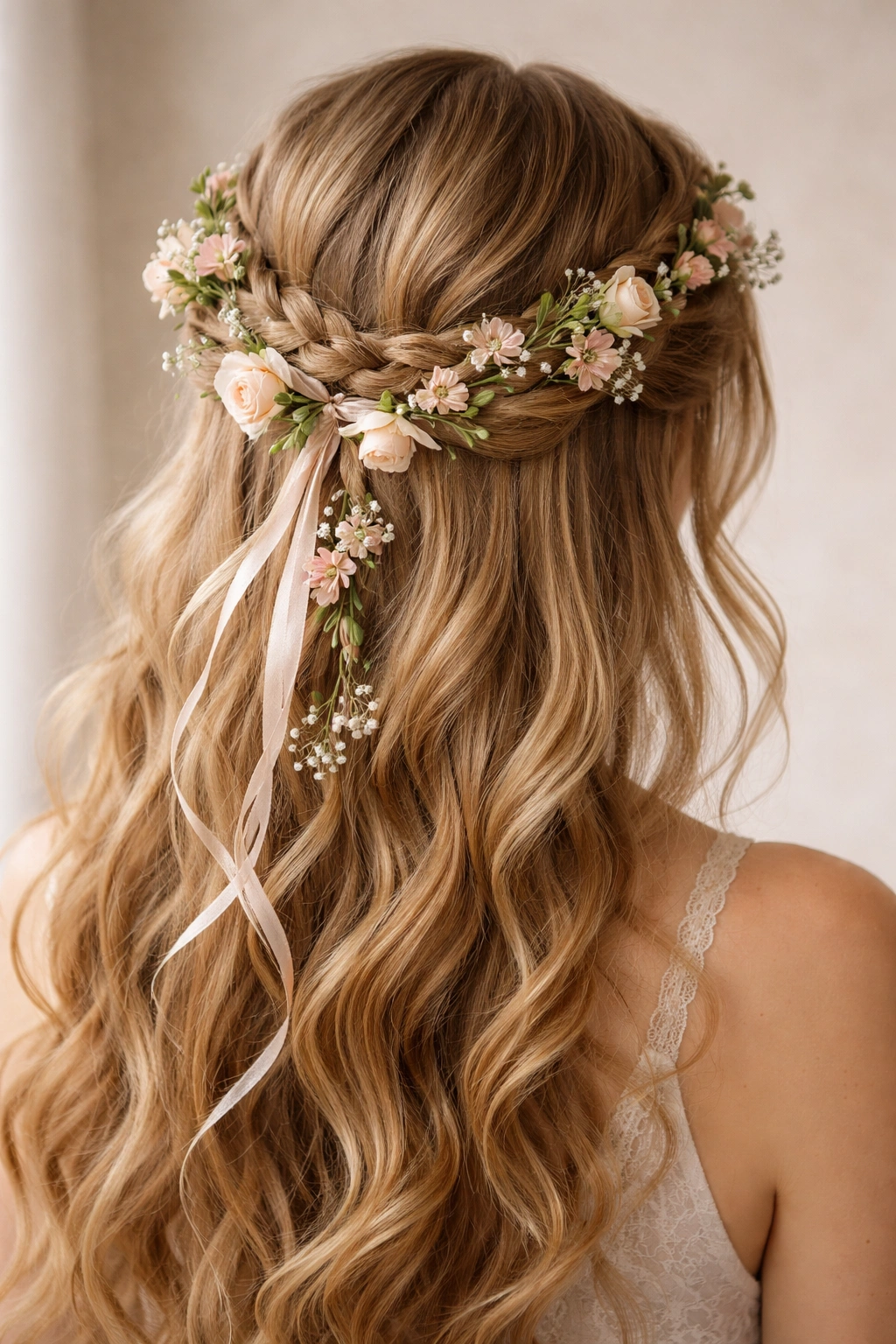
This style builds texture throughout the entire crown braid by weaving in strips of ribbon, silk, or thin floral garland along with flowers. The result is an unusually full, dimensional crown that looks far more complicated than it is.
Begin with hair that has natural texture or waves. Create a French braid from one temple toward the opposite temple, but as you’re braiding, weave in a thin silk ribbon or a delicate floral garland strip alongside the hair strands. The ribbon or garland becomes part of the braid structure, adding bulk and visual interest. Continue this throughout the braid. You can weave flowers in as well, or you can tuck individual blooms into the braid after you’ve completed it. Secure the entire braid loosely.
Texture Through Layering Materials
By combining hair strands with ribbon or garland and flowers, you’re creating visual depth that a hair-only braid can’t achieve. The eye travels through different elements and textures, making the crown feel luxurious and intentional.
Ribbon and Floral Garland Integration
- Choose silk ribbon in a color that complements your flowers: dusty rose, ivory, sage green, or gold work universally well
- Weave the ribbon consistently throughout the braid for a polished appearance, or vary how frequently you weave it for texture
- If using a delicate floral garland strip (available from craft or floral suppliers), weave it in alongside the ribbon for an integrated flower crown effect
- Tuck individual fresh flowers into the braid where there are gaps, or use the garland’s flowers as your primary floral element
Worth knowing: This style is more durable than one with loose flowers because the woven elements are locked into the braid structure. If you need the style to last all day or all evening, this is an excellent choice.
12. Asymmetrical Crown Half-Up with Floral Arrangement
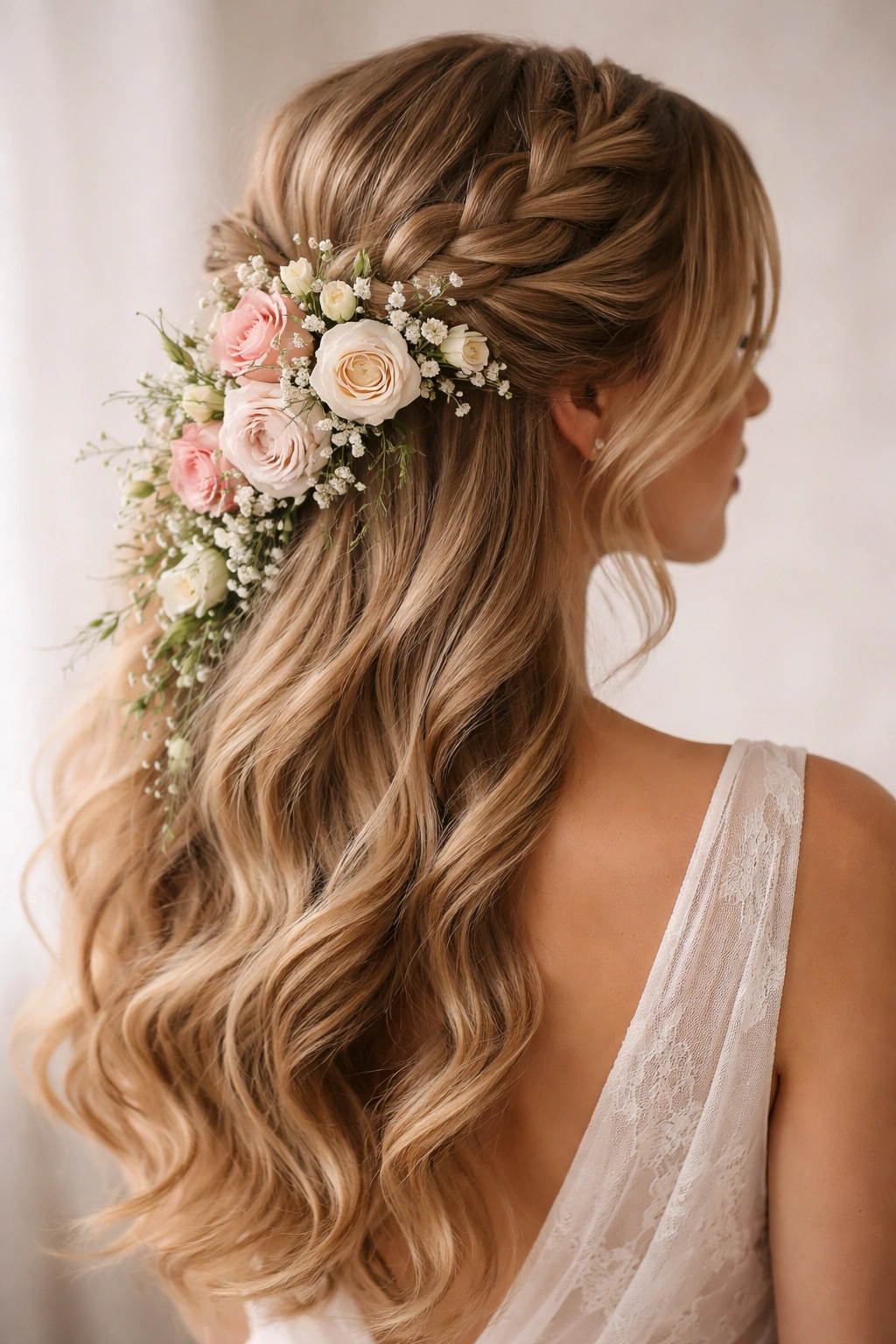
This final style combines several elements: asymmetrical placement, an actual decorative flower arrangement (rather than scattered flowers), and a bold half-up section that makes the arrangement the undeniable focal point. It’s dramatic and fashion-forward.
Create a small Dutch braid (raised braid) at one temple, working it toward the opposite side. Don’t worry about a full crown-width braid; instead, position this braid off to the side. Gather the hair where the braid ends plus some additional hair from that side, and secure it all together into a half-up section using bobby pins. The gathered section should feel intentional and positioned, not random.
Create an actual flower arrangement rather than casually placing flowers. You might create a cascading arrangement where flowers flow from the point where the braid meets the gathered hair down along one shoulder. Or create a concentrated sculptural arrangement clustered at one side of the crown.
Design Thinking, Not Accident
This style is about intentional, artistic placement. You’re not tucking flowers in; you’re designing a visible, appreciated arrangement that’s part of the overall composition.
Creating a Professional-Looking Arrangement
- Gather 8-15 flowers in your chosen color palette, including a mix of focal flowers (larger, more open blooms) and secondary flowers (smaller, supporting blooms)
- Incorporate greenery and filler materials to create structure and natural-looking spaces
- Use floral picks, floral tape, and potentially a small piece of floral foam to create a structured arrangement that maintains its shape
- Position the arrangement where it creates visual balance with the asymmetrical braid—usually opposite to where the braid is concentrated
Pro tip: If you’re not comfortable creating a floral arrangement yourself, ask a florist to create a small bouquet or arrangement specifically sized for a hairstyle. They understand weight distribution, secure construction, and aesthetics in a way that ensures your vision looks polished.
Final Thoughts
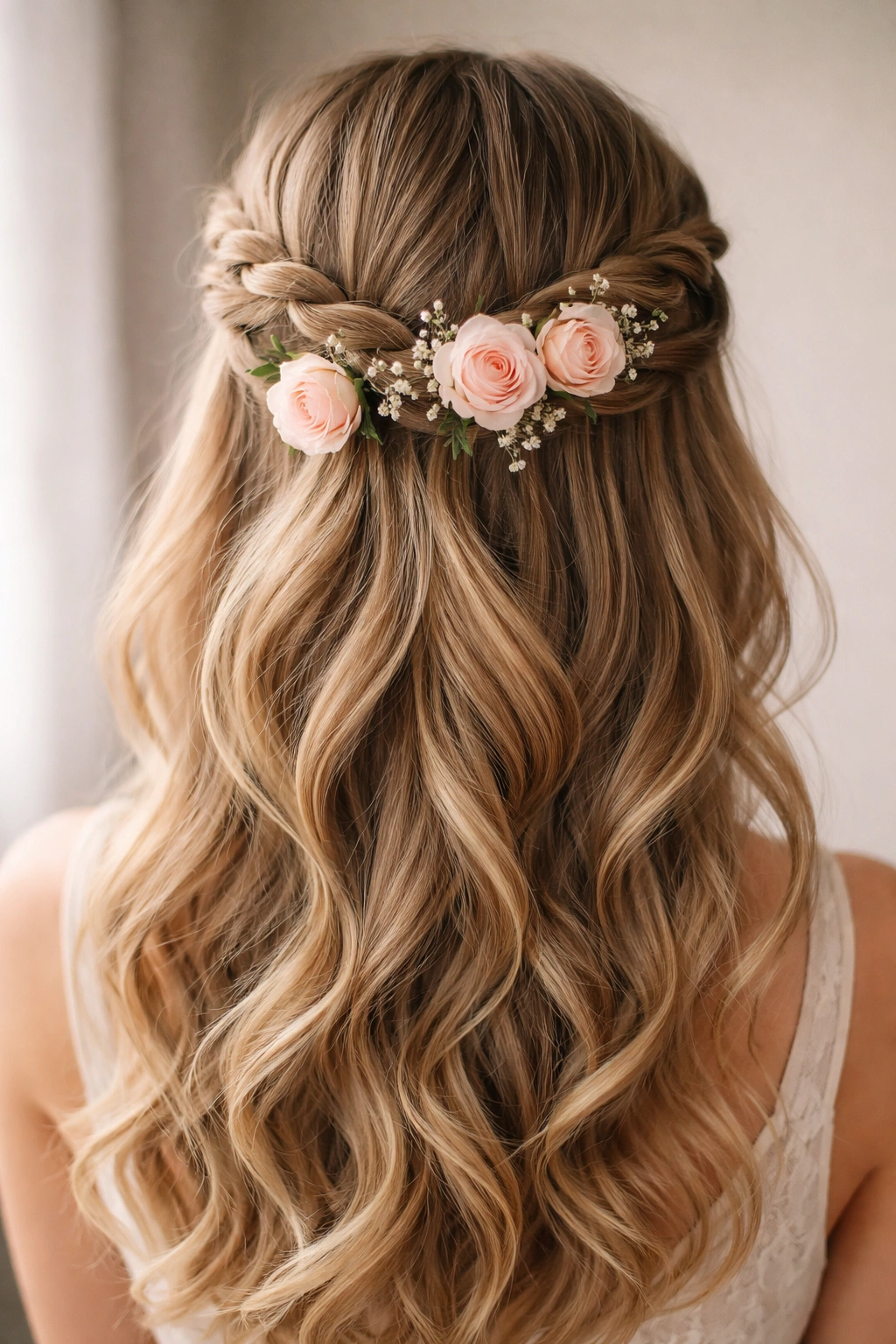
Crown braid half-up half-down styles with flowers offer something for every occasion, skill level, and personal aesthetic. Whether you’re drawn to the simplicity of a twisted crown with a single rose or the complexity of a French braid woven with ribbon and an artistic floral arrangement, the underlying principle remains the same: you’re creating a style that frames the face, shows off beautiful flowers, and allows your hair to flow in all its romantic, voluminous glory simultaneously.
The key to pulling off any of these styles is understanding that perfection isn’t the goal—intentionality is. A braid doesn’t need to be perfectly even to look beautiful. Flowers don’t need to be arranged with mathematical precision to feel romantic and special. What matters is that you’re making thoughtful choices about structure, flowers, and the overall effect you’re creating.
Start with whichever style speaks to you most, practice it a few times with silk flowers so you don’t waste fresh blooms while you’re learning, and don’t hesitate to adapt the styles based on your hair texture, face shape, and personal preferences. The most beautiful version of any hairstyle is always the one that feels genuine to you.
