



Some braided styles look good in a photo and fall apart the minute real life gets involved—sweat, sleep, scalp itch, a rushed morning, the whole thing. Stitch braids with Bantu knots are not one of those styles when they’re done well. They hold shape, they frame the face with crisp parting, and they give you that mix of polish and edge that plain cornrows sometimes miss.
What makes this combo hit so hard is the contrast. Stitch braids are all about clean lines: sharp feed-in sections, even spacing, and those neat ridges that sit close to the scalp. Bantu knots bring the opposite energy. They’re round, sculpted, raised, and a little playful. Put the two together and the style has structure and personality.
There’s also a cultural point worth saying out loud. Bantu knots come from Bantu-speaking peoples of Southern Africa, and they deserve to be named correctly and worn with some respect, not brushed off as random mini buns. That matters. So does technique. A knot should feel secure, not like it’s trying to pull your eyebrows upward.
I’ve seen the same thing over and over in braiding chairs: the styles that last are not always the tightest ones. They’re the ones with smart sectioning, balanced knot placement, and tension that stays firm without turning your hairline angry. That’s where the difference shows.
Why Stitch Braids With Bantu Knots Work So Well Together
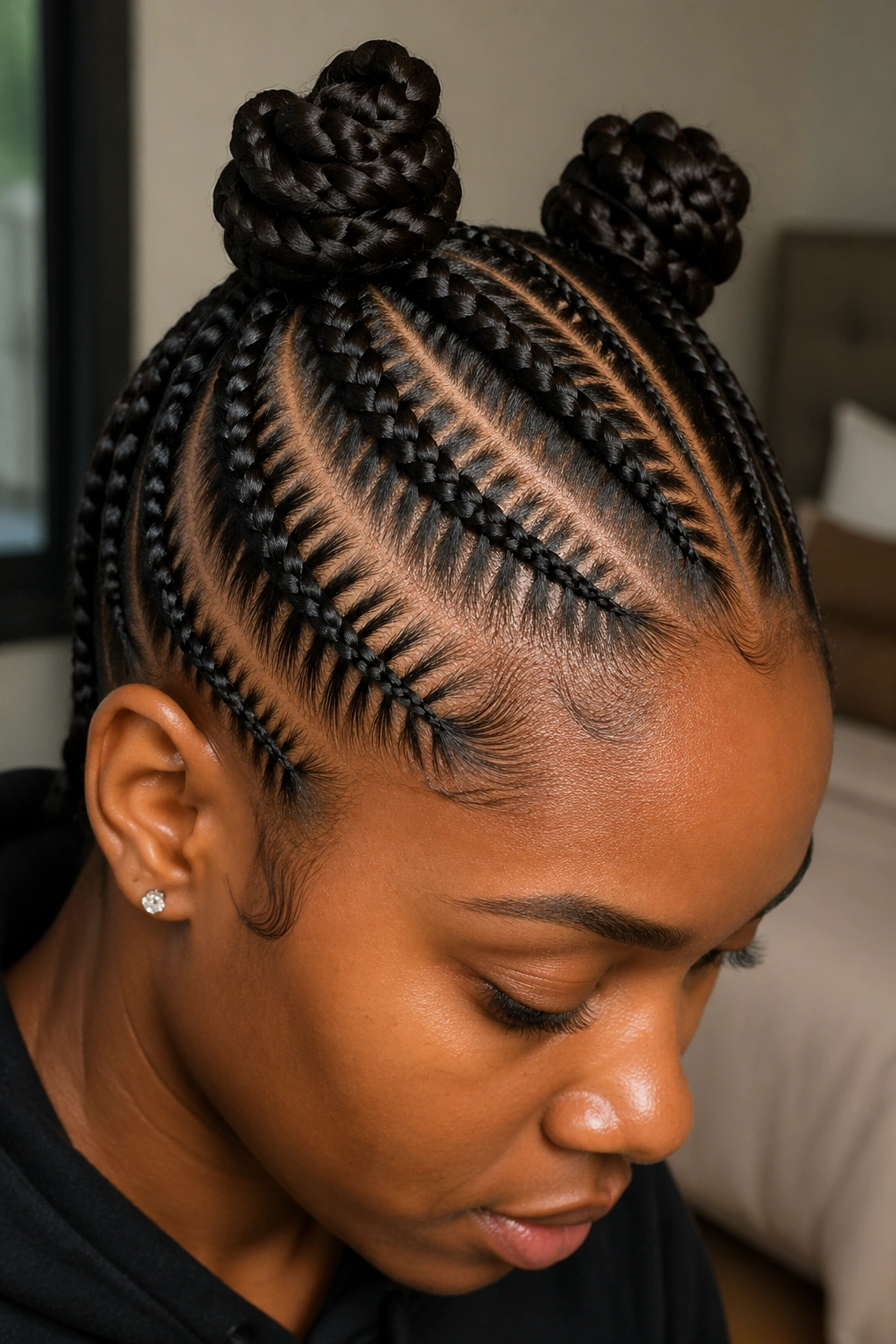
Stitch braids already give you one of the cleanest scalp patterns in protective styling. The braider uses gel or pomade, a rat-tail comb, and controlled feed-in sections to create those visible “stitches” across each row. That precision gives Bantu knots a clean base, which matters more than people think. A knot looks sharper when the braid feeding into it is straight, even, and not bulky at the root.
Bantu knots also solve a common braid problem: flatness. Straight-back stitch braids can look sleek, but they sit low. A few knots on the crown, side, or centerline lift the whole shape and make the style feel intentional instead of basic.
The shape contrast is the point
You’ve got long, narrow braid lines running across the scalp. Then you interrupt them with a compact spiral knot. That break in shape is what makes the look feel styled rather than simply braided and left alone.
Placement changes the mood fast:
- Two crown knots feel balanced and sporty.
- One high knot reads bolder and more fashion-forward.
- A row of small knots down the center creates a mohawk effect.
- Low side knots soften the style and pull attention toward the jawline.
Comfort matters more than people admit
The American Academy of Dermatology has warned for years that tight protective styles can contribute to traction alopecia, especially around the temples and nape. That warning applies here too. If your scalp feels hot, your edges look stretched thin, or blinking feels weirdly tight, say something before you leave the chair.
A sharp style is good. A sharp style that doesn’t hurt is better.
What to Decide Before Getting Stitch Braids With Bantu Knots
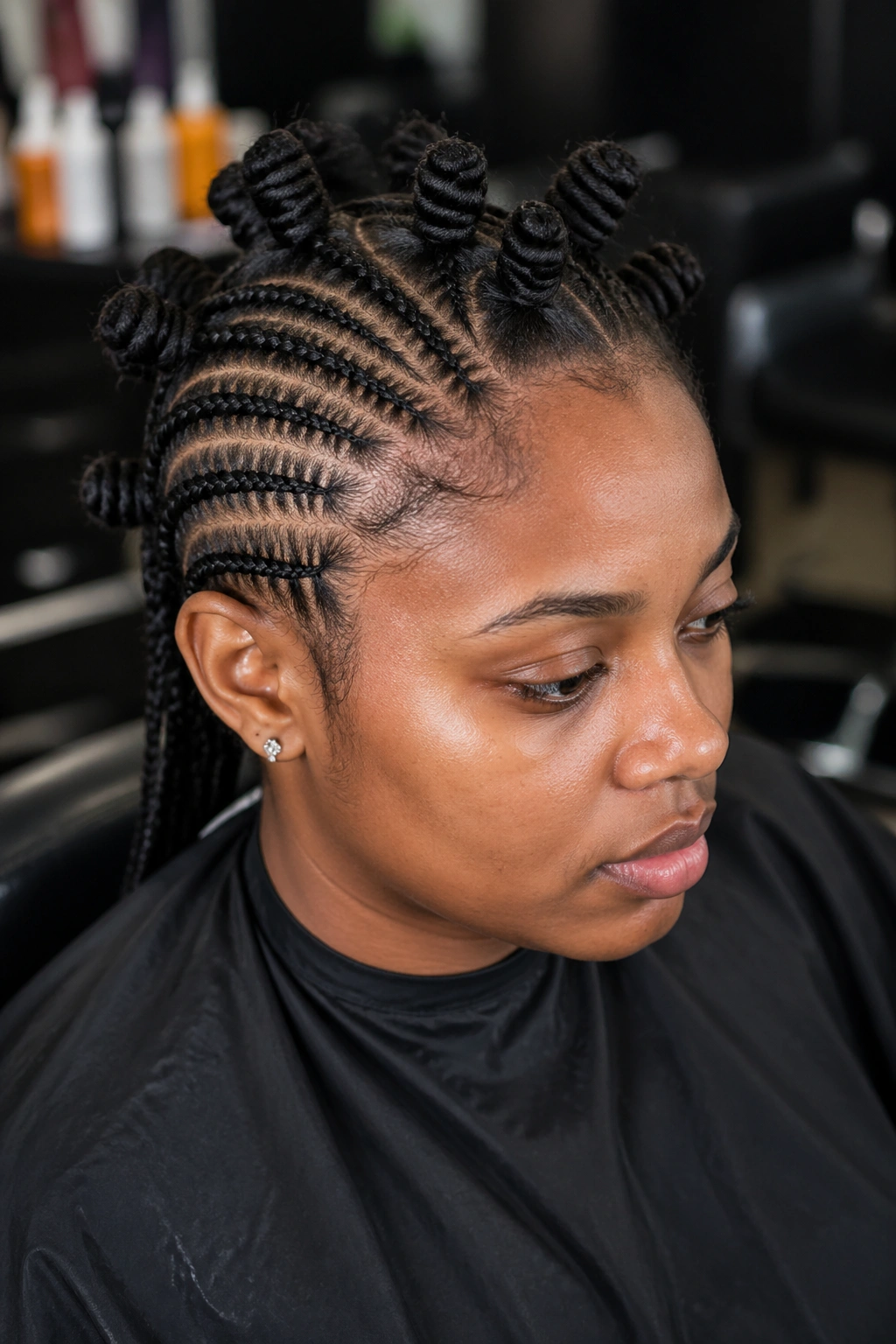
Walk into the appointment without a plan and you’ll end up making choices while someone is parting your hair at high speed. That rarely goes well. A style like this depends on proportion—braid size, knot size, knot count, and length all need to agree with each other.
Start with the braid count. Four to six jumbo stitch braids create a bold, graphic look and keep install time shorter. Eight to twelve medium braids give more room for pattern play. Fourteen or more small braids let you do detailed parting, beads, cuffs, and mixed knot placement, though you’ll be sitting longer.
Ask yourself these four questions first
- How many knots do I want? One, two, three, or five changes the whole style.
- Do I want length hanging loose? Some looks keep braid tails long; others wrap almost everything into knots.
- Where do I want the visual weight? Top-heavy, side-heavy, centered, or low.
- How much daily upkeep can I handle? Tiny braids and tiny knots stay detailed, but they frizz faster around the edges.
Color matters too. A solid black or dark brown set shows off stitch lines best. Ombre, burgundy, copper, and blonde blends bring more drama, though they can make the scalp pattern a little less obvious from a distance.
Bring photos. Bring two or three, not fifteen. And if your hairline is fine or fragile, say that before the first braid starts.
How to Keep Stitch Braids and Bantu Knots Looking Fresh
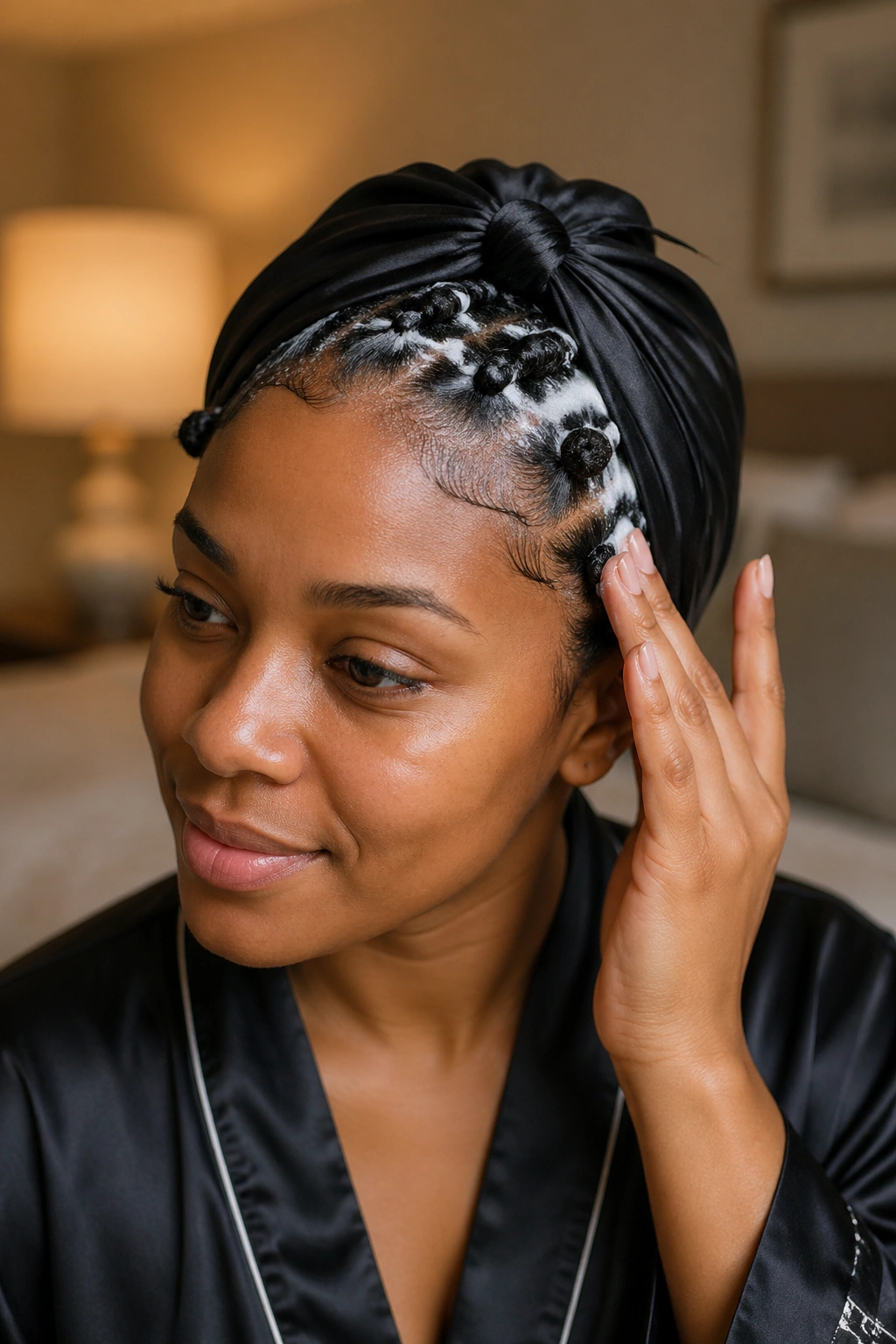
Night care decides whether this style still looks crisp after a week or turns fuzzy by day four. A satin scarf tied flat over the scalp helps preserve the stitch lines, while a satin bonnet over that protects the braid length and knots. It feels like a lot the first night. Then it becomes habit.
Mousse is your friend here. A light layer worked over the braids and knots, followed by a scarf for 10 to 15 minutes, smooths flyaways without making the style stiff. You do not need to drown the braids in foam. One or two pumps per section is usually enough.
Wash the scalp, not the whole style. Use diluted shampoo in a nozzle bottle, squeeze it along the parts, and pat the scalp with your fingertips. Don’t scrub like you’re washing loose hair. You’ll rough up the knots and lift the feed-ins.
A few more practical rules help:
- Oil the scalp lightly, especially if braid gel dries you out.
- Skip heavy edge control every day; buildup makes stitch lines look dull.
- Redo only the front if needed instead of stretching the whole style too long.
- Take the style down if the knots feel heavy or your edges start looking thin.
Two to four weeks is a common wear window, depending on size and tension. Some people stretch it longer. I don’t love that. Once the new growth blurs the scalp pattern, the style stops looking intentional.
1. Middle Part Straight-Back Stitch Braids With Two Crown Bantu Knots
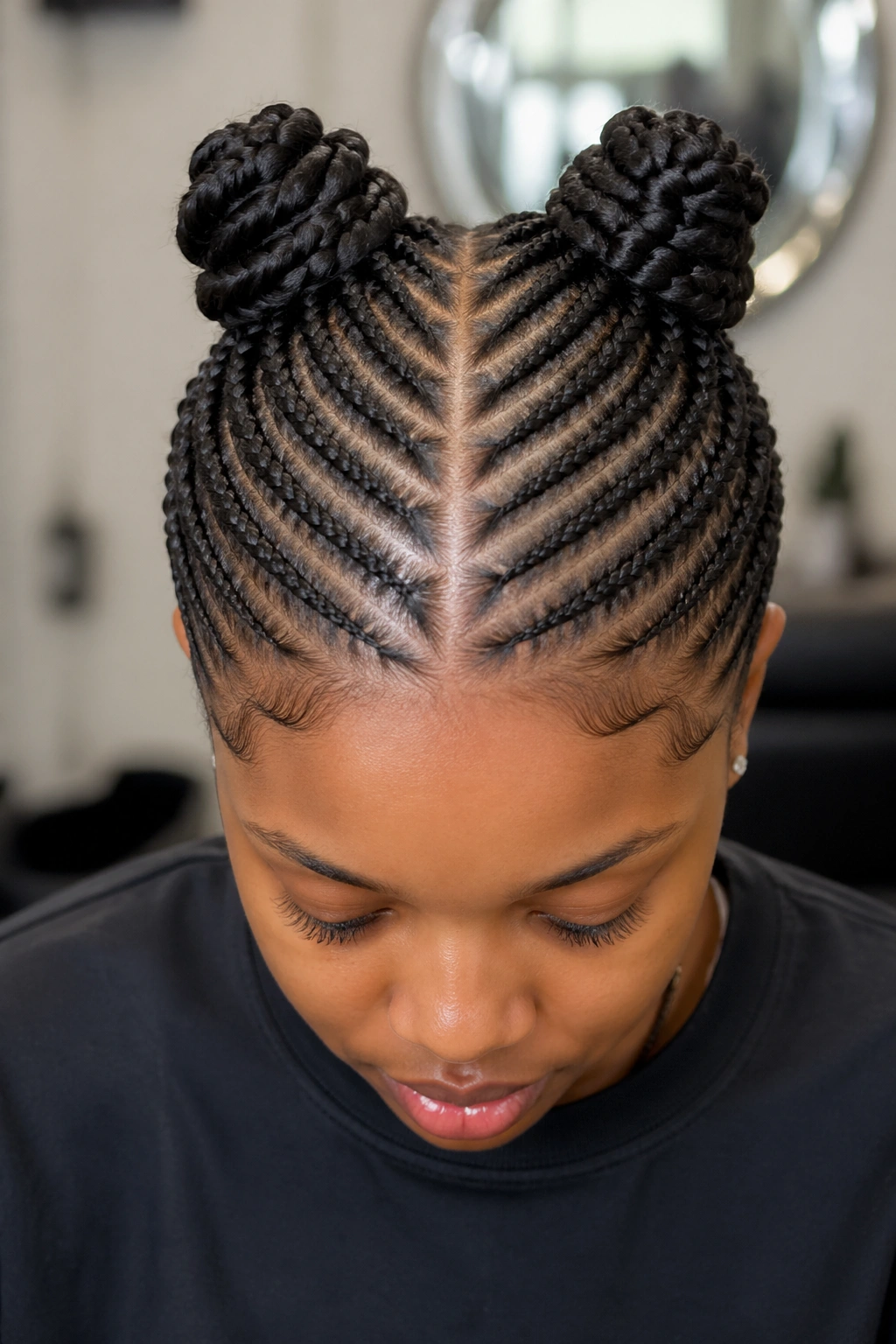
This is the clean, classic version—the one that almost always works. A center part splits the style evenly, then six to eight stitch braids run straight back on each side and feed into two medium Bantu knots near the crown. It’s balanced, easy to dress up, and it doesn’t fight with your face shape.
The reason this one stays so reliable is symmetry. If your features are strong—full brows, high cheekbones, a defined jaw—the middle part makes everything look sharper. If your face is rounder, the vertical line through the center gives a little length.
Why this layout holds up so well
Two knots are enough to lift the style without making the top look crowded. Ask for knots that are compact rather than oversized; a knot about the width of a small lime usually looks cleaner than one pushed too large with extra hair.
Details that make it better
- Medium stitch spacing keeps the rows visible from a few feet away.
- Clean baby hairs work with this style, but a full swoop isn’t necessary.
- Braids that hit mid-back keep the silhouette long without feeling heavy.
- Gold cuffs on one or two rows are enough—more than that can clutter the middle part.
Best for: anyone who wants a first try that still feels polished.
2. Side-Swept Stitch Braids With One High Bantu Knot
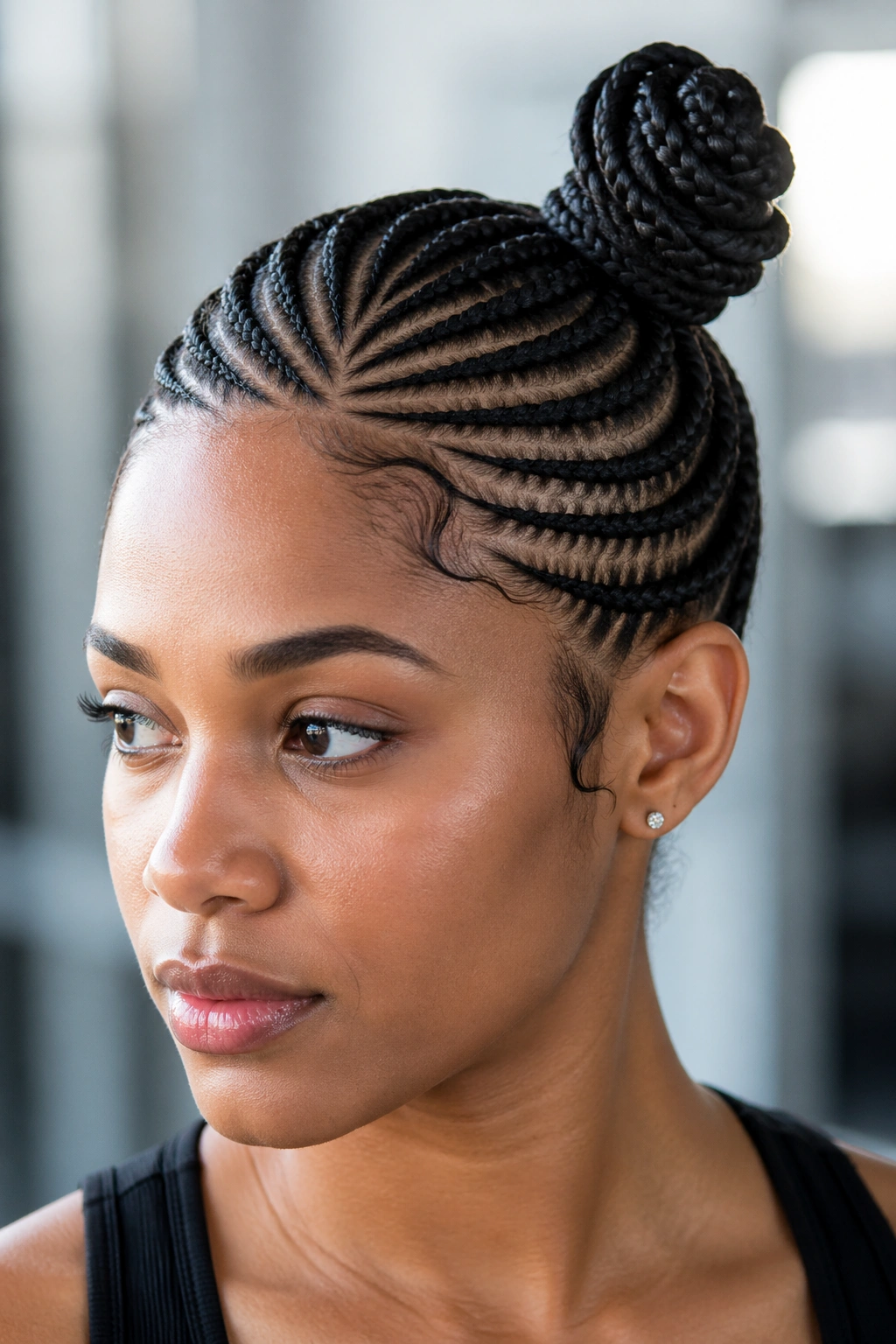
One knot can carry the whole style if the parting is good. In this version, the stitch braids sweep diagonally from one side toward a single high Bantu knot, usually placed above the temple or near the top center. The result feels less formal than a middle-part look and more directional.
A side-swept pattern does something useful for fuller faces: it breaks symmetry on purpose. That can slim the visual width a bit and draw attention upward. It also shows off earrings in a way straight-back braids don’t. Small hoop, cuff, bold stud—this style leaves room for all of it.
There’s a catch. If the knot sits too far forward, it can crowd your forehead. If it sits too far back, the style loses its punch. The sweet spot is usually one to two inches behind the hairline, with the braid rows angled cleanly into it.
This is one of those looks where edge styling changes the mood fast. Sleek edges make it sharper. A softer hairline keeps it casual.
3. Five Jumbo Stitch Braids With Triple Top Knots
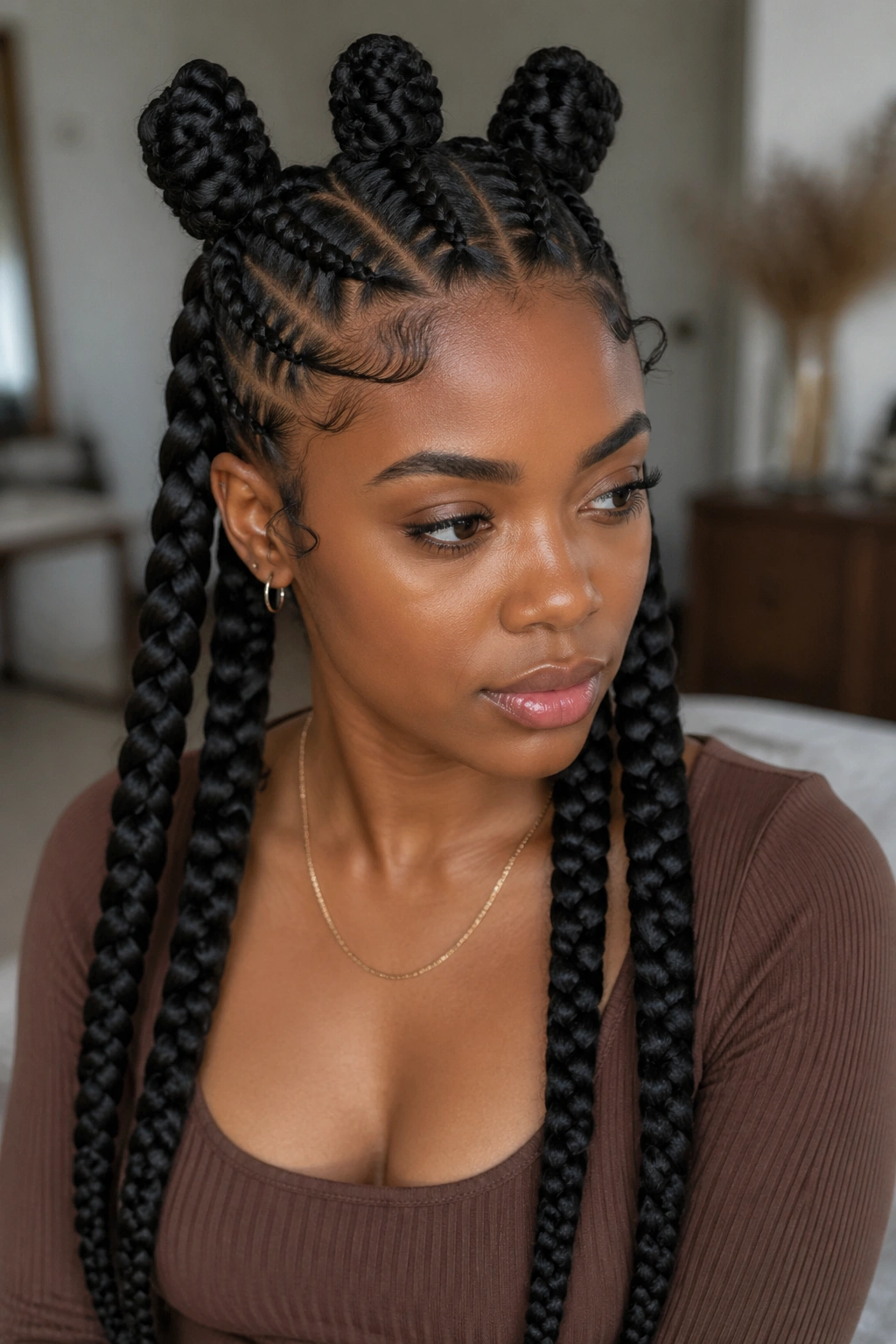
Why does this one feel lighter than it looks? Because fewer braids means less bulk at the scalp, even with three knots up top. You usually get five jumbo feed-in braids, each with bold stitched sections, and the top portion gets divided into three rounded knots across the crown.
The appeal here is graphic shape. Thick braids give you those broad, visible ridges, and the triple-knot layout creates a clean row that reads almost like a headpiece. It’s bold without needing beads, color, or wild parting.
This style shines on thick natural hair because the base has enough density to support jumbo sectioning. Fine hair can still wear it, though you’ll want your braider to feed in hair gradually so the front doesn’t look sparse next to the larger braid size.
Ask your braider for these specifics
- Wide, even stitch lines so each braid looks deliberate
- Three knots of equal size across the top
- Tails that fall behind the shoulders for balance
- A lighter grip at the temples, because jumbo roots can pull harder
Skip tiny accessories here. Jumbo braids already make a strong statement.
4. Lemonade Stitch Braids With Mini Bantu Knots
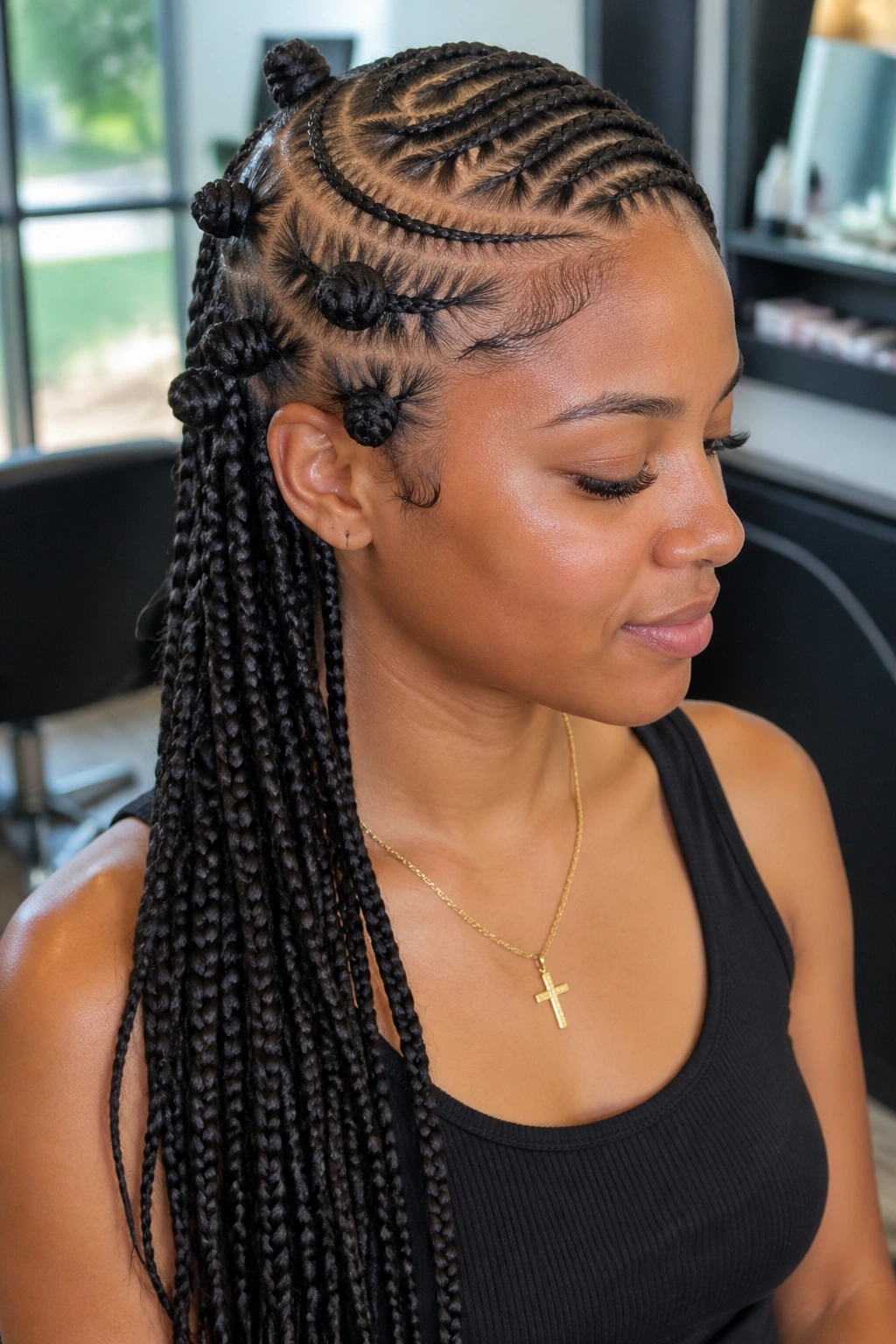
Sit in a braiding chair long enough and you’ll notice something: side-braided styles almost always look more dynamic while you’re turning your head. Lemonade-style stitch braids prove it. The rows run in one sweeping direction, then two to four mini Bantu knots interrupt the flow near the side crown or upper back area.
This is a strong choice if you like movement. The diagonal braid pattern keeps the scalp from looking too grid-like, and the smaller knots stop the style from feeling top-heavy. You get shape without losing the long, draped effect of side braids.
A good braider will keep the stitch rows thin near the hairline and slightly fuller as they move back. That gradient matters.
Quick details worth asking for:
- A deep side part instead of a shallow one
- Mini knots no bigger than a golf ball
- Braid length past the chest so the diagonal sweep stays visible
- Light, medium-size beads only if you want sound and movement
The style has attitude. No extra help needed.
5. Fulani-Inspired Stitch Braids With Front Knots and Beads
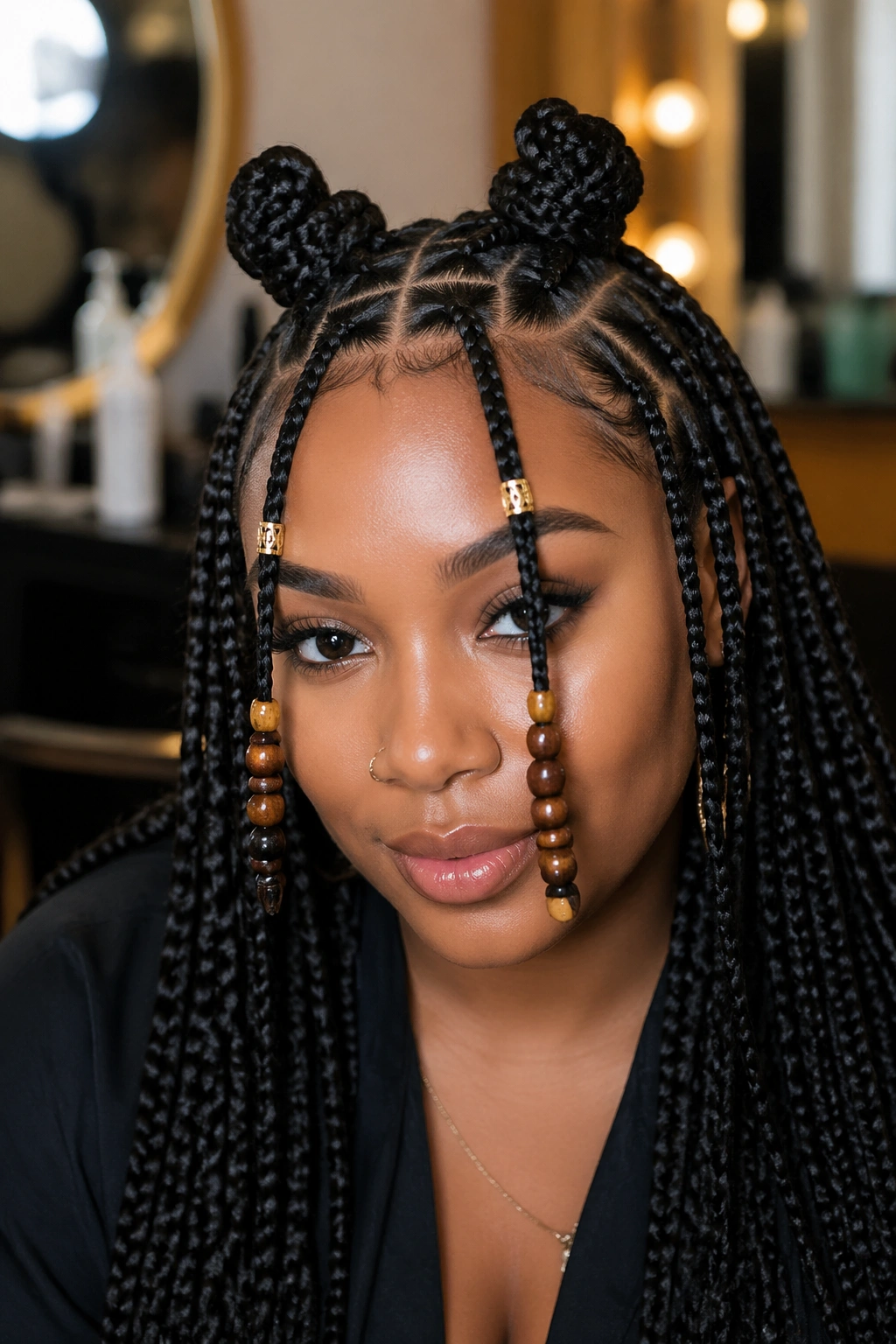
This one needs a careful hand, because there’s more going on: central braids, side braids, face-framing detail, and Bantu knots placed toward the front or upper crown. When done right, though, it looks rich and intentional, not busy.
Fulani-inspired braid patterns often include a center braid or center part, braids directed forward and back, and bead placement that frames the face. Add two small Bantu knots near the front section and the whole look gets a sculptural feel. The knots act almost like anchors for the design.
I’d keep the beads light here—wood, clear, amber, or a small metallic accent. Heavy beads can tug when they sit near front knots, and front tension is where people get into trouble fastest. If your edges are delicate, ask for a touch more space around the hairline and smaller feed-in sections.
This is not the style to rush. Parting needs to be exact, and the knot placement has to respect the pattern instead of fighting it. A sloppy version looks messy fast. A clean version looks special from every angle.
6. Crisscross Stitch Braids With Twin Space Bantu Knots
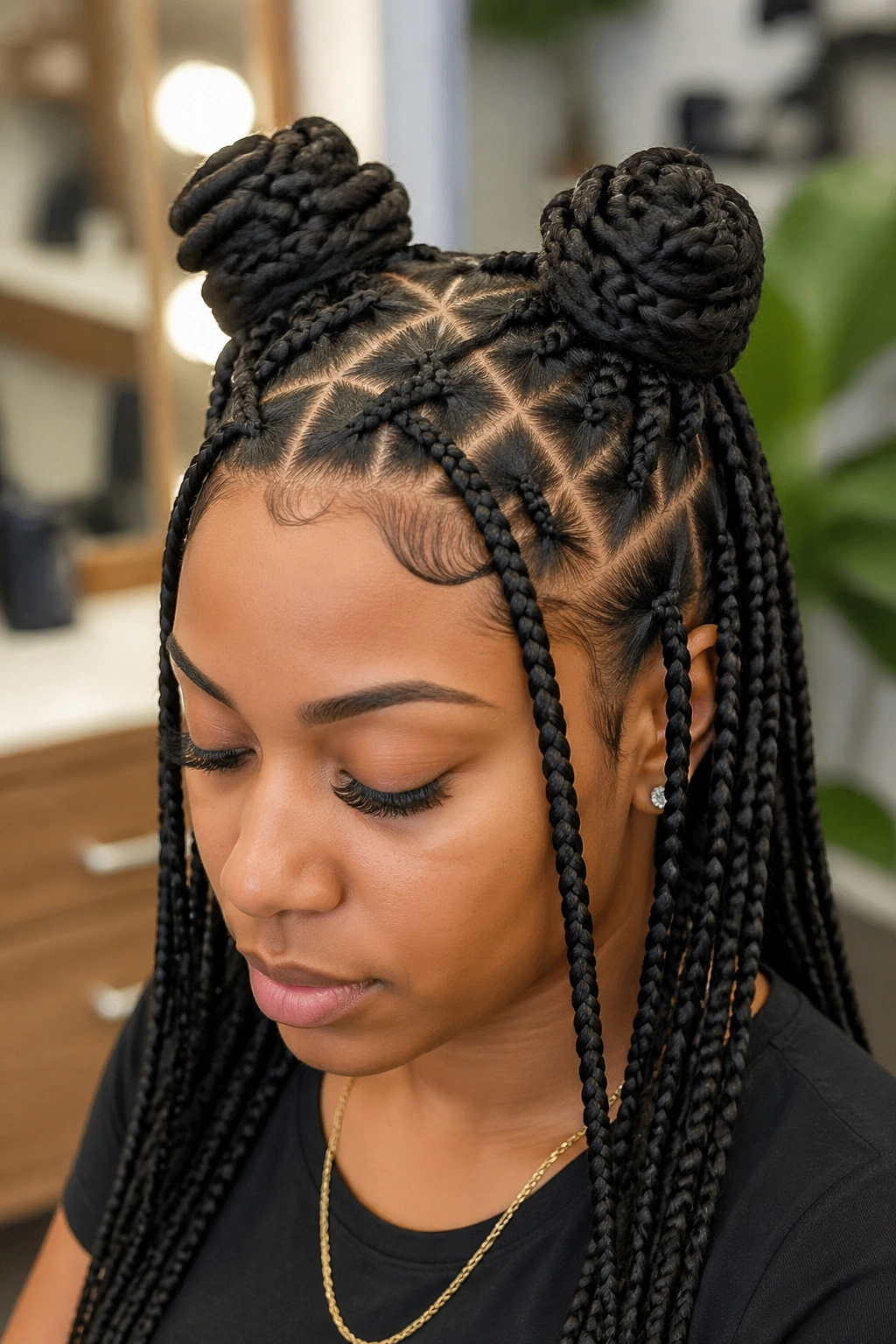
Unlike straight-back rows, crisscross parts create movement before the braids even start. That’s why this design lands so well with twin Bantu knots on top. The X-shaped sections break up the scalp pattern, then the two knots give the eye somewhere to settle.
This style suits people who want something playful without going full color or adding a pile of accessories. The crisscross detail already does enough. I’d keep the braid count in the medium range—around eight to ten—so the parting still shows.
Twin knots work best when they sit a little higher than standard space buns. Not on the hairline. More like the upper crown. That keeps the style youthful without making it look costume-like.
If you wear glasses, this one is a smart pick. The side sections stay neat, the ears stay visible, and the overall shape doesn’t crowd the frames.
7. Half-Up Stitch Braids With Bantu Knots and Long Braided Length
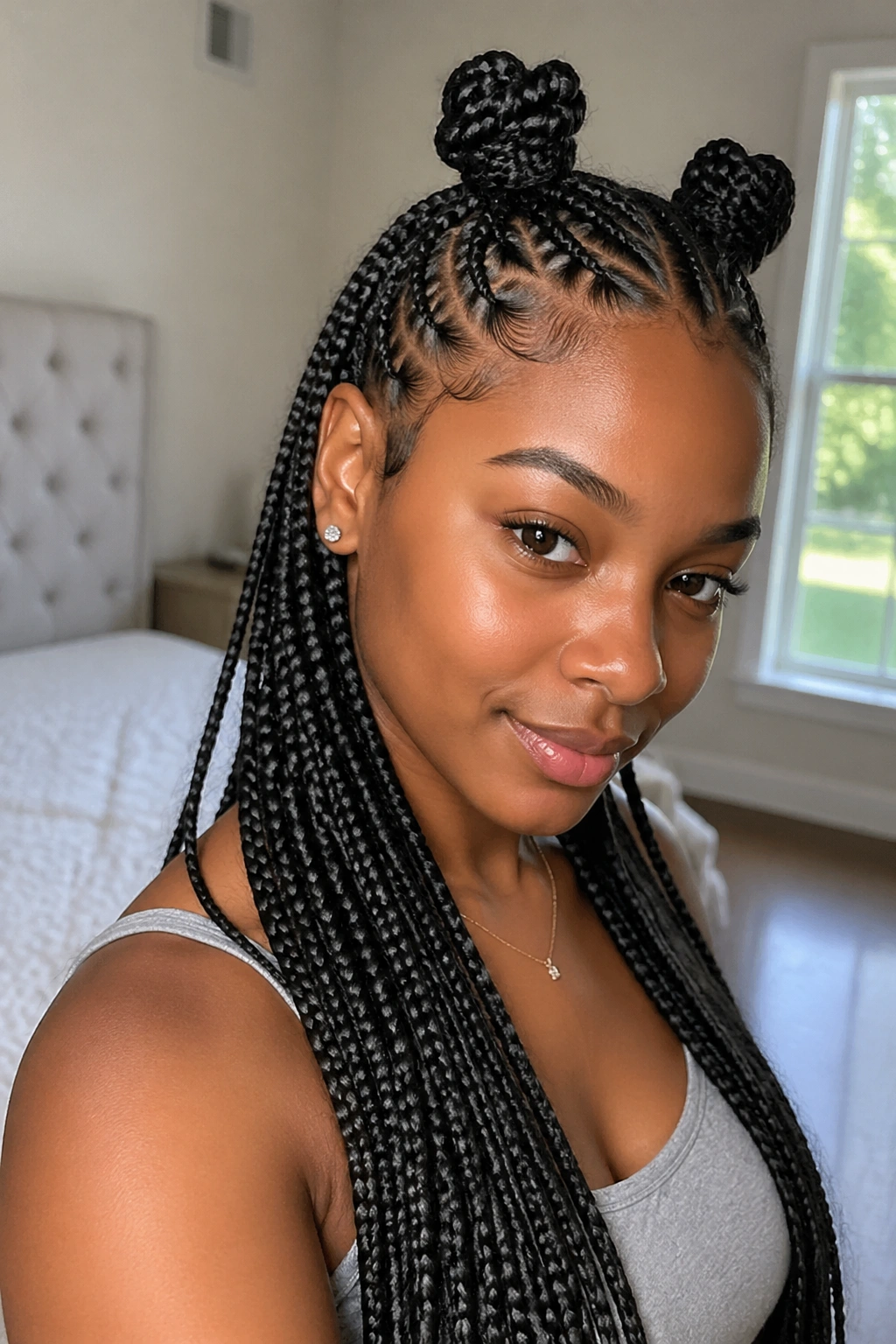
This style gives you two looks at once. The front and crown braids feed into one or two Bantu knots up top, while the remaining braid length hangs loose down the back. You get height on top and movement through the ends, which is why it feels softer than a full updo.
A half-up layout is useful if you like your neck exposed but don’t want all your hair wrapped into knots. It also cuts down on weight. Full knot-heavy styles can feel like a lot after day three. Half-up versions breathe better.
What makes this one flattering
The loose braid length elongates the silhouette. That helps if you feel bulky in all-up braided styles or you don’t love the look of a fully exposed nape.
Good ways to customize it
- Keep the top knots small and tight for a sleek finish
- Leave the back braids waist-length for more swing
- Add two face-framing braids if you want softness at the front
- Use a curved part instead of a middle part to avoid a strict look
Best mood: polished, but not stiff.
8. Zigzag Part Stitch Braids With Stacked Bantu Knots
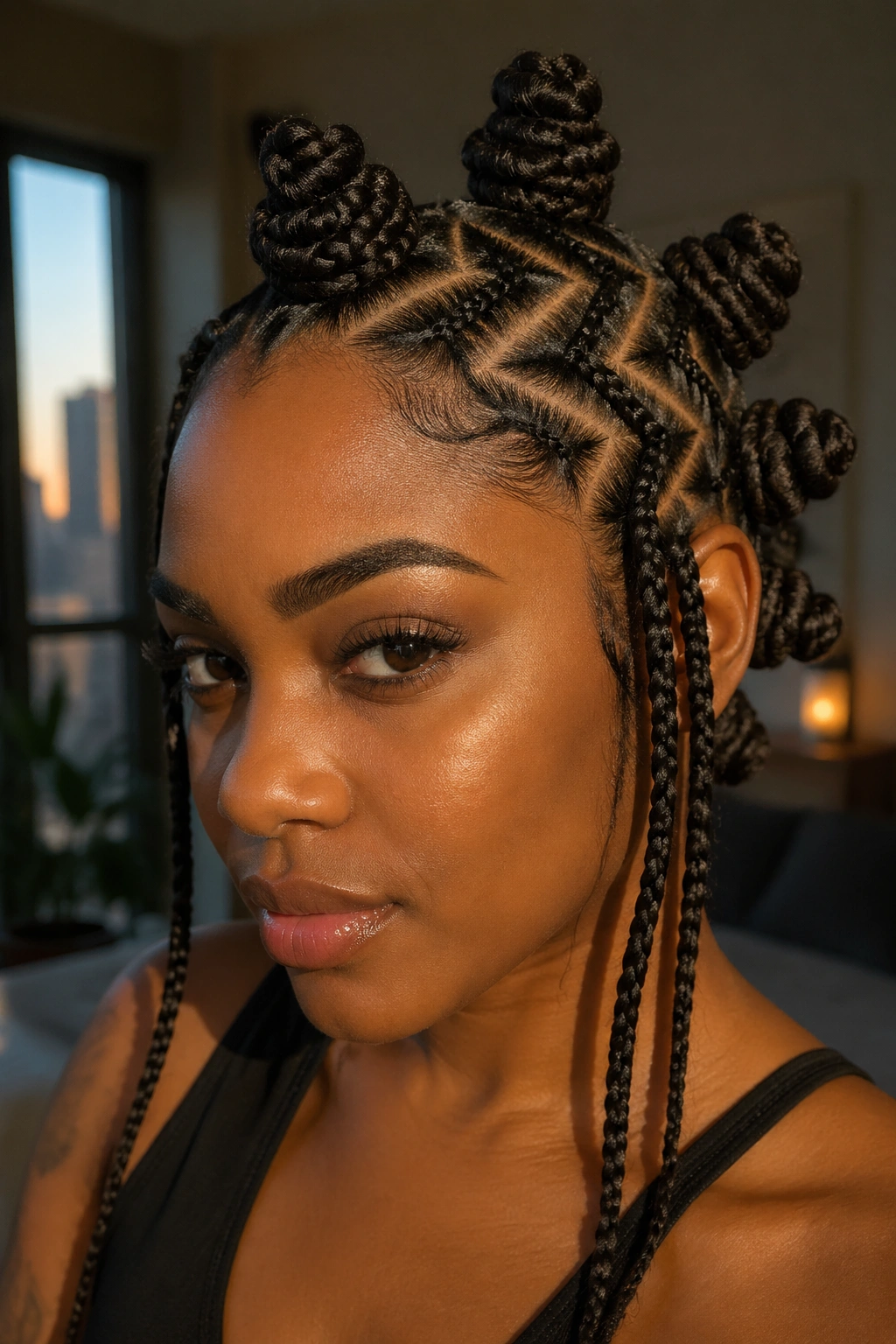
Sharp zigzag parting changes the whole energy before the first knot even goes in. The scalp pattern has more motion, more attitude, and a little bit of that old-school braid artistry people still love for good reason. Pair it with stacked Bantu knots—one above another on the same side or down the center—and the style starts looking sculpted.
You do need a braider with steady hands for this one. Zigzags show mistakes fast. Crooked parts, uneven stitch spacing, or knots that don’t line up will stand out in a way basic straight rows can hide.
Keep the braid size medium. Tiny braids can make zigzag parting disappear, while jumbo braids can swallow it. Medium gives you enough scalp visibility to appreciate the pattern.
This is one of my favorite choices for short-to-mid back length braids. Go too long and the lower half can overwhelm the parting. Keep it a bit shorter and the details stay front and center.
9. Bob-Length Stitch Braids With Small Bantu Knots
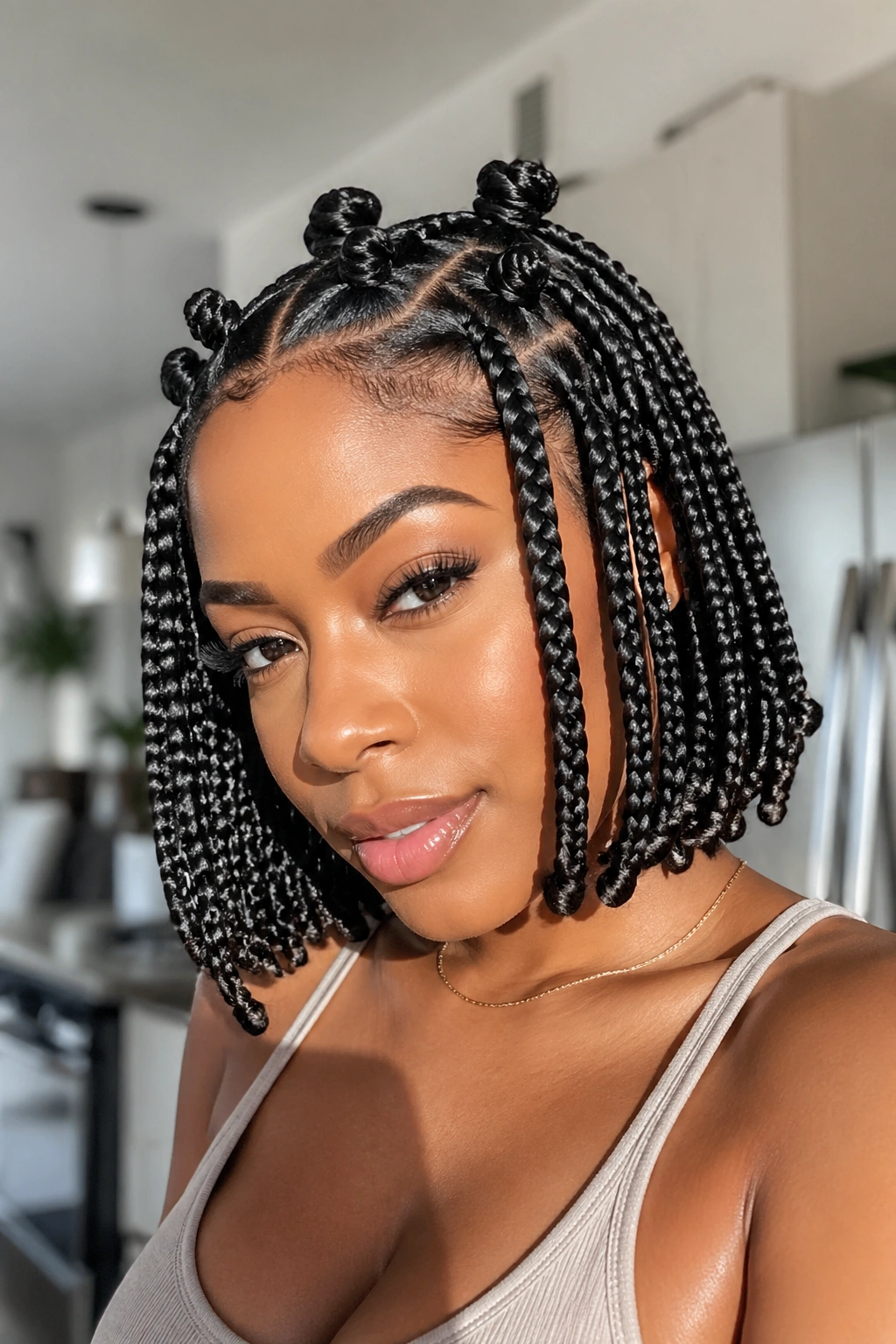
Want the style without all the weight? Go short. A bob-length version usually falls between the chin and shoulders, with small Bantu knots placed near the crown or upper sides. It feels lighter, dries faster after scalp cleansing, and it’s easier to sleep in.
Short braided bobs also tend to keep their shape better. Long braids can drag the roots down over time. A shorter cut lets the knots stay upright and neat longer, which matters if shape is the whole point of the look.
How to make the length work
Ask your braider where the finished braids will hit after the ends are sealed. Wet-dipped ends can spring up a bit when they dry, especially on blunt braided bobs.
Best details for this version
- Shoulder-grazing length for a fuller silhouette
- Small to medium knots so the top doesn’t look oversized
- Slightly curved front braids to frame the cheekbones
- Minimal accessories; short styles don’t need much extra
This one feels clean, sharp, and easy to wear to work, class, dinner—wherever.
10. Waist-Length Stitch Braids With Four Knots Along the Crown
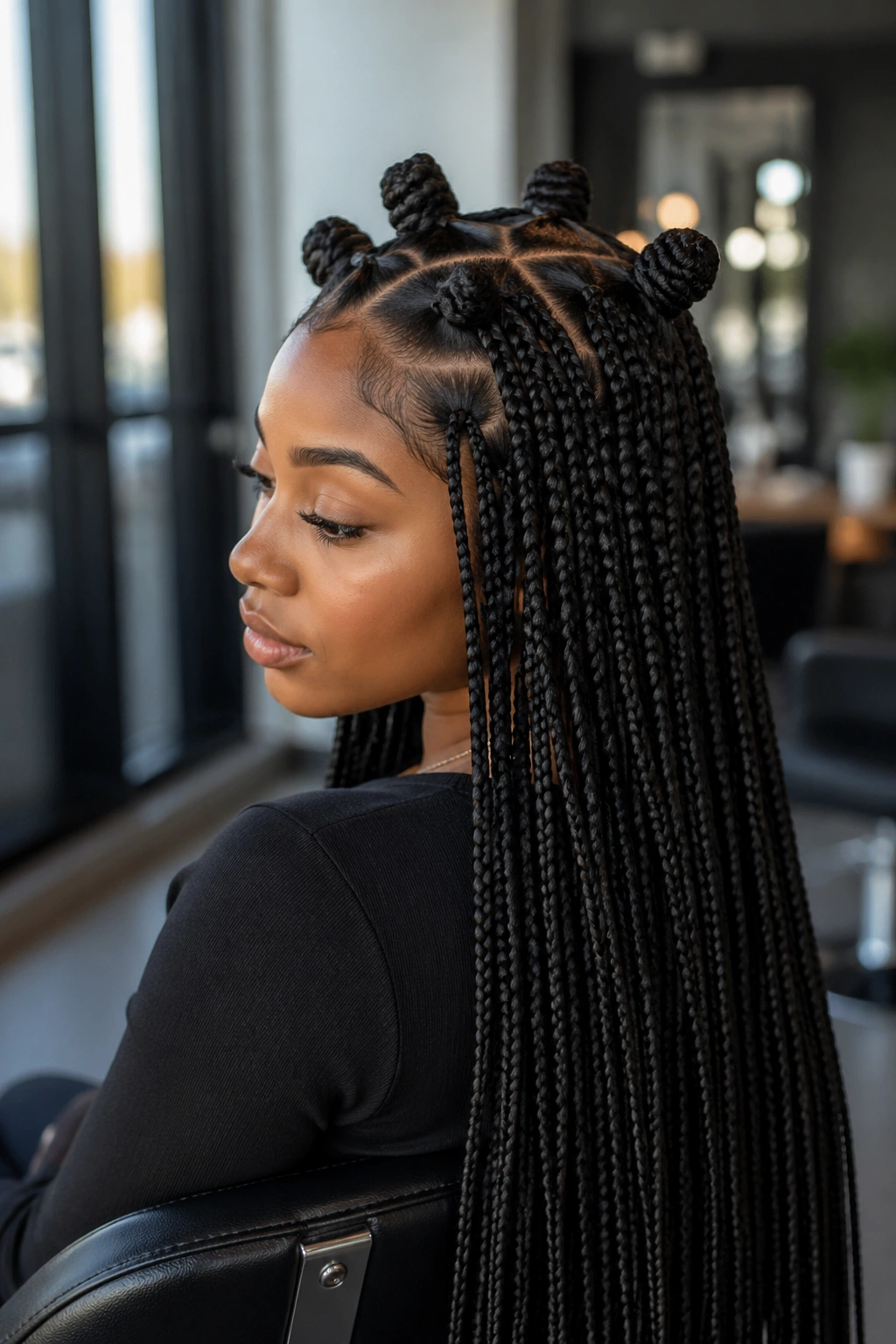
Long braids and multiple knots can look incredible, but balance is the whole job here. A waist-length set gives you drama through the length, then four evenly spaced Bantu knots across the crown keep the top from looking plain. Think of it as a long braid style with a strong architectural top.
The weight needs attention. Braids this long can pull if the feed-ins start too thick. Four knots can double that problem if they’re packed too tightly. Ask for hollow-feeling knots—securely wrapped, but not stuffed with extra hair for size alone.
A few practical notes help:
- Braids in the 24- to 26-inch range are long enough for impact without turning the style into a workout.
- Knot placement should follow the head shape, not sit in a flat line if your crown is rounded.
- A light braid spray helps keep the length from getting dry and rough.
- Skip oversized beads unless you enjoy carrying extra weight around all day.
This style is bold. You’ll feel it when you walk into a room.
11. Heart-Part Stitch Braids With Bantu Knot Accents
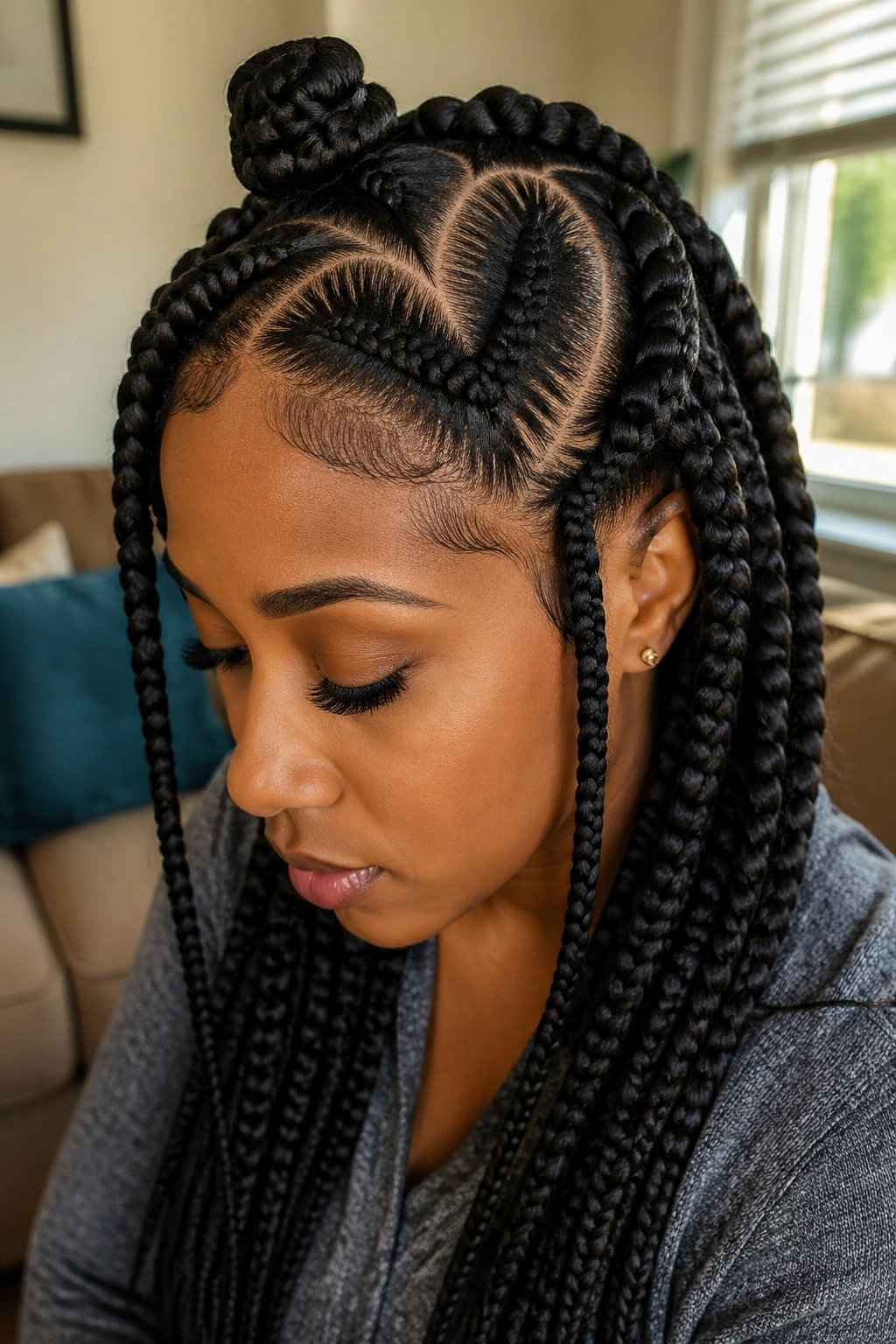
Custom parting can go left in a hurry, and heart parts are the first thing people attempt when they want “something cute” without thinking about how much skill the design actually takes. Done by the right braider, though, a heart-part pattern with one or two Bantu knot accents looks crisp and playful rather than gimmicky.
The trick is restraint. One heart on a side panel or near the crown is enough. Two can work if the rest of the scalp pattern stays clean. Once you add hearts, knots, beads, and cuffs all at once, the design loses its point.
This style works best on medium-size stitch braids. Small braids can crowd the part art. Jumbo braids leave too little room to shape it properly. Medium gives the heart enough space to read as a heart from a few steps away.
I’d wear this for birthdays, trips, photos, or any time you want the braids to feel a little more personal. Not every style needs to look serious.
12. Feed-In Stitch Braids With Gold Cuffs and Two Knots
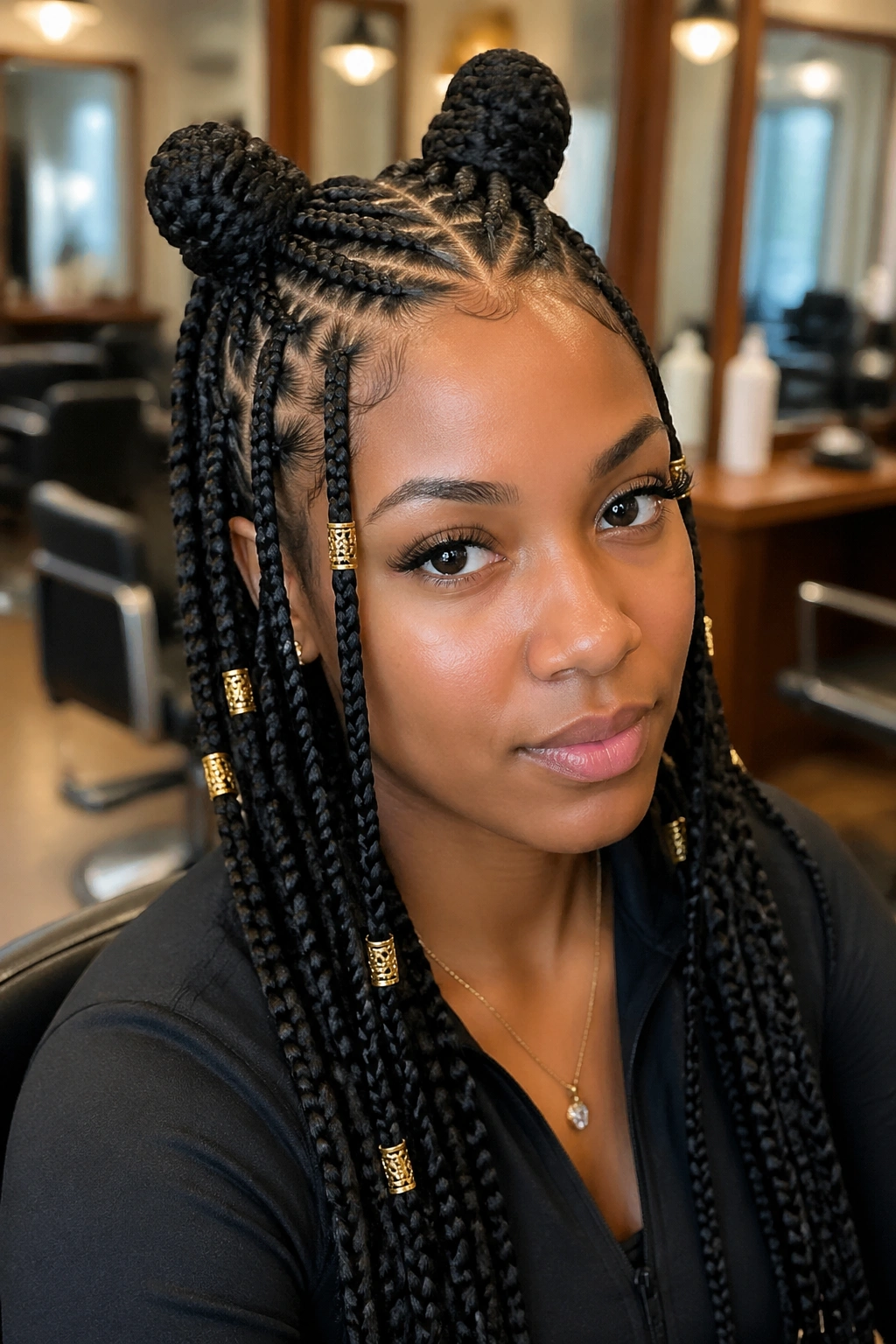
Beads are not the only accessory move. Gold cuffs on clean stitch braids can look more grown and less noisy, especially when the style already has two Bantu knots up top. The metal catches the eye near the braid ridges instead of piling all the visual weight at the ends.
This version works best with a simple braid map: middle part or slight side part, six to ten stitch braids, then two medium knots. After that, the cuffs do the styling. Place them a couple inches below the knot base or midway down one or two braids. That spacing keeps the top from feeling crowded.
Who should pick this? Anyone who likes jewelry and wants the hair to echo it. Gold hoops, a cuff bracelet, chain necklace—the braid cuffs tie in nicely without trying too hard.
Do not overload the head with metal. Two cuffs per side is often enough. Past that, the style can start clinking and slipping.
13. Triangle-Part Stitch Braids With Side Bantu Knots
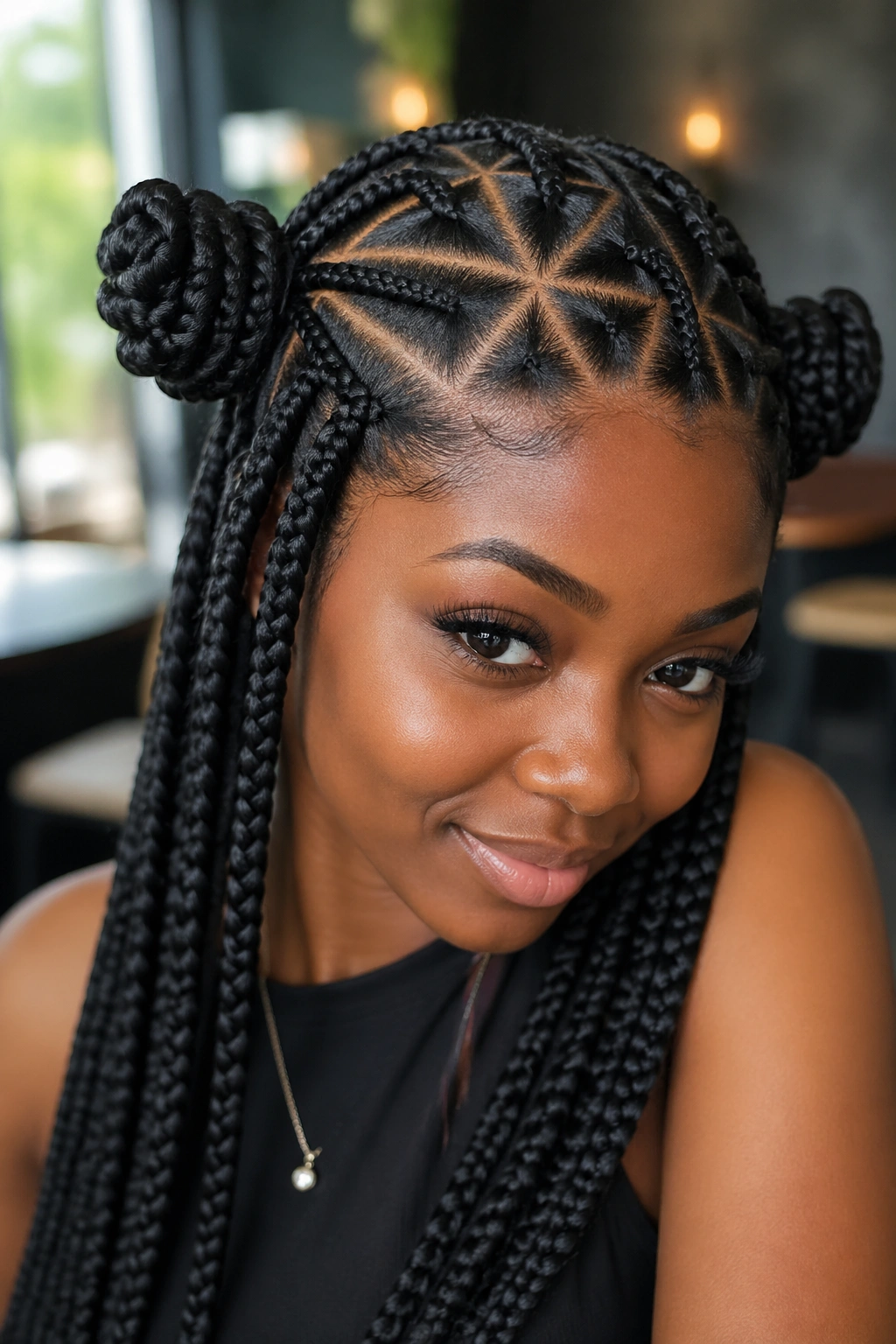
Triangle parts change the root geometry in a subtle way. Even before the braids fall into place, the scalp pattern looks less strict than square or straight-back parting. Add two side Bantu knots tucked above the ears or slightly behind them, and the look gets a fresh angle without losing wearability.
This one is good if you want detail that doesn’t scream for attention. From the front, people catch the knots. From the side, they notice the triangle bases. It unfolds in stages.
Why the side placement works
Knots placed off-center can soften a broad forehead and pull focus toward the cheekbones. That’s useful if top-center knots feel too severe on you.
Ask for these finishing choices
- Medium triangles so the pattern stays readable
- Knots that sit flat enough to be comfortable in a car seat
- Braid length around mid-back for balance
- A clean, gel-light finish if your scalp hates buildup
There’s a lot to like here, and none of it feels forced.
14. Ponytail Stitch Braids With a Wrapped Bantu Knot Bun
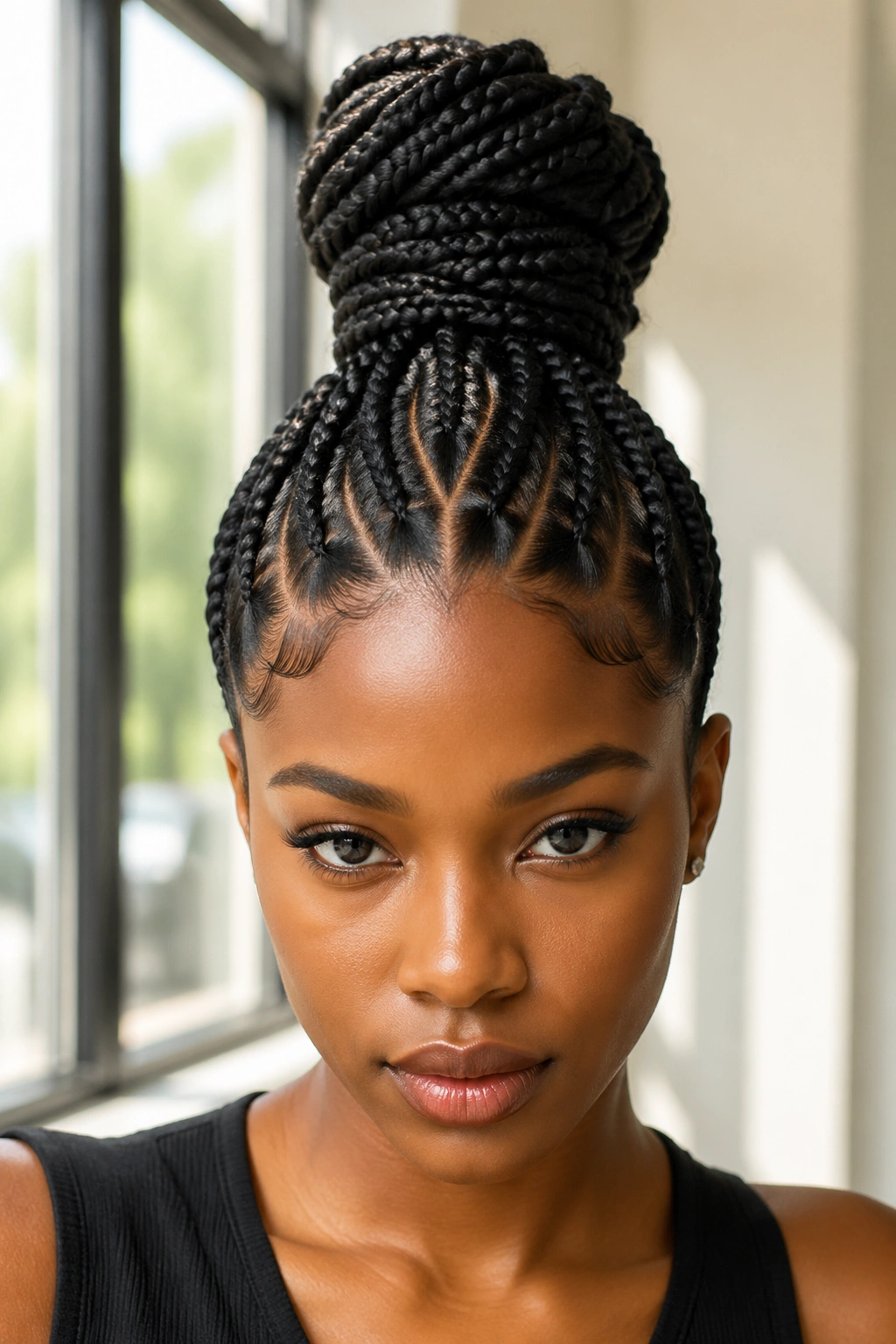
This one is sleek and a little bossy—in a good way. The stitch braids all travel upward into a high ponytail base, and then the braided length or a section of added hair gets wrapped into one large Bantu-knot-style bun. It borrows the shape language of a Bantu knot while reading more elevated than a casual top bun.
The cleanest version uses tight, parallel rows that all point to the same spot. No wandering sections. No uneven spacing. If the path to the bun looks messy, the whole style loses impact.
A high placement opens the face and shows the parting. A mid-height placement is easier on the scalp and easier to sleep in. Pick based on comfort, not only photos.
This is a smart option for warm weather, gym-heavy weeks, or anyone who hates hair brushing the neck. It also gives you room for statement earrings without the hairstyle competing too hard.
15. Kid-Friendly Stitch Braids With Soft Mini Knots
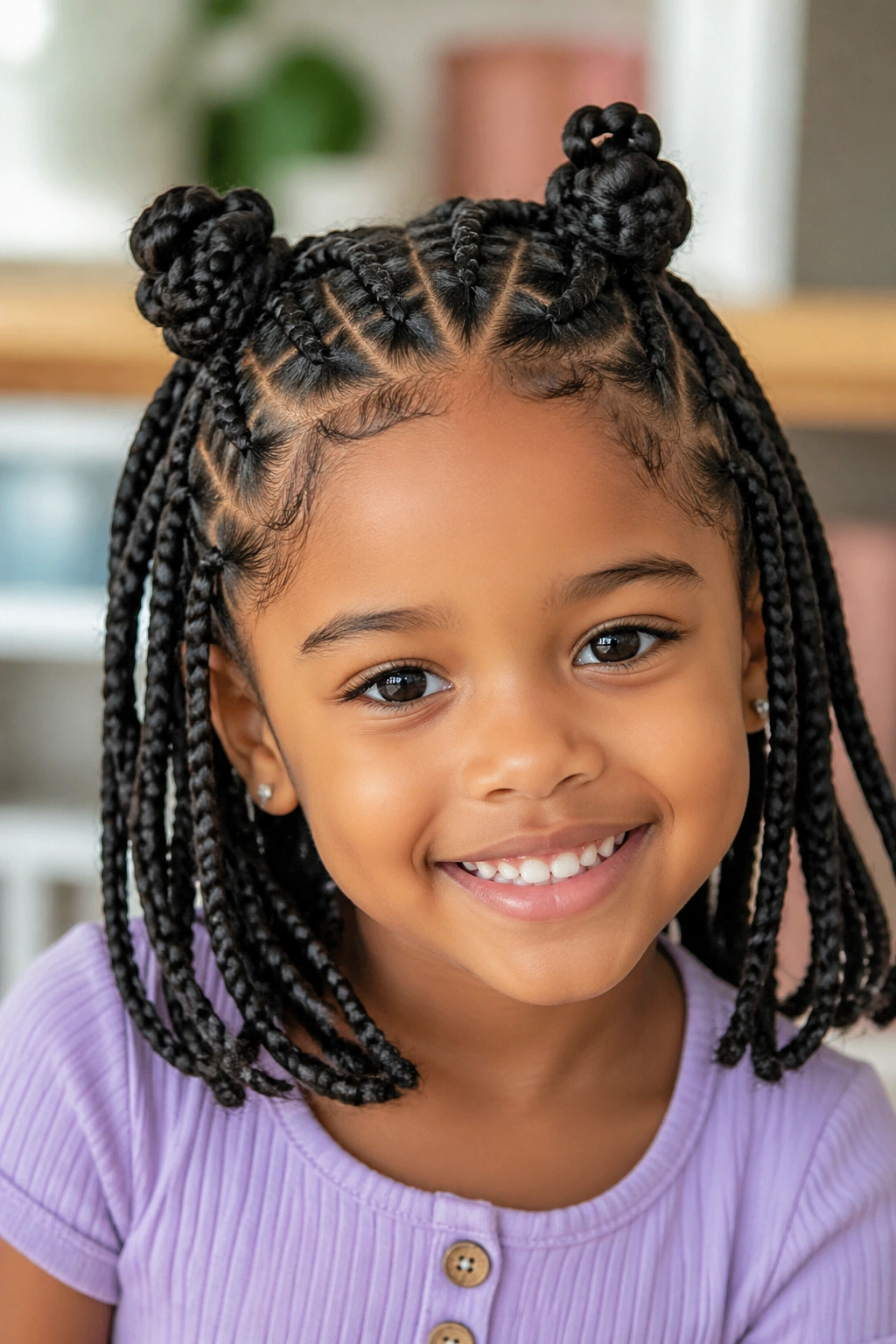
Children’s braided styles need a softer hand. Period. The prettiest pattern in the world is not worth a sore scalp, broken edges, or a child dreading bedtime because the braids hurt. A kid-friendly version of stitch braids with Bantu knots uses larger sections, lighter feed-ins, and tiny knots that don’t overload the top of the head.
Six to eight stitch braids are often enough. Two mini knots work well. Shorter lengths keep the style from swinging into the face or getting caught on backpacks and jackets.
What makes this one better for younger scalps
The roots do not need to be pulled tight to look neat. A skilled braider can keep the sections clean without braiding too close or too aggressively.
Smart choices for this style
- Fewer braids
- Smaller amounts of extension hair
- Soft edge styling, or none at all
- Beads only if the child likes the weight and sound
If a child says the style hurts, believe them. Don’t “give it a day.” Fix it.
16. Burgundy Stitch Braids With Sculpted Bantu Knots
Color changes the mood before shape even enters the conversation. A deep burgundy or 99J braid hair blend gives stitch braids with Bantu knots a richer, moodier finish than standard black, and the knots look more sculpted because the color highlights the wrap pattern differently.
I like burgundy best on medium to long lengths with two or three knots. Too many knots can make the top look dense, especially if the color is dark and saturated. Two knots keep it clean. Three can work if the sections are precise and the braid count stays moderate.
Useful details to think through:
- Burgundy with a black root blend looks softer at the scalp
- Full solid burgundy reads stronger and more editorial
- Gold cuffs pair better here than silver in most cases
- A berry lip or warm brown makeup pulls the whole look together fast
This style feels a little dressier without changing the braid technique itself.
17. Curved Cornrow Stitch Braids With Diagonal Knots
Straight rows are not the only way to do stitch braids, and honestly, some of the best styles curve. A curved braid path can follow the head shape more naturally, especially around the temple and crown. Add diagonal Bantu knot placement, and the whole design feels like it’s moving even when you’re standing still.
What I like here is the flow. Curved rows soften strong features and avoid that rigid helmet effect some tightly mapped braid styles can have. The diagonal knot line also keeps the top from looking too symmetrical, which can be helpful if you want a style with edge but not one that feels severe.
This is not the easiest pattern to install. The braider has to control both the braid tension and the curve consistency so the rows do not start wandering. Still, when it’s done right, it looks thoughtful. More custom. Less standard menu style.
18. Short Stitch Braids With Knots and Curled Ends
Unlike a blunt braided bob, curled ends break up the shape and make the whole style feel lighter. The scalp still carries stitch braids and one or two Bantu knots, but the free braid ends are curled with perm rods or hot water setting instead of sealed straight.
That mix of textures works well if you want something softer around the neck and shoulders. The knots keep the top structured. The curls stop the lower half from looking too rigid.
What makes this one feel softer
A curled finish catches movement each time you turn your head. Straight sealed ends tend to point and swing like cords. Curls bounce more and hide frizz a little better, which is handy after the first week.
This is a good fit for collarbone-length or shoulder-length styles. Too long, and the curls can tangle. Too short, and they may flip out awkwardly. Aim for a length where the curls rest instead of jutting.
19. Mohawk Stitch Braids With Centerline Bantu Knots
A mohawk braid layout is one of the cleanest ways to make Bantu knots the main event. The side braids angle upward from both temples and nape toward the center, then three to five knots sit in a line from the forehead area back toward the crown. It gives a faux-shaved effect without touching clippers.
This style has presence. You don’t need color. You don’t need beads. You barely need baby hair, either. The shape does the talking.
Key choices that keep it sharp
- Keep the side braids tight to the scalp and directed cleanly upward
- Use medium knots so the centerline stays defined
- Leave a little space between knots; crowding ruins the mohawk effect
- Choose shorter braid tails or tuck them in for a cleaner silhouette
If you like strong silhouettes, this one delivers with almost no extra fuss.
20. Small Stitch Braids With Alternating Knots and Braided Drops
Why pick between all knots and all hanging braids when the alternating pattern looks this good? In this version, small stitch braids are sectioned so every second or third braid feeds into a mini Bantu knot, while the rest continue as slim braided drops. The pattern creates rhythm across the scalp without turning the style into a busy mess.
Small braids are important here. Medium or jumbo sizes make the alternation look chunky. Smaller rows keep the layout precise, almost like a woven pattern.
The payoff is movement. The hanging braids keep the style from feeling locked in place, while the knots add lift and shape up top. It’s a strong option if you want detail that people notice on a second look, not only from across the room.
Ask your braider to map the pattern before starting. Alternating designs can go uneven fast if the braid count isn’t planned from the start.
21. Stitch Braids With Bantu Knots and Clear Beads
Clear beads are smarter than people give them credit for. They do not distract from the braid pattern the way bright beads can, and with stitch braids plus Bantu knots, that matters because the scalp design is half the point. The beads sit at the ends or on a few front braids and act more like punctuation than a headline.
This style works best when the knot count stays low—one or two knots, maybe three if they’re small. Too much top detail plus beads at the ends can split attention in the wrong way.
You can make this look younger or sharper depending on bead size. Small clear beads feel cleaner. Large ones lean playful. If you’re heading toward a more refined finish, keep the beads narrow and use them only on selected braids rather than every end.
A little sound, a little swing, and the stitch lines still stay visible. That’s the sweet spot.
22. Ombre Stitch Braids With Two Low Bantu Knots
Two low knots shift the whole mood. Instead of piling height on the crown, this style keeps the Bantu knots lower, closer to the back or lower sides, while the braids carry an ombre blend from dark roots into honey, copper, or blonde ends. It feels softer and less sporty than top knots.
Low knot placement is helpful if you don’t love the look of extra height near the forehead. It also makes the style easier to wear with hats, though sleeping can take a little adjustment depending on exactly where the knots sit.
Ombre color works hard here because the darker root keeps the stitch pattern crisp at the scalp, while the lighter ends add movement through the braid length. That balance is better than a full light color if your main goal is still showing off the parting.
I’d keep the braid count moderate and the knots smooth, not bulky. Let the color do some of the visual work.
23. Bridal Stitch Braids With a Sleek Bantu Knot Cluster
Wedding hair can go overboard fast. Too much shine spray, too many rhinestones, too much bulk in the back—suddenly the hairstyle is wearing you. A bridal take on stitch braids with Bantu knots works best when it stays sleek: small, polished braids feeding into a tight cluster of two or three knots, placed at the crown or upper back.
This is one of the few versions where I’d welcome pearl pins or small floral accents. A couple placed at the base of the knots can look refined without taking over the braid work. Keep the accessory scale small. Tiny is your friend here.
Compared with a heavy braided updo, this style sits cleaner under a veil and keeps the scalp pattern visible in photos from above and behind. It also tends to hold shape through a long day better than looser braided bun styles.
If you’re considering this for an event, do a trial. Knot size, veil comb placement, and edge styling all matter more than people expect.
24. Festival Stitch Braids With Color-Pop Knots
This is the fun one. Keep the base braids a natural shade—black, dark brown, maybe a subtle blend—and then use bright extension hair only in the Bantu knots. Cobalt, copper, red, plum, neon green if that’s your thing. The color stays concentrated at the top so the style reads bold without becoming chaos from root to tip.
Using color only in the knots is also practical. If you’re unsure about a full-head bright braid look, this gives you the excitement in a smaller dose. And when the style grows out, the scalp still looks cleaner than it would with a full bright shade.
A few placement ideas:
- Two high knots in one accent color
- Three centerline knots in a dark-to-bright gradient
- Side knots in a contrasting color with plain black braid length
- Matching nail color or liner to tie the whole look together
Short trip, concert weekend, birthday stretch—this one has the right kind of energy for it.
25. Extra-Long Stitch Braids With Five Sculpted Bantu Knots
A style this dramatic can go wrong in two directions: too heavy or too messy. Get the balance right, though, and extra-long stitch braids with five sculpted Bantu knots look striking in a way few protective styles do. The knots sit across the top or down the center, while the braids fall long—often hip length or longer.
Five knots is a lot, so size control matters. They should be sculpted and consistent, not giant. Think compact spirals with smooth wrapping and firm bases. If each one is oversized, the head shape gets swallowed.
Who should try this version
Pick it if you like statement hair and don’t mind a little maintenance. Do not pick it if you hate sleeping carefully, wearing a scarf every night, or feeling braid weight on your shoulders.
Practical details that help
- Keep the front feed-ins gradual
- Ask for lightweight extension hair if available
- Stay under 30 inches unless you know you enjoy super-long braids
- Limit accessories; the shape is already doing a lot
This look is not shy. That’s why it works.
Final Thoughts
The best stitch braids with Bantu knots all have the same backbone: clean parting, smart knot placement, and tension that respects your hairline. Everything else—length, color, beads, cuffs, part art—is styling choice. Fun stuff. Secondary stuff.
If you’re torn between two looks, pick the one you’d still want on day eight, not only the one that grabs you in a photo. Hairstyles live on your actual head, through sleep, sweat, weather, errands, and the occasional lazy night when wrapping your hair feels annoying.
And if a style looks sharp but feels wrong, trust your scalp. A good braided look should make you feel put together, not punished.
