



Half up half down styles have become a staple for Black women who wear locs, and there’s a really good reason why. These styles hit that perfect sweet spot — they’re polished enough for professional settings, creative enough to feel like self-expression, and genuinely practical for managing the length and weight of locs while keeping your face framed and accessible. Whether you’re looking for everyday styles that take five minutes to create or intricate looks that make a statement at special events, the versatility of half up half down loc styles is genuinely impressive.
What makes these styles so appealing is that they work across the entire spectrum of loc journeys. Fresh locs, mature locs, thick locs, thin locs — there’s a half up half down variation that’ll suit your hair and your lifestyle. Some styles lean into sleek, refined aesthetics that read boardroom-ready. Others embrace the bohemian, creative energy that locs naturally carry. And plenty of them sit right in the middle, giving you elegance with an edge.
The beauty of mastering half up half down loc styles is that you’re not locked into one approach. Many of these styles can be dressed up or dressed down, worn loose and flowing or secured tight for staying power, adorned with jewelry or worn completely bare. Once you understand the basic mechanics of a few styles, you can remix them based on what you’re doing that day, how much time you have, and what vibe you’re going for. Let’s explore twenty stunning options that’ll expand your styling repertoire and help you feel confident rocking your locs in any situation.
1. Classic Twisted Crown
The classic twisted crown is the foundation upon which many other half up half down styles are built, and it deserves its place at the top of this list. This style takes a section of locs from each side of your head at about ear level, twists them together as you move toward the back, and secures them at the nape of your neck or crown. What you end up with is a polished frame around your face with the bulk of your locs falling freely down your back.
Why This Style Remains Timeless
This style works because it’s elegant without being fussy, and it requires just enough intention to feel intentional while remaining completely achievable in under ten minutes. The twist itself adds visual interest and dimension, and because you’re working with multiple locs twisted together, the overall effect looks fuller and more defined than you might expect from a simple half up style.
How to Perfect Your Version
- Start by sectioning locs from roughly temple to temple across the top of your head
- Divide that section into two halves (left and right) for easier twisting
- Twist each half tightly as you move toward the back of your head
- Meet both twisted sections at the nape and secure with a clip, elastic, or bobby pins depending on your preference
- Adjust the front pieces to frame your face the way you like it
Pro tip: Smooth the front sections slightly for a more polished vibe, or leave them a bit textured and loose if you’re going for relaxed sophistication.
2. Sleek High Loc Bun
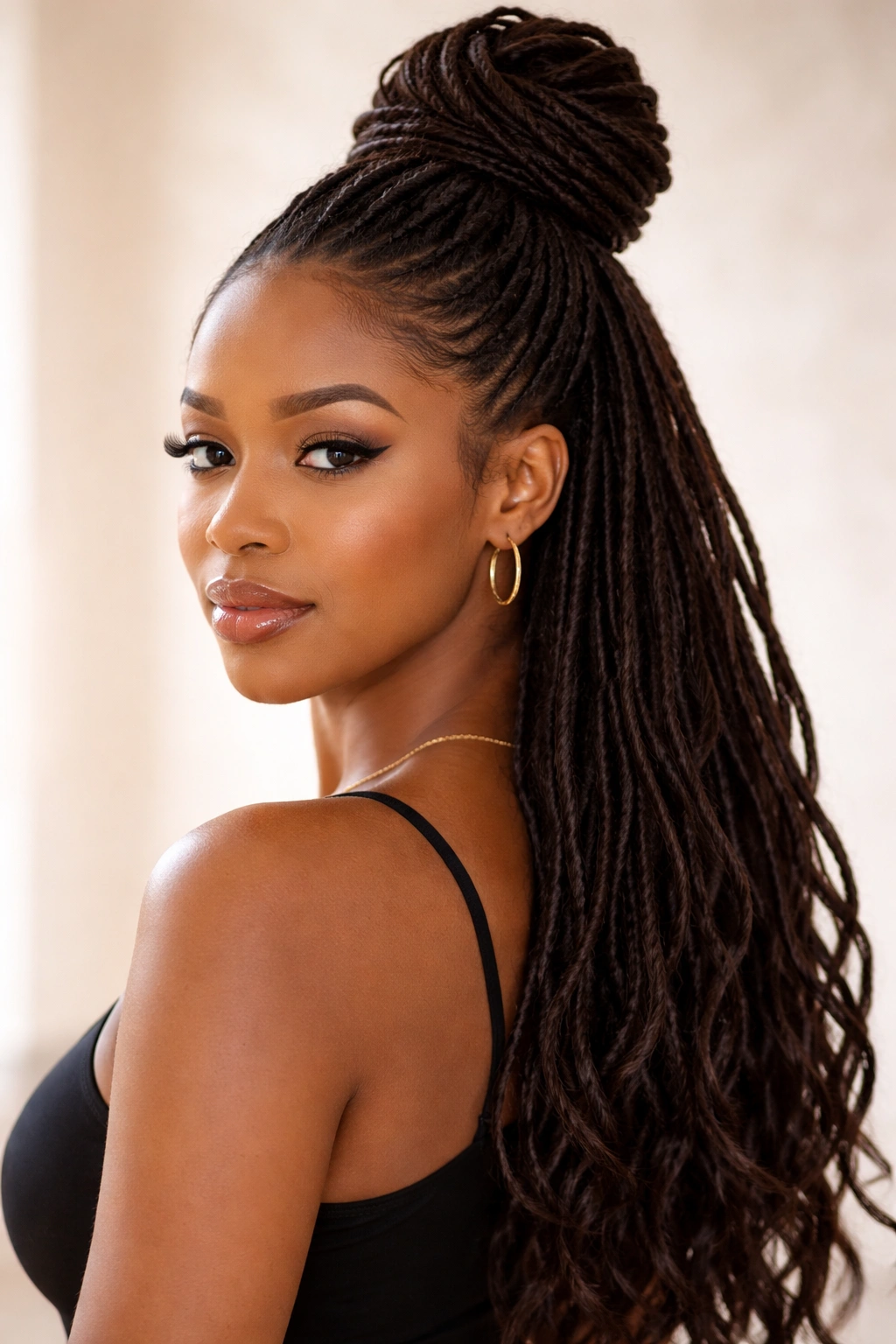
A sleek high bun takes your half up section all the way to the crown of your head, creates maximum volume and visual impact, and leaves the lower half of your locs completely loose and flowing. This style reads modern and intentional, and it’s surprisingly easy to achieve even if you’ve never attempted a bun with locs before.
What Makes This Style Stand Out
High placement automatically draws the eye upward and elongates your face. The contrast between the sleekness of the gathered-up locs and the texture of the locs flowing below creates visual interest and movement. It’s a style that photographs beautifully and feels special enough for dates or professional events, yet practical enough for everyday wear.
Step-by-Step Creation
- Gather roughly the upper third of your locs using a comb or your fingers
- Pull that section straight up toward the crown of your head
- Twist or coil the gathered locs into a bun shape
- Secure with bobby pins and finish with a lightweight gel if needed for a sleek look
- Leave the lower two-thirds of your locs completely loose or gently finger-comb them
Worth knowing: The key to a sleek finish is using bobby pins placed horizontally through the bun rather than vertically — this keeps everything in place without creating visible lines.
3. Bohemian Braided Half Up
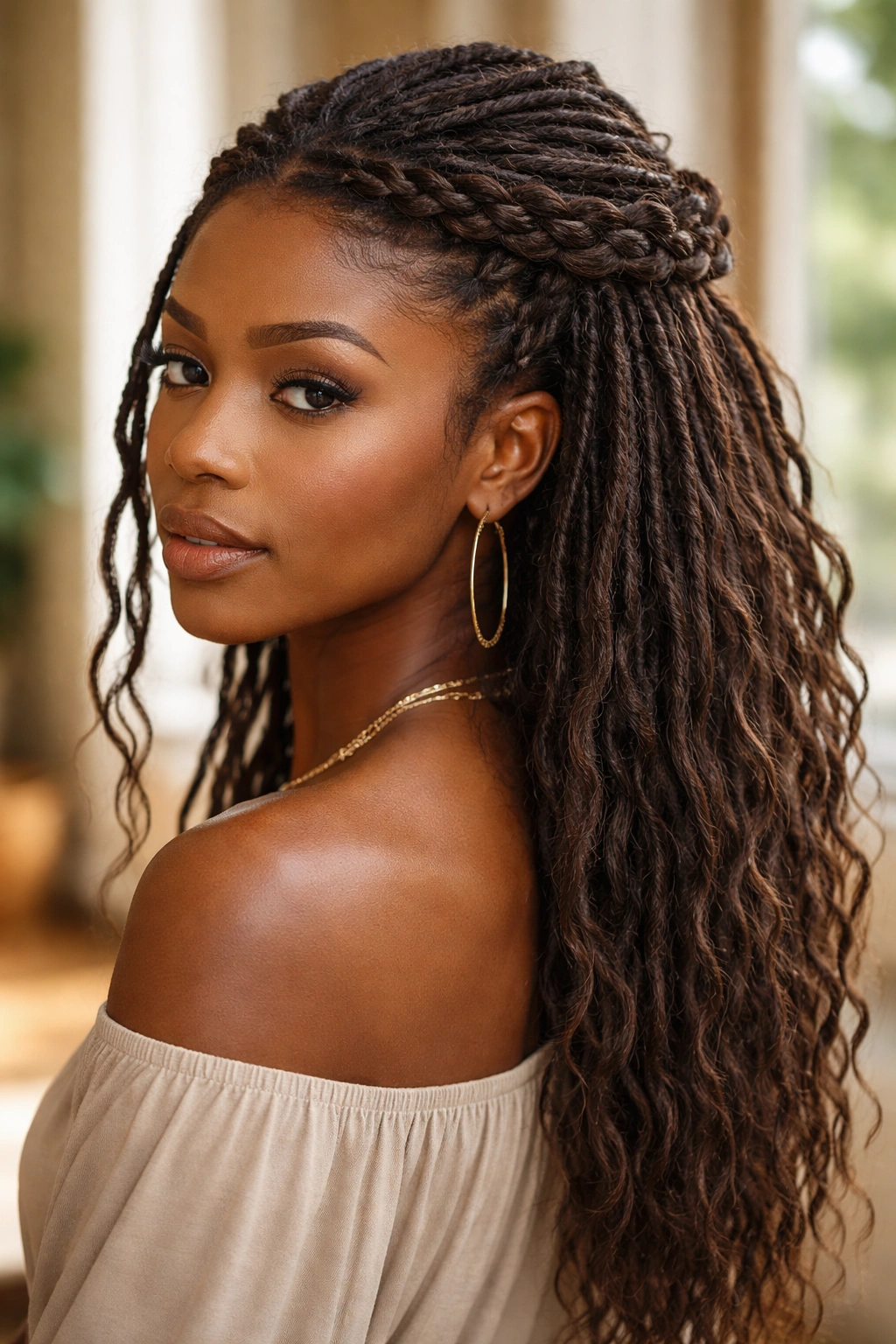
This style weaves locs together in a loose, flowing braid pattern, creating an effortless-looking hold that’s actually quite secure. The braiding technique gives you all the benefits of a half up style while adding texture, dimension, and that undeniably bohemian flair that locs naturally carry.
Why Braiding Changes Everything
A braid is more secure than a twist at the same level of tightness, which means you can wear this style loosely without worrying about it unraveling halfway through your day. The braid also catches light differently than a twist, creating more visual interest and depth. It’s the kind of style that makes people ask “How did you do that?” even though it’s really quite straightforward once you know the basic technique.
Construction Details
- Section locs from one side of your head, starting at the temple
- Braid those locs together, adding more locs as you move toward the back of your head
- Continue braiding around toward the opposite side
- Secure the braid at the nape with a clip or small elastic
- Leave the remaining locs completely loose, or create a second braid on the opposite side for symmetry
Insider note: Don’t aim for a tight, perfectly symmetrical braid here — looser, slightly asymmetrical braids actually photograph better and feel more intentional.
4. Layered Half Up with Accessories
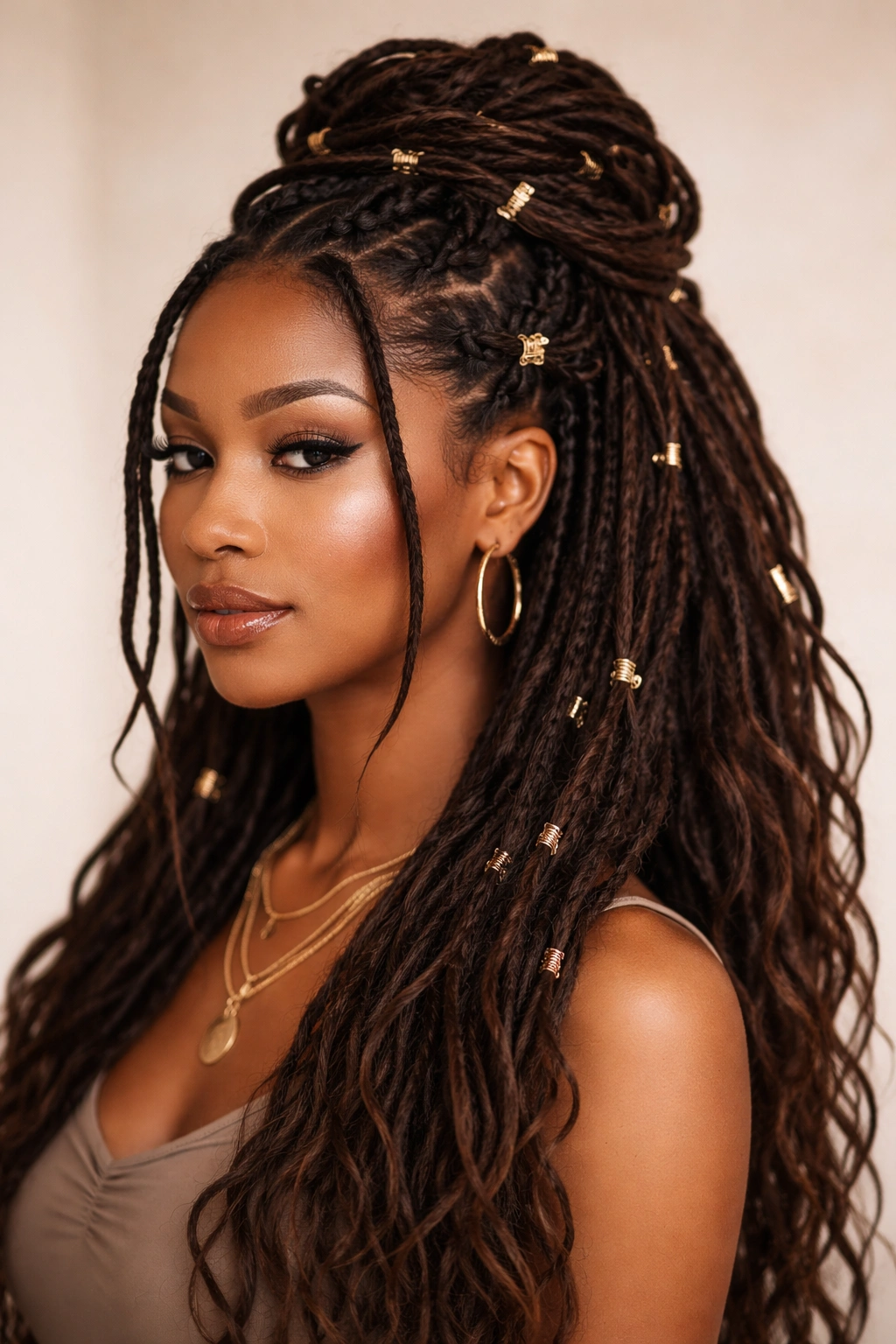
Layering different sections of locs and adding jewelry or hair accessories transforms a simple half up style into something that feels luxurious and statement-making. This approach takes the basic half up concept and elevates it by treating multiple height levels and incorporating adornment strategically.
How Layering Adds Dimension
When you gather locs at two or three different heights — one at the crown, one at mid-head, and one lower — you create visual depth and movement that a single gathered section simply can’t achieve. The spaces between the layers let light flow through your locs, and the overall effect is more dynamic and interesting than a standard half up style.
Building Your Layered Look
- Create a small section at the very crown and gather it into a small bun or twisted loop
- Create a second section just below, perhaps braided or twisted, secured below the first
- Create a third section lower still, perhaps with a different technique
- Add gold cuffs, wooden rings, or hair clips between the layers for visual pop
- Leave the remaining locs long and loose
Pro tip: Use accessories in coordinating metals or materials — mixing gold and silver can work if done intentionally, but sticking to one metal throughout feels more cohesive.
5. Side-Swept Half Up Half Down
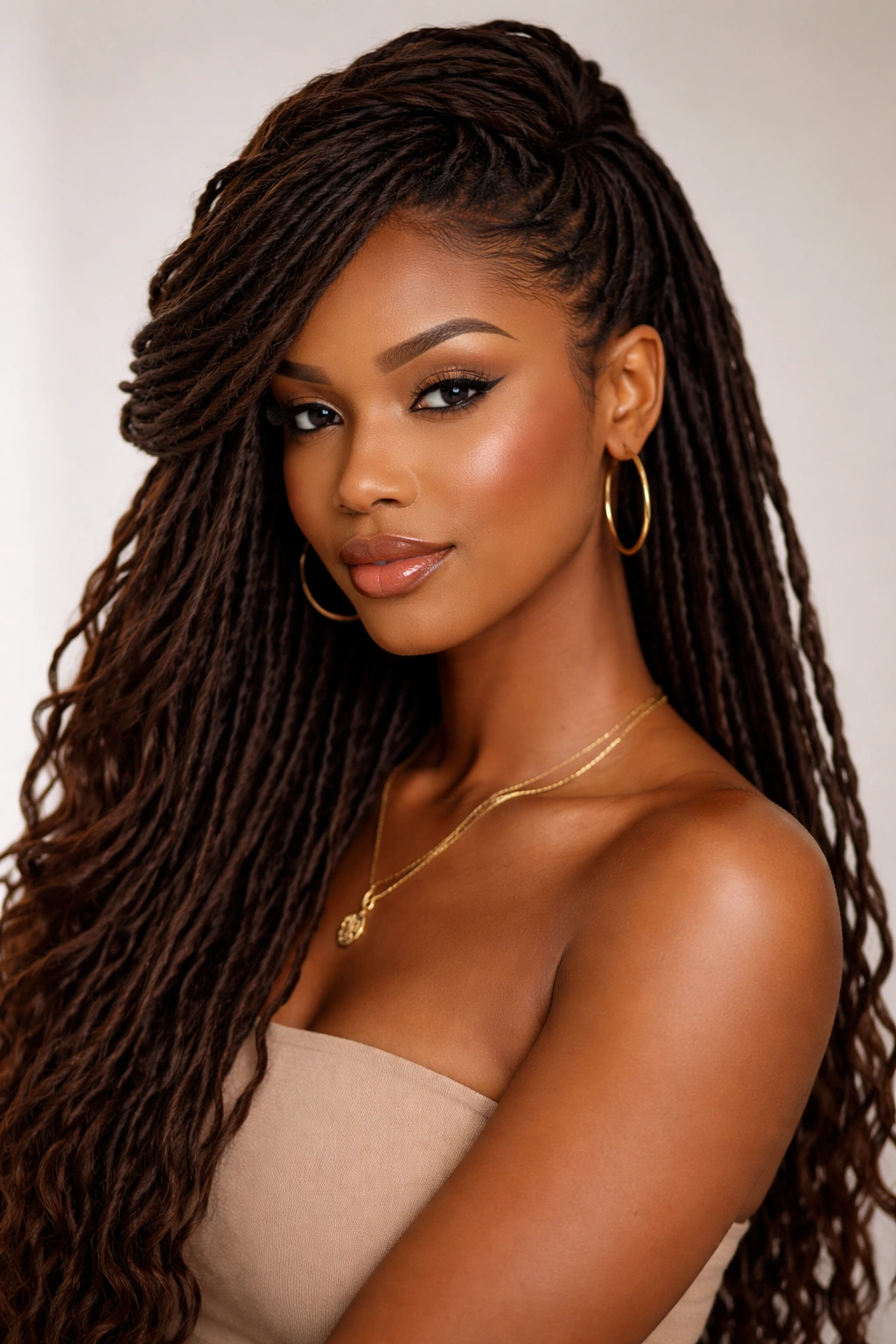
A side-swept half up takes the gathered section and angles it dramatically to one side of your head, creating asymmetry and movement. This style is flirty, modern, and genuinely flattering on most face shapes because the angled line draws attention upward and to the cheekbones.
The Power of Asymmetry
Side-swept styles automatically feel more fashion-forward than centered styles, and they read as deliberately styled rather than casual. The asymmetry also gives you freedom to show off one side of your face while maintaining some coverage on the other side — you can customize the look based on your own preferences and face shape.
Creating the Side-Swept Effect
- Take a larger-than-usual section from one side of your head
- Sweep that section diagonally across the back of your head toward the opposite side
- Secure the gathered section with bobby pins or a clip placed to the side rather than centered
- Smooth any flyaways along the swept path with a lightweight product
- Leave the other side of your locs loose and flowing naturally
Worth knowing: The angle matters more than perfection here — even a slightly imperfect side sweep reads as intentional and cool.
6. Twisted Front Section Half Up
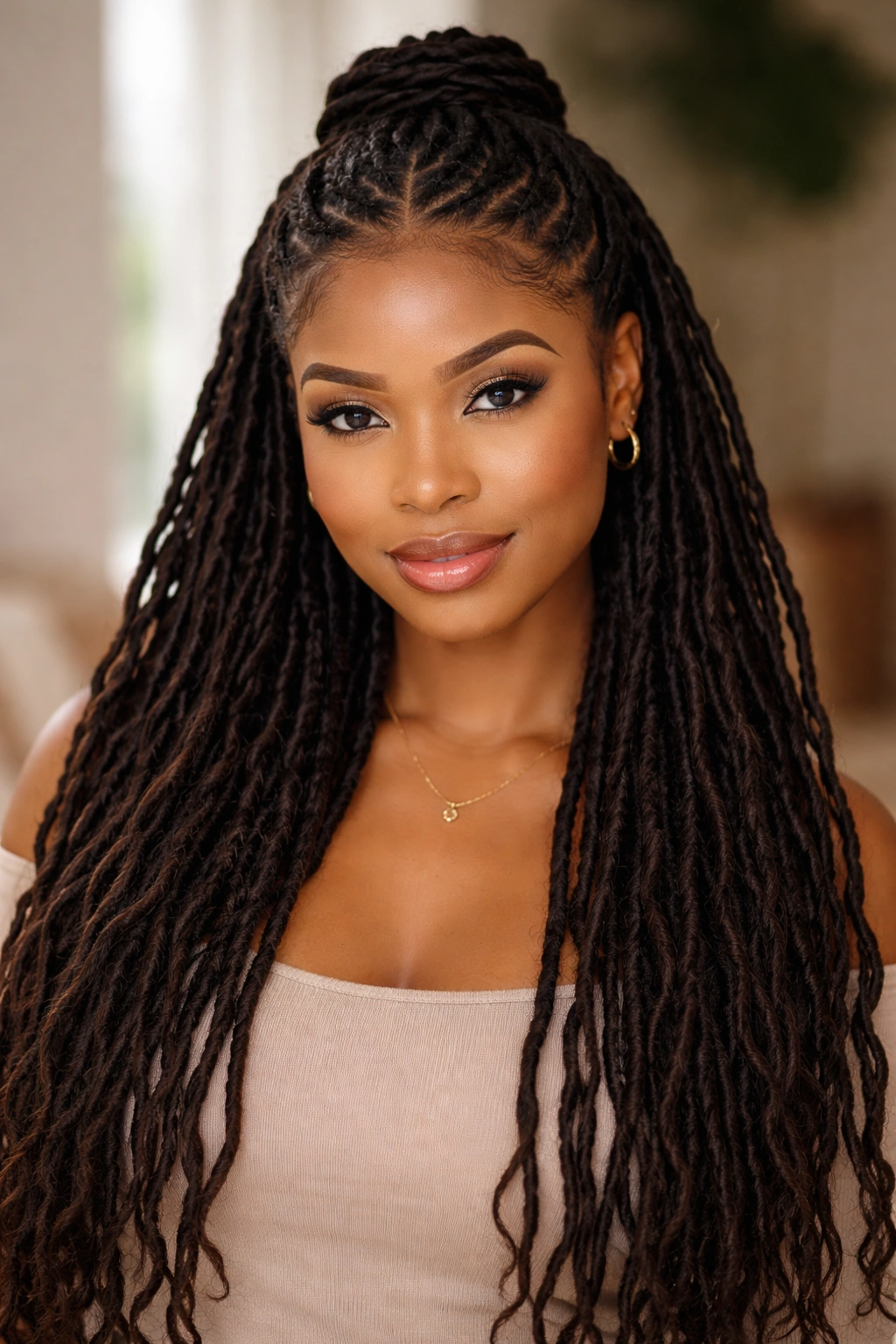
This style takes only the very front sections of locs from either side of your face, twists them tightly, and brings them together at the back. It’s minimalist in approach but creates serious visual impact because it frames your face while leaving most of your locs completely loose.
Minimalist Elegance
Because you’re only gathering a small portion of your hair, this style works beautifully across all loc thicknesses and densities. It’s quick to create, barely noticeable to wear, and yet completely transforms your appearance. The tight twists create a defined frame while the loose locs below feel free and unrestricted.
The Technique Breakdown
- Take a small section of locs from one temple, ideally three to five medium locs
- Twist that section tightly from root to tip as you move toward the back
- Repeat on the opposite side
- Meet both twisted sections at the center back and secure with a small clip or bobby pin
- The rest of your locs hang completely free
Pro tip: Twist tightly for a more polished look, or twist more loosely for a more relaxed vibe — both approaches work beautifully.
7. Spiral Bun Half Up
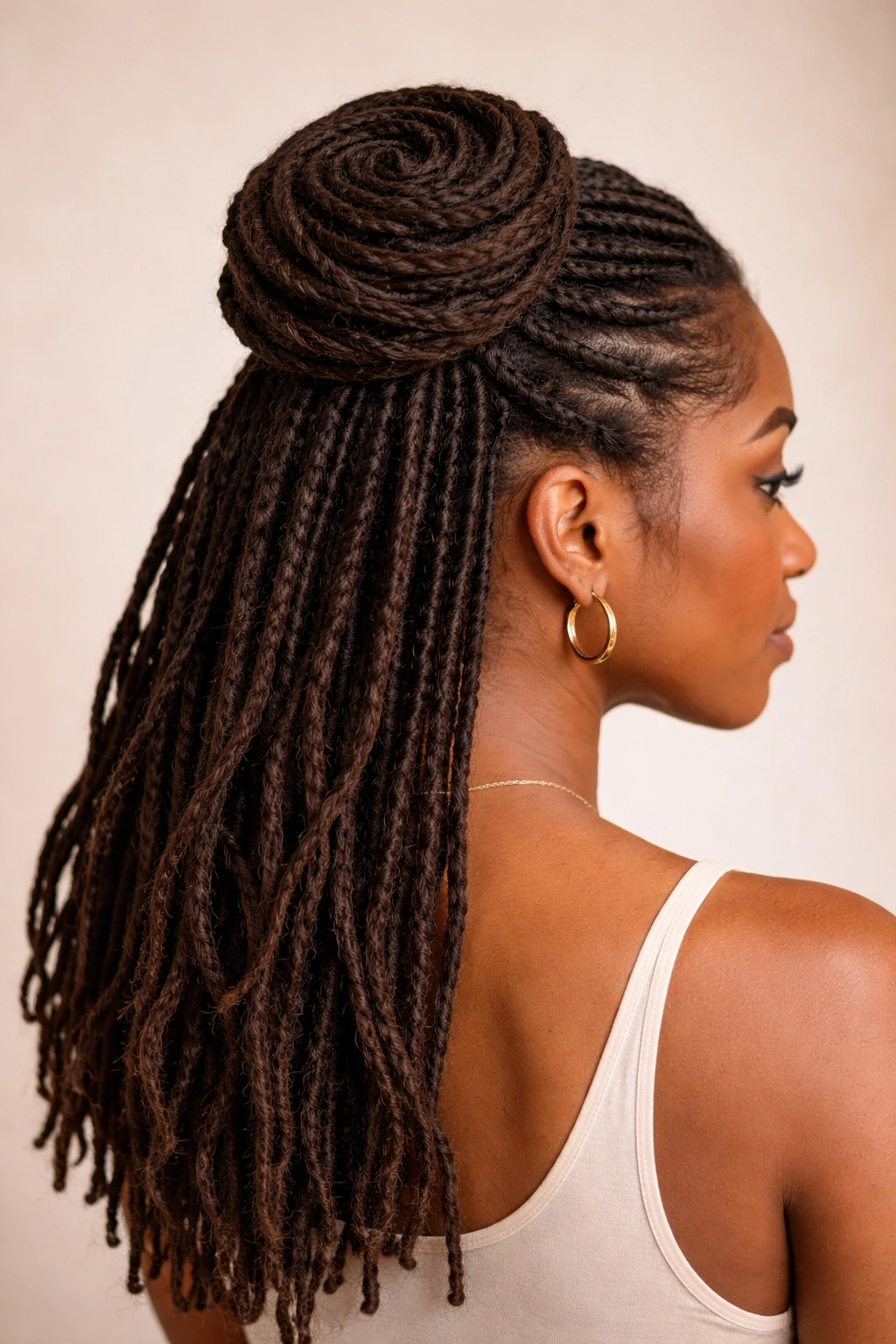
A spiral bun takes gathered locs and coils them in a flat spiral pattern against your head, creating a sculptural, almost architectural effect. This style is eye-catching and unique, and it genuinely showcases the texture and depth of your locs in a way that most other styles don’t.
Why Spiral Patterns Work
Spirals create natural flow that feels organic rather than rigid. They’re also very secure when done correctly, so you can wear this style confidently without worrying about it loosening throughout the day. The spiral pattern catches light beautifully, creating shadows and highlights that make the style feel three-dimensional.
Spiral Bun Construction
- Gather locs from the top section of your head
- Starting at the base of the gathered section, coil the locs in a flat spiral pattern
- Each coil should sit next to the previous one, creating a flat, compact shape
- Secure the entire spiral with bobby pins placed all around the perimeter
- Leave the lower locs completely free and loose
Insider note: Practice on a day when you have extra time — spiraling takes patience your first few times, but it becomes much quicker with repetition.
8. Waterfall Braid Half Up
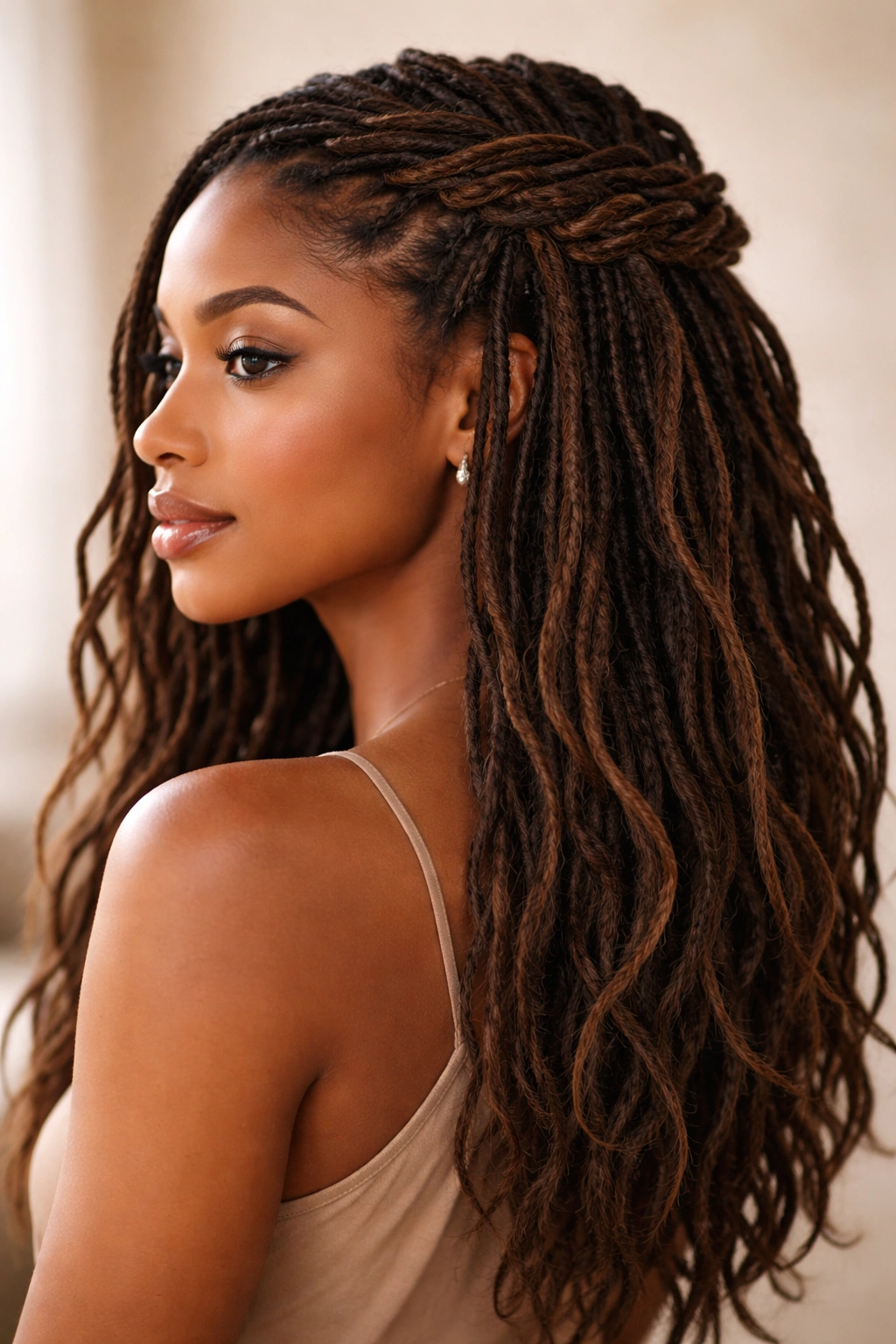
A waterfall braid releases small sections of locs as it progresses, creating a cascading effect that’s both whimsical and sophisticated. This style plays with the idea of a traditional half up by creating visual movement and releasing small sections that frame your face beautifully.
The Waterfall Effect Explained
Waterfall braids work by incorporating new hair as you braid while simultaneously releasing small sections from the braid itself. The result is a braid that appears to flow and cascade across your head. With locs, this creates an especially dramatic effect because each released section is a distinct, textured element.
Waterfall Braid Execution
- Start at one temple with a small section of three locs
- Braid those three locs together, then add a new loc to the outer edge
- Drop the inner loc from the braid, letting it fall free
- Continue this pattern as you move toward the back of your head
- Secure the remaining braid at the nape with a clip or elastic
- Leave all released sections and the remaining locs loose and free
Worth knowing: This style takes practice and looks best when you don’t aim for perfection — slight irregularities in the waterfall actually make it look more organic and intentional.
9. Half Up Loc Ponytail
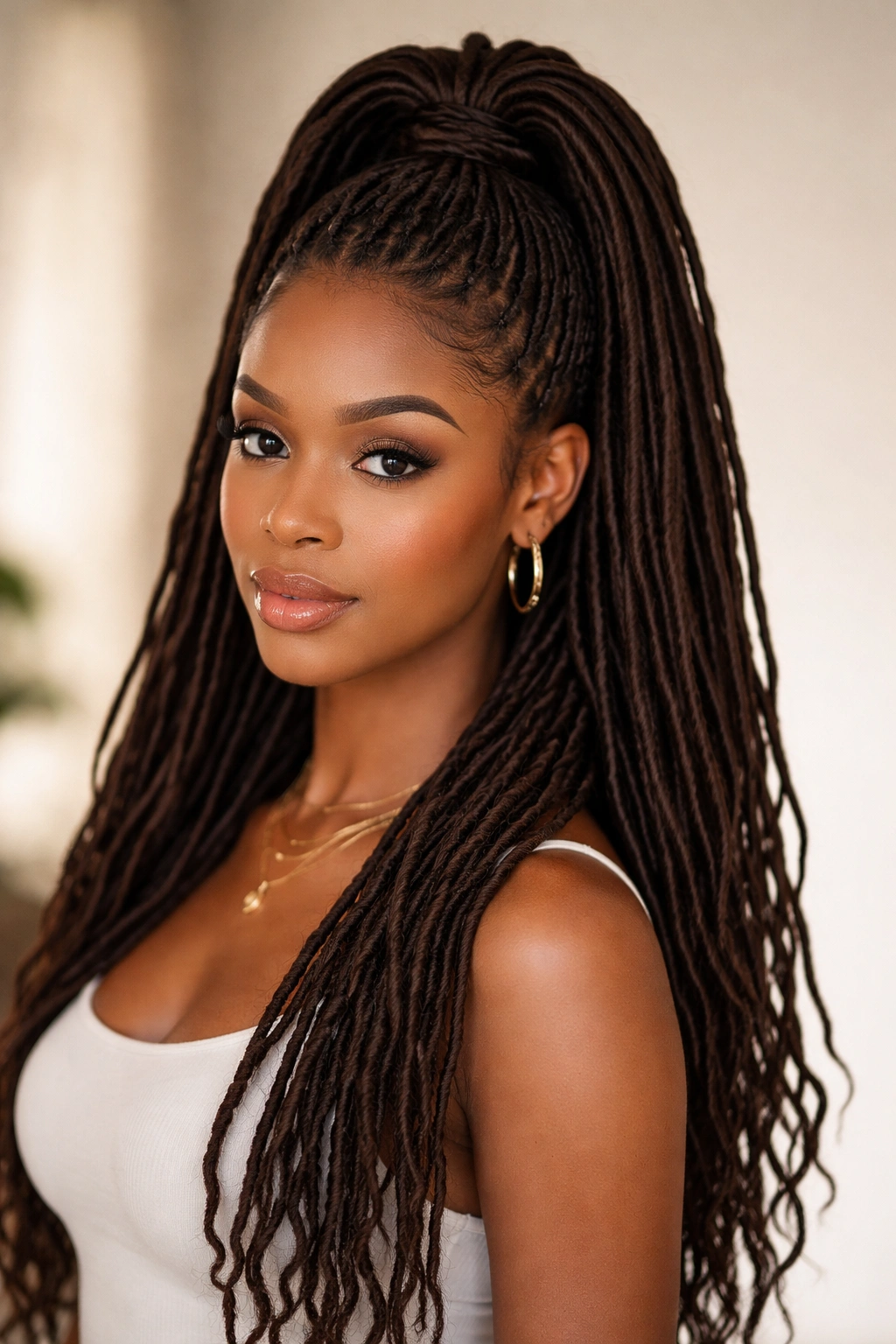
A half up loc ponytail gathers roughly the upper half of your locs and brings them together into a high, medium, or low ponytail, while leaving the lower locs completely loose. It’s a style that offers surprising versatility — the same basic technique creates entirely different looks depending on where you place the ponytail and what you do with the gathered section.
Versatility Through Placement
High ponytails read sporty and energetic. Mid-height ponytails feel balanced and wearable for almost any occasion. Low ponytails feel elegant and refined. The same technique, three completely different vibes. You can also create texture within the ponytail itself through twisting, coiling, or braiding the gathered locs.
Basic Half Up Ponytail Steps
- Gather the upper half of your locs using your fingers or a comb
- Decide on your placement (high, medium, or low) and pull the gathered section to that height
- Secure with an elastic band or hair tie
- Adjust the tightness and the position of individual locs for the vibe you want
- Let the lower locs hang completely free
Pro tip: If you want the ponytail to feel fuller, tease or backcomb the gathered section gently before securing it — this creates dimension and makes the ponytail look thicker.
10. Wrapped Crown Half Up
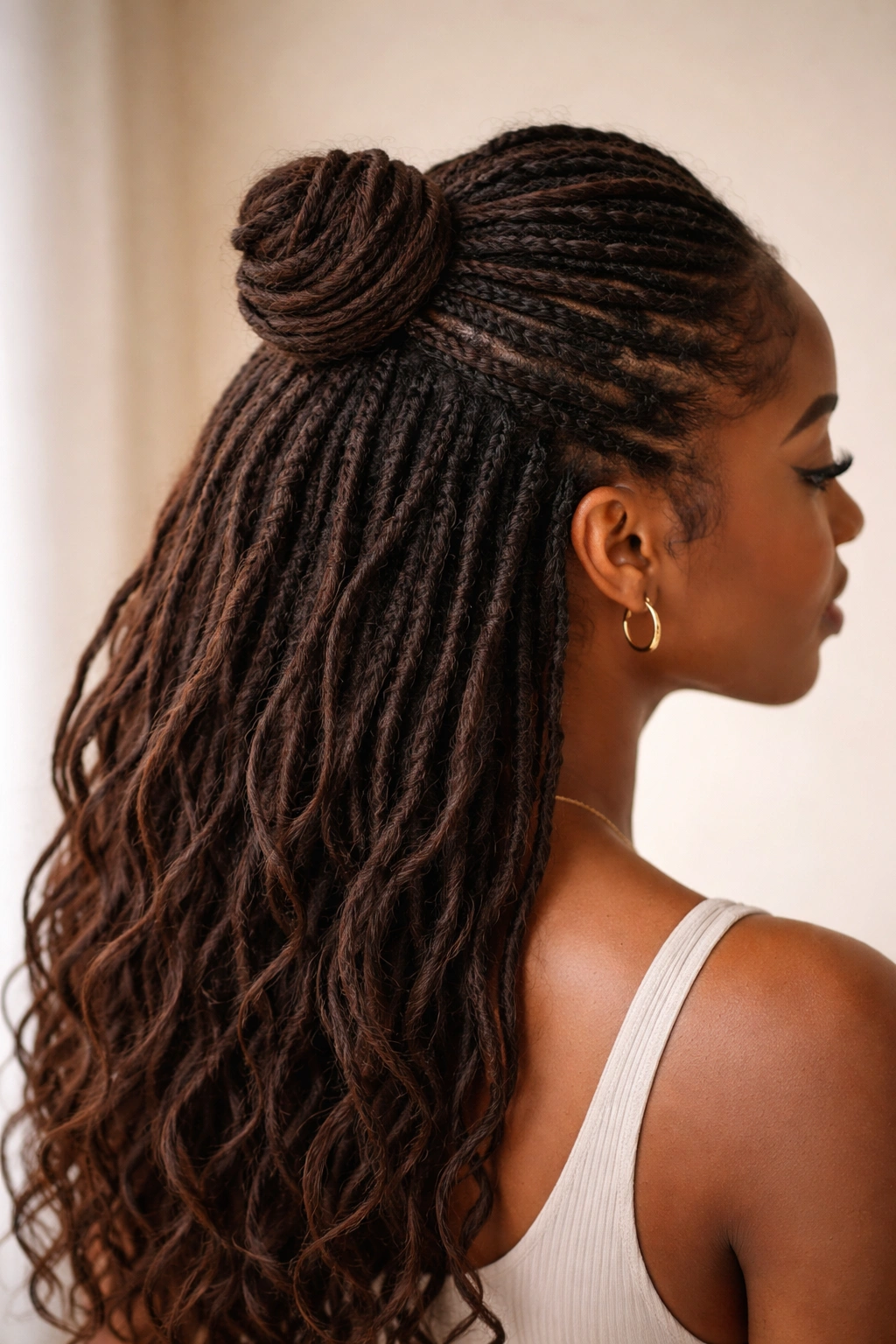
This style creates a gathered crown section at the very top of your head, then wraps a separate section of locs (or a strand of yarn or thread) around the base of the gathered section for visual definition and texture. The wrapped element transforms a basic bun into something that looks intricate and intentional.
What Makes Wrapping Powerful
Wrapping serves both a practical and aesthetic function. Practically, it secures the gathered section beautifully. Aesthetically, it creates a defined border that makes the style feel more finished and polished. The contrast between the wrapped element and the locs themselves creates visual interest and dimension.
Wrapping Technique
- Gather locs at the crown of your head into a small bun or twisted shape
- Secure the bun with bobby pins
- Take a separate loc or thin strand of yarn or thread
- Wrap it tightly around the base of the bun several times
- Tuck the ends of the wrapping element under itself or secure with a bobby pin
- Leave the remaining locs loose and flowing
Insider note: Wrapping with a contrasting element like gold thread, colorful yarn, or even a thin leather cord can completely change the style’s aesthetic.
11. Zigzag Half Up Half Down
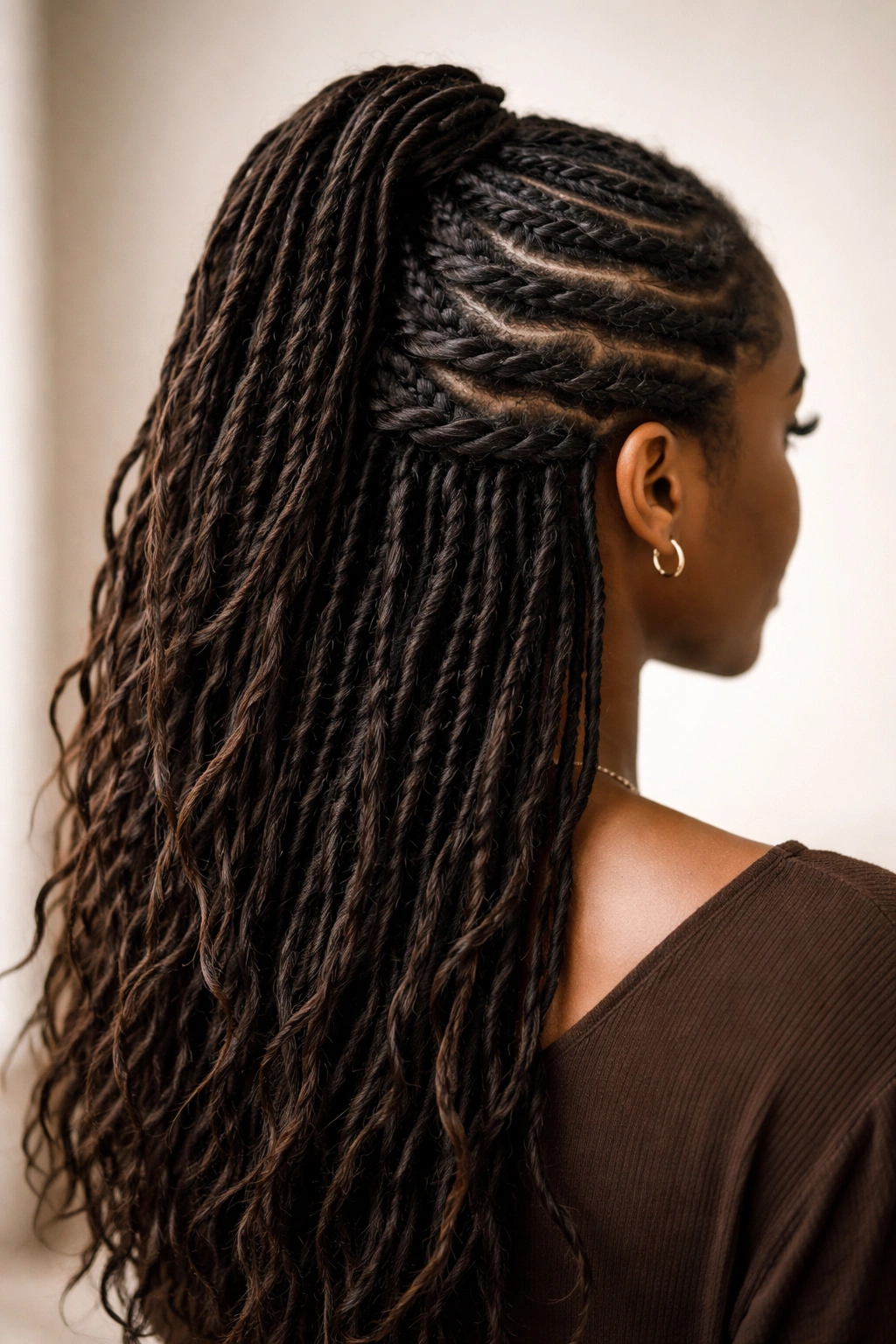
A zigzag pattern created by sectioning and twisting locs in an alternating diagonal pattern creates movement and visual excitement. This style takes a bit more time to create but delivers significant impact, and it’s genuinely unique — you won’t see many people wearing this variation.
Creating Zigzag Movement
The zigzag effect comes from taking alternating sections of locs and twisting them in opposite diagonal directions as you move from one side of your head to the other. When you gather everything together at the back, you get a pattern that’s both structured and flowing.
Zigzag Construction
- Section your locs into small groups using clips to separate them
- Take the first section and twist it diagonally down and to the right
- Take the next section and twist it diagonally down and to the left
- Continue alternating directions as you move across your head
- Gather all the twisted sections at the nape and secure them together
- Leave the remaining locs completely loose
Worth knowing: Mark your sections with clips before you start twisting so you don’t accidentally grab the wrong locs.
12. High Twisted Half Up
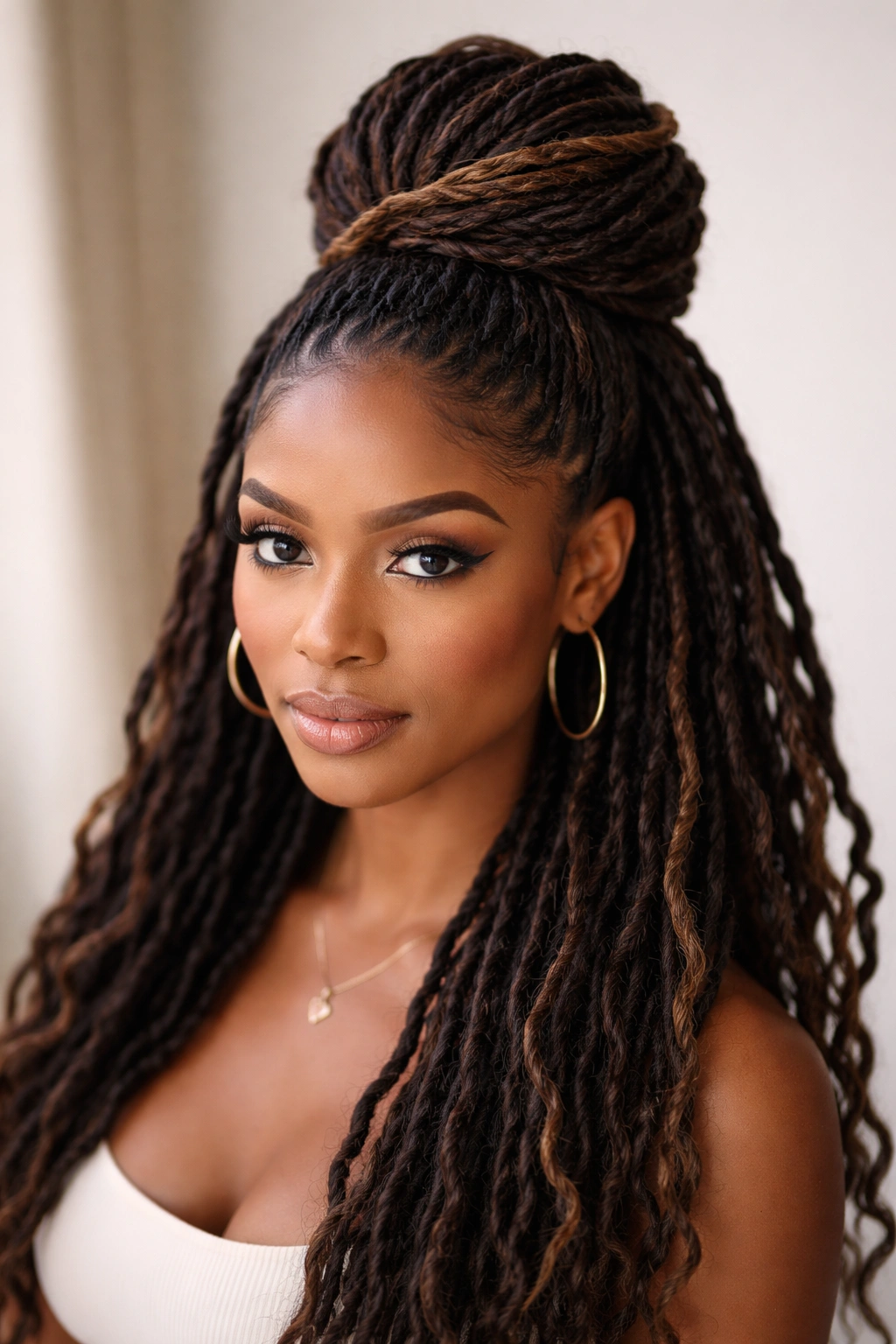
A high twisted half up takes the twisted crown concept and positions the twist extremely high on your head, creating dramatic lift and volume at the crown. This style is especially flattering if you have a longer face or want to add height to your overall silhouette.
Crown Height for Maximum Impact
Placing your gather point as high as possible creates several benefits. You get maximum lift at the crown, which creates the illusion of a taller face and a more elongated silhouette. You also leave more locs loose and free to move, which feels liberating and looks beautiful. The high placement makes the style read as intentional and fashion-forward.
High Twist Execution
- Take a section of locs from roughly temple to temple across the very top of your head
- Divide this section into two equal parts
- Twist each part tightly as you move toward the back, keeping the starting point as high as possible
- Bring the two twisted sections together at the very back of your crown
- Secure with bobby pins or a clip
- Leave everything below that point completely loose
Pro tip: Use bobby pins placed in an X pattern across the twist for maximum security without visible pins.
13. Curved Half Up with Volume
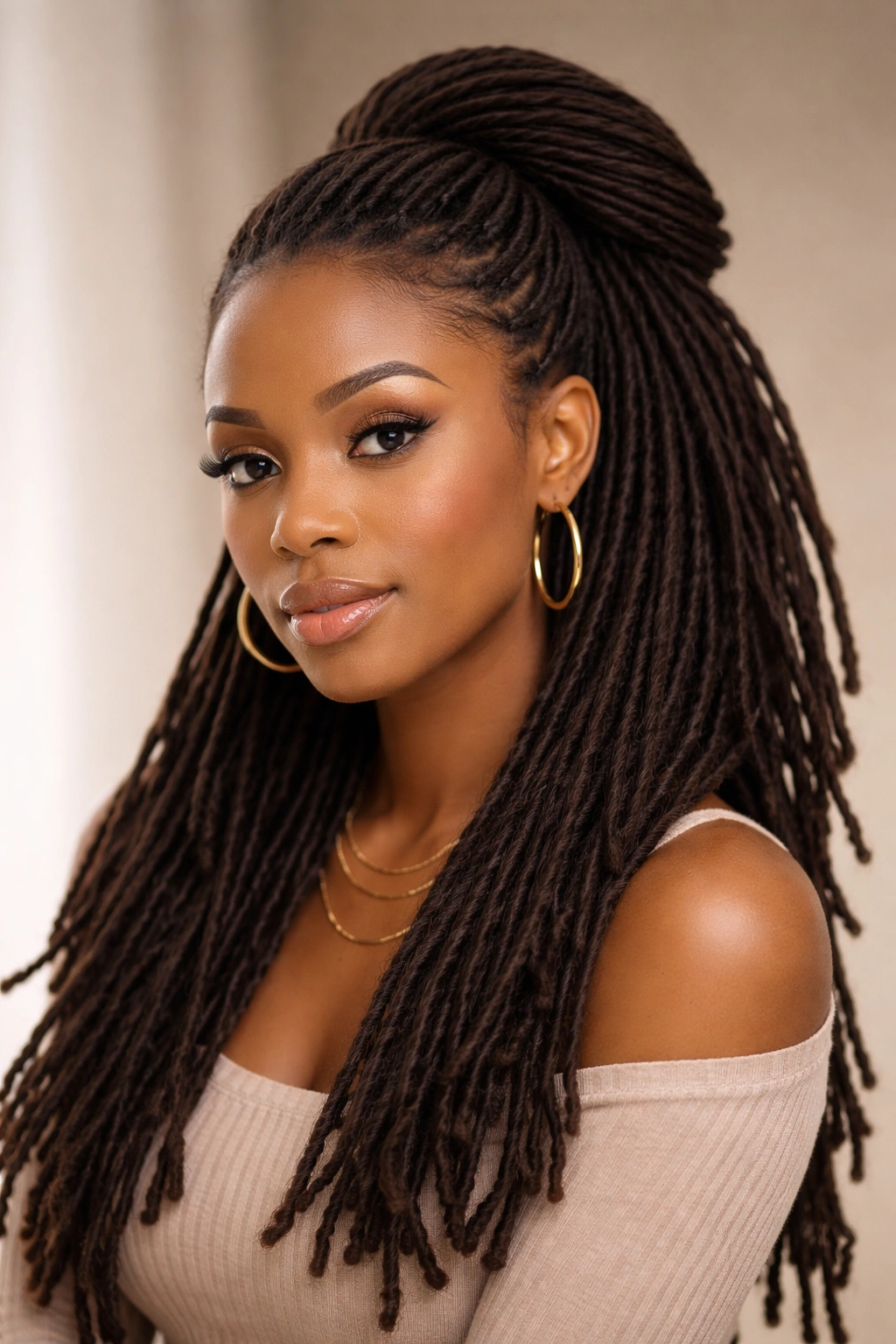
This style creates a curved or arched section that follows the natural curve of your head, gathering locs in a crescent shape rather than straight across. The curved approach is more flattering to face shape and creates a more organic, less rigid appearance than straight-line sections.
Why Curves Matter
Curved lines are naturally more flattering to human faces than straight lines — they echo the curves of the face itself and create visual harmony. A curved gather also feels less severe and rigid than a straight section, which makes the overall style feel softer and more approachable.
Creating the Curved Section
- Imagine a crescent moon shape from one temple to the other, arching slightly higher at the center
- Section your locs following this curved imaginary line
- Gather these locs together using multiple small twists or one larger spiral
- Secure at the center back rather than directly at the nape
- Let the loose section flow naturally, following the curves created by the gather
Insider note: This style is especially flattering if you have a rounder or wider face, as the curved gather complements rounded face shapes beautifully.
14. Two-Strand Twist Half Up
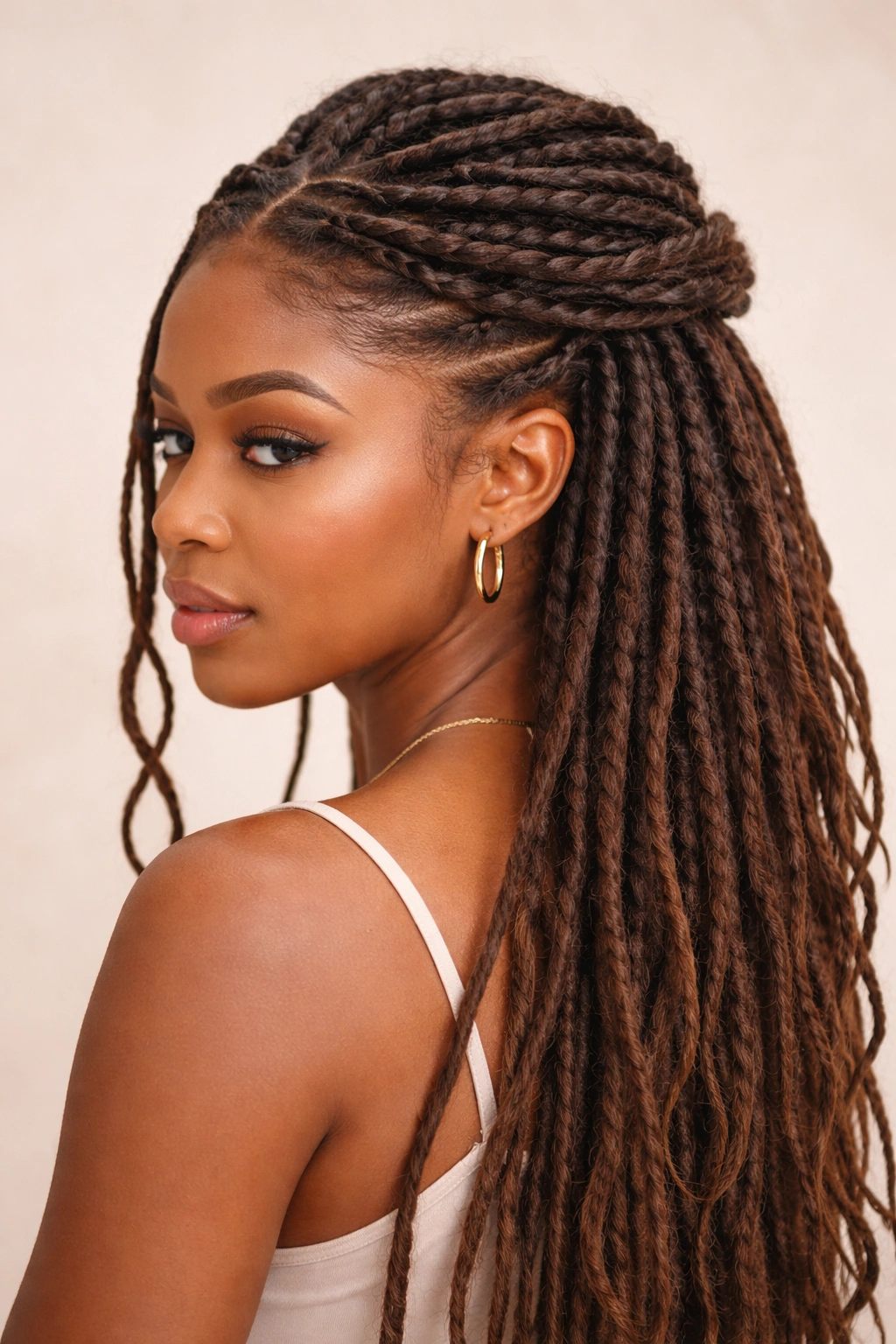
Two-strand twists, as opposed to the multi-strand twists used in many other styles, create a more delicate, refined appearance. Using two locs twisted tightly together creates fine lines and visual elegance, especially if you have thinner locs or medium thickness locs.
The Elegance of Two-Strand Twists
Two-strand twists feel more intricate and detailed than thicker multi-strand twists. They catch light differently, creating shadow and dimension. They also feel slightly more precious and thoughtful, as if you’ve put extra care into the styling.
Two-Strand Technique
- Select two adjacent medium-thickness locs
- Twist them tightly around each other from root to tip
- Continue creating two-strand twists across the top section of your head
- Bring all the twisted pairs together at the back in a cluster
- Secure with bobby pins or a small elastic
- Leave the remaining locs loose and free
Pro tip: For extra visual interest, create two-strand twists on one side and a simple gathered section on the other — asymmetry reads as intentional and modern.
15. Loc Faux Hawk Half Up
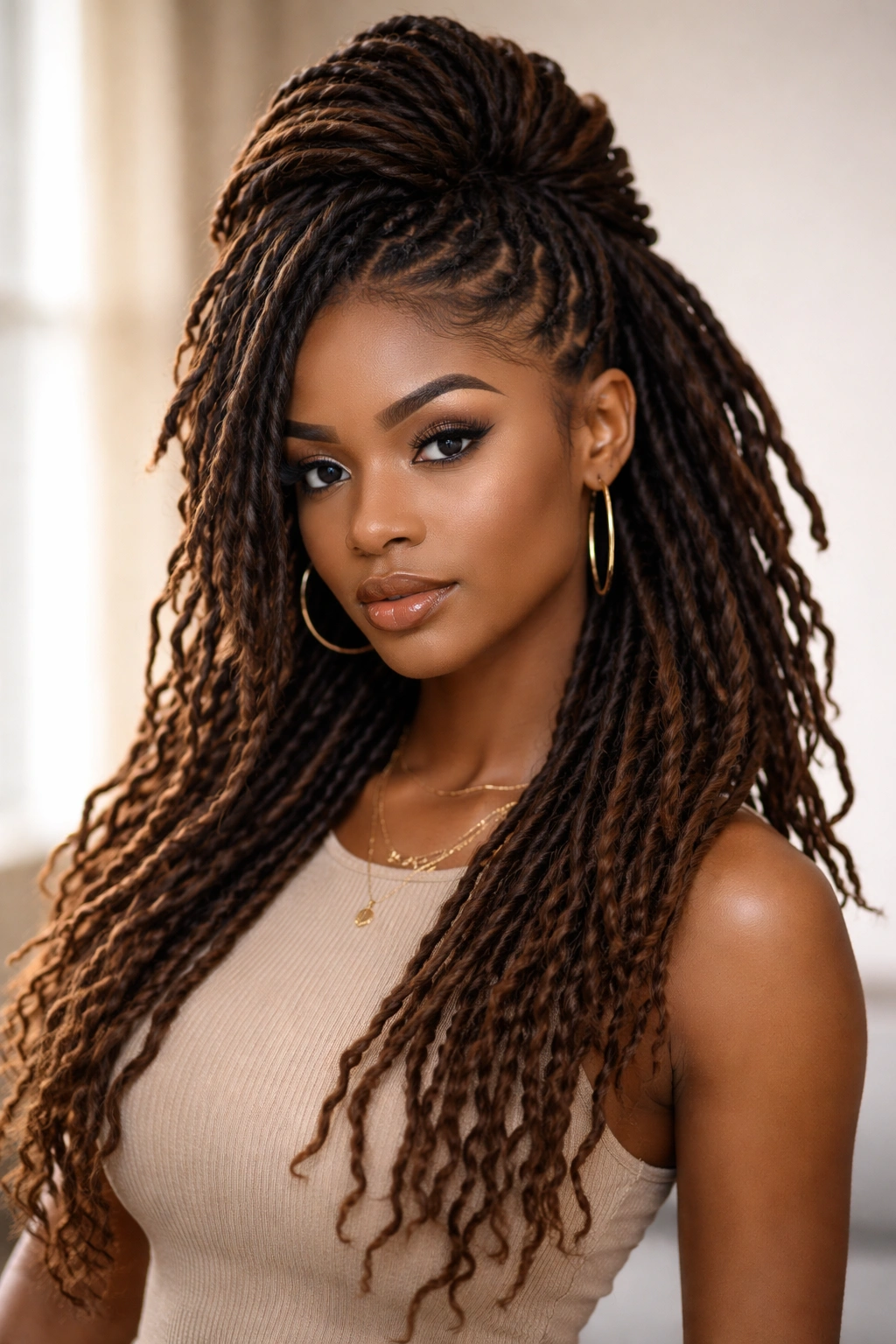
A faux hawk using locs creates height and attitude by gathering locs down the very center of your head from front to back, leaving the sides completely loose. This style is bold, playful, and genuinely different from the many side-gathered styles available.
Statement-Making Placement
Center-gathered styles automatically feel edgier and more fashion-forward than side-gathered or back-gathered styles. The faux hawk variation specifically creates lift and volume right down the middle of your head, which is flattering on almost every face shape and instantly communicates confidence and style.
Faux Hawk Construction
- Take a section of locs running straight down the center of your head from your front hairline to your nape
- Gather this center section into a twisted, braided, or coiled arrangement
- Secure the gathered section with bobby pins or a small elastic
- Smooth the gathered section slightly for a polished look
- Leave both sides of your head completely loose and free
- Optional: tease or backcomb the gathered center section for extra volume
Worth knowing: You can make this style more or less dramatic by gathering a thinner or thicker center section.
16. Side Knot Half Up
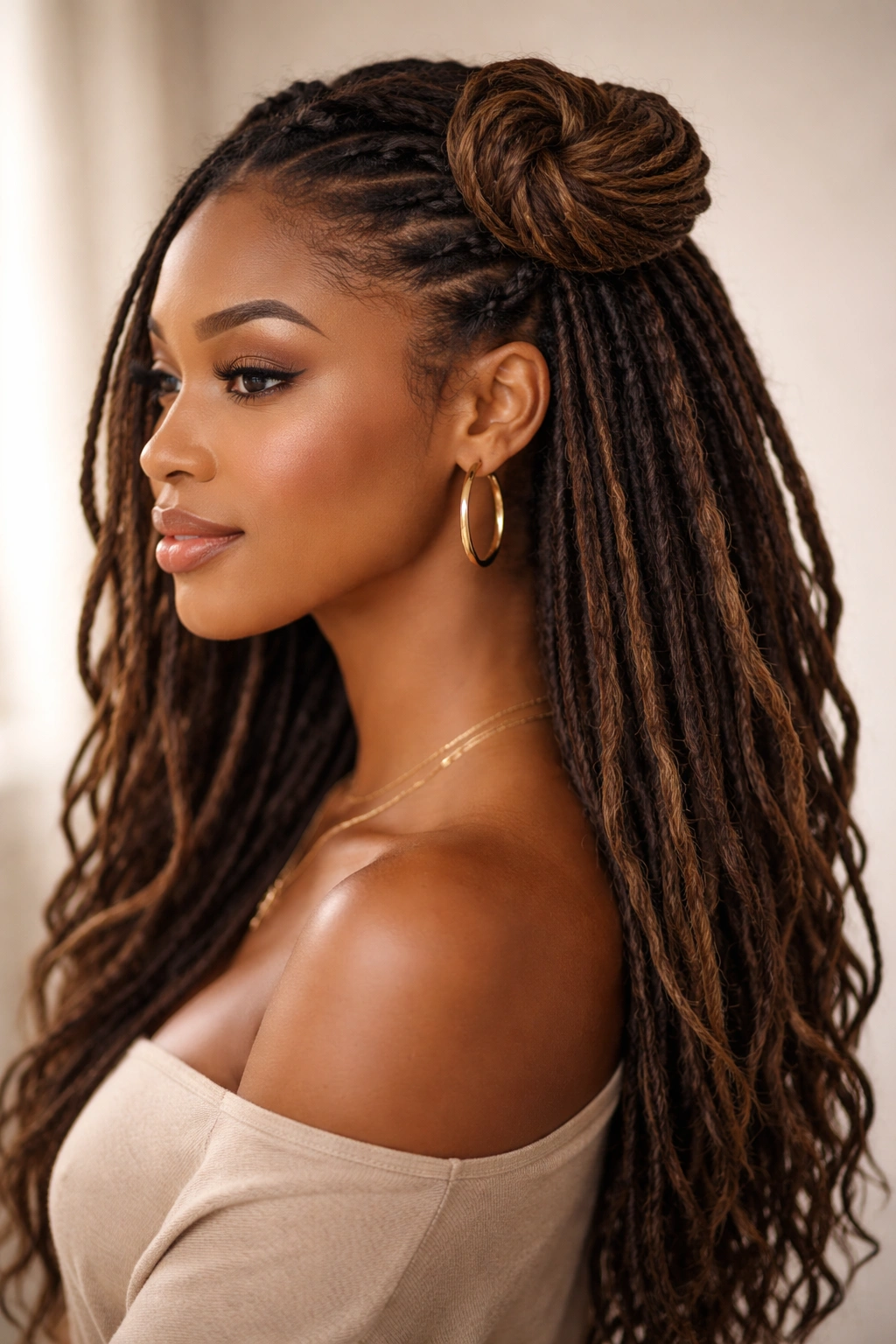
A side knot takes a gathered section and ties it literally into a loose knot shape before securing it, creating a sculptural, dimensional effect. This technique works especially well with thicker, more mature locs that have enough weight and substance to hold a knot shape beautifully.
Three-Dimensional Styling
A knot is three-dimensional in a way that twists and braids sometimes aren’t. It creates interesting shadows, catches light from multiple angles, and genuinely stands out. The knot shape also naturally accommodates the varying thicknesses within a loc, so it works beautifully even with less-than-perfectly-uniform locs.
Knotting Process
- Take a section of locs from the upper portion of your head
- Create a loose knot shape by bringing the section around and through itself
- Adjust the knot until it looks balanced and intentional
- Secure the knotted shape with bobby pins placed underneath and throughout the knot
- Tuck any loose ends under the knot securely
- Leave the remaining locs completely loose
Insider note: This style works best if you start with slightly damp or product-treated locs, as they hold the knot shape better than completely dry locs.
17. Braided Band Half Up
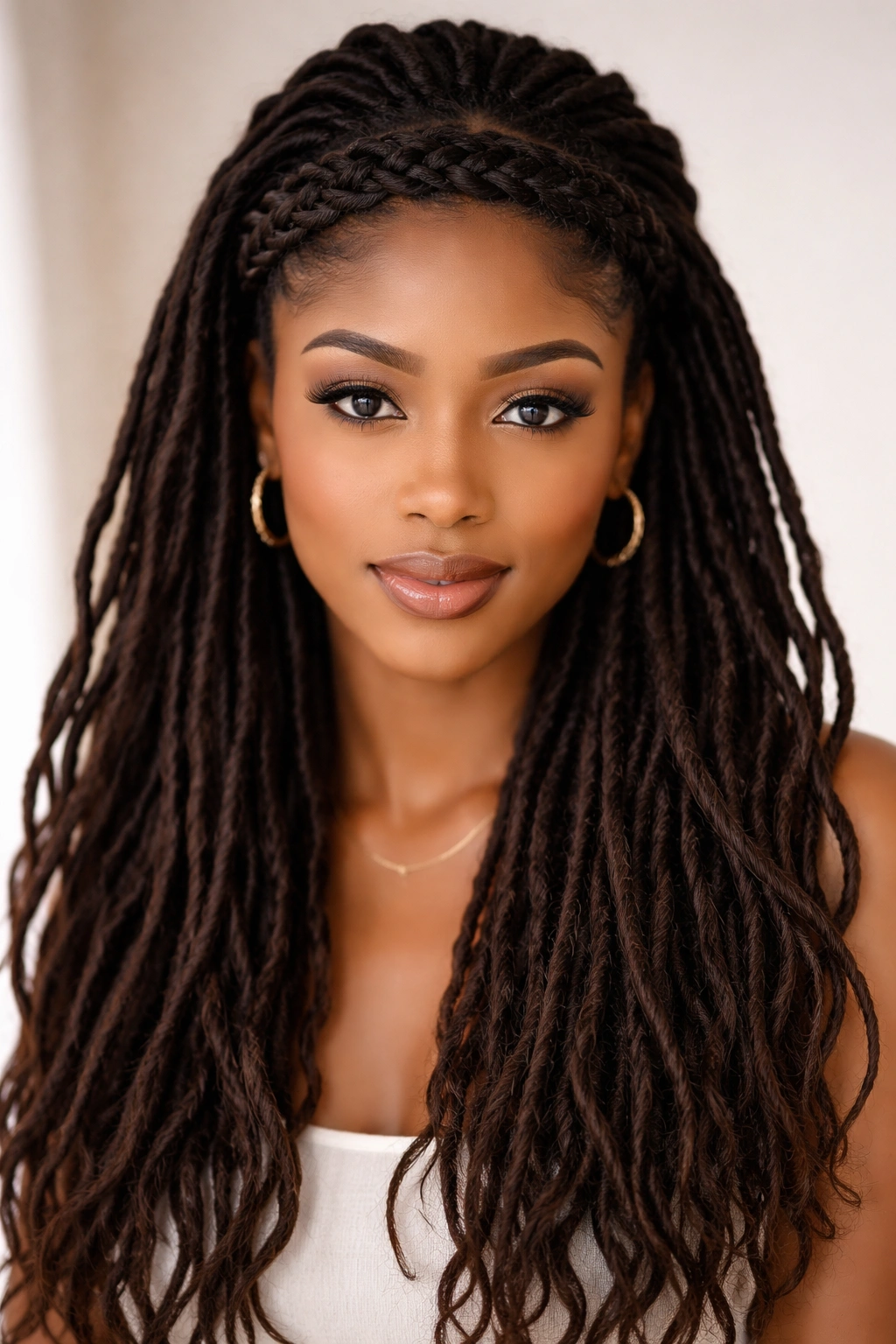
A braided band style creates a braid that functions like a band or headband running across the top of your head from one side to the other. The locs below the braided band hang completely loose, and the overall effect is sophisticated and distinctly different from traditional half up styles.
How a Band Changes the Game
Instead of gathering locs at the back of your head, a band-style braid sits horizontally across your head, creating a completely different visual line. This style is especially flattering on longer faces and reads very modern and fashion-forward — it’s the kind of style that makes a statement without being over-the-top.
Braided Band Execution
- Take a section of locs from one side of your head at about ear level
- Braid these locs together as you move across the back of your head toward the opposite side
- Continue braiding until you reach the opposite ear
- Secure the braid at both ends with bobby pins to keep it in place
- Leave all locs below the braid completely loose and free
- All locs above the braid also remain loose and free
Pro tip: Make the braid slightly loose and organic-looking rather than tight and controlled — that style reads as more modern and intentional.
18. Textured Curl Half Up
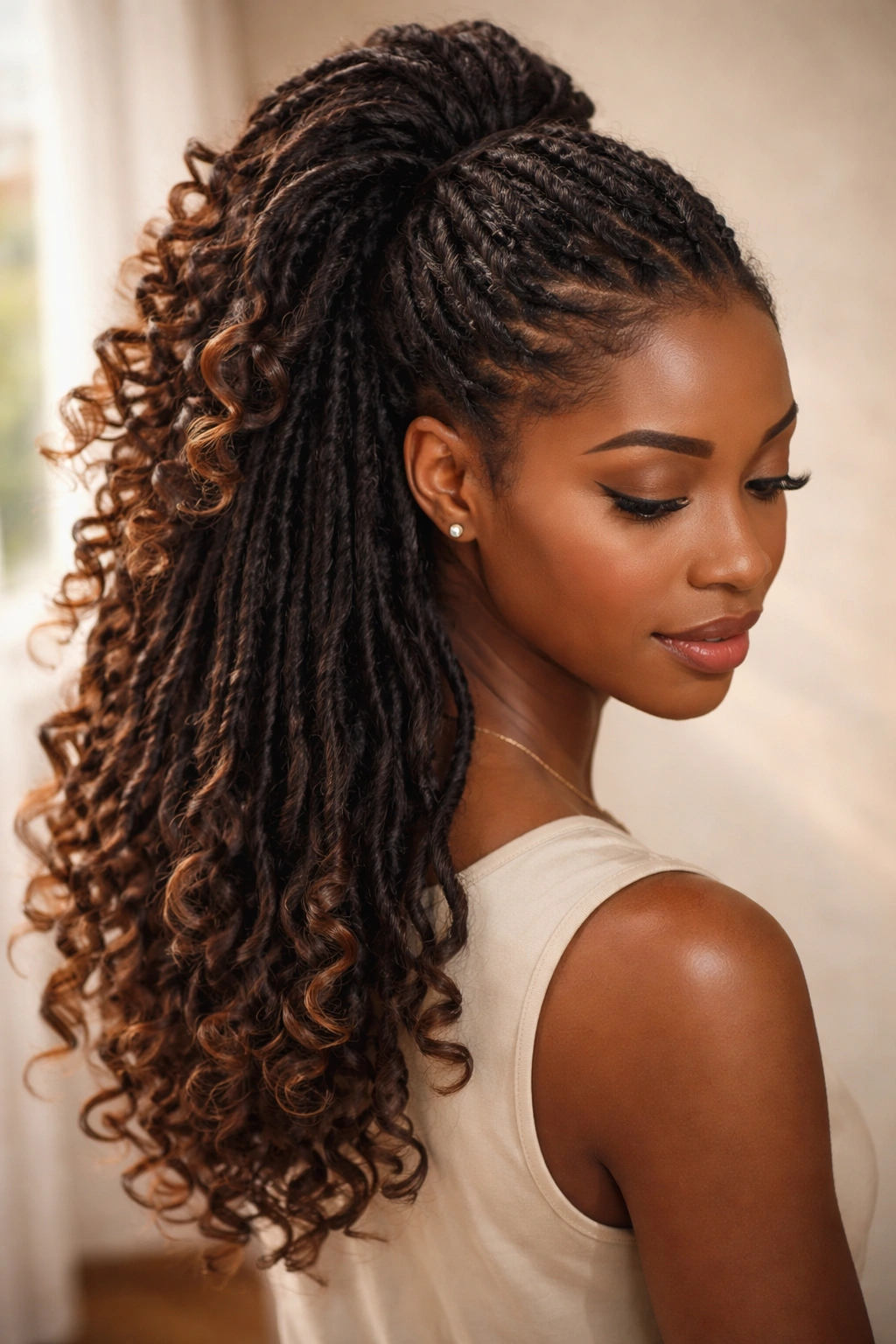
If you have locs that feature naturally curly or textured ends, a textured curl half up celebrates that texture by gathering your locs in a way that puts the curled ends on display. This style works with your locs’ natural texture rather than against it.
Celebrating What Your Locs Naturally Do
Many loc wearers with naturally textured locs try to hide or minimize the curled ends. A textured curl half up flips that script and makes those curls the focal point. It’s a celebration of your locs’ natural movement and texture, which reads as confident and intentional.
Textured Curl Styling
- Gather the upper section of your locs at the crown or slightly lower
- Secure this section loosely so the curled ends have freedom to move
- Gently finger-comb the loose section to enhance and define the natural curls
- Apply a lightweight curl cream or leave-in conditioner to enhance the curls further if desired
- Let the curled ends hang and move freely
- Avoid smoothing or controlling the texture — embrace the natural movement
Worth knowing: This style actually looks better a few days into your styling cycle when your locs have had time to fully relax and the curls have had time to set.
19. Sleek Low Half Up
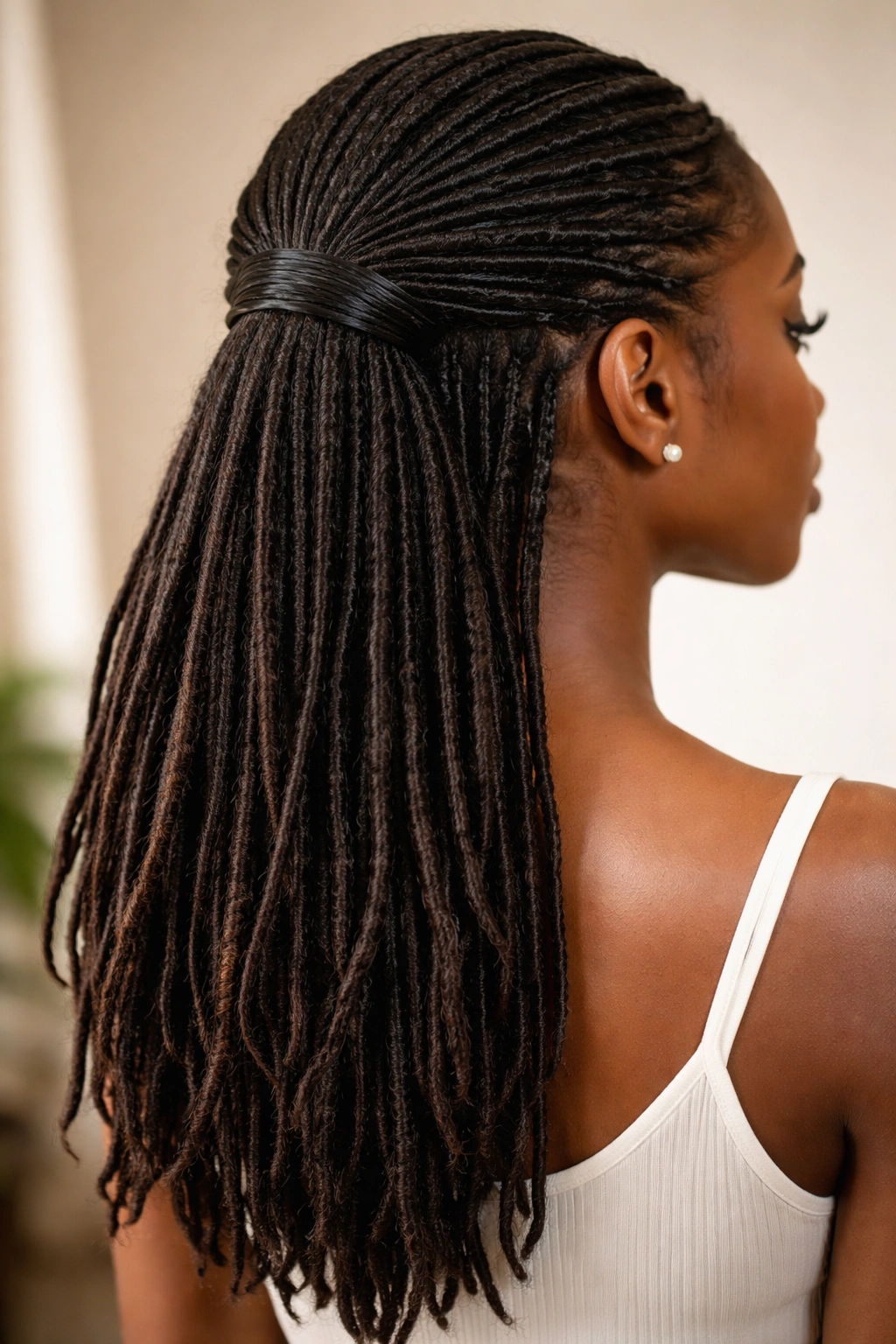
A sleek low half up gathers locs very low on the head — right at the nape or just slightly above — and creates a smooth, polished gathered section. The extremely low placement keeps most of your locs loose while still offering the benefits of a gathered style.
The Appeal of Low Placement
Low gathers are less dramatic than high gathers, which makes them perfect for professional settings or days when you want sophistication without statement-making. The low placement also means there’s less weight pulling on the locs at the gather point, which can be more comfortable for wearing throughout a long day.
Low Gather Technique
- Wait until you’re almost at the nape to begin gathering your locs
- Take a section from roughly ear level on each side
- Bring these sections together very low at the back of your head
- Secure with bobby pins, a small elastic, or a decorative clip
- Smooth the gathered section for a polished, finished look
- Let the vast majority of your locs hang loose and free
Pro tip: Use a fine-tooth comb and smoothing cream to create a sleek finish that reads as refined and intentional.
20. Half Up with Loc Jewelry
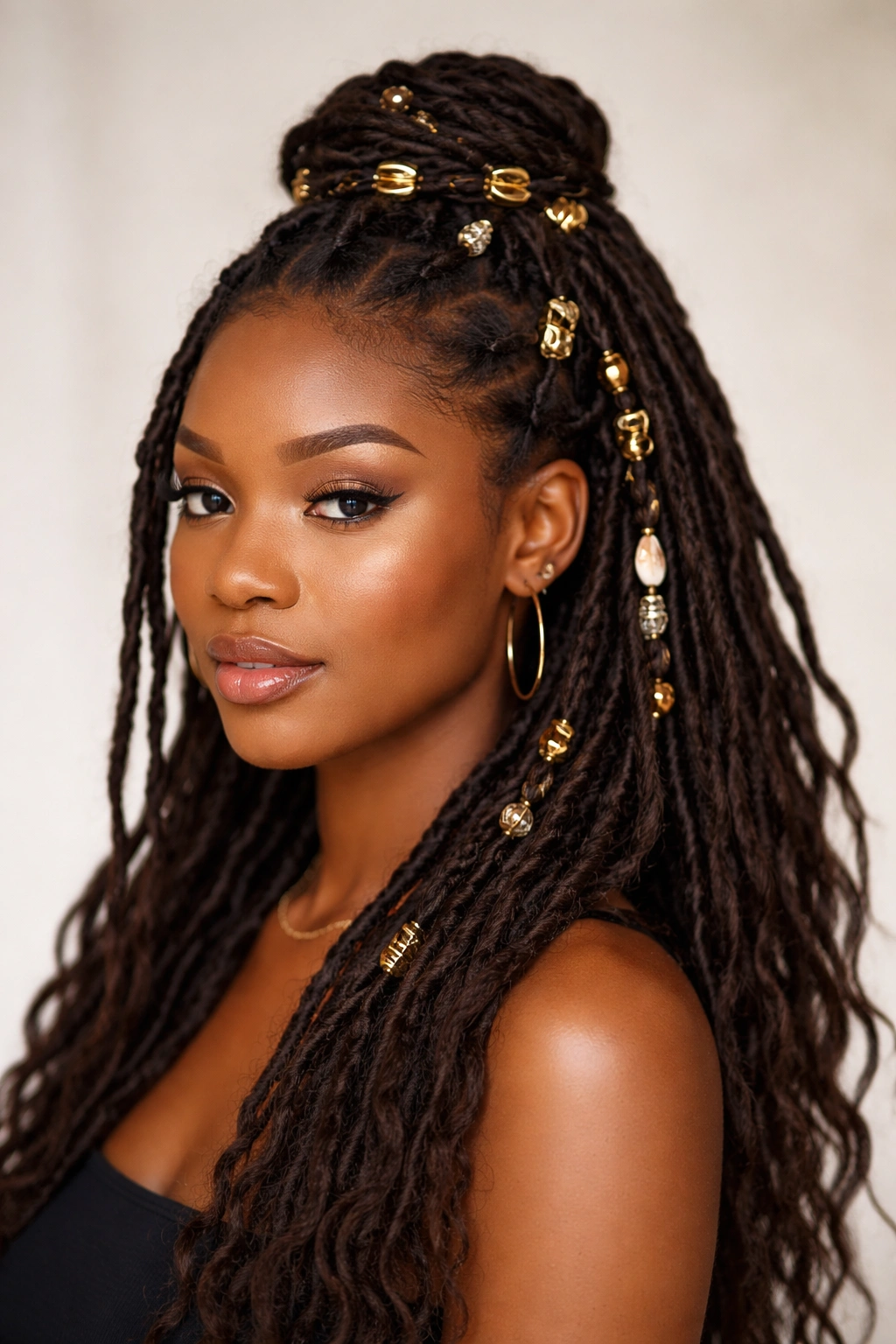
Half up with loc jewelry takes any of the previous styles and elevates it by incorporating jewelry specifically designed for locs — cuffs, rings, clips, and beads. The jewelry transforms the gathered section from simple to special, and it gives you unlimited creative direction.
Jewelry as Transformation
The same basic half up style reads entirely differently depending on what jewelry you choose. Gold cuffs create an elegant, refined look. Colorful beads create a playful, youthful vibe. Wooden rings create an earthy, bohemian aesthetic. You can change the entire mood of the style by simply swapping out the jewelry.
Jewelry Placement Ideas
- Add cuffs to the gathered section itself, sliding them onto individual locs
- Thread small beads onto specific locs in the loose section
- Use decorative clips to secure the gathered section, choosing clips that coordinate with your outfit
- Stack multiple thin metal rings across the gathered section
- Attach a hair charm or pendant to a single loc in the loose section
- Mix metals and materials for a curated, intentional look
Insider note: Invest in quality loc jewelry made specifically for locs rather than regular hair jewelry — specialty jewelry is designed to sit properly and won’t damage your locs.
Final Thoughts
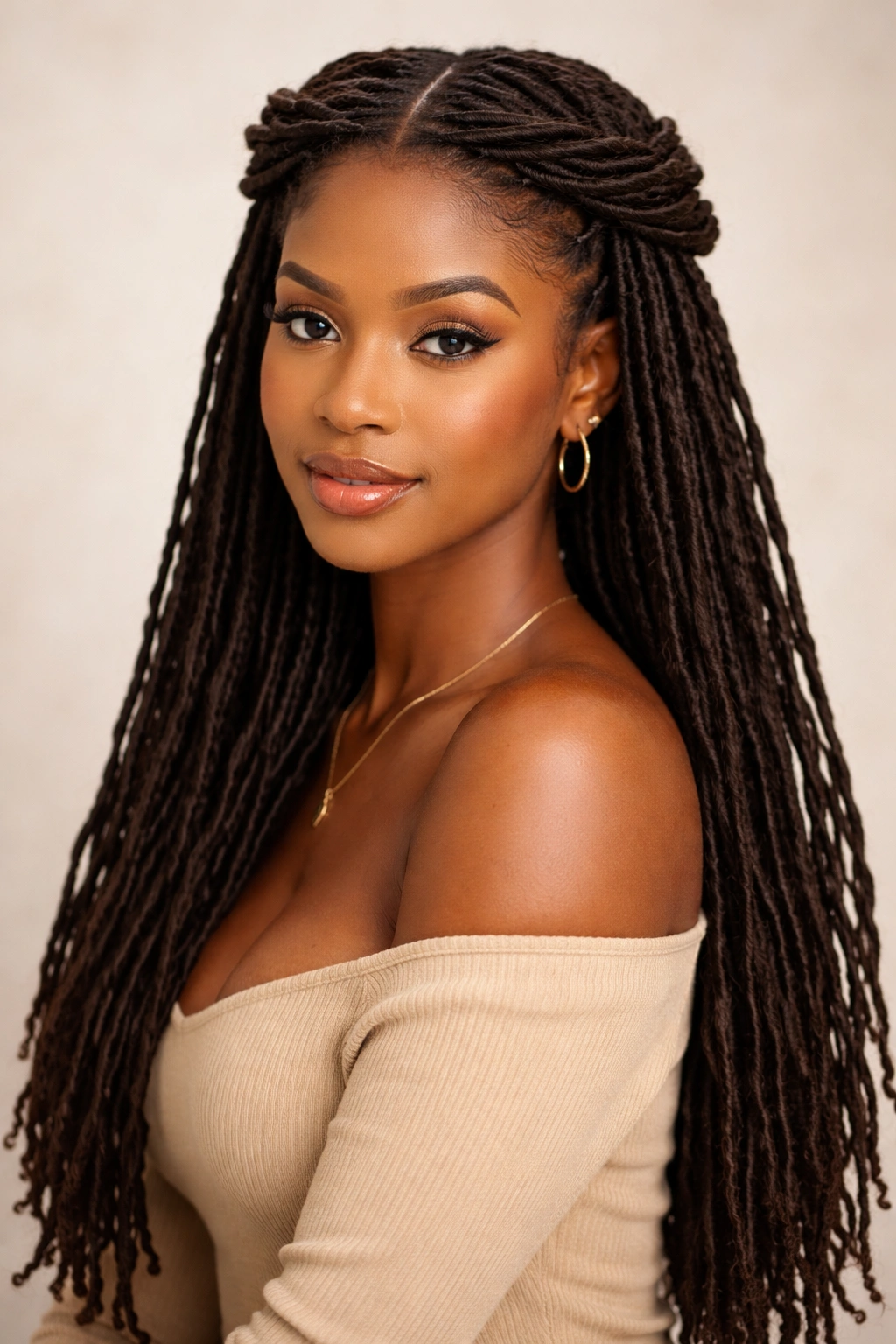
The incredible range of half up half down loc styles available means you’ll never run out of options. What makes these styles so powerful isn’t just their visual variety, but the fact that you can shift your entire look and feel simply by changing where you gather, how you twist or braid, or what accessories you choose. A style that reads polished and professional in the morning can feel bohemian and free by evening if you loosen it up and add a different clip.
The real secret to mastering these styles is giving yourself permission to experiment. Try the classic twisted crown when you’re learning, then play with variations — twist tighter or looser, place your gather higher or lower, add jewelry, or skip it entirely. The more you practice, the faster these styles become, and eventually you’ll be able to create a completely new look in the time it takes to drink your morning coffee.
Remember that your locs are unique, and styles will adapt themselves to your specific hair texture, thickness, and length. A style that looks one way on someone with thin, long locs will look different on someone with thick, shoulder-length locs — and both versions can be absolutely stunning. Trust your instincts, have fun with the process, and recognize that the confidence you wear is always the best accessory.
