



Half up half down hairstyles have become a staple for anyone who wants polished without looking overly formal. They hit that perfect sweet spot between casual and put-together — your hair has movement and texture, but you’re keeping it partially off your face so you actually look like you tried. The magic happens when you add a bandana to the mix. What might seem like a simple accessory instantly transforms the whole look, adding color, pattern, texture, and personality while keeping your styling options virtually endless.
A bandana isn’t just a nostalgic accessory from the nineties — it’s a legitimate styling tool that works across hair types, lengths, and textures. Whether you’re working with fine, straight hair that needs visual weight, thick curls that need a focal point, or anything in between, there’s a bandana style that amplifies what you’re doing with the half up half down technique. The best part? Most of these styles take less than five minutes once you’ve practiced them a couple of times, and they work just as well whether your hair is freshly styled or in its second or third day of wear.
What makes these styles so versatile is how a single bandana can completely change the vibe. A neutral linen bandana reads as minimalist and modern. A silk patterned bandana leans bohemian and artsy. A metallic or sequined bandana bumps the energy up to playful and bold. You’re not just choosing a hairstyle — you’re choosing a way to express what you’re going for on any given day. Let’s break down twelve distinct approaches that will give you real, tested options for incorporating a bandana into your half up half down style.
1. Classic Bandana Bow Tie
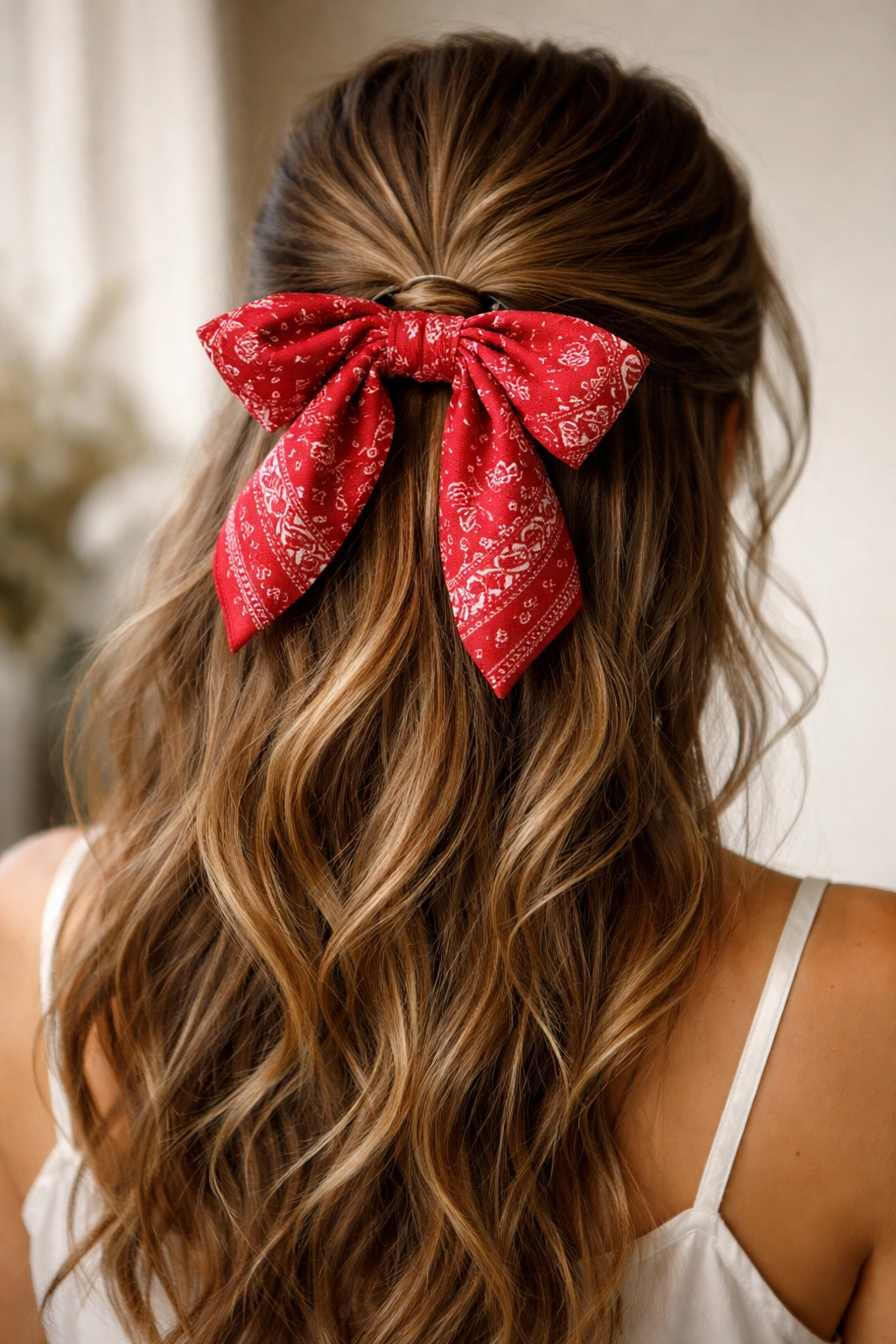
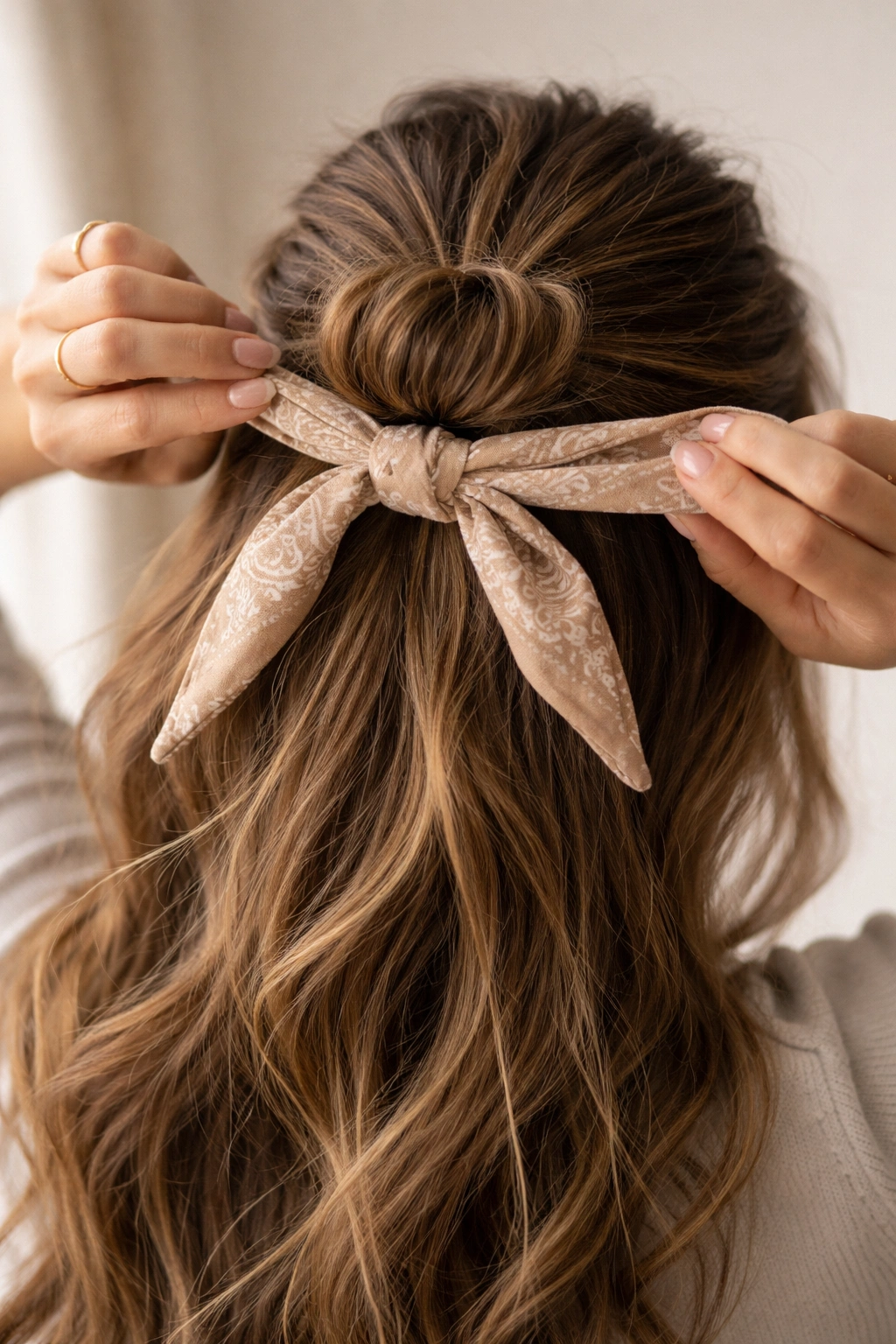
The simplest version is often the most elegant. Gather the top half of your hair at the crown and secure it with a clear elastic. Take a bandana folded into a long strip and wrap it around the base of your ponytail, then tie it into a bow at the back or to the side. The bow becomes the focal point, and your hair falls freely underneath, creating a polished look that reads sophisticated without effort.
Why This Works So Well
The bandana bow is forgiving because it doesn’t require your hair to be perfectly smooth or styled in any particular way. It works on wavy hair, curly hair, straight hair, and textured hair equally well. The bow adds a finished quality that makes even undone, textured hair look intentional rather than accidental.
How to Execute It Perfectly
- Start with your hair down and work a texturizing product (dry shampoo, texture spray, or even a light hairspray) through the crown area so you have grip for holding the ponytail
- Section out the top half of your hair by creating a horizontal part from temple to temple, about an inch above your ear on each side
- Gather this section and secure it with a clear elastic at the crown — make sure it’s not too tight or too loose, right in the sweet spot where it sits at the top of your head
- Fold your bandana lengthwise into a strip about one to two inches wide
- Wrap the bandana around the base of the ponytail, crossing one end over the other, and tie it in a simple bow
- Use the tails of the bandana to create the bow loops, or let them drape down the back for a more relaxed feel
Pro tip: If your bandana feels slippery when you tie it, secure it first with a tiny clear elastic before tying the bow — this prevents it from sliding throughout the day.
2. Twisted Bandana Through Half-Up
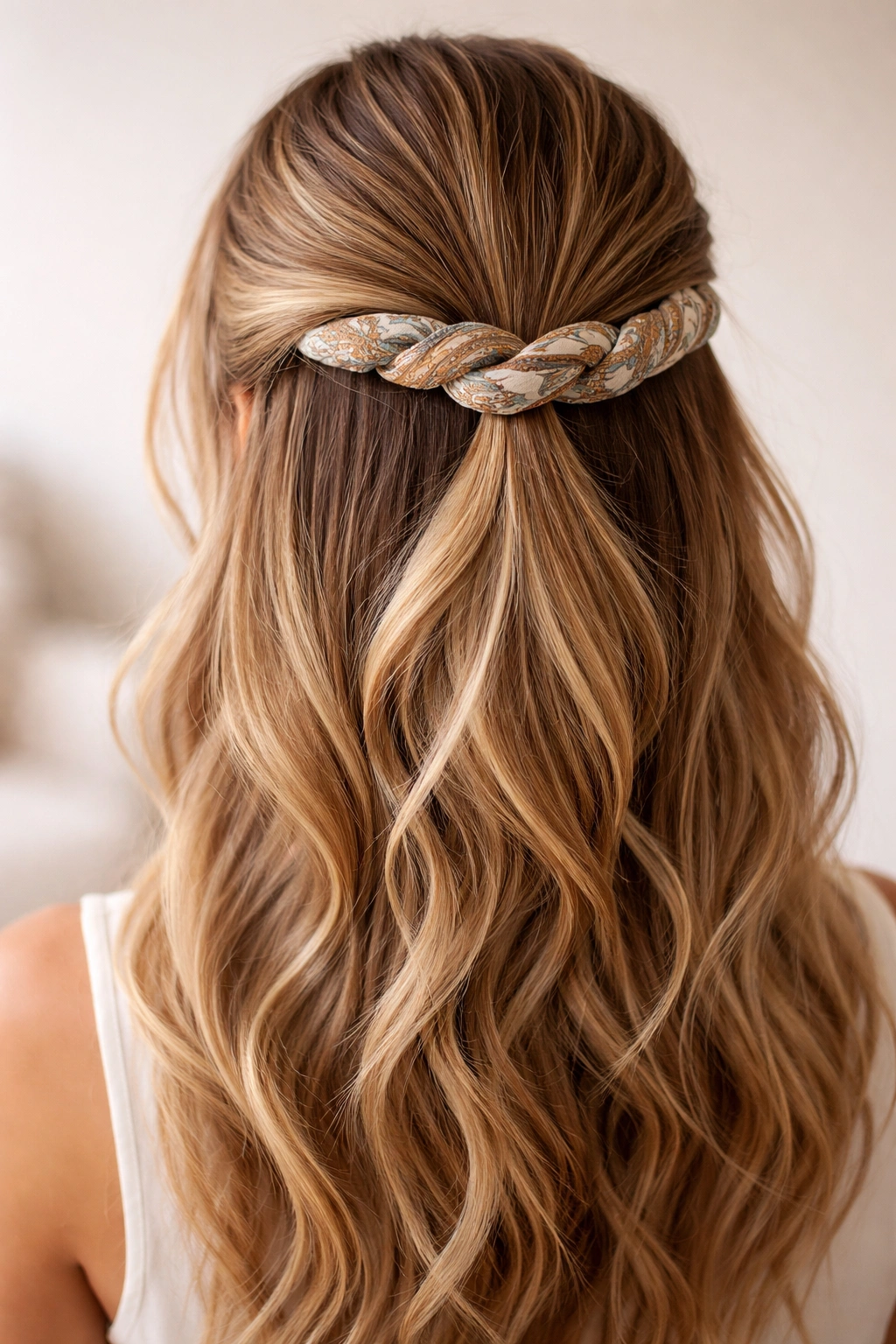
Instead of a bow, weave a twisted bandana directly through the base of your half-up section for a more integrated look. Fold the bandana into a band, twist it, and wrap it around where your elastic sits, then tuck the ends underneath or braid them in. This style creates the illusion that the bandana is part of your actual hair structure rather than sitting on top of it.
The Visual Impact
This approach adds dimension and color exactly where the eye naturally lands — at the crown. Because the bandana is twisted and woven rather than sitting as a separate accessory, it feels more sophisticated and less costume-y. It also works beautifully with patterned bandanas because the twist breaks up the pattern in an interesting way.
Step-by-Step Technique
- Create your half-up ponytail using a clear elastic at the crown
- Take your bandana and fold it lengthwise into a band shape
- Pinch one end of the bandana with your index and thumb, then twist the entire length gently until it forms a rope-like texture
- Wrap this twisted bandana around the base of your ponytail, starting at the back
- Cross the two ends in front and either tie them in a knot, tuck them under the elastic, or continue braiding them down through the ponytail
- Gently pull some face-framing pieces loose to soften the look
Worth knowing: Thinner bandanas work better for this style than thick cotton ones, which can create too much bulk at the crown.
3. Bandana as the Hair Tie
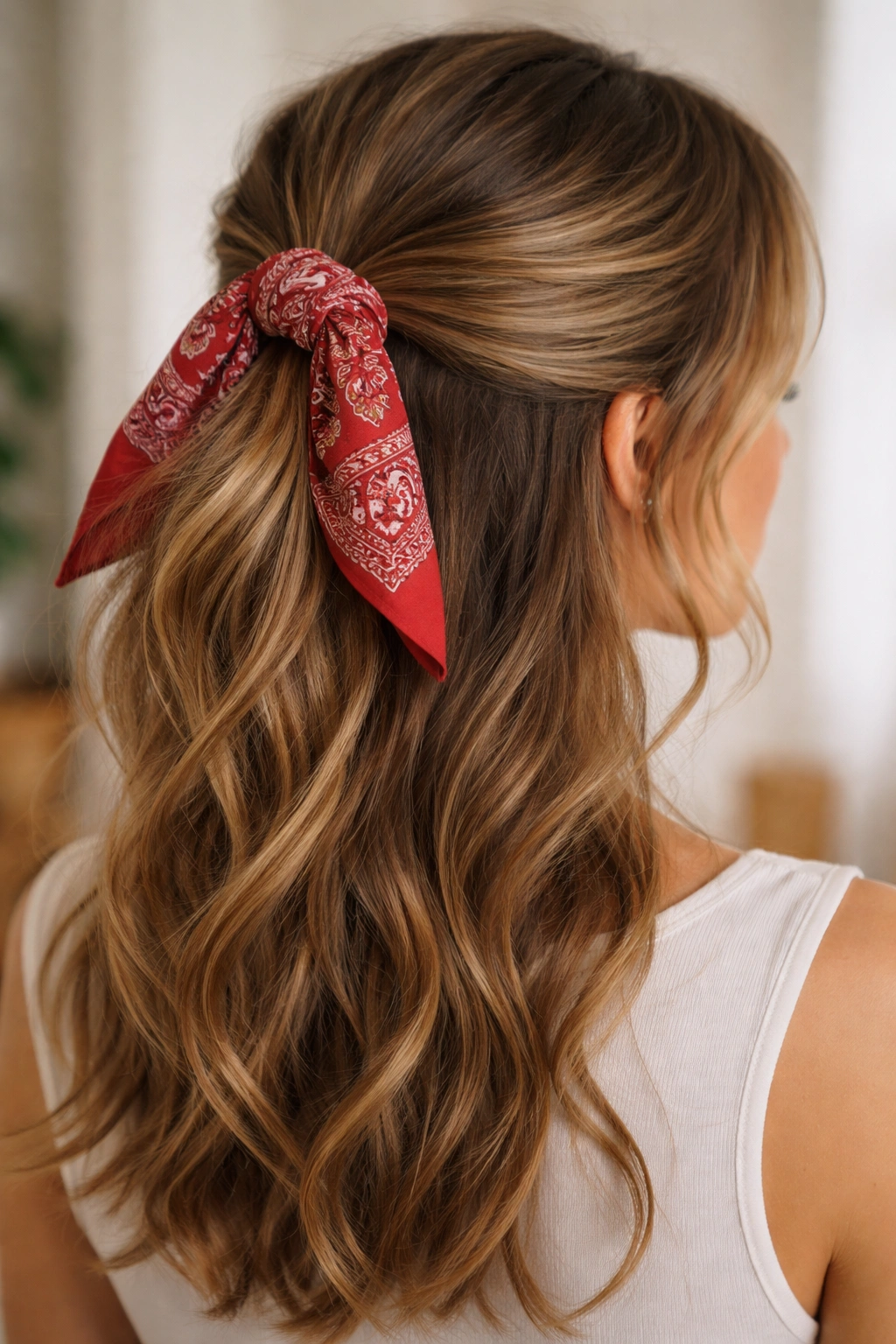
Make the bandana itself become the hair tie by folding it into a narrow strip and using it to secure your half-up section instead of using an elastic. This completely eliminates visible elastics from your style and creates a look that feels custom and intentional. Your hair sits in the bandana as if it’s been styled that way all along.
What Makes This Special
This is the version of the style that feels most polished, because there’s no plastic elastic showing anywhere. The fabric of the bandana is smooth against your hair and actually grips better than you’d expect, so your ponytail stays secure throughout the day. It also works for creating a more vintage or retro-inspired vibe.
How to Create a Bandana Hair Tie
- Select a bandana in a pattern or color that contrasts with or complements your hair color
- Fold it corner to corner to create a long triangle shape
- Continue folding it lengthwise until you have a band roughly one to one-and-a-half inches wide
- Gather your top half of hair into the position where you want your half-up section to sit
- Wrap the folded bandana around the hair twice, covering the base of the section completely
- Tie the two ends of the bandana in a secure knot at the back
- Gently tug a few wisps of hair loose around your face and temples to soften the structure
Pro tip: Use a silk or satin bandana for this version rather than cotton — it creates less friction and won’t snag your hair the way rougher fabrics can.
4. Double Bandana Technique
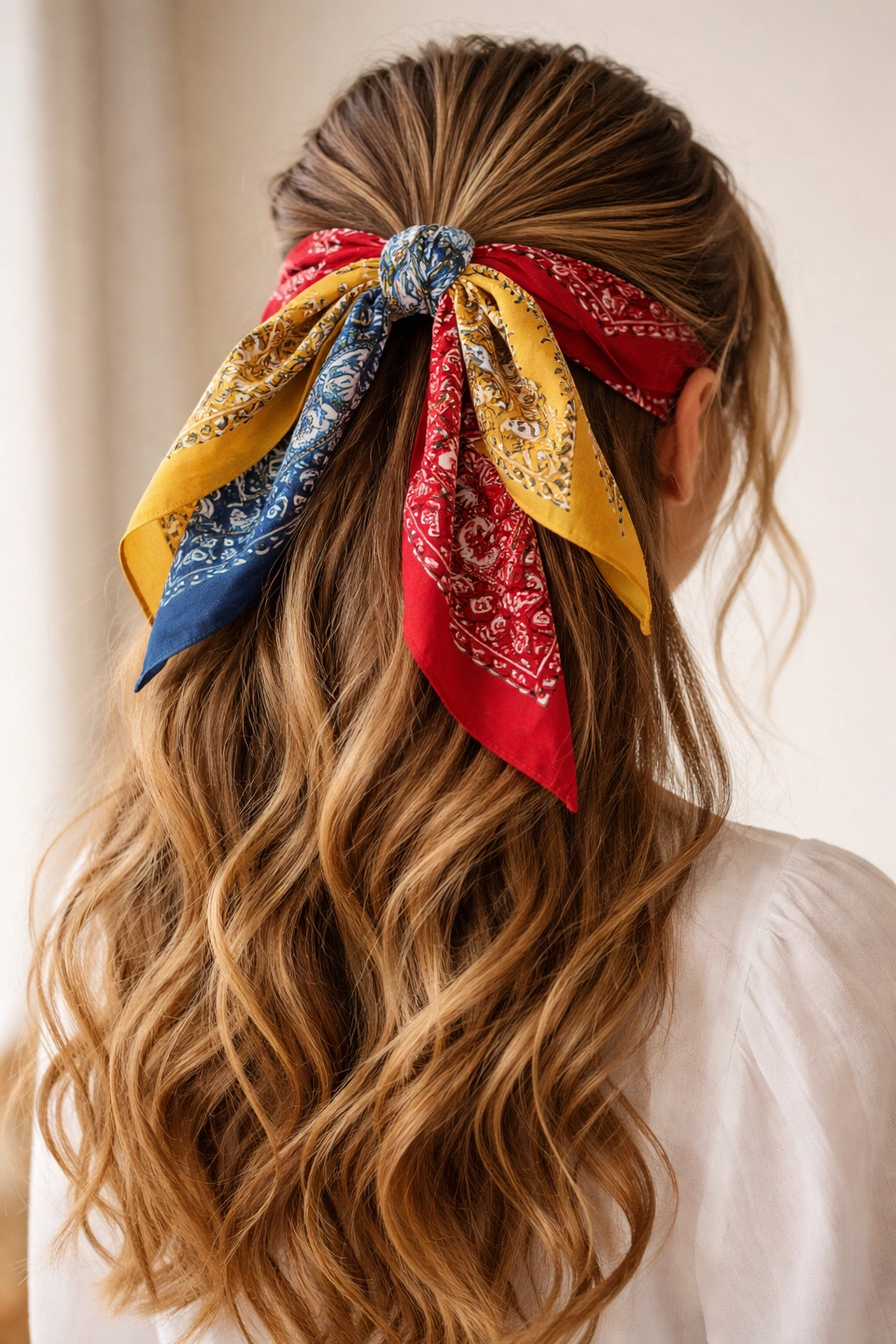
Layer two different bandanas in complementary colors or patterns — tie one in your half-up section and drape the second one loosely over the top, then tie both together. This creates visual richness and depth that a single bandana can’t achieve. The effect is bold without feeling overdone because both bandanas work together rather than competing.
Designing Your Color Combination
The key to making a double bandana work is choosing colors that speak to each other. You could use a solid color with a patterned version of the same color, or two solids that are adjacent on the color wheel (like blush pink and coral), or a bold contrast if you’re going for something more dramatic. Metallics work beautifully paired with jewel tones.
Layering Two Bandanas
- Start by creating your half-up ponytail and securing it with a clear elastic
- Take your first bandana (ideally the larger or bolder of the two) and fold it into a band
- Wrap it around the base of your ponytail and tie it into a bow or knot
- Take your second bandana and fold it slightly differently — maybe into a narrower band or a slightly different configuration
- Layer the second bandana over the first, wrapping it around the same base point
- Tie both bandanas together, or let the second one drape more loosely for a cascading effect
- Adjust the placement so both bandanas are visible and complement each other rather than one completely hiding the other
Real talk: This style works best when at least one of your bandanas is a lighter or brighter color, so both layers are actually visible.
5. Bandana-Wrapped Ponytail with Braid
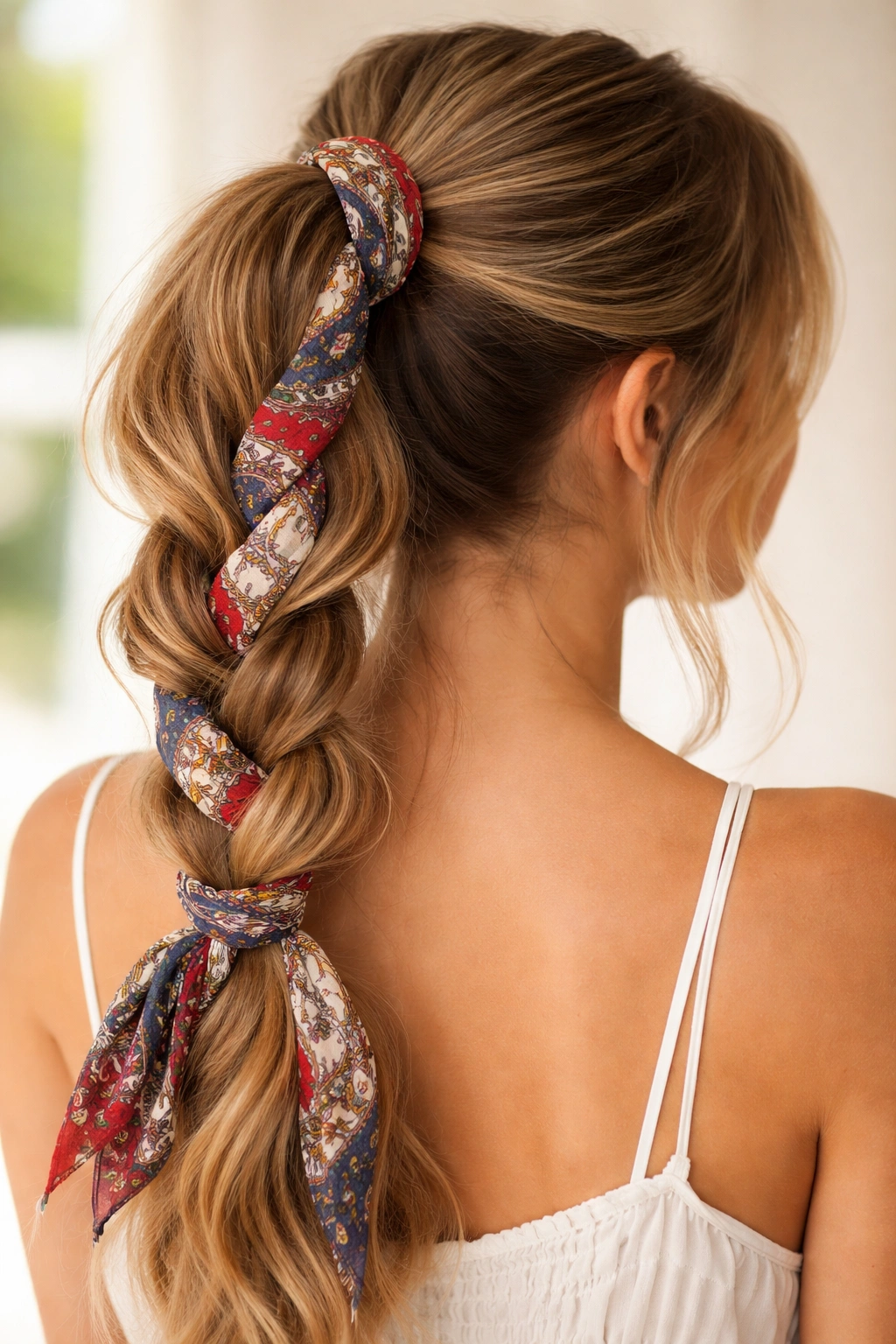
Create a half-up ponytail, wrap a bandana around the base, then braid the ponytail section with the bandana woven through it. The braid pulls the styling together and creates texture, while the bandana appears throughout the braid for continuous color. This hybrid approach works beautifully on longer hair with good texture or on people who want more visual interest than a simple ponytail creates.
The Braiding Strategy
This works best with three-strand braids because the width allows the bandana to show clearly between the strands. You can create a single centered braid or two side braids for a different vibe. The bandana should be visible at regular intervals down the braid rather than completely hidden.
Creating the Bandana-Through-Braid Style
- Secure your half-up ponytail at the crown with a clear elastic
- Fold your bandana lengthwise into a band about one inch wide
- Divide your ponytail into three even sections, and position the bandana so it sits alongside one of the three sections
- Begin a three-strand braid, keeping the bandana as one of your “sections” — you’ll braid the bandana over and under the hair sections as you normally would
- Braid all the way down to the ends of your hair
- Secure the braid with another small elastic at the bottom
- Gently pull the sides of the braid to make it looser and fluffier, which makes the bandana pattern more visible
- Wrap the tail of the bandana around the bottom elastic if there’s extra length
Pro tip: Practice this style without the bandana first, just doing a regular three-strand braid. Once that feels natural, adding the bandana as a “fourth section” becomes much easier.
6. Bandana Crown Detail Over Half-Up
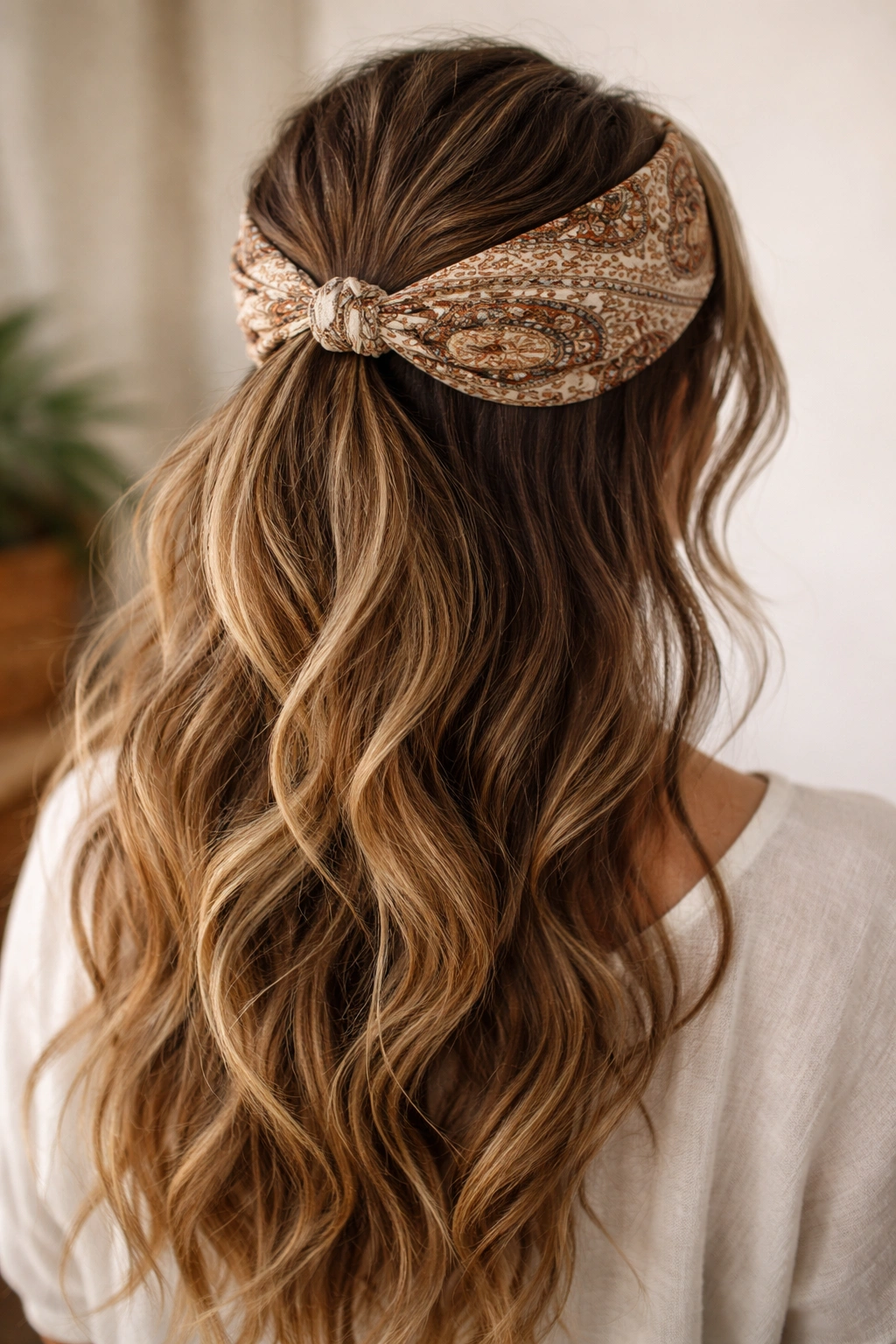
Instead of securing the bandana at the base of your ponytail, position it higher — right at the very crown of your head — as if it’s a headband sitting across the top. Create your half-up ponytail underneath this bandana crown, so the ponytail emerges from underneath the bandana at the back. This creates a princess-like or bohemian look depending on which style of bandana you choose.
The Positioning That Makes the Difference
The bandana crown works best when it sits right at your hairline, almost like a tiara, rather than further back on your head. This requires a slightly different securing method than the other styles. You’re not using the bandana as a hair tie — you’re placing it on your head and then arranging your hair around it.
Creating the Crown-Style Look
- Start with your hair down and brush it back smoothly
- Position a wide bandana across the top of your head like a headband, with the fold at your forehead and the tie area at the back of your head
- Tie the bandana at the back of your neck or at the base of your skull
- Now gather your hair from the sides and back into a ponytail that sits underneath the bandana tie
- Secure this ponytail with a clear elastic
- Make sure the bandana sits evenly across the top and the ponytail emerges cleanly below it
- Pull a few face-framing pieces loose to soften the look
- You can leave the rest of your hair down if you want, or braid the ponytail section for extra texture
Worth knowing: This style actually works beautifully on shorter hair (chin-length or longer) because the crown placement and the framing pieces create the effect of having more hair than you might actually have.
7. Side-Swept Half-Up with Bandana Accent
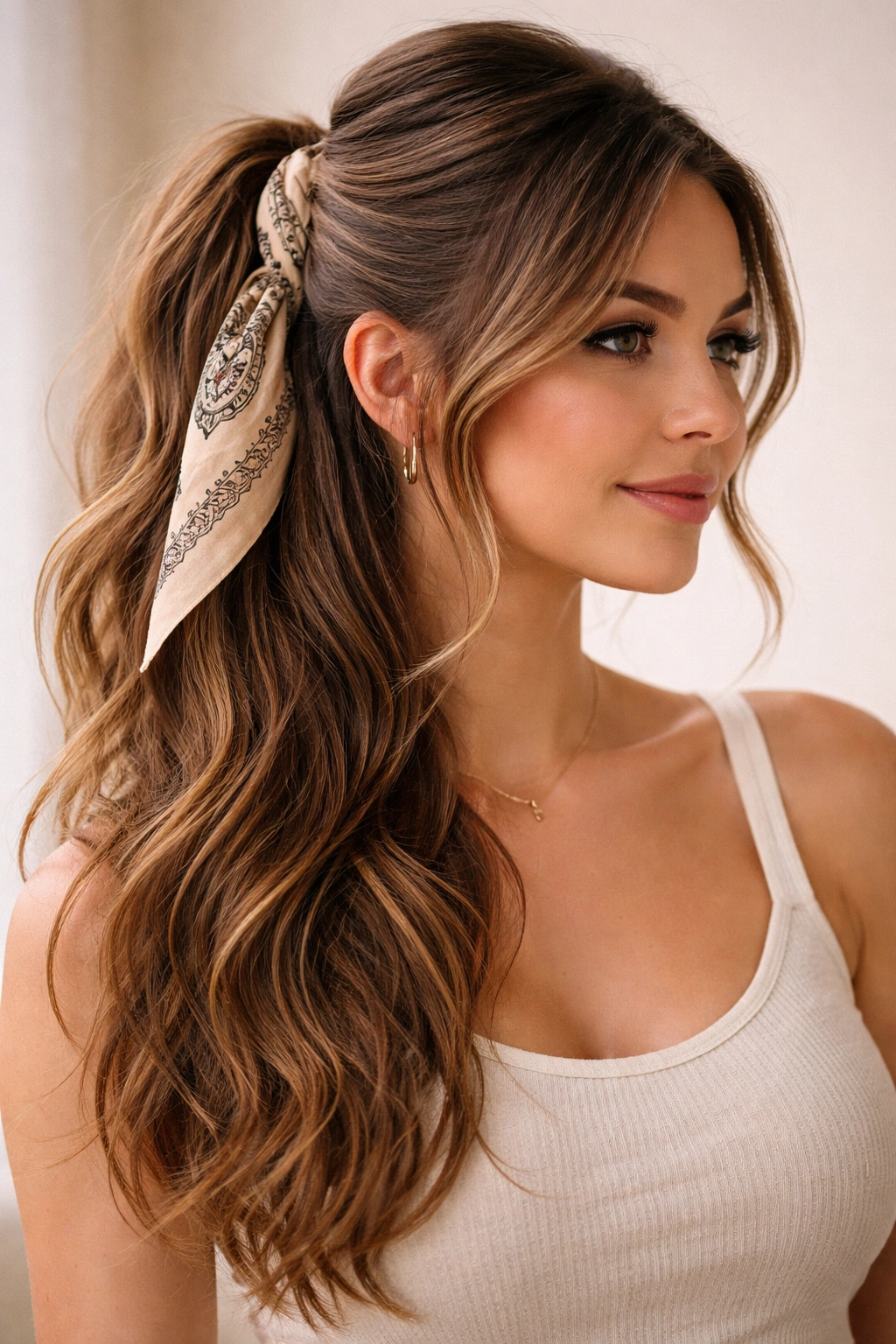
Pull your hair to one side for your half-up section instead of centering it at the crown, then secure a bandana around that off-center ponytail. This asymmetrical approach feels more modern and playful than a centered style, and it shows off more of your neck and face on one side. The off-center placement also makes the bandana feel less formal and more contemporary.
Why Side-Swept Works
An asymmetrical half-up automatically reads as more intentional and styled than a centered version. Adding a bandana to an already asymmetrical style doubles down on that effect. It’s perfect for days when you want to look put-together but not formal, or when you want to emphasize one side of your face or show off your neck.
Creating the Side-Swept Half-Up
- Part your hair on one side — at least two to three inches off-center
- Gather the hair on the side with less hair and pull it toward the back
- Bring the front section of hair from your larger side toward the back as well, so you’re gathering hair to a point at the back-lower side of your head rather than straight back
- Secure this section with a clear elastic
- Take your folded bandana and wrap it around this off-center ponytail
- Tie it in a bow or knot — the bow will sit to one side of the back of your head rather than centered
- Leave the rest of your hair down, textured however you prefer
- Pull a few longer pieces around your face to frame it softly
Pro tip: This style works especially well if you have longer hair (past shoulder length) because the asymmetry is more noticeable and creates better visual balance.
8. Bandana Crisscross Half-Up
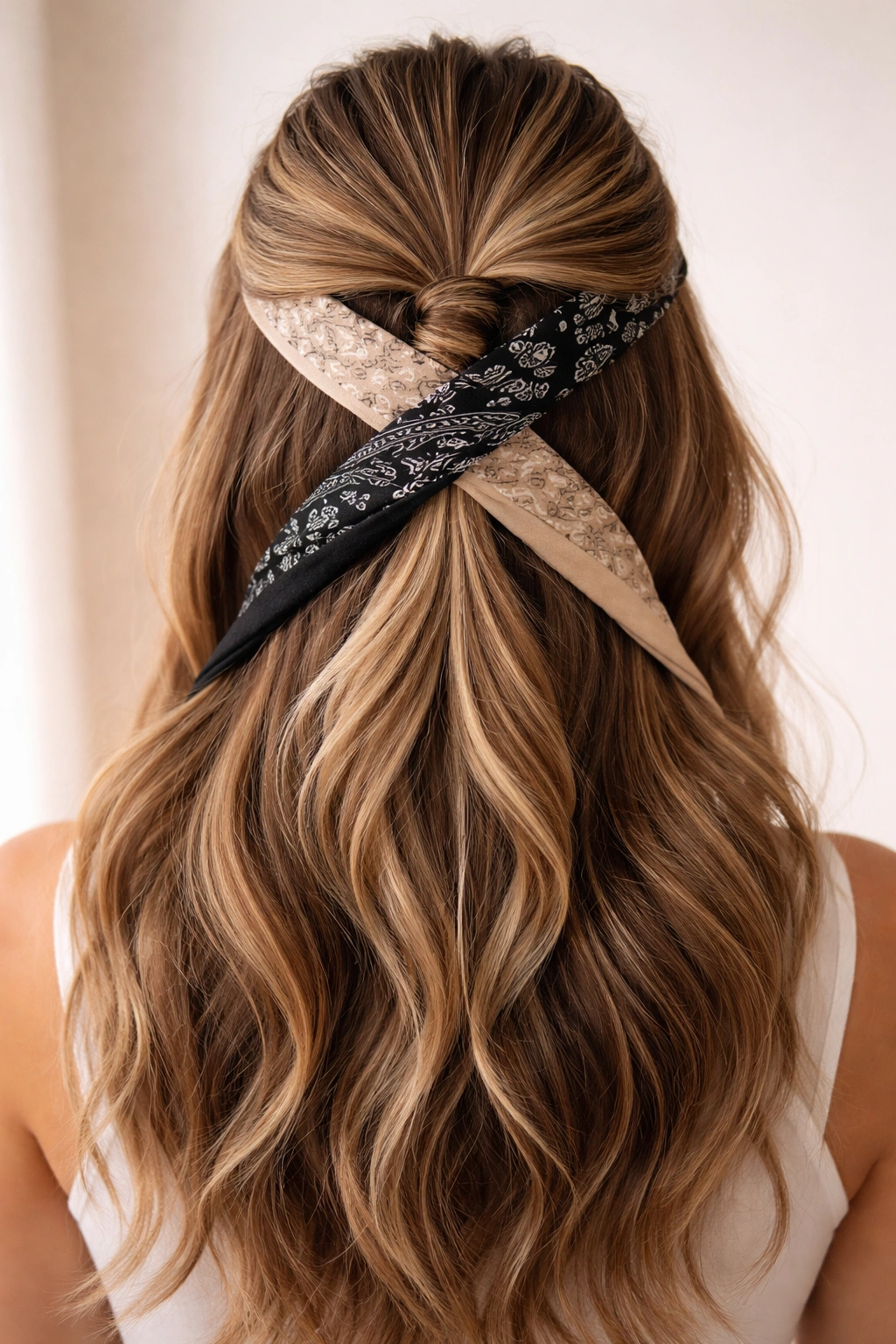
Use two bandanas (or fold one bandana into two sections) to create an X pattern across the back of your head, meeting at your half-up ponytail base. Each bandana comes from a side temple, crosses diagonally across the back, and they meet at the center back where your half-up section is secured. The crisscross pattern adds visual interest and a more artistic, fashion-forward feel.
The Dramatic Impact
This style is bolder than the single-bandana versions and definitely reads as “I made an effort.” It works beautifully in photos and creates a focal point that draws the eye. It’s the kind of style that makes people ask if you got your hair professionally done, even though it’s actually quite simple to execute.
Steps for the Crisscross Pattern
- Start with your half-up ponytail secured at the crown with a clear elastic
- Take your first bandana (or one half of your folded bandana) and start at the right temple
- Pull it diagonally across the back of your head toward the left, so it passes behind your ear
- Hold it in place at the left side back — it should look like a diagonal line from right front to left back
- Take your second bandana and start at the left temple
- Pull it diagonally across the back toward the right, creating an X pattern with the first bandana
- Cross both bandanas at the center back, right at the base of your ponytail
- Secure both bandanas together by wrapping them around your elastic and tying them in a bow or knot
- Adjust so both bandanas are visible and the X pattern is clear
Worth knowing: This style shows off your face shape well because it frames your face from the sides without any hair obscuring your features.
9. Bandana with Soft Waves and Texture
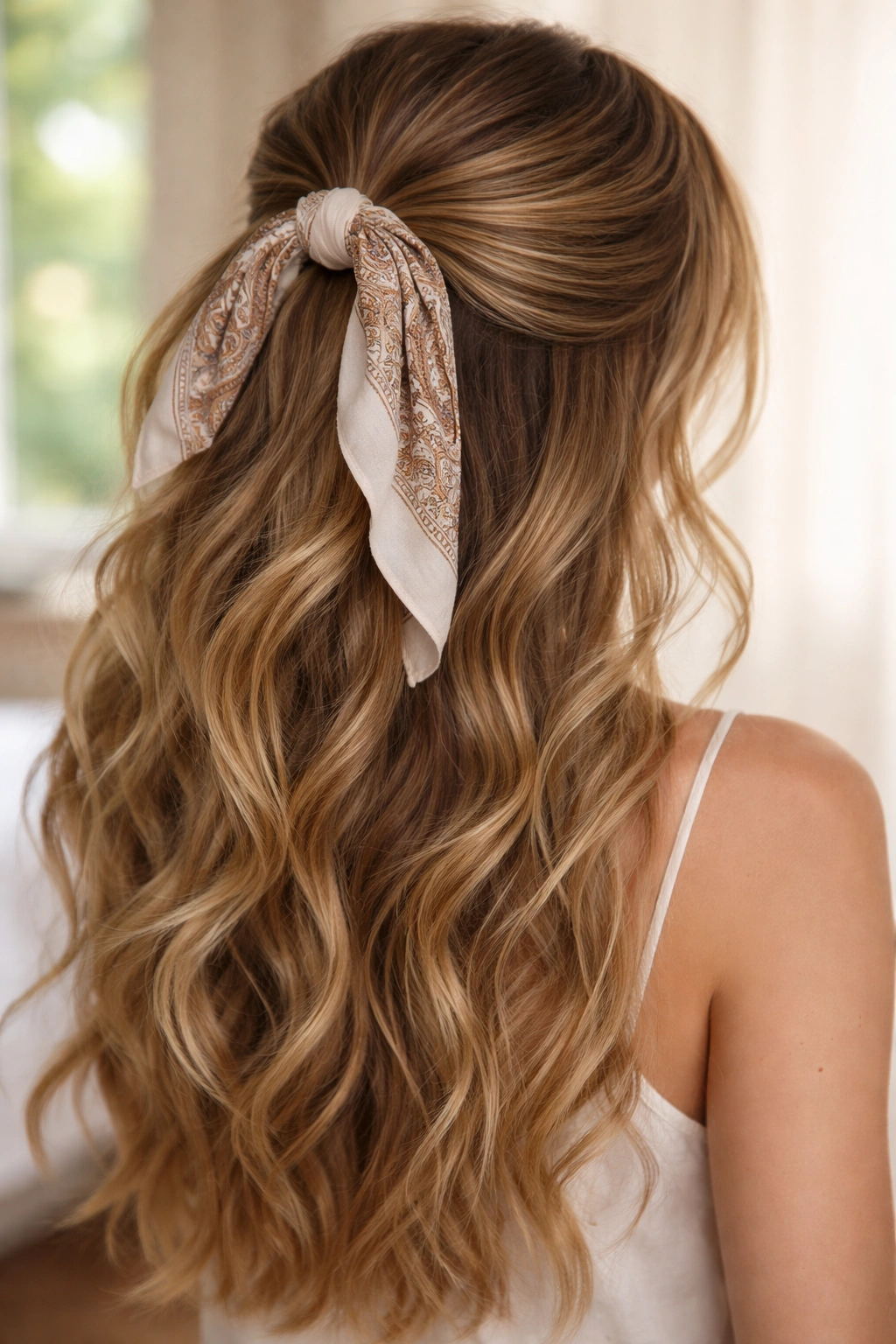
Create a half-up ponytail with a bandana tie, then focus on creating soft, loose waves throughout both the top and bottom sections of your hair. The bandana becomes the anchor that holds the styling together, while the waves create romantic, effortless texture. This version works beautifully on hair that can hold a wave (from styling or naturally) and emphasizes a soft, feminine aesthetic.
Creating the Wave Foundation
Waves look best when they’re loose and tousled rather than tight and formal. You can create them with a curling iron, with braids left in overnight, or with styling products and your fingers if your hair naturally waves. The key is making them feel undone rather than rigid.
Building the Waves and Bandana Style
- Create loose waves throughout your entire head using whatever method works best for your hair
- Once your waves are done, take the top section of your hair and gather it gently into a half-up configuration at the crown
- Don’t worry about it being perfectly smooth — some texture and pieces escaping actually improve this style
- Tie this section with a bandana, positioning it so the color of the bandana shows against the wave texture
- Let the rest of your hair fall in waves down your back
- Pull a few longer pieces around your face to frame it
- You can enhance the waves by running your fingers through them or using a bit of texture spray to separate them
Pro tip: This style actually improves throughout the day — the waves relax and loosen, making it look more effortlessly beautiful by evening than it did when you first finished styling.
10. Boho Bandana with Delicate Details
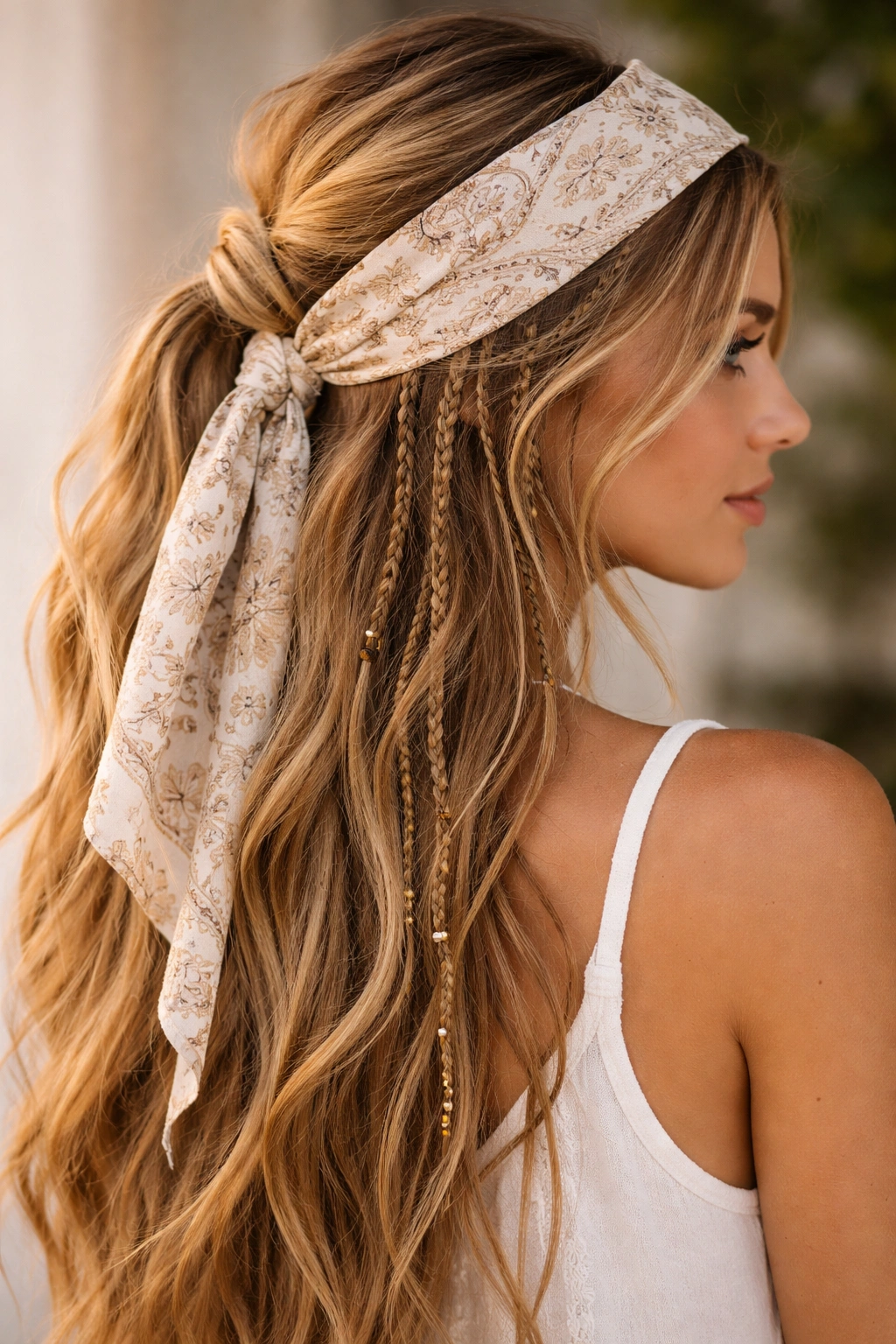
Pair your half-up ponytail and bandana with face-framing elements like thin braids, smaller braided sections, or pieces of delicate jewelry woven into the hair. This creates a bohemian, nature-inspired look that feels artsy and intentional. The combination of the bandana with the other details multiplies the visual impact and creates a style that’s more memorable than either element alone.
What Makes Boho Work
Bohemian styling is all about layers of texture and detail that catch the light and create visual interest. Adding a bandana to a boho half-up is like adding the final brushstroke to a painting — it ties everything together and gives it a focal point.
Creating a Boho-Bandana Half-Up
- Start with textured, wavy hair or create some texture with braiding
- Create thin braids on each side of your face — from your temple, braid down loosely, leaving the braid somewhat loose and undone-looking
- Gather these braids along with other hair from the crown and sides into your half-up ponytail
- Secure with a clear elastic at the crown
- Wrap your bandana around the base — a patterned or jewel-toned bandana works beautifully here
- Tie the bandana in a bow with long, flowing tails that you can let hang down
- Wrap thin gold or silver chains or delicate hair jewelry around the ponytail base, alongside the bandana
- Leave face-framing pieces loose, and let the texture be visible rather than trying to smooth everything
- You can even add a delicate hair pin or small clip as an additional detail
Real talk: This style is one of the most photogenic versions — it photographs beautifully in natural light and looks equally good in person.
11. Sleek Half-Up with Statement Bandana
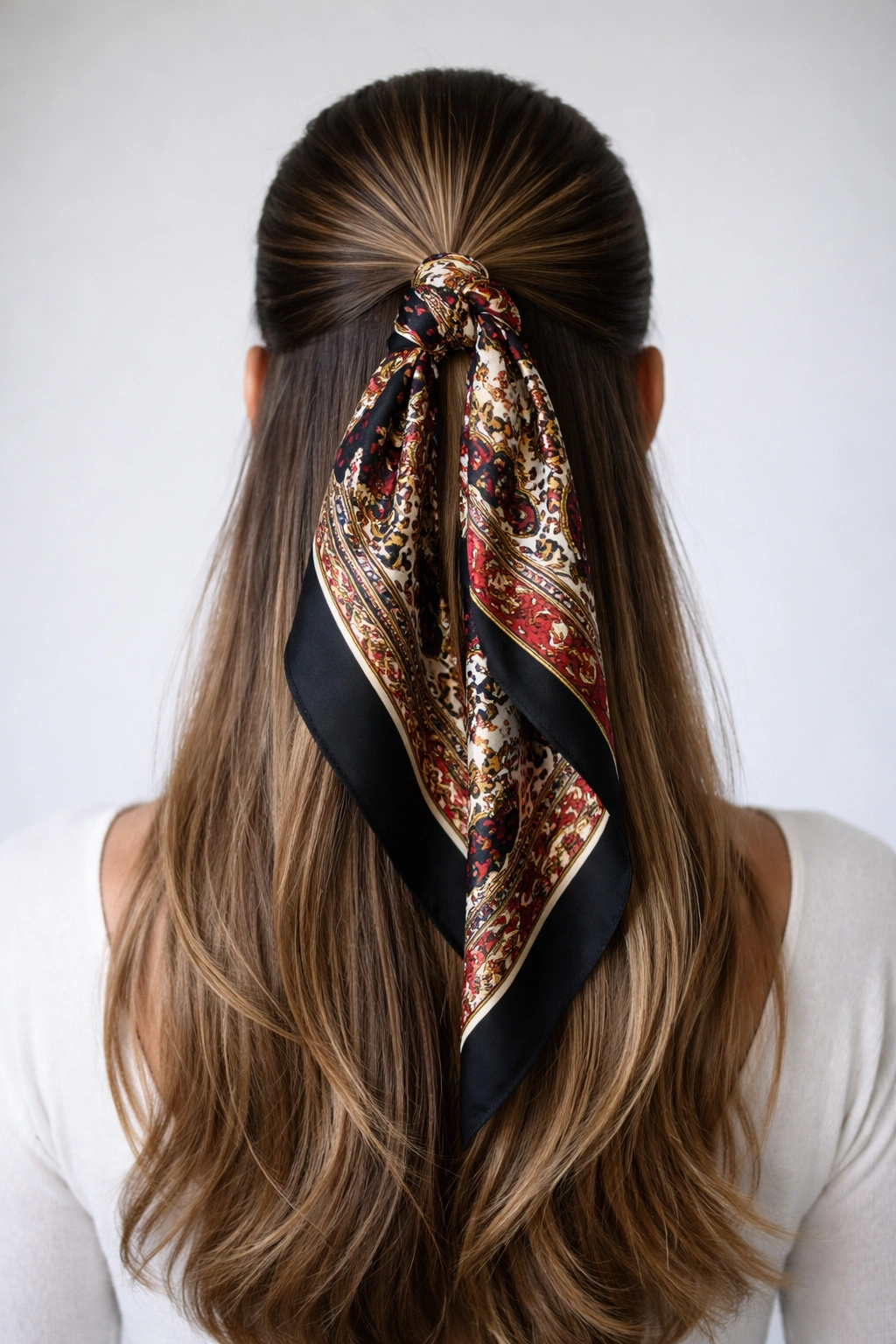
Go the opposite direction with minimal, sleek hair paired with a bold, eye-catching bandana. Smooth your hair back cleanly into a tight half-up ponytail, then tie a statement bandana — something brightly colored, patterned, metallic, or textured — around the base. The contrast between the polished, clean hair and the bold bandana creates a modern, fashion-forward look.
The Minimalist-Statement Contrast
This approach works because the extreme simplicity of the hair itself allows the bandana to be the undisputed star. There’s nothing competing for attention, so the bandana’s color and pattern pop dramatically. It’s the styling equivalent of a plain white t-shirt with a statement necklace.
Creating the Sleek Look
- Use a smoothing serum or lightweight styling cream and smooth your hair back from your face with a fine-tooth comb or paddle brush
- You want your hair to look deliberately sleek, not slicked back — there’s a difference in texture and shine
- Gather the top section into a clean, tight ponytail at the crown using a clear elastic
- Make sure there are no flyaways or pieces coming loose — smooth them down with a tiny bit of smoothing cream if needed
- Take a bold, statement bandana and fold it into a band
- Wrap it tightly around the base of your ponytail, covering the elastic completely
- Tie it in a clear, defined bow with crisp lines
- The bandana is now the only texture and movement in your style — let it be the statement piece
- Optionally, you can add one small detail like a thin gold chain wrapped around the bandana for extra polish
Pro tip: Use a satin pillowcase or sleep cap the night before you wear this style to maintain the sleek texture — you’ll have fewer flyaways to manage in the morning.
12. Textured Crown with Bandana Wrap
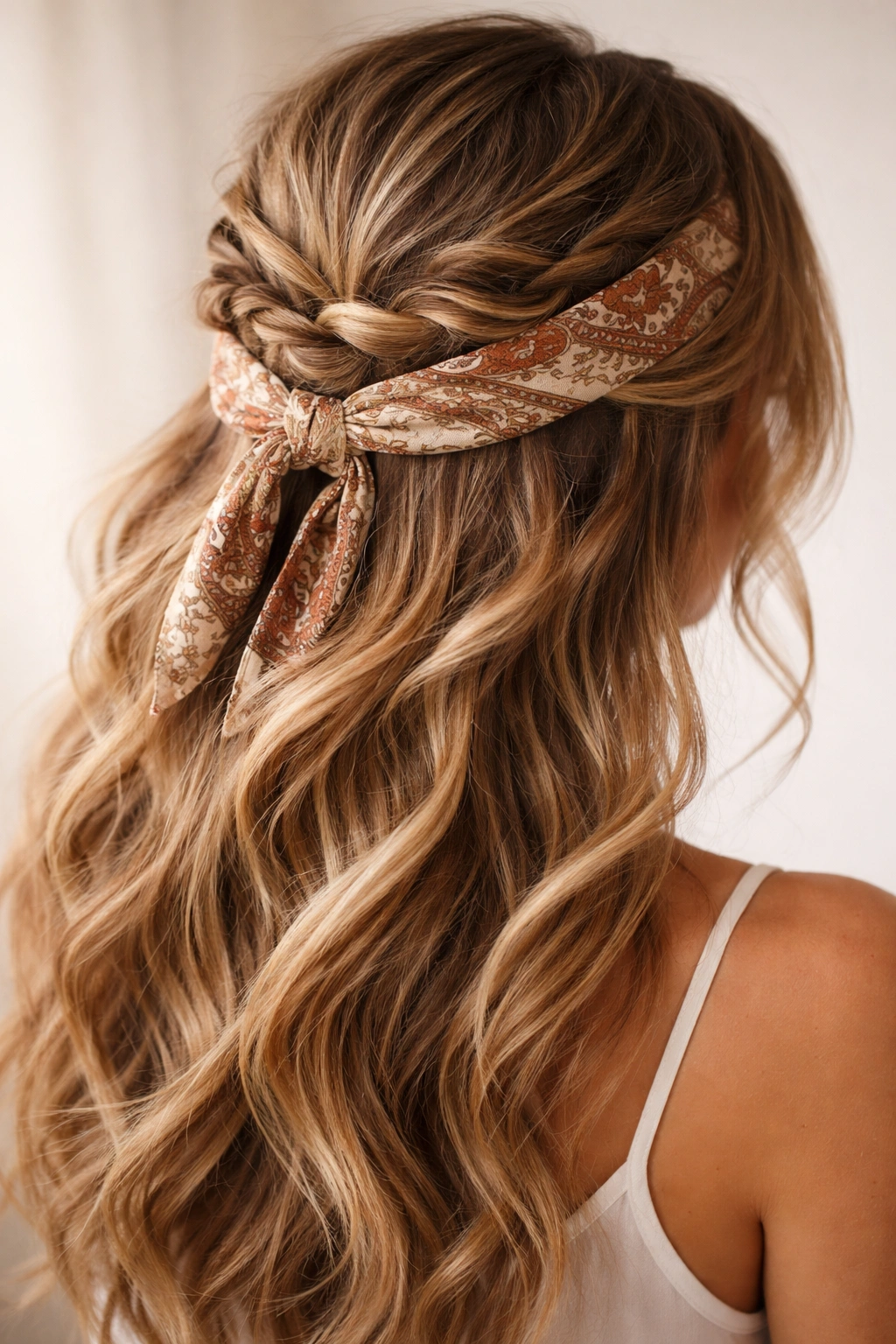
Create texture and volume at the crown using teasing, braiding, or just styling technique, then wrap a bandana around this textured base in a way that follows the contours of the bumps and braids. Instead of a smooth foundation for the bandana to sit on, you’re using the three-dimensionality of textured hair as part of the design. This creates depth and visual richness that reads as intentional and artistic.
Building the Texture First
The texture at the crown can come from subtle teasing, a Dutch braid or French braid that creates width, a series of small twists, or even just textured waves that you tease slightly. The point is creating bumps and dimension rather than a smooth surface.
Creating Texture With Bandana Integration
- Create texture at your crown using braids, teasing, twists, or a combination — whatever method suits your hair and skill level
- Gather your half-up ponytail as usual, placing it at the crown where your texture is
- Secure it with a clear elastic
- Take your bandana and wrap it around the base, but instead of just wrapping it smoothly, let it follow the contours of the texture you’ve created
- The bandana will naturally sit in the bumps and curves of the textured hair, which makes it look more integrated
- Tie or tuck the bandana ends so they’re secure
- Leave some of your textured hair visible above and around the bandana so the dimension is clear
Worth knowing: This style actually photographs beautifully from above, showing all the texture and dimension that might not be as apparent from straight-on.
Wrapping Up
The beauty of adding a bandana to a half-up half-down style is that you’re not starting from scratch each time — you’re taking a foundation you already know how to create and reimagining it with different placement, different folding techniques, and different visual intentions. A bandana isn’t a complicated styling tool; it’s an intentional choice that signals you’ve thought about your look and assembled it deliberately.
The styles that resonate most often are the ones that match your actual lifestyle and hair maintenance reality. If you’re someone who loves minimal effort, the classic bandana bow or the bandana-as-hair-tie approach will become your daily go-to. If you enjoy spending time on your hair and appreciate the therapeutic aspect of styling, the boho versions and the textured-crown approaches might become your favorites. The side-swept and asymmetrical versions appeal to people who want to feel modern and intentional. The sleek-with-statement versions work for anyone who wants to make a clear statement.
The real power of these styles is that a single bandana, folded and placed differently, creates genuinely different looks. You’re not just repeating the same style with different colors — you’re creating distinct visual effects that work for different occasions, different moods, and different clothing. Once you’ve tried a few of these approaches, you’ll develop intuition for which ones suit your hair type, face shape, and personal style. That’s when a bandana stops being just an accessory and becomes a legitimate styling tool that’s as essential as a good hair tie or bobby pin.
