



If you’re working with long hair and bangs, finding the right ponytail style can feel tricky — the bangs frame your face while the rest of your hair is pulled back, and getting the balance right transforms your entire look. The beauty of this combination is that it gives you versatility: you can go sleek and polished, textured and romantic, or somewhere in between, all while keeping your hair contained and styled. Long hair naturally creates volume and movement, and when paired with bangs that suit your face shape, you’ve got the foundation for hairstyles that work for casual days, work environments, and special occasions alike.
The challenge most people face is that bangs can feel like a commitment that limits your styling options — but that’s actually the opposite of the truth. Bangs paired with a ponytail open up a whole new category of hairstyle possibilities because your bangs stay framed around your face while your ponytail handles all the length behind it. Whether you prefer your bangs straight and blunt, soft and wispy, choppy and textured, or somewhere entirely different, there’s a ponytail style that will make them work harder for your look. Let’s explore twelve distinct ways to style long hair with bangs, each one creating a completely different vibe.
1. Classic High Ponytail with Straight-Across Bangs
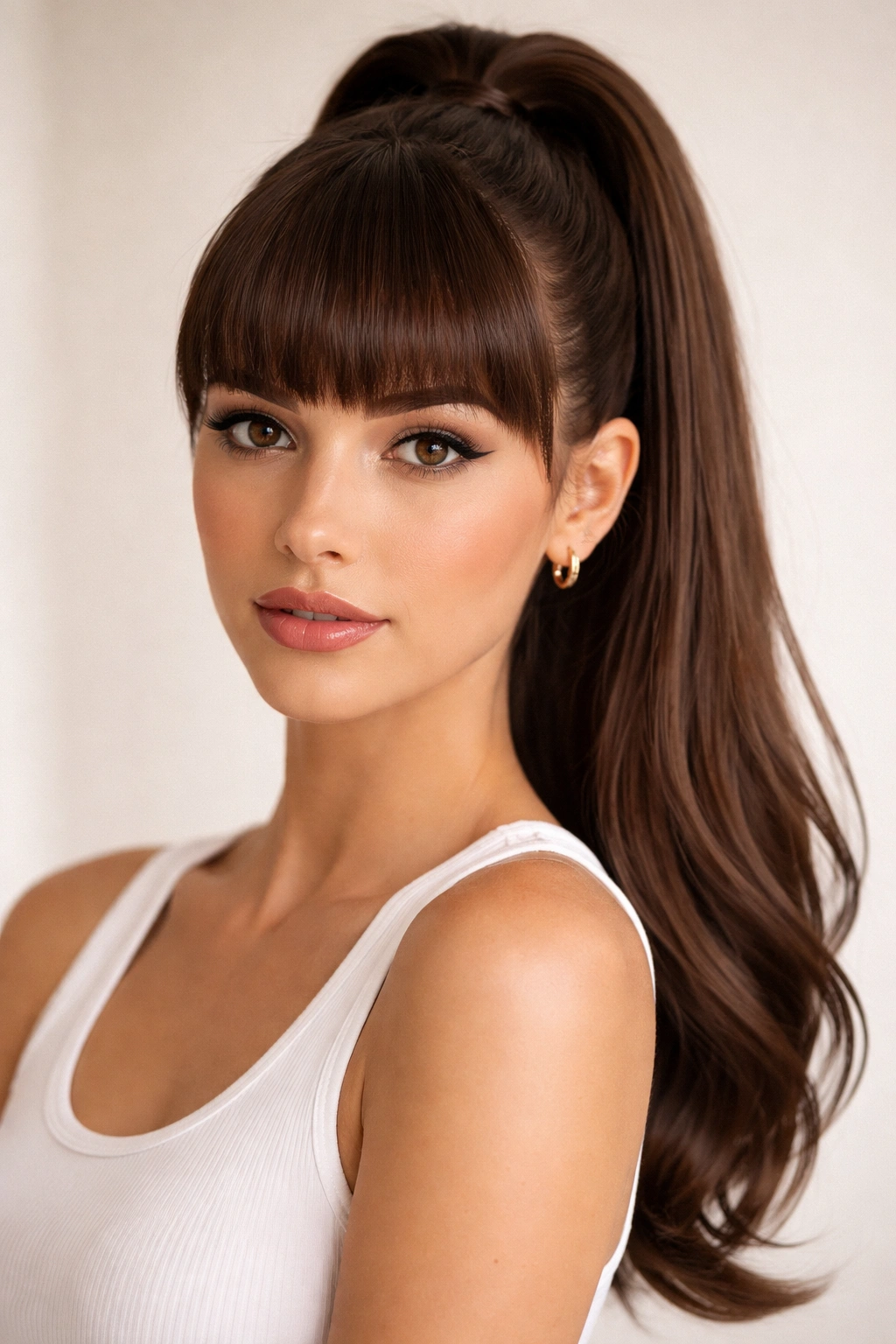
This is the foundation style that works for nearly every face shape and hair texture — a centered, high ponytail that sits at the crown with blunt, straight-across bangs that hit just above the eyebrows. The simplicity is what makes it so powerful: your bangs get the spotlight they deserve, and the high placement of the ponytail elongates your neck and face while creating an instantly polished, youthful appearance. This style works equally well for casual days and professional settings.
Why This Classic Works Every Time
The reason this pairing feels so effortless is because both elements are inherently clean and geometric. Your straight bangs create a strong horizontal line across your forehead, and the lifted ponytail creates vertical lift at the crown — together, they create a balanced, harmonious frame for your face. The high placement also means you’re not fighting gravity; the ponytail sits naturally at the spot where your hair naturally wants to gather, making it last longer throughout the day without slipping.
How to Perfect the Look
- Smooth your hair thoroughly before gathering — even one flyaway undermines the sleek effect this style is known for
- Use a fine-tooth comb to gather your ponytail, working from your part all the way back to smooth any bumps
- Secure with an elastic positioned at the crown — the higher you place it, the more lifted and youthful the overall effect
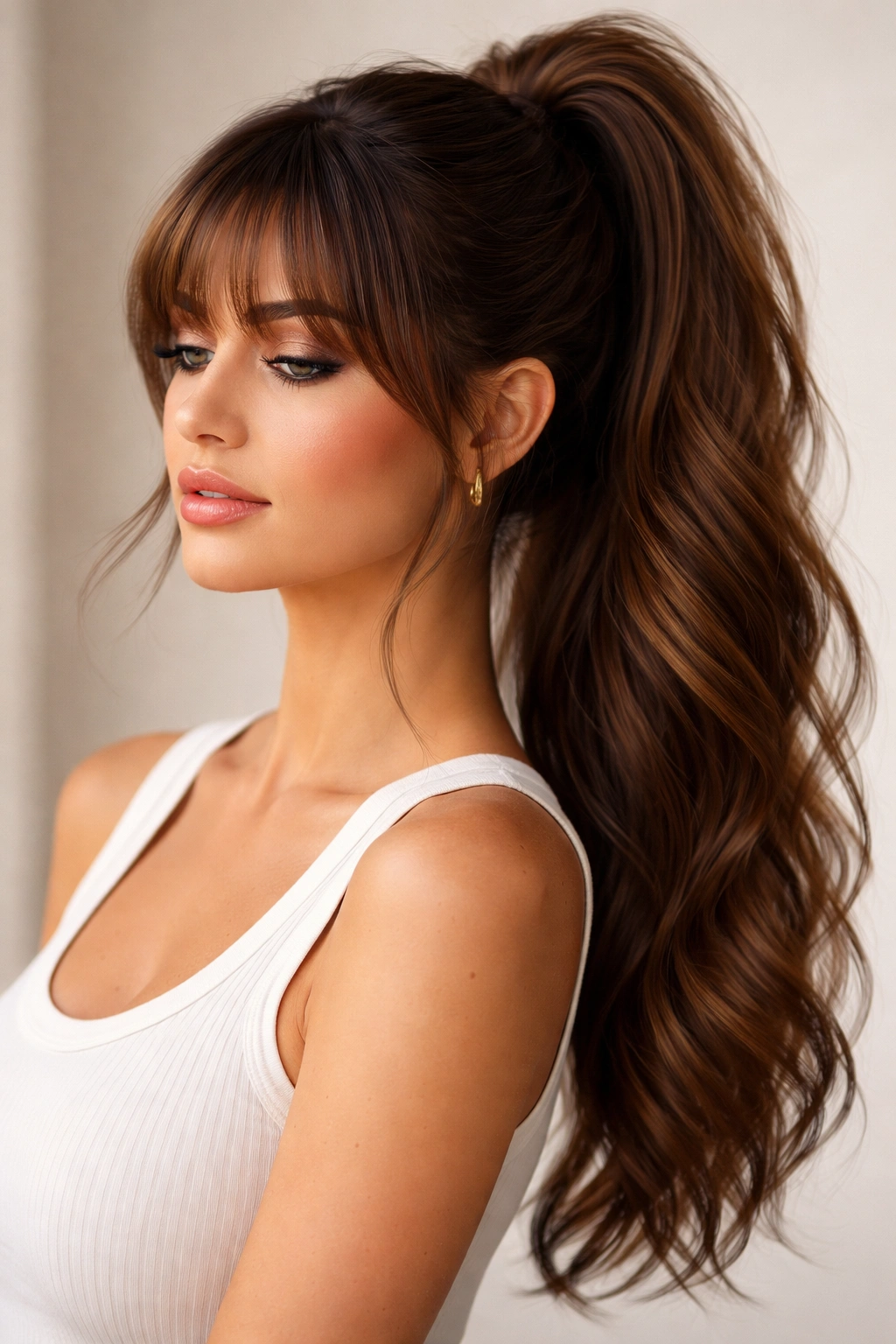
- Keep your bangs trimmed to just above the brow line; longer bangs make them feel less confident and bold
Pro tip: To prevent the slicked-back look from appearing too severe, take a small section of hair from the ponytail itself and wrap it around the elastic base, then pin it underneath. This simple detail softens the effect and makes the style feel intentional rather than rushed.
2. Sleek Low Ponytail with Wispy Bangs
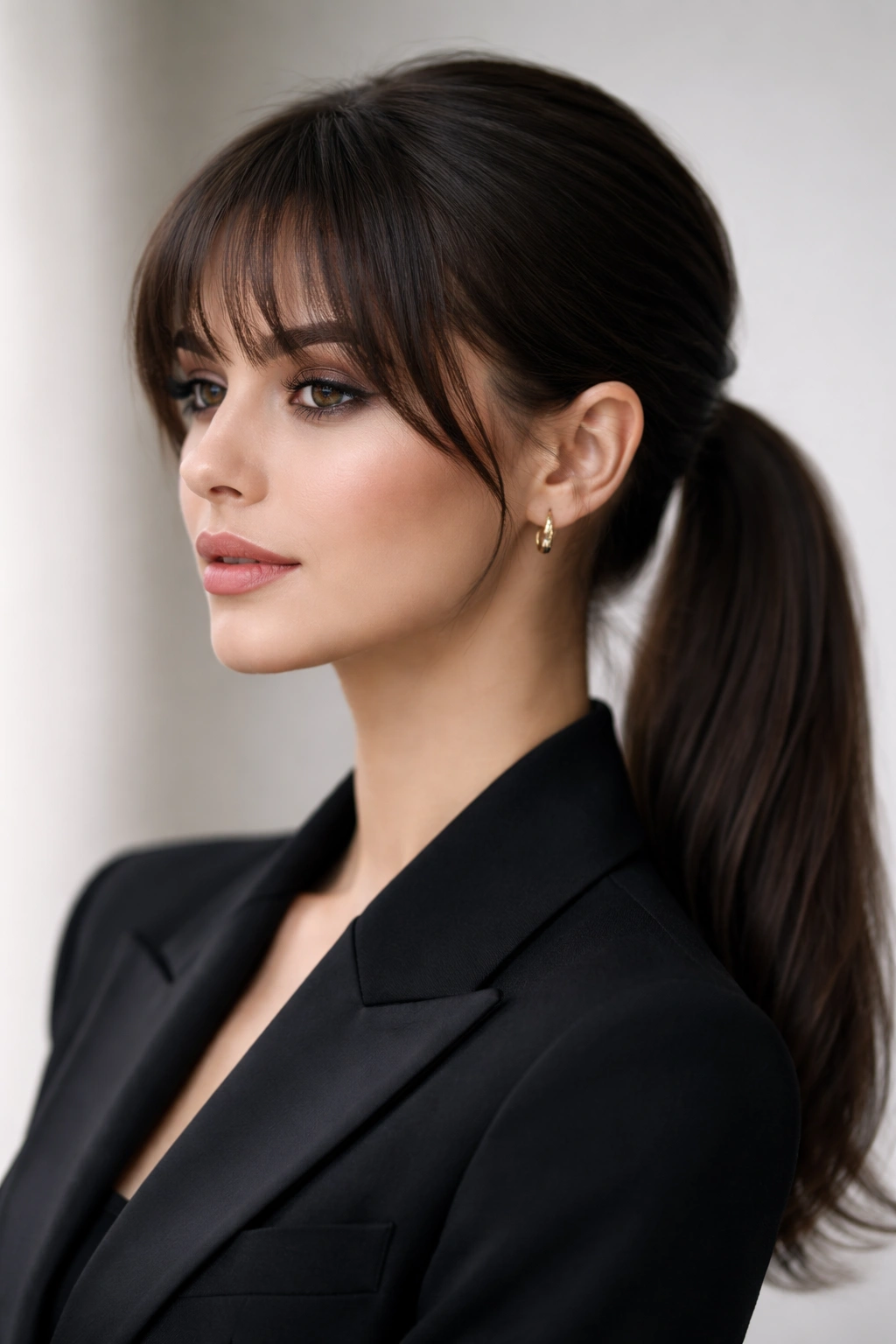
Where the classic high ponytail conveys youth and energy, a low ponytail at the nape of your neck paired with soft, wispy bangs reads as refined and sophisticated — this is the pairing that works for boardrooms, dinner dates, and anywhere you want to look polished without trying too hard. Wispy bangs that graze your eyebrows and break apart slightly soften the geometry of your face while the low ponytail keeps all the focus on your facial features rather than on your hair.
The Elegance of Understated Styling
Low ponytails have a quiet confidence about them — they’re not announcing themselves the way a high ponytail does. When you combine this with wispy bangs that frame rather than dominate, the total effect is someone who knows what they’re doing and isn’t concerned with being noticed. The bangs create softness around your eyes, and the low ponytail adds an element of ease, like you simply gathered your hair without thinking too much about it — even though you absolutely did.
Steps to Execute This Look
- Start with hair that has a little texture — straight hair at the nape can look too slick; use a curling iron to add soft waves before ponytailing
- Position the elastic low, approximately 2 inches above the nape of your neck, and gather smoothly without pulling too tightly
- Wrap a small strand around the elastic base to hide it and create dimension
- Cut your bangs at a length where they hit right at your eyebrow or slightly above, with feathered, wispy edges rather than blunt ones
Worth knowing: The key to wispy bangs is keeping them longer and more textured than blunt bangs. Ask your stylist for heavily feathered layers throughout the bang section so they naturally break apart rather than sitting as one solid chunk of hair.
3. Half-Up, Half-Down Ponytail with Layered Bangs
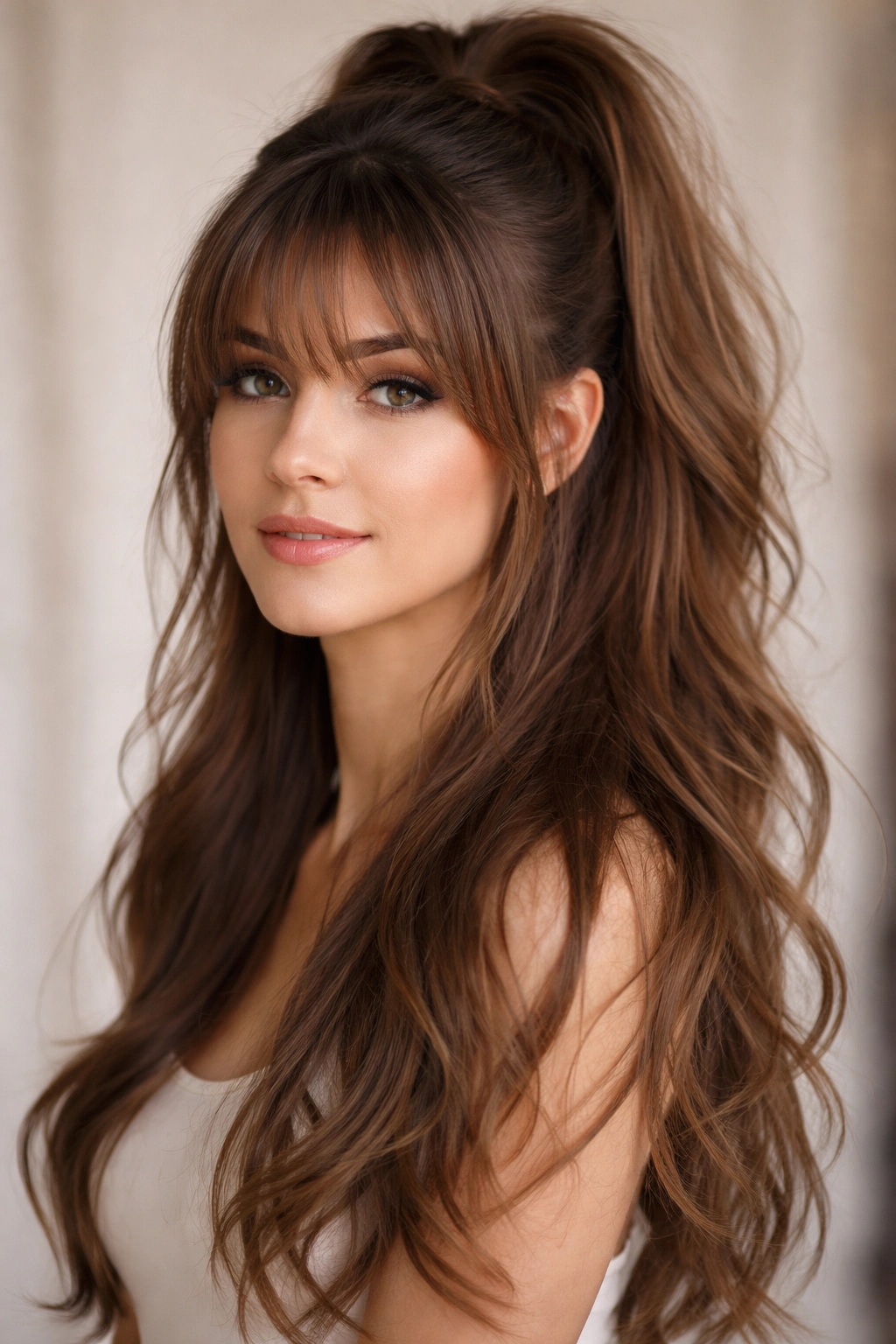
This is the style that lets you have everything at once: volume and movement in your long hair, pulled-back control on the top half, and bangs that frame your face with dimension. A half-up gather at the crown combines the lifted energy of a full high ponytail with the length and texture of wearing your hair down, and when paired with layered bangs that vary in length, the overall effect is romantic and effortlessly textured.
Why Half-Up Works So Well With Bangs
The half-up silhouette creates visual interest by showing off your hair’s length and waves while still pulling back enough to frame your face clearly. Layered bangs that vary in length — some longer pieces falling to your cheekbones, some shorter pieces at your brow — complement this mixed aesthetic perfectly. You’re not fully committed to the pulled-back look, and your bangs reflect that same sense of flexibility and movement.
Building the Half-Up Half-Down Style
- Blow-dry your hair with a brush to create base volume, or add waves with a curling iron before styling
- Take a section from your crown approximately 2-3 inches from your hairline, spanning ear to ear
- Gather this section at the back of your crown and secure with an elastic; don’t pull too tightly or you’ll flatten your crown
- Tease gently at the base of the half-up gather to add height and dimension
- Wrap a strand from the gathered section around the elastic for a finished look
- Ensure your bangs have choppy, varied lengths with longer pieces framing your cheekbones
Real talk: This style works better on wavy or curly hair than on completely straight hair. If you have straight hair, add texture with a curling iron before you gather the half-up section — even loose waves make a massive difference in how polished and intentional the style looks.
4. Braided Ponytail with Side-Swept Bangs
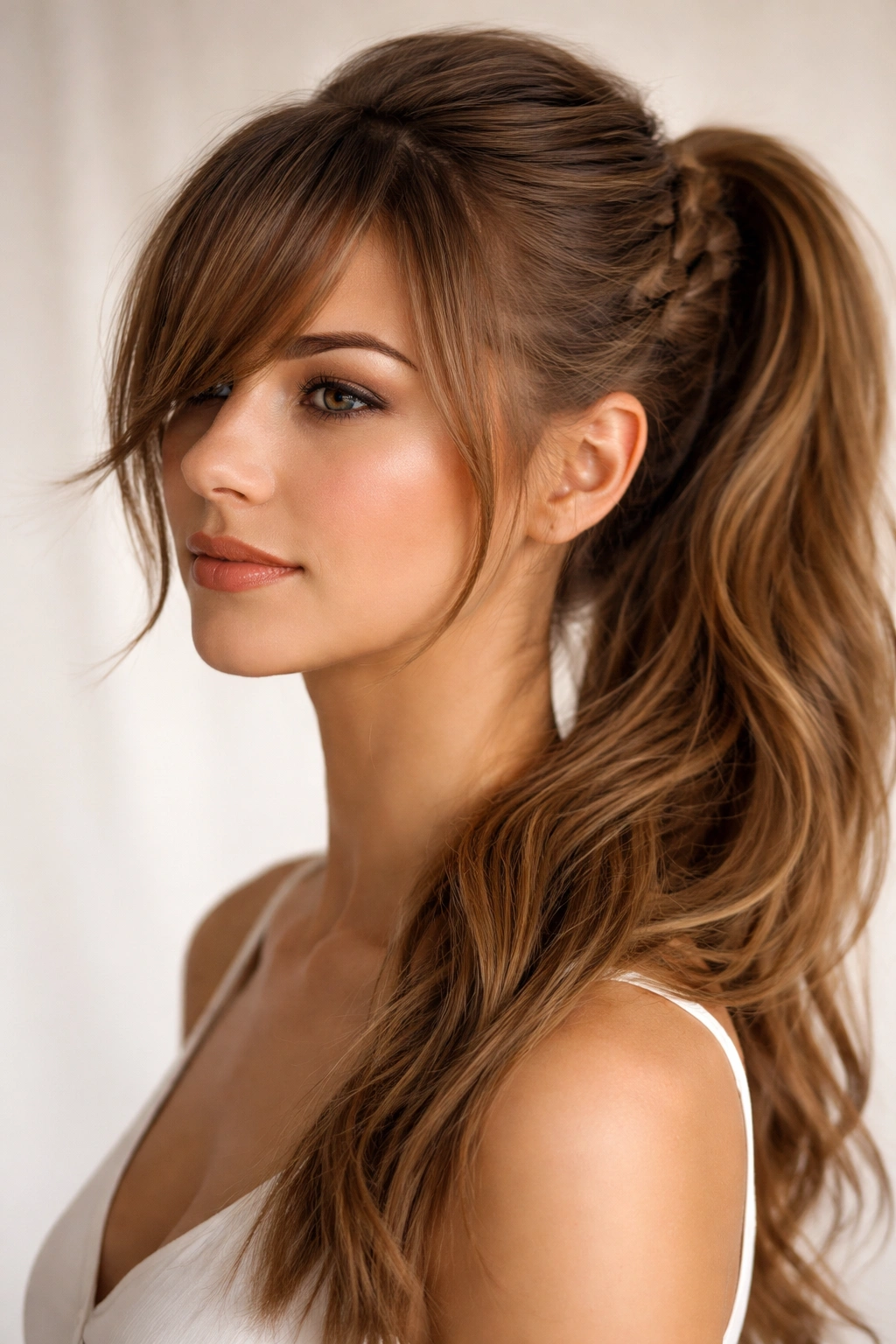
Introducing a braid into your ponytail style adds immediate visual interest and texture, transforming what could be a simple style into something that feels intentional and creative. A braid that gathers into a ponytail at the back of your head pairs beautifully with side-swept bangs that move across your forehead, creating movement and dimension throughout your entire look.
The Texture and Movement Factor
Braids create an architectural quality that simple ponytails don’t have — they show that you’ve spent time on your hair, and that effort reads as care and intentionality. When you combine a braid with side-swept bangs that angle across your forehead, you create multiple lines and curves in your hairstyle, making it feel dynamic and modern rather than static. The braid also helps your ponytail last longer throughout the day because the woven structure holds more securely than a simple gather.
Creating a Braided Ponytail
- Start with slightly damp hair or mist your hair with a texturizing spray to give the braid something to grip
- Create a side part in your hair, positioning it wherever feels natural on your scalp
- Begin a Dutch braid (braiding under rather than over) from one side of your head, starting near your temple
- Gradually gather more hair as you braid toward the back of your head, incorporating sections as you move
- Finish the braid at your crown or where you want your ponytail to sit, then secure the braid itself with a small elastic
- Gather any remaining hair at the base of the braid into a ponytail with a second elastic
- Leave your bangs side-swept so they flow across your forehead at an angle
Pro tip: Pull gently on the edges of your braid after you’ve secured it to loosen and widen the braid. This creates a softer, more romantic texture and makes the braid appear fuller and more dimensional.
5. Textured Ponytail with Feathered Bangs
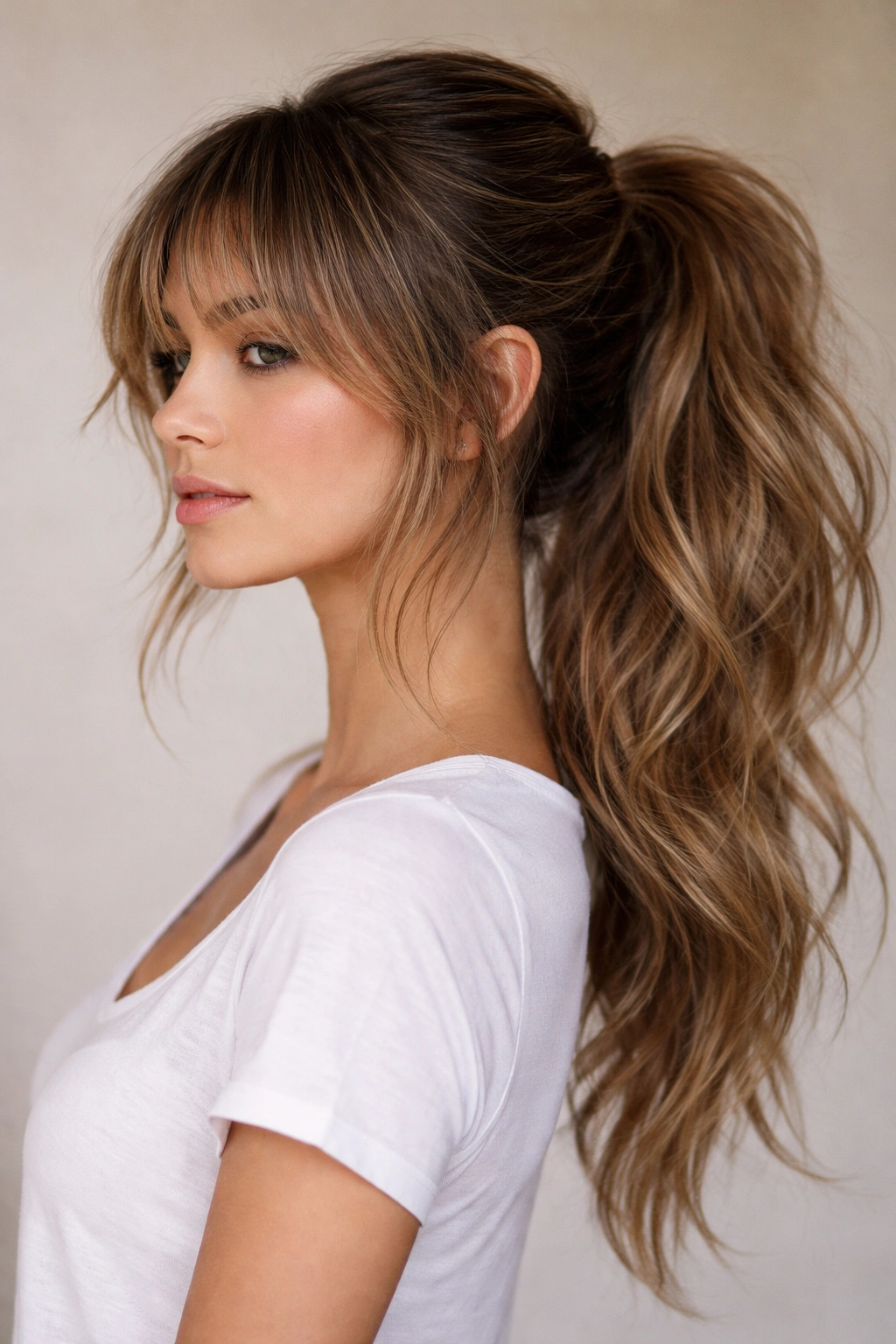
If you want a style that celebrates movement and texture rather than slickness, a textured, slightly undone ponytail paired with feathered bangs that flow outward is your answer. This combination creates a lived-in, effortless vibe — the kind of hair that looks like you woke up looking this good, even though you absolutely styled it intentionally.
Embracing the Textured Aesthetic
Textured ponytails aren’t trying to be perfectly smooth; they’re showing off your hair’s natural dimension and movement. When you pair this with feathered bangs where each strand flows slightly outward rather than sitting as a solid block, the total effect is someone comfortable in their own skin and confident enough not to pretend everything is perfect. This style works especially well for people with naturally wavy or curly hair, but you can create the texture on straight hair with the right styling tools.
Building Texture Into Your Ponytail
- Curl your hair in sections using a 1.5-inch curling iron, curling away from your face for each section
- Let the curls cool completely before touching them — this helps them last longer and hold their shape
- Gently run your fingers through the curled hair to break up the curls and create a softer, more textured effect
- Gather your hair loosely into a ponytail at your preferred height, allowing some sections to remain slightly undone and wispy
- Use a texture spray or dry shampoo to give grip and definition to individual strands
- For feathered bangs, ask your stylist to cut layers throughout so individual pieces fall at slightly different lengths
Insider note: The secret to textured ponytails lasting all day is using a strong-hold spray after you’ve gathered your hair, but before you tease and texture it. This prevents flyaways and keeps your style cohesive even as individual sections move.
6. Bubble Ponytail with Blunt Bangs
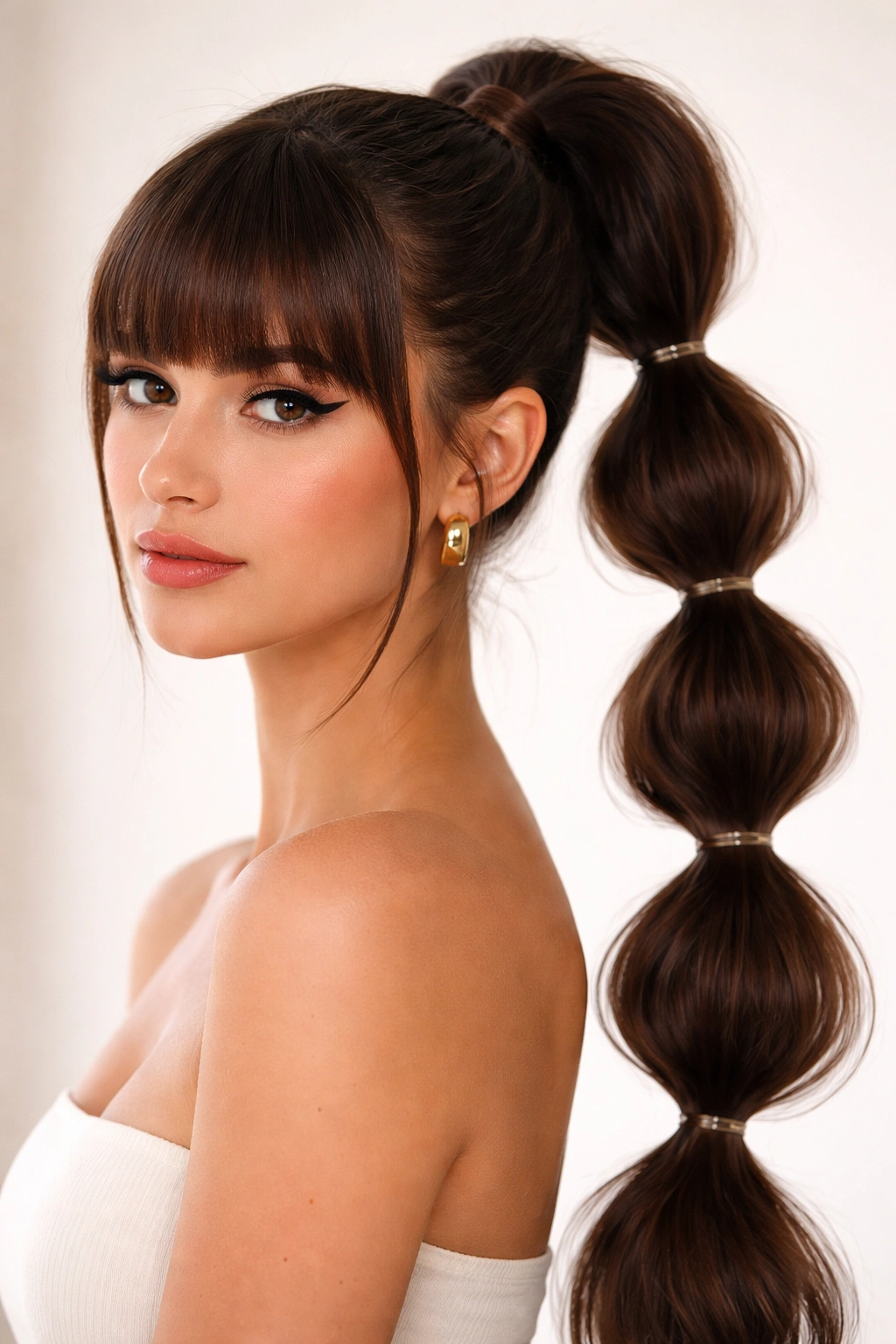
The bubble ponytail is one of the most playful and visually interesting ponytail styles available — it’s created by securing multiple elastic bands down the length of your ponytail, creating rounded “bubbles” of hair between each elastic. Paired with blunt, confident bangs, this style works for anyone wanting to inject personality and fun into their look.
The Playful Appeal of Bubble Ponytails
Bubble ponytails are inherently statement-making; they’re not subtle or understated. They work best when paired with equally bold bangs — straight-across, blunt bangs that hit at your brows and don’t apologize for taking up space on your forehead. Together, these elements create a look that’s confident and creative, working especially well for younger people or anyone wanting to express their personality through their hair.
How to Create Bubble Ponytail Segments
- Gather your hair into a high or mid-height ponytail and secure with an elastic
- Measure down approximately 2-3 inches from the first elastic and place a second elastic around the ponytail, securing it tightly
- Gently pull and puff out the hair between the two elastics to create the first “bubble”
- Repeat this process down the length of your ponytail — place an elastic every 2-3 inches, then puff out each segment
- Use a texturizing spray or light hairspray on each bubble to help it hold its shape and keep stray hairs in place
- Ensure your bangs are blunt and confident, sitting just above your eyebrows with clean, straight edges
Worth knowing: The bubble ponytail looks more intentional and polished if your bubbles are even in size and evenly spaced. Use your fingers to measure the space between each elastic so they’re consistent throughout.
7. Twisted High Ponytail with Curtain Bangs
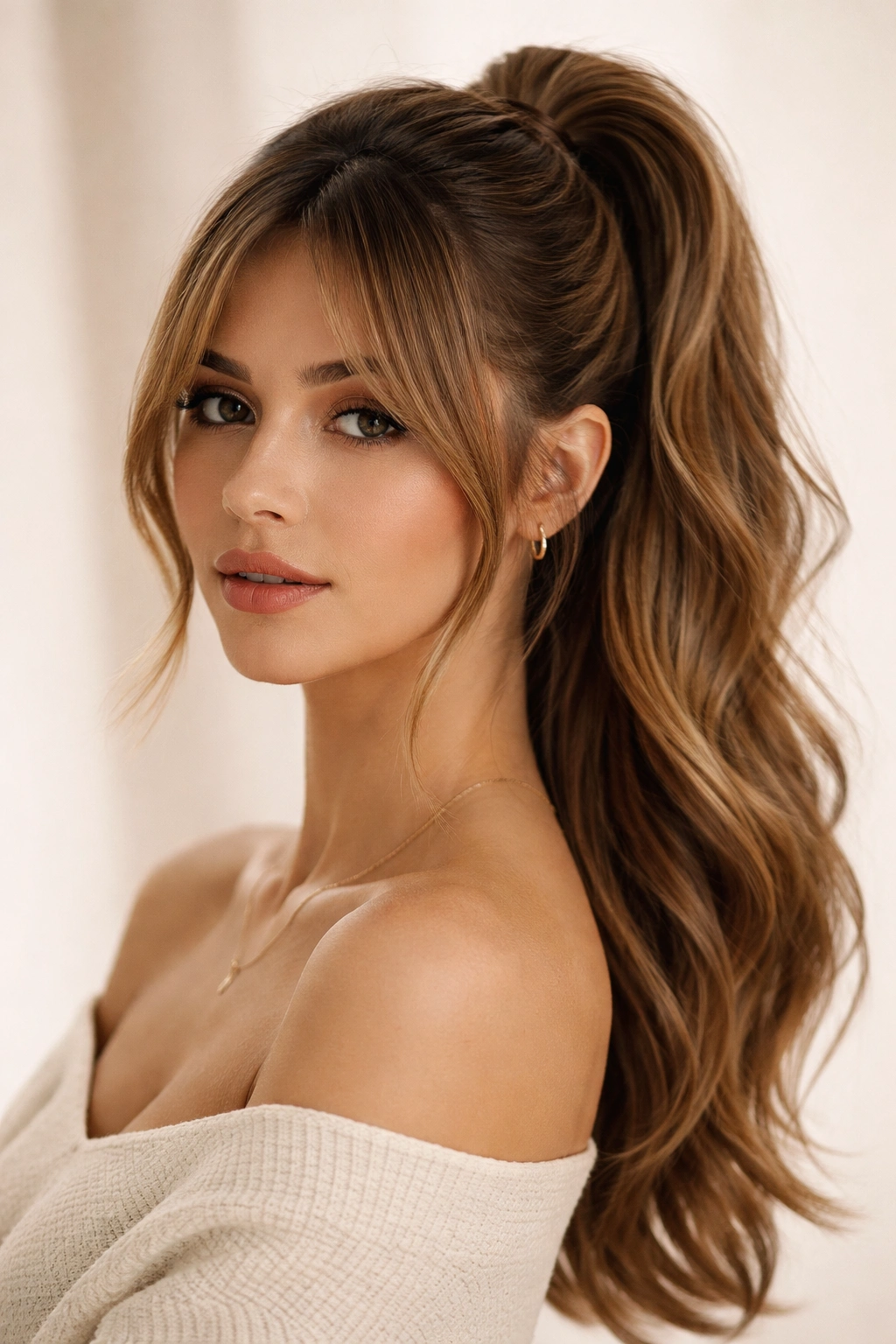
A twisted ponytail adds sophistication and visual interest to what might otherwise be a simple high gather, and when you pair it with curtain bangs that frame your face on both sides, you create a balanced, flattering look that works for nearly every face shape. The twists create texture and dimension while the curtain bangs create soft, rounded lines around your features.
The Balance of Twists and Curtain Bangs
Twists have a romantic, intentional quality — they look like you’ve spent time creating them, but they’re actually quicker and easier than braids. Curtain bangs that fall away from your face on both sides create softness and frame your cheekbones beautifully, and when combined with the visual interest of a twisted ponytail, you get a look that’s sophisticated without being severe. This pairing works especially well for people with rounder face shapes because the curtain bangs and the twisted texture create visual interest that moves the eye upward and outward.
Creating a Twisted Ponytail
- Section your hair into two equal parts from your part to the back of your crown
- Twist the first section loosely, moving from your part toward the back of your head
- Twist the second section the same way, moving parallel to the first twist
- Gather both twisted sections together at your preferred ponytail height and secure with an elastic
- Gently loosen each twist by pulling on the outer edges to create a softer, fuller appearance
- Wrap a strand around the elastic base for a polished finish
- Cut curtain bangs that start at the center of your forehead and angle down toward your cheekbones, creating that signature parted look
Pro tip: The looser you twist, the softer and more romantic the final effect. Don’t pull tightly while twisting; let the sections remain relaxed so they create a fuller, more textured appearance.
8. Low Messy Bun Ponytail with Soft Bangs
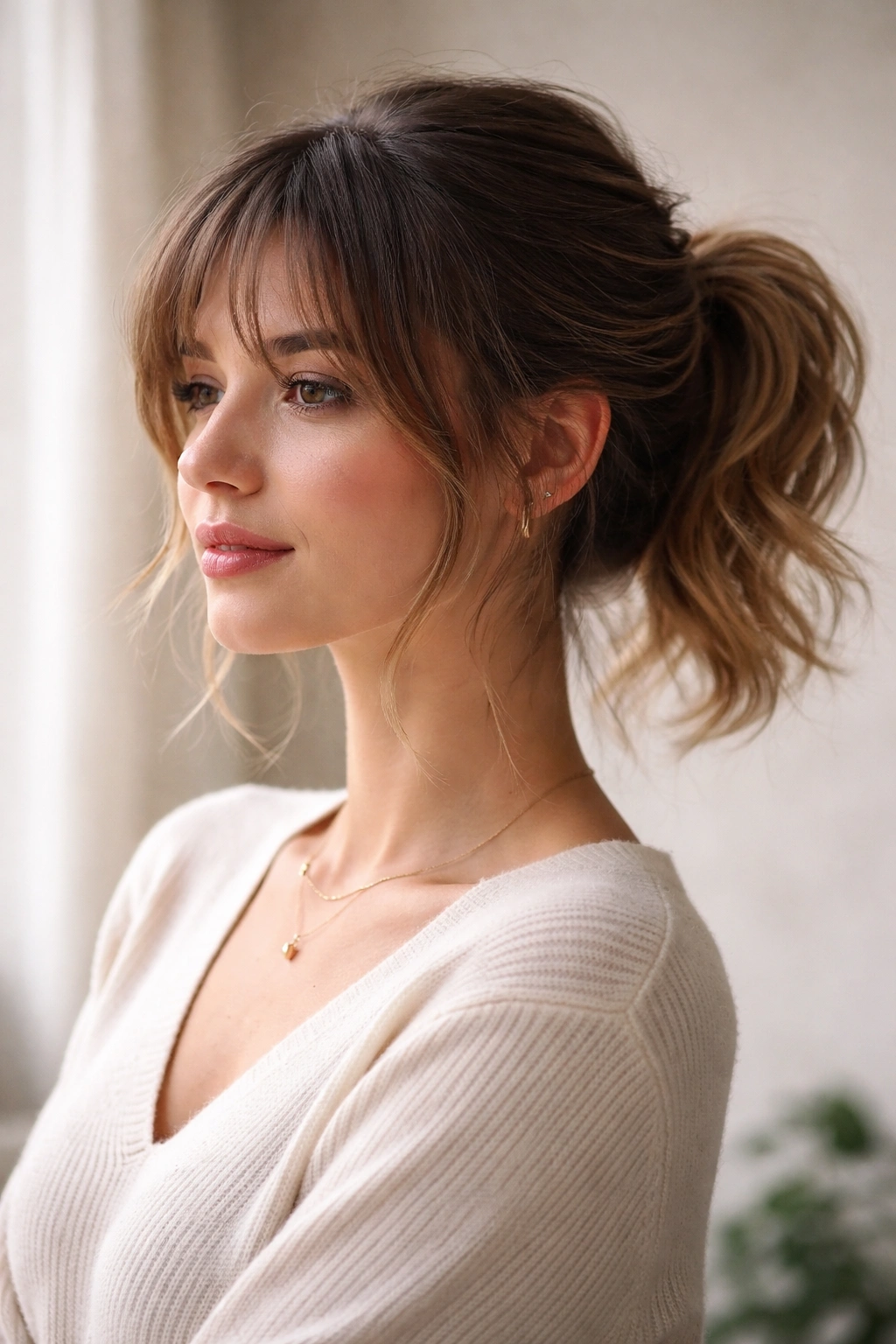
This style sits at the intersection of casual and intentional — a low, loosely gathered ponytail that almost-but-not-quite becomes a bun, paired with soft bangs that frame your face gently. It’s the hairstyle for people who want to look put-together without appearing to have spent hours on their hair, and it works equally well for weekend coffee runs and professional settings.
The Appeal of “Undone” Styling
There’s a reason messy bun styles are so popular — they convey effortless confidence. When you pair this with soft bangs rather than blunt or dramatic ones, the message becomes “I care about how I look, but not in an intense, high-maintenance way.” This style works best with naturally textured hair or hair that’s been curled and allowed to cool, because the texture helps the “messy” elements look intentional rather than actually messy.
Building a Messy Low Ponytail
- Create texture by curling your hair in sections or using a texturizing spray
- Gather your hair loosely at the nape of your neck — aim for low rather than centered
- Secure with an elastic, but leave several strands out intentionally; these should frame your face and neck
- Twist your ponytail loosely and wrap it around the base elastic to create a low, loose bun shape
- Pull gently on the wrapped section to create a fuller, messier appearance
- Leave your bangs soft and wispy, longer rather than blunt, so they blend with the overall relaxed vibe
- Use a light hairspray to keep flyaways in place without making the style look stiff
Real talk: The key to messy buns looking intentional rather than actually messy is texture. Smooth, straight hair gathered loosely tends to look unkempt. Curled or textured hair gathered the same way looks polished and creative.
9. Sleek Side Ponytail with Arched Bangs
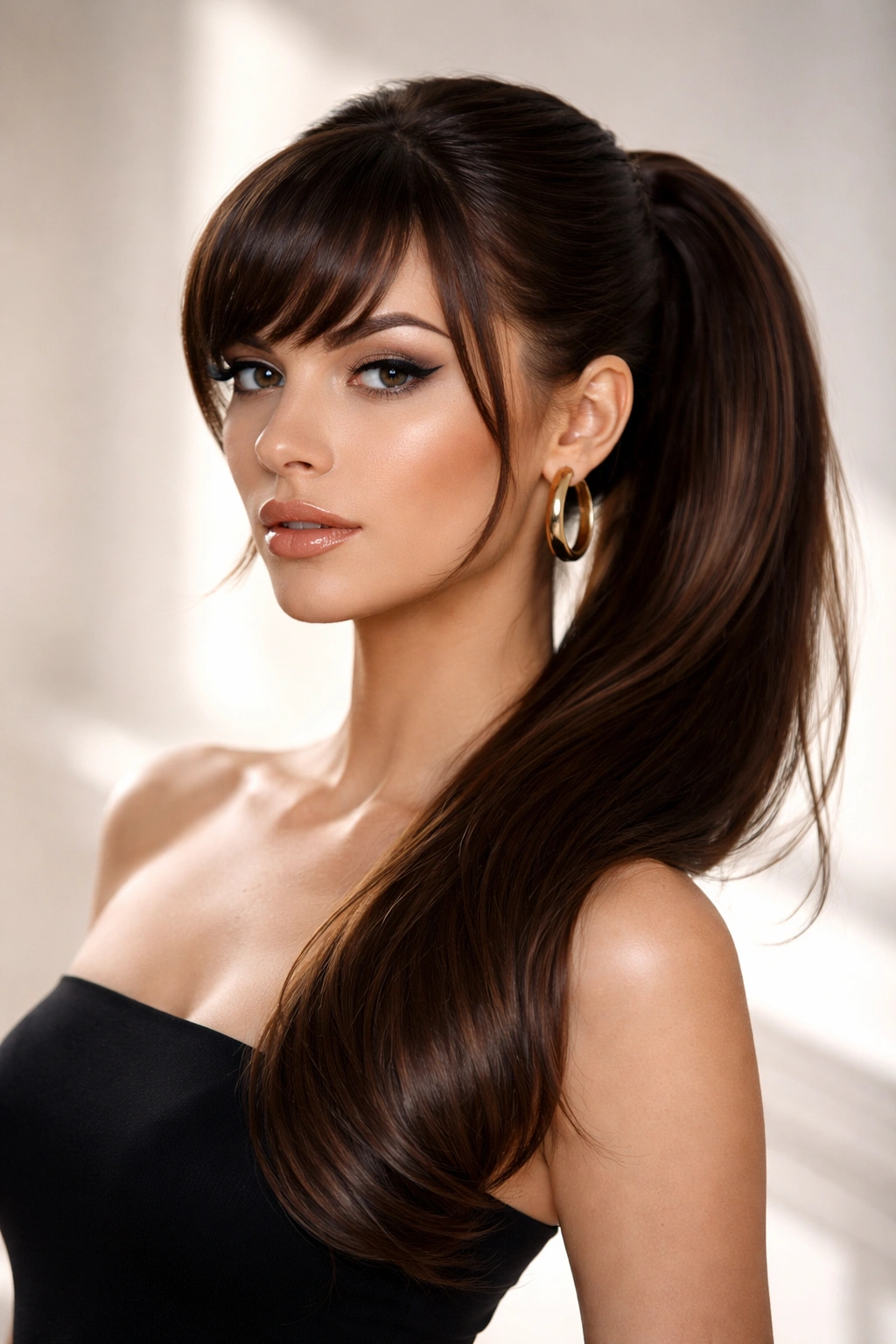
A side ponytail gathers your hair dramatically to one side of your head, creating an asymmetrical silhouette that feels dramatic and fashion-forward. Paired with arched bangs that follow the natural curve of your eyebrows, you get a look that’s striking and sophisticated, working especially well for people wanting to make a statement or trying something boldly different from their usual style.
The Drama of Asymmetrical Styling
Side ponytails aren’t subtle — they’re declaring that you’re doing something intentional with your hair, and they work best when everything else in your styling is equally confident. Arched bangs that follow your brow line and angle slightly upward create movement and visual interest that complements the drama of a side ponytail. Together, these elements create a look that photographs well and feels fashion-conscious.
Creating a Sleek Side Ponytail
- Brush your hair thoroughly and create a deep side part on whichever side you prefer
- Apply a smoothing serum or gel to create that sleek effect; this style requires smoothness
- Gather your hair to one side of your head at approximately ear level or slightly lower
- Secure tightly with an elastic, then wrap a strand around the base for polish
- Smooth any flyaways with additional serum or a smoothing cream
- Use an arched comb or brush to shape your bangs into a subtle arch that follows your natural brow line
- Ensure your bangs have soft edges rather than blunt ones — this prevents them from feeling too harsh alongside the dramatic side ponytail
Worth knowing: Side ponytails work best with long, thick hair because you need enough volume to create impact on one side of your head. If you have finer hair, tease your ponytail gently at the base to create fullness.
10. Voluminous High Ponytail with Choppy Bangs
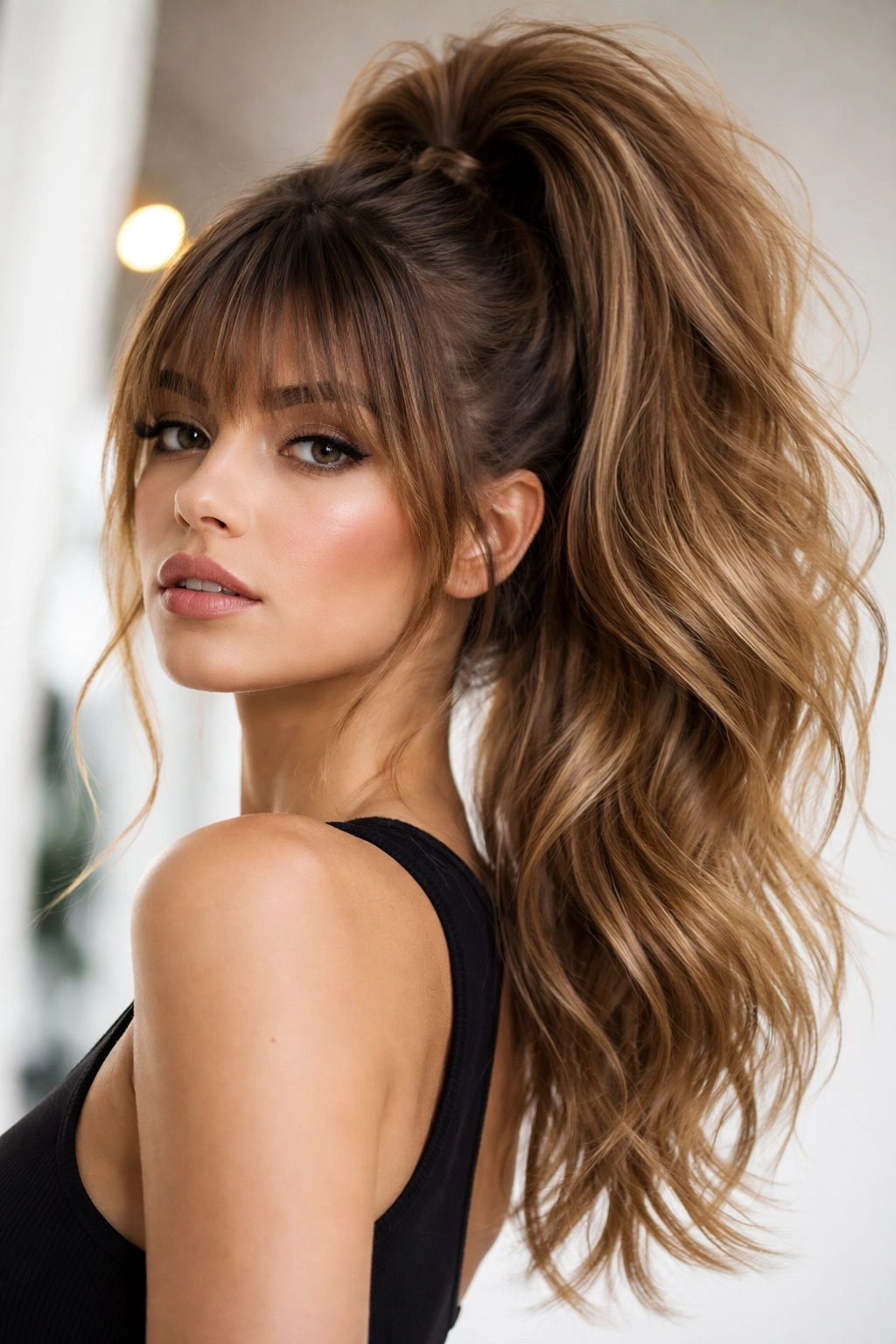
This is the style for anyone who wants their ponytail to announce itself — a high, noticeably full and voluminous ponytail paired with choppy, textured bangs that have multiple lengths and layers. The volume conveys confidence and energy, and the choppy bangs add personality and movement, creating a look that’s youthful and dynamic.
Creating Visual Impact With Volume
Volume in a ponytail comes from teasing, from the natural thickness of your hair, or from the way you section and gather it. When you pair a notably voluminous ponytail with choppy bangs that have visible layers and texture, you’re creating a look that demands attention. This works particularly well if you have naturally thick hair, but you can create the effect on finer hair with teasing and the right hairspray.
Building Maximum Ponytail Volume
- Blow-dry your hair with a volumizing product and with your head upside-down to maximize natural lift
- Section your hair into two parts at the crown — the back section and the front section
- Tease the back section gently using a fine-tooth comb, working from the ends toward the roots
- Smooth the outer layer of your teased section to contain the texture
- Gather both sections together at your crown, with the teased back section positioned to create height
- Secure tightly with an elastic, then wrap a strand around the base
- Ensure your bangs are choppy and textured, with visible layers and multiple lengths that create movement
Pro tip: The difference between “voluminous” and “poofball” is intentional shaping. After you’ve gathered your high ponytail, tease it slightly at the base to add height, then smooth the outer layer with a comb so you can see the actual ponytail shape. This keeps the volume looking intentional rather than accidental.
11. Romantic Curled Ponytail with Shag Bangs
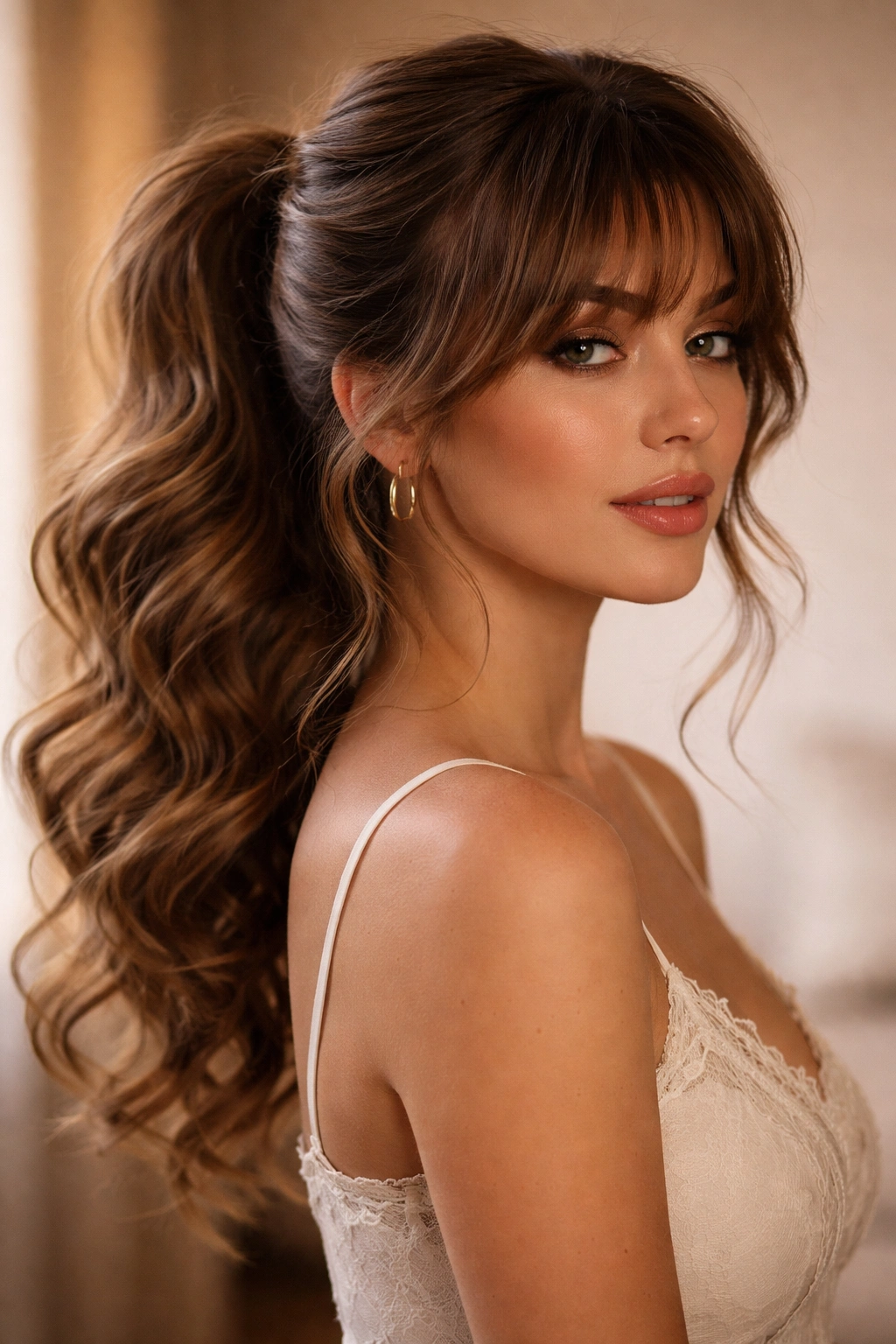
For anyone wanting their hairstyle to convey softness and romance, a loosely curled ponytail paired with shag bangs is the answer. Shag bangs have layers and movement built into them, and when combined with curls in your ponytail, the total effect is textured, glamorous, and undeniably romantic — perfect for special events, date nights, or whenever you want to feel like the best version of yourself.
The Romance of Curls and Texture
Curls create softness and movement; they’re literally the opposite of the sleek, controlled aesthetic. When you pair romantic curls with shag bangs that have choppy layers and built-in movement, you’re creating a look that celebrates your hair’s texture and dimension. This style works best on people with naturally wavy or curly hair, but you can absolutely achieve it on straight hair with the right tools and enough time.
Creating Romantic Curls in Your Ponytail
- Blow-dry your hair to create a smooth base, then divide into 1-inch sections
- Curl each section using a 1.25-inch curling iron, wrapping the hair around the barrel away from your face
- Allow each curl to cool in your hand or a clip before releasing — cooled curls last much longer
- Once all sections are curled, run your fingers gently through your curls to soften them slightly
- Gather your hair loosely into a ponytail at your preferred height, allowing the curls to maintain their shape and movement
- Use a strong-hold spray designed for curls to help them last throughout the day
- Ensure your shag bangs have multiple choppy layers that vary in length from the center to the sides
Insider note: The secret to romantic curled ponytails is not brushing your curls smooth. After you’ve gathered your hair, gently separate curls with your fingers rather than combing through them. This maintains the curl shape while creating a softer, less defined appearance.
12. Slicked-Back Ponytail with Micro Bangs
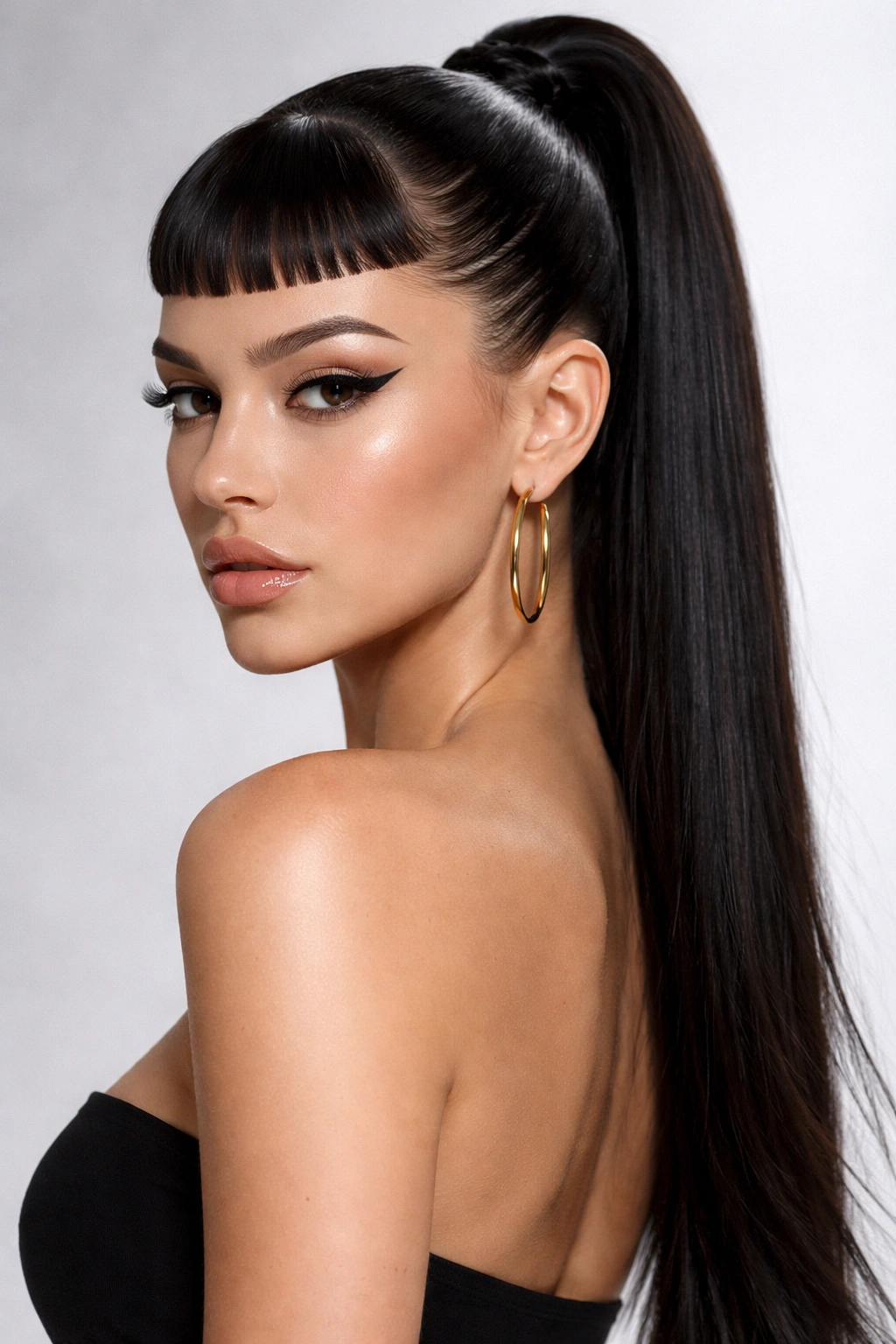
This is the bold, fashion-forward option for anyone wanting to make a statement and showcase their face features confidently. A slicked-back ponytail pulled tight and high, paired with micro bangs that are cut very short and sit well above the brow line, creates a look that’s modern, edgy, and undeniably striking. This pairing works best if you have a face shape you’re confident showing off, and it reads as artistic and intentional.
The Confidence Required for Bold Styling
Slicked-back ponytails and micro bangs don’t work for people wanting to blend in — they’re essentially saying “Look at me, and look at my face specifically.” This is a style for people who are comfortable with their features and want to draw attention to them. The high, tight ponytail elongates your face, and the short bangs expose your entire forehead, creating maximum impact. It’s a look that photographs beautifully and feels very current and fashion-conscious.
Executing Slicked-Back With Micro Bangs
- Apply a strong-hold gel to damp hair, working from your roots to your ends
- Brush your hair straight back from your forehead with a fine-tooth comb, ensuring complete smoothness
- Gather at the crown in a high ponytail and secure very tightly with an elastic
- Wrap a strand around the elastic and secure it underneath
- Smooth any flyaways with additional gel or a smoothing serum
- Ensure your micro bangs are cut very short, hitting 1-2 inches above your natural brow line, with blunt, precise edges
- Keep your micro bangs regularly trimmed — this style requires maintenance as your bangs grow out quickly
Real talk: Micro bangs and slicked-back ponytails are not a style you can maintain casually. This look requires a strong-hold product, regular trims to maintain the bang length, and a willingness to have your face fully exposed. If you have hair that’s naturally prone to frizz or flyaways, invest in a smoothing serum or anti-frizz product specifically for this style.
Final Thoughts
Whether you’re drawn to classic elegance, romantic texture, or bold drama, pairing your long hair with bangs in a ponytail style gives you options that work for your lifestyle, your hair type, and the message you want to send with your appearance. The key is choosing a ponytail style that feels authentic to you — not just something that looks good in a photo, but something you’ll actually feel confident wearing.
The beauty of having long hair is that you can experiment. If you’ve been wearing your bangs down for years, try a high ponytail and see how your face looks with your forehead fully exposed. If you’ve been doing slicked-back ponytails, try adding texture and curls for something softer. Your hair is a blank canvas, and bangs paired with a ponytail give you freedom to create multiple distinct looks without cutting your length or committing to one single style.
Start with the styles that call to you immediately, then experiment with the others as you gain confidence styling your hair. Each of these twelve ponytail styles will photograph differently, feel different on your head, and create a different impression — and that’s exactly the point. Your long hair with bangs deserves styling options that are just as interesting and multifaceted as you are.
