



Curly hair can feel like it has a mind of its own, which is exactly why finding the right ponytail style makes all the difference. When you work with your texture instead of against it, you unlock styles that actually look better as the day goes on—the kind of hairstyle that gets compliments from people who genuinely appreciate what goes into managing curls. Mid-length ponytails sit at that sweet spot where you get the convenience and polish of pulled-back hair without sacrificing the volume and movement that makes curly hair stunning.
The trick with curly hair ponytails isn’t just pulling everything back and calling it done. It’s about understanding how to position the ponytail so it actually flatters your curl pattern, how to secure it without creating damage or frizz, and which styles let your curls breathe and continue looking defined throughout the day. A mid ponytail—anchored somewhere between your ear and the base of your skull—offers more styling flexibility than high ponytails while keeping you cooler and less restricted than low styles. These styles work whether your curls are loose waves, tight coils, or anything in between, and they adapt to both casual days and more polished occasions.
What makes these 12 styles worth exploring is that they’re not just variations on the same theme. Each one plays with placement, texture, and embellishment in different ways. You’ll find styles that embrace your natural curl definition, others that soften and diffuse your texture, some that add visual interest through braiding or twisting, and a few that work beautifully with curly hair extensions if you’re looking to add volume. Whether you’re navigating a humid day, prepping for a special event, or just tired of your curls falling in your face while you work, one of these styles will solve your styling challenge while keeping your hair healthy and looking gorgeous.
1. The Textured Halfway Pony
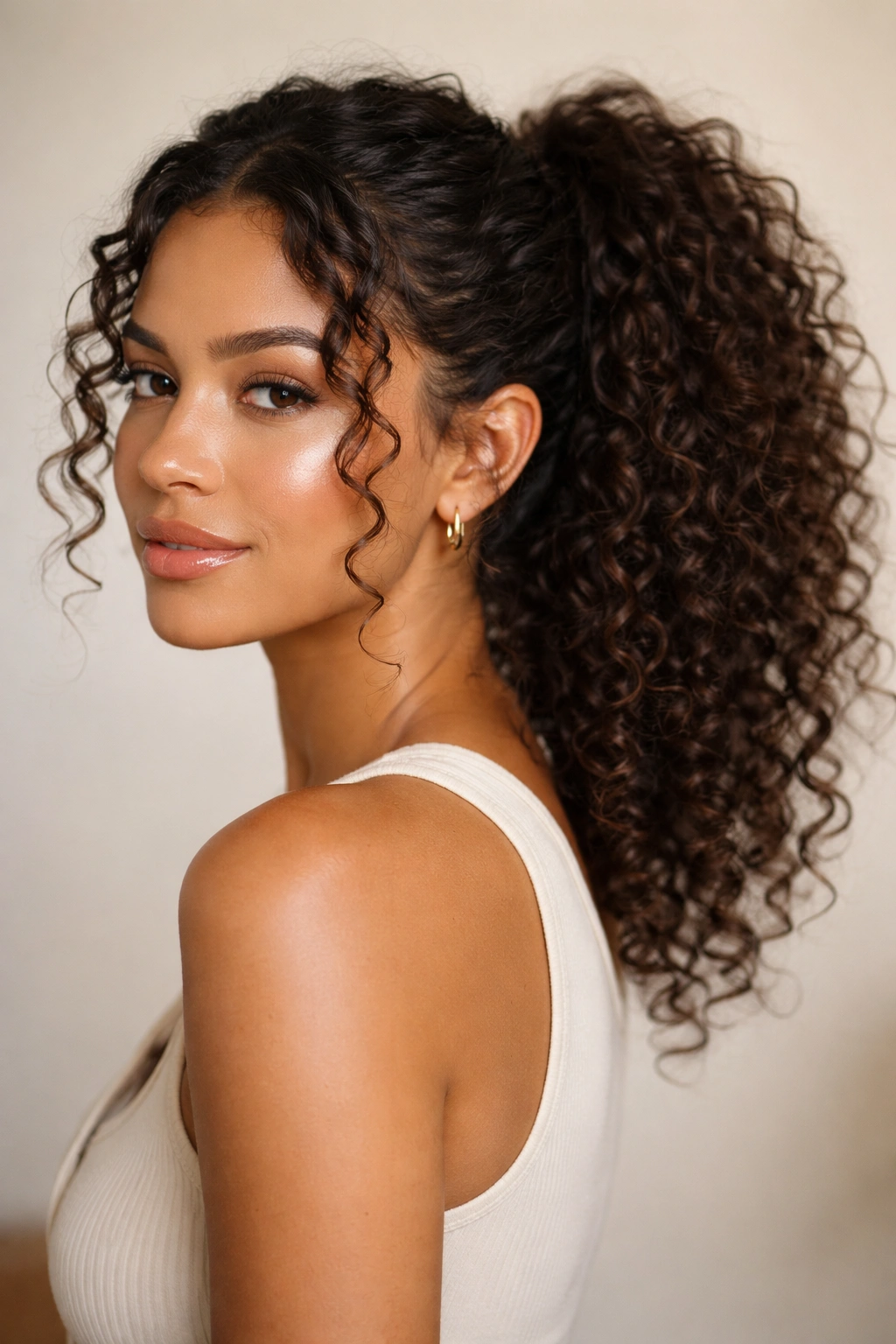
This style leaves the front sections down while gathering your mid-length curls into a soft ponytail, giving you the best of both worlds—face-framing curls and a clean, polished look behind. The magic is in how you gather it: not too tight, not too loose, but secure enough to actually stay put through movement. You’re creating dimension by keeping strategic pieces out, which makes this style feel intentional and allows your curls to showcase their natural beauty.
Why Curly Hair Loves This Approach
The textured halfway pony works beautifully for curly hair because it doesn’t require you to sacrifice the curls that frame your face, which are often your most defined and beautiful ones. By pulling back only the back and middle sections, you maintain volume at the crown and sides while keeping everything secure. This style is forgiving—if a few curls escape, it only adds to the intentional, undone vibe.
How to Achieve This Look
- Start with curls that are already defined, whether that’s fresh from a wash day or refreshed with a curl-refreshing spray
- Take sections from your temples back, leaving the front face-framing pieces loose and down
- Gather everything else into a ponytail at the base of your skull, using a elastic that’s gentle on curls (avoid thin hair ties that create tension and breakage)
- Gently tease or backcomb the base of the ponytail to add texture and grip without using uncomfortable tension
- Leave the gathered ponytail slightly loose and textured rather than smoothing it into a sleek finish
- Use a light hair cream or anti-frizz serum on the face-framing pieces to keep them defined and bouncy
Pro tip: This style works especially well on day-two curls when your texture is already softened slightly but still looks intentional—it’s the perfect transition style when you’re between wash days.
2. The Twisted Crown Pony
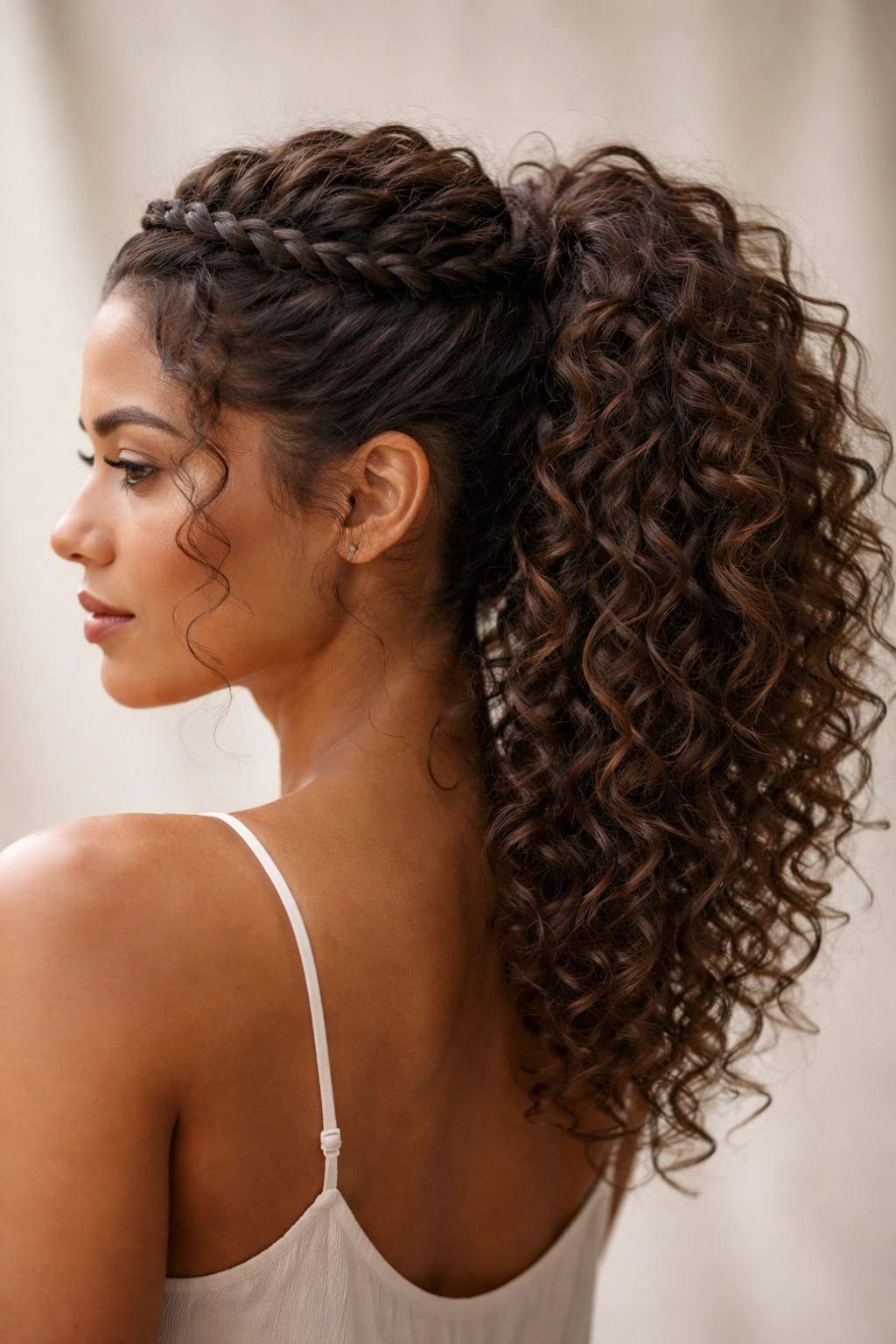
This variation involves twisting sections of your curls before gathering them into a mid-ponytail, creating visual interest and texture that goes far beyond a basic pull-back. The twists add an elegant, considered feel while keeping your curls from flattening where they’re secured. Even loose twists create definition that makes the whole style look more intentional and polished.
The Sophistication Factor for Curly Hair
Twisting sections before ponytailing adds a layer of visual complexity that suits curly hair perfectly. The twists catch light differently than your loose curls and create a styled appearance without requiring you to straighten or heavily manipulate your texture. This is the kind of style that photographs beautifully and works just as well for everyday wear as it does for special events.
Building Your Twisted Pony
- Section your curls into 3-4 pieces: two from your temples, one from the crown, and potentially one from the back depending on your hair density
- Starting with one temple section, gently twist it moving toward the back, allowing the curl pattern to work within the twist rather than fighting against it
- Repeat with your other sections, moving them toward the center back of your head
- Gather all twisted sections (and any remaining loose curls) into a mid-ponytail at the base of your skull
- Secure with a gentle elastic and arrange the twists so they’re visible and frame your ponytail nicely
- Let the ponytail itself remain textured and curly rather than smoothing it
Worth knowing: Two-strand twists work even better if you’re open to a slightly more involved styling process—they create beautiful definition and catch the light in dramatic ways.
3. The Curly Topknot Half-Up
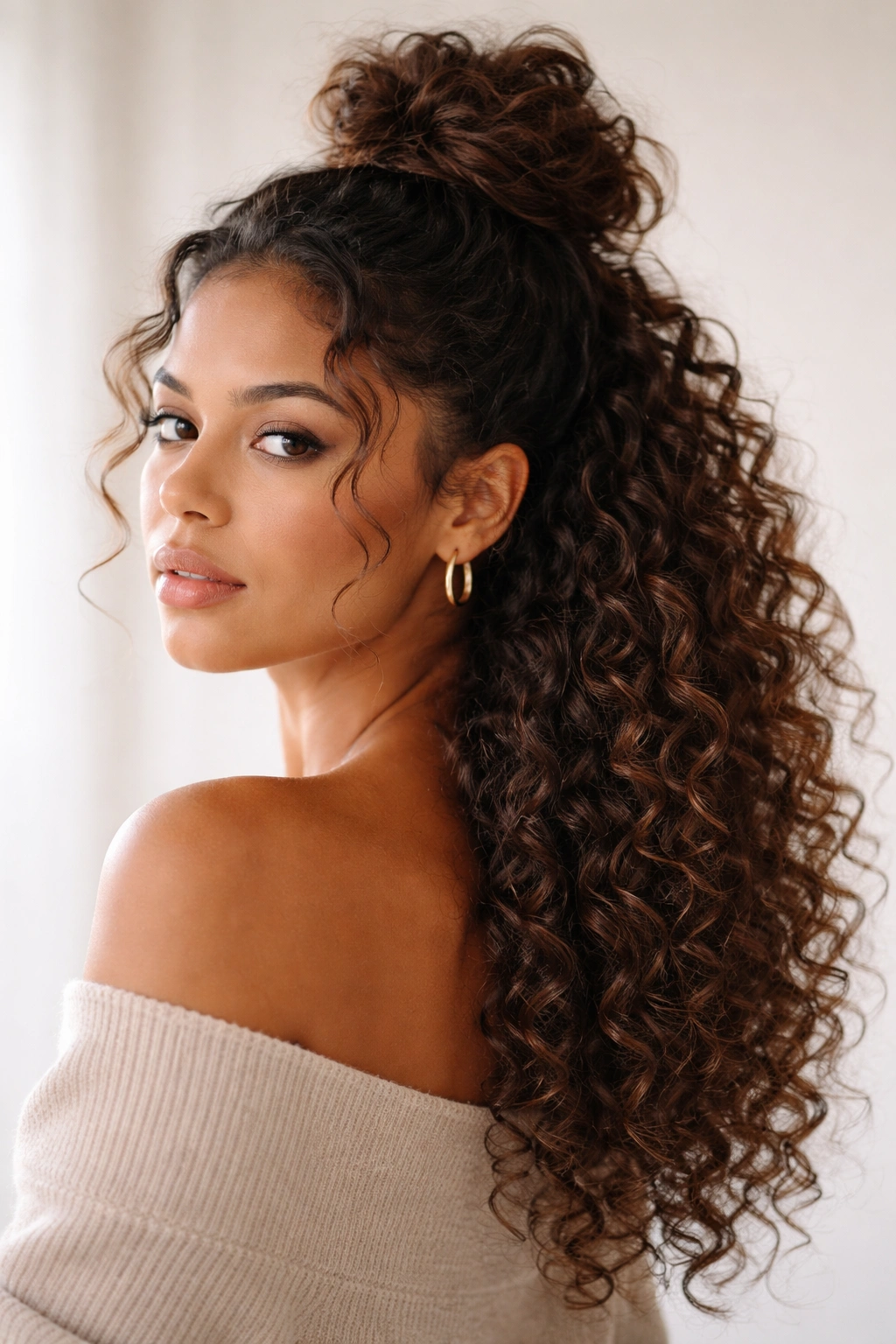
This playful hybrid combines a topknot at the crown with curls cascading down the back, created by gathering your top section and twisting it loosely before coiling it and pinning it. The result is height, polish, and the undeniable presence of your full curl definition below. This style is particularly stunning on curly hair because the loose topknot contrasts beautifully with the spiraling curls that fall below it.
Why Curly Hair Texture Elevates This Style
The topknot half-up traditionally works on straight hair, but it absolutely shines on curls. Your natural texture creates volume that a topknot on straight hair would never achieve. The spiraling of the topknot echoes the spiraling of your curls below it, creating a cohesive, visually interesting silhouette that looks intentional and polished without being overdone.
Creating Your Curly Topknot Half-Up
- Take the top section of your hair (from roughly your temples back to your crown) and loosely twist it
- Coil that twist into a knot shape at the crown of your head
- Secure it with bobby pins that match your hair color, pushing them through the coiled twist
- Leave the back and sides of your hair down in your natural curls
- Use your fingers to gently tousle the topknot so it looks intentionally relaxed rather than perfectly tight
- Apply a light-hold styling spray to keep everything in place without creating crunch or frizz
Pro tip: This works beautifully with curly hair clips or vintage-style bobby pins if you want to make the topknot itself a visual accessory rather than trying to hide it.
4. The Pineapple Pony with Definition
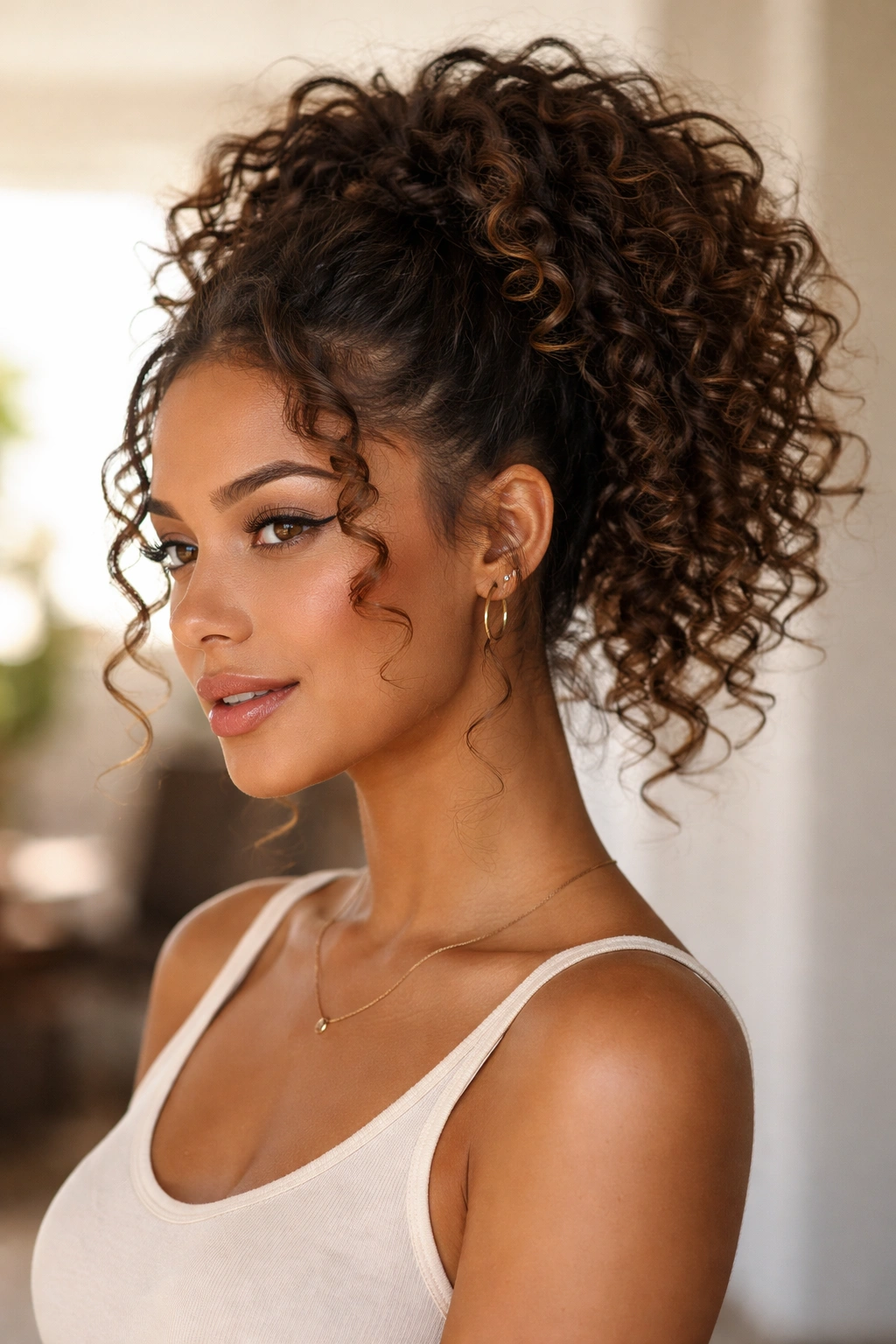
The pineapple technique—gathering curls loosely at the crown to protect them while sleeping—translates beautifully into a daytime style when you secure it at mid-length. This style celebrates the natural shape and fullness of your curls while keeping them out of your face. It’s one of the easiest styles to execute and looks intentional without requiring any special techniques or complicated steps.
How This Works for Everyday Wear
The pineapple pony is revolutionary for curly hair because it works with your curl pattern rather than against it. Instead of compressing your curls flat against your head, you’re gathering them loosely so they maintain their shape and volume. The natural bounce and definition of your curls is the actual design of the hairstyle, not something hidden underneath.
Building Your Pineapple Pony
- Flip your head forward and gather your curls loosely at the back of your head
- Use your fingers more than your comb to gather them—aggressive combing disrupts curl definition
- Secure with a soft elastic or silk scrunchie at mid-length (lower than a high ponytail)
- Flip back up and gently arrange the gathered curls so they sit naturally and maintain their shape
- Use a curl-defining product on any flyaways around your face to keep the style clean without adding weight
- Let the ponytail sit with its natural texture—the looser you keep it, the more intentional and beautiful it looks
Insider note: This style actually gets better as the day goes on because your curls continue to set and define themselves, creating even more texture and dimension by evening.
5. The Braided Mid-Pony with Curls
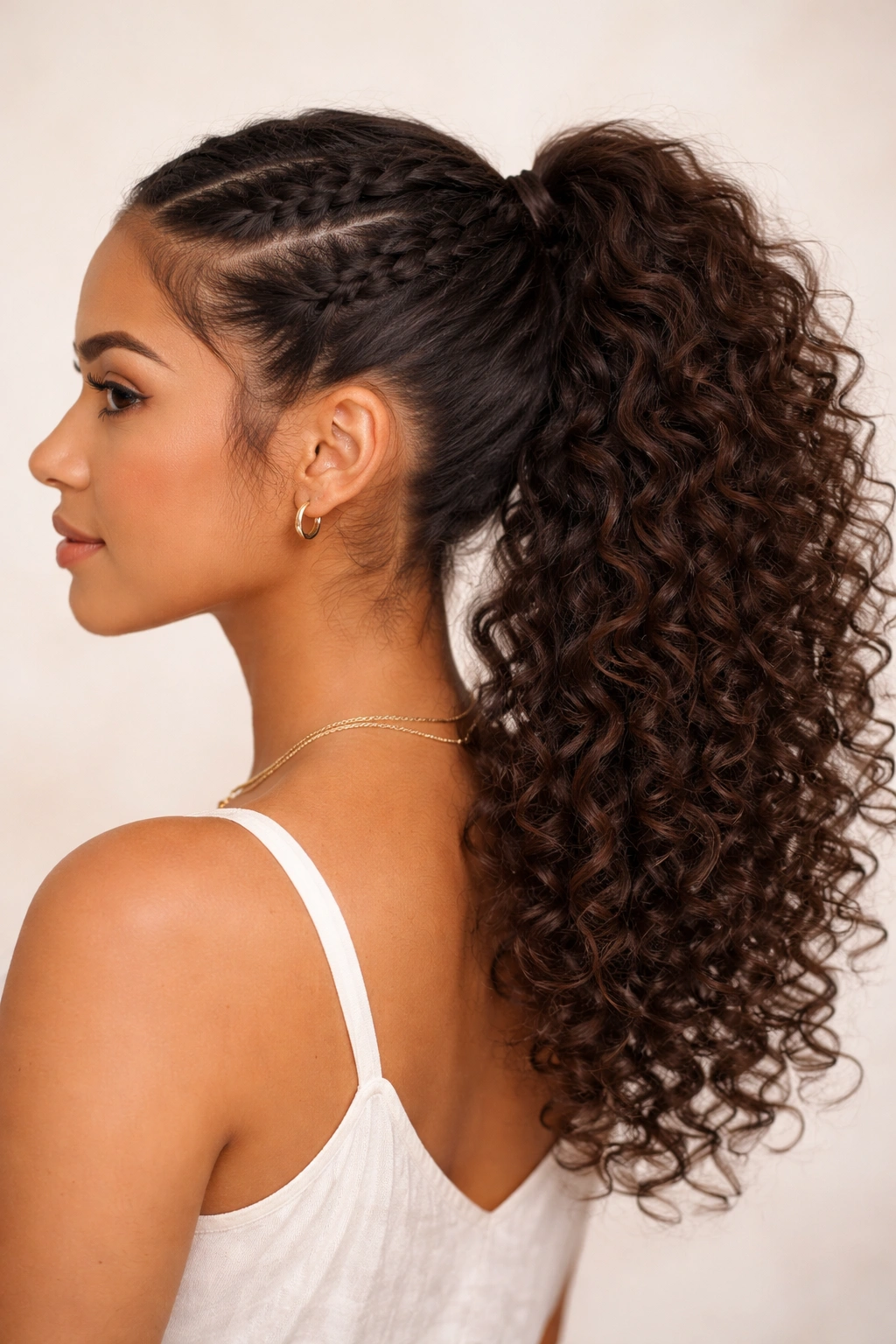
Adding a braid—whether it’s a traditional three-strand, Dutch, or loose crown braid—to a ponytail elevates the style from simple to special. The braiding adds visual interest and holds everything in place even more securely, which is perfect for active days or events where you need your hair to truly stay put. The contrast between the structured braid and the loose, spiraling curls below it is visually striking on curly hair.
Creating Interest Through Braiding on Curly Hair
Braids work beautifully on curly hair because your curl pattern creates texture that makes the braid itself more visually interesting. You don’t need a perfectly tight, smooth braid—in fact, a slightly looser, more textured braid complements curly hair better. The braid acts as a frame for your curls, drawing attention to your natural texture while keeping everything organized and secure.
How to Execute Your Braided Pony
- Section off the sides of your hair from temple to ear on each side
- Beginning with one side, braid loosely down toward the back of your head, allowing your curl pattern to exist within the braid
- Repeat on the other side, bringing both braids to meet at the center back
- Gather both braids along with any remaining loose curls into a mid-length ponytail
- Secure with a gentle elastic and gently pull the braids loose slightly to add texture and volume
- Leave your ponytail curly and undone—this contrast between the braids and the loose curls is what makes the style work
Pro tip: If traditional braiding feels complicated with your curl pattern, try creating two loose sections and twisting them together instead—the effect is similar but easier to execute on textured hair.
6. The Soft Bubble Pony
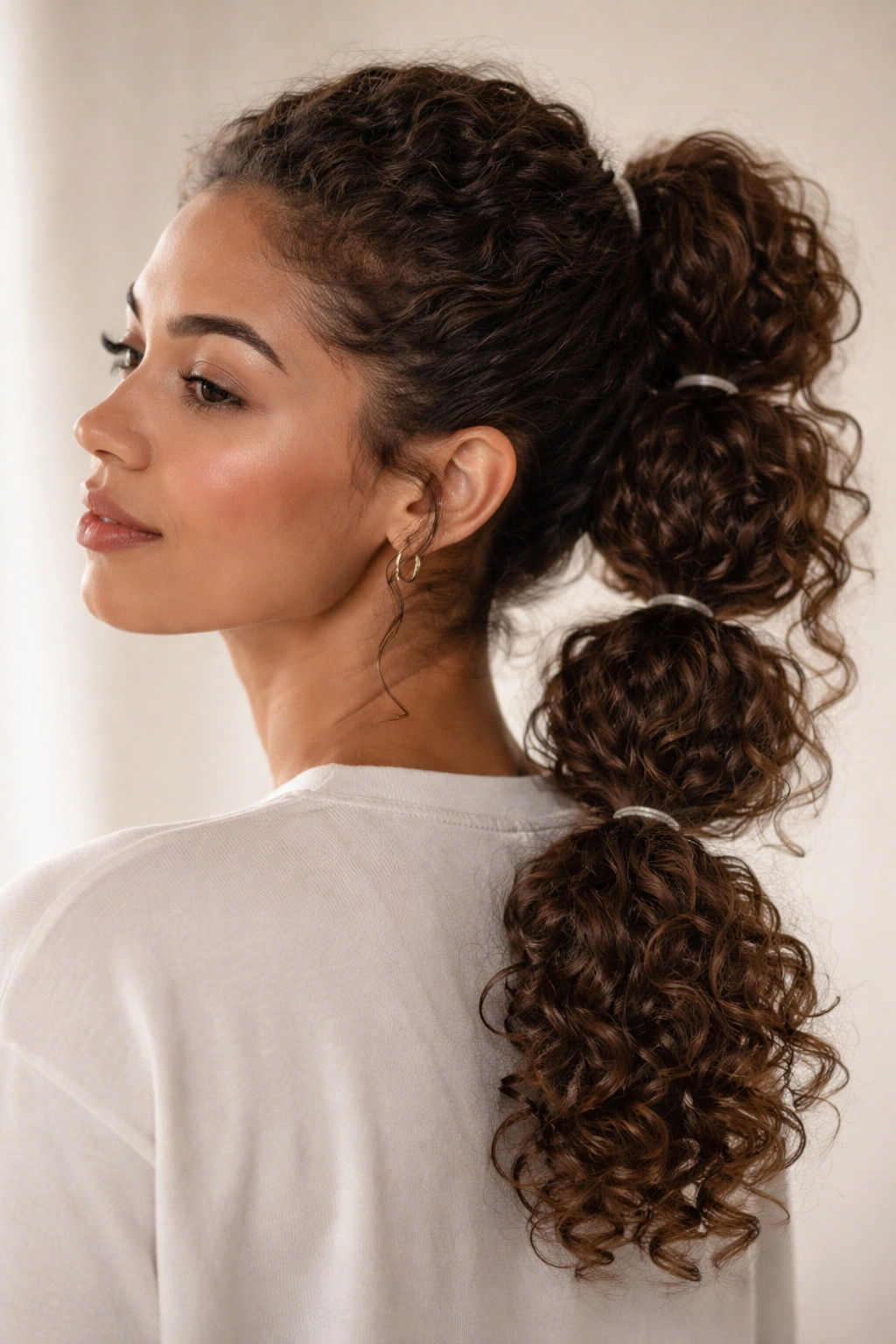
This style uses multiple elastics spaced evenly down your ponytail length to create bubble-like sections, adding playfulness and visual interest while giving your curls space to exist at each section. Each bubble is created by gently teasing or puffing out the hair between the elastics. What makes this style work for curly hair is that your natural texture creates the “bubble” effect almost automatically—you’re just highlighting what’s already there.
Why This Style Celebrates Curly Hair’s Texture
The bubble ponytail plays to curly hair’s natural strengths. Your curls want to expand and create volume—this style leans into that rather than fighting it. Each section can be gently puffed out to show off your curl pattern, and the multiple elastics actually help distribute tension throughout your hair length rather than concentrating it all in one spot at the base of your ponytail.
Crafting Your Bubble Pony
- Begin with a mid-length ponytail secured with an elastic at the base of your ponytail (lower than a typical high pony, at mid-skull height)
- Working from the base of the ponytail downward, place another elastic about 3-4 inches below the first
- Repeat this spacing down the length of your ponytail, using 4-6 elastics total depending on your hair length
- At each section between elastics, gently use your fingers to lift and puff out the curls, creating visible bubble sections
- Separate the curls between sections with your fingers or a wide-tooth comb to enhance the bubble effect
- Use a light hold spray to keep the puffed sections in place without flattening your natural curl definition
Worth knowing: The spacing between bubbles can be tighter for a more playful, youthful look or wider for a more sophisticated, subtle effect—adjust based on your preference and hair length.
7. The Scarf-Wrapped Mid-Pony
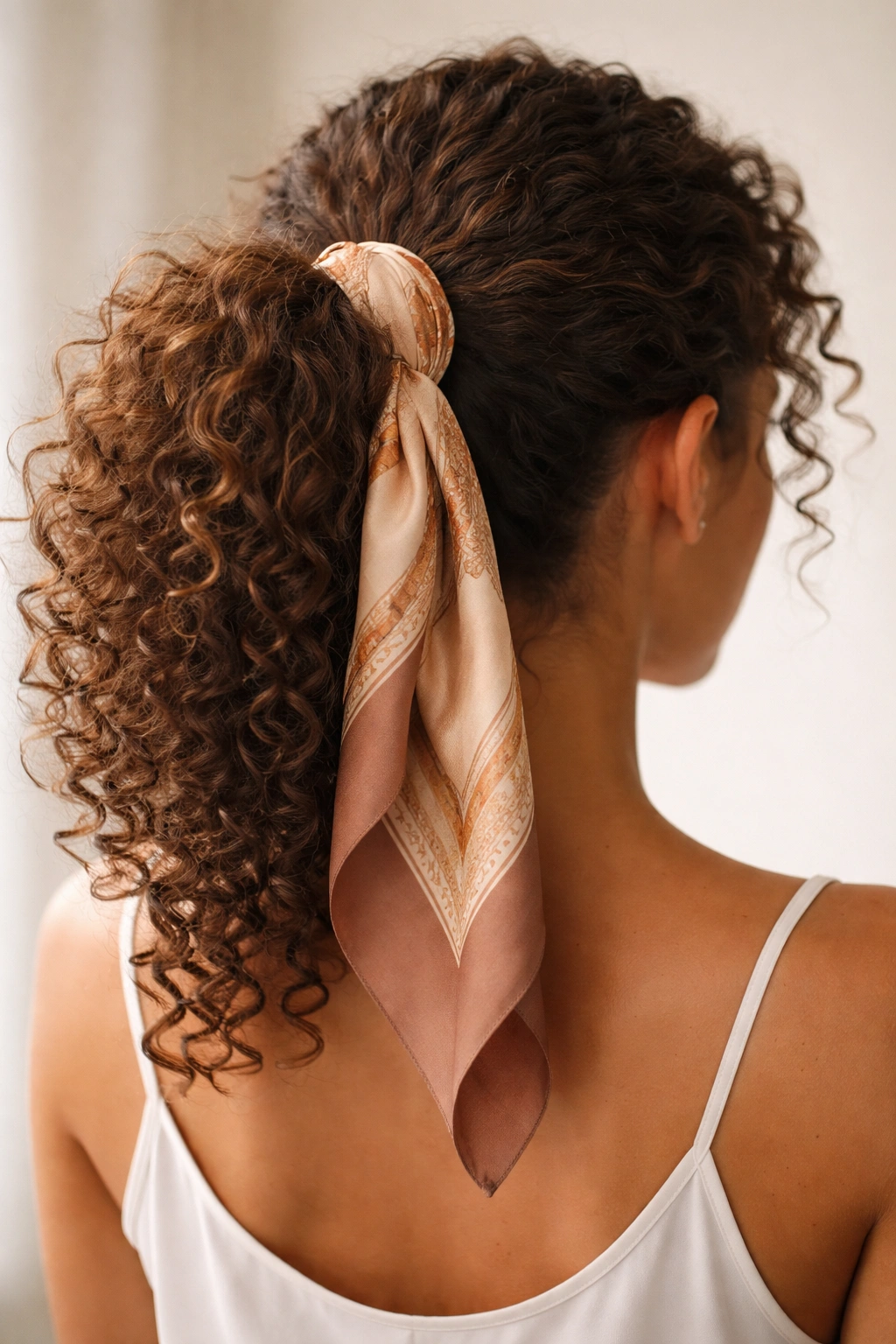
Wrapping a scarf, decorative fabric strip, or coordinating ribbon around the base of your ponytail elevates the entire style and adds a polished, intentional feel. This technique serves multiple purposes: it covers the elastic (which can look harsh on curly hair), adds visual interest, and provides a chic accessory element. For curly hair, this style transforms what could feel like a casual styling choice into something that looks carefully thought out.
The Accessory Factor for Curly Hair
Scarf wrapping is particularly effective for curly hair because it draws attention to and frames your curls beautifully. The wrapped element acts as a visual accent that highlights your texture rather than detracting from it. Whether you’re using a silk scarf, a decorative ribbon, or a coordinating fabric strip, you’re adding intentionality and polish that makes the hairstyle feel special.
Securing Your Scarf-Wrapped Style
- Create your mid-length ponytail using a thin, gentle elastic or a silk elastic that won’t damage your curls
- Choose a scarf or fabric strip in a color or pattern that complements your hair color and skin tone
- Wrap the scarf around the base of your ponytail, completely covering the elastic
- Secure the scarf by tying it in a knot at the base of the ponytail or tucking the ends underneath and pinning them with a bobby pin
- Gently adjust your ponytail curls so they fluff out nicely around the scarf
- Leave the ponytail with its natural texture and movement—the scarf is the styling element, not the curls
Pro tip: Silk scarves are gentler on curly hair than cotton or synthetic fabrics, and they also help minimize frizz compared to rougher materials.
8. The Side-Swept Mid-Pony
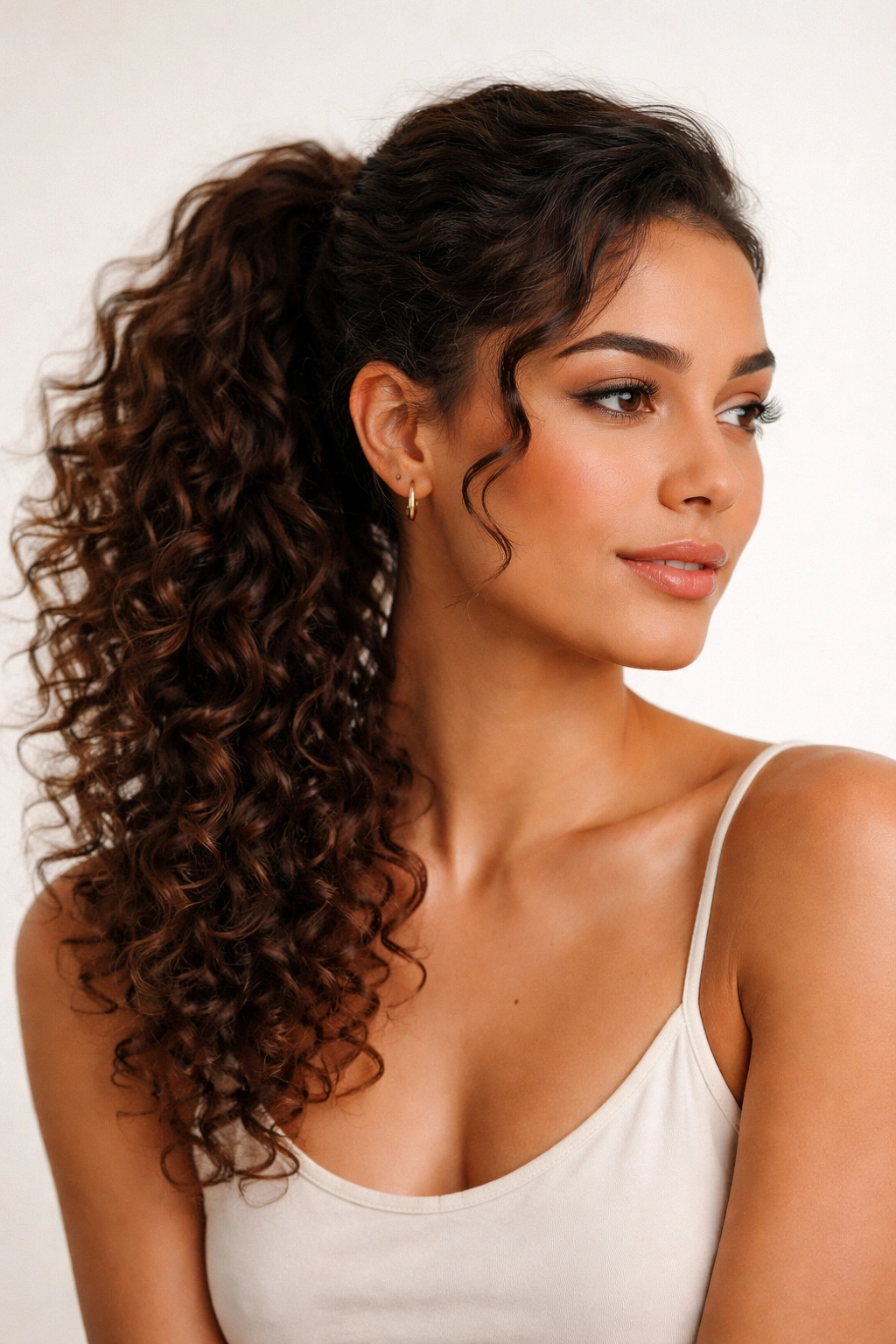
This variation places your ponytail off to one side rather than centered at the back of your head, creating an asymmetrical, more modern look. The side placement is flattering for most face shapes and works beautifully with curly hair because it allows your curls to spill across your shoulder and create visual interest. This style is slightly dressier than a centered ponytail while still being casual enough for daily wear.
Why Side-Swept Works for Your Curls
Side-swept ponytails are particularly flattering on curly hair because the asymmetry plays to the natural volume and movement of your texture. Instead of trying to create sleekness (which can be difficult and damaging to curly hair), you’re embracing the natural fullness of your curls and placing them strategically. The side placement also means you can show off more of your face and neck while still keeping hair off that area.
Creating Your Side-Swept Ponytail
- Brush or comb your curls gently to smooth them slightly while maintaining their shape
- Gather the bulk of your curls to one side of your head, roughly where your ear is but slightly further back
- Secure at mid-length with a gentle elastic, holding the ponytail slightly to the side as you fasten it
- Leave some face-framing pieces on both sides to soften the look
- Gently separate your curls so the ponytail has natural volume and movement
- Use your fingers to arrange the ponytail so it drapes across your shoulder rather than sitting stiffly
Insider note: This style is particularly striking on curly hair with multiple hair colors, dimension, or highlights because the side placement shows off color variations beautifully.
9. The Textured Pony with Extensions
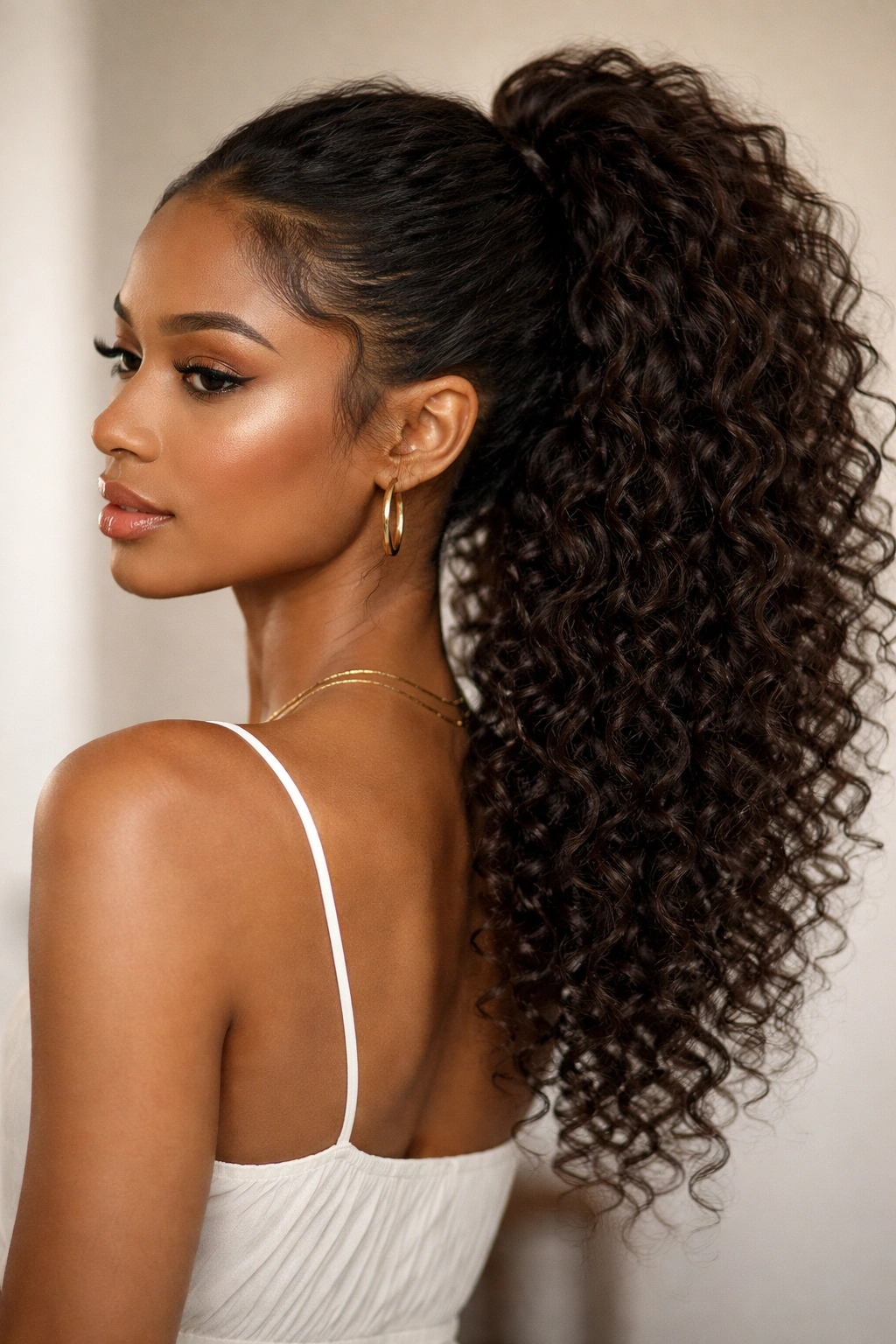
If you’re looking for added volume, length, or density, curly hair extensions clipped or woven into your mid-ponytail can dramatically change the impact of the style. Extensions on curly hair are particularly forgiving because the curl pattern disguises blend lines and blends your natural hair with the extensions seamlessly. This is the style to choose when you want maximum volume and impact.
How Extensions Transform Your Ponytail Game
Curly hair extensions create a totally different look without requiring permanent changes or significant damage to your natural hair. The extension curls blend with your natural texture almost invisibly, and the added volume makes even a mid-ponytail feel dramatic and full. This approach is perfect if you’re not ready to commit to growing out your own hair but want the fullness and length of longer curls.
Adding Extensions to Your Mid-Pony
- Create your base mid-length ponytail using your natural hair, securing it with a gentle elastic
- Choose curly hair extensions in a curl pattern that matches your natural texture as closely as possible
- Clip-in extensions typically sit just below your elastic, secured by carefully positioning the clips into the ponytail
- Alternatively, woven or braid-in extensions can be integrated into your ponytail during the initial gathering process
- Once extensions are secured, gently tousle and separate the combined natural hair and extension curls
- Use a curl-defining product on the combined hair to blend the extensions seamlessly with your natural curls
- Style the full ponytail with gentle movement and texture—the extensions will boost your natural curl pattern
Worth knowing: Match your extension curl pattern as closely as possible to your natural hair; even slight differences in curl size become obvious in a pony where the hair is gathered closely together.
10. The Sleek-Base Textured-Ends Pony
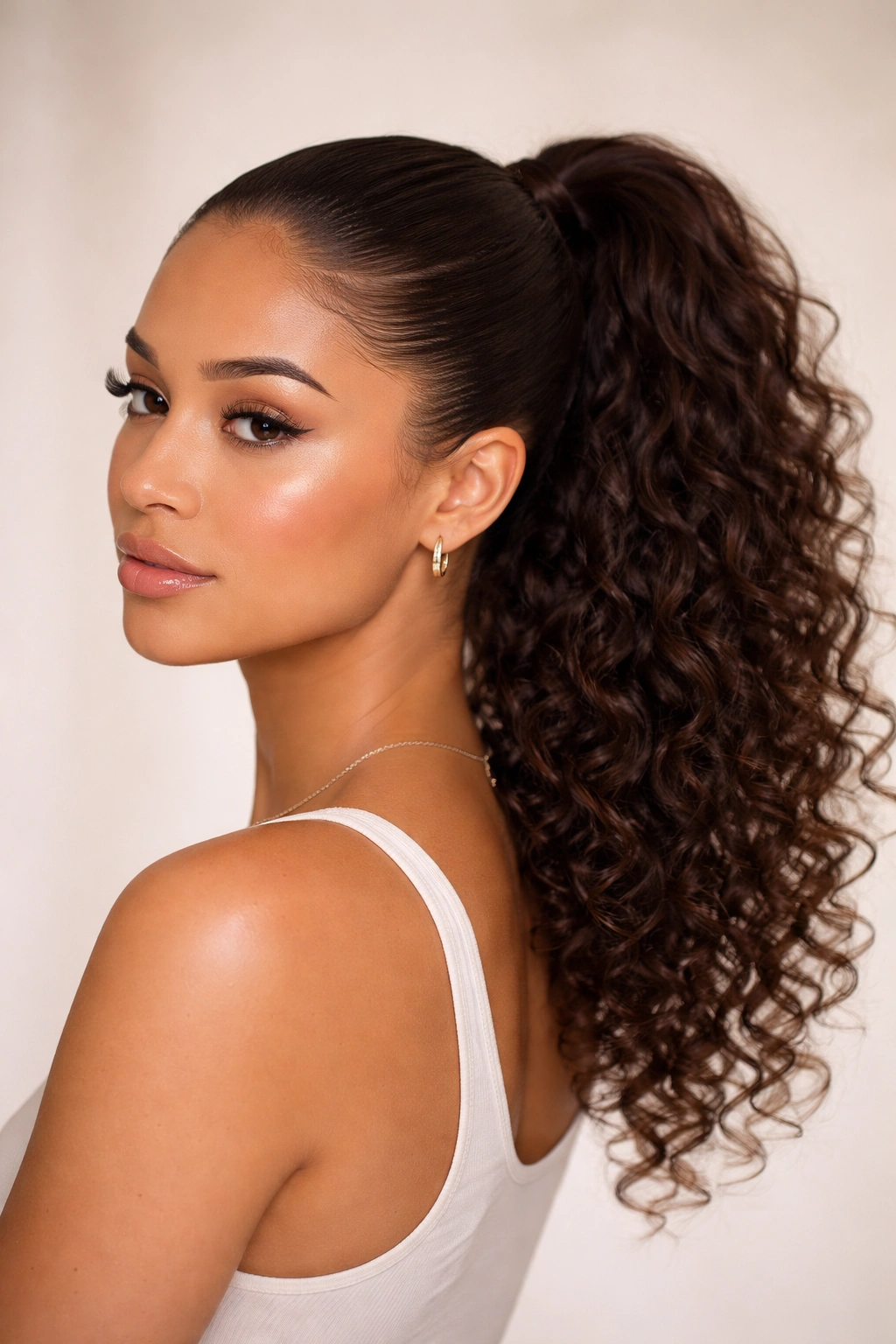
This style uses smoothing techniques and products only at the base of your ponytail (creating a sleek, polished gathered section) while allowing your curls to remain fully textured and full from roughly the middle of the ponytail downward. This approach gives you the polish and sophistication of a sleek style without sacrificing the beauty and movement of your natural curls. It’s an elegant compromise between sleek and textured.
Why This Works Better Than a Fully Sleek Pony on Curly Hair
A fully sleek ponytail on curly hair requires heat styling and chemical smoothing that damages your curls and is difficult to maintain. This hybrid approach lets you have the visual of a polished ponytail without the damage. The sleek base creates structure and elegance, while the textured ends show off your most beautiful curl definition. You’re getting the best of both styling worlds with this approach.
Building Your Sleek-Base Textured-Ends Pony
- Begin with clean, moisturized curls that are defined and bouncy
- Use a smoothing serum or curl gel at the roots and base area to create a sleeker foundation
- Gently comb or brush the top portion of your hair (roughly the top third to half) to smooth it while maintaining some body
- Gather this smoothed section into a mid-length ponytail, securing tightly enough that it stays put but not so tight that you’re causing tension damage
- Leave the ponytail itself completely unsmoothed—use your fingers to separate and define each curl starting roughly midway down the ponytail length
- Apply a curl-defining cream or mousse to the loose, textured portion of the ponytail to enhance definition and combat frizz
- Use a light-hold styling spray to set the smooth base and keep it looking polished throughout the day
Pro tip: This style actually improves as your natural oils distribute throughout the day, making it perfect for midday wear or events that last several hours.
11. The Two-Tiered Mid-Pony
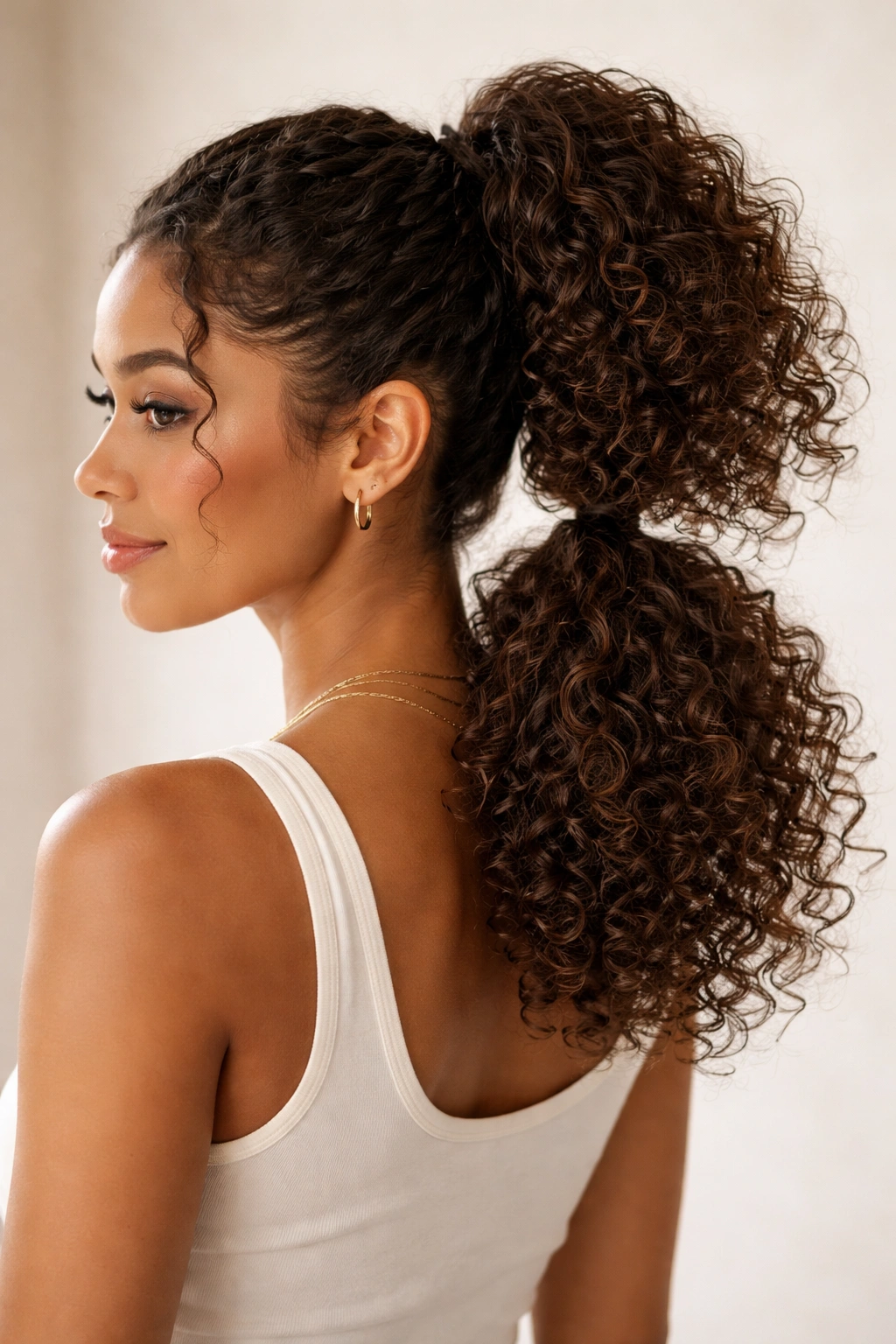
This style creates visual interest by gathering your hair into two separate ponytails at different heights—typically one at the crown and another at mid-length—creating a tiered effect that’s playful and modern. The two ponytails can be identical in style or subtly different, and the spacing between them creates dimension that makes this look more complex than it actually is. On curly hair, the two-tiered approach creates beautiful volume and visual interest without requiring complicated styling techniques.
The Visual Impact on Curly Hair
Two-tiered ponytails create the illusion of much thicker, fuller hair—something that’s particularly striking on curly hair where volume is already a natural feature. The layering also creates interesting proportions and a more fashion-forward look than traditional single-ponytail styles. This approach is perfect for when you want your hairstyle to be more of a style statement than just practical hair management.
Creating Your Two-Tiered Pony
- Create your first ponytail higher up, roughly at your crown level, using a gentle elastic
- Gently tease or backcomb the base of this first ponytail to add grip and texture
- Below this, create a second ponytail at mid-length, incorporating both the loose hair below your first ponytail and some hair from the sides
- Secure the lower ponytail with a gentle elastic, spacing it about 3-4 inches below the first ponytail
- Both ponytails should remain textured and curly—use your fingers to separate and fluff the curls in each section
- You can wrap a scarf around one or both elastic bases for added polish
- Apply a light-hold styling product to keep both ponytails looking neat without flattening your natural curl definition
Insider note: This style works particularly well with hair that has multiple texture levels or curl sizes, as the two tiers create visual rhythm that echoes your natural texture variation.
12. The Knotted Mid-Pony with Tendrils
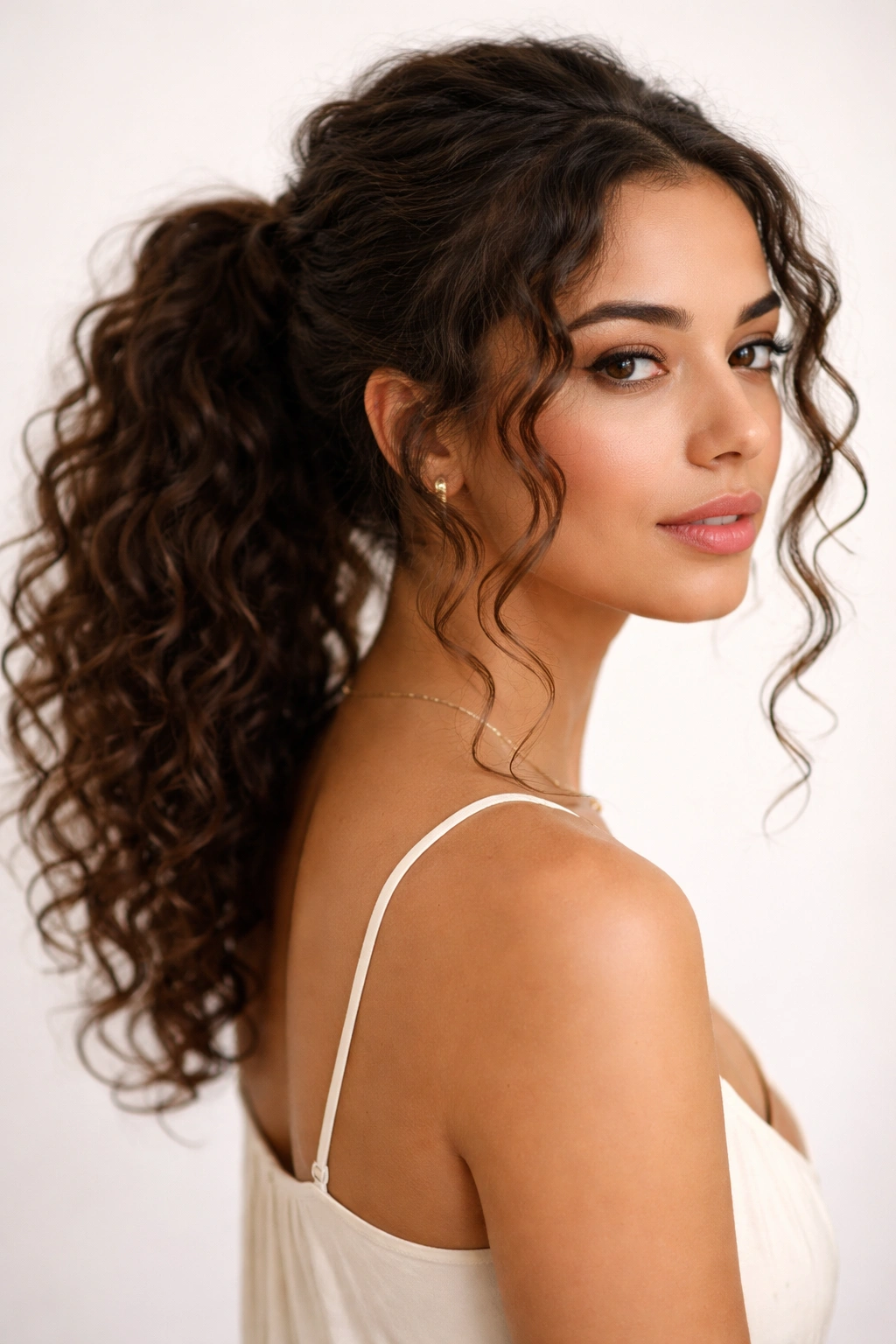
This refined style uses a simple knot (like tying a shoe without the loops) as the base securing method for your mid-ponytail, then leaves a few face-framing tendrils loose around your face. The knotted securing method is elegant and less structured-looking than a traditional elastic ponytail. Leaving intentional tendrils softens the style and makes it feel more romantic and less utilitarian. This approach is perfect for occasions where you want polish without severity.
The Sophistication of a Knotted Gather
Knot-securing a ponytail instead of using an elastic changes the entire vibe of the style from practical to intentional and refined. On curly hair, this approach works beautifully because the knot sits more loosely than an elastic, allowing your curls to maintain more natural volume and shape. The knotted base catches the eye in a way that makes the entire style feel more considered and stylish.
Tying Your Knotted Mid-Pony
- Gather your mid-section curls (from roughly ear level and back) in your hands, leaving face-framing pieces on both sides
- You can either use a small section of your own hair as the tying element or use a thin, beautiful ribbon or fabric strip in a coordinating color
- If using your own hair, section out a thin piece from the ponytail itself and use it to tie around the gathered section
- If using ribbon or fabric, wrap it around the gathered section and tie it in a secure knot
- Gently tousle the gathered curls so they maintain their natural shape and volume
- Leave 2-3 face-framing sections loose around your face, allowing them to frame your face softly
- Use a light styling spray to set the face-framing tendrils and keep them from frizzing
Worth knowing: This style works beautifully for special events because the knotted base gives you a sophisticated silhouette while the loose tendrils maintain a soft, romantic feel appropriate for celebrations.
Final Thoughts
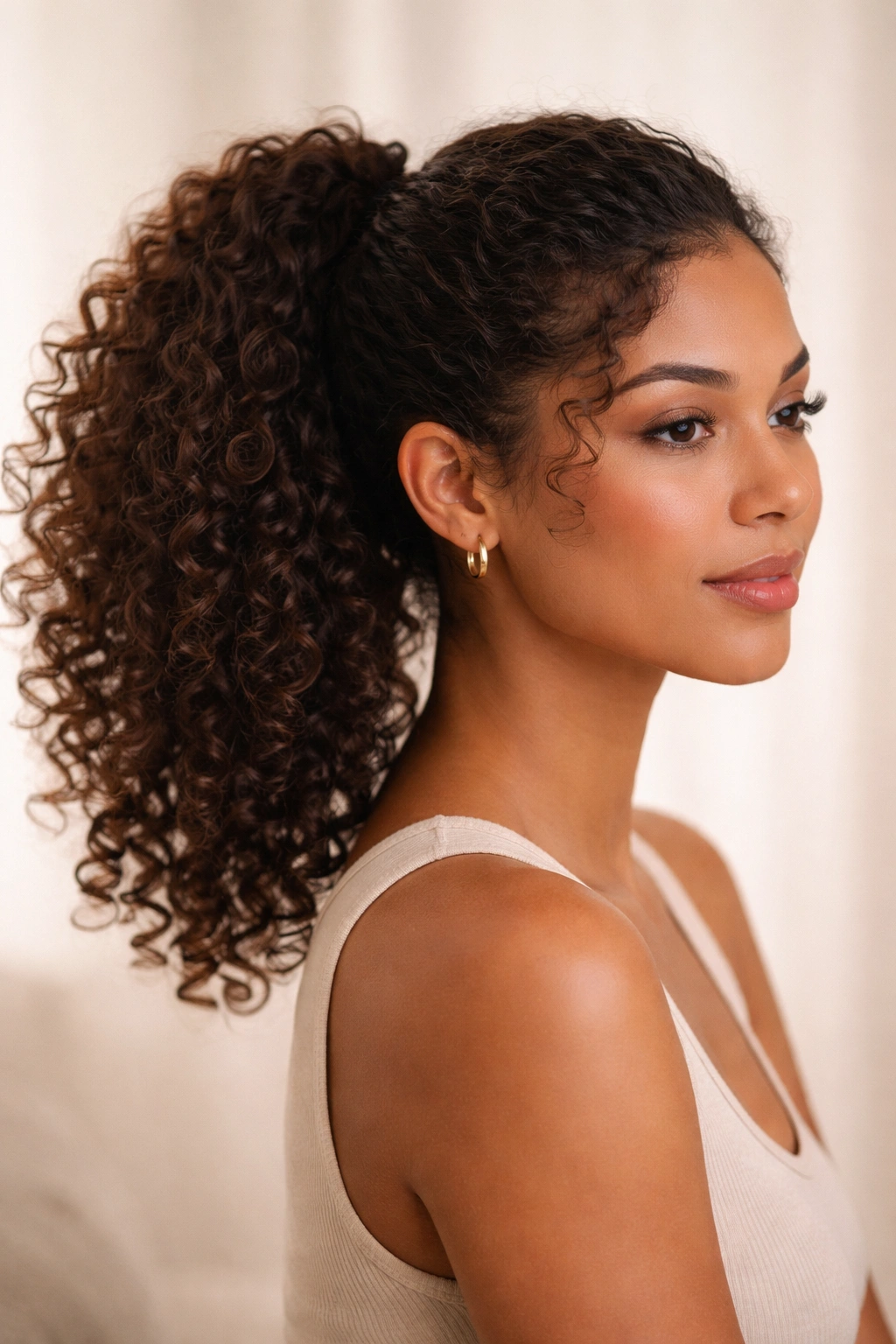
Finding your signature mid-ponytail style for curly hair is about understanding what works with your specific curl pattern rather than fighting against it. Each of these twelve styles offers a different solution—whether you’re looking for something quick and easy for everyday wear, something special for an event, or a style that requires a bit more technique and intention. The key across all of them is using gentle securing methods, letting your natural curl definition shine, and recognizing that curly hair actually makes simpler styles look more interesting and intentional because your texture does the visual work.
The beautiful part about styling curly hair is that it’s naturally forgiving. A slightly messy pony on straight hair looks sloppy; the same slightly undone pony on curls looks intentionally relaxed and textured. That works in your favor when you’re experimenting with these styles. Try a different one each week and notice how they make you feel, how they hold up throughout your day, and which ones have you getting the most compliments. Your favorite style might surprise you—it might be the simplest one or the most involved, the playful bubble pony or the elegant knotted version. What matters is that you’re working with your hair rather than against it, keeping your curls healthy and beautiful, and showing off the gorgeous texture you were born with.
