



Double ponytails instantly transform your entire look, adding playfulness and movement that a single ponytail simply can’t deliver. When you layer them with bangs, you’re creating a hairstyle that works across nearly every vibe—from polished and professional to fun and experimental. The combination of two symmetrical tails with framing bangs creates natural definition around your face while keeping longer strands beautifully contained. Whether you’re heading into a casual Friday at work, attending a music festival, or just wanting to refresh your everyday routine, double ponytails with bangs offer remarkable versatility without requiring hours in a salon chair.
What makes this pairing so special is how the bangs interact with the ponytails. They soften the look by framing your face while the double ponytails draw attention to your hair texture and overall style. The bangs also serve a practical purpose—they prevent wispy pieces from falling in your face while the double ponytails keep the bulk of your hair secured and tidy. You can adjust the height, thickness, and type of bangs to match your face shape and personal aesthetic, meaning this styling combination genuinely works for people with different hair types, face shapes, and style preferences.
The beauty of double ponytails with bangs is that they’re far more customizable than they initially appear. You can go high or low, sleek or textured, thick or thin, blunt or layered. Each variation completely changes the energy of the style, making it possible to create a different look every time you style your hair. Let’s explore twelve distinct approaches to this hairstyle, each with its own personality and the specific styling techniques that make it work.
1. Classic High Double Ponytails With Blunt Bangs
This is the foundational style that works for nearly everyone—high, symmetrical ponytails that sit at the crown paired with straight-across blunt bangs. The high placement creates an instantly youthful, alert appearance while the blunt bangs add a bold, definitive frame around your face. This style has been iconic across decades because it genuinely flatters different face shapes and hair textures. The key is getting the placement perfectly symmetrical—the ponytails should sit equidistant from your center part, and both should be pulled equally tight so they sit at precisely the same height.
Why It Works So Well
Blunt bangs paired with high ponytails create a clean, polished silhouette that photographs beautifully. The geometric lines created by the blunt cut work in perfect balance with the cylindrical shape of the ponytails below. This style also elongates the face slightly, making it flattering for rounder face shapes. The bangs protect the hairline from constant styling tension, and the high ponytails keep hair completely off the neck and shoulders, making it practical for exercise, work, or hot weather.
Styling Steps to Get It Right
- Part your hair directly down the center from your forehead to the nape of your neck—use a rattail comb for precision
- Spray a light texturizing spray throughout your lengths to create grip and prevent slippage
- Gather the right section of hair into a tight elastic, securing it at the crown (approximately 2-3 inches above your ear)
- Repeat on the left side, pulling the ponytail equally tight and positioning it at the exact same height
- Trim or style your bangs in a blunt line just above your eyebrows—they should sit parallel to the ground
- Smooth down any flyaways with a light serum or edge control product
Pro tip: This style stays put longer if you flip your head upside down before securing each ponytail, which redistributes hair volume and creates a tighter base.
2. Sleek Low Double Ponytails With Wispy Bangs
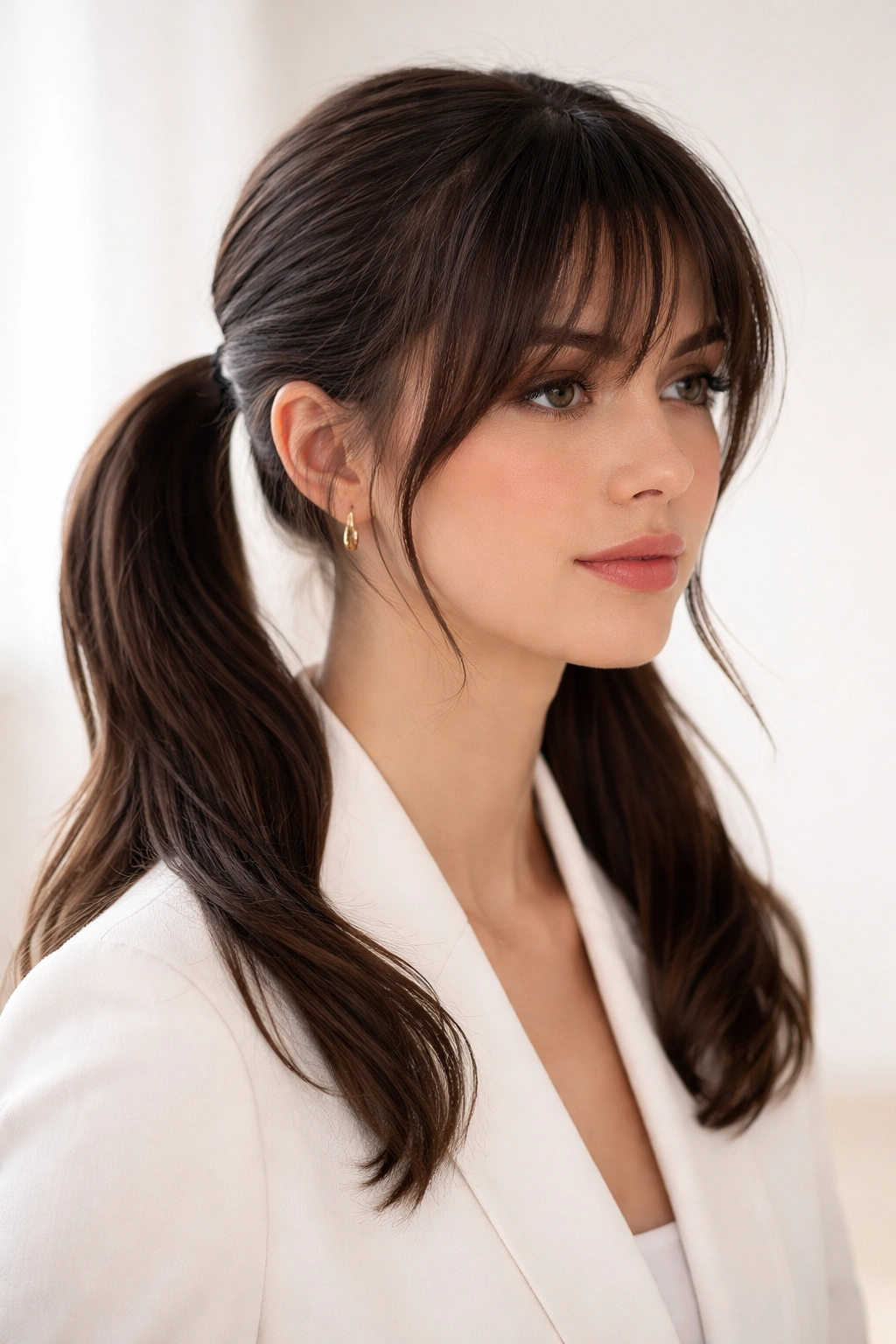
Moving the ponytails down to the nape of your neck creates an entirely different energy—more sophisticated, office-appropriate, and effortlessly polished. Wispy bangs soften this look considerably, allowing pieces to frame your face in a more romantic way rather than creating a stark line. This combination reads as refined and intentional while remaining completely wearable for professional settings. The lower placement also makes the style more comfortable for longer wearing periods, as it puts less tension on the crown of your head.
Why It Works So Well
Low ponytails suit nearly every hair type and face shape because the lower placement is inherently flattering—it elongates the neck and face while creating a slimming silhouette. Wispy bangs prevent this style from feeling too severe or corporate, adding movement and softness that makes you look approachable. The combination works beautifully for people with fine hair because the lower density at the crown means less visible scalp. The wispy quality of the bangs also forgives slight unevenness, making them more forgiving to style at home.
How to Achieve the Look
- Start with your hair slightly damp to help it hold a sleek shape
- Comb everything straight back toward the nape of your neck, smoothing as you go
- Divide your hair directly down the center, creating two equal sections
- Secure the right section into a low ponytail using a small elastic, positioning it approximately 1-2 inches above where your neck meets your shoulders
- Secure the left section at the exact same height, ensuring both ponytails have identical tension
- Cut or style your bangs with choppy, wispy layers using point-cutting or a razor technique
- Use a fine-tooth comb to gently blend the layers so they fall naturally around your face
Worth knowing: Wispy bangs require more frequent maintenance than blunt bangs because the layers can look stringy as they grow out. Schedule a trim every 3-4 weeks to keep them looking intentional.
3. Textured Double Ponytails With Curtain Bangs
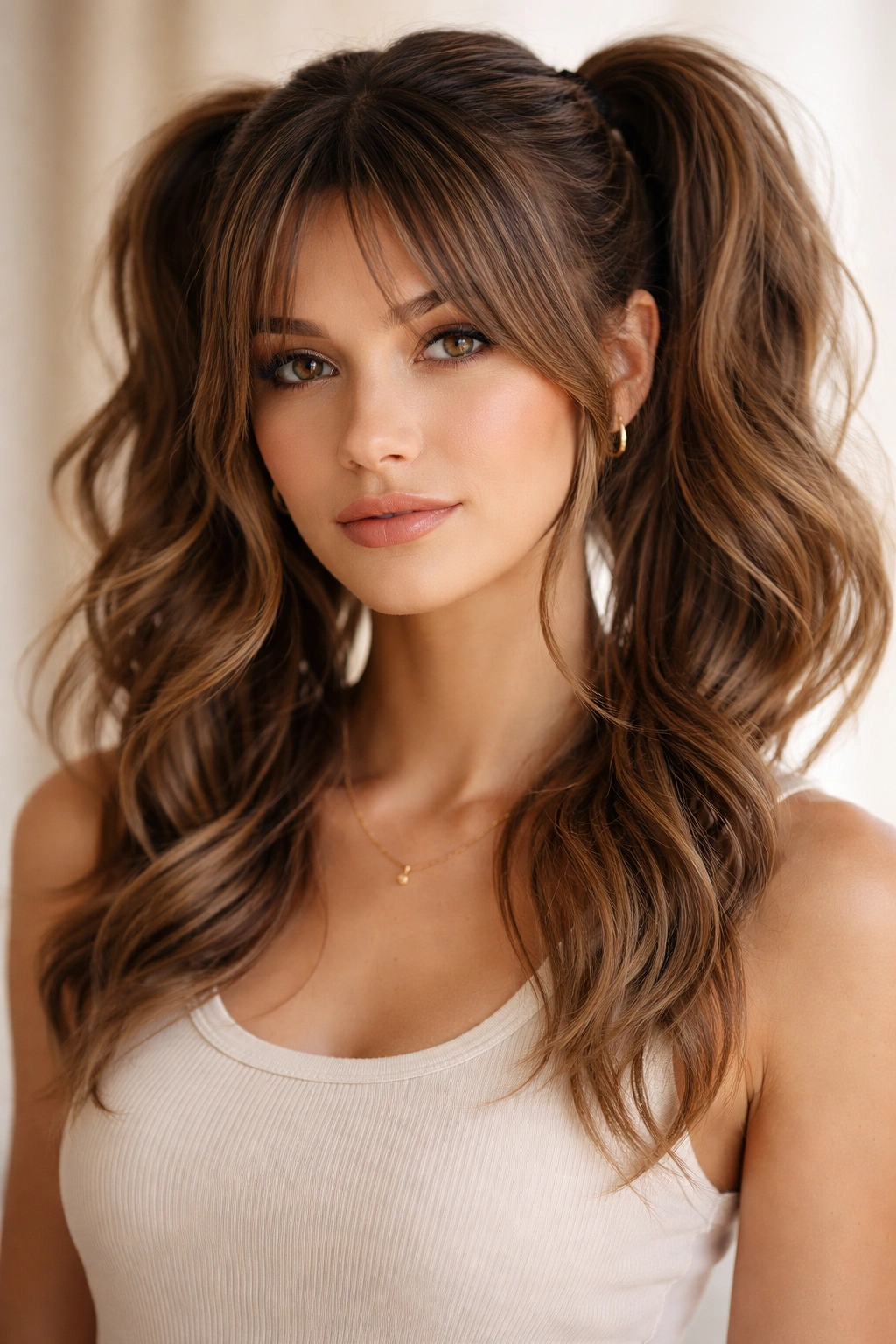
Adding texture throughout your hair creates dimension and movement, completely changing the visual weight and sophistication of the double ponytail look. Curtain bangs frame your face while opening it up—they create the illusion of a smaller face and work beautifully for people with prominent foreheads or wider face shapes. Textured hair also photographs beautifully and hides a multitude of styling imperfections. This version feels more casual and lived-in than sleek versions, making it perfect for people who prefer a relaxed aesthetic.
Why It Works So Well
Curtain bangs naturally parted down the center create symmetry with double ponytails while the outward-facing angles of the bangs open up your face considerably. When you pair this with textured hair, you get movement in multiple directions, which creates a more dynamic, interesting visual effect. Textured ponytails also feel less severe than slicked versions—the separation between individual hair strands creates a friendlier, less formal appearance. This style also hides root regrowth and doesn’t require your hair to be perfectly clean, making it lower-maintenance than sleek alternatives.
Getting the Texture and Style Right
- Spray your hair with a texturizing spray throughout, paying special attention to the roots and lengths
- Use a curling iron or wand to create loose waves—curl sections away from your face
- Let the waves cool while still in the curled shape to help them set
- Create a center part, allowing the front sections to fall naturally as future bangs
- Gather the right section of hair into a ponytail at your desired height, leaving the curtain bang section out
- Repeat on the left side, making sure both ponytails are at the same height and tension
- Style your curtain bangs so they fall on either side of your face with an outward curve
- Use your fingers to break up the waves slightly, creating a more natural, undone appearance
Pro tip: A light hairspray applied after styling helps maintain texture throughout the day without making hair feel stiff or crunchy.
4. Bubble Double Ponytails With Side-Swept Bangs
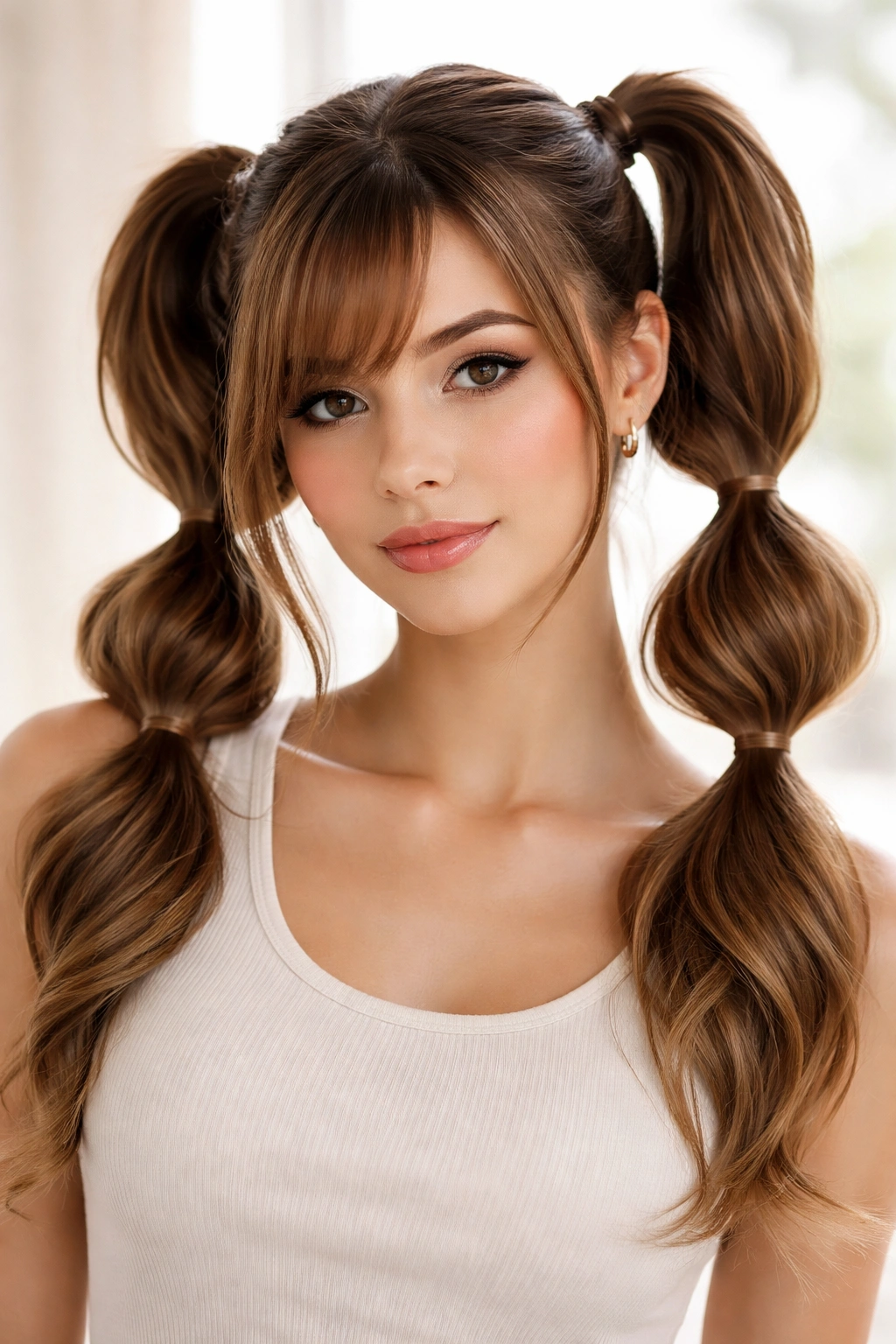
Bubble ponytails add a playful, creative element that elevates standard double ponytails into something more visually interesting and fashion-forward. By adding elastic bands at intervals down each ponytail, you create distinct sections that catch light and create visual rhythm. Pairing this with side-swept bangs softens the playfulness and creates an asymmetrical element that’s surprisingly sophisticated. This style works beautifully for people who want their hairstyle to serve as a statement without requiring any additional accessories.
Why It Works So Well
The bubble effect creates pockets of volume that make your hair look thicker and fuller, which is especially flattering if you have fine or thin hair. Side-swept bangs complement the bubble detail because they draw the eye toward your face while the bubbles in the ponytails draw attention downward, creating visual balance. The asymmetry of side-swept bangs paired with the symmetry of double ponytails creates interesting contrast. This style also reads as youthful and intentional—it’s clearly a choice rather than a default style, which makes people perceive it as more creative.
Step-by-Step Bubble Ponytail Instructions
- Secure two ponytails at your desired height (high or low) using clear or matching elastics
- Slide your fingers under the elastic from underneath and gently pull the hair forward, creating a bubble
- Secure this bubble using a second elastic placed approximately 2-3 inches below the first
- Repeat this process down each ponytail, creating 3-4 bubbles per tail depending on ponytail length
- Cut or sweep your bangs to one side, creating a diagonal line across your forehead
- Use a styling mousse or light hairspray to encourage the side sweep and keep bangs in place
- Adjust the bubble size throughout the day as needed—they naturally loosen slightly
Worth knowing: This style looks best on hair that’s been styled with some texture or waves. Completely straight hair in bubbles can look a bit stringy; add volume and bounce first for the best results.
5. Braided Double Ponytails With Layered Bangs
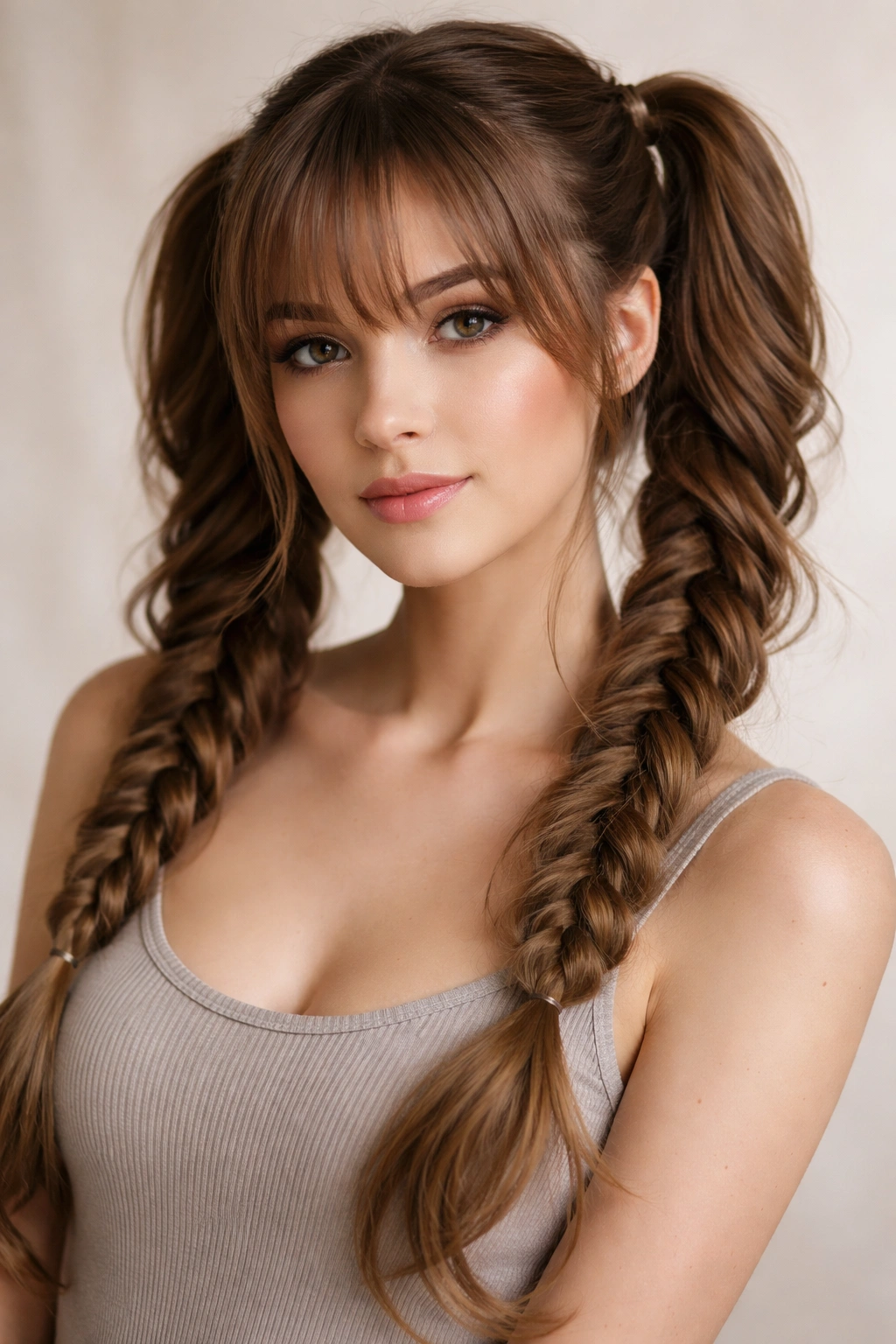
Incorporating braids into your double ponytail style adds texture, visual interest, and a craft-like quality that elevates it from basic to genuinely artistic. You can create Dutch braids, fishtail braids, or simple three-strand braids—each creates a completely different aesthetic. Layered bangs add movement and softness to your face, making the style feel approachable despite the complexity. This combination works beautifully for people with longer hair who want to showcase their styling skills or create a hairstyle that’s suitable for special occasions.
Why It Works So Well
Braided ponytails create visual depth and complexity that draws the eye—they read as more intentional and polished than simple ponytails. The texture created by braiding disguises imperfect hair texture and creates interest in the hair itself. Layered bangs prevent the style from feeling too heavy or complicated; the movement in the bangs balances the structured elements of the braids. This combination also lasts significantly longer than non-braided versions—the braids hold their shape throughout the day and night, making it excellent for travel or multi-day events.
How to Braid Your Ponytails
- Section your hair down the center and secure two loose ponytails using clear elastics
- Take one ponytail and divide it into three equal sections
- Create a Dutch braid by crossing sections under each other (rather than over) until you reach the end of the ponytail
- Secure the braided section with a small elastic
- Repeat the braiding process on the second ponytail
- Gently tug on each braid section to slightly loosen the weave—this creates a fuller, more voluminous appearance
- Cut or style your bangs with distinct layers, creating movement and softness around your face
- Use a light hairspray to hold everything in place without creating stiffness
Pro tip: Braids look fuller and more interesting if you tease your hair slightly before creating them, which adds volume and creates more texture within the braid structure.
6. Half-Up Double Ponytails With Face-Framing Bangs
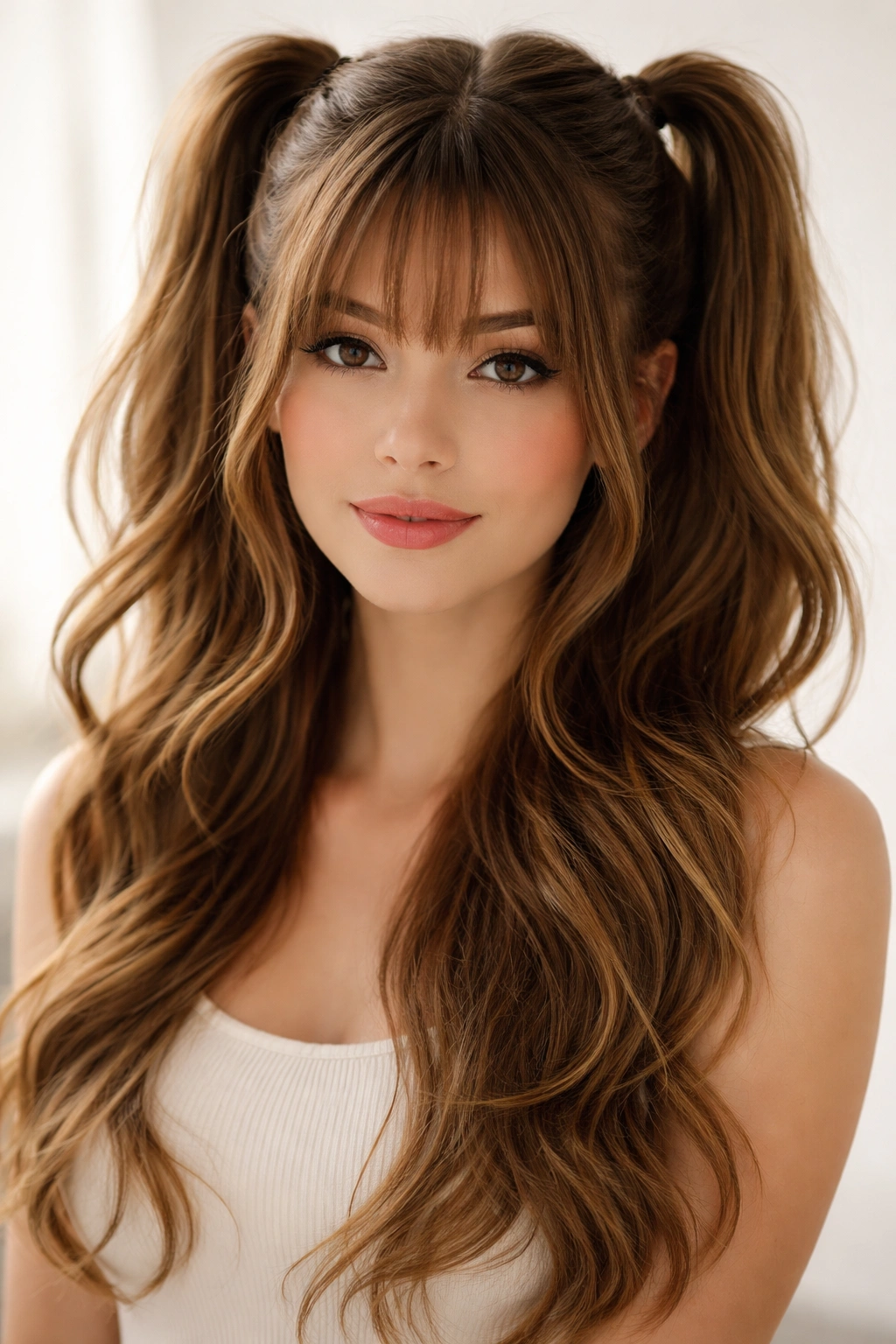
This hybrid style takes the best elements of both down-hair and up-hair aesthetics, creating something that feels fresh and balanced. By securing only the top portion of your hair into two ponytails, you keep length and movement while gaining the tidiness of an updo. Face-framing bangs (longer pieces that fall around your cheeks) create softness and femininity while maintaining definition. This style works beautifully for people with longer hair who want versatility—you can wear it this way or release the ponytails later to change your look.
Why It Works So Well
Half-up styles create visual balance by keeping some hair down while containing the bulk of the length. This is genuinely flattering for almost every face shape because the down portion can be adjusted and styled to suit your specific features. Face-framing bangs give you the styling control to create softness exactly where you want it, making them incredibly customizable. The half-up approach also means less tension on your hairline, making it comfortable for extended wear and less likely to cause headaches or hair damage.
Creating the Half-Up Look
- Start with your hair brushed smoothly or styled with soft waves, depending on your preferred texture
- Identify where you want the half-up section to start—typically around your temple or slightly back from your temple
- Create a half-up ponytail on the right side by gathering hair from your temple back through the crown, using a small elastic
- Repeat on the left side, pulling the hair back and securing it at the same point where the right ponytail is positioned
- The two elastics will sit very close to each other or can be combined into one
- Style your face-framing bangs so they fall naturally around your cheeks and jawline
- You can curl or wave these front pieces for added dimension and softness
- Lightly smooth the down portion of your hair and tuck it back behind your ears if desired
Worth knowing: This style works beautifully for second-day hair because the texture from a previous styling session helps everything hold together without looking freshly washed and slippery.
7. Twisted Double Ponytails With Micro Bangs
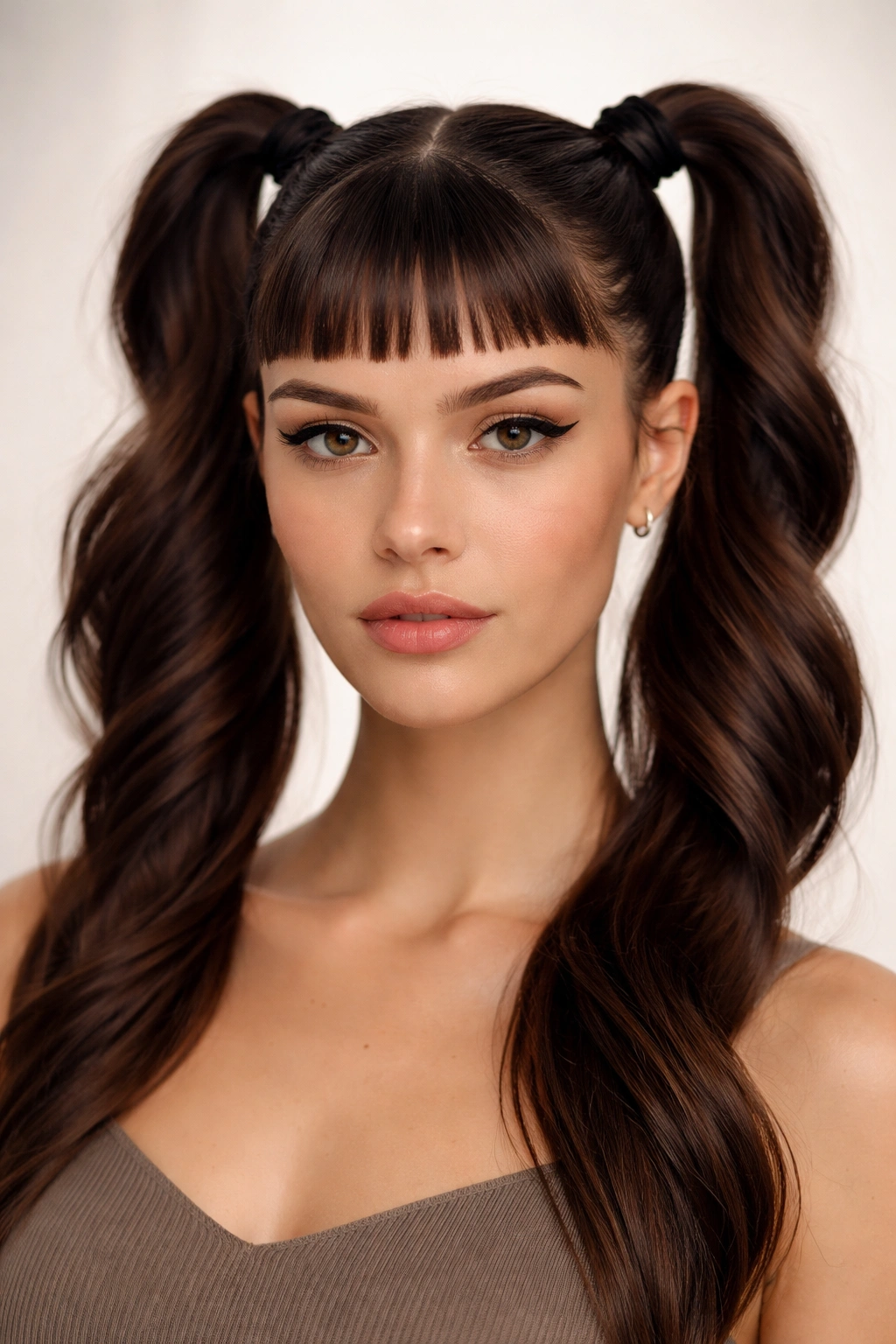
Twisted ponytails create a sophisticated, polished look that feels more intentional and styled than standard ponytails. Rather than gathering all hair at once, you twist sections as you move back, creating a spiral effect that’s visually interesting and flattering. Micro bangs—very short, just barely covering the top of your eyebrows—create a bold, fashion-forward frame that’s perfect for people who want to make a statement. This combination reads as artistic and creative, suitable for people who use fashion as self-expression.
Why It Works So Well
Twisted ponytails create visual texture and movement even on straight hair, making them flattering across different hair types. The spiral effect also has a slimming quality—the twists create lines that draw the eye downward and create a lengthening effect. Micro bangs are incredibly flattering for people with smaller or more delicate facial features, and they emphasize your eyes and eyebrows in a way that other bang styles don’t. The combination of twisted detail and bold bangs creates a cohesive, fashion-forward aesthetic.
Technique for Twisted Ponytails
- Part your hair down the center with a rattail comb for precision
- Starting on the right side, gather a small section of hair at the crown
- Twist this section as you move back toward the occipital bone (the back of your skull)
- Gradually add more hair to the twist as you move backward, incorporating all the hair on the right side
- Secure the completed twist with an elastic at your desired height
- Repeat the twisting process on the left side, making sure to mirror the movement and final position
- Trim your bangs very short, just at the edge of your eyebrows or slightly higher depending on your preference
- Keep the micro bangs in a blunt line—they should feel bold and intentional
Pro tip: Twisted ponytails hold best when your hair has some texture or grip. Apply a light texturizing spray before starting to ensure the twists don’t unravel throughout the day.
8. Voluminous Double Ponytails With Thick Bangs
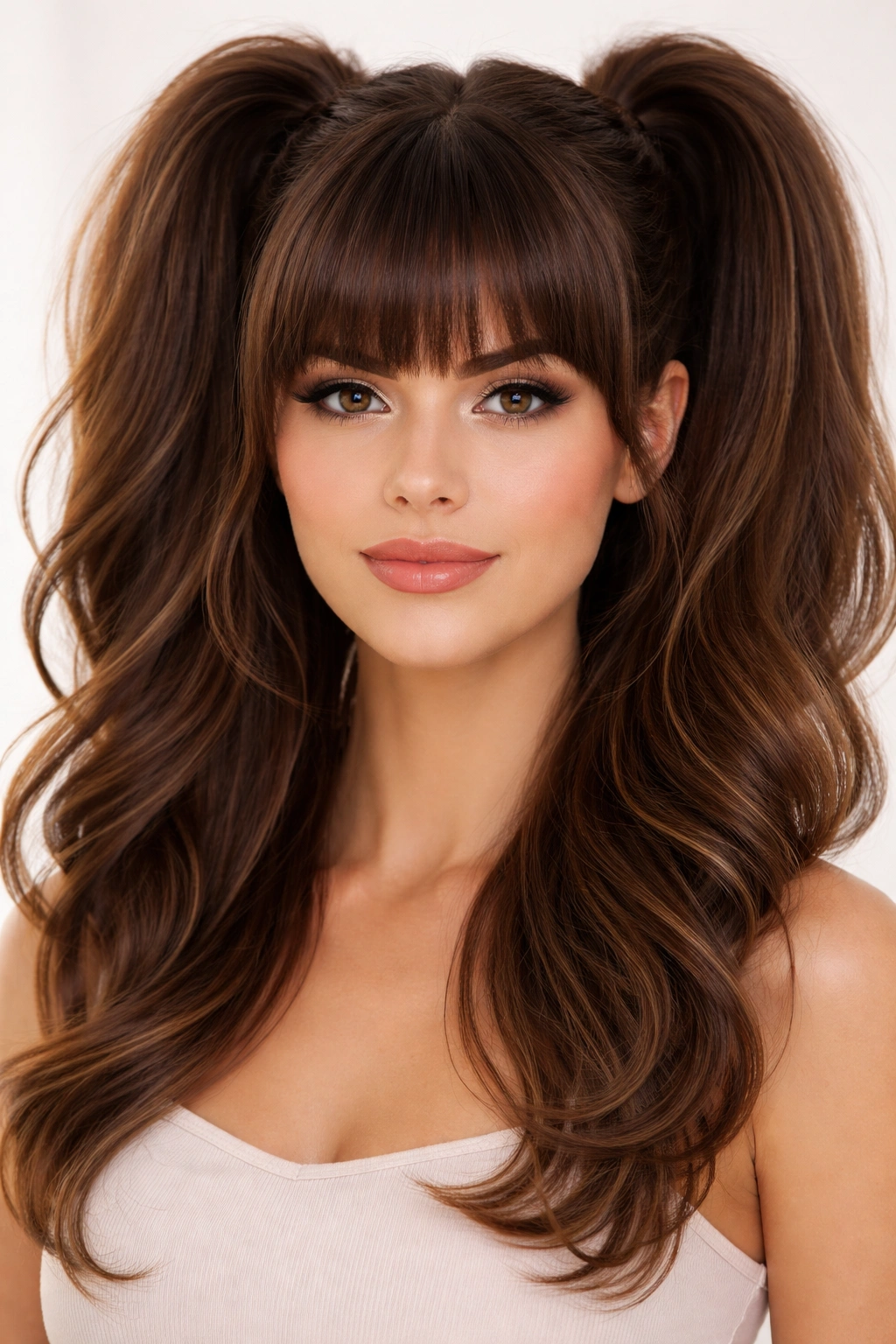
Creating maximum volume throughout your hair transforms the double ponytail style into something that feels bold and confident. By teasing at the roots and using volumizing products, you can create double ponytails that have serious presence and impact. Thick bangs (substantial density across your entire forehead) complement voluminous ponytails perfectly, creating a unified, full aesthetic. This style reads as powerful and self-assured, making it perfect for people who love making a visual statement.
Why It Works So Well
Volume creates visual impact and makes you look like you’ve spent time styling yourself, even if the styling process was actually quite quick. Thick bangs pair perfectly with voluminous ponytails because they echo the fullness of the style—there’s consistency in the visual weight throughout. Volume also works across different occasions; it can feel playful for casual settings or powerful for professional environments depending on other styling choices. Voluminous hair is inherently flattering because it softens facial features and creates a halo effect around your face.
Building Serious Volume
- Apply a volumizing mousse to your roots while your hair is still slightly damp
- Blow-dry your hair using a round brush, lifting at the roots to create height
- Tease sections at your crown using a fine-tooth comb or teasing brush—backcomb the hair to create texture
- Smooth the top layer of the teased section to make it look intentional rather than messy
- Create two center-parted sections and gather them into ponytails, maintaining the teased volume
- Flip your head upside down and lightly tease around the base of each ponytail, then flip back
- Secure the ponytails with elastics, positioning them at your desired height
- Trim your bangs into a thick, full line—they should be noticeably denser than wispy or layered alternatives
- Use a light hairspray to set everything in place without flattening the volume
Worth knowing: Voluminous styles require slightly more frequent washing than sleek styles because teasing and product buildup can eventually weigh hair down or make it look dull.
9. Messy Double Ponytails With Choppy Bangs
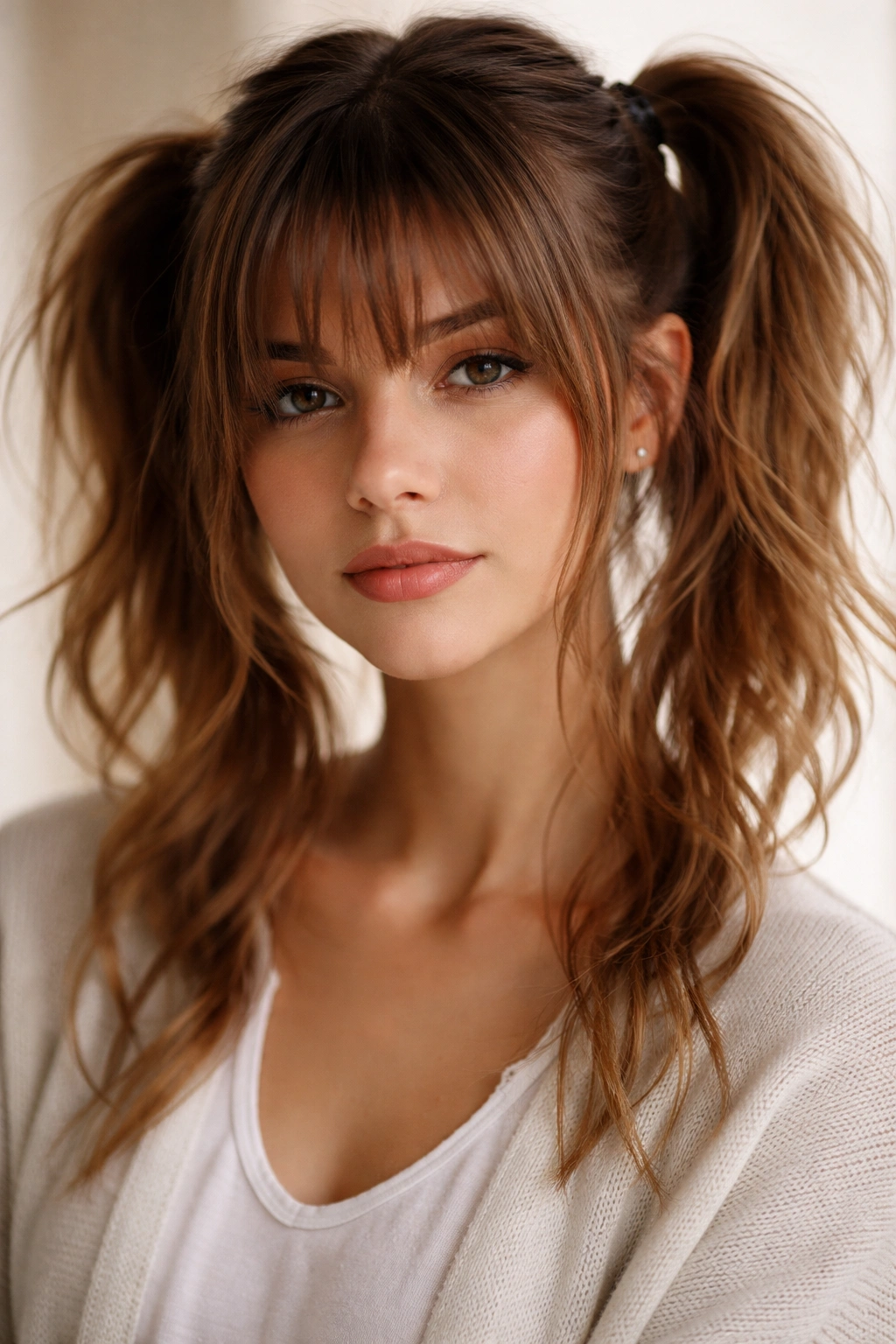
Embracing a deliberately undone aesthetic creates a style that feels modern, effortless, and genuinely wearable for everyday life. Messy double ponytails have loose, textured pieces falling out throughout the day, which many people find charming rather than requiring constant correction. Choppy bangs—cut with shorter and longer pieces throughout—complement this aesthetic perfectly by looking intentionally imperfect. This style is perfect for people who want to look styled without appearing to have spent excessive time on their hair.
Why It Works So Well
Messy styles are incredibly forgiving because perfection isn’t the goal—you’re embracing the natural way hair moves and falls. This makes them genuinely easier to style and maintain compared to sleek versions. Choppy bangs add movement and dimension to your face, and the varied lengths mean that flyaways and wispy pieces blend in rather than standing out. This combination reads as confident and current; it’s the style of someone who understands that perfect isn’t always better. Messy styles also work beautifully on second or third-day hair when some texture and bend have naturally developed.
Achieving the Deliberately Undone Look
- Start with textured or wavy hair—use a curling iron or apply a sea salt spray and let it dry for natural waves
- Create a slightly off-center part rather than a perfectly straight one
- Gather your hair loosely into two ponytails without worrying about making them perfectly aligned or equally tight
- Leave several small sections of hair loose around your face and hairline intentionally
- Allow these loose pieces to fall naturally; don’t smooth them back or secure them
- Cut your bangs with choppy, irregular layers using point-cutting or a razor
- The lengths should vary noticeably, creating movement and preventing a uniform line
- Use a very light hand with hairspray—the goal is to enhance the messy aesthetic, not tame it
Pro tip: This style actually looks better if you style it and then don’t look in a mirror for an hour—the initial styling sets the basic shape, and then the hair naturally relaxes into a more undone, authentic appearance.
10. Sleek Double Ponytails With Center-Part Bangs
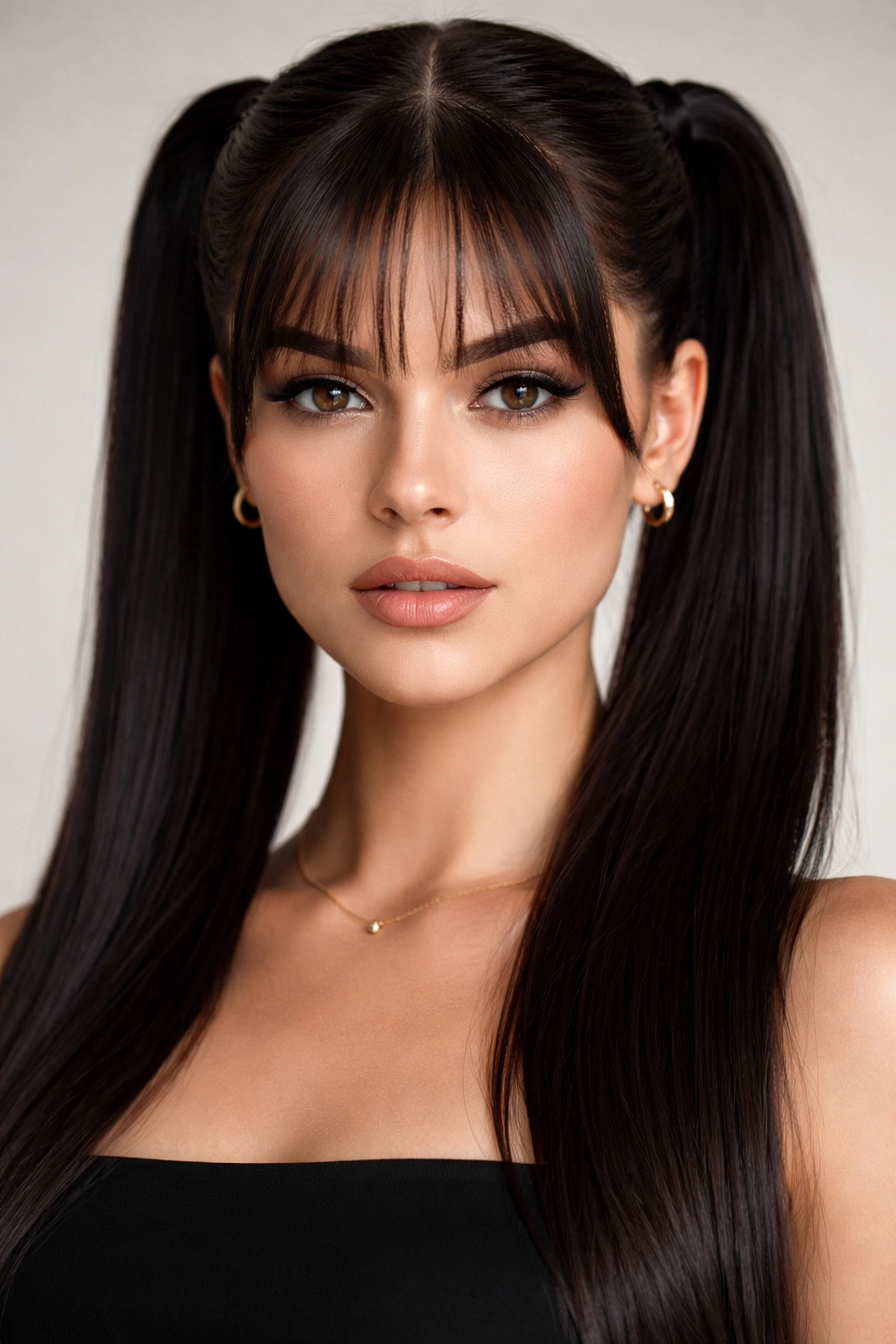
Taking the opposite approach from messy styles creates a sleek, sharp aesthetic that reads as intentional and polished. Pulling every hair perfectly straight and flat requires product and technique, but the payoff is a style that’s appropriate for virtually any setting. Center-part bangs—cut straight across from a perfectly centered part—create symmetry and visual balance that’s almost architectural in its precision. This style works beautifully for people who prefer minimalist aesthetics or need a hairstyle that’s suitable for professional environments.
Why It Works So Well
Sleek styles have an inherent sophistication and formality that works for job interviews, formal events, and professional environments. The center part creates balance and draws attention to your central facial features—your eyes and mouth. When every element is perfectly symmetrical and flat, it reads as deliberate and controlled, which many people perceive as professional and trustworthy. Sleek styles also make your face appear thinner and more angular because there’s no volume softening facial contours.
Achieving Sleek Perfection
- Wash your hair and blow-dry it completely straight, using a paddle brush to smooth away any waves or texture
- Create a perfectly centered part by using a rattail comb to divide your hair exactly down the middle
- Apply a smoothing serum or light oil to the lengths and ends to create shine and smoothness
- Gather the right section into a tight ponytail, pulling everything straight back without any height variation
- The ponytail should be pulled tight enough that you feel slight tension at your hairline
- Repeat on the left side, making sure both ponytails are at identical height and tension
- Trim your bangs in a blunt, straight line across your forehead—they should sit parallel to the ground
- Use an edge control product or smooth gel to keep your part perfectly defined and any baby hairs smoothed down
- Finish with a light hairspray to set everything in place
Worth knowing: Sleek styles show product buildup and dandruff more visibly than textured styles, so maintaining a healthy scalp is especially important if you wear this style frequently.
11. Colored Double Ponytails With Shaggy Bangs
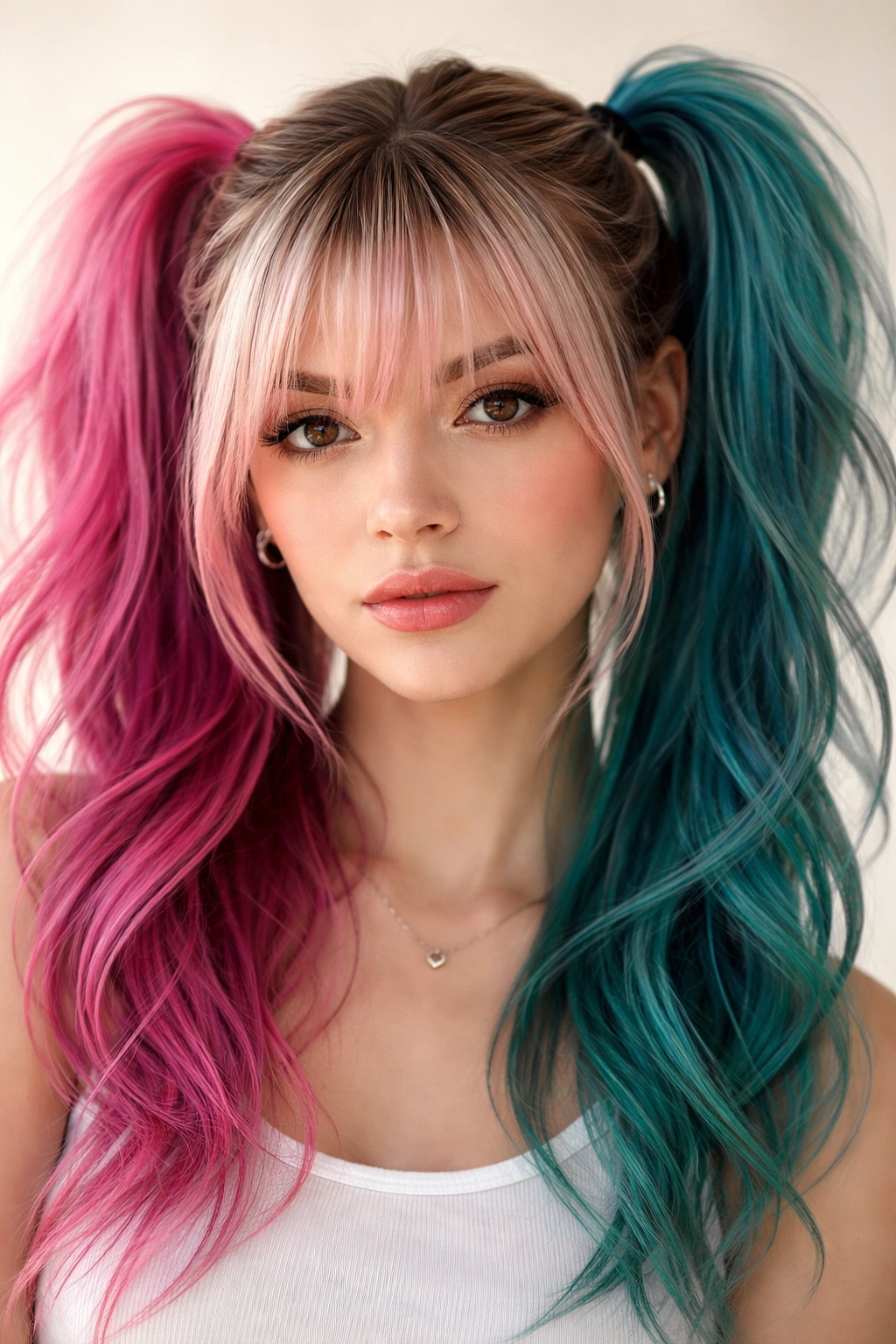
Introducing color variation—whether through highlights, balayage, or temporary colored extensions—transforms double ponytails into something even more visually interesting. When you have contrasting colors in your hair, the structure created by double ponytails showcases that color variation beautifully. Shaggy bangs (longer, choppy layers that move significantly) complement colored hair perfectly because the movement helps display the color dimension. This style is perfect for people who want their hair to serve as a complete fashion statement and work with a skilled colorist.
Why It Works So Well
Color creates visual interest and dimension that makes any hairstyle more striking and memorable. Double ponytails become a canvas for showcasing color variation—each tail can display different color sections depending on how your hair is colored. Shaggy bangs add movement that makes color appear to shift and change as you move, which is genuinely striking. This combination works across various color combinations—ombre, highlights, balayage, or even solid fashion colors can all look beautiful in this style.
Working With Color and Shag Bangs
- Choose your color approach in consultation with a colorist (highlights, balayage, full color change, or colored extensions)
- Apply a color-protecting shampoo and conditioner routine to maintain vibrancy
- Style with some texture—waves or slight curl enhance color visibility
- Create two ponytails at your desired height, positioning them so color variation is visible throughout
- Style your shaggy bangs with distinct, choppy layers at varying lengths
- Curl or wave your bangs slightly to enhance movement and showcase color throughout
- Use a light hairspray to hold the shag shape and allow movement
- Consider adding lightweight accessories like colorful clips or ribbons to further emphasize your color choice
Pro tip: Colored hair requires more maintenance than natural tones, but styling your hair with texture and movement actually helps make color look fresher longer because the dimension in the styling distracts from root regrowth.
12. Space Buns Style Double Ponytails With Bangs
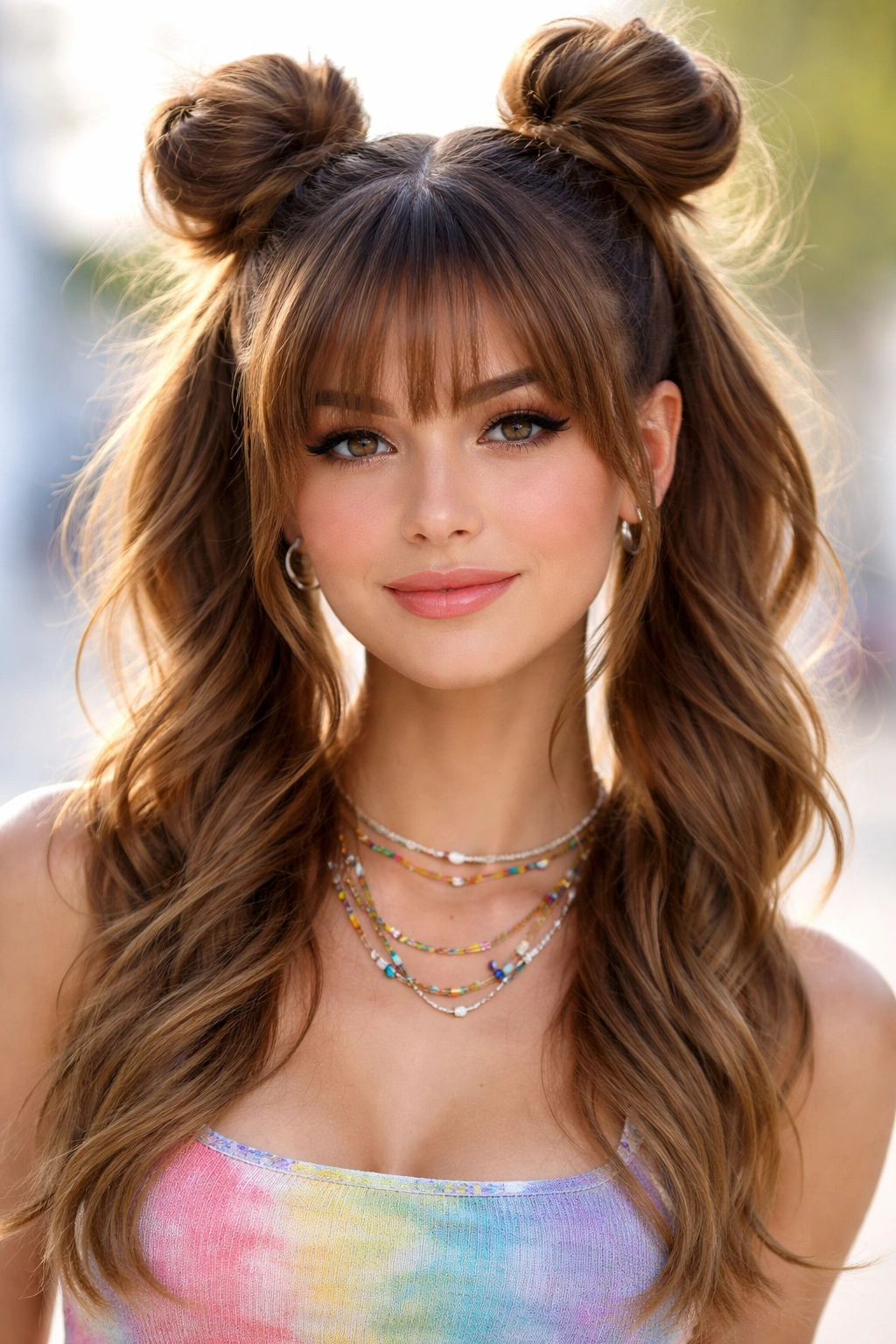
Taking the double ponytail concept into playful territory, space buns transform the basic double ponytail into something fun, bold, and undeniably eye-catching. Rather than leaving your ponytails hanging, you coil each one into a bun positioned at the top-back of your head. Pairing this with bangs—any style from blunt to wispy to choppy—creates a contrast between the playful, three-dimensional bun element and the flat, face-framing bangs. This style is perfect for festivals, creative events, or people who want their hairstyle to be a conversation starter.
Why It Works So Well
Space buns are instantly recognizable and evoke a fun, youthful, playful energy. The buns create interesting height and dimension from the back while keeping hair completely off your neck and face. Pairing buns with bangs creates visual balance—the buns are prominent from behind while the bangs frame your face for front-facing interactions. This style also allows you to choose your specific vibe through the bang style; wispy bangs make it softer and more romantic while blunt bangs make it bolder and more statement-making.
Creating Space Buns
- Part your hair directly down the center from your forehead to the nape of your neck
- Gather the right section into a ponytail positioned where you want your first bun to sit (higher at the back of your head creates more dramatic space bun vibes)
- Secure tightly with an elastic
- Take the ponytail and twist it, coiling it around the base to create a bun shape
- Secure the coiled bun with bobby pins positioned throughout the coil
- Repeat on the left side, creating a second bun at the same height and size as the first
- Gently tug on the bun coils to loosen them slightly, creating a fuller, more voluminous appearance
- Use a light hairspray to set the buns in place
- Style your bangs with your preferred cut—they should frame your face clearly
- Add colorful clips, ribbons, or other accessories to the buns if you want to enhance the playful aesthetic
Worth knowing: Space buns look best when the buns are positioned high enough on your head to be visible when you’re standing upright. If they sit too low, they can look more like regular buns than distinctive space buns.
Final Thoughts
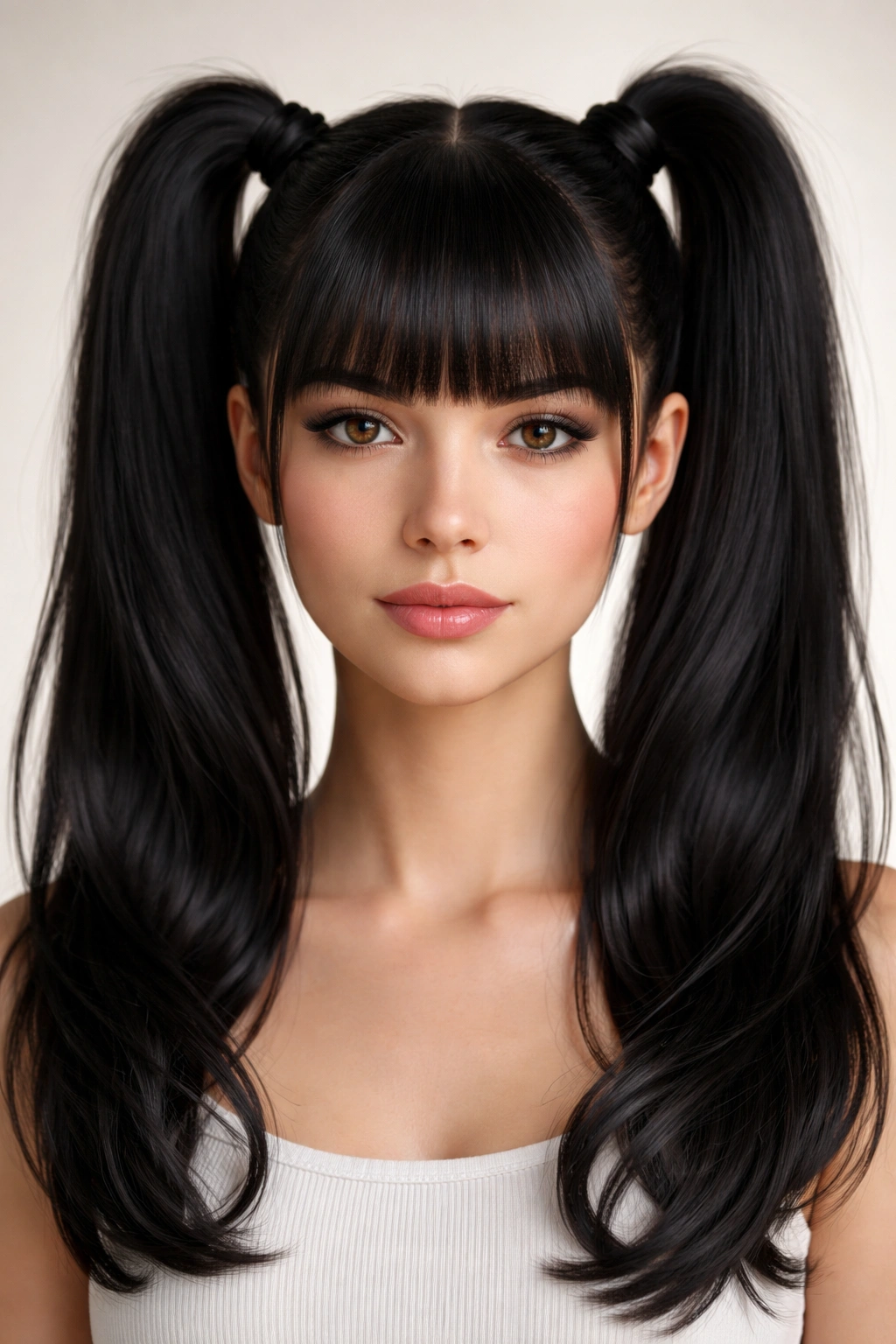
Double ponytails with bangs offer remarkable versatility and adaptability—you’re not locked into a single aesthetic once you commit to this general style direction. The variations available across height, texture, bang style, and overall polish mean you can genuinely create a different look every time you style your hair, which keeps your appearance feeling fresh and intentional. Whether you gravitate toward sleek and professional versions or prefer messy, textured, and playful interpretations, the fundamental structure of double ponytails with bangs provides a strong foundation for expression and creativity.
The most important factor across any of these variations is that your ponytails sit at matching heights and carry equal tension throughout the day. When the symmetry is right, even the messiest version of this style looks intentionally crafted rather than haphazard. Similarly, bangs are the most visible element of this hairstyle for anyone looking at you face-on, so investing time in getting them cut correctly by someone skilled with bangs is genuinely worth it. Well-cut bangs that match your face shape and personal aesthetic elevate the entire look.
Finding the right variation of double ponytails with bangs for your lifestyle, hair type, and aesthetic preferences means trying a few different approaches and noticing which ones feel genuinely easy to maintain and suit the image you want to project. You might discover that you love the messier versions for weekends but prefer sleek versions for work, or that certain bang styles feel more comfortable for extended wearing periods. Pay attention to what makes you feel confident and like yourself—that’s the most important factor in choosing a hairstyle that works for your actual life rather than just looking good in photos.
