



Bangs can feel like a risky move when you have coily hair—all that texture, that unpredictability, those questions about how curls will cooperate with a blunt edge. The truth is, bangs don’t just work with coily hair; they can transform your entire look when you choose a style that actually suits your curl pattern. The key isn’t fighting your texture or trying to make coils do something they’re not meant to do. It’s about working with the natural architecture of your curls to create a bang style that enhances your face, moves with your hair, and actually feels manageable in your daily routine.
Coily hair brings movement, dimension, and volume that straight-haired people often have to work to achieve. Bangs amplify those qualities. They frame your face differently than shoulder-length layers do. They can soften angular features, draw attention to your eyes, or add a playful edge to your look. But coily bangs live in a different world than straight bangs. Your curls will shrink, they’ll move differently throughout the day, and they’ll need specific styling approaches to look intentional rather than accidental.
The best bang styles for coily hair share a few things in common: they account for curl shrinkage, they work with your curl pattern rather than against it, and they don’t demand a blowout or heat styling every time you wash your hair. Whether your curls are tight coils, loose waves, or somewhere in between, there’s a bang style that will feel right. Let’s walk through the options that actually work.
1. Textured Wispy Bangs
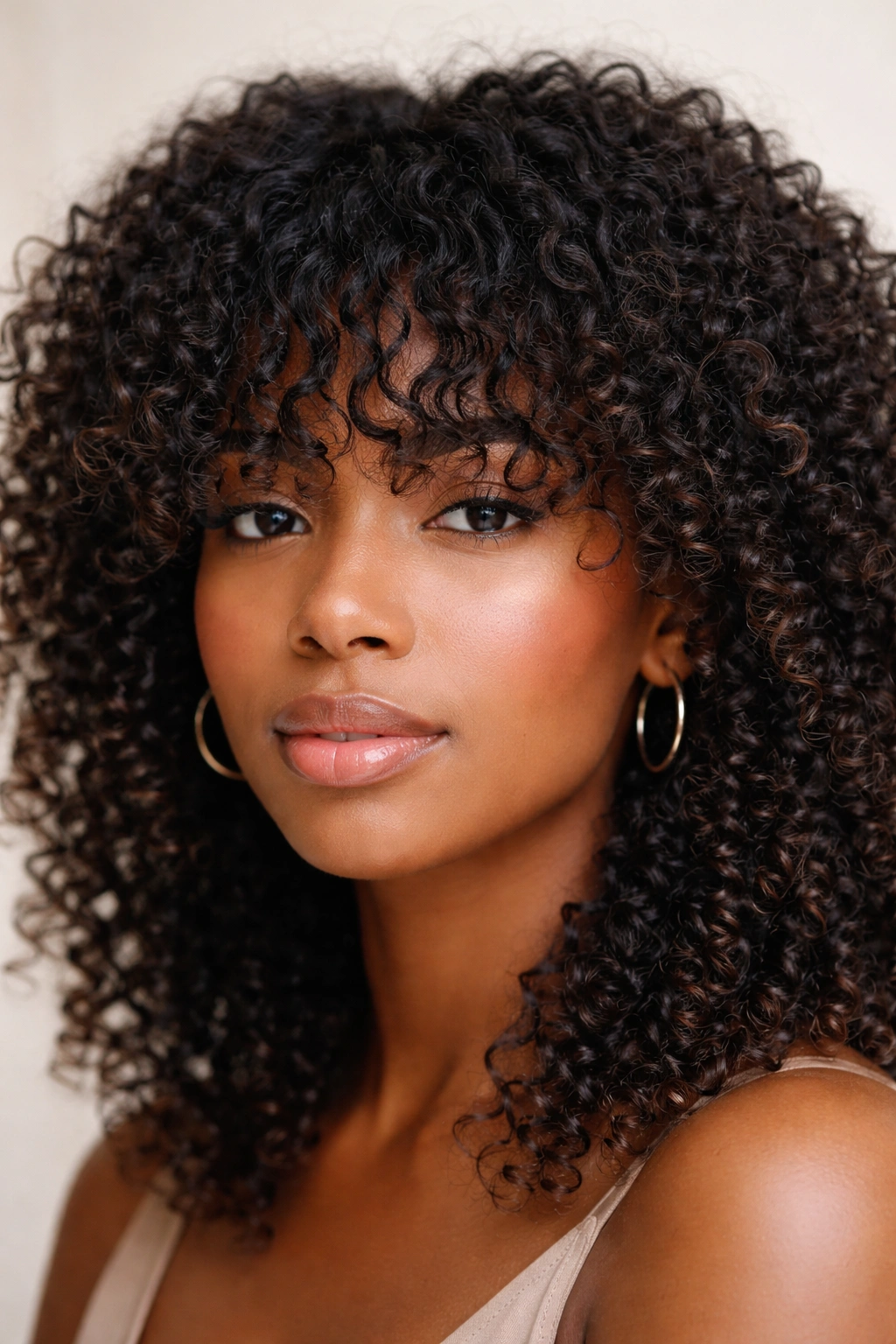
Textured wispy bangs are the anti-blunt option—they’re the perfect choice if you want bang energy without the rigid line that can look harsh against curly texture. These bangs are cut with choppy, uneven layers that embrace the natural variation in your curl pattern. Instead of trying to create one uniform length, your stylist is deliberately working with your curls, allowing some pieces to be slightly shorter or longer than others.
Why They Work So Well With Coils
Wispy bangs sit right at that intersection of intentional and effortless. Because they’re already choppy and textured at the tips, the natural variation that comes from your curls shrinking and moving looks like part of the design, not a styling mistake. When you apply your leave-in conditioner and styling cream, these bangs will look fuller and more defined without requiring you to fight them into submission. They’re forgiving—if your curls don’t cooperate on a particular day, the choppy layers make it look intentional.
How to Wear Them
- Part your hair in your normal way or slightly off-center for a softer frame
- Apply leave-in conditioner and styling cream through the bangs, scrunching upward to encourage curl formation
- Use a diffuser on medium heat to dry, or let them air dry for the most texture
- These bangs look best when they’re still wet and glistening; they soften as they dry, creating that wispy, lived-in effect
- Refresh them on non-wash days with a light mist of water and a quick scrunch with your styling cream
Pro tip: Ask your stylist to point-cut the ends rather than blunt-cut them—this creates that feathered, wispy texture and prevents blunt lines that can look heavy against curly hair.
2. Shoulder-Skimming Curved Bangs
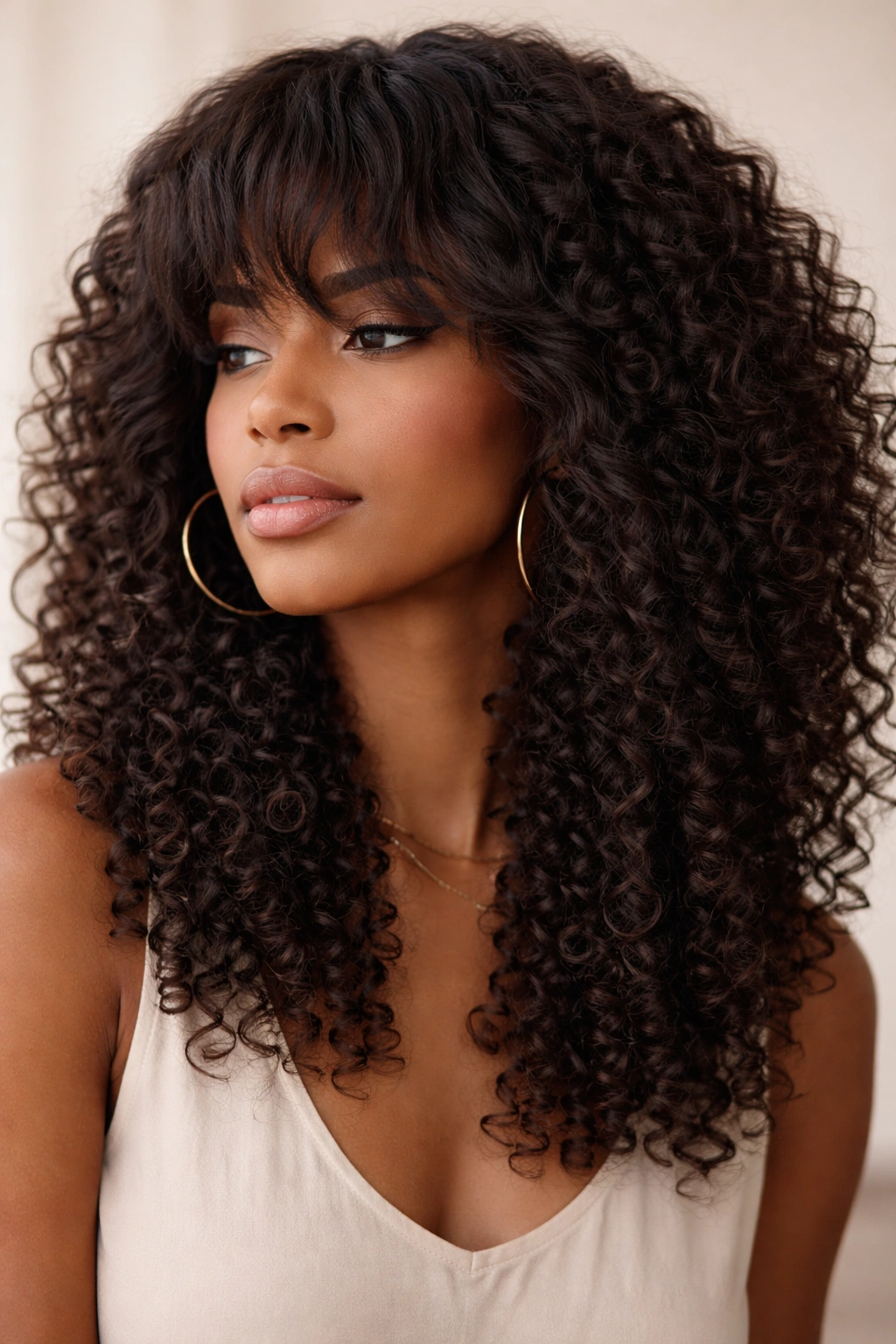
These bangs curve gently around the frame of your face, following your cheekbones down toward your shoulders. They’re longer than traditional bangs—think chin-length rather than forehead-length—which gives you flexibility in how you style them while still giving you that frame-your-face bang effect. The curve means they naturally tuck behind your ears or blend into your regular layers rather than sitting heavily against your forehead.
The Science Behind This Shape
Curved bangs work beautifully with coily hair because the longer length gives your curls more room to spring up without the shrinkage looking too dramatic. When you have coils, vertical length is your friend—it shows off the spiraling texture better than a super-short bang ever could. The curve also means that as your curls shrink and tighten, they do so along a line that’s already designed to move away from your face, rather than creating a blunt wall right at your forehead.
Styling Approach
- This style works best when your curls are fully defined and clumped rather than separated into individual strands
- Apply your products (leave-in, curl cream, gel) to the bangs while your hair is soaking wet
- Encourage the curve by scrunching the bangs slightly upward and back toward your crown as you apply products
- Dry with a diffuser, focusing on helping the bangs curve rather than dry straight down
- These bangs actually improve over the first three days of your curl cycle as the definition sets in
Worth knowing: If your curls are particularly dense or heavy, ask your stylist to thin out the underside of the curved bangs. This prevents them from getting too thick and heavy, which can make them sit weird against your face.
3. Short Curly Bangs With Lots of Volume
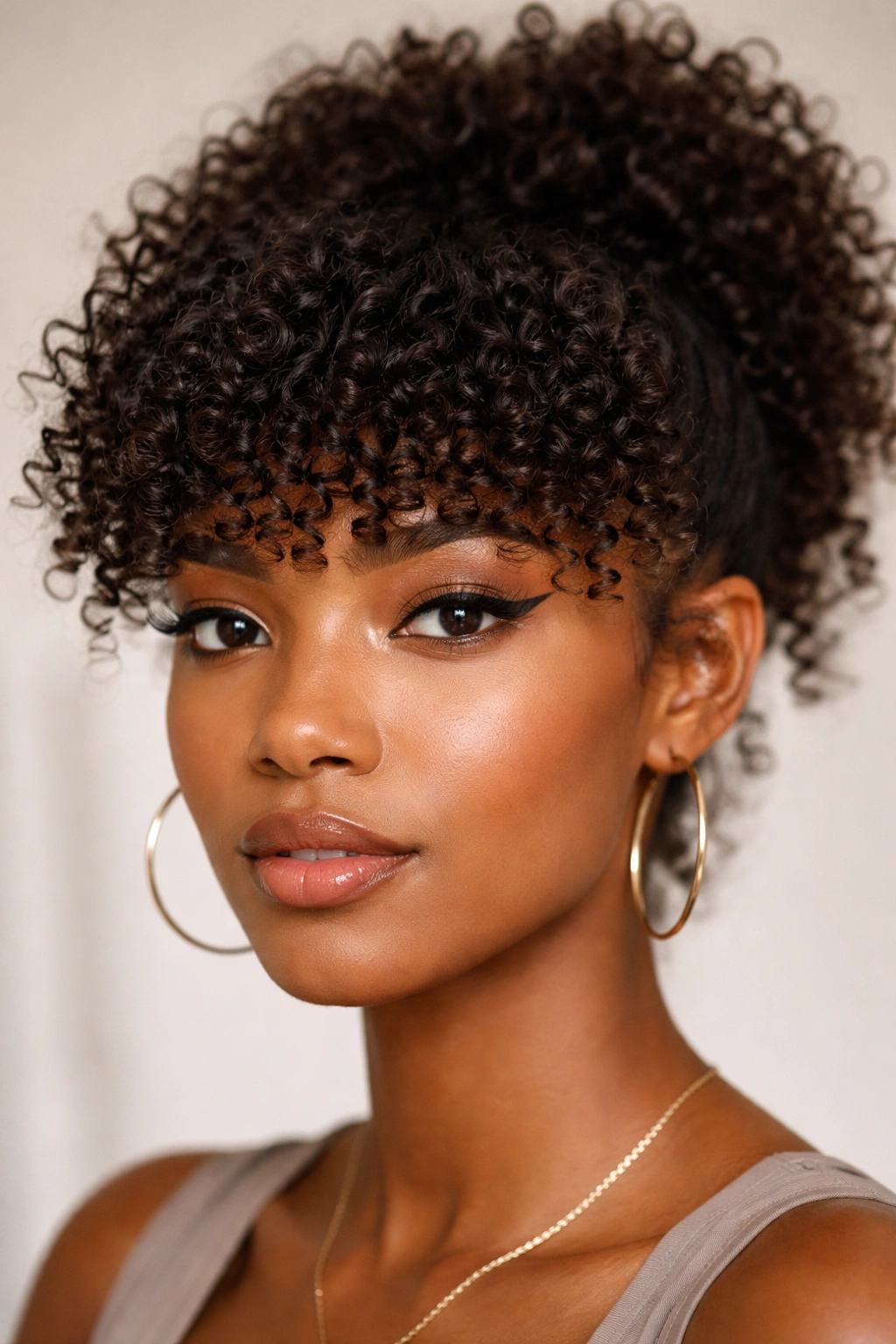
Short, voluminous bangs that sit well above the eyebrows showcase your curl pattern and add major personality to your look. These bangs are deliberately short—they sit in that space between your eyebrows and the crown of your head—and they’re meant to be full. Rather than lying flat, they have genuine height and dimension. This style works because short coily bangs don’t have to deal with the weight that longer styles do. Your curls can spring up freely.
Why This Is Bold in the Best Way
Short bangs on coily hair make a statement. They show off your curl texture in the most prominent real estate on your face. Because curly hair naturally has volume, these bangs actually look easier to maintain than you’d think—you’re not fighting against your texture; you’re leveraging it. The short length also means you get the cooling effect on your forehead and the face-framing benefit without the styling demands of managing longer bangs.
Making Them Look Intentional
- Your curls need to be well-hydrated and well-defined for this style to work
- Apply products generously to the bangs while wet, making sure every curl is clumped
- Diffuse on medium heat, focusing upward to encourage height rather than laying them flat
- A light gel or mousse through the bangs helps them hold shape throughout the day
- These bangs actually need more frequent refreshing than longer styles—plan to re-wet and re-scrunch every 2-3 days rather than stretching to day 4 or 5
Insider note: This style pairs especially well with shorter overall hair lengths (chin-length or shorter) because the proportions work together to create a cohesive, intentional look rather than looking unfinished.
4. Blended Coil Bangs
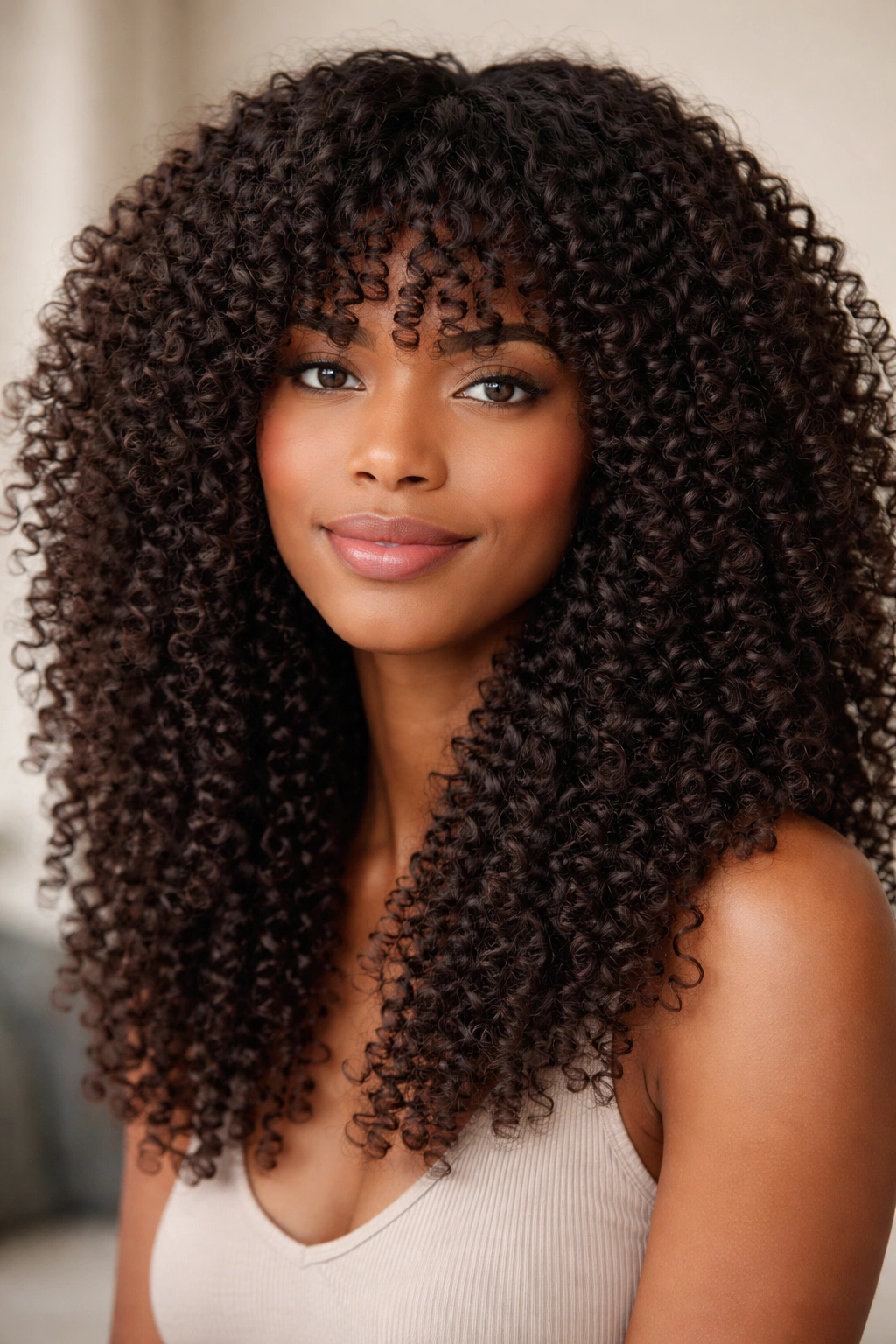
Blended coil bangs don’t have a defined line where the bangs end and the rest of your hair begins. Instead, they’re longer and gradually integrate into your regular haircut, creating a seamless visual effect. Your stylist is cutting the bangs and the layers throughout your hair in a way that they look like one cohesive texture rather than two separate sections. This approach is smart for people who want the effect of bangs without the maintenance of managing a distinct bang section.
The Maintenance Advantage
Blended bangs are the lower-maintenance version of traditional bang styles. Because there’s no hard line, you don’t have the blunt edge that gets crunchy or unmanageable-looking as it grows out. When your curls shrink, they’re shrinking as part of your overall haircut, which means the proportions stay balanced. You’re also not dealing with one super-short section that dries differently than the rest of your hair. Everything flows together, which is actually easier to manage and style.
How to Cut Them Right
- Your stylist should be thinking about the layers throughout your entire head, not just focusing on the front section
- Ask for long, gradual layers that start around face-framing length and integrate into your regular lengths
- This works best when you have some layers throughout your hair already—it creates visual continuity
- The shortest pieces in the front should still be long enough that your curls can spring up without looking too short for your face shape
Quick facts about this style:
- Works at any curl texture from loose waves to tight coils
- Requires less frequent trims than sharp-lined bangs
- Grows out gracefully; you don’t notice the day it “needs cutting”
- Gives you the option to tuck bangs back on days when you want variety
5. Middle-Part Bangs With Side Sweep
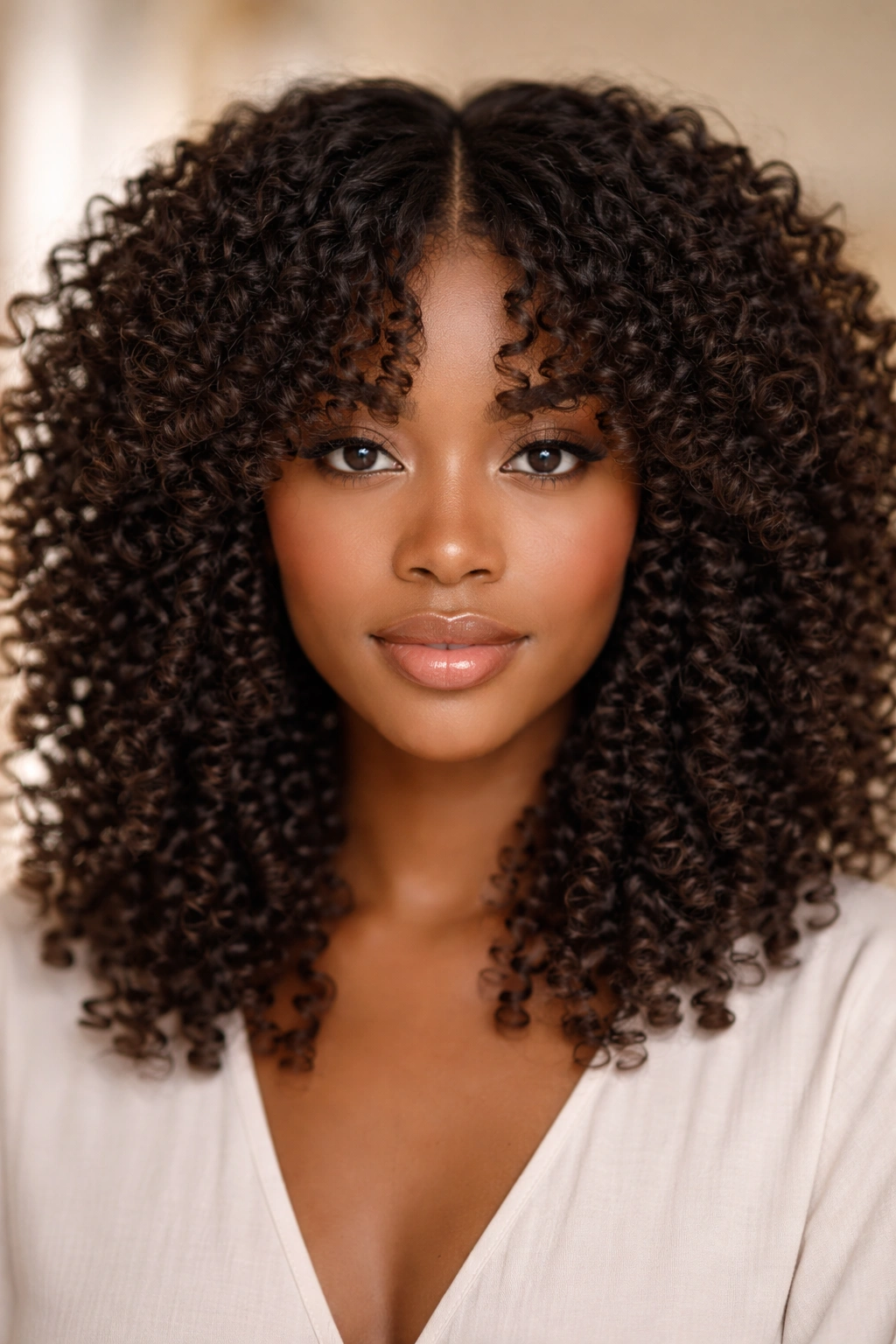
This style splits your bangs down the middle, allowing each side to sweep toward the cheekbone in a soft, asymmetrical way. Rather than parting your hair in the traditional sense, the bangs themselves create the line, and they flow away from center on both sides. This creates a really flattering frame, especially for round or square face shapes, because the diagonal movement draws the eye along your cheekbone rather than straight across your face.
Why the Middle-Part Magic Works
The beauty of this bang style with coily hair is that you’re using the natural diagonal movement of your curls to your advantage. Coils have an inherent tendency to move in different directions once they dry, so a bang style that expects and celebrates that asymmetry actually looks more polished and intentional than trying to control them into sameness. The middle part also has a modern, balanced feel that works with virtually any face shape.
Styling It Daily
- You’ll want to establish the direction early as your bangs are drying—use your fingers to gently guide each side outward and back
- Apply gel or mousse through the bangs before diffusing to help them hold the sweep
- Refresh on second or third day hair by misting with water, re-establishing the direction, and scrunching product back in
- This style works particularly well if you naturally deep-condition or use heavier styling creams that help hair stay set
Pro tip: Don’t try to create a razor-sharp middle part line. A soft, implied center line that blurs into your hair looks way more natural and works better with coily texture.
6. Tapered Coily Bangs (Shorter at Center, Longer at Sides)
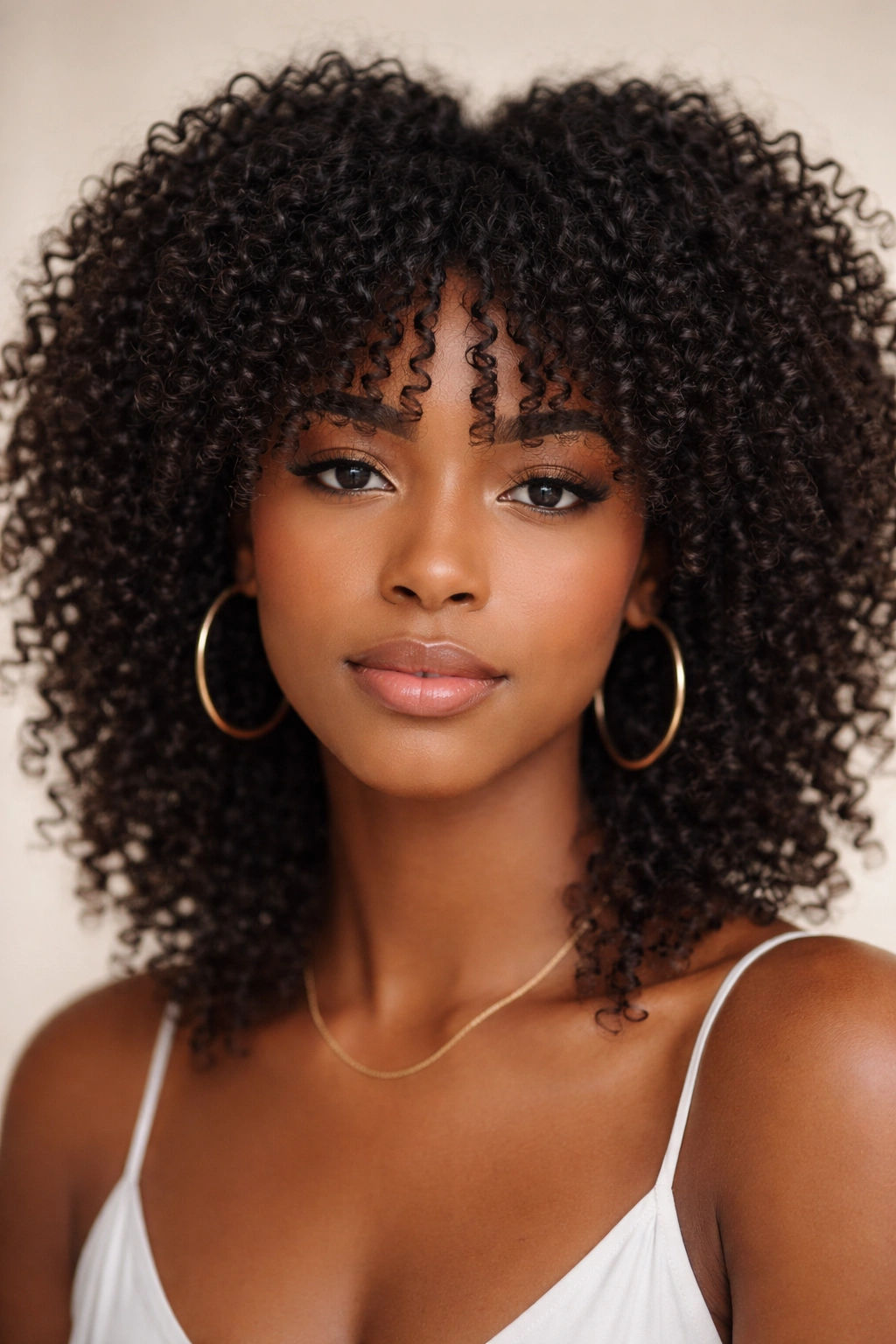
Tapered bangs are shorter in the center and gradually get longer as they move toward your temples and cheekbones. Imagine a curved V-shape or a gentle arch across your forehead—that’s what you’re going for. This style is incredibly flattering on coily hair because it plays with proportion in a smart way. The shorter center-front length shows off your curl texture in that prominent spot, while the longer sides integrate into your face-framing layers.
The Proportion Play
Tapered bangs create visual lift. The shorter pieces in the center make your forehead feel less heavy, while the longer pieces on the sides still give you that face-framing effect. For people with naturally round faces or wider foreheads, this shape is especially flattering. The taper also means your curls are moving in different directions (the short pieces spring up, the longer ones angle toward your face), which creates natural dimension and movement.
Maintaining the Taper
- Ask your stylist to cut this with some texture in the center—point-cutting or razor-cutting creates natural variation
- The taper should be gradual, not dramatic; think subtle slope rather than steep cliff
- Style these bangs by encouraging the center pieces upward and the side pieces to frame your cheeks
- A light hold gel through just the bang area helps them keep their shape
What to watch for: If your curl shrinkage is significant, check in with your stylist more frequently on this style. The taper is intentional, and if your center pieces shrink more than your sides (which they might, being shorter), it can throw off the proportions.
7. Halo-Effect Bangs (Framing Without Frontage)
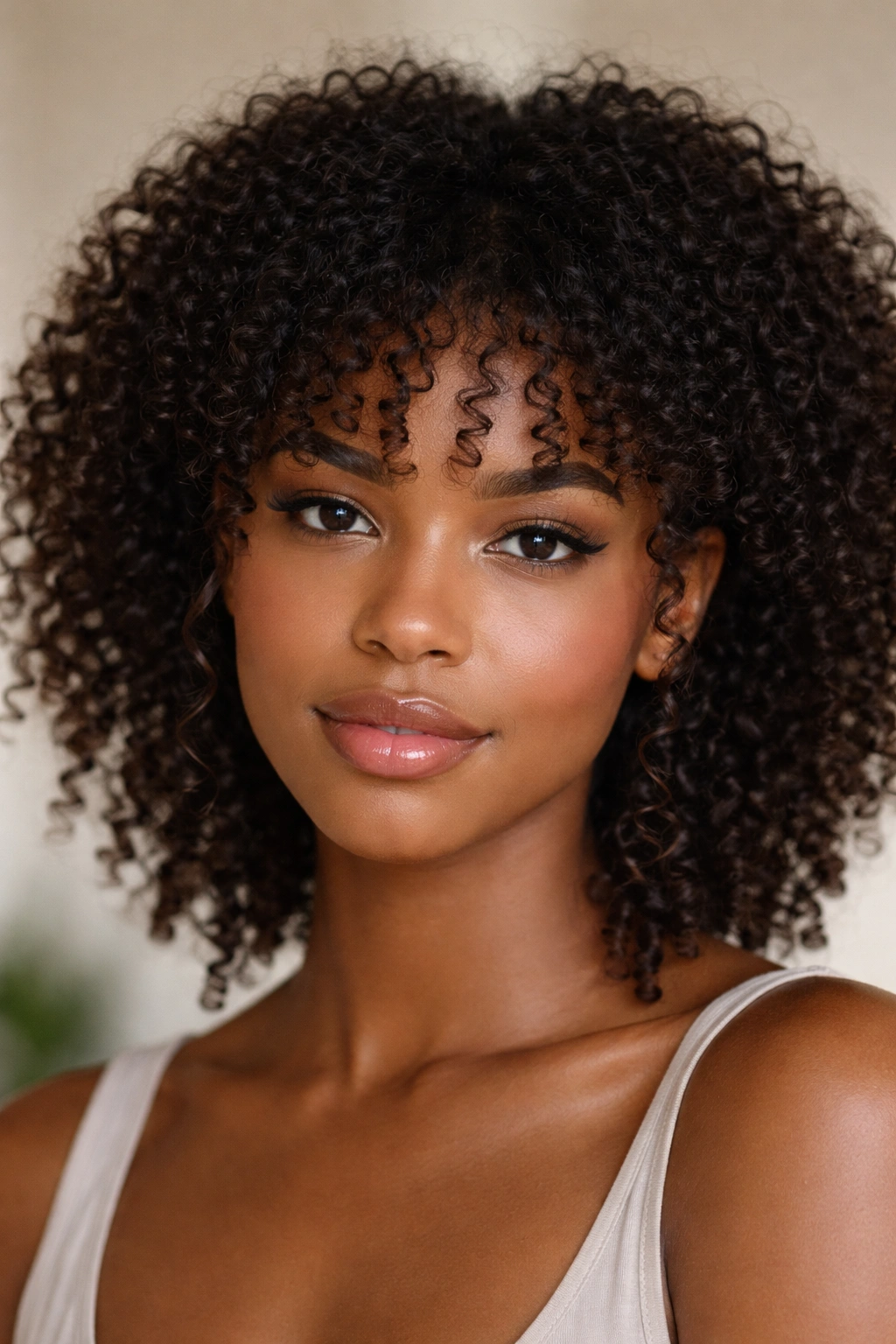
Halo bangs are very short, minimal bangs that frame only the very top and sides of your face rather than covering your entire forehead. You might have just one or two inches of actual “bang” in the center, with the rest of the bang-ness happening in delicate face-framing pieces that start at your temples. It’s the “I have bangs” look without the full forehead coverage. This style is perfect if you’ve wanted to try bangs but aren’t ready to commit to something that dramatic.
The Minimal Commitment Approach
Halo bangs are the dip-your-toes-in option. You get the face-framing benefit, the style statement, and the forehead cooling effect, but you’re not dealing with the daily styling demands of longer bangs. Because there’s minimal coverage on the forehead itself, you have tons of flexibility in how you wear them. You can slick them back on humid days, let them be bouncy and textured on good curl days, or tuck them away entirely. The very short length also means they’re not absorbing moisture differently than the rest of your hair, so they dry in sync with your overall curl pattern.
Styling Flexibility
- Apply product through the full bang area (center to temples) while your hair is soaking wet
- Let them define naturally as your curls set—these don’t need a lot of manipulation to look good
- On days when you want to change it up, you can sweep the longer side pieces back and clip them, creating an entirely different look
- These work well with any part line or no part line; they’re truly flexible
Real talk: This style is especially good for people with finer curl textures or thinner hair density. You don’t have a heavy bang weight pulling down on your hairline, and the minimal coverage means your entire face is visible, not just the parts above the bangs.
8. Curtain Bangs With Deep Center Part
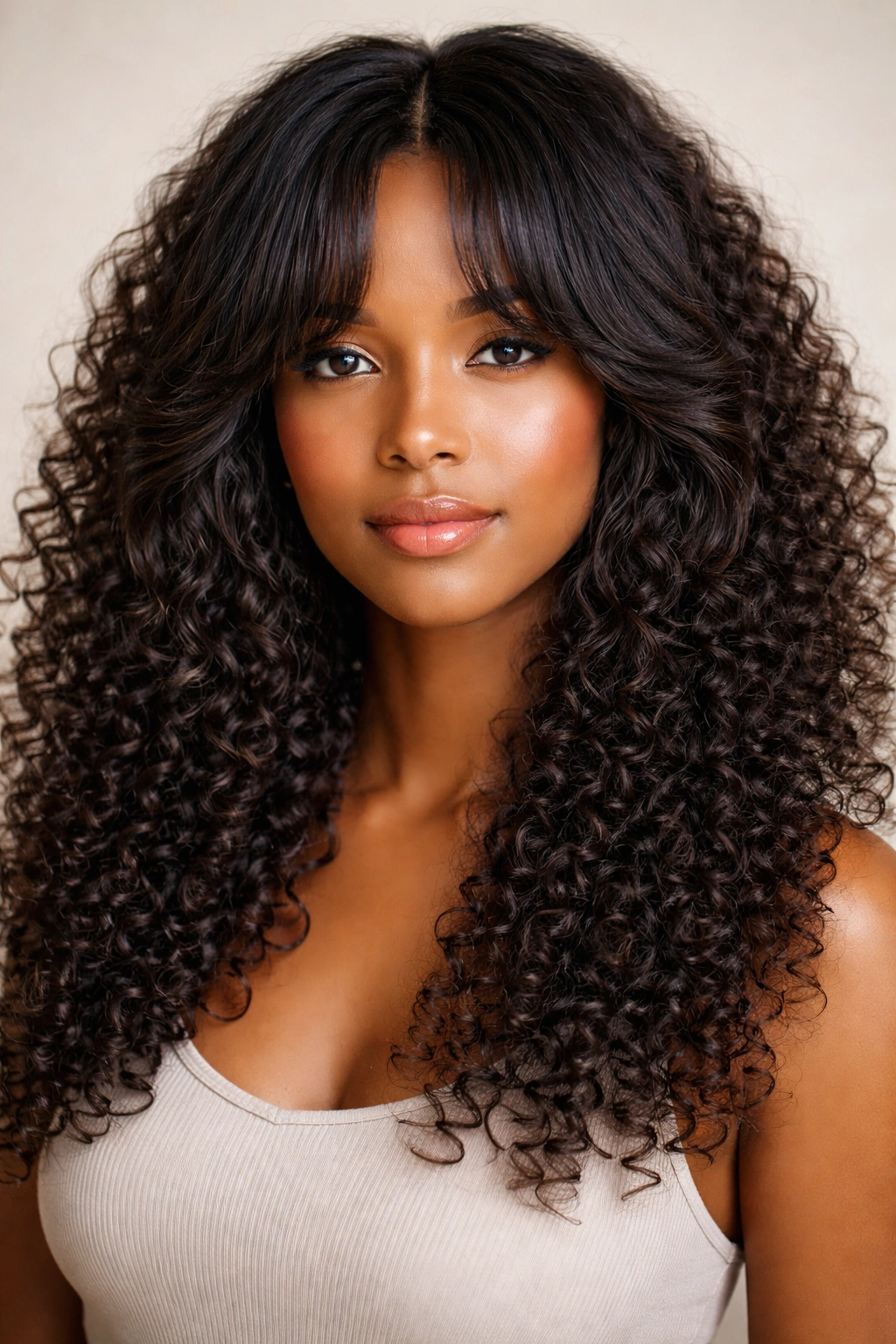
Curtain bangs are the sweeping, romantic style where your bangs frame both sides of your face, parted down the middle, and they gradually get longer as they move toward the back. They’re called curtains because they part down the center and sweep outward, like theatre curtains opening. With a coily hair texture, curtain bangs have an undeniable softness and movement. The deep center part creates a classic, feminine frame, and the longer length means your curls have plenty of room to express their texture.
Why Curtains Are Timeless
Curtain bangs have been around for decades because they’re genuinely flattering on most face shapes. For coily hair, they’re especially smart because the longer length prevents any appearance of being overwhelmed by texture right at the forehead. As your bangs move outward and back toward your crown, they integrate beautifully into the rest of your layers. The style also gives you tons of flexibility—you can wear your part deep, shallow, or shift it day to day depending on your mood.
The Deep-Part Magic
- Create a deep center part line by parting your hair with a fine-tooth comb before applying products
- Apply leave-in and styling cream to the bangs, scrunching upward and slightly away from the part line to encourage the sweep
- As you diffuse, help the bangs curve gently outward and back—think of them as following the line of your cheekbone
- Refresh on second-day hair by re-establishing the part and scrunching product back into the bangs
Pro tip: Curtain bangs look best when there’s subtle texture and choppy layers throughout the bang section. Ask your stylist to point-cut rather than create one uniform line. This helps them settle beautifully into your layers rather than sitting heavily.
9. Textured Micro-Bangs (Extra Short, Intentionally Wild)
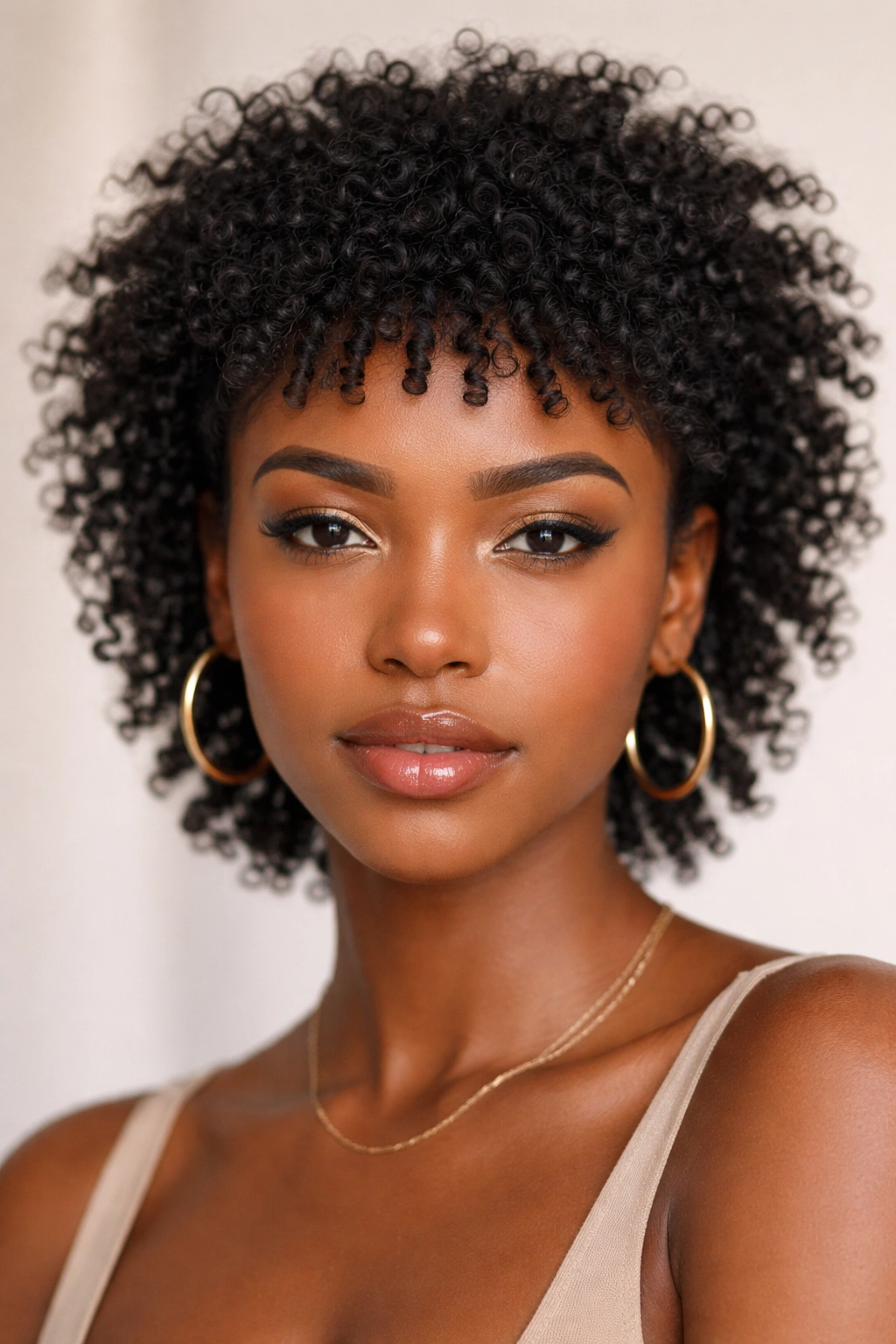
Micro-bangs sit very high on your forehead, often just barely below where your natural hairline begins. They’re unapologetically short and textured, meant to look artistic and undone rather than polished or precise. This is the statement style. With coily hair, micro-bangs become a texture showcase—you’re putting your curl pattern front and center in the most prominent place. This style says “I’m confident, I’m creative, and my natural texture is beautiful,” which is a powerful message.
The Boldness Factor
Micro-bangs require confidence because they’re undeniably noticeable. You can’t hide them or tone them down—you’re committing to showing off your forehead and your curl texture in equal measure. But here’s the thing: because coily hair naturally has so much texture and movement, micro-bangs actually look intentional and artistic on coils in a way they might look unfinished on straight hair. Your texture makes them look deliberate. This is also the style that requires the least day-to-day styling—the curls are doing what they naturally do, and that’s the whole point.
Making Them Look Polished
- Keep the bangs extremely well-moisturized; dryness makes them look frizzy rather than textured
- Apply a strong-hold styling cream or gel while wet to help them maintain definition
- Diffuse on medium-high heat to set the curl pattern
- These actually look best on wash day and the second day of your curl cycle; by day 3 they might feel looser and less intentional
- Style your hair with confidence—this cut requires you to own the look
Worth considering: Micro-bangs work best if you’re also styling the rest of your hair on wash days. If you’re doing a lazy day where your other layers look undefined, the micro-bangs might feel out of place rather than intentional.
10. Curved Side-Sweep Bangs
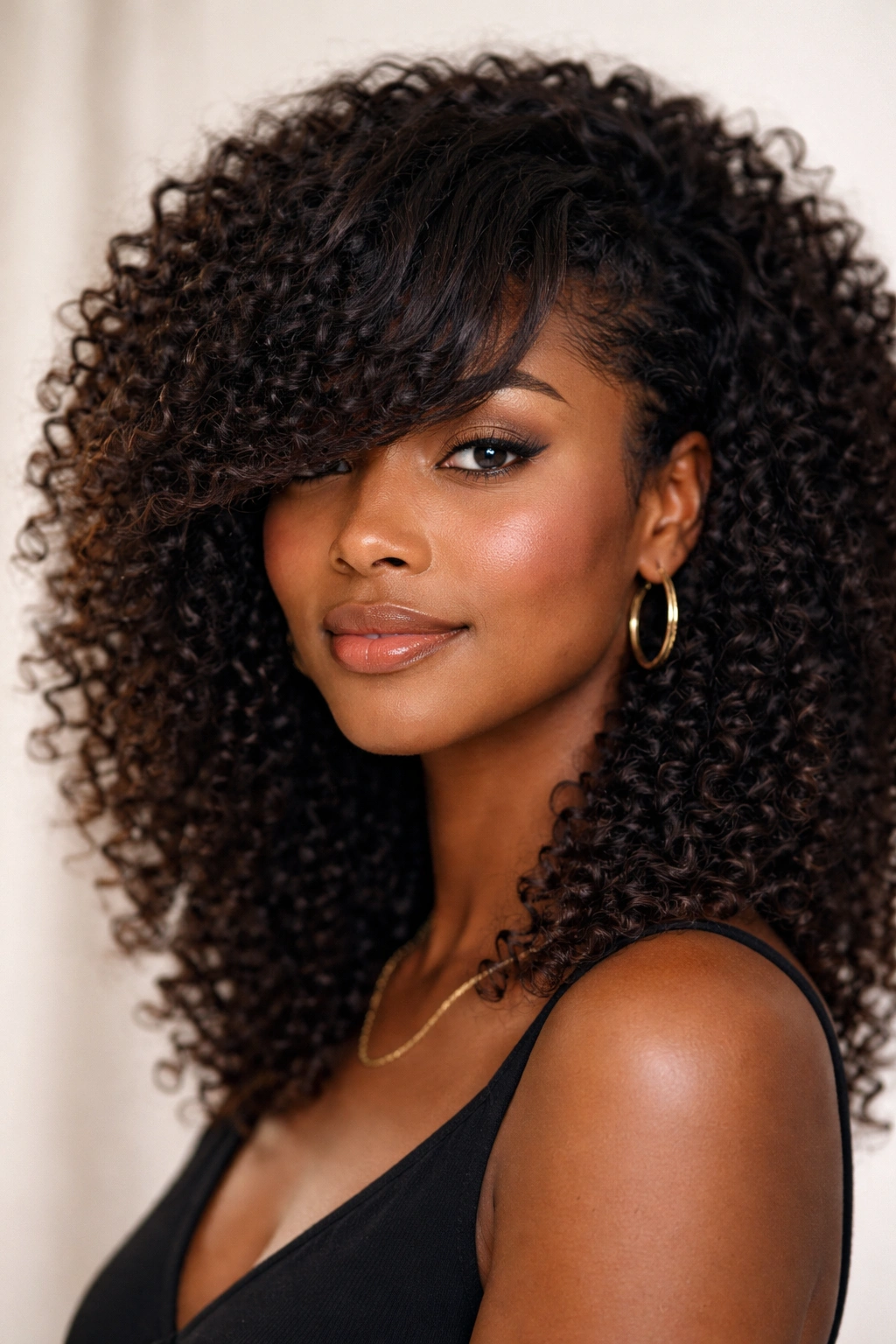
Curved side-sweep bangs are longer bangs that originate from your crown area and sweep across your forehead and down toward your opposite cheekbone, creating a dramatic curved line. Unlike curtain bangs that part in the middle, side-sweep bangs are asymmetrical—they cover more of your forehead on one side and less on the other. This style is romantic, textured, and incredibly flattering on coily hair because it uses that natural curl movement to create soft curves rather than rigid lines.
The Asymmetry Advantage
Asymmetrical styling works beautifully with coily texture because curls naturally move in multiple directions. A curved side-sweep bang style expects that movement and uses it intentionally. As your curls shrink, tighten, and move throughout the day, they’re following a line that’s already designed to curve and flow. This is the opposite of a blunt straight bang that looks weird if your curls move even slightly. The dramatic sweep also creates visual interest—it’s not as immediately striking as micro-bangs, but it’s more dynamic than some of the more integrated styles.
How to Style Them
- Determine which direction you want to sweep (typically toward your longer side) before applying products
- Apply leave-in conditioner and styling cream throughout the bang area while your hair is soaking wet
- As you diffuse, gently encourage the bangs to curve along the path you’ve chosen, rather than encouraging them upward
- Use your fingers or a wide-tooth comb to help shape the curve as the bangs are still slightly damp
- A light gel through the bang area helps them hold the sweep
Quick facts about this style:
- Works best with medium to long curl lengths; very short coils might not cooperate with the dramatic sweep
- Looks more polished on days 1-3 of your wash cycle; after that the curve relaxes
- Pairs beautifully with longer overall hair lengths and side-part styles
- Requires more intentional styling than some other bang options but the payoff is major visual impact
Caring for Coily Bangs: The Essentials
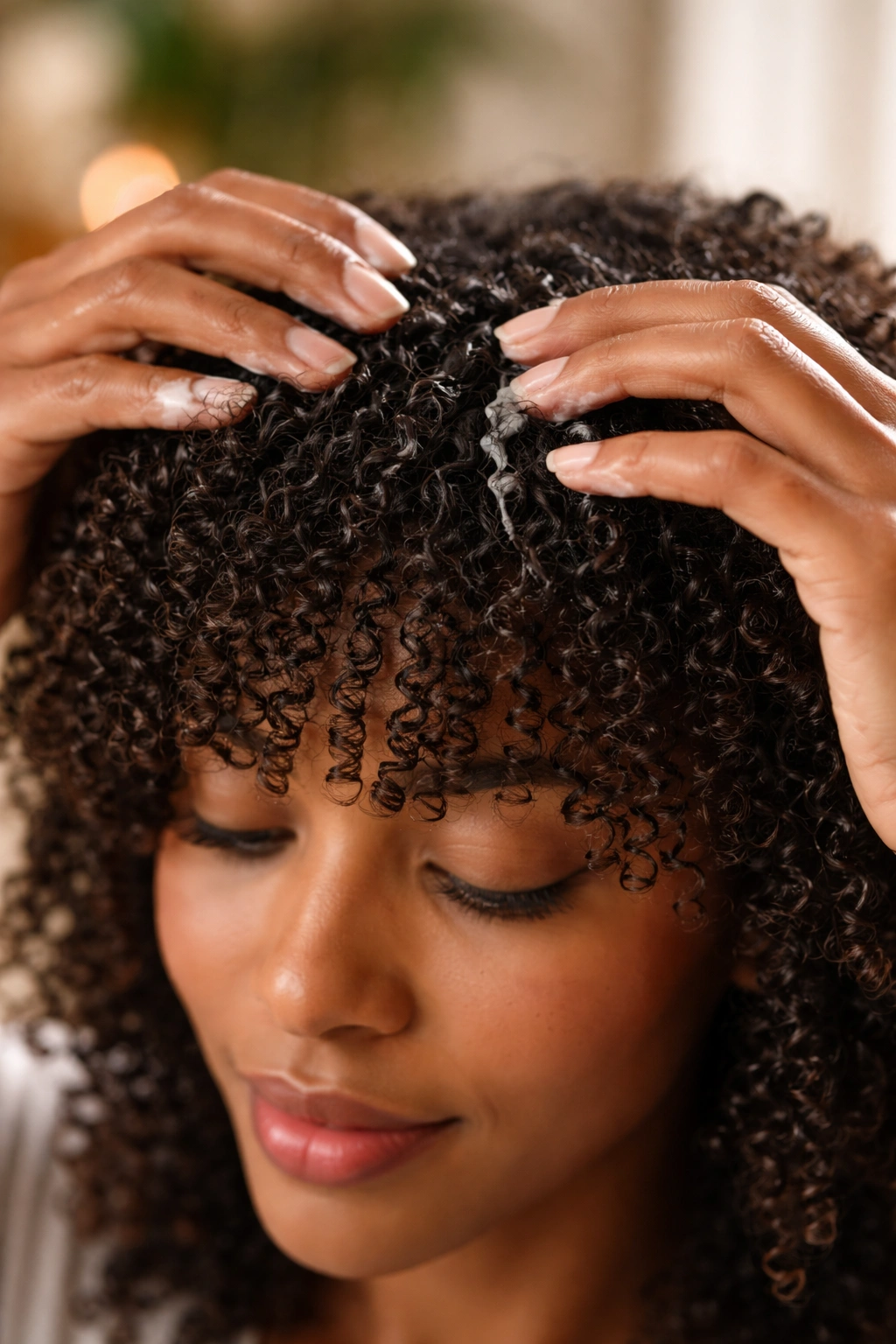
Your bang style is only going to look as good as the curl health underneath. Coily bangs live in a unique position—they’re more exposed to friction (from your forehead, glasses, hats), they might get touched more throughout the day, and they experience different drying patterns than the rest of your hair since they’re typically shorter. Treating them with extra care makes a real difference.
Keep your bangs consistently moisturized. Apply leave-in conditioner every wash day and consider an additional deep conditioning treatment on your regular wash day. Your bangs should feel soft and hydrated, not dry or crunchy. If they’re feeling rough, that’s a sign they need more moisture and gentleness, not more styling products.
Use a microfiber towel or cotton t-shirt to dry your bangs gently. Regular towels create friction that damages curls, and coily bangs are too visible to mess with friction damage. Once your hair is partially air-dried or damp-dried with the gentle method, use a diffuser on low to medium heat to dry them without creating frizz.
Resist the urge to touch your bangs throughout the day. Every time you brush them, tuck them, or adjust them, you’re potentially disrupting the curl clump and creating frizz. It’s tempting to fuss with bangs because they’re right there in your line of sight, but leaving them alone actually makes them look better longer.
On non-wash days, refresh your bangs with a light mist of water and a small amount of leave-in conditioner. Scrunch from the roots outward to encourage curl reformation, then diffuse on low heat if needed. This is way more effective than trying to tame your bangs with dry brushing or dry shampoo.
Choosing the Right Bang Style for Your Face Shape
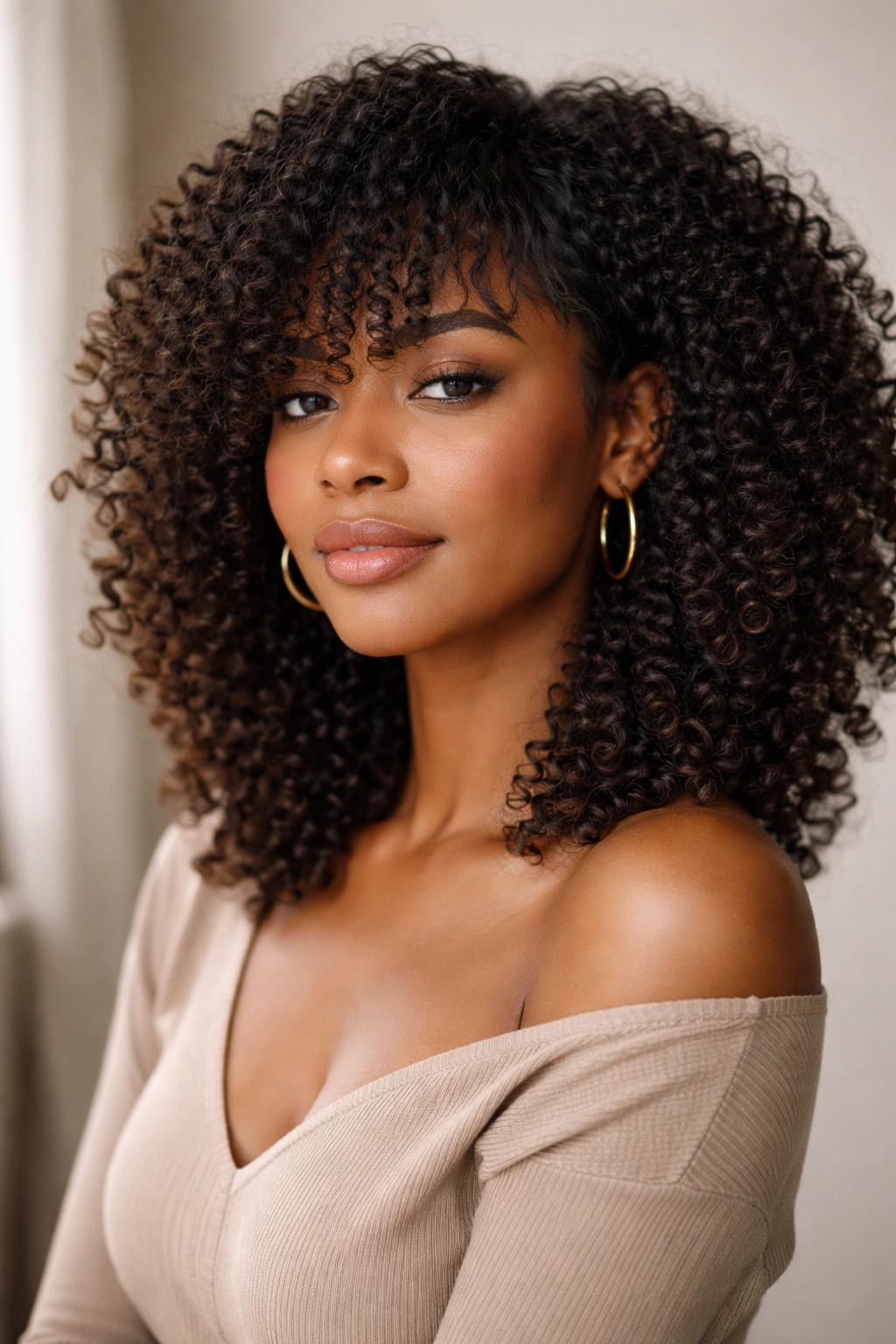
Before you book a consultation, think about your face shape and how you want bangs to interact with it. Different bang styles will create different proportions.
Round faces: Tapered bangs, side-sweep bangs, and curved bangs all work beautifully because they create height or angle that balances the roundness. Avoid extremely full, blunt bangs that add horizontal width.
Oval faces: You’re lucky—most bang styles work on oval faces. Curtain bangs, wispy bangs, and textured bangs all look great. You have the flexibility to choose based on your personal style rather than your face shape constraints.
Square faces: Soft, textured bangs help. Wispy bangs, curved bangs, and side-sweep bangs soften the angles. Avoid very blunt, severe lines that emphasize the squared-off jaw.
Heart-shaped faces: Curtain bangs and halo bangs work well, as they draw attention toward your cheekbones rather than emphasizing your wider forehead or narrower chin.
Long faces: Side-sweep bangs and curtain bangs create horizontal lines that balance vertical length. Micro-bangs might make your forehead feel even more prominent.
Remember that face shape is just one consideration. Your personal style, your curl density, and your willingness to style your bangs daily all matter. Choose a style that excites you and that you can realistically maintain.
Final Thoughts
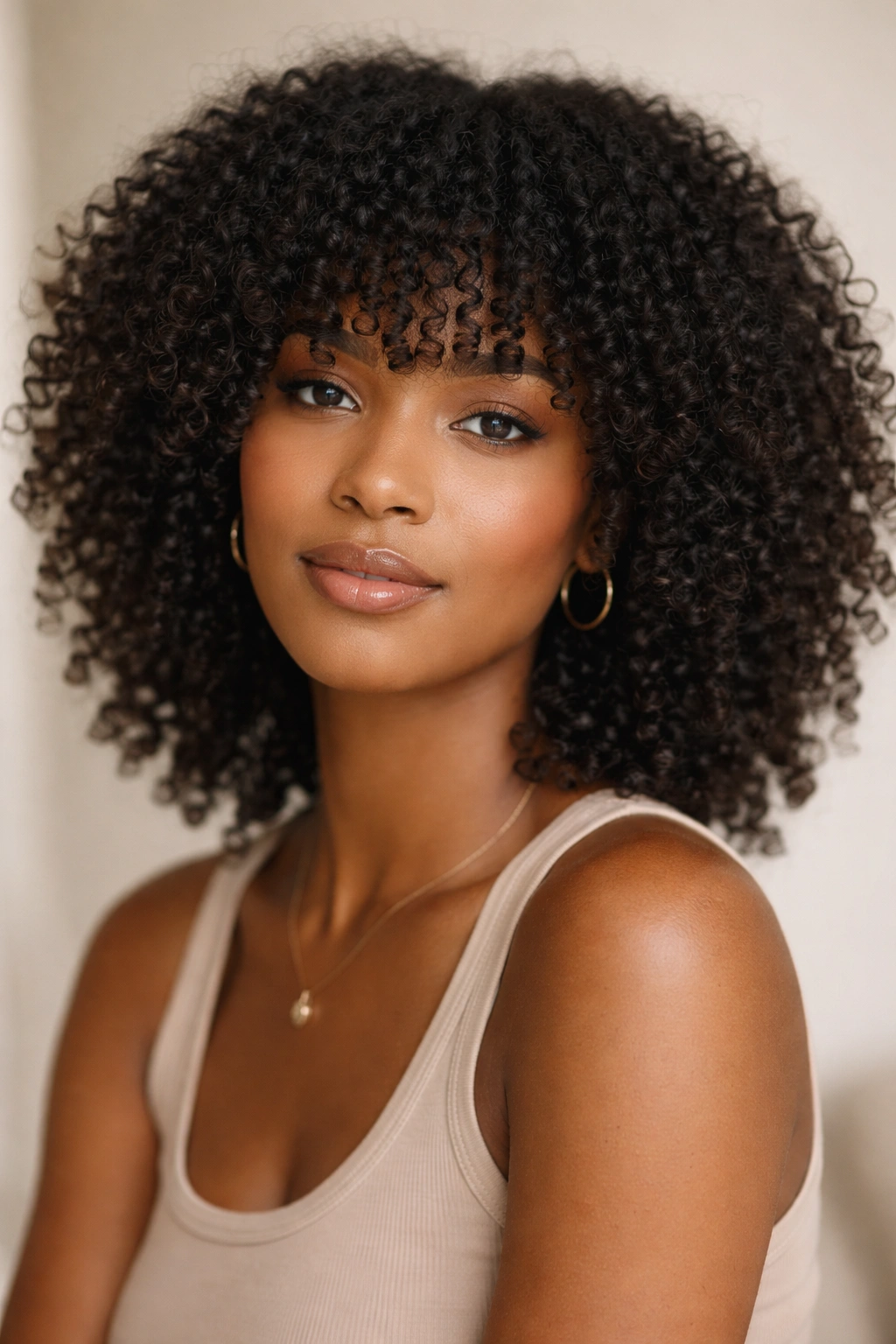
The best bang style for your coily hair is one that works with your texture, not against it. Whether you choose short textured bangs that showcase your coils, longer curved styles that integrate beautifully into layers, or anything in between, the foundation is the same: your stylist needs to understand coily hair, and you need a cutting style that accounts for shrinkage, embraces texture, and lets your curls do what they naturally do.
Start by bringing reference photos of bang styles you love to your consultation. Talk specifically with your stylist about your curl pattern, your shrinkage percentage, and what your daily styling routine realistically looks like. If you’re someone who likes to air-dry and keep styling minimal, tell them that—choose a style that looks good with minimal manipulation. If you enjoy styling your hair and have a detailed routine, you have more options.
Remember that bangs are not a permanent decision. If you try one style and it’s not working, you can grow them out or transition to a different style. Your hair is always growing, always changing, and bangs can be reimagined. Give yourself permission to experiment, to make adjustments, and to be patient as you figure out what actually works for your specific curl pattern and lifestyle. The right bang style isn’t just about looking beautiful—it’s about feeling confident in your natural texture.
