



Fulani braiding styles have made a major cultural statement for decades, but they’ve found a powerful new home in the natural hair community. If you’ve got coils, curls, and texture, these iconic styles aren’t just doable — they’re absolutely stunning on natural hair because of how they interact with your curl pattern. The key difference is understanding how to work with your curls instead of against them, which means adapting traditional Fulani braiding to celebrate the volume, dimension, and movement that natural hair brings to the table.
The beauty of Fulani styles for curly hair is that they’re both protective and customizable. You get the structural support of braids combined with the freedom to let your curls do their thing. Whether you’re maintaining a protective style for hair growth, going for a special occasion look, or just wanting to switch up your daily aesthetic, there’s a Fulani variation that fits your lifestyle and curl type. The styles here work across different curl patterns — from loose waves to tight coils — because they’re designed to accommodate volume and texture rather than flatten it.
What makes these eight styles particularly exciting is their versatility. Some are sleek and polished for professional settings, others are playful and undone for everyday wear, and several bridge that gap beautifully. They also range from quick styling options you can do in an hour to more intricate designs that deserve a full afternoon or a trip to a trusted stylist. The best part? Most of these styles stay looking fresh for 7-14 days with minimal maintenance, making them genuinely practical for busy people with curly hair who want their style to work as hard as they do.
1. Classic Gold Cuff Fulani Braids with Face-Framing Layers
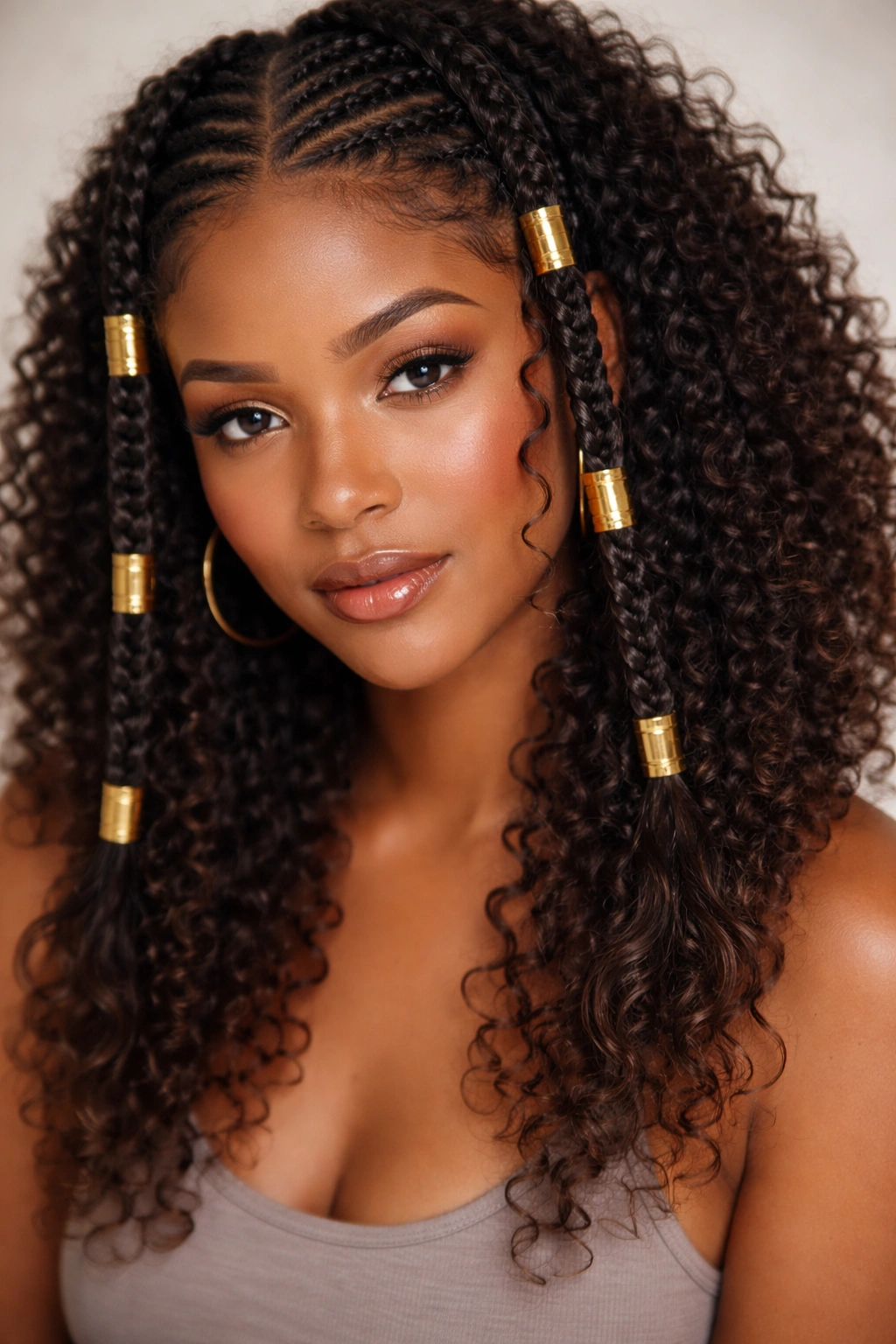
This is the style that probably comes to mind when you think “Fulani” — two thick braids anchored with gold cuffs, often framing the face beautifully. On curly natural hair, what makes this version special is how the face-framing pieces curve around your cheekbones, and how the gold metallics catch the light and contrast against rich textured hair. The braids themselves can be cornrow-style or thicker three-strand plaits, depending on how intricate you want to go and how long you want the style to last.
Why This Works for Curly Hair
The face-framing element is genuinely flattering on textured hair because it creates definition around the face while the rest of your curls stay free and voluminous. The gold cuffs — whether they’re traditional metal rings or modern chunky designs — draw the eye toward your face and frame your features without requiring your hair to be completely sleek. The style actually looks better when your braids have dimension and aren’t over-manipulated into submission, which is perfect for people who’ve struggled with overly-tight styles in the past.
How to Style and Maintain
Start with clean, moisturized curls that have some definition. Braid two sections from the crown area down toward the ends, making sure the braids aren’t pulled too tight — you want them secure but not straining your hairline. Slide the gold cuffs about two-thirds of the way down each braid for visual balance. If you want the face-framing effect, position the braids so they naturally fall alongside your cheekbones rather than straight back.
To keep this fresh for 10-14 days, pineapple your braids at night (gather them loosely at the top of your head) and use a silk or satin bonnet or pillowcase. Refresh the curls around your face by misting with a lightweight curl refresher spray and finger-coiling individual pieces. If frizz develops, a tiny amount of gel on your fingertips smoothed gently over the braid surface works without disturbing your hairline.
Pro tip: Gold cuffs made from actual metal won’t slide as easily and look more sophisticated, but they’re heavier — check your braids after a day or two to make sure they’re not slipping. If they are, wrap thin thread or string around the braid just above the cuff to give it something to grip.
2. Twisted Fulani Knots with Beaded Accents
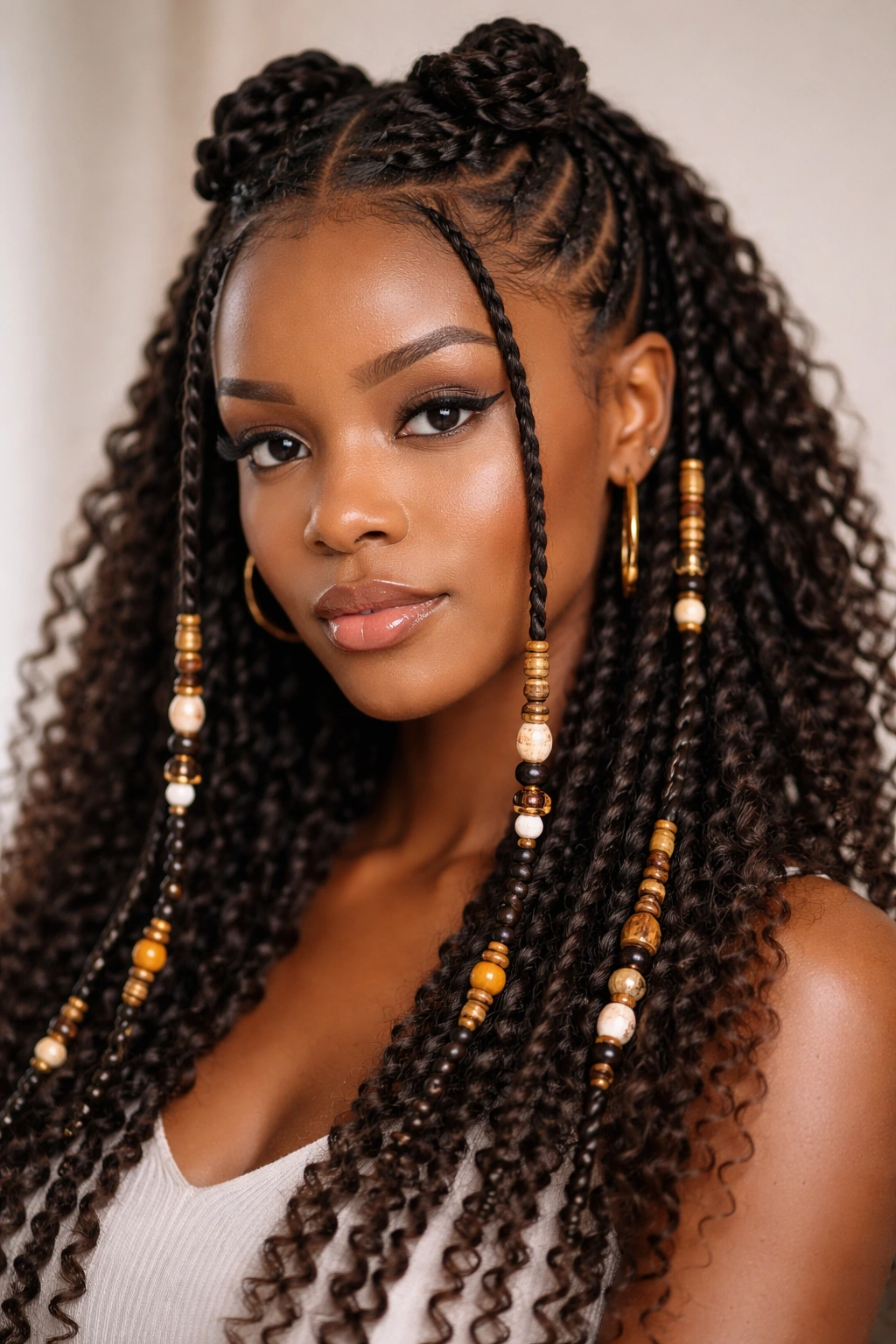
If braids feel too structured for your daily vibe, twisted Fulani knots offer that same protective quality with a slightly softer, more organic aesthetic. Instead of tight three-strand braids, you’re creating two-strand twists that spiral down from the crown, usually in pairs. Beads threaded onto the twists (either small seed beads or chunky statement pieces) create visual interest and have that authentic Fulani jewelry feel without being heavy.
The Curl-Friendly Advantage
Two-strand twists grip curly hair differently than braids — they actually use your natural curl pattern to hold the twist shape, rather than relying purely on tension. This means you can keep them looser and still have them last for two weeks. Curls that might feel cramped in tight braids actually thrive in this style because the twists expand slightly as your hair dries, creating gorgeous spiral texture that gets better as the days go on.
Installation and Styling Tips
Divide your hair into sections — usually between four and eight depending on how thick you want each twist and how much time you have. Taking two-strand twists from root to tip and adding beads as you go is meditative and relatively quick once you get the rhythm down. Thread beads onto the twists by pushing the bead down from the root, letting it settle somewhere around the middle or lower third of the twist. Mix bead sizes and metals (gold, copper, silver) for visual depth.
The magic of this style emerges over a few days. The twists relax slightly, the natural curl pattern shows through the twist structure, and the whole look becomes beautifully dimensional. Sleep on it with a silk bonnet or scarf, and by day two the texture is even more pronounced.
Worth knowing: Beads with sharp edges can catch and snag curls, so look for smooth, polished beads or ones with rolled edges. Large hole beads in African turquoise, amber, or brass are both beautiful and functional.
3. Fulani Braids Mixed with Natural Curls
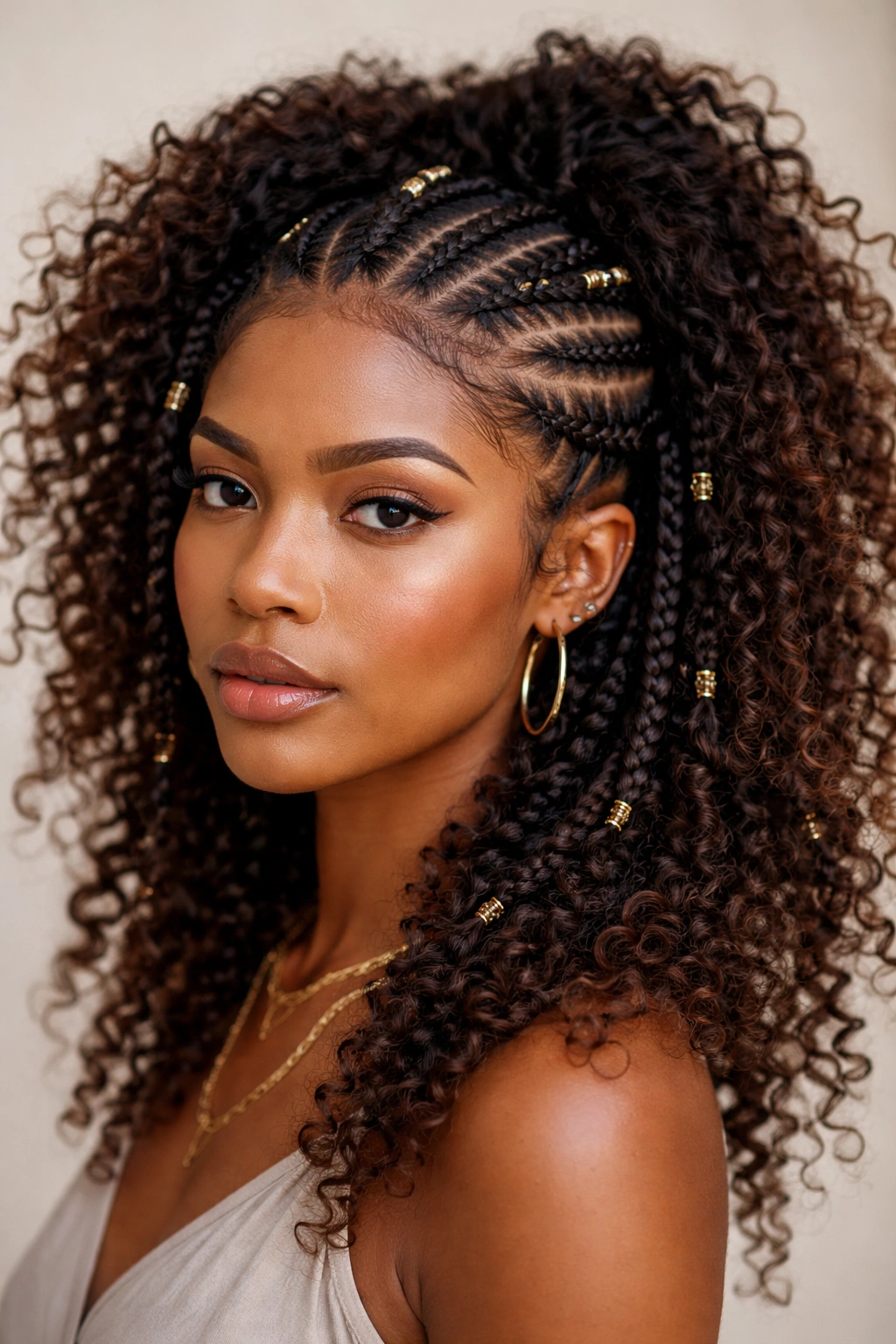
This hybrid style is exactly what it sounds like — traditional Fulani braids (often just two or four of them) woven through and around your natural curls, letting most of your hair stay unbraided and free. It’s less protective than full braids but more intentional than just wearing your curls loose, and it creates an absolutely striking visual of pattern and texture playing off each other.
Why Curly Hair Makes This Special
The braids act as visual anchors that draw the eye through your curl pattern, creating movement and intention where there might otherwise be just a cloud of curls. On straighter hair, mixing braids with loose sections can look chaotic, but with curly hair, the structure of the braids contrasts beautifully against the organic coil pattern. This style especially suits people with medium to thick density because there’s enough visual weight for both elements to shine.
How to Build This Look
Decide where you want your braids to sit — centered, off to the side, or creating a crown-like effect across the top. Braid two or three sections that will frame your face or create visual pathways through your hair. You want the braids to feel intentional, not accidental. The unbraided curls around them should be freshly refreshed (misted with water or curl cream and finger-coiled for definition) so they have shape and bounce.
This works well as a transitional style when your braids are coming out — install them fresh at the beginning of the week, then gradually remove them as you move through the week, just leaving the curls for the last few days.
Insider note: Use contrasting beads or cuffs on the braids — something that pops against your curl color — so the braids read as intentional design elements rather than looking like you just braided some random sections.
4. Cornrow-Based Fulani with High Crown Detail
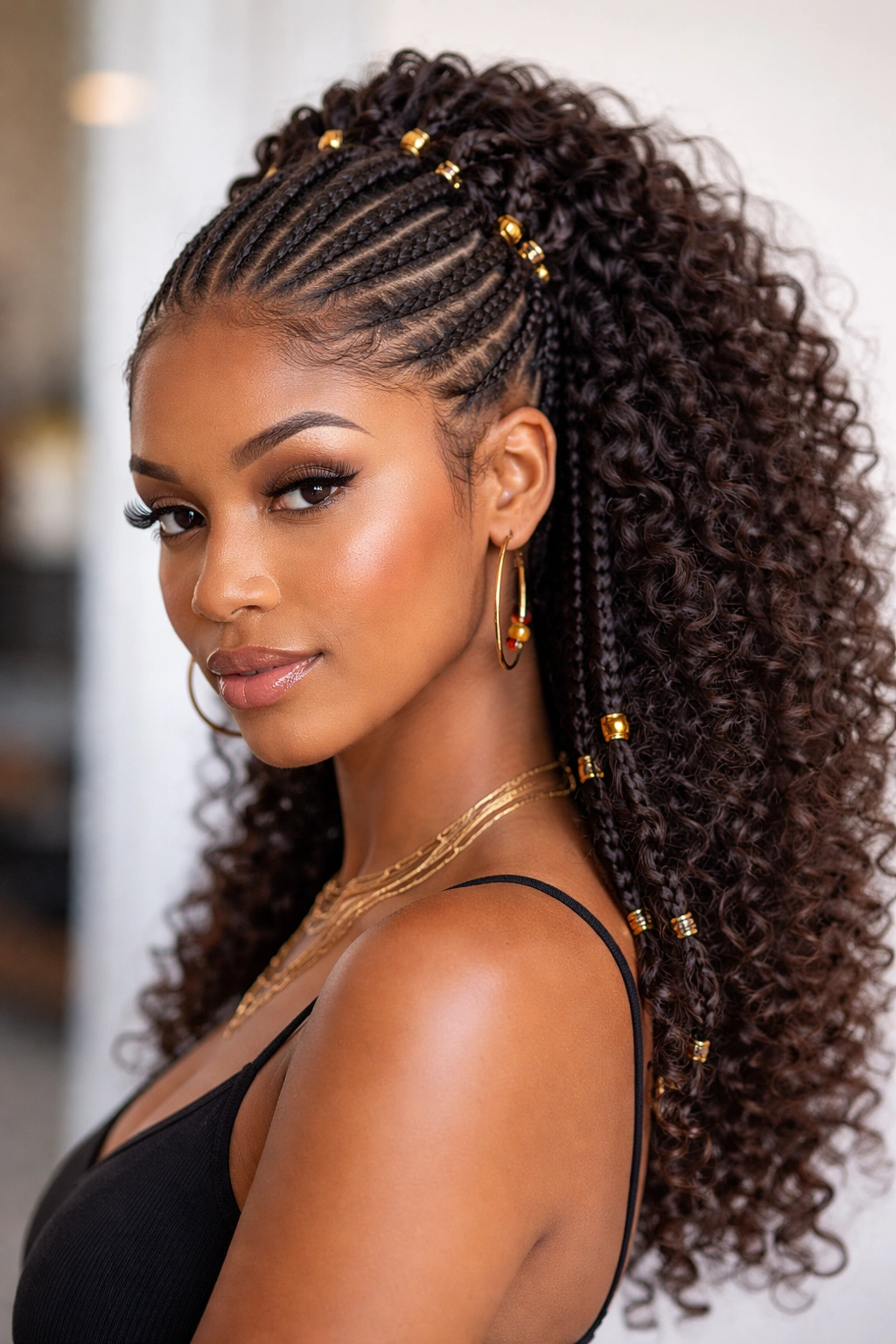
This style takes the classic Fulani silhouette and builds it with cornrows instead of loose braids, creating a more sculpted, structured look. The cornrows run from the front hairline back toward the crown, where they meet in the middle or transition into loose curls cascading down the back. Gold cuffs or beads accent the cornrows, and the overall effect is polished enough for formal events but cool enough for everyday wear.
Protecting Curls While Building Structure
Cornrows are inherently protective because they lie close to the scalp, but the key with curly hair is not making them so tight that you can see scalp all the way through — a little texture and dimension in the cornrows actually looks better and is gentler on your hairline. The transition from cornrows to loose curls at the back is where your natural texture really shines. You can leave those back sections loose and coily, braid them partially, or twist them — depending on how protected you want them to be.
Styling from Installation to Removal
Get these cornrows installed while your hair is clean and moisturized, with enough leave-in conditioner or cream in your hair that the braider’s fingers can move smoothly without friction. The braider should be experienced with textured hair and understand that these don’t need to be razor-tight to stay in place for two weeks.
Once installed, sleep on this style with a silk bonnet for the first few nights. After that, you can sleep with a loose pineapple or just let it breathe. Refresh the loose curls at the back every 3-4 days by misting and finger-coiling. If shine fades, a tiny bit of oil-based shine spray brings back the luster without making things look greasy.
Pro tip: Request that your braider leaves the last inch or two of each cornrow unbraided so you can coil it into a curl rather than ending it with a sharp braid point — this creates a softer transition and actually helps the style last longer because there’s less tension at the ends.
5. Single Fulani Braid with Spiral Curls
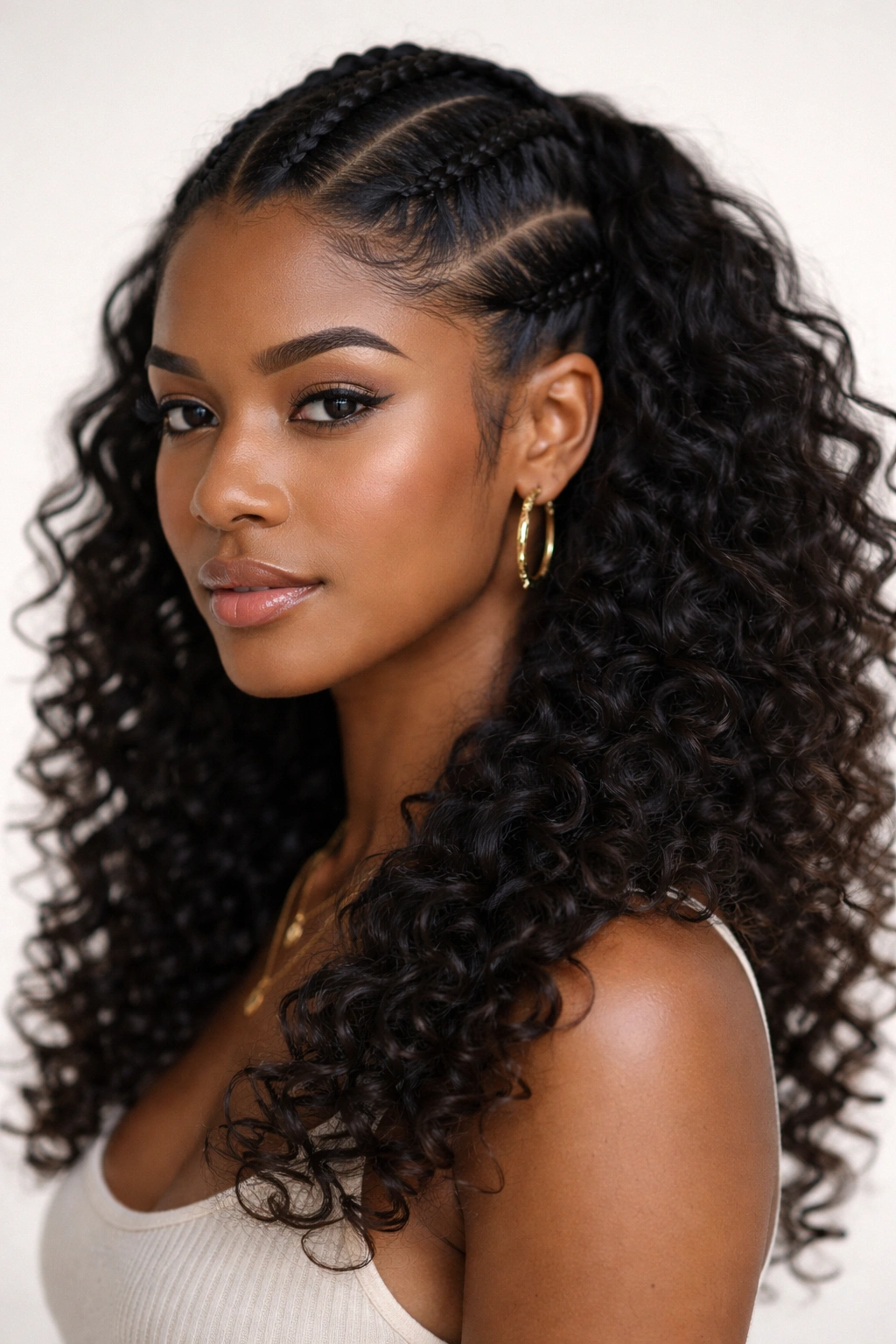
Sometimes less is more, and a single statement braid down the center of your head with the rest of your hair in gorgeous spiral curls is absolutely that. This is the everyday Fulani — easy to execute, striking to look at, and so low-pressure that you can redo it whenever you want. One thick braid (or two thinner ones running parallel) from the crown down the center, usually from your hairline toward the nape of your neck, with everything else left curly and full.
The Simplicity Factor
Because you’re only braiding one section, you can create this style in 15-20 minutes, even if you’re doing it yourself. It’s genuinely a hairstyle you can do on a Tuesday morning if you’re tired of your regular curls, and it will last through the whole week. The single braid creates a focal point without the commitment of a full protective style, which makes it perfect for people who like variety or who like to change their look frequently.
Making the Spiral Curls Part of the Design
The curls flanking your braid are the real stars here, so refresh them intentionally. Use a spray bottle with water and your favorite leave-in conditioner, then finger-coil individual sections for definition. You want those curls to have bounce and shape, not just frizz. The contrast between the sleekness of the braid and the volumetric texture of the curls on either side is what makes this style work visually.
You can add a single statement bead or cuff to the braid — gold works, but you could also do something unexpected like a small turquoise or jade piece. Or go minimal and let the braid speak for itself.
Worth knowing: This style looks fresher longer (14-21 days if you want it) because it’s looser and has less tension on your scalp. Just refresh the curls as needed and you’re good.
6. Fulani Braids with Cowrie Shell Details
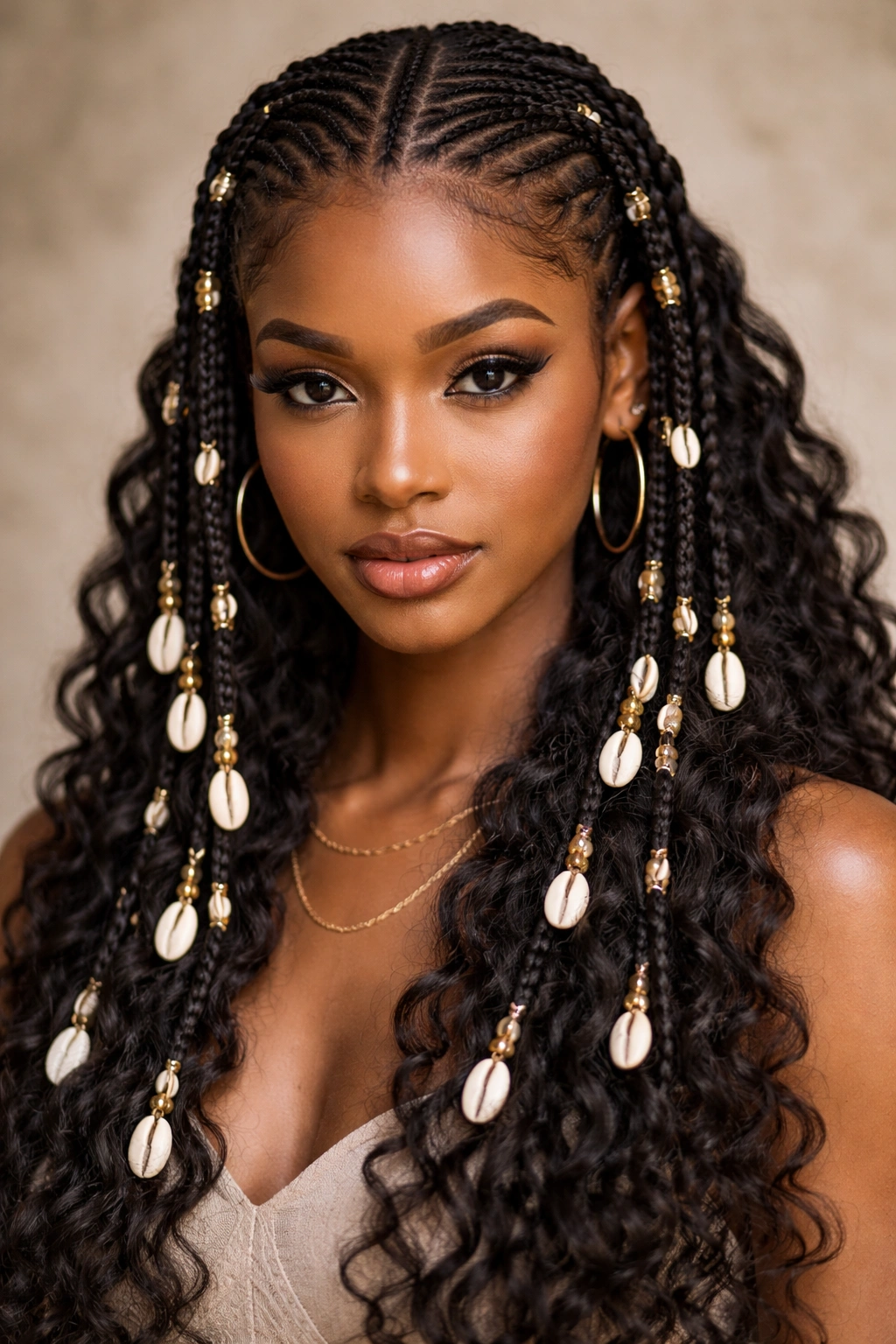
Cowrie shells are having a major moment in natural hair styling, and they pair beautifully with Fulani braids for a look that’s both cultural and contemporary. Unlike metal cuffs, cowrie shells add an earthy, organic quality while still being eye-catching. You can thread them onto the braids themselves, attach them to the ends, or cluster them at strategic points like where two braids meet or along your hairline.
The Cultural and Aesthetic Power of Cowries
Cowrie shells have historical significance in African and African diaspora culture — they were used as currency, as spiritual protection, and as adornment. Wearing them in your Fulani braids is both aesthetically beautiful and culturally intentional. On curly hair, the cream or white of the shells contrasts gorgeously against darker hair tones, and they catch light in a softer way than metal does.
How to Incorporate Cowries Into Your Style
You can buy cowrie shells pre-drilled (with a small hole already made) from beauty supply stores, African specialty shops, or online. Thread them onto your braids as you’re creating them, or attach them afterward using thin thread or fishing line. Some people space them evenly along the braid; others cluster them near the ends or group them in twos and threes for visual interest.
If you want a more subtle cowrie moment, attach one or two small shells near your hairline or at the very ends of your braids. If you want them to be the statement, use larger shells and place multiple ones throughout your style.
The shells add minimal weight — you don’t have to worry about them pulling your braids down or straining your edges the way heavy metal cuffs sometimes can. They’re also gentler and less likely to snag nearby curls.
Pro tip: Mix cowries with small gold beads or brass pieces for a look that blends natural and metallic elements — it creates visual richness without looking overdone.
7. Half-Up Fulani Style with Loose Coils
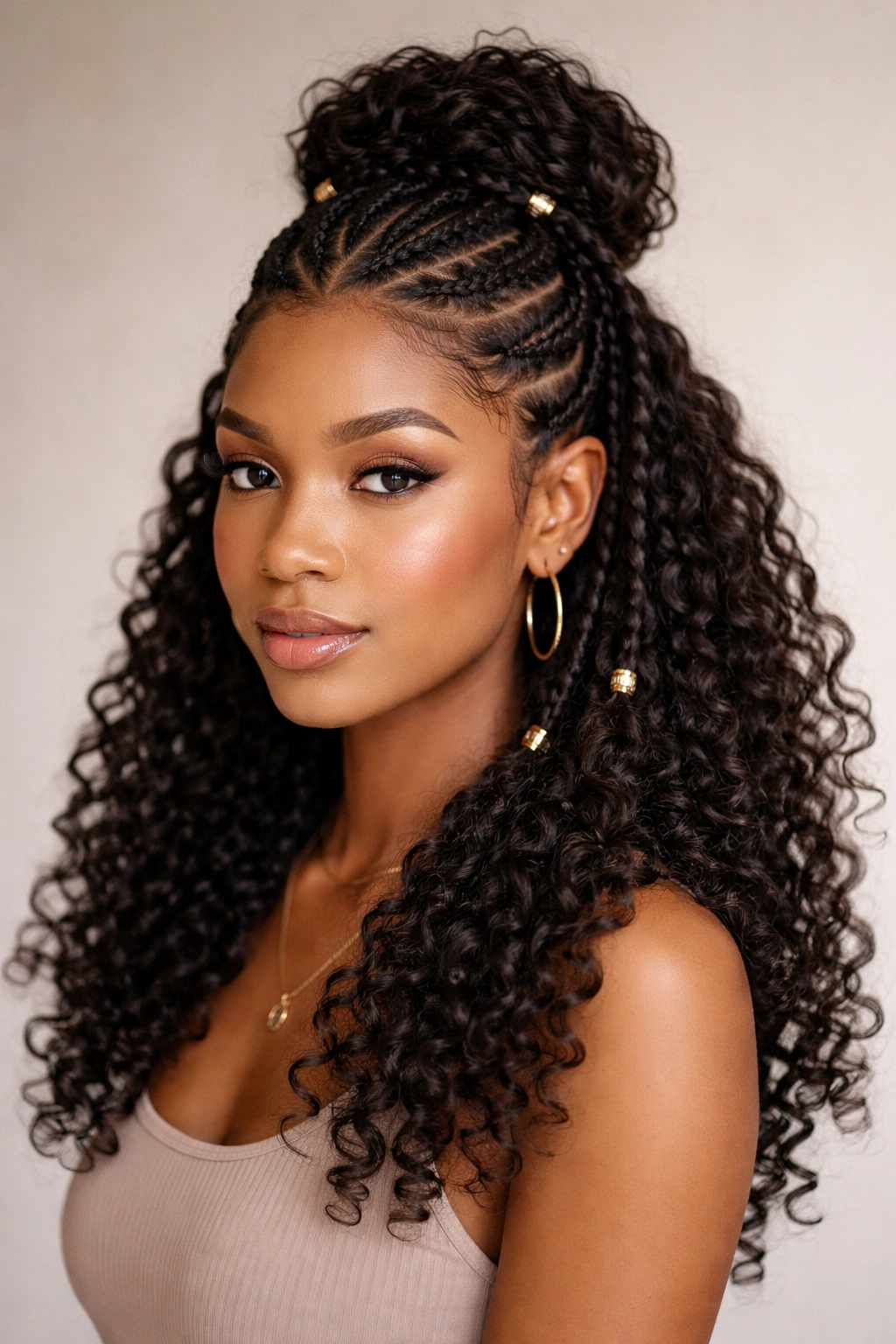
For days when you want the protective style benefits without fully committing to braids everywhere, a half-up Fulani is your answer. You’re braiding or twisting just the top section of your hair (from about your temples up and over the crown toward the back), while everything below stays in beautiful, defined coils. It’s casual enough for a Saturday but polished enough to wear to work or out to dinner.
Balancing Protection and Volume
The genius of this style is that you get the protective benefit of braided hair in the crown area — which is often the most fragile and valuable to protect — while letting the bulk of your hair stay loose and voluminous. This is perfect if you’re trying to grow out broken or damaged hair specifically in your crown, or if you just want the visual weight of your curls without the full-style commitment.
Building the Half-Up Version
Start by creating a horizontal section from about mid-ear on one side to mid-ear on the other side, across the crown. Everything above that line gets braided (usually two to four braids, depending on your preference and hair density). Everything below stays loose. The boundary between braided and loose sections should be a bit soft — you don’t need a razor-sharp line.
For the loose bottom section, refresh your coils or curls by misting with water and lightweight leave-in, then finger-coiling for definition. You can also apply a light curl-defining cream to enhance the coil pattern. The volume of the loose bottom section balanced against the structured top creates a gorgeous silhouette that photographs beautifully.
Add beads or cuffs to just the braided section so the metal draws the eye upward. Gold, copper, or brass all work depending on your skin tone and aesthetic.
Insider note: This style is particularly flattering if you have a narrower face shape because the volume at the bottom and the structure at the top create visual balance. If you have a rounder face, consider doing thinner, more numerous braids on top rather than thick chunky ones.
8. Double Fulani Plaits with Bold Gold Jewelry
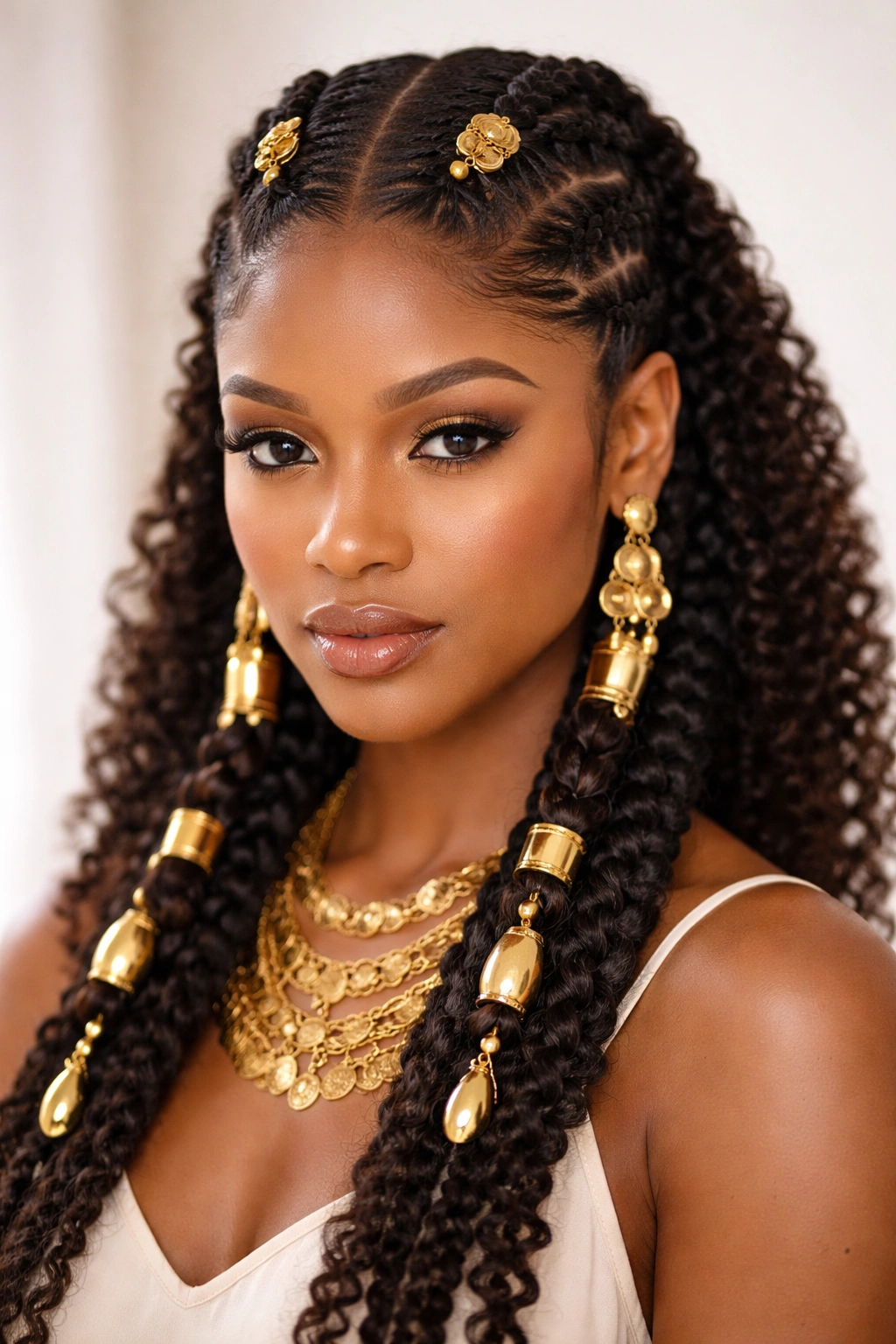
Go big or go home — this is the showstopping version of Fulani braiding. Two very thick, meticulously crafted braids running from your front hairline down your back, usually embellished with multiple gold cuffs, chunky beads, or even brass rings. The braids are the focal point, and everything else either frames them or gets woven into them.
Why This Works as a Statement Style
When you braid with this much intention and visual weight, the style becomes a true statement piece. You’re essentially wearing art on your head. On curly natural hair, the thickness of the braids and the generous jewelry make the style even more impactful because there’s visual contrast between the smooth braid surface and the textured curls potentially woven throughout or surrounding the braids.
This is the style you wear when you want to feel powerful, beautiful, and intentional. It’s perfect for special occasions, date nights, celebrations, or just Tuesdays when you’re in the mood to take up space.
Installation and Styling for Maximum Impact
These braids work best when done by someone with experience — the thickness, the placement, and the jewelry all need to be perfectly executed. You usually want them to start right at your hairline and run straight back, or you might offset them slightly off-center for an edgier vibe. The braids should be thick enough (usually ¾ inch to 1 inch wide) that they feel substantial but not so tight that you feel tension on your scalp.
Gold cuffs should be placed strategically — maybe one near the top of each braid, one in the middle, and several near the ends. You could also do a progression where the cuffs get bigger as they go down, or mix different metals and finishes for visual interest. Some people add long gold chains woven through the braids for extra drama.
This style lasts 10-14 days easily because the braids are so thick and the tension is distributed across such a wide section of hair. Sleep on it loosely, refresh any loose curls around your face, and you’re set.
Worth knowing: Going to an experienced natural hair stylist is worth the investment for this style. An inexperienced braider might create braids that are too tight, which can damage your hairline, or too loose, which fall apart in days.
Final Thoughts
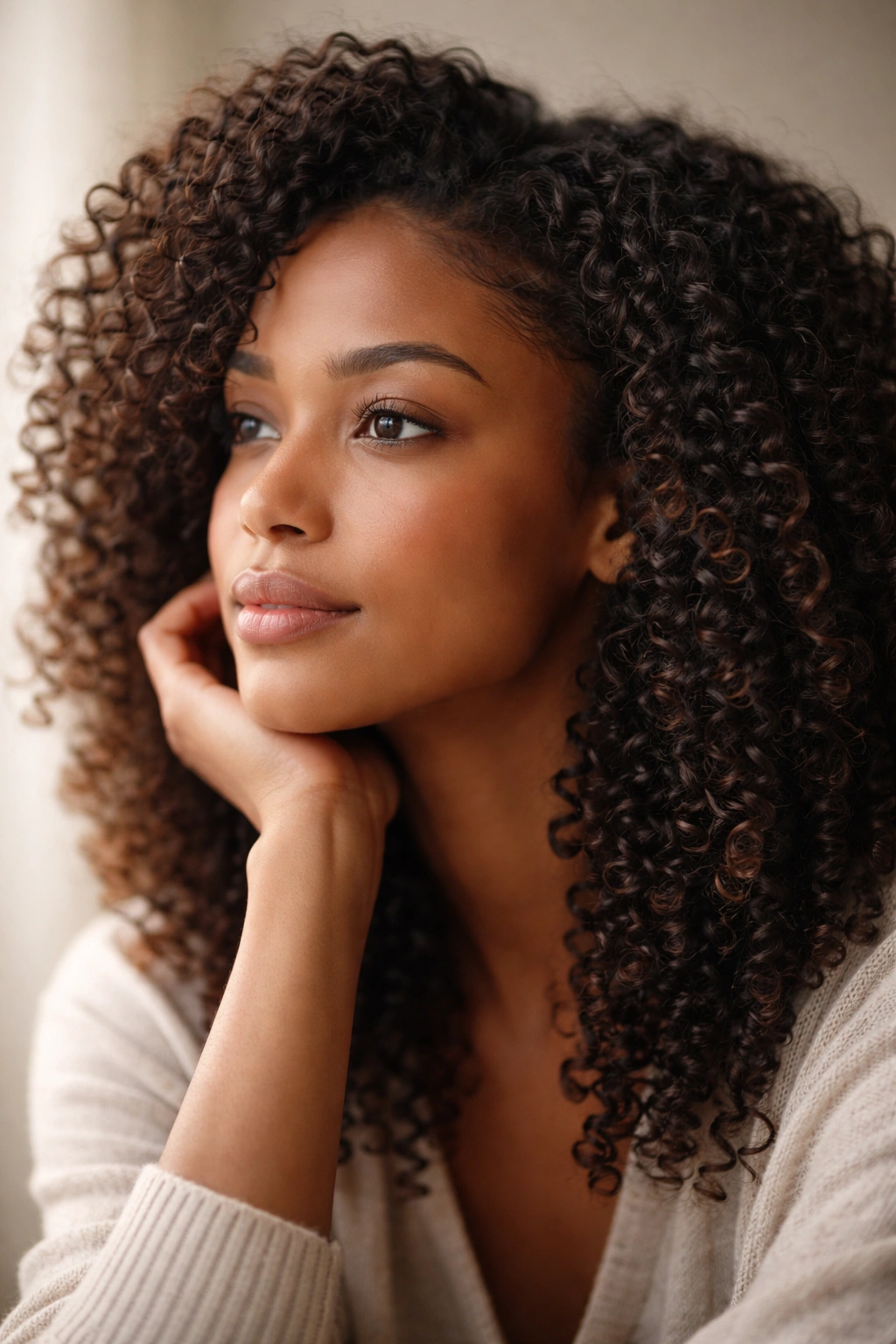
Fulani styles on natural curly hair are genuinely transformative — they work with your texture rather than against it, they’re protective without being oppressive, and they carry cultural significance that goes beyond just looking good (though they absolutely do that too). The eight styles here represent a range of complexity and commitment, which means there’s legitimately something for everyone whether you’re a braiding minimalist or someone who loves an elaborate crown.
The real secret to making any Fulani style work beautifully is starting with clean, well-moisturized curls and trusting a stylist who understands natural hair. Your curls aren’t a problem to solve in these styles — they’re the whole point. That shift in perspective is what makes all the difference between a style that feels like it’s fighting your hair and one that celebrates exactly what you’re working with.
