



There’s something undeniably sophisticated about a middle part. Unlike side-swept styles that draw the eye toward one angle, a middle-parted ponytail creates perfect balance and frames the face with an inherent sense of calm elegance. It’s the kind of hairstyle that looks effortlessly put-together, whether you’re heading to the office, attending a formal event, or simply wanting your everyday look to feel more refined.
What makes middle part ponytails particularly appealing is their versatility. A middle part works beautifully across nearly every hair texture, face shape, and styling preference. Whether your ponytail sits high and polished at the crown, rests sleekly at the nape of your neck, or falls somewhere in between, that centered part immediately elevates the entire style. It feels intentional, symmetrical, and undeniably chic—the hallmark of a truly polished look.
The key to mastering these styles lies in understanding how the placement, texture, and finishing details work together. A middle part ponytail isn’t one-size-fits-all; it’s a framework that adapts to your hair type, personal aesthetic, and the occasion. Some versions embrace sleek, controlled precision, while others lean into softness and texture. Some styles prioritize extreme neatness, while others benefit from strategic undone elements that feel modern and lived-in. Throughout this guide, you’ll discover fifteen distinct interpretations—each one polished, each one approachable, and each one offering something different depending on your goals and mood.
1. The Sleek High Ponytail with Middle Part
A sleek high ponytail positioned at the crown is arguably the most classic and versatile interpretation of a polished middle-parted style. This is the hairstyle that works equally well in the boardroom and on the red carpet, which explains why it remains a favorite among everyone from business professionals to celebrities navigating their public appearances. The magic happens through precision and preparation—the kind of look that appears simple but requires genuine attention to detail.
Why This Style Never Goes Out of Style
The high ponytail with a middle part succeeds because it combines functionality with sophisticated aesthetics. By pulling hair up and away from the face, you create an open canvas that makes cheekbones more prominent and the face appear more elongated and refined. The middle part adds that crucial element of symmetry, preventing the style from feeling pulled-back or harsh. Instead, it suggests intention and intentionality—like you’ve thoughtfully considered your appearance rather than simply throwing hair back in a rush.
How to Achieve Maximum Sleekness
Preparation is everything: Start with hair that’s been smoothed and prepped, either with a blow dryer and paddle brush or a flat iron, depending on your hair texture and the level of sleekness you want. Apply a lightweight smoothing serum or anti-frizz cream to damp hair before blow-drying—this creates the foundation for that glass-like finish.
Creating the perfect center part: Use a fine-tooth comb or rattail comb to create a perfectly straight line from your forehead to the nape of your neck. This precision is non-negotiable if you want the polished appearance. Take your time; rushing this step shows.
Securing with tension: Gather the hair into a high position at the crown—roughly in line with where your natural hairline curves. A classic mistake is making the ponytail too loose; polished versions require enough tension to smooth the hairline and create a taut, controlled appearance. Use a sturdy elastic or a decorative hair tie that complements your outfit.
Final smoothing: Once the ponytail is secured, use a smoothing cream, gel, or even a light hairspray to tame any flyaways around the face and along the part line. The goal is that flawless finish where every strand appears intentionally placed.
Pro tip: If you have fine or fragile hair that resists high-tension styles, try a slightly lower placement at the crown rather than directly at the very top. The effect remains polished without putting excessive stress on your hairline.
2. The Textured Middle-Parted High Pony with Volume
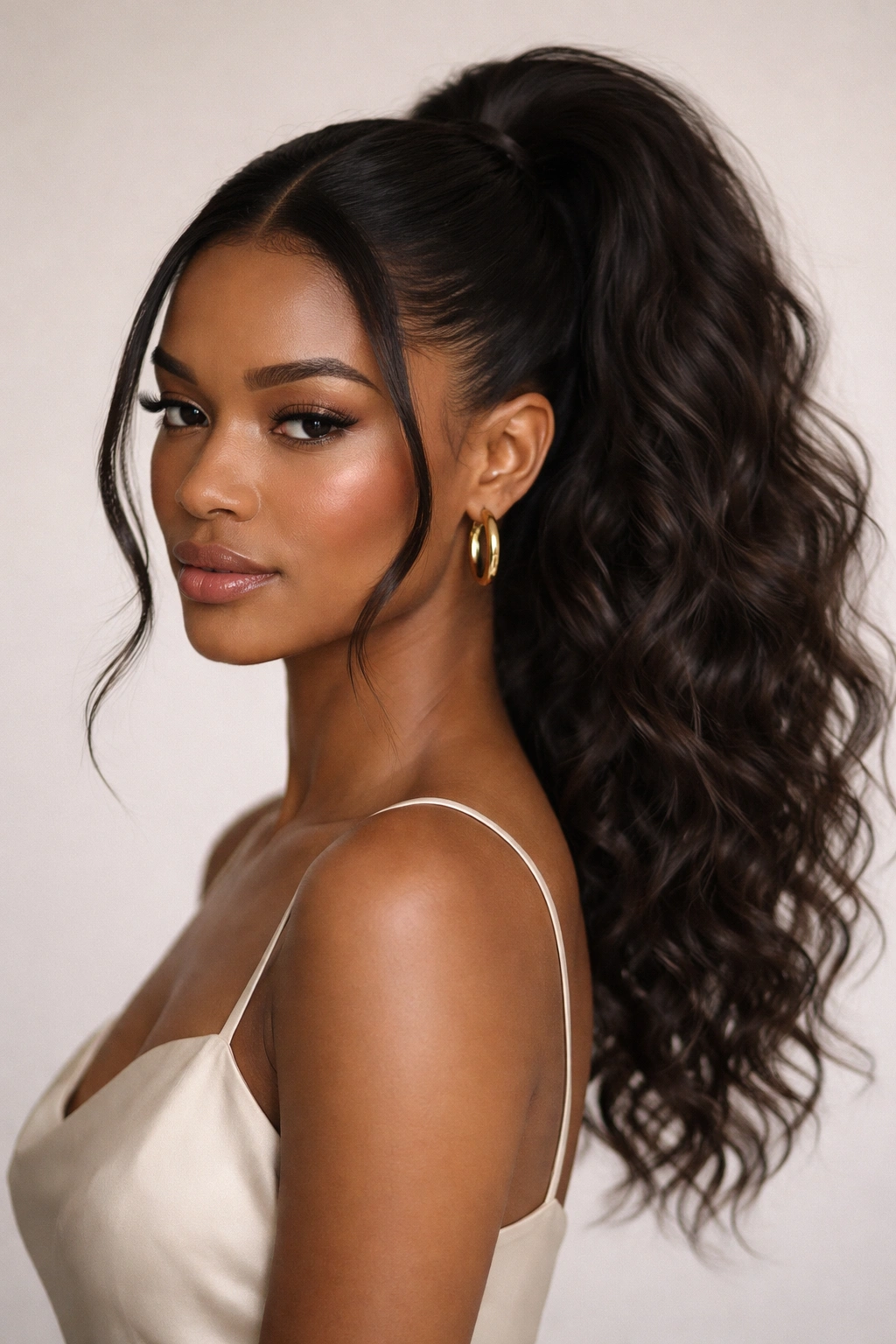
Not every polished ponytail needs to be stick-straight and sleek. A textured version with strategic volume offers sophistication while feeling more contemporary and less severe. This interpretation works beautifully if you prefer a hairstyle that doesn’t flatten your hair or if you have naturally textured, curly, or wavy hair that resists smoothing.
The key distinction is that texture here is intentional and controlled, not accidental or frizzy. Think smooth waves, defined curls, or a slight crimp texture that adds dimension while maintaining an overall sense of polish. The volume isn’t wild or chaotic—it’s concentrated and shaped so the entire style reads as put-together rather than bedhead-adjacent.
Building Volume the Right Way
Blow-drying for lift: Don’t blow-dry your hair completely smooth and flat; instead, blow-dry it while using your fingers or a round brush to direct hair away from the roots. This creates volume and movement that will be visible in the final ponytail. The roots especially need that lifting action; it’s what prevents the style from sitting flat against your head.
Texture creation options: Depending on your preference and hair type, you can use a wave spray or sea salt spray before blow-drying, create waves with a curling iron, use dry texture spray for grittiness, or braid damp hair overnight and release the braids just before creating the ponytail. Each method creates a different texture quality—choose the one that feels most natural for your hair.
Gathering and securing: When you gather the hair, use a slightly looser elastic than you would for a super-sleek version. This allows the textured strands to maintain their shape and movement rather than compressing everything into a tight bundle. A velvet scrunchie or silk-covered elastic is especially useful here because it grips the hair less aggressively than a standard rubber band, which allows texture to show.
Strategic smoothing: Even though you want texture, the part line itself and the front hairline should remain smooth and defined. Use a light smoothing cream on just those areas, not throughout the entire ponytail. This creates contrast—sleek, intentional styling at the face and part, with textured movement in the ponytail itself.
This version reads as polished because the texture is clearly chosen and shaped, not random or unkempt. The middle part remains sharp and defined, anchoring the style with sophistication.
3. The Low Middle-Parted Ponytail with Elegance
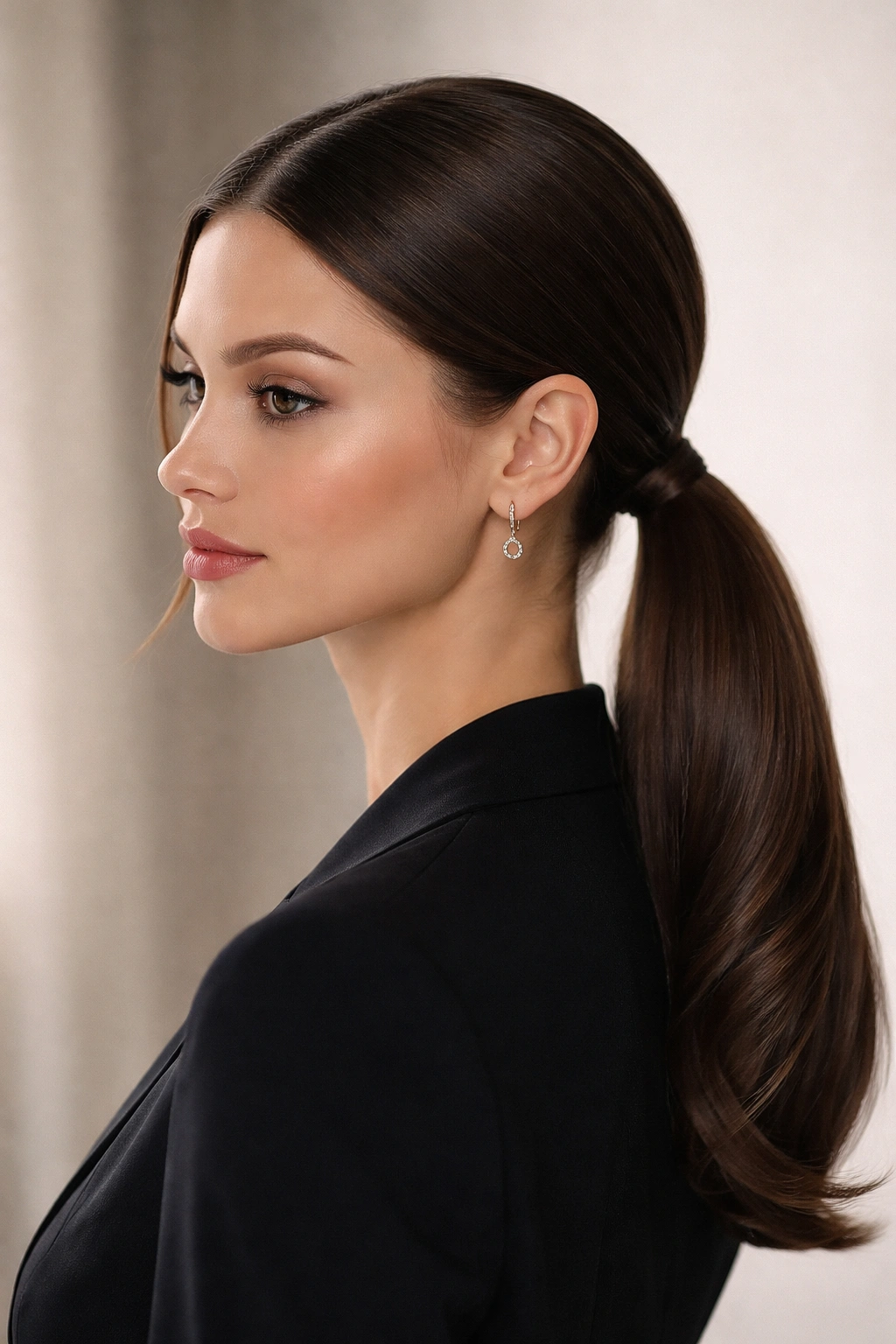
Contrary to popular belief, a polished middle-parted ponytail doesn’t require a high placement. A low ponytail—one that sits at the nape of the neck or even lower—can feel incredibly refined, especially when paired with a middle part. This version works especially well for professional settings, formal events, or when you want a polished look without the intensity of a high crown placement.
The lower position offers a different kind of sophistication: it’s elegant rather than striking, understated rather than dramatic. There’s an inherent gracefulness to a low middle-parted ponytail, perhaps because it resembles classic updos and formal hairstyles that have been considered refined for generations.
The Allure of a Lower Placement
Why low works: Positioning the ponytail lower allows you to create a style that feels sleek and polished without emphasizing the crown of the head. This can be flattering if you prefer not to accentuate the top of your head or if you have a hairstyle that requires a specific crown shape. A low placement also tends to feel more natural and less styled, which appeals to people who like their polished looks to feel effortless rather than engineered.
Creating the perfect low section: Rather than gathering hair directly at the crown, establish a mental point at the base of your skull where you’d imagine the start of your neck. This is where your ponytail should begin. Take sections of hair from around this level and gather them together, making sure you’re including the hair from the sides as well as the back. The middle part should continue naturally down to this gathering point.
Maintaining hair density: Because you’re pulling from lower sections, you might not have quite as much hair volume as you’d get from a high gather. To compensate, don’t pull too tightly at the base. Use a sturdy elastic but avoid excessive tension; this allows hair to maintain its natural shape and appear fuller. A rubber band slightly smaller than you’d normally use (but not uncomfortably tight) will hold without creating an overly taut appearance.
Finishing the ends: The ponytail itself can be sleek or textured, depending on your preference. Many people find that a low ponytail benefits from slightly wavy or curled ends, as this adds softness and prevents the style from feeling too austere. Even five minutes with a curling iron creating loose waves through the ends makes a significant difference in how polished and intentional the style appears.
A low middle-parted ponytail is the thinking person’s polished hairstyle—it suggests quiet confidence rather than statement-making boldness.
4. The Graphic Black Tie Ponytail with Precision Parting
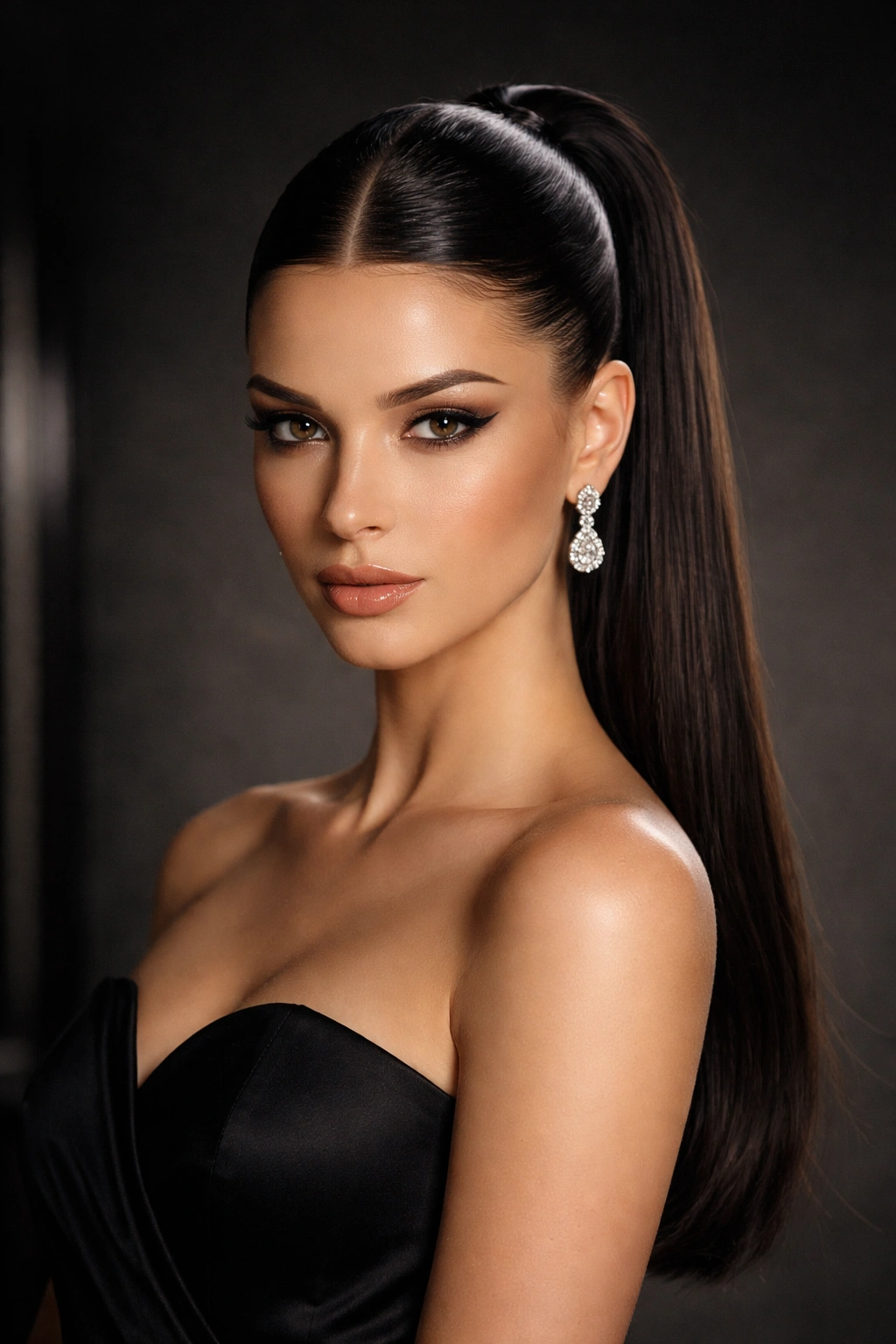
If you’re attending a formal event, black-tie occasion, or any setting where hair needs to look impeccably controlled and refined, the graphic black tie ponytail deserves consideration. This interpretation prioritizes absolute precision and zero imperfection, with every strand exactly where it should be and no flyaways tolerated.
“Graphic” here refers to the defined, almost architectural quality of the style. The middle part is razor-sharp, the ponytail is positioned with mathematical precision, and the hair itself appears almost sculptural. This is the hairstyle of choice when you want to look formal, untouchable, and completely polished.
Achieving Flawless Formality
Preparation is non-negotiable: Wash your hair, apply a smoothing treatment, and blow-dry with maximum precision using a paddle brush or flat iron. Every strand should be smooth and tamed. If you have any natural wave or texture, this is the time to remove it entirely. The goal is absolute sleekness—the kind where light reflects uniformly off your hair.
The perfect part: Using a fine-tooth comb or a rattail comb, create a part line that’s absolutely straight and perfectly centered. This part line should be visible and crisp, not soft or blended. For formal events, some people even use a fine black line pencil to sharpen the part line further, though this works better for certain hair colors and is entirely optional.
Positioning with precision: Decide whether you want a high or mid-height placement, but whichever you choose, it should be perfectly centered and perfectly symmetrical. Measure from your hairline to the gathering point to ensure you’re not favoring one side. Use a sturdy, decorative elastic or hair tie that complements your formal attire.
Controlling every edge: Once the ponytail is secured, use a light-hold hairspray or gel to tame any potential flyaways. Then, using a fine comb, smooth the hair at the front and sides one more time. The hairline should be smooth, and the perimeter of the style should be clean and defined.
Ponytail finishing: Keep the actual ponytail sleek as well. Don’t allow texture; use smoothing products to ensure every strand in the ponytail itself is controlled. Some people even lightly flat-iron the length of the ponytail for maximum sleekness, though this is only necessary if your hair is particularly resistant to smoothing.
This level of precision reads as utterly professional and polished. It’s the ponytail for occasions when your appearance needs to be beyond reproach.
5. The Soft Middle-Parted Ponytail with Face-Framing Pieces
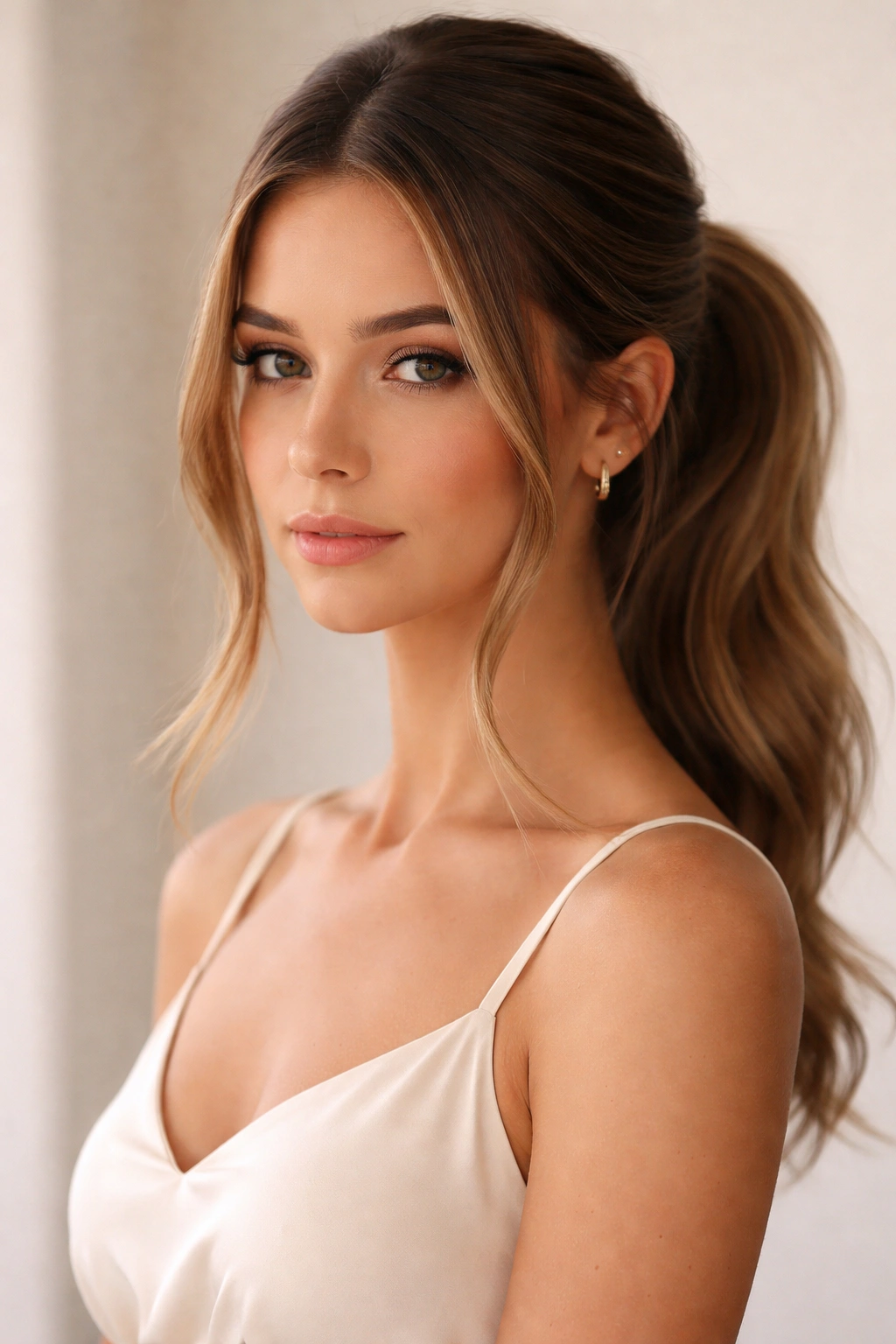
While some polished looks prioritize tight control, others succeed through strategic softness. A soft middle-parted ponytail with intentional face-framing pieces offers polish through balance—the hairstyle is primarily contained and controlled, but carefully placed pieces frame the face, adding dimension and approachability. This version feels refined without feeling austere or uncomfortable.
The face-framing pieces are key to the aesthetic. These shouldn’t be random or haphazard; they’re strategically pulled out to create a specific effect. They soften the overall appearance, draw attention to the face, and prevent the style from feeling overly severe or pulled-back.
Creating Strategic Softness
Choosing your frame pieces: Once you’ve created your middle part and gathered most of your hair into the ponytail, identify 2-4 pieces on each side (so 4-8 total) that you’ll leave out as face framers. These should be pieces that fall naturally at cheekbone level when released. They can be slightly wavy or straight, depending on your overall style aesthetic, but they should complement rather than contrast with the rest of the style.
Securing without trapping: When you gather your main ponytail, be intentional about which hairs you’re including in the gather and which you’re leaving out. This is easier if you section clearly—part your middle section, then use clips to hold the frame pieces away from the sides, then gather everything else. Release the frame pieces last, and they’ll fall naturally.
Texturing the frame pieces: Whether you want these pieces to be wavy or straight, intentional texture (rather than random flyaways) reads as polish. If they’re textured, create defined waves using a curling iron. If they’re straight, make sure they’re smoothly finished with a flat iron and a light smoothing product. Either way, they should look chosen, not accidental.
Balancing polish with softness: Use a light-hold hairspray that allows movement but maintains shape. You want these frame pieces to move slightly with your head’s motion, creating an elegant, alive quality rather than feeling stiff or overly controlled.
This interpretation of a polished middle-parted ponytail works beautifully for professional settings that still want to feel warm and approachable, formal events with a contemporary edge, or everyday styling when you want to feel polished but not overworked.
6. The Sleek Side-Swept Pony-Adjacent Style with Center Part
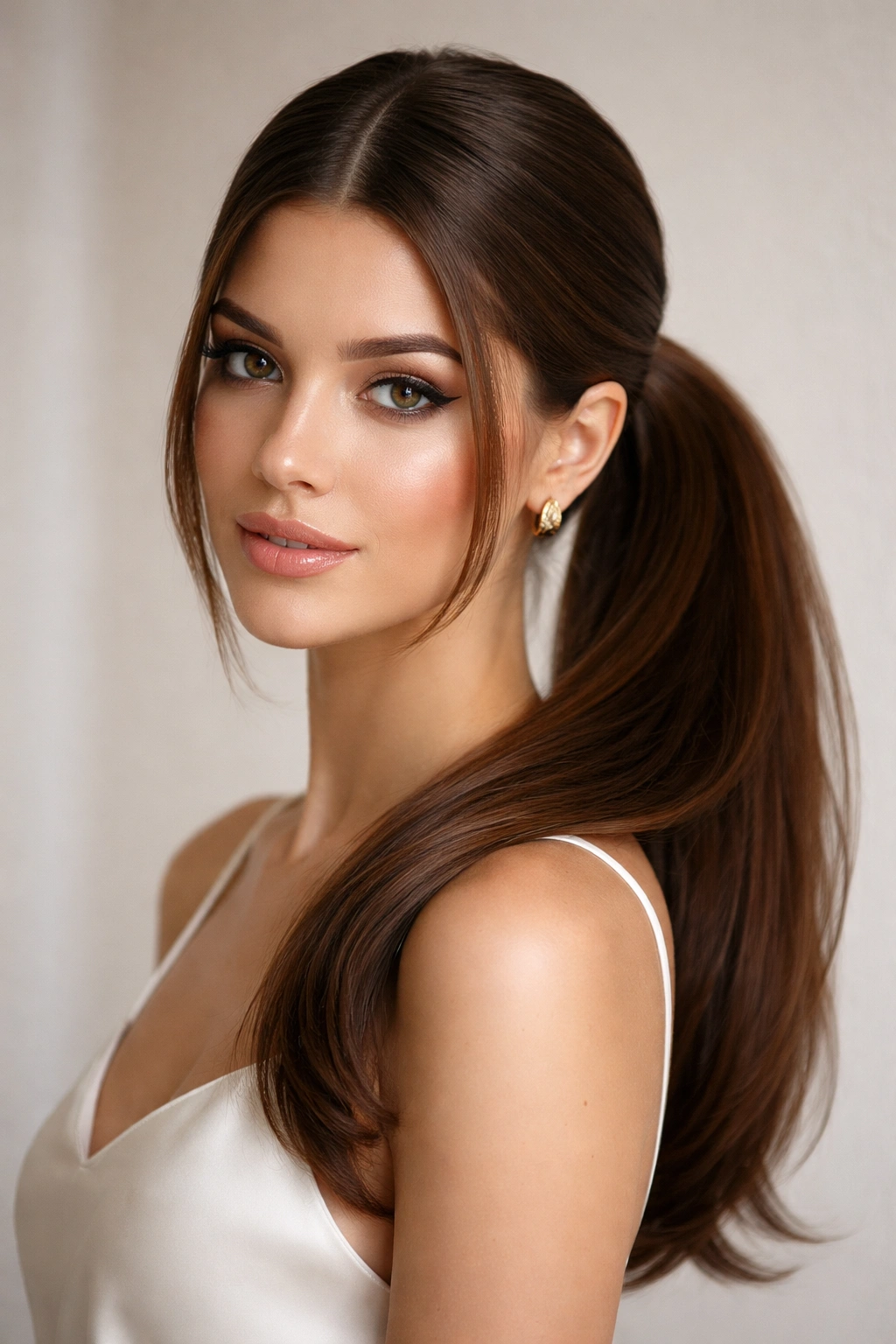
Here’s an interesting hybrid: a middle part at the crown that transitions into a ponytail positioned slightly off-center, creating a subtle asymmetry that feels modern and dynamic. This style begins with absolute middle-part precision but allows the gathered ponytail itself to rest in a position that’s not directly centered. It’s polished and intentional, but it avoids the “too perfect” feeling that some people find unflattering or severe.
The middle part grounds the style with its symmetry, but the off-center ponytail placement adds movement and visual interest. It’s a perfect compromise for people who love the look of a middle part but find a perfectly centered ponytail placement either uncomfortable or less flattering to their face shape.
Balancing Symmetry with Movement
Starting with precision: Begin exactly as you would with a standard centered middle-parted ponytail. Create a sharp, centered part from your forehead to the nape of your neck. Style your hair so that both sides are equally smooth and shaped. At this stage, you’ve established visual balance and intentionality through the middle part.
Repositioning at the nape: As you gather your hair, shift the gathering point slightly to one side—about half an inch to an inch off-center. This subtle shift means that while your part is perfectly centered, your ponytail rests slightly to the left or right. The effect is modern and interesting without reading as sloppy or unintentional.
Maintaining the polished aesthetic: The way you secure and finish the ponytail itself is what determines whether this reads as polished or simply off-center. Keep the elastic neatly placed, smooth any potential flyaways, and ensure the ponytail itself is sleek or textured depending on your preference. The off-center placement adds interest, but precision everywhere else adds polish.
Why this works: This style succeeds because the middle part signals intention and planning, while the off-center ponytail placement suggests modern styling confidence. It’s a hairstyle for people who want polish but also personality—who appreciate symmetry aesthetically but want their hairstyle to feel contemporary rather than classic.
7. The Braided Middle-Parted Ponytail
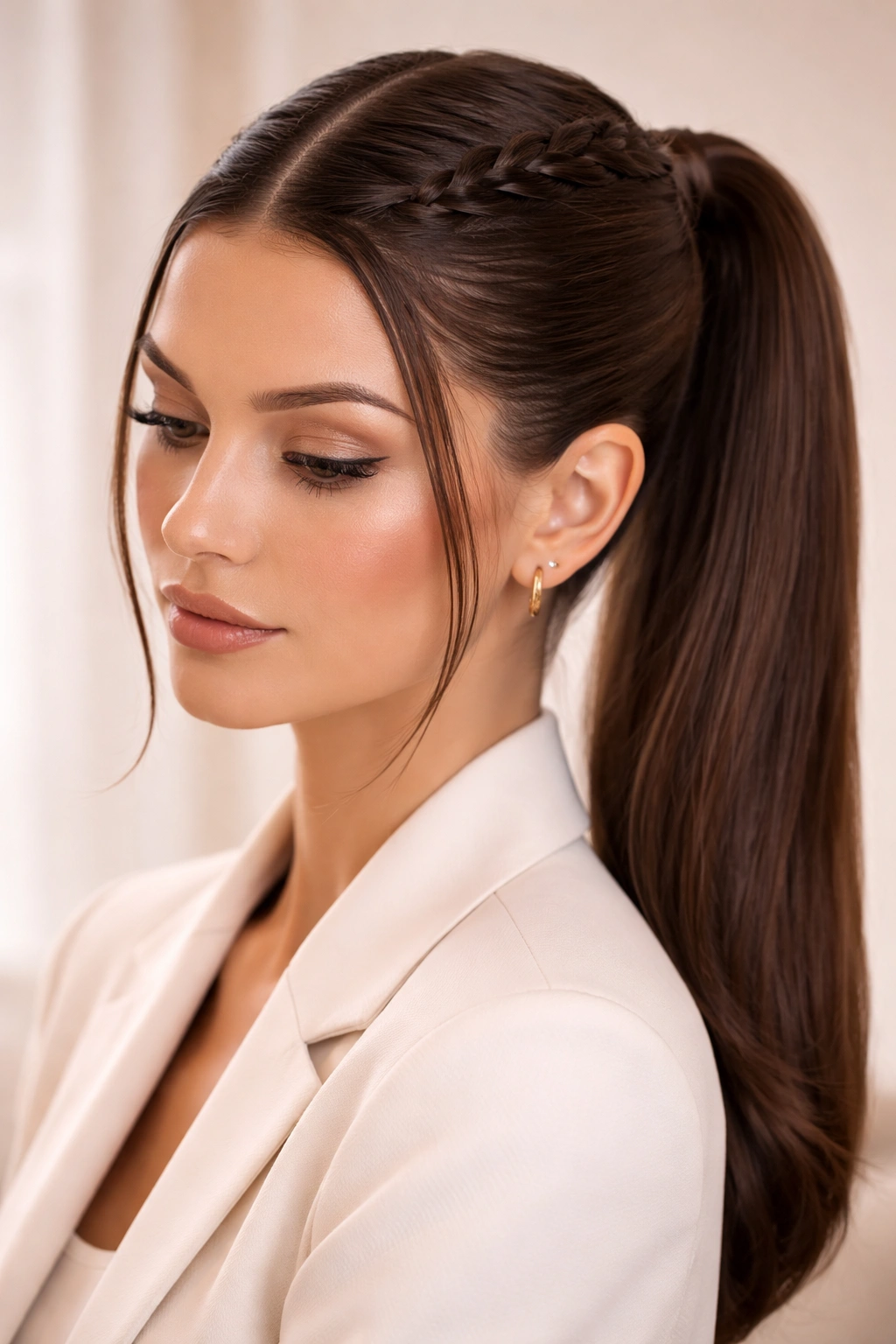
For a polished look with added texture and visual interest, incorporating a braid into a middle-parted ponytail elevates the style significantly. Rather than a simple gathered ponytail, you’re creating something with dimension and craft, which inherently reads as more polished and intentional. The braid also serves a practical purpose—it’s incredibly secure and stays polished throughout the entire day without requiring touch-ups.
The most effective versions use a Dutch braid or French braid that begins at the part line and incorporates hair from both sides as it travels down toward the nape. The result is a style that feels both modern and classically refined.
Creating the Perfect Braid Integration
Starting the braid at the top: Begin your middle part as usual, then identify where you want your braid to begin—typically at the crown or slightly lower. Separate three sections of hair at this point, ensuring they’re equal in size, and begin your braid. For a Dutch braid, you’ll braid by crossing sections under rather than over, which creates a braid that sits slightly raised on the scalp and appears more defined.
Incorporating hair as you go: A Dutch braid or French braid involves picking up new sections of hair with each pass, incorporating hair from across the scalp as you move downward. Keep your tension consistent—tight enough that the braid stays secure and polished, but not so tight that it appears uncomfortable or strained. The braid should feel intentional and controlled, not messy or loose.
Transition to ponytail: As you reach the nape of your neck (or whatever height you’ve chosen for your ponytail), stop braiding and gather all hair—including the braided section—into a ponytail. The braid now becomes part of the gathered ponytail structure, adding visual interest and texture to what might otherwise be a simple gathered style.
Finishing the braided style: Smooth any potential flyaways around the part and the braid itself. The braid should be neat and clearly defined, with visible sections. If you want added texture, you can very gently pull the sections of the braid slightly outward to create a fuller, softer appearance, but keep this subtle—you’re adding dimension, not destroying the braid’s structure.
A braided middle-parted ponytail reads as deeply polished because it demonstrates both technical skill and thoughtful styling. It’s a hairstyle that works beautifully for formal events, special occasions, or professional settings where you want to demonstrate that you’ve put genuine effort and care into your appearance.
8. The Curved Middle Part with Romantic Waves
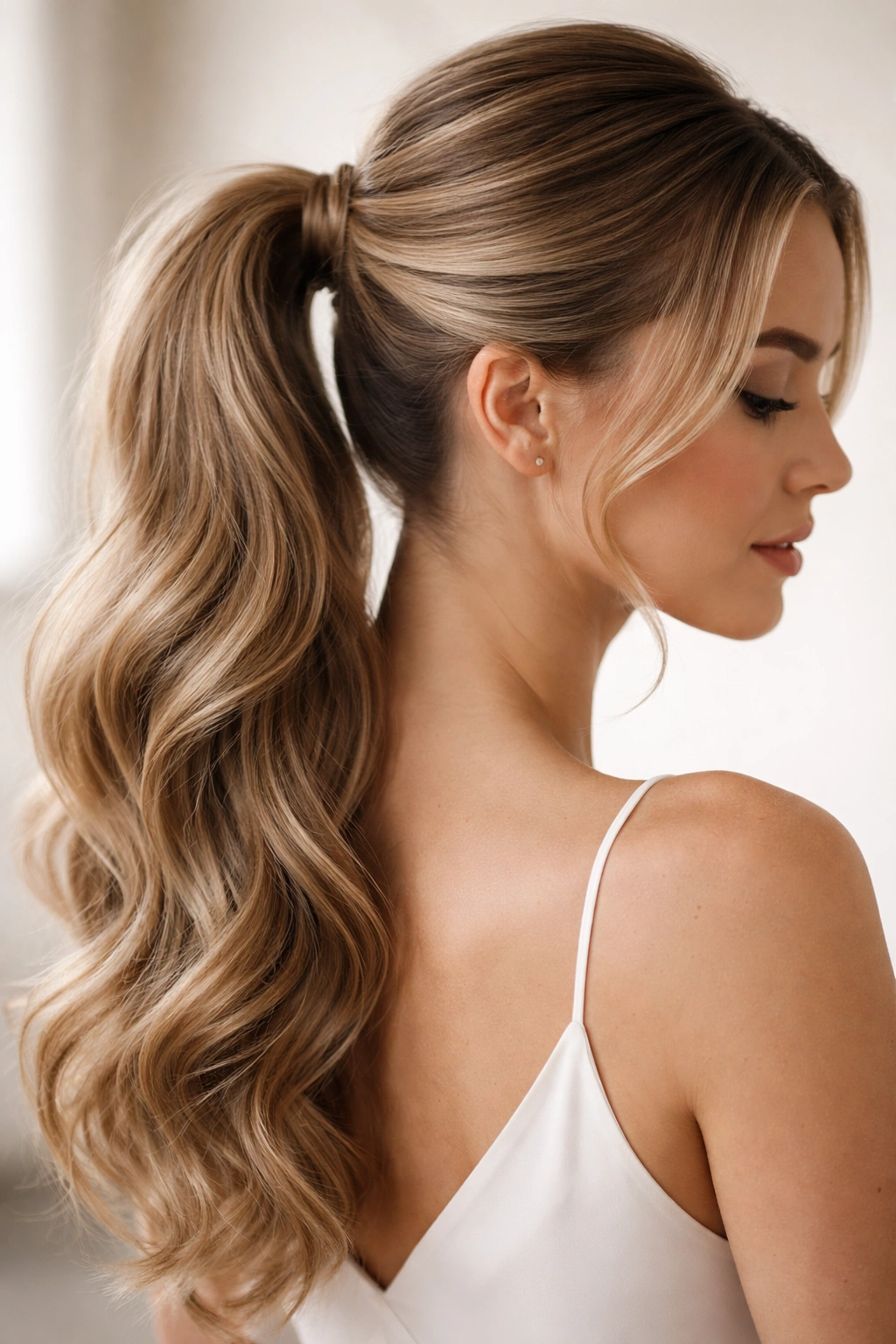
This interpretation prioritizes femininity and movement while maintaining a polished aesthetic. Instead of a ruler-straight middle part, you create a gentle curve or soft S-shape in your part line, which adds a romantic, almost art-nouveau quality to the style. Combined with romantic waves throughout the ponytail, this creates a look that feels polished, intentional, and deeply feminine.
The curved part line is subtle enough that it doesn’t read as sloppy, but distinctive enough that observers will notice the thought behind your styling. It’s a perfect option for weddings, romantic occasions, or anytime you want your polished look to lean toward elegance and grace rather than severity and precision.
Creating Romantic Structure
Designing the curved part: Instead of drawing a straight line from your hairline to your nape, create a gentle curve or soft S-shape. This is easiest to accomplish using a fine comb and careful observation. Decide whether your curve will flow slightly to the left or right, then draw the part line following that direction. The curve should be subtle—noticeable to someone looking closely but not dramatic or exaggerated.
Styling for softness: Blow-dry your hair so it has body and movement rather than lying completely flat. You want the hair on either side of the part to fall naturally with a soft quality. Use a large-barrel curling iron or a wave spray to create gentle waves throughout your hair before gathering into the ponytail.
Gathering with grace: When you gather the hair into the ponytail, do so with enough tension to keep the style secure and polished, but not so much that you’re fighting against the natural movement and curves in your hair. The ponytail should maintain the curves and waves you’ve created, not flatten them entirely.
Wave definition in the ponytail: Once gathered, you can enhance the waves in the ponytail portion using additional curling or waving techniques. The key is creating consistent, clearly defined waves rather than random texture. These waves should be visible and intentional, suggesting that you’ve chosen this romantic aesthetic deliberately.
Finishing with softness: Use a light-to-medium hold hairspray that allows movement without sacrificing shape. You want the waves to move slightly with head motion, creating that living, romantic quality that makes this style feel alive and dynamic.
A curved-part middle-parted ponytail with romantic waves is the choice for occasions where polish means elegance and femininity rather than severity and control.
9. The Minimalist Slicked-Back Middle Ponytail
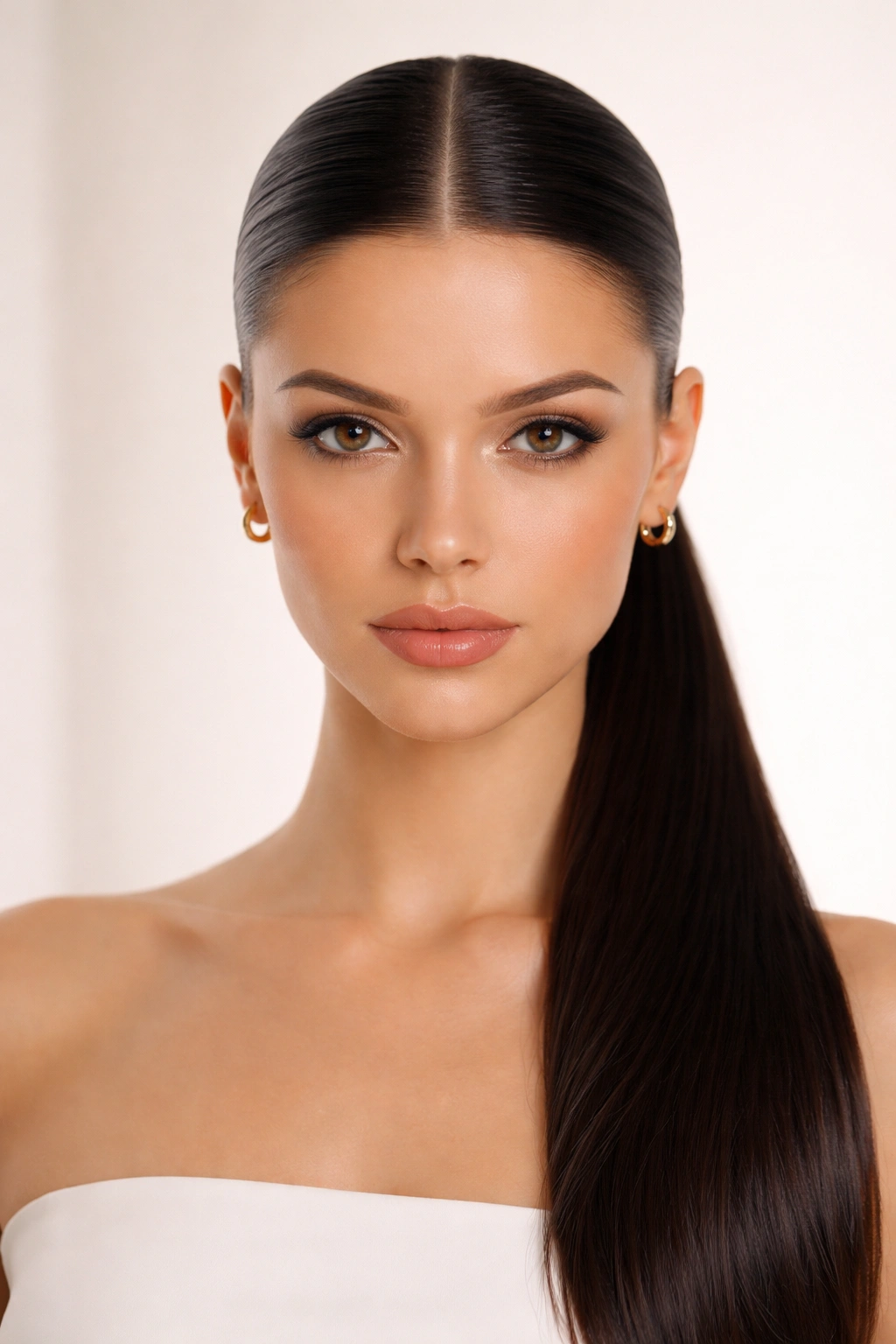
For a look of absolute modern polish, the minimalist slicked-back interpretation is unbeatable. This is the hairstyle of fashion editorials, high-fashion photography, and anyone who appreciates severe, architectural styling. The middle part is graphic and sharp, the hair is slicked back with precision, and the ponytail is positioned with mathematical exactness. There are no frills, no softness, and no apologies.
This interpretation requires absolute control and precision, which is precisely what makes it so visually striking. It’s a look that communicates confidence, intention, and a clear aesthetic vision.
Achieving Severity with Polish
Maximum smoothing: Start with a base coat of smoothing serum or gel applied to damp hair. Blow-dry completely smooth using a paddle brush, ensuring every strand is tamed and directed. Some people follow blow-drying with a flat iron to create a glass-like smoothness. The goal is hair that appears almost wet or shiny from the smoothing products and styling precision.
The graphic part line: Create a middle part that’s absolutely straight and precisely centered. Use a fine comb and take your time with this step. The part line should be visible from a distance; it should read as intentional and architectural.
Slicking back the sides: Use a slicking gel or pomade to smooth the hair at the sides and front away from the face. Apply this with your fingers or a fine comb, directing hair straight back and ensuring no pieces fall forward. The effect should be that all hair is smoothly directed backward, creating an open, unobstructed view of your face and the line of your jaw.
Positioning the ponytail: Gather the hair into a high or mid-height ponytail positioned directly at the center back of your head. Keep tension high so that the entire style reads as controlled and precise. Use a clear elastic or a thin, minimal elastic that doesn’t create visual bulk.
The perfectly slicked finish: Once gathered, smooth the ponytail itself so it’s sleek and shiny. The ponytail can be left to hang straight, curled into a smooth coil at the base, or even wrapped with a thin section of hair for a more finished appearance. Every detail should look intentional and controlled.
This look is undeniably powerful and polished. It reads as fashion-forward, confident, and completely intentional. However, it’s also quite severe, so it works best for people who genuinely enjoy this aesthetic rather than those trying to achieve a more approachable kind of polish.
10. The Tousled Undone Middle-Part Pony
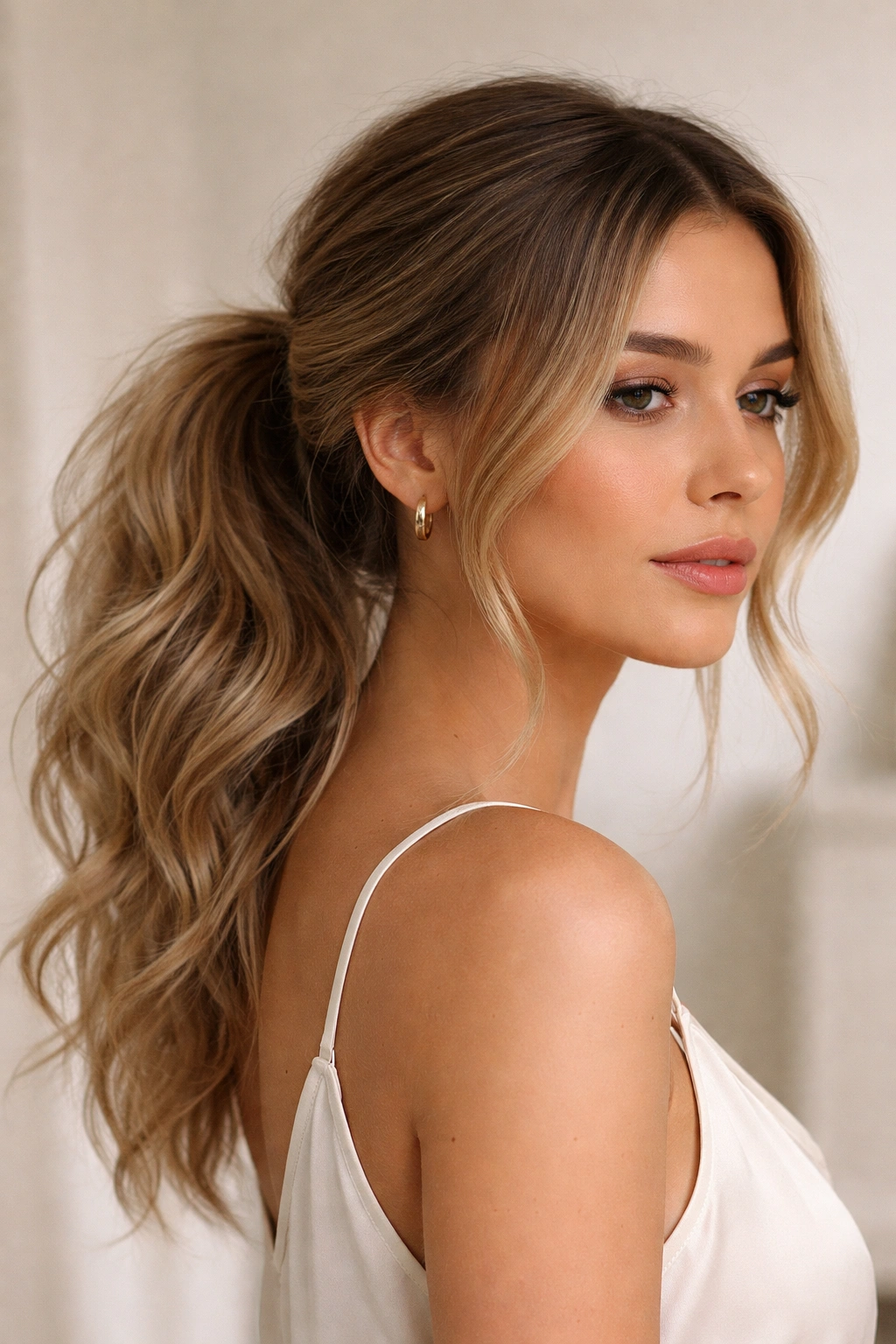
Not all polished hairstyles need to look like they took hours to create. The tousled undone middle-parted ponytail suggests polish through intentionality while maintaining an effortless, lived-in quality. This interpretation works beautifully for contemporary professionals, casual formal events, or anyone who prefers their styled looks to feel modern and relaxed rather than rigidly controlled.
The middle part remains clear and intentional, establishing the polished framework. But the ponytail itself is textured, loosely gathered, and allowed to show movement and imperfection. It’s a hairstyle that says, “I care about how I look, but I’m not precious about it.”
Creating Intentional Undone-ness
Building texture intentionally: Create waves or texture throughout your hair using a curling iron, sea salt spray, or overnight braiding. The texture should be visible and intentional, not the result of skipped hair washing. You’re going for tousled waves, not unwashed hair.
Loose gathering technique: Rather than pulling your hair into a tight ponytail, gather it with a lighter hand. Use a velvet scrunchie or silk hair tie that creates less tension on your hair, allowing strands to maintain their individual shape rather than being forced into a uniform bundle. Some hair should appear to fall slightly out of the main gather, as if it’s been naturally released.
Intentional imperfection: Pull out a few small sections around your face to frame it, as you would with the softer interpretations. But this version allows slightly more texture and movement in those frame pieces. They should look effortlessly placed, not strategically positioned.
Securing without controlling: Use a flexible elastic that allows movement. You might even use a hair stick or wooden pin rather than an elastic, gathering hair loosely and securing it with the pin. This allows pieces to shift and move slightly, creating that tousled effect throughout the day.
Finishing spray choice: Use a texture spray, sea salt spray, or light-hold hairspray rather than a strong-hold product. You want to support the texture and hold the style’s general shape, but you’re not trying to lock every strand into place. Movement and slight imperfection are part of the intended aesthetic.
This style is perfect for people who appreciate polish but dislike looking overly styled. It’s also wonderfully practical because it maintains its polished appearance as you move through your day, actually improving slightly as gravity and movement enhance the tousled effect.
11. The Geometric Graphic Ponytail with Sculptural Middle Part
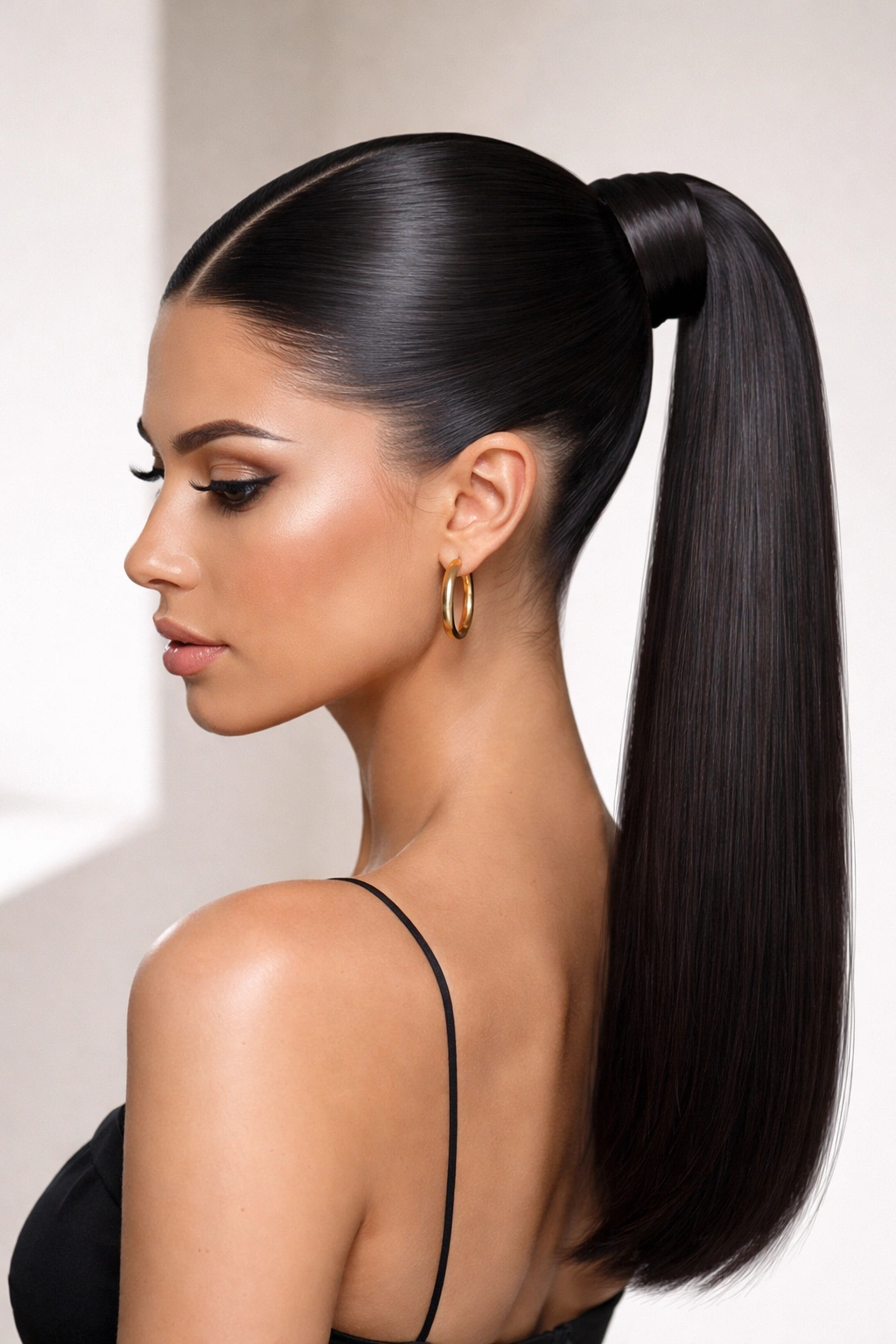
For those seeking maximum visual impact and modern polish, the geometric graphic ponytail takes the style to architectural extremes. This interpretation treats the middle part and ponytail as sculptural elements, using the shape of the gather, the placement, and sometimes even hair wrapping to create graphic, almost three-dimensional visual interest.
This might include a perfectly cylindrical ponytail created by super-tight gathering and smoothing, a ponytail that’s twisted or coiled into a geometric shape, or strategic wrapping of the ponytail base with contrasting materials. The result is a hairstyle that functions as a statement of personal style and artistic vision.
Designing Geometric Elements
The sculptural gather: Instead of a simple smooth gather, consider a tightly gathered ponytail that’s extremely smooth and almost tubular in appearance. This requires absolute smoothness and tight gathering tension. Some people achieve this by first creating a very smooth ponytail, then using a flat iron to further smooth and refine the gathered section until it’s almost sculptural.
Precise part placement: The middle part itself becomes a geometric element. It should be absolutely straight, razor-sharp at the edges, and clearly visible. Some people even enhance the visual impact by using a contrasting product (like a darker gel) to define the part line further.
Wrap or binding options: Consider wrapping the base of the ponytail with a thin section of hair, a metallic hair tie, a contrasting thread, or even a small silk scarf. This creates a visual break between the head and the ponytail, emphasizing the gathered section and adding a designed, intentional element to the overall style.
Considering ponytail finish: The actual ponytail can hang straight for a clean, graphic look, or it can be coiled, braided, or otherwise shaped into a geometric form. A low ponytail that’s coiled up and pinned into a smooth bun shape, for example, creates incredible visual interest while maintaining the polished middle part above.
Maintaining architectural precision: This style requires precision throughout the day. You may need to touch up smoothness and ensure that wrapping elements remain exactly where you placed them. It’s a hairstyle for special occasions, photo opportunities, or times when you want your hair to function as a statement piece.
This interpretation is for the genuinely confident and the seriously committed to making a visual statement. It’s undeniably polished, but it’s also undeniably bold.
12. The Middle-Part Ponytail with Glossy Shine
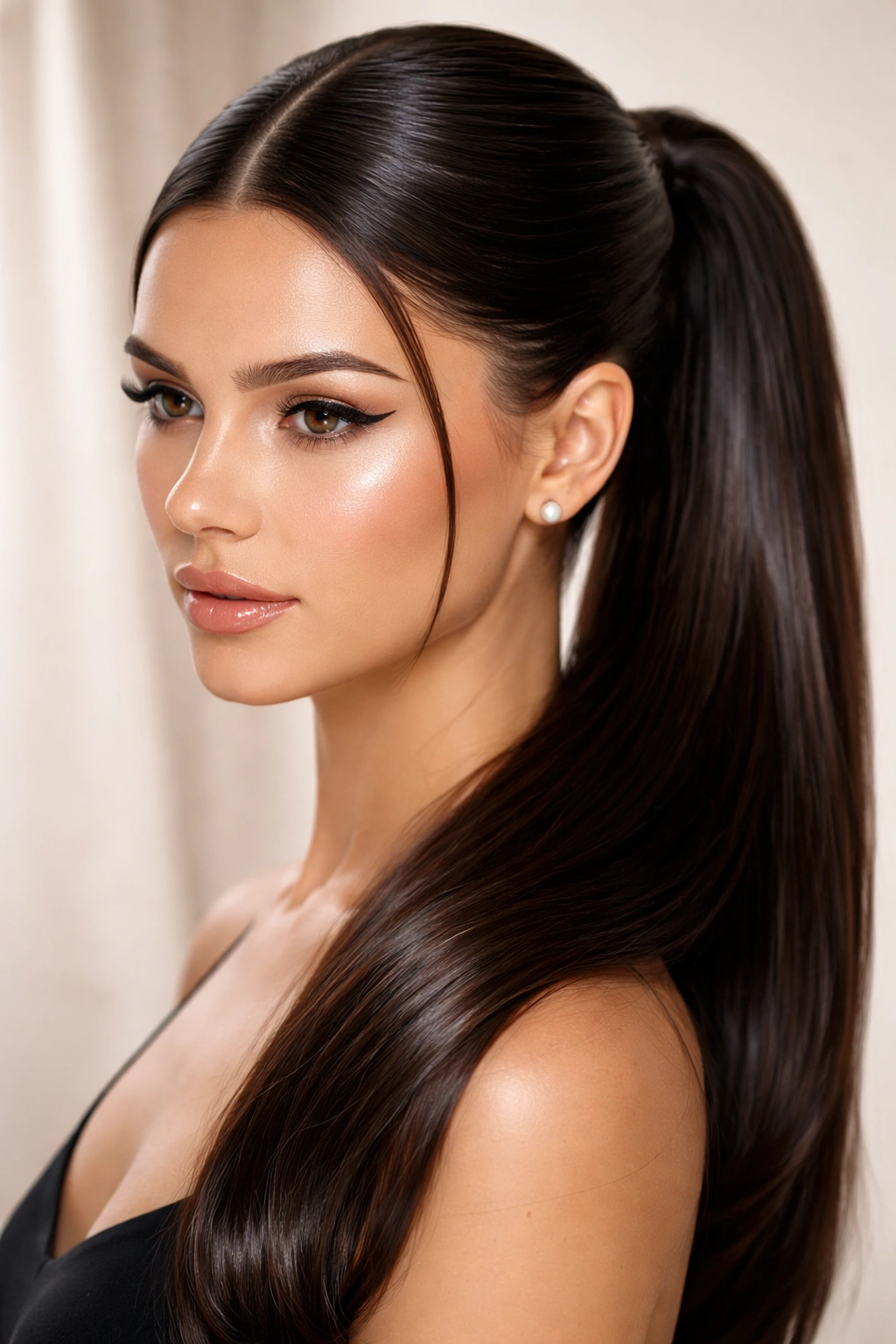
Sometimes polish is about light and reflectivity. This interpretation prioritizes glossy, shiny hair as the central element of the polished aesthetic. The style itself might be relatively simple—a sleek or loosely textured middle-parted ponytail—but the hair gleams with shine and health, which instantly reads as polished and well-cared-for.
Achieving this requires actual hair health combined with strategic styling products designed to enhance shine. The result is a hairstyle that looks luminous, expensive, and well-maintained.
Creating Luminous Shine
Hair health foundation: Shiny hair begins with genuine health. Regular conditioning, deep treatments, and minimizing heat damage all contribute to hair that naturally reflects light. If your hair is damaged or dry, no product can fully compensate, so begin with conditioning treatments that restore moisture and elasticity.
Shine-enhancing products: Use products specifically formulated to enhance glossiness. These include shine serums, glossing sprays, and liquid hair glosses that can be applied to damp or dry hair. Apply these products to the mid-lengths and ends of your hair before styling, and then use additional products on your finished ponytail to create maximum luminosity.
Strategic smoothing: Whether you’re creating a sleek or textured version, smooth the hair enough that light can reflect uniformly off the strands. Hair that’s too textured or rough tends to scatter light in all directions; smoothed hair reflects it more dramatically. Use a paddle brush when blow-drying and consider a final pass with a flat iron set to low heat to seal the cuticle and enhance shine.
Lighting considerations: The environment where you’ll be seen matters. If you’ll be indoors under artificial lighting, certain shine products perform better than others. If you’ll be outdoors in natural light, other products create more dramatic shine. Experiment to see which combination works best in your typical environments.
Finishing touch: Once your ponytail is gathered and styled, apply a lightweight shine spray or gloss to the outside of the ponytail, distributing it evenly with your fingers. The goal is even shine throughout, not concentrated glossiness in certain areas.
Hair that gleams with health and shine reads as incredibly polished, even if the styling itself is simple. It communicates that you take care of yourself and your appearance.
13. The Woven Ribbon Middle-Parted Ponytail
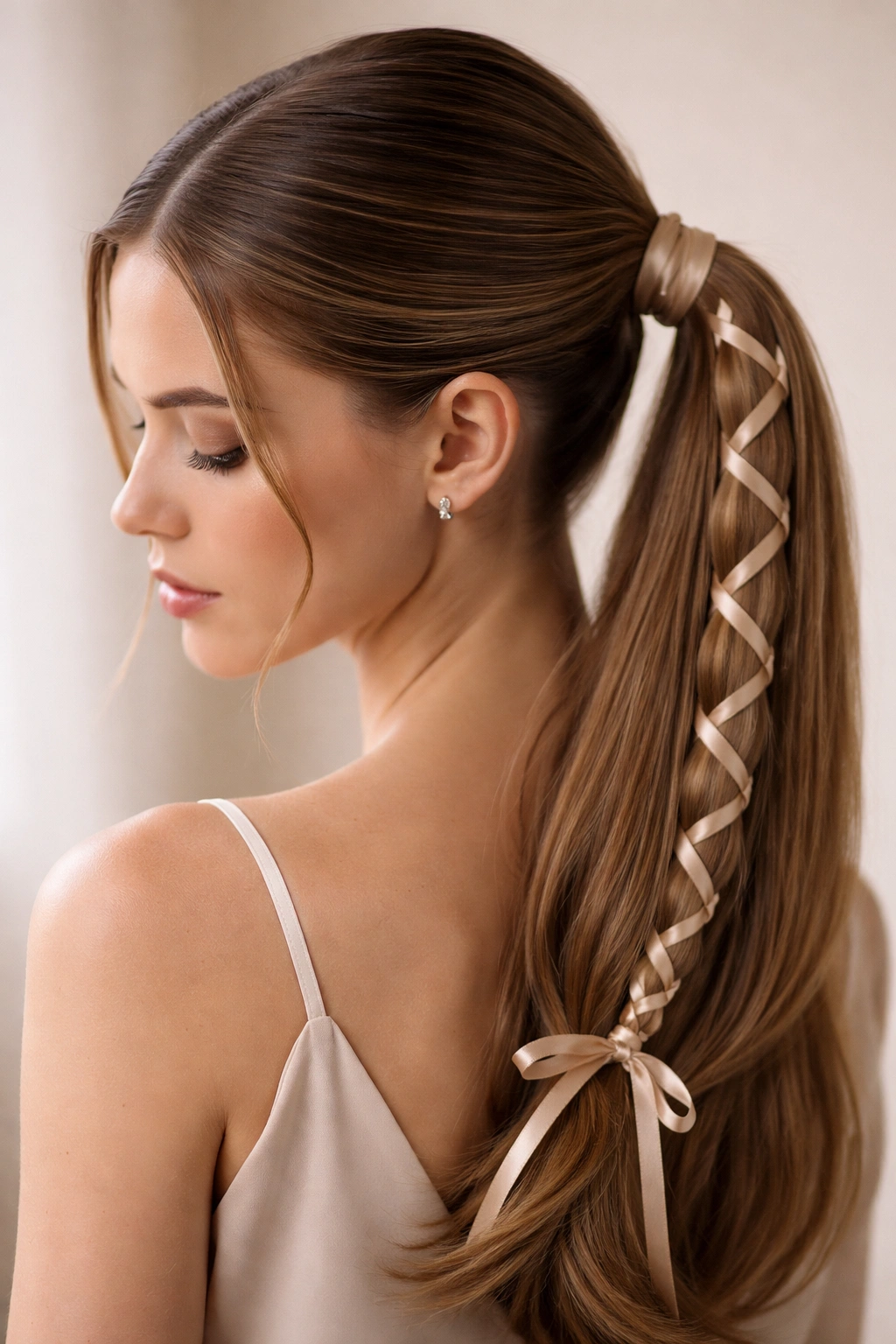
For a touch of intentional decoration without veering into costume territory, incorporating a thin ribbon woven through a middle-parted ponytail creates effortless elegance. The ribbon adds visual interest, introduces color or pattern, and creates a hairstyle that feels special and polished. This interpretation works beautifully for professional events, casual formal occasions, or any time you want polish with a subtle decorative element.
The ribbon should coordinate with your outfit or skin tone rather than contrasting wildly. The weaving should be neat and intentional, not haphazard or loose.
Incorporating Ribbon With Intention
Choosing your ribbon: Select a thin silk, satin, or grosgrain ribbon in a color that complements your outfit and skin tone. The width should be narrow enough that it integrates with the ponytail rather than overpowering it—typically a quarter-inch to half-inch wide is ideal. Metallics, pastels, and neutrals tend to photograph beautifully and coordinate easily with clothing.
Securing the ribbon at the base: Once you’ve gathered your ponytail, secure one end of the ribbon at the base of the ponytail using a bobby pin or by wrapping it underneath the elastic. The ribbon should begin at the exact gathering point so that the beginning of the weaving is clean and intentional.
Weaving technique: Take the ribbon and weave it through the ponytail in one of several ways: you can create a simple spiral by weaving the ribbon around the ponytail as it hangs, you can create a figure-eight pattern by weaving the ribbon in and out through vertical sections of the ponytail, or you can use the ribbon to wrap around a braided section within the ponytail. Choose the method that feels most balanced and intentional.
Securing the end: Once you’ve woven the ribbon through the desired length of the ponytail, secure the end using a bobby pin or by tying a small knot. Ensure the ribbon doesn’t unravel or shift.
Alternative placement: For a simpler version, skip the weaving and simply wrap the ribbon around the base of the ponytail where the elastic sits, tying a small bow or knot. This is less intricate but equally polished and requires less precision.
A ribbon-woven middle-parted ponytail feels sophisticated and intentional without requiring advanced technical skills. It’s an excellent option for anyone seeking to elevate their polished look with a decorative element.
14. The Sleek Side-Swept Waves with Centered Part
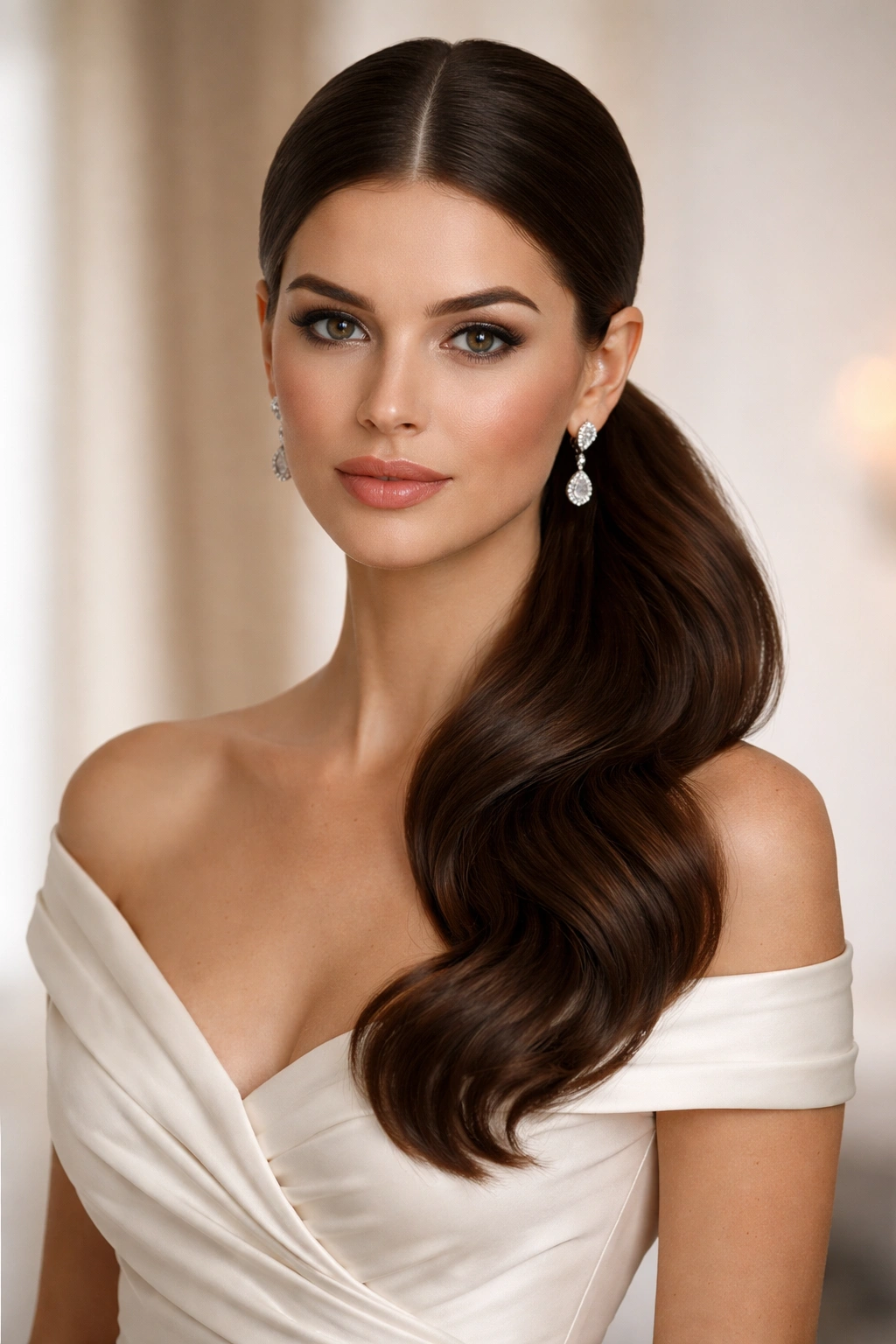
This sophisticated style maintains a centered middle part at the crown but allows the ponytail itself to feature side-swept waves that drape gracefully over one shoulder. The result is a hairstyle that balances symmetry at the top with movement and asymmetry in the lower half. It’s polished and formal while still featuring a touch of romanticism and movement.
This interpretation works especially well for formal events, weddings, or any occasion where you want a hairstyle that’s clearly been styled but still feels elegant and natural rather than architectural or severe.
Creating the Perfect Balance
Establishing the middle part: Begin with a sharp, centered middle part exactly as you would with any middle-parted style. Smooth and shape both sides equally so you’ve established visual balance and clear intention through the part line.
Gathering at center: Create your ponytail at the center back of your head, gathering hair from both sides equally. This keeps the top of the style symmetrical and balanced in line with your middle part.
Creating side-swept waves: Once you’ve gathered the ponytail, create waves throughout the length using a curling iron. Curl the hair in sections, directing the waves to fall predominantly to one side (left or right, according to your preference). The waves should be romantic and clearly defined, with consistent curl direction.
Draping the ponytail: Allow the ponytail to drape over the shoulder on the side where your waves fall. This creates an asymmetrical, sweeping line while maintaining the centered part line. The effect is elegant and romantic, with the waves catching light beautifully.
Smoothing the sides and part: To maintain maximum polish, ensure that the part line is crisp, the sides of your head are smooth, and there are no flyaways. The contrast between the smoothness at the crown and the romantic waves in the ponytail creates visual interest and polish.
Securing wave movement: Use a medium-hold hairspray that allows the waves to maintain their shape while still moving slightly. You want the waves to drape and flow gracefully, not be frozen in place.
This style is perfect for people who appreciate both symmetry and movement, polish and romance. It reads as intentional, elegant, and thoroughly considered.
15. The Polished Everyday Ponytail
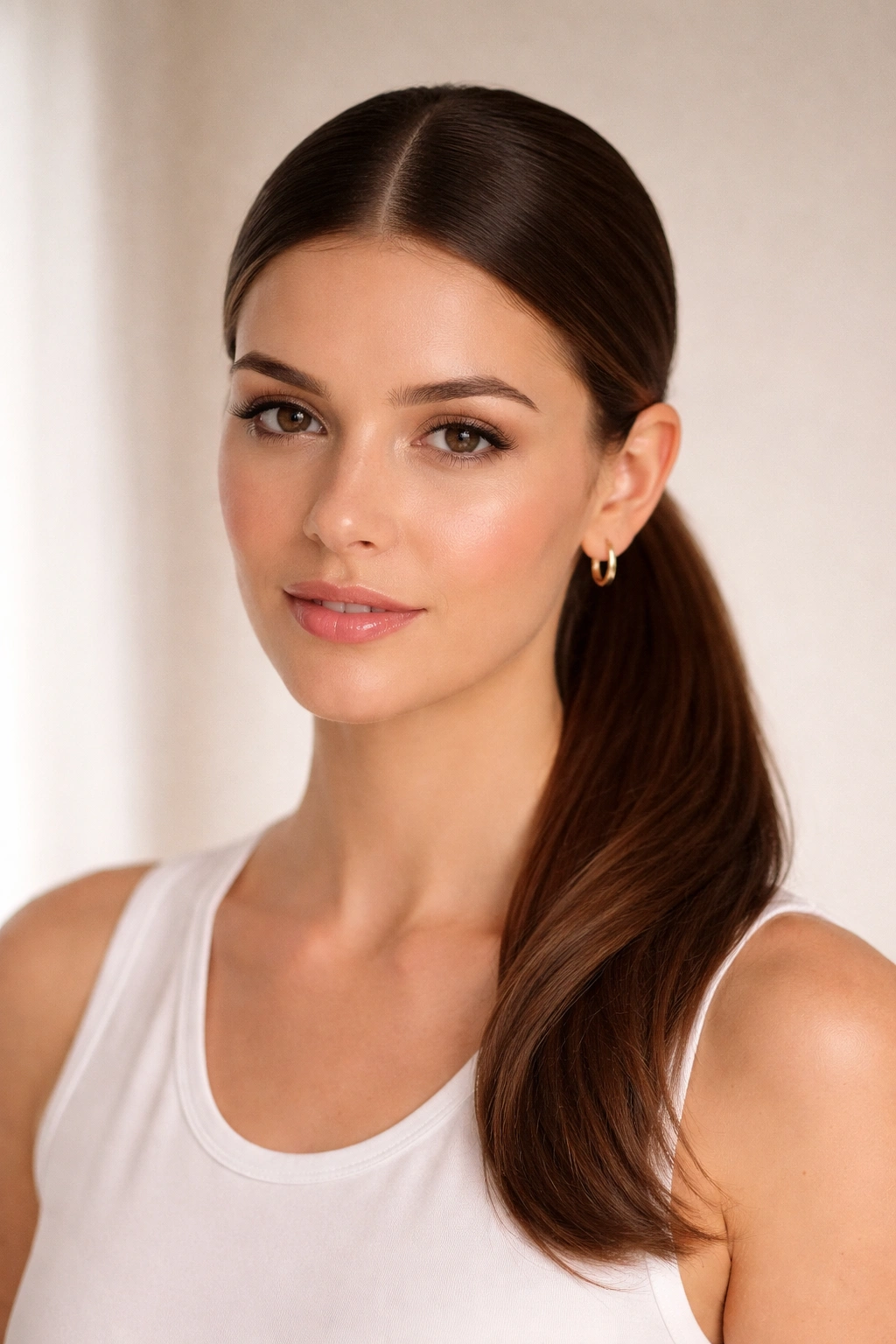
The final interpretation is perhaps the most important: the polished everyday middle-parted ponytail that you can recreate regularly without requiring extensive time or styling products. This is the hairstyle for people who want their daily look to feel intentional and put-together, even on mornings when you’re rushed or tired.
The everyday polished ponytail succeeds through simplicity and consistency. It doesn’t require extreme precision or technical skill, but it does require the basic fundamentals: a clear middle part, secure gathering, and attention to detail in smoothing and finishing. It’s sustainable polish—the kind you can actually maintain day after day.
Making Polish Part of Your Routine
Developing a system: Establish a simple routine that becomes automatic. This might be: brush hair and create middle part → blow-dry both sides smoothly → apply light smoothing serum → gather into ponytail at chosen height → smooth flyaways with light hairspray → done. The entire process should take 10-15 minutes maximum once you’ve developed the routine.
Choosing your specific style: Decide whether you prefer high or low, textured or sleek, tight or loose. Pick one version that genuinely flatters you and that you actually enjoy wearing, then make that your go-to style. Consistency itself creates polish; people learn to associate you with this particular hairstyle, and it reads as intentional.
Using quality basics: Invest in good hair elastics (quality rubber bands or velvet scrunchies that don’t damage hair), a reliable smoothing product, and a light hairspray. These don’t need to be expensive, but they should be products you genuinely like using.
Maintenance throughout the day: As your day progresses, your ponytail may loosen slightly or develop flyaways. Spend 30 seconds smoothing and tightening to maintain polish. Keep a small smoothing product or hairspray in your bag for touch-ups.
Accepting your hair’s nature: Choose a style that actually works with your hair texture rather than constantly fighting against it. If you have wavy hair, lean into soft waves rather than trying to achieve glass-like sleekness. If you have very straight hair, embrace that rather than trying to add texture where it doesn’t naturally occur. Polish comes from intentionality, not from fighting your hair’s basic nature.
The everyday polished ponytail is the style that genuinely improves your daily life. It takes minimal effort while creating maximum impact on how put-together and intentional you appear.
Final Thoughts
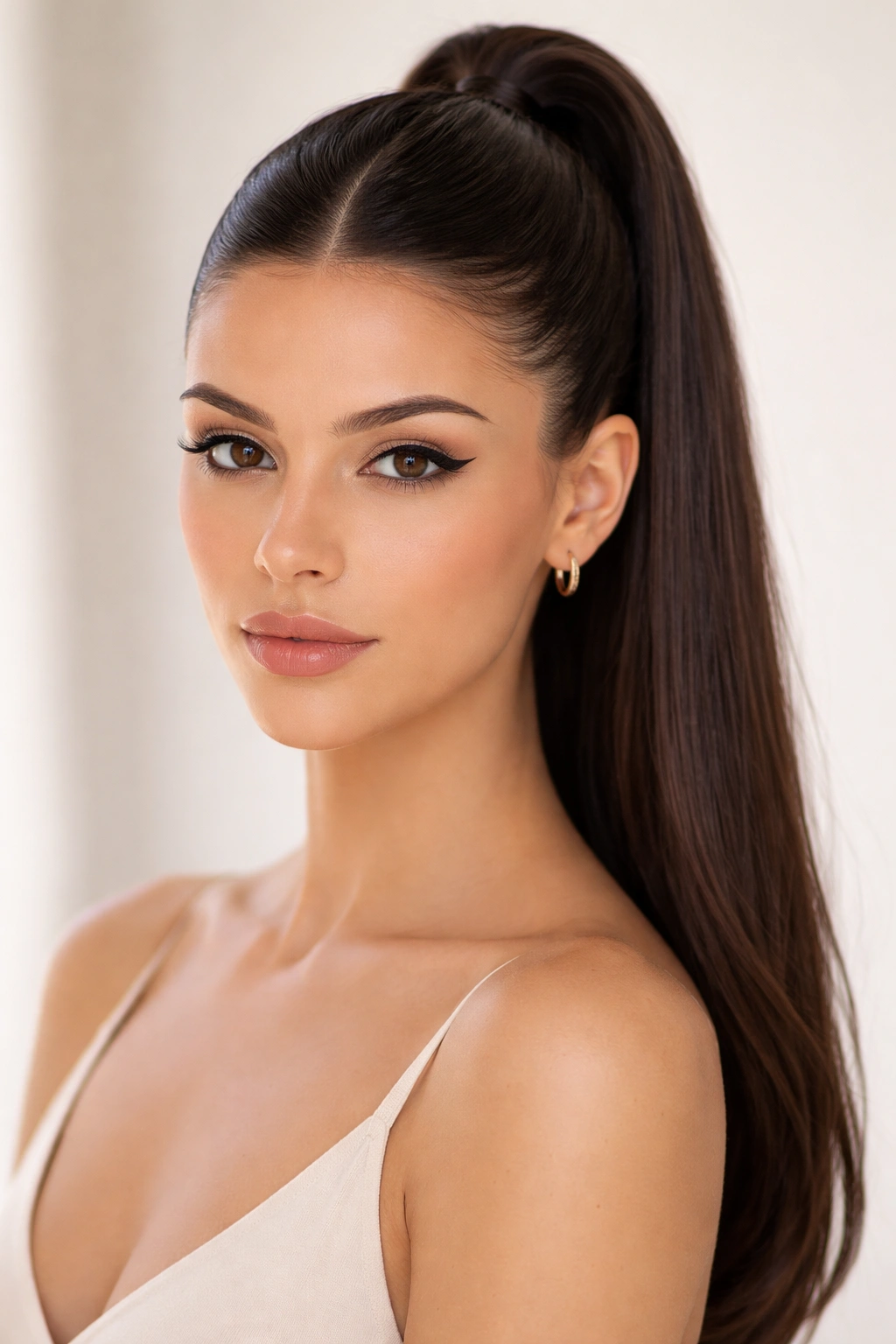
A middle-parted ponytail is a framework—a starting point that offers endless variation depending on your preferences, your hair type, and the occasion. The middle part itself provides the foundation of polish through its inherent symmetry and intentionality. Everything else—the height, the texture, the tightness, the decorative elements, the finishing details—becomes a choice you make based on the specific polished look you’re trying to achieve.
What unites all these interpretations is precision in at least one element (usually the part line and the gathering point) combined with care and attention to detail throughout. Polish isn’t about being perfect or rigid; it’s about demonstrating that you’ve thought about your appearance and chosen an intentional style. Whether you’re leaning into severity and control or tousled texture and movement, the polished middle-parted ponytail communicates that you’ve made a deliberate choice and executed it with care.
Start with one style that appeals to you most. Master the fundamentals until they feel automatic. Then, as you grow more confident with the basic technique, experiment with variations. You might find that different occasions, different outfits, and different moods call for different interpretations. The beauty of a middle-parted ponytail is its flexibility—it’s a polished hairstyle framework that can be adapted and adjusted to suit virtually any circumstance, face shape, or personal aesthetic. Once you’ve learned the basics, you’ll have a tool you can rely on for years.
