



There’s something wonderfully romantic about a half up half down hairstyle — it strikes that perfect balance between keeping hair off your face and letting it flow freely down your shoulders. Now imagine combining that versatility with the texture, bounce, and dimensional look of crochet braids. You get a hairstyle that’s not just cute, but genuinely transformative.
Crochet half up styles have become a go-to protective styling choice because they offer the best of both worlds: the intricate, eye-catching detail of the braided crown section, paired with the volume and movement of crocheted extensions flowing below. Whether you’re drawn to the softness of box braids, the refined look of thin twists, or something more sculptural and textured, there’s a crochet half up style that’ll make you feel confident and beautiful.
The appeal goes beyond aesthetics, too. These styles protect your natural hair while allowing you to experiment with color, length, and texture without commitment. They’re protective enough to wear for weeks, yet flexible enough to restyle the down-section whenever you want a change. The crown detail gives you that polished, intentional look that reads as “I put thought into this,” while the ease of the crochet braids means you’re not spending six hours in the salon chair.
Let’s explore 12 stunning crochet half up half down styles that range from subtle and professional to bold and playful — all absolutely beautiful, all absolutely wearable.
1. Crochet Box Braids With Layered Crocheted Hair
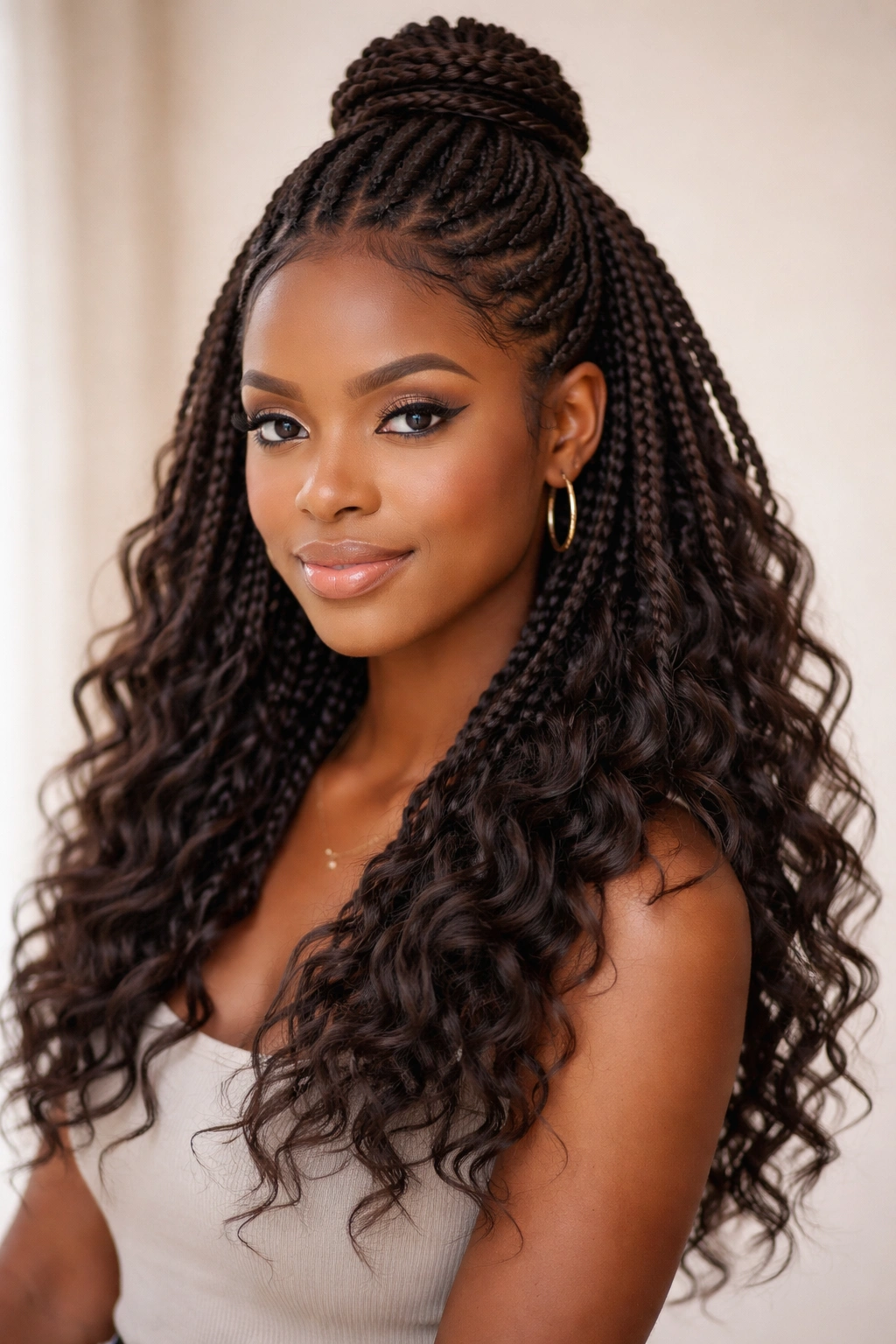
Box braids are the classic foundation for half up styling, and there’s a reason they’ve stayed beloved for years. The clean, geometric lines of individual box braids create a polished crown that feels intentional and well-maintained. When you crochet box braids into the top half and let crocheted extensions flow below, you get a style that’s versatile enough for work, playful enough for weekends, and striking enough to photograph beautifully.
The key to this look is variation in texture below the crown. While your braids stay precise and structured on top, the crochet hair creates a softer, wavy effect underneath. This contrast is what makes the style work visually — it’s not monotonous, and it frames your face with dimension.
Why This Style Works So Well
Box braids in the crown section sit cleanly and don’t slip around, which means your half up ponytail or bun stays exactly where you put it. The defined edges of each braid also make it easier to see the crown detail from the side and back, which is where the real visual impact lives. You’re not fighting frizz or fly-aways because every hair is contained within the braid structure.
Key Details to Consider
- Braid size: Medium-sized box braids (about the thickness of a pencil) photograph better and feel less heavy than very thick or very thin braids
- Crochet hair texture: Pair straight or wavy crochet hair below to contrast with the braids above, or go for curly crochet if you want a more cohesive texture throughout
- Crown placement: Gather the braids into a half up ponytail or bun about 2-3 inches back from your hairline to keep the look balanced
- Styling longevity: Refresh the crown ponytail every 3-4 days to prevent tugging and pulling at your real hair underneath
- Maintenance tip: Use a soft brush to smooth any loose texture on the crochet hair below, but avoid brushing the braids themselves aggressively
Pro tip: If you want maximum volume in your half up section, ask your stylist to add a few braids from your underside that you can hide in the crown. This creates a fuller, more dramatic ponytail without adding bulk to the overall style.
2. Twisted Crown With Wavy Crochet Hair Below
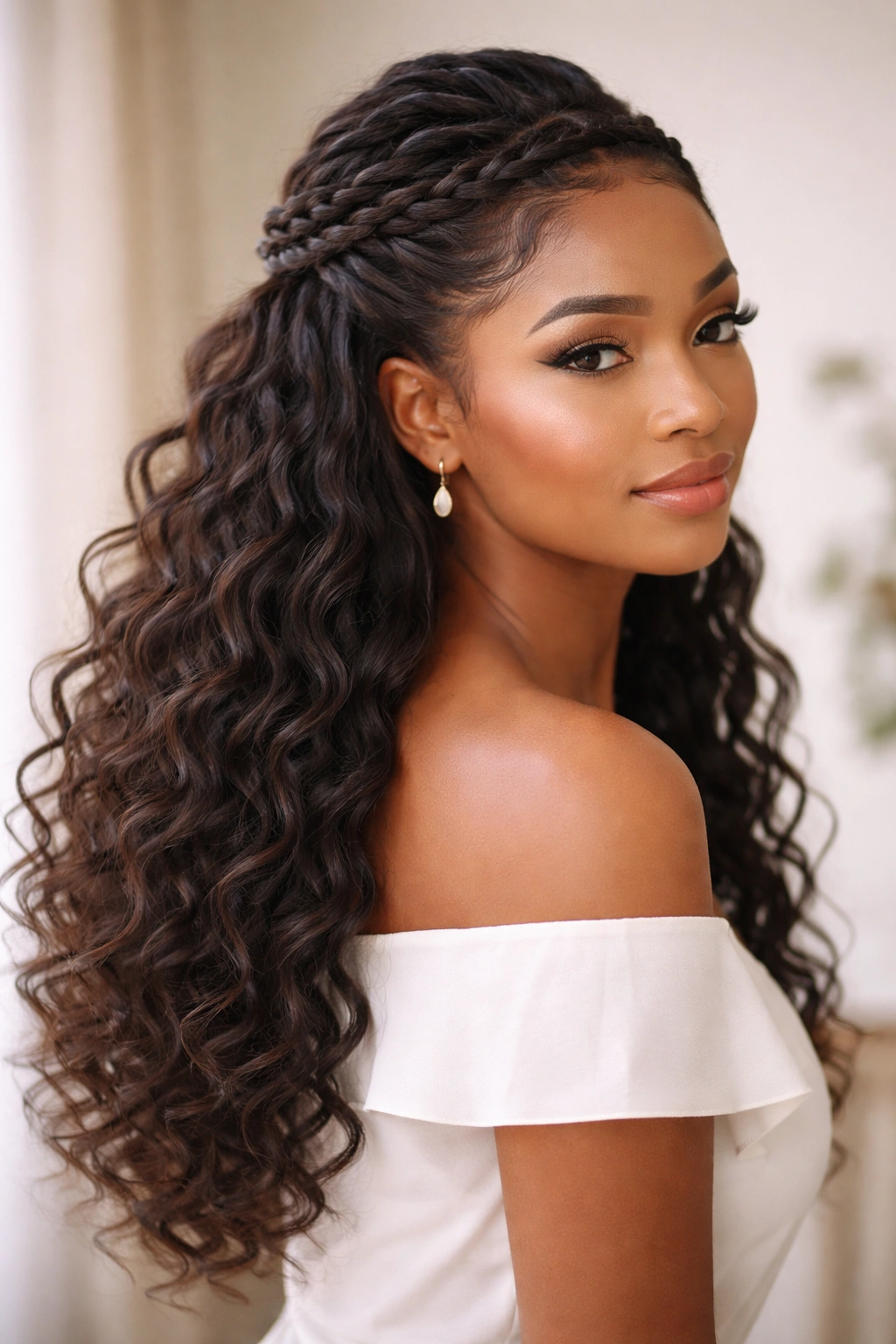
Twists offer a more refined, almost elegant alternative to box braids. They’re thinner, softer-looking, and they carry an understated sophistication that reads equally well in professional and creative settings. A twisted crown paired with long, wavy crochet hair creates a romantic, flowing silhouette that photographs like a dream.
The beauty of twists is that they look intentionally styled even when you’re just going about your day. There’s no “slicked back” severity — instead, you get something that feels naturally beautiful and effortlessly put-together.
What Makes Twisted Styles Different
Twists use only two strands of hair twisted together, compared to box braids which are braided sections. This means they’re technically faster to install and they sit lighter on your head, which is a genuine comfort advantage during longer wear periods. They’re also naturally more flexible — you can loosen them slightly for a softer look, or keep them tight for precision.
Styling and Maintenance Details
- Twist thickness: Thin to medium twists (the width of a pencil or thinner) look more polished than very thick twists for a half up style
- Crochet texture pairing: Wavy or curly crochet hair creates beautiful contrast with the smooth, linear quality of twists
- Crown gathering: Twist the hair back and secure into a ponytail with a thin elastic at about ear-level for an elegant effect
- Refreshing between washes: Twists can unravel slightly if pulled at by the ponytail elastic, so consider using a scarf or bonnet to protect them at night
- Scalp care: Twists put slightly less tension on the scalp than braids, but still part your natural hair underneath with a lightweight oil to keep it hydrated
Worth knowing: If your natural hair texture tends to shrink, you might lose an inch or two of length over several weeks in twists. Account for this when planning how long you want to keep the style.
3. Ghana Knots Half Up With Voluminous Curly Crocheted Hair
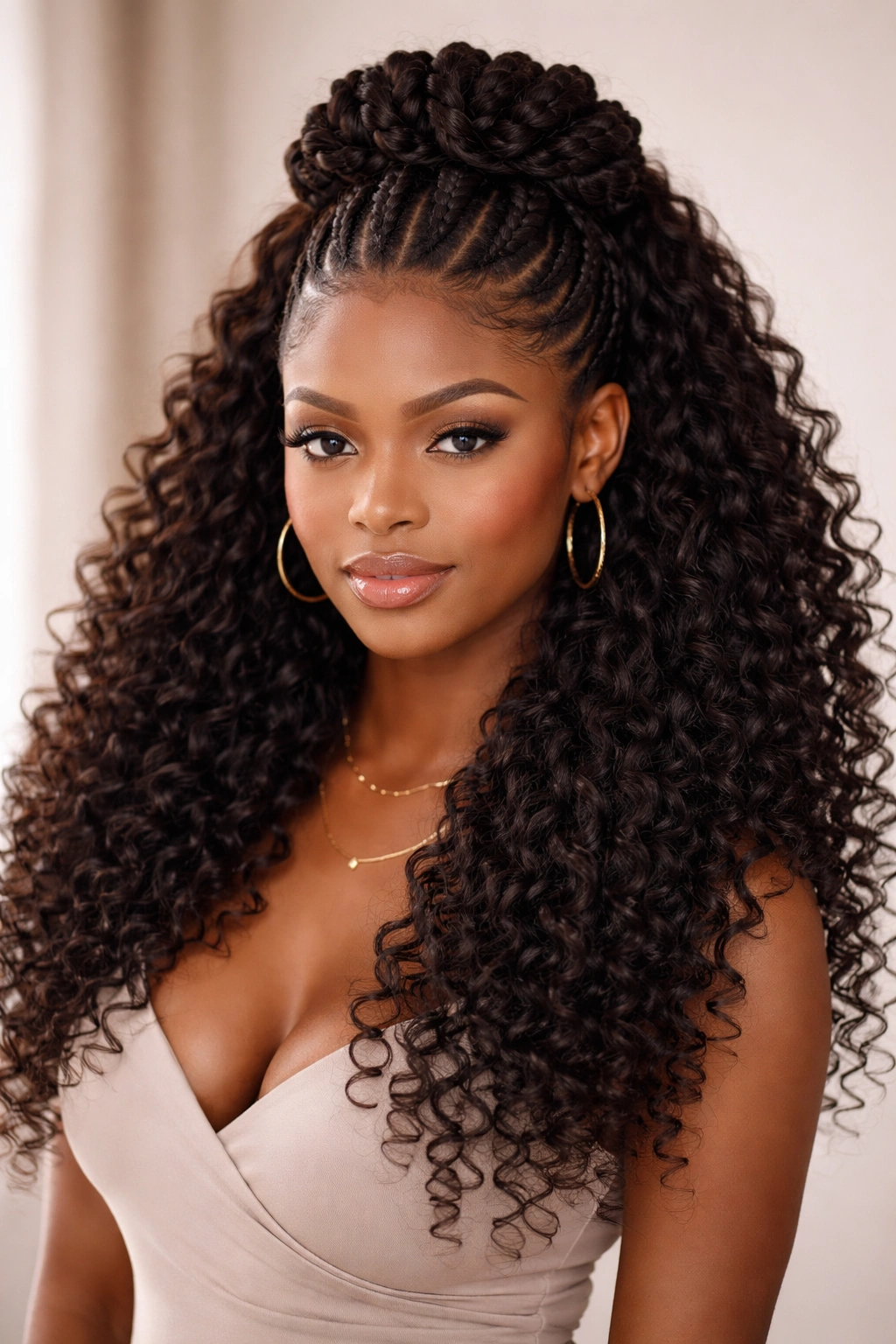
Ghana knots are a textured, sculptural alternative to braids and twists. They’re created by wrapping sections of hair around themselves to form knots, and they have a wonderfully chunky, three-dimensional appearance. When you do Ghana knots in the crown and pair them with voluminous curly crochet hair, you get a style that’s absolutely show-stopping.
This style has real presence. It commands attention because the knots are visually distinct and the detail reads clearly from across a room. The texture of the knots combined with the fullness of curly crochet hair below creates a style that feels bold and confident without being outrageous.
Why Ghana Knots Stand Out
Each knot is a compact, sculptural element that creates visual interest and dimension. They don’t unravel the way twists sometimes can, and they sit close to the head, which means they’re comfortable for wearing for extended periods. The knots also photograph beautifully because they catch light in different ways depending on how you position your head.
Installation and Styling Tips
- Knot size: Medium-sized Ghana knots (about the width of a grape or larger) create the best visual impact for a half up style
- Knot placement: Space them evenly across the crown section, and ensure they’re tight enough not to slip but not so tight they create tension headaches
- Crochet hair choice: Curly or kinky-textured crochet hair shows off the dimensional quality of the knots beautifully
- Half up securing: Gather the knots into a ponytail about 2 inches back from your hairline for maximum visual effect
- Weight distribution: Ghana knots can be slightly heavier than braids or twists, so take breaks from pulling them up tightly
- Maintenance attention: Check knots weekly for any loosening at the base and re-tighten if needed
Insider note: If you’re installing Ghana knots yourself or working with a stylist for the first time, start with a trial style on a smaller section. It’s worth the extra effort to make sure the knot tension is perfect for your comfort level.
4. Waterfall Braids Transitioning Into Braided Ponytail
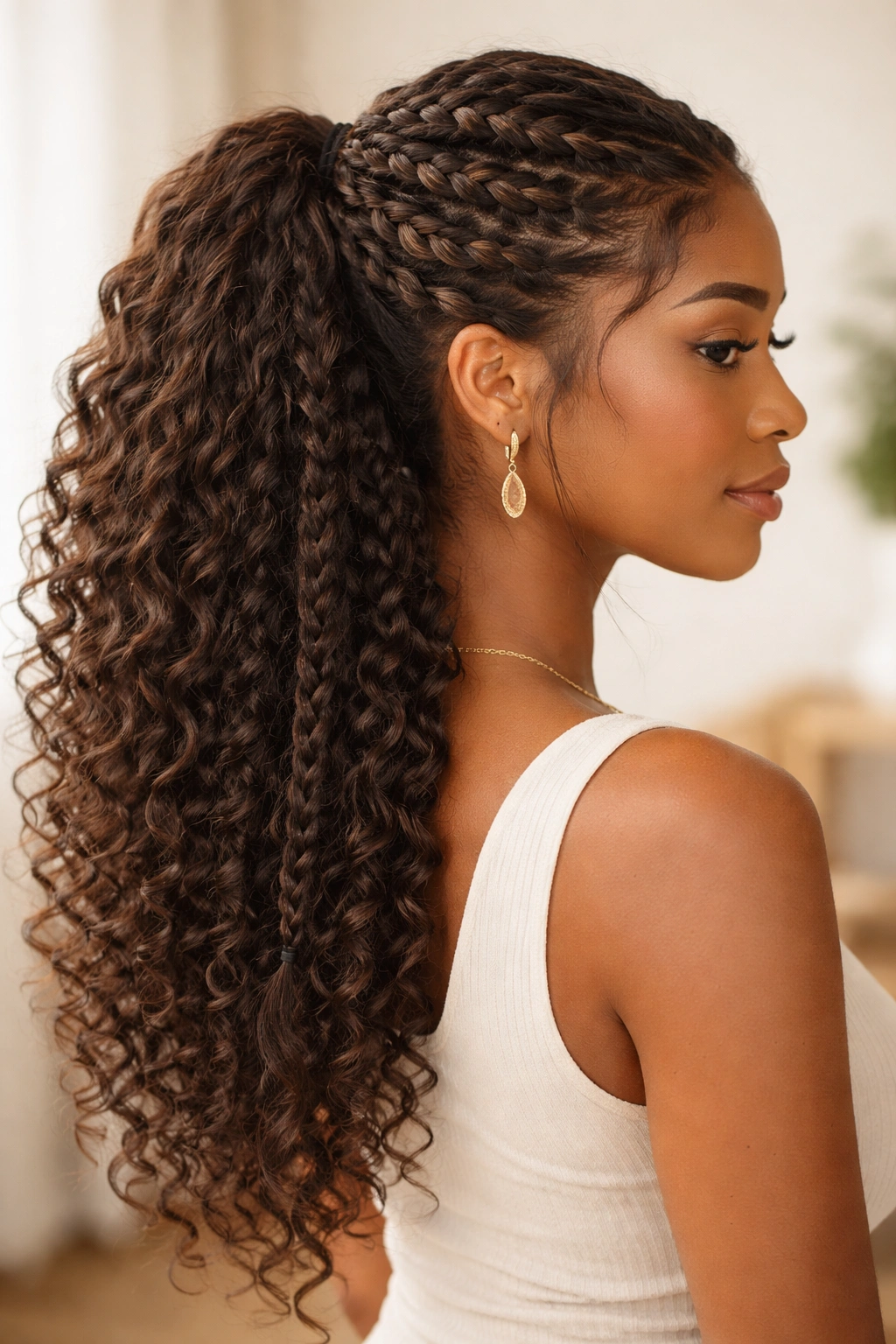
A waterfall braid is one of the most elegantly romantic braid styles available. The technique involves braiding down the side of your head while dropping sections of hair to create a cascading, flowing effect. When you turn this into a half up style — braiding from one side across to the back and gathering into a ponytail — you get something that looks far more complicated than it actually is.
Pair this with wavy or straight crochet hair and you have a style that reads as high-effort, high-reward. It’s the kind of look that makes people ask “did you get that done professionally?” even if you created it yourself in thirty minutes.
What Makes Waterfall Braids Special
The dropped sections of the waterfall braid create negative space that shows off hair texture beautifully. They’re also inherently more flattering to the face because the braided sections frame your features while the dropped sections add softness. This braid technique looks good on virtually every face shape and hair texture.
Creating and Securing the Waterfall Half Up
- Starting point: Begin the waterfall braid at the temple on one side, aiming to end at the nape of your neck or the opposite side
- Dropping technique: As you braid, release one section of hair after each braid intersection, letting it flow down while picking up new hair from below
- Securing the braid: Once you reach your gathering point, braid all remaining sections into a standard braid and secure into your half up ponytail
- Crochet hair integration: Crochet hair can be braided into the final ponytail for added volume and length
- Texture finishing: The waterfall sections should remain loose and flowing — avoid over-tightening or smoothing them
- Longevity: Waterfall braid half ups last well for 4-5 days before you might want to refresh the braid tension
Pro tip: If you’re nervous about getting the waterfall braid symmetrical, practice the technique on a friend first or watch tutorials in slow motion. Once you understand the dropping pattern, it becomes intuitive and repeatable.
5. Cornrow Crown With Ombré Crochet Hair
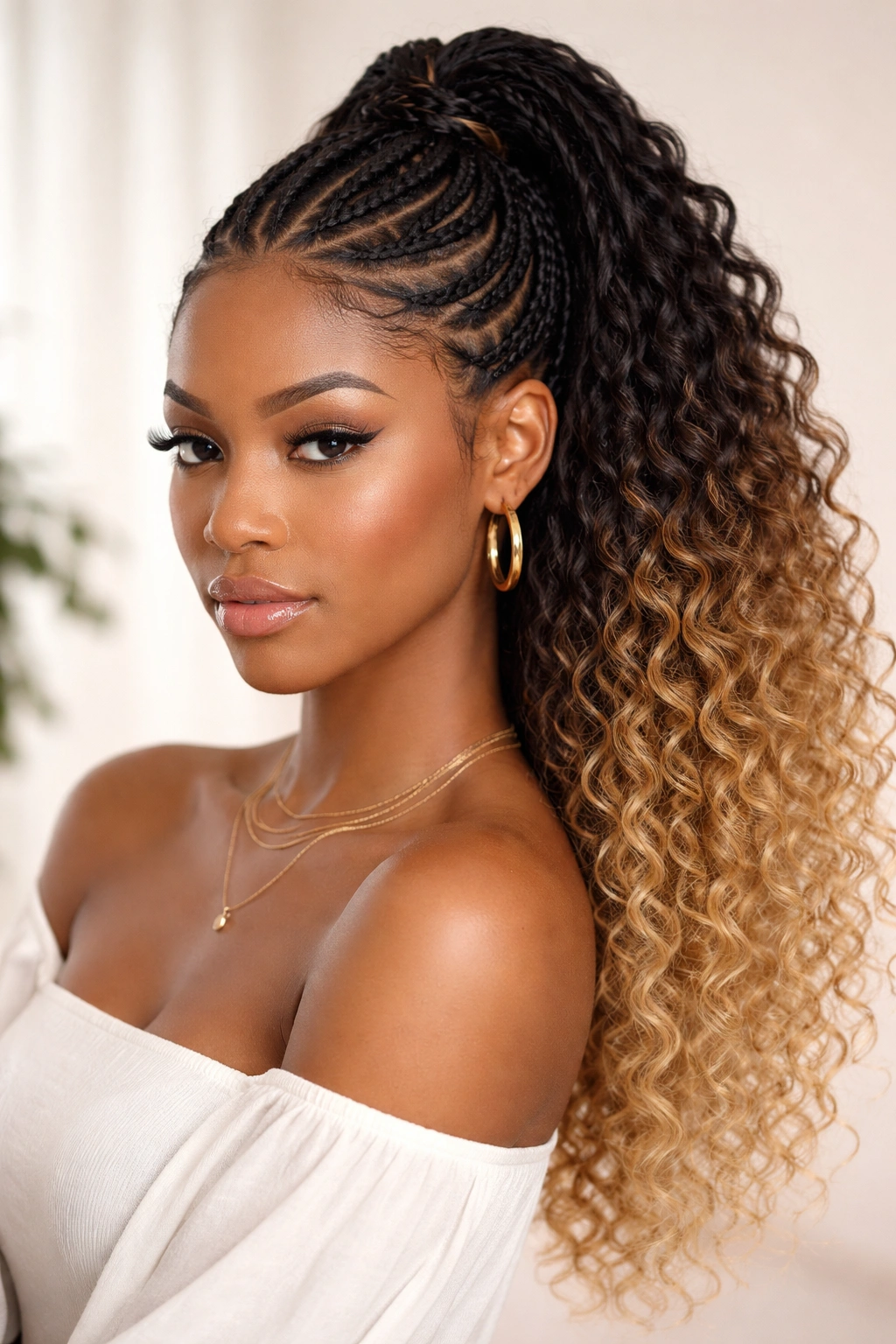
Cornrows down the center or sides of the crown create a sleek, geometric-looking foundation for a half up style. When you feed ombré crochet hair into the cornrow ponytail — starting with one color at the roots and transitioning to another color down the length — you create visual interest that goes beyond a simple hairstyle into something truly artistic.
The color gradient adds depth and sophistication. It’s a styling choice that feels intentional and creative without requiring you to color your actual hair. You can change the color palette seasonally or whenever you want a refresh, simply by choosing different crochet hair colors next time.
The Power of Color in Crochet Styles
Ombré crochet hair comes in virtually every color combination imaginable — from subtle transitions like caramel to honey, to bold shifts like burgundy to black. The color gradient naturally draws the eye downward and makes long crochet hair feel even longer. It also gives you a focal point, which means the style photographs beautifully and reads clearly from any distance.
Cornrow and Color Pairing Details
- Cornrow direction: Center cornrows create a balanced look, while side cornrows have more edge and personality
- Number of cornrows: 2-4 cornrows in your crown section create enough visual texture without overwhelming your face
- Color choice: High-contrast ombré shows the gradient most clearly, while analogous color transitions feel more harmonious
- Crochet hair length: Ombré works best with longer crochet hair (20+ inches) where the color gradient has space to fully develop
- Protective care: Ombré crochet hair sometimes has a slightly different texture than single-color hair, so condition it well
- Styling options: You can wear the half up gathered tightly into a bun, loosely in a ponytail, or even slightly pulled out for a softer effect
Worth knowing: If you choose heavily dyed or fashion-color crochet hair (like bright pink or blue), be prepared for minimal color transfer to your clothing. Keep a scarf handy for sleeping and try washing your hands after styling.
6. Senegalese Twists Crown With Straight Crochet Extensions
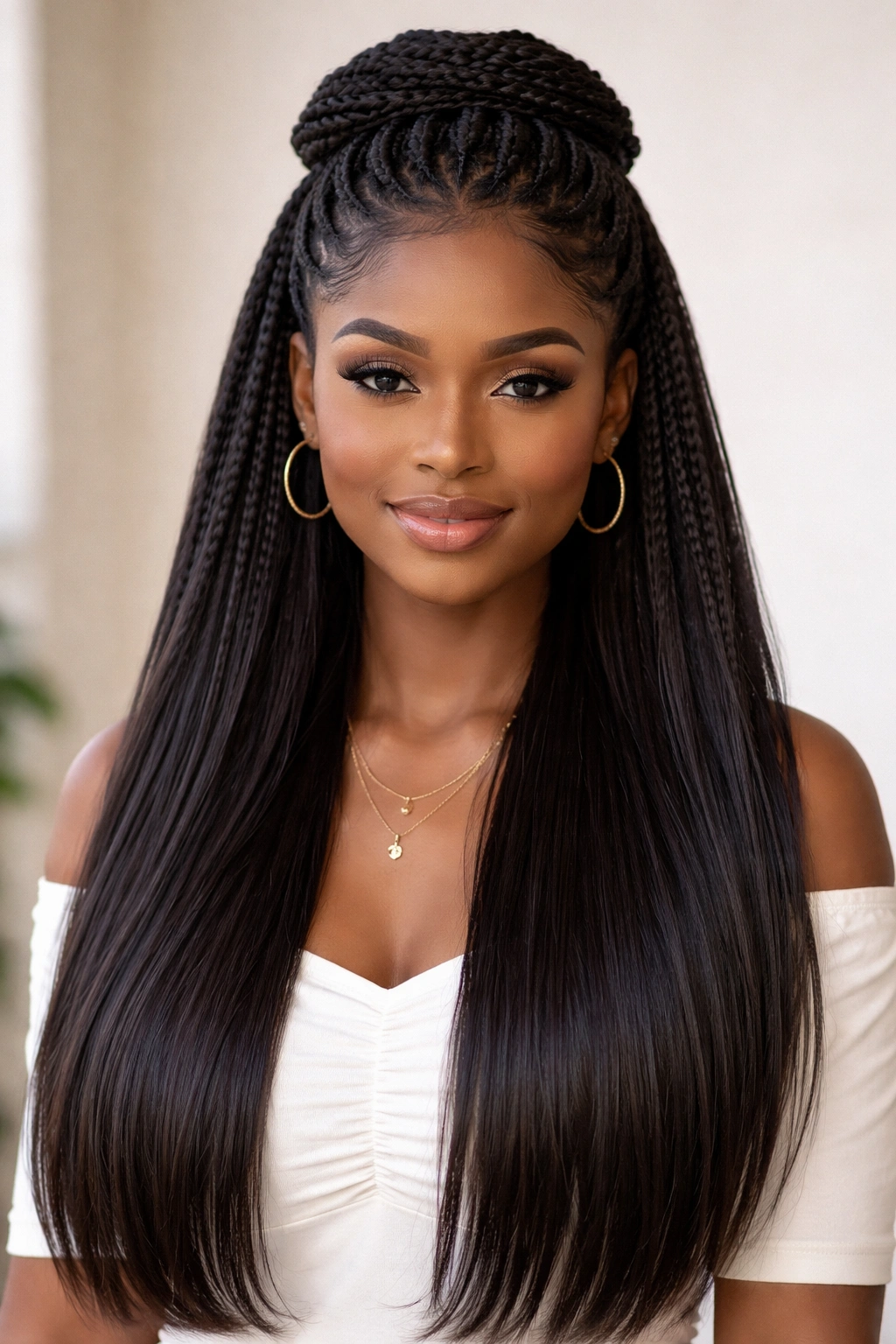
Senegalese twists are distinctive because they use three strands instead of two, creating a rounder, fuller twist that stands out visually. The depth and dimension of Senegalese twists in the crown, paired with sleek straight crochet hair falling below, creates a study in contrast — textured detail on top, smooth flow on the bottom.
This style is wonderfully wearable for professional settings while still feeling current and intentional. The crown detail shows skill and care, while the straight crochet below keeps the overall look polished and not overly decorative.
What Senegalese Twists Bring to a Half Up Style
The three-strand structure of Senegalese twists makes them sturdier than two-strand twists, which means they stay tight longer and maintain their shape beautifully. They also have a visual roundness that’s flattering and interesting to look at. The twist sits slightly fuller than a regular twist, which means your crown section has real volume and presence.
Installation and Care Considerations
- Twist size: Medium Senegalese twists (slightly thicker than a pencil) create the best visual proportion for a half up crown
- Straight crochet pairing: Silky straight or yaki-textured crochet hair emphasizes the contrast with the twisted crown
- Crown gathering height: Secure your Senegalese twists into a ponytail about 2-3 inches back from your hairline
- Tension management: Senegalese twists put moderate tension on the scalp, so monitor comfort levels and avoid pulling the half up section too tightly
- Maintenance routine: Check twist tightness weekly and refresh with light moisture on dry days
- Longevity: Senegalese twists typically last 4-6 weeks depending on how much movement is in the ponytail section
Pro tip: If you want maximum volume in your Senegalese twist ponytail, ask your stylist to create a few braids from underneath that feed into the ponytail but stay hidden. This creates a fuller look without extra bulk.
7. Fulani Braids With Beads and Crochet Curls
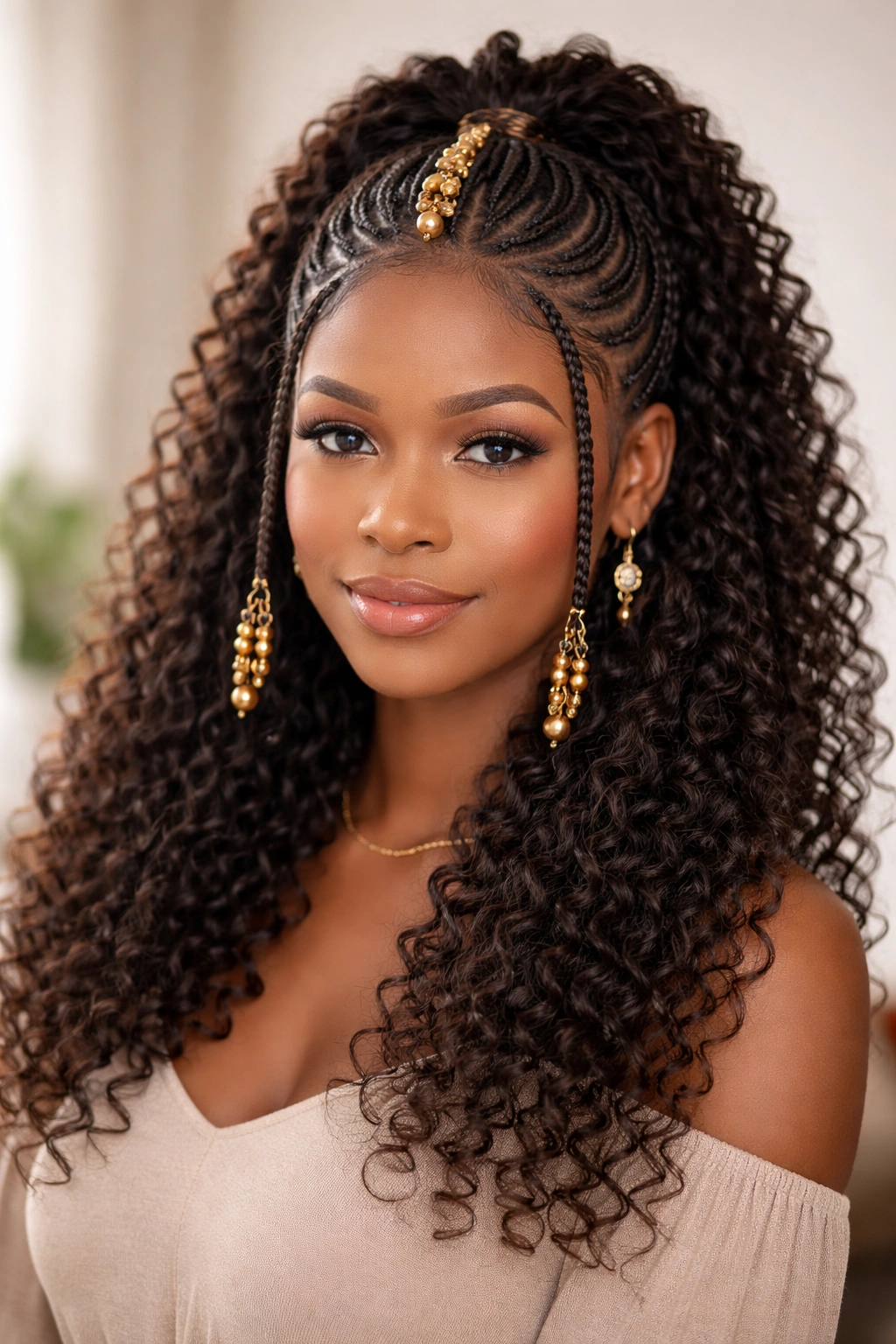
Fulani braids are instantly recognizable by their distinctive style — typically a central braid down the middle with smaller braids framing the face, often decorated with beads, rings, or shells. This iconic style translates beautifully into a half up look, especially when you incorporate beads into the braided crown section and pair it with bouncy, textured crochet curls flowing below.
The beads add functionality and personality. They keep the braids from unraveling at the ends, yes, but they’re also a styling element that reads as intentional and artistic. The style feels celebratory and joyful, yet still protective and practical for maintaining your natural hair.
The Cultural and Aesthetic Appeal of Fulani Styles
Fulani braids carry rich cultural history and visual impact. The style is inherently decorative and thoughtfully styled, which means your half up look automatically reads as high-effort and intentional. The bead placement is both functional and beautiful — beads weight the end of each braid, preventing unraveling while adding visual interest and a soft clicking sound when the braids move.
Braiding and Beading Details
- Center braid: Install a thick, prominent center braid that will become your main crown piece
- Side braids: 2-4 smaller braids framing each side of your face, also fed into the half up ponytail
- Bead selection: Gold-toned, silver, or natural wood beads pair beautifully with almost any crochet hair color
- Bead placement: Space beads evenly along the braids, typically 2-4 beads per braid depending on length
- Crochet hair choice: Curly or coily crochet creates beautiful movement and pairs visually with the structured braids
- Ponytail positioning: Gather all braids into a ponytail at the crown or slightly back, ensuring the side braids are visible
- Bead maintenance: Check that beads are secure weekly and won’t slide off; retighten any loose ones
Insider note: Fulani braid hairstyles are steeped in cultural significance. Research the style’s origins and wear it with the respect and appreciation it deserves. This isn’t just a trend — it’s a beautiful protective style with deep roots in Black and African culture.
8. Dutch Braids Going Into Dutch-Braided Bun Half Up
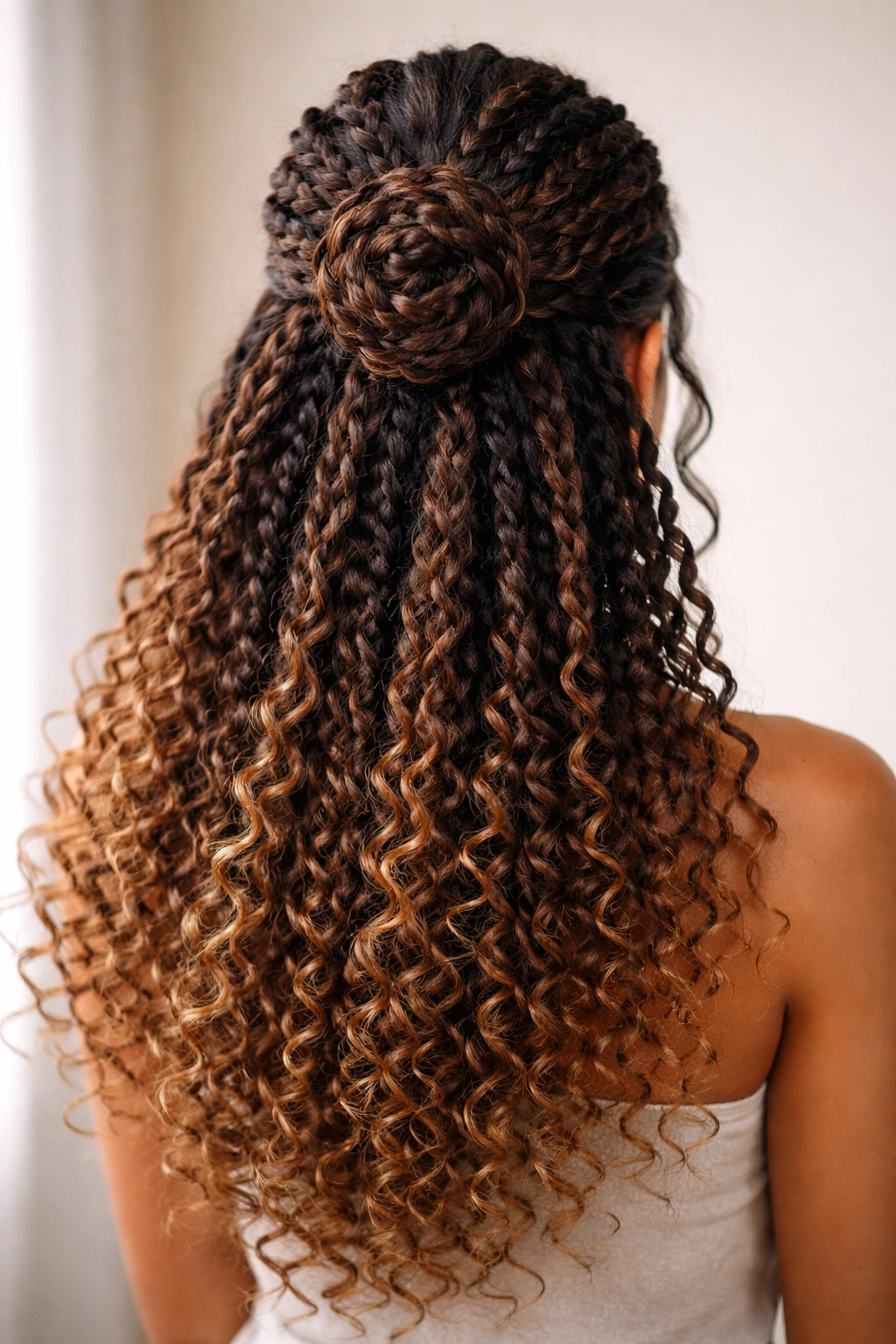
Dutch braids are inverted French braids — instead of the traditional braid sections going under, in a Dutch braid the sections go over, creating a raised, sculptural appearance. When you create two Dutch braids down the crown and gather them into a Dutch-braided bun at the back of your head, then let crochet hair flow below, you get a style that’s visually impressive from every angle.
This style has serious depth and dimension. The raised nature of Dutch braids photographs beautifully, and the technique creates natural texture even on smooth, straight hair. It’s a style that feels both polished and creative — suitable for special occasions but also wearable for everyday life.
Why Dutch Braids Create Visual Impact
The raised braid structure catches light differently than regular braids, which makes the style look more dimensional and interesting. Dutch braids also read as more complex and intentional than standard braids, even though they’re often easier to install once you get the hang of the technique. The sculptural quality means your crown detail is visible and striking.
Dutch Braid Crown Installation
- Starting point: Begin two Dutch braids at your hairline, aiming to move toward the back of your head
- Braid path: You can angle the braids toward your center back, or run them parallel down the center line
- Gathering point: Combine both Dutch braids into a single bun at the nape of your neck or slightly higher
- Bun style: Create a Dutch-braided bun (continue braiding the combined sections) for extra texture, or a simple wrapped bun for a cleaner look
- Crochet hair integration: Crochet hair can be woven into the bun and left flowing below for added volume
- Securing: Use bobby pins in the bun and elastic in your desired ponytail or bun style
- Texture finishing: Dutch braids stay neat longer than regular braids, but smooth them gently if any sections loosen
Pro tip: Dutch braids are easier to master than they seem. The key is remembering that sections go over rather than under — watch a few slow-motion tutorials and try practicing on a friend or in the mirror before attempting your own style.
9. Micro Braids Half Up With Sleek Ponytail Effect
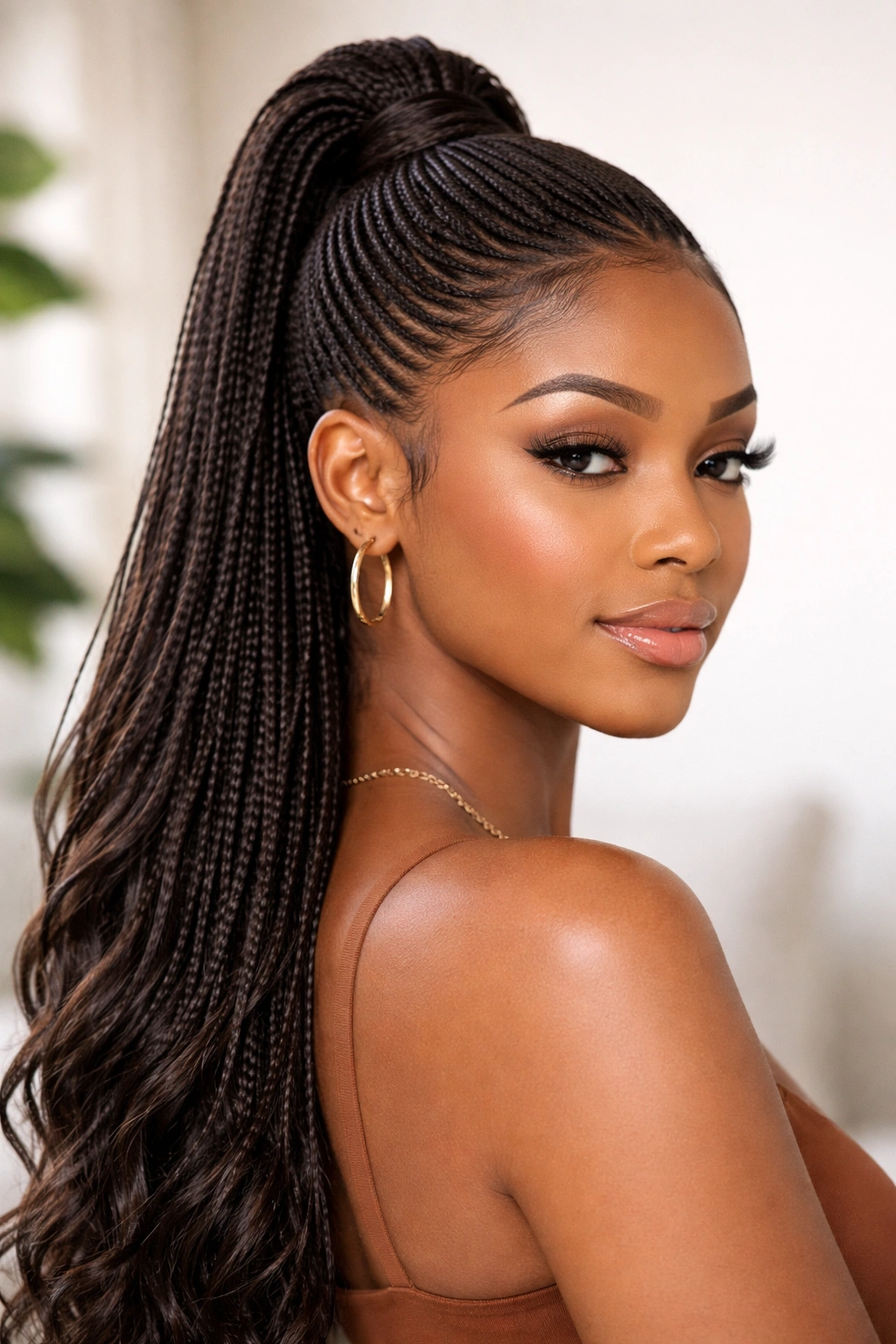
Micro braids are tiny, delicate braids that create an incredibly detailed and refined crown section. When you gather hundreds of micro braids into a sleek, tight half up ponytail, you create a style that looks intricate but not overly busy. It’s the kind of look that makes your hairstyle the focal point of your appearance.
Micro braids require patience to install — they’re time-intensive — but the payoff is a style that lasts beautifully for 6-8 weeks with minimal maintenance. The sleek ponytail effect means you’re not fighting frizz or loose baby hairs. Everything is contained and smooth and precise.
The Appeal of Micro-Braid Precision
Micro braids are as close to sculptural perfection as you can get in a protective style. Every single braid is identical in size and tightness, which creates a visual uniformity that reads as high-skill installation. The tiny braids also allow you to wear your hair in styles without showing large sections of scalp, which many people prefer aesthetically.
Micro Braid Half Up Styling
- Installation time: Plan for 6-8 hours of installation time; this is a commitment, but it’s worth it for the longevity
- Braid tightness: Micro braids should be tight enough to last but not so tight that they create tension headaches
- Ponytail height: Gather into a ponytail about 2 inches back from your hairline for a classic half up look
- Ponytail shape: You can smooth the ponytail very sleekly with edges, or leave it slightly relaxed for a softer effect
- Styling flexibility: Micro braids are light enough to wear in multiple styles — you can rotate between half up ponytails, top knots, and loose-flowing styles
- Maintenance simplicity: Because each braid is so small, they rarely tangle or require refreshing
- Duration: Expect 6-8 weeks of wear, longer than most other braid styles
Worth knowing: Micro braids are not the best choice if you have a sensitive scalp or if previous tight styles have caused discomfort. Start with a smaller, trial section if you’re unsure how your scalp will tolerate the tension.
10. Knotless Braids With Crochet Curls and Defined Edges
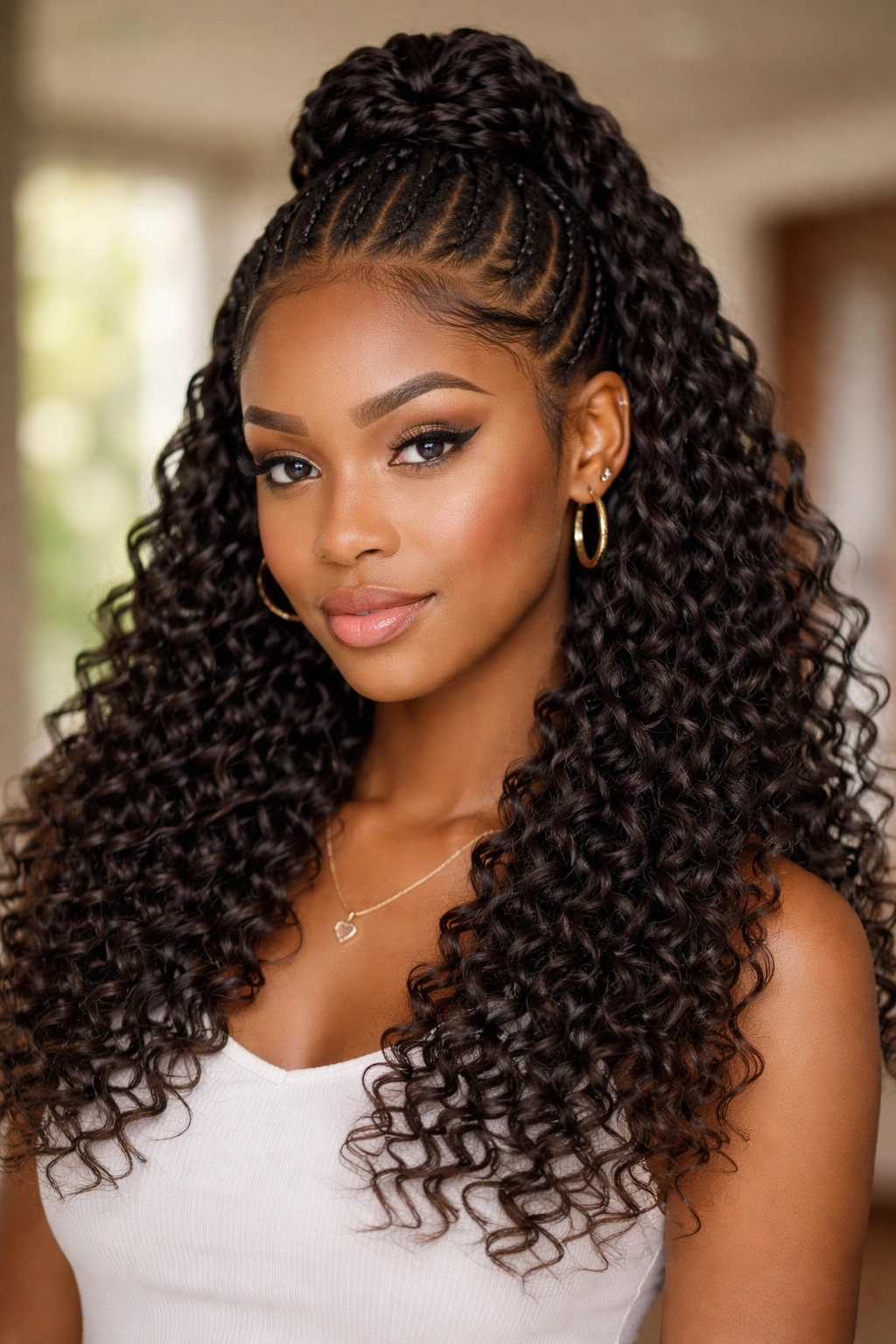
Knotless braids are a gentler alternative to traditional box braids. Instead of creating a knot at the base of the braid, knotless braids are started with hair clips and braided smoothly from the root downward. This technique significantly reduces tension on the scalp and your natural hair. Pair knotless braids in your crown with voluminous crochet curls below, and you have a style that’s beautiful, comfortable, and genuinely protective.
The defining feature of knotless braids is how smooth and seamless they look at the root — there’s no visible knot or bump. This creates a very sleek, polished appearance, especially when you smooth the root area with a brush and lay it down with edge control.
Why Knotless Braids Are Game-Changing
Knotless braids reduce tension-related hair loss significantly. They’re more comfortable for extended wear, which makes them ideal if you’ll be keeping the style for 6+ weeks. They also look incredibly neat and polished because the root area is smooth and tight without the bulk of a knot. For many people, knotless braids are the perfect balance between protective styling and comfort.
Knotless Braid Crown Details
- Braiding technique: Knotless braids use hair clips at the root and are braided downward, so they require an experienced stylist familiar with the technique
- Root tightness: The roots should be snug but not uncomfortably tight — you should be able to move your scalp without tension
- Edge styling: Lay down your edges with edge control around the braided crown for a finished, polished look
- Crochet integration: Lightweight crochet hair pairs best with knotless braids, as the lighter weight reduces stress on the roots
- Half up gathering: Secure the crown braids into a ponytail about 2-3 inches back for a balanced effect
- Longevity: Knotless braids last 4-6 weeks depending on how much movement the style has
- Scalp care: The reduced tension of knotless braids is gentler on your scalp, so you might find you can keep them longer comfortably
Pro tip: If you’re switching from traditional braids to knotless braids, give your hair a 1-2 week break in between. This allows your scalp to recover and your natural hair to rehydrate before starting a new protective style.
11. Twisted Updo Bun Half Up With Long Crochet Flow
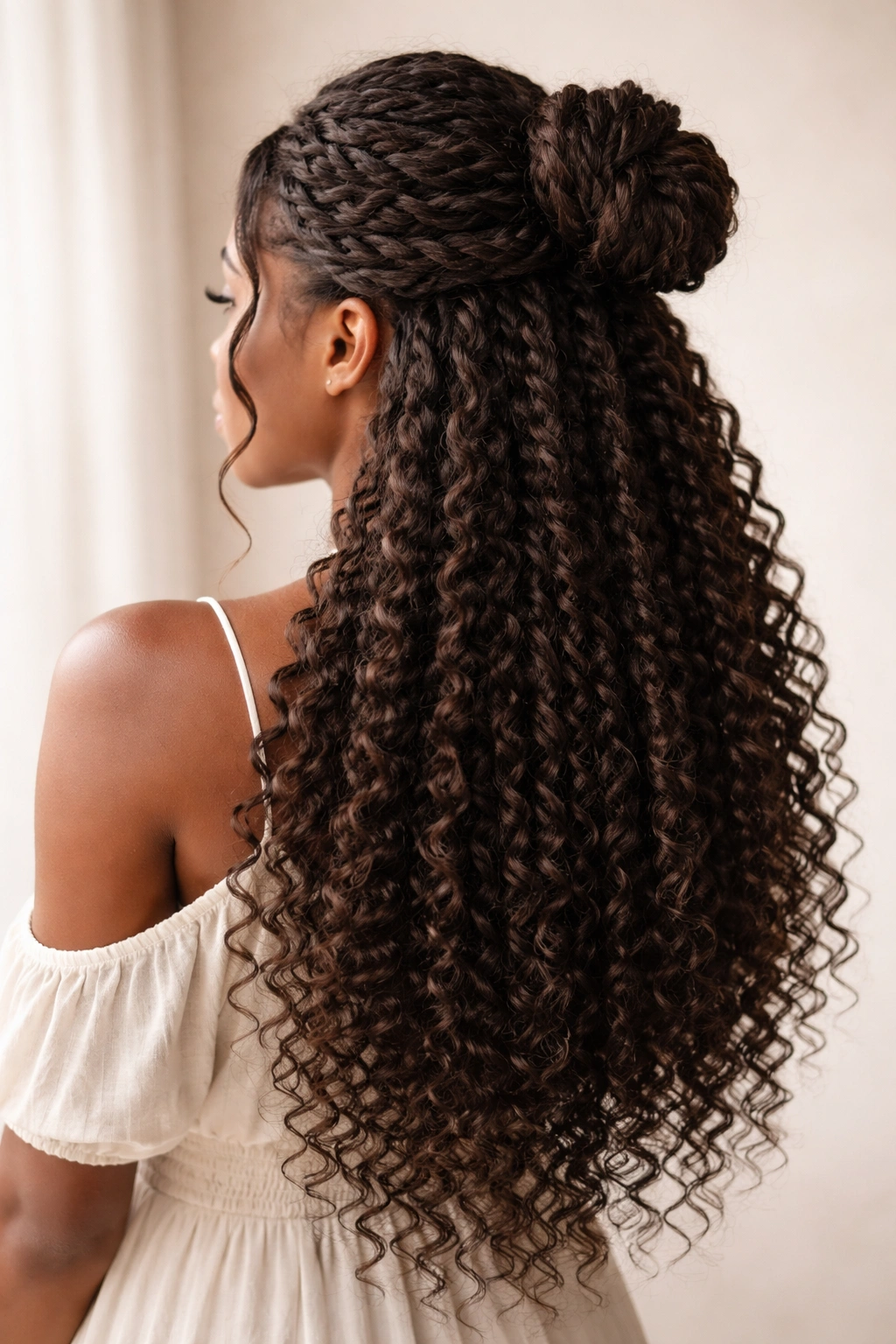
For a half up style that reads as more formal or specially styled, consider creating two thick twists in your crown and wrapping them into a bun at the back of your head. This creates a style that sits somewhere between bohemian and elegant — it’s romantic but also polished, free-spirited but intentional. Add long crochet hair flowing below the bun for maximum impact.
This style works beautifully for special occasions like weddings, dates, or celebrations. But it’s also accessible enough to wear regularly if you love the aesthetic. The twisted bun crown gives you something interesting to look at from the back and sides, while the flowing crochet hair below keeps the style from feeling overly formal.
Creating a Twisted Bun Crown
The technique is simpler than it sounds: create two thick twists from your natural hair (or feed crochet hair into the twists for added volume), then wrap the twists together into a bun shape and secure with bobby pins. The result is a textured, dimensional crown that’s visually interesting and surprisingly secure.
Twisted Bun Half Up Execution
- Twist thickness: Use thicker twists (about the width of a thumb) for the crown to create a more substantial, visible bun
- Crochet hair usage: You can crochet hair into the twists themselves, or simply secure the natural-hair twists and let crochet hair flow below
- Bun position: Center or slightly off-center at the crown or nape, depending on how you want to position the rest of your hair
- Securing method: Use multiple bobby pins and cross them for security; this bun needs to stay put
- Visual softness: Leave a few small sections of the twist visible and slightly loosened for a romantic, undone feeling
- Crochet hair styling: You can leave it flowing straight, curl it into waves, or partially pin sections back for variation
- Duration: This style lasts well for 4-5 days before the bun might need tightening
Insider note: If you’re creating this style for a special event, practice it a day or two beforehand. That way, you’ll know exactly how much time to allow and you can troubleshoot any issues before the actual event.
12. Braided Halo Half Up With Wrapped Crochet Hair
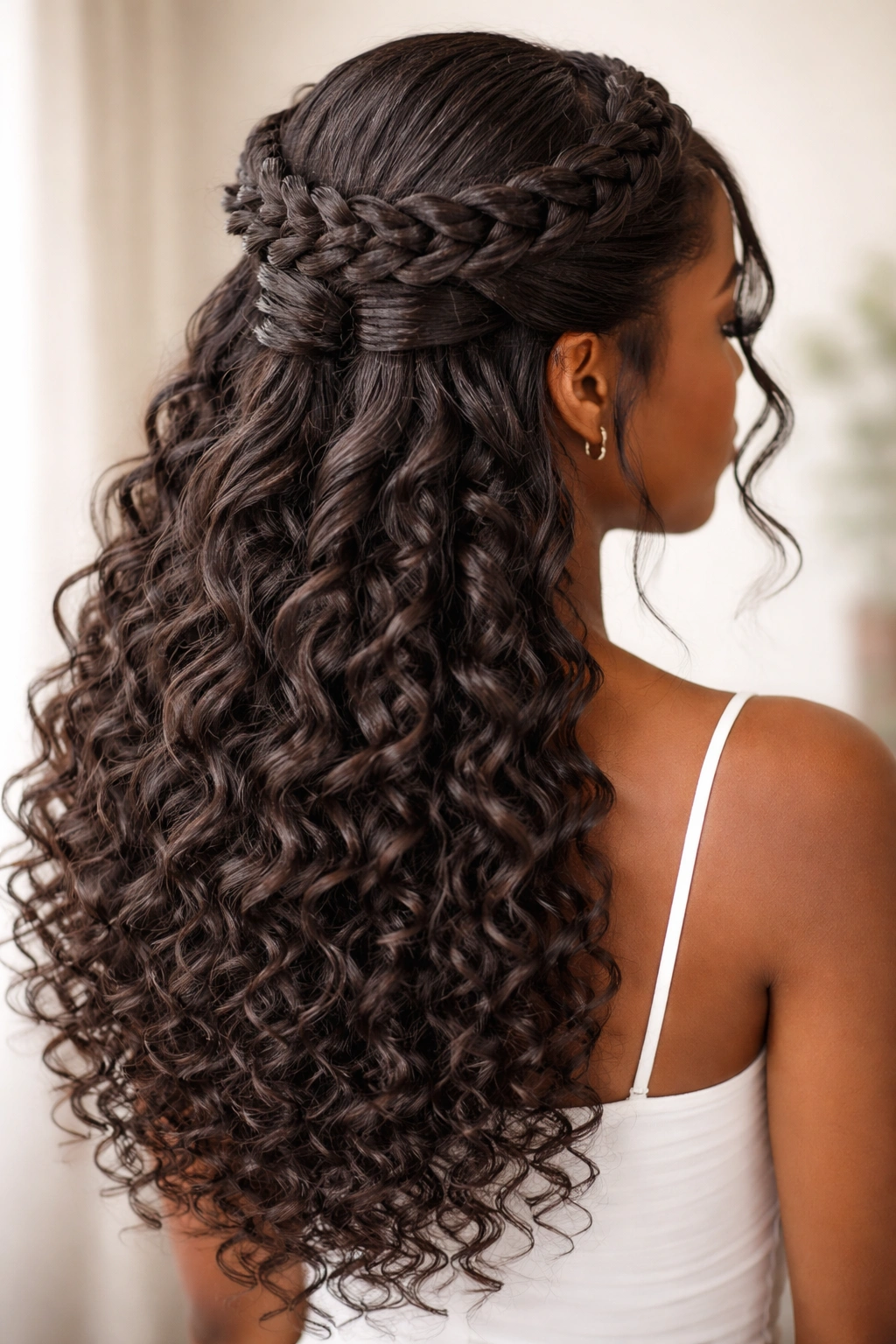
A halo braid is a braid that circles your head like a crown, typically covering the top from ear to ear. For a half up version, you create a halo braid that covers just the top half of your head and gathers into a wrapped crochet style. This is sophisticated, romantic, and utterly wearable — the halo effect frames your face beautifully and creates a polished look that reads as high-effort styling.
The halo braid doesn’t require you to pull your hair back tightly, which makes it more comfortable for all-day wear. And because it stays relatively close to your head, it reads as elegant rather than casual. Pair it with wrapped or coiled crochet hair for a style that feels intentional and artistic.
The Romance of Halo Braids
A halo braid inherently flatters your face because it frames your features while drawing attention upward and outward. The circular braid pattern is visually interesting from every angle — the back, the sides, and the front all look beautiful. It’s a style that works for virtually every face shape and reads as universally flattering.
Creating and Styling the Halo Half Up
- Braid path: Start the braid at one temple, move up and over the top of your head, and end at the opposite temple
- Braid thickness: A medium to thick braid creates more visual impact and stays secure longer
- Securing endpoints: Tuck the braid ends back and secure with bobby pins so they’re hidden under your crochet hair
- Crochet hair gathering: Bundle your crochet hair at the nape of your neck or slightly lower, just under where the halo braid ends
- Wrapping technique: You can wrap sections of crochet hair around the ponytail to create a coiled, textured effect
- Volume building: Backcomb or tease the wrapped section slightly for more fullness and dimension
- Styling longevity: The halo braid stays secure for 5-6 days, though you might want to refresh the under-section ponytail every few days
- Face framing: Leave a few small braids or twist sections from the halo unbraid for a softer, romantic effect
Pro tip: A halo braid is easiest to create if you have another person to help braid around the back of your head. If you’re doing it solo, use a mirror and work slowly — the braid doesn’t need to be perfect to look beautiful.
Final Thoughts
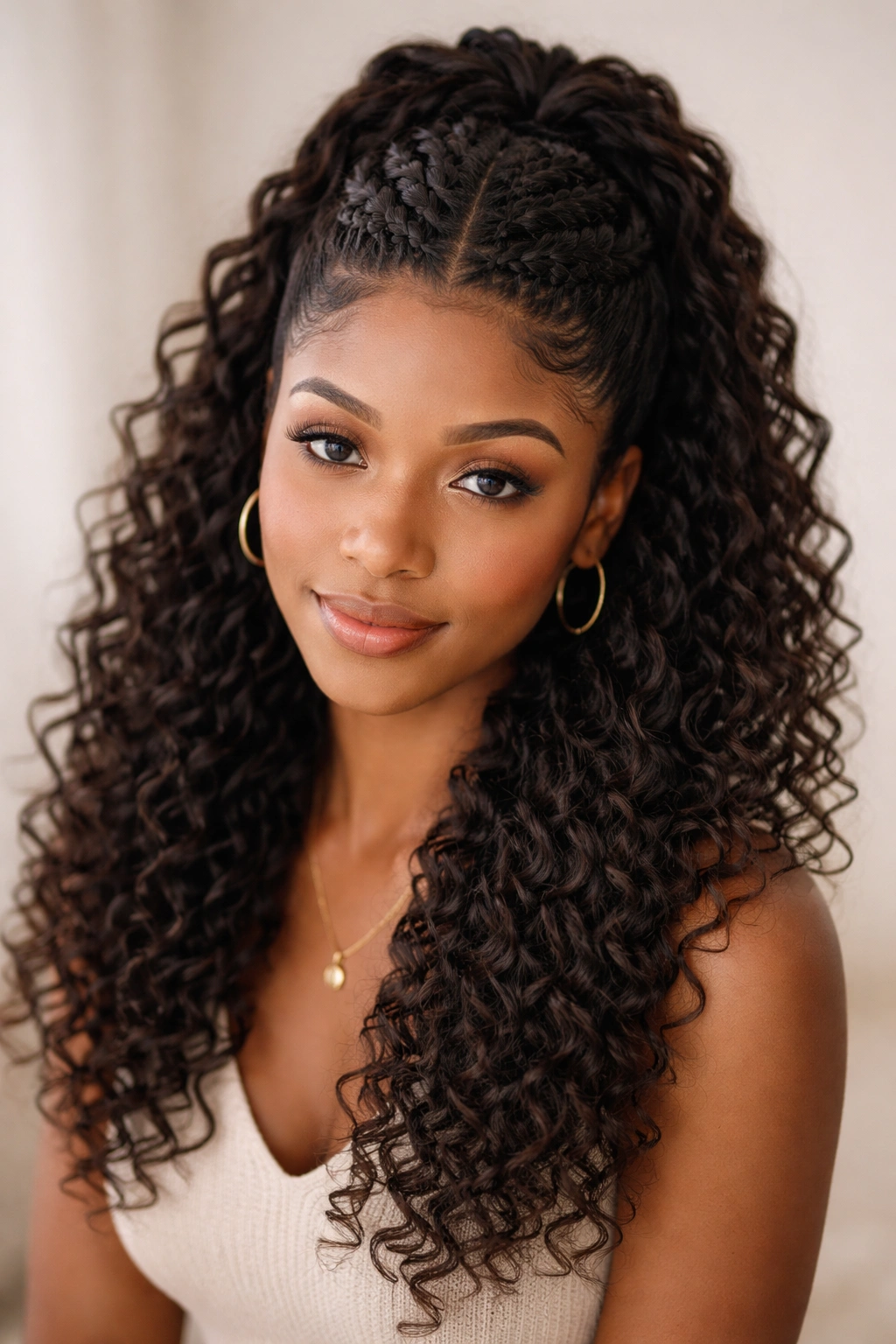
Crochet half up half down styles give you the freedom to be creative, protective, and beautiful all at the same time. Whether you choose the classic elegance of box braids, the refined romance of waterfall styles, or the sculptural boldness of Ghana knots, you’re making a styling choice that works for your life. These styles protect your natural hair while letting you experiment with length, texture, and color without permanent commitment.
The real magic of a half up style is that it’s genuinely versatile. You can wear it sleekly for professional settings, loosen it for casual days, dress it up with jewelry and accessories, or keep it simple and let the braid work speak for itself. The crown detail does the heavy lifting — it makes every version of the style feel intentional and put-together, even on days when you’re just living your life.
Take time to find the style that resonates with you. Consider your lifestyle, how much time you’re willing to spend on styling, and which crown techniques genuinely appeal to you visually. There’s no wrong choice here — just different ways of expressing yourself and caring for your hair simultaneously.
