



Feed-in cornrows have become one of the most versatile and creative protective hairstyles, and when you add heart designs to the mix, you’re combining functionality with undeniable style. Small feed-in cornrows are particularly appealing because they’re manageable to maintain, work beautifully on different hair types and textures, and create a sophisticated look that feels both playful and polished. The heart design element—whether woven throughout the entire style or featured as a central focal point—brings an extra layer of personality and artistry to your braids.
What makes small feed-in cornrows with heart designs especially compelling is how they showcase the braider’s skill while remaining practical for everyday wear. Unlike larger, thicker braids that can feel heavy or take weeks to complete, smaller braids dry faster, feel lighter on your neck and shoulders, and allow for intricate patterns that would be impossible with thicker sections. The heart motif itself has become increasingly popular because it’s instantly recognizable, photographs beautifully, and works for literally any occasion—from casual hangouts to special events.
Whether you’re drawn to bold, geometric interpretations of the heart shape or softer, more organic designs woven subtly into your pattern, there’s a small feed-in cornrow heart style to match your aesthetic. Each variation we’ll explore brings its own character while maintaining that signature neat, tight, intentional look that makes feed-ins so satisfying.
1. Small Braids with Gradient Heart
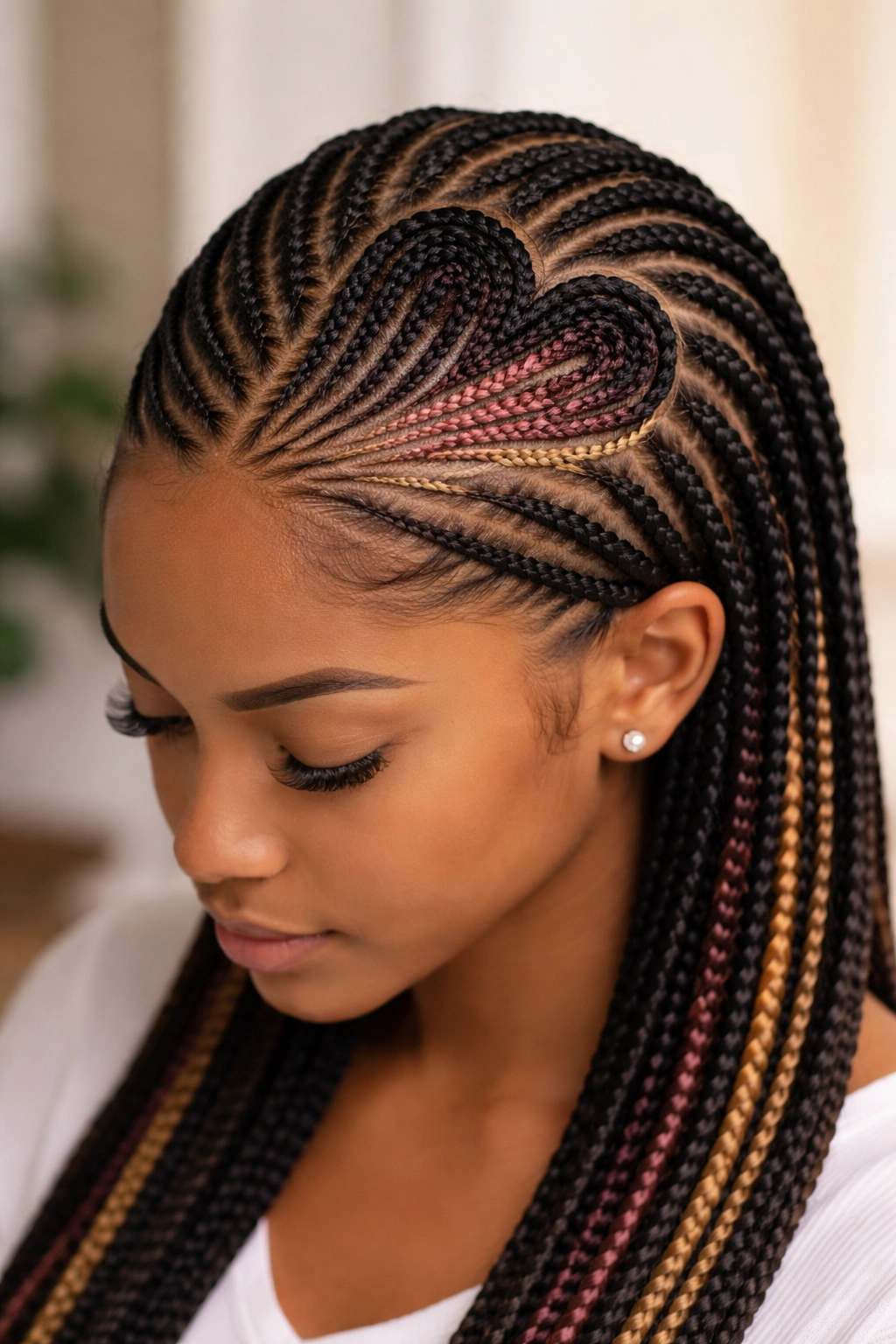
This style features consistently small feed-in braids throughout your entire head, with a prominent heart shape created in the crown or front section using thread or yarn in a contrasting color. The real magic happens when you use a gradient effect—starting with one shade and gradually transitioning to another as the heart design flows down, creating depth and dimension.
Why This Design Works
The gradient heart creates visual interest without overwhelming your look, and it’s surprisingly easy to customize to your color preferences. Small braids throughout mean the style maintains structural integrity for weeks while remaining lightweight enough for daily comfort. The heart shape in this version becomes a natural focal point when you wear your hair down or partially pulled up, and it photographs incredibly well for social media or special occasions.
The Technical Details
- The gradient typically starts with a darker or bolder color at the top of the heart and fades to a lighter or contrasting shade by the time it reaches the point
- Small feed-ins throughout (usually 1/4 to 1/2 inch thick) create a neat, refined appearance
- The heart outline is created by changing your threading color while maintaining the same braid size
- Installation takes 3 to 4 hours depending on your hair density and the complexity of the gradient effect
- This style lasts 4 to 6 weeks with proper maintenance
Styling and Maintenance Tips
- Refresh your braids every 2 to 3 weeks with edge control and light moisturizing oil
- Sleep in a silk or satin bonnet to reduce friction and extend the lifespan
- Avoid heavy hair products that can accumulate at the roots
- The gradient heart looks stunning when pulled into a high pony or bun that showcases the design
- Nourish your natural hair underneath by doing light scalp massages with a lightweight oil
Pro tip: Ask your braider to create a slight curve in the heart lines—perfectly straight geometric shapes look less organic, while subtle curves feel more intentional and artistic.
2. Tribal-Inspired Heart Design with Feed-Ins
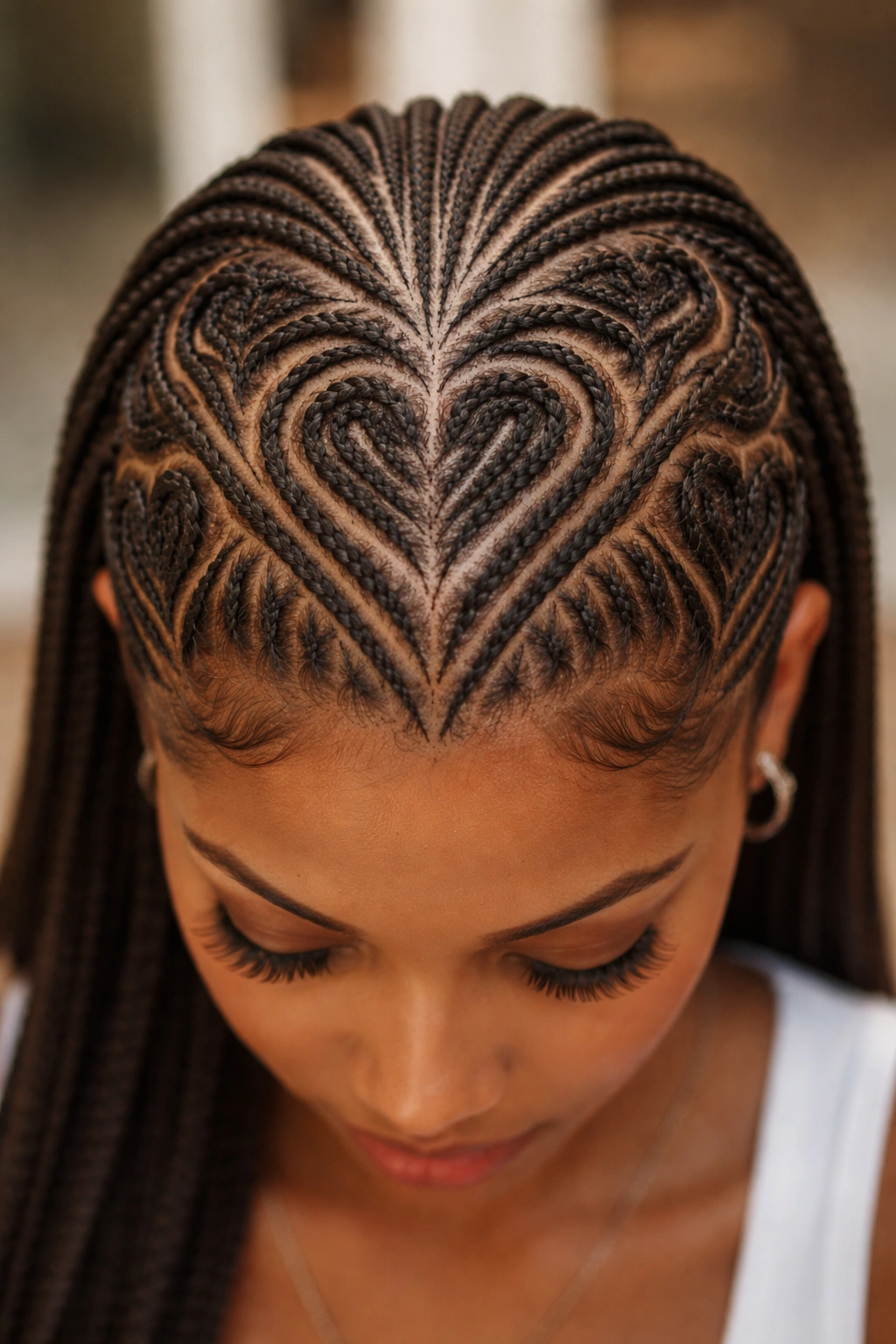
This variation draws inspiration from traditional African tribal patterns and incorporates the heart shape as part of a larger geometric composition across your scalp. The braids are kept uniformly small throughout, but the spacing and directional flow create an intricate tribal pattern that feels ancestral and deeply intentional.
Why This Design Works
Tribal-inspired patterns honor cultural heritage while creating a bold, distinctive statement. When you add a heart element to a tribal design, you’re creating something uniquely yours—a blend of traditional artistry and personal expression. This style works particularly well if you’re interested in braids that tell a story or connect you to cultural roots, and it transforms your entire head into a canvas.
The Technical Details
- Multiple heart shapes may be incorporated throughout the design rather than just one central heart
- Braids typically flow in different directions to create the geometric pattern effect
- Some braiders use thin lines of contrasting thread to outline and define the tribal elements
- The design requires an experienced braider who understands spatial composition and pattern flow
- Installation typically takes 4 to 5 hours
- The style holds beautifully for 4 to 7 weeks with minimal maintenance
What to Discuss With Your Braider
- Reference images of tribal patterns you connect with, but also bring heart design examples separately—your braider can merge these concepts
- Discuss the exact placement of hearts (centered, symmetrical, or scattered throughout the pattern)
- Talk about color—neutral tones often showcase the pattern more clearly, while bold colors create higher contrast
- Ask about which direction the braids should flow to best frame your face
- Clarify how visible you want the tribal pattern to be—some designs are subtle while others are bold and impossible to miss
Worth knowing: This style photographs dramatically from above, so it’s perfect if you enjoy taking overhead photos or videos of your braids.
3. Minimalist Geometric Heart Pattern
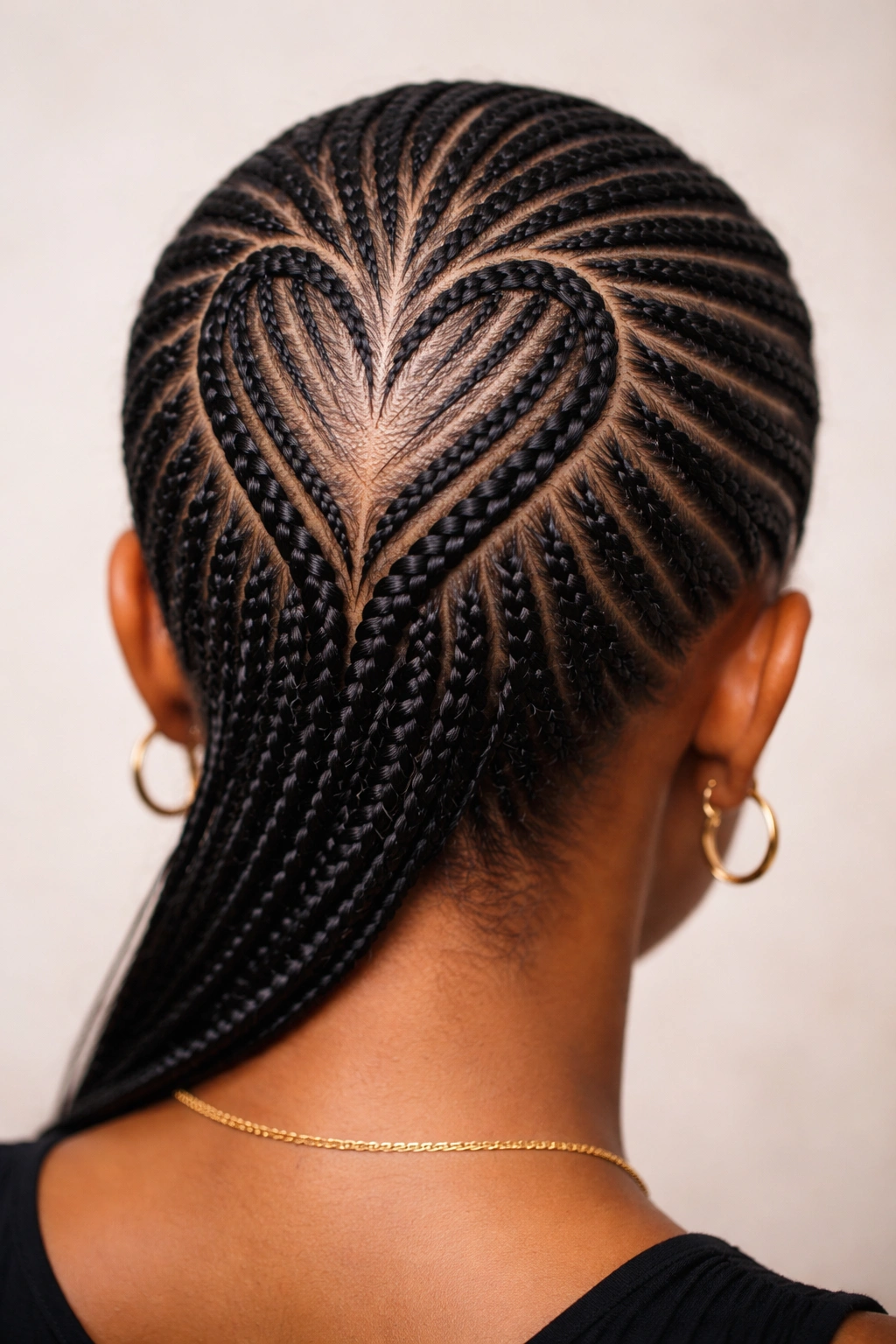
Clean lines, precise angles, and intentional spacing define this style, which strips away excess detail in favor of pure geometric form. Small feed-in cornrows create the foundation, while the heart is rendered in sharp, angular lines rather than curves—think more modern art installation than traditional heart symbol.
Why This Design Works
The minimalist approach appeals to people who love understated sophistication and contemporary aesthetics. There’s something compelling about a style that looks incredibly intentional without being loud or attention-seeking. This version of the heart design works beautifully on all face shapes and hair types because the focus is on form rather than decoration.
The Technical Details
- The heart shape is typically created using 5 to 7 thin braids positioned to form the outline rather than filling in the entire shape
- Spacing between braids is crucial—usually uniform and deliberate, anywhere from 1/8 to 1/4 inch apart
- The overall effect is more sculptural than decorative
- Monochromatic threading (all one color) often looks best with geometric patterns because contrast can break up the clean lines
- Installation takes 3 to 4 hours
- The style holds for 5 to 7 weeks and looks better over time as braids settle and show more definition
Why Less Is More With This Approach
- Clean lines are easier to maintain because there’s no thick yarn or complex gradient to worry about
- The minimalist aesthetic actually highlights your natural features rather than competing with them
- This style pairs beautifully with minimal makeup or bold makeup—either direction works
- Geometric shapes photograph with sharp definition, making them ideal for professional headshots or portfolio photos
- The simplicity means you can add accessories without overwhelming the overall look
Quick fact: Minimalist geometric designs actually look more striking the older the braids get, as the braids loosen slightly and the spacing becomes more pronounced.
4. Heart with Contrasting Bead Accents
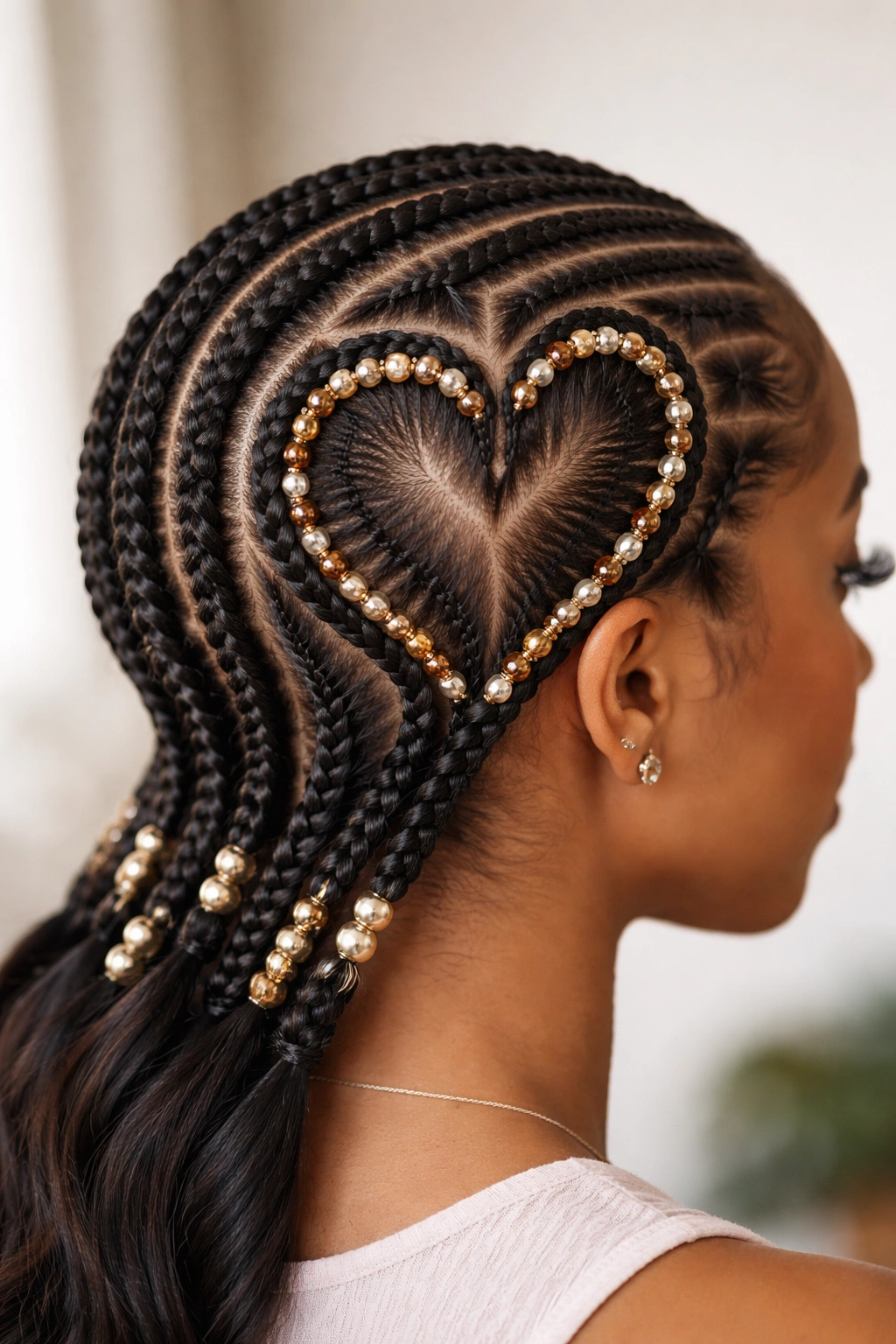
Small feed-in cornrows throughout the entire head become interactive art when you incorporate strategic bead placement around a central heart design. Beads in contrasting colors—metallic, bold jewel tones, or complementary shades to your threading—draw the eye and add dimension that’s both tactile and visual.
Why This Design Works
Beads serve both aesthetic and practical purposes: they secure the ends of your braids, add weight that helps the style hold longer, and create visual breaks that make the overall pattern more dynamic. A heart design becomes even more focal with the right bead placement, and you can choose beads that match your personal style—from delicate and minimal to bold and statement-making.
Bead Placement Strategy
- Place beads directly along the heart outline for maximum definition
- Use larger beads at key points (the dips of the heart, the point) and smaller beads throughout
- Mix metallic and colored beads for visual interest
- Consider doing an ombre effect with beads, transitioning from one bead color to another
- Some braiders alternate bead sizes along each braid for rhythm and texture
- Installation takes 4 to 5 hours depending on how many beads you’re using
Bead Maintenance and Longevity
- Beads can slip as the braids relax—check and adjust every 2 to 3 weeks
- Some beads may need to be replaced if they become loose or tarnished
- Metallic beads show wear faster than solid color beads, so factor that into your choice
- Beads can occasionally snag on pillowcases or clothing, so be mindful when sleeping and changing clothes
- The weight of beads can cause slight tension, so this style works best if you don’t have sensitive scalp
Pro tip: Ask your braider to use beads with larger holes designed for braids specifically—cheap beads with small holes can weaken the braid and cause breakage.
5. Spiraling Heart Motif
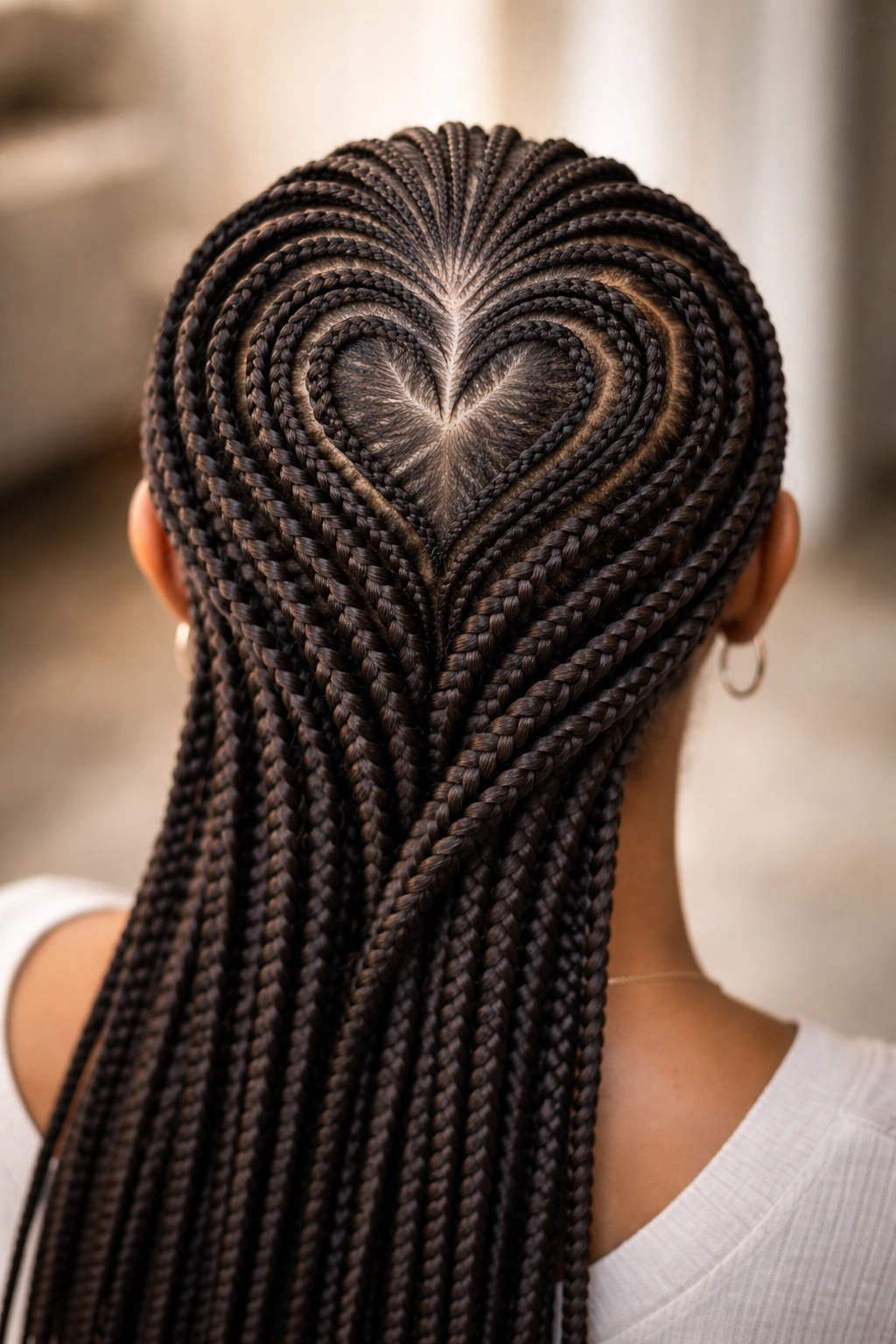
Instead of a traditional outline-based heart, this design uses spiraling braids that form the heart shape through movement and flow. Imagine starting from a central point and the braids swirling outward and downward, creating a heart that feels almost three-dimensional and organic rather than flat and graphic.
Why This Design Works
The spiral approach feels more natural and less geometric than a standard heart outline, making it perfect if you prefer organic-looking patterns. The movement of the braids creates visual flow that’s satisfying to look at and feels dynamic rather than static. This style actually photographs beautifully at multiple angles because the spiraling creates depth—it’s not just a 2D pattern on your scalp.
How Spiral Hearts Work
- The design starts with a small central point (often at the very crown)
- Braids spiral outward from that center point, gradually expanding into the larger heart shape
- Some braiders create alternating spiral directions for added visual interest
- The edges of the heart are often thicker and more defined than the inner spirals
- This design requires careful planning because the spiral must flow naturally with your head’s geography
Installation Specifics
- Takes 4 to 5 hours because the braider must think through the spatial layout carefully
- Requires an experienced braider who understands how to create spiral patterns that actually work
- Threading or contrasting colors work beautifully to emphasize the spiral movement
- The style holds for 4 to 6 weeks and actually looks better as the braids relax slightly and the spiral becomes more pronounced
Insider note: Request that your braider create a reference sketch of the spiral pattern before she starts braiding—it ensures you both have the same vision for how the heart will actually flow.
6. Double Hearts with Side Feed-Ins
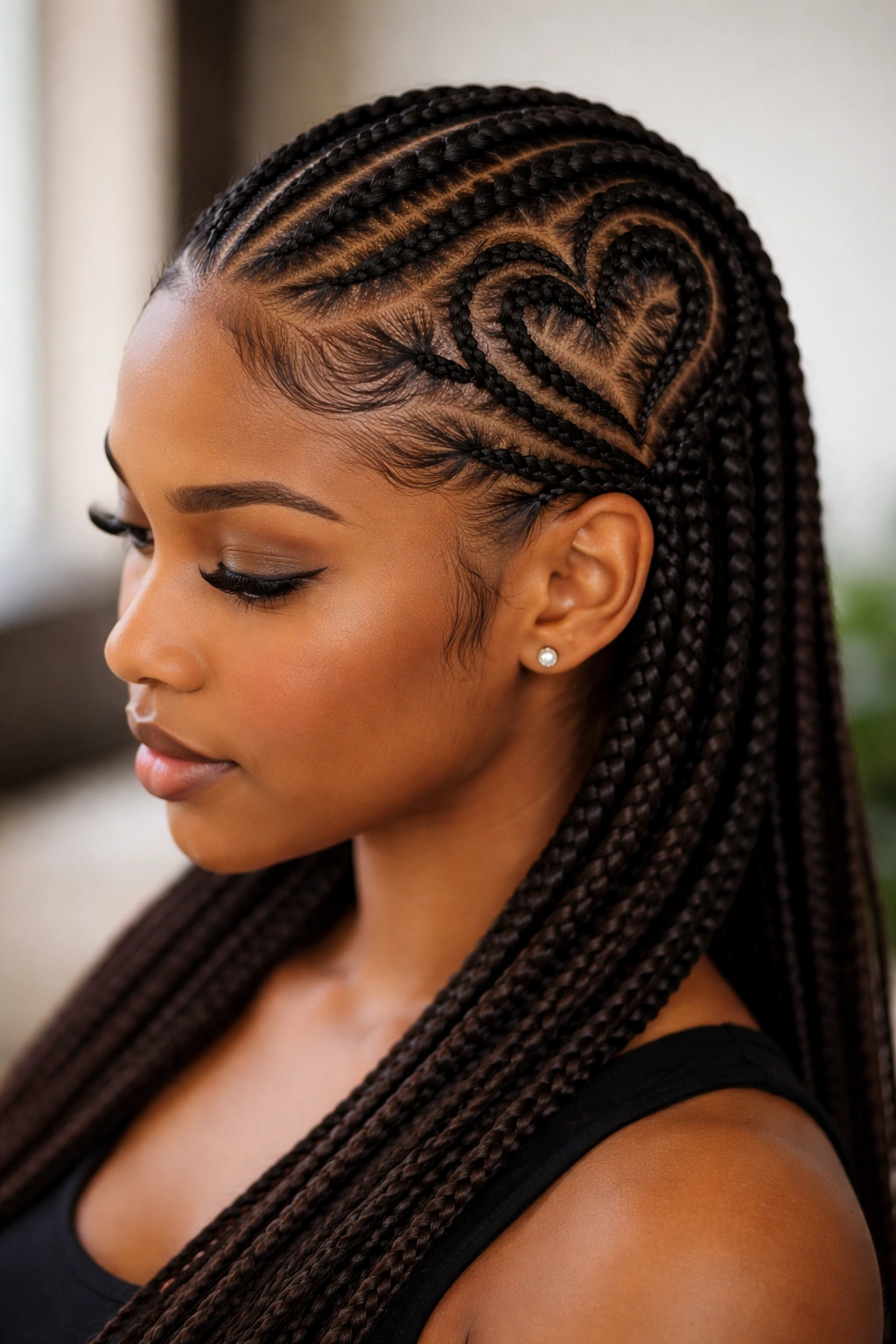
This design incorporates two symmetrical hearts positioned one on each side of your head, created through careful feed-in placement while maintaining small braids throughout. Rather than one central heart, you’re creating a balanced, mirrored effect that feels sophisticated and intentional.
Why This Design Works
Double hearts feel more balanced and symmetrical than a single centered heart, and they create a frame for your face that’s genuinely flattering. If you have a larger head or fuller hair, the symmetrical design feels more proportionate than a single focal point. This version is also ideal if you like the heart design concept but want something less obvious or attention-grabbing.
Symmetry and Balance
- Each heart is positioned equidistant from the center part line
- Hearts are typically angled slightly toward your face, creating a framing effect
- The same threading color can be used for both hearts, or you can use different colors for even more visual interest
- This design works beautifully with a center part or a side part
- The symmetry creates a calming visual effect that’s less bold than a single large statement heart
Styling Versatility
- You can wear your hair down to show both hearts
- Pull your hair into a ponytail to emphasize just the one closest to the back
- Style it half-up to feature one heart prominently while subtly showing the other
- The dual-heart design photographs beautifully from a front-facing angle
- This design ages really well—it looks better and more defined as the braids settle
Worth knowing: Double hearts work particularly well if you plan to wear your hair in different styles throughout the length of time you keep the braids in.
7. Heart with Ombre Threading
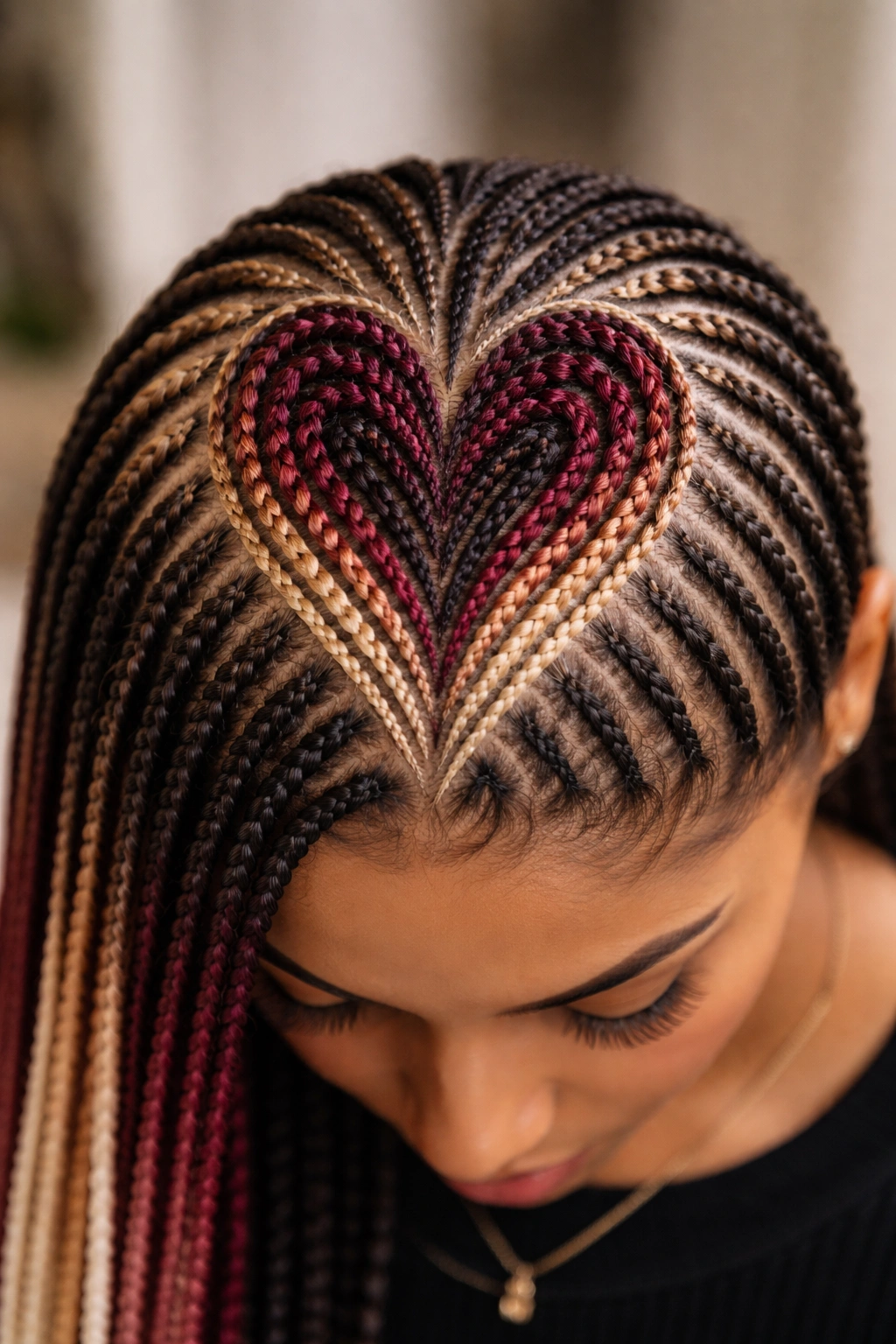
Small braids throughout your entire head become an ombre masterpiece when you use threading in gradually shifting colors. The heart shape is created using the most saturated or boldest color, while surrounding braids transition through progressively lighter or different shades, creating a halo effect around the heart.
Why This Design Works
Ombre threading creates visual drama and makes your entire head feel like a cohesive piece of art rather than just braids with a design. The color gradient draws the eye to the heart while also making your entire head feel intentional and thoughtfully composed. This style works beautifully on all skin tones and can be customized entirely to your color preferences.
Color Progression Strategies
- Classic ombre: Heart is darkest, surrounding braids lighten progressively outward
- Reverse ombre: Heart is lightest, braids darken toward the edges of your head
- Multi-color ombre: Heart in one bold color, then transitions through 3 to 4 additional colors as it expands outward
- Complementary ombre: Heart in one color family, surrounding braids in a different family (warm to cool, for example)
- Monochromatic ombre: Same color family in different shades or tints, from deepest to lightest
Threading and Installation Details
- Ombre threading requires precise planning so the braider knows exactly which color goes with which braid
- Installation typically takes 4 to 5 hours because color placement adds another layer of complexity
- More thread is required than a single-color design because you’re using multiple colors
- The ombre effect is most visible and stunning when viewed from above or in photos
- This style holds beautifully for 4 to 6 weeks, and the color contrast may actually appear sharper as braids settle
Pro tip: Bring color swatches or pictures of ombre palettes you love—this ensures your braider sources thread in the exact shades you’re envisioning.
8. Nested Hearts Design
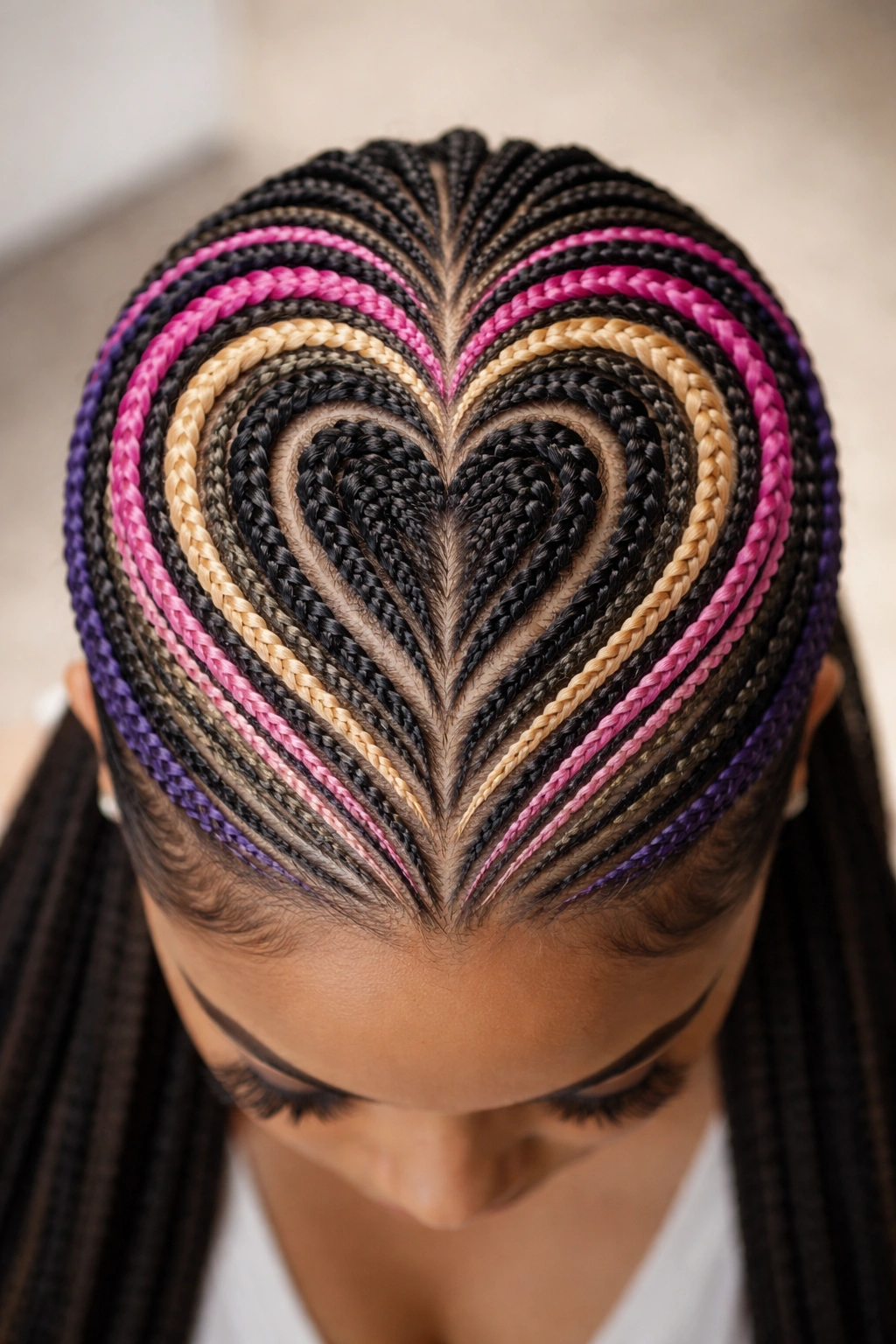
This intricate pattern features multiple hearts of different sizes positioned inside each other, creating a layered, almost target-like effect. Small feed-in braids throughout create the foundation, while the nested hearts are outlined using different threading colors or a combination of color and spacing.
Why This Design Works
The nested hearts design appeals to people who want something more complex and intricate than a single heart. There’s a mathematical elegance to how each heart fits inside the next, creating a visual rhythm that’s satisfying to look at. This design requires real skill from your braider and becomes an immediate conversation starter.
Design Complexity
- Typically involves 3 to 5 concentric hearts, each smaller and inside the previous one
- Can use a single color with different saturation levels, or multiple colors for maximum contrast
- Some braiders vary the braid thickness slightly to distinguish between different heart layers
- The spacing between each heart layer is crucial—too close together and the design becomes muddled; too far apart and it loses cohesion
- This is genuinely an advanced design that requires an experienced braider
Installation and Maintenance
- Takes 4.5 to 5.5 hours due to the precision required
- Requires careful planning and possibly even a sketch beforehand
- Works best with contrasting thread colors to ensure each layer is clearly visible
- The design photographs beautifully, especially from directly above
- Lasts 4 to 6 weeks with proper care and maintenance
- Looks increasingly striking as the braids settle and the layers become more pronounced
Worth knowing: This design is perfect if you’re planning to share photos of your braids on social media or want something truly unique that you’re unlikely to see on anyone else.
9. Asymmetrical Heart with Face-Framing Braids
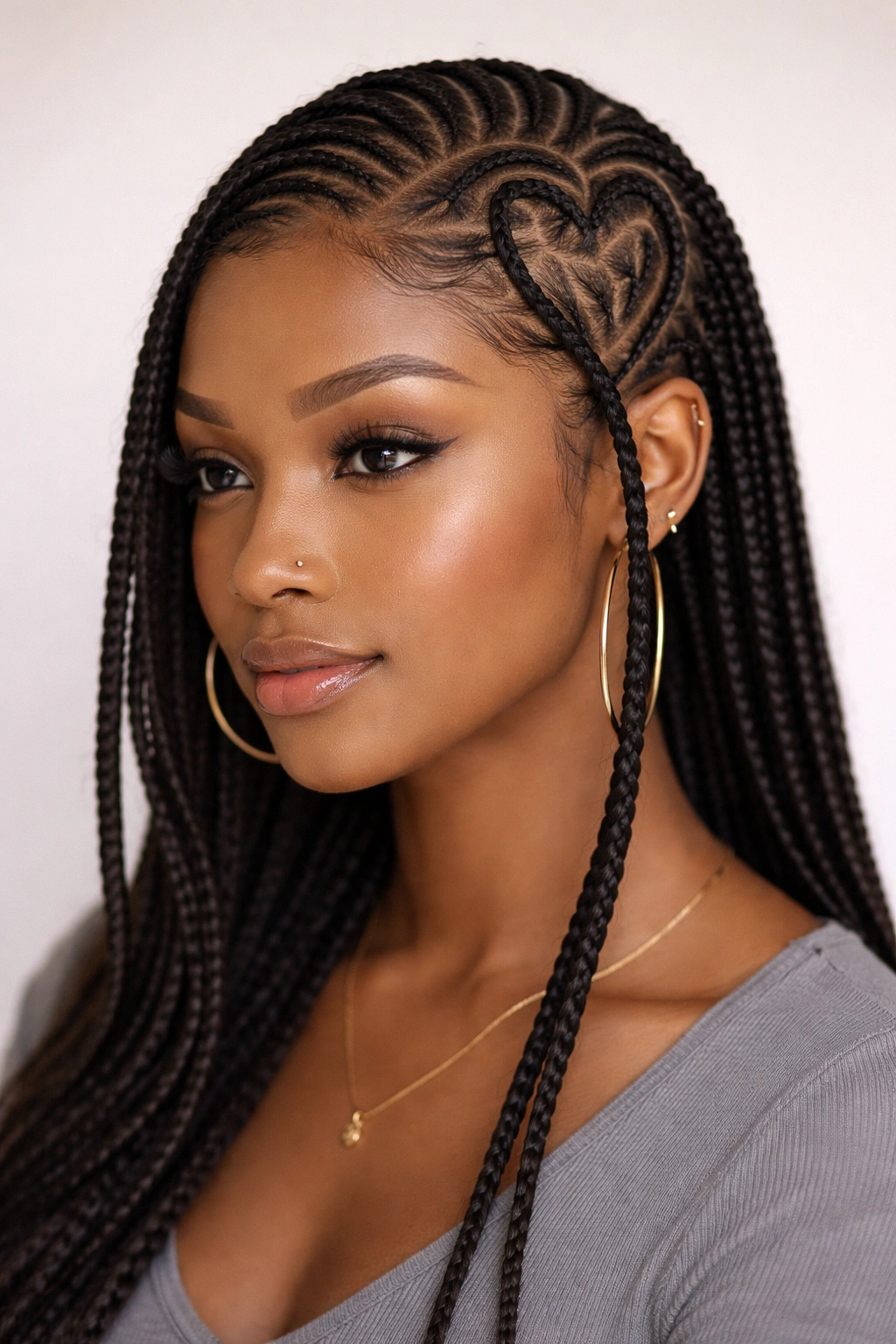
This creative variation places the heart off-center while incorporating intentionally styled face-framing braids that draw attention toward your features. Small feed-in cornrows create the base, but some braids are left slightly loose or styled with a gentle curve to frame your face, creating movement and dimension.
Why This Design Works
Asymmetry feels edgy, modern, and intentional in a way that’s different from traditional centered designs. By pairing the heart with face-framing elements, you’re creating a style that’s equally about framing and flattering your face as it is about the design itself. This works beautifully if you prefer less symmetrical, more creative aesthetics.
Face-Framing Technique
- Braids closest to your face can be left slightly thicker for a softer frame
- Some braiders create gentle curves in the face-framing braids for organic movement
- The asymmetrical heart is typically positioned toward the back or side rather than centered
- Face-framing braids can feature different threading colors than the heart, or complementary shades
- This design creates the illusion of a more structured face shape by drawing attention strategically
Styling Possibilities
- Pull the braids back to fully feature the face-framing elements
- Leave all braids down for full visual impact of both the frame and the heart design
- Create a half-up style that showcases the face-framing while hinting at the heart design
- The asymmetry means you can wear it multiple ways and have it look intentionally different each time
- This style actually looks better with bolder makeup or jewelry because the overall look is more fashion-forward
Quick fact: Asymmetrical designs are technically harder to create but often feel more modern and personal than perfectly symmetrical versions.
10. Heart with Diamond Surrounding Pattern
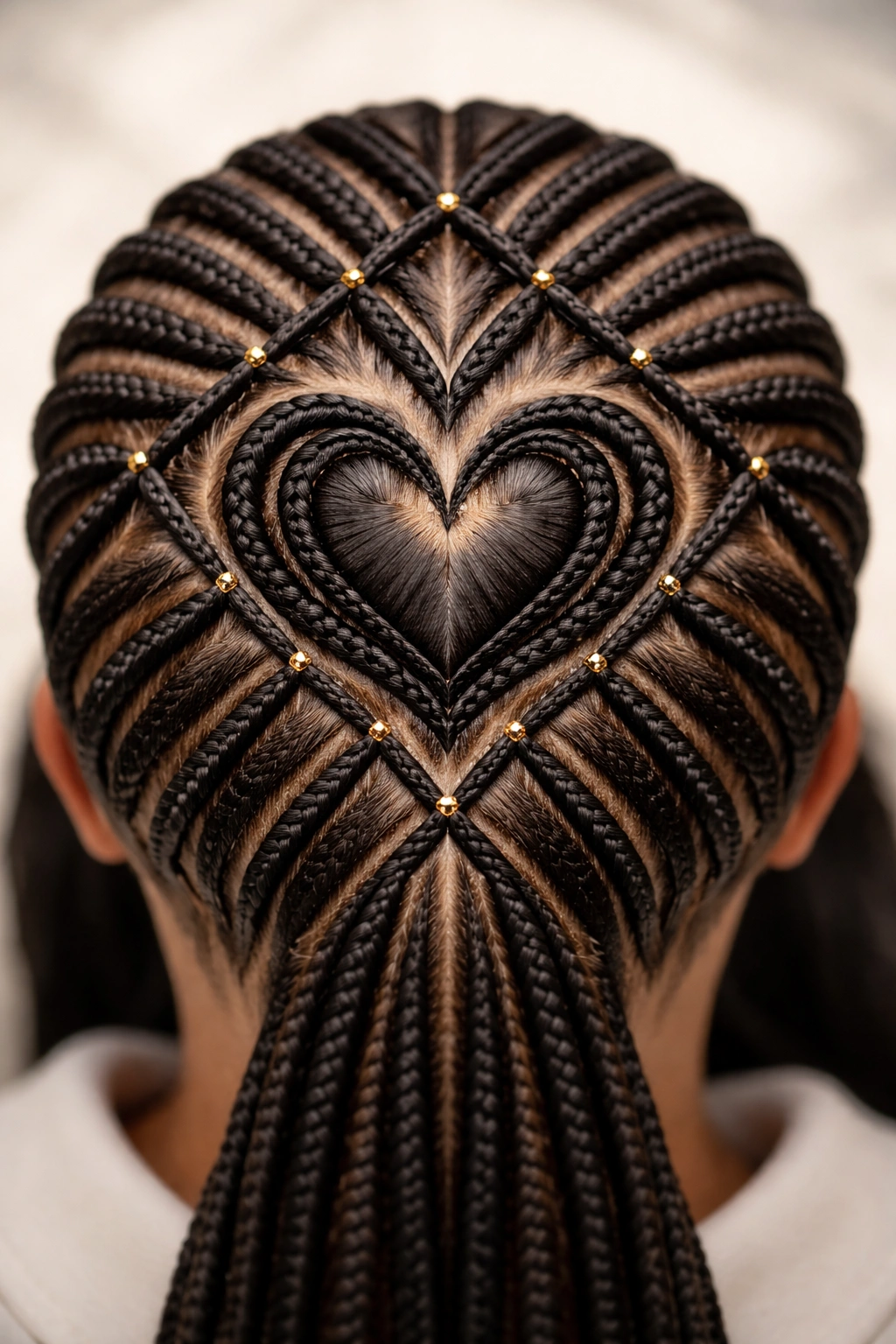
Small braids throughout form a larger diamond or geometric grid pattern, with a prominent heart design at the absolute center of this geometric composition. The surrounding diamonds create a frame that emphasizes and elevates the heart, making it feel like the most important element despite being surrounded by other shapes.
Why This Design Works
This design appeals to people who love geometry and pattern work but want to keep the emotional, personal element of a heart design front and center. The surrounding diamonds actually make the heart pop visually because of the contrast—your eye goes directly to the heart because it stands out from the geometric precision around it.
Pattern Composition
- The diamond pattern typically surrounds the heart on all sides or at least the major sides
- Diamonds can be created through spacing alone or with contrasting threading
- Some braiders use different braid thicknesses to distinguish between the diamonds and the heart
- The overall effect creates a medallion or emblem-like appearance
- This design requires understanding how to create geometric patterns while maintaining small, uniform braids
Visual Impact and Maintenance
- Installation takes 4 to 5 hours due to the pattern complexity
- The style photographs beautifully because the geometric pattern plus the heart creates visual interest at multiple levels
- Works best with at least two contrasting thread colors to clearly delineate the diamonds from the heart
- Lasts 4 to 6 weeks with standard maintenance
- Consider your overall aesthetic carefully—this design works best on people who genuinely love geometry and don’t mind a busier, more detailed look
Pro tip: Ask your braider to create the diamond pattern slightly larger in scale than the heart itself—this ensures the heart remains the focal point rather than being overwhelmed by the geometry around it.
Final Thoughts
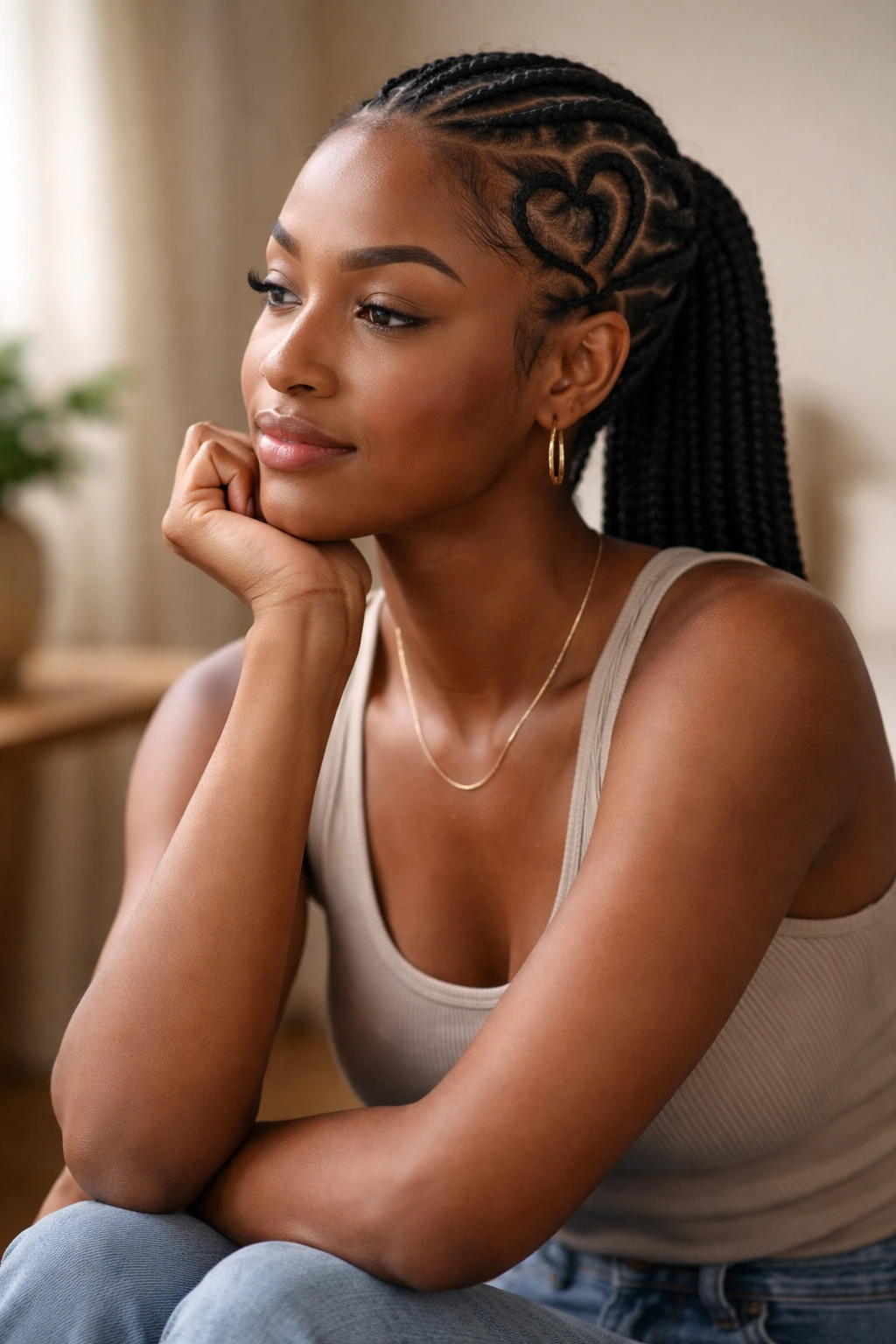
Small feed-in cornrows with heart designs represent a beautiful intersection of artistry, personal expression, and practical hair care. Whether you’re drawn to minimalist geometry, bold ombre effects, spiraling movement, or intricate nested patterns, there’s a heart design that speaks to your aesthetic and lifestyle. The versatility of this style means you can go bold and statement-making or subtle and sophisticated—the heart motif adapts to whatever vibe you’re going for.
The key to a stunning result is finding a braider whose work you genuinely love and clearly communicating your vision. Bring multiple reference images, discuss color preferences thoroughly, and don’t hesitate to ask questions about installation time, maintenance requirements, and how long you can realistically keep the style in. Your braider is essentially an artist, and the more specific feedback you provide, the better your result will be.
Take care of your braids by sleeping in a silk bonnet, keeping your scalp moisturized, and refreshing your style every 2 to 3 weeks. When you remove the braids, give your natural hair deep conditioning and moisture treatments to restore what gets temporarily sealed away during the braiding process. Most importantly, enjoy the confidence and visual impact of your braids during the time you wear them—a well-executed small cornrow heart design is genuinely a wearable work of art that you get to showcase every single day.
