



Curtain bangs have made a major comeback, and for good reason—they’re actually flattering for textured hair in ways that other bang styles simply aren’t. Unlike blunt bangs that can look heavy and disappear into waves or curls, curtain bangs fall gracefully alongside your face, frame your features, and work with your natural texture instead of against it. For medium-length wavy or curly hair, they’re genuinely a game-changer because they add movement and dimension while giving you that effortlessly cool, soft aesthetic that looks intentional without requiring you to fight your hair every morning.
The real advantage of pairing curtain bangs with medium-length wavy or curly hair is that you get the best of both worlds: definition and shape from a proper cut, plus the freedom that comes from bangs that don’t demand ceramic-flat styling to look good. Your natural waves and curls actually enhance the way curtain bangs sit and move—they create volume at the roots, soften the face, and catch light in ways that make your hair look thicker and healthier. Whether your waves are loose and breezy or your curls are tighter and more defined, the right curtain bang style transforms your whole look.
The following styles work beautifully with medium-length wavy and curly hair because they respect your texture while giving you shape, movement, and a strategic frame for your face. Each one can be customized to match your specific wave pattern, face shape, and styling preferences—and most of them require far less heat styling than you’d think.
1. Curtain Bangs With Textured Waves
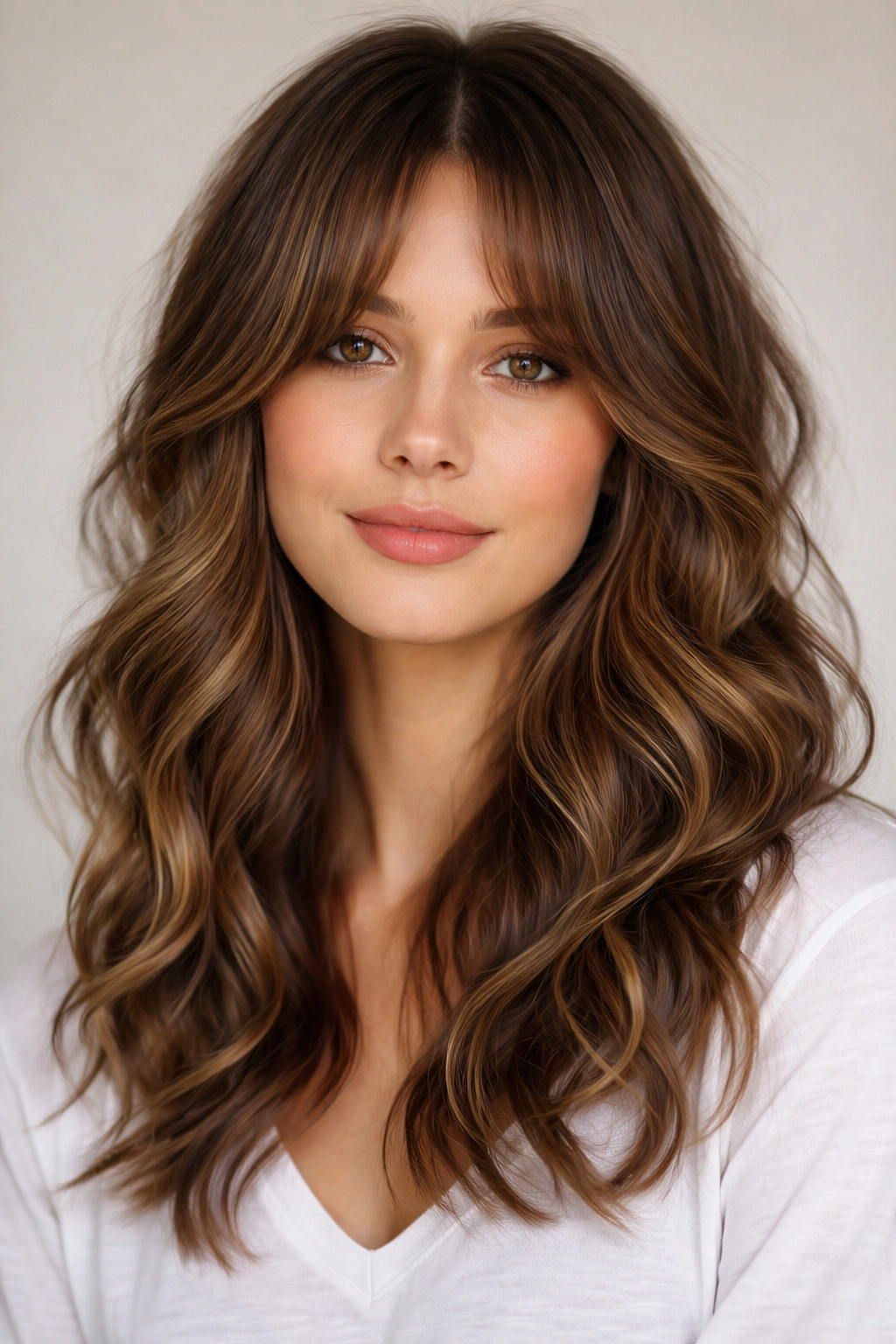
This is the most versatile curtain bang option for wavy hair because it simply enhances what you already have naturally. The bangs fall in the classic curtain shape—parted in the center with soft layers that frame the face—while the rest of your medium-length hair maintains its natural wave pattern without heavy layering throughout. What makes this style work is that the texture of your waves does the actual work; you’re not fighting your hair or trying to force it into something it’s not.
Why This Works for Wavy Hair
Textured waves need minimal help to look dimensional and alive, which is exactly what makes this style so low-maintenance. The curtain bangs draw attention to your face and eyes, while the bulk of your hair keeps its natural movement. Your waves create the illusion of more volume at the roots and ends, and the center part that curtain bangs require actually looks intentional and modern when paired with undone waves. You get that effortless, “I don’t try hard but I look put-together” aesthetic that’s surprisingly hard to fake with perfectly straight hair.
How to Style and Maintain
- Wash and condition with products designed for wave definition (sulfate-free is non-negotiable)
- Apply leave-in conditioner or styling cream to damp hair, focusing on mid-lengths and ends
- Use a diffuser attachment on your blow dryer on low heat, or air-dry with your head tilted to encourage texture
- Scrunch your waves gently while damp to encourage the curl pattern to form
- Let bangs air-dry or dry with the diffuser; they’ll naturally fall into a soft, textured frame
- Reset waves overnight with a loose braid or pineapple method to maintain texture without disturbing the curtain part
Pro tip: Don’t trim your bangs perfectly straight even at the appointment—ask your stylist to cut them with slight choppy texture built in, so they look intentional and interesting when your natural waves move them around.
2. Layered Curtain Bangs With Side-Swept Volume
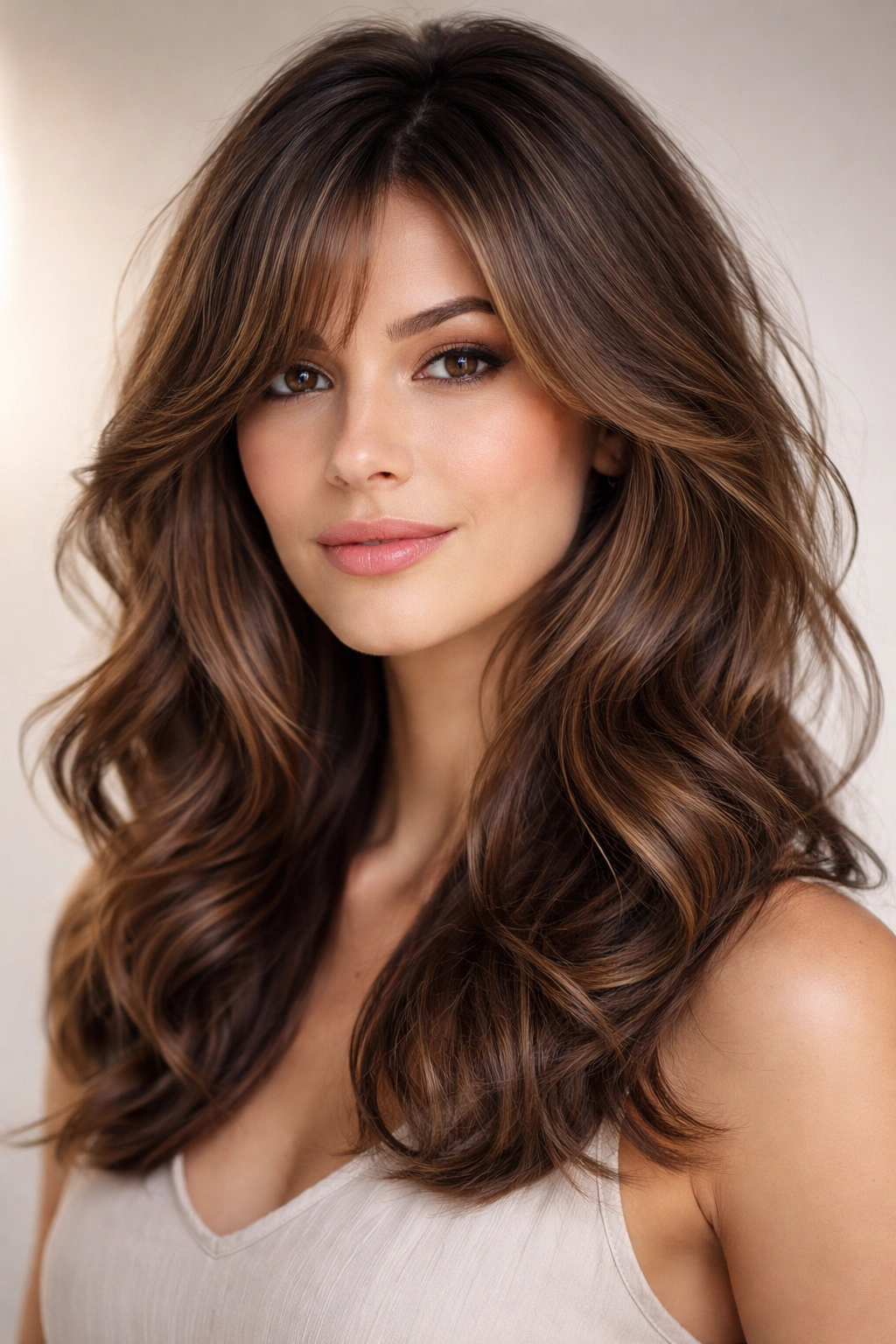
This style takes the basic curtain bang concept and adds strategic layers throughout the mid-lengths and ends, which creates serious movement and dimension for wavy hair. Instead of a blunt center part, this version has slightly more weight concentrated on one side of the bangs, giving them a subtle side-sweep that softens the face even more. The layers underneath catch air and spring up with your natural waves, creating volume that looks fuller and more sculpted than a one-length cut.
The Layering Strategy
Layers work magic on wavy hair because they reduce bulk in all the wrong places while encouraging your natural texture to do its job. With this style, your stylist creates shorter layers at the crown (to add lift), medium layers through the mid-section (where your waves naturally want to bend and fold), and slightly longer layers toward the ends. The curtain bangs sit at the front, framing your face, while the side-swept component gives you the option to tuck one side behind your ear for a more polished look or let both sides fall soft for something messier and more casual.
Styling Tips for Maximum Volume
- Blow-dry with your head upside down to create root lift, using a diffuser or concentrator nozzle
- Direct heat away from your face and toward the back of your head to encourage bangs to fall naturally at the center
- Once mostly dry, flip your head back up and use your fingers to tousle and separate layers
- Apply a lightweight texturizing spray or mousse to encourage waves to hold their shape throughout the day
- For side-swept styling, gently brush or comb the bang area slightly to one side while still damp, then let waves take over once fully dry
Worth knowing: This style requires trims every 6-8 weeks to maintain the shape and prevent the layers from becoming too wispy and disconnected. Wavy hair grows at varying speeds depending on curl pattern, so regular maintenance keeps everything looking intentional.
3. Curtain Bangs With Piece-y Layers
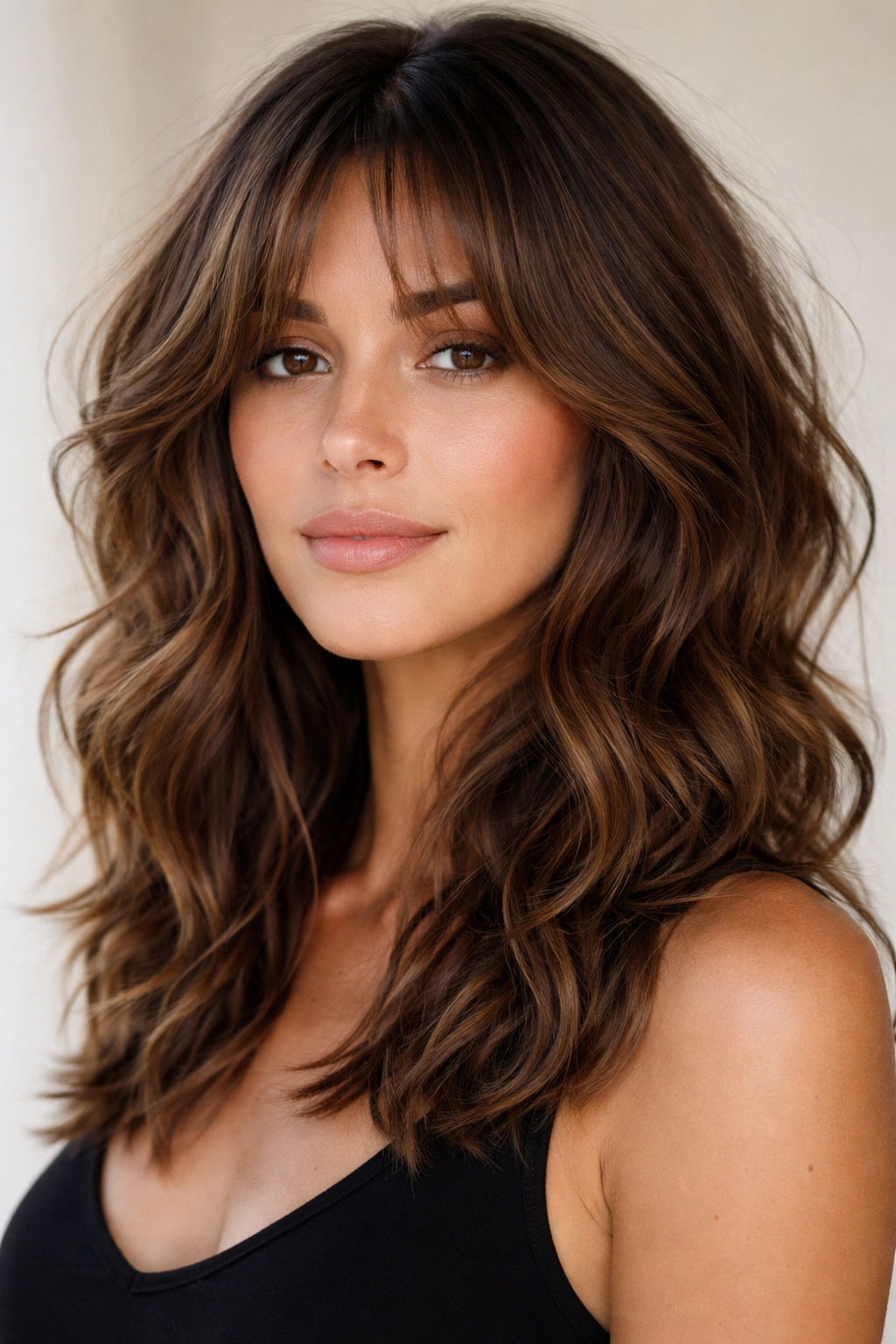
Piece-y layers are exactly what they sound like: individual, distinct layers that move separately from each other, rather than blending into one cohesive form. When combined with curtain bangs on medium-length wavy or curly hair, this style creates a multidimensional, lived-in effect that feels modern and interesting. Each section of hair catches light differently, making your hair look thicker and more textured, and the individual pieces work beautifully with the way waves naturally break apart and reform.
How Piece-y Layers Change the Look
Rather than uniform layers that transition gradually from short to long, piece-y layers are deliberately disconnected—shorter pieces sit on top of longer sections, creating visual separation and movement in every direction. When your natural waves hit these layers, they don’t all move as one unit; instead, different sections move at different speeds and angles, which is exactly what creates that coveted textured, dimensional appearance. Curtain bangs pair perfectly because they’re also piece-y by design—individual strands fall at slightly different angles—so the whole aesthetic feels cohesive and intentional.
Achieving the Piece-y Effect
- Ask your stylist to use point-cutting or razor-cutting techniques to create actual separation between layers, not soft blending
- The bangs should be cut shorter at the center and gradually longer toward the sides, with slightly choppy edges
- Medium-length piece-y layers work best when shorter pieces are concentrated around the crown and face, with longer pieces in the back
- Styling relies on texture more than on blow-drying technique—your natural waves do most of the heavy lifting
- Use a texturizing product (spray, paste, or wax) to separate pieces and encourage them to look distinct rather than blended together
Pro tip: This style photographs beautifully because the piece-y texture catches light and creates visual interest in every angle. It also forgives imperfect styling—the more “undone” it looks, the better it actually works.
4. Soft Curtain Bangs With Face-Framing Waves
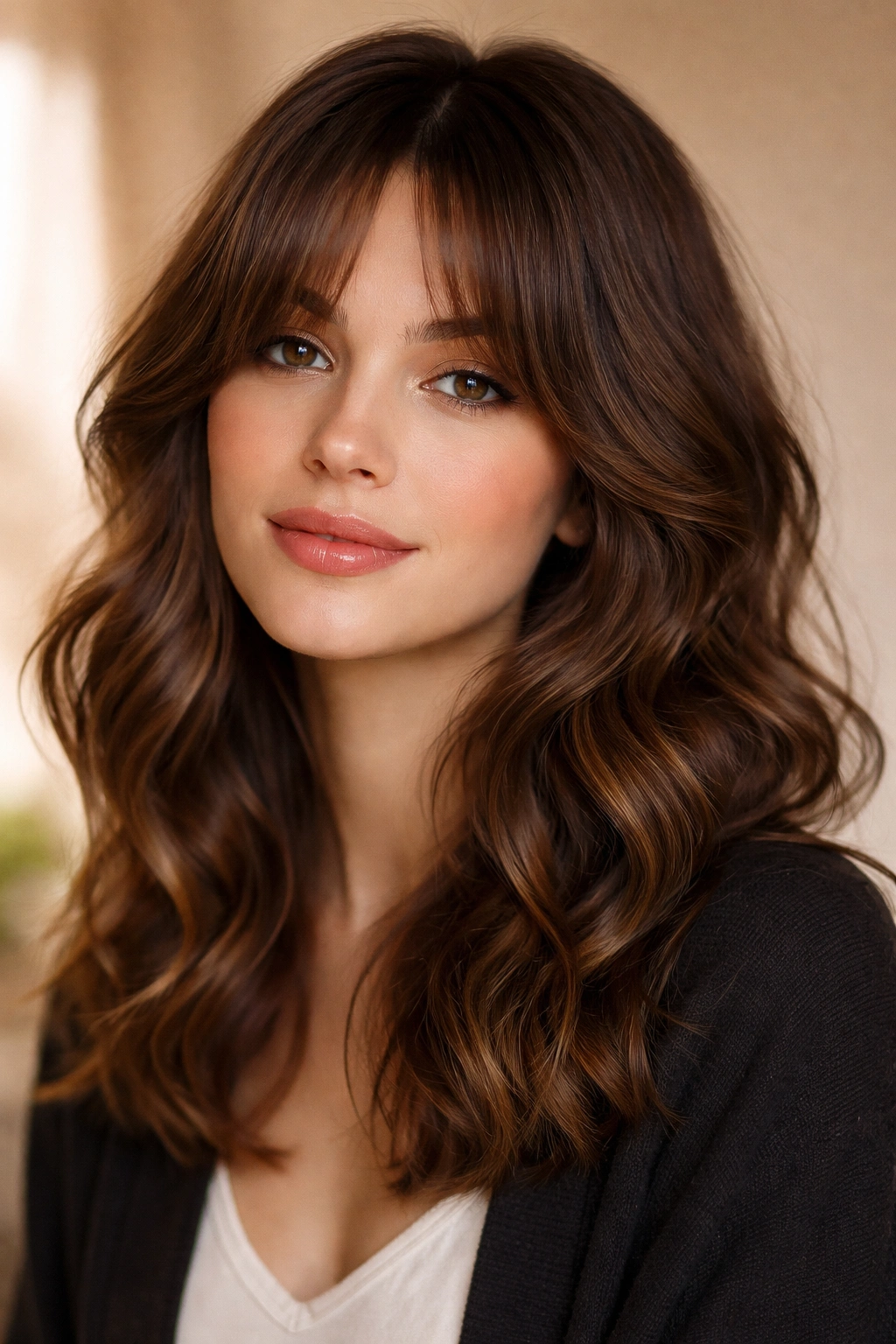
If you want the curtain bang look but prefer something softer and less structured, face-framing waves are your answer. This style combines curtain bangs that are slightly longer and less blunt than traditional versions, with gentle waves that specifically frame the face and neck. The bangs themselves have more length, so they sit closer to your eyebrows when your waves are fully set, creating a softer overall impression while still giving you that face-framing effect you want.
The Softness Factor
Soft doesn’t mean less shaped or less intentional—it means the cut itself uses rounded, blended lines rather than sharp angles and disconnected pieces. Your stylist is working with your natural wave pattern to enhance it, rather than cutting against it. The face-framing layers start closer to your ears and curve gently around your face, creating a subtle frame that flatters most face shapes. When combined with softer, longer curtain bangs, this approach gives you something that feels gentle and romantic rather than edgy or trendy.
Styling for Softness
- Blow-dry with a round brush or your fingers to encourage waves to curve gently inward around the face
- Use a curling iron or wand loosely on the face-framing pieces to ensure they curve toward your face rather than away from it
- Apply a smoothing serum or lightweight oil to bangs and face-framing layers to reduce frizz while maintaining movement
- Don’t scrunch or squeeze your waves aggressively—instead, cup them gently in your hands while damp to encourage soft, flowing movement
- Let your curtain bangs fall naturally; resisting the urge to tousle them keeps them looking polished and soft rather than deliberately messy
Insider note: Soft face-framing works especially well if you have a longer or more angular face shape, because the curves around your face add width and softness where you need it most.
5. Curtain Bangs With Choppy, Disconnected Layers
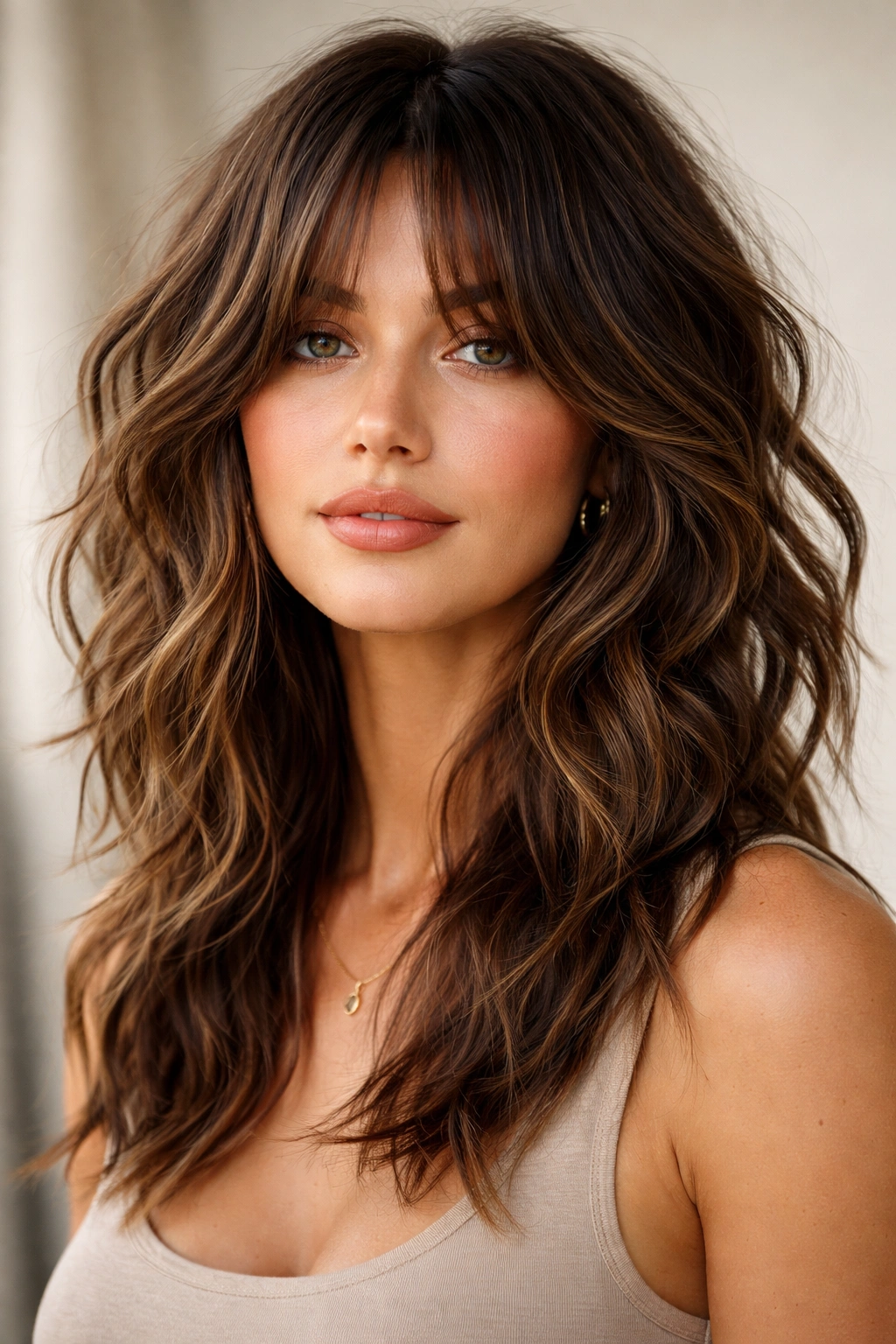
For those who want something with serious texture and movement, choppy disconnected layers are the ticket. This style combines curtain bangs—still soft and face-framing—with purposefully choppy, jagged layers throughout the entire head. The layers don’t blend smoothly; instead, they create distinct lines and separation that make your wavy or curly hair look even more textured and dynamic. This is the choice for people who want their hair to look intentionally styled rather than gently enhanced.
The Choppy Advantage
Choppy layers work because they embrace the natural chaos of wavy and curly hair rather than trying to smooth it over. When you have short, disconnected layers throughout, every single wave and curl becomes more visible and defined. You lose some length in the process (shorter layers obviously sit higher), but you gain incredible texture, movement, and visual interest. Your hair looks fuller because individual pieces are shorter and creating volume at different heights rather than all moving as one longer mass.
Styling Choppy Layers
- Enhance your natural wave or curl pattern with a defining product (cream, gel, or mousse) applied to damp hair
- Blow-dry with a diffuser to emphasize texture without creating frizz
- Once dry, use your fingers to separate and tousle the choppy pieces, deliberately highlighting the disconnection
- A texturizing spray applied after styling helps pieces stay separated and defined throughout the day
- The more “undone” the styling, the better this cut looks—polish is the enemy here; go for deliberately messy
Real talk: Choppy layers require commitment to styling. Unlike blended layers that can look acceptable even with minimal effort, choppy pieces actually need some attention to look intentional rather than accident-prone. If you’re looking for a true wash-and-go style, this isn’t it.
6. Blunt Curtain Bangs With Curly Texture
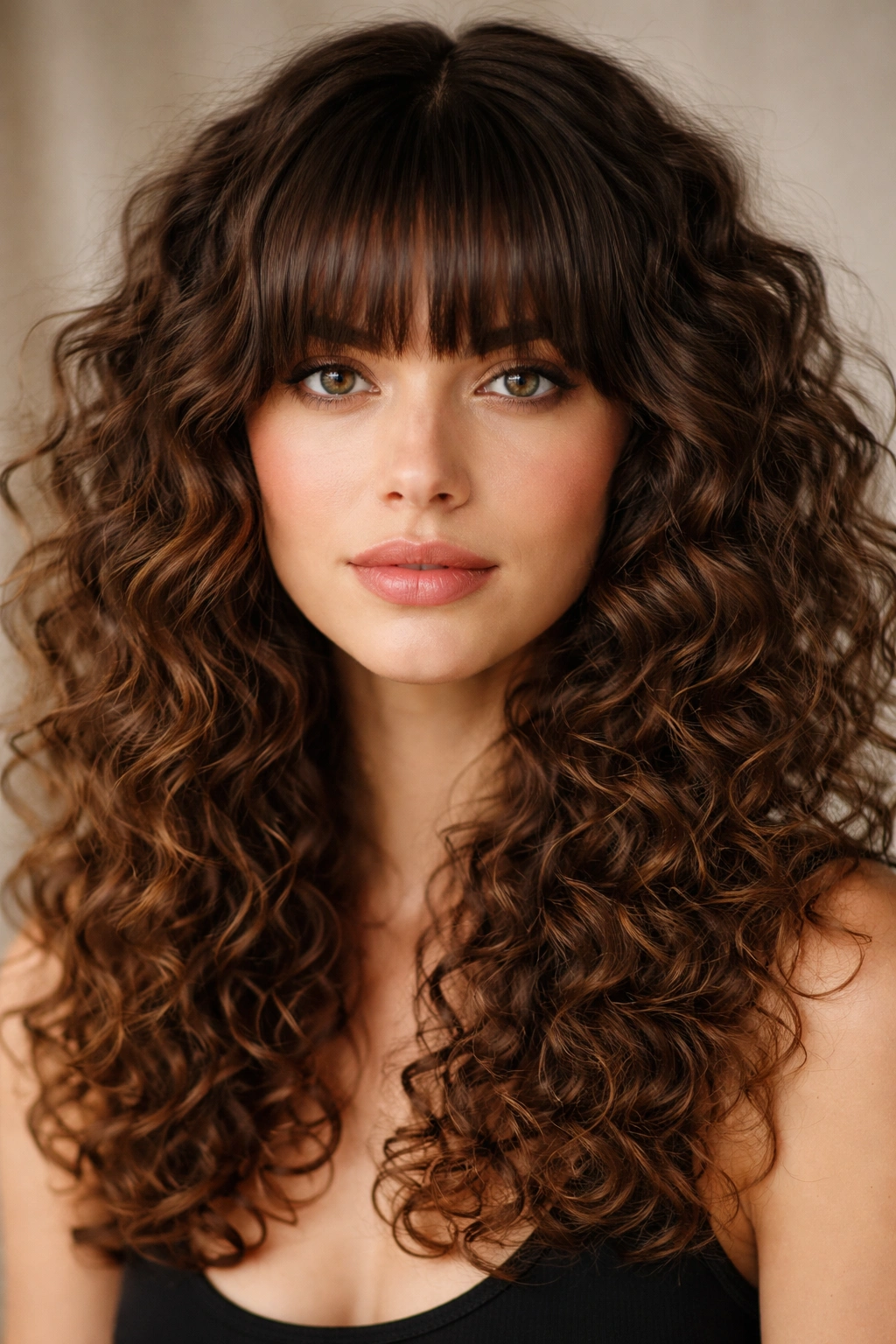
For those with true curly hair (not just waves, but actual spirals and coils), blunt curtain bangs can work beautifully if they’re cut correctly and styled with intention. Blunt means the bangs are cut straight across with minimal texture, so when your curls frame your face, the blunt edge of the bangs creates a sharp, modern contrast with your texture. This style works best if your curls are relatively consistent in size and you’re committed to keeping your curls well-hydrated and defined.
Why Blunt Works for Curls
Blunt curtain bangs create a striking visual frame for curly hair because the sharp line contrasts beautifully with the round, dimensional quality of curls. When your curls are well-defined and bouncy, the blunt edge becomes even more obvious and stylish. The key is that your curls need to be healthy and hydrated—dry, frizzy curls will undermine the intentional sharpness of blunt bangs. But when everything is working in harmony, you get a look that’s polished, modern, and totally intentional.
Maintaining Blunt Bangs on Curls
- Curl-specific products are essential—use a curl-defining cream or gel applied to soaking wet hair
- Section your bangs separately when styling; apply product directly to the roots and smooth downward
- Diffuse dry on low heat to set your curl pattern without disrupting the blunt bang shape
- Once fully dry, your bangs will curl along with the rest of your hair, which is okay—the blunt edge will still be visible
- Trim every 4-6 weeks to maintain the blunt line, as curly hair grows and the line becomes less defined over time
Worth knowing: Blunt bangs on curly hair are less forgiving than softer options. If you don’t keep up with trims or if your curls are inconsistently defined, the style can look less polished. This is a commitment, not a low-maintenance choice.
7. Curtain Bangs With Long, Beachy Waves
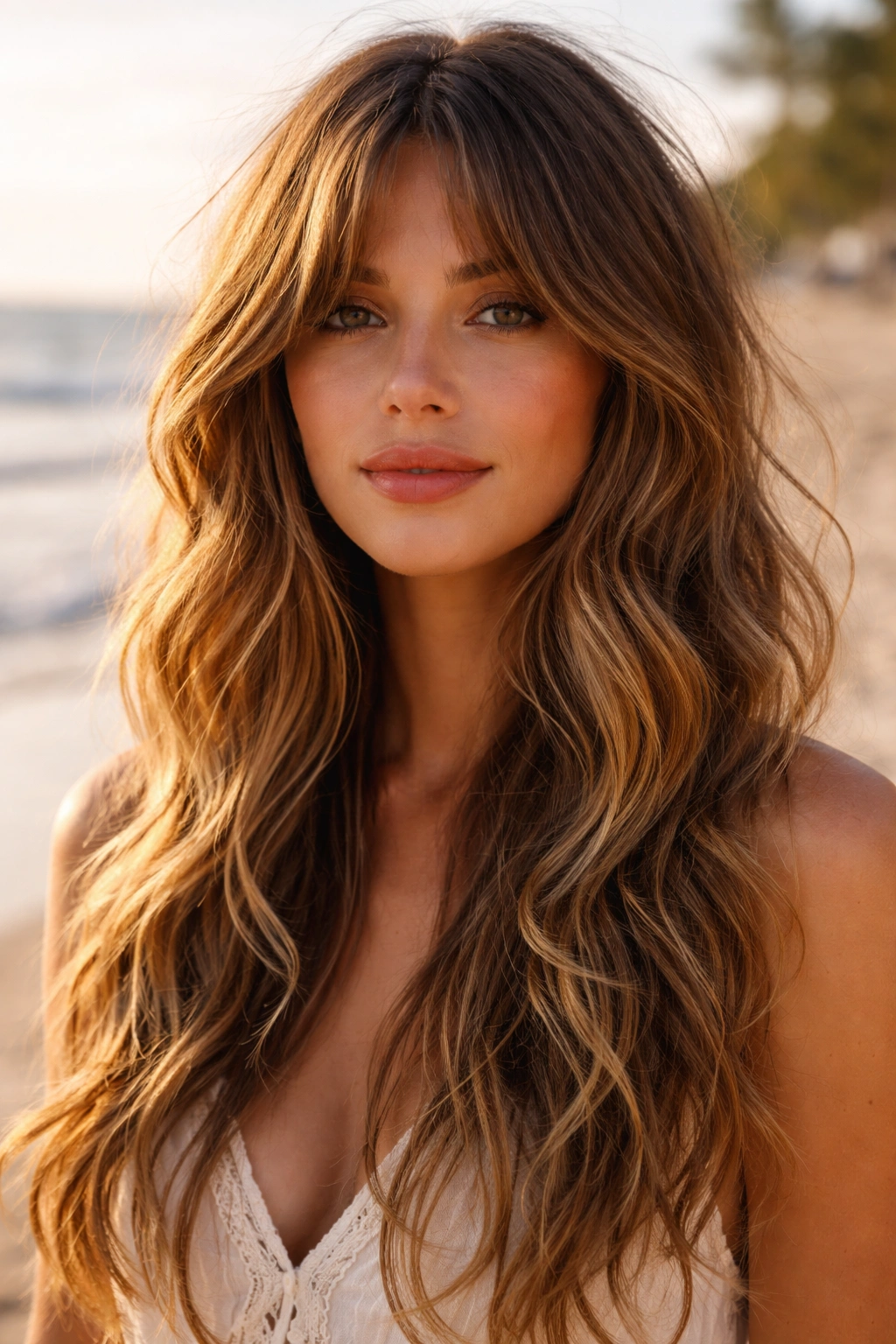
The beachy wave aesthetic pairs perfectly with curtain bangs because both elements embrace movement, texture, and a carefree attitude. This style features longer curtain bangs that fall past your eyebrows, paired with medium-length hair that’s been styled into loose, flowing waves. The emphasis is on movement and flow rather than precise structure; the goal is to look like you just came from the beach, even if the only water your hair has touched is your shower.
Creating the Beachy Effect
Beachy waves require either your natural wave pattern or intentional styling with tools and products. If you have natural waves, you’re halfway there already—beachy styling just enhances and encourages them. If your hair is straighter, you’ll need to use a curling iron, wand, or braiding method to create the wave pattern. Either way, the goal is waves that are relaxed and imperfect, not tight or uniform. Longer curtain bangs work beautifully because they wave right along with the rest of your hair, creating soft movement around your face.
Styling Beachy Waves
- Apply a texturizing spray or sea salt spray to damp hair for instant texture and hold
- Blow-dry with your fingers to encourage natural waves, or curl sections with a wand for more intentional waves
- Once dry, scrunch your hair gently to break up the waves and create a more relaxed, beachy texture
- Use a lightweight oil or serum on ends to enhance shine without weighing down your waves
- Resist the urge to brush or comb once dry—finger-combing only, to maintain wave definition
- Re-activate waves with a spritz of sea salt spray and gentle scrunching on day two or three
Pro tip: The longer your curtain bangs are, the more they need that beachy texture to look good. Very blunt, straight bangs would look out of place in a beachy aesthetic, but long, textured, wavy bangs are perfect.
8. Shoulder-Length Curtain Bangs With Spiral Curls
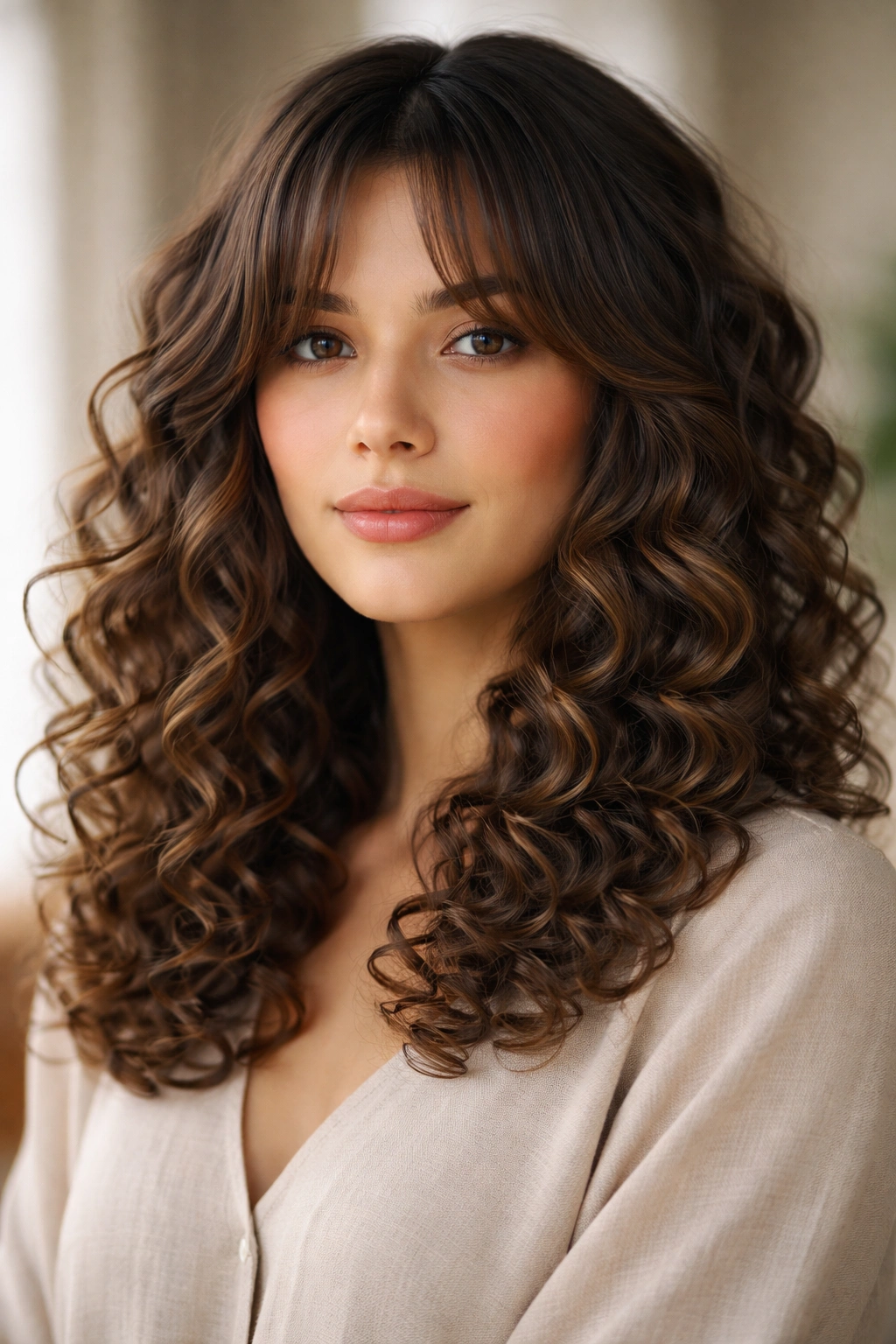
For curlies with defined spiral or coil patterns, shoulder-length hair with curtain bangs and intentional spiral styling is absolutely show-stopping. The bangs frame your face while your spirals cascade down, creating a striking combination of face-framing detail and full-bodied texture. This style celebrates the specific beauty of tightly coiled curls by creating lots of movement and dimension through strategic cutting and intentional styling.
The Spiral Advantage
Spiral curls have natural body and bounce that looser waves simply don’t have. When you cut curtain bangs that frame a face full of spirals, you’re creating contrast and focus—your face gets attention because the curls around it are bouncy and dimensional. Medium to shoulder-length curls are ideal for this style because they’re long enough to show off individual spirals, but short enough to look shaped rather than unkempt. The curtain bangs add sophistication and intentionality without disrupting the spirals’ natural movement.
Styling Defined Spirals
- Use a curl-specific, leave-in conditioner as your base product applied to soaking wet hair
- Add a curl-defining gel or cream on top of the leave-in, scrunching upward to encourage spirals to form
- Diffuse dry on low to medium heat, or air-dry if you have time, scrunching occasionally to enhance spiral formation
- Once dry, gently separate spirals with your fingers or a pick to create more definition and dimension
- Avoid brushing or combing; instead, use your fingers to separate and fluff curls
- Maintain spirals with pineapple-method overnight care and regular deep-conditioning treatments
Insider note: Spiral curls look best when they’re well-hydrated and bouncy. Dry curls lose their springiness and look more like texture than defined spirals, so investing in excellent hydrating products is essential for this style.
9. Feathered Curtain Bangs With Tousled Waves
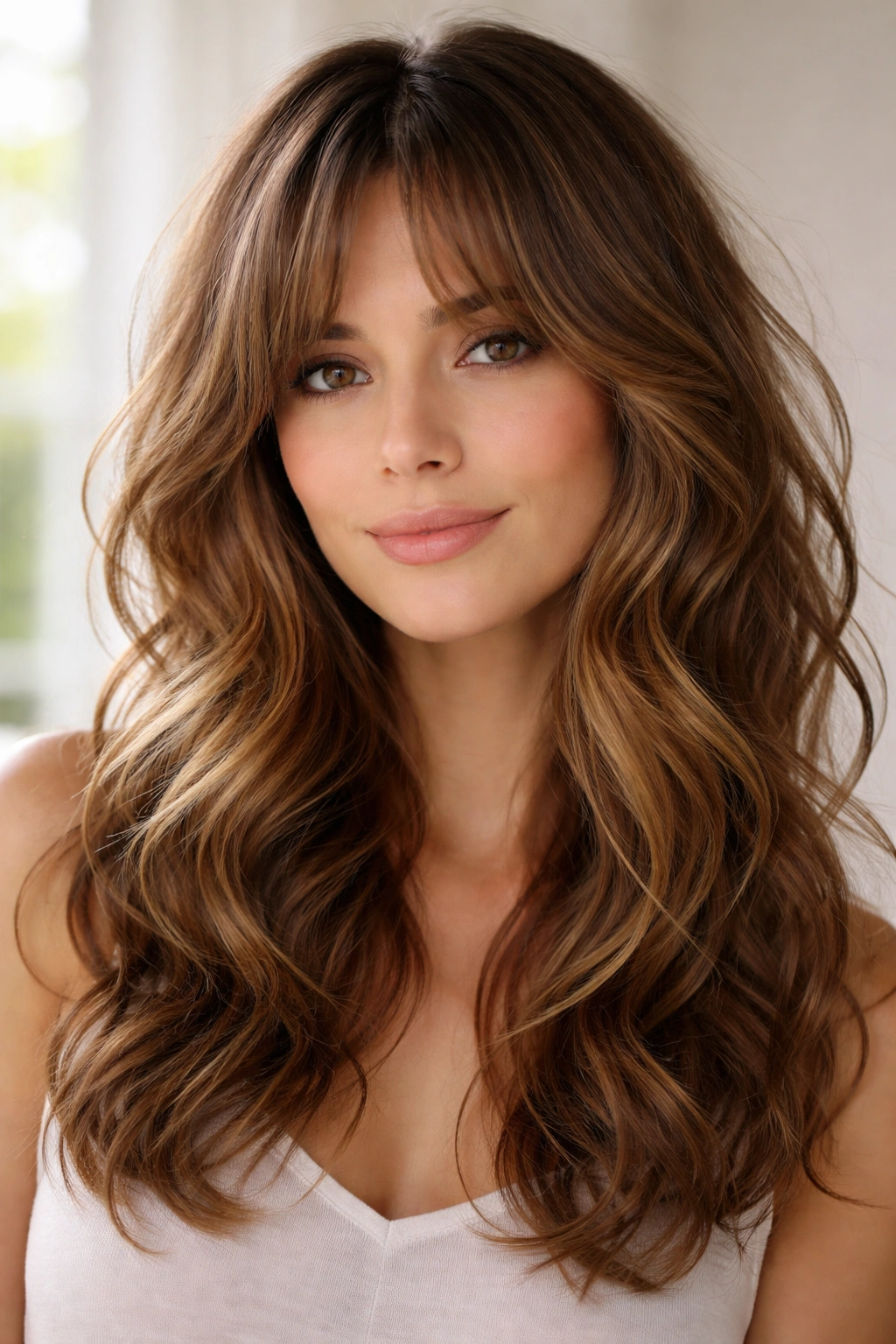
Feathering is a cutting technique that creates soft, wispy layers with movement and a lived-in aesthetic. When feathered bangs are combined with tousled waves on medium-length hair, you get something that looks effortlessly cool and textured. Feathered edges mean your bangs aren’t blunt or thick—instead, they’re light and airy, with individual pieces that move independently. This works beautifully with waves because everything moves together in a cohesive, soft, undone way.
The Feathering Technique
Feathering means your stylist is creating soft, tapered edges throughout your bangs and potentially throughout your layers too. Instead of cutting straight across, they’re using scissors or a razor to create pointed, wispy edges that feel lighter and airier. When you have feathered bangs paired with tousled waves throughout your hair, nothing looks heavy or blunt. Instead, everything looks soft, intentional, and like you’re not trying too hard—which is the whole point.
Styling Feathered Texture
- Feathered bangs require less styling effort than thicker cuts because they’re already textured
- Blow-dry gently with your fingers or a round brush to encourage waves while maintaining the feathered shape
- Use a texturizing spray on bangs specifically to enhance the feathered appearance
- Tousle and separate your waves with fingers rather than brushes to maintain the intentional undone look
- The goal is movement and texture, not polish or precision—embrace the lived-in aesthetic
- Feathered styles look better with some texture throughout your hair, not with slicked-back sections
Worth knowing: Feathered bangs require trims more frequently (every 4-6 weeks) because the fine, tapered edges become choppy faster than blunt cuts do. But the ease of styling makes it worthwhile.
10. Curtain Bangs With Shaggy, Textured Layers
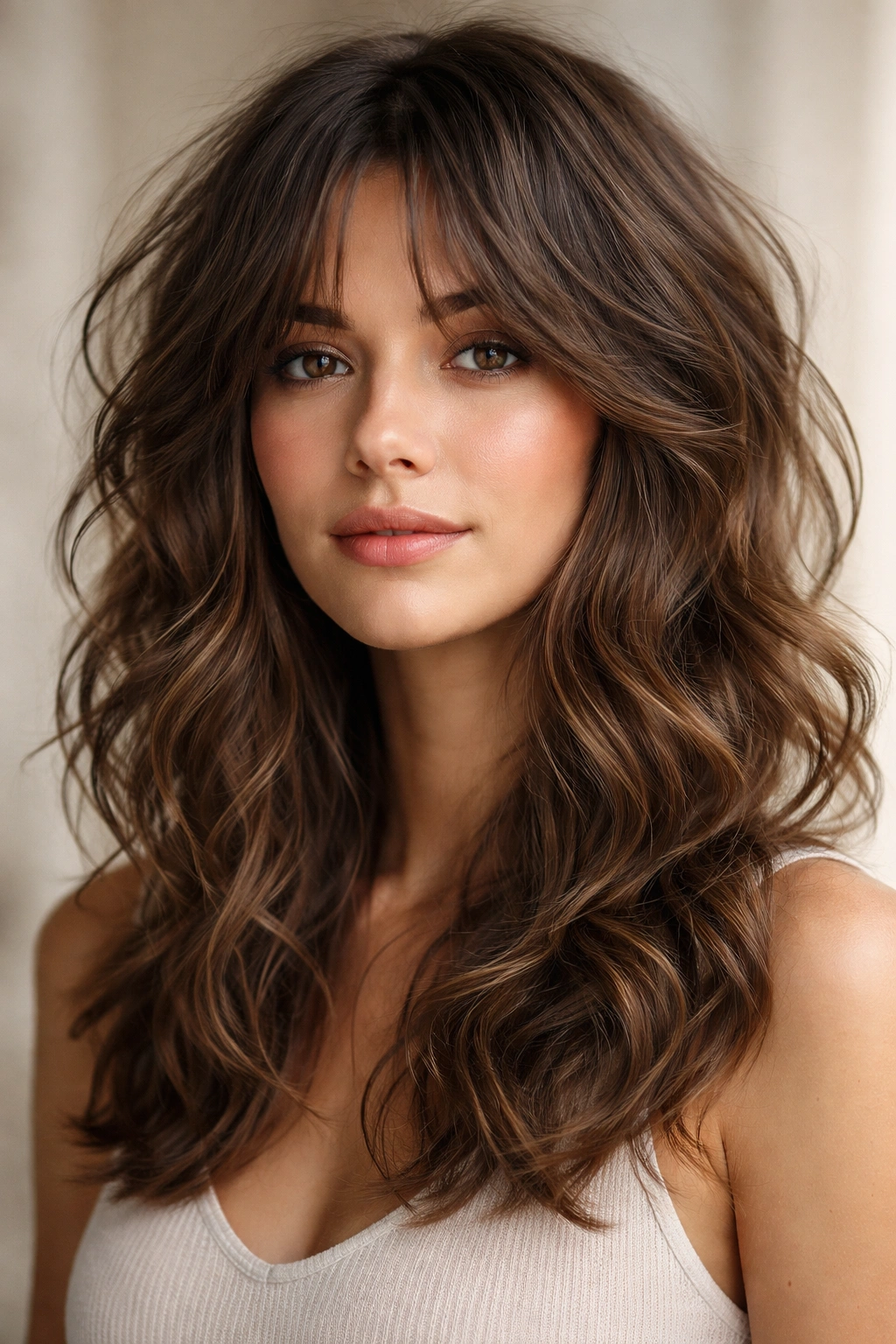
The shag is back, and when done right on wavy or curly hair, it’s an absolute winner. This style features curtain bangs combined with multiple layers of varying lengths throughout, creating that signature shag silhouette—shorter at the crown with progressively longer layers toward the back and ends. On wavy or curly hair, shag layers create incredible texture, movement, and volume because each layer moves independently. It’s vintage-inspired but feels completely modern and cool.
Why Shag Works on Wavy Hair
Shag layers multiply texture. When you have a bunch of shorter pieces around your head, combined with medium-length longer pieces, waves and curls have room to bounce and move in all directions. The result is hair that looks thicker, fuller, and way more dimensional than it actually is. Curtain bangs tie the whole look together by framing your face and creating intentionality rather than letting the shag feel chaotic. The combination reads as “coolly styled” rather than “randomly layered.”
Styling the Modern Shag
- Define your natural wave or curl pattern with hydrating products applied to damp hair
- Blow-dry with a diffuser to encourage all your layers to dry with texture and volume
- Use your fingers to tousle and separate layers; brushing disrupts the shag silhouette
- Apply texturizing spray to add grip and encourage layers to stay defined and separated
- The shag works best when it looks slightly undone and lived-in, not perfectly sleek
- Rock the piece-y, textured aesthetic—this isn’t a style that looks good when overly polished
Real talk: Shag is a high-maintenance style in terms of regular trims (every 4-6 weeks to keep layers sharp and defined), but low-maintenance in terms of daily styling. You’re paying in chair time rather than styling time, which is a trade-off many people love.
Final Thoughts
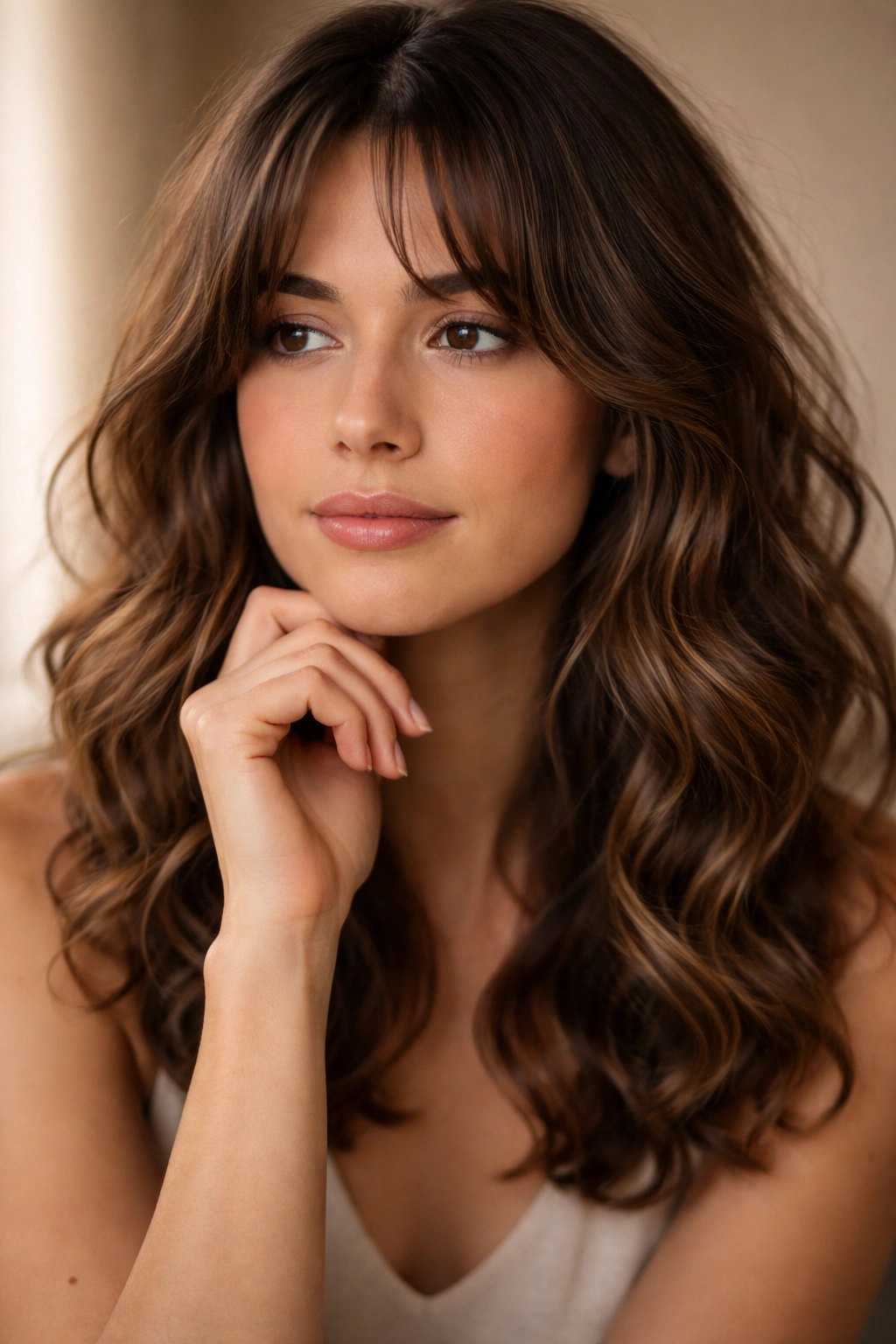
Curtain bangs genuinely transform wavy and curly hair because they work with your natural texture instead of demanding that you flatten or fight it. Whether you’re drawn to soft, romantic face-framing waves or you want something choppy and textured that celebrates your curls, there’s a curtain bang style that fits your aesthetic and your lifestyle.
The key to making any of these styles work is finding a stylist who understands curly and wavy hair—someone who knows how your texture behaves when wet versus dry, how layers interact with waves, and why certain cutting techniques matter more for textured hair than for straight hair. Bring photos of styles you love, and be specific about what you’re looking for: if you want soft and romantic, say that; if you want textured and choppy, don’t let your stylist talk you into blending.
Once you’ve got the cut, styling these styles takes practice but not necessarily an hour of effort. Most wavy and curly curtain bang styles look better when they’re not over-styled, so lean into the texture you already have, invest in products that enhance your natural pattern, and trust that your hair knows how to do this. After a few rounds of styling, you’ll find your groove, and your new curtain bangs will feel like the best hair decision you’ve ever made.
