



Wavy hair has a natural texture that’s absolutely ideal for half-up styles — there’s something about those soft waves that makes this look feel effortlessly put-together. The half-up half-down format strikes that perfect balance: you get the polished, intentional feel of a styled updo without the commitment of putting all your hair up, and the waves flowing down your back add serious dimension and texture to the finished look. Whether you’re heading to a casual coffee date, a wedding, or just a regular Tuesday that deserves better than a messy bun, a half-up style can elevate your entire appearance in about five minutes flat.
The beauty of wearing wavy hair in a half-up half-down ponytail is that the texture does half the work for you. Those natural waves catch light differently than straight hair, they photograph beautifully, and they give you an inherent sense of movement and softness that makes even simple styles feel deliberate and polished. The trick is choosing a half-up style that actually complements your wave pattern and hair thickness — some styles work better with tighter waves, others shine with loose, flowing texture.
Real talk: if you’ve been sticking with the same basic half-up look for months, it’s time to branch out. The variations available go way beyond a simple twist or basic ponytail, and most of them take barely any longer to create than what you’re probably already doing. Let’s explore twelve distinct half-up ponytail styles that will make your wavy hair look intentional, beautiful, and absolutely on-trend.
1. The Soft Twisted Half-Up Ponytail
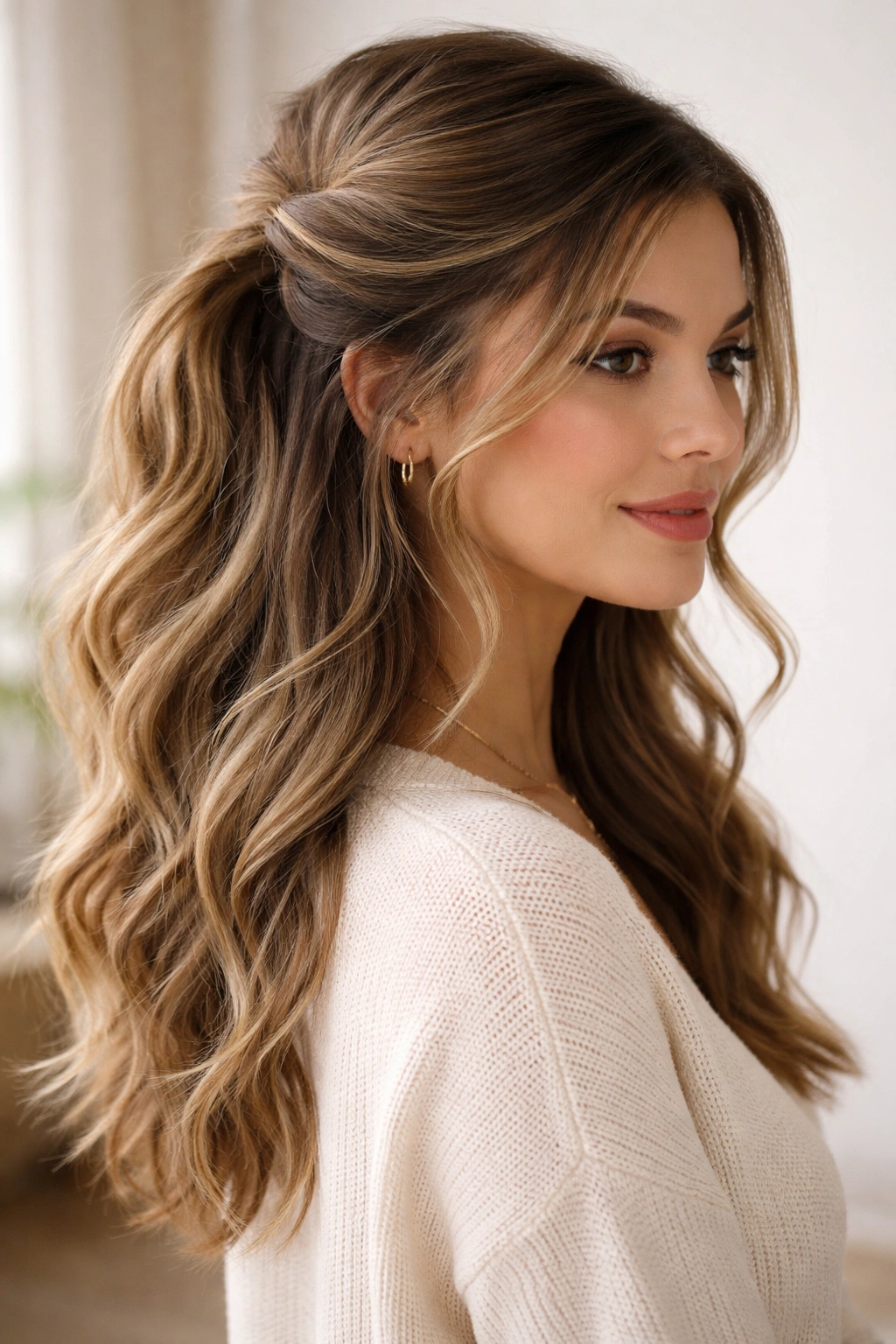
This is the everyday workhorse of half-up styles, and it’s exactly what you should reach for when you want something polished but not overly fussy. The soft twist creates dimension and visual interest while staying completely practical for real life. It works beautifully on wavy hair because the waves add texture that makes the twist appear fuller and more intentional than it might on straighter hair.
Why This Style Suits Wavy Hair
A soft twist naturally accommodates the existing wave pattern in your hair without fighting it or requiring heat styling to flatten sections. The loose, relaxed feel of this style means your waves blend seamlessly with the twisted sections, creating a cohesive, intentional look rather than an obvious contrast between textured sections and smooth twists. It’s forgiving enough that imperfect waves actually add to the charm rather than making the style look undone.
How to Create Your Own
- Section your hair by taking a line from one ear, across the back of your head, to the other ear — this creates the separation between your top half and bottom half
- Using your fingers or a fine-tooth comb, gently brush the top section backward, starting from your hairline
- Take a one-inch section from one side of your face and begin twisting it loosely away from your face as you move backward toward the crown
- As you twist, gradually incorporate small sections of hair from the surrounding area, building the twist larger as you go
- When you reach the back of your head, continue twisting loosely until you’ve incorporated about half the top section of hair
- Secure the twist at the back of your head with a bobby pin tucked underneath the twist so it’s invisible from above
- Gather all your hair into a ponytail at the base of where your twist ends, securing it with an elastic
- Pull gently on the edges of your twist to loosen it slightly and create a softer, fuller appearance
Pro tip: Mist your twist lightly with a texture spray before securing it — this helps the twist hold its shape throughout the day while maintaining that soft, relaxed vibe.
2. The Double Twisted Half-Up Ponytail
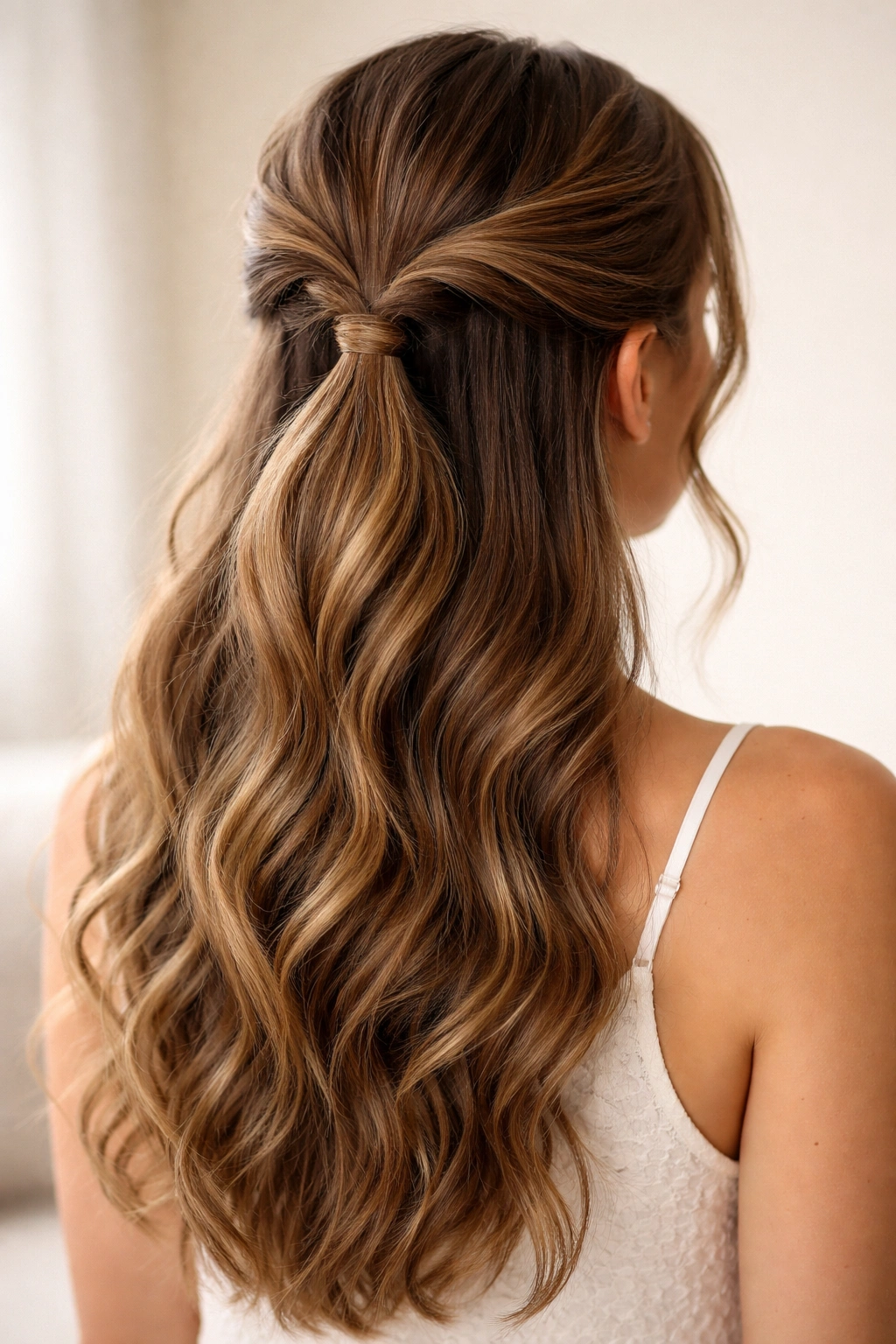
Two twists are exponentially more interesting than one, and they create a romantic, intricate look that actually takes only a few minutes longer than the single-twist version. With wavy hair, two twists offer built-in symmetry and a sophisticated appearance that people will assume took serious effort.
The Visual Impact of Double Twists
Two matching twists frame your face and create a balanced, intentional aesthetic that reads as more polished than a single twist. The symmetry tricks the eye into perceiving your style as more complicated and deliberately crafted than it actually is. On wavy hair, each twist sits slightly differently based on your wave pattern, which creates organic texture variation rather than a too-perfect, wig-like appearance.
Step-by-Step Technique
- Establish your half-up line by creating an invisible line from ear to ear across the back of your head
- Take a thin section from the right side of your face near your temple and begin twisting it loosely backward
- Build the twist by gradually incorporating small sections of hair as you twist toward the back of your head
- Stop when you’re about halfway to the crown, then secure this first twist with a bobby pin
- Repeat the exact same process on the left side of your head
- Gather both twists together at the back of your head along with the rest of your top-section hair
- Secure everything with an elastic, positioning it where both twists meet for a seamless transition
- Gently loosen both twists by pulling on their edges to create a softer, fuller aesthetic
Worth knowing: Using matching elastics at the base of your twists before you combine them into the main ponytail creates a layered, multi-dimensional look — it’s a small detail that makes a noticeable difference.
3. The Braided Half-Up Ponytail
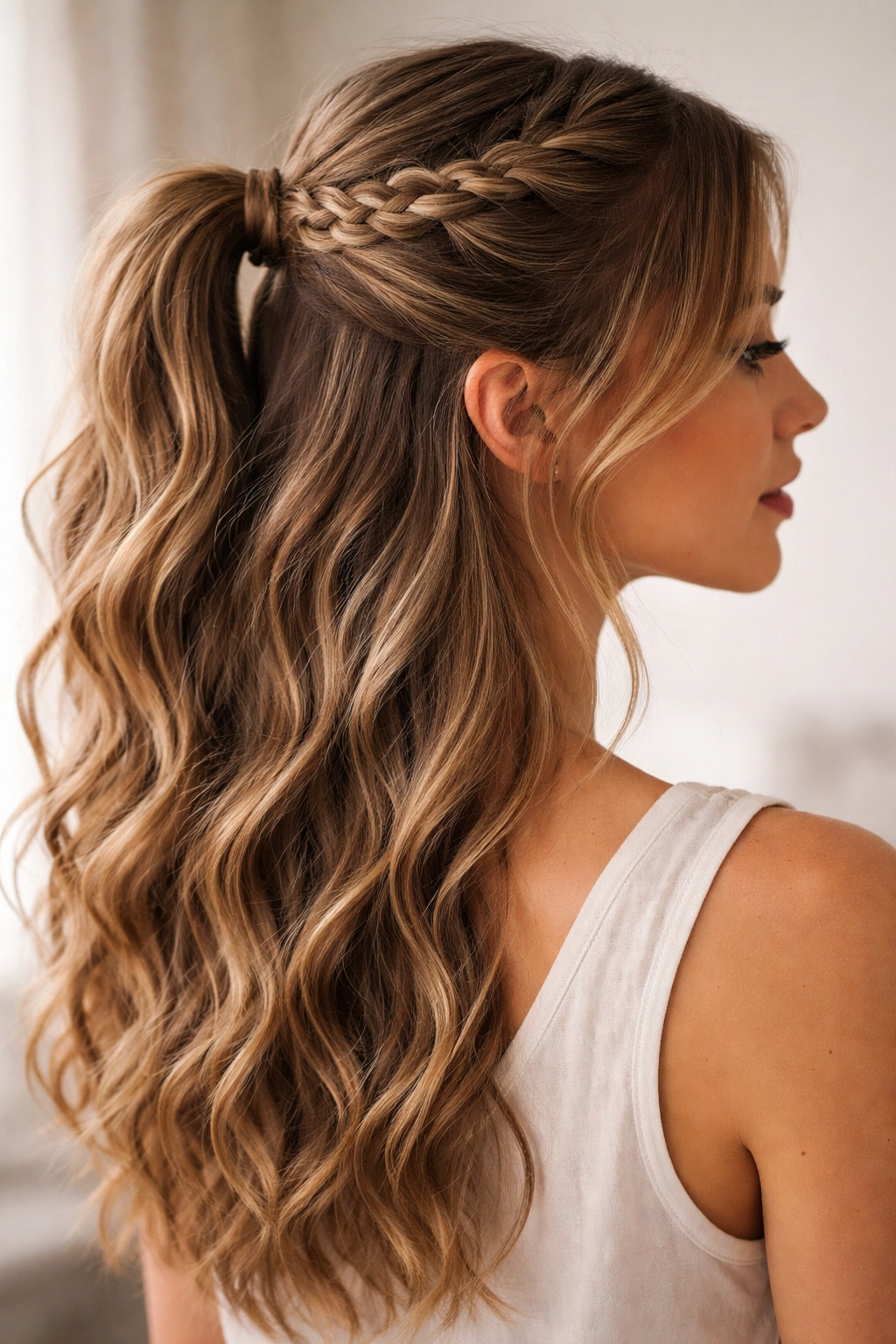
A braid adds texture and visual interest that even wavy hair appreciates, and the braid actually helps organize your waves rather than fighting against them. This style walks the line between casual and dressy, making it adaptable for morning coffee, work, or an evening out.
How a Braid Enhances Wave Texture
A braid naturally breaks up the visual pattern of your waves and creates a focal point at the back of your head. The braided section pulls your eye upward, emphasizing your face and features while the waves flowing beneath add softness. On wavy hair specifically, a braid integrates seamlessly because the wave pattern within the braid sections reads as intentional texture rather than flyaways or frizz.
Creating a Perfect Half-Up Braid
- Determine your half-up line and section off the top portion of your hair
- Starting at one temple, create a three-strand braid by taking a small section, dividing it into three pieces, and crossing the right piece over the center, then the left piece over the center, alternating continuously
- As you braid, gradually add small sections of hair from your scalp — this is called a Dutch braid and it sits slightly raised from your head
- Continue braiding toward the back of your head, adding hair as you go
- When you’ve braided about halfway across the back of your head, secure the end of your braid with a small elastic
- Repeat the braiding process starting from the other temple, creating a matching braid that ends at approximately the same spot
- Gather both braids along with all the remaining top-section hair into a ponytail at the base of your braids
- Secure with an elastic and gently loosen the braids by pulling on their sides
Quick tip: For a softer, more romantic look, loosen your braids significantly before creating your ponytail — messy, loose braids photograph beautifully on wavy hair.
4. The Sleek High Half-Ponytail
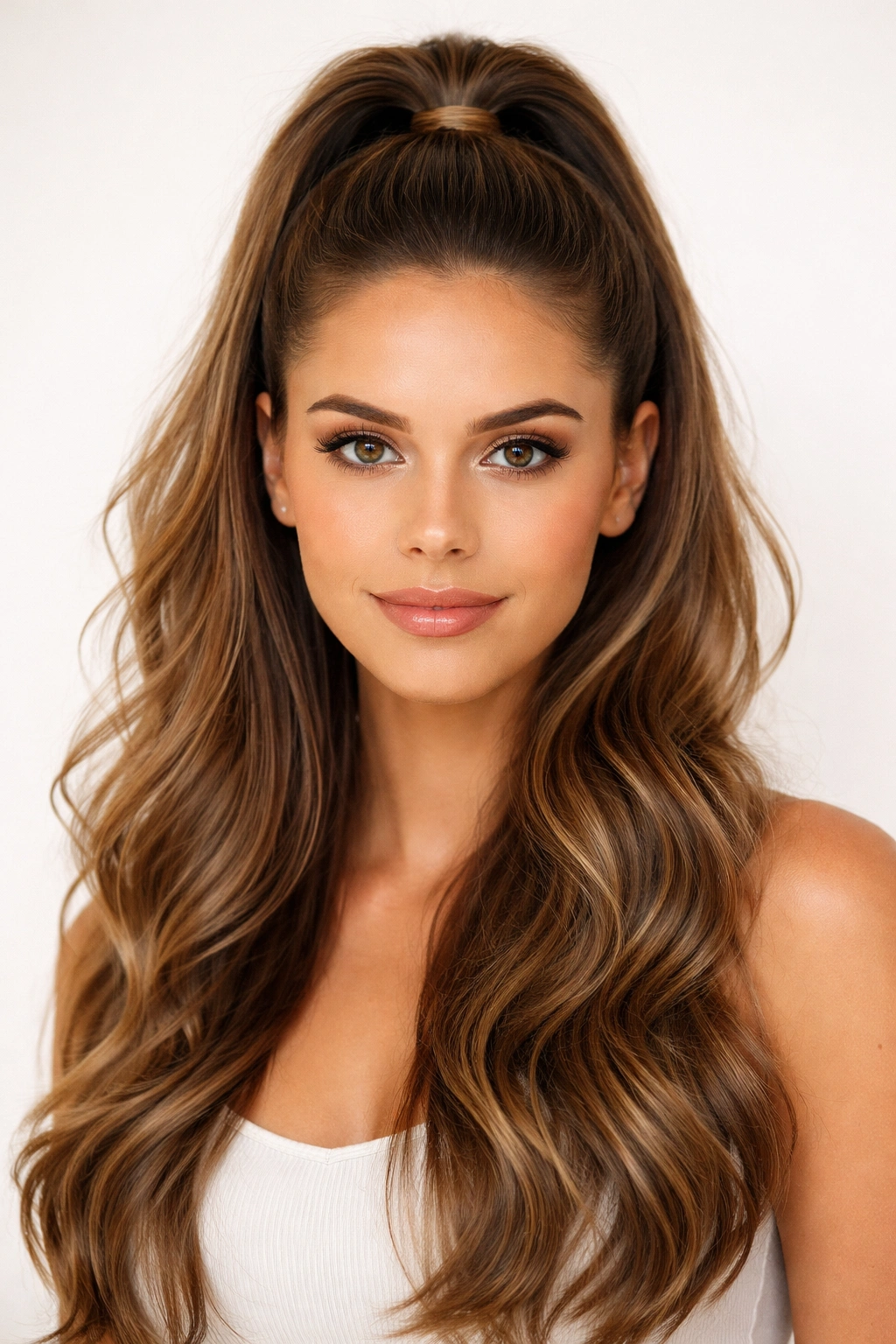
When you want your wavy hair to feel elevated and polished rather than casual, a sleek high half-up ponytail delivers. This version keeps the softness of a half-up style while presenting a more refined, put-together aesthetic. It’s ideal for work, date nights, or anytime you want your waves to feel intentional rather than effortless.
Achieving That Polished Sleekness
The contrast between sleek, tamed hair at the top and natural waves at the bottom creates a visually interesting balance. This works especially well on wavy hair because the softness of your waves in the lower half provides a counterpoint to the intentionality of the controlled upper half. The sleekness signals effort and intention, while the waves maintain your hair’s natural beauty.
Styling Technique for Maximum Sleekness
- Start with slightly damp or damp hair — this gives you better control than completely dry hair
- Apply a smoothing cream or lightweight serum to the top section of your hair, focusing on any pieces that tend to frizz or wave
- Using a fine-tooth comb or brush, smooth your hair back firmly, starting from your hairline
- Brush the top section backward toward the crown, maintaining tension as you brush
- Gather your smoothed top section into a ponytail positioned fairly high on your head — this height creates a more refined appearance than a lower ponytail
- Secure your ponytail tightly with an elastic, taking care to keep all pieces smooth
- Use a smoothing serum on any flyaways and smooth them into the sleek ponytail with a small brush
- Allow your ponytail to catch your waves, creating a visual transition from sleekness to texture
Insider note: Applying your smoothing product to slightly damp hair and blow-drying briefly helps lock in the sleek effect for hours longer than styling on completely dry hair.
5. The Textured Top Half-Up Ponytail
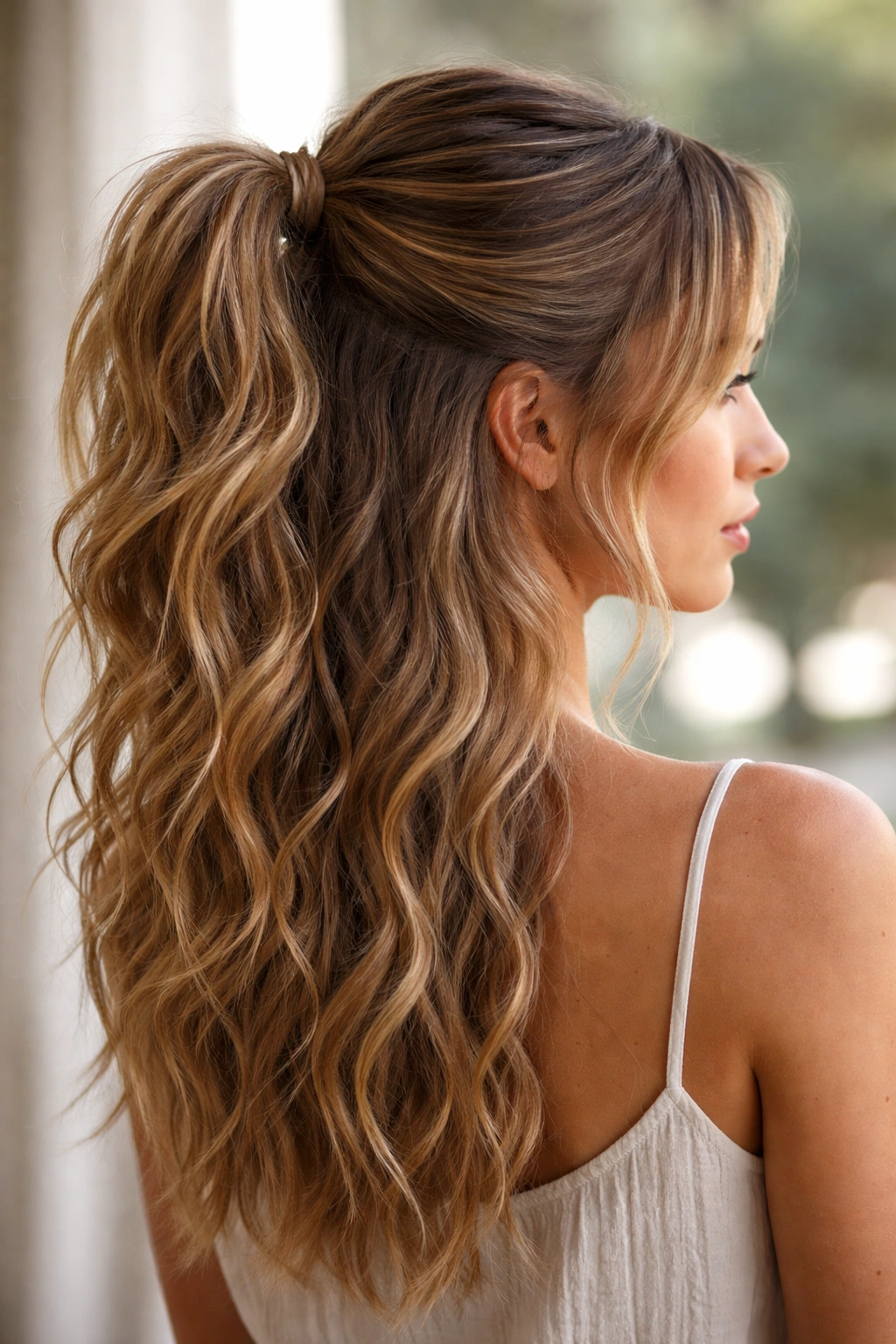
If you’re obsessed with your waves and want to showcase them even in your styled look, a textured half-up ponytail puts them front and center. Rather than smoothing or taming the top section, you enhance and celebrate your natural texture, creating a style that looks like it took minimal effort while actually being quite intentional.
Embracing Your Wave Pattern
This style works beautifully on wavy hair because it leans into rather than fighting your hair’s natural texture. The contrast between the slightly roughed-up top section and the organized ponytail below creates visual interest and dimensionality. Your waves become a design element rather than something to manage or control.
Building Intentional Texture
- Start with hair that has natural texture — either air-dried waves or waves enhanced with a texture spray
- Gently flip your hair upside down and apply a texture spray or sea salt spray to the roots of your top-section hair
- Flip back upright and use your fingers to tousle the top section gently, breaking up the wave pattern slightly
- Apply the same texture spray throughout the top section, focusing on mids and ends
- Using your fingers rather than a brush, gather the top section of hair backward and slightly upward
- Secure into a ponytail, leaving a few pieces loose around your face for softness
- Gently tousle the ponytail and the section above it to enhance texture and create movement
Pro tip: This style looks fresher if you don’t fully brush or comb the top section — use your fingers to gather it loosely, which maintains the texture you’ve created while still organizing the hair.
6. The Romantic Pulled-Back Half-Up Ponytail
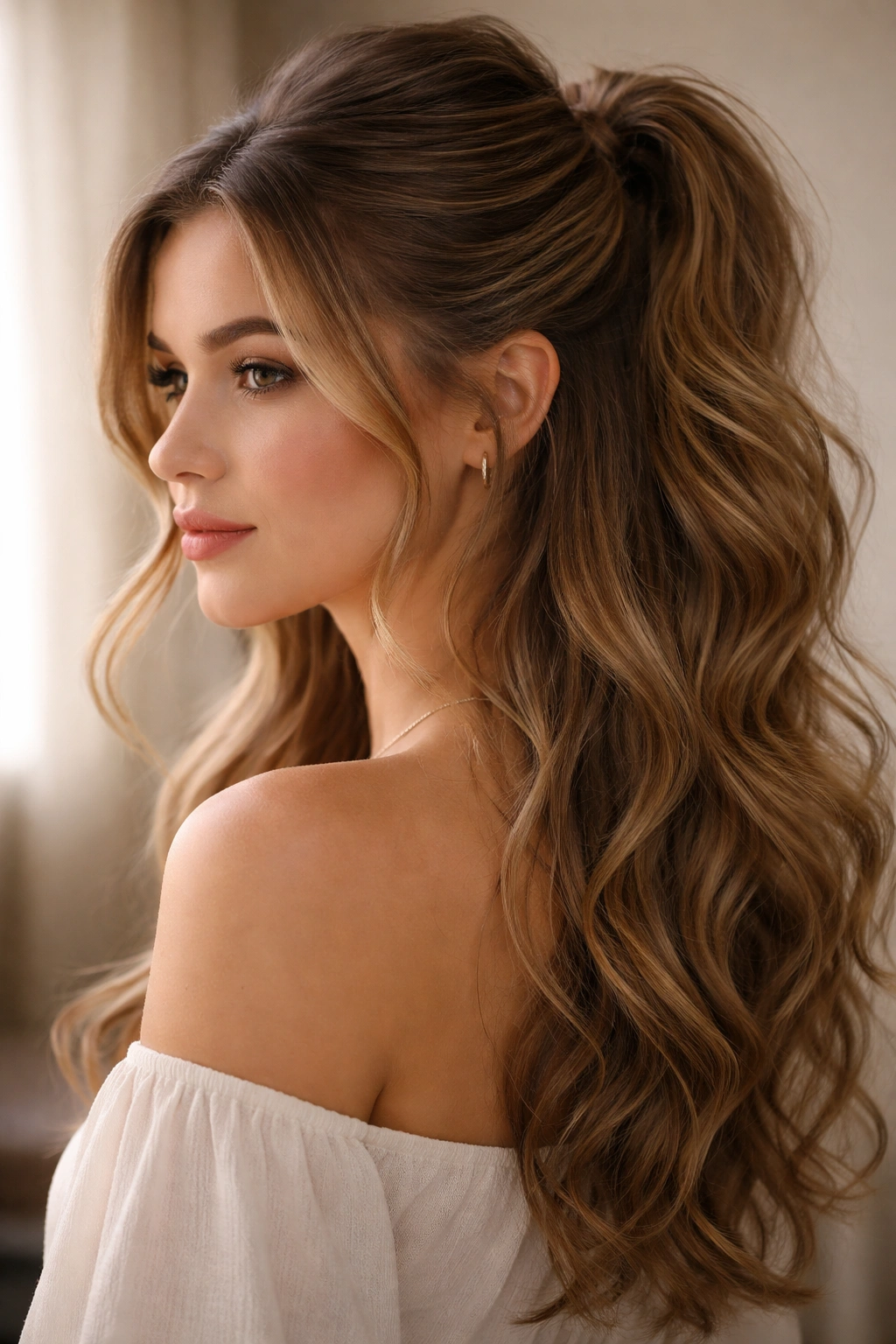
For occasions when you want your look to feel genuinely romantic and feminine — think date night, special events, or anytime you want to feel your absolute best — a softly pulled-back half-up ponytail creates a dreamy aesthetic. This version prioritizes soft lines and gentle organization rather than sleekness or drama.
Why Wavy Hair Excels at Romantic Styling
Waves naturally photograph as romantic and soft, and when you organize them gently rather than severely, you amplify that feeling. The key to romantic styling on wavy hair is avoiding anything too tight or structured — instead, every element should feel intentional but effortless. Your waves provide the texture foundation; you’re just organizing them in a way that enhances their natural beauty.
Creating Romantic Softness
- Start with waves that have been gently air-dried or created with a curling wand — you want natural-looking, soft waves, not tight curls
- Take a small section from one side of your face and loosely pull it backward, securing it temporarily with a small clip
- Do the same on the other side, creating two soft sections that frame your face
- Gather these two sections at the back of your head along with any hair that naturally falls into your hand when you bring your hands together at the crown
- Secure this loose ponytail with an elastic
- Leave several soft waves loose around your face and shoulders, allowing them to frame your features
- Gently pull on the secured sections above your ponytail to loosen them and create softness
- Optional: Take a small section of hair from your ponytail and wrap it around the base of your elastic, securing the wrap with a bobby pin for a polished finish
Worth knowing: The softer your starting waves, the more romantic your final style will appear — it’s worth taking a few extra minutes to create beautiful waves before building your ponytail.
7. The Voluminous Crown Half-Up Ponytail
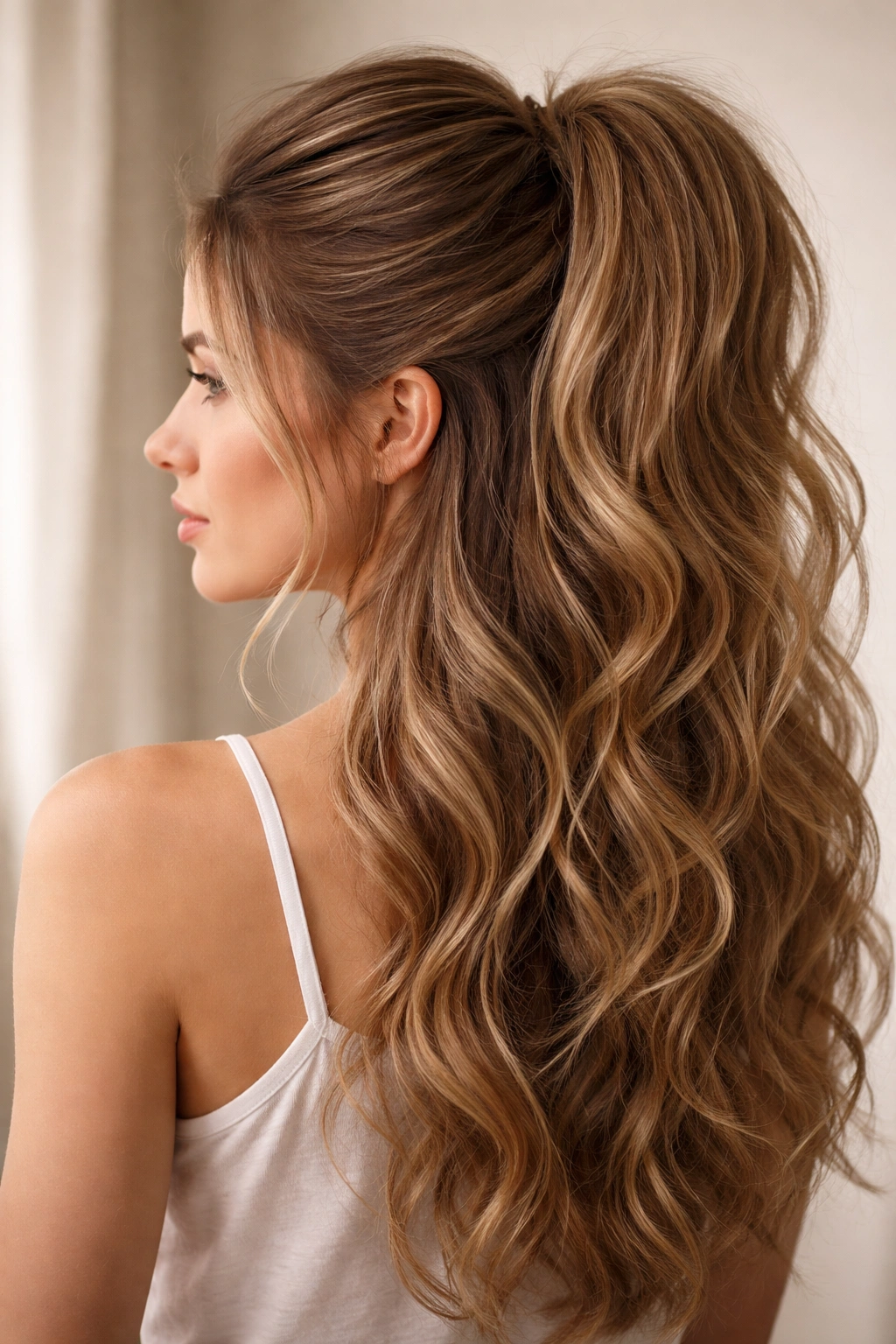
When you want your style to feel high-impact and dramatic while still keeping half your hair down, a voluminous crown half-up ponytail delivers serious presence. This version builds lift and fullness at the crown, creating a style that photographs beautifully and makes a genuine statement.
Creating Crown Volume on Wavy Hair
Volume at the crown is particularly effective on wavy hair because your waves already provide texture that catches light. By adding intentional lift through backcombing or styling techniques, you create a style that reads as glamorous and intentional. The waves flowing beneath the voluminous crown section add softness that prevents the style from feeling severe or overly dramatic.
Technique for Genuine Volume
- Apply a volumizing mousse or spray to the roots of your top-section hair while it’s damp, distributing it evenly throughout
- Blow-dry your top section using a round brush, directing air upward at the roots to create lift
- Once dry, use a fine-tooth comb to gently backcomb the top section at the crown area, creating texture and grip
- Smooth the outer layer of your backcombed section to create a polished appearance over the texture
- Gather your top section gently, allowing the backcombed section to maintain its lift and fullness
- Secure your ponytail at the point where your crown naturally peaks, positioning it to frame your voluminous section
- Using your fingers, gently tousle the section above your ponytail to enhance volume and create movement
Quick fact: Backcombing creates texture that holds a ponytail more securely while simultaneously building volume — it serves both function and aesthetics.
8. The Side-Swept Half-Up Ponytail
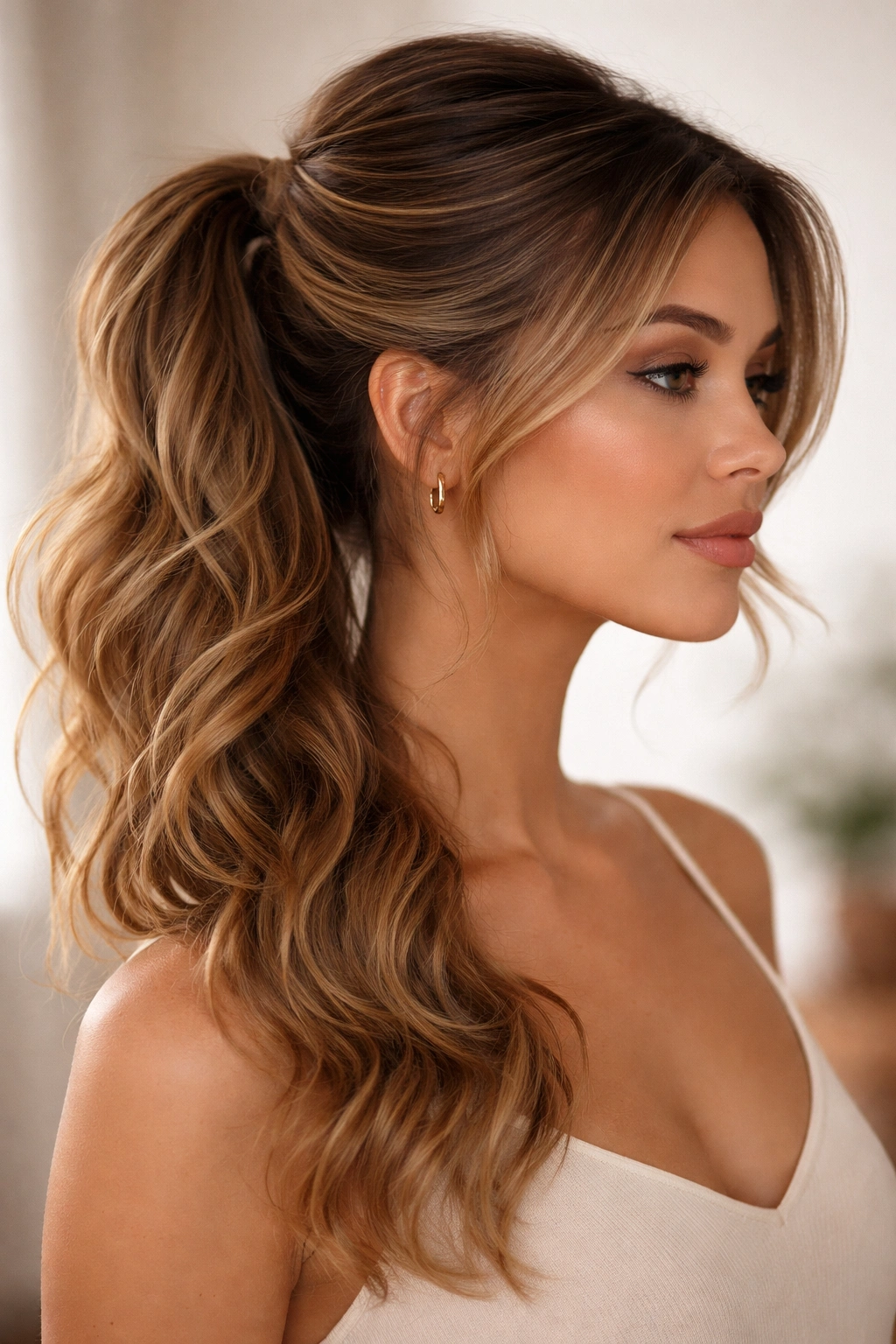
For a look that feels fresh and slightly unexpected, a side-swept half-up ponytail redirects your ponytail to one side rather than positioning it at the back center. This asymmetrical approach creates visual interest and works particularly well when you want one side of your face emphasized or when you’re simply ready for something different.
The Asymmetrical Appeal
A side-swept ponytail creates movement and visual interest that a centered ponytail doesn’t — your eye moves across the style rather than going straight up the center. On wavy hair, this asymmetry works beautifully because your waves flow naturally over one shoulder, creating an organic, intentional appearance. The side-sweep also shows off your waves in profile, which is especially flattering if you love how your waves look from the side.
Executing the Side Sweep
- Create your half-up line as usual, taking the top section and brushing it back gently from your face
- Instead of gathering your ponytail at the back center of your head, position your hands to one side — generally the side that frames your face less
- Gather your half-up section to the side, positioning your ponytail approximately two to three inches to the side of center
- Secure with an elastic, making sure your ponytail sits far enough to the side to create clear asymmetry
- Allow the waves from your lower section to cascade over the opposite shoulder, creating a natural flow
- Optional: Tease slightly above your ponytail on the back of your head for added volume and dimension
- Smooth any flyaways and allow your waves to flow naturally
Pro tip: This style looks best when your side ponytail is positioned noticeably to one side — a subtle side sweep often just looks like an accident rather than intentional styling.
9. The Bubble Ponytail Half-Up Hybrid
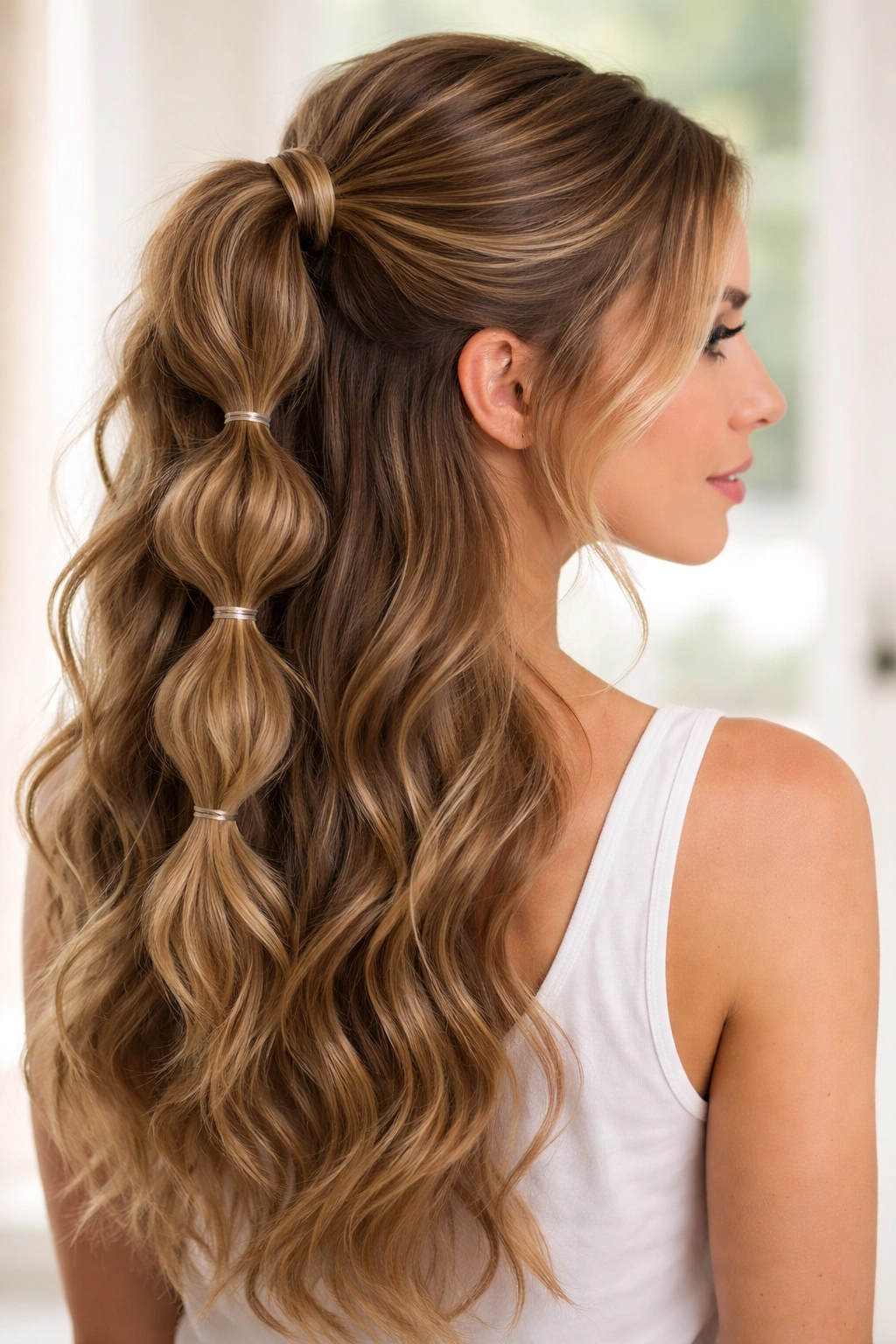
A bubble ponytail — where you create multiple small sections secured with distinct elastics along the length of your hair — becomes absolutely stunning when adapted to a half-up style. This playful, modern approach adds visual interest and dimension while remaining surprisingly easy to execute.
Why Bubbles Work on Wavy Hair
Bubble ponytails create natural breaking points that enhance your wave pattern rather than fighting it. Each bubble section catches light separately, creating multiple points of visual interest. On wavy hair, the bubbles add dimension and texture that photographs beautifully and catches light in ways a simple ponytail doesn’t.
Building Your Bubble Half-Up
- Create your standard half-up ponytail at the back of your head, securing with an elastic
- Starting at the base of your elastic, create the first bubble by gathering a section of hair from your ponytail approximately two inches down from your elastic
- Secure this section with another elastic, creating a bulge or bubble of hair between the two elastics
- Gently fluff and loosen this first bubble by pulling gently on the hair between the elastics
- Move down approximately two to three inches and create a second bubble using the same technique
- Continue creating bubbles down the length of your ponytail for three to four bubbles total
- Gently loosen each bubble for a softer, fuller appearance
- Allow your waves to flow naturally from between the bubbles
Worth knowing: Using clear elastics makes your bubbles look more polished and modern — colored elastics that match your hair are a close second choice.
10. The Half-Up with Decorative Pins or Clips
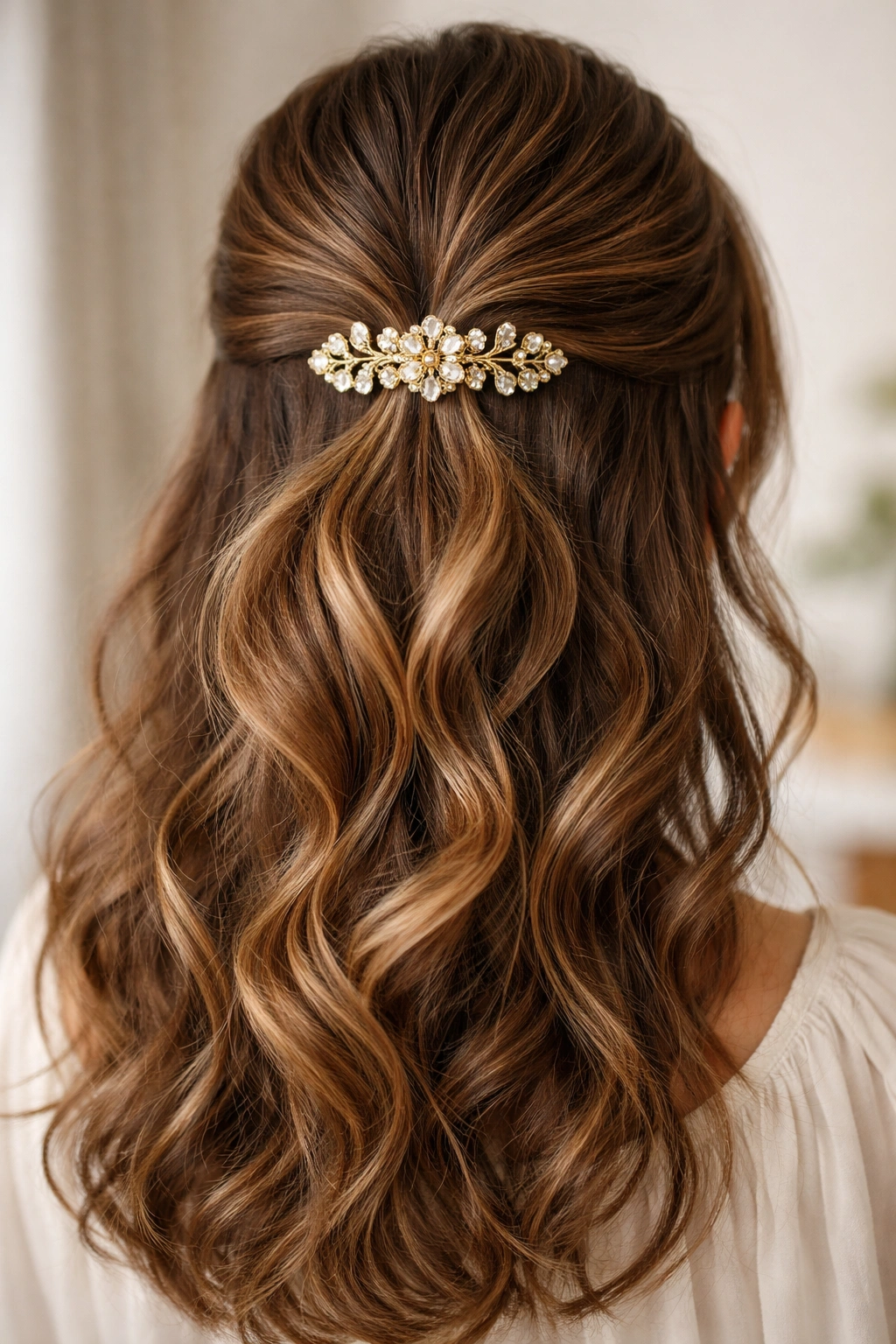
Sometimes the simplest way to elevate your half-up ponytail is through the addition of a stunning hair accessory. A decorative clip, jeweled barrette, or vintage hair pin transforms a basic half-up into something special and immediately on-trend. This approach works beautifully on wavy hair because the texture provides a lovely backdrop for showcasing an accessory.
Styling That Lets Accessories Shine
When you’re featuring a beautiful clip or pin, your styling should support the accessory rather than compete with it. This typically means keeping the overall style slightly simpler — perhaps a basic half-up ponytail or a single twist — so your accessory becomes the focal point. Wavy hair provides enough natural interest that you don’t need additional complexity.
Accessory Placement and Integration
- Create a basic half-up ponytail or simple twist as your base
- Position your decorative clip or pin at the base of your ponytail or at the point where your twist ends, securing your elastic at the same location
- The clip should cover your elastic and provide the visual anchor for your entire style
- If using a decorative pin, insert it diagonally or at an angle through your ponytail for a more intentional, polished appearance
- Allow your waves to flow naturally from beneath your accessory
- Ensure your clip or pin is positioned securely so it won’t shift throughout your day
Quick fact: Claw clips in tortoiseshell, metallic, or jeweled finishes have become incredibly popular for exactly this reason — they’re visually interesting enough to be a feature of your style, not just a functional component.
11. The Twisted Crown with Side-Fall Ponytail
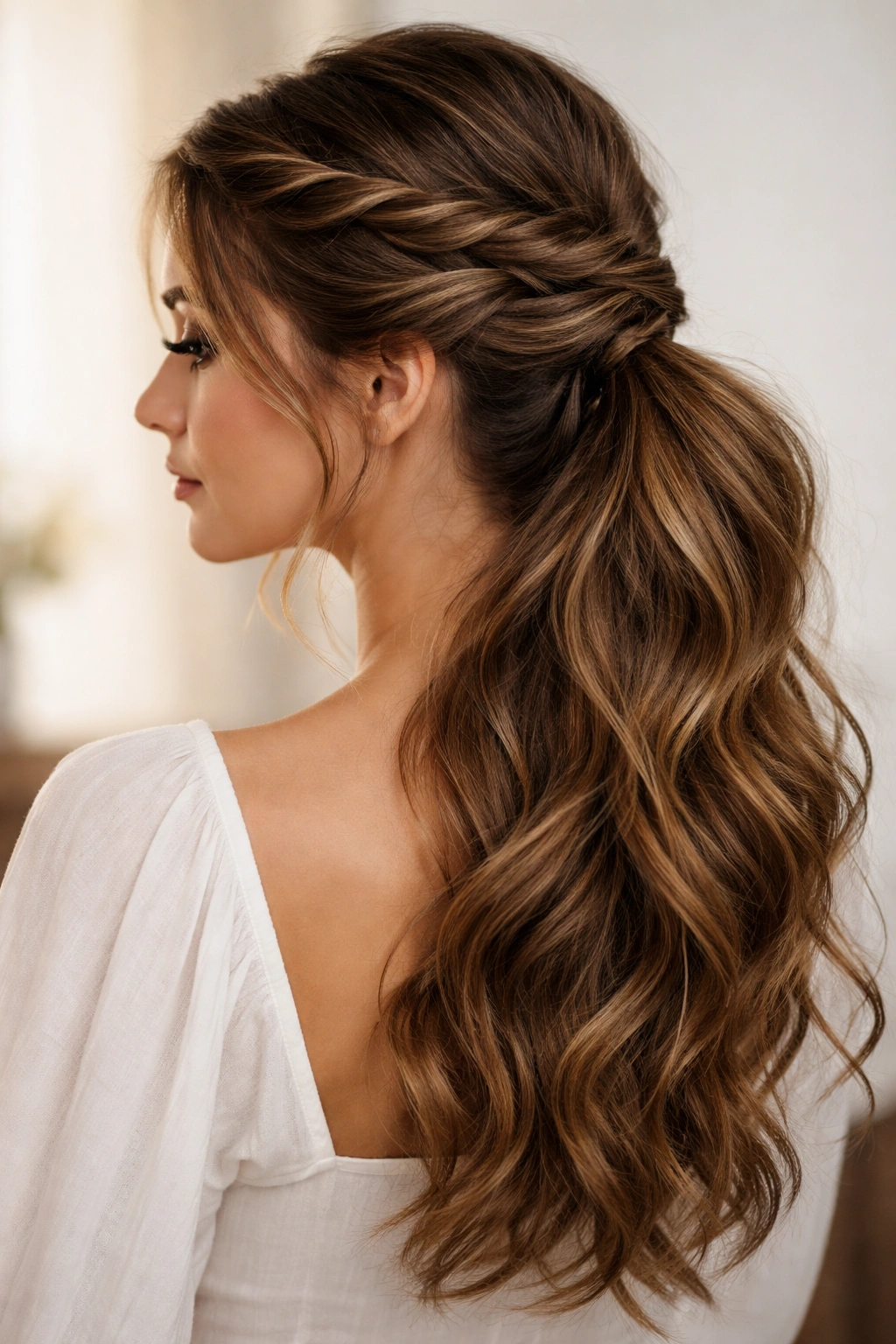
This slightly more intricate style combines elements of several other approaches: you build a twisted crown detail, then position your ponytail to the side where it allows your waves to cascade beautifully. The result feels more intentional and styled than a basic half-up while remaining achievable with basic styling tools.
The Complexity That Works
This style looks more complicated than it actually is, which is always a win for styling efforts. The combination of a twisted crown with a side ponytail creates visual interest and dimension that makes even simple wavy hair look like you’ve spent significant time on your appearance. The key is building the twist intentionally while keeping the ponytail relaxed.
Creating Sophisticated Movement
- Starting at one temple, take a thin section of hair and begin a simple two-strand twist — simply take two thin sections and twist them around each other
- As you twist toward the back of your head, gradually incorporate small sections of hair into your twist, building it larger
- Continue your twist across the back of your head, creating a soft crown detail
- When you reach approximately the center-back of your head, stop twisting and secure the end with a small bobby pin
- Take your remaining top-section hair and your twist and gather them to one side of your head
- Secure your side ponytail with an elastic positioned noticeably to one side
- Gently loosen your crown twist to create softness and fullness
- Allow your waves to cascade over the opposite shoulder
Pro tip: This style photographs beautifully from the side because the crown twist creates vertical interest while your waves add softness and movement flowing downward.
12. The Loose Gathering Half-Up Ponytail
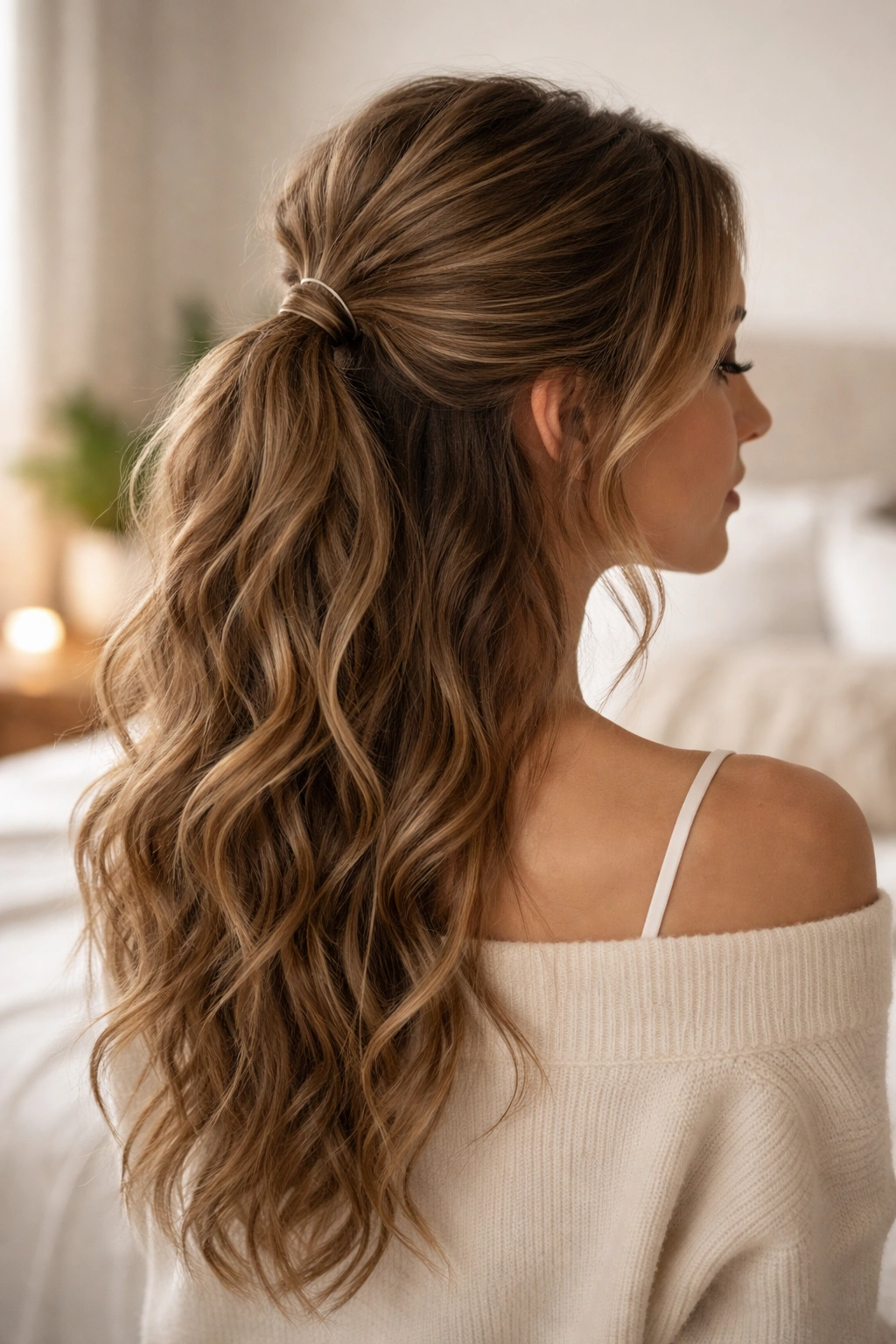
When you want something that looks effortlessly beautiful rather than obviously styled, a loose gathering half-up ponytail is your answer. This approach prioritizes a relaxed, undone aesthetic — the kind of style where it appears you simply gathered your hair without thinking much about it, even though you’ve actually been quite intentional.
The Appeal of Intentional Looseness
Wavy hair naturally lends itself to this effortless aesthetic because your waves already provide texture and visual interest. A loose gathering style plays into this, creating a look that feels authentically you rather than a formal updo. The trick is being intentional about your looseness — you’re not actually being careless; you’re being strategic about which pieces to leave down and how to organize everything in a relaxed way.
Achieving Effortless-Looking Style
- Take your top-section hair and gather it loosely at the back of your head using just your fingers, not a comb
- Position your ponytail slightly lower than a traditional half-up, somewhere between your crown and the middle of the back of your head
- Secure with a soft elastic, keeping the ponytail loose enough that a few pieces naturally fall around it
- Leave several longer pieces loose around your face and temples, allowing them to frame your features softly
- Allow any shorter pieces or baby hairs to remain naturally, contributing to the effortless feel
- Avoid tightening or flattening your style — any texture or slight messiness adds to the charm
- Optional: Mist lightly with a texture spray to enhance your waves and ensure the style holds without looking stiff
Worth knowing: This style actually holds better if you secure your elastic slightly tighter than feels right — the tightness at the base keeps everything anchored while the looseness throughout the rest of the style creates your intended aesthetic.
Final Thoughts
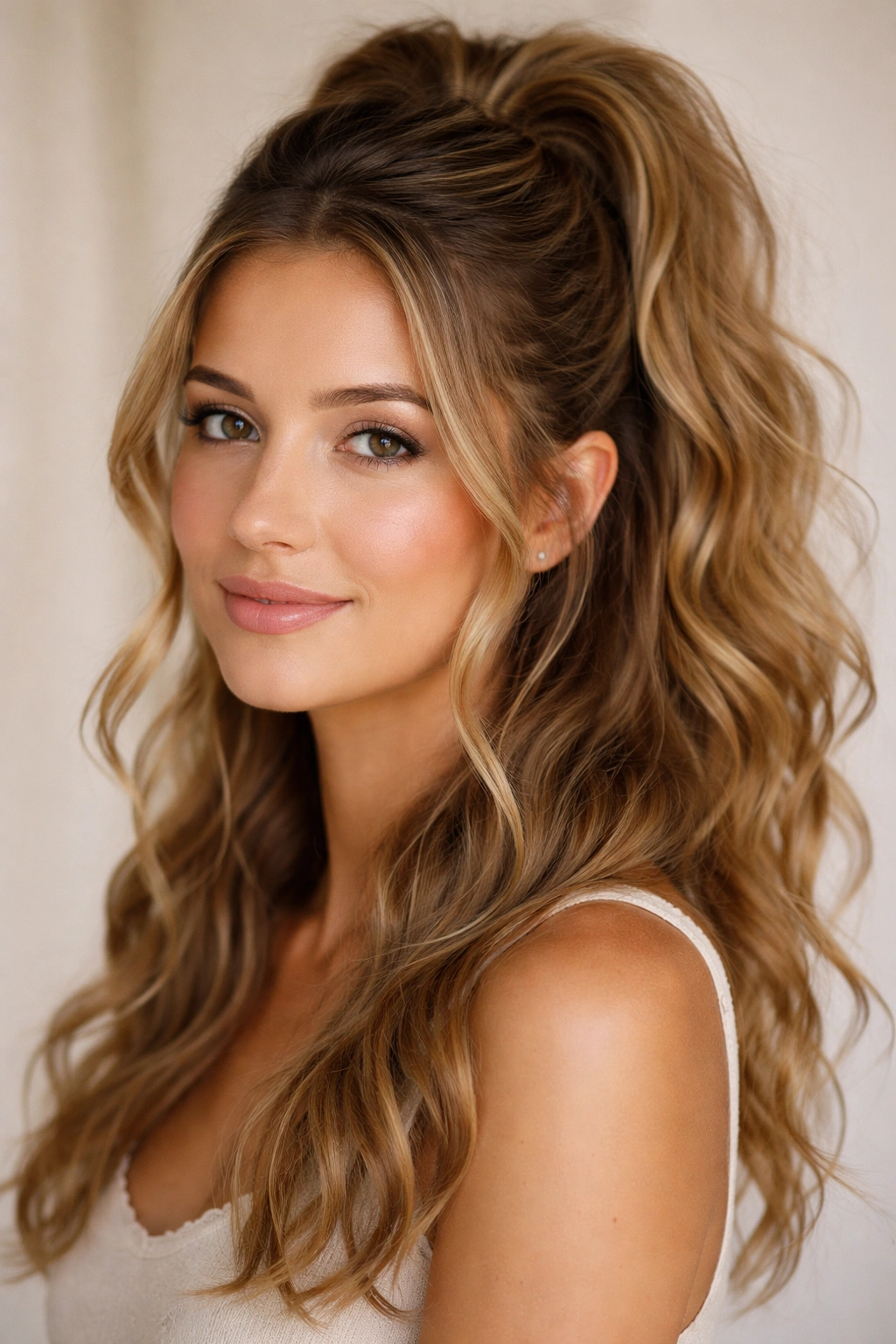
Half-up half-down ponytails offer the perfect marriage of practical and beautiful, and when you’re working with wavy hair, you’ve already got the texture to make any of these styles absolutely shine. The variations available go far beyond what most people realize — from simple twists to intricate braids, from sleek polish to romantic softness, you have options for literally every occasion and mood.
The real key to pulling off these styles is understanding that your waves are an asset, not something to fight against. The styles that work best on wavy hair aren’t the ones that try to smooth and control every wave; they’re the ones that integrate your texture into the design. Whether you’re going for drama with a voluminous crown or softness with a romantic pulled-back look, you’re working with your hair’s natural tendencies rather than against them.
Start with whichever style speaks to you most, and then spend time experimenting with the others. You’ll quickly discover which versions feel most comfortable to create, which ones photograph best, and which ones make you feel most like yourself. The beauty of having twelve different half-up approaches is that you never need to resort to the same basic ponytail twice — you’ve got real variety to play with, and your wavy hair will look stunning in every single one.
